When learning a schema that has a linked cdc schema, we need to learn
also the cdc schema, and at the end the schema should point to the
learned cdc schema.
This is needed because the linked cdc schema is used for generating cdc
mutations, and when we process the mutations later it is assumed in some
places that the mutation's schema has a schema registry entry.
We fix a scenario where we could end up with a schema that points to a
cdc schema that doesn't have a schema registry entry. This could happen
for example if the schema is loaded before it is learned, so when we
learn it we see that it already has an entry. In that case, we need to
set the cdc schema to the learned cdc schema as well, because it could
have been loaded previously with a cdc schema that was not learned.
Fixesscylladb/scylladb#27610Closesscylladb/scylladb#27704
The properties can be directly manipulated by the user
via statements like `ALTER TABLE`. To better organize
the structure of `raw_schema`, we encapsulate that data
in the form of a dedicated struct. This change will be
later used for applying multiple properties to `schema_builder`
in one go.
Add to the schema object a member that points to the CDC schema object
that is compatible with this schema, if any.

The compatible CDC schema is created and altered with its base schema in
the same group0 operation.

When generating CDC log mutations for some base mutation we want them to
be created using a compatible schema thas has a CDC column corresponding
to each base column. This change will allow us to find the right CDC
schema given a base mutation.

We also update the relevant structures in the schema registry that are
related to learning about schemas and transporting schemas across
shards or nodes.

When transporting a schema as frozen_schema, we need to transport the
frozen cdc schema as well, and set it again when unfreezing and
reconstructing the schema.

When adding a schema to the registry, we need to ensure its CDC schema
is added to the registry as well.

Currently we always set the CDC schema to nullptr and maintain the
previous behavior. We will change it in a later commit. Until then, we
mark all places where CDC schema is passed clearly so we don't forget
it.
The namespace usage in this directory is very inconsistent, with files
and classes scattered in:
* global namespace
* namespace compaction
* namespace sstables

With cases, where all three used in the same file. This code used to
live in sstables/ and some of it still retains namespace sstables as a
heritage of that time. The mismatch between the dir (future module) and
the namespace used is confusing, so finish the migration and move all
code in compaction/ to namespace compaction too.

This patch, although large, is mechanic and only the following kind of
changes are made:
* replace namespace sstable {} with namespace compaction {}
* add namespace compaction {}
* drop/add sstables::
* drop/add compaction::
* move around forward-declarations so they are in the correct namespace
  context

This refactoring revealed some awkward leftover coupling between
sstables and compaction, in sstables/sstable_set.cc, where the
make_sstable_set() methods of compaction strategies are implemented.
As requested in #22104, moved the files and fixed other includes and build system.
Moved files:
- combine.hh
- collection_mutation.hh
- collection_mutation.cc
- converting_mutation_partition_applier.hh
- converting_mutation_partition_applier.cc
- counters.hh
- counters.cc
- timestamp.hh
Fixes: #22104
This is a cleanup, no need to backport
Closesscylladb/scylladb#25085
Fixes#22106
Moves the shared compress components to sstables, and rename to
match class type.
Adjust includes, removing redundant/unneeded ones where possible.
Closesscylladb/scylladb#25103
As requested in #22102, #22103 and #22105 moved the files and fixed other includes and build system.
Moved files:
- clustering_bounds_comparator.hh
- keys.cc
- keys.hh
- clustering_interval_set.hh
- clustering_key_filter.hh
- clustering_ranges_walker.hh
- compound_compat.hh
- compound.hh
- full_position.hh
Fixes: #22102Fixes: #22103Fixes: #22105Closesscylladb/scylladb#25082
Before for views and indexes it was fetching base schema from db (and
couple other properties). This is a problem once we introduce atomic
tables and views deletion (in the following commit).
Because once we delete table it can no longer be fetched from db object,
and truncation is performed after atomically deleting all relevant
tables/views/indexes.

Now the whole relevant schema will be fetched via global_table_ptr
(table_shards) object.
When describing a table, we need to do it carefully: if some
columns were dropped, we must specify that explicitly by
```
ALTER TABLE {table} DROP {column} USING TIMESTAMP ...
```
in the result of the DESCRIBE statement. Failing to do so
could lead to data resurrection.
However, if a table has been altered many, many times,
we might end up with a huge create statement. Constructing
it could, in turn, trigger an oversized allocation.
Some tests ran into that very problem in fact.
In this commit, we want to mitigate the problem: instead of
allocating a contiguous chunk of memory for the create
statement, we use `fragmented_ostringstream` and `managed_string`
to possibly keep data scattered in memory. It makes handling
`cql3::description` less convenient in the code, but since
the struct is pretty much immediately serialized after
creating it, it's a very good trade-off.
We provide a reproducer. It consistently passes with this commit,
while having about 50% chance of failure before it (based on my
own experiments). Playing with the parameters of the test
doesn't seem to improve that chance, so let's keep it as-is.
Fixesscylladb/scylladb#24018
This commit increases the maximum length of names for keyspaces, tables, materialized views, and indexes from 48 to 192 bytes.
The previous 48-bytes limit was inherited from Cassandra 3 for compatibility. However, this validation was removed in Cassandra 4 and 5 (see CASSANDRA-20389)
and some usage scenarios (such as some feature store workflows generating long table names) now depend on this relaxed constraint.
This change brings ScyllaDB's behavior in line with modern Cassandra versions and better supports these use cases.

The new limit of 192 bytes is derived from underlying filesystem limitations to prevent runtime errors when creating directories for table data.
When a new table is created, ScyllaDB generates a directory for its SSTables. The directory name is constructed from the table name, a dash, and a 32-character UUID.
For a CDC-enabled table, an associated log table is also created, which has the suffix `_scylla_cdc_log` appended to its name.
The directory name for this log table becomes the longest possible representation.
Additionally we reserve 15 bytes for future use, allowing for potential future extensions without breaking existing schemas.
To guarantee that directory creation never fails due to exceeding filesystem name limits, the maximum name length is calculated as follows:
  255 bytes (common filesystem limit for a path component)
-  32 bytes (for the 32-character UUID string)
-   1 byte  (for the '-' separator)
-  15 bytes (for the '_scylla_cdc_log' suffix)
-  15 bytes (reserved for future use)
----------
= 192 bytes (Maximum allowed name length)
This calculation is similar in principle to the one proposed for Cassandra to fix related directory creation failures (see apache/cassandra/pull/4038).

This patch also updates/adds all associated tests to validate the new 192-byte limit.
The documentation has been updated accordingly.
This reverts commit 0b516da95b, reversing
changes made to 30199552ac. It breaks
cluster.random_failures.test_random_failures.test_random_failures
in debug mode (at least).
Fixes#24513
Before for views and indexes it was fetching base schema from db (and
couple other properties). This is a problem once we introduce atomic
tables and views deletion (in the following commit).
Because once we delete table it can no longer be fetched from db object,
and truncation is performed after atomically deleting all relevant
tables/views/indexes.

Now the whole relevant schema will be fetched via global_table_ptr
(table_shards) object.
This pull request adds support for creating custom indexes (at a metadata level) as long as a supported custom class is provided (currently only vector search).
The patch contains:
- a change in CREATE INDEX statement that allows for the USING keyword to be present as long as one of the supported classes is used
- support for describing custom indexes in the DESCRIBE statement
- unit tests
Co-authored by: @Balwancia
Closesscylladb/scylladb#23720
* github.com:scylladb/scylladb:
test/cqlpy: add custom index tests
index: support storing metadata for custom indices
Added function returning custom index class name.
Added printing custom index class name when using DESCRIBE.
Changed validation to reflect current support of indices.
In the following patch we plan to remove the base schema from the base_info
to make the base_info immutable. To do that, we first prepare the schema
registry for the change; we need to be able to create view schemas from
frozen schemas there and frozen schemas have no information about the base
table. Unless we do this change, after base schemas are removed from the
base info, we'll no longer be able to load a view schema to the schema registry
without looking up the base schema in the database.

This change also required some updates to schema building:
* we add a method for unfreezing a view schema with base info instead of
a base schema
* we make it possible to use schema_builder with a base info instead of
a base schema
* we add a method for creating a view schema from mutations with a base info
instead of a base schema
* we add a view_info constructor withat base info instead of a base schema
* we update the naming in schema_registry to reflect the usage of base info
instead of base schema
Currently, the base_info may or may not be set in view schemas.
Even when it's set, it may be modified. This necessitates extra
checks when handling view schemas, as well as potentially causing
errors when we forget to set it at some point.

Instead, we want to make the base info an immutable member of view
schemas (inside view_info). The first step towards that is making
sure that all newly created schemas have the base info set.
We achieve that by requiring a base schema when constructing a view
schema. Unfortunately, this adds complexity each time we're making
a view schema - we need to get the base schema as well.
In most cases, the base schema is already available. The most
problematic scenario is when we create a schema from mutations:
- when parsing system tables we can get the schema from the
database, as regular tables are parsed before views
- when loading a view schema using the schema loader tool, we need
to load the base additionally to the view schema, effectively
doubling the work
- when pulling the schema from another node - in this case we can
only get the current version of the base schema from the local
database

Additionally, we need to consider the base schema version - when
we generate view updates the version of the base schema used for
reads should match the version of the base schema in view's base
info.
This is achieved by selecting the correct (old or new) schema in
`db::schema_tables::merge_tables_and_views` and using the stored
base schema in the schema_registry.
schema_extension allows making invisible changes to system_schema
that evade upgrade rollback tests. They appear in system_schema
as an encoded blob which reduces serviceability, as they cannot
be read.
Deprecate it and point users to adding explicit columns in scylla_tables.
We could probably make use of the data structure, after we teach it
to encode its payload into proper named and typed columns instead of
using IDL.
Closesscylladb/scylladb#23151
Unlike with vnodes, each tablet is served only by a single
shard, and it is associated with a memtable that, when
flushed, it creates sstables which token-range is confined
to the tablet owning them.

On one hand, this allows for far better agility and elasticity
since migration of tablets between nodes or shards does not
require rewriting most if not all of the sstables, as required
with vnodes (at the cleanup phase).

Having too few tablets might limit performance due not
being served by all shards or by imbalance between shards
caused by quantization.  The number of tabelts per table has to be
a power of 2 with the current design, and when divided by the
number of shards, some shards will serve N tablets, while others
may serve N+1, and when N is small N+1/N may be significantly
larger than 1. For example, with N=1, some shards will serve
2 tablet replicas and some will serve only 1, causing an imbalance
of 100%.

Now, simply allocating a lot more tablets for each table may
theoretically address this problem, but practically:
a. Each tablet has memory overhead and having too many tablets
in the system with many tables and many tablets for each of them
may overwhelm the system's and cause out-of-memory errors.
b. Too-small tablets cause a proliferation of small sstables
that are less efficient to acces, have higher metadata overhead
(due to per-sstable overhead), and might exhaust the system's
open file-descriptors limitations.

The options introduced in this change can help the user tune
the system in two ways:
1. Sizing the table to prevent unnecessary tablet splits
and migrations.  This can be done when the table is created,
or later on, using ALTER TABLE.
2. Controlling min_per_shard_tablet_count to improve
tablet balancing, for hot tables.

Signed-off-by: Benny Halevy <bhalevy@scylladb.com>
ICS is a compaction strategy that inherits size tiered properties --
therefore it's write optimized too -- but fixes its space overhead of
100% due to input files being only released on completion. That's
achieved with the concept of sstable run (similar in concept to LCS
levels) which breaks a large sstable into fixed-size chunks (1G by
default), known as run fragments. ICS picks similar-sized runs
for compaction, and fragments of those runs can be released
incrementally as they're compacted, reducing the space overhead
to about (number_of_input_runs * 1G). This allows user to increase
storage density of nodes (from 50% to ~80%), reducing the cost of
ownership.
NOTE: test_system_schema_version_is_stable adjusted to account for batchlog
using IncrementalCompactionStrategy
contains:
compaction/: added incremental_compaction_strategy.cc (.hh), incremental_backlog_tracker.cc (.hh)
compaction/CMakeLists.txt: include ICS cc files
configure.py: changes for ICS files, includes test
db/legacy_schema_migrator.cc / db/schema_tables.cc: fallback to ICS when strategy is not supported
db/system_keyspace: pick ICS for some system tables
schema/schema.hh: ICS becomes default
test/boost: Add incremental_compaction_test.cc
test/boost/sstable_compaction_test.cc: ICS related changes
test/cqlpy/test_compaction_strategy_validation.py: ICS related changes
docs/architecture/compaction/compaction-strategies.rst: changes to ICS section
docs/cql/compaction.rst: changes to ICS section
docs/cql/ddl.rst: adds reference to ICS options
docs/getting-started/system-requirements.rst: updates sentence mentioning ICS
docs/kb/compaction.rst: changes to ICS section
docs/kb/garbage-collection-ics.rst: add file
docs/kb/index.rst: add reference to <garbage-collection-ics>
docs/operating-scylla/procedures/tips/production-readiness.rst: add ICS section
some relevant commits throughout the ICS history:
commit 434b97699b39c570d0d849d372bf64f418e5c692
Merge: 105586f747 30250749b8
Author: Paweł Dziepak <pdziepak@scylladb.com>
Date: Tue Mar 12 12:14:23 2019 +0000
Merge "Introduce Incremental Compaction Strategy (ICS)" from Raphael
"
Introduce new compaction strategy which is essentially like size tiered
but will work with the existing incremental compaction. Thus incremental
compaction strategy.
It works like size tiered, but each element composing a tier is a sstable
run, meaning that the compaction strategy will look for N similar-sized
sstable runs to compact, not just individual sstables.
Parameters:
* "sstable_size_in_mb": defines the maximum sstable (fragment) size
composing
a sstable run, which impacts directly the disk space requirement which is
improved with incremental compaction.
The lower the value the lower the space requirement for compaction because
fragments involved will be released more frequently.
* all others available in size tiered compaction strategy
HOWTO
=====
To change an existing table to use it, do:
ALTER TABLE mykeyspace.mytable WITH compaction =
{'class' : 'IncrementalCompactionStrategy'};
Set fragment size:
ALTER TABLE mykeyspace.mytable WITH compaction =
{'class' : 'IncrementalCompactionStrategy', 'sstable_size_in_mb' : 1000 }
"
commit 94ef3cd29a196bedbbeb8707e20fe78a197f30a1
Merge: dca89ce7a5 e08ef3e1a3
Author: Avi Kivity <avi@scylladb.com>
Date: Tue Sep 8 11:31:52 2020 +0300
Merge "Add feature to limit space amplification in Incremental Compaction" from Raphael
"
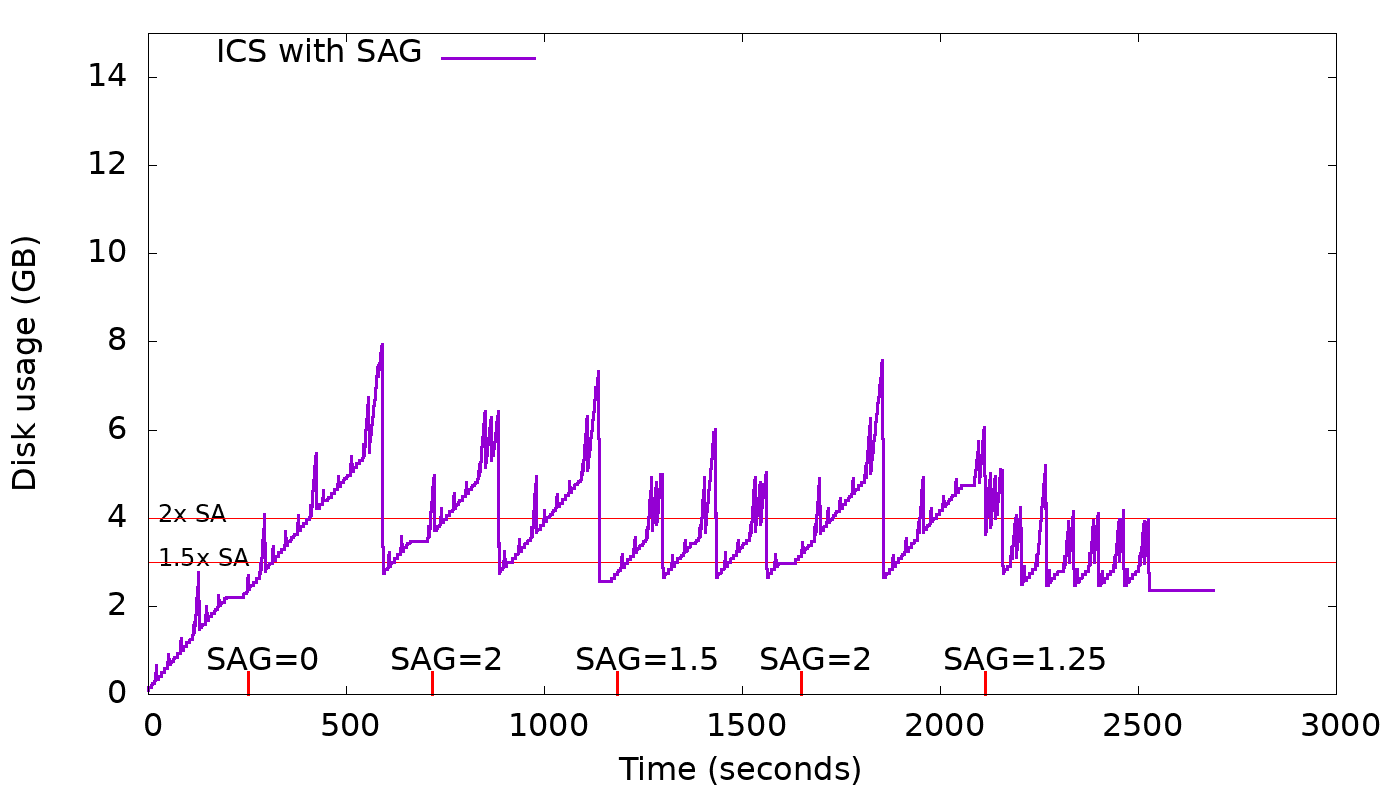
A new option, space_amplification_goal (SAG), is being added to ICS. This option
will allow ICS user to set a goal on the space amplification (SA). It's not
supposed to be an upper bound on the space amplification, but rather, a goal.
This new option will be disabled by default as it doesn't benefit write-only
(no overwrites) workloads and could hurt severely the write performance.
The strategy is free to delay triggering this new behavior, in order to
increase overall compaction efficiency.
The graph below shows how this feature works in practice for different values
of space_amplification_goal:
https://user-images.githubusercontent.com/1409139/89347544-60b7b980-d681-11ea-87ab-e2fdc3ecb9f0.png
When strategy finds space amplification crossed space_amplification_goal, it
will work on reducing the SA by doing a cross-tier compaction on the two
largest tiers. This feature works only on the two largest tiers, because taking
into account others, could hurt the compaction efficiency which is based on
the fact that the more similar-sized sstables are compacted together the higher
the compaction efficiency will be.
With SAG enabled, min_threshold only plays an important role on the smallest
tiers, given that the second-largest tier could be compacted into the largest
tier for a space_amplification_goal value < 2.
By making the options space_amplification_goal and min_threshold independent,
user will be able to tune write amplification and space amplification, based on
the needs. The lower the space_amplification_goal the higher the write
amplification, but by increasing the min threshold, the write amplification
can be decreased to a desired amount.
"
commit 7d90911c5fb3fa891ad64a62147c3a6ca26d61b1
Author: Raphael S. Carvalho <raphaelsc@scylladb.com>
Date: Sat Oct 16 13:41:46 2021 -0300
compaction: ICS: Add garbage collection
Today, ICS lacks an approach to persist expired tombstones in a timely manner,
which is a problem because accumulation of tombstones are known to affecting
latency considerably.
For an expired tombstone to be purged, it has to reach the top of the LSM tree
and hope that older overlapping data wasn't introduced at the bottom.
The condition are there and must be satisfied to avoid data resurrection.
STCS, today, has an inefficient garbage collection approach because it only
picks a single sstable, which satisfies the tombstone density threshold and
file staleness. That's a problem because overlapping data either on same tier
or smaller tiers will prevent tombstones from being purged. Also, nothing is
done to push the tombstones to the top of the tree, for the conditions to be
eventually satisfied.
Due to incremental compaction, ICS can more easily have an effecient GC by
doing cross-tier compaction of relevant tiers.
The trigger will be file staleness and tombstone density, which threshold
values can be configured by tombstone_compaction_interval and
tombstone_threshold, respectively.
If ICS finds a tier which meets both conditions, then that tier and the
larger[1] *and* closest-in-size[2] tier will be compacted together.
[1]: A larger tier is picked because we want tombstones to eventually reach the
top of the tree.
[2]: It also has to be the closest-in-size tier as the smaller the size
difference the higher the efficiency of the compaction. We want to minimize
write amplification as much as possible.
The staleness condition is there to prevent the same file from being picked
over and over again in a short interval.
With this approach, ICS will be continuously working to purge garbage while
not hurting overall efficiency on a steady state, as same-tier compactions are
prioritized.
Signed-off-by: Raphael S. Carvalho <raphaelsc@scylladb.com>
Message-Id: <20211016164146.38010-1-raphaelsc@scylladb.com>
Signed-off-by: Raphael S. Carvalho <raphaelsc@scylladb.com>
Closesscylladb/scylladb#22063
This string conversion functions are not in any fast path. Deinlining
them moves a <boost/lexical_cast.hpp> include out of a common header file.
Some files accessed on boost::iterator_range via lexical_cast.hpp,
so they gain a new dependency.
Closesscylladb/scylladb#21950
Currently, if version is missing, we use a unique timeuuid as the
version. It's not useful for creating static schema of system tables
because to achieve the same version on all the nodes, version needs to
be provided externally.

This patch introduces a way to build the schema with version computed
from schema definition, so we can have a stable version which is the
same on all machines.

Will be used for reliable computation of schema version for system
tables. System tables currently set the version statically and we rely
on the developer to bump up the version manually when the definition
changes. We cannot use mutation hash, since system tables are
initialized too rearly (mutation hash needs system schema to be
already there). This is a very error prone process, as it is easy to
forget to do so, and the issue comes up only when testing mixed
clusters.
It will be used for hashing, which will work with raw_schema.

Also, it's more in-line with the current design, where basic information
is kept in raw_schema and other fields are derived from it.
It's somewhat common to ask for the partition key and clustering key
columns, or for the static and regular columsn. Provide accessors for them
rather than requiring the user to glue them.
Some callers are converted.
Closesscylladb/scylladb#21191
To reduce dependency load, use std ranges instead of boost ranges.

The std::ranges::{lower,upper}_bound don't support heterogeneous lookup,
but a more natural solution is to use a projection to search for the name,
so we use that and the custom comparator is removed.

Many callers are converted as well due to poor interoperability between
boost ranges and std ranges.
all_columns_in_select_order() returns a complicated boost range type
that has no analog in std::ranges. To ease the transition to std::ranges,
precompute most of the work done in that function, and only convert
pointers to references in the function itself.

Since boost ranges and std::ranges don't fully interoperate, one of
the user has to be adjusted.
Add the gossip state for broadcasting the nodes state_id.
Implemented the Group0 state broadcaster (based on the gossip) that will broadcast the state id of each node and check the minimal state id for the tombstone GC.
When there is a change in the tombstone GC minimal state id, the state broadcaster will update the tombstone GC time for the group0-managed tables.
The main component of the change is the newly added `group0_state_id_handler` that keeps track, broadcasts and receives the last group0 state_ids across all nodes and sets the tombstone GC deletion time accordingly:
* on each group0 change applied, the state_id handler broadcasts the state_id as a gossip state (only if the value has changed)
* the handler checks for the node state ids every refresh period (configurable, 1h by default)
* on every check, the handler figures out the lowest state_id (timeuuid), which is state_id that all of the nodes already have
* the timestamp of this minimum state_id is then used to set the tombstone GC deletion time
* the tombstone GC calculation then uses that deletion time to provide the GC time back to the callers, e.g. when doing the compaction
* (as the time for tombstone GC calculation has the 1s granularity we actually deduce 1s from the determined timestamp, because it can happen that there were some newer mutations received in the same second that were not distributed across the nodes yet)
This change introduces a new flag to the static schema descriptor (`is_group0_table`) that is being checked for this newly added mode in the tombstone GC. We also add a check (in non-release builds only) on every group0 modification that the table has this flag set.
The group0 tombstone GC handling is similar to the "repair" tombstone GC mode in a sense (that the tombstone GC time is determined according to a reconciliation action), however it is not explicitly visible to (nor editable by) the user. And also the tombstone GC calculation is much simpler than the "repair" mode calculation - for example, we always use the whole range (as opposed to the "repair" mode that can have specific repair times set for specific ranges).
We use the group0 configuration to determine the set of nodes (both current and previous in case of joint configuration) - we need to make sure that we account for all the group0 nodes (if any node didn't provide the state_id yet, the current check round will be skipped, i.e. no GC will be done until all known nodes provide their state_id timestamp value).
Also note that the group0 state_id handling works on all nodes independently, i.e. each node might have its own (possibly different) state depending on the gossip application state propagation. This is however not a problem, as some nodes might be behind, but they will catch up eventually, and this solution has the benefit of being distributed (as opposed to having a central point to handle the state, like for example the topology coordinator that has been considered in the early stages of the design).
Fixes: scylladb/scylla#15607
New feature, should not be backported.
Closesscylladb/scylladb#20394
* github.com:scylladb/scylladb:
raft: add the check for the group0 tables
raft: fast tombstone GC for group0-managed tables
tombstone_gc: refactor the repair map
raft: flag the group0-managed tables
gossip: broadcast the group0 state id
raft/test: add test for the group0 tombstone GC
treewide: code cleanup and refactoring
The schema module (everything in schema/) is supposed to be towards the
leafs in the ScyllaDB inter-module dependency graph. In other words, it
should not depend on many other modules. On the other hand, almost the
entire codebase depends on the schema module itself.
Currently there is a circular dependency between schema and
replica::database, as the latter is a required argument for
schema::describe(). This is bad, not just because of the dependency mess
it introduces, but also because now schema::describe() can only be used
by code which has a reference to the database handy.
This patch breaks this circular dependency, by introducing the
schema_describe_helper interface and providing an implementation for it
in database.hh.
There is another circular dependency: schema <-> replica::table. This is
not addressed by this patch.
Closesscylladb/scylladb#20893
The interface is not used anywhere anymore, so we can
remove it safely. It has been replaced by custom
functions for each keyspace element and `cql3::description`.
We add a new parameter in functions used to generate instances
of `cql3::description` for types related to situations where we
might not need a create statement. An example of such a scenario
could be `DESCRIBE TYPES`.
We're removing `data_dictionary::keyspace_element`.
Before we can do that, we need to substitute the existing
methods used for describing keyspace elements with their
new versions returning `cql3::description`.
That's what happens in this commit.
assert() is traditionally disabled in release builds, but not in
scylladb. This hasn't caused problems so far, but the latest abseil
release includes a commit [1] that causes a 1000 insn/op regression when
NDEBUG is not defined.
Clearly, we must move towards a build system where NDEBUG is defined in
release builds. But we can't just define it blindly without vetting
all the assert() calls, as some were written with the expectation that
they are enabled in release mode.
To solve the conundrum, change all assert() calls to a new SCYLLA_ASSERT()
macro in utils/assert.hh. This macro is always defined and is not conditional
on NDEBUG, so we can later (after vetting Seastar) enable NDEBUG in release
mode.
[1] 66ef711d68Closesscylladb/scylladb#20006
Fixes#19334
Current impl uses hardcoded printing of a few extensions.
Instead, use extension options to string and print all.
Note: required to make enterprise CI happy again.
Closesscylladb/scylladb#19337
* github.com:scylladb/scylladb:
schema: Make "describe" use extensions to string
schema_extensions: Add an option to string method
Allow an extension to describe itself as the CQL property
string that created it (and is serialized to schema tables)

Only paxos extension requires override.
thrift support was deprecated since ScyllaDB 5.2
> Thrift API - legacy ScyllaDB (and Apache Cassandra) API is
> deprecated and will be removed in followup release. Thrift has
> been disabled by default.
so let's drop it. in this change,
* thrift protocol support is dropped
* all references to thrift support in document are dropped
* the "thrift_version" column in system.local table is
preserved for backward compatibility, as we could load
from an existing system.local table which still contains
this clolumn, so we need to write this column as well.
* "/storage_service/rpc_server" is only preserved for
backward compatibility with java-based nodetool.
* `rpc_port` and `start_rpc` options are preserved, but
they are marked as "Unused". so that the new release
of scylladb can consume existing scylla.yaml configurations
which might contain these settings. by making them
deprecated, user will be able get warned, and update
their configurations before we actually remove them
in the next major release.
Fixes#3811Fixes#18416
Signed-off-by: Kefu Chai <kefu.chai@scylladb.com>
Before the patch, dht::sharder could be instantiated and it would
behave like a static sharder. This is not safe with regards to
extensions of the API because if a derived implementation forgets to
override some method, it would incorrectly default to the
implementation from static sharder. Better to fail the compilation in
this case, so extract static sharder logic to dht::static_sharder
class and make all methods in dht::sharder pure virtual.

This also allows us to have algorithms indicate that they only work
with static sharder by accepting the type, and have compile-time
safety for this requirement.

schema::get_sharder() is changed to return the static_sharder&.
In the describe statement, we need to generate `ALTER TABLE` statement
with all schema's properties for some tables (cdc log tables).

The method prints valid CQL statement with current values of
the properties.
dclocal_read_repair_chance and read_repair_chance have been removed
in Cassandra 3.11 and 4.x, see
https://issues.apache.org/jira/browse/CASSANDRA-13910.
if we expose the properties via DDL, Cassandra would fails to consume
the CQL statement to creating the table when performing migration
from Scylla to Cassandra 4.x, as the latter does not understand
these properties anymore.
currently the default values of `dc_local_read_repair_chance` and
`read_repair_chance` are both "0". so this is practically disabled,
unless user deliberately set them to a value greater than 0.
also, as a side effect, Cassandra 4.x has better support of
Python3. the cqlsh shipped along with Cassandra 3.11.16 only
supports python2.7, see
https://github.com/apache/cassandra/blob/cassandra-3.11.16/bin/cqlsh.py
it errors out if the system only provides python3 with the error
of
```
No appropriate python interpreter found.
```
but modern linux systems do not provide python2 anymore.
so, in this change, we deprecate these two options.
Fixes#3502
Signed-off-by: Kefu Chai <kefu.chai@scylladb.com>
in in {fmt} before v10, it provides the specialization of `fmt::formatter<..>`
for `std::string_view` as well as the specialization of `fmt::formatter<..>`
for `fmt::string_view` which is an implementation builtin in {fmt} for
compatibility of pre-C++17. and this type is used even if the code is
compiled with C++ stadandard greater or equal to C++17. also, before v10,
the `fmt::formatter<std::string_view>::format()` is defined so it accepts
`std::string_view`. after v10, `fmt::formatter<std::string_view>` still
exists, but it is now defined using `format_as()` machinery, so it's
`format()` method does not actually accept `std::string_view`, it
accepts `fmt::string_view`, as the former can be converted to
`fmt::string_view`.
this is why we can inherit from `fmt::formatter<std::string_view>` and
use `formatter<std::string_view>::format(foo, ctx);` to implement the
`format()` method with {fmt} v9, but we cannot do this with {fmt} v10,
and we would have following compilation failure:
```
FAILED: service/CMakeFiles/service.dir/RelWithDebInfo/topology_state_machine.cc.o
/home/kefu/.local/bin/clang++ -DFMT_DEPRECATED_OSTREAM -DFMT_SHARED -DSCYLLA_BUILD_MODE=release -DSEASTAR_API_LEVEL=7 -DSEASTAR_LOGGER_COMPILE_TIME_FMT -DSEASTAR_LOGGER_TYPE_STDOUT -DSEASTAR_SCHEDULING_GROUPS_COUNT=16 -DSEASTAR_SSTRING -DXXH_PRIVATE_API -DCMAKE_INTDIR=\"RelWithDebInfo\" -I/home/kefu/dev/scylladb -I/home/kefu/dev/scylladb/build/gen -I/home/kefu/dev/scylladb/seastar/include -I/home/kefu/dev/scylladb/build/seastar/gen/include -I/home/kefu/dev/scylladb/build/seastar/gen/src -ffunction-sections -fdata-sections -O3 -g -gz -std=gnu++20 -fvisibility=hidden -Wall -Werror -Wextra -Wno-error=deprecated-declarations -Wimplicit-fallthrough -Wno-c++11-narrowing -Wno-deprecated-copy -Wno-mismatched-tags -Wno-missing-field-initializers -Wno-overloaded-virtual -Wno-unsupported-friend -Wno-enum-constexpr-conversion -Wno-unused-parameter -ffile-prefix-map=/home/kefu/dev/scylladb=. -march=westmere -mllvm -inline-threshold=2500 -fno-slp-vectorize -U_FORTIFY_SOURCE -Werror=unused-result -MD -MT service/CMakeFiles/service.dir/RelWithDebInfo/topology_state_machine.cc.o -MF service/CMakeFiles/service.dir/RelWithDebInfo/topology_state_machine.cc.o.d -o service/CMakeFiles/service.dir/RelWithDebInfo/topology_state_machine.cc.o -c /home/kefu/dev/scylladb/service/topology_state_machine.cc
/home/kefu/dev/scylladb/service/topology_state_machine.cc:254:41: error: no matching member function for call to 'format'
254 | return formatter<std::string_view>::format(it->second, ctx);
| ~~~~~~~~~~~~~~~~~~~~~~~~~~~~~^~~~~~
/usr/include/fmt/core.h:2759:22: note: candidate function template not viable: no known conversion from 'seastar::basic_sstring<char, unsigned int, 15>' to 'const fmt::basic_string_view<char>' for 1st argument
2759 | FMT_CONSTEXPR auto format(const T& val, FormatContext& ctx) const
| ^ ~~~~~~~~~~~~
```
because the inherited `format()` method actually comes from
`fmt::formatter<fmt::string_view>`. to reduce the confusion, in this
change, we just inherit from `fmt::format<string_view>`, where
`string_view` is actually `fmt::string_view`. this follows
the document at
https://fmt.dev/latest/api.html#formatting-user-defined-types,
and since there is less indirection under the hood -- we do not
use the specialization created by `FMT_FORMAT_AS` which inherit
from `formatter<fmt::string_view>`, hopefully this can improve
the compilation speed a little bit. also, this change addresses
the build failure with {fmt} v10.
Signed-off-by: Kefu Chai <kefu.chai@scylladb.com>
Closesscylladb/scylladb#18299
before this change, we rely on the default-generated fmt::formatter
created from operator<<, but fmt v10 dropped the default-generated
formatter.
in this change, we define formatters for
* column_definition
* column_mapping
* ordinal_column_id
* raw_view_info
* schema
* view_ptr
their operator<<:s are dropped. but operator<< for schema is preserved,
as we are still printing `seastar::lw_shared_ptr<const schema>` with
our homebrew generic formatter for `seastar::lw_shared_ptr<>`, which
uses operator<< to print the pointee.
Refs #13245
Signed-off-by: Kefu Chai <kefu.chai@scylladb.com>
Closesscylladb/scylladb#17768