Introduce a new compaction_type enum : `Major`.
This type will be used by the next patches to differentiate between
major compaction and regular compaction (compaction_type::Compaction).

Signed-off-by: Lakshmi Narayanan Sreethar <lakshmi.sreethar@scylladb.com>
The `compaction_strategy_state` class holds strategy specific state via
a `std::variant` containing different state types. When a compaction
strategy performs compaction, it retrieves a reference to its state from
the `compaction_strategy_state` object. If the table's compaction
strategy is ALTERed while a compaction is in progress, the
`compaction_strategy_state` object gets replaced, destroying the old
state. This leaves the ongoing compaction holding a dangling reference,
resulting in a use after free.
Fix this by using `seastar::shared_ptr` for the state variant
alternatives(`leveled_compaction_strategy_state_ptr` and
`time_window_compaction_strategy_state_ptr`). The compaction strategies
now hold a copy of the shared_ptr, ensuring the state remains valid for
the duration of the compaction even if the strategy is altered.
The `compaction_strategy_state` itself is still passed by reference and
only the variant alternatives use shared_ptrs. This allows ongoing
compactions to retain ownership of the state independently of the
wrapper's lifetime.
Fixes#25913
Signed-off-by: Lakshmi Narayanan Sreethar <lakshmi.sreethar@scylladb.com>
Various compaction strategies still have their respective
make_sstable_set() implementation in sstables/sstable_set.cc. Move them
to the appropriate .cc files in compaction/, making the compaction
module more self contained.
Some files in compaction/ have using namespace {compaction,sstables}
clauses, some even in headers. This is considered bad practice and
muddies the namespace use. Remove them.
The namespace usage in this directory is very inconsistent, with files
and classes scattered in:
* global namespace
* namespace compaction
* namespace sstables

With cases, where all three used in the same file. This code used to
live in sstables/ and some of it still retains namespace sstables as a
heritage of that time. The mismatch between the dir (future module) and
the namespace used is confusing, so finish the migration and move all
code in compaction/ to namespace compaction too.

This patch, although large, is mechanic and only the following kind of
changes are made:
* replace namespace sstable {} with namespace compaction {}
* add namespace compaction {}
* drop/add sstables::
* drop/add compaction::
* move around forward-declarations so they are in the correct namespace
  context

This refactoring revealed some awkward leftover coupling between
sstables and compaction, in sstables/sstable_set.cc, where the
make_sstable_set() methods of compaction strategies are implemented.
This will allow upcoming work to gently produce a sstable set for
each compaction group view. Example: repaired and unrepaired.

Locking strategy for compaction's sstable selection:
Since sstable retrieval path became futurized, tasks in compaction
manager will now hold the write lock (compaction_state::lock)
when retrieving the sstable list, feeding them into compaction
strategy, and finally registering selected sstables as compacting.
The last step prevents another concurrent task from picking the
same sstable. Previously, all those steps were atomic, but
we have seen stall in that area in large installations, so
futurization of that area would come sooner or later.

Signed-off-by: Raphael S. Carvalho <raphaelsc@scylladb.com>
Since table_state is a view to a compaction group, it makes sense
to rename it as so.

With upcoming incremental repair, each replica::compaction_group
will be actually two compaction groups, so there will be two
views for each replica::compaction_group.

Signed-off-by: Raphael S. Carvalho <raphaelsc@scylladb.com>
Interval map is very susceptible to quadratic space behavior when
it's flooded with many entries overlapping all (or most of)
intervals, since each such entry will have presence on all
intervals it overlaps with.
A trigger we observed was memtable flush storm, which creates many
small "L0" sstables that spans roughly the entire token range.
Since we cannot rely on insertion order, solution will be about
storing sstables with such wide ranges in a vector (unleveled).
There should be no consequence for single-key reads, since upper
layer applies an additional filtering based on token of key being
queried.
And for range scans, there can be an increase in memory usage,
but not significant because the sstables span an wide range and
would have been selected in the combined reader if the range of
scan overlaps with them.
Anyway, this is a protection against storm of memtable flushes
and shouldn't be the common scenario.
It works both with tablets and vnodes, by adjusting the token
range spanned by compaction group accordingly.
Fixes#23634.
Signed-off-by: Raphael S. Carvalho <raphaelsc@scylladb.com>
ICS is a compaction strategy that inherits size tiered properties --
therefore it's write optimized too -- but fixes its space overhead of
100% due to input files being only released on completion. That's
achieved with the concept of sstable run (similar in concept to LCS
levels) which breaks a large sstable into fixed-size chunks (1G by
default), known as run fragments. ICS picks similar-sized runs
for compaction, and fragments of those runs can be released
incrementally as they're compacted, reducing the space overhead
to about (number_of_input_runs * 1G). This allows user to increase
storage density of nodes (from 50% to ~80%), reducing the cost of
ownership.
NOTE: test_system_schema_version_is_stable adjusted to account for batchlog
using IncrementalCompactionStrategy
contains:
compaction/: added incremental_compaction_strategy.cc (.hh), incremental_backlog_tracker.cc (.hh)
compaction/CMakeLists.txt: include ICS cc files
configure.py: changes for ICS files, includes test
db/legacy_schema_migrator.cc / db/schema_tables.cc: fallback to ICS when strategy is not supported
db/system_keyspace: pick ICS for some system tables
schema/schema.hh: ICS becomes default
test/boost: Add incremental_compaction_test.cc
test/boost/sstable_compaction_test.cc: ICS related changes
test/cqlpy/test_compaction_strategy_validation.py: ICS related changes
docs/architecture/compaction/compaction-strategies.rst: changes to ICS section
docs/cql/compaction.rst: changes to ICS section
docs/cql/ddl.rst: adds reference to ICS options
docs/getting-started/system-requirements.rst: updates sentence mentioning ICS
docs/kb/compaction.rst: changes to ICS section
docs/kb/garbage-collection-ics.rst: add file
docs/kb/index.rst: add reference to <garbage-collection-ics>
docs/operating-scylla/procedures/tips/production-readiness.rst: add ICS section
some relevant commits throughout the ICS history:
commit 434b97699b39c570d0d849d372bf64f418e5c692
Merge: 105586f747 30250749b8
Author: Paweł Dziepak <pdziepak@scylladb.com>
Date: Tue Mar 12 12:14:23 2019 +0000
Merge "Introduce Incremental Compaction Strategy (ICS)" from Raphael
"
Introduce new compaction strategy which is essentially like size tiered
but will work with the existing incremental compaction. Thus incremental
compaction strategy.
It works like size tiered, but each element composing a tier is a sstable
run, meaning that the compaction strategy will look for N similar-sized
sstable runs to compact, not just individual sstables.
Parameters:
* "sstable_size_in_mb": defines the maximum sstable (fragment) size
composing
a sstable run, which impacts directly the disk space requirement which is
improved with incremental compaction.
The lower the value the lower the space requirement for compaction because
fragments involved will be released more frequently.
* all others available in size tiered compaction strategy
HOWTO
=====
To change an existing table to use it, do:
ALTER TABLE mykeyspace.mytable WITH compaction =
{'class' : 'IncrementalCompactionStrategy'};
Set fragment size:
ALTER TABLE mykeyspace.mytable WITH compaction =
{'class' : 'IncrementalCompactionStrategy', 'sstable_size_in_mb' : 1000 }
"
commit 94ef3cd29a196bedbbeb8707e20fe78a197f30a1
Merge: dca89ce7a5 e08ef3e1a3
Author: Avi Kivity <avi@scylladb.com>
Date: Tue Sep 8 11:31:52 2020 +0300
Merge "Add feature to limit space amplification in Incremental Compaction" from Raphael
"
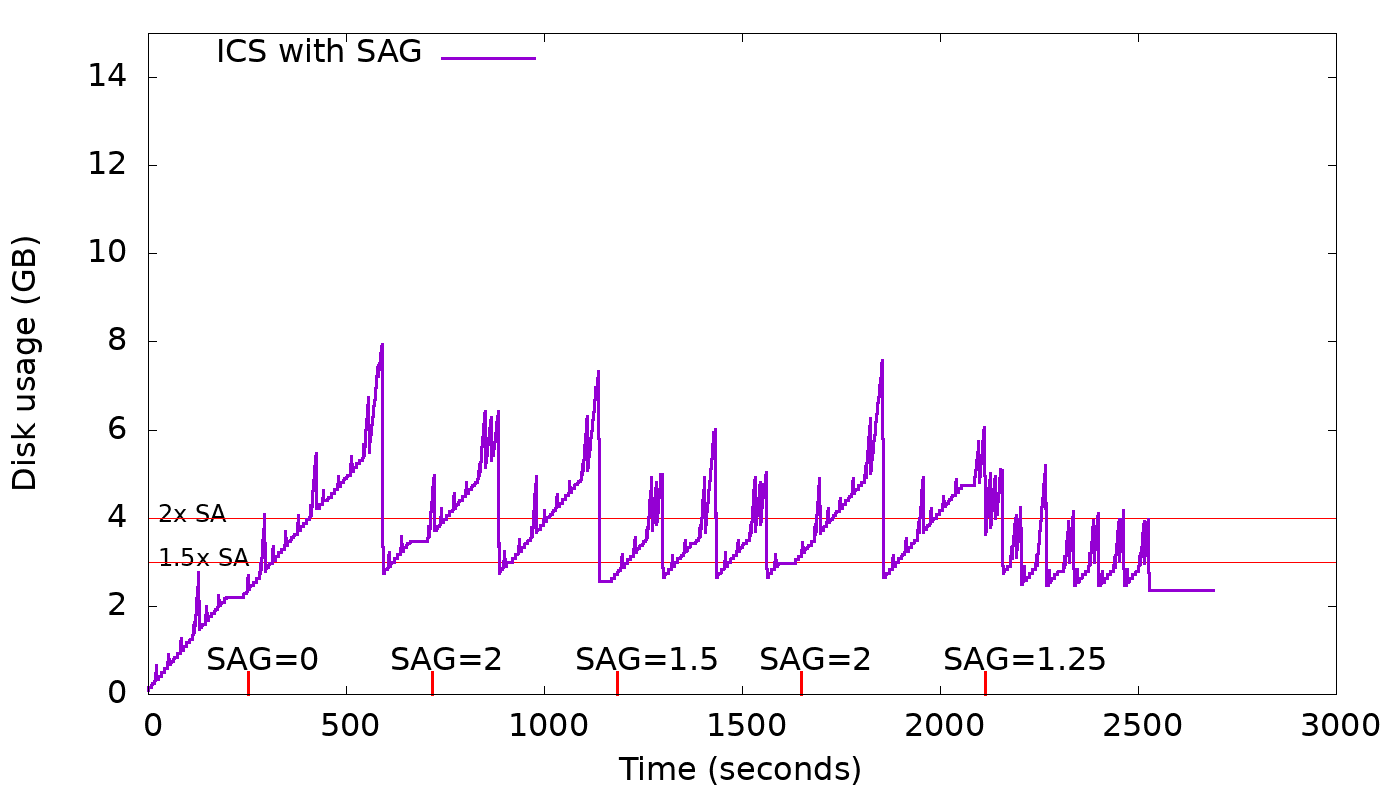
A new option, space_amplification_goal (SAG), is being added to ICS. This option
will allow ICS user to set a goal on the space amplification (SA). It's not
supposed to be an upper bound on the space amplification, but rather, a goal.
This new option will be disabled by default as it doesn't benefit write-only
(no overwrites) workloads and could hurt severely the write performance.
The strategy is free to delay triggering this new behavior, in order to
increase overall compaction efficiency.
The graph below shows how this feature works in practice for different values
of space_amplification_goal:
https://user-images.githubusercontent.com/1409139/89347544-60b7b980-d681-11ea-87ab-e2fdc3ecb9f0.png
When strategy finds space amplification crossed space_amplification_goal, it
will work on reducing the SA by doing a cross-tier compaction on the two
largest tiers. This feature works only on the two largest tiers, because taking
into account others, could hurt the compaction efficiency which is based on
the fact that the more similar-sized sstables are compacted together the higher
the compaction efficiency will be.
With SAG enabled, min_threshold only plays an important role on the smallest
tiers, given that the second-largest tier could be compacted into the largest
tier for a space_amplification_goal value < 2.
By making the options space_amplification_goal and min_threshold independent,
user will be able to tune write amplification and space amplification, based on
the needs. The lower the space_amplification_goal the higher the write
amplification, but by increasing the min threshold, the write amplification
can be decreased to a desired amount.
"
commit 7d90911c5fb3fa891ad64a62147c3a6ca26d61b1
Author: Raphael S. Carvalho <raphaelsc@scylladb.com>
Date: Sat Oct 16 13:41:46 2021 -0300
compaction: ICS: Add garbage collection
Today, ICS lacks an approach to persist expired tombstones in a timely manner,
which is a problem because accumulation of tombstones are known to affecting
latency considerably.
For an expired tombstone to be purged, it has to reach the top of the LSM tree
and hope that older overlapping data wasn't introduced at the bottom.
The condition are there and must be satisfied to avoid data resurrection.
STCS, today, has an inefficient garbage collection approach because it only
picks a single sstable, which satisfies the tombstone density threshold and
file staleness. That's a problem because overlapping data either on same tier
or smaller tiers will prevent tombstones from being purged. Also, nothing is
done to push the tombstones to the top of the tree, for the conditions to be
eventually satisfied.
Due to incremental compaction, ICS can more easily have an effecient GC by
doing cross-tier compaction of relevant tiers.
The trigger will be file staleness and tombstone density, which threshold
values can be configured by tombstone_compaction_interval and
tombstone_threshold, respectively.
If ICS finds a tier which meets both conditions, then that tier and the
larger[1] *and* closest-in-size[2] tier will be compacted together.
[1]: A larger tier is picked because we want tombstones to eventually reach the
top of the tree.
[2]: It also has to be the closest-in-size tier as the smaller the size
difference the higher the efficiency of the compaction. We want to minimize
write amplification as much as possible.
The staleness condition is there to prevent the same file from being picked
over and over again in a short interval.
With this approach, ICS will be continuously working to purge garbage while
not hurting overall efficiency on a steady state, as same-tier compactions are
prioritized.
Signed-off-by: Raphael S. Carvalho <raphaelsc@scylladb.com>
Message-Id: <20211016164146.38010-1-raphaelsc@scylladb.com>
Signed-off-by: Raphael S. Carvalho <raphaelsc@scylladb.com>
Closesscylladb/scylladb#22063
now that we are allowed to use C++23. we now have the luxury of using
`std::ranges::to`.
in this change, we:
- replace `boost::copy_range` to `std::ranges::to`
- remove unused `#include` of boost headers
Signed-off-by: Kefu Chai <kefu.chai@scylladb.com>
Closesscylladb/scylladb#21880
now that we are allowed to use C++23. we now have the luxury of using
`std::views::transform`.
in this change, we:
- replace `boost::adaptors::transformed` with `std::views::transform`
- use `fmt::join()` when appropriate where `boost::algorithm::join()`
is not applicable to a range view returned by `std::view::transform`.
- use `std::ranges::fold_left()` to accumulate the range returned by
`std::view::transform`
- use `std::ranges::fold_left()` to get the maximum element in the
range returned by `std::view::transform`
- use `std::ranges::min()` to get the minimal element in the range
returned by `std::view::transform`
- use `std::ranges::equal()` to compare the range views returned
by `std::view::transform`
- remove unused `#include <boost/range/adaptor/transformed.hpp>`
- use `std::ranges::subrange()` instead of `boost::make_iterator_range()`,
to feed `std::views::transform()` a view range.
to reduce the dependency to boost for better maintainability, and
leverage standard library features for better long-term support.
this change is part of our ongoing effort to modernize our codebase
and reduce external dependencies where possible.
limitations:
there are still a couple places where we are still using
`boost::adaptors::transformed` due to the lack of a C++23 alternative
for `boost::join()` and `boost::adaptors::uniqued`.
Signed-off-by: Kefu Chai <kefu.chai@scylladb.com>
Closesscylladb/scylladb#21700
now that we are allowed to use C++23. we now have the luxury of using
`std::ranges::any_of`.

in this change, we replace `boost::algorithm::any_of` with
`std::ranges::any_of`

to reduce the dependency to boost for better maintainability, and
leverage standard library features for better long-term support.

this change is part of our ongoing effort to modernize our codebase
and reduce external dependencies where possible.

Signed-off-by: Kefu Chai <kefu.chai@scylladb.com>
This includes way too much, including <boost/regex.hpp>, which is huge.
Drop includes of adaptors.hpp and replace by what is needed.
Closesscylladb/scylladb#21187
std::optional formatting changed while moving from the home-grown formatter to
the fmt provided formatter; don't rely on it for user visible messages.
Here, the optional formatted is known to be engaged, so just print it.
Closesscylladb/scylladb#18533
since we do not rely on FMT_DEPRECATED_OSTREAM to define the
fmt::formatter for us anymore, let's stop defining `FMT_DEPRECATED_OSTREAM`.

in this change,

* utils: drop the range formatters in to_string.hh and to_string.c, as
  we don't use them anymore. and the tests for them in
  test/boost/string_format_test.cc are removed accordingly.
* utils: use fmt to print chunk_vector and small_vector. as
  we are not able to print the elements using operator<< anymore
  after switching to {fmt} formatters.
* test/boost: specialize fmt::details::is_std_string_like<bytes>
  due to a bug in {fmt} v9, {fmt} fails to format a range whose
  element type is `basic_sstring<uint8_t>`, as it considers it
  as a string-like type, but `basic_sstring<uint8_t>`'s char type
  is signed char, not char. this issue does not exist in {fmt} v10,
  so, in this change, we add a workaround to explicitly specialize
  the type trait to assure that {fmt} format this type using its
  `fmt::formatter` specialization instead of trying to format it
  as a string. also, {fmt}'s generic ranges formatter calls the
  pair formatter's `set_brackets()` and `set_separator()` methods
  when printing the range, but operator<< based formatter does not
  provide these method, we have to include this change in the change
  switching to {fmt}, otherwise the change specializing
  `fmt::details::is_std_string_like<bytes>` won't compile.
* test/boost: in tests, we use `BOOST_REQUIRE_EQUAL()` and its friends
  for comparing values. but without the operator<< based formatters,
  Boost.Test would not be able to print them. after removing
  the homebrew formatters, we need to use the generic
  `boost_test_print_type()` helper to do this job. so we are
  including `test_utils.hh` in tests so that we can print
  the formattable types.
* treewide: add "#include "utils/to_string.hh" where
  `fmt::formatter<optional<>>` is used.
* configure.py: do not define FMT_DEPRECATED_OSTREAM
* cmake: do not define FMT_DEPRECATED_OSTREAM

Refs #13245

Signed-off-by: Kefu Chai <kefu.chai@scylladb.com>
before this change, we rely on the default-generated fmt::formatter
created from operator<<, but fmt v10 dropped the default-generated
formatter.

in this change, we include `fmt/ranges.h` and/or `fmt/std.h`
for formatting the container types, like vector, map
optional and variant using {fmt} instead of the homebrew
formatter based on operator<<.
with this change, the changes adding fmt::formatter and
the changes using ostream formatter explicitly, we are
allowed to drop `FMT_DEPRECATED_OSTREAM` macro.

Refs scylladb#13245

Signed-off-by: Kefu Chai <kefu.chai@scylladb.com>
This change adds the missing Cassandra compaction option unchecked_tombstone_compaction.
Setting this option to true causes the compaction to ignore tombstone_threshold,
and decide whether to do a compaction only on the value of tombstone_compaction_interval
The interface is fragile because the user may incorrectly use the
wrong "gc before". Given that sstable knows how to properly calculate
"gc before", let's do it in estimate__d__t__r(), leaving no room
for mistakes.
sstable_run's variant was also changed to conform to new interface,
allowing ICS to properly estimate droppable ratio, using GC before
that is calculated using each sstable's range. That's important for
upcoming tablets, as we want to query only the range that belongs
to a particular tablet in the repair history table.
Signed-off-by: Raphael S. Carvalho <raphaelsc@scylladb.com>
Closesscylladb/scylladb#15931
When off-strategy is disabled, data segregation is not postponed,
meaning that getting partition estimate right is important to
decrease filter's false positives. With streaming, we don't
have min and max timestamps at destination, well, we could have
extended the RPC verb to send them, but turns out we can deduce
easily the amount of windows using default TTL. Given partitioner
random nature, it's not absurd to assume that a given range being
streamed may overlap with all windows, meaning that each range
will yield one sstable for each window when segregating incoming
data. Today, we assume the worst of 100 windows (which is the
max amount of sstables the input data can be segregated into)
due to the lack of metadata for estimating the window count.
But given that users are recommended to target a max of ~20
windows, it means partition estimate is being downsized 5x more
than needed. Let's improve it by using default TTL when
estimating window count, so even on absence of timestamp
metadata, the partition estimation won't be way off.
Fixes#15704.
Signed-off-by: Raphael S. Carvalho <raphaelsc@scylladb.com>
After "repair: Get rid of the gc_grace_seconds", the sstable's schema (mode,
gc period if applicable, etc) is used to estimate the amount of droppable
data (or determine full expiration = max_deletion_time < gc_before).
It could happen that the user switched from timeout to repair mode, but
sstables will still use the old mode, despite the user asked for a new one.
Another example is when you play with value of grace period, to prevent
data resurrection if repair won't be able to run in a timely manner.
The problem persists until all sstables using old GC settings are recompacted
or node is restarted.
To fix this, we have to feed latest schema into sstable procedures used
for expiration purposes.
Fixes#15643.
Signed-off-by: Raphael S. Carvalho <raphaelsc@scylladb.com>
Closesscylladb/scylladb#15746
Now everything is prepared for the switch, let's do it.

Now let's wait for ICS to enjoy the set of changes.

Signed-off-by: Raphael S. Carvalho <raphaelsc@scylladb.com>
Split compaction_strategy_impl constructor into methods that will
be reused for validation.

Add additional checks providing that options' values are legal.
Add compaction_strategy_impl::validate_min_max_threshold method
that will be used to validate min and max threshold values
for different compaction methods.
This is the first phase of providing strong exception safety guarantees by the generic `compaction_backlog_tracker::replace_sstables`.
Once all compaction strategies backlog trackers' replace_sstables provide strong exception safety guarantees (i.e. they may throw an exception but must revert on error any intermediate changes they made to restore the tracker to the pre-update state).
Once this series is merged and ICS replace_sstables is also made strongly exception safe (using infrastructure from size_tiered_backlog_tracker introduced here), `compaction_backlog_tracker::replace_sstables` may allow exceptions to propagate back to the caller rather than disabling the backlog tracker on errors.
Closes#14104
* github.com:scylladb/scylladb:
leveled_compaction_backlog_tracker: replace_sstables: provide strong exception safety guarantees
time_window_backlog_tracker: replace_sstables: provide strong exception safety guarantees
size_tiered_backlog_tracker: replace_sstables: provide strong exception safety guarantees
size_tiered_backlog_tracker: provide static calculate_sstables_backlog_contribution
size_tiered_backlog_tracker: make log4 helper static
size_tiered_backlog_tracker: define struct sstables_backlog_contribution
size_tiered_backlog_tracker: update_sstables: update total_bytes only if set changed
compaction_backlog_tracker: replace_sstables: pass old and new sstables vectors by ref
compaction_backlog_tracker: replace_sstables: add FIXME comments about strong exception safety
This is the last step of deprecation dance of DTCS.
In Scylla 5.1, users were warned that DTCS was deprecated.
In 5.2, altering or creation of tables with DTCS was forbidden.
5.3 branch was already created, so this is targetting 5.4.
Users that refused to move away from DTCS will have Scylla
falling back to the default strategy, either STCS or ICS.
See:
WARN 2023-07-14 09:49:11,857 [shard 0] schema_tables - Falling back to size-tiered compaction strategy after the problem: Unable to find compaction strategy class 'DateTieredCompactionStrategy
Then user can later switch to a supported strategy with
alter table.
Signed-off-by: Raphael S. Carvalho <raphaelsc@scylladb.com>
Closes#14559
By making all changes on temporary variables
and eventually moving them back into the tracker members
in a noexcept block the function can safely throw
until the changes are committed.

Signed-off-by: Benny Halevy <bhalevy@scylladb.com>
Instead of providing refresh_sstables_backlog_contribution
that updates the tracker in place, provide a static function
calculate_sstables_backlog_contribution that doesn't change
the tracker state to facilitate exception safety in the next patch.

Signed-off-by: Benny Halevy <bhalevy@scylladb.com>
Encapsulate the contribution-related members in
struct contribution, to be used for strong exception safety.

Signed-off-by: Benny Halevy <bhalevy@scylladb.com>
Although replace_sstables is supposed to be called
only once per {old_ssts, new_ssts} it is safer
to update `_total_bytes` with `sst->data_size()`
only if the sst was inserted/erased successfully.
Otherwise _total_bytes may go out of sync with the
contents of _all.

That said, the next step should be to refer to the
compaction_group's main sstable set directly rather
than maintaining a "shadow" set in the tracker.

Signed-off-by: Benny Halevy <bhalevy@scylladb.com>
In that level no io_priority_class-es exist. Instead, all the IO happens
in the context of current sched-group. File API no longer accepts prio
class argument (and makes io_intent arg mandatory to impls).
So the change consists of
- removing all usage of io_priority_class
- patching file_impl's inheritants to updated API
- priority manager goes away altogether
- IO bandwidth update is performed on respective sched group
- tune-up scylla-gdb.py io_queues command
The first change is huge and was made semi-autimatically by:
- grep io_priority_class | default_priority_class
- remove all calls, found methods' args and class' fields
Patching file_impl-s is smaller, but also mechanical:
- replace io_priority_class& argument with io_intent* one
- pass intent to lower file (if applicatble)
Dropping the priority manager is:
- git-rm .cc and .hh
- sed out all the #include-s
- fix configure.py and cmakefile
The scylla-gdb.py update is a bit hairry -- it needs to use task queues
list for IO classes names and shares, but to detect it should it checks
for the "commitlog" group is present.
Signed-off-by: Pavel Emelyanov <xemul@scylladb.com>
Closes#13963