Add user-facing documentation for the new CQL per-row TTL feature,
in docs/cql/cql-extensions.md.

Also mention (and link) the new alternative TTL feature in a few
relevant documents about the old (per-write) TTL,  about CDC,
and about the CREATE TABLE and ALTER TABLE commands.

Signed-off-by: Nadav Har'El <nyh@scylladb.com>
There is a difference how ScyllaDB and Cassandra handle conditional
batches with different IF statements (such as "IF EXISTS" and "IF NOT
EXISTS").

This commit explicitly documents the differences in the behavior.

Refs: #13011
Current protocol extension that sends tablet info to drivers only does
that if the driver selects a non-replica coordinator for a routable
request. It works well if some node on the replica list is replaced by
other node, or if some replicas are removed from the list. Driver will
at some point send a request to stale replica, and receive new list in
response.
The issue is with extending the list with new replicas. In that case old
replicas are all still correct, so driver will not select any wrong
replica, and will not receive the new list. As far as I know that only
scenario where this could happen is RF increase.
It could be to some degree worked around in the drivers, but it would
add significant complexity (definitely more than any other invalidations
we introduced) while still not being ideal solution. This scenario
should be rare enough, and the consequences of not handling it minor
enough (new replicas not being used as coordinators) that it does not
warrant driver-side solution. Instead this commit adds info about this
to documentation, advising users to restart applications after replica
lists are extended.
It is worth noting that if new tablet feedback protocol extension is
implemented then this problem goes away. See issue #21664.
Closesscylladb/scylladb#23447
This commit removes the outdated information about seed nodes.
We no longer need it in the docs, as a) the documentation is versioned,
and b) the ScyllaDB Open Source 4.3 and ScyllaDB Enterprise 2021.1 versions
mentioned in the docs are no longer supported.
In addition, some clarification has been added to the existing sections.
Fixes https://github.com/scylladb/scylladb/issues/22400Closesscylladb/scylladb#23282
remove the "ScyllaDB Enterprise" labels in document. because
there is no need to differentiate ScyllaDB Enterprise from its OSS
variant, let's stop adding the "ScyllaDB Enterprise" labels to
enterprise-only features. this helps to reduce the confusion.
as we are still in the process of porting the enterprise features
to this repo, this change does not fixscylladb/scylladb#22175.
we will review the document again when completing the migration.
we also take this opportunity to stop referencing "Enterprise" in
the changed paragraph.
Refs scylladb/scylladb#22175
Signed-off-by: Kefu Chai <kefu.chai@scylladb.com>
Closesscylladb/scylladb#22177
in 047ce136, we cherry-picked the change adding
garbage-collection-ics.rst to the document. but it was still
referencing the git sha1 and version number in enterprise.
this change updates kb/garbage-collection-ics.rst, so that it
* references the git commit sha1 in this repo
* do not reference the version introducing this feature, as
per Anna Stuchlik
> As a rule, we should avoid documenting when something was
> introduced or set as a default because our documentation
> was versioned. Per-version information should be listed in
> the release notes.
Signed-off-by: Kefu Chai <kefu.chai@scylladb.com>
Closesscylladb/scylladb#22195
ICS is a compaction strategy that inherits size tiered properties --
therefore it's write optimized too -- but fixes its space overhead of
100% due to input files being only released on completion. That's
achieved with the concept of sstable run (similar in concept to LCS
levels) which breaks a large sstable into fixed-size chunks (1G by
default), known as run fragments. ICS picks similar-sized runs
for compaction, and fragments of those runs can be released
incrementally as they're compacted, reducing the space overhead
to about (number_of_input_runs * 1G). This allows user to increase
storage density of nodes (from 50% to ~80%), reducing the cost of
ownership.
NOTE: test_system_schema_version_is_stable adjusted to account for batchlog
using IncrementalCompactionStrategy
contains:
compaction/: added incremental_compaction_strategy.cc (.hh), incremental_backlog_tracker.cc (.hh)
compaction/CMakeLists.txt: include ICS cc files
configure.py: changes for ICS files, includes test
db/legacy_schema_migrator.cc / db/schema_tables.cc: fallback to ICS when strategy is not supported
db/system_keyspace: pick ICS for some system tables
schema/schema.hh: ICS becomes default
test/boost: Add incremental_compaction_test.cc
test/boost/sstable_compaction_test.cc: ICS related changes
test/cqlpy/test_compaction_strategy_validation.py: ICS related changes
docs/architecture/compaction/compaction-strategies.rst: changes to ICS section
docs/cql/compaction.rst: changes to ICS section
docs/cql/ddl.rst: adds reference to ICS options
docs/getting-started/system-requirements.rst: updates sentence mentioning ICS
docs/kb/compaction.rst: changes to ICS section
docs/kb/garbage-collection-ics.rst: add file
docs/kb/index.rst: add reference to <garbage-collection-ics>
docs/operating-scylla/procedures/tips/production-readiness.rst: add ICS section
some relevant commits throughout the ICS history:
commit 434b97699b39c570d0d849d372bf64f418e5c692
Merge: 105586f747 30250749b8
Author: Paweł Dziepak <pdziepak@scylladb.com>
Date: Tue Mar 12 12:14:23 2019 +0000
Merge "Introduce Incremental Compaction Strategy (ICS)" from Raphael
"
Introduce new compaction strategy which is essentially like size tiered
but will work with the existing incremental compaction. Thus incremental
compaction strategy.
It works like size tiered, but each element composing a tier is a sstable
run, meaning that the compaction strategy will look for N similar-sized
sstable runs to compact, not just individual sstables.
Parameters:
* "sstable_size_in_mb": defines the maximum sstable (fragment) size
composing
a sstable run, which impacts directly the disk space requirement which is
improved with incremental compaction.
The lower the value the lower the space requirement for compaction because
fragments involved will be released more frequently.
* all others available in size tiered compaction strategy
HOWTO
=====
To change an existing table to use it, do:
ALTER TABLE mykeyspace.mytable WITH compaction =
{'class' : 'IncrementalCompactionStrategy'};
Set fragment size:
ALTER TABLE mykeyspace.mytable WITH compaction =
{'class' : 'IncrementalCompactionStrategy', 'sstable_size_in_mb' : 1000 }
"
commit 94ef3cd29a196bedbbeb8707e20fe78a197f30a1
Merge: dca89ce7a5 e08ef3e1a3
Author: Avi Kivity <avi@scylladb.com>
Date: Tue Sep 8 11:31:52 2020 +0300
Merge "Add feature to limit space amplification in Incremental Compaction" from Raphael
"
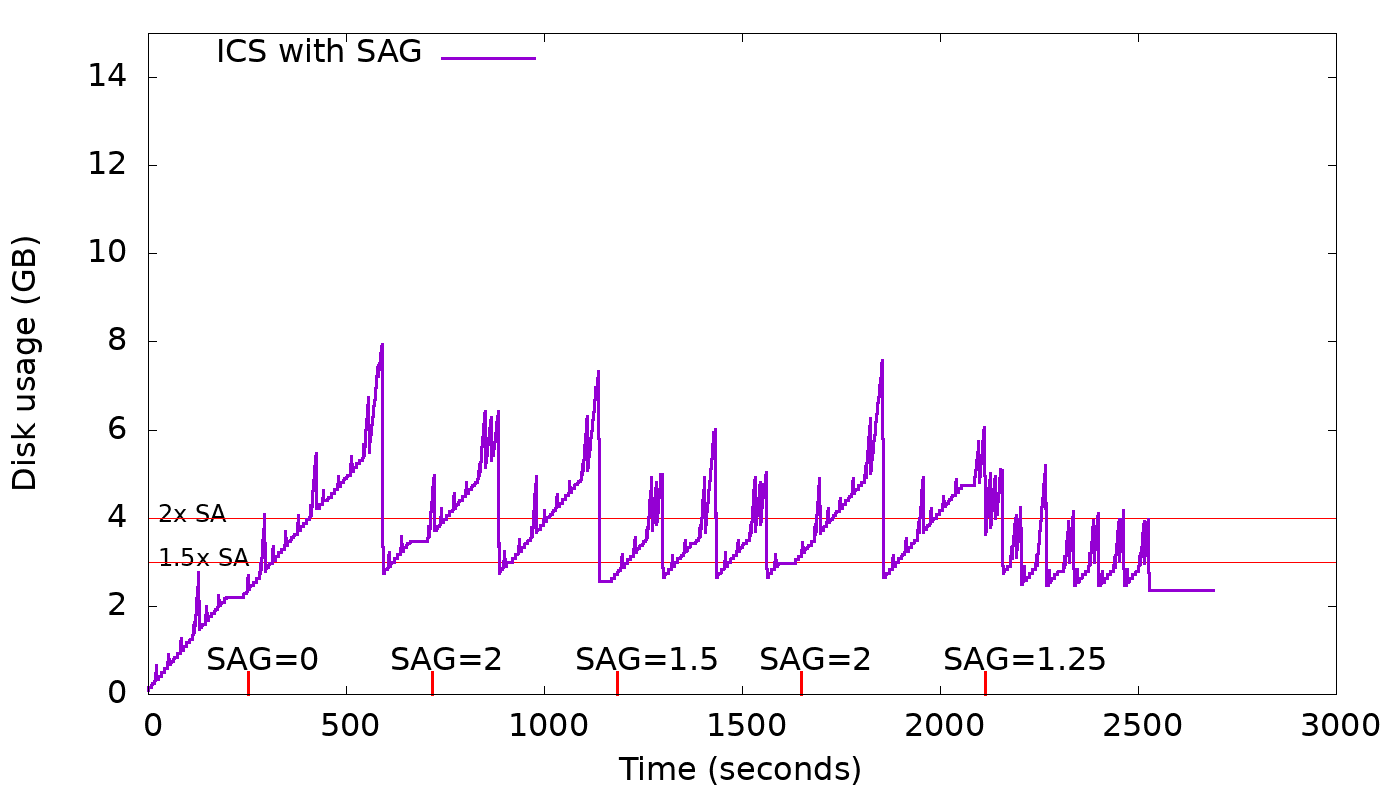
A new option, space_amplification_goal (SAG), is being added to ICS. This option
will allow ICS user to set a goal on the space amplification (SA). It's not
supposed to be an upper bound on the space amplification, but rather, a goal.
This new option will be disabled by default as it doesn't benefit write-only
(no overwrites) workloads and could hurt severely the write performance.
The strategy is free to delay triggering this new behavior, in order to
increase overall compaction efficiency.
The graph below shows how this feature works in practice for different values
of space_amplification_goal:
https://user-images.githubusercontent.com/1409139/89347544-60b7b980-d681-11ea-87ab-e2fdc3ecb9f0.png
When strategy finds space amplification crossed space_amplification_goal, it
will work on reducing the SA by doing a cross-tier compaction on the two
largest tiers. This feature works only on the two largest tiers, because taking
into account others, could hurt the compaction efficiency which is based on
the fact that the more similar-sized sstables are compacted together the higher
the compaction efficiency will be.
With SAG enabled, min_threshold only plays an important role on the smallest
tiers, given that the second-largest tier could be compacted into the largest
tier for a space_amplification_goal value < 2.
By making the options space_amplification_goal and min_threshold independent,
user will be able to tune write amplification and space amplification, based on
the needs. The lower the space_amplification_goal the higher the write
amplification, but by increasing the min threshold, the write amplification
can be decreased to a desired amount.
"
commit 7d90911c5fb3fa891ad64a62147c3a6ca26d61b1
Author: Raphael S. Carvalho <raphaelsc@scylladb.com>
Date: Sat Oct 16 13:41:46 2021 -0300
compaction: ICS: Add garbage collection
Today, ICS lacks an approach to persist expired tombstones in a timely manner,
which is a problem because accumulation of tombstones are known to affecting
latency considerably.
For an expired tombstone to be purged, it has to reach the top of the LSM tree
and hope that older overlapping data wasn't introduced at the bottom.
The condition are there and must be satisfied to avoid data resurrection.
STCS, today, has an inefficient garbage collection approach because it only
picks a single sstable, which satisfies the tombstone density threshold and
file staleness. That's a problem because overlapping data either on same tier
or smaller tiers will prevent tombstones from being purged. Also, nothing is
done to push the tombstones to the top of the tree, for the conditions to be
eventually satisfied.
Due to incremental compaction, ICS can more easily have an effecient GC by
doing cross-tier compaction of relevant tiers.
The trigger will be file staleness and tombstone density, which threshold
values can be configured by tombstone_compaction_interval and
tombstone_threshold, respectively.
If ICS finds a tier which meets both conditions, then that tier and the
larger[1] *and* closest-in-size[2] tier will be compacted together.
[1]: A larger tier is picked because we want tombstones to eventually reach the
top of the tree.
[2]: It also has to be the closest-in-size tier as the smaller the size
difference the higher the efficiency of the compaction. We want to minimize
write amplification as much as possible.
The staleness condition is there to prevent the same file from being picked
over and over again in a short interval.
With this approach, ICS will be continuously working to purge garbage while
not hurting overall efficiency on a steady state, as same-tier compactions are
prioritized.
Signed-off-by: Raphael S. Carvalho <raphaelsc@scylladb.com>
Message-Id: <20211016164146.38010-1-raphaelsc@scylladb.com>
Signed-off-by: Raphael S. Carvalho <raphaelsc@scylladb.com>
Closesscylladb/scylladb#22063
This commit moves the Features page from the section for developers
to the top level in the page tree. This involves:
- Moving the source files to the *features* folder from the *using-scylla* folder.
- Moving images into *features/images* folder.
- Updating references to the moved resources.
- Adding redirections to the moved pages.
Closesscylladb/scylladb#20401
since "read_repair_chance" and "dclocal_read_repair_chance" are
removed, and not supported anymore. let's stop documenting them.

Refs #3502

Signed-off-by: Kefu Chai <kefu.chai@scylladb.com>
The goal is to make the available defaults safe for future use, as they
are often taken from existing config files or documentation verbatim.
Referenced issue: #14290Closesscylladb/scylladb#15947
This commit moves the Glossary page to the Reference
section. In addition, it adds the redirection so that
there are no broken links because of this change
and fixes a link to a subsection of Glossary.
Closes#13664
Related: https://github.com/scylladb/scylladb/issues/13119
This commit removes the pages that describe Enterprise only features
from the Open Source documentation:
- Encryption at Rest
- Workload Prioritization
- LDAP Authorization
- LDAP Authentication
- Audit
In addition, it removes most of the information about Incremental
Compaction Strategy (ICS), which is replaced with links to the
Enterprise documentation.
The changes above required additional updates introduced with this
commit:
- The links to Enterprise-only features are replaced with the
corresponding links in the Enterprise documentation.
- The redirections are added for the removed pages to be redirected to
the corresponding pages in the Enterprise documentation.
This commit must be reverted in the scylla-enterprise repository to
avoid deleting the Enterprise-only content from the Enterprise docs.
Closes#13123
Fix https://github.com/scylladb/scylla-docs/issues/4126Closes#11122
* github.com:scylladb/scylladb:
doc: add info about the time-consuming step due to resharding
doc: add the new KB to the toctree
doc: doc: add a KB about updating the mode in perftune.yaml after upgrade
This PR adds the "ScyllaDB Enterprise" label to highlight the Enterprise-only features on the following pages:
- Encryption at Rest - the label indicates that the entire page is about an Enterprise-only feature.
- Compaction - the labels indicate the sections that are Enterprise-only.
There are more occurrences across the docs that require a similar update. I'll update them in another PR if this PR is approved.
Closes#11918
* github.com:scylladb/scylladb:
doc: fix the links to resolve the warnings
doc: add the Enterprise label on the Compaction page (to a subheading and on a list of strategies) to replace the info box
doc: add the Enterprise label to the Encryption at Rest page (the entire page) to replace the info box