By default it's true, in which case tablet count of the table is
rounded up to a power of two. This option allows lifting this, in
which case the count can be arbitrary. This will allow testing the
logic of arbitrary tablet count.
Introduced a new max_tablet_count tablet option that caps the maximum number of tablets a table can have. This feature is designed primarily for backup and restore workflows.
During backup, when load balancing is disabled for snapshot consistency, the current tablet count is recorded in the backup manifest.
During restore, max_tablet_count is set to this recorded value, ensuring the restored table's tablet count never exceeds the original snapshot's tablet distribution.
This guarantee enables efficient file-based SSTable streaming during restore, as each SSTable remains fully contained within a single tablet boundary.
Closesscylladb/scylladb#28450
Update the documentation about restrictions to tablets keyspaces related
to RF-rack.

* MV/SI require the keyspace to be RF-rack-valid
* topology operations are restricted if a keyspace has views to preserve
  RF-rack-validity
Counters are now supported in tablet-enabled keyspaces, so remove
the documentation that listed counters as an unsupported feature
and the note warning users about the limitation.
Materialized views are currently in the experimental phase and using them
in tablet-based keyspaces requires starting Scylla with an experimental feature,
`views-with-tablets`. Any attempts to create a materialized view or secondary
index when it's not enabled will fail with an appropriate error.
After considerable effort, we're drawing close to bringing views out of the
experimental phase, and the experimental feature will no longer be needed.
However, materialized views in tablet-based keyspaces will still be restricted,
and creating them will only be possible after enabling the configuration option
`rf_rack_valid_keyspaces`. That's what we do in this PR.
In this patch, we adjust existing tests in the tree to work with the new
restriction. That shouldn't have been necessary because we've already seemingly
adjusted all of them to work with the configuration option, but some tests hid
well. We fix that mistake now.
After that, we introduce the new restriction. What's more, when starting Scylla,
we verify that there is no materialized view that would violate the contract.
If there are some that do, we list them, notify the user, and refuse to start.
High-level implementation strategy:
1. Name the restrictions in form of a function.
2. Adjust existing tests.
3. Restrict materialized views by both the experimental feature
and the configuration option. Add validation test.
4. Drop the requirement for the experimental feature. Adjust the added test
and add a new one.
5. Update the user documentation.
Fixesscylladb/scylladb#23030
Backport: 2025.4, as we are aiming to support materialized views for tablets from that version.
Closesscylladb/scylladb#25802
* github.com:scylladb/scylladb:
view: Stop requiring experimental feature
db/view: Verify valid configuration for tablet-based views
db/view: Require rf_rack_valid_keyspaces when creating view
test/cluster/random_failures: Skip creating secondary indexes
test/cluster/mv: Mark test_mv_rf_change as skipped
test/cluster: Adjust MV tests to RF-rack-validity
test/boost/schema_loader_test.cc: Explicitly enable rf_rack_valid_keyspaces
db/view: Name requirement for views with tablets
We modify the requirements for using materialized views in tablet-based
keyspaces. Before, it was necessary to enable the configuration option
`rf_rack_valid_keyspaces`, having the cluster feature `VIEWS_WITH_TABLETS`
enabled, and using the experimental feature `views-with-tablets`.
We drop the last requirement.
We adjust code to that change and provide a new validation test.
We also update the user documentation to reflect the changes.
Fixesscylladb/scylladb#23030
Introduce `ms` -- a new sstable format version which
is a hybrid of Cassandra's `me` and `da`.

It is based on `me`, but with the index components
(Summary.db and Index.db) replaced with the index
components of `da` (Partitions.db and Rows.db).

As of this patch, the version is never chosen
anywhere for writing sstables yet. It is only introduced.
We will add it to unit tests in a later commit,
and expose it to users in yet later commit.
This change adds the documentation section which explains the algorithm
to compute the absolute number of tablets a table has.
Fixes: #25740Closesscylladb/scylladb#25741
initial implementation to support CDC in tablets-enabled keyspaces.
The design is described in https://docs.google.com/document/d/1qO5f2q5QoN5z1-rYOQFu6tqVLD3Ha6pphXKEqbtSNiU/edit?usp=sharing
It is followed closely for the most part except "Deciding when to change streams" - instead, streams are changed synchronously with tablet split / merge.
Instead of the stream switching algorithm with the double writes, we use a scheme similar to the previous method for vnodes - we add the new streams with timestamp that is sufficiently far into the future.
In this PR we:
* add new group0-based internal system tables for tablet stream metadata and loading it into in-memory CDC metadata
* add virtual tables for CDC consumers
* the write coordinator chooses a stream by looking up the appropriate stream in the CDC metadata
* enable creating tables with CDC enabled in tablets-enabled keyspaces. tablets are allocated for the CDC table, and a stream is created per each tablet.
* on tablet resize (split / merge), the topology coordinator creates a new stream set with a new stream for each new tablet.
* the cdc tablets are co-located with the base tablets
Fixes https://github.com/scylladb/scylladb/issues/22576
backport not needed - new feature
update dtests: https://github.com/scylladb/scylla-dtest/pull/5897
update java cdc library: https://github.com/scylladb/scylla-cdc-java/pull/102
update rust cdc library: https://github.com/scylladb/scylla-cdc-rust/pull/136Closesscylladb/scylladb#23795
* github.com:scylladb/scylladb:
docs/dev: update CDC dev docs for tablets
doc: update CDC docs for tablets
test: cluster_events: enable add_cdc and drop_cdc
test/cql: enable cql cdc tests to run with tablets
test: test_cdc_with_alter: adjust for cdc with tablets
test/cqlpy: adjust cdc tests for tablets
test/cluster/test_cdc_with_tablets: introduce cdc with tablets tests
cdc: enable cdc with tablets
topology coordinator: change streams on tablet split/merge
cdc: virtual tables for cdc with tablets
cdc: generate_stream_diff helper function
cdc: choose stream in tablets enabled keyspaces
cdc: rename get_stream to get_vnode_stream
cdc: load tablet streams metadata from tables
cdc: helper functions for reading metadata from tables
cdc: colocate cdc table with base
cdc: remove streams when dropping CDC table
cdc: create streams when allocating tablets
migration_listener: add on_before_allocate_tablet_map notification
cdc: notify when creating or dropping cdc table
cdc: move cdc table creation to pre_create
cdc: add internal tables for cdc with tablets
cdc: add cdc_with_tablets feature flag
cdc: add is_log_schema helper
Capacity based balancing was introduced in 2025.1. It computes balance
based on a node's capacity: the number of tablets located on a node
should be directly proportional to that node's storage capacity.
This change adds this explanation to the docs.
Fixes: #25686Closesscylladb/scylladb#25687
We replace the documentation of the old recovery procedure with the
documentation of the new recovery procedure.
The new recovery procedure requires the Raft-based topology to be
enabled, so to remove the old procedure from the documentation,
we must assume users have the Raft-based topology enabled.
We can do it in 2025.2 because the upgrade guides to 2025.1 state that
enabling the Raft-based topology is a mandatory step of the upgrade.
Another reminder is the upgrade guides to 2025.2.
Since we rely on the Raft-based topology being enabled, we remove the
obsolete parts of the documentation.
We will make the Raft-based topology mandatory in the code in the
future, hopefully in 2025.3. For this reason, we also don't touch the
dev docs in this PR.
Fixesscylladb/scylladb#24530
Requires backport to 2025.2 because 2025.2 contains the new recovery
procedure.
Closesscylladb/scylladb#24583
* github.com:scylladb/scylladb:
docs: rely on the Raft-based topology being enabled
docs: handling-node-failures: document the new recovery procedure
In 2025.2, we don't force enabling the Raft-based topology in the code,
but we stated in the upgrade guides that it's a mandatory step of the
upgrade to 2025.1. We also remind users to enable the Raft-based
topology in the upgrade guides to 2025.2. Hence, we can rely in the
the documentation on the Raft-based topology being enabled. If it is
still disabled, we can just send the user to the upgrade guides. Hence:
- we remove all documentation related to enabling the Raft-based
  topology, enabling the Raft-based schema (enabled Raft-based topology
  implies enabled Raft-based schema), and the gossip-based topology,
- we can replace the documentation of the old manual recovery procedure
  with the documentation of the new manual recovery procedure (done in
  the previous commit).
`tablets_mode_for_new_keyspaces=enforced` enables tablets by default for
new keyspaces, like `tablets_mode_for_new_keyspaces=enabled`.
However, it does not allow to opt-out when creating
new keyspaces by setting `tablets = {'enabled': false}`.

Refs scylladb/scylla-enterprise#4355

Signed-off-by: Benny Halevy <bhalevy@scylladb.com>
The new option deprecates the existing `enable_tablets` option.
It will be extended in the next patch with a 3rd value: "enforced"
while will enable tablets by default for new keyspace but
without the posibility to opt out using the `tablets = {'enabled':
false}` keyspace schema option.

Signed-off-by: Benny Halevy <bhalevy@scylladb.com>
We introduce a new term in the glossary: RF-rack-valid keyspace.
We also highlight in our user documentation that all keyspaces
must remain RF-rack-valid throughout their lifetime, and failing
to guarantee that may result in data inconsistencies or other
issues. We base that information on our experience with materialized
views in keyspaces using tablets, even though they remain
an experimental feature.
Along with the new term, we introduce a new configuration option
called `rf_rack_valid_keyspaces`, which, when enabled, will enforce
preserving all keyspaces RF-rack-valid. That functionality will be
implemented in upcoming commits. For now, we materialize the
restriction in form of a named requirement: a function verifying
that the passed keyspace is RF-rack-valid.
The option is disabled by default. That will change once we adjust
the existing tests to the new semantics. Once that is done, the option
will first be enabled by default, and then it will be removed.
Fixesscylladb/scylladb#20356
This commit adds documentation for zero-token nodes and an explanation
of how to use them to set up an arbiter DC to prevent a quorum loss
in multi-DC deployments.
The commit adds two documents:
- The one in Architecture describes zero-token nodes.
- The other in Cluster Management explains how to use them.
We need separate documents because zero-token nodes may be used
for other purposes in the future.
In addition, the documents are cross-linked, and the link is added
to the Create a ScyllaDB Cluster - Multi Data Centers (DC) document.
Refs https://github.com/scylladb/scylladb/pull/19684
Fixes https://github.com/scylladb/scylladb/issues/20294Closesscylladb/scylladb#21348
This commit adds a link to the Limitations section on the Tablets page
to the CQL pag, the tablets option.
This is actually the place where the user will need the information:
when creating a keyspace.
In addition, I've reorganized the section for better readability
(otherwise, the section about limitations was easy to miss)
and moved the section up on the page.
Note that I've removed the updated content from the `_common` folder
(which I deleted) to the .rst page - we no longer split OSS and Enterprise,
so there's no need to keep using the `scylladb_include_flag` directive
to include OSS- and Ent-specific content.
Fixes https://github.com/scylladb/scylladb/issues/22892
Fixes https://github.com/scylladb/scylladb/issues/22940Closesscylladb/scylladb#22939
This pull request is an implementation of vector data type similar to one used by Apache Cassandra.
The patch contains:
- implementation of vector_type_impl class
- necessary functionalities similar to other data types
- support for serialization and deserialization of vectors
- support for Lua and JSON format
- valid CQL syntax for `vector<>` type
- `type_parser` support for vectors
- expression adjustments such as:
- add `collection_constructor::style_type::vector`
- rename `collection_constructor::style_type::list` to `collection_constructor::style_type::list_or_vector`
- vector type encoding (for drivers)
- unit tests
- cassandra compatibility tests
- necessary documentation
Co-authored-by: @janpiotrlakomy
Fixes https://github.com/scylladb/scylladb/issues/19455Closesscylladb/scylladb#22488
* github.com:scylladb/scylladb:
docs: add vector type documentation
cassandra_tests: translate tests covering the vector type
type_codec: add vector type encoding
boost/expr_test: add vector expression tests
expression: adjust collection constructor list style
expression: add vector style type
test/boost: add vector type cql_env boost tests
test/boost: add vector type_parser tests
type_parser: support vector type
cql3: add vector type syntax
types: implement vector_type_impl
This commit adds the information about SStable version support in 2025.1
by replacing "2022.2" with "2022.2 and above".
In addition, this commit removes information about versions that are
no longer supported.
Fixes https://github.com/scylladb/scylladb/issues/22485Closesscylladb/scylladb#22486
Add missing vector type documentation including: definition of vector,
adjustment of term definition, JSON encoding, Lua and cql3 type
mapping, vector dimension limit, and keyword specification.
File based stream is a new feature that optimizes tablet movement
significantly. It streams the entire SSTable files without deserializing
SSTable files into mutation fragments and re-serializing them back into
SSTables on receiving nodes. As a result, less data is streamed over the
network, and less CPU is consumed, especially for data models that
contain small cells.
The following patches are imported from the scylla enterprise:
*) Merge 'Introduce file stream for tablet' from Asias He
This patch uses Seastar RPC stream interface to stream sstable files on
network for tablet migration.
It streams sstables instead of mutation fragments. The file based
stream has multiple advantages over the mutation streaming.
- No serialization or deserialization for mutation fragments
- No need to read and process each mutation fragments
- On wire data is more compact and smaller
In the test below, a significant speed up is observed.
Two nodes, 1 shard per node, 1 initial_tablets:
- Start node 1
- Insert 10M rows of data with c-s
- Bootstrap node 2
Node 1 will migration data to node2 with the file stream.
Test results:
1) File stream: bytes on wire = 1132006250 bytes, bw = 836MB/s
[shard 0:stre] stream_blob - stream_sstables[eadaa8e0-a4f2-4cc6-bf10-39ad1ce106b0]
Finished sending sstable_nr=2 files_nr=18 files={} range=(-1,9223372036854775807] bytes_sent=1132006250 stream_bw=836MB/s
[shard 0:stre] storage_service - Streaming for tablet migration of a4f68900-568a-11ee-b7b9-c2b13945eed2:1 took 1.08004s seconds
2) Mutation stream: bytes on wire = 3030004736 bytes, bw = 125410.87 KiB/s = 128MB/s
[shard 0:stre] stream_session - [Stream #406dc8b0-56b5-11ee-bc2d-000bf4871058]
Streaming plan for Tablet migration-ks1-index-0 succeeded, peers={127.0.0.1}, tx=0 KiB, 0.00 KiB/s, rx=2958989 KiB, 125410.87 KiB/s
[shard 0:stre] storage_service - Streaming for tablet migration of a4f68900-568a-11ee-b7b9-c2b13945eed2:1 took 23.5992s seconds
Test Summary:
File stream v.s. Mutation stream improvements
- Stream bandwidth = 836 / 128 (MB/s) = 6.53X
- Stream time = 23.60 / 1.08 (Seconds) = 21.85X
- Stream bytes on wire = 3030004736 / 1132006250 (Bytes)= 2.67X
Closes scylladb/scylla-enterprise#3438
* github.com:scylladb/scylla-enterprise:
tests: Add file_stream_test
streaming: Implement file stream for tablet
*) streaming: Use new take_storage_snapshot interface
The new take_storage_snapshot returns a file object instead of a file
name. This allows the file stream sender to read from the file even if
the file is deleted by compaction.
Closes scylladb/scylla-enterprise#3728
*) streaming: Protect unsupported file types for file stream
Currently, we assume the file streamed over the stream_blob rpc verb is
a sstable file. This patch rejects the unsupported file types on the
receiver side. This allows us to stream more file types later using the
current file stream infrastructure without worrying about old nodes
processing the new file types in the wrong way.
- The file_ops::noop is renamed to file_ops::stream_sstables to be
explicit about the file types
- A missing test_file_stream_error_injection is added to the idl
Fixes: #3846
Tests: test_unsupported_file_ops
Closesscylladb/scylla-enterprise#3847
*) idl: Add service::session_id id to idl
It will be used in the next patch.
Refs #3907
*) streaming: Protect file stream with topology_guard
Similar to "storage_service, tablets: Use session to guard tablet
streaming", this patch protects file stream with topology_guard.
Fixes#3907
*) streaming: Take service topology_guard under the try block
Taking the service::topology_guard could throw. Currently, it throws
outside the try block, so the rpc sink will not be closed, causing the
following assertion:
```
scylla: seastar/include/seastar/rpc/rpc_impl.hh:815: virtual
seastar::rpc::sink_impl<netw::serializer,
streaming::stream_blob_cmd_data>::~sink_impl() [Serializer =
netw::serializer, Out = <streaming::stream_blob_cmd_data>]: Assertion
`this->_con->get()->sink_closed()' failed.
```
To fix, move more code including the topology_guard taking code to the
try block.
Fixes https://github.com/scylladb/scylla-enterprise/issues/4106Closesscylladb/scylla-enterprise#4110
*) Merge 'Preserve original SSTable state with file based tablet migration' from Raphael "Raph" Carvalho
We're not preserving the SSTable state across file based migration, so
staging SSTables for example are being placed into main directory, and
consequently, we're mixing staging and non-staging data, losing the
ability to continue from where the old replica left off.
It's expected that the view update backlog is transferred from old
into new replica, as migration doesn't wait for leaving replica to
complete view update work (which can take long). Elasticity is preferred.
So this fix guarantees that the state of the SSTable will be preserved
by propagating it in form of subdirectory (each subdirectory is
statically mapped with a particular state).
The staging sstables aren't being registered into view update generator
yet, as that's supposed to be fixed in OSS (more details can be found
at https://github.com/scylladb/scylladb/issues/19149).
Fixes#4265.
Closesscylladb/scylla-enterprise#4267
* github.com:scylladb/scylla-enterprise:
tablet: Preserve original SSTable state with file based tablet migration
sstables: Add get method for sstable state
*) sstable: (Re-)add shareabled_components getter
*) Merge 'File streaming sstables: Use sstable source/sink to transfer snapshots' from Calle Wilund
Fixes#4246
Alternative approach/better separation of concern, transport vs. sstable layer. Builds on #4472, but fancier.
Ensures we transfer and pre-process scylla metadata for streamed
file blobs first, then properly apply receiving nodes local config
by using a source and sink layer exported from sstables, which
handles things like ordering, metadata filtering (on source) as well
as handling metadata and proper IO paths when writing data on
receiver node (sink).
This implementation maintains the statelessness of the current
design, and the delegated sink side will re-read and re-write the
metadata for each component processed. This is a little wasteful,
but the meta is small, and it is less error prone than trying to do
caching cross-shards etc. The transport is isolated from the
knowledge.
This is an alternative/complement to #4436 and #4472, fixing the
underlying issue. Note that while the layers/API:s here allows easy
fixing of other fundamental problems in the feature (such as
destination location etc), these are not included in the PR, to keep
it as close to the current behaviour as possible.
Closesscylladb/scylla-enterprise#4646
* github.com:scylladb/scylla-enterprise:
raft_tests: Copy/add a topology test with encryption
file streaming: Use sstable source/sink to transfer snapshots
sstables: Add source and sink objects + producers for transfering a snapshot
sstable::types: Add remove accessor for extension info in metadata
*) The change for error injection in merge commit 966ea5955dd8760:
File streaming now has "stream_mutation_fragments" error injection points
so test_table_dropped_during_streaming works with file streaming.
*) doc: document file-based streaming
This commit adds a description of the file-based streaming feature to the documentation.
It will be displayed in the docs using the scylladb_include_flag directive after
https://github.com/scylladb/scylladb/pull/20182 is merged, backported to branch-6.0,
and, in turn, branch-2024.2.
Refs https://github.com/scylladb/scylla-enterprise/issues/4585
Refs https://github.com/scylladb/scylla-enterprise/issues/4254Closesscylladb/scylla-enterprise#4587
*) doc: move File-based streaming to the Tablets source file-based-streaming
This commit moves the description of file-based streaming from a common include file
to the regular doc source file where tablets are described.
Closesscylladb/scylla-enterprise#4652
*) streaming: sstable_stream_sink_impl: abort: prevent null pointer dereference
Closesscylladb/scylladb#22467
File based stream is a new feature that optimizes tablet movement
significantly. It streams the entire SSTable files without deserializing
SSTable files into mutation fragments and re-serializing them back into
SSTables on receiving nodes. As a result, less data is streamed over the
network, and less CPU is consumed, especially for data models that
contain small cells.
The following patches are imported from the scylla enterprise:
*) Merge 'Introduce file stream for tablet' from Asias He
This patch uses Seastar RPC stream interface to stream sstable files on
network for tablet migration.
It streams sstables instead of mutation fragments. The file based
stream has multiple advantages over the mutation streaming.
- No serialization or deserialization for mutation fragments
- No need to read and process each mutation fragments
- On wire data is more compact and smaller
In the test below, a significant speed up is observed.
Two nodes, 1 shard per node, 1 initial_tablets:
- Start node 1
- Insert 10M rows of data with c-s
- Bootstrap node 2
Node 1 will migration data to node2 with the file stream.
Test results:
1) File stream: bytes on wire = 1132006250 bytes, bw = 836MB/s
[shard 0:stre] stream_blob - stream_sstables[eadaa8e0-a4f2-4cc6-bf10-39ad1ce106b0]
Finished sending sstable_nr=2 files_nr=18 files={} range=(-1,9223372036854775807] bytes_sent=1132006250 stream_bw=836MB/s
[shard 0:stre] storage_service - Streaming for tablet migration of a4f68900-568a-11ee-b7b9-c2b13945eed2:1 took 1.08004s seconds
2) Mutation stream: bytes on wire = 3030004736 bytes, bw = 125410.87 KiB/s = 128MB/s
[shard 0:stre] stream_session - [Stream #406dc8b0-56b5-11ee-bc2d-000bf4871058]
Streaming plan for Tablet migration-ks1-index-0 succeeded, peers={127.0.0.1}, tx=0 KiB, 0.00 KiB/s, rx=2958989 KiB, 125410.87 KiB/s
[shard 0:stre] storage_service - Streaming for tablet migration of a4f68900-568a-11ee-b7b9-c2b13945eed2:1 took 23.5992s seconds
Test Summary:
File stream v.s. Mutation stream improvements
- Stream bandwidth = 836 / 128 (MB/s) = 6.53X
- Stream time = 23.60 / 1.08 (Seconds) = 21.85X
- Stream bytes on wire = 3030004736 / 1132006250 (Bytes)= 2.67X
Closes scylladb/scylla-enterprise#3438
* github.com:scylladb/scylla-enterprise:
tests: Add file_stream_test
streaming: Implement file stream for tablet
*) streaming: Use new take_storage_snapshot interface
The new take_storage_snapshot returns a file object instead of a file
name. This allows the file stream sender to read from the file even if
the file is deleted by compaction.
Closes scylladb/scylla-enterprise#3728
*) streaming: Protect unsupported file types for file stream
Currently, we assume the file streamed over the stream_blob rpc verb is
a sstable file. This patch rejects the unsupported file types on the
receiver side. This allows us to stream more file types later using the
current file stream infrastructure without worrying about old nodes
processing the new file types in the wrong way.
- The file_ops::noop is renamed to file_ops::stream_sstables to be
explicit about the file types
- A missing test_file_stream_error_injection is added to the idl
Fixes: #3846
Tests: test_unsupported_file_ops
Closesscylladb/scylla-enterprise#3847
*) idl: Add service::session_id id to idl
It will be used in the next patch.
Refs #3907
*) streaming: Protect file stream with topology_guard
Similar to "storage_service, tablets: Use session to guard tablet
streaming", this patch protects file stream with topology_guard.
Fixes#3907
*) streaming: Take service topology_guard under the try block
Taking the service::topology_guard could throw. Currently, it throws
outside the try block, so the rpc sink will not be closed, causing the
following assertion:
```
scylla: seastar/include/seastar/rpc/rpc_impl.hh:815: virtual
seastar::rpc::sink_impl<netw::serializer,
streaming::stream_blob_cmd_data>::~sink_impl() [Serializer =
netw::serializer, Out = <streaming::stream_blob_cmd_data>]: Assertion
`this->_con->get()->sink_closed()' failed.
```
To fix, move more code including the topology_guard taking code to the
try block.
Fixes https://github.com/scylladb/scylla-enterprise/issues/4106Closesscylladb/scylla-enterprise#4110
*) Merge 'Preserve original SSTable state with file based tablet migration' from Raphael "Raph" Carvalho
We're not preserving the SSTable state across file based migration, so
staging SSTables for example are being placed into main directory, and
consequently, we're mixing staging and non-staging data, losing the
ability to continue from where the old replica left off.
It's expected that the view update backlog is transferred from old
into new replica, as migration doesn't wait for leaving replica to
complete view update work (which can take long). Elasticity is preferred.
So this fix guarantees that the state of the SSTable will be preserved
by propagating it in form of subdirectory (each subdirectory is
statically mapped with a particular state).
The staging sstables aren't being registered into view update generator
yet, as that's supposed to be fixed in OSS (more details can be found
at https://github.com/scylladb/scylladb/issues/19149).
Fixes#4265.
Closesscylladb/scylla-enterprise#4267
* github.com:scylladb/scylla-enterprise:
tablet: Preserve original SSTable state with file based tablet migration
sstables: Add get method for sstable state
*) sstable: (Re-)add shareabled_components getter
*) Merge 'File streaming sstables: Use sstable source/sink to transfer snapshots' from Calle Wilund
Fixes#4246
Alternative approach/better separation of concern, transport vs. sstable layer. Builds on #4472, but fancier.
Ensures we transfer and pre-process scylla metadata for streamed
file blobs first, then properly apply receiving nodes local config
by using a source and sink layer exported from sstables, which
handles things like ordering, metadata filtering (on source) as well
as handling metadata and proper IO paths when writing data on
receiver node (sink).
This implementation maintains the statelessness of the current
design, and the delegated sink side will re-read and re-write the
metadata for each component processed. This is a little wasteful,
but the meta is small, and it is less error prone than trying to do
caching cross-shards etc. The transport is isolated from the
knowledge.
This is an alternative/complement to #4436 and #4472, fixing the
underlying issue. Note that while the layers/API:s here allows easy
fixing of other fundamental problems in the feature (such as
destination location etc), these are not included in the PR, to keep
it as close to the current behaviour as possible.
Closesscylladb/scylla-enterprise#4646
* github.com:scylladb/scylla-enterprise:
raft_tests: Copy/add a topology test with encryption
file streaming: Use sstable source/sink to transfer snapshots
sstables: Add source and sink objects + producers for transfering a snapshot
sstable::types: Add remove accessor for extension info in metadata
*) The change for error injection in merge commit 966ea5955dd8760:
File streaming now has "stream_mutation_fragments" error injection points
so test_table_dropped_during_streaming works with file streaming.
*) doc: document file-based streaming
This commit adds a description of the file-based streaming feature to the documentation.
It will be displayed in the docs using the scylladb_include_flag directive after
https://github.com/scylladb/scylladb/pull/20182 is merged, backported to branch-6.0,
and, in turn, branch-2024.2.
Refs https://github.com/scylladb/scylla-enterprise/issues/4585
Refs https://github.com/scylladb/scylla-enterprise/issues/4254Closesscylladb/scylla-enterprise#4587
*) doc: move File-based streaming to the Tablets source file-based-streaming
This commit moves the description of file-based streaming from a common include file
to the regular doc source file where tablets are described.
Closesscylladb/scylla-enterprise#4652
*) streaming: sstable_stream_sink_impl: abort: prevent null pointer dereference
Closesscylladb/scylladb#22034
ICS is a compaction strategy that inherits size tiered properties --
therefore it's write optimized too -- but fixes its space overhead of
100% due to input files being only released on completion. That's
achieved with the concept of sstable run (similar in concept to LCS
levels) which breaks a large sstable into fixed-size chunks (1G by
default), known as run fragments. ICS picks similar-sized runs
for compaction, and fragments of those runs can be released
incrementally as they're compacted, reducing the space overhead
to about (number_of_input_runs * 1G). This allows user to increase
storage density of nodes (from 50% to ~80%), reducing the cost of
ownership.
NOTE: test_system_schema_version_is_stable adjusted to account for batchlog
using IncrementalCompactionStrategy
contains:
compaction/: added incremental_compaction_strategy.cc (.hh), incremental_backlog_tracker.cc (.hh)
compaction/CMakeLists.txt: include ICS cc files
configure.py: changes for ICS files, includes test
db/legacy_schema_migrator.cc / db/schema_tables.cc: fallback to ICS when strategy is not supported
db/system_keyspace: pick ICS for some system tables
schema/schema.hh: ICS becomes default
test/boost: Add incremental_compaction_test.cc
test/boost/sstable_compaction_test.cc: ICS related changes
test/cqlpy/test_compaction_strategy_validation.py: ICS related changes
docs/architecture/compaction/compaction-strategies.rst: changes to ICS section
docs/cql/compaction.rst: changes to ICS section
docs/cql/ddl.rst: adds reference to ICS options
docs/getting-started/system-requirements.rst: updates sentence mentioning ICS
docs/kb/compaction.rst: changes to ICS section
docs/kb/garbage-collection-ics.rst: add file
docs/kb/index.rst: add reference to <garbage-collection-ics>
docs/operating-scylla/procedures/tips/production-readiness.rst: add ICS section
some relevant commits throughout the ICS history:
commit 434b97699b39c570d0d849d372bf64f418e5c692
Merge: 105586f747 30250749b8
Author: Paweł Dziepak <pdziepak@scylladb.com>
Date: Tue Mar 12 12:14:23 2019 +0000
Merge "Introduce Incremental Compaction Strategy (ICS)" from Raphael
"
Introduce new compaction strategy which is essentially like size tiered
but will work with the existing incremental compaction. Thus incremental
compaction strategy.
It works like size tiered, but each element composing a tier is a sstable
run, meaning that the compaction strategy will look for N similar-sized
sstable runs to compact, not just individual sstables.
Parameters:
* "sstable_size_in_mb": defines the maximum sstable (fragment) size
composing
a sstable run, which impacts directly the disk space requirement which is
improved with incremental compaction.
The lower the value the lower the space requirement for compaction because
fragments involved will be released more frequently.
* all others available in size tiered compaction strategy
HOWTO
=====
To change an existing table to use it, do:
ALTER TABLE mykeyspace.mytable WITH compaction =
{'class' : 'IncrementalCompactionStrategy'};
Set fragment size:
ALTER TABLE mykeyspace.mytable WITH compaction =
{'class' : 'IncrementalCompactionStrategy', 'sstable_size_in_mb' : 1000 }
"
commit 94ef3cd29a196bedbbeb8707e20fe78a197f30a1
Merge: dca89ce7a5 e08ef3e1a3
Author: Avi Kivity <avi@scylladb.com>
Date: Tue Sep 8 11:31:52 2020 +0300
Merge "Add feature to limit space amplification in Incremental Compaction" from Raphael
"
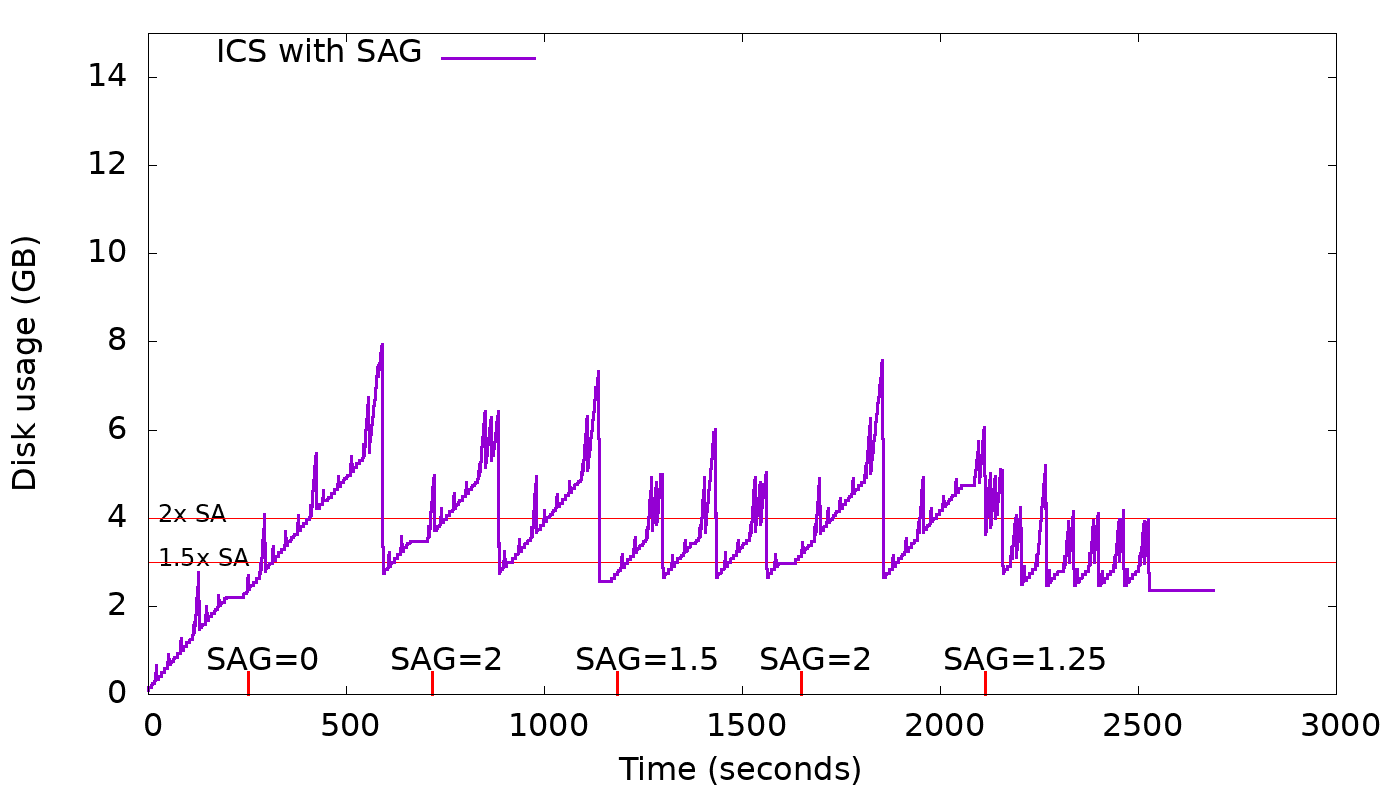
A new option, space_amplification_goal (SAG), is being added to ICS. This option
will allow ICS user to set a goal on the space amplification (SA). It's not
supposed to be an upper bound on the space amplification, but rather, a goal.
This new option will be disabled by default as it doesn't benefit write-only
(no overwrites) workloads and could hurt severely the write performance.
The strategy is free to delay triggering this new behavior, in order to
increase overall compaction efficiency.
The graph below shows how this feature works in practice for different values
of space_amplification_goal:
https://user-images.githubusercontent.com/1409139/89347544-60b7b980-d681-11ea-87ab-e2fdc3ecb9f0.png
When strategy finds space amplification crossed space_amplification_goal, it
will work on reducing the SA by doing a cross-tier compaction on the two
largest tiers. This feature works only on the two largest tiers, because taking
into account others, could hurt the compaction efficiency which is based on
the fact that the more similar-sized sstables are compacted together the higher
the compaction efficiency will be.
With SAG enabled, min_threshold only plays an important role on the smallest
tiers, given that the second-largest tier could be compacted into the largest
tier for a space_amplification_goal value < 2.
By making the options space_amplification_goal and min_threshold independent,
user will be able to tune write amplification and space amplification, based on
the needs. The lower the space_amplification_goal the higher the write
amplification, but by increasing the min threshold, the write amplification
can be decreased to a desired amount.
"
commit 7d90911c5fb3fa891ad64a62147c3a6ca26d61b1
Author: Raphael S. Carvalho <raphaelsc@scylladb.com>
Date: Sat Oct 16 13:41:46 2021 -0300
compaction: ICS: Add garbage collection
Today, ICS lacks an approach to persist expired tombstones in a timely manner,
which is a problem because accumulation of tombstones are known to affecting
latency considerably.
For an expired tombstone to be purged, it has to reach the top of the LSM tree
and hope that older overlapping data wasn't introduced at the bottom.
The condition are there and must be satisfied to avoid data resurrection.
STCS, today, has an inefficient garbage collection approach because it only
picks a single sstable, which satisfies the tombstone density threshold and
file staleness. That's a problem because overlapping data either on same tier
or smaller tiers will prevent tombstones from being purged. Also, nothing is
done to push the tombstones to the top of the tree, for the conditions to be
eventually satisfied.
Due to incremental compaction, ICS can more easily have an effecient GC by
doing cross-tier compaction of relevant tiers.
The trigger will be file staleness and tombstone density, which threshold
values can be configured by tombstone_compaction_interval and
tombstone_threshold, respectively.
If ICS finds a tier which meets both conditions, then that tier and the
larger[1] *and* closest-in-size[2] tier will be compacted together.
[1]: A larger tier is picked because we want tombstones to eventually reach the
top of the tree.
[2]: It also has to be the closest-in-size tier as the smaller the size
difference the higher the efficiency of the compaction. We want to minimize
write amplification as much as possible.
The staleness condition is there to prevent the same file from being picked
over and over again in a short interval.
With this approach, ICS will be continuously working to purge garbage while
not hurting overall efficiency on a steady state, as same-tier compactions are
prioritized.
Signed-off-by: Raphael S. Carvalho <raphaelsc@scylladb.com>
Message-Id: <20211016164146.38010-1-raphaelsc@scylladb.com>
Signed-off-by: Raphael S. Carvalho <raphaelsc@scylladb.com>
Closesscylladb/scylladb#22063
With the tablets feature always enabled (Unless gossip toopology
changes are forced), the enable_tablets option now controls only
the default for newly created keyspaces.

Even when set to `false`, tablets are still enabled as a
feature and the user may explicitly enable tablets
using `CREATE KEYSPACE <name> WITH tablets = {'enabled': true}`

Note: best viewed with `git show -w`

Signed-off-by: Benny Halevy <bhalevy@scylladb.com>
This reverts commit c286434e4c, reversing
changes made to 6712fcc316.

The commit causes memtable_test to be very flaky in debug mode.
Specifically, subtests test_exceptions_in_flush_on_sstable_open
and test_exceptions_in_flush_on_sstable_write).
With the tablets feature always enabled (Unless gossip toopology
changes are forced), the enable_tablets option now controls only
the default for newly created keyspaces.

Even when set to `false`, tablets are still enabled as a
feature and the user may explicitly enable tablets
using `CREATE KEYSPACE <name> WITH tablets = {'enabled': true}`

Note: best viewed with `git show -w`

Signed-off-by: Benny Halevy <bhalevy@scylladb.com>
This commit moves the Features page from the section for developers
to the top level in the page tree. This involves:
- Moving the source files to the *features* folder from the *using-scylla* folder.
- Moving images into *features/images* folder.
- Updating references to the moved resources.
- Adding redirections to the moved pages.
Closesscylladb/scylladb#20401
In this commit, we describe the mechanism of sync point
in Hinted Handoff in the user documentation. We explain
the motivation for it and how to use it, as well as list
and describe all of the parameters involved in the process.
Errors that may appear and experienced by the user
are addressed in the article.
Fixesscylladb/scylladb#18500Closesscylladb/scylladb#19686
This commit removes the 5.4-to-6.0 upgrade guide and all references to it.
It mainly removes references to the Enable Consistent Topology Updates page,
which was added as enabling the feature was optional.
In rare cases, when a reference to that page is necessary,
the internal link is replaced with an external link to version 6.0.
Especially the Handling Cluster Membership Change Failures page was modified
for troubleshooting purposes rather than removed.
This commit adds the main description of tablets and their
benefits.
The article can be used as a reference in other places
across the docs where we mention tablets.
Closesscylladb/scylladb#18619
This commit updates the documentation about Raft in version 6.0.
- "Introduction": The outdated information about consistent topology updates not being supported
is removed and replaced with the correct information.
- "Enabling Raft": The relevant information is moved to other sections. The irrelevant information
is removed. The section no longer exists.
- "Verifying that the Raft upgrade procedure finished successfully" - moved under Schema
(in the same document). I additionally removed the include saying that after you verify
that schema on Raft is enabled, you MUST enable topology changes on Raft (it is not mandatory;
also, it should be part of the upgrade guide, not the Raft document).
- Unnecessary or incorrect references to versions are removed.
Refs https://github.com/scylladb/scylladb/issues/18580Closesscylladb/scylladb#18689
This PR:
- Removes the `.. only:: opensource` directive from Consistent Topology with Raft.
This feature is no longer an Open Source-only experimental feature.
- Removes redundant version-specific information.
- Moves the necessary version-specific information to a separate file.
This is a follow-up to 55b011902e.
Refs https://github.com/scylladb/scylladb/pull/18285/Closesscylladb/scylladb#18553