The series overhauls the compaction_manager::task design and implementation
by properly layering the functionality between the compaction_manager
that deals with generic task execution, and the per-task business logic that is defined
in a set of classes derived from the generic task class.
While at it, the series introduces `task::state` and a set of helper functions to manage it
to prevent leaks in the statistics, fixing #9974.
Two more stats counter were exposed: `completed_tasks` and a new `postponed_tasks`.
Test: sstable_compaction_test
Dtest: compaction_test.py compaction_additional_test.py
Fixes#9974Closes#10122
* github.com:scylladb/scylla:
compaction_manager: use coroutine::switch_to
compaction_manager::task: drop _compaction_running
compaction_manager: move per-type logic to derived task
compaction_manager: task: add state enum
compaction_manager: task: add maybe_retry
compaction_manager: reevaluate_postponed_compactions: mark as noexcept
compaction_manager: define derived task types
compaction_manager: register_metrics: expose postponed_compactions
compaction_manager: register_metrics: expose failed_compactions
compaction_manager: register_metrics: expose _stats.completed_tasks
compaction: add documentation for compaction_type to string conversions
compaction: expose to_string(compaction_type)
compaction_manager: task: standardize task description in log messages
compaction_manager: refactor can_proceed
compaction_manager: pass compaction_manager& to task ctor
compaction_manager: use shared_ptr<task> rather than lw_shared_ptr
compaction_manager: rewrite_sstables: acquire _maintenance_ops_sem once
compaction_manager: use compaction_state::lock only to synchronize major and regular compaction
Saving an allocation for running the functor
as a task in the switched-to scheduling group.

Also, switch to the desired scheduling group at
the beginning of the task so that the higher level logic,
like getting the list of sstables to compact
will be performed under the desired scheduling group,
not only the compaction code itself.

Signed-off-by: Benny Halevy <bhalevy@scylladb.com>
Replace the _compaction_running boolean member
by calculating _state == state::active
now that setup_new_compaction switches state to
`active`

Signed-off-by: Benny Halevy <bhalevy@scylladb.com>
Move the business logic into the task specific classes.
Separating initialization during task construction,
from the compaction_done task, moved into
a do_run() method, and in some cases moving
a lambda function that was called per table (as in
rewrite_sstables) into a private method of the
derived class.

Signed-off-by: Benny Halevy <bhalevy@scylladb.com>
Add an enum class representing the task state machine
and a switch_state function to transition between the states
and update the corresponding compaction_manager stats counters.

Refs #9974

Signed-off-by: Benny Halevy <bhalevy@scylladb.com>
To be used in the next patch to generate
a string dscription from the compaction_type.

In theory, we could use compaction_name()
btu the latter returns the compaction type
in all-upper case and that is very different from
what we print to the log today.  The all-upper
strings are used for the api layer, e.g. to
stop tasks of a particular compaction type.

Signed-off-by: Benny Halevy <bhalevy@scylladb.com>
Define task::describe and use it via operator<<
to print the task metadata to the log in a standard way.

Signed-off-by: Benny Halevy <bhalevy@scylladb.com>
Move the task-internal parts of can_proceed
to a respective compaction_manager::task method,
preparing for turning it into a class with
a proper hierarchy of access to private members.

Signed-off-by: Benny Halevy <bhalevy@scylladb.com>
And use it to get the compaction state of the
table to compact.

It will be used in a later patch
to manage the task state from task
methods.

Signed-off-by: Benny Halevy <bhalevy@scylladb.com>
Like all other maintenance operations, acquire the _maintenance_ops_sem
once for the whole task, rather than for each sstable.

Signed-off-by: Benny Halevy <bhalevy@scylladb.com>
Maintenance operations like cleanup, upgrade, reshape, and reshard
are serialized serialized with major compaction using the _maintenance_ops_sem
and they need no further synchronization with regular compaction
by acquiring the per-table read lock..

Signed-off-by: Benny Halevy <bhalevy@scylladb.com>
The sstables::sstable class has two methods for writing sstables:
1) sstable_writer get_writer(...);
2) future<> write_components(flat_mutation_reader, ...);

(1) directly exposes the writer type, so we have to update all users of
it (there is not that many) in this same patch. We defer updating
users of (2) to a follow-up commits.
Since regular compaction may run in parallel no lock
is required per-table.
We still acquire a read lock in this patch, for backporting
purposes, in case the branch doesn't contain
6737c88045.
But it can be removed entirely in master in a follow-up patch.
This should solve some of the slowness in cleanup compaction (and
likely in upgrade sstables seen in #10060, and
possibly #10166.
Fixes#10175
Signed-off-by: Benny Halevy <bhalevy@scylladb.com>
Closes#10177
Info messages are logged when compaction jobs start and finish
but there is no message logged when the job is interrupted, e.g.
when stopped by the compaction_manager.

Refs scylladb/scylla-dtest#2468

Signed-off-by: Benny Halevy <bhalevy@scylladb.com>
Simplify the function by implementing it as a coroutine,
ensuring the input vector, holding the shared task ptrs, is
kept alive throughout the lifetime of the function
(instead of using do_with to achieve that)

Signed-off-by: Benny Halevy <bhalevy@scylladb.com>
Message-Id: <20220302081547.2205813-2-bhalevy@scylladb.com>
task_stop is called exclusively from stop_tasks,
Now that stop_tasks calls task::stop() directly,
there is no need for this separation, so open-code
task_stop in stop_tasks, using coroutines.

Signed-off-by: Benny Halevy <bhalevy@scylladb.com>
Message-Id: <20220302081547.2205813-1-bhalevy@scylladb.com>
It was assumed that offstrategy compaction is always triggered by streaming/repair
where it would inherit the caller's scheduling group.
However, offstrategy is triggered by a timer via table::_off_strategy_trigger so I don't see
how the expiration of this timer will inherit anything from streaming/repair.
Also, since d309a86, offstrategy compaction
may be triggered by the api where it will run in the default scheduling group.
The bottom line is that the compaction manager needs to explicitly perform offstrategy compaction
in the maintenance scheduling group similar to `perform_sstable_scrub_validate_mode`.
Fixes#10151
Signed-off-by: Benny Halevy <bhalevy@scylladb.com>
Message-Id: <20220302084821.2239706-1-bhalevy@scylladb.com>
Introduced in commit: ddd693c6d7

We're not emplacing newer windows in the tracker, causing
std::out_of_range when replacing sstables for windows.

Let's fix the logic and add an unit test to cover this.

Signed-off-by: Raphael S. Carvalho <raphaelsc@scylladb.com>
Message-Id: <20220301194944.95096-1-raphaelsc@scylladb.com>
Currently the output_run_identifier is assigned right
after the calling setup_new_compaction.
Move setting the uuid to setup_new_compaction to simplify
the flow.

Signed-off-by: Benny Halevy <bhalevy@scylladb.com>
Message-Id: <20220301083643.1845096-1-bhalevy@scylladb.com>
Instead, rely solely on compaction_data.abort source
that is task::stop now uses to stop the task.

This makes task stopping permanent, so it can't be undone
(as used to be the case where task_stop
set stopping to false after waiting for compaction_done,
to allow rerite_sstables's task to be created before
calling run_with_compaction_disabled, and start
running after it - which is no longer the case)

Signed-off-by: Benny Halevy <bhalevy@scylladb.com>
Message-Id: <20220301083535.1844829-1-bhalevy@scylladb.com>
Currently, rewrite_sstables retrieved the sstables under
run_with_compaction_disabled, *after* it's created a task for itself.

This makes little sense as this task have not started running yet
and therefore does not need to be stopped by
run_with_compaction_disabled.

This is currently worked around by setting task->stopping = false
in task_stop().

This change just moves task create in rewrite_sstables till
after the sstables are retrieved and the deferred cleanup
of _stats.pending_tasks till after it's first adjusted.

Signed-off-by: Benny Halevy <bhalevy@scylladb.com>
Message-Id: <20220301083409.1844500-1-bhalevy@scylladb.com>
Rather than using a std::optional<compacting_sstable_registration>
for lazy construction, construct the object early
and call register_compacting when the sstables to register
are available.

Signed-off-by: Benny Halevy <bhalevy@scylladb.com>
Rather than a compaction_manager* so that in the next
patch it could be constructed with just that and
the caller can call register_compacting when
it has the sstables to register ready.

Signed-off-by: Benny Halevy <bhalevy@scylladb.com>
"
Problem statement
=================
Today, compaction can act much more aggressive than it really has to, because
the strategy and its definition of backlog are completely decoupled.

The backlog definition for size-tiered, which is inherited by all
strategies (e.g.: LCS L0, TWCS' windows), is built on the assumption that the
world must reach the state of zero amplification. But that's unrealistic and
goes against the intent amplification defined by the compaction strategy.
For example, size tiered is a write oriented strategy which allows for extra
space amplification for compaction to keep up with the high write rate.

It can be seen today, in many deployments, that compaction shares is either
close to 1000, or even stuck at 1000, even though there's nothing to be done,
i.e. the compaction strategy is completely satisfied.
When there's a single sstable per tier, for example.
This means that whenever a new compaction job kicks in, it will act much more
aggressive because of the high shares, caused by false backlog of the existing
tables. This translates into higher P99 latencies and reduced throughput.

Solution
========
This problem can be fixed, as proposed in the document "Fixing compaction
aggressiveness due to suboptimal definition of zero backlog by controller" [1],
by removing backlog of tiers that don't have to be compacted now, like a tier
that has a single file. That's about coupling the strategy goal with the
backlog definition. So once strategy becomes satisfied, so will the controller.

Low-efficiency compaction, like compacting 2 files only or cross-tier, only
happens when system is under little load and can proceed at a slower pace.
Once efficient jobs show up, ongoing compactions, even if inefficient, will get
more shares (as efficient jobs add to the backlog) so compaction won't fall
behind.

With this approach, throughput and latency is improved as cpu time is no longer
stolen (unnecessarily) from the foreground requests.

[1]: https://docs.google.com/document/d/1EQnXXGWg6z7VAwI4u8AaUX1vFduClaf6WOMt2wem5oQ

Results
=======
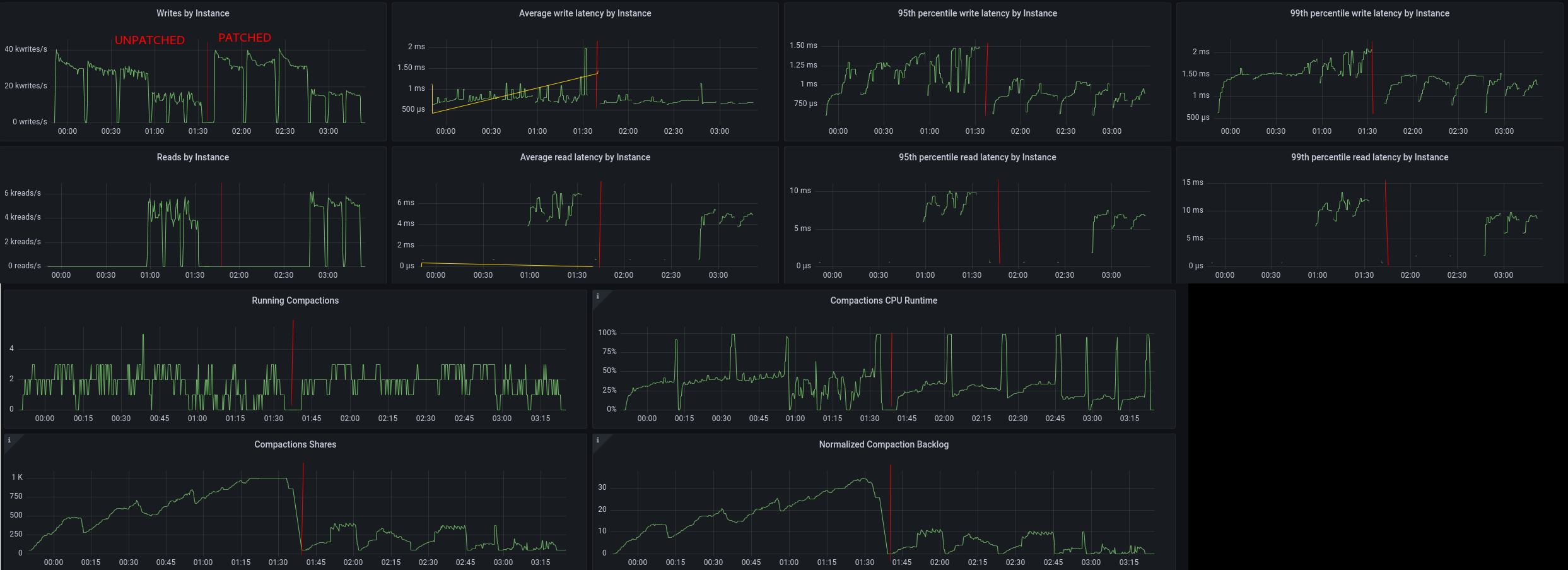
Test sequentially populates 3 tables and then run a mixed workload on them,
where disk:memory ratio (usage) reaches ~30:1 at the peak.

Please find graphs here:
https://user-images.githubusercontent.com/1409139/153687219-32368a35-ac63-461b-a362-64dbe8449a00.png

1) Patched version started at ~01:30
2) On population phase, throughput increase and lower P99 write latency can be
clearly observed.
3) On mixed phase, throughput increase and lower P99 write and read latency can
also be clearly observed.
4) Compaction CPU time sometimes reach ~100% because of the delay between each
loader.
5) On unpatched version, it can be seen that backlog keeps growing even when
though strategies become satisfied, so compaction is using much more CPU time
in comparison. Patched version correctly clears the backlog.

Can also be found at:
github.com/raphaelsc/scylla.git compaction-controller-v5

tests: UNIT(dev, debug).
"

* 'compaction-controller-v5' of https://github.com/raphaelsc/scylla:
  tests: Add compaction controller test
  test/lib/sstable_utils: Set bytes_on_disk for fake SSTables
  compaction/size_tiered_backlog_tracker.hh: Use unsigned type for inflight component
  compaction: Redefine compaction backlog to tame compaction aggressiveness
  compaction_backlog_tracker: Batch changes through a new replacement interface
  table: Disable backlog tracker when stopping table
  compaction_backlog_tracker: make disable() public
  compaction_backlog_tracker: Clear tracker state when disabled
  compaction: Add normalized backlog metric
  compaction: make size_tiered_compaction_strategy static
Today, compaction can act much more aggressive than it really has to, because
the strategy and its definition of backlog are completely decoupled.
The backlog definition for size-tiered, which is inherited by all
strategies (e.g.: LCS L0, TWCS' windows), is built on the assumption that the
world must reach the state of zero amplification. But that's unrealistic and
goes against the intent amplification defined by the compaction strategy.
For example, size tiered is a write oriented strategy which allows for extra
space amplification for compaction to keep up with the high write rate.
It can be seen today, in many deployments, that compaction shares is either
close to 1000, or even stuck at 1000, even though there's nothing to be done,
i.e. the compaction strategy is completely satisfied.
When there's a single sstable per tier, for example.
This means that whenever a new compaction job kicks in, it will act much more
aggressive because of the high shares, caused by false backlog of the existing
tables. This translates into higher P99 latencies and reduced throughput.
Solution
========
This problem can be fixed, as proposed in the document "Fixing compaction
aggressiveness due to suboptimal definition of zero backlog by controller" [1],
by removing backlog of tiers that don't have to be compacted now, like a tier
that has a single file. That's about coupling the strategy goal with the
backlog definition. So once strategy becomes satisfied, so will the controller.
Low-efficiency compaction, like compacting 2 files only or cross-tier, only
happens when system is under little load and can proceed at a slower pace.
Once efficient jobs show up, ongoing compactions, even if inefficient, will get
more shares (as efficient jobs add to the backlog) so compaction won't fall
behind.
With this approach, throughput and latency is improved as cpu time is no longer
stolen (unnecessarily) from the foreground requests.
[1]: https://docs.google.com/document/d/1EQnXXGWg6z7VAwI4u8AaUX1vFduClaf6WOMt2wem5oQFixes#4588.
Signed-off-by: Raphael S. Carvalho <raphaelsc@scylladb.com>
This new interface allows table to communicate multiple changes in the
SSTable set with a single call, which is useful on compaction completion
for example.
With this new interface, the size tiered backlog tracker will be able to
know when compaction completed, which will allow it to recompute tiers
and their backlog contribution, if any. Without it, tiered tracker
would have to recompute tiers for every change, which would be terribly
expensive.
The old remove/add interface are being removed in favor of the new one.

Signed-off-by: Raphael S. Carvalho <raphaelsc@scylladb.com>
If the tracker is disabled, we never get to access the underlying
implementation anymore. It makes sense to clear _impl on
disable(). So table::stop() can call its backlog tracker's disable
method, clearing all its state. This is important for clean
shutdown, as any sstable in tracker state may cause sstable
manager to hang when being stopped.

Signed-off-by: Raphael S. Carvalho <raphaelsc@scylladb.com>
Normalized backlog metric is important for understanding the controller
behavior as the controller acts on normalized backlog for yielding an
output, not the raw backlog value in bytes.

Signed-off-by: Raphael S. Carvalho <raphaelsc@scylladb.com>
Use exponential_backoff_retry::retry(abort_source&)
when sleeping between retries and request abort
when the task is stopped.
Fixes#10112
Test: unit(dev)
Closes#10113
* github.com:scylladb/scylla:
compaction_manager: allow stopping sleeping tasks
compaction_manager: task: add make_compaction_stopped_exception
compaction_manager: task: refactor stop
Use exponential_backoff_retry::retry(abort_source&)
when sleeping between retries and request abort
when the task is stopped.
Fixes#10112
Test: unit(dev)
Signed-off-by: Benny Halevy <bhalevy@scylladb.com>
Provide a function to make a sstables::compaction_stopped_exception
based on the information in the stopped task.

To be reused by the next patch that will
also throw this exception from the retry sleep path,
when the task is stopped.

Signed-off-by: Benny Halevy <bhalevy@scylladb.com>
Before we add a v2 output option to the compactor, we want to get rid of
all the v1 inputs to make it simpler. This means that for a while the
compacting reader will be in a strange place of having a v2 input and a
v1 output. Hopefully, not for long.
This reverts commit 4c05e5f966.
Moving cleanup to maintenance group made its operation time up to
10x slower than previous release. It's a blocker to 4.6 release,
so let's revert it until we figure this all out.
Probably this happens because maintenance group is fixed at a
relatively small constant, and cleanup may be incrementally
generating backlog for regular compaction, where the former is
fighting for resources against the latter.
Fixes#10060.
Signed-off-by: Raphael S. Carvalho <raphaelsc@scylladb.com>
Message-Id: <20220213184306.91585-1-raphaelsc@scylladb.com>