Currently, the function unfreezes each schema mutation partition
and then checks if it's for a system keyspace.
This isn't really needed since we can check the partition key
using the frozen_mutation, skip it if the partition is for a system keyspace.

Note that the constructed partition_key just copies
the frozen partition_key_view, without copying or deserializing the
actual key contents.

Also, reserve `results` capacity using the queried
partitions' size to prevent reallocations of the results
vector.

Signed-off-by: Benny Halevy <bhalevy@scylladb.com>
The namespace usage in this directory is very inconsistent, with files
and classes scattered in:
* global namespace
* namespace compaction
* namespace sstables

With cases, where all three used in the same file. This code used to
live in sstables/ and some of it still retains namespace sstables as a
heritage of that time. The mismatch between the dir (future module) and
the namespace used is confusing, so finish the migration and move all
code in compaction/ to namespace compaction too.

This patch, although large, is mechanic and only the following kind of
changes are made:
* replace namespace sstable {} with namespace compaction {}
* add namespace compaction {}
* drop/add sstables::
* drop/add compaction::
* move around forward-declarations so they are in the correct namespace
  context

This refactoring revealed some awkward leftover coupling between
sstables and compaction, in sstables/sstable_set.cc, where the
make_sstable_set() methods of compaction strategies are implemented.
The latter is recommended in seastar, and the former was left as
compatibility alias. Latest seastar explicitly marks it as deprecated so
once the submodule is updated, compilation logs will explode.
Most of the patch is generated with
for f in $(git grep -l '\<distributed<[A-Za-z0-9:_]*>') ; do sed -e 's/\<distributed<\([A-Za-z0-9:_]*\)>/sharded<\1>/g' -i $f; done
for f in $(git grep -l distributed.hh); do sed -e 's/distributed.hh/sharded.hh/' -i $f ; done
and a small manual change in test/perf/perf.hh
Signed-off-by: Pavel Emelyanov <xemul@scylladb.com>
Closesscylladb/scylladb#26136
As requested in #22120, moved the files and fixed other includes and build system.
Moved files:
- query.cc
- query-request.hh
- query-result.hh
- query-result-reader.hh
- query-result-set.cc
- query-result-set.hh
- query-result-writer.hh
- query_id.hh
- query_result_merger.hh
Fixes: #22120
This is a cleanup, no need to backport
Closesscylladb/scylladb#25105
Add parsing of `ANN OF` queries to the `select_statement` and
`indexed_table_select_statement` classes.
Add a placeholder for the implementation of external ANN queries.

Rename `should_create_view` to `view_should_exist` as it is used
not only to check if the view should be created but also if
the view has been created.

Co-authored-by: Dawid Pawlik <dawid.pawlik@scylladb.com>
As requested in #22114, moved the files and fixed other includes and build system.
Moved files:
- interval.hh
- Map_difference.hh
Fixes: #22114
This is a cleanup, no need to backport
Closesscylladb/scylladb#25095
This PR adds a way for custom indexes to decide whether a view should be created for them, as for the vector_index the view is not needed, because we store it in the external service. To allow this, custom logic for describing indexes using custom classes was added (as it used to depend on the view corresponding to an index).
Fixes: VECTOR-10
Closesscylladb/scylladb#24438
* github.com:scylladb/scylladb:
custom_index: do not create view when creating a custom index
custom_index: refactor describe for custom indexes
custom_index: remove unneeded duplicate of a static string
This change is preparing ground for state update unification for raft bound subsystems. It introduces schema_applier which in the future will become generic interface for applying mutations in raft.
Pulling database::apply() out of schema merging code will allow to batch changes to subsystems. Future generic code will first call prepare() on all implementations, then single database::apply() and then update() on all implementations, then on each shard it will call commit() for all implementations, without preemption so that the change is observed as atomic across all subsystems, and then post_commit().
Backport: no, it's a new feature
Fixes: https://github.com/scylladb/scylladb/issues/19649
Fixes https://github.com/scylladb/scylladb/issues/24531Closesscylladb/scylladb#24886
[avi: adjust for std::vector<mutations> -> utils::chunked_vector<mutations>]
* github.com:scylladb/scylladb:
test: add type creation to test_snapshot
storage_service: always wake up load balancer on update tablet metadata
db: schema_applier: call destroy also when exception occurs
db: replica: simplify seeding ERM during shema change
db: remove cleanup from add_column_family
db: abort on exception during schema commit phase
db: make user defined types changes atomic
replica: db: make keyspace schema changes atomic
db: atomically apply changes to tables and views
replica: make truncate_table_on_all_shards get whole schema from table_shards
service: split update_tablet_metadata into two phases
service: pull out update_tablet_metadata from migration_listener
db: service: add store_service dependency to schema_applier
service: simplify load_tablet_metadata and update_tablet_metadata
db: don't perform move on tablet_hint reference
replica: split add_column_family_and_make_directory into steps
replica: db: split drop_table into steps
db: don't move map references in merge_tables_and_views()
db: introduce commit_on_shard function
db: access types during schema merge via special storage
replica: make non-preemptive keyspace create/update/delete functions public
replica: split update keyspace into two phases
replica: split creating keyspace into two functions
db: rename create_keyspace_from_schema_partition
db: decouple functions and aggregates schema change notification from merging code
db: store functions and aggregates change batch in schema_applier
db: decouple tables and views schema change notifications from merging code
db: store tables and views schema diff in schema_applier
db: decouple user type schema change notifications from types merging code
service: unify keyspace notification functions arguments
db: replica: decouple keyspace schema change notifications to a separate function
db: add class encapsulating schema merging
The same order of creation/destruction is preserved as in the
original code, looking from single shard point of view.

create_types() is called on each shard separately, while in theory
we should be able reuse results similarly as diff_rows(). But we
don't introduce this optimization yet.
Once we create types atomically the code which is before commit
may depend on newly added types, so it has to access both old and
new types. New storage called in_progress_types_storage was added.
Currently we create a view for every index, however
for currently supported custom index classes (vector_index)
that work is redundant, as we store the index in the external
service.

This patch adds a way for custom indexes to choose whether to
create a view when creating the index and makes it so that
for vector indexes the view is not created.
This reverts commit 0b516da95b, reversing
changes made to 30199552ac. It breaks
cluster.random_failures.test_random_failures.test_random_failures
in debug mode (at least).
Fixes#24513
Once we create types atomically the code which is before commit
may depend on newly added types, so it has to access both old and
new types. New storage called in_progress_types_storage was added.
Blobs can be large, and unfragmented blobs can easily exceed 128k
(as seen in #23903). Rename get_blob() to get_blob_unfragmented()
to warn users.
Note that most uses are fine as the blobs are really short strings.
Closesscylladb/scylladb#24102
In the following patch we plan to remove the base schema from the base_info
to make the base_info immutable. To do that, we first prepare the schema
registry for the change; we need to be able to create view schemas from
frozen schemas there and frozen schemas have no information about the base
table. Unless we do this change, after base schemas are removed from the
base info, we'll no longer be able to load a view schema to the schema registry
without looking up the base schema in the database.

This change also required some updates to schema building:
* we add a method for unfreezing a view schema with base info instead of
a base schema
* we make it possible to use schema_builder with a base info instead of
a base schema
* we add a method for creating a view schema from mutations with a base info
instead of a base schema
* we add a view_info constructor withat base info instead of a base schema
* we update the naming in schema_registry to reflect the usage of base info
instead of base schema
Currently, the base_info may or may not be set in view schemas.
Even when it's set, it may be modified. This necessitates extra
checks when handling view schemas, as well as potentially causing
errors when we forget to set it at some point.

Instead, we want to make the base info an immutable member of view
schemas (inside view_info). The first step towards that is making
sure that all newly created schemas have the base info set.
We achieve that by requiring a base schema when constructing a view
schema. Unfortunately, this adds complexity each time we're making
a view schema - we need to get the base schema as well.
In most cases, the base schema is already available. The most
problematic scenario is when we create a schema from mutations:
- when parsing system tables we can get the schema from the
database, as regular tables are parsed before views
- when loading a view schema using the schema loader tool, we need
to load the base additionally to the view schema, effectively
doubling the work
- when pulling the schema from another node - in this case we can
only get the current version of the base schema from the local
database

Additionally, we need to consider the base schema version - when
we generate view updates the version of the base schema used for
reads should match the version of the base schema in view's base
info.
This is achieved by selecting the correct (old or new) schema in
`db::schema_tables::merge_tables_and_views` and using the stored
base schema in the schema_registry.
schema_extension allows making invisible changes to system_schema
that evade upgrade rollback tests. They appear in system_schema
as an encoded blob which reduces serviceability, as they cannot
be read.
Deprecate it and point users to adding explicit columns in scylla_tables.
We could probably make use of the data structure, after we teach it
to encode its payload into proper named and typed columns instead of
using IDL.
Closesscylladb/scylladb#23151
There are few more places left that can use all_table_infos() as a
replacement for all_table_names(), patch them.

Signed-off-by: Pavel Emelyanov <xemul@scylladb.com>
There are convert_schema_to_mutations() and calculate_schema_digest()
that collect table names and then use them to find schema and query
mutations from the table.

Both can use the newly introduced all_table_infos() and use the returned
table_id-s to do the same, thus avoiding re-lookups (which are fast
anyway, but still).

Signed-off-by: Pavel Emelyanov <xemul@scylladb.com>
This method is like all_table_names(), but returns a vector of
table_info-s which is effectively a pair of string name and uuid id.
To be used later, and the string-returning all_table_name() will be
removed very soon too.

Signed-off-by: Pavel Emelyanov <xemul@scylladb.com>
result_set_row is a heavyweight object containing multiple cell types:
regular columns, partition keys, and static values. To prevent expensive
accidental copies, delete the copy constructor and replace it with:
1. A move constructor for efficient vector reallocation
2. An explicit copy() method when copies are actually needed
This change reduces overhead in some non-hot paths by eliminating implicit
deep copies. Please note, previously, in `create_view_from_mutation()`,
we kept a copy of `result_set_row`, and then reused `table_rs` for
holding the mutation for `scylla_tables`. Because we don't copy
the `result_set_row` in this change, in order to avoid invalidating
the `row` after reusing `table_rs` in the outer scope, we define a
new `table_rs` shadowing the one in the out scope.
Signed-off-by: Kefu Chai <kefu.chai@scylladb.com>
Closesscylladb/scylladb#22741
This series extends the table schema with per-table tablet options.
The options are used as hints for initial tablet allocation on table creation and later for resize (split or merge) decisions,
when the table size changes.
* New feature, no backport required
Closesscylladb/scylladb#22090
* github.com:scylladb/scylladb:
tablets: resize_decision: get rid of initial_decision
tablet_allocator: consider tablet options for resize decision
tablet_allocator: load_balancer: table_size_desc: keep target_tablet_size as member
network_topology_strategy: allocate_tablets_for_new_table: consider tablet options
network_topology_strategy: calculate_initial_tablets_from_topology: precalculate shards per dc using for_each_token_owner
network_topology_strategy: calculate_initial_tablets_from_topology: set default rf to 0
cql3: data_dictionary: format keyspace_metadata: print "enabled":true when initial_tablets=0
cql3/create_keyspace_statement: add deprecation warning for initial tablets
test: cqlpy: test_tablets: add tests for per-table tablet options
schema: add per-table tablet options
feature_service: add TABLET_OPTIONS cluster schema feature
Unlike with vnodes, each tablet is served only by a single
shard, and it is associated with a memtable that, when
flushed, it creates sstables which token-range is confined
to the tablet owning them.

On one hand, this allows for far better agility and elasticity
since migration of tablets between nodes or shards does not
require rewriting most if not all of the sstables, as required
with vnodes (at the cleanup phase).

Having too few tablets might limit performance due not
being served by all shards or by imbalance between shards
caused by quantization.  The number of tabelts per table has to be
a power of 2 with the current design, and when divided by the
number of shards, some shards will serve N tablets, while others
may serve N+1, and when N is small N+1/N may be significantly
larger than 1. For example, with N=1, some shards will serve
2 tablet replicas and some will serve only 1, causing an imbalance
of 100%.

Now, simply allocating a lot more tablets for each table may
theoretically address this problem, but practically:
a. Each tablet has memory overhead and having too many tablets
in the system with many tables and many tablets for each of them
may overwhelm the system's and cause out-of-memory errors.
b. Too-small tablets cause a proliferation of small sstables
that are less efficient to acces, have higher metadata overhead
(due to per-sstable overhead), and might exhaust the system's
open file-descriptors limitations.

The options introduced in this change can help the user tune
the system in two ways:
1. Sizing the table to prevent unnecessary tablet splits
and migrations.  This can be done when the table is created,
or later on, using ALTER TABLE.
2. Controlling min_per_shard_tablet_count to improve
tablet balancing, for hot tables.

Signed-off-by: Benny Halevy <bhalevy@scylladb.com>
ICS is a compaction strategy that inherits size tiered properties --
therefore it's write optimized too -- but fixes its space overhead of
100% due to input files being only released on completion. That's
achieved with the concept of sstable run (similar in concept to LCS
levels) which breaks a large sstable into fixed-size chunks (1G by
default), known as run fragments. ICS picks similar-sized runs
for compaction, and fragments of those runs can be released
incrementally as they're compacted, reducing the space overhead
to about (number_of_input_runs * 1G). This allows user to increase
storage density of nodes (from 50% to ~80%), reducing the cost of
ownership.
NOTE: test_system_schema_version_is_stable adjusted to account for batchlog
using IncrementalCompactionStrategy
contains:
compaction/: added incremental_compaction_strategy.cc (.hh), incremental_backlog_tracker.cc (.hh)
compaction/CMakeLists.txt: include ICS cc files
configure.py: changes for ICS files, includes test
db/legacy_schema_migrator.cc / db/schema_tables.cc: fallback to ICS when strategy is not supported
db/system_keyspace: pick ICS for some system tables
schema/schema.hh: ICS becomes default
test/boost: Add incremental_compaction_test.cc
test/boost/sstable_compaction_test.cc: ICS related changes
test/cqlpy/test_compaction_strategy_validation.py: ICS related changes
docs/architecture/compaction/compaction-strategies.rst: changes to ICS section
docs/cql/compaction.rst: changes to ICS section
docs/cql/ddl.rst: adds reference to ICS options
docs/getting-started/system-requirements.rst: updates sentence mentioning ICS
docs/kb/compaction.rst: changes to ICS section
docs/kb/garbage-collection-ics.rst: add file
docs/kb/index.rst: add reference to <garbage-collection-ics>
docs/operating-scylla/procedures/tips/production-readiness.rst: add ICS section
some relevant commits throughout the ICS history:
commit 434b97699b39c570d0d849d372bf64f418e5c692
Merge: 105586f747 30250749b8
Author: Paweł Dziepak <pdziepak@scylladb.com>
Date: Tue Mar 12 12:14:23 2019 +0000
Merge "Introduce Incremental Compaction Strategy (ICS)" from Raphael
"
Introduce new compaction strategy which is essentially like size tiered
but will work with the existing incremental compaction. Thus incremental
compaction strategy.
It works like size tiered, but each element composing a tier is a sstable
run, meaning that the compaction strategy will look for N similar-sized
sstable runs to compact, not just individual sstables.
Parameters:
* "sstable_size_in_mb": defines the maximum sstable (fragment) size
composing
a sstable run, which impacts directly the disk space requirement which is
improved with incremental compaction.
The lower the value the lower the space requirement for compaction because
fragments involved will be released more frequently.
* all others available in size tiered compaction strategy
HOWTO
=====
To change an existing table to use it, do:
ALTER TABLE mykeyspace.mytable WITH compaction =
{'class' : 'IncrementalCompactionStrategy'};
Set fragment size:
ALTER TABLE mykeyspace.mytable WITH compaction =
{'class' : 'IncrementalCompactionStrategy', 'sstable_size_in_mb' : 1000 }
"
commit 94ef3cd29a196bedbbeb8707e20fe78a197f30a1
Merge: dca89ce7a5 e08ef3e1a3
Author: Avi Kivity <avi@scylladb.com>
Date: Tue Sep 8 11:31:52 2020 +0300
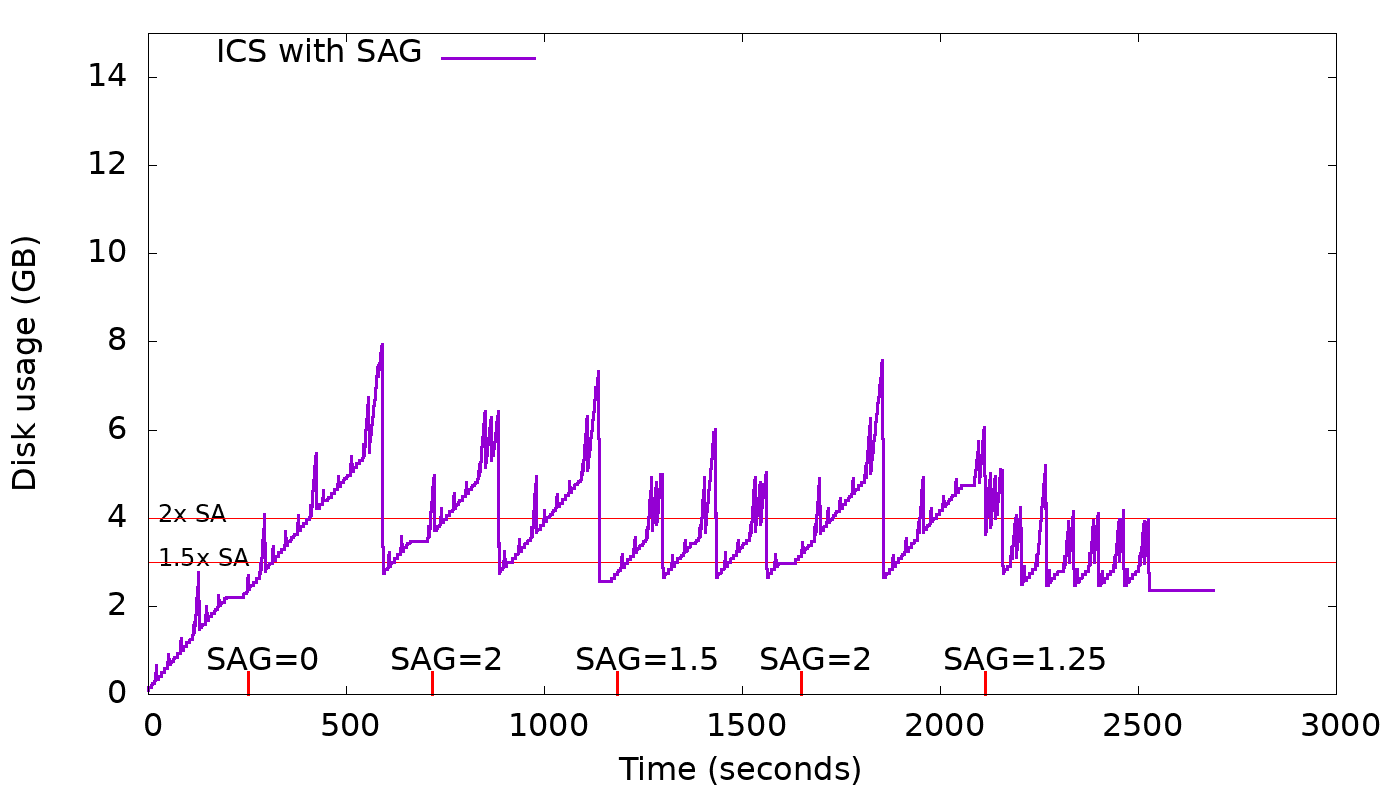
Merge "Add feature to limit space amplification in Incremental Compaction" from Raphael
"
A new option, space_amplification_goal (SAG), is being added to ICS. This option
will allow ICS user to set a goal on the space amplification (SA). It's not
supposed to be an upper bound on the space amplification, but rather, a goal.
This new option will be disabled by default as it doesn't benefit write-only
(no overwrites) workloads and could hurt severely the write performance.
The strategy is free to delay triggering this new behavior, in order to
increase overall compaction efficiency.
The graph below shows how this feature works in practice for different values
of space_amplification_goal:
https://user-images.githubusercontent.com/1409139/89347544-60b7b980-d681-11ea-87ab-e2fdc3ecb9f0.png
When strategy finds space amplification crossed space_amplification_goal, it
will work on reducing the SA by doing a cross-tier compaction on the two
largest tiers. This feature works only on the two largest tiers, because taking
into account others, could hurt the compaction efficiency which is based on
the fact that the more similar-sized sstables are compacted together the higher
the compaction efficiency will be.
With SAG enabled, min_threshold only plays an important role on the smallest
tiers, given that the second-largest tier could be compacted into the largest
tier for a space_amplification_goal value < 2.
By making the options space_amplification_goal and min_threshold independent,
user will be able to tune write amplification and space amplification, based on
the needs. The lower the space_amplification_goal the higher the write
amplification, but by increasing the min threshold, the write amplification
can be decreased to a desired amount.
"
commit 7d90911c5fb3fa891ad64a62147c3a6ca26d61b1
Author: Raphael S. Carvalho <raphaelsc@scylladb.com>
Date: Sat Oct 16 13:41:46 2021 -0300
compaction: ICS: Add garbage collection
Today, ICS lacks an approach to persist expired tombstones in a timely manner,
which is a problem because accumulation of tombstones are known to affecting
latency considerably.
For an expired tombstone to be purged, it has to reach the top of the LSM tree
and hope that older overlapping data wasn't introduced at the bottom.
The condition are there and must be satisfied to avoid data resurrection.
STCS, today, has an inefficient garbage collection approach because it only
picks a single sstable, which satisfies the tombstone density threshold and
file staleness. That's a problem because overlapping data either on same tier
or smaller tiers will prevent tombstones from being purged. Also, nothing is
done to push the tombstones to the top of the tree, for the conditions to be
eventually satisfied.
Due to incremental compaction, ICS can more easily have an effecient GC by
doing cross-tier compaction of relevant tiers.
The trigger will be file staleness and tombstone density, which threshold
values can be configured by tombstone_compaction_interval and
tombstone_threshold, respectively.
If ICS finds a tier which meets both conditions, then that tier and the
larger[1] *and* closest-in-size[2] tier will be compacted together.
[1]: A larger tier is picked because we want tombstones to eventually reach the
top of the tree.
[2]: It also has to be the closest-in-size tier as the smaller the size
difference the higher the efficiency of the compaction. We want to minimize
write amplification as much as possible.
The staleness condition is there to prevent the same file from being picked
over and over again in a short interval.
With this approach, ICS will be continuously working to purge garbage while
not hurting overall efficiency on a steady state, as same-tier compactions are
prioritized.
Signed-off-by: Raphael S. Carvalho <raphaelsc@scylladb.com>
Message-Id: <20211016164146.38010-1-raphaelsc@scylladb.com>
Signed-off-by: Raphael S. Carvalho <raphaelsc@scylladb.com>
Closesscylladb/scylladb#22063
now that we are allowed to use C++23. we now have the luxury of using
`std::views::transform`.
in this change, we:
- replace `boost::adaptors::transformed` with `std::views::transform`
- use `fmt::join()` when appropriate where `boost::algorithm::join()`
is not applicable to a range view returned by `std::view::transform`.
- use `std::ranges::fold_left()` to accumulate the range returned by
`std::view::transform`
- use `std::ranges::fold_left()` to get the maximum element in the
range returned by `std::view::transform`
- use `std::ranges::min()` to get the minimal element in the range
returned by `std::view::transform`
- use `std::ranges::equal()` to compare the range views returned
by `std::view::transform`
- remove unused `#include <boost/range/adaptor/transformed.hpp>`
- use `std::ranges::subrange()` instead of `boost::make_iterator_range()`,
to feed `std::views::transform()` a view range.
to reduce the dependency to boost for better maintainability, and
leverage standard library features for better long-term support.
this change is part of our ongoing effort to modernize our codebase
and reduce external dependencies where possible.
limitations:
there are still a couple places where we are still using
`boost::adaptors::transformed` due to the lack of a C++23 alternative
for `boost::join()` and `boost::adaptors::uniqued`.
Signed-off-by: Kefu Chai <kefu.chai@scylladb.com>
Closesscylladb/scylladb#21700
Once e.g. `ALTER KEYSPACE` is performed, all in-memory objects should be updated accordingly, but this is not entirely true for keyspace metadata object. The reason for that is that keyspace metadata are stored in 2 system tables: `system_schema.keyspaces` and `system_schema.scylla_keyspaces`. Up until now the in-memory keyspace metadata object has been updated only with entries from the first table, and missed updates when entries from the 2nd table changed. These entries were e.g. initial tablets or storage options.
This change fixes this oversight by considering both tables when checking if keyspace metadata need to be updated. From the implementation point of view, the change is simple: we're considering `system_schema.scylla_keyspaces` also in `merge_keyspaces()` and if old and new schemas have any differences, we include that when altering ks.
Fixes#20768
Backport: no need, I don't think the issue is severe, atm it seems like it can only influence the tablets number, which should not bring the cluster down nor result in returning bad data, it can mostly influence the speed of the db.
Closesscylladb/scylladb#20852
This depends on the previous change to the schema_builder
which makes version computation depend on definition only
instead of being new time uuid.

This way we avoid the possibility for a common mistake
when schema of a system table is extended but we forget
to bump up its version passed to .with_version().
now that we are allowed to use C++23. we now have the luxury of using
`std::views::values`.
in this change, we:
- replace `boost::adaptors::map_values` with `std::views::values`
- update affected code to work with `std::views::values`
- the places where we use `boost::join()` are not changed, because
we cannot use `std::views::concat` yet. this helper is only
available in C++26.
to reduce the dependency to boost for better maintainability, and
leverage standard library features for better long-term support.
this change is part of our ongoing effort to modernize our codebase
and reduce external dependencies where possible.
Signed-off-by: Kefu Chai <kefu.chai@scylladb.com>
Closesscylladb/scylladb#21265
It's somewhat common to ask for the partition key and clustering key
columns, or for the static and regular columsn. Provide accessors for them
rather than requiring the user to glue them.
Some callers are converted.
Closesscylladb/scylladb#21191
the log.hh under the root of the tree was created keep the backward
compatibility when seastar was extracted into a separate library.
so log.hh should belong to `utils` directory, as it is based solely
on seastar, and can be used all subsystems.

in this change, we move log.hh into utils/log.hh to that it is more
modularized. and this also improves the readability, when one see
`#include "utils/log.hh"`, it is obvious that this source file
needs the logging system, instead of its own log facility -- please
note, we do have two other `log.hh` in the tree.

Signed-off-by: Kefu Chai <kefu.chai@scylladb.com>
now that we are allowed to use C++23. we now have the luxury of using
`std::views::keys`.
in this change, we:
- replace `boost::adaptors::map_keys` with `std::views::keys`
- update affected code to work with `std::views::keys`
to reduce the dependency to boost for better maintainability, and
leverage standard library features for better long-term support.
this change is part of our ongoing effort to modernize our codebase
and reduce external dependencies where possible.
Signed-off-by: Kefu Chai <kefu.chai@scylladb.com>
Closesscylladb/scylladb#21198
To reduce dependency load, use std ranges instead of boost ranges.

The std::ranges::{lower,upper}_bound don't support heterogeneous lookup,
but a more natural solution is to use a projection to search for the name,
so we use that and the custom comparator is removed.

Many callers are converted as well due to poor interoperability between
boost ranges and std ranges.
Since extract_scylla_specific_keyspace_info() was always coupled
with create_keyspace_from_schema_partition() there is no value
in separating them. By moving first into the latter we:
- reduce number of exported functions
- simplify arguments of create_keyspace_from_schema_partition
- simplify caller's code
It's mostly self containted and it's easier to
maintain reasonably sized files. Also splitting
better shows boundaries between schema and
schema merging code.
In subseqent commits schema merging code will be separated from
db/schema_tables.cc but code which manages schema will remain intact.
So those two translation units will share some amount of code.

It's similar case as with replica/database.cc which creates schema
on startup, it calls functions from db/schema_tables.cc.

Struct qualified_name got moved to header as it's used as
read_table_mutations() argument.
A dialect is a different way to interpret the same CQL statement.

Examples:
 - how duplicate bind variable names are handled (later in this series)
 - whether `column = NULL` in LWT can return true (as is now) or
   whether it always returns NULL (as in SQL)

Currently, dialect is an empty structure and will be filled in later.
It is passed to query_processor methods that also accept a CQL string,
and from there to the parser. It is part of the prepared statement cache
key, so that if the dialect is changed online, previous parses of the
statement are ignored and the statement is prepared again.

The patch is careful to pick up the dialect at the entry point (e.g.
CQL protocol server) so that the dialect doesn't change while a statement
is parsed, prepared, and cached.
Currently, each frozen mutation we get from
system_keyspace::query_mutations is unfrozen in whole
to a mutation and only then we check its key with
the provided `accept_keyspace` function.

This is wasteful, since they key can be processed
directly form the frozen mutation, before taking
the toll of unfreezing it.

Signed-off-by: Benny Halevy <bhalevy@scylladb.com>
With a large number of table the schema mutations
vector might get big enoug to cause reactor stalls
when freed.
For example, the following stall was hit on
2023.1.0~rc1-20230208.fe3cc281ec73 with 5000 tables:
```
(inlined by) ~vector at /usr/bin/../lib/gcc/x86_64-redhat-linux/12/../../../../include/c++/12/bits/stl_vector.h:730
(inlined by) db::schema_tables::calculate_schema_digest(seastar::sharded<service::storage_proxy>&, enum_set<super_enum<db::schema_feature, (db::schema_feature)0, (db::schema_feature)1, (db::schema_feature)2, (db::schema_feature)3, (db::schema_feature)4, (db::schema_feature)5, (db::schema_feature)6, (db::schema_feature)7> >, seastar::noncopyable_function<bool (std::basic_string_view<char, std::char_traits<char> >)>) at ./db/schema_tables.cc:799
```
This change returns a mutations generator from
the `map` lambda coroutine so we can process them
one at a time, destroy the mutations one at a time,
and by that, reducing memory footprint and preventing
reactor stalls.
Fixes#18173
Signed-off-by: Benny Halevy <bhalevy@scylladb.com>