Commit e739f2b779 ("cql3: expr: make evaluate() return a
cql3::raw_value rather than an expr::constant") introduced
raw_value::view() as a synonym to raw_value::to_view() to reduce
churn. To fix this duplication, we now remove raw_value::to_view().
raw_value::to_view() was picked for removal because is has fewer
call sites, reducing churn again.
Closes#10819
A named bind-variable can be reused:
SELECT * FROM tab
WHERE a = :var AND b = :var
Currently, the grammar just ignores the possibility and creates
a new variable with the same name. The new variable cannot be
referenced by name since the first one shadows it.
Catch variable reuse by maintaining a map from bind variable names
to indexed, and check that when reusing a bind variable the types
match.
A unit test is added.
Fixes#10810Closes#10813
When evaluating an LWT condition involving both static and non-static
cells, and matching no regular row, the static row must be used UNLESS
the IF condition is IF EXISTS/IF NOT EXISTS, in which case special rules
apply.
Before this fix, Scylla used to assume a row doesn't exist if there is
no matching primary key. In Cassandra, if there is a
non-empty static row in the partition, a regular row based
on the static row' cell values is created in this case, and then this
row is used to evaluate the condition.
This problem was reported as gh-10081.
The reason for Scylla behaviour before the patch was that when
implementing LWT I tried to converge Cassandra data model (or lack of
thereof) with a relational data model, and assumed a static row is a
"shared" portion of a regular row, i.e. a storage level concept intended
to save space, and doesn't have independent existence.
This was an oversimplification.
This patch fixes gh-10081, making Scylla semantics match the one of
Cassandra.
I will now list other known examples when a static row has an own
independent existence as part of a table, for cataloguing purposes.
SELECT * from a partition which has a partition key
and a static cell set returns 1 row. If later a regular row is added
to the partition, the SELECT would still return 1 row, i.e.
the static row will disappear, and a regular row will appear instead.
Another example showing a static row has an independent existence below:
CREATE TABLE t (p int, c int, s int static, PRIMARY KEY(p, c));
INSERT INTO t (p, c) VALUES(1, 1);
INSERT INTO t (p, s) VALUES(1, 1) IF NOT EXISTS;
In Cassandra (and Scylla), IF NOT EXISTS evaluates to TRUE, even though both
the regular row and the partition exist. But the static cells are not
set, and the insert only provides a partition key, so the database assumes the
insert is operating against a static row.
It would be wrong to assume that a static row exists when the partition
key exists:
INSERT INTO t (p, c, s) VALUES(1, 1, 1) IF NOT EXISTS;
[applied] | p | c | s
-----------+---+---+------
False | 1 | 1 | null
evaluates to False, i.e. the regular row does exist when p and c exist.
Issue
CREATE TABLE t (p INT, c INT, r INT, s INT static, PRIMARY KEY(p, c))
INSERT INTO t (p, s) VALUES (1, 1);
UPDATE t SET s=2, r=1 WHERE p=1 AND c=1 IF s=1 and r=null;
- in this case, even though the regular row doesn't exist, the static
row does, and should be used for condition evaluation.
In other words, IF EXISTS/IF NOT EXISTS have contextual semantics.
They apply to the regular row if clustering key is used in the WHERE
clause, otherwise they apply to static row.
One analogy for static rows is that it is like a static member of C++ or
Java class. It's an attribute of the class (assuming class = partition),
which is accessible through every object of the class (object = regular
row). It is also present if there are no objects of the class, but the
class itself exists: i.e. a partition could have no regular rows, but
some static cells set, in this case it has a static row.
*Unlike C++/Java static class members* a static row is an optional
attribute of the partition. A partition may exist, but the static row
may be absent (e.g. no static cell is set). If the static row does exist,
all regular rows share its contents, *even if they do not exist*.
A regular row exists when its clustering key is present
in the table. A static row exists when at least one static cell is set.
Tests are updated because now when no matching row is found
for the update we show the value of the static row as the previous
value, instead of a non-matching clustering row.
Changes in v2:
- reworded the commit message
- added select tests
Closes#10711
A pre-scrub view snapshot cannot be attributed to user error, so no
call to bail out.
Closes#10760.
Signed-off-by: Michael Livshin <michael.livshin@scylladb.com>
Closes#10783
* github.com:scylladb/scylla:
api-doc: correct spelling
allow pre-scrub snapshots of materialized views and secondary indices
When memtable receives a tombstone it can happen under some workloads
that it covers data which is still in the memtable. Some workloads may
insert and delete data within a short time frame. We could reduce the
rate of memtable flushes if we eagerly drop tombstoned data.
One workload which benefits is the raft log. It stores a row for each
uncommitted raft entry. When entries are committed they are
deleted. So the live set is expected to be short under normal
conditions.
Fixes#652.
Closes#10807
* github.com:scylladb/scylla:
memtable: Add counters for tombstone compaction
memtable, cache: Eagerly compact data with tombstones
memtable: Subtract from flushed memory when cleaning
mvcc: Introduce apply_resume to hold state for partition version merging
test: mutation: Compare against compacted mutations
compacting_reader: Drop irrelevant tombstones
mutation_partition: Extract deletable_row::compact_and_expire()
mvcc: Apply mutations in memtable with preemption enabled
test: memtable: Make failed_flush_prevents_writes() immune to background merging
This patch adds an extensive array of tests for the Cassandra feature
that Scylla hasn't implemented yet (issues #2962, #8745, #10707) of
indexing the keys, values or entries of a collection column.
The goal of these tests is to explicitly exercise every corner case
I could think of by looking at the documentation of this feature and
considering its possible implementation - and as usual, making sure
that the tests actually pass on Cassandra.
These tests overlap some of the existing unit tests that we translated
from Cassandra, as well as some randomized tests that do not necessarily
cover the same edge cases as these tests cover.
All tests added in this patch pass on Cassandra, but currently fail
on Scylla due to the above issues.
Signed-off-by: Nadav Har'El <nyh@scylladb.com>
Closes#10771
`sstable_directory::process_sstables_dir` may hit an exception when calling `handle_component`.
In this case we currently destroy the `sstable_dir_lister` variable without closing the `directory_lister` first -
leading to terminate in `~directory_lister` as seen in #10697.
This mini-series handles this exception and always closes the `directory_lister`.
Add unit test to reproduce this issue.
Fixes#10697Closes#10754
* github.com:scylladb/scylla:
sstable_directory: process_sstable_dir: fixup indentation
sstable_directory: process_sstable_dir: close directory_lister on error
Before the change, the test artificiallu set the soft pressure
condition hoping that the background flusher will flush the
memtable. It won't happen if by the time the background flusher runs
the LSA region is updated and soft pressure (which is not really
there) is lifted. Once apply() becomes preemptibe, backgroun partition
version merging can lift the soft pressure, making the memtable flush
not occur and making the test fail.
Fix by triggering soft pressure on retries.
Fixes#10801
Refs #10793
(cherry picked from commit 0e78ad50ea)
Closes#10802
If we reach a situation where flush rate exceeds compaction rate, we may
end up with arbitrarily large number of sstables on disk. If a read is
executed in such case, the amount of memory required is proportional to
the number of sstables for the given shard, which in extreme cases can
lead to OOM.
In the wild, this was observed in 2 scenarios:
- A node with >10 shards creates a keyspace with thousands of tables,
drops the keyspace and shuts down before compaction finishes. Dropping
keyspace drops tables, and each dropped table is smp::count writes to
system.local table with flush after write, which creates tens of
thousands of sstables. Bootstrap read from system.local will run OOM.
- A failure to agree on table schema (due to a code bug) between nodes
during repair resulted in excessive flushing of small sstables which
compaction couldn't keep up with.
In the unit test introduced in this patch series it can be proved that
even hard setting maximum shares for compaction and minimum shares for
flushing doesn't tilt the balance towards compaction enough to prevent
the problem. Since it's a fast producer, slow consumer problem, the
remaining solution is to block producer until the consumer catches up.
If there are too many table runs originating from memtable, we block the
current flush until the number of sstables is reduced (via ongoing
compaction or a truncate operation).
Fixes https://github.com/scylladb/scylla/issues/4116
Changelog:
v5:
- added a nicer way of timing the stalls caused by waiting for flush
- added predicate on signal when waiting for reduction of the number of sstables to correctly handle spurious wake ups
- added comment why we trigger compaction before waiting for sstable count reduction
- removed unnecessary cv.signal from table::stop
v4:
- removed conversion of table::stop to coroutines. It's an orthogonal change and doesn't need to go into this patchset
v3:
- removed unnecessary change to scheduling groups from v2
- moved sstables_changed signalling to suggested place in table::stop
- added log how long the table flush was blocked for
- changed the threshold to max(schema()->max_compaction_threshold(), 32) and comparison to <=
v2:
- Reimplemented waiting algorithm based on reviewers' feedback. It's confined to the table class and it waits in a loop until the number of sstable runs goes below threshold. It uses condition variable which is signaled on sstable set refresh. It handles node shutdown as well.
- Converted table::stop to coroutines.
- Reordered commits so that test is committed after fix, so it doesn't trip up bisection.
Closes#10717
* github.com:scylladb/scylla:
table: Add test where compaction doesn't keep up with flush rate.
random_mutation_generator: Add option to specify ks_name and cf_name
table: Prevent creating unbounded number of sstables
Otherwise, if we don't consume all lister's entries,
~directory_lister terminates since the
directory_lister is destroyed without being closed.
Add unit test to reproduce this issue.
Fixes#10697
Signed-off-by: Benny Halevy <bhalevy@scylladb.com>
When memtable receives a tombstone it can happen under some workloads
that it covers data which is still in the memtable. Some workloads may
insert and delete data within a short time frame. We could reduce the
rate of memtable flushes if we eagerly drpo tombstoned data.
One workload which benefits is the raft log. It stores a row for each
uncommitted raft entry. When entries are committed they are
deleted. So the live set is expected to be short under normal
conditions.
Fixes#652.
This patch prevents virtual dirty from going negative during memtable
flush in case partition version merging erases data previously
accounted by the flush reader. There is an assert in
~flush_memory_accounter which guards for this.

This will start happening after tombstones are compacted with rows on
partition version merging.

This problem is prevented by the patch by having the cleaner notify
the memtable layer via callback about the amount of dirty memory released
during merging, so that the memtable layer can adjust its accounting.
Memtables and cache will compact eagerly, so tests should not expect
readers to produce exact mutations written, only those which are
equivalant after applying copmaction.
The compacting reader created using make_compacting_reader() was not
dropping range_tombstone_change fragments which were shadowed by the
partition tombstones. As a result the output fragment stream was not
minimal.

Lack of this change would cause problems in unit tests later in the
series after the change which makes memtables lazily compact partition
versions. In test_reverse_reader_reads_in_native_reverse_order we
compare output of two readers, and assume that compacted streams are
the same. If compacting reader doesn't produce minimal output, then
the streams could differ if one of them went through the compaction in
the memtable (which is minimal).
Preerequisite for eagerly applying tombstones, which we want to be
preemptible. Before the patch, apply path to the memtable was not
preemptible.

Because merging can now be defered, we need to involve snapshots to
kick-off background merging in case of preemption. This requires us to
propagate region and cleaner objects, in order to create a snapshot.
Before the change, the test artificiallu set the soft pressure
condition hoping that the background flusher will flush the
memtable. It won't happen if by the time the background flusher runs
the LSA region is updated and soft pressure (which is not really
there) is lifted. Once apply() becomes preemptibe, backgroun partition
version merging can lift the soft pressure, making the memtable flush
not occur and making the test fail.

Fix by triggering soft pressure on retries.
The test simulates a situation where 2 threads issue flushes to 2
tables. Both issue small flushes, but one has injected reactor stalls.
This can lead to a situation where lots of small sstables accumulate on
disk, and, if compaction never has a chance to keep up, resources can be
exhausted.
The series fixes a couple of crashes that were found during starting and
stopping Scylla with raft while doing ddl operations. Most of them
related to shutdown order between different components.

Also in scylla-dev gleb/group0-fixes-v1

CI https://jenkins.scylladb.com/job/releng/job/Scylla-CI/749/

* origin-dev/gleb/group0-fixes-v1:
  migration manager: remove unused code
  db/system_distributed_keyspace: do not announce empty schema
  main: stop raft before the migration manager
  storage_service: do not pass the raft group manager to storage_service constructor
  main: destroy the group0_client after stopping the group0
Previously, any attempt to take a materialized view or secondary index
snapshot was considered a mistake and caused the snapshot operation to
abort, with a suggestion to snapshot the base table instead.
But an automatic pre-scrub snapshot of a view cannot be attributed to
user error, so the operation should not be aborted in that case.
(It is an open question whether the more correct thing to do during
pre-scrub snapshot would be to silently ignore views. Or perhaps they
should be ignored in all cases except when the user explicitly asks to
snapshot them, by name)
Closes#10760.
Signed-off-by: Michael Livshin <michael.livshin@scylladb.com>
An expr::constant is an expression that happens to represent a constant,
so it's too heavyweight to be used for evaluation. Right now the extra
weight is just a type (which causes extra work by having to maintain
the shared_ptr reference count), but it will grow in the future to include
source location (for error reporting) and maybe other things.
Prior to e9b6171b5 ("Merge 'cql3: expr: unify left-hand-side and
right-hand-side of binary_operator prepares' from Avi Kivity"), we had
to use expr::constant since there was not enough type infomation in
expressions. But now every expression carries its type (in programming
language terms, expressions are now statically typed), so carrying types
in values is not needed.
So change evaluate() to return cql3::raw_value. The majority of the
patch just changes that. The rest deals with some fallout:
- cql3::raw_value gains a view() helper to convert to a raw_value_view,
and is_null_or_unset() to match with expr::constant and reduce further
churn.
- some helpers that worked on expr::constant and now receive a
raw_value now need the type passed via an additional argument. The
type is computed from the expression by the caller.
- many type checks during expression evaluation were dropped. This is
a consequence of static typing - we must trust the expression prepare
phase to perform full type checking since values no longer carry type
information.
Closes#10797
This reverts commit e0670f0bb5, reversing
changes made to 605ee74c39. It causes failures
in debug mode in
database_test.test_database_with_data_in_sstables_is_a_mutation_source_plain,
though with low probability.
Fixes#10780Reopens#652.
active_memtable().empty() becomes true once seal_active_memtable
succeeds with _memtables->add_memtable(), not when it is able
to flush the (once active) memtable.
In contrast, min_memtable_timestamp() returns api::max_timestamp
only if there is no data in any memtable.
Fixes#10793
Backport notes:
- Introduced in f6d9d6175f (currently in
branch-5.0)
- backport requires also 0e78ad50ea
Signed-off-by: Benny Halevy <bhalevy@scylladb.com>
Closes#10798
and LSIs' from Nadav Har'El
This series includes three small fixes (and of course, tests) for
various edge cases of GSI and LSI handling in Alternator:
1. We add the IndexArn that were missing in DescribeTable for indexes
(GSI and LSI)
2. We forbid the same name to be used for both GSI and LSI (allowing it
was a bug, not a feature)
3. We improve the error handling when trying to tag a GSI or LSI, which
is not currently allowed (it's also not allowed in DynamoDB).
Closes#10791
* github.com:scylladb/scylla:
alternator: improve error handling when trying to tag a GSI or LSI
alternator: forbid duplicate index (LSI and GSI) names
alternator: add ARN for indexes (LSI and GSI)
In issue #10786, we raised the idea of maybe allowing to tag (with
TagResource) GSIs and LSIs, not just base tables. However, currently,
neither DynamoDB nor Syclla allows it. So in this patch we add a
test that confirms this. And while at it, we fix Alternator to
return the same error message as DynamoDB in this case.

Refs #10786.

Signed-off-by: Nadav Har'El <nyh@scylladb.com>
Adding an LSI and GSI with the same name to the same Alternator table
should be forbidden - because if both exists only one of them (the GSI)
would actually be usable. DynamoDB also forbids such duplicate name.
So in this patch we add a test for this issue, and fix it.
Since the patch involves a few more uses of the IndexName string,
we also clean up its handling a bit, to use std::string_view instead
of the old-style std::string&.
Fixes#10789
Signed-off-by: Nadav Har'El <nyh@scylladb.com>
DynamoDB gives an ARN ("Amazon Resource Name") to LSIs and GSIs. These
look like BASEARN/index/INDEXNAME, where BASEARN is the ARN of the base
table, and INDEXNAME is the name of the LSI or the GSI.

These ARNs should be returned by DescribeTable as part of its
description of each index, and this patch adds that missing IndexArn
field.

The ARN we're adding here is hardly useful (e.g., as explained in
issue #10786, it can't be used to add tags to the index table),
but nevertheless should exist for compatibility with DynamoDB.

Signed-off-by: Nadav Har'El <nyh@scylladb.com>
Older versions of the Python Cassandra driver had a bug where a single empty
page aborts a scan.
The test test_secondary_index.py::test_filter_and_limit uses filtering and deliberately
tiny pages, so it turns out that some of them are empty, so the test breaks on buggy
versions of the driver, which cause the test to fail when run by developers who happen
to have old versions of the driver.
So in this small series we skip this test when running on a buggy version of the driver.
Fixes#10763Closes#10766
* github.com:scylladb/scylla:
test/cql-pytest: skip another test on older, buggy, drivers
test/cql-pytest: de-duplicate code checking for an old buggy driver
Marking a test as flaky allows to keep running it in CI rather than disable it when it's discovered that a test is flaky.
Flaky tests, if they fail, show up as flaky in the output, but don't fail the CI.
```
kostja@hulk:~/work/scylla/scylla$ ./test.py cdc_with --repeat=30 --verbose
Found 30 tests.
================================================================================
[N/TOTAL] SUITE MODE RESULT TEST
------------------------------------------------------------------------------
[1/30] cql debug [ FLKY ] cdc_with_lwt_test.2 9.36s
[2/30] cql debug [ FLKY ] cdc_with_lwt_test.1 9.53s
[3/30] cql debug [ PASS ] cdc_with_lwt_test.7 9.37s
[4/30] cql debug [ PASS ] cdc_with_lwt_test.8 9.41s
[5/30] cql debug [ PASS ] cdc_with_lwt_test.10 9.76s
[6/30] cql debug [ FLKY ] cdc_with_lwt_test.9 9.71s
```
Closes#10721
* github.com:scylladb/scylla:
test.py: add support for flaky tests
test.py: make Test hierarchy resettable
test.py: proper suite name in the log
test.py: shutdown cassandra-python connection before exit
Use a nice suite name rather than an internal Python
object key in the log. Fixes a regression introduced
when addressing a style-related review remark.
Shutdown cassandra-python connections before exit, to avoid
warnings/exceptions at shutdown.

Cassandra-python runs a thread pool and if
connections are not shut down before exit, there could
be a warning that the thread pool is not destroyed
before exiting main.
Change port type passed to Cassandra Python driver to int to avoid format errors in exceptions.
Manually shutdown connections to avoid reconnects after tests are done (required by upcoming async pytests).
Tests: (dev)
Closes#10722
* github.com:scylladb/scylla:
test.py: shutdown connection manually
test.py: fix port type passed to Cassandra driver
"
This series is a consequence of the work started by:
"compaction: LCS: Fix inefficiency when pushing SSTables to higher levels"
9de7abdc80
"Redefine Compaction Backlog to tame compaction aggressiveness" d8833de3bb
The backlog definition for leveled is incorrectly built on the assumption that
the world must reach the state of zero amplification, i.e. everything in the
last level. The actual goal is space amplification of 1.1.
In reality, LCS just wants that for every level L, level L is fan_out=10 times
larger than L-1. See more in commit 9de7abdc80 which adjusts LCS to conform
to this goal.
If level 3 = 1000G, level 2 = 100G, level 1 = 10G, level 0 = 1G, that should
return zero backlog as space amplification is (1000+100+10+1)/1000 = ~1.1
But today, LCS calculates high backlog for the layout above, as it will only be
satisfied once everything is promoted to the maximum level. That's completely
disconnected from what the strategy actually wants. Therefore, a mismatch.
With today's definition, the backlog for any SSTable is:
sizeof(sstable) * (Lmax - levelof(sstable)) * fan_out
where Lmax = maximum level,
and fan_out = LCS' fan out which is 10 by default
That's essentially calculating the total cost for data in the SSTable to climb
up to the maximum level. Of course, if a SSTable is at the maximum level,
(Lmax - levelof(sstable)) returns zero, therefore backlog for it is zero.
Take a look at this example:
If L0 sstable is 0.16G, then its backlog = 0.16G * (3 - 0) * 10 = 4.8G
0.16G = LCS' default fragment size
Maximum level (Lmax in formula) can be easily 3 as:
log10 of (30G/0.16G=~187 sstables)) = ~2.27
~2.27 means that data has exceeded level 2 capacity and so needs 3 levels.
So 3 L0 sstables could add ~15G of backlog. With 1G memory per shard (30:1 disk
memory ratio), that's normalized backlog of ~15, which translates into
additional ~500 shares. That's halfway to full compaction speed.
With more files in higher levels, we can easily get to a normalized backlog
above 30, resulting in 1k shares.
The suboptimal backlog definition causes either table using LCS or coexisting
tables to run with more shares than needed, causing compaction to steal
resources, resulting in higher latency and reduced throughput.
To solve this problem, a new formula is used which will basically calculate
the amount of work needed to achieve the layout goal. We no longer want to
promote everything to the last level, but instead we'll incrementally calculate
the backlog in each level L, which is the amount of work needed such that the
next level L + 1 is at least fan_out times bigger.
Fixes#10583.
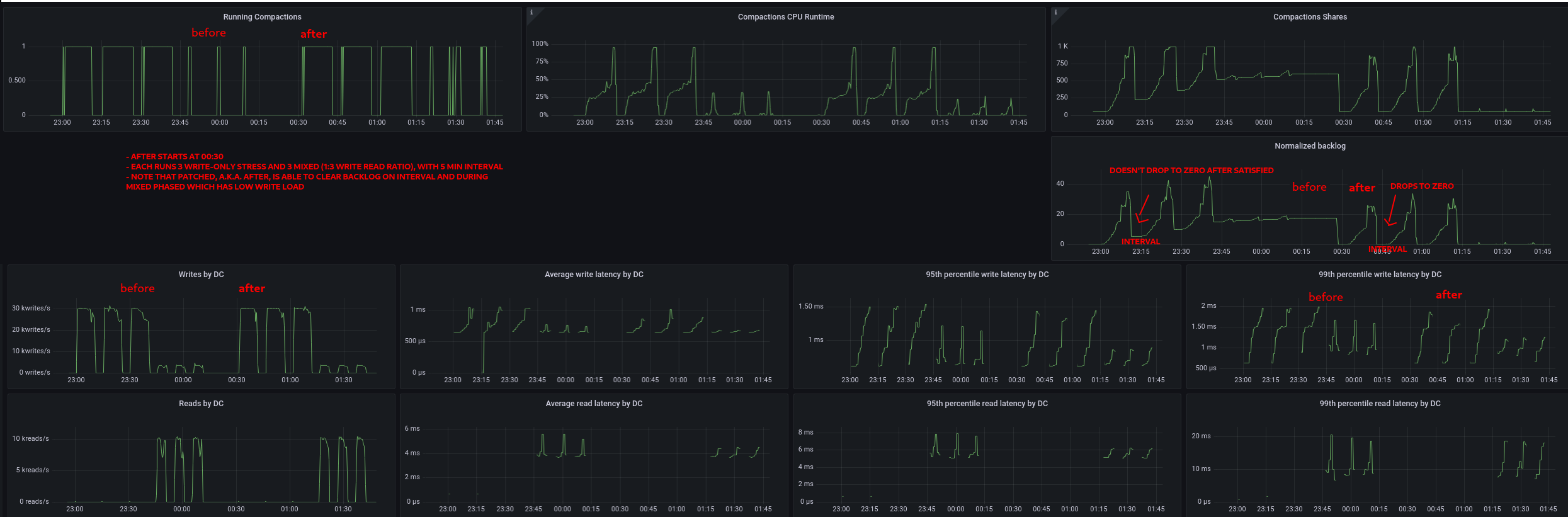
Results
=====
image:
https://user-images.githubusercontent.com/1409139/168713675-d5987d09-7011-417c-9f91-70831c069382.png
The patched version correctly clears the backlog, meaning that once LCS is
satisfied, backlog is 0. Therefore, next compaction either from this table or
another won't run unnecessarily aggressive.
p99 read and write latency have clearly improved. throughput is also more
stable.
"
* 'LCS_backlog_revamp' of https://github.com/raphaelsc/scylla:
tests: sstable_compaction_test: Adjust controller unit test for LCS
compaction: Redefine Leveled compaction backlog
The controller unit test for LCS was only creating level 0 SSTables.
As level 0 falls back to STCS controller, it means that we weren't actually
testing LCS controller.
So let's adjust the unit test to account for LCS fan_out, which is 10
instead of 4, and also allow creation of SSTables on higher levels.

Signed-off-by: Raphael S. Carvalho <raphaelsc@scylladb.com>
Older versions of the Python Cassandra driver had a bug, detected by
the driver_bug_1 fixture, where a single empty page aborts a scan.
The test test_secondary_index.py::test_filter_and_limit uses filtering
and deliberately tiny pages, so it turns out that some of them are
empty, so the test breaks on buggy versions of the driver, which causes
the test to fail when run by developers who happen to have old versions
of the driver.
So in this patch we use the driver_bug_1 fixture, to skip this test
when running on a buggy version of the driver.
Fixes#10763
Signed-off-by: Nadav Har'El <nyh@scylladb.com>
We have in test_filtering.py two tests which fail when running on an old
version of the Python driver which has a specific bug, so we skip those
tests if the buggy driver is installed.

But the code to check the driver version is duplicated twice, so in this
patch we move the version-checking-and-skipping code to a fixture, which
we can use twice.

The motivation is that in the next patch we will want to introduce a
third use of the same code - and a fixture is cleaner than a third
duplicate.

This patch is supposed to be code-movement only, without functional
changes.

Signed-off-by: Nadav Har'El <nyh@scylladb.com>
Reduce the storage_service's dependency on the raft group manager. The
group manager is needed only during bootstrap and in an rpc handler, so
pass it to those functions directly.
It turns out that DynamoDB forbids requesting the same item more than
once in a GetBatchItem request. Trying to do it would obviously be a
waste, but DynamoDB outright refuses it - and Alternator currently
doesn't (refs #10757).
The test currently passes on DynamoDB and fails on Alternator, so it
is marked xfail.
Signed-off-by: Nadav Har'El <nyh@scylladb.com>
Closes#10758
The issue is about handling errors when the user specifies something strange instead of a type, e.g. CREATE TABLE try1 (a int PRIMARY KEY, b list<zzz>):
* the error message only talks about collections, while zzz could also be an UDT;
* the same error message is given even when zzz is not a valid collection or UDT name.
The first point has already been fixed, now Scylla says 'Non-frozen user types or collections are not allowed inside collections: list<zzz>'. This commit fixes the second.
Whether the type is a valid UDT or not is checked in cql3_type::raw_ut::prepare_internal, but 'non-frozen' check triggers first in cql3_type::raw_collection::prepare_internal, before we recursively get to the argument types of the collection. The patch reverses the order here, first thing we recurse and ensure that the collection argument types are valid, and only then we apply the collection checks. A side effect of this is that the error messages of the checks in raw_collection will include the keyspace name, because it will now be assigned in raw_ut::prepare_internal before them.
The patch affects the validation order, so in case of list<zzz<xxx>> the message could be different, but it doesn't seem to be possible according to the Cql grammar.
Examples:
create type ut2 (a int, b list<ut1>); --> error('Unknown type ks.ut1')
create type ut1 (a int);
create type ut2 (a int, b list<ut1>); --> error('Non-frozen user types or collections are not allowed inside collections: list<ks.ut1>')
create type ut2 (a int, b list<frozen<ut1>>); --> OK
Fixes: scylladb#3541
Closes#10726
When memtable receives a tombstone it can happen under some workloads
that it covers data which is still in the memtable. Some workloads may
insert and delete data within a short time frame. We could reduce the
rate of memtable flushes if we eagerly drpo tombstoned data.
One workload which benefits is the raft log. It stores a row for each
uncommitted raft entry. When entries are committed they are
deleted. So the live set is expected to be short under normal
conditions.
Fixes#652.
This patch prevents virtual dirty from going negative during memtable
flush in case partition version merging erases data previously
accounted by the flush reader. There is an assert in
~flush_memory_accounter which guards for this.

This will start happening after tombstones are compacted with rows on
partition version merging.

This problem is prevented by the patch by having the cleaner notify
the memtable layer via callback about the amount of dirty memory released
during merging, so that the memtable layer can adjust its accounting.
Memtables and cache will compact eagerly, so tests should not expect
readers to produce exact mutations written, only those which are
equivalant after applying copmaction.
The compacting reader created using make_compacting_reader() was not
dropping range_tombstone_change fragments which were shadowed by the
partition tombstones. As a result the output fragment stream was not
minimal.

Lack of this change would cause problems in unit tests later in the
series after the change which makes memtables lazily compact partition
versions. In test_reverse_reader_reads_in_native_reverse_order we
compare output of two readers, and assume that compacted streams are
the same. If compacting reader doesn't produce minimal output, then
the streams could differ if one of them went through the compaction in
the memtable (which is minimal).
Preerequisite for eagerly applying tombstones, which we want to be
preemptible. Before the patch, apply path to the memtable was not
preemptible.

Because merging can now be defered, we need to involve snapshots to
kick-off background merging in case of preemption. This requires us to
propagate region and cleaner objects, in order to create a snapshot.
Before the change, the test artificiallu set the soft pressure
condition hoping that the background flusher will flush the
memtable. It won't happen if by the time the background flusher runs
the LSA region is updated and soft pressure (which is not really
there) is lifted. Once apply() becomes preemptibe, backgroun partition
version merging can lift the soft pressure, making the memtable flush
not occur and making the test fail.

Fix by triggering soft pressure on retries.
To prevent async scheduling issues of reconnection after tests are done,
manually close the connection after fixture ends.

Signed-off-by: Alejo Sanchez <alejo.sanchez@scylladb.com>
- Introduce a simpler substitute for `flat_mutation_reader`-resulting-from-a-downgrade that is adequate for the remaining uses but is _not_ a full-fledged reader (does not redirect all logic to an `::impl`, does not buffer, does not really have `::peek()`), so hopefully carries a smaller performance overhead. The name `mutation_fragment_v1_stream` is kind of a mouthful but it's the best I have
- (not tests) Use the above instead of `downgrade_to_v1()`
- Plug it in as another option in `mutation_source`, in and out
- (tests) Substitute deliberate uses of `downgrade_to_v1()` with `mutation_fragment_v1_stream()`
- (tests) Replace all the previously-overlooked occurrences of `mutation_source::make_reader()` with `mutation_source::make_reader_v2()`, or with `mutation_source::make_fragment_v1_stream()` where deliberate or still required (see below)
- (tests) This series still leaves some tests with `mutation_fragment_v1_stream` (i.e. at v1) where not called for by the test logic per se, because another missing piece of work is figuring out how to properly feed `mutation_fragment_v2` (i.e. range tombstone changes) to `mutation_partition`. While that is not done (and I think it's better to punt on it in this PR), we have to produce `mutation_fragment` instances in tests that `apply()` them to `mutation_partition`, thus we still use downgraded readers in those tests
- Remove the `flat_mutation_reader` class and things downstream of it
Fixes#10586Closes#10654
* github.com:scylladb/scylla:
fix "ninja dev-headers"
flat_mutation_reader ist tot
tests: downgrade_to_v1() -> mutation_fragment_v1_stream()
tests: flat_reader_assertions: refactor out match_compacted_mutation()
tests: ms.make_reader() -> ms.make_fragment_v1_stream()
repair/row_level: mutation_fragment_v1_stream() instead of downgrade_to_v1()
stream_transfer_task: mutation_fragment_v1_stream() instead of downgrade_to_v1()
sstables_loader: mutation_fragment_v1_stream() instead of downgrade_to_v1()
mutation_source: add ::make_fragment_v1_stream()
introduce mutation_fragment_v1_stream
tests: ms.make_reader() -> ms.make_reader_v2()
tests: remove test_downgrade_to_v1_clear_buffer()
mutation_source_test: fix indentation
tests: remove some redundant calls to downgrade_to_v1()
tests: remove some to-become-pointless ms.make_reader()-using tests
tests: remove some to-become-pointless reader downgrade tests
The test sometimes fails because the order of rows in the SELECT results
depends on how stream IDs for the different partition keys get generated.
In some runs the stream ID for pk=1 may go before the stream ID for
pk=4, in some runs the other way.
The fix is to use the same partition key but different clustering keys
for the different rows.
Refs: #10601Closes#10718