 c973254362
ICS is a compaction strategy that inherits size tiered properties --
therefore it's write optimized too -- but fixes its space overhead of
100% due to input files being only released on completion. That's
achieved with the concept of sstable run (similar in concept to LCS
levels) which breaks a large sstable into fixed-size chunks (1G by
default), known as run fragments. ICS picks similar-sized runs
for compaction, and fragments of those runs can be released
incrementally as they're compacted, reducing the space overhead
to about (number_of_input_runs * 1G). This allows user to increase
storage density of nodes (from 50% to ~80%), reducing the cost of
ownership.

NOTE: test_system_schema_version_is_stable adjusted to account for batchlog
using IncrementalCompactionStrategy

contains:

compaction/: added incremental_compaction_strategy.cc (.hh), incremental_backlog_tracker.cc (.hh)
compaction/CMakeLists.txt: include ICS cc files
configure.py: changes for ICS files, includes test
db/legacy_schema_migrator.cc / db/schema_tables.cc: fallback to ICS when strategy is not supported
db/system_keyspace: pick ICS for some system tables
schema/schema.hh: ICS becomes default
test/boost: Add incremental_compaction_test.cc
test/boost/sstable_compaction_test.cc: ICS related changes
test/cqlpy/test_compaction_strategy_validation.py: ICS related changes

docs/architecture/compaction/compaction-strategies.rst: changes to ICS section
docs/cql/compaction.rst: changes to ICS section
docs/cql/ddl.rst: adds reference to ICS options
docs/getting-started/system-requirements.rst: updates sentence mentioning ICS
docs/kb/compaction.rst: changes to ICS section
docs/kb/garbage-collection-ics.rst: add file
docs/kb/index.rst: add reference to <garbage-collection-ics>
docs/operating-scylla/procedures/tips/production-readiness.rst: add ICS section

some relevant commits throughout the ICS history:

commit 434b97699b39c570d0d849d372bf64f418e5c692
Merge: 105586f747 30250749b8
Author: Paweł Dziepak <pdziepak@scylladb.com>
Date:   Tue Mar 12 12:14:23 2019 +0000

    Merge "Introduce Incremental Compaction Strategy (ICS)" from Raphael

    "
    Introduce new compaction strategy which is essentially like size tiered
    but will work with the existing incremental compaction. Thus incremental
    compaction strategy.

    It works like size tiered, but each element composing a tier is a sstable
    run, meaning that the compaction strategy will look for N similar-sized
    sstable runs to compact, not just individual sstables.

    Parameters:
    * "sstable_size_in_mb": defines the maximum sstable (fragment) size
    composing
    a sstable run, which impacts directly the disk space requirement which is
    improved with incremental compaction.
    The lower the value the lower the space requirement for compaction because
    fragments involved will be released more frequently.
    * all others available in size tiered compaction strategy

    HOWTO
    =====

    To change an existing table to use it, do:
         ALTER TABLE mykeyspace.mytable  WITH compaction =
    {'class' : 'IncrementalCompactionStrategy'};

    Set fragment size:
         ALTER TABLE mykeyspace.mytable  WITH compaction =
    {'class' : 'IncrementalCompactionStrategy', 'sstable_size_in_mb' : 1000 }

    "

commit 94ef3cd29a196bedbbeb8707e20fe78a197f30a1
Merge: dca89ce7a5 e08ef3e1a3
Author: Avi Kivity <avi@scylladb.com>
Date:   Tue Sep 8 11:31:52 2020 +0300

    Merge "Add feature to limit space amplification in Incremental Compaction" from Raphael

    "
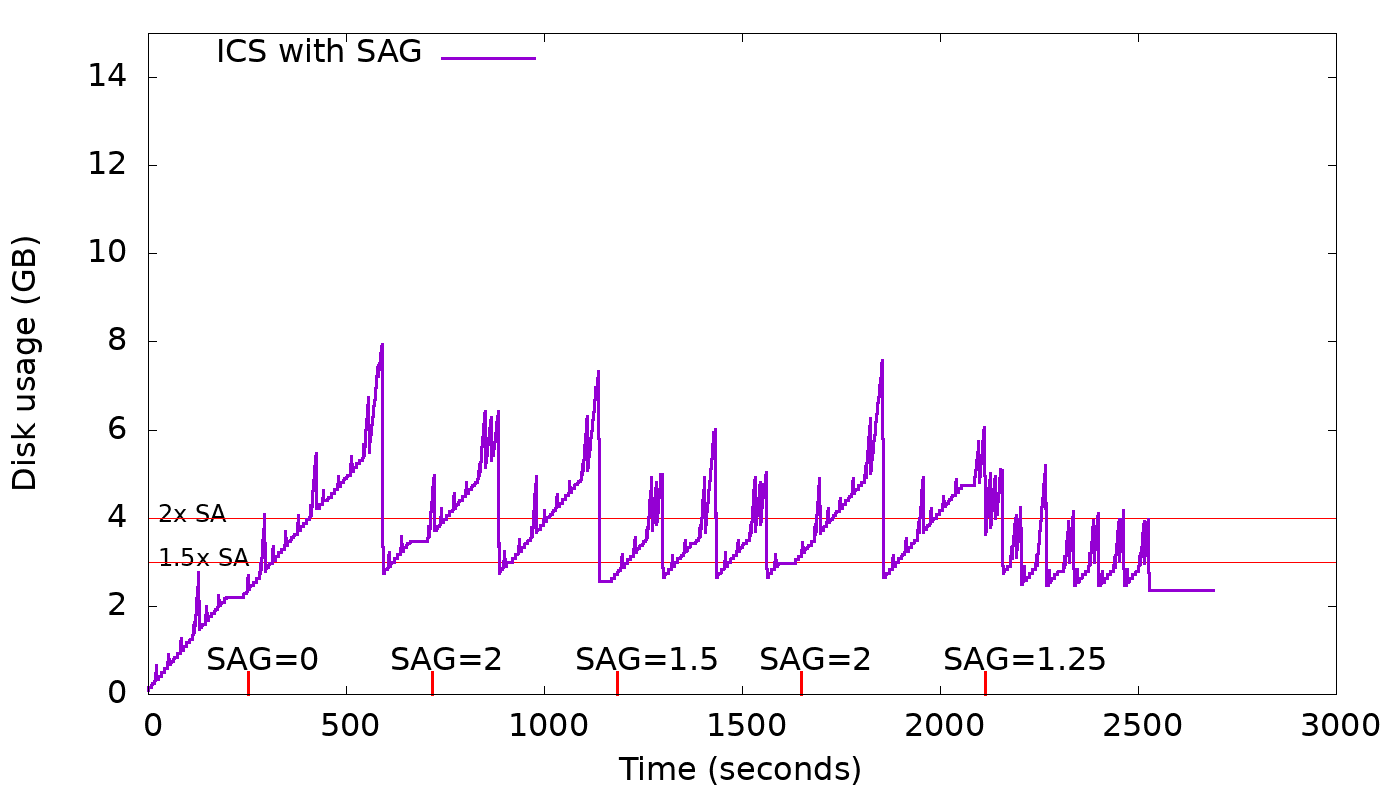
    A new option, space_amplification_goal (SAG), is being added to ICS. This option
    will allow ICS user to set a goal on the space amplification (SA). It's not
    supposed to be an upper bound on the space amplification, but rather, a goal.
    This new option will be disabled by default as it doesn't benefit write-only
    (no overwrites) workloads and could hurt severely the write performance.
    The strategy is free to delay triggering this new behavior, in order to
    increase overall compaction efficiency.

    The graph below shows how this feature works in practice for different values
    of space_amplification_goal:
    https://user-images.githubusercontent.com/1409139/89347544-60b7b980-d681-11ea-87ab-e2fdc3ecb9f0.png

    When strategy finds space amplification crossed space_amplification_goal, it
    will work on reducing the SA by doing a cross-tier compaction on the two
    largest tiers. This feature works only on the two largest tiers, because taking
    into account others, could hurt the compaction efficiency which is based on
    the fact that the more similar-sized sstables are compacted together the higher
    the compaction efficiency will be.

    With SAG enabled, min_threshold only plays an important role on the smallest
    tiers, given that the second-largest tier could be compacted into the largest
    tier for a space_amplification_goal value < 2.
    By making the options space_amplification_goal and min_threshold independent,
    user will be able to tune write amplification and space amplification, based on
    the needs. The lower the space_amplification_goal the higher the write
    amplification, but by increasing the min threshold, the write amplification
    can be decreased to a desired amount.
    "

commit 7d90911c5fb3fa891ad64a62147c3a6ca26d61b1
Author: Raphael S. Carvalho <raphaelsc@scylladb.com>
Date:   Sat Oct 16 13:41:46 2021 -0300

    compaction: ICS: Add garbage collection

    Today, ICS lacks an approach to persist expired tombstones in a timely manner,
    which is a problem because accumulation of tombstones are known to affecting
    latency considerably.

    For an expired tombstone to be purged, it has to reach the top of the LSM tree
    and hope that older overlapping data wasn't introduced at the bottom.
    The condition are there and must be satisfied to avoid data resurrection.

    STCS, today, has an inefficient garbage collection approach because it only
    picks a single sstable, which satisfies the tombstone density threshold and
    file staleness. That's a problem because overlapping data either on same tier
    or smaller tiers will prevent tombstones from being purged. Also, nothing is
    done to push the tombstones to the top of the tree, for the conditions to be
    eventually satisfied.

    Due to incremental compaction, ICS can more easily have an effecient GC by
    doing cross-tier compaction of relevant tiers.

    The trigger will be file staleness and tombstone density, which threshold
    values can be configured by tombstone_compaction_interval and
    tombstone_threshold, respectively.

    If ICS finds a tier which meets both conditions, then that tier and the
    larger[1] *and* closest-in-size[2] tier will be compacted together.
    [1]: A larger tier is picked because we want tombstones to eventually reach the
    top of the tree.
    [2]: It also has to be the closest-in-size tier as the smaller the size
    difference the higher the efficiency of the compaction. We want to minimize
    write amplification as much as possible.
    The staleness condition is there to prevent the same file from being picked
    over and over again in a short interval.

    With this approach, ICS will be continuously working to purge garbage while
    not hurting overall efficiency on a steady state, as same-tier compactions are
    prioritized.

    Signed-off-by: Raphael S. Carvalho <raphaelsc@scylladb.com>
    Message-Id: <20211016164146.38010-1-raphaelsc@scylladb.com>

Signed-off-by: Raphael S. Carvalho <raphaelsc@scylladb.com>

Closes scylladb/scylladb#22063
62 lines
2.3 KiB
C++
62 lines
2.3 KiB
C++
/*
|
|
* Copyright (C) 2019-present ScyllaDB
|
|
*
|
|
* SPDX-License-Identifier: LicenseRef-ScyllaDB-Source-Available-1.0
|
|
*/
|
|
|
|
#pragma once
|
|
|
|
#include <cmath>
|
|
|
|
#include "compaction_backlog_manager.hh"
|
|
#include "incremental_compaction_strategy.hh"
|
|
|
|
using namespace sstables;
|
|
|
|
// The only difference to size tiered backlog tracker is that it will calculate
|
|
// backlog contribution using total bytes of each sstable run instead of total
|
|
// bytes of an individual sstable object.
|
|
class incremental_backlog_tracker final : public compaction_backlog_tracker::impl {
|
|
incremental_compaction_strategy_options _options;
|
|
int64_t _total_bytes = 0;
|
|
int64_t _total_backlog_bytes = 0;
|
|
unsigned _threshold = 0;
|
|
double _sstables_backlog_contribution = 0.0f;
|
|
std::unordered_set<sstables::run_id> _sstable_runs_contributing_backlog;
|
|
std::unordered_map<sstables::run_id, sstable_run> _all;
|
|
|
|
struct inflight_component {
|
|
int64_t total_bytes = 0;
|
|
double contribution = 0;
|
|
};
|
|
|
|
inflight_component compacted_backlog(const compaction_backlog_tracker::ongoing_compactions& ongoing_compactions) const;
|
|
|
|
struct backlog_calculation_result {
|
|
int64_t total_backlog_bytes;
|
|
float sstables_backlog_contribution;
|
|
std::unordered_set<sstables::run_id> sstable_runs_contributing_backlog;
|
|
};
|
|
|
|
public:
|
|
static double log4(double x) {
|
|
static const double inv_log_4 = 1.0f / std::log(4);
|
|
return log(x) * inv_log_4;
|
|
}
|
|
|
|
static backlog_calculation_result calculate_sstables_backlog_contribution(const std::unordered_map<sstables::run_id, sstable_run>& all,
|
|
const incremental_compaction_strategy_options& options, unsigned threshold);
|
|
|
|
incremental_backlog_tracker(incremental_compaction_strategy_options options);
|
|
|
|
virtual double backlog(const compaction_backlog_tracker::ongoing_writes& ow, const compaction_backlog_tracker::ongoing_compactions& oc) const override;
|
|
|
|
// Removing could be the result of a failure of an in progress write, successful finish of a
|
|
// compaction, or some one-off operation, like drop
|
|
virtual void replace_sstables(const std::vector<sstables::shared_sstable>& old_ssts, const std::vector<sstables::shared_sstable>& new_ssts) override;
|
|
|
|
int64_t total_bytes() const {
|
|
return _total_bytes;
|
|
}
|
|
};
|