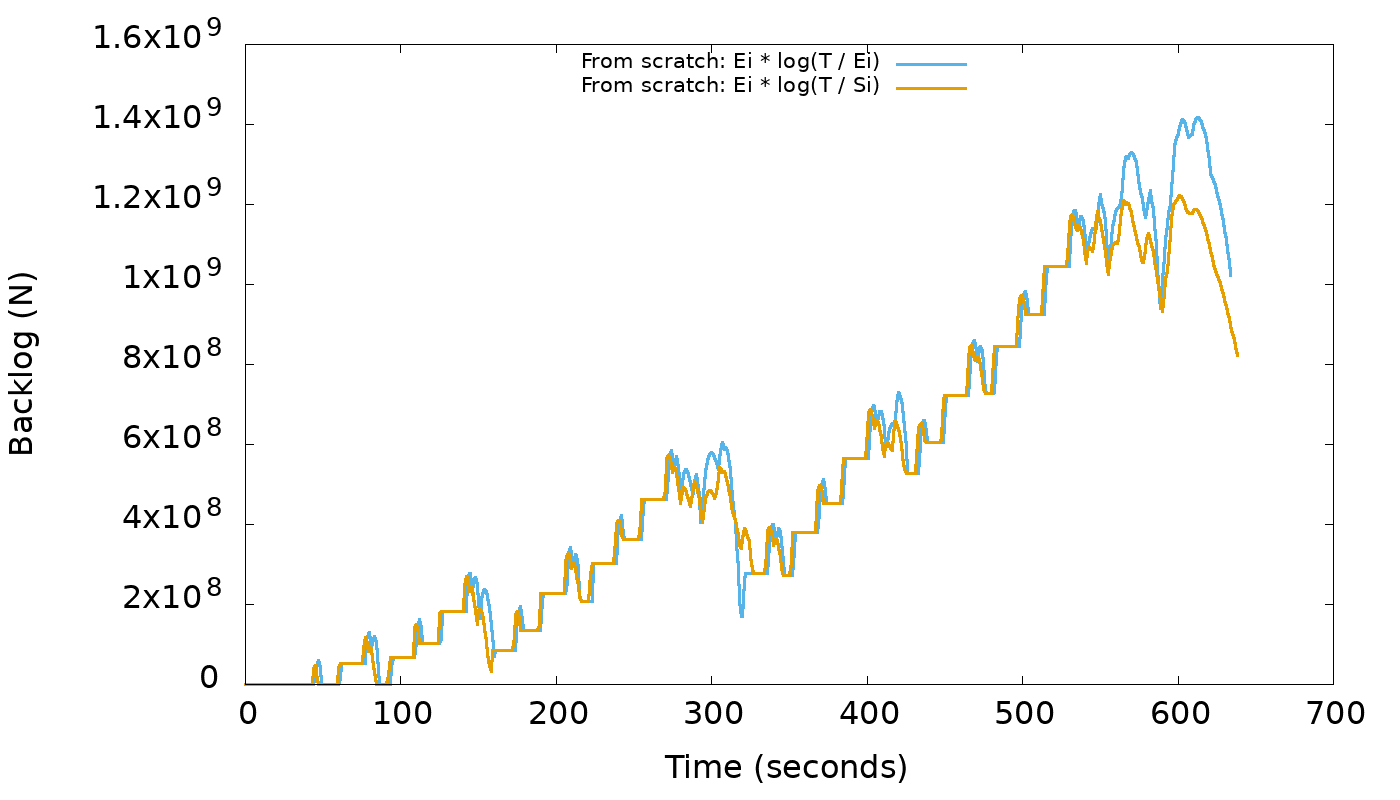
There is a typo in schema.cql of snapshot, lack of comma after
compaction strategy. It will fail to restore schema by the file.
AND compaction = {'class': 'SizeTieredCompactionStrategy''max_compaction_threshold': '32'}
map_as_cql_param() function has a `first` parameter to smartly add
comma, the compaction_strategy_options is always not the first.
Fixes#7741
Signed-off-by: Amos Kong <amos@scylladb.com>
Closes#7734
(cherry picked from commit 6b1659ee80)
Row marker has a cell name which sorts after the row tombstone's start
bound. The old code was writing the marker first, then the row
tombstone, which is incorrect.
This was harmeless to our sstable reader, which recognized both as
belonging to the current clustering row fragment, and collects both
fine.
However, if both atoms trigger creation of promoted index blocks, the
writer will create a promoted index with entries wich violate the cell
name ordering. It's very unlikely to run into in practice, since to
trigger promoted index entries for both atoms, the clustering key
would be so large so that the size of the marker cell exceeds the
desired promoted index block size, which is 64KB by default (but
user-controlled via column_index_size_in_kb option). 64KB is also the
limit on clustering key size accepted by the system.
This was caught by one of our unit tests:
sstable_conforms_to_mutation_source_test
...which runs a battery of mutation reader tests with various
desired promoted index block sizes, including the target size of 1
byte, which triggers an entry for every atom.
The test started to fail for some random seeds after commit ecb6abe
inside the
test_streamed_mutation_forwarding_is_consistent_with_slicing test
case, reporting a mutation mismatch in the following line:
assert_that(*sliced_m).is_equal_to(*fwd_m, slice_with_ranges.row_ranges(*m.schema(), m.key()));
It compares mutations read from the same sstable using different
methods, slicing using clustering key restricitons, and fast
forwarding. The reported mismatch was that fwd_m contained the row
marker, but sliced_m did not. The sstable does contain the marker, so
both reads should return it.
After reverting the commit which introduced dynamic adjustments, the
test passes, but both mutations are missing the marker, both are
wrong!
They are wrong because the promoted index contians entries whose
starting positions violate the ordering, so binary search gets confused
and selects the row tombstone's position, which is emitted after the
marker, thus skipping over the row marker.
The explanation for why the test started to fail after dynamic
adjustements is the following. The promoted index cursor works by
incrementally parsing buffers fed by the file input stream. It first
parses the whole block and then does a binary search within the parsed
array. The entries which cursor touches during binary search depend on
the size of the block read from the file. The commit which enabled
dynamic adjustements causes the block size to be different for
subsequent reads, which allows one of the reads to walk over the
corrupted entries and read the correct data by selecting the entry
corresponding to the row marker.
Fixes#8324
Message-Id: <20210322235812.1042137-1-tgrabiec@scylladb.com>
(cherry picked from commit 9272e74e8c)
When failing to rebuild a node, we would print the error with the useless
explanation "<no exception>". The problem was a typo in the logging command
which used std::current_exception() - which wasn't relevant in that point -
instead of "ep".
Refs #8089
Signed-off-by: Nadav Har'El <nyh@scylladb.com>
Message-Id: <20210314113118.1690132-1-nyh@scylladb.com>
(cherry picked from commit d73934372d)
Relaxed mode, used during initialization, of reshape only tolerates min_threshold
(default: 4) L0 sstables. However, relaxed mode should tolerate more sstables in
level 0, otherwise boot will have to reshape level 0 every time it crosses the
min threshold. So let's make LCS reshape tolerate a max of max_threshold and 32.
This change is beneficial because once table is populated, LCS regular compaction
can decide to merge those sstables in level 0 into level 1 instead, therefore
reducing WA.
Refs #8297.
Signed-off-by: Raphael S. Carvalho <raphaelsc@scylladb.com>
Message-Id: <20210318131442.17935-1-raphaelsc@scylladb.com>
(cherry picked from commit e53cedabb1)
Prior to 463d0ab, only one table could be cleaned up at a time on a given shard.
Since then, all tables belonging to a given keyspace are cleaned up in parallel.
Cleanup serialization on each shard was enforced with a semaphore, which was
incorrectly removed by the patch aforementioned.
So space requirement for cleanup to succeed can be up to the size of keyspace,
increasing the chances of node running out of space.
Node could also run out of memory if there are tons of tables in the keyspace.
Memory requirement is at least #_of_tables * 128k (not taking into account write
behind, etc). With 5k tables, it's ~0.64G per shard.
Also all tables being cleaned up in parallel will compete for the same
disk and cpu bandwidth, so making them all much slower, and consequently
the operation time is significantly higher.
This problem was detected with cleanup, but scrub and upgrade go through the
same rewrite procedure, so they're affected by exact the same problem.
Fixes#8247.
Signed-off-by: Raphael S. Carvalho <raphaelsc@scylladb.com>
Message-Id: <20210312162223.149993-1-raphaelsc@scylladb.com>
(cherry picked from commit 7171244844)
Due to regression introduced by 463d0ab, regular can compact in parallel a sstable
being compacted by cleanup, scrub or upgrade.
This redundancy causes resources to be wasted, write amplification is increased
and so does the operation time, etc.
That's a potential source of data resurrection because the now-owned data from
a sstable being compacted by both cleanup and regular will still exist in the
node afterwards, so resurrection can happen if node regains ownership.
Fixes#8155.
Signed-off-by: Raphael S. Carvalho <raphaelsc@scylladb.com>
Message-Id: <20210225172641.787022-1-raphaelsc@scylladb.com>
(cherry picked from commit 2cf0c4bbf1)
Includes fixup patch:
compaction_manager: Fix use-after-free in rewrite_sstables()
Use-after-free introduced by 2cf0c4bbf1.
That's because compacting is moved into then_wrapped() lambda, so it's
potentially freed on the next iteration of repeat().
Signed-off-by: Raphael S. Carvalho <raphaelsc@scylladb.com>
Message-Id: <20210309232940.433490-1-raphaelsc@scylladb.com>
(cherry picked from commit f7cc431477)
The shared_from_this lw_shared_ptr must not be accessed
across shards. Capturing it in the lambda passed to
mutation_writer::distribute_reader_and_consume_on_shards
causes exactly that since the captured lw_shared_ptr
is copied on other shards, and ends up in memory corruption
as seen in #7535 (probably due to lw_shared_ptr._count
going out-of-sync when incremented/decremented in parallel
on other shards with no synchronization.
This was introduced in 289a08072a.
The writer is not needed in the body of this lambda anyways
so it doesn't need to capture it. It is already held
by the continuations until the end of the chain.
Fixes#7535
Test: repair_additional_test:RepairAdditionalTest.repair_disjoint_row_3nodes_diff_shard_count_test (dev)
Signed-off-by: Benny Halevy <bhalevy@scylladb.com>
Message-Id: <20201104142216.125249-1-bhalevy@scylladb.com>
(cherry picked from commit f93fb55726)
Currently we decide whether to delete large data entries
based on the overall sstable data_size, since the entries
themselves are typically much smaller than the whole sstable
(especially cells and rows), this causes overzealous
deletions (#7668) and inefficiency in the rows cache
due to the large number of range tombstones created.
Refs #7575
Test: sstable_3_x_test(dev)
Signed-off-by: Benny Halevy <bhalevy@scylladb.com>
This patch is targetted for branch-4.3 or earlier.
In 4.4, the problem was fixed in #7669, but the fix
is out of scope for backporting.
Branch: 4.3
Signed-off-by: Benny Halevy <bhalevy@scylladb.com>
Message-Id: <20201203130018.1920271-1-bhalevy@scylladb.com>
(cherry picked from commit bb99d7ced6)
TWCS reshape was silently ignoring windows which contain at least
min_threshold sstables (can happen with data segregation).
When resizing candidates, size of multi_window was incorrectly used and
it was always empty in this path, which means candidates was always
cleared.
Fixes#8147.
Signed-off-by: Raphael S. Carvalho <raphaelsc@scylladb.com>
Message-Id: <20210224125322.637128-1-raphaelsc@scylladb.com>
(cherry picked from commit 21608bd677)
It turns out that `cql_table_large_data_handler::record_large_rows`
and `cql_table_large_data_handler::record_large_cells` were broken
for reporting static cells and static rows from the very beginning:
In case a large static cell or a large static row is encountered,
it tries to execute `db::try_record` with `nullptr` additional values,
denoting that there is no clustering key to be recorded.
These values are next passed to `qctx.execute_cql()`, which
creates `data_value` instances for each statement parameter,
hence invoking `data_value(nullptr)`.
This uses `const char*` overload which delegates to
`std::string_view` ctor overload. It is UB to pass `nullptr`
pointer to `std::string_view` ctor. Hence leading to
segmentation faults in the aforementioned large data reporting
code.
What we want here is to make a null `data_value` instead, so
just add an overload specifically for `std::nullptr_t`, which
will create a null `data_value` with `text` type.
A regression test is provided for the issue (written in
`cql-pytest` framework).
Tests: test/cql-pytest/test_large_cells_rows.py
Fixes: #6780
Signed-off-by: Pavel Solodovnikov <pa.solodovnikov@scylladb.com>
Message-Id: <20201223204552.61081-1-pa.solodovnikov@scylladb.com>
(cherry picked from commit 219ac2bab5)
When psutil.disk_paritions() reports / is /dev/root, aws_instance mistakenly
reports root partition is part of ephemeral disks, and RAID construction will
fail.
This prevents the error and reports correct free disks.
Fixes#8055Closes#8040
(cherry picked from commit 32d4ec6b8a)
The first condition expressions we implemented in Alternator were the old
"Expected" syntax of conditional updates. That implementation had some
specific assumptions on how it handles errors: For example, in the "LT"
operator in "Expected", the second operand is always part of the query, so
an error in it (e.g., an unsupported type) resulted it a ValidationException
error.
When we implemented ConditionExpression and FilterExpression, we wrongly
used the same functions check_compare(), check_BETWEEN(), etc., to implement
them. This results in some inaccurate error handling. The worst example is
what happens when you use a FilterExpression with an expression such as
"x < y" - this filter is supposed to silently skip items whose "x" and "y"
attributes have unsupported or different types, but in our implementation
a bad type (e.g., a list) for y resulted in a ValidationException which
aborted the entire scan! Interestingly, in once case (that of BEGINS_WITH)
we actually noticed the slightly different behavior needed and implemented
the same operator twice - with ugly code duplication. But in other operators
we missed this problem completely.
This patch first adds extensive tests of how the different expressions
(Expected, QueryFilter, FilterExpression, ConditionExpression) and the
different operators handle various input errors - unsupported types,
missing items, incompatible types, etc. Importantly, the tests demonstrate
that there is often different behavior depending on whether the bad
input comes from the query, or from the item. Some of the new tests
fail before this patch, but others pass and were useful to verify that
the patch doesn't break anything that already worked correctly previously.
As usual, all the tests pass on Cassandra.
Finally, this patch *fixes* all these problems. The comparison functions
like check_compare() and check_BETWEEN() now not only take the operands,
they also take booleans saying if each of the operands came from the
query or from an item. The old-syntax caller (Expected or QueryFilter)
always say that the first operand is from the item and the second is
from the query - but in the new-syntax caller (ConditionExpression or
FilterExpression) any or all of the operands can come from the query
and need verification.
The old duplicated code for check_BEGINS_WITH() - which a TODO to remove
it - is finally removed. Instead we use the same idea of passing booleans
saying if each of its operands came from an item or from the query.
Fixes#8043
Signed-off-by: Nadav Har'El <nyh@scylladb.com>
(cherry picked from commit 653610f4bc)
UpdateItem's "ADD" operation usually adds elements to an existing set
or adds a number to an existing counter. But it can *also* be used
to create a new set or counter (as if adding to an empty set or zero).
We unfortunately did not have a test for this case (creating a new set
or counter), and when I wrote such a test now, I discovered the
implementation was missing. So this patch adds both the test and the
implementation. The new test used to fail before this patch, and passes
with it - and passes on DynamoDB.
Note that we only had this bug for the newer UpdateItem syntax.
For the old AttributeUpdates syntax, we already support ADD actions
on missing attributes, and already tested it in test_update_item_add().
I just forgot to test the same thing for the newer syntax, so I missed
this bug :-(
Fixes#7763.
Signed-off-by: Nadav Har'El <nyh@scylladb.com>
Message-Id: <20201207085135.2551845-1-nyh@scylladb.com>
(cherry picked from commit a8fdbf31cd)
on_compaction_completion() updates _sstables_compacted_but_not_deleted
through a temporary to avoid an exception causing a partial update:
1. copy _sstables_compacted_but_not_deleted to a temporary
2. update temporary
3. do dangerous stuff
4. move temporary to _sstables_compacted_but_not_deleted
This is racy when we have parallel compactions, since step 3 yields.
We can have two invocations running in parallel, taking snapshots
of the same _sstables_compacted_but_not_deleted in step 1, each
modifying it in different ways, and only one of them winning the
race and assigning in step 4. With the right timing we can end
with extra sstables in _sstables_compacted_but_not_deleted.
Before a5369881b3, this was a benign race (only resulting in
deleted file space not being reclaimed until the service is shut
down), but afterwards, extra sstable references result in the service
refusing to shut down. This was observed in database_test in debug
mode, where the race more or less reliably happens for system.truncated.
Fix by using a different method to protect
_sstables_compacted_but_not_deleted. We unconditionally update it,
and also unconditionally fix it up (on success or failure) using
seastar::defer(). The fixup includes a call to rebuild_statistics()
which must happen every time we touch the sstable list.
Ref #7331.
Fixes#8038.
BACKPORT NOTES:
- Turns out this race prevented deletion of expired sstables because the leaked
deleted sstables would be accounted when checking if an expired sstable can
be purged.
- Switch to unordered_set<>::count() as it's not supported by older compilers.
(cherry picked from commit a43d5079f3)
Signed-off-by: Raphael S. Carvalho <raphaelsc@scylladb.com>
Message-Id: <20210212203832.45846-1-raphaelsc@scylladb.com>
Although the code for it existed already, the validation function
hasn't been invoked properly. This change fixes that, adding
a validating check when converting from text to specific value
type and throwing a marshal exception if some characters
are not ASCII.
Fixes#5421Closes#7532
(cherry picked from commit caa3c471c0)
This patch causes orphaned hints (hints that were written towards a node
that is no longer their replica) to be sent with a default write
timeout. This is what is currently done for non-orphaned hints.
Previously, the timeout was hardcoded to one hour. This could cause a
long delay while shutting down, as hints manager waits until all ongoing
hint sending operation finish before stopping itself.
Fixes: #7051
(cherry picked from commit b111fa98ca)
Overview
Fixes#7355.
Before this changes, there were a few invalid results of aggregates/GROUP BY on tables with secondary indexes (see below).
Unfortunately, it still does NOT fix the problem in issue #7043. Although this PR moves forward fixing of that issue, there is still a bug with `TOKEN(...)` in `WHERE` clauses of indexed selects that is not addressed in this PR. It will be fixed in my next PR.
It does NOT fix the problems in issues #7432, #7431 as those are out-of-scope of this PR and do not affect the correctness of results (only return a too large page).
GROUP BY (first commit)
Before the change, `GROUP BY` `SELECT`s with some `WHERE` restrictions on an indexed column would return invalid results (same grouped column values appearing multiple times):
```
CREATE TABLE ks.t(pk int, ck int, v int, PRIMARY KEY(pk, ck));
CREATE INDEX ks_t on ks.t(v);
INSERT INTO ks.t(pk, ck, v) VALUES (1, 2, 3);
INSERT INTO ks.t(pk, ck, v) VALUES (1, 4, 3);
SELECT pk FROM ks.t WHERE v=3 GROUP BY pk;
pk
----
1
1
```
This is fixed by correctly passing `_group_by_cell_indices` to `result_set_builder`. Fixes the third failing example from issue #7355.
Paging (second commit)
Fixes two issues related to improper paging on indexed `SELECT`s. As those two issues are closely related (fixing one without fixing the other causes invalid results of queries), they are in a single commit (second commit).
The first issue is that when using `slice.set_range`, the existing `_row_ranges` (which specify clustering key prefixes) are not taken into account. This caused the wrong rows to be included in the result, as the clustering key bound was set to a half-open range:
```
CREATE TABLE ks.t(a int, b int, c int, PRIMARY KEY ((a, b), c));
CREATE INDEX kst_index ON ks.t(c);
INSERT INTO ks.t(a, b, c) VALUES (1, 2, 3);
INSERT INTO ks.t(a, b, c) VALUES (1, 2, 4);
INSERT INTO ks.t(a, b, c) VALUES (1, 2, 5);
SELECT COUNT(*) FROM ks.t WHERE c = 3;
count
-------
2
```
The second commit fixes this issue by properly trimming `row_ranges`.
The second fixed problem is related to setting the `paging_state` to `internal_options`. It was improperly set to the value just after reading from index, making the base query start from invalid `paging_state`.
The second commit fixes this issue by setting the `paging_state` after both index and base table queries are done. Moreover, the `paging_state` is now set based on `paging_state` of index query and the results of base table query (as base query can return more rows than index query).
The second commit fixes the first two failing examples from issue #7355.
Tests (fourth commit)
Extensively tests queries on tables with secondary indices with aggregates and `GROUP BY`s.
Tests three cases that are implemented in `indexed_table_select_statement::do_execute` - `partition_slices`,
`whole_partitions` and (non-`partition_slices` and non-`whole_partitions`). As some of the issues found were related to paging, the tests check scenarios where the inserted data is smaller than a page, larger than a page and larger than two pages (and some in-between page boundaries scenarios).
I found all those parameters (case of `do_execute`, number of inserted rows) to have an impact of those fixed bugs, therefore the tests validate a large number of those scenarios.
Configurable internal_paging_size (third commit)
Before this change, internal `page_size` when doing aggregate, `GROUP BY` or nonpaged filtering queries was hard-coded to `DEFAULT_COUNT_PAGE_SIZE` (10,000). This change adds new internal_paging_size variable, which is configurable by `set_internal_paging_size` and `reset_internal_paging_size` free functions. This functionality is only meant for testing purposes.
Closes#7497
* github.com:scylladb/scylla:
tests: Add secondary index aggregates tests
select_statement: Introduce internal_paging_size
select_statement: Fix paging on indexed selects
select_statement: Fix GROUP BY on indexed select
(cherry picked from commit 8c645f74ce)
Few method in column_familiy API were doing the aggregation wrong,
specifically, bloom filter disk size.
The issue is not always visible, it happens when there are multiple
filter files per shard.
Fixes#4513
Signed-off-by: Amnon Heiman <amnon@scylladb.com>
Closes#8007
(cherry picked from commit 4498bb0a48)
This series makes sure that before the table is dropped, all pending memtable flushes related to its memtables would finish.
Normally, flushes are not problematic in Scylla, because all tables are by default `auto_snapshot=true`, which also implies that a table is flushed before being dropped. However, with `auto_snapshot=false` the flush is not attempted at all. It leads to the following race:
1. Run a node with `auto_snapshot=false`
2. Schedule a memtable flush (e.g. via nodetool)
3. Get preempted in the middle of the flush
4. Drop the table
5. The flush that already started wakes up and starts operating on freed memory, which causes a segfault
Tests: manual(artificially preempting for a long time in bullet point 2. to ensure that the race occurs; segfaults were 100% reproducible before the series and do not happen anymore after the series is applied)
Fixes#7792Closes#7798
* github.com:scylladb/scylla:
database: add flushes to waiting for pending operations
table: unify waiting for pending operations
database: add a phaser for flush operations
database: add waiting for pending streams on table drop
(cherry picked from commit 7636799b18)
do_read() does not linearize cache_entry::_key; this can cause a crash
with keys larger than 13k.
Fixes#7897.
Closes#7898
(cherry picked from commit d508a63d4b)
sstable_writer may depend on the sstable throughout its whole lifecycle.
If the sstable is freed before the sstable_writer we might hit use-after-free
as in the follwing case:
```
std::_Deque_iterator<sstables::compression::segmented_offsets::bucket, sstables::compression::segmented_offsets::bucket&, sstables::compression::segmented_offsets::bucket*>::operator+=(long) at /usr/include/c++/10/bits/stl_deque.h:240
(inlined by) std::operator+(std::_Deque_iterator<sstables::compression::segmented_offsets::bucket, sstables::compression::segmented_offsets::bucket&, sstables::compression::segmented_offsets::bucket*> const&, long) at /usr/include/c++/10/bits/stl_deque.h:378
(inlined by) std::_Deque_iterator<sstables::compression::segmented_offsets::bucket, sstables::compression::segmented_offsets::bucket&, sstables::compression::segmented_offsets::bucket*>::operator[](long) const at /usr/include/c++/10/bits/stl_deque.h:252
(inlined by) std::deque<sstables::compression::segmented_offsets::bucket, std::allocator<sstables::compression::segmented_offsets::bucket> >::operator[](unsigned long) at /usr/include/c++/10/bits/stl_deque.h:1327
(inlined by) sstables::compression::segmented_offsets::push_back(unsigned long, sstables::compression::segmented_offsets::state&) at ./sstables/compress.cc:214
sstables::compression::segmented_offsets::writer::push_back(unsigned long) at ./sstables/compress.hh:123
(inlined by) compressed_file_data_sink_impl<crc32_utils, (compressed_checksum_mode)1>::put(seastar::temporary_buffer<char>) at ./sstables/compress.cc:519
seastar::output_stream<char>::put(seastar::temporary_buffer<char>) at table.cc:?
(inlined by) seastar::output_stream<char>::put(seastar::temporary_buffer<char>) at ././seastar/include/seastar/core/iostream-impl.hh:432
seastar::output_stream<char>::flush() at table.cc:?
seastar::output_stream<char>::close() at table.cc:?
sstables::file_writer::close() at sstables.cc:?
sstables::mc::writer::~writer() at writer.cc:?
(inlined by) sstables::mc::writer::~writer() at ./sstables/mx/writer.cc:790
sstables::mc::writer::~writer() at writer.cc:?
flat_mutation_reader::impl::consumer_adapter<stable_flattened_mutations_consumer<compact_for_compaction<sstables::compacting_sstable_writer, noop_compacted_fragments_consumer> > >::~consumer_adapter() at compaction.cc:?
(inlined by) std::_Optional_payload_base<sstables::compaction_writer>::_M_destroy() at /usr/include/c++/10/optional:260
(inlined by) std::_Optional_payload_base<sstables::compaction_writer>::_M_reset() at /usr/include/c++/10/optional:280
(inlined by) std::_Optional_payload<sstables::compaction_writer, false, false, false>::~_Optional_payload() at /usr/include/c++/10/optional:401
(inlined by) std::_Optional_base<sstables::compaction_writer, false, false>::~_Optional_base() at /usr/include/c++/10/optional:474
(inlined by) std::optional<sstables::compaction_writer>::~optional() at /usr/include/c++/10/optional:659
(inlined by) sstables::compacting_sstable_writer::~compacting_sstable_writer() at ./sstables/compaction.cc:229
(inlined by) compact_mutation<(emit_only_live_rows)0, (compact_for_sstables)1, sstables::compacting_sstable_writer, noop_compacted_fragments_consumer>::~compact_mutation() at ././mutation_compactor.hh:468
(inlined by) compact_for_compaction<sstables::compacting_sstable_writer, noop_compacted_fragments_consumer>::~compact_for_compaction() at ././mutation_compactor.hh:538
(inlined by) std::default_delete<compact_for_compaction<sstables::compacting_sstable_writer, noop_compacted_fragments_consumer> >::operator()(compact_for_compaction<sstables::compacting_sstable_writer, noop_compacted_fragments_consumer>*) const at /usr/include/c++/10/bits/unique_ptr.h:85
(inlined by) std::unique_ptr<compact_for_compaction<sstables::compacting_sstable_writer, noop_compacted_fragments_consumer>, std::default_delete<compact_for_compaction<sstables::compacting_sstable_writer, noop_compacted_fragments_consumer> > >::~unique_ptr() at /usr/include/c++/10/bits/unique_ptr.h:361
(inlined by) stable_flattened_mutations_consumer<compact_for_compaction<sstables::compacting_sstable_writer, noop_compacted_fragments_consumer> >::~stable_flattened_mutations_consumer() at ././mutation_reader.hh:342
(inlined by) flat_mutation_reader::impl::consumer_adapter<stable_flattened_mutations_consumer<compact_for_compaction<sstables::compacting_sstable_writer, noop_compacted_fragments_consumer> > >::~consumer_adapter() at ././flat_mutation_reader.hh:201
auto flat_mutation_reader::impl::consume_in_thread<stable_flattened_mutations_consumer<compact_for_compaction<sstables::compacting_sstable_writer, noop_compacted_fragments_consumer> >, flat_mutation_reader::no_filter>(stable_flattened_mutations_consumer<compact_for_compaction<sstables::compacting_sstable_writer, noop_compacted_fragments_consumer> >, flat_mutation_reader::no_filter, std::chrono::time_point<seastar::lowres_clock, std::chrono::duration<long, std::ratio<1l, 1000l> > >) at ././flat_mutation_reader.hh:272
(inlined by) auto flat_mutation_reader::consume_in_thread<stable_flattened_mutations_consumer<compact_for_compaction<sstables::compacting_sstable_writer, noop_compacted_fragments_consumer> >, flat_mutation_reader::no_filter>(stable_flattened_mutations_consumer<compact_for_compaction<sstables::compacting_sstable_writer, noop_compacted_fragments_consumer> >, flat_mutation_reader::no_filter, std::chrono::time_point<seastar::lowres_clock, std::chrono::duration<long, std::ratio<1l, 1000l> > >) at ././flat_mutation_reader.hh:383
(inlined by) auto flat_mutation_reader::consume_in_thread<stable_flattened_mutations_consumer<compact_for_compaction<sstables::compacting_sstable_writer, noop_compacted_fragments_consumer> > >(stable_flattened_mutations_consumer<compact_for_compaction<sstables::compacting_sstable_writer, noop_compacted_fragments_consumer> >, std::chrono::time_point<seastar::lowres_clock, std::chrono::duration<long, std::ratio<1l, 1000l> > >) at ././flat_mutation_reader.hh:389
(inlined by) seastar::future<void> sstables::compaction::setup<noop_compacted_fragments_consumer>(noop_compacted_fragments_consumer)::{lambda(flat_mutation_reader)#1}::operator()(flat_mutation_reader)::{lambda()#1}::operator()() at ./sstables/compaction.cc:612
```
What happens here is that:
compressed_file_data_sink_impl(output_stream<char> out, sstables::compression* cm, sstables::local_compression lc)
: _out(std::move(out))
, _compression_metadata(cm)
, _offsets(_compression_metadata->offsets.get_writer())
, _compression(lc)
, _full_checksum(ChecksumType::init_checksum())
_compression_metadata points to a buffer held by the sstable object.
and _compression_metadata->offsets.get_writer returns a writer that keeps
a reference to the segmented_offsets in the sstables::compression
that is used in the ~writer -> close path.
Fixes#7821
Signed-off-by: Benny Halevy <bhalevy@scylladb.com>
Message-Id: <20201227145726.33319-1-bhalevy@scylladb.com>
(cherry picked from commit 8a745a0ee0)
feed_writer() eats exception and transforms it into an end of stream
instead. Downstream validators hate when this happens.
Fixes#7482
Message-Id: <20201216090038.GB3244976@scylladb.com>
(cherry picked from commit 61520a33d6)
aws_instance.ebs_disks() method should return ebs disk
instead of ephemeral
Signed-off-by: Aleksandr Bykov <alex.bykov@scylladb.com>
Closes#7780
(cherry picked from commit e74dc311e7)
tuned 2.11.0-9 and later writes to kerned.sched_wakeup_granularity_ns
and other sysctl tunables that we so laboriously tuned, dropping
performance by a factor of 5 (due to increased latency). Fix by
obsoleting tuned during install (in effect, we are a better tuned,
at least for us).
Not needed for .deb, since debian/ubunto do not install tuned by
default.
Fixes#7696Closes#7776
(cherry picked from commit 615b8e8184)
When an Alternator table has partition keys or sort keys of type "bytes"
(blobs), a Scan or Query which required paging used to fail - we used
an incorrect function to output LastEvaluatedKey (which tells the user
where to continue at the next page), and this incorrect function was
correct for strings and numbers - but NOT for bytes (for bytes, we
need to encode them as base-64).
This patch also includes two tests - for bytes partition key and
for bytes sort key - that failed before this patch and now pass.
The test test_fetch_from_system_tables also used to fail after a
Limit was added to it, because one of the tables it scans had a bytes
key. That test is also fixed by this patch.
Fixes#7768
Signed-off-by: Nadav Har'El <nyh@scylladb.com>
Message-Id: <20201207175957.2585456-1-nyh@scylladb.com>
(cherry picked from commit 86779664f4)
When getting local ranges, an assumption is made that
if a range does not contain an end or when its end is a maximum token,
then it must contain a start. This assumption proven not true
during manual tests, so it's now fortified with an additional check.
Here's a gdb output for a set of local ranges which causes an assertion
failure when calling `get_local_ranges` on it:
(gdb) p ranges
$1 = std::vector of length 2, capacity 2 = {{_interval = {_start = std::optional<interval_bound<dht::token>> = {[contained value] = {_value = {_kind = dht::token_kind::before_all_keys,
_data = 0}, _inclusive = false}}, _end = std::optional<interval_bound<dht::token>> [no contained value], _singular = false}}, {_interval = {
_start = std::optional<interval_bound<dht::token>> [no contained value], _end = std::optional<interval_bound<dht::token>> = {[contained value] = {_value = {
_kind = dht::token_kind::before_all_keys, _data = 0}, _inclusive = true}}, _singular = false}}}
Closes#7764
(cherry picked from commit 1cc4ed50c1)
The test test_fetch_from_system_tables tests Alternator's system-table
feature by reading from all system tables. The intention was to confirm
we don't crash reading any of them - as they have different schemas and
can run into different problems (we had such problems in the initial
implementation). The intention was not to read *a lot* from each table -
we only make a single "Scan" call on each, to read one page of data.
However, the Scan call did not set a Limit, so the single page can get
pretty big.
This is not normally a problem, but in extremely slow runs - such as when
running the debug build on an extremely overcommitted test machine (e.g.,
issue #7706) reading this large page may take longer than our default
timeout. I'll send a separate patch for the timeout issue, but for now,
there is really no reason why we need to read a big page. It is good
enough to just read 50 rows (with Limit=50). This will still read all
the different types and make the test faster.
As an example, in the debug run on my laptop, this test spent 2.4
seconds to read the "compaction_history" table before this patch,
and only 0.1 seconds after this patch. 2.4 seconds is close to our
default timeout (10 seconds), 0.1 is very far.
Fixes#7706
Signed-off-by: Nadav Har'El <nyh@scylladb.com>
Message-Id: <20201207075112.2548178-1-nyh@scylladb.com>
(cherry picked from commit 220d6dde17)
We had a bug when a Query/Scan had both projection (ProjectionExpression
or AttributesToGet) and filtering (FilterExpression or Query/ScanFilter).
The problem was that projection left only the requested attributes, and
the filter might have needed - and not got - additional attributes.
The solution in this patch is to add the generated JSON item also
the extra attributes needed by filtering (if any), run the filter on
that, and only at the end remove the extra filtering attributes from
the item to be returned.
The two tests
test_query_filter.py::test_query_filter_and_attributes_to_get
test_filter_expression.py::test_filter_expression_and_projection_expression
Which failed before this patch now pass so we drop their "xfail" tag.
Fixes#6951.
Signed-off-by: Nadav Har'El <nyh@scylladb.com>
(cherry picked from commit 282742a469)
We used to calculate the number of endpoints for quorum and local_quorum
unconditionally as ((rf / 2) + 1). This formula doesn't take into
account the corner case where RF = 0, in this situation quorum should
also be 0.
This commit adds the missing corner case.
Tests: Unit Tests (dev)
Fixes#6905Closes#7296
(cherry picked from commit 925cdc9ae1)
This is a regression caused by aebd965f0.
After the sstable_directory changes, resharding now waits for all sstables
to be exhausted before releasing reference to them, which prevents their
resources like disk space and fd from being released. Let's restore the
old behavior of incrementally releasing resources, reducing the space
requirement significantly.
Fixes#7463.
Signed-off-by: Raphael S. Carvalho <raphaelsc@scylladb.com>
Message-Id: <20201020140939.118787-1-raphaelsc@scylladb.com>
(cherry picked from commit 6f805bd123)
The future of the fiber that writes data into sstables inside
the repair_writer is stored in _writer_done like below:
class repair_writer {
_writer_done[node_idx] =
mutation_writer::distribute_reader_and_consume_on_shards().then([this] {
...
}).handle_exception([this] {
...
});
}
The fiber access repair_writer object in the error handling path. We
wait for the _writer_done to finish before we destroy repair_meta
object which contains the repair_writer object to avoid the fiber
accessing already freed repair_writer object.
To be safer, we can make repair_writer a shared pointer and take a
reference in the distribute_reader_and_consume_on_shards code path.
Fixes#7406Closes#7430
(cherry picked from commit 289a08072a)
Before updating the _last_[cp]key (for subsequent .fetch_page())
the pager checks is 'if the pager is not exhausted OR the result
has data'.
The check seems broken: if the pager is not exhausted, but the
result is empty the call for keys will unconditionally try to
reference the last element from empty vector. The not exhausted
condition for empty result can happen if the short_read is set,
which, in turn, unconditionally happens upon meeting partition
end when visiting the partition with result builder.
The correct check should be 'if the pager is not exhausted AND
the result has data': the _last_[pc]key-s should be taken for
continuation (not exhausted), but can be taken if the result is
not empty (has data).
fixes: #7263
tests: unit(dev), but tests don't trigger this corner case
Signed-off-by: Pavel Emelyanov <xemul@scylladb.com>
Message-Id: <20200921124329.21209-1-xemul@scylladb.com>
(cherry picked from commit 550fc734d9)
We currently set PATH for relocatable CLI tools in scylla_util.run() and
scylla_util.out(), but it doesn't work for perftune.py, since it's not part of
Scylla, does not use scylla_util module.
We can set PATH in python thunk instead, it can set PATH for all python scripts.
Fixes#7350
(cherry picked from commit 5867af4edd)
Retry mechanism didn't work when URLError happend. For example:
urllib.error.URLError: <urlopen error [Errno 101] Network is unreachable>
Let's catch URLError instead of HTTP since URLError is a base exception
for all exceptions in the urllib module.
Fixes: #7569Closes#7567
(cherry picked from commit 956b97b2a8)
When we introduced dependencies.conf, we mistakenly added it on rpm as %ghost,
but it should be normal file, should be installed normally on package installation.
Fixes#7703Closes#7704
(cherry picked from commit ba4d54efa3)
We don't apply sysctl.d files on non-packaging installation, apply them
just like rpm/deb taking care of that.
Fixes#7702Closes#7705
(cherry picked from commit 5f81f97773)
Since f3bcd4d205 ("Merge 'Support SSL Certificate Hot
Reloading' from Calle"), we reload certificates as they are
modified on disk. This uses inotify, which is limited by a
sysctl fs.inotify.max_user_instances, with a default of 128.
This is enough for 64 shards only, if both rpc and cql are
encrypted; above that startup fails.
Increase to 1200, which is enough for 6 instances * 200 shards.
Fixes#7700.
Closes#7701
(cherry picked from commit 390e07d591)
If interposer consumer is enabled, partition filtering will be done by the
consumer instead, but that's not possible because only the producer is able
to skip to the next partition if the current one is filtered out, so scylla
crashes when that happens with a bad function call in queue_reader.
This is a regression which started here: 55a8b6e3c9
To fix this problem, let's make sure that partition filtering will only
happen on the producer side.
Fixes#7590.
Signed-off-by: Raphael S. Carvalho <raphaelsc@scylladb.com>
Message-Id: <20201111221513.312283-1-raphaelsc@scylladb.com>
(cherry picked from commit 13fa2bec4c)
When there are hint files to be sent and the target endpoint is DOWN,
end_point_hints_manager works in the following loop:
- It reads the first hint file in the queue,
- For each hint in the file it decides that it won't be sent because the
target endpoint is DOWN,
- After realizing that there are some unsent hints, it decides to retry
this operation after sleeping 1 second.
This causes the first segment to be wholly read over and over again,
with 1 second pauses, until the target endpoint becomes UP or leaves the
cluster. This causes unnecessary I/O load in the streaming scheduling
group.
This patch adds a check which prevents end_point_hints_manager from
reading the first hint file at all when it is not allowed to send hints.
First observed in #6964
Tests:
- unit(dev)
- hinted handoff dtests
Closes#7407
(cherry picked from commit 77a0f1a153)
If the consumer happens to check the EOS flag before it hits the
exception injected by the abort (by calling fill_buffer()), they can
think the stream ended normally and expect it to be valid. However this
is not guaranteed when the reader is aborted. To avoid consumers falsely
thinking the stream ended normally, don't set the EOS flag on abort at
all.
Additionally make sure the producer is aborted too on abort. In theory
this is not needed as they are the one initiating the abort, but better
to be safe then sorry.
Fixes: #7411
Signed-off-by: Botond Dénes <bdenes@scylladb.com>
Message-Id: <20201102100732.35132-1-bdenes@scylladb.com>
(cherry picked from commit f5323b29d9)
Instead of eagerly linearizing all values as they are passed to
validate(), defer linearization to those validators that actually need
linearized values. Linearizing large values puts pressure on the memory
allocator with large contiguous allocation requests. This is something
we are trying to actively avoid, especially if it is not really neaded.
Turns out the types, whose validators really want linearized values are
a minority, as most validators just look at the size of the value, and
some like bytes don't need validation at all, while usually having large
values.
This is achieved by templating the validator struct on the view and
using the FragmentedRange concept to treat all passed in views
(`bytes_view` and `fragmented_temporary_buffer_view`) uniformly.
This patch makes no attempt at converting existing validators to work
with fragmented buffers, only trivial cases are converted. The major
offenders still left are ascii/utf8 and collections.
Fixes: #7318
Tests: unit(dev)
Signed-off-by: Botond Dénes <bdenes@scylladb.com>
Message-Id: <20201007054524.909420-1-bdenes@scylladb.com>
(cherry picked from commit db56ae695c)
This patch change the code that iterates over the metrics to use a copy
of the metrics names to make it safe to remove the metrics from the
metrics object.
Fixes#7488
Signed-off-by: Amnon Heiman <amnon@scylladb.com>
(cherry picked from commit 52db99f25f)
Refs #7364
The number of tombstones can be large. As a stopgap measure to
just returning a source range (with keepalive), we can at least
alleviate the problem by using a chunked vector.
Closes#7433
(cherry picked from commit 4b65d67a1a)
Cleanup compaction is using consume_pausable_in_thread() to skip over
disowned partitions, which uses flat_mutation_reader::next_partition().
The implementation of next_partition() for the sstable reader has a
bug which may cause the following assertion failure:
scylla: sstables/mp_row_consumer.hh:422: row_consumer::proceed sstables::mp_row_consumer_k_l::flush(): Assertion `!_ready' failed.
This happens when the sstable reader's buffer gets full when we reach
the partition end. The last fragment of the partition won't be pushed
into the buffer but will stay in the _ready variable. When
next_partition() is called in this state, _ready will not be cleared
and the fragment will be carried over to the next partition. This will
cause assertion failure when the reader attempts to emit the first
fragment of the next partition.
The fix is to clear _ready when entering a partition, just like we
clear _range_tombstones there.
Fixes#7553.
Message-Id: <1604534702-12777-1-git-send-email-tgrabiec@scylladb.com>
(cherry picked from commit fb9b5cae05)
"
Issue https://github.com/scylladb/scylla/issues/7019 describes a problem of an ever-growing map of temporary values stored in query_options. In order to mitigate this kind of problems, the storage for temporary values is moved from an external data structure to the value views itself. This way, the temporary lives only as long as it's accessible and is automatically destroyed once a request finishes. The downside is that each temporary is now allocated separately, while previously they were bundled in a single byte stream.
Tests: unit(dev)
Fixes https://github.com/scylladb/scylla/issues/7019
"
7055297649 ("cql3: remove query_options::linearize and _temporaries")
is reverted from this backport since linearize() is still used in
this branch.
* psarna-move_temporaries_to_value_view:
cql3: remove query_options::linearize and _temporaries
cql3: remove make_temporary helper function
cql3: store temporaries in-place instead of in query_options
cql3: add temporary_value to value view
cql3: allow moving data out of raw_value
cql3: split values.hh into a .cc file
(cherry picked from commit 2b308a973f)
Old secondary index schemas did not have their idx_token column
marked as computed, and there already exists code which updates
them. Unfortunately, the fix itself contains an error and doesn't
fire if computed columns are not yet supported by the whole cluster,
which is a very common situation during upgrades.
Fixes#7515Closes#7516
(cherry picked from commit b66c285f94)
This is a backport of PR #7469 that did not apply cleanly to 4.2 with a trivial conflict, another commit that touched one of the files but in a completely different region.
Closes#7480
* github.com:scylladb/scylla:
materialized views: add a base table reference if missing
view info: support partial match between base and view for only reading from view.
view info: guard against null dereference of the base info
schema pointers can be obtained from two distinct entities,
one is the database, those schema are obtained from the table
objects and the other is from the schema registry.
When a schema or a new schema is attached to a table object that
represents a base table for views, all of the corresponding attached
view schemas are guarantied to have their base info in sync.
However if an older schema is inserted into the registry by the
migratrion manager i.e loaded from other node, it will be
missing this info.
This becomes a problem when this schema is published through the
schema registry as it can be obtained for an obsolete read command
for example and then eventually cause a segmentation fault by null
dereferencing the _base_info ptr.
Refs #7420
only reading from view.
The current implementation of materialized views does
no keep the version to which a specific version of materialized
view schema corresponds to. This complicate things especially on
old views versions that the schema doesn't support anymore. However,
the views, being also an independent table should allow reading from
them as long as they exist even if the base table changed since then.
For the reading purpose, we don't need to know the exact composition
of view primary key columns that are not part of the base primary
key, we only need to know that there are any, and this is a much
looser constrain on the schema.
We can rely on a table invariants such as the fact that pk columns are
not going to disappear on newer version of the table.
This means that if we don't find a view column in the base table, it is
not a part of the base table primary key.
This information is enough for us to perform read on the view.
This commit adds support for being able to rely on such partial
information along with a validation that it is not going to be used for
writes. If it is, we simply abort since this means that our schema
integrity is compromised.
The change's purpose is to guard against segfault that is the
result of dereferencing the _base_info member when it is
uninitialized. We already know this can happen (#7420).
The only purpose of this change is to treat this condition as
an internal error, the reason is that it indicates a schema integrity
problem.
Besides this change, other measures should be taken to ensure that
the _base_table member is initialized before calling methods that
rely on it.
We call the internal_error as a last resort.
When Alternator is enabled over HTTPS - by setting the
"alternator_https_port" option - it needs to know some SSL-related options,
most importantly where to pick up the certificate and key.
Before this patch, we used the "server_encryption_options" option for that.
However, this was a mistake: Although it sounds like these are the "server's
options", in fact prior to Alternator this option was only used when
communicating with other servers - i.e., connections between Scylla nodes.
For CQL connections with the client, we used a different option -
"client_encryption_options".
This patch introduces a third option "alternator_encryption_options", which
controls only Alternator's HTTPS server. Making it separate from the
existing CQL "client_encryption_options" allows both Alternator and CQL to
be active at the same time but with different certificates (if the user
so wishes).
For backward compatibility, we temporarily continue to allow
server_encryption_options to control the Alternator HTTPS server if
alternator_encryption_options is not specified. However, this generates
a warning in the log, urging the user to switch. This temporary workaround
should be removed in a future version.
This patch also:
1. fixes the test run code (which has an "--https" option to test over
https) to use the new name of the option.
2. Adds documentation of the new option in alternator.md and protocols.md -
previously the information on how to control the location of the
certificate was missing from these documents.
Fixes#7204.
Signed-off-by: Nadav Har'El <nyh@scylladb.com>
Message-Id: <20200930123027.213587-1-nyh@scylladb.com>
(cherry picked from commit 509a41db04)
scylla-python3 causes segfault when non-default locale specified.
As workaround for this, we need to set LC_ALL=en_US.UTF_8 on python3 thunk.
Fixes#7408Closes#7414
(cherry picked from commit ff129ee030)
Currently in all cases we first deduct the to-be-consumed resources,
then construct the `reader_resources` class to protect it (release it on
destruction). This is error prone as it relies on no exception being
thrown while constructing the `reader_resources`. Albeit the
`reader_resources` constructor is `noexcept` right now this might change
in the future and as the call sites relying on this are disconnected
from the declaration, the one modifying them might not notice.
To make this safe going forward, make the `reader_resources` a true RAII
class, consuming the units in its constructor and releasing them in its
destructor.
Fixes: #7256
Tests: unit(dev)
Signed-off-by: Botond Dénes <bdenes@scylladb.com>
Message-Id: <20200922150625.1253798-1-bdenes@scylladb.com>
(cherry picked from commit a0107ba1c6)
The lockup:
When view_builder starts all shards at some point get to a
barrier waiting for each other to pass. If any shard misses
this checkpoint, all others stuck forever. As this barrier
lives inside the _started future, which in turn is waited
on stop, the stop stucks as well.
Reasons to miss the barrier -- exception in the middle of the
fun^w start or explicit abort request while waiting for the
schema agreement.
Fix the "exception" case by unlocking the barrier promise with
exception and fix the "abort request" case by turning it into
an exception.
The bug can be reproduced by hands if making one shard never
see the schema agreement and continue looping until the abort
request.
The crash:
If the background start up fails, then the _started future is
resolved into exception. The view_builder::stop then turns this
future into a real exception caught-and-rethrown by main.cc.
This seems wrong that a failure in a background fiber aborts
the regular shutdown that may proceed otherwise.
tests: unit(dev), manual start-stop
branch: https://github.com/xemul/scylla/tree/br-view-builder-shutdown-fix-3fixes: #7077
Patch #5 leaves the seastar::async() in the 1-st phase of the
start() although can also be tuned not to produce a thread.
However, there's one more (painless) issue with the _sem usage,
so this change appears too large for the part of the bug-fix
and will come as a followup.
* 'br-view-builder-shutdown-fix-3' of git://github.com/xemul/scylla:
view_builder: Add comment about builder instances life-times
view_builder: Do sleep abortable
view_builder: Wakeup barrier on exception
view_builder: Always resolve started future to success
view_builder: Re-futurize start
view_builder: Split calculate_shard_build_step into two
view_builder: Populate the view_builder_init_state
view_builder: Fix indentation after previous patch
view_builder: Introduce view_builder_init_state
(cherry picked from commit ca9422ca73)
Unavailable exception means that operation was not started and it can be
retried safely. If lwt fails in the learn stage though it most
certainly means that its effect will be observable already. The patch
returns timeout exception instead which means uncertainty.
Fixes#7258
Message-Id: <20201001130724.GA2283830@scylladb.com>
(cherry picked from commit 3e8dbb3c09)
`trace_keyspace_helper::make_slow_query_mutation_data` expected a
"query" key in its parameters, which does not appear in case of
e.g. batches of prepared statements. This is example of failing
`record.parameters`:
```
...{"query[0]" : "INSERT INTO ks.tbl (pk, i) values (?, ?);"},
{"query[1]" : "INSERT INTO ks.tbl (pk, i) values (?, ?);"}...
```
In such case Scylla recorded no trace and said:
```
ERROR 2020-09-28 10:09:36,696 [shard 3] trace_keyspace_helper - No
"query" parameter set for a session requesting a slow_query_log record
```
Fix here is to leave query empty if not found. The users can still
retrieve the query contents from existing info.
Fixes#5843Closes#7293
(cherry picked from commit 0afa738a8f)
"
This series fixes a bug in `appending_hash<row>` that caused it to ignore any cells after the first NULL. It also adds a cluster feature which starts using the new hashing only after the whole cluster is aware of it. The series comes with tests, which reproduce the issue.
Fixes#4567
Based on #4574
"
* psarna-fix_ignoring_cells_after_null_in_appending_hash:
test: extend mutation_test for NULL values
tests/mutation: add reproducer for #4567
gms: add a cluster feature for fixed hashing
digest: add null values to row digest
mutation_partition: fix formatting
appending_hash<row>: make publicly visible
(cherry picked from commit 0e03c979d2)
"
Migration manager installs several cluster feature change listeners.
The listeners will call update_schema_version_and_announce() when cluster
features are enabled, which does this:
return update_schema_version(proxy, features).then([] (utils::UUID uuid) {
return announce_schema_version(uuid);
});
It first updates the schema version and then publishes it via
gossip in announce_schema_version(). It is possible that the
announce_schema_version() part of the first schema change will be
deferred and will execute after the other four calls to
update_schema_version_and_announce(). It will install the old schema
version in gossip instead of the more recent one.
The fix is to serialize schema digest calculation and publishing.
Refs #7200
This problem also brought my attention to initialization code, which could be
prone to the same problem.
The storage service computes gossiper states before it starts the
gossiper. Among them, node's schema version. There are two problems with that.
First is that computing the schema version and publishing it is not
atomic, so is not safe against concurrent schema changes or schema
version recalculations. It will not exclude with
recalculate_schema_version() calls, and we could end up with the old
(and incorrect) schema version being advertised in gossip.
Second problem is that we should not allow the database layer to call
into the gossiper layer before it is fully initialized, as this may
produce undefined behavior.
Maybe we're not doing concurrent schema changes/recalculations now,
but it is easy to imagine that this could change for whatever reason
in the future.
The solution for both problems is to break the cyclic dependency
between the database layer and the storage_service layer by having the
database layer not use the gossiper at all. The database layer
publishes schema version inside the database class and allows
installing listeners on changes. The storage_service layer asks the
database layer for the current version when it initializes, and only
after that installs a listener which will update the gossiper.
Tests:
- unit (dev)
- manual (3 node ccm)
"
Fixes#7291
* tag 'fix-schema-digest-calculation-race-v1' of github.com:tgrabiec/scylla:
db, schema: Hide update_schema_version_and_announce()
db, storage_service: Do not call into gossiper from the database layer
db: Make schema version observable
utils: updateable_value_source: Introduce as_observable()
schema: Fix race in schema version recalculation leading to stale schema version in gossip
(cherry picked from commit dcaf4ea4dd)
The reader recreation mechanism is a very delicate and error-prone one,
as proven by the countless bugs it had. Most of these bugs were related
to the recreated reader not continuing the read from the expected
position, inserting out-of-order fragments into the stream.
This patch adds a defense mechanism against such bugs by validating the
start position of the recreated reader.
The intent is to prevent corrupt data from getting into the system as
well as to help catch these bugs as close to the source as possible.
Fixes: #7208
Tests: unit(dev), mutation_reader_test:debug (v4)
* botond/evictable-reader-validate-buffer/v5:
mutation_reader_test: add unit test for evictable reader self-validation
evictable_reader: validate buffer after recreation the underlying
evictable_reader: update_next_position(): only use peek'd position on partition boundary
mutation_reader_test: add unit test for evictable reader range tombstone trimming
evictable_reader: trim range tombstones to the read clustering range
position_in_partition_view: add position_in_partition_view before_key() overload
flat_mutation_reader: add buffer() accessor
(cherry picked from commit 97c99ea9f3)
This patch fixes a race between two methods in hints manager: drain_for
and store_hint.
The first method is called when a node leaves the cluster, and it
'drains' end point hints manager for that node (sends out all hints for
that node). If this method is called when the local node is being
decomissioned or removed, it instead drains hints managers for all
endpoints.
In the case of decomission/remove, drain_for first calls
parallel_for_each on all current ep managers and tells them to drain
their hints. Then, after all of them complete, _ep_managers.clear() is
called.
End point hints managers are created lazily and inserted into
_ep_managers map the first time a hint is stored for that node. If
this happens between parallel_for_each and _ep_managers.clear()
described above, the clear operation will destroy the new ep manager
without draining it first. This is a bug and will trigger an assert in
ep manager's destructor.
To solve this, a new flag for the hints manager is added which is set
when it drains all ep managers on removenode/decommission, and prevents
further hints from being written.
Fixes#7257Closes#7278
(cherry picked from commit 39771967bb)
Hints writes are handled by storage_proxy in the exact same way
regular writes are, which in turn means that the same smp service
group is used for both. The problem is that it can lead to a priority
inversion where writes of the lower priority kind occupies a lot of
the semaphores units making the higher priority writes wait for an
empty slot.
This series adds a separate smp group for hints as well as a field
to pass the correct smp group to mutate_locally functions, and
then uses this field to properly classify the writes.
Fixes#7177
* eliransin-hint_priority_inversion:
Storage proxy: use hints smp group in mutate locally
Storage proxy: add a dedicated smp group for hints
(cherry picked from commit c075539fea)
Corresponding overload of `storage_proxy::mutate_locally`
was hardcoded to pass `db::commitlog::force_sync::no` to the
`database::apply`. Unhardcode it and substitute `force_sync::no`
to all existing call sites (as it were before).
`force_sync::yes` will be used later for paxos learn writes
when trying to apply mutations upgraded from an obsolete
schema version (similar to the current case when applying
locally a `frozen_mutation` stored in accepted proposal).
Tests: unit(dev)
Signed-off-by: Pavel Solodovnikov <pa.solodovnikov@scylladb.com>
Message-Id: <20200716124915.464789-1-pa.solodovnikov@scylladb.com>
(cherry picked from commit 5ff5df1afd)
Prerequisite for #7177.
This patch fixes a bug noted in issue #7218 - where PutItem operations
sometimes lose part of the item's data - some attributes were lost,
and the name of other attributes replaced by empty strings. The problem
happened when the write-isolation policy was LWT and there was contention
of writes to the same partition (not necessarily the same item).
To use CAS (a.k.a. LWT), Alternator builds an alternator::rmw_operation
object with an apply() function which takes the old contents of the item
(if needed) and a timestamp, and builds a mutation that the CAS should
apply. In the case of the PutItem operation, we wrongly assumed that apply()
will be called only once - so as an optimization the strings saved in the
put_item_operation were moved into the returned mutation. But this
optimization is wrong - when there is contention, apply() may be called
again when the changed proposed by the previous one was not accepted by
the Paxos protocol.
The fix is to change the one place where put_item_operation *moved* strings
out of the saved operations into the mutations, to be a copy. But to prevent
this sort of bug from reoccuring in future code, this patch enlists the
compiler to help us verify that it can't happen: The apply() function is
marked "const" - it can use the information in the operation to build the
mutation, but it can never modify this information or move things out of it,
so it will be fine to call this function twice.
The single output field that apply() does write (_return_attributes) is
marked "mutable" to allow the const apply() to write to it anyway. Because
apply() might be called twice, it is important that if some apply()
implementation sometimes sets _return_attributes, then it must always
set it (even if to the default, empty, value) on every call to apply().
The const apply() means that the compiler verfies for us that I didn't
forget to fix additional wrong std::move()s. Additionally, a test I wrote
to easily reproduce issue #7218 (which I will submit as a dtest later)
passes after this fix.
Fixes#7218.
Signed-off-by: Nadav Har'El <nyh@scylladb.com>
Message-Id: <20200916064906.333420-1-nyh@scylladb.com>
(cherry picked from commit 5e8bdf6877)
"
The view_info object, which is attached to the schema object of the
view, contains a data structure called
"base_non_pk_columns_in_view_pk". This data structure contains column
ids of the base table so is valid only for a particular version of the
base table schema. This data structure is used by materialized view
code to interpret mutations of the base table, those coming from base
table writes, or reads of the base table done as part of view updates
or view building.
The base table schema version of that data structure must match the
schema version of the mutation fragments, otherwise we hit undefined
behavior. This may include aborts, exceptions, segfaults, or data
corruption (e.g. writes landing in the wrong column in the view).
Before this patch, we could get schema version mismatch here after the
base table was altered. That's because the view schema did not change
when the base table was altered.
Another problem was that view building was using the current table's schema
to interpret the fragments and invoke view building. That's incorrect for two
reasons. First, fragments generated by a reader must be accessed only using
the reader's schema. Second, base_non_pk_columns_in_view_pk of the recorded
view ptrs may not longer match the current base table schema, which is used
to generate the view updates.
Part of the fix is to extract base_non_pk_columns_in_view_pk into a
third entity called base_dependent_view_info, which changes both on
base table schema changes and view schema changes.
It is managed by a shared pointer so that we can take immutable
snapshots of it, just like with schema_ptr. When starting the view
update, the base table schema_ptr and the corresponding
base_dependent_view_info have to match. So we must obtain them
atomically, and base_dependent_view_info cannot change during update.
Also, whenever the base table schema changes, we must update
base_dependent_view_infos of all attached views (atomically) so that
it matches the base table schema.
Fixes#7061.
Tests:
- unit (dev)
- [v1] manual (reproduced using scylla binary and cqlsh)
"
* tag 'mv-schema-mismatch-fix-v2' of github.com:tgrabiec/scylla:
db: view: Refactor view_info::initialize_base_dependent_fields()
tests: mv: Test dropping columns from base table
db: view: Fix incorrect schema access during view building after base table schema changes
schema: Call on_internal_error() when out of range id is passed to column_at()
db: views: Fix undefined behavior on base table schema changes
db: views: Introduce has_base_non_pk_columns_in_view_pk()
(cherry picked from commit 3daa49f098)
test is currently flaky since system reads can happen
in the background and disturb the global row cache stats.
Use the table's row_cache stats instead.
Fixes#6773
Test: cql_query_test.test_cache_bypass(dev, debug)
Credit-to: Botond Dénes <bdenes@scylladb.com>
Signed-off-by: Benny Halevy <bhalevy@scylladb.com>
Message-Id: <20200811140521.421813-1-bhalevy@scylladb.com>
(cherry picked from commit 6deba1d0b4)
There was a typo in get_column_defs_for_filtering(): it checked the
wrong pointer before dereferencing. Add a test exposing the NULL
dereference and fix the typo.
Tests: unit (dev)
Fixes#7198.
Signed-off-by: Dejan Mircevski <dejan@scylladb.com>
(cherry picked from commit 9d02f10c71)
Consider an unpaged query that consumes all of available memory, despite
fea5067dfa which limits them (perhaps the
user raised the limit, or this is a system query). Eventually we will see a
bad_alloc which will abort the query and destroy this reconcilable_result_builder.
During destruction, we first destroy _memory_accounter, and then _result.
Destroying _memory_accounter resumes some continuations which can then
allocate memory synchronously when increasing the task queue to accomodate
them. We will then crash. Had we not crashed, we would immediately afterwards
release _result, freeing all the memory that we would ever need.
Fix by making _result the last member, so it is freed first.
Fixes#7240.
(cherry picked from commit 9421cfded4)
In commit 7d86a3b208 (storage_service:
Make replacing node take writes), application state of TOKENS of the
replacing node is added into gossip and propagated to the cluster after
the initial start of gossip service. This can cause a race below
1. The replacing node replaces the old dead node with the same ip address
2. The replacing node starts gossip without application state of the TOKENS
3. Other nodes in the cluster replace the application states of old dead node's
version with the new replacing node's version
4. replacing node dies
5. replace operation is performed again, the TOKENS application state is
not preset and replace operation fails.
To fix, we can always add TOKENS application state when the
gossip service starts.
Fixes: #7166
Backports: 4.1 and 4.2
(cherry picked from commit 3ba6e3d264)
"
This path set fixes stalls in repair that are caused by std::list merge and clear operations during test_latency_read_with_nemesis test.
Fixes#6940Fixes#6975Fixes#6976
"
* 'fix_repair_list_stall_merge_clear_v2' of github.com:asias/scylla:
repair: Fix stall in apply_rows_on_master_in_thread and apply_rows_on_follower
repair: Use clear_gently in get_sync_boundary to avoid stall
utils: Add clear_gently
repair: Use merge_to_gently to merge two lists
utils: Add merge_to_gently
(cherry picked from commit 4547949420)
We copy a list, which was reported to generate a 15ms stall.
This is easily fixed by moving it instead, which is safe since this is
the last use of the variable.
Fixes#7115.
(cherry picked from commit 6ff12b7f79)
While fetching CDC generations, various exceptions can occur. They
are divided into "fatal" and "nonfatal", where "fatal" ones prevent
retrying of the fetch operation.
This patch makes `read_failure_exception` "non-fatal", because such
error may appear during restart. In general this type of error can
mean a few different things (e.g. an error code in a response from
replica, but also a broken connection) so retrying seems reasonable.
Fixes#6804
(cherry picked from commit d1dec3fcd7)
check_and_repair_cdc_streams, in case it decides to create a new CDC
generation, updates the STATUS application state so that other nodes
gossiped with pick up the generation change.
The node which runs check_and_repair_cdc_streams also learns about a
generation change: the STATUS update causes a notification change.
This happens during add_local_application_state call
which caused the STATUS update; it would lead to calling
handle_cdc_generation, which detects a generation change and calls
add_local_application_state with the new generation's timestamp.
Thus, we get a recursive add_local_application_state call. Unforunately,
the function takes a lock before doing on_change notifications, so we
get a deadlock.
This commit prevents the deadlock.
We update the local variable which stores the generation timestamp
before updating STATUS, so handle_cdc_generation won't consider
the observed generation to be new, hence it won't perform the recursive
add_local_application_state call.
(cherry picked from commit 42fb4fe37c)
LCS can have its overlapping invariant broken after operations that can
proceed in parallel to regular compaction like cleanup. That's because
there could be two compactions in parallel placing data in overlapping
token ranges of a given level > 0.
After reshape, the whole table will be rewritten, on restart, if a
given level has more than (fan_out*2)=20 overlaps.
That may sound like enough, but that's not taking into account the
exponential growth in # of SSTables per level, so 20 overlaps may
sound like a lot for level 2 which can afford 100 sstables, but it's
only 2% of level 3, and 0.2% of level 4. So let's change the
overlapping tolerance from the constant of fan_out*2 to 10% of level
limit on # of SSTables, or fan_out, whichever is higher.
Refs #6938.
Signed-off-by: Raphael S. Carvalho <raphaelsc@scylladb.com>
Message-Id: <20200810154510.32794-1-raphaelsc@scylladb.com>
(cherry picked from commit 7d7f9e1c54)
After 8014c7124, cleanup can potentially pick a compacting SSTable.
Upgrade and scrub can also pick a compacting SSTable.
The problem is that table::candidates_for_compaction() was badly named.
It misleads the user into thinking that the SSTables returned are perfect
candidates for compaction, but manager still need to filter out the
compacting SSTables from the returned set. So it's being renamed.
When the same SSTable is compacted in parallel, the strategy invariant
can be broken like overlapping being introduced in LCS, and also
some deletion failures as more than one compaction process would try
to delete the same files.
Let's fix scrub, cleanup and ugprade by calling the manager function
which gets the correct candidates for compaction.
Fixes#6938.
Signed-off-by: Raphael S. Carvalho <raphaelsc@scylladb.com>
Message-Id: <20200811200135.25421-1-raphaelsc@scylladb.com>
(cherry picked from commit 11df96718a)
"
After data segregation feature, anything that cause out-of-order writes,
like read repair, can result in small updates to past time windows.
This causes compaction to be very aggressive because whenever a past time
window is updated like that, that time window is recompacted into a
single SSTable.
Users expect that once a window is closed, it will no longer be written
to, but that has changed since the introduction of the data segregation
future. We didn't anticipate the write amplification issues that the
feature would cause. To fix this problem, let's perform size-tiered
compaction on the windows that are no longer active and were updated
because data was segregated. The current behavior where the last active
window is merged into one file is kept. But thereafter, that same
window will only be compacted using STCS.
Fixes#6928.
"
* 'fix_twcs_agressiveness_after_data_segregation_v2' of github.com:raphaelsc/scylla:
compaction/twcs: improve further debug messages
compaction/twcs: Improve debug log which shows all windows
test: Check that TWCS properly performs size-tiered compaction on past windows
compaction/twcs: Make task estimation take into account the size-tiered behavior
compaction/stcs: Export static function that estimates pending tasks
compaction/stcs: Make get_buckets() static
compact/twcs: Perform size-tiered compaction on past time windows
compaction/twcs: Make strategy easier to extend by removing duplicated knowledge
compaction/twcs: Make newest_bucket() non-static
compaction/twcs: Move TWCS implementation into source file
(cherry picked from commit 6f986df458)
Never trust Occam's Razor - it turns out that the use-after-free bug in the
"exists" command was caused by two separate bugs. We fixed one in commit
9636a33993, but there is a second one fixed in
this patch.
The problem fixed here was that a "service_permit" object, which is designed to
be copied around from place to place (it contains a shared pointer, so is cheap
to copy), was saved by reference, and the reference was to a function argument
and was destroyed prematurely.
This time I tested *many times* that that test_strings.py passes on both dev and
debug builds.
Note that test/run/redis still fails in a debug build, but due to a different
problem.
Fixes#6469
Signed-off-by: Nadav Har'El <nyh@scylladb.com>
Reviewed-by: Benny Halevy <bhalevy@scylladb.com>
Message-Id: <20200825183313.120331-1-nyh@scylladb.com>
(cherry picked from commit 868194cd17)
A missing "&" caused the key stored in a long-living command to be copied
and the copy quickly freed - and then used after freed.
This caused the test test_strings.py::test_exists_multiple_existent_key for
this feature to frequently crash.
Fixes#6469
Signed-off-by: Nadav Har'El <nyh@scylladb.com>
Message-Id: <20200823190141.88816-1-nyh@scylladb.com>
(cherry picked from commit 9636a33993)
The following stall was seen during a cleanup operation:
scylla: Reactor stalled for 16262 ms on shard 4.
| std::_MakeUniq<locator::tokens_iterator_impl>::__single_object std::make_unique<locator::tokens_iterator_impl, locator::tokens_iterator_impl&>(locator::tokens_iterator_impl&) at /usr/include/fmt/format.h:1158
| (inlined by) locator::token_metadata::tokens_iterator::tokens_iterator(locator::token_metadata::tokens_iterator const&) at ./locator/token_metadata.cc:1602
| locator::simple_strategy::calculate_natural_endpoints(dht::token const&, locator::token_metadata&) const at simple_strategy.cc:?
| (inlined by) locator::simple_strategy::calculate_natural_endpoints(dht::token const&, locator::token_metadata&) const at ./locator/simple_strategy.cc:56
| locator::abstract_replication_strategy::get_ranges(gms::inet_address, locator::token_metadata&) const at /usr/include/fmt/format.h:1158
| locator::abstract_replication_strategy::get_ranges(gms::inet_address) const at /usr/include/fmt/format.h:1158
| service::storage_service::get_ranges_for_endpoint(seastar::basic_sstring<char, unsigned int, 15u, true> const&, gms::inet_address const&) const at /usr/include/fmt/format.h:1158
| service::storage_service::get_local_ranges(seastar::basic_sstring<char, unsigned int, 15u, true> const&) const at /usr/include/fmt/format.h:1158
| (inlined by) operator() at ./sstables/compaction_manager.cc:691
| (inlined by) _M_invoke at /usr/include/c++/9/bits/std_function.h:286
| std::function<std::vector<seastar::lw_shared_ptr<sstables::sstable>, std::allocator<seastar::lw_shared_ptr<sstables::sstable> > > (table const&)>::operator()(table const&) const at /usr/include/fmt/format.h:1158
| (inlined by) compaction_manager::rewrite_sstables(table*, sstables::compaction_options, std::function<std::vector<seastar::lw_shared_ptr<sstables::sstable>, std::allocator<seastar::lw_shared_ptr<sstables::sstable> > > (table const&)>) at ./sstables/compaction_manager.cc:604
| compaction_manager::perform_cleanup(table*) at /usr/include/fmt/format.h:1158
To fix, we furturize the function to get local ranges and sstables.
In addition, this patch removes the dependency to global storage_service object.
Fixes#6662
(cherry picked from commit 07e253542d)
needs_cleanup() returns true if a sstable needs cleanup.
Turns out it's very slow because it iterates through all the local
ranges for all sstables in the set, making its complexity:
O(num_sstables * local_ranges)
We can optimize it by taking into account that abstract_replication_strategy
documents that get_ranges() will return a list of ranges that is sorted
and non-overlapping. Compaction for cleanup already takes advantage of that
when checking if a given partition can be actually purged.
So needs_cleanup() can be optimized into O(num_sstables * log(local_ranges)).
With num_sstables=1000, RF=3, then local_ranges=256(num_tokens)*3, it means
the max # of checks performed will go from 768000 to ~9584.
Fixes#6730.
Signed-off-by: Raphael S. Carvalho <raphaelsc@scylladb.com>
Message-Id: <20200629171355.45118-2-raphaelsc@scylladb.com>
(cherry picked from commit cf352e7c14)
Add a version that runs inside a seastar thread. The benefit is that
get_ranges can yield to avoid stalls.
Refs #6662
(cherry picked from commit 94995acedb)
1. The node1 is shutdown
2. The node1 sends shutdown message to node2
3. The node2 receives gossip shutdown message but the handler yields
4. The node1 is restarted
5. The node1 sends new gossip endpoint_state to node2, node2 applies the state
in apply_state_locally and calls gossiper::handle_major_state_change
and then calls gossiper::mark_alive
6. The shutdown message handler in step 3 resumes and sets status of node1 to SHUTDOWN
7. The gossiper::mark_alive fiber in step 5 resumes and calls gossiper::real_mark_alive,
node2 will skip to mark node1 as alive because the status of node1 is
SHUTDOWN. As a result, node1 is alive but it is not marked as UP by node2.
To fix, we serialize the two operations.
Fixes#7032
(cherry picked from commit e6ceec1685)
While Alternator doesn't yet support creating a table with a different
"server-side encryption" (a.k.a. encryption-at-rest) parameters, the
SSESpecification option with Enabled=false should still be allowed, as
it is just the default, and means exactly the same as would a missing
SSESpecification.
This patch also adds a test for this case, which failed on Alternator
before this patch.
Fixes#7031.
Signed-off-by: Nadav Har'El <nyh@scylladb.com>
Message-Id: <20200812205853.173846-1-nyh@scylladb.com>
(cherry picked from commit 4c73d43153)
Currently, if a user tries to CreateTable with a forbidden set of tags,
e.g., the Tags list is too long or contains an invalid value for
system:write_isolation, then the CreateTable request fails but the table
is still created. Without the tag of course.
This patch fixes this bug, and adds two test cases for it that fail
before this patch, and succeed with it. One of the test cases is
scylla_only because it checks the Scylla-specific system:write_isolation
tag, but the second test case works on DynamoDB as well.
What this patch does is to split the update_tags() function into two
parts - the first part just parses the Tags, validates them, and builds
a map. Only the second part actually writes the tags to the schema.
CreateTable now does the first part early, before creating the table,
so failure in parsing or validating the Tags will not leave a created
table behind.
Fixes#6809.
Signed-off-by: Nadav Har'El <nyh@scylladb.com>
Message-Id: <20200713120611.767736-1-nyh@scylladb.com>
(cherry picked from commit 35f7048228)
"
There are 5 services, that register their RPC handlers in messaging
service, but quite a few of them unregister them on stop.
Unregistering is somewhat critical, not just because it makes the
code look clean, but also because unregistration does wait for the
message processing to complete, thus avoiding use-after-free's in
the handlers.
In particular, several handlers call service::get_schema_for_write()
which, in turn, may end up in service::maybe_sync() calling for
the local migration manager instance. All those handlers' processing
must be waited for before stopping the migration manager.
The set brings the RPC handlers unregistration in sync with the
registration part.
tests: unit (dev)
dtest (dev: simple_boot_shutdown, repair)
start-stop by hands (dev)
fixes: #6904
"
* 'br-rpc-unregister-verbs' of https://github.com/xemul/scylla:
main: Add missing calls to unregister RPC hanlers
messaging: Add missing per-service unregistering methods
messaging: Add missing handlers unregistration helpers
streaming: Do not use db->invoke_on_all in vain
storage_proxy: Detach rpc unregistration from stop
main: Shorten call to storage_proxy::init_messaging_service
(cherry picked from commit 01b838e291)
A check, to validate that counter column cannot be added into non-counter table,
is missing for alter table statement. Validation is performed when building new
schema, but it's limited to checking that a schema will not contain both counter
and non-counter columns.
Due to lack of validation, the added counter column could be incorrectly
persisted to the schema, but this results in a crash when setting the new
schema to its table. On restart, it can be confirmed that the schema change
was indeed persisted when describing the table.
This problem is fixed by doing proper validation for the alter table statement,
which consists of making sure a new counter column cannot be added to a
non-counter table.
The test cdc_disallow_cdc_for_counters_test is adjusted because one of its tests
was built on the assumption that counter column can be added into a non-counter
table.
Fixes#7065.
Signed-off-by: Raphael S. Carvalho <raphaelsc@scylladb.com>
Message-Id: <20200824155709.34743-1-raphaelsc@scylladb.com>
(cherry picked from commit 1c29f0a43d)
Since older binutils on some distribution does not able to handle
compressed debuginfo generated on Fedora, we need to disable it.
However, debian packager force debuginfo compression since debian/compat = 9,
we have to uncompress them after compressed automatically.
Fixes#6982
(cherry picked from commit 75c2362c95)
The `shard` parameter of `find_db()` is optional and is defaulted to
`None`. When missing, the current shard's database instance is returned.
The problem is that the if condition checking this uses `not shard`,
which also evaluates to `True` if `shard == 0`, resulting in returning
the current shard's database instance for shard 0. Change the condition
to `shard is None` to avoid this.
Fixes: #7016
Signed-off-by: Botond Dénes <bdenes@scylladb.com>
Message-Id: <20200812091546.1704016-1-bdenes@scylladb.com>
(cherry picked from commit 4cfab59eb1)
fea83f6 introduced a race between processing (and hence removing)
sstables from `_sstables_with_tables` and registering new ones. This
manifested in sstables that were added concurrently with processing a
batch for the same sstables being dropped and the semaphore units
associated with them not returned. This resulted in repairs being
blocked indefinitely as the units of the semaphore were effectively
leaked.
This patch fixes this by moving the contents of `_sstables_with_tables`
to a local variable before starting the processing. A unit test
reproducing the problem is also added.
Fixes: #6892
Tests: unit(dev)
Signed-off-by: Botond Dénes <bdenes@scylladb.com>
Message-Id: <20200817160913.2296444-1-bdenes@scylladb.com>
(cherry picked from commit 22a6493716)
Currently we assign the reference to the vector of selected sstables to
`auto sst`. This makes a copy and we pass this local variable to
`do_for_each()`, which will result in a use-after-free if the latter
defers.
Fix by not making a copy and instead just keep the reference.
Fixes: #7060
Tests: unit(dev)
Signed-off-by: Botond Dénes <bdenes@scylladb.com>
Message-Id: <20200818091241.2341332-1-bdenes@scylladb.com>
(cherry picked from commit 78f94ba36a)
Fixes#6995
In c2c6c71 the assert on replay positions in flushed sstables discarded by
truncate was broken, by the fact that we no longer flush all sstables
unless auto snapshot is enabled.
This means the low_mark assertion does not hold, because we maybe/probably
never got around to creating the sstables that would hold said mark.
Note that the (old) change to not create sstables and then just delete
them is in itself good. But in that case we should not try to verify
the rp mark.
(cherry picked from commit 9620755c7f)
"
When commitlog is recreated in hints manager, only shutdown() method is
called, but not release(). Because of that, some internal commitlog
objects (`segment_manager` and `segment`s) may be left pointing to each
other through shared_ptr reference cycles, which may result in memory
leak when the parent commitlog object is destroyed.
This PR prevents memory leaks that may happen this way by calling
release() after shutdown() from the hints manager.
Fixes: #6409, Fixes#6776
"
* piodul-fix-commitlog-memory-leak-in-hinted-handoff:
hinted handoff: disable warnings about segments left on disk
hinted handoff: release memory on commitlog termination
(cherry picked from commit 4c221855a1)
The column names in SlicePredicate can be passed in arbitrary order.
We converted them to clustering ranges in read_command preserving the
original order. As a result, the clustering ranges in read command may
appear out of order. This violates storage engine's assumptions and
lead to undefined behavior.
It was seen manifesting as a SIGSEGV or an abort in sstable reader
when executing a get_slice() thrift verb:
scylla: sstables/consumer.hh:476: seastar::future<> data_consumer::continuous_data_consumer<StateProcessor>::fast_forward_to(size_t, size_t) [with StateProcessor = sstables::data_consume_rows_context_m; size_t = long unsigned int]: Assertion `end >= _stream_position.position' failed.
Fixes#6486.
Tests:
- added a new dtest to thrift_tests.py which reproduces the problem
Message-Id: <1596725657-15802-1-git-send-email-tgrabiec@scylladb.com>
(cherry picked from commit bfd129cffe)
The "NULL" operator in Expected (old-style conditional operations) doesn't
have any parameters, so we insisted that the AttributeValueList be empty.
However, we forgot to allow it to also be missing - a possibility which
DynamoDB allows.
This patch adds a test to reproduce this case (the test passes on DyanmoDB,
fails on Alternator before this patch, and succeeds after this patch), and
a fix.
Fixes#6816.
Signed-off-by: Nadav Har'El <nyh@scylladb.com>
Message-Id: <20200709161254.618755-1-nyh@scylladb.com>
(cherry picked from commit f549d147ea)
On some CLI tools, command options may different between latest version
vs older version.
To maximize compatibility of setup scripts, we should always use
relocatable CLI tools instead of distribution version of the tool.
Related #6954
(cherry picked from commit a19a62e6f6)
For collections and UDTs the `MIN()` and `MAX()` functions are
generated on the fly. Until now they worked by comparing just the
byte representations of arguments.
This patch uses specific per-type comparators to provide semantically
sensible, dynamically created aggregates.
Fixes#6768
(cherry picked from commit 5b438e79be)
Fixes#6828
When using the scylla list index from UUID extension,
null values were not handled properly causing throws
from underlying layer.
(cherry picked from commit 3b74b9585f)
On CentOS7, systemd does not support percentage-based parameter.
To apply memory parameter on CentOS7, we need to override the parameter
in bytes, instead of percentage.
Fixes#6783
(cherry picked from commit 3a25e7285b)
The mutation object may be freed prematurely during commitlog replay
in the schema upgrading path. We will hit the problem if the memtable
is full and apply_in_memory() needs to defer.
This will typically manifest as a segfault.
Fixes#6953
Introduced in 79935df
Tests:
- manual using scylla binary. Reproduced the problem then verified the fix makes it go away
Message-Id: <1596044010-27296-1-git-send-email-tgrabiec@scylladb.com>
(cherry picked from commit 3486eba1ce)
On GCE, /dev/sda14 reported as unused disk but it's BIOS boot partition,
should not use for scylla data partition, also cannot use for it since it's
too small.
It's better to exclude such partiotion from unsed disk list.
Fixes#6636
(cherry picked from commit d7de9518fe)
We saw scylla hit user after free in repair with the following procedure during tests:
- n1 and n2 in the cluster
- n2 ran decommission
- n2 sent data to n1 using repair
- n2 was killed forcely
- n1 tried to remove repair_meta for n1
- n1 hit use after free on repair_meta object
This was what happened on n1:
1) data was received -> do_apply_rows was called -> yield before create_writer() was called
2) repair_meta::stop() was called -> wait_for_writer_done() / do_wait_for_writer_done was called
with _writer_done[node_idx] not engaged
3) step 1 resumed, create_writer() was called and _repair_writer object was referenced
4) repair_meta::stop() finished, repair_meta object and its member _repair_writer was destroyed
5) The fiber created by create_writer() at step 3 hit use after free on _repair_writer object
To fix, we should call wait_for_writer_done() after any pending
operations were done which were protected by repair_meta::_gate. This
prevents wait for writer done finishes before the writer is in the
process of being created.
Fixes: #6853Fixes: #6868
Backports: 4.0, 4.1, 4.2
(cherry picked from commit e6f640441a)
Turns out the fix f591c9c710 wasn't enough to make sure all input streams
are properly closed on failure.
It only closes the main input stream that belongs to context, but it misses
all the input streams that can be opened in the consumer for promote index
reading. Consumer stores a list of indexes, where each of them has its own
input stream. On failure, we need to make sure that every single one of
them is properly closed before destroying the indexes as that could cause
memory corruption due to read ahead.
Fixes#6924.
Signed-off-by: Raphael S. Carvalho <raphaelsc@scylladb.com>
Message-Id: <20200727182214.377140-1-raphaelsc@scylladb.com>
(cherry picked from commit 0d70efa58e)
Merged patch set by Botond Dénes:
The view update generation process creates two readers. One is used to
read the staging sstables, the data which needs view updates to be
generated for, and another reader for each processed mutation, which
reads the current value (pre-image) of each row in said mutation. The
staging reader is created first and is kept alive until all staging data
is processed. The pre-image reader is created separately for each
processed mutation. The staging reader is not restricted, meaning it
does not wait for admission on the relevant reader concurrency
semaphore, but it does register its resource usage on it. The pre-image
reader however *is* restricted. This creates a situation, where the
staging reader possibly consumes all resources from the semaphore,
leaving none for the later created pre-image reader, which will not be
able to start reading. This will block the view building process meaning
that the staging reader will not be destroyed, causing a deadlock.
This patch solves this by making the staging reader restricted and
making it evictable. To prevent thrashing -- evicting the staging reader
after reading only a really small partition -- we only make the staging
reader evictable after we have read at least 1MB worth of data from it.
test/boost: view_build_test: add test_view_update_generator_buffering
test/boost: view_build_test: add test test_view_update_generator_deadlock
reader_permit: reader_resources: add operator- and operator+
reader_concurrency_semaphore: add initial_resources()
test: cql_test_env: allow overriding database_config
mutation_reader: expose new_reader_base_cost
db/view: view_updating_consumer: allow passing custom update pusher
db/view: view_update_generator: make staging reader evictable
db/view: view_updating_consumer: move implementation from table.cc to view.cc
database: add make_restricted_range_sstable_reader()
Signed-off-by: Botond Dénes <bdenes@scylladb.com>
(cherry picked from commit f488eaebaf)
Fixes#6892.
"
0c6bbc8 refactored `get_rpc_client_idx()` to select different clients
for statement verbs depending on the current scheduling group.
The goal was to allow statement verbs to be sent on different
connections depending on the current scheduling group. The new
connections use per-connection isolation. For backward compatibility the
already existing connections fall-back to per-handler isolation used
previously. The old statement connection, called the default statement
connection, also used this. `get_rpc_client_idx()` was changed to select
the default statement connection when the current scheduling group is
the statement group, and a non-default connection otherwise.
This inadvertently broke `scheduling_group_for_verb()` which also used
this method to get the scheduling group to be used to isolate a verb at
handle register time. This method needs the default client idx for each
verb, but if verb registering is run under the system group it instead
got the non-default one, resulting in the per-handler isolation not
being set-up for the default statement connection, resulting in default
statement verb handlers running in whatever scheduling group the process
loop of the rpc is running in, which is the system scheduling group.
This caused all sorts of problems, even beyond user queries running in
the system group. Also as of 0c6bbc8 queries on the replicas are
classified based on the scheduling group they are running on, so user
reads also ended up using the system concurrency semaphore.
In particular this caused severe problems with ranges scans, which in
some cases ended up using different semaphores per page resulting in a
crash. This could happen because when the page was read locally the code
would run in the statement scheduling group, but when the request
arrived from a remote coordinator via rpc, it was read in a system
scheduling group. This caused a mismatch between the semaphore the saved
reader was created with and the one the new page was read with. The
result was that in some cases when looking up a paused reader from the
wrong semaphore, a reader belonging to another read was returned,
creating a disconnect between the lifecycle between readers and that of
the slice and range they were referencing.
This series fixes the underlying problem of the scheduling group
influencing the verb handler registration, as well as adding some
additional defenses if this semaphore mismatch ever happens in the
future. Inactive read handles are now unique across all semaphores,
meaning that it is not possible anymore that a handle succeeds in
looking up a reader when used with the wrong semaphore. The range scan
algorithm now also makes sure there is no semaphore mismatch between the
one used for the current page and that of the saved reader from the
previous page.
I manually checked that each individual defense added is already
preventing the crash from happening.
Fixes: #6613Fixes: #6907Fixes: #6908
Tests: unit(dev), manual(run the crash reproducer, observe no crash)
"
* 'query-classification-regressions/v1' of https://github.com/denesb/scylla:
multishard_mutation_query: use cached semaphore
messaging: make verb handler registering independent of current scheduling group
multishard_mutation_query: validate the semaphore of the looked-up reader
reader_concurrency_semaphore: make inactive read handles unique across semaphores
reader_concurrency_semaphore: add name() accessor
reader_concurrency_semaphore: allow passing name to no-limit constructor
(cherry picked from commit 3f84d41880)
In some cases estimated number of partitions can be 0, which is albeit a
legit estimation result, breaks many low-level sstable writer code, so
some of these have assertions to ensure estimated partitions is > 0.
To avoid hitting this assert all users of the sstable writers do the
clamping, to ensure estimated partitions is at least 1. However leaving
this to the callers is error prone as #6913 has shown it. As this
clamping is standard practice, it is better to do it in the writers
themselves, avoiding this problem altogether. This is exactly what this
patch does. It also adds two unit tests, one that reproduces the crash
in #6913, and another one that ensures all sstable writers are fine with
estimated partitions being 0 now. Call sites previously doing the
clamping are changed to not do it, it is unnecessary now as the writer
does it itself.
Fixes#6913
Tests: unit(dev)
Signed-off-by: Botond Dénes <bdenes@scylladb.com>
Message-Id: <20200724120227.267184-1-bdenes@scylladb.com>
(cherry picked from commit fe127a2155)
from Botond.
Recently it was observed (#6603) that since 4e6400293ea, the staging
reader is reading from a lot of sstables (200+). This consumes a lot of
memory, and after this reaches a certain threshold -- the entire memory
amount of the streaming reader concurrency semaphore -- it can cause a
deadlock within the view update generation. To reduce this memory usage,
we exploit the fact that the staging sstables are usually disjoint, and
use the partitioned sstable set to create the staging reader. This
should ensure that only the minimum number of sstable readers will be
opened at any time.
Refs: #6603Fixes: #6707
Tests: unit(dev)
* 'view-update-generator-use-partitioned-set/v1' of https://github.com/denesb/scylla:
db/view: view_update_generator: use partitioned sstable set
sstables: make_partitioned_sstable_set(): return an sstable_set
(cherry picked from commit e4b74356bb)
Staging SSTables can be incorrectly added or removed from the backlog tracker,
after an ALTER TABLE or TRUNCATE, because the add and removal don't take
into account if the SSTable requires view building, so a Staging SSTable can
be added to the tracker after a ALTER table, or removed after a TRUNCATE,
even though not added previously, potentially causing the backlog to
become negative.
Fixes#6798.
Signed-off-by: Raphael S. Carvalho <raphaelsc@scylladb.com>
Message-Id: <20200716180737.944269-1-raphaelsc@scylladb.com>
(cherry picked from commit b67066cae2)
* seastar 8aad24a5f8...4641f4f2d3 (4):
> httpd: Don't warn on ECONNABORTED
> httpd: Avoid calling future::then twice on the same future
Fixes#6709.
> httpd: Use handle_exception instead of then_wrapped
> httpd: Use std::unique_ptr instead of a raw pointer
Consider a cluster with two nodes:
- n1 (dc1)
- n2 (dc2)
A third node is bootstrapped:
- n3 (dc2)
The n3 fails to bootstrap as follows:
[shard 0] init - Startup failed: std::runtime_error
(bootstrap_with_repair: keyspace=system_distributed,
range=(9183073555191895134, 9196226903124807343], no existing node in
local dc)
The system_distributed keyspace is using SimpleStrategy with RF 3. For
the keyspace that does not use NetworkTopologyStrategy, we should not
require the source node to be in the same DC.
Fixes: #6744
Backports: 4.0 4.1, 4.2
(cherry picked from commit 38d964352d)
In case a row hash conflict, a hash in set_diff will get more than one
row from get_row_diff.
For example,
Node1 (Repair master):
row1 -> hash1
row2 -> hash2
row3 -> hash3
row3' -> hash3
Node2 (Repair follower):
row1 -> hash1
row2 -> hash2
We will have set_diff = {hash3} between node1 and node2, while
get_row_diff({hash3}) will return two rows: row3 and row3'. And the
error below was observed:
repair - Got error in row level repair: std::runtime_error
(row_diff.size() != set_diff.size())
In this case, node1 should send both row3 and row3' to peer node
instead of fail the whole repair. Because node2 does not have row3 or
row3', otherwise node1 won't send row with hash3 to node1 in the first
place.
Refs: #6252
(cherry picked from commit a00ab8688f)
The test/alternator/run script creates a temporary directory for the Scylla
database in /tmp. The assumption was that this is the fastest disk (usually
even a ramdisk) on the test machine, and we didn't need anything else from
it.
But it turns out that on some systems, /tmp is actually a slow disk, so
this patch adds a way to configure the temporary directory - if the TMPDIR
environment variable exists, it is used instead of /tmp. As before this
patch, a temporary subdirectry is created in $TMPDIR, and this subdirectory
is automatically deleted when the test ends.
The test.py script already passes an appropriate TMPDIR (testlog/$mode),
which after this patch the Alternator test will use instead of /tmp.
Fixes#6750
Signed-off-by: Nadav Har'El <nyh@scylladb.com>
Message-Id: <20200713193023.788634-1-nyh@scylladb.com>
(cherry picked from commit 8e3be5e7d6)
Export TMPDIR environment variable pointing at a subdir of testlog.
This variable is used by seastar/scylla tests to create a
a subdirectory with temporary test data. Normally a test cleans
up the temporary directory, but if it crashes or is killed the
directory remains.
By resetting the default location from /tmp to testlog/{mode}
we allow test.py we consolidate all test artefacts in a single
place.
Fixes#6062, "test.py uses tmpfs"
(cherry picked from commit e628da863d)
* seastar 1e762652c4...8aad24a5f8 (2):
> futures: Add a test for a broken promise in a parallel_for_each
> future: Call set_to_broken_promise earlier
Fixes#6749 (probably).
In one of the longevity tests, we observed 1.3s reactor stall which came from
repair_meta::get_full_row_hashes_source_op. It traced back to a call to
std::unordered_set::insert() which triggered big memory allocation and
reclaim.
I measured std::unordered_set, absl::flat_hash_set, absl::node_hash_set
and absl::btree_set. The absl::btree_set was the only one that seastar
oversized allocation checker did not warn in my tests where around 300K
repair hashes were inserted into the container.
- unordered_set:
hash_sets=295634, time=333029199 ns
- flat_hash_set:
hash_sets=295634, time=312484711 ns
- node_hash_set:
hash_sets=295634, time=346195835 ns
- btree_set:
hash_sets=295634, time=341379801 ns
The btree_set is a bit slower than unordered_set but it does not have
huge memory allocation. I do not measure real difference of total time
to finish repair of the same dataset with unordered_set and btree_set.
To fix, switch to absl btree_set container.
Fixes#6190
(cherry picked from commit 67f6da6466)
We could hit "cannot serialize '_io.BufferedReader' object" when request get 404 error from the server
Now you will get legit error message in the case.
Fixes#6690
(cherry picked from commit de82b3efae)
WHERE clauses with start point above the end point were handled
incorrectly. When the slice bounds are transformed to interval
bounds, the resulting interval is interpreted as wrap-around (because
start > end), so it contains all values above 0 and all values below
0. This is clearly incorrect, as the user's intent was to filter out
all possible values of a.
Fix it by explicitly short-circuiting to false when start > end. Add
a test case.
Fixes#5799.
Tests: unit (dev)
Signed-off-by: Dejan Mircevski <dejan@scylladb.com>
(cherry picked from commit 921dbd0978)
We currently does not able to apply version number fixup for .orig.tar.gz file,
even we applied correct fixup on debian/changelog, becuase it just reading
SCYLLA-VERSION-FILE.
We should parse debian/{changelog,control} instead.
Fixes#6736
(cherry picked from commit a107f086bc)
After commit 7d86a3b208 (storage_service:
Make replacing node take writes), during replace operation, tokens in
_token_metadata for node being replaced are updated only after the replace
operation is finished. As a result, in range_streamer::add_ranges, the
node being replaced will be considered as a source to stream data from.
Before commit 7d86a3b208, the node being
replaced will not be considered as a source node because it is already
replaced by the replacing node before the replace operation is finished.
This is the reason why it works in the past.
To fix, filter out the node being replaced as a source node explicitly.
Tests: replace_first_boot_test and replace_stopped_node_test
Backports: 4.1
Fixes: #6728
(cherry picked from commit e338028b7e22b0a80be7f80c337c52f958bfe1d7)
"
Before this series scylla would effectively infinite loop when, for
example, casting a decimal with a negative scale to float.
Fixes#6720
"
* 'espindola/fix-decimal-issue' of https://github.com/espindola/scylla:
big_decimal: Add a test for a corner case
big_decimal: Correctly handle negative scales
big_decimal: Add a as_rational member function
big_decimal: Move constructors out of line
(cherry picked from commit 3e2eeec83a)
This makes the code a bit easier to read as there are no discarded
futures and no references to having to keep a subscription alive,
which we don't with current seastar.
Signed-off-by: Rafael Ávila de Espíndola <espindola@scylladb.com>
Message-Id: <20200527013120.179763-1-espindola@scylladb.com>
"
Row level repair, when using a local reader, is prone to deadlocking on
the streaming reader concurrency semaphore. This has been observed to
happen with at least two participating nodes, running more concurrent
repairs than the maximum allowed amount of reads by the concurrency
semaphore. In this situation, it is possible that two repair instances,
competing for the last available permits on both nodes, get a permit on
one of the nodes and get queued on the other one respectively. As
neither will let go of the permit it already acquired, nor give up
waiting on the failed-to-acquired permit, a deadlock happens.
To prevent this, we make the local repair reader evictable. For this we
reuse the already existing evictable reader mechanism of the multishard
combining reader. This patchset refactors this evictable reader
mechanism into a standalone flat mutation reader, then exposes it to the
outside world.
The repair reader is paused after the repair buffer is filled, which is
currently 32MB, so the cost of a possible reader recreation is amortized
over 32MB read.
The repair reader is said to be local, when it can use the shard-local
partitioner. This is the case if the participating nodes are homogenous
(their shard configuration is identical), that is the repair instance
has to read just from one shard. A non-local reader uses the multishard
reader, which already makes its shard readers evictable and hence is not
prone to the deadlock described here.
Fixes: #6272
Tests: unit(dev, release, debug)
"
* 'repair-row-level-evictable-local-reader/v3' of https://github.com/denesb/scylla:
repair: row_level: destroy reader on EOS or error
repair: row_level: use evictable_reader for local reads
mutation_reader: expose evictable_reader
mutation_reader: evictable_reader: add auto_pause flag
mutation_reader: make evictable_reader a flat_mutation_reader
mutation_reader: s/inactive_shard_read/inactive_evictable_reader/
mutation_reader: move inactive_shard_reader code up
mutation_reader: fix indentation
mutation_reader: shard_reader: extract remote_reader as evictable_reader
mutation_reader: reader_lifecycle_policy: make semaphore() available early
The database has a mechanism of performing internal CQL queries,
mainly to edit its own local tables. Unfortunately, it's easy
to use the interface incorrectly - e.g. issuing an `ALTER TABLE`
statement on a non-local table will result in not propagating
the schema change to other nodes, which in turn leads to
inconsistencies. In order to avoid such mistakes (one of them
was a root cause of #6513), when an attempt to alter a distributed
table via a local interface is performed, it results in an error.
Tests: unit(dev)
Fixes#6700
Message-Id: <61be3defb57be79f486e6067ceff4f4c965e34cb.1592990796.git.sarna@scylladb.com>
The function that determines if a level L, where L > 0, is disjoint,
is returning false if level is disjoint.
That's because it incorrectly accounts an overlapping SSTable in
the level as a disjoint SSTable. So we need to inverse the logic.
The side effect is that boot will always try to reshape levels
greater than 0 because reshape procedure incorrectly thinks that
levels are overlapping when they're actually disjoint.
Fixes#6695.
Signed-off-by: Raphael S. Carvalho <raphaelsc@scylladb.com>
Message-Id: <20200623180221.229695-1-raphaelsc@scylladb.com>
Currently the message only mentions the endpoint and the error message
returned from the replica. Add the keyspace and table to this message to
provide more context. This should help investigations of such errors
greatly, as in the case of tests where there is usually a single table,
we can already guess what exactly is timing out based on this.
We should add even more context, like the kind of the query (single
partition or range scan) but this information is not readily available
in the surrounding scope so this patch defers it.
Refs: #6548
Signed-off-by: Botond Dénes <bdenes@scylladb.com>
Message-Id: <20200624054647.413256-1-bdenes@scylladb.com>
Manual translation from JSON to string_view is replaced
with rjson::to_string_view helper function. In one place,
a redundant string_view intermediary is removed
in favor of creating the string straight from JSON.
Message-Id: <2aa9d9fedd73f14b7640870d14db4f2f0bd7bd8a.1592936139.git.sarna@scylladb.com>
Updating tags was erroneously done locally, which means that
the schema change was not propagated to other nodes.
The new code announces new schema globally.
Fixes#6513
Branches: 4.0,4.1
Tests: unit(dev)
dtest(alternator_tests.AlternatorTest.test_update_condition_expression_and_write_isolation)
Message-Id: <3a816c4ecc33c03af4f36e51b11f195c231e7ce1.1592935039.git.sarna@scylladb.com>
To avoid having to make it an optional with all the additional checks,
we just replace it with an empty reader instead, this also also achieves
the desired effect of releasing the read permit and all the associated
resources early.
Row level repair, when using a local reader, is prone to deadlocking on
the streaming reader concurrency semaphore. This has been observed to
happen with at least two participating nodes, running more concurrent
repairs than the maximum allowed amount of reads by the concurrency
semaphore. In this situation, it is possible that two repair instances,
competing for the last available permits on both nodes, get a permit on
one of the nodes and get queued on the other one respectively. As
neither will let go of the permit it already acquired, nor give up
waiting on the failed-to-acquired permit, a deadlock happens.
To prevent this, we make the local repair reader evictable. For this we
reuse the newly exposed evictable reader.
The repair reader is paused after the repair buffer is filled, which is
currently 32MB, so the cost of a possible reader recreation is amortized
over 32MB read.
The repair reader is said to be local, when it can use the shard-local
partitioner. This is the case if the participating nodes are homogenous
(their shard configuration is identical), that is the repair instance
has to read just from one shard. A non-local reader uses the multishard
reader, which already makes its shard readers evictable and hence is not
prone to the deadlock described here.
Expose functions for the outside world to create evictable readers. We
expose two functions, which create an evictable reader with
`auto_pause::yes` and `auto_pause::no` respectively. The function
creating the latter also returns a handle in addition to the reader,
which can be used to pause the reader.
Currently the evictable reader unconditionally pauses the underlying
reader after each use (`fill_buffer()` or `fast_forward_to()` call).
This is fine for current users (the multishard reader), but the future
user we are doing all this refactoring for -- repair -- will want to
control when the underlying reader is paused "manually". Both these
behaviours can easily be supported in a single implementation, so we
add an `auto_pause` flag to allow the creator of the evictable reader
to control this.
The `evictable_reader` class is almost a proper flat mutation reader
already, it roughly offers the same interface. This patch makes this
formal: changing the class to inherit from `flat_mutation_reader::impl`,
and implement all virtual methods. This also entails a departure from
using the lifecycle policy to pause/resume and create readers, instead
using more general building blocks like the reader concurrency semaphore
and a mutation source.
Unlike refresh on upload dir, column family population shouldn't mutate
level of SSTables to level 0. Otherwise, LCS will have to regenerate all
levels by rewriting the data multiple times, hurting a lot the write
amplification and consequently the node performance. That's also affecting
the time for a node to boot because reshape may be triggered as a result
of this.
Refs #6695.
Signed-off-by: Raphael S. Carvalho <raphaelsc@scylladb.com>
Message-Id: <20200622192502.187532-2-raphaelsc@scylladb.com>
The thrift compiler (since 0.13 at least) complains that
the csharp target is deprecated and recommend replacing it
with netstd. Since we don't use either, humor it.
I suspect that this warning caused some spurious rebuilds,
but have not proven it.
Pager belongs to a different layer than CQL and thus should not be
coupled with CQL stats - if any different frontends want to use paging,
they shouldn't be forced to instantiate CQL stats at all.
Same goes with CQL restrictions, but that will require much bigger
refactoring, so is left for later.
Message-Id: <5585eb470949e3457334ffd6dba80742abf3a631.1592902295.git.sarna@scylladb.com>
In the section explaining how to build a docker image for a self-built
Scylla executable, we have a warning that even if you already built
Scylla, build_reloc.sh will re-run configure.py and rebuild the executable
with slightly different options.
The re-run of configure.py and ninja still happens (see issue #6547) but
we no longer pass *different* options to configure.py, so the rebuild
usually doesn't do anything and finishes in seconds, and the paragraph
warning about the rebuild is no longer relevant.
Signed-off-by: Nadav Har'El <nyh@scylladb.com>
Message-Id: <20200621093049.975044-1-nyh@scylladb.com>
* seastar a6c8105443...7664f991b9 (13):
> gate: add try_enter and try_with_gate
> Merge "Manage reference counts in the file API" from Rafael
> cmake: Refactor a bit of duplicated code
> stream: Delete _sub
> future: Add a rethrow_exception to future_state_base
> future: Use a new seastar::nested_exception in finally
> cmake: only apply C++ compile options to C++ language
> testing: Enable fail-on-abandoned-failed-futures by default
> future: Correct a few hypercorrect uses of std::forward
> futures_test: Test using future::then with functions
> Merge "io-queue: A set of cleanups collected so far" from Pavel E
> tmp_file: Replace futurize_apply with futurize_invoke
> future: Replace promise::set_coroutine with forward_state_and_schedule
Contains update to tests from Rafael:
tests: Update for fail-on-abandoned-failed-futures's new default
This depends on the corresponding change in seastar.
Signed-off-by: Rafael Ávila de Espíndola <espindola@scylladb.com>
Rename `inactive_shard_read` to `inactive_evictable_reader` to reflect
that the fact that the evictable reader is going to be of general use,
not specific to the multishard reader.
We want to make the evictable reader mechanism used in the multishard
reader pipeline available for general (re)use, as a standalone
flat mutation reader implementation. The first step is extracting
`shard_reader::remote_reader` the class implementing this logic into a
top-level class, also renamed to `evictable_reader`.
Currently all reader lifecycle policy implementations assume that
`semaphore()` will only be called after at least one call to
`make_reader()`. This assumption will soon not hold, so make sure
`semaphore()` can be called at any time, including before any calls are
made to `make_reader()`.
On Ubuntu 18.04 and ealier & Deiban 10 and ealier, /usr merge is not done, so
/usr/bin/systemd-escape and /bin/systemd-escape is different place, and we call
/usr/bin but Debian variants tries to install the command in /bin.
Drop full path, just call command name and resolve by default PATH.
Fixes: #6650
LCS reshape job may pick a wrong level because we iterate through
levels from index 1 and stop the iteration as soon as the current
level is NOT disjoint, so it happens that we never reach the upper
levels, meaning the level of the first NOT disjoint level is used,
and not the actual maximum filled level. That's fixed by doing
the iteration in the inverse order.
Signed-off-by: Raphael S. Carvalho <raphaelsc@scylladb.com>
Message-Id: <20200618154112.8335-1-raphaelsc@scylladb.com>
Streaming is handled by just once group for CPU scheduling, so
separating it into read and write classes for I/O is artificial, and
inflates the resources we allow for streaming if both reads and writes
happen at the same time.
Merge both classes into one class ("streaming") and adjust callers. The
merged class has 200 shares, so it reduces streaming bandwidth if both
directions are active at the same time (which is rare; I think it only
happens in view building).
Retrying the operation of fetching generations not always makes
sense. In this patch only the lightest exceptions (timeout and
unavailable) trigger retrying, while the heavy, unrecoverable ones
abort the operation and get logged on ERROR level.
Fixes#6557
SSTable upgrade is requiring 2x the space of input SSTables because
we aren't releasing references of the SSTables that were already
upgraded. So if we're upgrading 1TB, it means that up to 2TB may be
required for the upgrade operation to succeed.
That can be fixed by moving all input SSTables when rewrite_sstables()
asks for the set of SSTables to be compacted, so allowing their space
to be released as soon as there is no longer any ref to them.
Spotted while auditting code.
Fixes#6682.
Signed-off-by: Raphael S. Carvalho <raphaelsc@scylladb.com>
Message-Id: <20200619205701.92891-1-raphaelsc@scylladb.com>
Now every tests starts by deferring a call to
await_background_jobs. That can be verified with:
$ git grep -B 1 await_background test/boost/sstable_3_x_test.cc | grep THREAD | wc -l
90
$ git grep -A 1 SEASTAR_THREAD_TEST_CASE test/boost/sstable_3_x_test.cc | grep await_background | wc -l
90
Thanks to Raphael Carvalho for noticing it.
Refs #6624
Signed-off-by: Rafael Ávila de Espíndola <espindola@scylladb.com>
Reviewed-by: Raphael S. Carvalho <raphaelsc@scylladb.com>
Message-Id: <20200619220048.1091630-1-espindola@scylladb.com>
after e40aa042a7, auto compaction is explicitly disabled on all
tables being populated and only enabled later on in the boot
process. we forgot to update cql_test_env to also reenable
auto compaction, so unit tests based on cql_test_env were not
compacting at all.
database_test, for example, was running out of file descriptors
because the number kept growing unboundly due to lack of compaction.
Signed-off-by: Raphael S. Carvalho <raphaelsc@scylladb.com>
Message-Id: <20200618225621.15937-1-raphaelsc@scylladb.com>
The call to `verify_owner_and_mode` from `flush_upload_dir`
fell between the cracks in b34c0c2ff6
(distributed_loader: rework uploading of SSTables).
It causes https://jenkins.scylladb.com/view/master/job/scylla-master/job/dtest-release/528/testReport/nodetool_additional_test/TestNodetool/nodetool_refresh_with_wrong_upload_modes_test/
to fail like this:
```
/Directory cannot be accessed .* write/ not found in 'Nodetool command '/jenkins/workspace/scylla-master/dtest-release/scylla/.ccm/scylla-repository/7351db7cab7bbf907172940d0bbf8b90afde90ba/scylla-tools-java/bin/nodetool -h 127.0.87.1 -p 7187 refresh -- keyspace1 standard1' failed; exit status: 1; stdout: nodetool: Scylla API server HTTP POST to URL '/storage_service/sstables/keyspace1' failed: Failed to load new sstables: std::filesystem::__cxx11::filesystem_error (error system:13, filesystem error: remove failed: Permission denied [/jenkins/workspace/scylla-master/dtest-release/scylla/.dtest/dtest-rqzo7km7/test/node1/data/keyspace1/standard1-8a57a660b29611eabf0c000000000000/upload/mc-3-big-TOC.txt])
```
Reenable it in this patch makes the dtest pass again.
Signed-off-by: Benny Halevy <bhalevy@scylladb.com>
Message-Id: <20200621140439.85843-1-bhalevy@scylladb.com>
We already have a docker image option to enable alternator on an unencrypted
port, "--alternator-port", but we forgot to also allow the similar option
for enabling alternator on an encrypted (HTTPS) port: "--alternator-https-port"
so this patch adds the missing option, and documents how to use it.
Note that using this option is not enough. When this option is used,
Alternator also requires two files, /etc/scylla/scylla.crt and
/etc/scylla/scylla.key, to be inserted into the image. These files should
contain the SSL certificate, and key, respectively. If these files are
missing, you will get an error in the log about the missing file.
Fixes#6583.
Signed-off-by: Nadav Har'El <nyh@scylladb.com>
Message-Id: <20200621125219.12274-1-nyh@scylladb.com>
"
This patchset adds a reshape operation to each compaction strategy;
that is a strategy-specific way of detecting if SSTables are in-strategy
or off-strategy, and in case they are offstrategy moving them to in-strategy.
Often times the number of SSTables in a particular slice of the sstable set
matters for that decision (number of SSTables in the same time window for TWCS,
number of SSTables per tier for STCS, number of L0 SSTables for LCS). We want
to be more lenient for operations that keep the node offline, like reshape at
boot, but more forgiving for operations like upload, which run in maintenance
mode. To accomodate for that the threshold for considering a slice of the SSTable
set offstrategy is passed as a parameter
Once this patchset is applied, the upload directory will reshape the SSTables
before moving them to the main directory (if needed). One side effect of it
is that it is no longer necessary to take locks for the refresh operation nor
disable writes in the table.
With the infrastructure that we have built in the upload directory, we can
apply the same set of steps to populate_column_family. Using the sstable_directory
to scan the files we can reshard and reshape (usually if we resharded a reshape
will be necessary) with the node still offline. This has the benefit of never
adding shared SSTables to the table.
Applying this patchset will unlock a host of cleanups:
- we can get rid of all testing for shared sstables, sstable_need_rewrite, etc.
- we can remove the resharding backlog tracker.
and many others. Most cleanups are deferred for a later patchset, though.
"
* 'reshard-reshape-v4' of github.com:glommer/scylla:
distributed_loader: reshard before the node is made online
distributed_loader: rework uploading of SSTables
sstable_directory: add helper to reshape existing unshared sstables
compaction_strategy: add method to reshape SSTables
compaction: add a new compaction type, Reshape
compaction: add a size and throught pretty printer.
compaction: add default implementation for some pure functions
tests: fix fragile database tests
distributed_loader.cc: add a helper function to extract the highest SSTable version found
distributed_loader.cc : extract highest_generation_seen code
compaction_manager: rename run_resharding_job
distributed_loader: assume populate_column_families is run in shard 0
api: do not allow user to meddle with auto compaction too early
upload: use custom error handler for upload directory
sstable_directory: fix debug message
This patch moves the resharding process to use the new
directory_with_sstables_handler infrastructure. There is no longer
a clear reshard step, and that just becomes a natural part of
populate_column_family.
In main.cc, a couple of changes are necessary to make that happen.
The first one obviously is to stop calling reshard. We also need to
make sure that:
- The compaction manager is started much earlier, so we can register
resharding jobs with it.
- auto compactions are disabled in the populate method, so resharding
doesn't have to fight for bandwidth with auto compactions.
Now that we are resharding through the sstable_directory, the old
resharding code can be deleted. There is also no need to deal with
the resharding backlog either, because the SSTables are not yet
added to the sstable set at this point.
Signed-off-by: Glauber Costa <glauber@scylladb.com>
Uploading of SSTables is problematic: for historical reasons it takes a
lock that may have to wait for ongoing compactions to finish, then it
disables writes in the table, and then it goes loading SSTables as if it
knew nothing about them.
With the sstable_directory infrastructure we can do much better:
* we can reshard and reshape the SSTables in place, keeping the number
of SSTables in check. Because this is an background process we can be
fairly aggressive and set the reshape mode to strict.
* we can then move the SSTables directly into the main directory.
Because we know they are few in number we can call the more elegant
add_sstable_and_invalidate_cache instead of the open coding currently
done by load_new_sstables
* we know they are not shared (if they were, we resharded them),
simplifying the load process even further.
The major changes after this patch is applied is that all compactions
(resharding and reshape) needed to make the SSTables in-strategy are
done in the streaming class, which reduces the impact of this operation
on the node. When the SSTables are loaded, subsequent reads will not
suffer as we will not be adding shared SSTables in potential high
numbers, nor will we reshard in the compaction class.
There is also no more need for a lock in the upload process so in the
fast path where users are uploading a set of SSTables from a backup this
should essentially be instantaneous. The lock, as well as the code to
disable and enable table writes is removed.
A future improvement is to bypass the staging directory too, in which
case the reshaping compaction would already generate the view updates.
Signed-off-by: Glauber Costa <glauber@scylladb.com>
Before moving SSTables to the main directory, we may need to reshape them
into in-strategy. This patch provides helper code that reshapes the SSTables
that are known to be unshared local in the sstable directory, and updates the
sstable directory with the result.
Rehaping can be made more or less aggressive by passing a reshape mode
(relaxed or strict), which will influence the amount of SSTables reshape
can tolerate to consider a particular slice of the SSTable set
offstrategy.
Because the compaction expects an std::vector everywhere, we changed
our chunked vector for the unshared sstables to a std::vector so we
can more easily pass it around without conversions.
Signed-off-by: Glauber Costa <glauber@scylladb.com>
Some SSTable sets are considered to be off-strategy: they are in a shape
that is at best not optimal and at worst adversarial to the current
compaction strategy.
This patch introduces the compaction strategy-specific method
get_reshaping_job(). Given an SSTable set, it returns one compaction
that can be done to bring the table closer to being in-strategy. The
caller can then call this repeatedly until the table is fully
in-strategy.
As an example of how this is supposed to work, consider TWCS: some
SSTables will belong to a single window -> in which case they are
already in-strategy and don't need to be compacted, and others span
multiple windows in which case they are considered off-strategy and
have to be compacted.
Signed-off-by: Glauber Costa <glauber@scylladb.com>
From the point of view of selecting SSTables and its expected output,
Reshaping really is just a normal compaction. However, there are some
key differences that we would like to uphold:
- Reshaping is done separately from the main SSTable set. It can be
done with the node offline, or it can be done in a separate priority
class. Either way, we don't want those SSTables to count towards
backlog. For reads, because the SSTables are not yet registered in
the backlog tracker (if offline or coming from upload), if we were
to deduct compaction charges from it we would go negative. For writes,
we don't want to deal with backlog management here because we will add
the SSTable at once when reshaping is finished.
- We don't need to do early replacements.
- We would like to clearly mark the Reshaping compactions as such in the
logs
For the reasons above, it is nicer to add a new Reshape compaction type,
a subclass of compaction, that upholds such properties.
Signed-off-by: Glauber Costa <glauber@scylladb.com>
This is so we don't always use MB. Sometimes it is best
to report GB, TB, and their equivalent throughput metrics.
Signed-off-by: Glauber Costa <glauber@scylladb.com>
* seastar b515d63735...a6c8105443 (15):
> Merge "Move thread_wake_task out of line" from Rafael
> future: Fix result_of_apply instantiation
> future: Move the function in then/then_wrapped only once
> io-queue: Dont leak desc
> fair-queue: Keep request queues self-consistent
> app: Do not coredump on missing options
> future: promise: mark set_value as noexcept
> future: future_state: mark set as noexcept
> fair_queue_perf: Remove unused captures
> file_io_test: Add missing override
> Merge "tmp_dir: handle remove failure in do_with_thread" from Benny
> api-level: Add missing api_v4 namespace
> future: Fix CanApplyTuple
> http: use logger instead of stderr for erro reporting
> sstring: Generalize make_sstring a bit
There are some functions that are today pure that have an obvious
implementation (for example on_new_partition, do nothing). We'll add
default implementations to the compaction class, which reduces the
boilerplate needed to add a new compaction type.
Signed-off-by: Glauber Costa <glauber@scylladb.com>
This test wants to make sure that an SSTable with generation number 4,
which is incomplete, gets deleted.
While that works today, the way the test verifies that is fragile
because new SSTables can and will be created, especially in the local
directory that sees a lot of activity on startup.
It works if generations don't go that far, but with SMP, even a single
SSTable in the right shard can end up having generation 4. In practice
this isn't an issue today because the code calls
cf.update_sstables_known_generation() as soon as it sees a file, before
deciding whether or not the file has to be deleted. However this
behavior is not guaranteed and is changing.
The best way to fix this would be to check if the file is the same,
including its inode. But given that this is just a unit test (which
is almost always if not always single node), I am just moving to use
the peers table instead. Again, we could have created a user table,
but it's just not worth the hassle.
Signed-off-by: Glauber Costa <glauber@scylladb.com>
Using a map reduce in a shared sstable directory, finds the highest
version seen across all shards.
Signed-off-by: Glauber Costa <glauber@scylladb.com>
It will be used to run any custom job where the caller provides a
function. One such example is indeed resharding, but reshaping SSTables
can also fall here.
The semaphore is also renamed, and we'll allow only one custom job at a
time (across all possible types).
We also remove the assumption of the scheduling group. The caller has to
have already placed the code in the correct CPU scheduling group. The
I/O priority class comes from the descriptor.
To make sure that we don't regress, we wrap the entire reshard-at-boot
code in the compaction class. Currently the setup would be done in the
main group, and the actual resharding in the compaction group. Note that
this is temporary, as this code is about to change.
Signed-off-by: Glauber Costa <glauber@scylladb.com>
This is already the case, since main.cc calls it from shard 0 and
relies on it to spread the information to the other shards. We will
turn this branch - which is always taken - into an assert for the
sake of future-proofing and soon add even more code that relies on this
being executed in shard 0.
Signed-off-by: Glauber Costa <glauber@scylladb.com>
We are about to use the auto compaction property during the
populate/reshard process. If the user toggles it, the database can be
left in a bad state.
There should be no reason why a user would want to set that up this
early. So we'll disallow it.
To do that property, it is better if the check of whether or not
the storage service is ready to accomodate this request is local
to the storage service itself. We then move the logic of set_tables_autocompaction
from api to the storage service. The API layer now merely translates
the table names and pass it along.
Signed-off-by: Glauber Costa <glauber@scylladb.com>
The seastar api v4 changes the return type of when_all_succeed. This
patch adds discard_result when that is best solution to handle the
change.
This doesn't do the actual update to v4 since there are still a few
issues left to fix in seastar. A patch doing just the update will
follow.
Signed-off-by: Rafael Ávila de Espíndola <espindola@scylladb.com>
Message-Id: <20200617233150.918110-1-espindola@scylladb.com>
This patch aim to make the implementation and usage of the
approx_exponential_histogram clearer.
The approx_exponential_histogram Uses a combination of Min, Max,
Precision and number of buckets where the user needs to pick 3.
Most of the changes in the patch are about documenting the class and
method, but following the review there are two functionality changes:
1. The user would pick: Min, Max and Precision and the number of buckets
will be calculated from these values.
2. The template restrictions are now state in a requires so voiolation
will be stop at compile time.
When debugging this for first time c412a7a, I thought the problem,
which causes backlog to be negative, was a bug in the implementation of the
formula, but it turns out that the bug is actually in the formula itself.
Not limiting the scope of this bug to STCS because its tracker is inherited
by the trackers of other strategies, meaning they're also affected by this.
The backlog for a SSTable is known to be
Bi = Ei * log(T / Si)
Where T = total Size minus compacted bytes for a table,
Ci = Compacted Bytes for a SSTable,
Si = Size of a SStable
Ei = Ci - Si
The problem was that we were assuming T > Si, but it can happen that T
is lower than Si if the table in question is decreasing in size.
If we rewrite SSTable backlog as
Bi = Ei * log (T) - Ei * log(Si)
It becomes even clearer why T cannot be lower than Si whatsoever,
or the backlog calculation can go wrong because first term becomes
lower than the second.
Fixing the formula consists of changing it to
Bi = Ei * log (T / Ei)
Bi = Ei * log (T) - Ei * log (Si - Ci)
After this change, the backlog still behave in a very similar way
as before, which can be confirmed via this graph:
https://user-images.githubusercontent.com/1409139/79627762-71afdf80-8111-11ea-9ebc-0831c4e3d9c6.pngFixes#6021.
Signed-off-by: Raphael S. Carvalho <raphaelsc@scylladb.com>
Message-Id: <20200616174712.16505-1-raphaelsc@scylladb.com>
"
This patch series attempts to decouple package build and release
infrastructure, which is internal to Scylla (the company). The goal of
this series is to make it easy for humans and machines to build the full
Scylla distribution package artifacts, and make it easy to quickly
verify them.
The improvements to build system are done in the following steps.
1. Make scylla.git a super-module, which has git submodules for
scylla-jmx and scylla-tools. A clone of scylla.git is now all that
is needed to access all source code of all the different components
that make up a Scylla distribution, which is a preparational step to
adding "dist" ninja build target. A scripts/sync-submodules.sh helper
script is included, which allows easy updating of the submodules to the
latest head of the respective git repositories.
2. Make builds reproducible by moving the remaining relocatable package
specific build options from reloc/build_reloc.sh to the build system.
After this step, you can build the exact same binaries from the git
repository by using the dbuild version from scylla.git.
3. Add a "dist" target to ninja build, which builds all .rpm and .deb
packages with one command. To build a release, run:
$ ./tools/toolchain/dbuild ./configure.py --mode release
$ ./tools/toolchain/dbuild ninja-build dist
and you will now have .rpm and .deb packages to all the components of
a Scylla distribution.
4. Add a "dist-check" target to ninja build for verification of .rpm and
.deb packages in one command. To verify all the built packages, run:
$ ninja-build dist-check
Please note that you must run this step on the host, because the
target uses Docker under the hood to verify packages by installing
them on different Linux distributions.
Currently only CentOS 7 verification is supported.
All these improvements are done so that backward compatibility is
retained. That is, any existing release infrastructure or other build
scripts are completely unaffacted.
Future improvements to consider:
- Package repository generation: add a "ninja repo" command to generate
a .rpm and .deb repositories, which can be uploaded to a web site.
This makes it possible to build a downloadable Scylla distribution
from scylla.git. The target requires some configuration, which user
has to provide. For example, download URL locations and package
signing keys.
- Amazon Machine Image (AMI) support: add a "ninja ami" command to
simplify the steps needed to generate a Scylla distribution AMI.
- Docker image support: add a "ninja docker" command to simplify the
steps needed to generate a Scylla distribution Docker image.
- Simplify and unify package build: simplify and unify the various shell
scripts needed to build packages in different git repositories. This
step will break backward compatiblity and can be done only after
relevant build scripts and release infrastructure is updated.
"
* 'penberg/packaging/v5' of github.com:penberg/scylla:
docs: Update packaging documentation
build: Add "dist-check" target
scripts/testing: Add "dist-check" for package verification
build: Add "dist" target
reloc: Add '--builddir' option to build_deb.sh
build: Add "-ffile-prefix-map" to cxxflags
docs: Document sync-submodules.sh script in maintainer.md
sync-submodules.sh: Add script for syncing submodules
Add scylla-tools submodule
Add scylla-jmx submodule
Intersection was previously not tested for singular ranges. This
ensures it will always work for singular ranges, too.
Tests: unit(dev)
Signed-off-by: Dejan Mircevski <dejan@scylladb.com>
"
The "promoted index" is how the sstable format calls the clustering key index within a given partition.
Large partitions with many rows have it. It's embedded in the partition index entry.
Currently, lookups in the promoted index are done by scanning the index linearly so the lookup
is O(N). For large partitions that's inefficient. It consumes both a lot of CPU and I/O.
We could do better and use binary search in the index. This patch series switches the mc-format
index reader to do that. Other formats use the old way.
The "mc" format promoted index has an extra structure at the end of the index called "offset map".
It's a vector of offsets of consecutive promoted index entries. This allows us to access random
entries in the index without reading the whole index.
The location of the offset entry for a given promoted index entry can be derived by knowing where
the offset vector ends in the index file, so the offset map also doesn't have to be read completely
into the memory.
The most tricky part is caching. We need to cache blocks read from the index file to amortize the
cost of binary search:
- if the promoted index fits in the 32 KiB which was read from the index when looking for
the partition entry, we don't want to issue any additional I/O to search the promoted index.
- with large promoted indexes, the last few bisections will fall into the same I/O block and we
want to reuse that block.
- we don't want the cache to grow too big, we don't want to cache the whole promoted index
as the read progresses over the index. Scanning reads may skip multiple times.
This series implements a rather simple approach which meets all the
above requirements and is not worse than the current state of affairs:
- Each index cursor has its own cache of the index file area which corresponds to promoted index
This is managed by the cached_file class.
- Each index cursor has its own cache of parsed blocks. This allows the upper bound estimation to
reuse information obtained during lower bound lookup. This estimation is used to limit
read-aheads in the data file.
- Each cursor drops entries that it walked past so that memory footprint stays O(log N)
- Cached buffers are accounted to read's reader_permit.
Later, we could have a single cache shared by many readers. For that, we need to come up with eviction
policy.
Fixes#4007.
TESTING RESULTS
* Point reads, large promoted index:
Config: rows: 10000000, value size: 2000
Partition size: 20 GB
Index size: 7 MB
Notes:
- Slicing read into the middle of partition (offset=5000000, read=1) is a clear win for the binary search:
time: 1.9ms vs 22.9ms
CPU utilization: 8.9% vs 92.3%
I/O: 21 reqs / 172 KiB vs 29 reqs / 3'520 KiB
It's 12x faster, CPU utilization is 10x times smaller, disk utilization is 20x smaller.
- Slicing at the front (offset=0) is a mixed bag.
time is similar: 1.8ms
CPU utilization is 6.7x smaller for bsearch: 8.5% vs 57.7%
disk bandwidth utilization is smaller for bsearch but uses more IOs: 4 reqs / 320 KiB (scan) vs 17 reqs / 188 KiB (bsearch)
bsearch uses less bandwidth because the series reduces buffer size used for index file I/O.
scan is issuing:
2 * 128 KB (index page)
2 * 32 KB (data file)
bsearch is issuing:
1 * 64 KB (index page)
15 * 4 KB (promoted index)
1 * 64 KB (data file)
The 1 * 64 KB is chosen dynamically by seastar. Sometimes it chooses 2 * 32 KB (with read-ahead).
32 KB is the minimum I/O currently.
Disk utilization could be further improved by changing the way seastar's dynamic I/O adjustments work
so that it uses 1 * 4 KB when it suffices. This is left for the follow-up.
Command:
perf_fast_forward --datasets=large-part-ds1 \
--run-tests=large-partition-slicing-clustering-keys -c1 --test-case-duration=1
Before:
offset read time (s) iterations frags frag/s mad f/s max f/s min f/s avg aio aio (KiB) blocked dropped idx hit idx miss idx blk c hit c miss c blk cpu mem
0 1 0.001836 172 1 545 9 563 175 4.0 4 320 2 2 0 1 1 0 0 0 57.7% 0
0 32 0.001858 502 32 17220 126 17776 11526 3.2 3 324 2 1 0 1 1 0 0 0 56.4% 0
0 256 0.002833 339 256 90374 427 91757 85931 7.0 7 776 3 1 0 1 1 0 0 0 41.1% 0
0 4096 0.017211 58 4096 237984 2011 241802 233870 66.1 66 8376 59 2 0 1 1 0 0 0 21.4% 0
5000000 1 0.022952 42 1 44 1 45 41 29.2 29 3520 22 2 0 1 1 0 0 0 92.3% 0
5000000 32 0.023052 43 32 1388 14 1414 1331 31.1 32 3588 26 2 0 1 1 0 0 0 91.7% 0
5000000 256 0.024795 41 256 10325 129 10721 9993 43.1 39 4544 29 2 0 1 1 0 0 0 86.4% 0
5000000 4096 0.038856 27 4096 105414 398 106918 103162 95.2 95 12160 78 5 0 1 1 0 0 0 61.4% 0
After (v2):
offset read time (s) iterations frags frag/s mad f/s max f/s min f/s avg aio aio (KiB) blocked dropped idx hit idx miss idx blk c hit c miss c blk cpu mem
0 1 0.001831 248 1 546 21 581 252 17.6 17 188 2 0 0 1 1 0 0 0 8.5% 0
0 32 0.001910 535 32 16751 626 17770 13896 17.9 19 160 3 0 0 1 1 0 0 0 8.8% 0
0 256 0.003545 266 256 72207 2333 89076 62852 26.9 24 764 7 0 0 1 1 0 0 0 9.7% 0
0 4096 0.016800 56 4096 243812 524 245430 239736 83.6 83 8700 64 0 0 1 1 0 0 0 16.6% 0
5000000 1 0.001968 351 1 508 19 538 380 21.3 21 172 2 0 0 1 1 0 0 0 8.9% 0
5000000 32 0.002273 431 32 14077 436 15503 11551 22.7 22 268 3 0 0 1 1 0 0 0 8.9% 0
5000000 256 0.003889 257 256 65824 2197 81833 57813 34.0 37 652 18 0 0 1 1 0 0 0 11.2% 0
5000000 4096 0.017115 54 4096 239324 834 241310 231993 88.3 88 8844 65 0 0 1 1 0 0 0 16.8% 0
After (v1):
offset read time (s) iterations frags frag/s mad f/s max f/s min f/s avg aio aio (KiB) blocked dropped idx hit idx miss idx blk c hit c miss c blk cpu mem
0 1 0.001886 259 1 530 4 545 261 18.0 18 376 2 2 0 1 1 0 0 0 9.1% 0
0 32 0.001954 513 32 16381 93 16844 15618 19.0 19 408 3 2 0 1 1 0 0 0 9.3% 0
0 256 0.003266 318 256 78393 1820 81567 61663 30.8 26 1272 7 2 0 1 1 0 0 0 10.4% 0
0 4096 0.017991 57 4096 227666 855 231915 225781 83.1 83 8888 55 5 0 1 1 0 0 0 15.5% 0
5000000 1 0.002353 232 1 425 2 432 232 23.0 23 396 2 2 0 1 1 0 0 0 8.7% 0
5000000 32 0.002573 384 32 12437 47 12571 429 25.0 25 460 4 2 0 1 1 0 0 0 8.5% 0
5000000 256 0.003994 259 256 64101 2904 67924 51427 37.0 35 1484 11 2 0 1 1 0 0 0 10.6% 0
5000000 4096 0.018567 56 4096 220609 448 227395 219029 89.8 89 9036 59 5 0 1 1 0 0 0 15.1% 0
* Point reads, small promoted index (two blocks):
Config: rows: 400, value size: 200
Partition size: 84 KiB
Index size: 65 B
Notes:
- No significant difference in time
- the same disk utilization
- similar CPU utilization
Command:
perf_fast_forward --datasets=large-part-ds1 \
--run-tests=large-partition-slicing-clustering-keys -c1 --test-case-duration=1
Before:
offset read time (s) iterations frags frag/s mad f/s max f/s min f/s avg aio aio (KiB) blocked dropped idx hit idx miss idx blk c hit c miss c blk cpu mem
0 1 0.000279 470 1 3587 31 3829 478 3.0 3 68 2 1 0 1 1 0 0 0 21.1% 0
0 32 0.000276 3498 32 116038 811 122756 104033 3.0 3 68 2 1 0 1 1 0 0 0 24.0% 0
0 256 0.000412 2554 256 621044 1778 732150 559221 2.0 2 72 2 0 0 1 1 0 0 0 32.6% 0
0 4096 0.000510 1901 400 783883 4078 819058 665616 2.0 2 88 2 0 0 1 1 0 0 0 36.4% 0
200 1 0.000339 2712 1 2951 8 3001 2569 2.0 2 72 2 0 0 1 1 0 0 0 17.8% 0
200 32 0.000352 2586 32 91019 266 92427 83411 2.0 2 72 2 0 0 1 1 0 0 0 20.8% 0
200 256 0.000458 2073 200 436503 1618 453945 385501 2.0 2 88 2 0 0 1 1 0 0 0 29.4% 0
200 4096 0.000458 2097 200 436475 1676 458349 381558 2.0 2 88 2 0 0 1 1 0 0 0 29.0% 0
After (v1):
Testing slicing of large partition using clustering keys:
offset read time (s) iterations frags frag/s mad f/s max f/s min f/s avg aio aio (KiB) blocked dropped idx hit idx miss idx blk c hit c miss c blk cpu mem
0 1 0.000278 492 1 3598 30 3831 500 3.0 3 68 2 1 0 1 1 0 0 0 19.4% 0
0 32 0.000275 3433 32 116153 753 122915 92559 3.0 3 68 2 1 0 1 1 0 0 0 22.5% 0
0 256 0.000458 2576 256 559437 2978 728075 504375 2.1 2 88 2 0 0 1 1 0 0 0 29.0% 0
0 4096 0.000506 1888 400 790064 3306 822360 623109 2.0 2 88 2 0 0 1 1 0 0 0 36.6% 0
200 1 0.000382 2493 1 2619 10 2675 2268 2.0 2 88 2 0 0 1 1 0 0 0 16.3% 0
200 32 0.000398 2393 32 80422 333 84759 22281 2.0 2 88 2 0 0 1 1 0 0 0 19.0% 0
200 256 0.000459 2096 200 435943 1608 453989 380749 2.0 2 88 2 0 0 1 1 0 0 0 30.5% 0
200 4096 0.000458 2097 200 436410 1651 455779 382485 2.0 2 88 2 0 0 1 1 0 0 0 29.2% 0
* Scan with skips, large index:
Config: rows: 10000000, value size: 2000
Partition size: 20 GB
Index size: 7 MB
Notes:
- Similar time, slightly worse for binary search: 36.1 s (scan) vs 36.4 (bsearch)
- Slightly more I/O for bsearch: 153'932 reqs / 19'703'260 KiB (scan) vs 155'651 reqs / 19'704'088 KiB (bsearch)
Binary search reads more by 828 KB and by 1719 IOs.
It does more I/O to read the the promoted index offset map.
- similar (low) memory footprint. The danger here is that by caching index blocks which we touch as we scan
we would end up caching the whole index. But this is protected against by eviction as demonstrated by the
last "mem" column.
Command:
perf_fast_forward --datasets=large-part-ds1 \
--run-tests=large-partition-skips -c1 --test-case-duration=1
Before:
read skip time (s) iterations frags frag/s mad f/s max f/s min f/s avg aio aio (KiB) blocked dropped idx hit idx miss idx blk c hit c miss c blk cpu mem
1 1 36.103451 4 5000000 138491 38 138601 138453 153932.0 153932 19703260 153561 1 0 1 1 0 0 0 31.5% 502690
After (v2):
read skip time (s) iterations frags frag/s mad f/s max f/s min f/s avg aio aio (KiB) blocked dropped idx hit idx miss idx blk c hit c miss c blk cpu mem
1 1 37.000145 4 5000000 135135 6 135146 135128 155651.0 155651 19704088 138968 0 0 1 1 0 0 0 34.2% 0
After (v1):
read skip time (s) iterations frags frag/s mad f/s max f/s min f/s avg aio aio (KiB) blocked dropped idx hit idx miss idx blk c hit c miss c blk cpu mem
1 1 36.965520 4 5000000 135261 30 135311 135231 155628.0 155628 19704216 139133 1 0 1 1 0 0 0 33.9% 248738
Also in:
git@github.com:tgrabiec/scylla.git sstable-use-index-offset-map-v2
Tests:
- unit (all modes)
- manual using perf_fast_forward
"
* tag 'sstable-use-index-offset-map-v2' of github.com:tgrabiec/scylla:
sstables: Add promoted index cache metrics
position_in_partition: Introduce external_memory_usage()
cached_file, sstables: Add tracing to index binary search and page cache
sstables: Dynamically adjust I/O size for index reads
sstables, tests: Allow disabling binary search in promoted index from perf tests
sstables: mc: Use binary search over the promoted index
utils: Introduce cached_file
sstables: clustered_index: Relax scope of validity of entry_info
sstables: index_entry: Introduce owning promoted_index_block_position
compound_compat: Allow constructing composite from a view
sstables: index_entry: Rename promoted_index_block_position to promoted_index_block_position_view
sstables: mc: Extract parser for promoted index block
sstables: mc: Extract parser for clustering out of the promoted index block parser
sstables: consumer: Extract primitive_consumer
sstables: Abstract the clustering index cursor behavior
sstables: index_reader: Rearrange to reduce branching and optionals
This patch adds "-ffile-prefix-map" to cxxflags for all build modes.
This has two benefits:
1, Relocatable packages no longer have any special build flags, which
makes deeper integration with the build system possible (e.g.
targets for packages).
2 Builds are now reproducible, which makes debugging easier in case you
only have a backtrace, but no artifacts. Rafael explains:
"BTW, I think I found another argument for why we should always build
with -ffile-prefix-map=.
There was user after free test failure on next promotion. I am unable
to reproduce it locally, so it would be super nice to be able to
decode the backtrace.
I was able to do it, but I had to create a
/jenkins/workspace/scylla-master/next/ directory and build from there
to get the same results as the bot."
Acked-by: Botond Dénes <bdenes@scylladb.com>
Acked-by: Nadav Har'El <nyh@scylladb.com>
Acked-by: Rafael Avila de Espindola <espindola@scylladb.com>
This reverts commit ac7237f991. The logic
is wrong and always picks "podman" if it's installed on the system even
if user asks for "docker" with the DBUILD_TOOL environment variable.
This wreaks havoc on machines that have both docker and podman packages
installed, but podman is not configured correctly.
When a token is calculated for stream_id, we check that the key is
exactly 16 bytes long. If it's not - `minimum_token` is returned
and client receives empty result.
This used to be the expected behavior for empty keys; now it's
extended to keys of any incorrect length.
Fixes#6570
All tests that write some data and then read it back need to use
ConsistentRead=True, otherwise the test may sporadically fail on a multi-
node cluster.
In the previous patch we fixed the full_query()/full_scan() convenience
functions. In this patch, I audited the calls to the boto3 read methods -
get_item(), batch_get_item(), query(), scan(), and although most of them
did use ConsistentRead=True as needed, I found some missing and this patch
fixes them.
Signed-off-by: Nadav Har'El <nyh@scylladb.com>
Message-Id: <20200616080334.825893-1-nyh@scylladb.com>
Many of the Alternator tests use the convenience functions full_query()/
full_scan() to read from the table. Almost all these tests need to be able
to read their own writes, i.e., want ConsistentRead=True, but none of them
explicitly specified this parameter. Such tests may sporadically fail when
running on cluster with multiple nodes.
So this patch follows a TODO in the code, and makes ConsistentRead=True
the default for the full_*() functions. The caller can still override it
with ConsistentRead=False - and this is necessary in the GSI tests, because
ConsistentRead=True is not allowed in GSIs.
Note that while ConsistentRead=True is now the default for the full_*()
convenience functions, but it is still not the default for the lower level
boto3 functions scan(), query() and get_item() - so usages of those should
be evaluated as well and missing ConsistentRead=True, if any, should be
added.
Signed-off-by: Nadav Har'El <nyh@scylladb.com>
Message-Id: <20200616073821.824784-1-nyh@scylladb.com>
SSTables created for the upload directory should be using its custom error
handler.
There is one user of the custom error handler in tree, which is the current
upload directory function. As we will use a free function instead of a lambda
in our implementation we also use the opportunity to fix it for consistency.
Signed-off-by: Glauber Costa <glauber@scylladb.com>
I just noticed while working on the reshape patches that there
is an extra format bracket in two of the debug message. As they
are debug I've seen them less often than the others and that slipped.
Signed-off-by: Glauber Costa <glauber@scylladb.com>
Merged patch series by Rafael Ávila de Espíndola:
The main advantage is that callers now don't have to construct
sstrings. It is also a 0.09% win in text size (from 41804308 to
41766484 bytes) and the tps reported by
perf_simple_query --duration 16 --smp 1 -m4G >> log 2>err
in 500 randomized runs goes up by 0.16% (from 162259 to 162517).
Rafael Ávila de Espíndola (3):
service: Pass a std::string_view to client_state::set_keyspace
cql3: Use a flat_hash_map in untyped_result_set_row
cql3: Pass std::string_view to various untyped_result_set member
functions
cql3/untyped_result_set.hh | 30 ++++++++++++++++--------------
service/client_state.hh | 2 +-
cql3/untyped_result_set.cc | 6 +++---
service/client_state.cc | 4 ++--
4 files changed, 22 insertions(+), 20 deletions(-)
Debian package builds provide a root environment for the installation
scripts, since that's what typical installation scripts expect. To
avoid providing actual root, a "fakeroot" system is used where syscalls
are intercepted and any effect that requires root (like chown) is emulated.
However, fakeroot sporadically fails for us, aborting the package build.
Since our install scripts don't really require root (when operating in
the --packaging mode), we can just tell dpkg-buildpackage that we don't
need fakeroot. This ought to fix the sporadic failures.
As a side effect, package builds are faster.
Fixes#6655.
Currently, index reader uses 128 KiB I/O size with read-ahead. That is
a waste of bandwidth if index entries contain large promoted index and
binary search will be used within the promoted index, which may not
need to access as much.
The read-ahead is wasted both when using binary search and when using
the scanning cursor.
On the other hand, large I/O is optimal if there is no promoted index
and we're going to parse the whole page.
There is no way to predict which case it is up front before reading
the index.
Attaching dynamic adjustments (per-sstable) lets the system auto adjust
to the workload from past history.
The large promoted index workload will settle on reading 32 KiB (with
read-ahead). This is still not optimal, we should lower the buffer
size even more. But that requires a seastar change, so is deferred.
Currently, lookups in the promoted index are done by scanning the index linearly so the lookup
is O(N). For large partitions that's inefficient. It consumes both a lot of CPU and I/O.
We could do better and use binary search in the index. This patch series switches the mc-format
index reader to do that. Other formats use the old way.
The "mc" format promoted index has an extra structure at the end of the index called "offset map".
It's a vector of offsets of consecutive promoted index entries. This allows us to access random
entries in the index without reading the whole index.
The location of the offset entry for a given promoted index entry can be derived by knowing where
the offset vector ends in the index file, so the offset map also doesn't have to be read completely
into the memory.
The most tricky part is caching. We need to cache blocks read from the index file to amortize the
cost of binary search:
- if the promoted index fits in the 32 KiB which was read from the index when looking for
the partition entry, we don't want to issue any additional I/O to search the promoted index.
- with large promoted indexes, the last few bisections will fall into the same I/O block and we
want to reuse that block.
- we don't want the cache to grow too big, we don't want to cache the whole promoted index
as the read progresses over the index. Scanning reads may skip multiple times.
This patch implements a rather simple approach which meets all the
above requirements and is not worse than the current state of affairs:
- Each index cursor has its own cache of the index file area which corresponds to promoted index
This is managed by the cached_file class.
- Each index cursor has its own cache of parsed blocks. This allows the upper bound estimation to
reuse information obtained during lower bound lookup. This estimation is used to limit
read-aheads in the data file.
- Each cursor drops entries that it walked past so that memory footprint stays O(log N)
- Cached buffers are accounted to read's reader_permit.
It is a read-through cache of a file.
Will be used to cache contents of the promoted index area from the
index file.
Currently, cached pages are evicted manually using the invalidate_*()
method family, or when the object is destroyed.
The cached_file represents a subset of the file. The reason for this
is to satisfy two requirements. One is that we have a page-aligned
caching, where pages are aligned relative to the start of the
underlying file. This matches requirements of the seastar I/O engine
on I/O requests. Another requirement is to have an effective way to
populate the cache using an unaligned buffer which starts in the
middle of the file when we know that we won't need to access bytes
located before the buffer's position. See populate_front(). If we
couldn't assume that, we wouldn't be able to insert an unaligned
buffer into the cache.
entry_info holds views, which may get invalidated when the containing
index blocks are removed. Current implementations of next_entry() keeps
the blocks in memory as long as the cursor is alive but that will
change in new implementations of the cursor.
Adjust the assumption of tests accordingly.
In preparation for supporting more than one algorithm for lookups in
the promoted index, extract relevant logic out of the index_reader
(which is a partition index cursor).
The clustered index cursor implementation is now hidden behind
abstract interface called clustered_index_cursor.
The current implementation is put into the
scanning_clustered_index_cursor. It's mostly code movement with minor
adjustments.
In order to encapsulate iteration over promoted index entries,
clustered_index_cursor::next_entry() was introduced.
No change in behavior intended in this patch.
This adds support for configuring whether to run dbuild with 'docker' or
'podman' via a new environment variable, DBUILD_TOOL. While at it, check
if 'podman' exists, and prefer that by default as the tool for dbuild.
In this patch I rewrote the explanations in both README.md and HACKING.md
about Scylla's dependencies, and about dbuild.
README.md used to mention only dbuild. It now explains better (I think)
why dbuild is needed in the first place, and that the alternative is
explained in HACKING.md.
HACKING.md used to explain *only* install-dependencies.sh - and now explains
why it is needed, what install-dependencies.sh and that it ONLY works on
very recent distributions (e.g., Fedora older than 32 are not supported),
and now also mentions the alternative - dbuild.
Mentions of incorrect requirements (like "gcc > 8.1") were fixed or dropped.
Mention of the archaic 'scripts/scylla_current_repo' script, which we used
to need to install additional packages on non-Fedora systems, was dropped.
The script itself is also removed.
Signed-off-by: Nadav Har'El <nyh@scylladb.com>
Message-Id: <20200616100253.830139-1-nyh@scylladb.com>
nonwrapping_range<T> and related templates represent mathematical
intervals, and are different from C++ ranges. This causes confusion,
especially when C++ ranges and the range templates are used together.
As the first step to disentable this, introduce a new interval.hh
header with the contents of the old range.hh header, renaming as
follows:
range_bound -> interval_bound
nonwrapping_range -> nonwrapping_interval
wrapping_range -> wrapping_interval
Range -> Interval (concepts)
The range alias, which previously aliased wrapping_range, did
not get renamed - instead the interval alias now aliases
nonwrapping_interval, which is the natural interval type. I plan
to follow up making interval the template, and nonwrapping_interval
the alias (or perhaps even remove it).
To avoid churn, a new range.hh header is provided with the old names
as aliases (range, nonwrapping_range, wrapping_range, range_bound,
and Range) with the same meaning as their former selves.
Tests: unit (dev)
This series contains two improvements to hint file replay logic
in hints manager:
- During replay of a hint file, keeping track of the first hint that fails
to be sent is now done via a simple std::optional variable instead of an
unordered_set. This slightly reduces complexity of next replay position
calculation.
- A corner case is handled: if reading commitlog fails, but there won't be an
error related to sending hints, starting position wouldn't be updated. This
could cause us to replay more hints than necessary.
Tests:
- unit(dev)
- dtest(hintedhandoff_additional_test, dev)
* piodul-hints-manager-handle-commitlog-failure-in-replay-position-calculation:
hinted handoff: use bool instead of send_state_set
hinted handoff: update replay position on commitlog failure
hinted handoff: remove rps_set, use first_failed_rp instead
* seastar 81242ccc3f...8f0858cfd7 (18):
> Merge 'future, future-utils: stop returning a variadic future from when_all_succeed'
> file: introduce layered_file_impl, a helper for layered files
> net: packet: mark move assignment operator as noexcept
> core: weak_ptr, weakly_referencable: implement empty default constructor
> circular_buffer: Fix build with gcc 11 (avoid template parameters in d'tor declaration)
> test: weak_ptr_test: fix static asserts about nothrow constructibility
> coroutines: Fix clang build
> cmake: Delete SEASTAR_COROUTINES_TS
> Merge "future-util: Mark a few more functions as noexcept" from Rafael
> tests: add a perf test to measure the fair_queue performance
> Merge "iostream: make iostream stack nothrow move constructible" from Benny
> future: Move most of rethrow_with_nested out of line.
> future_test: Add test for nested exceptions in finally
> core: Add noexcept to unaligned members functions
> Merge "core: make weak_ptr and checked_ptr default and move nothrow constructible" from Benny
> core: file: Fix typo in a comment
> byteorder: Mark functions as noexcept
> future: replace CanInvoke concepts with std::invocable
Avi says:
"The backlog is a large number that changes slowly, so float
might not have enough resolution to track small changes.
For example, if the backlog is 800GB and changes less than 100kB, then
we won't see a change (float resolution is 2^23 ~ 1:8,000,000).
This is outside the normal range of values (usually the backlog changes
a lot more than 100kB per 15-second period), so it will work, but better
to be more careful."
Signed-off-by: Raphael S. Carvalho <raphaelsc@scylladb.com>
Message-Id: <20200615150621.17543-1-raphaelsc@scylladb.com>
No functionality changed. This just makes it possible to use
heterogeneous lookups, which the next patch will add.
Signed-off-by: Rafael Ávila de Espíndola <espindola@scylladb.com>
No change in the implementation since it was already copying the
string. Taking a std::string_view is just a bit more flexible.
Signed-off-by: Rafael Ávila de Espíndola <espindola@scylladb.com>
But not compaction.
When reclaiming segments to seastar non-empty segments are copied
as-is to some other place. Instead of doing this reclaimer can copy
only allocated objects and leave the freed holes behing, i.e. -- do
the regular compaction. This would be the same or better from the
timing perspective, and will help to avoid yet another compaction
pass over the same set of objects in the future.
Current migration code checks for the free segments reserve to be
above minimum to proceed with migration, so does the code after this
patch, thus the segment compaction is called with non-empty free
segments set and thus it's guaranteed not to fail the new segment
allocation (if it will be required at all).
Plus some bikeshedding patches for the run-up.
tests: unit(dev)
* https://github.com/xemul/scylla/tree/br-logalloc-compact-on-reclaim-2:
logalloc: Compact segments on reclaim instead of migration
logallog: Introduce RAII allocation lock
logalloc: Shuffle code around region::impl::compact
logalloc: Do not lock reclaimer twice
logalloc: Do not calculate object size twice
logalloc: Do not convert obj_desc to migrator back and forth
SSTable_set is now an optional, and if we don't want to expire data
it will be empty. We need to check that it is not empty before dereferencing
it.
Signed-off-by: Glauber Costa <glauber@scylladb.com>
Message-Id: <20200610170647.142817-1-glauber@scylladb.com>
This is relevant only when using partition or clustering keys which
have a representation in memory which is larger than 12.8 KB (10% of
LSA segment size).
There are several places in code (cache, background garbage
collection) which may need to linearize keys because of performing key
comparison, but it's not done safely:
1) the code does not run with the LSA region locked, so pointers may
get invalidated on linearization if it needs to reclaim memory. This
is fixed by running the code inside an allocating section.
2) LSA region is locked, but the scope of
with_linearized_managed_bytes() encloses the allocating section. If
allocating section needs to reclaim, linearization context will
contain invalidated pointers. The fix is to reorder the scopes so
that linearization context lives within an allocating section.
Example of 1 can be found in
range_populating_reader::handle_end_of_stream() where it performs a
lookup:
auto prev = std::prev(it);
if (prev->key().equal(*_cache._schema, *_last_key->_key)) {
it->set_continuous(true);
but handle_end_of_stream() is not invoked under allocating section.
Example of 2 can be found in mutation_cleaner_impl::merge_some() where
it does:
return with_linearized_managed_bytes([&] {
...
return _worker_state->alloc_section(region, [&] {
Fixes#6637.
Refs #6108.
Tests:
- unit (all)
Message-Id: <1592218544-9435-1-git-send-email-tgrabiec@scylladb.com>
Merged pull request https://github.com/scylladb/scylla/pull/6551
from Juliusz Stasiewicz:
The command regenerates streams when:
generations corresponding to a gossiped timestamp cannot be
fetched from system_distributed table,
or when generation token ranges do not align with token metadata.
In such case the streams are regenerated and new timestamp is
gossiped around. The returned JSON is always empty, regardless of
whether streams needed regeneration or not.
Fixes#6498
Accompanied by: scylladb/scylla-jmx#109, scylladb/scylla-tools-java#172
Since scylla-cpupower.service isn't installed by .rpm package, but created
in the setup script, it's better to not use /usr/lib directory, use /etc.
We already doing same way for scylla-server.service.d/*.conf, *.mount, and
*.swap created by setup scripts.
In decommission operation, current code requires a node in local dc to
sync data with. This requirement is too strong for a non network topology
strategy. For example, consider:
n1 dc1
n2 dc1
n3 dc2
n2 runs decommission operation. For a keyspace with simple strategy and
RF = 2, it is possible n3 is the new owner but n3 is not in the same dc
as n2.
To fix, perform the dc check only for the network topology strategy.
Fixes#6564
"
This series Adds a pseudo-floating-point histogram implementation.
The histogram is used for time_estimated_histogram a histogram for latency tracking and then used in storage_proxy as a more efficient with a higher resolution histogram.
Follow up series would use the new histogram in other places in the system and will add an implementation that supports lower values.
Fixes#5815Fixes#4746
"
* amnonh-quicker_estimated_histogram:
storage_proxy: use time_estimated_histogram for latencies
test/boost/estimated_histogram_test
utils/histogram_metrics_helper Adding histogram converter
utils/estimated_histogram: Adding approx_exponential_histogram
5ceb20c439 switched --enable-dpdk
to a tristate switch, but forgot that add_tristate() prepends
--enable and --disable itself; so now the switch looks like
--enable-enable-dpdk and --disable-enable-dpdk.
Fix by removing the "enable-" prefix.
This patch adds a helper converter function to convert from a
approx_exponential_histogram histogram to a seastar::metrics::histogram
Signed-off-by: Amnon Heiman <amnon@scylladb.com>
This patch adds an efficient histogram implementation.
The implementation chooses efficiency over flexibility.
That is why templates are used.
How the approx_exponential_histogram pseudo floating point histogram
works: It split the range [MIN, MAX] into log2(MAX/MIN) ranges it then
split each of that ranges linearly according to a given resolution.
For example, using resolution of 4, would be similar to using an
exponentially growing histogram with a coefficient of 1.2.
All values are uint64. To prevent handling of corner cases, it is not
allowed to set the MIN to be lower than the resolution.
The approx_exponential_histogram will probably not be used directly,
the first used is by time_estimated_histogram. A histogram for durations.
It should be compared to the estimated_histogram.
Performance comparison:
Comparison was done by inserting 2^20 values into
time_estimated_histogram and estimated_histogram.
In debug mode on a local machine insert operation took an average of
26.0 nanoseconds vs 342.2 nanoseconds.
In release mode insert operation took an average of 1.90 vs 8.28 nanoseconds
Fixes#5815
Signed-off-by: Amnon Heiman <amnon@scylladb.com>
The main goal of this series is to implement FilterExpression - the
newer syntax for filtering results of Query and Scan requests.
This feature itself is just one simple patch - it just needs to have the
already-existing filtering code call the already-existing expression
evaluation code. However, before we can do this, we need a patch to
refactor the expression-evaluation interface (this patch also fixes
pre-existing bugs). Then we need three additional patches to fix pre-
existing bugs in the various corner cases of expressions (this bugs
already existed in ConditionExpression but now became visible in
tests for FilerExpression). Finally, in the end of the series, we also
do a bit of code cleanup.
After this series, the FilterExpression feature is complete, and all
tests for this feature pass.
Tests: unit(dev)
* 'alternator-filterexpression' of git://github.com/nyh/scylla:
alternator: avoid unnecessary conversion to string
alternator: move some code out of executor.cc
alternator: implement FilterExpression
alternator: improve error path of attribute_type() function
alternator: fix begins_with() error path
alternator: fix corner case of contains() function in conditions
alternator: refactor resolving of references in expressions
"
This is part of the work for replacing global sstring variables with
constexpr std::string_view ones.
To have std::string_view values we have to convert a few APIs to take
std::string_view instead of sstring references.
The API conversions are complicated by the fact that
std::unordered_map doesn't support heterogeneous lookup, so we need
another hash map.
The one provided by abseil seems like a natural choice since it has an
API that looks like what is being proposed for c++
(http://www.open-std.org/JTC1/SC22/WG21/docs/papers/2019/p1690r0.html)
but is also much faster.
A nice side effect is that this series is a 0.46% win in
perf_simple_query --duration 16 --smp 1 -m4G
Over 500 runs with randomized section layout and environment on each
run.
"
* 'espindola/absl-v10' of https://github.com/espindola/scylla:
database: Use a flat_hash_map for _ks_cf_to_uuid
database: Use flat_hash_map for _keyspaces
Add absl wrapper headers
build: Link with abseil
cofigure: Don't overwrite seastar_cflags
Add abseil as a submodule
Given that the key is a std::pair, we have to explicitly mark the hash
and eq types as transparent for heterogeneous lookup to work.
With that, pass std::string_view to a few functions that just check if
a value is in the map.
This increases the .text section by 11 KiB (0.03%).
Signed-off-by: Rafael Ávila de Espíndola <espindola@scylladb.com>
This changes the hash map used for _keyspaces. Using a flat_hash_map
allows using std::string_view in has_keyspace thanks to the
heterogeneous lookup support.
This add 200 KiB to .text, since this is the first use of absl and
brings in files from the .a.
Signed-off-by: Rafael Ávila de Espíndola <espindola@scylladb.com>
Using these instead of using the absl headers directly adds support
for heterogeneous lookup with sstring as key.
The is no gain from having the hash function inline, so this
implements it in a .cc file.
Signed-off-by: Rafael Ávila de Espíndola <espindola@scylladb.com>
It is a pity we have to list so many libraries, but abseil doesn't
provide a .pc file.
Signed-off-by: Rafael Ávila de Espíndola <espindola@scylladb.com>
The variable seastar_cflags was being used for flags passed to seastar
and for flags extracted from the seastar.pc file.
This introduces a new variable for the flags extracted from the
seastar.pc file.
Signed-off-by: Rafael Ávila de Espíndola <espindola@scylladb.com>
This adds the https://abseil.io library as a submodule. The patch
series that follows needs a hash table that supports heterogeneous
lookup, and abseil has a really good hash table that supports that
(https://abseil.io/blog/20180927-swisstables).
The library is still not available in Fedora, but it is fairly easy to
use it directly from a submodule.
Signed-off-by: Rafael Ávila de Espíndola <espindola@scylladb.com>
"
Use table_id instead of table_name in row level repair to find a table. It
guarantees we repair the same table even if a table is dropped and a new
table is created with the same name.
Refs: #5942
"
* asias-repair_use_table_id_instead_of_table_name:
repair: Do not pass table names to repair_info
repair: Add table_id to row_level_repair
repair: Use table id to find a table in get_sharder_for_tables
repair: Add table_ids to repair_info
repair: Make func in tracker::run run inside a thread
This backlog metric holds the sum of backlog for all the tables
in the system. This is very useful for understanding the behavior
of the backlog trackers. That's how we managed to fix most of
backlog bugs like #6054, #6021, etc.
Signed-off-by: Raphael S. Carvalho <raphaelsc@scylladb.com>
Message-Id: <20200612194908.39909-1-raphaelsc@scylladb.com>
"
The cql_server and thrift are "owned" by storage_service for
the sake of managing those, i.e. starting and stopping. Since
other services (still) need the storage_service this creates
dependencies loops.
This set makes the client services independent from the storage
service. As a consequence of it the auth service is also removed
from storage_service and put standalone. This, in turn, sets
some tests free from the need to start and stop auth and makes
one step towards NOT join_cluster()-ing in unit tests.
Also the set fixes few wierd races on scylla start and stop
that can trigger local_is_initialized() asserts, and one case of
unclear aborted shutdown when client services remain running
till the scylla process exit.
Yet another benefit is localization of "isolating" functionality
that sits deeper in storage_service than it should.
One thing that's not completely clean after it is the need for cql
server to continue referencing the service_memory_limiter semaphore
from the storage_service, but this will go away with one of the
next sets.
tests: unit(debug), manual start-stop,
nodetool check of cql/thrift start/stop
"
* 'br-split-transport-1' of https://github.com/xemul/scylla:
storage_service: Isolate isolator
auth: Move away from storage_service
auth: Move start-stop code into main
main: Don't forget to stop cql/thrift when start is aborted
thrift_controller: Switch on standalone
thrift_controller: Pass one through management API
thrift_controller: Move the code into thrift/
thrift_controller: Introduce own lock for management
thrift: Wrap start/stop/is_running code into a class
cql_controller: Switch on standalone
cql_controller: Pass one through management API
cql_controller: Move the code into transport/
cql_controller: Introduce own lock for management
cql: Wrap start/stop/is_running code into a class
api: Tune reg/unreg of client services control endpoints
A lot is going on when calculating effective ownership.
For each node in the cluster, we need to go over all the ranges belong
to that node and see if that node is the owner or not.
This patch uses futurized loops with do_for_each so it would preempt if
needed.
The patch replaces the current for-loops with do_for_each and do_with
but keeps the logic.
Fixes#6380
In a couple of places, where we already have a std::string_view, there
is no need to convert to to a std::string (which requires allocation).
One cool observation (by Piotr Sarna) is that map over std::string_view
is fine, when the strings in the map are always string constants.
Signed-off-by: Nadav Har'El <nyh@scylladb.com>
The source file alternator/executor.cc has grown too much, reaching almost
4,000 lines. In this patch I move about 400 lines out of executor.cc:
1. Some functions related to serialization of sets and lists were moved to
serialization.cc,
2. Functions related to evaluating parsed expressions were moved to
expressions.cc.
The header file expressions_eval.hh was also removed - the calculate_value()
functions now live in expressions.cc, so we can just define them in
expressions.hh, no need for a separate header files.
This patch just moves code around. It doesn't make any functional changes.
Refs #5783.
Signed-off-by: Nadav Har'El <nyh@scylladb.com>
This patch provides a complete implementation for the FilterExpression
parameter - the newer syntax for filtering the results of the Query or
Scan operations.
The implementation is pretty straightforward - we already added earlier
a result-filtering framework to Alternator, and used it for the older
filtering syntax - QuryFilter and ScanFilter. All we had to do now was
to run the FilterExpression (which has the same syntax as a
ConditionExpression) on each individual items. The previous cleanup
patches were important to reduce the friction of running these expressions
on the items.
After the previous patches fixing small esoteric bugs in a few expression
functions, with this patch *all* the tests in test_filter_expression.py
now pass, and so do the two FilterExpression tests in test_query.py and
test_scan.py. As far as I know (and of course minus any bugs we'll discover
later), this marks the FilterExpression feature complete.
Fixes#5038.
Signed-off-by: Nadav Har'El <nyh@scylladb.com>
The attribute_type() function, which can be used in expressions like
ConditionExpression and FilterExpression, is supposed to generate an
error if its second parameter is not one of the known types. What we
did until now was to just report a failed check in this case.
We already had a reproducing test with FilterExpression, but in this patch
we also add a test with ConditionExpression - which fails before this
patch and passes afterwards (and of course, passes with DynamoDB).
Fixes#6641.
Signed-off-by: Nadav Har'El <nyh@scylladb.com>
The begins_with() function should report an error if a constant is
passed to it which isn't one of the supported types - string or bytes
(e.g., a number).
The code we had to check this had wrong logic, though. If the item
attribute was also a number, we silently returned false, and didn't
go on to detect that the second parameter - a constant - was a number
too and should generate an error - not be silent.
Fixed and added a reproducing test case and another test to validate
my understanding of the type of parameters that begins_with() accepts.
Fixes#6640.
Signed-off-by: Nadav Har'El <nyh@scylladb.com>
It turns out that the contains() functions in the new syntax of
conditions (ConditionExpression, FilterExpression) is not identical
to the CONTAINS operator in the old-syntax conditions (Expected).
In the new syntax, one can check whether *any* constant object is contained
in a list. In the old syntax, the constant object must be of specific
types.
So we need to move the testing out of the check_CONTAINS() functions
that both implementations used, and into just the implementation of
the old syntax (in conditions.cc).
This bug broke one of the FilterExpression tests, but this patch also
adds new tests for the different behaviour of ConditionExpression and
Expected - tests which also reproduce this issue and verify its fix.
Fixes#6639.
Signed-off-by: Nadav Har'El <nyh@scylladb.com>
In the DynamoDB API, expressions (e.g., ConditionExpression and many more)
may contain references to column names ("#name") or to values (":val")
given in a separate part of the request - ExpressionAttributeNames and
ExpressionAttributeValues respectively.
Before this patch, we resolved these references as part of the expression's
evaluation. This approach had two downsides:
1. It often misdiagnosed (both false negatives and false positives) cases
of unused names and values in expressions. We already had two xfailing
tests with examples - which pass after this patch. This patch also
adds two additional tests, which failed before this patch and pass
with it.
2. In one of the following patches we will add support for FilterExpression,
where the same expression is used repeatedly on many items. It is a waste
(as well as makes the code uglier) to resolve the same references again
and again each time the expression is evaluated. We should be able
to do it just once.
So this patch introduces an intermediate step between parsing and evaluating
an expression - "resolving" the expression. The new resolve_*() functions
modify the already parsed expression, replacing references to attribute
names and constant values by the actual names and values taken from the
request. The resolve_*() functions also keep track which references were
used, making it very easy to check (as DynamoDB does) if there are any
unused names or values, before starting the evaluation.
The interface of evaluate() functions become much simpler - they no longer
need to know the original request (which was previously needed for
ExpressionAttributeNames/Values), the table's schema (which was previously
needed only for some error checking), keep track of which references were
used. This simplification is helpful for using the expressions in contexts
where these things (request and schema) are no longer conveniently available,
namely in FilterExpression.
A small side-benefit of this patch is that it moves a bit of code, which
handled resolving of references in expressions, from executor.cc to
expressions.cc. This is just the first step in a bigger effort to
reduce the size of executor.cc by moving code to smaller source files.
There is no attempt in this patch to move as much code as we can.
We will move more code in a separate patch in this series.
Fixes#6572.
Signed-off-by: Nadav Har'El <nyh@scylladb.com>
LCS and SCTS already have their own files, reducing the clutter in
compaction_strategy.cc. Do the same for TWCS. I am doing this in
preparation to add more functions.
Signed-off-by: Glauber Costa <glauber@scylladb.com>
Message-Id: <20200611230906.409023-6-glauber@scylladb.com>
There is a code that isolates a node on disk error. After all the previous
changes this code can be collected in one place (better to move it away from
storage_service at all, but still).
This simplifies the stop_transport(): now it can avoid rescheduling itself
on shard 0 for the 2nd time.
Signed-off-by: Pavel Emelyanov <xemul@scylladb.com>
Now after the auth start/stop is standalone, we can remove
reference from storage service to it. This frees some tests
from the need to carry the auth service around for nothing.
Signed-off-by: Pavel Emelyanov <xemul@scylladb.com>
The auth service management is currently sitting in storage
service, but it was needed there just for cql/thrift start
code. After the latters has been moved away there are no
other reasons for the auth to be integrated with the storage
service, so move it.
Signed-off-by: Pavel Emelyanov <xemul@scylladb.com>
The defer action for stopping the storage_service is registered
very late, after the cql and thrift started. If an error happens
in between, these client-shutdown hooks will not be called.
This is a problem with the hooks, but fixing it in hooks place
is a big rework, so for now put fuses for cql and thrift
individually -- both their stopping codes are re-entrable.
Signed-off-by: Pavel Emelyanov <xemul@scylladb.com>
Remove the on-storage_service instance and make everybody use
th standalone one.
Stopping the thrift is done by registering the controller in
client service shutdown hooks. This automatically wires the
stopping into drain, decommission and isolation codes.
Signed-off-by: Pavel Emelyanov <xemul@scylladb.com>
The goal is to make the relevant endpoints work on standalone
thrift controller instead of the storage_service's one, so
prepare this controller (dummy for now) and pass it all the
way down the API code.
Signed-off-by: Pavel Emelyanov <xemul@scylladb.com>
Currently start/stop of thrift is protected with storage_service's
run_with_api_lock, but this protection is purely needed to
guard start and stop against each other, not from anything else.
For the sake of thrift management isolation it's worth having its own
start-stop lock. This also decouples thrift code from storage_service's
"isolated" thing.
Signed-off-by: Pavel Emelyanov <xemul@scylladb.com>
The plan is to decouple thrift management code from
storage_service and move into thrift/ directory, so
prepare for that by introducing a controller class.
This leaves some unclean indentation in start/stop helpers
to reduce the churn, it will be fixed two patches ahead.
Signed-off-by: Pavel Emelyanov <xemul@scylladb.com>
Remove the on-storage_service instance and make everybody use
th standalone one.
Stopping the server is done by registering the controller in
client service shutdown hooks. This automatically wires the
stopping into drain, decommission and isolation codes.
Signed-off-by: Pavel Emelyanov <xemul@scylladb.com>
The goal is to make the relevant endpoints work on standalone
cql controller instead of the storage_service's one, so
prepare this controller (dummy for now) and pass it all the
way down the API code.
Signed-off-by: Pavel Emelyanov <xemul@scylladb.com>
Currently start/stop of cql is protected with storage_service's
run_with_api_lock, but this protection is purely needed to
guard start and stop against each other, not from anything else.
For the sake of cql server isolation it's worth having its own
start-stop lock. This also decouples cql code from storage_service's
"isolated" thing.
Signed-off-by: Pavel Emelyanov <xemul@scylladb.com>
The plan is to decouple cql server management code from
storage_service and move into transport/ directory, so
prepare for that by introducing a controller class.
This leaves some unclean indentation in start/stop helpers
to reduce the churn, it will be fixed two patches ahead.
Signed-off-by: Pavel Emelyanov <xemul@scylladb.com>
Currntly API endpoints to start and stop cql_server and thrift
are registered right after the storage service is started, but
much earlier than those services are. In between these two
points a lot of other stuff gets initialized. This opens a small
window during which cql_server and thrift can be started by
hand too early.
The most obvious problem is -- the storage_service::join_cluster()
may not yet be called, the auth service is thus not started, but
starting cql/thrift needs auth.
Another problem is those endpoints are not unregistered on stop,
thus creating another way to start cql/thrif at wrong time.
Also the endpoints registration change helps further patching.
Signed-off-by: Pavel Emelyanov <xemul@scylladb.com>
After restart_segment was removed from send_state enum, send_state_set
now has only one possible element: segment_replay_failed.
This patch removes send_state_set and uses bool in its place instead.
Hints manager uses commitlog framework to store and replay hints.
The commitlog::read_log_file function is used for replaying hints. It
reads commitlog entries and passes them to a callback. In case of hints
manager, the callback calls manager::send_one_hint function.
In case something goes wrong during this process, sending of that file
is attempted again later. If the error was caused by hints that failed
to be sent (e.g. due to network error), then we also advance
_last_not_complete_rp field to the position of the first hint that
failed. In the next retry, we will start reading from the commitlog from
that position.
However, current logic does not account for the case when an error
occurs in the commitlog::read_log_file function itself. If,
coincidentally, all hints sent by send_one_hint succeed, then we won't
advance the _last_not_complete_rp field and we may unnecessarily repeat
sending some of the hints that succeeded.
This patch adds the send_one_file_ctx::last_sent_rp field, which keeps
track of the last commitlog position for which a hint was attempted to
be sent. In case read_log_file throws an error but all send_one_hint
calls succeed, then it will be used to update _last_not_complete_rp.
This will reduce the amount of hints that are resent in this case to
only one.
Tests:
- unit(dev)
- dtest(hintedhandoff_additional_test, dev)
When sending hints from one file, rps_set is used to keep track of
positions of hints that are currently sent. If sending of a hint fails,
its position is not removed from rps_set. If some hints fail to be sent
while handling a hints file, the lowest position from rps_set is used
to calculate the position from where to start when sending of the file
is retried.
Keeping track of commitlog positions this way isn't necessary to
calculate this position. This patch removes rps_set and replaces it
with first_failed_rp - which is just a single
std::optional<db::replay_position>. This value is updated when a hint
send failure is detected.
This simplifies calculation of starting position for the next retry, and
allowed to remove some error handling logic related to an edge case when
inserting to rps_set fails.
- unit(dev)
- dtest(hintedhandoff_additional_test, dev)
tracked_file_impl is a wrapper around another file, that tracks
memory allocated for buffers in order to control memory consumption.
However, it neglects to inherit the disk and memory alignment settings
from the wrapped file, which can cause unnecessarily-large buffers
to be read from disk, reducing throughput.
Fix by copying the alignment parameters.
Fixes#6290.
To reduce special cases for the build bots, default dpdk to enabled
in release mode, keeping it disabled for debug and dev.
To allow release modes without dpdk to be build, the --enable-dpdk
switch is converted to a tri-state. When disabled, dpdk is disabled
across all modes. Similarly when enabled the effect is global. When
unspecified, dpdk is enabled for release mode only.
After this change, reloc/build_reloc.sh no longer needs to specify
--enable-dpdk, so remove it.
The messaging service constructor's body does two main things in this
order:
1. it registers the CLIENT_ID verb with rpc.
2. it initializes the scheduling mechanism in charge of locating the
right scheduling group for each verb.
The registration function uses the scheduling mechanism to determine
the scheduling group for the verb.
This commit simply reverses the order of execution.
Fixes#6628
When compaction A completes, a request is issued so that all parallel compactions
will replace compaction A's input sstables by respective output sstables, in the
SSTable set snapshot used for expiration purposes.
That's done to allow space of input SSTables to be released as soon as possible,
helping a lot incremental compaction, but also the non-incremental approach.
Recently I came to realization that we're copying the SSTable set, when doing the
replacement, to make the code exception safe, but it turns out that if an exception
is triggered, the compaction will fail anyway. So this copy is very useless and a
potential source of reactor stalls if strategies like LCS is used.
Signed-off-by: Raphael S. Carvalho <raphaelsc@scylladb.com>
Message-Id: <20200608192614.9354-1-raphaelsc@scylladb.com>
"
After "Make replacing node take writes" series, with repair based node
operations disabled, we saw the replace operation fail like:
```
[shard 0] init - Startup failed: std::runtime_error (unable to find
sufficient sources for streaming range (9203926935651910749, +inf) in
keyspace system_auth)
```
The reason is the system_auth keyspace has default RF of 1. It is
impossible to find a source node to stream from for the ranges owned by
the replaced node.
In the past, the replace operation with keyspace of RF 1 passes, because
the replacing node calls token_metadata.update_normal_tokens(tokens,
ip_of_replacing_node) before streaming. We saw:
```
[shard 0] range_streamer - Bootstrap : keyspace system_auth range
(-9021954492552185543, -9016289150131785593] exists on {127.0.0.6}
```
Node 127.0.0.6 is the replacing node 127.0.0.5. The source node check in
range_streamer::get_range_fetch_map will pass if the source is the node
itself. However, it will not stream from the node itself. As a result,
the system_auth keyspace will not get any data.
After the "Make replacing node take writes" series, the replacing node
calls token_metadata.update_normal_tokens(tokens, ip_of_replacing_node)
after the streaming finishes. We saw:
```
[shard 0] range_streamer - Bootstrap : keyspace system_auth range
(-9049647518073030406, -9048297455405660225] exists on {127.0.0.5}
```
Since 127.0.0.5 was dead, the source node check failed, so the bootstrap
operation.
Ta fix, we ignore the table of RF 1 when it is unable to find a source
node to stream.
Fixes#6351
"
* asias-fix_bootstrap_with_rf_one_in_range_streamer:
range_streamer: Handle table of RF 1 in get_range_fetch_map
streaming: Use separate streaming reason for replace operation
We were not consistent about using '#include "foo.hh"' instead of
'#include <foo.hh>' for scylla's own headers. This patch fixes that
inconsistency and, to enforce it, changes the build to use -iquote
instead of -I to find those headers.
Signed-off-by: Rafael Ávila de Espíndola <espindola@scylladb.com>
Message-Id: <20200608214208.110216-1-espindola@scylladb.com>
There is no point to hold prepared_metadata in result_message::prepared
as a shared_ptr since their lifetime match.
Message-Id: <20200610113217.GF335449@scylladb.com>
The test test_key_condition_expression_multi() had a small typo, which
was hidden by the fact that the request was expected to fail for other
reasons, but nevertheless should be fixed.
Moreover, it appears that the Amazon DynamoDB changed their error message
for this case, so running the test with "--aws" failed. So this patch
makes it work again by being more forgiving on the exact error message.
Signed-off-by: Nadav Har'El <nyh@scylladb.com>
Message-Id: <20200609205628.562351-1-nyh@scylladb.com>
In the existing Alternator code, we used std::unique_ptr<rjson::value> for
passing the optional old value of an item read for a RMW operation.
The benfit of this type over the simpler "const rjson::value*" is that it
gives the callee ownership of the item, and thus the ability to move parts
of it into the response without copying them. We only used this ability in a
handful of obscure cases involving ReturnedValues, but I am not going to
break this dubious feature in this patch.
Nevertheless, a lot of internal code, like condition checks, just needs
read-only access to that previous item, so we passed a reference to the
unique_ptr, i.e., "const std::unique_ptr<rjson::value>&". This is ugly,
and also forces new code that wants to use the same condition checks (i.e.,
filtering code), to artificially allocate a unique_ptr just because that
is what these functions expect.
So in this patch, we change the utility functions such as
verify_condition_expression() and everything they use, to pass around a
"const rjson::value*" instead of a "const std::unique_ptr<rjson::value>&.
Signed-off-by: Nadav Har'El <nyh@scylladb.com>
Message-Id: <20200604131352.436506-1-nyh@scylladb.com>
Since we don't support Ubuntu 14.04 anymore, we can drop Upstart related code
from supervisor.[cc|hh].
Also, "#ifdef HAVE_LIBSYSTEMD" was for compiling Scylla on older distribution
which does not provide libsystemd, we nolonger need this since we always build
Scylla on latest Fedora.
Dropping HAVE_LIBSYSTEMD also means removing libsystemd from optional_packages
in configure.py, make it required library.
Note that we still may run Scylla without systemd such as our Docker image,
but sd_notify() does nothing when systemd does not detected, so we can ignore
such case.
Reference: https://www.freedesktop.org/software/systemd/man/sd_notify.html
Reference: https://github.com/systemd/systemd/blob/master/src/libsystemd/sd-daemon/sd-daemon.c
Amazon Linux 2 has /usr/bin/cpupower, but does not have cpupower.service
unlike CentOS7.
We need to provide the .service file when distribution is Amazon Linux 2.
Fixes#5977
Current sender sends stream_mutation_fragments_cmd::end_of_stream to
receiver when an error is received from a peer node. To be safe, send
stream_mutation_fragments_cmd::error instead of
stream_mutation_fragments_cmd::end_of_stream to prevent end_of_stream to
be written into the sstable when a partition is not closed yet.
In addition, use mutation_fragment_stream_validator to valid the
mutation fragments emitted from the reader, e.g., check if
partition_start and partition_end are paired when the reader is done. If
not, fail the stream session and send
stream_mutation_fragments_cmd::error instead of
stream_mutation_fragments_cmd::end_of_stream to isolate the problematic
sstables on the sender node.
Refs: #6478
"
This series allows for resharding SSTables (if needed) before SSTables are
moved from the upload directory, instead of after.
The infrastructure is supposed to be used soon to also load SSTables at boot.
That, however, will take a bit longer as we need to reshape resharded SSTables
for maximum benefit. That should benefit the upload directory as well, however
the current series already presents high incremental value for upload directory
and could be merged sooner (so I can focus on reshaping).
For now, this series still keep the actual moving from upload directory
to the main directory untouched. Once reshaping is ready, it will take
care of this too.
A new file with tests is introduced that tests the process of reading
SSTables from an existing directory.
dtests executed: migration_test.py (--smp 4), which previously failed
"
* 'upload-reshard-v8.1' of github.com:glommer/scylla:
load_new_sstables: reshard before scanning the upload directory
distributed_load: initial handling of off-strategy SSTables
remove manifest_file filter from table.
sstables: move open-related structures to their own file.
sstables: store data size in foreign_sstable_open_info
compaction: split compaction.hh header
In a later patch we will be able move files directly from upload
into the main directory. However for now, for the benefit of doing
this incrementally, we will first reshard in place with our new
reshard infrastructure.
load_new_sstables can then move the SSTables directly, without having
to worry about resharding. This has the immediate benefit that the
resharding happens:
- in the streaming group, without affecting compaction work
- without waiting for the current locks (which are held by compactions)
in load_new_sstables to release.
We could, at this point, just move the SSTables to the main directory
right away.
I am not doing this in this patch, and opting to keep the rest of upload
process unchanged. This will be fixed later when we enable offstrategy
compactions: we'll then compact the SSTables generated into the main
directory.
Signed-off-by: Glauber Costa <glauber@scylladb.com>
Fixes#6561
Pre-image generation in row deletion case only checked if we had a pre-image
result set row. But that can be from post-image. Also check actual existance
of the pre-image CK.
Message-Id: <20200608132804.23541-1-calle@scylladb.com>
Off-strategy SSTables are SSTables that do not conform to the invariants
that the compaction strategies define. Examples of offstrategy SSTables
are SSTables acquired over bootstrap, resharding when the cpu count
changes or imported from other databases through our upload directory.
This patch introduces a new class, sstable_directory, that will
handle SSTables that are present in a directory that is not one of the
directories where the table expects its SSTables.
There is much to be done to support off-strategy compactions fully. To
make sure we make incremental progress, this patch implements enough
code to handle resharding of SSTables in the upload directory. SSTables
are resharded in place, before we start accessing the files.
Later, we will take other steps before we finally move the SSTables into
the main directory. But for now, starting with resharding will not only
allow us to start small, but it will also allow us to start unleashing
much needed cleanups in many places. For instance, once we start
resharding on boot before making the SSTables available, we will be able
to expurge all places in Scylla where, during normal operations, we have
extra handler code for the fact that SSTables could be shared.
Tests: a new test is added and it passes in debug mode.
Signed-off-by: Glauber Costa <glauber@scylladb.com>
When we are scanning an sstable directory, we want to filter out the
manifest file in most situations. The table class has a filter for that,
but it is a static filter that doesn't depend on table for anything. We
are better off removing it and putting in another independent location.
While it seems wasteful to use a new header just for that, this header
will soon be populated with the sstable_directory class.
Tests: unit (dev)
Signed-off-by: Glauber Costa <glauber@scylladb.com>
sstables/sstables.hh is one of our heaviest headers and it's better that we don't
include it if possible. For some users, like distributed_loader, we are mostly
interested in knowing the shape of structures used to open an SSTable.
They are:
- the entry_descriptor, representing an SSTable that we are scanning on-disk
- the sstable_open_info, representing information about a local, opened SSTable
- the foreign_sstable_open_info, representing information about an opened SSTable
that can cross shard boundaries.
Signed-off-by: Glauber Costa <glauber@scylladb.com>
In the new version of resharding we'll want to spread SSTables around
the many shards based on their total size. This means we also need to
know the size of each SSTable individually.
We could wrap the foreign_sstable_info around another structure that
keeps track of that, but because this structure exists mostly for
resharding purposes anyway we will just add the data_size to it.
Signed-off-by: Glauber Costa <glauber@scylladb.com>
compaction.hh is one of our heavy headers, but some users just want to
use information on it about how to describe a compaction, not how to
perform one.
For that reason this patch splits the compaction_descriptor into a new
header.
The compaction_descriptor has, as a member type, compaction_options.
That is moved too, and brings with it the compaction_type. Both of those
structures would make sense in a separate header anyway.
The compaction_descriptor also wants the creator_fn and replacer_fn
functions. We also take this opportunity to rename them into something
more descriptive
Signed-off-by: Glauber Costa <glauber@scylladb.com>
same as redhat, makeself script changes current umask, scylla_setup causes
"scylla does not work with current umask setting (0077)" error.
To fix that we need use latest version of makeself, and specfiy --keep-umask
option.
See #6243
Unlike redhat version, debian version already supported cross build since
it uses debootstrap, but the shellscript rejecting to continue build on
non-debian distribution, so drop these lines to build on Fedora.
[avi: regenerate toolchain]
This is scylla-python3 version of #6611, but we also need to rename
.deb build directory for scylla-python3, since we may lose .deb when
building both scylla and scylla-python3 .deb package, since we currently
sharing build directory.
So renamed it to build/python3/debian.
On 287d6e5, we stopped to rm -rf debian/ on build_deb.sh, since now we have
prebuilt debian/ directory.
However, it might cause .deb build error when we modified debian package source,
since it never cleanup.
To prevent build error, we need to cleanup build/debian on reloc/build_deb.sh,
before extracting contents from relocatable package.
When reclaiming segments to the seastar the code tries to free the segments
sequentially. For this it walks the segments from left to right and frees
them, but every time a non-empty segment is met it gets migrated to another
segment, that's allocated from the right end of the list.
This is waste of cycles sometimes. The destination segment inherits the
holes from the source one, and thus it will be compacted some time in the
future. Why not compact it right at the reclamation time? It will take the
same time or less, but will result in better compaction.
To acheive this, the segment to be reclaimed is compacted with the existing
compact_segment_locked() code with some special care around it.
1. The allocation of new segments from seastar is locked
2. The reclaiming of segments with evict-and-compact is locked as well
3. The emergency pool is opened (the compaction is called with non-empty
reserve to avoid bad_alloc exception throw in the middle of compaction)
4. The segment is forcibly removed from the histogram and the closed_occupancy
is updated just like it is with general compaction
The segments-migration auxiliary code can be removed after this.
Signed-off-by: Pavel Emelyanov <xemul@scylladb.com>
The lock disables the segment_pool to call for more segments from
the underlying allocator.
To be used in next patch.
Signed-off-by: Pavel Emelyanov <xemul@scylladb.com>
This includes 3 small changes to facilitate next patching:
- rename region::impl::compact into compact_segment_locked
- merging former compact with compact_single_segment_locked
- moving log print and stats update into compact_segment_locked
Signed-off-by: Pavel Emelyanov <xemul@scylladb.com>
storage_proxy is never deinitialized, so it may have still used cdc_service
after its destructor was called.
This fixes the problem by cdc_service inheriting from
async_sharded_service and storage_proxy calling shared_from_this on
the service whenever it uses it.
cdc_service inherits from async_sharded_service and not simply from
enable_shared_from_this, because there might be other services that
cdc_service depends on. Assuming that these services are
deinitialized after cdc_service (as they should), i.e. after stop() is
called on cdc_service, making cdc_service async_sharded_service will
keep their deinitialization code from being called until all references
to cdc_service disappear (async_sharded_service keeps stop() from
returning until this happens).
Some more improvements should be possible through some refactoring:
1. Make augment_mutation_call a free function, not a member of
cdc_service: it doesn't need any state that cdc_service has.
db_context can be passed down from storage_proxy when it calls the
function.
2. Remove the storage_proxy -> cdc_service reference. storage_proxy
only needs augment_mutation_call, which would not be a part of the
service. This would also get rid of the proxy -> cdc -> proxy
reference cycle that we have now, and would allow storage_proxy to be
safely deinitialized after cdc_service.
3. Maybe we could even remove the cdc_service -> storage_proxy
reference. Is it really needed?
The tracker::impl::reclaim is already in reclaim-locked
section, no need for yet another nested lock.
Signed-off-by: Pavel Emelyanov <xemul@scylladb.com>
When calling alloc_small the migrator is passed just to get the
object descriptor, but during compaction the descriptor is already
at hands, so no need to re-get it again.
Signed-off-by: Pavel Emelyanov <xemul@scylladb.com>
When a replacing node is in early boot up and is not in HIBERNATE sate
yet, if the node is killed by a user, the node will wrongly send a
shutdown message to other nodes. This is because UNKNOWN is not in
SILENT_SHUTDOWN_STATES, so in gossiper::do_stop_gossiping, the node will
send shutdown message. Other nodes in the cluster will call
storage_service::handle_state_normal for this node, since NORMAL and
SHUTDOWN status share the same status handler. As a result, other nodes
will incorrectly think the node is part of the cluster and the replace
operation is finished.
Such problem was seen in replace_node_no_hibernate_state_test dtest:
n1, n2 are in the cluster
n2 is dead
n3 is started to replace n2, but n3 is killed in the middle
n3 announces SHUTDOWN status wrongly
n1 runs storage_service::handle_state_normal for n3
n1 get tokens for n3 which is empty, because n3 hasn't gossip tokens yet
n1 skips update normal tokens for n3, but think n3 has replaced n2
n4 starts to replace n2
n4 checks the tokens for n2 in storage_service::join_token_ring (Cannot
replace token {} which does not exist!) or
storage_service::prepare_replacement_info (Cannot replace_address {}
because it doesn't exist in gossip)
To fix, we add UNKNOWN into SILENT_SHUTDOWN_STATES and avoid sending
shutdown message.
Tests: replace_address_test.py:TestReplaceAddress.replace_node_no_hibernate_state_test
Fixes: #6436
It seems that the following functions are never used, delete them:
* `function::has_reference_to`
* `functions::get_overload_count`
* `to_identifiers` in column_identifier.hh
* `single_column_relation::get_map_key`
Tests: unit(dev, debug)
Signed-off-by: Pavel Solodovnikov <pa.solodovnikov@scylladb.com>
Message-Id: <20200606115149.1770453-1-pa.solodovnikov@scylladb.com>
Merged pull request https://github.com/scylladb/scylla/pull/6516 from
Piotr Sarna:
This series adds error injection points to materialized view paths:
view update generation from staging sstables;
view building;
generating view updates from user writes.
This series comes with a corresponding dtest pull request which adds some
test cases based on error injection.
Fixes#6488
"
Now we generate dist/changelog on relocatable package generation time,
we cannot run '.rc' fixup on .deb package building time, need to do it
in debian_files_gen.py.
Also, we uses '_' in version number for some test version packages,
which does not supported in .deb packaging system, need to replaced
with '-'.
"
* syuu1228-debian_version_number_fix:
dist/debian: support version number containing '_'
dist/debian: move version number fixup to debian_files_gen.py
In current mutate_MV() code it's possible for a local endpoint
to become a target for a network operation. That's the source
of occasional `broken promise` benign error messages appearing,
since the mutation is actually applied locally, so there's no point
in creating a write response handler - the node will not send a response
to itself via network.
While at it, the code is deduplicated a little bit - with the paths
simplified, it's easier to ensure that a local endpoint is never
listed as a target for remote network operations.
Fixes#5459
Tests: unit(dev),
dtest(materialized_views_test.TestMaterializedViews.add_dc_during_mv_insert_test)
Overwriting a collection cell using timestamp T is a process with
following steps:
1. inserting a row marker (if applicable) with timestamp T;
2. writing a collection tombstone with timestamp T-1;
3. writing the new collection value with timestamp T.
Since CDC does clustering of the operations by timestamp, this
would result in 3 separate calls to `transform` (in case of
INSERT, or 2 - in the case of UPDATE), which seems excessive,
especially when pre-/postimage is enabled. This patch makes
collection tombstones being treated as if they had the same TS as
the base write and thus they are processed in one call to `transform`
(as long as TTLs are not used).
Also, `cdc_test` had to be updated in places that relied on former
splitting strategy.
Fixes#6084
For tombstone expiration to proceed correctly without the risk of resurrecting
data, the sstable set must be present.
Regular compaction and derivatives provide the sstable set, so they're able
to expire tombstones with no resurrection risk.
Resharding, on the other hand, can run on any shard, not necessarily on the
same shard that one of the input sstables belongs to, so it currently cannot
provide a sstable set for tombstone expiration to proceed safely.
That being said, let's only do expiration based on the presence of the set.
This makes room for the sstable set to be feeded to compaction via descriptor,
allowing even resharding to do expiration. Currently, compaction thinks that
sstable set can only come from the table, and that also needs to be changed
for further flexibility.
It's theoretically possible that a given resharding job will resurrect data if
a fully expired SSTable is resharded at a shard which it doesn't belong to.
Resharding will have no way to tell that expiring all that data will lead to
resurrection because the relevant SSTables are at different shards.
This is fixed by checking for fully expired sstables only on presence of
the sstable set.
Fixes#6600.
Signed-off-by: Raphael S. Carvalho <raphaelsc@scylladb.com>
Message-Id: <20200605200954.24696-1-raphaelsc@scylladb.com>
The command regenerates streams when:
- generations corresponding to a gossiped timestamp cannot be
fetched from `system_distributed` table,
- or when generation token ranges do not align with token metadata.
In such case the streams are regenerated and new timestamp is
gossiped around. The returned JSON is always empty, regardless of
whether streams needed regeneration or not.
Now we generate dist/changelog on relocatable package generation time,
we cannot run '.rc' fixup on .deb package building time, need to do it
in debian_files_gen.py.
Commit 968177da04 has changed the schema
of cdc_topology_description and cdc_description tables in the
system_distributed keyspace.
Unfortunately this was a backwards-incompatible change: these tables
would always be created, irrespective of whether or not "experimental"
was enabled. They just wouldn't be populated with experimental=off.
If the user now tries to upgrade Scylla from a version before this change
to a version after this change, it will work as long as CDC is protected
b the experimental flag and the flag is off.
However, if we drop the flag, or if the user turns experimental on,
weird things will happen, such as nodes refusing to start because they
try to populate cdc_topology_description while assuming a different schema
for this table.
The simplest fix for this problem is to rename the tables. This fix must
get merged in before CDC goes out of experimental.
If the user upgrades his cluster from a pre-rename version, he will simply
have two garbage tables that he is free to delete after upgrading.
sstables and digests need to be regenerated for schema_digest_test since
this commit effectively adds new tables to the system_distributed keyspace.
This doesn't result in schema disagreement because the table is
announced to all nodes through the migration manager.
from Juliusz.
CDC for counters is unimplemented as of now,
therefore any attempt to enable CDC log on counter
table needs to be clearly disallowed. This patch does
exactly this.
The check whether schema has counter columns
is performed in `cdc_service::impl` in:
- `on_before_create_column_family`,
- `on_before_update_column_family`
and, if so, results in `invalid_request_exception` thrown.
Fixes#6553
* jul-stas-6553-disallow-cdc-for-counters:
test/cql: Check that CDC for counters is disallowed
CDC: Disallowed CDC for tables with counter column(s)
This patch adds a test reproducing issue #6572, where the perfectly
good condition expression:
#name1 = :val1 OR #name2 = :val2
Gets refused because of the following combination in our implementation:
1. Short-circuit evaluation, i.e., after we discover #name1 = :val1
we don't evaluate the second half of the expression.
2. The list of "used" references is collected at evaluation time,
instead of at parsing time. Because evaluation never reaches
#name2 (or :val2) our implementation complains that they are not
used, and refuses the request - which should have been allowed.
This test xfails on Alternator. It passes on DynamoDB.
Refs #6572
Signed-off-by: Nadav Har'El <nyh@scylladb.com>
Message-Id: <20200604171954.444291-1-nyh@scylladb.com>
While not very interesting by itself, the test case shows
that in case of TagResource and UntagResource it's actually correct
to return empty HTTP body instead of an empty JSON object,
which was the case for PutItem.
Message-Id: <6331963179c5174a695f0e9eeed17de6c9f9a3be.1591269516.git.sarna@scylladb.com>
The DynamoDB GetItem request returns the requested item in a specific way,
wrapped in a map with a "Item" member. For historic reasons, we used the
same function that returns this (describe_item()) also in other code which
reads items - e.g. for checking conditional operations. The result is
wasteful - after adding this "Item" member we had other code to extract it,
all for no good reason. It is also ugly and confusing.
Importantly, this situation also makes it harder for me to add support for
FilterExpression. The issue is that the expression evaluator got the item
with the wrapper (from the existing ConditionExpression code) but the
filtering code had it without this wrapper, as it didn't use describe_item().
So this patch uses describe_single_item(), which doesn't add the wrapper
map, instead of describe_item(). The latter function is used just once -
to implement GetItem. The unnecessary code to unwrap the item in multiple
places was then dropped.
All the tests still pass. I also tested test_expected.py in unsafe_rmw write
isolation mode, because code only for this mode had to be modified as well.
Refs #5038.
Signed-off-by: Nadav Har'El <nyh@scylladb.com>
Message-Id: <20200604092050.422092-1-nyh@scylladb.com>
Correct the compatibility section in docs/alternator/alternator.md:
Filtering of Scan/Query results using the older syntax (ScanFilter,
QueryFilter) is, after commit bea9629031,
now fully supported. The newer syntax (FilterExpression) is not yet.
Signed-off-by: Nadav Har'El <nyh@scylladb.com>
Message-Id: <20200604073207.416860-1-nyh@scylladb.com>
Recently ./reloc/build_deb.sh started failing with
dpkg-source: info: using source format '1.0'
dpkg-source: info: building scylla-python3 using existing scylla-python3_3.8.3-0.20200604.77dfa4f15.orig.tar.gz
dpkg-source: info: building scylla-python3 in scylla-python3_3.8.3-0.20200604.77dfa4f15-1.diff.gz
dpkg-source: error: cannot represent change to scylla-python3/lib64/python3.8/site-packages/urllib3/packages/backports/__pycache__/__init__.cpython-38.pyc:
dpkg-source: error: new version is plain file
dpkg-source: error: old version is symlink to /usr/lib/python3.8/site-packages/__pycache__/six.cpython-38.pyc
dpkg-source: error: unrepresentable changes to source
dpkg-buildpackage: error: dpkg-source -b . subprocess returned exit status 1
debuild: fatal error at line 1182:
Those files are not in fact symlinks, so it's clear that dpkg is confused
about something. Rather than debug dpkg, however, it's easier to just
drop __pycache__ directories. These hold the result of bytecode
compilation and are therefore optional, as Python will compile the sources
if the cache is not populated.
Fixes#6584.
In 28c3d4 `out()` was used without `shell=True` and was the spliting of arguments
failed cause of the complex commands in the cmd (pipe and such)
Fixes#6159
"
The new seastar api changes make_file_output_stream and
make_file_data_sink to return futures. This series includes a few
refactoring patches and the actual transition.
"
* 'espindola/api-v3-v3' of https://github.com/espindola/scylla:
table: Fix indentation
everywhere: Move to seastar api level 3
sstables: Pass an output_stream to make_compressed_file_.*_format_output_stream
sstables: Pass a data_sink to checksummed_file_writer's constructor
sstables: Convert a file_writer constructor to a static make
sstables: Move file_writer constructor out of line
This is a bit simpler as we don't have to pass in the options and
moves the calls to make_file_output_stream to places where we can
handle futures.
Signed-off-by: Rafael Ávila de Espíndola <espindola@scylladb.com>
checksummed_file_writer cannot be moved, so we can't have a
checksummed_file_writer::make that returns a future. So instead we
pass in a data_sink and let the callers call make_file_data_sink.
This is in preparation for make_file_data_sink returning a future in
the seastar api v3.
Signed-off-by: Rafael Ávila de Espíndola <espindola@scylladb.com>
For now it always returns a ready future. This is in preparation for
using seastar v3 api where make_file_output_stream returns a future.
Signed-off-by: Rafael Ávila de Espíndola <espindola@scylladb.com>
Until we get implementation of CDC for counters, we explicitly
disallow it. The check is performed in `cdc_service::impl` in:
- `on_before_create_column_family`,
- `on_before_update_column_family`
and results in `invalid_request_exception` thrown.
* seastar 9066edd512...42e770508c (15):
> Revert "sharded: constrain sharded::map_reduce0"
> tls: Fix race/unhandled case in reloadable_certificates
> fair_queue: rename operator< to strictly_less
> future: Add a current_exception_future_marker
> Merge "Avoid passing non nothrow move constructible lambdas to future::then" from Rafael
> tls_echo_server_demo: main: capture server post stop()
> tests: fstream: remove obsolete comments about running in background
> everywhere: Reopen inline namespaces as inline
> Merge "Merge the two do_with implementations" from Rafael
> sharded: constrain sharded::map_reduce0
> Merge "Backtracing across tasks" from Tomasz
> posix-stack: fix strict aliasing violations on CMSG_DATA(cmsghdr)
> sharded: unify invoke_on_*() variants
> sharded_parameter_demo: Delete unused member variable
> futures_test: Fix delete of copy constructor
The querier cache expects all querier objects it stores to have certain
methods. To avoid accessing these via `std::visit()` (the querier object
is stored in an `std::variant`), we move all the stuff that is common to
all querier types into a base class. The querier cache now accesses the
members via a reference to this common base. Additionally the variant is
eliminated completely and the cache entry stores an
`std::unique_ptr<querier_base>` instead.
Tests: unit(dev)
Signed-off-by: Botond Dénes <bdenes@scylladb.com>
Message-Id: <20200603152544.83704-1-bdenes@scylladb.com>
After 7f1a215, a sstable is only added to backlog tracker if
sstable::shared() returns true.
sstable::shared() can return true for a sstable that is actually owned
by more than one shard, but it can also incorrectly return true for
a sstable which wasn't made explicitly unshared through set_unshared().
A recent work of mine is getting rid of set_unshared() because a
sstable has the knowledge to determine whether or not it's shared.
The problem starts with streaming sstable which hasn't set_unshared()
called for it, so it won't be added to backlog tracker, but it can
be eventually removed from the tracker when that sstable is compacted.
Also, it could happen that a shared sstable, which was resharded, will
be removed from the tracker even though it wasn't previously added.
When those problems happen, backlog tracker will have an incorrect
account of total bytes, which leads it to producing incorrect
backlogs that can potentially go negative.
These problems are fixed by making every add / removal go through
functions which take into account sstable::shared().
Fixes#6227.
Signed-off-by: Raphael S. Carvalho <raphaelsc@scylladb.com>
Message-Id: <20200512220226.134481-2-raphaelsc@scylladb.com>
New SStables are only added to backlog tracker if set_unshared() was
called on their behalf. SStables created for streaming are not being
added to the tracker because make_streaming_sstable_for_write()
doesn't call set_unshared() nor does it caller. Which results in backlog
not accounting for their existence, which means backlog will be much
lower than expected.
This problem could be fixed by adding a set_unshared() call but it
turns out we don't even need set_unshared() anymore. It was introduced
when Scylla metadata didn't exist, now a SSTable has built-in knowledge
of whether or not it's shared. Relying on every SSTable creator calling
set_unshared() is bug prone. Let's get rid of it and let the SStable
itself say whether or not it's shared. If an imported SSTable has not
Scylla metadata, Scylla will still be able to compute shards using
token range metadata.
Refs #6021.
Refs #6227.
Fixes#6441.
Signed-off-by: Raphael S. Carvalho <raphaelsc@scylladb.com>
Message-Id: <20200512220226.134481-1-raphaelsc@scylladb.com>
Add Paxos error injections before/after save promise, proposal, decision,
paxos_response_handler, delete decision.
Adds a method to inject an error providing a lambda while avoiding to add
a continuation when the error injection is disabled.
For this provide error exception and enter() to allow flow control (i.e. return)
on simple error injections without lambdas.
Also includes Pavel's patch for CQL API for error injections, updated to
current error injection API and added one_shot support. Also added some
basic CQL API boost tests.
For CQL API there's a limitation of the current grammar not supporting
f(<terminal>) so values have to be inserted in a table until this is
resolved. See #5411
* https://github.com/alecco/scylla/tree/error_injection_v11:
paxos: fix indentation
paxos: add error injections
utils: add timeout error injection with lambda
utils: error injection add enter() for control flow
utils: error injections provide error exceptions
failure_injector: implement CQL API for failure injector class
lwt: fix disabled error injection templates
Even if there are no attributes to return from PutItem requests,
we should return a valid JSON object, not an empty string.
Fixes#6568
Tests: unit(dev)
Client libraries (e.g. PynamoDB) expect the UnprocessedKeys
and UnprocessedItems attributes to appear in the response
unconditionally - it's hereby added, along with a simple test case.
Fixes#6569
Tests: unit(dev)
Even though calling then() on a ready future does not allocate a
continuation, calling then on the result of it will allocate.
This error injection only adds a continuation in the dependency
chain if error injections are enabled at compile timeand this particular
error injection is enabled.
Signed-off-by: Alejo Sanchez <alejo.sanchez@scylladb.com>
For control flow (i.e. return) and simplicity add enter() method.
For disabled injections, this method is const returning false,
therefore it has no overhead.
Add boost test.
Signed-off-by: Alejo Sanchez <alejo.sanchez@scylladb.com>
This patch implements the missing QueryFilter (and ScanFilter)
functionality:`
1. All operators. Previously, only the "EQ" operator was implemented.
2. Either "OR" or "AND" of conditions (previously only "AND").
3. Correctly returning Count and ScannedCount for post-filter and
pre-filter item counts, respectively.
All of the previously-xfailing tests in test_query_filter.py are now
passing.
The implementation in this patch abandons our previous attempts to
translate the DynamoDB API filters into Scylla's CQL filters.
Doing this correctly for all operators would have been exceedingly
difficult (for reasons explained in #5028), and simply not worth the
effort: CQL's filters receive a page of results and then filter them,
and we can do exactly the same without CQL's filters:
The new code just retrieves an unfiltered page of items, and then for
each of these items checks whether it passes the filters. The great thing
is that we already had code for this checking - the QueryFilter syntax is
identical to the "Expected" syntax (for conditional operations) that
we already supported, so we already had code for checking these conditions,
including all the different operators.
This patch prepares for the future need to support also the newer
FilterExpression syntax (see issue #5038), and the "filter" class
supports either type of filter - the implementation for the second
syntax is just missing and can be added (fairly easily) later.
Fixes#5028.
Refs #5038.
Signed-off-by: Nadav Har'El <nyh@scylladb.com>
Message-Id: <20200603110118.399325-1-nyh@scylladb.com>
This fixes a bug in CDC mutation augmentation logic. A lambda that is
called for each partition key in a batch captures a trace state pointer,
but moves it out after being called for the first time. This caused CDC
tracing information to be included only for one of the partition keys
of the batch.
Fixes#6575
We implemented the order operators (LT, GT, LE, GE, BETWEEN) incorrectly
for binary attributes: DynamoDB requires that the bytes be treated as
unsigned for the purpose of order (so byte 128 is higher than 127), but
our implementation uses Scylla's "bytes" type which has signed bytes.
The solution is simple - we can continue to use the "bytes" type, but
we need to use its compare_unsigned() function, not its "<" operator.
This bug affected conditional operations ("Expected" and
"ConditionExpression") and also filters ("QueryFilter", "ScanFilter",
"FilterExpression"). The bug did *not* affect Query's key conditions
("KeyConditions", "KeyConditionExpression") because those already
used Scylla's key comparison functions - which correctly compare binary
blobs as unsigned bytes (in fact, this is why we have the
compare_unsigned() function).
The patch also adds tests that reproduce the bugs in conditional
operations, and show that the bug did not exist in key conditions.
Fixes#6573
Signed-off-by: Nadav Har'El <nyh@scylladb.com>
Message-Id: <20200603084257.394136-1-nyh@scylladb.com>
To make unified relocatable package easily, we may want to merge tarballs to single tarball like this:
zcat *.tar.gz | gzip -c > scylla-unified.tar.xz
But it's not possible with current relocatable package format, since there are multiple files conflicts, install.sh, SCYLLA-*-FILE, dist/, README.md, etc..
To support this, we need to archive everything in the directory when building relocatable package.
This is modifying relocatable package format, we need to provide a way to
detect the format version.
To do this, we added a new file ".relocatable_package_version" on the top of the
archive, and set version number "2" to the file.
Fixes#6315
We generate a coredump as part of "scylla_coredump_setup" to verify that
coredumps are working. However, we need to *remove* that test coredump
to avoid people and test infrastructure reporting those coredumps.
Fixes#6159
This test (which passes successfully on both Alternator and DynamoDB)
was written to confirm our understanding of how the *paging* feature
works.
Our understanding, based on DynamoDB documentation, has been that the
"Limit" parameter determines the number of pre-filtering items, *not*
the actual number of items returned after having passed the filter.
So the number of items actually returned may be lower than Limit - in
some cases even zero.
This test tries an extreme case: We scan a collection of 20 items with
a filter matching only 10 (or so) of them, with Limit=1, and count
the number of pages that we needed to request until collecting all these
10 (or so) matches. We note that the result is 21 - i.e., DynamoDB and
Alternator really went through the 20 pre-filtering items one by one,
and for the items which didn't match the filter returned an empty page.
The last page (the 21st) is always empty: DynamoDB or Alternator doesn't
know whether or not there is a 21st item, and it takes a 21st request
to discover there isn't.
Signed-off-by: Nadav Har'El <nyh@scylladb.com>
Message-Id: <20200602145015.361694-1-nyh@scylladb.com>
This test reproduces a bug in the current implementation of
QueryFilter, which returns for ScannedCount the count of
post-filter items, whereas it should return the pre-filter
count.
The test tests both ScannedCount and Count, when QueryFilter
is used and when it isn't used.
The test currently xfails on Alternator, passes on DynamoDB.
Refs #5028
Signed-off-by: Nadav Har'El <nyh@scylladb.com>
Message-Id: <20200602125924.358636-1-nyh@scylladb.com>
"Currently in coredump setup, we enabled a systemd mount to mount default
coredump directory to /var/lib/scylla/coredump, but we didn't start it.
So the coredump will still be saved to default coredump directory
before a system reboot, it might touch enospc problem.
One patch started the systemd mount during coredump setup, and make the
mount effect. Another patch improved the error message of systemd
unit, it's confused when the unit config is invalid."
Fixes#6566
* 'coredump_conf' of git://github.com/amoskong/scylla:
scylla_util/systemd_unit: improve the error message
active the coredump directory mount during coredump setup
we always raise exception 'Unit xxx not found' when exception is raised in
executing 'systemctl cat xxx'. Sometimes the error is confused.
On OEL7, the 'systemctl cat var-lib-systemd-coredump.mount' will also verify
the config content, scylla_coredump_setup failed for that the config file
is invalid, but the error is 'unit var-lib-systemd-coredump.mount not found'.
This patch improved the error message.
Related issue: https://github.com/scylladb/scylla/issues/6432
Currently we use a systemd mount (var-lib-systemd-coredump.mount) to mount
default coredump directory (/var/lib/systemd/coredump) to
(/var/lib/scylla/coredump). The /var/lib/scylla had been mounted to a big
storage, so we will have enough space for coredump after the mount.
Currently in coredump_setup, we only enabled var-lib-systemd-coredump.mount,
but not start it. The directory won't be mounted after coredump_setup, so the
coredump will still be saved to default coredump directory.
The mount will only effect after reboot.
Fixes#6566
This reverts commit e77dad3adf because its
incorrect.
Amos explains:
"Quote from https://www.freedesktop.org/software/systemd/man/systemd.mount.html
What=
Takes an absolute path of a device node, file or other resource to
mount. See mount(8) for details. If this refers to a device node, a
dependency on the respective device unit is automatically created.
Where=
Takes an absolute path of a file or directory for the mount point; in
particular, the destination cannot be a symbolic link. If the mount
point does not exist at the time of mounting, it is created as
directory.
So the mount point is '/var/lib/systemd/coredump' and
'/var/lib/scylla/coredump' is the file to mount, because /var/lib/scylla
had mounted a second big storage, which has enough space for Huge
coredumps.
Bentsi or other touched problem with old scylla-master AMI, a coredump
occurred but not successfully saved to disk for enospc. The directory
/var/lib/systemd/coredump wasn't mounted to /var/lib/scylla/coredump.
They WRONGLY thought the wrong mount was caused by the config problem,
so he posted a fix.
Actually scylla-ami-setup / coredump wasn't executed on that AMI, err:
unit scylla-ami-setup.service not found Because
'scylla-ami-setup.service' config file doesn't exist or is invalid.
Details of my testing: https://github.com/scylladb/scylla/issues/6300#issuecomment-637324507
So we need to revert Bentsi's patch, it changed the right config to wrong."
The comparison operator (<=>) default implementation happens to exactly
match tombstone::compare(), so use the compiler-generated defaults. Also
default operator== and operator!= (these are not brought in by operator<=>).
These become slightly faster as they perform just an equality comparison,
not three-way compare.
shadowable_tombstone and row_tombstone depend on tombstone::compare(),
so convert them too in a similar way.
with_relational_operations.hh becomes unused, so delete it.
Tests: unit (dev)
Message-Id: <20200602055626.2874801-1-avi@scylladb.com>
Seastar recently lost support for the experimental Concepts Technical
Specification (TS) and gained support for C++20 concepts. Re-enable
concepts in Scylla by updating our use of concepts to the C++20
standard.
This change:
- peels off uses of the GCC6_CONCEPT macro
- removes inclusions of <seastar/gcc6-concepts.hh>
- replaces function-style concepts (no longer supported) with
equation-style concepts
- semicolons added and removed as needed
- deprecated std::is_pod replaced by recommended replacement
- updates return type constraints to use concepts instead of
type names (either std::same_as or std::convertible_to, with
std::same_as chosen when possible)
No attempt is made to improve the concepts; this is a specification
update only.
Message-Id: <20200531110254.2555854-1-avi@scylladb.com>
Merged patch series by Piotr Sarna:
This series migrates the regex-based implementation of big decimal
parsing to a more efficient one, based on string views.
The series originated as a single patch, but was later
extended by more tests and a microbenchmark.
Perf results, comparing the old implementation, the new one,
and the experimental one from v2 of this series are here:
test iterations median mad min max
Regex: 88895 11.228us 25.891ns 11.202us 11.510us
String view: 232334 4.303us 21.660ns 4.282us 4.736us
State machine (experimental, ditched):
148318 6.723us 51.896ns 6.672us 6.877us
Tests: unit(dev)
Piotr Sarna (4):
big_decimal: migrate to string views
test: add test cases to big_decimal_test
test/lib: add generating random numeric string
test: add big_decimal perf test
configure.py | 1 +
test/boost/big_decimal_test.cc | 29 +++++++++++++++++++
test/lib/make_random_string.hh | 11 +++++++
test/perf/perf_big_decimal.cc | 52 ++++++++++++++++++++++++++++++++++
utils/big_decimal.cc | 51 ++++++++++++++++++++++-----------
5 files changed, 127 insertions(+), 17 deletions(-)
Test cases for big decimals were quite complete, but since the
implementation was recently changed, some corner cases are added:
- incorrect strings
- numbers not fitting into uint64_t
- numbers less than uint64_t::max themselves, but with the unscaled
value exceeding the maximum
Big decimals are, among other use cases, used as a main number
type for alternator, and as such can appear on the fast path.
Parsing big decimals was performed via std::regex, which is not
precisely famous for its speeds, and also enforces unnecessary
string copying. Therefore, the implementation is replaced
with an open-coded version based on string_views.
One previous iteration of this series also included
a hand-coded state machine implementation, but it proved
to be slower than the slightly naive string_view one.
Overall, execution time is reduced by 61.6% according to
microbenchmarks, which sounds like a promising improvement.
Perf results:
test iterations median mad min max
Regex (original):
big_decimal_test.from_string 88895 11.228us 25.891ns 11.202us 11.510us
String view (new):
big_decimal_test.from_string 232334 4.303us 21.660ns 4.282us 4.736us
State machine (experimental, ditched):
big_decimal_test.from_string 148318 6.723us 51.896ns 6.672us 6.877us
Tests: unit(dev + release(big_decimal_test))
Get the table names from the table ids instead which prevents the user
of repair_info class provides inconsistent table names and table ids.
Refs: #5942
Now that repair_info has tables id for the tables we want to repair. Use
table_id instead of table_name in row level repair to find a table. It
guarantees we repair the same table even if a table is dropped and a new
table is created with the same name.
Refs: #5942
A helper get_table_ids is added to convert the table names to table ids.
We convert it once and use the same table ids for the whole repair
operations. This guarantees we repair the same table during the same
repair request.
Refs: #5942
"
This is a combined set of tiny cleanups that has been
collected for the past few monthes. Mostly about removing
storage_service.hh inclusions here and there.
tests: unit(dev), headers compilation
"
* 'br-storage-service-cleanups-a' of https://github.com/xemul/scylla:
storage_service: Remove some inclusions of its header
storage_service: Move get_generation_number to util/
streaming: Get local db with own helper
streaming: Fix indentation after previous patch
streaming: Do not explicitly switch sched group
This is purely utility helper routine. As a nice side effect the
inclusion of storage_service.hh is removed from several unrelated
places.
Signed-off-by: Pavel Emelyanov <xemul@scylladb.com>
There's a static global instance of needed services and helpers
for it in streaming code. This is not great to use them, but at
least this change unifies different pieces of streaming code and
removes the storage_service.hh from streaming_session.cc (the
streaming_sessio.hh doesn't include it either).
Signed-off-by: Pavel Emelyanov <xemul@scylladb.com>
This is continuation of ac998e95 -- the sched group is
switched by messaging service for a verb, no need to do
it by hands.
Signed-off-by: Pavel Emelyanov <xemul@scylladb.com>
Boost test macros are not thread safe, using them from multiple threads
results in garbled XML test report output.
3f1823a4f0 replaced most of the
thread-unsafe boost test macros in multishard_mutation_query_test, but
one still managed to slip through the cracks. This patch removes that as
well.
Signed-off-by: Botond Dénes <bdenes@scylladb.com>
Message-Id: <20200529130706.149603-3-bdenes@scylladb.com>
since dbuild was updated to fedora-32, hence to python3.8
`platform.dist()` is deprecated, and need to be replaced
Fixes: #6501
[avi: folded patch with install-dependencies.sh change]
[avi: regenerated toolchain]
Sadly, std::ranges is missing an equivalent of boost::copy_range(), so
we introduce a replacement: ranges::to(). There is an existing proposal
to introduce something similar to the standard library:
std::ranges::to() (https://github.com/cplusplus/papers/issues/145). We
name our own version similarly, so if said proposal makes it in we can
just prepend std:: and be good.
Signed-off-by: Botond Dénes <bdenes@scylladb.com>
Message-Id: <20200529141407.158960-2-bdenes@scylladb.com>
This patch changes the signatures of `test_assignment` and
`test_all` functions to accept `cql3::column_specification` by
const reference instead of shared pointer.
Mostly a cosmetic change reducing overall shared_ptr bloat in
cql3 code.
Tests: unit(dev, debug)
Signed-off-by: Pavel Solodovnikov <pa.solodovnikov@scylladb.com>
Message-Id: <20200529195249.767346-1-pa.solodovnikov@scylladb.com>
Compaction is checking for abortion whenever it's consuming a new partition.
The problem with this approach is that the abortion can take too long if
compaction is working with really large partitions. If the current partition
takes minutes to be compacted, it means that abortion may be delayed by
a factor of minutes as well.
Truncate, for example, relies on this abortion mechanism, so it could happen
that the operation would take much longer than expected due to this
ineffiency, probably result in timeouts in the user side.
To fix this, it's clear that we need to increase the frequency at which
we check for abortion requests. More precisely, we need to do it not only
on partition granularity, but also on row granularity.
Fixes#6309.
Signed-off-by: Raphael S. Carvalho <raphaelsc@scylladb.com>
Message-Id: <20200529172847.44444-1-raphaelsc@scylladb.com>
The timer.stop() call, that reports not only the time-taken, but also
the reclaimation rate, was unintentionally dropped while expanding its
scope (c70ebc7c).
Take it back (and mark the compact_and_evict_locked as private while
at it).
Signed-off-by: Pavel Emelyanov <xemul@scylladb.com>
Message-Id: <20200528185331.10537-1-xemul@scylladb.com>
Currently test.py has three different places it checks whether stdout is
a tty. This patch centralizes these into a single global variable. This
ensures consistency and makes it easier to override it later with a
command-line switch, should we want to.
Signed-off-by: Botond Dénes <bdenes@scylladb.com>
Message-Id: <20200529101124.123925-1-bdenes@scylladb.com>
Instead of doing 3 smp::invoke_on_all-s and duplicating
tracker::impl API for the tracker itself, introduce the
tracker::configure, simplify the tracker configuration
and narrow down the public tracker API.
Signed-off-by: Pavel Emelyanov <xemul@scylladb.com>
Message-Id: <20200528185442.10682-1-xemul@scylladb.com>
"
Currently we classify queries as "system" or "user" based on the table
they target. The class of a query determines how the query is treated,
currently: timeout, limits for reverse queries and the concurrency
semaphore. The catch is that users are also allowed to query system
tables and when doing so they will bypass the limits intended for user
queries. This has caused performance problems in the past, yet the
reason we decided to finally address this is that we want to introduce a
memory limit for unpaged queries. Internal (system) queries are all
unpaged and we don't want to impose the same limit on them.
This series uses scheduling groups to distinguish user and system
workloads, based on the assumption that user workloads will run in the
statement scheduling group, while system workloads will run in the main
(or default) scheduling group, or perhaps something else, but in any
case not in the statement one. Currently the scheduling group of reads
and writes is lost when going through the messaging service, so to be
able to use scheduling groups to distinguish user and system reads this
series refactors the messaging service to retain this distinction across
verb calls. Furthermore, we execute some system reads/writes as part of
user reads/writes, such as auth and schema sync. These processes are
tagged to run in the main group.
This series also centralises query classification on the replica and
moves it to a higher level. More specifically, queries are now
classified -- the scheduling group they run in is translated to the
appropriate query class specific configuration -- on the database level
and the configuration is propagated down to the lower layers.
Currently this query class specific configuration consists of the reader
concurrency semaphore and the max memory limit for otherwise unlimited
queries. A corollary of the semaphore begin selected on the database
level is that the read permit is now created before the read starts. A
valid permit is now available during all stages of the read, enabling
tracking the memory consumption of e.g. the memtable and cache readers.
This change aligns nicely with the needs of more accurate reader memory
tracking, which also wants a valid permit that is available in every layer.
The series can be divided roughly into the following distinct patch
groups:
* 01-02: Give system read concurrency a boost during startup.
* 03-06: Introduce user/system statement isolation to messaging service.
* 07-13: Various infrastructure changes to prepare for using read
permits in all stages of reads.
* 14-19: Propagate the semaphore and the permit from database to the
various table methods that currently create the permit.
* 20-23: Migrate away from using the reader concurrency semaphore for
waiting for admission, use the permit instead.
* 24: Introduce `database::make_query_config()` and switch the database
methods needing such a config to use it.
* 25-31: Get rid of all uses of `no_reader_permit()`.
* 32-33: Ban empty permits for good.
* 34: querier_cache: use the queriers' permits to obtain the semaphore.
Fixes: #5919
Tests: unit(dev, release, debug),
dtest(bootstrap_test.py:TestBootstrap.start_stop_test_node), manual
testing with a 2 node mixed cluster with extra logging.
"
* 'query-class/v6' of https://github.com/denesb/scylla: (34 commits)
querier_cache: get semaphore from querier
reader_permit: forbid empty permits
reader_permit: fix reader_resources::operator bool
treewide: remove all uses of no_reader_permit()
database: make_multishard_streaming_reader: pass valid permit to multi range reader
sstables: pass valid permits to all internal reads
compaction: pass a valid permit to sstable reads
database: add compaction read concurrency semaphore
view: use valid permits for reads from the base table
database: use valid permit for counter read-before-write
database: introduce make_query_class_config()
reader_concurrency_semaphore: remove wait_admission and consume_resources()
test: move away from reader_concurrency_semaphore::wait_admission()
reader_permit: resource_units: introduce add()
mutation_reader: restricted_reader: work in terms of reader_permit
row_cache: pass a valid permit to underlying read
memtable: pass a valid permit to the delegate reader
table: require a valid permit to be passed to most read methods
multishard_mutation_query: pass a valid permit to shard mutation sources
querier: add reader_permit parameter and forward it to the mutation_source
...
GC writer, used for incremental compaction, cannot be currently used if interposer
consumer is used. That's because compaction assumes that GC writer will be operated
only by a single compaction writer at a given point in time.
With interposer consumer, multiple writers will concurrently operate on the same
GC writer, leading to race condition which potentially result in use-after-free.
Let's disable GC writer if interposer consumer is enabled. We're not losing anything
because GC writer is currently only needed on strategies which don't implement an
interposer consumer. Resharding will always disable GC writer, which is the expected
behavior because it doesn't support incremental compaction yet.
The proper fix, which allows GC writer and interposer consumer to work together,
will require more time to implement and test, and for that reason, I am postponing
it as #6472 is a showstopper for the current release.
Fixes#6472.
tests: mode(dev).
Signed-off-by: Raphael S. Carvalho <raphaelsc@scylladb.com>
Reviewed-by: Glauber Costa <glauber@scylladb.com>
Message-Id: <20200526195428.230472-1-raphaelsc@scylladb.com>
The ScanFilter and QueryFilter features are only partially implemented.
Most of their unimplemented features cause clear errors telling the user
of the unimplemented feature, but one exception is the ConditionalOperator
parameter, which can be used to "OR", instead of the default "AND", of
several conditions. Before this patch, we simply ignored this parameter -
causing wrong results to be returned instead of an error.
In this patch, ScanFilter and QueryFilter parse, instead of ignoring, the
ConditionalOperator. The common implementation, get_filtering_restrictions(),
still does not implement the OR case, but returns an error if we reach
this case instead of just ignoring it.
There is no new test. The existing test_query_filter.py::test_query_filter_or
xfailed before this patch, and continues to xfail after it, but the failure
is different (you can see it by running the test with "--runxfail"):
Before this patch, the failure was because of different results. After this
patch, the failure is because of an "unimplemented" error message.
Signed-off-by: Nadav Har'El <nyh@scylladb.com>
Message-Id: <20200528214721.230587-2-nyh@scylladb.com>
The code for parsing the ConditionalOperator attribute was used once in
for the "Expected" case, but we will also need it for the "QueryFilter" and
"ScanFilter" cases, so let's extract it into a function,
get_conditional_operator().
While doing this extraction, I also noticed a bug: when Expected is missing,
ConditionalOperator should not be allowed. We correctly checked the case
of an empty Expected, but forgot to also check the case of a missing
Expected. So the new code also fixes this corner case, and we include
a new test case for it (which passes on DynamoDB and used to fail in
Alternator but passes after this patch).
Signed-off-by: Nadav Har'El <nyh@scylladb.com>
Message-Id: <20200528214721.230587-1-nyh@scylladb.com>
I just hit a circularity in header inclusion that I traced back to the
fact that schema.hh includes compaction_strategy.hh. schema.hh is in
turn included in lots of places, so a circularity is not hard to come
by.
The schema header really only needs to know about the compaction_type,
so it can inform schema users about it. Following the trend in header
clenups, I am moving that to a separate header which will both break
the circularity and make sure we are included less stuff that is not
needed.
With this change, Scylla fails to compile due to a new missing forward
declaration at index/secondary_index_manager.hh, so this is fixed.
Signed-off-by: Glauber Costa <glauber@scylladb.com>
Message-Id: <20200527172203.915936-1-glauber@scylladb.com>
Until now, view updates were generated with a bunch of random
time points, because the interface was not adjusted for passing
a single time point. The time points were used to determine
whether cells were alive (e.g. because of TTL), so it's better
to unify the process:
1. when generating view updates from user writes, a single time point
is used for the whole operation
2. when generating view updates via the view building process,
a single time point is used for each build step
NOTE: I don't see any reliable and deterministic way of writing
test scenarios which trigger problems with the old code.
After #6488 is resolved and error injection is integrated
into view.cc, tests can be added.
Fixes#6429
Tests: unit(dev)
Message-Id: <f864e965eb2e27ffc13d50359ad1e228894f7121.1590070130.git.sarna@scylladb.com>
The following UDFs are defined to control failure injector API usage:
* enable_injection(name, args)
* disable_injection(name)
All arguments have string type.
As currently function(terminal) is not supported by the parser,
the arguments must come from selected rows.
Added boost test for CQL API.
Signed-off-by: Pavel Solodovnikov <pa.solodovnikov@scylladb.com>
Signed-off-by: Alejo Sanchez <alejo.sanchez@scylladb.com>
Fix disabled injection templates to match enabled ones.
Fix corresponding test to not be a continuation.
Signed-off-by: Alejo Sanchez <alejo.sanchez@scylladb.com>
Currently the `querier_cache` is passed a semaphore during its
construction and it uses this semaphore to do all the inactive reader
registering/unregistering. This is inaccurate as in theory cached reads
could belong to different semaphores (although currently this is not yet
the case). As all queriers store a valid permit now, use this
permit to obtain the semaphore the querier is associated with, and
register the inactive read with this semaphore.
Remove `no_reader_permit()` and all ways to create empty (invalid)
permits. All permits are guaranteed to be valid now and are only
obtainable from a semaphore.
`reader_permit::semaphore()` now returns a reference, as it is
guaranteed to always have a valid semaphore reference.
We will soon require a valid permit for all reads, including low level
index reads. The sstable layer has several internal reads which can not
be associated with either the user or the system read semaphores or it
would be very hard to obtain the correct semaphore, for limited/no gain.
To be able to pass a valid permit still, we either expose a permit
parameter so upper layers can pass down one, or create a local semaphore
for these reads and use that to obtain a permit.
The following methods now require a permit to be passed to them:
* `sstables::sstabe::read_data()`: only used in tests.
The following methods use internal semaphores:
* `sstables::sstable::generate_summary()` used when loading an sstable.
* `sstables::sstable::has_partition_key()`: used by a REST API method.
All reads will soon require a valid permit, including those done during
compaction. To allow creating valid permits for these reads create a
compaction specific semaphore. This semaphore is unlimited as compaction
concurrency is managed by higher level layer, we use just for resource
usage accounting.
View update generation involves reading existing values from the base
table, which will soon require a valid permit to be passed to it, so
make sure we create and pass a valid permit to these reads.
We use `database::make_query_class_config()` to obtain the semaphore for
the read which selects the appropriate user/system semaphore based on
the scheduling group the base table write is running in.
Counter writes involve a read-before-write, which will soon require a
valid permit to be passed to it, so make sure we create and pass a valid
permit to this read. We use `database::make_query_class_config()` to
obtain the semaphore for the read which selects the appropriate
user/system semaphore based on the scheduling group the counter write is
running in.
And use it to obtain any query-class specific configuration that was
obtained from `table::config` before, such as the read concurrency
semaphore and the max memory limit for unlimited queries. As all users
of these items get these from the query class config now, we can remove
them from `table::config`.
Permits are now created with `make_permit()` and code is using the
permit to do all resource consumption tracking and admission waiting, so
we can remove these from the semaphore. This allows us to remove some
now unused code from the permit as well, namely the `base_cost` which
was used to track the resource amount the permit was created with. Now
this amount is also tracked with a `resource_units` RAII object, returned
from `reader_permit::wait_admission()`, so it can be removed. Curiously,
this reduces the reader permit to be glorified semaphore pointer. Still,
the permit abstraction is worth keeping, because it allows us to make
changes to how the resource tracking part of the semaphore works,
without having to change the huge amount of code sites passing around
the permit.
And use the reader_permit for this instead. This refactoring has
revealed a pre-existing bug in the `test_lifecycle_policy`, which is
also addressed in this patch. The bug is that said policy executes
reader destructions in the background, and these are not waited for. For
some reason, the semaphore -> permit transition pushes these races over
the edge and we start seeing some of these destruction fibers still
being unfinished when test scopes are exited, causing all sorts of
trouble. The solution is to introduce a special gate that tests can use
to wait for all background work to finish, before the test scope is
exited.
All reader are soon going to require a valid permit, so make sure we
have a valid permit which we can pass to the underlying reader when
creating it. This means `row_cache::make_reader()` now also requires
a permit to be passed to it.
All reader are soon going to require a valid permit, so make sure we
have a valid permit which we can pass to the delegate reader when
creating it. This means `memtable::make_flat_reader()` now also requires
a permit to be passed to it.
Internally the permit is stored in `scanning_reader`, which is used both
for flushes and normal reads. In the former case a permit is not
required.
Now that the most prevalent users (range scan and single partition
reads) all pass valid permits we require all users to do so and
propagate the permit down towards `make_sstable_reader()`. The plan is
to use this permit for restricting the sstable readers, instead of the
semaphore the table is configured with. The various
`make_streaming_*reader()` overloads keep using the internal semaphores
as but they also create the permit before the read starts and pass it to
`make_sstable_reader()`.
In preparation of a valid permit being required to be passed to all
mutation sources, create a permit before creating the shard readers and
pass it to the mutation source when doing so. The permit is also
persisted in the `shard_mutation_querier` object when saving the reader,
which is another forward looking change, to allow the querier-cache to
use it to obtain the semaphore the read is actually registered with.
In preparation of a valid permit being required to be passed to all
mutation sources, also add a permit to the querier object, which is then
passed to the source when it is used to create a reader.
We want to move away from the current practice of selecting the relevant
read concurrency semaphore inside `table` and instead want to pass it
down from `database` so that we can pass down a semaphore that is
appropriate for the class of the query. Use the recently created
`query_class_config` struct for this. This is added as a parameter to
`data_query`, `mutation_query` and propagated down to the point where we
create the `querier` to execute the read. We are already propagating
down a parameter down the same route -- max_memory_reverse_query --
which also happens to be part of `query_class_config`, so simply replace
this parameter with a `query_class_config` one. As the lower layers are
not prepared for a semaphore passed from above, make sure this semaphore
is the same that is selected inside `table`. After the lower layers are
prepared for a semaphore arriving from above, we will switch it to be
the appropriate one for the class of the query.
This struct will serve as a container of all the query-class
dependent configuration such as the semaphore to be used and the memory
limit for unlimited queries. As there is no good place to put this, we
create a separate header for it.
Mutation sources will soon require a valid permit so make sure we have
one and pass it to the mutation sources when creating the underlying
readers.
For now, pass no_reader_permit() on call sites, deferring the obtaining
of a valid permit to later patches.
This contains a reader concurrency semaphore for the tests, that they
can use to obtain a valid permit for reads. Soon we are going to start
working towards a point where all APIs taking a permit will require a
valid one. Before we start this work we must ensure test code is able to
obtain a valid permit.
We want to make `read_permit` the single interface through which reads
interact with the concurrency limiting mechanism. So far it was only
usable to track memory consumption. Add the missing `wait_admission()`
and `consume_resources()` to the permit API. As opposed to
`reader_concurrency_semaphore::` equivalents which returned a
permit, the `reader_permit::` variants jut return
`reader_permit::resource_units` which is an RAII holder for the acquired
units. This also allows for the permit to be created earlier, before the
reader is admitted, allowing for tracking pre-admission memory usage as
well. In fact this is what we are going to do in the next patches.
This patch also introduces a `broken()` method on the reader concurrency
semaphore which resolves waiters with an exception. This method is also
called internally from the semaphore's destructor. This is needed
because the semaphore can now have external waiters, who has to be
resolved before the semaphore itself is destroyed.
We want to refactor reader_permit::memory_units to work in terms of
reader_resources, as we are planning to use it for guarding count
resources as well. This patch makes the first step: renames it from
memory_units to resources_units. Since this is a very noisy change, we
do it in a separate patch, the semantic change is in the next patch.
Tenants get their own connections for statement verbs and are further
isolated from each other by different scheduling groups. A tenant is
identified by a scheduling group and a name. When selecting the client
index for a statement verb, we look up the tenant whose scheduling group
matches the current one. This scheduling group is persisted across the
RPC call, using the name to identify the tenant on the remote end, where
a reverse lookup (name -> scheduling group) happens.
Instead of a single scheduling group to be used for all statement verbs,
messaging_service::scheduling_config now contains a list of tenants. The
first among these is the default tenant, the one we use when the current
scheduling group doesn't match that of any configured tenant.
To make this mapping easier, we reshuffle the client index assignment,
such that statement and statement-ack verbs have the idx 2 and 3
respectively, instead of 0 and 3.
The tenant configuration is configured at message service construction
time and cannot be changed after. Adding such capability should be easy
but is not needed for query classification, the current user of the
tenant concept.
Currently two tenants are configured: $user (default tenant) and
$system.
Per-user SLA means we have connection classifications determined dynamically,
as SLAs are added or removed. This means the classification information cannot
be static.
Fix by making it a non-static vector (instead of a static array), allowing it
to be extended. The scheduling group member pointer is replaced by a scheduling
group as a member pointer won't work anymore - we won't have a member to refer
to.
On the client side, we supply an isolation cookie based on the connection index
On the server side, we convert an isolation cookie back to a scheduling_group.
This has two advantages:
- rpc processes the entire connection using the scheduling group, so that code
is also isolated and accounted for
- we can later add per-user connections; the previous approach of looking at the
verb to decide the scheduling_group doesn't help because we don't have a set of
verbs per user
With this, the main group sees <0.1% usage under simple read and write loads.
Move it from a function-local static to a class static variable. We will want
to extend it in two ways:
- add more information per connection index (like the rpc isolation cookie)
- support adding more connections for per-user SLA
As a first step, make it an array of structures and make it accessible to all
of messaging_service.
In the next patches we will match reads to the appropriate reader
concurrency semaphore based on the scheduling group they run in. This
will result in a lot of system reads that are executed during startup
and that were up to now (incorrectly) using the user read semaphore to
switch to the system read semaphore. This latter has a much more
constrained concurrency, which was observed to cause system reads to
saturate and block on the semaphore, slowing down startup.
To solve this, boost the concurrency of the system read semaphore during
startup to match that of the user semaphore. This is ok, as during
startup there are no user reads to compete with. After startup, before
we start serving user reads the concurrency is reverted back to the
normal value.
* seastar 37774aa78...c97b05b23 (13):
> test: futures: test async with throw_on_move arg
> Merge 'fstream: close file if construction fails' from Botond
> util: tmp_file: include <seastar/core/thread.hh>
> test: file_io: test_file_stat_method: convert to use tmp_dir
> reactor: don't mlock all memory at once
> future: specify uninitialized_wrapper_base default constructors as noexcept
> test: tls: ignore gate_closed_exception
> rpc: recv_helper: ignore gate_closed_exception when replying to oversized requests
> sharded: support passing arbitrary shard-dependent parameters to service constructors
> Update circleci configuration for C++20
> treewide: deprecate seastar::apply()
> Update README.md about c++ versions
> cmake: Remove Seastar_STD_OPTIONAL_VARIANT_STRINGVIEW
No change right now as that is the current api version on the seastar
we have, but being explicit will let us upgrade seastar and change the
api independently.
Signed-off-by: Rafael Ávila de Espíndola <espindola@scylladb.com>
Message-Id: <20200527235211.301654-1-espindola@scylladb.com>
The QueryFilter parameter of Query is only partially implemented (issue
tests for it.
In this patch, we add comprehensive tests for this feature and all its
various operators, types, and corner cases. The tests cover both the
parts we already implemented, and the parts we did not yet.
As usual, all tests succeed on DynamoDB, but many still xfail on Alternator
pending the complete implementation.
Refs #5028.
Signed-off-by: Nadav Har'El <nyh@scylladb.com>
Message-Id: <20200525141242.133710-1-nyh@scylladb.com>
test_compaction_with_multiple_regions() has two calls to std::shuffle(),
one using std::default_random_engine() has the PRNG, but the other, later
on, using the std::random_device directly. This can cause failures due to
entropy pool exhaustion.
Fix by making the `random` variable refer to the PRNG, not the random_device,
and adjust the first std::shuffle() call. This hides the random_device so
it can't be used more than once.
Message-Id: <20200527124247.2187364-1-avi@scylladb.com>
Boost test macros are not safe to use in multiple shards (threads).
Doing so will result in their output being interwoven, making it
unreadable and generating invalid XML test reports. There was a lot of
back-and-forth on how to solve this, including introducing thread-safe
wrappers of the boost test macros, that use locks. This patch does
something much simple: it defines a bunch of replacement utility
functions for the used macros. These functions use the thread safe
seastar logger to log messages and throw exceptions when the
test has to be failed, which is pretty much what boost test does too.
With this the previously seen complaint about invalid XML is gone.
Example log messages from the utility functions:
DEBUG 2020-05-27 13:32:54,248 [shard 1] testlog - check_equal(): OK @ validate_result() test/boost/multishard_mutation_query_test.cc:863: ckp{0004fe57c8d2} == ckp{0004fe57c8d2}
DEBUG 2020-05-27 13:32:54,248 [shard 1] testlog - require(): OK @ validate_result() test/boost/multishard_mutation_query_test.cc:855
Fixes: #4774
Tests: unit(dev)
Signed-off-by: Botond Dénes <bdenes@scylladb.com>
Message-Id: <20200527104426.176342-1-bdenes@scylladb.com>
Boost test uses colored output by default, even when the output of the
test is redirected to a file. This makes the output quite hard to read
for example in Jenkins. This patch fixes this by disabling the colored
output when stdout is not a tty. This is in line with the colored output
of configure.py itself, which is also enabled only if stdout is a tty.
Signed-off-by: Botond Dénes <bdenes@scylladb.com>
Message-Id: <20200526112857.76131-1-bdenes@scylladb.com>
seastar::apply() is deprecated in recent versions of seastar in favor
of std::apply(), so stop including its header. Calls to unqualified
apply(..., std::tuple<>) are resolved to std::apply() by argument
dependent lookup, so no changes to call sites are necessary.
This avoids a huge number of deprecation warnings with latest seastar.
Message-Id: <20200526090552.1969633-1-avi@scylladb.com>
We had to wait many years for it, but finally we have a starts_with()
method in C++20. Let's use it instead of ugly substr()-based code.
This is probably not a performance gain - substr() for a string_view
was already efficient. But it makes the code easier to understand,
and it allows us to rejoice in our decision to switch to C++20.
Signed-off-by: Nadav Har'El <nyh@scylladb.com>
Message-Id: <20200526185812.165038-2-nyh@scylladb.com>
In commit cb7d3c6b55 we started to check
if two base64-encoded strings begin with each other without decoding
the strings first.
However, we missed the check_BEGINS_WITH function which does the same
thing. So this patch fixes this function as well.
Signed-off-by: Nadav Har'El <nyh@scylladb.com>
Message-Id: <20200526185812.165038-1-nyh@scylladb.com>
"
In several tests we were calling random_device::operator() in a tight
loop. This is a slow operation, and in gcc 10 can fail if called too
frequently due to a bug [1].
Change to use a random_engine instead, seeded once from the
random_device.
Tests: unit (dev)
[1] https://gcc.gnu.org/bugzilla/show_bug.cgi?id=94087
"
* 'entropy' of git://github.com/avikivity/scylla:
tests: lsa_sync_eviction_test: don't exhaust random number entropy
tests: querier_cache_test: don't exhaust random number entropy
tests: loading_cache_test: don't exhaust random number entropy
tests: dynamic_bitset_test: don't exhaust random number entropy
In python, `is` and `is not` checks object identity, not value
equivalence, yet in `idl-compiler.py` it is used to compare strings.
Newer python versions (that shipped in Fedora32) complains about this
misuse, so this patch fixes it.
Tests: unit(dev)
Signed-off-by: Botond Dénes <bdenes@scylladb.com>
Message-Id: <20200526091811.50229-1-bdenes@scylladb.com>
This gives us access to std::ranges, the spaceship operator, and more.
Note coroutines are not yet enabled (these require g++ -fcoroutines) as
we are still working our problem with address santizer support.
Tests: unit (dev, debug, release)
Message-Id: <20200521092157.1460983-1-avi@scylladb.com>
Alternator supports four ways in which write operations can use quorum
writes or LWT or both, which we called "write isolation policies".
Until this patch, Alternator defaulted to the most generally safe policy,
"always_use_lwt". This default could have been overriden for each table
separately, but there was no way to change this default for all tables.
This patch adds a "--alternator-write-isolation" configuration option which
allows changing the default.
Moreover, @dorlaor asked that users must *explicitly* choose this default
mode, and not get "always_use_lwt" without noticing. The previous default,
"always_use_lwt" supports any workload correctly but because it uses LWT
for all writes it may be disappointingly slow for users who run write-only
workloads (including most benchmarks) - such users might find the slow
writes so disappointing that they will drop Scylla. Conversely, a default
of "forbid_rmw" will be faster and still correct, but will fail on workloads
which need read-modify-write operations - and suprise users that need these
operations. So Dor asked that that *none* of the write modes be made the
default, and users must make an informed choice between the different write
modes, rather than being disappointed by a default choice they weren't
aware of.
So after this patch, Scylla refuses to boot if Alternator is enabled but
a "--alternator-write-isolation" option is missing.
The patch also modifies the relevant documentation, adds the same option to
our docker image, and the modifies the test-running script
test/alternator/run to run Scylla with the old default mode (always_use_lwt),
which we need because we want to test RMW operations as well.
Fixes#6452
Signed-off-by: Nadav Har'El <nyh@scylladb.com>
Message-Id: <20200524160338.108417-1-nyh@scylladb.com>
The format is currently sitting in storage_service, but the
previous set patched all the users not to call it, instead
they use sstables_manager to get the highest supported format.
So this set finalizes this effort and places the format on
sstables_manager(s).
The set introduces the db::sstables_format_selector, that
- starts with the lowest format (ka)
- reads one on start from system tables
- subscribes on sstables-related features and bumps
up the selection if the respective feature is enabled
During its lifetime the selector holds a reference to the
sharded<database> and updates the format on it, the database,
in turn, propagates it further to sstables_managers. The
managers start with the highest known format (mc) which is
done for tests.
* https://github.com/xemul/scylla br-move-sstables-format-4:
storage_service: Get rid of one-line helpers
system_keyspace: Cleanup setup() from storage_service
format_selector: Log which format is being selected
sstables_manager: Keep format on
format_selector: Make it standalone
format_selector: Move the code into db/
format_selector: Select format locally
storage_service: Introduce format_selector
storage_service: Split feature_enabled_listener::on_enabled
storage_service: Tossing bits around
features: Introduce and use masked features
features: Get rid of per-features booleans
Instead of waiting for all replicas to reply execute prune after quorum
of replicas. This will keep system.paxos smaller in the case where one
node is down.
Fixes#6330
Message-Id: <20200525110822.GC233208@scylladb.com>
* seastar ee516b1c...37774aa7 (12):
> task: specify the default constructor as noexcept
> scheduling: scheduling_group: specify explicit constructor as noexcept
> net: tcp: use var after std::move()ed
> future: implement make_exception_future_with_backtrace
> future: Add noexcept to a few functions
> scheduling: Add noexcept to a couple of functions
> future: Move current_exception_as_future out of internal
> future: Avoid a call to std::current_exception
> seastar.hh: fix typo in doxygen main page text
> future: Replace a call to futurize_apply with futurize_invoke
> rpc: document how isolation work
> future: Optimize any::move_it
rt is moved before rt.tomb.timestamp is retrieved, so there's a
something that looks like use-after-move here (but really isn't).
found it while auditting the code.
[avi: adjusted changelog to note that it's not really a use-after-move]
Signed-off-by: Raphael S. Carvalho <raphaelsc@scylladb.com>
Message-Id: <20200525141047.168968-1-raphaelsc@scylladb.com>
Merge pull request https://github.com/scylladb/scylla/pull/6484 by
Kamil Braun:
Allow a node to join without bootstrapping, even if it couldn't contact
other nodes.
Print a BIG WARNING saying that you should never join nodes without
bootstrapping (by marking it as a seed or using auto_bootstrap=off).
Only the very first node should (must) be joined as a seed.
If you want to have more seeds, first join them using the only supported
way (i.e. bootstrap them), and only AFTER they have bootstrapped, change
their configuration to include them in the seed list.
Does not fix, but closes#6005. Read the discussion: it's enlightening.
See scylladb/scylla-docs#2647 for the correct procedure of joining a node.
Reverts 7cb6ac3.
The tests for the contains() operator of FilterExpression were based on
an incorrect understanding of what this operator does. Because the tests
were (as usual) run against DynamoDB and passed, there was nothing wrong
in the test per se - but it contains comments based on the wrong
understanding, and also various corner cases which aren't as interesting
as I thought (and vice versa - missed interesting corner cases).
All these tests continue to pass on DynamoDB, and xfail on Alternator
(because we didn't implement FilterExpression yet).
Refs #5038.
Signed-off-by: Nadav Har'El <nyh@scylladb.com>
Message-Id: <20200525123812.131209-1-nyh@scylladb.com>
Same as 9d91ac345a, drop dependency on pystache
since it nolonger present in Fedora 32.
To implement it, simplified debian package build process.
It will be generate debian/ directory when building relocatable package,
we just need to run debuild using the package.
To generate debian/ directory this commit added debian_files_gen.py,
it construct whole directory including control and changelog files
from template files.
Since we need to stop pystache, these template files swiched to
string.Template class which is included python3 standard library.
see: https://github.com/scylladb/scylla/pull/6313
This patch cleans the estimated histogram implementation.
It removes the FIXME that were left in the code from the migration time
and the if0 commented out code.
Signed-off-by: Amnon Heiman <amnon@scylladb.com>
We call shuffle() with a random_device, extracting a true random
number in each of the many calls shuffle() will invoke.
Change it to use a random_engine seeded by a random_device.
This avoids exhausting entropy, see [1] for details.
[1] https://gcc.gnu.org/bugzilla/show_bug.cgi?id=94087
rand_int() re-creates a random device each time it is called.
Change it to use a static random_device, and get random numbers
from a random_engine instead of from the device directly.
This avoids exhausting entropy, see [1] for details.
[1] https://gcc.gnu.org/bugzilla/show_bug.cgi?id=94087
rand_int() re-creates a random device each time it is called.
Change it to use a static random_device, and get random numbers
from a random_engine instead of from the device directly.
This avoids exhausting entropy, see [1] for details.
[1] https://gcc.gnu.org/bugzilla/show_bug.cgi?id=94087
tests_random_ops() extracts a real random number from a random_device.
Change it to use a random number engine.
This avoids exhausting entropy, see [1] for details.
[1] https://gcc.gnu.org/bugzilla/show_bug.cgi?id=94087
Make the database be the format_selector target, so
when the format is selected its set on database which
in turn just forwards the selection into sstables
managers. All users of the format are already patched
to read it from those managers.
The initial value for the format is the highest, which
is needed by tests. When scylla starts the format is
updated by format_selector, first after reading from
system tables, then by selectiing it from features.
Signed-off-by: Pavel Emelyanov <xemul@scylladb.com>
Remove the selector from storage_service and introduce
an instance in main.cc that starts soon after the gossiper
and feature_service, starts listening for features and
sets the selected format on storage_service.
This change includes
- Removal of for_testing bit from format_selector constructor,
now tests just do not use it
- Adding a gate to selection routine to make sure on exit all
the selection stuff is done. Although before the cluster join
the selector waits for the feature listeners to finish (the
.sync() method) this gate is still required to handle aborted
start cases and wait for gossiper announcement from selector
to complete.
Signed-off-by: Pavel Emelyanov <xemul@scylladb.com>
Now format_selector uses storage_service as a place to
keep the selected format. Change this by keeping the
selected format on selector itself and after selection
update one on the target.
The selector starts with the lowest format to maybe bumps
it up later.
Signed-off-by: Pavel Emelyanov <xemul@scylladb.com>
The final goal is to have a entity that will
- read the saved sstables format (if any)
- listen for sstables format related features enabling
- select the top-most format
- put the selected format onto a "target"
- spread the world about it (via gossiper)
The target is the service from which the selected format is
read (so the selector can be removed once features agreement
is reached). Today it's the storage_service, but at the end
of this series it will be sstables_manager.
Signed-off-by: Pavel Emelyanov <xemul@scylladb.com>
The split is into two parts, the goal is to move the 2nd one (the
selection logic itself) into another class.
Signed-off-by: Pavel Emelyanov <xemul@scylladb.com>
The goal is to have main.cc add code between prepare_to_join
and join_token_ring. As a side effect this drives us closer
to proper split of storage service into sharded service itslef
vs start/boot/join code.
Signed-off-by: Pavel Emelyanov <xemul@scylladb.com>
Nowadays the knowledge about known/supported features is
scattered between frature_service and storage_service. The
latter uses knowledge about the selected _sstables_format
to alter the "supported" set.
Encapsulate this knowledge inside the feature_service with
the help of "masked_features" -- those, that shouldn't be
advertized to other nodes. When only maskable feature for
today is the UNBOUNDED_RANGE_TOMBSTONES one. Nowadays it's
reported as supported only if the sstables format is MC.
With this patch it starts as masked and gets unmasked when
the sstables format is selected to be MC, so the change is
correct.
This will make it possible to move sstables_format from
storage service to anywhere else.
Signed-off-by: Pavel Emelyanov <xemul@scylladb.com>
The set of bool enable_something-s on feature_fonfig duplicates
the disabled_features set on it, so remove the former and make
full use of the latter.
Signed-off-by: Pavel Emelyanov <xemul@scylladb.com>
We had a very limited set of tests for the KeyConditions feature of
Query, which some error cases as well as important use cases (such as
bytes keys), leading to bugs #6490 and #6495 remaining undiscovered.
This patch adds a comprehensive test for the KeyConditions and (hopefully)
all its different combinations of operators, types, and many cases of errors.
We already had a comprehensive test suite for the newer
KeyConditionsExpression syntax, and this patch brings a similar level of
coverage for the older KeyConditions syntax.
Refs #6490
Refs #6495
Signed-off-by: Nadav Har'El <nyh@scylladb.com>
Message-Id: <20200524141800.104950-3-nyh@scylladb.com>
Improve error messages coming from Query's KeyCondition parameter when
wrong ComparisonOperators were used (issue discovered by @Orenef11).
At one point the error message was missing a parameter so resulted in an
internal error, while in another place the message mentioned an unuseful
number (enum) for the operator instead of its name. This patch fixes these
error messages.
Fixes#6490
Signed-off-by: Nadav Har'El <nyh@scylladb.com>
Message-Id: <20200524141800.104950-2-nyh@scylladb.com>
Our parsing of values in a KeyConditions paramter of Query was done naively.
As a result, we got bizarre error messages "condition not met: false" when
these values had incorrect type (this is issue #6490). Worse - the naive
conversion did not decode base64-encoded bytes value as needed, so
KeyConditions on bytes-typed keys did not work at all.
This patch fixes these bugs by using our existing utility function
get_key_from_typed_value(), which takes care of throwing sensible errors
when types don't match, and decoding base64 as needed.
Unfortunately, we didn't have test coverage for many of the KeyConditions
features including bytes keys, which is why this issue escaped detection.
A patch will follow with much more comprehensive tests for KeyConditions,
which also reproduce this issue and verify that it is fixed.
Refs #6490Fixes#6495
Signed-off-by: Nadav Har'El <nyh@scylladb.com>
Message-Id: <20200524141800.104950-1-nyh@scylladb.com>
When the 'forbid_rmw' write isolation policy is selected, read-modify-write
are intentionally forbidden. The error message in this case used to say:
"Read-modify-write operations not supported"
Which can lead users to believe that this operation isn't supported by this
version of Alternator - instead of realizing that this is in fact a
configurable choice.
So in this patch we just change the error message to say:
"Read-modify-write operations are disabled by 'forbid_rmw' write isolation policy. Refer to https://github.com/scylladb/scylla/blob/master/docs/alternator/alternator.md#write-isolation-policies for more information."
Fixes#6421.
Signed-off-by: Nadav Har'El <nyh@scylladb.com>
Message-Id: <20200518125538.8347-1-nyh@scylladb.com>
Commit 75cf255c67 (repair: Ignore keyspace
that is removed in sync_data_using_repair) is not enough to fix the
issue because when the repair master checks if the table is dropped, the
table might not be dropped yet on the repair master.
To fix, the repair master should check if the follower failed the repair
because the table is dropped by checking the error returned from
follower.
With this patch, we would see
WARN 2020-04-14 11:19:00,417 [shard 0] repair - repair id 1 on shard 0
completed successfully, keyspace=ks, ignoring dropped tables={cf}
when the table is dropped during bootstrap.
Tests: update_cluster_layout_tests.py:TestUpdateClusterLayout.simple_add_new_node_while_schema_changes_test
Fixes: #5942
"
This small series instructs seastar-json2code.py to also create a .cc
file. This reduces header bloat and fixes the current stack usage
warning in a dev build.
"
* 'espindola/json2code-cc' of https://github.com/espindola/scylla:
configure.py: Pass --create-cc to seastar-json2code.py
configure.py: Add a Source base class
configure.py: Fix indentation
DynamoDB seems to have started refusing requests unless
they include Content-Type header set to the following value:
application/x-amz-json-1.0
In order to make sure that manual tests work correctly,
let's add this header.
Message-Id: <ae0edafa311bce27b27e9e72aa51bb9717c360f2.1590052823.git.sarna@scylladb.com>
In docs/protocols.md, describing the protocols used by Scylla's (both
inter-node protocols and client-facing protocols), add a paragraph about
the ability to inspect most of these protocols, including Scylla's internal
inter-node protocol, using wireshark. Link to Piotr Sarna's recent blog post
about how to do this.
Signed-off-by: Nadav Har'El <nyh@scylladb.com>
Message-Id: <20200524065248.76898-1-nyh@scylladb.com>
Print a BIG WARNING saying that you should never join nodes without
bootstrapping (by marking it as a seed or using auto_bootstrap=off).
Only the very first node should (must) be joined as a seed.
If you want to have more seeds, first join them using the only supported
way (i.e. bootstrap them), and only AFTER they have bootstrapped, change
their configuration to include them in the seed list.
Tested against performance regression using:
build/release/test/perf/perf_fast_forward --run-test=small-partition-skips -c1
I get similar results before and after the patch.
Message-Id: <20200521213032.15286-1-tgrabiec@scylladb.com>
Introduce ~/.config/scylladb/dbuild configuration file, and
SCYLLADB_DBUILD environment variables, that inject options into
the docker run command. This allows adding bind mounts for ccache
and distcc directories, as well as any local scripts and PATH
or other environment configuration to suit the user's needs.
Message-Id: <20200521133529.25880-1-avi@scylladb.com>
After "Make replacing node take writes" series, with repair based node
operations disabled, we saw the replace operation fail like:
```
[shard 0] init - Startup failed: std::runtime_error (unable to find
sufficient sources for streaming range (9203926935651910749, +inf) in
keyspace system_auth)
```
The reason is the system_auth keyspace has default RF of 1. It is
impossible to find a source node to stream from for the ranges owned by
the replaced node.
In the past, the replace operation with keyspace of RF 1 passes, because
the replacing node calls token_metadata.update_normal_tokens(tokens,
ip_of_replacing_node) before streaming. We saw:
```
[shard 0] range_streamer - Bootstrap : keyspace system_auth range
(-9021954492552185543, -9016289150131785593] exists on {127.0.0.6}
```
Node 127.0.0.6 is the replacing node 127.0.0.5. The source node check in
range_streamer::get_range_fetch_map will pass if the source is the node
itself. However, it will not stream from the node itself. As a result,
the system_auth keyspace will not get any data.
After the "Make replacing node take writes" series, the replacing node
calls token_metadata.update_normal_tokens(tokens, ip_of_replacing_node)
after the streaming finishes. We saw:
```
[shard 0] range_streamer - Bootstrap : keyspace system_auth range
(-9049647518073030406, -9048297455405660225] exists on {127.0.0.5}
```
Since 127.0.0.5 was dead, the source node check failed, so the bootstrap
operation.
Ta fix, we ignore the keyspace of RF 1 when it is unable to find a source
node to stream.
Fixes#6351
Currently, replace and bootstrap share the same streaming reason,
stream_reason::bootstrap, because they share most of the code
in boot_strapper.
In order to distinguish the two, we need to introduce a new stream
reason, stream_reason::replace. It is safe to do so in a mixed cluster
because current code only check if the stream_reason is
stream_reason::repair.
Refs: #6351
When index file is larger than 4GB, offset calculation will overflow
uint32_t and _promoted_index_end will be too small.
As a result, promoted_index_size calculation will underflow and the
rest of the page will be interpretd as a promoted index.
The partitions which are in the remainder of the index page will not
be found by single-partition queries.
Data is not lost.
Introduced in 6c5f8e0eda.
Fixes#6040
Message-Id: <20200521174822.8350-1-tgrabiec@scylladb.com>
Replace it with std::tuple, introduce range_populating_reader::read_result
type alias for less keystrokes.
This makes row_cache.o compilation warn-less.
tests: unit(dev)
Signed-off-by: Pavel Emelyanov <xemul@scylladb.com>
Message-Id: <20200518160511.26984-1-xemul@scylladb.com>
- base image changed from Fedora 31 to Fedora 32
- disambiguate base image to use docker.io registry
- pystache and python-casasndra-driver are no longer availble,
so use pip3 to install them. Add pip3 to packages.
- since pip3 installs commands to /usr/local/bin, update checks
in build_deb to check for those too
Fedora 32 packages gcc 10, which has support for coroutines.
Message-Id: <20200521063138.1426400-1-avi@scylladb.com>
In order to remove a FIXME, code which checks a BEGINS_WITH
relation between base64-encoded strings is computed in a way
which does not involve decoding the whole string.
In case of padding, the remainders are still decoded, but their
size is bounded by 3, which means they will be eligible for the
small string optimization.
In order to get rid of a FIXME, the code which computes the size
of decoded base64 string based only on encoded size + padding is added.
The result is an O(1) function with just a couple of ops
(15 when checking with godbolt and gcc9), so it's a general improvement
over having to allocate a string and get its size.
Currently, push() attaches a continuation to the _not_full future, if
push() is called when the buffer is already full. This is not needed as
we can safely push the fragment even if the buffer is already full.
Furthermore we can eliminate the possibility of push() being called when
the buffer is full, by checking whether it is full *after* pushing the
fragment, not before.
Signed-off-by: Botond Dénes <bdenes@scylladb.com>
Message-Id: <20200521055840.376019-1-bdenes@scylladb.com>
This reverts commit 43b488a7bc. The commit
was originally reverted because a dtest was sensitive to the value. The
dtest is fixed now, so let's revert the revert as requested by Glauber.
Fixes#6459
When moving or removing endpoints, we should ensure
that the set of available racks reflect the nodes
known, i.e. match what would be the result of a
reboot + create sets initially.
Message-Id: <20200519153300.15391-1-calle@scylladb.com>
Although Python 2 is deprecated, some systems today still have "python"
and "pytest" pointing to Python 2, so it would be convenient for the
Alternator tests to work on both Python 2 and 3 if it's not too much
of an effort.
And it really isn't too much of an effort - they all work on both versions
except for one problem introduced in the previous test patch: The syntax b''
for an empty byte array works correctly on Python 3 but incorrectly on
Python 2: In Python 2, b'' is just a normal empty string, not byte array,
which confuses Boto3 which refuses to accept a string as a value for a
byte-array key.
The trivial fix is to replace b'' by bytearray('', 'utf-8').
Uglier, but works as expected on both Python 2 and 3.
Signed-off-by: Nadav Har'El <nyh@scylladb.com>
Message-Id: <20200519214321.25152-1-nyh@scylladb.com>
* seastar 92365e7b8...ee516b1cc (17):
> build: use -fcommon compiler flag for dpdk
> coroutines: reduce template bloat
> thread: make async noexcept
> file: specify methods noexcept
> doc: drop grace period for old C++ standard revisions
> semaphore: specify consume_units as noexcept
> doc/tutorial.md: add short intro to seastar::sharded<>
> future: Move promise_base move constructor out of line
> coroutines: enable for C++20
> tutorial: adjust evaluation order warning to note it is C++14-only
> rpc_test: Fix test_stream_connection_error with valgrind
> file: Remove unused lambda capture
> install-dependencies: add valgrind to arch
> coroutines_test: Don't access a destroyed lambda
> tutorial: warn about evaluation order pitfall
> merge: apps: improvements in httpd and seawreck
> file: Move functions out of line
This adds a Json2Code class now that both a .cc and a .hh are
produced.
Creating a .cc file reduces header bloat and fixes the current stack
too large warning in a dev build.
Signed-off-by: Rafael Ávila de Espíndola <espindola@scylladb.com>
The Alternator test (test/alternator/run) runs the real Scylla executable
to test it. Users sometimes want to run Scylla manually in parallel (on
different IP addresses, of course) and sometimes use commands like
"killall scylla" to stop it, may be surprised that this command will also
unintentionally kill a running test.
So what this patch does is to name the Scylla process used for the test
with the name "test_scylla". It will be visible as "test_scylla" in top,
and a "killall scylla" will not touch it. You can, of course, kill it with
a "killall test_scylla" if you wish.
Signed-off-by: Nadav Har'El <nyh@scylladb.com>
Message-Id: <20200519071604.19161-1-nyh@scylladb.com>
According to DynamoDB, string/binary blob keys cannot be empty
and this definition affects secondary indexes as well.
As a result, only nonempty strings/binary blobs are accepted
as values for columns which form a GSI or LSI key.
Clarify in README.md that the instructions there will build a Docker image
containing a Scylla executable downloaded from downloads.scylla.com - NOT
the one you built yourself. The image is also CentOS based - not Fedora-based
as claimed.
In addition, a new dist/docker/redhat/README.md explains the somewhat
steps needed to actually build a Docker image with the Scylla executable
that you built. In the future, these steps should be automated (e.g.,
"ninja docker") but until then, let's at least document the process.
Signed-off-by: Nadav Har'El <nyh@scylladb.com>
Message-Id: <20200518151123.11313-1-nyh@scylladb.com>
C++20 deprecates capturing this in default-copy lambdas ([=]), with
good reason. Move to explicit captures to avoid any ambiguity and
reduce warning spew.
Message-Id: <20200517150834.753463-1-avi@scylladb.com>
In order to add tracing to places where it can be useful,
e.g. materialized view updates and hinted handoff, tracing state
is propagated to all applicable call sites.
CDC Log is a time series which uses time window compaction with some
time window. Data is TTLed with the same value. This means that sstable
won't become fully expired more often than once per time window
duration.
This patch sets expired_sstable_check_frequency_seconds compaction
strategy parameter to half of the time window. Default value of this
parameter is 10 minutes which in most cases won't be a good fit.
By default, we set TTL to 24h and time window to 1h. This means that
with a default value of the parameter we would be checking every 10
minutes but new expired sstable would appear only every 60 minutes.
The parameter is set to half of the time window duration because it's
the expected time we have to wait for sstable to become fully expired.
Half of the time we will wait longer and half of the time we will wait
shorter.
Signed-off-by: Piotr Jastrzebski <piotr@scylladb.com>
LWT batches conditions can't span multiple tables.
This was detected in batch_statement::validate() called in ::prepare().
But ::cas_result_set_metadata() was built in the constructor,
causing a bitset assert/crash in a reported scenario.
This patch moves validate() to the constructor before building metadata.
Closes#6332
Tested with https://github.com/scylladb/scylla-dtest/pull/1465
Signed-off-by: Alejo Sanchez <alejo.sanchez@scylladb.com>
C++20 deprecates capturing this in default-copy lambdas ([=]), with
good reason. Move to explicit captures to avoid any ambiguity and
reduce warning spew.
Message-Id: <20200517150921.754073-1-avi@scylladb.com>
C++20 deprecates capturing this in default-copy lambdas ([=]), with
good reason. Move to explicit captures to avoid any ambiguity and
reduce warning spew.
Message-Id: <20200517151023.754906-1-avi@scylladb.com>
In a recent next failure I got the following backtrace
#3 0x00007efd71251a66 in __GI___assert_fail (assertion=assertion@entry=0x2d0c00 "this->_con->get()->sink_closed()", file=file@entry=0x32c9d0 "./seastar/include/seastar/rpc/rpc_impl.hh", line=line@entry=795,
function=function@entry=0x270360 "seastar::rpc::sink_impl<Serializer, Out>::~sink_impl() [with Serializer = netw::serializer; Out = {repair_row_on_wire_with_cmd}]") at assert.c:101
#4 0x0000000001f5d2c3 in seastar::rpc::sink_impl<netw::serializer, repair_row_on_wire_with_cmd>::~sink_impl (this=<optimized out>, __in_chrg=<optimized out>) at ./seastar/include/seastar/core/future.hh:312
#5 0x0000000001f5d2f4 in seastar::shared_ptr_count_for<seastar::rpc::sink_impl<netw::serializer, repair_row_on_wire_with_cmd> >::~shared_ptr_count_for (this=0x60100075b680, __in_chrg=<optimized out>)
at ./seastar/include/seastar/core/shared_ptr.hh:463
#6 seastar::shared_ptr_count_for<seastar::rpc::sink_impl<netw::serializer, repair_row_on_wire_with_cmd> >::~shared_ptr_count_for (this=0x60100075b680, __in_chrg=<optimized out>) at ./seastar/include/seastar/core/shared_ptr.hh:463
#7 0x000000000240f2e6 in seastar::shared_ptr<seastar::rpc::sink<repair_row_on_wire_with_cmd>::impl>::~shared_ptr (this=0x601003118590, __in_chrg=<optimized out>) at ./seastar/include/seastar/core/future.hh:427
#8 seastar::rpc::sink<repair_row_on_wire_with_cmd>::~sink (this=0x601003118590, __in_chrg=<optimized out>) at ./seastar/include/seastar/rpc/rpc_types.hh:270
#9 <lambda(auto:134&)>::<lambda(const seastar::rpc::client_info&, uint64_t, seastar::rpc::source<repair_hash_with_cmd>)>::<lambda(std::__exception_ptr::exception_ptr)>::~<lambda> (this=0x601003118570, __in_chrg=<optimized out>)
at repair/row_level.cc:2059
This patch changes a few functions to use finally to make sure the sink
is always closed.
Signed-off-by: Rafael Ávila de Espíndola <espindola@scylladb.com>
Message-Id: <20200515202803.60020-1-espindola@scylladb.com>
Some statements made in docs/alternator/alternator.md on having a single
keyspace, or recommending a DNS setup, are not up-to-date. So fix them.
Signed-off-by: Nadav Har'El <nyh@scylladb.com>
Message-Id: <20200517132444.9422-1-nyh@scylladb.com>
The test/alternator/run script starts Scylla to be tested. It waits until
CQL is responsive and if Scylla dies earlier, recognizes the failure
immediately. This is useful so we see boot errors immediately instead of
waiting for the first test to timeout and fail.
However, Scylla starts the Alternator service after CQL. So it is possible
that after the "run" script found CQL to be up, Alternator couldn't start
(e.g., bad configuration parameters) and Scylla is shut down, and instead
of recognizing this situation, we start the actual test.
The fix is simple: don't start the tests until verifying that Alternator
is up. We verify this using the trivial healthcheck request (which is
nothing more than an HTTP GET request).
Signed-off-by: Nadav Har'El <nyh@scylladb.com>
Message-Id: <20200517125851.8484-1-nyh@scylladb.com>
The instructions in README.md about building a docker image start with
"cd dist/docker", but it actually needs to be "cd dist/docker/redhat".
Signed-off-by: Nadav Har'El <nyh@scylladb.com>
Message-Id: <20200517152815.15346-1-nyh@scylladb.com>
"
This series changes the describe_ring API to use HTTP stream instead of serializing the results and send it as a single buffer.
While testing the change I hit a 4-year-old issue inside service/storage_proxy.cc that causes a use after free, so I fixed it along the way.
Fixes#6297
"
* amnonh-stream_describe_ring:
api/storage_service.cc: stream result of token_range
storage_service: get_range_to_address_map prevent use after free
The get token range API can become big which can cause large allocation
and stalls.
This patch replace the implementation so it would stream the results
using the http stream capabilities instead of serialization and sending
one big buffer.
Fixes#6297
Signed-off-by: Amnon Heiman <amnon@scylladb.com>
The implementation of get_range_to_address_map has a default behaviour,
when getting an empty keypsace, it uses the first non-system keyspace
(first here is basically, just a keyspace).
The current implementation has two issues, first, it uses a reference to
a string that is held on a stack of another function. In other word,
there's a use after free that is not clear why we never hit.
The second, it calls get_non_system_keyspaces twice. Though this is not
a bug, it's redundant (get_non_system_keyspaces uses a loop, so calling
that function does have a cost).
This patch solves both issues, by chaning the implementation to hold a
string instead of a reference to a string.
Second, it stores the results from get_non_system_keyspaces and reuse
them it's more efficient and holds the returned values on the local
stack.
Fixes#6465
Signed-off-by: Amnon Heiman <amnon@scylladb.com>
In add40d4e59, we relaxed the prohibition of unbounded DELETE and
stopped testing the failure message. But there are still scenarios
when unbounded DELETE is prohibited, so add a test to ensure we
continue to catch it where appropriate.
Signed-off-by: Dejan Mircevski <dejan@scylladb.com>
"
The shutdown process of compaction manager starts with an explicit call
from the database object. However that can only happen everything is
already initialized. This works well today, but I am soon to change
the resharding process to operate before the node is fully ready.
One can still stop the database in this case, but reshardings will
have to finish before the abort signal is processed.
This patch passes the existing abort source to the construction of the
compaction_manager and subscribes to it. If the abort source is
triggered, the compaction manager will react to it firing and all
compactions it manages will be stopped.
We still want the database object to be able to wait for the compaction
manager, since the database is the object that owns the lifetime of
the compaction manager. To make that possible we'll use a future
that is return from stop(): no matter what triggered the abort, either
an early abort during initial resharding or a database-level event like
drain, everything will shut down in the right order.
The abort source is passed to the database, who is responsible from
constructing the compaction manager
Tests: unit (debug), manual start+stop, manual drain + stop, previously
failing dtests.
"
Fixed-size integer types are legal varints - both are serialized as
two's complement in network byte order. So there's tinyint, shortint,
int, and bigint can be interpreted as varints.
Change is_compatible_with() to reflect that.
Message-Id: <20200516115143.28690-2-avi@scylladb.com>
The short and byte types are two's complement network byte order,
just like varint (except fixed size) and so varint can read them
just fine.
Mark them as value compatible like int32_type and long_type.
A unit test is added.
Message-Id: <20200516115143.28690-1-avi@scylladb.com>
This avoids potential use-after-move, since undefined c++ sequencing order
may std::move(f) in the lambda capture before evaluating f.stat().
Also, this makes use of a more generic library function that doesn't
require to open and hold on to the file in the application.
Signed-off-by: Benny Halevy <bhalevy@scylladb.com>
Message-Id: <20200514152054.162168-1-bhalevy@scylladb.com>
Consider: n1, n2, n1 is the repair master, n2 is the repair follower.
=== Case 1 ===
1) n1 sends missing rows {r1, r2} to n2
2) n2 runs apply_rows_on_follower to apply rows, e.g., {r1, r2}, r1
is written to sstable, r2 is not written yet, r1 belongs to
partition 1, r2 belongs to partition 2. It yields after row r1 is
written.
data: partition_start, r1
3) n1 sends repair_row_level_stop to n2 because error has happened on n1
4) n2 calls wait_for_writer_done() which in turn calls write_end_of_stream()
data: partition_start, r1, partition_end
5) Step 2 resumes to apply the rows.
data: partition_start, r1, partition_end, partition_end, partition_start, r2
=== Case 2 ===
1) n1 sends missing rows {r1, r2} to n2
2) n2 runs apply_rows_on_follower to apply rows, e.g., {r1, r2}, r1
is written to sstable, r2 is not written yet, r1 belongs to partition
1, r2 belongs to partition 2. It yields after partition_start for r2
is written but before _partition_opened is set to true.
data: partition_start, r1, partition_end, partition_start
3) n1 sends repair_row_level_stop to n2 because error has happened on n1
4) n2 calls wait_for_writer_done() which in turn calls write_end_of_stream().
Since _partition_opened[node_idx] is false, partition_end is skipped,
end_of_stream is written.
data: partition_start, r1, partition_end, partition_start, end_of_stream
This causes unbalanced partition_start and partition_end in the stream
written to sstables.
To fix, serialize the write_end_of_stream and apply_rows with a semaphore.
Fixes: #6394Fixes: #6296Fixes: #6414
The Redis API in Scylla only supports a small subset of the Redis
commands. Let's document what we support so people have the right
expectations when they try it out.
Avoid `f(s).then([s = std::move(s)] {})` patterns,
where the move into the lambda capture may potentially be
sequenced by the compiler before passing `s` to function `f`.
Signed-off-by: Benny Halevy <bhalevy@scylladb.com>
Message-Id: <20200514131701.140046-1-bhalevy@scylladb.com>
The existing text did not explain what happens if additional DCs are added
to the cluster, so this patch improves the explanation of the status of
our support for global tables, including that issue.
Fixes#6353
Signed-off-by: Nadav Har'El <nyh@scylladb.com>
Message-Id: <20200513175908.21642-1-nyh@scylladb.com>
The shutdown process of compaction manager starts with an explicit call
from the database object. However that can only happen everything is
already initialized. This works well today, but I am soon to change
the resharding process to operate before the node is fully ready.
One can still stop the database in this case, but reshardings will
have to finish before the abort signal is processed.
This patch passes the existing abort source to the construction of the
compaction_manager and subscribes to it. If the abort source is
triggered, the compaction manager will react to it firing and all
compactions it manages will be stopped.
We still want the database object to be able to wait for the compaction
manager, since the database is the object that owns the lifetime of
the compaction manager. To make that possible we'll use a future
that is return from stop(): no matter what triggered the abort, either
an early abort during initial resharding or a database-level event like
drain, everything will shut down in the right order.
The abort source is passed to the database, who is responsible from
constructing the compaction manager.
Signed-off-by: Glauber Costa <glauber@scylladb.com>
We want stop() to be callable just once. Having the compaction manager
stopped twice is a potential indication that something is wrong.
Still there are places where we want to stop all ongoing compactions
and prevent new from running - like the drain operation. Today the
only operation that allows for cancellation of all existing compations
is stop(). To unweave this, we will split those two things.
A drain operation is carved out, and it should be safe to be called many
times. The compaction manager is usable after this, and new compactions
can even be sent if it happen to be enabled again (we currently don't)
A stop operation, which includes a drain, will only be allowed once. After
a stop() the compaction_manager object is no longer usable.
Signed-off-by: Glauber Costa <glauber@scylladb.com>
We are having many issues with the stop code in the compaction_manager.
Part of the reason is that the "stopped" state has its meaning overloaded
to indicate both "compaction manager is not accepting compactions" and
"compaction manager is not ready or destructed".
In a later step we could default to enabled-at-start, but right now we
maintain current behavior to minimize noise.
It is only possible to stop the compaction manager once.
It is possible to enable / disable the compaction manager many times.
Signed-off-by: Glauber Costa <glauber@scylladb.com>
Merged pull request https://github.com/scylladb/scylla/pull/6427
by Piotr Jastrzębski:
CDC Log is a time series so it makes sense to use time window compaction
strategy for it.
Our support for time series is limited so we make sure that we don't create
more than 24 sstables.
If TTL is configured to 0, meaning data does not expire, we don't use time
window compaction strategy.
This PR also sets gc_grace_seconds to 0 when TTL is not set to 0.
Print the test command line and the UBSAN and ASAN env settings to the log
so the run can be easily reproduced (optionally with providing --random-seed=XXX
that is printed by scylla unit tests when they start).
Signed-off-by: Benny Halevy <bhalevy@scylladb.com>
Message-Id: <20200513110959.32015-1-bhalevy@scylladb.com>
After commit 88d2486fca, removal of shared SSTables is not atomic anymore.
They can be first removed from the list of shared SSTables and only later be
removed from the SSTable set. That list is used to filter out shared SSTables
from regular compaction candidates.
So it can happen that regular compaction pick up a shared SSTable as candidate
after it was removed from that list but before it was removed from the set.
To fix this, let's only remove a shared SSTable from that aforementioned list
after it was successfully removed from the SSTable set, so that a shared
SSTable cannot be selected for regular compaction anymore.
Fixes#6439.
Signed-off-by: Raphael S. Carvalho <raphaelsc@scylladb.com>
Message-Id: <20200512175224.114487-1-raphaelsc@scylladb.com>
C++20 makes string literals defined with u8"my string" as using
a new type char8_t. This is sensible, as plain char might not
have 8 bits, but conflicts with our bytes type.
Adjust by having overloads that cast back to char*. This limits
us to environments where char is 8 bits, but this is already a
restriction we have.
Reviewed-by: Dejan Mircevski <dejan@scylladb.com>
Message-Id: <20200512101646.127688-1-avi@scylladb.com>
C++20 deprecates std::is_pod<> in favor of the easier-to-type
std::is_starndard_layout<> && std::is_trivial<>. Change to the
recommendation in order to avoid a flood of warnings.
Reviewed-by: Rafael Ávila de Espíndola <espindola@scylladb.com>
Message-Id: <20200512092200.115351-1-avi@scylladb.com>
std::memory_order is an unscoped enum, and so does not need its
members to be prefixed with std::memory_order::, just std::.
This used to work, but in C++20 it no longer does. Use the
standard way to name these constants, which works in both C++17
and C++20.
Reviewed-by: Rafael Ávila de Espíndola <espindola@scylladb.com>
Message-Id: <20200512092408.115649-1-avi@scylladb.com>
C++20 changed the parameter to the binary operation function in std::accumulate()
to be passed by value (quite sensibly). Adjust the code to be compatible by
using a #if. This will be removed once we switch over to C++20.
Message-Id: <20200512105427.142423-1-avi@scylladb.com>
C++20 makes string literals defined with u8"foo" return a new char8_t.
This is sensible but is noisy for us. Cast them to plain const char.
Message-Id: <20200512104751.137816-1-avi@scylladb.com>
C++20 makes string literals defined with u8"blah" return a new
char8_t type, which is sensible but noisy here.
Adjust for it by dropping an unneeded u8 in one place, and adding a
cast in another.
Message-Id: <20200512104515.137459-1-avi@scylladb.com>
C++20 passes the input to the binary operation by value (which is
sensible), but is not compatible with C++17. Add some #if logic
to support both methods. We can remove the logic when we fully
transition to C++20.
Message-Id: <20200512101355.127333-1-avi@scylladb.com>
In theory we shouldn't have empty keys in the database, as we validate
all keys that enter the database via CQL with
`validation::validate_cql_keys()`, which will reject empty keys. In this
context, empty means a single-component key, with its only component
being empty.
Yet recently we've seen empty keys appear in a cluster and wreak havoc
on it, as they will cause the memtable flush to fail due to the sstable
summary rejecting the empty key. This will cause an infinite loop, where
Scylla keeps retrying to flush the memtable and failing. The intermediate
consequence of this is that the node cannot be shut down gracefully. The
indirect consequence is possible data loss, as commitlog files cannot be
replayed as they just re-insert the empty key into the memtable and the
infinite flush retry circle starts all over again. A workaround is to
move problematic commitlog files away, allowing the node to start up.
This can however lead to data loss, if multiple replicas had to move
away commitlogs that contain the same data.
To prevent the node getting into an unusable state and subsequent data
loss, extend the existing defenses against invalid (empty) keys to the
commitlog replay, which will now ignore them during replay.
Fixes: #6106
* denesb/empty-keys/v5:
commitlog_replayer: ignore entries with invalid keys
test: lib/sstable_utils: add make_keys_for_shard
validation: add is_cql_key_invalid()
validation: validate_cql_key(): make key parameter a `partition_key_view`
partition_key_view: add validate method
We use boost::bimap for bi-directional conversion from protocol type
encodings to type objects.
Unfortunately, boost::bimap isn't C++20-ready.
Fortunately, we only used one direction of the bimap.
Replace with plain old std::unordered_map<>.
Message-Id: <20200512103726.134124-1-avi@scylladb.com>
Related commit: 85d5c3d
When attempting to send a hint, an exception might occur that results in
that hint being discarded (e.g. keyspace or table of the hint was
removed).
When such an exception is thrown, position of the hint will already be
stored in rps_set. We are only allowed to retain positions of hints that
failed to be sent and needed to be retried later. Dropping a hint is not
an error, therefore its position should be removed from rps_set - but
current logic does not do that.
Because of that bug, hint files with many discardable hints might cause
rps_set to grow large when the file is replayed. Furthermore, leaving
positions of such hints in rps_set might cause more hints than necessary
to be re-sent if some non-discarded hints fail to be sent.
This commit fixes the problem by removing positions of discarded hints
from rps_set.
Fixes#6433
* seastar e708d1df3a...92365e7b87 (11):
> tests: distributed_test: convert to SEASTAR_TEST_CASE
> Merge "Avoid undefined behavior on future self move assignments" from Rafael
> Merge "C++20 support" from Avi
> optimized_optional: don't use experimental C++ features
> tests: scheduling_group_test: verify that later() doesn't modify the current group
> tests: demos: coroutine_demo: add missing include for open_file_dma()
> rpc: minor documentation improvements
> rpc: Assert that sinks are closed
> Merge "Fix most tests under valgrind" from Rafael
> distributed_test: Fix it on slow machines
> rpc_test: Make sure we always flush and close the sink
loading_shard_values.hh: added missing include for gcc6-concepts.hh,
exposed by the submodule update.
Frozen toolchain updated for the new valgrind dependency.
When replaying the commitlog, pass keys to
`validation::validate_cql_key()`. Discard entries which fail validation
and warn about it in the logs.
This prevents invalid keys from getting into the system, possibly
failing the commitlog replay and the successful boot of the node,
preventing the node from recovering data.
A variant of make_keys() which creates keys for the requested shard. As
this version is more generic than the existing local_shards_only
variant, the former is reimplemented on top of the latter.
This is more general than the previous `const partition_key&` and allows
for passing keys obtained from the likes of `frozen_mutation` that only
have a view of the key.
While at it also change the schema parameter from schema_ptr to const
schema&. No need to pass a shared pointer.
We want to be able to pass `partition_key_view` to
`validation::validate_cql_key()`. As the latter wants to call
`validate()` on the key, replicate `partition_key::validate()` in
`partition_key_view`.
In write_end_of_stream, it does:
1) Write write_partition_end
2) Write empty mutation_fragment_opt
If 1) fails, 2) will be skipped, the consumer of the queue will wait for
the empty mutation_fragment_opt forever.
Found this issue when injecting random exceptions between 1) and 2).
Refs #6272
Refs #6248
This series adds support for taking a snapshot of multiple tables.
Fixes#6333
* amnonh-snapshot_keyspace_table:
api/storage_service.cc: Snapshot, support multiple tables
service/storage_service: Take snapshot of multiple tables
CDC Log is a time series with data TTLed by default to 24 hours so
it makes sense to use for it a time window compaction.
A window size is adjusted to the TTL configured for CDC Log so that
no more than 24 sstables will be created.
Signed-off-by: Piotr Jastrzebski <piotr@scylladb.com>
We shouldn't assume the I/O priority class for compactions. For
instance, if we are dealing with offstrategy compactions we may want to
use the maintenance group priority for them.
For now, all compactions are put in the compaction class. rewrite
compactions (scrub, cleanup) could be maintenance, but we don't have
clear access to the database object at this time to derive the
equivalent CPU priority. This is planned to be changed in the future,
and when we do change it, we'll adjust.
Same goes for resharding: while we could at this point change it we'd
risking memory pressure since resharding is run online and sstables are
shared until resharding is done. When we move it to offline execution
we'll do it with maintenance priority.
Signed-off-by: Glauber Costa <glauber@scylladb.com>
Message-Id: <20200512002233.306538-3-glauber@scylladb.com>
To do that - and still avoid a copy - we need to add some fields
to the compaction object that are exclusive to regular_compaction.
Still, not only this simplifies the code, resharding and regular
compaction look more and more alike.
This is done now in preparation for another patch that will add
more information to the descriptor.
Signed-off-by: Glauber Costa <glauber@scylladb.com>
Message-Id: <20200512002233.306538-2-glauber@scylladb.com>
In order to be sure that all nodes acknowledged that a table was
created, the CreateTable request will now only return after
seeing that schema agreement was reached.
Rationale: alternator users check if the table was created by issuing
a DescribeTable request, and assume that the table was correctly
created if it returns nonempty results. However, our current
implementation of DescribeTable returns local results, which is
not enough to judge if all the other nodes acknowledge the new table.
CQL drivers are reported to always wait for schema agreement after
issuing DDL-changing requests, so there should be no harm in waiting
a little longer for alternator's CreateTable as well.
Fixes#6361
Tests: alternator(local)
Since alternator is based on Scylla, two "already exists" error types
can appear when trying to create a table - that a table itself exists,
or that its keyspace does. That's however an implementation detail,
since alternator does not have a notion of keyspaces at all.
This patch unifies the error message to simply mention that a table
already exists, and comes with a more robust test case.
If the keyspace already exists, table creation will still be attempted.
Fixes#6340
Tests: alternator(local, remote)
Paxos may leave an operation in a background after returning result to a
caller. Lest add a counter for background/foreground paxos handlers so
that it will be easier to detect memory related issues.
Message-Id: <20200510092942.GA24506@scylladb.com>
"
A good portion of the values that one would want to be examine with
scylla-tools will be partition or clustering keys. While examining them
was possible before too, especially for single component keys, it
required manually extracting the components from it, so they can be
individually examined.
This series adds support for working with keys directly, by adding
prefixable and full compound type support.
When passing --prefix-compound or --full-compound, multiple types can be
passed, which will form the compound type.
Example:
$ scylla_types --print --prefix-compound -t TimeUUIDType -t Int32Type 0010d00819896f6b11ea00000000001c571b000400000010
(d0081989-6f6b-11ea-0000-0000001c571b, 16)
Another feature added in this series is validation. For this,
`compound_type::validate()` had to be implemented first. We already use
this in our code, but currently has a no-op body.
Example:
$ scylla-types --validate --full-compound -t TimeUUIDType -t Int32Type 0010d00819896f6b11ea00000000001c571b0004000000
0010d00819896f6b11ea00000000001c571b0004000000: INVALID - seastar::internal::backtraced<marshal_exception> (marshaling error: compound_type iterator - not enough bytes, expected 4, got 3 Backtrace: 0x1b2e30f
0x85c9d5
0x85cb07
0x85cc7b
0x85cd7c
0x85d2d7
0x844e03
0x84241b
0x84490b
0x844ae5
0x19c0362
0x19c0741
0x19c13d1
0x19c4b44
0x8aeb7a
0x8aeca7
0x19ebc90
0x19fb8d5
0x1a12b49
0x19c4376
0x19c47a6
0x19c4900
0x843373
/lib64/libc.so.6+0x271a2
0x84202d
)
Tests: unit(dev)
"
* 'tools-scylla-types-compound-support/v1' of https://github.com/denesb/scylla:
tools/scylla_types: add validation action
tools/scylla_types: add compound_type support
tools/scylla_types: single source of truth for actions
compound_type: implement validate()
compound_type: fix const correctness
tools: mv scylla_types scylla-types
When sending hints from one file, rps_set field in send_one_file_ctx
keeps track of commitlog positions of hints that are being currently
sent, or have failed to be sent. At the end of the operation, if sending
of some hints failed, we will choose position of the earliest hint that
failed to be sent, and will retry sending that file later, starting from
that position. This position is stored in _last_not_complete_rp.
Usually, this set has a bounded size, because we impose a limit of at
most 128 hints being sent concurrently. Because we do not attempt to
send any more hints after a failure is detected, rps_set should not have
more than 128 elements at a time.
Due to a bug, commitlog positions of old hints (older than
gc_grace_seconds of the destination table) were inserted into rps_set
but not removed after checking their age. This could cause rps_set to
grow very large when replaying a file with old hints.
Moreover, if the file mixed expired and non-expired hints (which could
happen if it had hints to two tables with different gc_grace_seconds),
and sending of some non-expired hints failed, then positions of expired
hints could influence calculation _last_not_complete_rp, and more hints
than necessary would be resent on the next retry.
This simple patch removes commitlog position of a hint from rps_set when
it is detected to be too old.
Fixes#6422
"
We inherited from Origin a `caching` table parameter. It's a map of named caching parameters. Before this PR two caching parameters were expected: `keys` and `rows_per_partition`. So far we have been ignoring them. This PR adds a new caching parameter called `enabled` which can be set to `true` or `false` and controls the usage of the cache for the table. By default, it's set to `true` which reflects Scylla behavior before this PR.
This new capability is used to disable caching for CDC Log table. It is desirable because CDC Log entries are not expected to be read often. They also put much more pressure on memory than entries in Base Table. This is caused by the fact that some writes to Base Table can override previous writes. Every write to CDC Log is unique and does not invalidate any previous entry.
Fixes#6098Fixes#6146
Tests: unit(dev, release), manual
"
* haaawk-dont_cache_cdc:
cdc: Don't cache CDC Log table
table: invalidate disabled cache on memtable flush
table: Add cache_enabled member function
cf_prop_defs: persist caching_options in schema
property_definitions: add get that returns variant
feature: add PER_TABLE_CACHING feature
caching_options: add enabled parameter
We use pystache to parametrize our scylla.spec, but pystache is not
present in Fedora 32. Fortunately rpm provides its own template mechanism,
and this patch switches to using it:
- no longer install pystache
- pass parameters via rpm "-D" options
- use 0/1 for conditionals instead of true/false as per rpm conventions
- sanitize the "product" variable to not contain dashes
- change the .spec file to use rpm templating: %{...} and %if ... %endif
instead of mustache templating
Input SSTables of resharding is deleted at the coordinator shard, not at the
shards they belong to.
We're not acquiring deletion semaphore before removing those input SSTables
from the SSTable set, so it could happen that resharding deletes those
SSTables while another operation like snapshot, which acquires the semaphore,
find them deleted.
Let's acquire the deletion semaphore so that the input SSTables will only
be removed from the set, when we're certain that nobody is relying on their
existence anymore.
Now resharding will only delete input SStables after they're safely removed
from the SSTable set of all shards they belong to.
unit: test(dev).
Fixes#6328.
Signed-off-by: Raphael S. Carvalho <raphaelsc@scylladb.com>
Message-Id: <20200507233636.92104-1-raphaelsc@scylladb.com>
Allow examining partition and clustering keys, by adding support for
full and prefix compound types. The members of the compound type are
specified by passing several types with --type on the command line.
Currently the available actions are documented in several different
places:
* code implementing them
* description
* documentation for --action
* error message that validates value for --action
This is guaranteed to result in incorrect, possibly self-contradicting
documentation. Resolve by generating all documentation from the handler
registry, which now also contains the description of the action.
Also have a separate flag for each action, instead of --action=$ACTION.
CDC writes are not expected to be read multiple times so it makes little sense
to cache them. Moreover, CDC Log puts much bigger pressure on memory usage than
Base Table because some updates to the Base Table override existing data while
related CDC Log updates are always a new entry in a memtable.
Signed-off-by: Piotr Jastrzebski <piotr@scylladb.com>
table::update_cache has two branches of its logic.
One when caching is enabled and the other when it's
disabled. This patch adds unconditional cache invalidation
to the second (disabled caching) branch.
This is done for two purposes. First and foremost, it gives
the guarantee that when we enable the cache later it will be in
the right state and will be ready for usage. This is because
any memtable flush that would logically invalidate the cache,
actually physically does that too now. An additional benefit of this
change is that disabled cache will be cleared during the next
memtable flush that will happen after turning the switch off.
Previously, the cache would also be emptied but it would take
more time before all its elements are removed by eviction.
Signed-off-by: Piotr Jastrzebski <piotr@scylladb.com>
Previously 'WITH CACHING =' was ignored both in
CREATE TABLE and in ALTER TABLE statements.
Now it will be persisted in schema so that
it can be used later to control caching per table.
Signed-off-by: Piotr Jastrzebski <piotr@scylladb.com>
This patch change the table snapshot implementation to support multiple
tables.
The method for taking a snapshot using a single table was modified to
use the new implementation.
To support multiple tables, the method now takes a vector of tables and
it loops over it.
Relates to #6333
Signed-off-by: Amnon Heiman <amnon@scylladb.com>
This feature will ensure that caching can be switched
off per table only after the whole cluster supports it.
Signed-off-by: Piotr Jastrzebski <piotr@scylladb.com>
Scylla inherits from Origin two caching parameters
(keys and rows_per_partition) that are ignored.
This patch adds a new parameter called "enabled"
which is true by default and controls whether cache
is used for a selected table or not.
If the parameter is missing in the map then it
has the default value of true. To minimize the impact
of this change, enabled == true is represented as an
absence of this parameter.
Signed-off-by: Piotr Jastrzebski <piotr@scylladb.com>
2020-05-05 08:14:49 +02:00
463 changed files with 18249 additions and 9355 deletions
@@ -8,4 +8,4 @@ Please use the [Issue Tracker](https://github.com/scylladb/scylla/issues/) to re
# Contributing Code to Scylla
To contribute code to Scylla, you need to sign the [Contributor License Agreement](http://www.scylladb.com/opensource/cla/) and send your changes as [patches](https://github.com/scylladb/scylla/wiki/Formatting-and-sending-patches) to the [mailing list](https://groups.google.com/forum/#!forum/scylladb-dev). We don't accept pull requests on GitHub.
To contribute code to Scylla, you need to sign the [Contributor License Agreement](https://www.scylladb.com/open-source/contributor-agreement/) and send your changes as [patches](https://github.com/scylladb/scylla/wiki/Formatting-and-sending-patches) to the [mailing list](https://groups.google.com/forum/#!forum/scylladb-dev). We don't accept pull requests on GitHub.
**Note**: Compiling Scylla requires, conservatively, 2 GB of memory per native
thread, and up to 3 GB per native thread while linking. GCC >= 8.1.1. is
thread, and up to 3 GB per native thread while linking. GCC >= 10 is
required.
Scylla is built with [Ninja](https://ninja-build.org/), a low-level rule-based system. A Python script, `configure.py`, generates a Ninja file (`build.ninja`) based on configuration options.
throwexceptions::invalid_request_exception(format("Invalid map literal for {}: key {} is not of type {}",*receiver.name,*entry.first,key_spec->type->as_cql3_type()));
throwexceptions::invalid_request_exception(format("Invalid map literal for {}: value {} is not of type {}",*receiver.name,*entry.second,value_spec->type->as_cql3_type()));
throwexceptions::invalid_request_exception(format("Invalid set literal for {}: value {} is not of type {}",*receiver.name,*rt,value_spec->type->as_cql3_type()));
throwexceptions::invalid_request_exception(format("Invalid tuple literal for {}: component {:d} is not of type {}",receiver.name,i,spec->type->as_cql3_type()));
throwexceptions::invalid_request_exception(format("Invalid user type literal for {}: field {} is not of type {}",receiver.name,field,field_spec->type->as_cql3_type()));
Some files were not shown because too many files have changed in this diff
Show More
Reference in New Issue
Block a user
Blocking a user prevents them from interacting with repositories, such as opening or commenting on pull requests or issues. Learn more about blocking a user.