Chris LuandGitHub
2f7ac1d664
Chris LuandGitHub
2f7ac1d664
* feat(s3/lifecycle): NoncurrentVersionExpiration via bootstrap (Phase 5b/3)

Bootstrap now expands every <key>.versions/ directory into one event
per version with sibling state pre-computed. The router fires
NoncurrentDays / NewerNoncurrent off these events using
SuccessorModTime as the noncurrent clock; previously these rules
never ran on a versioned bucket because buildObjectInfo couldn't
classify version-folder events without the latest pointer.

Mechanics

walkBucketDir treats a directory ending in .versions and carrying
ExtLatestVersionIdKey as a SeaweedFS .versions container — emit it
once and skip the recursion. Coincidentally-named directories without
the latest pointer recurse normally.

BucketBootstrapper.expandVersionsDir lists the children, sorts
newest-first by mtime, resolves the latest position from the pointer,
and injects a synthesized reader.Event per version with
BootstrapVersion populated. NoncurrentIndex is 0-based among
noncurrents in newest-first order; SuccessorModTime is the immediate
newer sibling's mtime (zero for the latest). Pointer naming a missing
or absent version falls back to the newest-by-mtime sibling so a
race window can't flag every entry as noncurrent.

routeBootstrapVersion uses BootstrapVersion to build ObjectInfo
directly (bypassing the version-folder skip in buildObjectInfo) and
runs the standard match loop. ABORT_MPU is excluded by kind-shape
gate. The schedule clock uses SuccessorModTime for noncurrents and
ModTime for the latest, so the dispatcher fires when the rule's days
threshold is met. Match.ObjectKey is the LOGICAL key,
Match.VersionID is the marker's stored version_id — the dispatcher
reaches deleteSpecificObjectVersion or createDeleteMarker correctly.

Layer 2 tests cover both sides. Router: latest fires ExpirationDays;
noncurrent fires NoncurrentDays; NewerNoncurrentVersions retains the
N newest noncurrents; ABORT_MPU never matches. Bootstrap: .versions
dir emitted once and not recursed; missing latest pointer falls back
to newest; backdated PUT (latest pointer is older by mtime) keeps
the right noncurrent index; delete-marker flag propagates.

* fix(s3/lifecycle): no VersionID for latest expirations, child-based dir disambig

Two correctness gaps in Phase 5b/3.

Bootstrap was pinning the version_id on every Match. For
EXPIRATION_DAYS / EXPIRATION_DATE on the latest version this is
unsafe: between schedule and dispatch a fresh PUT can land, the
dispatcher would still identity-match against the original version's
bytes (it still exists at that path) and the resulting delete marker
would hide the new latest. Drop VersionID for those kinds; an empty
VersionID makes the dispatcher fetch the current latest, where
identity-CAS resolves to STALE_IDENTITY and bootstrap re-schedules
with the new latest's identity. NoncurrentDays / NewerNoncurrent /
EXPIRED_DELETE_MARKER still pin the version_id since those are
version-targeted.

isVersionsDir gating on ExtLatestVersionIdKey lost a race window:
createDeleteMarker writes the version file before updating the
parent's Extended pointer, so a walk between those two steps would
see a .versions/ dir without the pointer, recurse into it, and emit
raw version files that the router drops. Match the suffix only and
let expandVersionsDir disambiguate by child inspection: if any child
carries ExtVersionIdKey it's a real .versions container and we expand;
otherwise it's a coincidentally-named user folder and we recurse via
the bucket-walk's own callback so nested entries still flow through.

Tests: latest-expiration assertion flipped to expect empty VersionID;
new tests cover the coincidentally-named-folder recursion and the
race-window expansion (children present, pointer absent).

* fix(s3/lifecycle): filter directory + missing-version-id children at listing

expandVersionsDir's listing callback collected every child with
attributes; subdirectories or entries without ExtVersionIdKey would
make it past the empty-id skip in the inner loop but still inflate
NumVersions and skew NoncurrentIndex (the rank derives from the
filtered slice's position, which was wrong when the unfiltered slice
was sorted). Drop directories at listing time and partition the
file children into a versions slice that's the actual rank source.

Test cleanups: out-of-order-mtime test now sets v1 older than v2 so
latestPos > 0 actually exercises the rank-skip branch in
expandVersionsDir; bootstrapVersionEntry preserves nanosecond
precision via MtimeNs to match markerLoneEntry's pattern; drop a
leftover unused idx variable.

* fix(s3/lifecycle): null version + canonical version-id tiebreak

Two correctness gaps in Phase 5b/3 bootstrap.

Null versions live at the bare logical path, not under .versions/.
Bootstrap previously expanded only .versions/<key>/ children, so:
  - pre-versioning objects with newer .versions/ history never had
    their null version expired by NoncurrentDays
  - suspended-bucket writes (which clear the .versions/ latest pointer
    so null becomes current) had every .versions/ child wrongly
    classified as latest by the buildObjectInfo fallback

expandVersionsDir now looks up the bare key via NewFullPath +
LookupEntry, accepts a regular file or an explicit S3 directory-key
marker (Mime set), and folds it into the sibling set with
VersionID="null". Latest resolution: pointer present + names a real
id wins; pointer absent + null exists makes null latest; otherwise
falls back to newest sibling. The walker's regular emission for the
bare entry would otherwise duplicate, so walkBucketDir now does a
two-pass walk per directory level — .versions/ first, then everything
else with a per-walk skipBare set keyed by bucket-relative path that
expandVersionsDir populates when it claims a bare null sibling.

Sort tiebreak: PUTs only set second-level Mtime, so two versions
written in the same second tied. The unstable secondary order let
old-format version filenames sort oldest-first and corrupt
NoncurrentIndex under NewerNoncurrentVersions retention. Add
CompareVersionIds to s3lifecycle/version_time.go (mirrors the
canonical comparator in s3api/s3api_version_id.go to avoid the
import cycle) and use it as a secondary key after mtime equality.

Tests: pre-versioning null-as-noncurrent, suspended null-as-current,
directory-key marker as null version, end-to-end claim through
walkBucketDir's two-pass ordering, and same-second tiebreak via
canonical version-id ordering. fakeFilerClient grows a
LookupDirectoryEntry implementation backed by the same in-memory tree.

* fix(s3/lifecycle): only treat explicit-null bare entries as current

The pointer-missing branch in expandVersionsDir made null latest as
soon as a bare object was found. That's correct for suspended-bucket
writes (s3api_object_handlers_put.go writes the bare entry with
ExtVersionIdKey="null") but wrong for the pre-versioning race window:
a brand-new version under .versions/<file> exists before the parent's
ExtLatestVersionIdKey update lands, and a pre-versioning bare object
has no version-id marker. Marking that older bare object latest hides
the real new version and skips noncurrent expiration of the null
until the next process restart/bootstrap.

Distinguish the two: lookupNullVersion now returns whether the bare
entry's Extended map carries ExtVersionIdKey="null" (the suspended
write marker). expandVersionsDir's pointer-missing branch only
promotes null to latest when explicit; otherwise it falls back to
newest-sibling, which is safe for the race window since the new
version's mtime is fresher than the bare object's.

The existing suspended-null test now uses a new helper that adds the
explicit marker. New regression test covers the race window: bare
entry without the marker + a fresh .versions/<v1> file + missing
parent pointer must keep v1 as latest and the null as noncurrent.

* fix(s3/lifecycle): only the newest item can be the explicit-null latest

The pointer-missing branch in expandVersionsDir scanned every item for
an explicit null and promoted it to latest. After a suspended->enabled
transition that's the wrong call: createVersion writes the version
file before updating ExtLatestVersionIdKey, so a bootstrap that lands
in the race window sees an older bare null with ExtVersionIdKey="null"
plus a newer .versions/<v-new> child and no parent pointer. Promoting
the null misclassifies v-new as noncurrent and skips both the new
version's current-version expiration and the null's noncurrent
scheduling until the next bootstrap.

Constrain the explicit-null branch to items[0]: if the suspended-null
write is genuinely current it'll be the newest by mtime AND tagged.
Anything else falls through to the newest-sibling default.

Adds a regression test for the suspended->re-enabled race.

* fix(s3/lifecycle): paginate bootstrap directory listings

SeaweedList(..., limit=0) is a single-page request: the filer caps
limit=0 at DirListingLimit (1000 by default) and returns whatever fits
in one round trip. expandVersionsDir and walkBucketDir both relied on
that, so any directory bigger than the cap silently truncated. For
noncurrent retention this is correctness, not just scale — a hot key
with more versions than the cap had its rank/sort math computed off
the first page only, NumVersions, NoncurrentIndex, SuccessorModTime,
and the latest-fallback all wrong, with the older versions never
scheduled until a future bootstrap.

Add a listAll helper that drives pagination via StartFromFileName +
inclusive=false, looping until a page returns fewer entries than the
configured page size. Use it in both call sites. Page size is a var
(listPageSize, default 1024) so tests can shrink it without
generating thousands of entries.

The fake filer client now mirrors the real semantics: sort children
by name, honor StartFromFileName/InclusiveStartFrom, cap at Limit.
New regression tests force a small page size and assert the full
result set is processed and the call count matches what pagination
should drive.

* perf(s3/lifecycle): stream bucket walk in two passes instead of buffering

walkBucketDir was paginating into a children slice and then iterating
twice (pass 1: .versions/, pass 2: everything else). For flat buckets
with millions of entries the buffer is a real memory spike. Drop the
materialization: each pass now drives its own listAll over the same
directory and acts on entries as they stream in. The skipBare ordering
contract is preserved — pass 2 still runs after pass 1 finishes — and
the per-pass paging keeps memory bounded by listPageSize.

Tradeoff: each directory level is listed twice. For workloads where
that matters more than the memory headroom, we can revisit; the
correctness/scale dial here is what the noncurrent rules need.

Updated three tests for the new call count: each walk now records 2
listings per directory (pass 1 + pass 2). The KickOffNew dedup tests
expect 2 calls per bucket; the pagination test expects 6 instead of 3.
SeaweedFS






Sponsor SeaweedFS via Patreon
SeaweedFS is an independent Apache-licensed open source project with its ongoing development made possible entirely thanks to the support of these awesome backers. If you'd like to grow SeaweedFS even stronger, please consider joining our sponsors on Patreon.
Your support will be really appreciated by me and other supporters!
Gold Sponsors



- Download Binaries for different platforms
- SeaweedFS on Slack
- SeaweedFS on Twitter
- SeaweedFS on Telegram
- SeaweedFS on Reddit
- SeaweedFS Mailing List
- Wiki Documentation
- SeaweedFS White Paper
- SeaweedFS Introduction Slides 2025.5
- SeaweedFS Introduction Slides 2021.5
- SeaweedFS Introduction Slides 2019.3
Table of Contents
- Quick Start
- Introduction
- Features
- Example: Using Seaweed Object Store
- Architecture
- Compared to Other File Systems
- Dev Plan
- Installation Guide
- Disk Related Topics
- Benchmark
- Enterprise
- License
Quick Start
Quick Start with weed mini
Download the latest binary from https://github.com/seaweedfs/seaweedfs/releases and unzip the single weed (or weed.exe) file, or run go install github.com/seaweedfs/seaweedfs/weed@latest. Then start a ready-to-use S3 object store with credentials and a pre-created bucket in one command:
AWS_ACCESS_KEY_ID=admin \
AWS_SECRET_ACCESS_KEY=secret \
S3_BUCKET=my-bucket \
./weed mini -dir=/data
That's it — the S3 endpoint is at http://localhost:8333, my-bucket already exists, and admin/secret are valid credentials. S3_BUCKET accepts a comma-separated list (e.g. raw,processed); use S3_TABLE_BUCKET for S3 Tables (Iceberg) buckets. Drop any of the env vars to skip that piece (no AWS keys → S3 runs in unauthenticated "Allow All" mode for development).
The same command starts everything else too:
- S3 Endpoint: http://localhost:8333
- Master UI: http://localhost:9333
- Volume Server: http://localhost:9340
- Filer UI: http://localhost:8888
- WebDAV: http://localhost:7333
- Admin UI: http://localhost:23646
macOS: if the binary is quarantined, run
xattr -d com.apple.quarantine ./weedfirst.
Perfect for development, testing, learning SeaweedFS, and single-node deployments. To scale out, add more volume servers by running weed volume -dir="/some/data/dir2" -master="<master_host>:9333" -port=8081 locally, on another machine, or on thousands of machines.
Quick Start for S3 API on Docker
docker run -p 8333:8333 \
  -e AWS_ACCESS_KEY_ID=admin \
  -e AWS_SECRET_ACCESS_KEY=secret \
  -e S3_BUCKET=my-bucket \
  chrislusf/seaweedfs
Same behavior as the weed mini command above — the S3 endpoint is at http://localhost:8333 with my-bucket pre-created. Drop the env vars to run anonymously for development.
Introduction
SeaweedFS is a simple and highly scalable distributed file system. There are two objectives:
- to store billions of files!
- to serve the files fast!
SeaweedFS started as a blob store to handle small files efficiently. Instead of managing all file metadata in a central master, the central master only manages volumes on volume servers, and these volume servers manage files and their metadata. This relieves concurrency pressure from the central master and spreads file metadata into volume servers, allowing faster file access (O(1), usually just one disk read operation).
There is only 40 bytes of disk storage overhead for each file's metadata. It is so simple with O(1) disk reads that you are welcome to challenge the performance with your actual use cases.
SeaweedFS started by implementing Facebook's Haystack design paper. Also, SeaweedFS implements erasure coding with ideas from f4: Facebook’s Warm BLOB Storage System, and has a lot of similarities with Facebook’s Tectonic Filesystem and Google's Colossus File System
On top of the blob store, optional Filer can support directories and POSIX attributes. Filer is a separate linearly-scalable stateless server with customizable metadata stores, e.g., MySql, Postgres, Redis, Cassandra, HBase, Mongodb, Elastic Search, LevelDB, RocksDB, Sqlite, MemSql, TiDB, Etcd, CockroachDB, YDB, etc.
SeaweedFS can transparently integrate with the cloud. With hot data on local cluster, and warm data on the cloud with O(1) access time, SeaweedFS can achieve both fast local access time and elastic cloud storage capacity. What's more, the cloud storage access API cost is minimized. Faster and cheaper than direct cloud storage!
SeaweedFS also ships a built-in Iceberg REST Catalog, turning the same cluster into a self-contained lakehouse. Spark, Trino, Dremio, DuckDB, and RisingWave can query Iceberg tables directly — no Hive Metastore, Glue, or external catalog service required. Storage and table metadata live in one system, simplifying on-prem and small-team analytics stacks.
Features
Additional Blob Store Features
- Support different replication levels, with rack and data center aware.
- Automatic master servers failover - no single point of failure (SPOF).
- Automatic compression depending on file MIME type.
- Automatic compaction to reclaim disk space after deletion or update.
- Automatic entry TTL expiration.
- Flexible Capacity Expansion: Any server with some disk space can add to the total storage space.
- Adding/Removing servers does not cause any data re-balancing unless triggered by admin commands.
- Optional picture resizing.
- Support ETag, Accept-Range, Last-Modified, etc.
- Support in-memory/leveldb/readonly mode tuning for memory/performance balance.
- Support rebalancing the writable and readonly volumes.
- Customizable Multiple Storage Tiers: Customizable storage disk types to balance performance and cost.
- Transparent cloud integration: unlimited capacity via tiered cloud storage for warm data.
- Erasure Coding for warm storage Rack-Aware 10.4 erasure coding reduces storage cost and increases availability. Enterprise version can customize EC ratio.
Filer Features
- Filer server provides "normal" directories and files via HTTP.
- File TTL automatically expires file metadata and actual file data.
- Mount filer reads and writes files directly as a local directory via FUSE.
- Filer Store Replication enables HA for filer meta data stores.
- Active-Active Replication enables asynchronous one-way or two-way cross cluster continuous replication.
- Amazon S3 compatible API accesses files with S3 tooling.
- Hadoop Compatible File System accesses files from Hadoop/Spark/Flink/etc or even runs HBase.
- Async Replication To Cloud has extremely fast local access and backups to Amazon S3, Google Cloud Storage, Azure, BackBlaze.
- WebDAV accesses as a mapped drive on Mac and Windows, or from mobile devices.
- AES256-GCM Encrypted Storage safely stores the encrypted data.
- Super Large Files stores large or super large files in tens of TB.
- Cloud Drive mounts cloud storage to local cluster, cached for fast read and write with asynchronous write back.
- Gateway to Remote Object Store mirrors bucket operations to remote object storage, in addition to Cloud Drive
Data Lakehouse Features
- S3 Table Buckets expose a dedicated namespace for Iceberg tables with strict layout validation.
- Built-in Iceberg REST Catalog runs alongside the S3 endpoint — no external metastore needed.
- Native integrations with Apache Spark, Trino, Dremio, DuckDB, and RisingWave.
- Automated table maintenance: compaction, snapshot expiration, orphan removal, manifest rewriting.
- Granular IAM at the bucket, namespace, and table level via standard S3 bucket policies.
Kubernetes
- Kubernetes CSI Driver A Container Storage Interface (CSI) Driver.

- SeaweedFS Operator
Example: Using Seaweed Blob Store
By default, the master node runs on port 9333, and the volume nodes run on port 8080. Let's start one master node, and two volume nodes on port 8080 and 8081. Ideally, they should be started from different machines. We'll use localhost as an example.
SeaweedFS uses HTTP REST operations to read, write, and delete. The responses are in JSON or JSONP format.
Start Master Server
> ./weed master
Start Volume Servers
> weed volume -dir="/tmp/data1" -max=5  -master="localhost:9333" -port=8080 &
> weed volume -dir="/tmp/data2" -max=10 -master="localhost:9333" -port=8081 &
Write A Blob
A blob, also referred as a needle, a chunk, or mistakenly as a file, is just a byte array. It can have attributes, such as name, mime type, create or update time, etc. But basically it is just a byte array of a relatively small size, such as 2 MB ~ 64 MB. The size is not fixed.
To upload a blob: first, send a HTTP POST, PUT, or GET request to /dir/assign to get an fid and a volume server URL:
> curl http://localhost:9333/dir/assign
{"count":1,"fid":"3,01637037d6","url":"127.0.0.1:8080","publicUrl":"localhost:8080"}
Second, to store the blob content, send a HTTP multi-part POST request to url + '/' + fid from the response:
> curl -F file=@/home/chris/myphoto.jpg http://127.0.0.1:8080/3,01637037d6
{"name":"myphoto.jpg","size":43234,"eTag":"1cc0118e"}
To update, send another POST request with updated blob content.
For deletion, send an HTTP DELETE request to the same url + '/' + fid URL:
> curl -X DELETE http://127.0.0.1:8080/3,01637037d6
Save Blob Id
Now, you can save the fid, 3,01637037d6 in this case, to a database field.
The number 3 at the start represents a volume id. After the comma, it's one file key, 01, and a file cookie, 637037d6.
The volume id is an unsigned 32-bit integer. The file key is an unsigned 64-bit integer. The file cookie is an unsigned 32-bit integer, used to prevent URL guessing.
The file key and file cookie are both coded in hex. You can store the <volume id, file key, file cookie> tuple in your own format, or simply store the fid as a string.
If stored as a string, in theory, you would need 8+1+16+8=33 bytes. A char(33) would be enough, if not more than enough, since most uses will not need 2^32 volumes.
If space is really a concern, you can store the file id in the binary format. You would need one 4-byte integer for volume id, 8-byte long number for file key, and a 4-byte integer for the file cookie. So 16 bytes are more than enough.
Read a Blob
Here is an example of how to render the URL.
First look up the volume server's URLs by the file's volumeId:
> curl http://localhost:9333/dir/lookup?volumeId=3
{"volumeId":"3","locations":[{"publicUrl":"localhost:8080","url":"localhost:8080"}]}
Since (usually) there are not too many volume servers, and volumes don't move often, you can cache the results most of the time. Depending on the replication type, one volume can have multiple replica locations. Just randomly pick one location to read.
Now you can take the public URL, render the URL or directly read from the volume server via URL:
http://localhost:8080/3,01637037d6.jpg
Notice we add a file extension ".jpg" here. It's optional and just one way for the client to specify the file content type.
If you want a nicer URL, you can use one of these alternative URL formats:
 http://localhost:8080/3/01637037d6/my_preferred_name.jpg
 http://localhost:8080/3/01637037d6.jpg
 http://localhost:8080/3,01637037d6.jpg
 http://localhost:8080/3/01637037d6
 http://localhost:8080/3,01637037d6
If you want to get a scaled version of an image, you can add some params:
http://localhost:8080/3/01637037d6.jpg?height=200&width=200
http://localhost:8080/3/01637037d6.jpg?height=200&width=200&mode=fit
http://localhost:8080/3/01637037d6.jpg?height=200&width=200&mode=fill
Rack-Aware and Data Center-Aware Replication
SeaweedFS applies the replication strategy at a volume level. So, when you are getting a blob id, you can specify the replication strategy. For example:
curl http://localhost:9333/dir/assign?replication=001
The replication parameter options are:
000: no replication
001: replicate once on the same rack
010: replicate once on a different rack, but same data center
100: replicate once on a different data center
200: replicate twice on two different data center
110: replicate once on a different rack, and once on a different data center
More details about replication can be found on the wiki.
You can also set the default replication strategy when starting the master server.
Allocate Blob Key on Specific Data Center
Volume servers can be started with a specific data center name:
 weed volume -dir=/tmp/1 -port=8080 -dataCenter=dc1
 weed volume -dir=/tmp/2 -port=8081 -dataCenter=dc2
When requesting a blob key, an optional "dataCenter" parameter can limit the assigned volume to the specific data center. For example, this specifies that the assigned volume should be limited to 'dc1':
http://localhost:9333/dir/assign?dataCenter=dc1
Other Features
- No Single Point of Failure
- Insert with your own keys
- Chunking large files
- Collection as a Simple Name Space
Blob Store Architecture
Usually distributed file systems split each file into chunks. A central server keeps a mapping of filenames to chunks, and also which chunks each chunk server has.
The main drawback is that the central server can't handle many small files efficiently, and since all read requests need to go through the central master, so it might not scale well for many concurrent users.
Instead of managing chunks, SeaweedFS manages data volumes in the master server. Each data volume is 32GB in size, and can hold a lot of blobs. And each storage node can have many data volumes. So the master node only needs to store the metadata about the volumes, which is a fairly small amount of data and is generally stable.
The actual blob metadata, which are the blob volume, offset, and size, is stored in each volume on volume servers. Since each volume server only manages metadata of blobs on its own disk, with only 16 bytes for each blob, all access can read the metadata just from memory and only needs one disk operation to actually read file data.
For comparison, consider that an xfs inode structure in Linux is 536 bytes.
Master Server and Volume Server
The architecture is fairly simple. The actual data is stored in volumes on storage nodes. One volume server can have multiple volumes, and can both support read and write access with basic authentication.
All volumes are managed by a master server. The master server contains the volume id to volume server mapping. This is fairly static information, and can be easily cached.
On each write request, the master server also generates a file key, which is a growing 64-bit unsigned integer. Since write requests are not generally as frequent as read requests, one master server should be able to handle the concurrency well.
Write and Read files
When a client sends a write request, the master server returns (volume id, file key, file cookie, volume node URL) for the blob. The client then contacts the volume node and POSTs the blob content.
When a client needs to read a blob based on (volume id, file key, file cookie), it asks the master server by the volume id for the (volume node URL, volume node public URL), or retrieves this from a cache. Then the client can GET the content, or just render the URL on web pages and let browsers fetch the content.
Saving memory
All blob metadata stored on a volume server is readable from memory without disk access. Each file takes just a 16-byte map entry of <64bit key, 32bit offset, 32bit size>. Of course, each map entry has its own space cost for the map. But usually the disk space runs out before the memory does.
Tiered Storage to the cloud
The local volume servers are much faster, while cloud storages have elastic capacity and are actually more cost-efficient if not accessed often (usually free to upload, but relatively costly to access). With the append-only structure and O(1) access time, SeaweedFS can take advantage of both local and cloud storage by offloading the warm data to the cloud.
Usually hot data are fresh and warm data are old. SeaweedFS puts the newly created volumes on local servers, and optionally upload the older volumes on the cloud. If the older data are accessed less often, this literally gives you unlimited capacity with limited local servers, and still fast for new data.
With the O(1) access time, the network latency cost is kept at minimum.
If the hot/warm data is split as 20/80, with 20 servers, you can achieve storage capacity of 100 servers. That's a cost saving of 80%! Or you can repurpose the 80 servers to store new data also, and get 5X storage throughput.
SeaweedFS Filer
Built on top of the blob store, SeaweedFS Filer adds directory structure to create a file system. The directory sturcture is an interface that is implemented in many key-value stores or databases.
The content of a file is mapped to one or many blobs, distributed to multiple volumes on multiple volume servers.
Compared to Other File Systems
Most other distributed file systems seem more complicated than necessary.
SeaweedFS is meant to be fast and simple, in both setup and operation. If you do not understand how it works when you reach here, we've failed! Please raise an issue with any questions or update this file with clarifications.
SeaweedFS is constantly moving forward. Same with other systems. These comparisons can be outdated quickly. Please help to keep them updated.
Compared to HDFS
HDFS uses the chunk approach for each file, and is ideal for storing large files.
SeaweedFS is ideal for serving relatively smaller files quickly and concurrently.
SeaweedFS can also store extra large files by splitting them into manageable data chunks, and store the file ids of the data chunks into a meta chunk. This is managed by "weed upload/download" tool, and the weed master or volume servers are agnostic about it.
Compared to GlusterFS, Ceph
The architectures are mostly the same. SeaweedFS aims to store and read files fast, with a simple and flat architecture. The main differences are
- SeaweedFS optimizes for small files, ensuring O(1) disk seek operation, and can also handle large files.
- SeaweedFS statically assigns a volume id for a file. Locating file content becomes just a lookup of the volume id, which can be easily cached.
- SeaweedFS Filer metadata store can be any well-known and proven data store, e.g., Redis, Cassandra, HBase, Mongodb, Elastic Search, MySql, Postgres, Sqlite, MemSql, TiDB, CockroachDB, Etcd, YDB etc, and is easy to customize.
- SeaweedFS Volume server also communicates directly with clients via HTTP, supporting range queries, direct uploads, etc.
| System | File Metadata | File Content Read | POSIX | REST API | Optimized for large number of small files |
|---|---|---|---|---|---|
| SeaweedFS | lookup volume id, cacheable | O(1) disk seek | Yes | Yes | |
| SeaweedFS Filer | Linearly Scalable, Customizable | O(1) disk seek | FUSE | Yes | Yes |
| GlusterFS | hashing | FUSE, NFS | |||
| Ceph | hashing + rules | FUSE | Yes | ||
| MooseFS | in memory | FUSE | No | ||
| MinIO | separate meta file for each file | Yes | No |
Compared to GlusterFS
GlusterFS stores files, both directories and content, in configurable volumes called "bricks".
GlusterFS hashes the path and filename into ids, and assigned to virtual volumes, and then mapped to "bricks".
Compared to MooseFS
MooseFS chooses to neglect small file issue. From moosefs 3.0 manual, "even a small file will occupy 64KiB plus additionally 4KiB of checksums and 1KiB for the header", because it "was initially designed for keeping large amounts (like several thousands) of very big files"
MooseFS Master Server keeps all meta data in memory. Same issue as HDFS namenode.
Compared to Ceph
Ceph can be setup similar to SeaweedFS as a key->blob store. It is much more complicated, with the need to support layers on top of it. Here is a more detailed comparison
SeaweedFS has a centralized master group to look up free volumes, while Ceph uses hashing and metadata servers to locate its objects. Having a centralized master makes it easy to code and manage.
Ceph, like SeaweedFS, is based on the object store RADOS. Ceph is rather complicated with mixed reviews.
Ceph uses CRUSH hashing to automatically manage data placement, which is efficient to locate the data. But the data has to be placed according to the CRUSH algorithm. Any wrong configuration would cause data loss. Topology changes, such as adding new servers to increase capacity, will cause data migration with high IO cost to fit the CRUSH algorithm. SeaweedFS places data by assigning them to any writable volumes. If writes to one volume failed, just pick another volume to write. Adding more volumes is also as simple as it can be.
SeaweedFS is optimized for small files. Small files are stored as one continuous block of content, with at most 8 unused bytes between files. Small file access is O(1) disk read.
SeaweedFS Filer uses off-the-shelf stores, such as MySql, Postgres, Sqlite, Mongodb, Redis, Elastic Search, Cassandra, HBase, MemSql, TiDB, CockroachCB, Etcd, YDB, to manage file directories. These stores are proven, scalable, and easier to manage.
| SeaweedFS | comparable to Ceph | advantage |
|---|---|---|
| Master | MDS | simpler |
| Volume | OSD | optimized for small files |
| Filer | Ceph FS | linearly scalable, Customizable, O(1) or O(logN) |
Compared to MinIO
MinIO follows AWS S3 closely and is ideal for testing for S3 API. It has good UI, policies, versionings, etc. SeaweedFS is trying to catch up here. It is also possible to put MinIO as a gateway in front of SeaweedFS later.
MinIO metadata are in simple files. Each file write will incur extra writes to corresponding meta file.
MinIO does not have optimization for lots of small files. The files are simply stored as is to local disks. Plus the extra meta file and shards for erasure coding, it only amplifies the LOSF problem.
MinIO has multiple disk IO to read one file. SeaweedFS has O(1) disk reads, even for erasure coded files.
MinIO has full-time erasure coding. SeaweedFS uses replication on hot data for faster speed and optionally applies erasure coding on warm data.
MinIO does not have POSIX-like API support.
MinIO has specific requirements on storage layout. It is not flexible to adjust capacity. In SeaweedFS, just start one volume server pointing to the master. That's all.
Dev Plan
- More tools and documentation, on how to manage and scale the system.
- Read and write stream data.
- Support structured data.
This is a super exciting project! And we need helpers and support!
Installation Guide
Installation guide for users who are not familiar with golang
Step 1: install go on your machine and setup the environment by following the instructions at:
https://golang.org/doc/install
make sure to define your $GOPATH
Step 2: checkout this repo:
git clone https://github.com/seaweedfs/seaweedfs.git
Step 3: download, compile, and install the project by executing the following command
cd seaweedfs/weed && make install
Once this is done, you will find the executable "weed" in your $GOPATH/bin directory
For more installation options, including how to run with Docker, see the Getting Started guide.
Disk Related Topics
Hard Drive Performance
When testing read performance on SeaweedFS, it basically becomes a performance test of your hard drive's random read speed. Hard drives usually get 100MB/s~200MB/s.
Solid State Disk
To modify or delete small files, SSD must delete a whole block at a time, and move content in existing blocks to a new block. SSD is fast when brand new, but will get fragmented over time and you have to garbage collect, compacting blocks. SeaweedFS is friendly to SSD since it is append-only. Deletion and compaction are done on volume level in the background, not slowing reading and not causing fragmentation.
Benchmark
My Own Unscientific Single Machine Results on Mac Book with Solid State Disk, CPU: 1 Intel Core i7 2.6GHz.
Write 1 million 1KB file:
Concurrency Level:      16
Time taken for tests:   66.753 seconds
Completed requests:      1048576
Failed requests:        0
Total transferred:      1106789009 bytes
Requests per second:    15708.23 [#/sec]
Transfer rate:          16191.69 [Kbytes/sec]

Connection Times (ms)
              min      avg        max      std
Total:        0.3      1.0       84.3      0.9

Percentage of the requests served within a certain time (ms)
   50%      0.8 ms
   66%      1.0 ms
   75%      1.1 ms
   80%      1.2 ms
   90%      1.4 ms
   95%      1.7 ms
   98%      2.1 ms
   99%      2.6 ms
  100%     84.3 ms
Randomly read 1 million files:
Concurrency Level:      16
Time taken for tests:   22.301 seconds
Completed requests:      1048576
Failed requests:        0
Total transferred:      1106812873 bytes
Requests per second:    47019.38 [#/sec]
Transfer rate:          48467.57 [Kbytes/sec]

Connection Times (ms)
              min      avg        max      std
Total:        0.0      0.3       54.1      0.2

Percentage of the requests served within a certain time (ms)
   50%      0.3 ms
   90%      0.4 ms
   98%      0.6 ms
   99%      0.7 ms
  100%     54.1 ms
Run WARP and launch a mixed benchmark.
make benchmark
warp: Benchmark data written to "warp-mixed-2025-12-05[194844]-kBpU.csv.zst"

Mixed operations.
Operation: DELETE, 10%, Concurrency: 20, Ran 42s.
 * Throughput: 55.13 obj/s

Operation: GET, 45%, Concurrency: 20, Ran 42s.
 * Throughput: 2477.45 MiB/s, 247.75 obj/s

Operation: PUT, 15%, Concurrency: 20, Ran 42s.
 * Throughput: 825.85 MiB/s, 82.59 obj/s

Operation: STAT, 30%, Concurrency: 20, Ran 42s.
 * Throughput: 165.27 obj/s

Cluster Total: 3302.88 MiB/s, 550.51 obj/s over 43s.
Enterprise
For enterprise users, please visit seaweedfs.com for the SeaweedFS Enterprise Edition, which has a self-healing storage format with better data protection.
License
Licensed under the Apache License, Version 2.0 (the "License"); you may not use this file except in compliance with the License. You may obtain a copy of the License at
http://www.apache.org/licenses/LICENSE-2.0
Unless required by applicable law or agreed to in writing, software distributed under the License is distributed on an "AS IS" BASIS, WITHOUT WARRANTIES OR CONDITIONS OF ANY KIND, either express or implied. See the License for the specific language governing permissions and limitations under the License.
The text of this page is available for modification and reuse under the terms of the Creative Commons Attribution-Sharealike 3.0 Unported License and the GNU Free Documentation License (unversioned, with no invariant sections, front-cover texts, or back-cover texts).
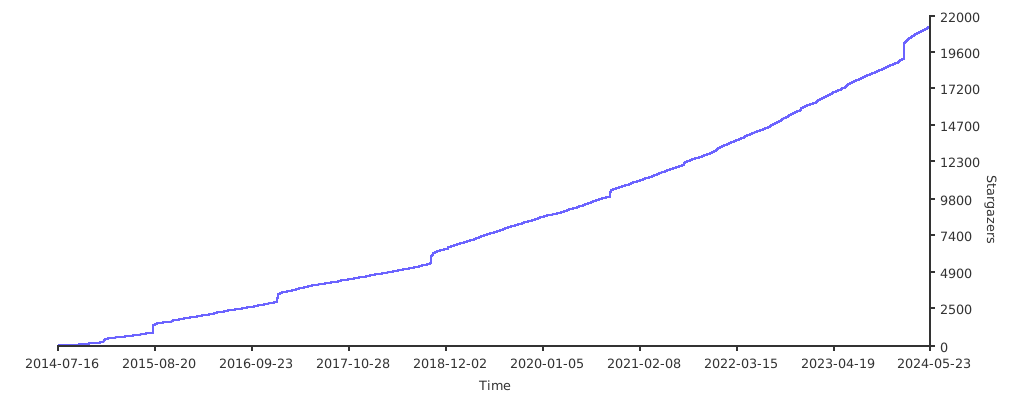
Stargazers over time