Chris LuandGitHub
47b491b53c
Chris LuandGitHub
47b491b53c
* filer: stamp a log position on lookup and remote-cache responses

Metadata events are logged after their store write and stamped with the
filer clock. Reading that clock before serving an entry therefore gives
a timestamp with a causal guarantee: every event at or below it is
reflected in the returned entry. Clients caching filer state can use it
as the entry's version to order the response against subscription
events, including events committed before the call but delivered after
it.

* mount: version open file handles by filer log position

A subscription event refreshing an open handle did a second lookup; a
transient failure left the handle pinned to its old entry with no
retry, since the subscription cursor had already advanced. The deeper
problem is ordering: the handle is a cache written by three unordered
channels — the async invalidation worker, local mutation acks, and
open-time lookups — and overwriting cached state safely requires
knowing which write is newer.

The filer log timestamp is that order, and it now travels with every
value instead of being derived out of band. Events carry it natively;
lookup and remote-cache responses carry the log position stamped before
the serving read; mutation acks carry it in their returned event; and
the local store pairs each read with a version cursor advanced under
the same lock as the store write. Each handle records the version its
entry reflects, and one rule replaces the per-site reasoning: state at
or below the handle's version is old news and must not be installed.

The invalidation itself applies the event's own entry — no lookup, so
no transient-failure window — except under a cached parent, where the
store entry is the ordered merge of the event and anything applied
since, and its version outranks the event's. An uncached parent
receives no store writes, so a hit there would be a stale leftover
masking the event. A vacated path (delete, rename away) keeps the last
entry so unlinked-but-open reads still work. Directory builds version
the completed directory at the listing snapshot and re-invalidate
buffered events at that version, since their mid-build refresh ran
against an incomplete store.

The tests replay every race this replaces machinery for: rollback of a
newer local flush (queued, cached, and read-through), stale leftovers
under uncached parents, the build window including abort, handles
opened after an event was queued, events landing mid-lookup, and
undelivered events at remote-cache time across a filer failover.

* filer: serialize the log position fence with mutations, stamp mutation acks

The fence stamped before an unlocked entry read could precede state the
read returned: a mutation writes storage first and assigns its event
timestamp only at notify time, so a lookup racing that window handed
the mount an entry newer than its fence, and the event's later delivery
looked like fresh news — destroying dirty pages for a change the handle
already had. The mutation handlers already hold an exclusive per-path
lock across read, write, and notify; the lookup and remote-cache reads
now take it shared around the stamp and the read, making the fence
exact: everything at or below it is in the entry, nothing above it is.

A no-change update returns success without an event, leaving the mount
nothing to fence with even though the response confirms current state.
Create and update acks now carry a log position stamped under the same
lock, and the mount falls back to it whenever the ack has no event.

Also regenerate the VT marshalers, which the earlier generation missed:
without them a VT round-trip silently zeroed every log position.

* java: sync filer.proto

* mount: scope store versions to what they vouch for; atomic handle install

The store's version cursor claimed too much. Advanced by local mutation
acks and directory listing snapshots, it inflated the version of store
reads for unrelated paths whose events the subscription still owed, and
those events were then fenced out permanently. The cursor now tracks
subscription progress only — events arrive in log order, so everything
at or below it has been delivered for every path — and a completed
listing records its snapshot as a per-directory floor instead of a
global claim. Local acks never touch it: they version their own handle
directly. Buffered build events advance the cursor at delivery, since
their store write may never happen (abort) while their invalidation is
already queued; their read-through directory pairs no store read with
it, and rename fragments are applied first.

Concurrent first opens raced: a slower opener's older lookup could
overwrite the newer entry a faster opener had installed, while the
monotonic version kept the newer timestamp — an old entry fenced at a
new version, immune to every correcting event. Entry and version are
now installed as one decision under the handle map lock, and an install
that does not outrank the handle's version is dropped.

The remote-cache commit also escaped the fence: it wrote storage and
notified without the path lock, so a lookup's shared-locked fence and
read could land between the two and hand out the cached state
under-versioned. The commit now re-reads and writes under the exclusive
path lock, and backs off entirely when the entry changed during the
download — the concurrent writer supersedes the cached content.

* mount: floors gate store applies; installs respect handle users; renames join the fence

A directory floor certifies the listing state as of its snapshot, but a
delayed event at or below the floor was still applied to the store —
rolling the content back to pre-snapshot state while the floor kept
claiming the snapshot version, so the correcting events were fenced out
of every future read. Events are now gated against the affected
directory's floor, each half of a rename independently.

Fences are lower bounds: a listing or lookup can include a mutation
whose event has not been delivered yet, and that event later passes
every gate carrying state the handle already holds. Such a re-delivery
now advances the version without destroying dirty pages or reinstalling
the entry — invalidating local writes over a no-op was the real damage
in every remaining under-fence window, including the unlocked listing
snapshot, which no per-path lock can serialize.

The concurrent-open install moved from the map lock to the handle lock
every reader, writer, and invalidation synchronizes on, and rejects
what cannot improve the handle: dirty state (local writes would be
lost), unversioned lookup responses (they cannot outrank anything, and
two zero-version opens must not overwrite each other), and anything not
strictly newer. New handles are still fully initialized before the map
exposes them.

Renames committed metadata and emitted events with no path lock, so a
lookup could read the renamed state under a fence preceding its events.
Both rename handlers now hold the source and destination locks, ordered
by path, across commit and notification; descendants of a renamed
directory are not individually locked and rely on the no-op re-delivery
handling above.

* mount: per-entry store versions replace the cursor and directory floors

The store's aggregate versions — a global subscription cursor and
per-directory listing floors — were versions at coarser granularity
than the values they described, and every over-claiming bug in this
series traced to that gap: an aggregate vouching for state its source
never saw. Each store entry now carries the filer log position of the
write that produced it — the event that applied it, or the listing
snapshot that inserted it, recorded in the store's key-value space
under the same lock as the entry write. The store becomes what the
handle already is: a last-writer-wins register with one rule, install
only what outranks the current claim.

The cursor, the floors, their advancement rules, the pairing ordering
constraint, and the floor gating all collapse into that rule. Applies
are gated per entry, each half of a rename independently; an
unversioned local write clears the claim its content no longer proves;
version records lingering after a bulk folder wipe cannot fence a
recreate, since a claim only blocks while its entry exists. Listing
inserts are stamped at build completion, before the buffered replay so
newer replayed events override the stamp.

Filer side, the fence dance every versioned read must perform is now a
single choke point, fencedFindEntry, so a future read RPC gets the
lock-serialized stamp by construction rather than by convention.

* mount: judge no-op re-deliveries against an immutable base, not the live entry

The equal-state skip compared the incoming event to the live handle
entry, but local writes mutate the live entry — size, timestamps,
chunks — so a delayed event re-delivering the base the handle was
opened with no longer matched, and the installer destroyed the dirty
pages and rolled the entry back over nothing new. The handle now keeps
an immutable snapshot of the filer state it last installed or
acknowledged, refreshed at every install and mutation ack (flush acks
snapshot the request entry before the id mapping mutates it), and the
no-op judgment runs against that base: an event carrying the base
brings nothing, whatever the live entry has diverged to since.

* mount: tombstones for versioned deletes, absence floors, copy enrollment

Four gaps in the per-entry version protocol, all the same shape: a
versioned fact with nothing carrying its version.

A deletion is a fact about a path with no entry left to hold it —
clearing the record let a delayed older event resurrect the deleted
path, permanently, since the deletion's own redelivery is
dedup-suppressed. Versioned deletes now leave a tombstone record that
fences without an entry; renames tombstone their source the same way.
Plain records still only block while their entry exists, so records
lingering after a bulk folder wipe cannot fence a recreate.

A completed listing proves absences as well as presences: a name it
omitted was deleted as of the snapshot, and a delayed create below the
snapshot re-creates it. The snapshot is kept per directory strictly as
an absence fence, consulted only when a path has neither an entry nor
a version record — present entries carry their own versions and never
touch it, which is what separates this from the over-claiming floor it
replaces.

A rebuild against a pre-upgrade filer returns no snapshot; stamping
now clears the children's records in that case, so a reinserted entry
cannot reactivate the stale claim its previous incarnation left
behind and reject valid events below it.

Server-side copies installed the copied entry without enrolling in the
base protocol, so the copy's own event differed from the stale
pre-copy base and destroyed writes made to the destination after the
copy. The install now refreshes the base and takes its version from
the fenced readback.

* mount: deletion facts outlive the cache's knowledge of the entry

A versioned delete of a path the store held no entry for recorded
nothing, so a delayed older event recreated the path — permanently,
with the deletion's redelivery dedup-suppressed. The tombstone is now
written whenever a versioned event vacates a path: the deletion is a
fact about the path, not about what this cache happened to hold.

For an absent entry, the listing's absence floor now speaks whatever
older record remains: a tombstone at one position does not exhaust
what is known about the path when a newer snapshot has confirmed the
name still absent, and an event between the two was slipping past
both.

A committed copy whose readback failed installed a synthesized base
with local timestamps; the copy's real event legitimately differs from
it, and was read as foreign state — destroying writes made to the
destination after the copy. The handle now marks that its own event is
en route and adopts that event's state as the base without touching
the live entry or the dirty pages; the adoption is one-shot, so a
genuinely foreign event still invalidates.

* mount: authoritative acks cancel pending event adoption; tombstones scoped and pruned

The copy-event adoption flag could outlive its purpose: a flush after
the failed readback installs a newer base and advances the version, the
copy's own event is then version gated without consuming the flag, and
the next genuinely foreign event was silently adopted — base advanced,
live entry and dirty pages untouched — leaving the mount to later
overwrite that remote change. Every local acknowledgment now installs
its base through one helper that also cancels any pending adoption: the
ack supersedes the mutation the adoption was waiting for.

Tombstones were written for every versioned delete under the mount and
survived directory eviction by design, growing LevelDB with historical
deletions on delete-heavy mounts. They are now scoped to directories
whose cached state the fence actually protects — an uncached parent
never serves from the store nor applies the resurrecting insert — and a
completed listing prunes the direct-child tombstones its absence floor
supersedes, leaving only those above the snapshot. The store gains a
key-prefix visitor for the sweep.

* mount: acked saves install their value; trailer snapshots; direct-child prune range

A version must never advance without its value. saveEntry stamped any
open handle with the acknowledgment's version, but a handle opened
while the save was in flight holds the pre-mutation entry — stamping it
fenced out the events carrying the state it lacked, permanently, with
the local apply performing no invalidation and the redelivery
deduplicated. The acknowledged entry is now installed together with its
version, through the same guarded install the racing-open path uses:
under the handle lock, only when it outranks the handle, never over
dirty local writes.

Empty listings return no in-band snapshot — a snapshot-only response
would be read as an entry by older consumers — so directories that end
empty gained no absence floor and their tombstones were never pruned.
The filer now sends the snapshot in the stream trailer, which older
clients ignore, and the client reads it when no in-band snapshot
arrived. Empty directories get real floors, their tombstones prune,
and their buffered replays gain the snapshot filter instead of the
replay-all fallback.

Version records now encode the parent directory and name separated by
a NUL, making a directory's direct children one contiguous key range:
the tombstone prune scans exactly them under the cache lock, instead
of walking every descendant record — the whole store, for root.

* mount: fix dirty-page loss, uid/gid base, download race, copy adopt, leak; dedup

Correctness fixes from the versioned-invalidation review:

- A foreign delete/rename-away of a file held open with unflushed local
  writes destroyed the dirty pages unconditionally. A process may keep
  writing to an unlinked-but-open file and those writes were already
  acknowledged; preserve the pages when the handle is dirty.
- downloadRemoteEntry stored the handle's base with filer-side uid/gid
  while every candidate it is later compared against is in local form,
  so under a non-identity UidGidMapper an unchanged re-delivery looked
  foreign and force-destroyed dirty pages. Map the base to local.
- downloadRemoteEntry wrote the entry/base/version triple under only the
  handle's shared lock, so two concurrent reads of the same remote-only
  file could tear it. Serialize the install with a dedicated mutex
  (invalidation is already excluded by the exclusive handle lock).
- A committed server-side copy whose readback failed adopted the FIRST
  event past the version gate as its base; a foreign write delivered
  first was silently swallowed. Adopt only an event whose content
  matches the synthesized base — the copy's own event — and install any
  other normally.
- The deferred-create path relied on AcquireFileHandle installing the
  passed entry on a pre-existing handle, which the version rework
  dropped. Restore that install in the compat wrapper; the versioned
  open path keeps its gated install.

Growth and hot-path cost:

- Per-entry version records and tombstones leaked when a directory was
  evicted or read-through without a rebuild. An uncached directory
  gates its own inserts, so its records fence nothing; clear a
  directory's child version records when it is wiped for eviction.
- FindEntry paid for the version KvGet on every lookup/getattr cache hit
  and threw it away. FindEntry now reads only the entry; the hot
  lookupEntry cache-hit path skips the version entirely.

Cleanups:

- Extract ackVersionTsNs over the shared response interface, replacing
  the metadata-event-else-log-ts snippet copy-pasted at four ack sites.
- Extract acquireRenamePathLocks, replacing the verbatim sorted
  two-path lock fence in both rename handlers.

* mount: no resurrection on foreign delete, version no-event acks, gate downloads, tighten copy adopt

Follow-ups to the review patches:

- Preserving dirty pages on a foreign delete let the next flush pass the
  isDeleted guard and CreateEntry, resurrecting the remotely-unlinked
  name. Mark the handle deleted in the vacate branch: the open fd can
  still read its buffered writes, but a flush no longer recreates the
  file.
- A no-event acknowledgment (log fence only) synthesized a metadata
  event with TsNs 0, so the cache stored the entry unversioned and an
  older subscriber event rolled it back. Stamp the synthesized event
  with the ack's log position at all four ack sites.
- downloadRemoteEntry serialized its install but did not check the
  version, so an older response arriving last overwrote the entry/base
  while the monotonic version kept the newer value, fencing corrections
  out. Install only when the response is at least as new as the handle.
- sameEntryContent compared only size and chunks, so a foreign chmod
  with unchanged content was adopted as the copy's own event. Compare
  everything except server-assigned timestamps, so a metadata-only
  foreign change installs instead.

* mount: trim comments to the non-obvious why

The versioning work accumulated multi-line comment blocks restating what
the code says. Keep the constraint a reader cannot derive — why a fence
is exact, why a version must not advance without its value, why an
uncached parent's records fence nothing — and drop the rest.

* mount: distinguish rename from delete, tighten the download and adopt gates

- A rename emits a nil old-path invalidation just like an unlink, so the
  vacate branch marked the handle deleted and later writes through the
  already-open descriptor were skipped instead of persisted. Carry the
  delete/rename distinction on the invalidation and mark only an actual
  delete.
- The remote-download install accepted an unversioned response
  regardless of the handle's version, so during a rolling upgrade a
  delayed response could install stale content under a newer version.
  Require the response to be at least as new, with one exception: a
  handle still lacking local chunks takes the content anyway — it cannot
  read without it — but does not claim the response's log position.
- Copy-event adoption returned without installing, so a foreign touch
  arriving before the copy's own event lost its timestamps. Content is
  unchanged either way, so the dirty pages stay valid; a clean handle now
  takes the entry, while a dirty one keeps its diverged version.

* mount: one directory floor instead of a record per child; agree on TTL

Review feedback:

- Build completion wrote one KV record per direct child inside the cache
  write lock, so a large directory stalled every other cache operation
  for O(children) store writes. The directory's listing snapshot already
  covers every child it saw; make that floor the version for any child
  without a record of its own, and a child earns a record only when a
  later event touches it. One map write per build replaces the per-child
  writes, with the same fencing.
- The presence probe read the store directly and so counted a
  TTL-expired entry as present, judging the path by a record describing
  content that has logically vanished. It now applies the same expiry
  the read path does, and an expired path falls back to its directory
  floor.
- Preserve ErrNotFound identity when the commit-time re-read finds the
  object deleted, so callers still surface a 404.
- Assert the rename-away source fence timestamp in the invalidation test.

Also record the tombstone ceiling: distinct deleted names in a cached
directory accumulate until it is rebuilt or evicted, which prunes
everything at or below the new snapshot.

* mount: pin the fence's clock domain instead of letting skew decide

A log-position fence is stamped by one filer's clock under that filer's
in-process lock, so comparing it to an event another filer logged is
comparing two unrelated clocks. The two error directions are not equally
costly: applying an event the fence already covered is a re-apply the
base-equality check absorbs, while skipping one it does not cover leaves
the handle holding exactly the state the event was meant to correct,
with the subscription cursor already past it — the unhealable staleness
this whole PR exists to remove.

So refuse to guess. Fences now carry the signature of the filer that
stamped them, and a handle records it alongside the position. An event
is only fenced out when the filer that logged it is the one that stamped
the fence — the logging filer appends its own signature, so its presence
identifies the clock domain. Events from any other filer are applied.
Positions taken from events keep comparing as before; the subscription
already delivers those in order.

The invalidation callback takes a struct now: it carries the path,
entry, position, delete/rename distinction, and signatures, and was
about to need a fifth positional parameter.

* mount: follow a foreign rename; key page invalidation on content, not equality

- A rename's old-path invalidation now carries the destination, and the
  handle follows the file there: an open fd tracks the inode, and leaving
  it on the old path made its next flush recreate that name instead of
  updating the renamed file.
- Dirty pages overlay content, so only a content change invalidates them.
  Keying that on exact equality meant any timestamp-only event destroyed
  them, which the copy-adoption marker existed to paper over — a foreign
  touch could consume the marker and leave the copy's own event to drop
  the post-copy writes. Comparing content instead makes the marker
  unnecessary, so it is gone: a metadata-only event keeps the overlay,
  and a dirty handle keeps its diverged entry unless foreign content
  supersedes it.
- A remote download response that is merely older is now refused even
  when the handle still lacks chunks; only an unversioned one is taken
  (and claims no position), since an older response's content predates
  what the handle reflects.
- A refused or unversioned download no longer publishes to the metadata
  cache, where a zero-position event would clear the entry's version and
  let an older subscriber event roll the cache back.

* mount: page invalidation keys on content alone; unversioned writes claim no position

- sameEntryContent compared everything but timestamps, so a foreign
  chmod, chown, or xattr change counted as a content change and
  destroyed the dirty-page overlay. It was strict only to serve the
  copy-adoption marker, which is gone; its one caller now asks the
  question it actually needs — did the bytes change — so metadata-only
  events leave the overlay alone.
- A rename over an existing file destroys that file, but its open handle
  was left live and still pointed at the name the renamed source now
  occupies, so its flush could overwrite it. MovePath already reports the
  displaced inode; mark that handle deleted.
- An acknowledgment was refused whenever its position was numerically
  lower, even when a different filer stamped the fence it lost to. Two
  known, differing signatures mean unrelated clocks, so the comparison no
  longer applies there; unknown signatures still compare as before.
- A local write with no log position behind it now records that
  explicitly instead of deleting its version record. Absence means the
  directory listing covers the path, which is why the snapshot floor
  applies; local content the listing never saw must not inherit it, or
  the events that would correct it are fenced out.

* mount: widen the existing lookup functions instead of forking WithVersion twins

The versioning work grew a parallel function for every accessor that
needed to return a log position — lookupEntryWithVersion beside
lookupEntry, maybeLoadEntryWithVersion beside maybeLoadEntry,
FindEntryWithVersion beside FindEntry, AcquireFileHandleWithVersion
beside AcquireFileHandle, advanceEntryVersion beside
advanceEntryVersionTsNs, plus a getPbEntryWithVersion wrapper and an
InsertListedEntriesForTest hook. Two names for one operation is two
places to keep in step, and the split let callers pick the one that
happened to compile.

Each pair is now the single original name carrying the position, with
callers that do not want it discarding it. filer_pb.GetEntry returns the
fence its response already carried rather than a mount-side wrapper
re-issuing the lookup, and InsertEntry takes the position its content
reflects rather than a test-only twin that inserted without one.

The one behavioural knot the merge exposed: AcquireFileHandle had been
installing the entry on a pre-existing handle only in its unversioned
form, which conflated 'the caller is authoritative' with 'the lookup had
no version'. Deferred create is the only caller that means the former,
so it now installs explicitly and the map function just acquires.
SeaweedFS






Sponsor SeaweedFS via Patreon
SeaweedFS is an independent Apache-licensed open source project with its ongoing development made possible entirely thanks to the support of these awesome backers. If you'd like to grow SeaweedFS even stronger, please consider joining our sponsors on Patreon.
Your support will be really appreciated by me and other supporters!
Gold Sponsors




- Download Binaries for different platforms
- SeaweedFS on Slack
- SeaweedFS on Twitter
- SeaweedFS on Telegram
- SeaweedFS on Reddit
- SeaweedFS Mailing List
- Wiki Documentation
- SeaweedFS White Paper
- SeaweedFS Introduction Slides 2025.5
- SeaweedFS Introduction Slides 2021.5
- SeaweedFS Introduction Slides 2019.3
Table of Contents
- Quick Start
- Introduction
- Features
- Example: Using Seaweed Object Store
- Architecture
- Compared to Other File Systems
- Dev Plan
- Installation Guide
- Disk Related Topics
- Benchmark
- Enterprise
- License
Quick Start
Quick Start with weed mini
Download the latest binary from https://github.com/seaweedfs/seaweedfs/releases and unzip the single weed (or weed.exe) file, or run go install github.com/seaweedfs/seaweedfs/weed@latest. Then start a ready-to-use S3 object store with credentials and a pre-created bucket in one command:
AWS_ACCESS_KEY_ID=admin \
AWS_SECRET_ACCESS_KEY=secret \
S3_BUCKET=my-bucket \
./weed mini -dir=/data
That's it — the S3 endpoint is at http://localhost:8333, my-bucket already exists, and admin/secret are valid credentials. S3_BUCKET accepts a comma-separated list (e.g. raw,processed); use S3_TABLE_BUCKET for S3 Tables (Iceberg) buckets. Drop any of the env vars to skip that piece (no AWS keys → S3 runs in unauthenticated "Allow All" mode for development).
The same command starts everything else too:
- S3 Endpoint: http://localhost:8333
- Master UI: http://localhost:9333
- Volume Server: http://localhost:9340
- Filer UI: http://localhost:8888
- WebDAV: http://localhost:7333
- Admin UI: http://localhost:23646
macOS: if the binary is quarantined, run
xattr -d com.apple.quarantine ./weedfirst.
Perfect for development, testing, learning SeaweedFS, and single-node deployments. To scale out, add more volume servers by running weed volume -dir="/some/data/dir2" -master="<master_host>:9333" -port=8081 locally, on another machine, or on thousands of machines.
Quick Start for S3 API on Docker
docker run -p 8333:8333 \
  -e AWS_ACCESS_KEY_ID=admin \
  -e AWS_SECRET_ACCESS_KEY=secret \
  -e S3_BUCKET=my-bucket \
  chrislusf/seaweedfs
Same behavior as the weed mini command above — the S3 endpoint is at http://localhost:8333 with my-bucket pre-created. Drop the env vars to run anonymously for development.
Introduction
SeaweedFS is a simple and highly scalable distributed file system. There are two objectives:
- to store billions of files!
- to serve the files fast!
SeaweedFS started as a blob store to handle small files efficiently. Instead of managing all file metadata in a central master, the central master only manages volumes on volume servers, and these volume servers manage files and their metadata. This relieves concurrency pressure from the central master and spreads file metadata into volume servers, allowing faster file access (O(1), usually just one disk read operation).
There is only 40 bytes of disk storage overhead for each file's metadata. It is so simple with O(1) disk reads that you are welcome to challenge the performance with your actual use cases.
SeaweedFS started by implementing Facebook's Haystack design paper. Also, SeaweedFS implements erasure coding with ideas from f4: Facebook’s Warm BLOB Storage System, and has a lot of similarities with Facebook’s Tectonic Filesystem and Google's Colossus File System
On top of the blob store, optional Filer can support directories and POSIX attributes. Filer is a separate linearly-scalable stateless server with customizable metadata stores, e.g., MySql, Postgres, Redis, Cassandra, HBase, Mongodb, Elastic Search, LevelDB, RocksDB, Sqlite, MemSql, TiDB, Etcd, CockroachDB, YDB, etc.
SeaweedFS can transparently integrate with the cloud. With hot data on local cluster, and warm data on the cloud with O(1) access time, SeaweedFS can achieve both fast local access time and elastic cloud storage capacity. What's more, the cloud storage access API cost is minimized. Faster and cheaper than direct cloud storage!
SeaweedFS also ships a built-in Iceberg REST Catalog, turning the same cluster into a self-contained lakehouse. Spark, Trino, Dremio, DuckDB, and RisingWave can query Iceberg tables directly — no Hive Metastore, Glue, or external catalog service required. Storage and table metadata live in one system, simplifying on-prem and small-team analytics stacks.
Features
Additional Blob Store Features
- Support different replication levels, with rack and data center aware.
- Automatic master servers failover - no single point of failure (SPOF).
- Automatic compression depending on file MIME type.
- Automatic compaction to reclaim disk space after deletion or update.
- Automatic entry TTL expiration.
- Flexible Capacity Expansion: Any server with some disk space can add to the total storage space.
- Adding/Removing servers does not cause any data re-balancing unless triggered by admin commands.
- Optional picture resizing.
- Support ETag, Accept-Range, Last-Modified, etc.
- Support in-memory/leveldb/readonly mode tuning for memory/performance balance.
- Support rebalancing the writable and readonly volumes.
- Customizable Multiple Storage Tiers: Customizable storage disk types to balance performance and cost.
- Transparent cloud integration: unlimited capacity via tiered cloud storage for warm data.
- Erasure Coding for warm storage Rack-Aware 10.4 erasure coding reduces storage cost and increases availability. Enterprise version can customize EC ratio.
Filer Features
- Filer server provides "normal" directories and files via HTTP.
- File TTL automatically expires file metadata and actual file data.
- Mount filer reads and writes files directly as a local directory via FUSE.
- Filer Store Replication enables HA for filer meta data stores.
- Active-Active Replication enables asynchronous one-way or two-way cross cluster continuous replication.
- Amazon S3 compatible API accesses files with S3 tooling.
- Hadoop Compatible File System accesses files from Hadoop/Spark/Flink/etc or even runs HBase.
- Async Replication To Cloud has extremely fast local access and backups to Amazon S3, Google Cloud Storage, Azure, BackBlaze.
- WebDAV accesses as a mapped drive on Mac and Windows, or from mobile devices.
- AES256-GCM Encrypted Storage safely stores the encrypted data.
- Super Large Files stores large or super large files in tens of TB.
- Cloud Drive mounts cloud storage to local cluster, cached for fast read and write with asynchronous write back.
- Gateway to Remote Object Store mirrors bucket operations to remote object storage, in addition to Cloud Drive
Data Lakehouse Features
- S3 Table Buckets expose a dedicated namespace for Iceberg tables with strict layout validation.
- Built-in Iceberg REST Catalog runs alongside the S3 endpoint — no external metastore needed.
- Native integrations with Apache Spark, Trino, Dremio, DuckDB, and RisingWave.
- Automated table maintenance: compaction, snapshot expiration, orphan removal, manifest rewriting.
- Granular IAM at the bucket, namespace, and table level via standard S3 bucket policies.
Kubernetes
- Kubernetes CSI Driver A Container Storage Interface (CSI) Driver.

- SeaweedFS Operator
Example: Using Seaweed Blob Store
By default, the master node runs on port 9333, and the volume nodes run on port 8080. Let's start one master node, and two volume nodes on port 8080 and 8081. Ideally, they should be started from different machines. We'll use localhost as an example.
SeaweedFS uses HTTP REST operations to read, write, and delete. The responses are in JSON or JSONP format.
Start Master Server
> ./weed master
Start Volume Servers
> weed volume -dir="/tmp/data1" -max=5  -master="localhost:9333" -port=8080 &
> weed volume -dir="/tmp/data2" -max=10 -master="localhost:9333" -port=8081 &
Write A Blob
A blob, also referred as a needle, a chunk, or mistakenly as a file, is just a byte array. It can have attributes, such as name, mime type, create or update time, etc. But basically it is just a byte array of a relatively small size, such as 2 MB ~ 64 MB. The size is not fixed.
To upload a blob: first, send a HTTP POST, PUT, or GET request to /dir/assign to get an fid and a volume server URL:
> curl http://localhost:9333/dir/assign
{"count":1,"fid":"3,01637037d6","url":"127.0.0.1:8080","publicUrl":"localhost:8080"}
Second, to store the blob content, send a HTTP multi-part POST request to url + '/' + fid from the response:
> curl -F file=@/home/chris/myphoto.jpg http://127.0.0.1:8080/3,01637037d6
{"name":"myphoto.jpg","size":43234,"eTag":"1cc0118e"}
To update, send another POST request with updated blob content.
For deletion, send an HTTP DELETE request to the same url + '/' + fid URL:
> curl -X DELETE http://127.0.0.1:8080/3,01637037d6
Save Blob Id
Now, you can save the fid, 3,01637037d6 in this case, to a database field.
The number 3 at the start represents a volume id. After the comma, it's one file key, 01, and a file cookie, 637037d6.
The volume id is an unsigned 32-bit integer. The file key is an unsigned 64-bit integer. The file cookie is an unsigned 32-bit integer, used to prevent URL guessing.
The file key and file cookie are both coded in hex. You can store the <volume id, file key, file cookie> tuple in your own format, or simply store the fid as a string.
If stored as a string, in theory, you would need 8+1+16+8=33 bytes. A char(33) would be enough, if not more than enough, since most uses will not need 2^32 volumes.
If space is really a concern, you can store the file id in the binary format. You would need one 4-byte integer for volume id, 8-byte long number for file key, and a 4-byte integer for the file cookie. So 16 bytes are more than enough.
Read a Blob
Here is an example of how to render the URL.
First look up the volume server's URLs by the file's volumeId:
> curl http://localhost:9333/dir/lookup?volumeId=3
{"volumeId":"3","locations":[{"publicUrl":"localhost:8080","url":"localhost:8080"}]}
Since (usually) there are not too many volume servers, and volumes don't move often, you can cache the results most of the time. Depending on the replication type, one volume can have multiple replica locations. Just randomly pick one location to read.
Now you can take the public URL, render the URL or directly read from the volume server via URL:
http://localhost:8080/3,01637037d6.jpg
Notice we add a file extension ".jpg" here. It's optional and just one way for the client to specify the file content type.
If you want a nicer URL, you can use one of these alternative URL formats:
 http://localhost:8080/3/01637037d6/my_preferred_name.jpg
 http://localhost:8080/3/01637037d6.jpg
 http://localhost:8080/3,01637037d6.jpg
 http://localhost:8080/3/01637037d6
 http://localhost:8080/3,01637037d6
If you want to get a scaled version of an image, you can add some params:
http://localhost:8080/3/01637037d6.jpg?height=200&width=200
http://localhost:8080/3/01637037d6.jpg?height=200&width=200&mode=fit
http://localhost:8080/3/01637037d6.jpg?height=200&width=200&mode=fill
Rack-Aware and Data Center-Aware Replication
SeaweedFS applies the replication strategy at a volume level. So, when you are getting a blob id, you can specify the replication strategy. For example:
curl http://localhost:9333/dir/assign?replication=001
The replication parameter options are:
000: no replication
001: replicate once on the same rack
010: replicate once on a different rack, but same data center
100: replicate once on a different data center
200: replicate twice on two different data center
110: replicate once on a different rack, and once on a different data center
More details about replication can be found on the wiki.
You can also set the default replication strategy when starting the master server.
Allocate Blob Key on Specific Data Center
Volume servers can be started with a specific data center name:
 weed volume -dir=/tmp/1 -port=8080 -dataCenter=dc1
 weed volume -dir=/tmp/2 -port=8081 -dataCenter=dc2
When requesting a blob key, an optional "dataCenter" parameter can limit the assigned volume to the specific data center. For example, this specifies that the assigned volume should be limited to 'dc1':
http://localhost:9333/dir/assign?dataCenter=dc1
Other Features
- No Single Point of Failure
- Insert with your own keys
- Chunking large files
- Collection as a Simple Name Space
Blob Store Architecture
Usually distributed file systems split each file into chunks. A central server keeps a mapping of filenames to chunks, and also which chunks each chunk server has.
The main drawback is that the central server can't handle many small files efficiently, and since all read requests need to go through the central master, so it might not scale well for many concurrent users.
Instead of managing chunks, SeaweedFS manages data volumes in the master server. Each data volume is 32GB in size, and can hold a lot of blobs. And each storage node can have many data volumes. So the master node only needs to store the metadata about the volumes, which is a fairly small amount of data and is generally stable.
The actual blob metadata, which are the blob volume, offset, and size, is stored in each volume on volume servers. Since each volume server only manages metadata of blobs on its own disk, with only 16 bytes for each blob, all access can read the metadata just from memory and only needs one disk operation to actually read file data.
For comparison, consider that an xfs inode structure in Linux is 536 bytes.
Master Server and Volume Server
The architecture is fairly simple. The actual data is stored in volumes on storage nodes. One volume server can have multiple volumes, and can both support read and write access with basic authentication.
All volumes are managed by a master server. The master server contains the volume id to volume server mapping. This is fairly static information, and can be easily cached.
On each write request, the master server also generates a file key, which is a growing 64-bit unsigned integer. Since write requests are not generally as frequent as read requests, one master server should be able to handle the concurrency well.
Write and Read files
When a client sends a write request, the master server returns (volume id, file key, file cookie, volume node URL) for the blob. The client then contacts the volume node and POSTs the blob content.
When a client needs to read a blob based on (volume id, file key, file cookie), it asks the master server by the volume id for the (volume node URL, volume node public URL), or retrieves this from a cache. Then the client can GET the content, or just render the URL on web pages and let browsers fetch the content.
Saving memory
All blob metadata stored on a volume server is readable from memory without disk access. Each file takes just a 16-byte map entry of <64bit key, 32bit offset, 32bit size>. Of course, each map entry has its own space cost for the map. But usually the disk space runs out before the memory does.
Tiered Storage to the cloud
The local volume servers are much faster, while cloud storages have elastic capacity and are actually more cost-efficient if not accessed often (usually free to upload, but relatively costly to access). With the append-only structure and O(1) access time, SeaweedFS can take advantage of both local and cloud storage by offloading the warm data to the cloud.
Usually hot data are fresh and warm data are old. SeaweedFS puts the newly created volumes on local servers, and optionally upload the older volumes on the cloud. If the older data are accessed less often, this literally gives you unlimited capacity with limited local servers, and still fast for new data.
With the O(1) access time, the network latency cost is kept at minimum.
If the hot/warm data is split as 20/80, with 20 servers, you can achieve storage capacity of 100 servers. That's a cost saving of 80%! Or you can repurpose the 80 servers to store new data also, and get 5X storage throughput.
SeaweedFS Filer
Built on top of the blob store, SeaweedFS Filer adds directory structure to create a file system. The directory structure is an interface that is implemented in many key-value stores or databases.
The content of a file is mapped to one or many blobs, distributed to multiple volumes on multiple volume servers.
Compared to Other File Systems
Most other distributed file systems seem more complicated than necessary.
SeaweedFS is meant to be fast and simple, in both setup and operation. If you do not understand how it works when you reach here, we've failed! Please raise an issue with any questions or update this file with clarifications.
SeaweedFS is constantly moving forward. Same with other systems. These comparisons can be outdated quickly. Please help to keep them updated.
Compared to HDFS
HDFS uses the chunk approach for each file, and is ideal for storing large files.
SeaweedFS is ideal for serving relatively smaller files quickly and concurrently.
SeaweedFS can also store extra large files by splitting them into manageable data chunks, and store the file ids of the data chunks into a meta chunk. This is managed by "weed upload/download" tool, and the weed master or volume servers are agnostic about it.
Compared to GlusterFS, Ceph
The architectures are mostly the same. SeaweedFS aims to store and read files fast, with a simple and flat architecture. The main differences are
- SeaweedFS optimizes for small files, ensuring O(1) disk seek operation, and can also handle large files.
- SeaweedFS statically assigns a volume id for a file. Locating file content becomes just a lookup of the volume id, which can be easily cached.
- SeaweedFS Filer metadata store can be any well-known and proven data store, e.g., Redis, Cassandra, HBase, Mongodb, Elastic Search, MySql, Postgres, Sqlite, MemSql, TiDB, CockroachDB, Etcd, YDB etc, and is easy to customize.
- SeaweedFS Volume server also communicates directly with clients via HTTP, supporting range queries, direct uploads, etc.
| System | File Metadata | File Content Read | POSIX | REST API | Optimized for large number of small files |
|---|---|---|---|---|---|
| SeaweedFS | lookup volume id, cacheable | O(1) disk seek | Yes | Yes | |
| SeaweedFS Filer | Linearly Scalable, Customizable | O(1) disk seek | FUSE | Yes | Yes |
| GlusterFS | hashing | FUSE, NFS | |||
| Ceph | hashing + rules | FUSE | Yes | ||
| MooseFS | in memory | FUSE | No | ||
| MinIO | separate meta file for each file | Yes | No |
Compared to GlusterFS
GlusterFS stores files, both directories and content, in configurable volumes called "bricks".
GlusterFS hashes the path and filename into ids, and assigned to virtual volumes, and then mapped to "bricks".
Compared to MooseFS
MooseFS chooses to neglect small file issue. From moosefs 3.0 manual, "even a small file will occupy 64KiB plus additionally 4KiB of checksums and 1KiB for the header", because it "was initially designed for keeping large amounts (like several thousands) of very big files"
MooseFS Master Server keeps all meta data in memory. Same issue as HDFS namenode.
Compared to Ceph
Ceph can be setup similar to SeaweedFS as a key->blob store. It is much more complicated, with the need to support layers on top of it. Here is a more detailed comparison
SeaweedFS has a centralized master group to look up free volumes, while Ceph uses hashing and metadata servers to locate its objects. Having a centralized master makes it easy to code and manage.
Ceph, like SeaweedFS, is based on the object store RADOS. Ceph is rather complicated with mixed reviews.
Ceph uses CRUSH hashing to automatically manage data placement, which is efficient to locate the data. But the data has to be placed according to the CRUSH algorithm. Any wrong configuration would cause data loss. Topology changes, such as adding new servers to increase capacity, will cause data migration with high IO cost to fit the CRUSH algorithm. SeaweedFS places data by assigning them to any writable volumes. If writes to one volume failed, just pick another volume to write. Adding more volumes is also as simple as it can be.
SeaweedFS is optimized for small files. Small files are stored as one continuous block of content, with at most 8 unused bytes between files. Small file access is O(1) disk read.
SeaweedFS Filer uses off-the-shelf stores, such as MySql, Postgres, Sqlite, Mongodb, Redis, Elastic Search, Cassandra, HBase, MemSql, TiDB, CockroachCB, Etcd, YDB, to manage file directories. These stores are proven, scalable, and easier to manage.
| SeaweedFS | comparable to Ceph | advantage |
|---|---|---|
| Master | MDS | simpler |
| Volume | OSD | optimized for small files |
| Filer | Ceph FS | linearly scalable, Customizable, O(1) or O(logN) |
Compared to MinIO
Please note, as Apr 25, 2026 MinIO ceased development. It's strongly discouraged to use that unmaintained software with multiple security bugs.
MinIO followed AWS S3 closely and was ideal for testing for S3 API. It had good UI, policies, versionings, etc. SeaweedFS is trying to catch up here.
MinIO metadata were in simple files. Each file write will incur extra writes to corresponding meta file.
MinIO did not have optimization for lots of small files. The files were simply stored as is to local disks. Plus the extra meta file and shards for erasure coding, it only amplifies the LOSF problem.
MinIO had multiple disk IO to read one file. SeaweedFS has O(1) disk reads, even for erasure coded files.
MinIO had full-time erasure coding. SeaweedFS uses replication on hot data for faster speed and optionally applies erasure coding on warm data.
MinIO did not have POSIX-like API support.
MinIO had specific requirements on storage layout. It is not flexible to adjust capacity. In SeaweedFS, just start one volume server pointing to the master. That's all.
Dev Plan
- More tools and documentation, on how to manage and scale the system.
- Read and write stream data.
- Support structured data.
This is a super exciting project! And we need helpers and support!
Installation Guide
Installation guide for users who are not familiar with golang
Step 1: install go on your machine and setup the environment by following the instructions at:
https://golang.org/doc/install
make sure to define your $GOPATH
Step 2: checkout this repo:
git clone https://github.com/seaweedfs/seaweedfs.git
Step 3: download, compile, and install the project by executing the following command
cd seaweedfs/weed && make install
Once this is done, you will find the executable "weed" in your $GOPATH/bin directory
For more installation options, including how to run with Docker, see the Getting Started guide.
Disk Related Topics
Hard Drive Performance
When testing read performance on SeaweedFS, it basically becomes a performance test of your hard drive's random read speed. Hard drives usually get 100MB/s~200MB/s.
Solid State Disk
To modify or delete small files, SSD must delete a whole block at a time, and move content in existing blocks to a new block. SSD is fast when brand new, but will get fragmented over time and you have to garbage collect, compacting blocks. SeaweedFS is friendly to SSD since it is append-only. Deletion and compaction are done on volume level in the background, not slowing reading and not causing fragmentation.
Benchmark
My Own Unscientific Single Machine Results on Mac Book with Solid State Disk, CPU: 1 Intel Core i7 2.6GHz.
Write 1 million 1KB file:
Concurrency Level:      16
Time taken for tests:   66.753 seconds
Completed requests:      1048576
Failed requests:        0
Total transferred:      1106789009 bytes
Requests per second:    15708.23 [#/sec]
Transfer rate:          16191.69 [Kbytes/sec]

Connection Times (ms)
              min      avg        max      std
Total:        0.3      1.0       84.3      0.9

Percentage of the requests served within a certain time (ms)
   50%      0.8 ms
   66%      1.0 ms
   75%      1.1 ms
   80%      1.2 ms
   90%      1.4 ms
   95%      1.7 ms
   98%      2.1 ms
   99%      2.6 ms
  100%     84.3 ms
Randomly read 1 million files:
Concurrency Level:      16
Time taken for tests:   22.301 seconds
Completed requests:      1048576
Failed requests:        0
Total transferred:      1106812873 bytes
Requests per second:    47019.38 [#/sec]
Transfer rate:          48467.57 [Kbytes/sec]

Connection Times (ms)
              min      avg        max      std
Total:        0.0      0.3       54.1      0.2

Percentage of the requests served within a certain time (ms)
   50%      0.3 ms
   90%      0.4 ms
   98%      0.6 ms
   99%      0.7 ms
  100%     54.1 ms
Run WARP and launch a mixed benchmark.
make benchmark
warp: Benchmark data written to "warp-mixed-2025-12-05[194844]-kBpU.csv.zst"

Mixed operations.
Operation: DELETE, 10%, Concurrency: 20, Ran 42s.
 * Throughput: 55.13 obj/s

Operation: GET, 45%, Concurrency: 20, Ran 42s.
 * Throughput: 2477.45 MiB/s, 247.75 obj/s

Operation: PUT, 15%, Concurrency: 20, Ran 42s.
 * Throughput: 825.85 MiB/s, 82.59 obj/s

Operation: STAT, 30%, Concurrency: 20, Ran 42s.
 * Throughput: 165.27 obj/s

Cluster Total: 3302.88 MiB/s, 550.51 obj/s over 43s.
Enterprise
For enterprise users, please visit seaweedfs.com for the SeaweedFS Enterprise Edition, which has advanced features, including data recovery, self-healing storage, customizable erasure coding, EC vacuum and repair, etc.
License
Licensed under the Apache License, Version 2.0 (the "License"); you may not use this file except in compliance with the License. You may obtain a copy of the License at
http://www.apache.org/licenses/LICENSE-2.0
Unless required by applicable law or agreed to in writing, software distributed under the License is distributed on an "AS IS" BASIS, WITHOUT WARRANTIES OR CONDITIONS OF ANY KIND, either express or implied. See the License for the specific language governing permissions and limitations under the License.
The text of this page is available for modification and reuse under the terms of the Creative Commons Attribution-Sharealike 3.0 Unported License and the GNU Free Documentation License (unversioned, with no invariant sections, front-cover texts, or back-cover texts).
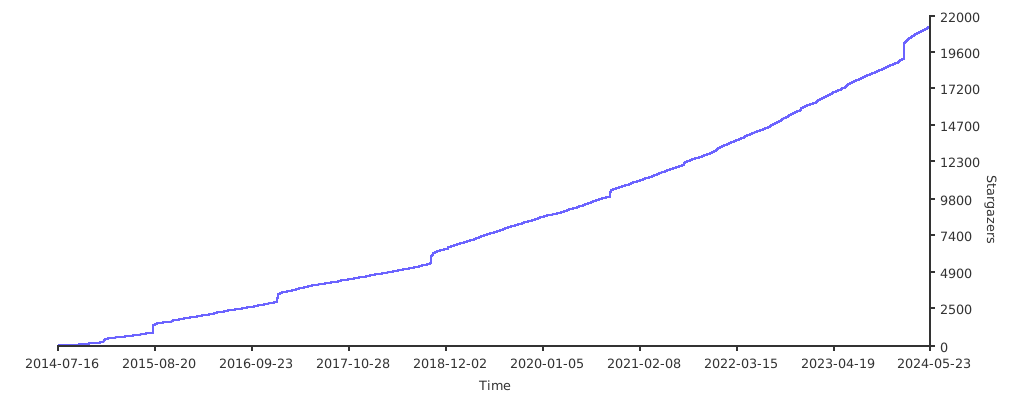
Stargazers over time