Chris LuandGitHub
4f628ff4e5
Chris LuandGitHub
4f628ff4e5
* fix(s3api): stream multipart SSE-S3 chunks lazily to avoid truncated GETs (#8908) buildMultipartSSES3Reader opened a volume-server HTTP response for EVERY chunk upfront, then walked them with io.MultiReader. For a multipart SSE-S3 object with N internal chunks (e.g. a 200MB Docker Registry blob with 25+ chunks), N volume-server bodies sat live at once; chunks 1..N-1 were idle while io.MultiReader drained chunk 0. Under concurrent load the volume server's keep-alive logic closed those idle responses mid-flight, and the S3 client saw `unexpected EOF` partway through the GET. Truncated bytes hash to the wrong SHA-256, which is exactly the "Digest did not match" symptom Docker Registry reports in #8908 (and which persisted even after the per-chunk metadata fix in #9211 and the completion backfill in #9224). Introduce lazyMultipartChunkReader + preparedMultipartChunk{chunk, wrap}: a generic lazy chunk streamer with a per-chunk wrap closure for the SSE-specific decryption setup. Per-chunk metadata is still validated UPFRONT so a malformed chunk fails fast without opening any HTTP connection -- the eager validation contract callers and tests rely on is preserved. The volume-server GET and the SSE-specific decrypt wrap, however, fire LAZILY: at most one chunk body is live at any time, regardless of object size. This commit applies the new pattern to buildMultipartSSES3Reader only; the SSE-KMS and SSE-C multipart readers retain their eager form for now and will be migrated in follow-up commits, since the same shape exists there too. Tests: - TestBuildMultipartSSES3Reader_LazyChunkFetch pins the new contract: zero chunks opened at construction, peak liveness == 1, all closed after drain. - TestBuildMultipartSSES3Reader_RejectsBadChunkBeforeAnyFetch (replaces ClosesAppendedOnError) asserts a malformed chunk in position N causes zero fetches for chunks 0..N -- the previous test pinned a weaker contract (cleanup after eager open). - TestBuildMultipartSSES3Reader_InvalidIVLength updated for the same reason: the fetch callback must NOT be invoked at all on a bad-IV chunk. - TestMultipartSSES3RealisticEndToEnd round-trips multiple parts encrypted the way putToFiler writes them (shared DEK + baseIV, partOffset=0, post-completion global offsets) and walks them through buildMultipartSSES3Reader. * fix(s3api): stream multipart SSE-KMS chunks lazily Apply the same fix as the previous commit to createMultipartSSEKMSDecryptedReaderDirect: per-chunk SSE-KMS metadata is validated upfront, but volume-server GETs fire lazily through lazyMultipartChunkReader. At most one chunk body is live at any time. This is the same eager-open-all-chunks shape that produced #8908's truncated GETs for SSE-S3; SSE-KMS multipart objects with many chunks were exposed to the same idle-keepalive failure mode under concurrent load. The wire format on disk is unchanged (same per-chunk metadata, same encrypted bytes, same object Extended attributes). Existing SSE-KMS multipart objects read back identically -- only when the volume-server GETs fire changes. * fix(s3api): stream multipart SSE-C chunks lazily Apply the same fix as the previous two commits to createMultipartSSECDecryptedReaderDirect: per-chunk SSE-C metadata is validated upfront (IV decode, IV length check, non-negative PartOffset), but the volume-server GET and CreateSSECDecryptedReader- WithOffset wrap fire lazily through lazyMultipartChunkReader. At most one chunk body is live at any time. This is the same eager-open-all-chunks shape that produced #8908's truncated GETs for SSE-S3; SSE-C multipart objects with many chunks were exposed to the same idle-keepalive failure mode under concurrent load. The pre-existing TODO note about CopyObject SSE-C PartOffset handling is preserved verbatim. The wire format on disk is unchanged (same per-chunk metadata, same encrypted bytes); existing SSE-C multipart objects read back identically. After this commit all three multipart SSE read paths (SSE-S3, SSE-KMS, SSE-C) share lazyMultipartChunkReader as their streaming engine. * test(s3): add Docker Registry-shape multipart SSE-S3 GET regression Pin the end-to-end fix for #8908 with a test that mirrors what Docker Registry actually does on pull: a 25-part * 5MB upload with bucket- default SSE-S3, then a full GET, then SHA-256 over the streamed body must match SHA-256 over the uploaded bytes. The eager-multipart-reader bug was specifically a streaming truncation under load: the response status was 200 with a Content-Length matching the object size, but the body short-circuited mid-stream because later chunks' volume-server connections had already been closed by keepalive. The hash check is the symptom Docker Registry surfaces ("Digest did not match"), so this is the most faithful regression we can pin without spinning up a registry. uploadAndVerifyMultipartSSEObject already byte-compares the GET body, but hashing on top is intentionally explicit -- it documents WHY the test exists, and matches the failure mode reported in the issue. * test(s3): add range-read coverage matrix across SSE modes and sizes Existing range-read coverage in test/s3/sse was scoped to small (<= 1MB) single-chunk objects, with one ad-hoc range case per SSE mode and one 129-byte boundary-crossing case in TestSSEMultipartUploadIntegration. Nothing exercised: - Range reads on single-PUT objects whose content crosses the 8MB internal chunk boundary (medium size class). - Range reads on multipart objects whose parts each span multiple internal chunks (large size class) -- the shape #8908 originally surfaced for full-object GETs and the most likely site of any future regression in per-chunk IV / PartOffset plumbing for partial reads. - A consistent range-pattern set applied uniformly across SSE modes, so any divergence between modes (SSE-C uses random IV + PartOffset; SSE-S3/KMS use base IV + offset) is comparable at a glance. TestSSERangeReadCoverageMatrix introduces a parameterized matrix: modes: no_sse, sse_c, sse_kms, sse_s3 sizes: small (256KB single chunk), medium (12MB single PUT crossing one internal boundary), large (5x9MB multipart, ~10 internal chunks, every part itself spans an 8MB boundary) ranges: single byte at 0, prefix 512B, single byte at last, suffix bytes=-100, open-ended bytes=N-, whole object, AES-block boundary 15-31, mid straddling one internal boundary (medium+large), mid spanning many internal boundaries (large only) Per case it asserts: body bytes equal the expected slice, Content-Length matches the range length, Content-Range matches start-end/total, and the SSE response headers match the mode. The sse_kms branch probes once with a 1-byte SSE-KMS PUT and t.Skip's the remaining sse_kms subtests with a clear reason if the local server has no KMS provider configured -- the default `weed mini` setup lacks one; the Makefile target `test-with-kms` provides one via OpenBao. Other modes always run. Verified locally: 75 subtests pass under no_sse / sse_c / sse_s3 against weed mini, sse_kms cleanly skipped. * test(s3): conform new test names to TestSSE*Integration so CI runs them The two tests added in the previous commits had names that did NOT match the patterns the test/s3/sse Makefile and .github/workflows/s3-sse-tests.yml use to discover SSE integration tests: - test/s3/sse/Makefile `test` target: TestSSE.*Integration - test/s3/sse/Makefile `test-multipart`: TestSSEMultipartUploadIntegration - .github/workflows/s3-sse-tests.yml: ...|.*Multipart.*Integration|.*RangeRequestsServerBehavior Result: SSE-KMS coverage I added to TestSSERangeReadCoverageMatrix and the Docker-Registry-shape multipart regression in TestSSES3MultipartManyChunks_DockerRegistryShape were silently invisible to CI even though the underlying test setup (start-seaweedfs-ci using s3-config-template.json with the embedded `local` KMS provider) already has SSE-KMS configured. Renames: TestSSERangeReadCoverageMatrix -> TestSSERangeReadIntegration TestSSES3MultipartManyChunks_... -> TestSSEMultipartManyChunksIntegration Both names now match `TestSSE.*Integration` (Makefile `test` target) and TestSSEMultipartManyChunksIntegration additionally matches `.*Multipart.*Integration` (CI's comprehensive subset). No behavior change; only the function names move. Verified locally against `weed mini` with s3-config-template.json: TestSSERangeReadIntegration runs 96 leaf subtests across 4 SSE modes (none, SSE-C, SSE-KMS, SSE-S3) x 3 size classes x 7-9 range patterns, all passing, 0 skipped. The probe-and-skip in the SSE-KMS arm now only fires for ad-hoc local setups that don't load any KMS provider; the project's standard test setup loads the local provider, so CI has full SSE-KMS range coverage. * fix(s3api): validate SSE-KMS chunk IV during prep, before any fetch Addresses CodeRabbit review on PR #9228: in createMultipartSSEKMSDecryptedReaderDirect the per-chunk SSE-KMS metadata was deserialized in the prep loop but the IV length was only validated later, inside CreateSSEKMSDecryptedReader, which runs from the wrap closure -- AFTER the chunk's volume-server fetch has already started. That weakens the new "reject malformed chunks before any fetch" contract for SSE-KMS specifically: a chunk with a missing/short/long IV would fire its HTTP GET, then fail mid-stream during decrypt. The fix moves the existing ValidateIV check into the prep loop, matching the SSE-S3 and SSE-C paths. Drive-by: extract the SSE-KMS prep loop into a free buildMultipartSSEKMSReader helper that mirrors buildMultipartSSES3Reader, so the new contract is unit-testable without an S3ApiServer. The exported method (createMultipartSSEKMSDecryptedReaderDirect) stays a thin caller, so behavior for production callers is unchanged. New tests in weed/s3api/s3api_multipart_ssekms_test.go pin the contract: - TestBuildMultipartSSEKMSReader_RejectsBadIVBeforeAnyFetch covers missing IV, empty IV, short IV, long IV. Each case asserts both that an error is returned AND that the fetch callback is never invoked. - TestBuildMultipartSSEKMSReader_RejectsMissingMetadataBeforeAnyFetch pins the analogous behavior when SseMetadata is nil on a chunk in position N: chunks 0..N-1 must not be fetched (the earlier eager implementation depended on a closeAppendedReaders cleanup path; the new contract is stronger -- nothing is opened in the first place). - TestBuildMultipartSSEKMSReader_RejectsUnparseableMetadataBeforeAnyFetch covers the JSON-unmarshal failure branch. - TestBuildMultipartSSEKMSReader_SortsByOffset smoke-tests the documented sort-by-offset contract by recording the order in which fetch is invoked. All four pass under `go test ./weed/s3api/`. Existing weed/s3api unit suite + the SSE integration suite (with the local KMS provider enabled via s3-config-template.json) continue to pass. * test(s3): address CodeRabbit nitpicks on range coverage matrix Three small follow-ups on the range-read coverage matrix from the previous commit, per CodeRabbit nitpicks on PR #9228: 1. Promote the body-length check from `assert.Equal` to `require.Equal` so a truncation regression -- the canonical #8908 failure mode -- aborts the subtest immediately. Previously the assertion logged a length mismatch and then `assertDataEqual` ran on differently-sized slices, producing a noisy byte-diff on top of the actual symptom. The redundant trailing `t.Fatalf` block becomes dead and is removed. 2. Broaden the SSE-KMS probe-skip heuristic. The probe previously produced the friendly "KMS provider not configured" message only for 5xx responses; KMS-misconfig surfaces also include 501 NotImplemented, 4xx KMS.NotConfigured, and error messages containing "KMS.NotConfigured" / "NotImplemented" / "not configured". The behaviour change is purely cosmetic (the caller t.Skip's on any non-empty reason either way) but the new diagnostic is more useful in CI logs. 3. Add `t.Parallel()` at the mode and size-class levels of the matrix. Each (mode, size) writes an independent object key under the shared bucket, with no cross-talk, so parallel execution is safe. Local wall time on the full matrix dropped from ~2.0s to ~1.1s (~45%); the savings scale with chunk count and CI machine concurrency. Verified locally against `weed mini` with s3-config-template.json: - go test ./weed/s3api/ -count=1 PASS - TestSSERangeReadIntegration -v 112 PASS, 0 SKIP - TestSSEMultipartUploadIntegration etc. PASS * fix(s3api): tighten lazy reader error path; unify SSE IV validation Three CodeRabbit nitpicks on PR #9228: 1. lazyMultipartChunkReader: mark finished on non-EOF Read errors The Read loop's three earlier failure paths (chunk index past end, fetch error, wrap error) all set l.finished = true before returning. The non-EOF Read path -- where l.current.Read itself errors mid-chunk -- did not, leaving l.current/l.closer set and l.finished = false. A caller that retried Read after an error would re-enter the same broken stream instead of advancing or giving up. Set l.finished = true on non-EOF Read error so post-error state is consistent across all four failure sites; Close() (which the GetObjectHandler defers) still releases the chunk body. 2. Unify IV-length validation across SSE-S3, SSE-KMS, SSE-C prep paths The previous commit moved SSE-KMS to the shared ValidateIV helper but left SSE-S3 and SSE-C with bespoke inline `len(...) != AESBlockSize` checks. All three are enforcing the same invariant; inconsistency obscures the symmetry. Move SSE-S3 and SSE-C to ValidateIV too, with the same `<algo> chunk <fileId> IV` name convention. Error message wording shifts from "<algo> chunk X has invalid IV length N (expected 16)" to ValidateIV's "invalid <algo> chunk X IV length: expected 16 bytes, got N". The substring "IV length" is preserved across both, so the existing TestBuildMultipartSSES3Reader_InvalidIVLength substring assertion is loosened to match either form. 3. TestBuildMultipartSSEKMSReader_SortsByOffset: verify full ordering The test previously drove Read() to observe fetch-call order, but CreateSSEKMSDecryptedReader requires a live KMS provider to unwrap the encrypted DEK -- unavailable in unit tests -- so the wrap closure failed on the first chunk and only one fetch was ever recorded. The test asserted only fetchOrder[0] == "c0", which is weaker than the comment promised. Switch to a static check: type-assert the returned reader to *lazyMultipartChunkReader (same package so unexported fields are accessible) and inspect the prepared chunks slice directly. This pins the entire [c0, c1, c2] sort order in one place, doesn't depend on KMS, and runs in zero fetch calls. The fetch closure now asserts it is never invoked during preparation. All weed/s3api unit tests pass; integration suite (with KMS provider configured via s3-config-template.json) passes. * test(s3): switch range coverage cleanup to t.Cleanup; tighten KMS probe Two CodeRabbit comments on PR #9228, both about test/s3/sse/s3_sse_range_coverage_test.go: 1. CRITICAL: defer + t.Parallel() race in TestSSERangeReadIntegration The test creates one bucket up front, then runs subtests that call t.Parallel() at the mode and size levels (added in058cbf27to cut wall time). t.Parallel() pauses each subtest and yields back to the parent. The parent's for loop finishes scheduling, the function returns, and the deferred cleanupTestBucket fires -- BEFORE any parallel subtest body has executed. The bucket gets deleted out from under the parallel subtests, which then race the cleanup and either fail with NoSuchBucket or, depending on lazy-deletion behaviour on the server side, mask other regressions because chunks happen to still be readable for a brief window. The local matrix passing prior to this commit was a server-side coincidence; the t.Cleanup contract is the right one for parent tests with parallel children, and switching to it is a one-line change. t.Cleanup runs after the test AND all its (parallel) subtests complete, so the bucket survives until every leaf subtest is done. 2. MINOR: tighten the SSE-KMS probe-skip heuristic The previous broadening (058cbf27) treated `code == 400` as "KMS provider not configured", on the theory that some servers return 4xx for KMS misconfig. That is too aggressive: a real misconfiguration in the SSE-KMS test request itself (bad keyID format, missing header) ALSO surfaces as a 400, and would silently t.Skip the SSE-KMS subtree in CI -- which is exactly the integration coverage the new TestSSERangeReadIntegration is supposed to add. Drop the 400 branch (and the redundant 501 match, since 501 >= 500 already covers it). Genuine "KMS.NotConfigured" / "NotImplemented" responses are still recognised via the string-match block immediately below, regardless of status code, so the friendly skip message survives for the cases where it actually applies. Verified locally against `weed mini` with s3-config-template.json: - go test ./weed/s3api/ PASS - TestSSERangeReadIntegration -v 113 PASS lines, 0 SKIP - TestSSEMultipartUploadIntegration etc. PASS
SeaweedFS






Sponsor SeaweedFS via Patreon
SeaweedFS is an independent Apache-licensed open source project with its ongoing development made possible entirely thanks to the support of these awesome backers. If you'd like to grow SeaweedFS even stronger, please consider joining our sponsors on Patreon.
Your support will be really appreciated by me and other supporters!
Gold Sponsors



- Download Binaries for different platforms
- SeaweedFS on Slack
- SeaweedFS on Twitter
- SeaweedFS on Telegram
- SeaweedFS on Reddit
- SeaweedFS Mailing List
- Wiki Documentation
- SeaweedFS White Paper
- SeaweedFS Introduction Slides 2025.5
- SeaweedFS Introduction Slides 2021.5
- SeaweedFS Introduction Slides 2019.3
Table of Contents
- Quick Start
- Introduction
- Features
- Example: Using Seaweed Object Store
- Architecture
- Compared to Other File Systems
- Dev Plan
- Installation Guide
- Disk Related Topics
- Benchmark
- Enterprise
- License
Quick Start
Quick Start with weed mini
The easiest way to get started with SeaweedFS for development and testing:
- Download the latest binary from https://github.com/seaweedfs/seaweedfs/releases and unzip a single binary file
weedorweed.exe.
Example:
# remove quarantine on macOS
# xattr -d com.apple.quarantine  ./weed

./weed mini -dir=/data
This single command starts a complete SeaweedFS setup with:
- Master UI: http://localhost:9333
- Volume Server: http://localhost:9340
- Filer UI: http://localhost:8888
- S3 Endpoint: http://localhost:8333
- WebDAV: http://localhost:7333
- Admin UI: http://localhost:23646
Perfect for development, testing, learning SeaweedFS, and single node deployments!
Quick Start for S3 API on Docker
docker run -p 8333:8333 chrislusf/seaweedfs server -s3
Quick Start with Single Binary
- Download the latest binary from https://github.com/seaweedfs/seaweedfs/releases and unzip a single binary file
weedorweed.exe. Or rungo install github.com/seaweedfs/seaweedfs/weed@latest. export AWS_ACCESS_KEY_ID=admin ; export AWS_SECRET_ACCESS_KEY=keyas the admin credentials to access the object store.- Run
weed server -dir=/some/data/dir -s3to start one master, one volume server, one filer, and one S3 gateway. The difference withweed miniis thatweed minican auto configure based on the single host environment, whileweed serverrequires manual configuration and are designed for production use.
Also, to increase capacity, just add more volume servers by running weed volume -dir="/some/data/dir2" -master="<master_host>:9333" -port=8081 locally, or on a different machine, or on thousands of machines. That is it!
Introduction
SeaweedFS is a simple and highly scalable distributed file system. There are two objectives:
- to store billions of files!
- to serve the files fast!
SeaweedFS started as a blob store to handle small files efficiently. Instead of managing all file metadata in a central master, the central master only manages volumes on volume servers, and these volume servers manage files and their metadata. This relieves concurrency pressure from the central master and spreads file metadata into volume servers, allowing faster file access (O(1), usually just one disk read operation).
There is only 40 bytes of disk storage overhead for each file's metadata. It is so simple with O(1) disk reads that you are welcome to challenge the performance with your actual use cases.
SeaweedFS started by implementing Facebook's Haystack design paper. Also, SeaweedFS implements erasure coding with ideas from f4: Facebook’s Warm BLOB Storage System, and has a lot of similarities with Facebook’s Tectonic Filesystem and Google's Colossus File System
On top of the blob store, optional Filer can support directories and POSIX attributes. Filer is a separate linearly-scalable stateless server with customizable metadata stores, e.g., MySql, Postgres, Redis, Cassandra, HBase, Mongodb, Elastic Search, LevelDB, RocksDB, Sqlite, MemSql, TiDB, Etcd, CockroachDB, YDB, etc.
SeaweedFS can transparently integrate with the cloud. With hot data on local cluster, and warm data on the cloud with O(1) access time, SeaweedFS can achieve both fast local access time and elastic cloud storage capacity. What's more, the cloud storage access API cost is minimized. Faster and cheaper than direct cloud storage!
Features
Additional Blob Store Features
- Support different replication levels, with rack and data center aware.
- Automatic master servers failover - no single point of failure (SPOF).
- Automatic compression depending on file MIME type.
- Automatic compaction to reclaim disk space after deletion or update.
- Automatic entry TTL expiration.
- Flexible Capacity Expansion: Any server with some disk space can add to the total storage space.
- Adding/Removing servers does not cause any data re-balancing unless triggered by admin commands.
- Optional picture resizing.
- Support ETag, Accept-Range, Last-Modified, etc.
- Support in-memory/leveldb/readonly mode tuning for memory/performance balance.
- Support rebalancing the writable and readonly volumes.
- Customizable Multiple Storage Tiers: Customizable storage disk types to balance performance and cost.
- Transparent cloud integration: unlimited capacity via tiered cloud storage for warm data.
- Erasure Coding for warm storage Rack-Aware 10.4 erasure coding reduces storage cost and increases availability. Enterprise version can customize EC ratio.
Filer Features
- Filer server provides "normal" directories and files via HTTP.
- File TTL automatically expires file metadata and actual file data.
- Mount filer reads and writes files directly as a local directory via FUSE.
- Filer Store Replication enables HA for filer meta data stores.
- Active-Active Replication enables asynchronous one-way or two-way cross cluster continuous replication.
- Amazon S3 compatible API accesses files with S3 tooling.
- Hadoop Compatible File System accesses files from Hadoop/Spark/Flink/etc or even runs HBase.
- Async Replication To Cloud has extremely fast local access and backups to Amazon S3, Google Cloud Storage, Azure, BackBlaze.
- WebDAV accesses as a mapped drive on Mac and Windows, or from mobile devices.
- AES256-GCM Encrypted Storage safely stores the encrypted data.
- Super Large Files stores large or super large files in tens of TB.
- Cloud Drive mounts cloud storage to local cluster, cached for fast read and write with asynchronous write back.
- Gateway to Remote Object Store mirrors bucket operations to remote object storage, in addition to Cloud Drive
Kubernetes
- Kubernetes CSI Driver A Container Storage Interface (CSI) Driver.

- SeaweedFS Operator
Example: Using Seaweed Blob Store
By default, the master node runs on port 9333, and the volume nodes run on port 8080. Let's start one master node, and two volume nodes on port 8080 and 8081. Ideally, they should be started from different machines. We'll use localhost as an example.
SeaweedFS uses HTTP REST operations to read, write, and delete. The responses are in JSON or JSONP format.
Start Master Server
> ./weed master
Start Volume Servers
> weed volume -dir="/tmp/data1" -max=5  -master="localhost:9333" -port=8080 &
> weed volume -dir="/tmp/data2" -max=10 -master="localhost:9333" -port=8081 &
Write A Blob
A blob, also referred as a needle, a chunk, or mistakenly as a file, is just a byte array. It can have attributes, such as name, mime type, create or update time, etc. But basically it is just a byte array of a relatively small size, such as 2 MB ~ 64 MB. The size is not fixed.
To upload a blob: first, send a HTTP POST, PUT, or GET request to /dir/assign to get an fid and a volume server URL:
> curl http://localhost:9333/dir/assign
{"count":1,"fid":"3,01637037d6","url":"127.0.0.1:8080","publicUrl":"localhost:8080"}
Second, to store the blob content, send a HTTP multi-part POST request to url + '/' + fid from the response:
> curl -F file=@/home/chris/myphoto.jpg http://127.0.0.1:8080/3,01637037d6
{"name":"myphoto.jpg","size":43234,"eTag":"1cc0118e"}
To update, send another POST request with updated blob content.
For deletion, send an HTTP DELETE request to the same url + '/' + fid URL:
> curl -X DELETE http://127.0.0.1:8080/3,01637037d6
Save Blob Id
Now, you can save the fid, 3,01637037d6 in this case, to a database field.
The number 3 at the start represents a volume id. After the comma, it's one file key, 01, and a file cookie, 637037d6.
The volume id is an unsigned 32-bit integer. The file key is an unsigned 64-bit integer. The file cookie is an unsigned 32-bit integer, used to prevent URL guessing.
The file key and file cookie are both coded in hex. You can store the <volume id, file key, file cookie> tuple in your own format, or simply store the fid as a string.
If stored as a string, in theory, you would need 8+1+16+8=33 bytes. A char(33) would be enough, if not more than enough, since most uses will not need 2^32 volumes.
If space is really a concern, you can store the file id in the binary format. You would need one 4-byte integer for volume id, 8-byte long number for file key, and a 4-byte integer for the file cookie. So 16 bytes are more than enough.
Read a Blob
Here is an example of how to render the URL.
First look up the volume server's URLs by the file's volumeId:
> curl http://localhost:9333/dir/lookup?volumeId=3
{"volumeId":"3","locations":[{"publicUrl":"localhost:8080","url":"localhost:8080"}]}
Since (usually) there are not too many volume servers, and volumes don't move often, you can cache the results most of the time. Depending on the replication type, one volume can have multiple replica locations. Just randomly pick one location to read.
Now you can take the public URL, render the URL or directly read from the volume server via URL:
http://localhost:8080/3,01637037d6.jpg
Notice we add a file extension ".jpg" here. It's optional and just one way for the client to specify the file content type.
If you want a nicer URL, you can use one of these alternative URL formats:
 http://localhost:8080/3/01637037d6/my_preferred_name.jpg
 http://localhost:8080/3/01637037d6.jpg
 http://localhost:8080/3,01637037d6.jpg
 http://localhost:8080/3/01637037d6
 http://localhost:8080/3,01637037d6
If you want to get a scaled version of an image, you can add some params:
http://localhost:8080/3/01637037d6.jpg?height=200&width=200
http://localhost:8080/3/01637037d6.jpg?height=200&width=200&mode=fit
http://localhost:8080/3/01637037d6.jpg?height=200&width=200&mode=fill
Rack-Aware and Data Center-Aware Replication
SeaweedFS applies the replication strategy at a volume level. So, when you are getting a blob id, you can specify the replication strategy. For example:
curl http://localhost:9333/dir/assign?replication=001
The replication parameter options are:
000: no replication
001: replicate once on the same rack
010: replicate once on a different rack, but same data center
100: replicate once on a different data center
200: replicate twice on two different data center
110: replicate once on a different rack, and once on a different data center
More details about replication can be found on the wiki.
You can also set the default replication strategy when starting the master server.
Allocate Blob Key on Specific Data Center
Volume servers can be started with a specific data center name:
 weed volume -dir=/tmp/1 -port=8080 -dataCenter=dc1
 weed volume -dir=/tmp/2 -port=8081 -dataCenter=dc2
When requesting a blob key, an optional "dataCenter" parameter can limit the assigned volume to the specific data center. For example, this specifies that the assigned volume should be limited to 'dc1':
http://localhost:9333/dir/assign?dataCenter=dc1
Other Features
- No Single Point of Failure
- Insert with your own keys
- Chunking large files
- Collection as a Simple Name Space
Blob Store Architecture
Usually distributed file systems split each file into chunks. A central server keeps a mapping of filenames to chunks, and also which chunks each chunk server has.
The main drawback is that the central server can't handle many small files efficiently, and since all read requests need to go through the central master, so it might not scale well for many concurrent users.
Instead of managing chunks, SeaweedFS manages data volumes in the master server. Each data volume is 32GB in size, and can hold a lot of blobs. And each storage node can have many data volumes. So the master node only needs to store the metadata about the volumes, which is a fairly small amount of data and is generally stable.
The actual blob metadata, which are the blob volume, offset, and size, is stored in each volume on volume servers. Since each volume server only manages metadata of blobs on its own disk, with only 16 bytes for each blob, all access can read the metadata just from memory and only needs one disk operation to actually read file data.
For comparison, consider that an xfs inode structure in Linux is 536 bytes.
Master Server and Volume Server
The architecture is fairly simple. The actual data is stored in volumes on storage nodes. One volume server can have multiple volumes, and can both support read and write access with basic authentication.
All volumes are managed by a master server. The master server contains the volume id to volume server mapping. This is fairly static information, and can be easily cached.
On each write request, the master server also generates a file key, which is a growing 64-bit unsigned integer. Since write requests are not generally as frequent as read requests, one master server should be able to handle the concurrency well.
Write and Read files
When a client sends a write request, the master server returns (volume id, file key, file cookie, volume node URL) for the blob. The client then contacts the volume node and POSTs the blob content.
When a client needs to read a blob based on (volume id, file key, file cookie), it asks the master server by the volume id for the (volume node URL, volume node public URL), or retrieves this from a cache. Then the client can GET the content, or just render the URL on web pages and let browsers fetch the content.
Saving memory
All blob metadata stored on a volume server is readable from memory without disk access. Each file takes just a 16-byte map entry of <64bit key, 32bit offset, 32bit size>. Of course, each map entry has its own space cost for the map. But usually the disk space runs out before the memory does.
Tiered Storage to the cloud
The local volume servers are much faster, while cloud storages have elastic capacity and are actually more cost-efficient if not accessed often (usually free to upload, but relatively costly to access). With the append-only structure and O(1) access time, SeaweedFS can take advantage of both local and cloud storage by offloading the warm data to the cloud.
Usually hot data are fresh and warm data are old. SeaweedFS puts the newly created volumes on local servers, and optionally upload the older volumes on the cloud. If the older data are accessed less often, this literally gives you unlimited capacity with limited local servers, and still fast for new data.
With the O(1) access time, the network latency cost is kept at minimum.
If the hot/warm data is split as 20/80, with 20 servers, you can achieve storage capacity of 100 servers. That's a cost saving of 80%! Or you can repurpose the 80 servers to store new data also, and get 5X storage throughput.
SeaweedFS Filer
Built on top of the blob store, SeaweedFS Filer adds directory structure to create a file system. The directory sturcture is an interface that is implemented in many key-value stores or databases.
The content of a file is mapped to one or many blobs, distributed to multiple volumes on multiple volume servers.
Compared to Other File Systems
Most other distributed file systems seem more complicated than necessary.
SeaweedFS is meant to be fast and simple, in both setup and operation. If you do not understand how it works when you reach here, we've failed! Please raise an issue with any questions or update this file with clarifications.
SeaweedFS is constantly moving forward. Same with other systems. These comparisons can be outdated quickly. Please help to keep them updated.
Compared to HDFS
HDFS uses the chunk approach for each file, and is ideal for storing large files.
SeaweedFS is ideal for serving relatively smaller files quickly and concurrently.
SeaweedFS can also store extra large files by splitting them into manageable data chunks, and store the file ids of the data chunks into a meta chunk. This is managed by "weed upload/download" tool, and the weed master or volume servers are agnostic about it.
Compared to GlusterFS, Ceph
The architectures are mostly the same. SeaweedFS aims to store and read files fast, with a simple and flat architecture. The main differences are
- SeaweedFS optimizes for small files, ensuring O(1) disk seek operation, and can also handle large files.
- SeaweedFS statically assigns a volume id for a file. Locating file content becomes just a lookup of the volume id, which can be easily cached.
- SeaweedFS Filer metadata store can be any well-known and proven data store, e.g., Redis, Cassandra, HBase, Mongodb, Elastic Search, MySql, Postgres, Sqlite, MemSql, TiDB, CockroachDB, Etcd, YDB etc, and is easy to customize.
- SeaweedFS Volume server also communicates directly with clients via HTTP, supporting range queries, direct uploads, etc.
| System | File Metadata | File Content Read | POSIX | REST API | Optimized for large number of small files |
|---|---|---|---|---|---|
| SeaweedFS | lookup volume id, cacheable | O(1) disk seek | Yes | Yes | |
| SeaweedFS Filer | Linearly Scalable, Customizable | O(1) disk seek | FUSE | Yes | Yes |
| GlusterFS | hashing | FUSE, NFS | |||
| Ceph | hashing + rules | FUSE | Yes | ||
| MooseFS | in memory | FUSE | No | ||
| MinIO | separate meta file for each file | Yes | No |
Compared to GlusterFS
GlusterFS stores files, both directories and content, in configurable volumes called "bricks".
GlusterFS hashes the path and filename into ids, and assigned to virtual volumes, and then mapped to "bricks".
Compared to MooseFS
MooseFS chooses to neglect small file issue. From moosefs 3.0 manual, "even a small file will occupy 64KiB plus additionally 4KiB of checksums and 1KiB for the header", because it "was initially designed for keeping large amounts (like several thousands) of very big files"
MooseFS Master Server keeps all meta data in memory. Same issue as HDFS namenode.
Compared to Ceph
Ceph can be setup similar to SeaweedFS as a key->blob store. It is much more complicated, with the need to support layers on top of it. Here is a more detailed comparison
SeaweedFS has a centralized master group to look up free volumes, while Ceph uses hashing and metadata servers to locate its objects. Having a centralized master makes it easy to code and manage.
Ceph, like SeaweedFS, is based on the object store RADOS. Ceph is rather complicated with mixed reviews.
Ceph uses CRUSH hashing to automatically manage data placement, which is efficient to locate the data. But the data has to be placed according to the CRUSH algorithm. Any wrong configuration would cause data loss. Topology changes, such as adding new servers to increase capacity, will cause data migration with high IO cost to fit the CRUSH algorithm. SeaweedFS places data by assigning them to any writable volumes. If writes to one volume failed, just pick another volume to write. Adding more volumes is also as simple as it can be.
SeaweedFS is optimized for small files. Small files are stored as one continuous block of content, with at most 8 unused bytes between files. Small file access is O(1) disk read.
SeaweedFS Filer uses off-the-shelf stores, such as MySql, Postgres, Sqlite, Mongodb, Redis, Elastic Search, Cassandra, HBase, MemSql, TiDB, CockroachCB, Etcd, YDB, to manage file directories. These stores are proven, scalable, and easier to manage.
| SeaweedFS | comparable to Ceph | advantage |
|---|---|---|
| Master | MDS | simpler |
| Volume | OSD | optimized for small files |
| Filer | Ceph FS | linearly scalable, Customizable, O(1) or O(logN) |
Compared to MinIO
MinIO follows AWS S3 closely and is ideal for testing for S3 API. It has good UI, policies, versionings, etc. SeaweedFS is trying to catch up here. It is also possible to put MinIO as a gateway in front of SeaweedFS later.
MinIO metadata are in simple files. Each file write will incur extra writes to corresponding meta file.
MinIO does not have optimization for lots of small files. The files are simply stored as is to local disks. Plus the extra meta file and shards for erasure coding, it only amplifies the LOSF problem.
MinIO has multiple disk IO to read one file. SeaweedFS has O(1) disk reads, even for erasure coded files.
MinIO has full-time erasure coding. SeaweedFS uses replication on hot data for faster speed and optionally applies erasure coding on warm data.
MinIO does not have POSIX-like API support.
MinIO has specific requirements on storage layout. It is not flexible to adjust capacity. In SeaweedFS, just start one volume server pointing to the master. That's all.
Dev Plan
- More tools and documentation, on how to manage and scale the system.
- Read and write stream data.
- Support structured data.
This is a super exciting project! And we need helpers and support!
Installation Guide
Installation guide for users who are not familiar with golang
Step 1: install go on your machine and setup the environment by following the instructions at:
https://golang.org/doc/install
make sure to define your $GOPATH
Step 2: checkout this repo:
git clone https://github.com/seaweedfs/seaweedfs.git
Step 3: download, compile, and install the project by executing the following command
cd seaweedfs/weed && make install
Once this is done, you will find the executable "weed" in your $GOPATH/bin directory
For more installation options, including how to run with Docker, see the Getting Started guide.
Disk Related Topics
Hard Drive Performance
When testing read performance on SeaweedFS, it basically becomes a performance test of your hard drive's random read speed. Hard drives usually get 100MB/s~200MB/s.
Solid State Disk
To modify or delete small files, SSD must delete a whole block at a time, and move content in existing blocks to a new block. SSD is fast when brand new, but will get fragmented over time and you have to garbage collect, compacting blocks. SeaweedFS is friendly to SSD since it is append-only. Deletion and compaction are done on volume level in the background, not slowing reading and not causing fragmentation.
Benchmark
My Own Unscientific Single Machine Results on Mac Book with Solid State Disk, CPU: 1 Intel Core i7 2.6GHz.
Write 1 million 1KB file:
Concurrency Level:      16
Time taken for tests:   66.753 seconds
Completed requests:      1048576
Failed requests:        0
Total transferred:      1106789009 bytes
Requests per second:    15708.23 [#/sec]
Transfer rate:          16191.69 [Kbytes/sec]

Connection Times (ms)
              min      avg        max      std
Total:        0.3      1.0       84.3      0.9

Percentage of the requests served within a certain time (ms)
   50%      0.8 ms
   66%      1.0 ms
   75%      1.1 ms
   80%      1.2 ms
   90%      1.4 ms
   95%      1.7 ms
   98%      2.1 ms
   99%      2.6 ms
  100%     84.3 ms
Randomly read 1 million files:
Concurrency Level:      16
Time taken for tests:   22.301 seconds
Completed requests:      1048576
Failed requests:        0
Total transferred:      1106812873 bytes
Requests per second:    47019.38 [#/sec]
Transfer rate:          48467.57 [Kbytes/sec]

Connection Times (ms)
              min      avg        max      std
Total:        0.0      0.3       54.1      0.2

Percentage of the requests served within a certain time (ms)
   50%      0.3 ms
   90%      0.4 ms
   98%      0.6 ms
   99%      0.7 ms
  100%     54.1 ms
Run WARP and launch a mixed benchmark.
make benchmark
warp: Benchmark data written to "warp-mixed-2025-12-05[194844]-kBpU.csv.zst"

Mixed operations.
Operation: DELETE, 10%, Concurrency: 20, Ran 42s.
 * Throughput: 55.13 obj/s

Operation: GET, 45%, Concurrency: 20, Ran 42s.
 * Throughput: 2477.45 MiB/s, 247.75 obj/s

Operation: PUT, 15%, Concurrency: 20, Ran 42s.
 * Throughput: 825.85 MiB/s, 82.59 obj/s

Operation: STAT, 30%, Concurrency: 20, Ran 42s.
 * Throughput: 165.27 obj/s

Cluster Total: 3302.88 MiB/s, 550.51 obj/s over 43s.
Enterprise
For enterprise users, please visit seaweedfs.com for the SeaweedFS Enterprise Edition, which has a self-healing storage format with better data protection.
License
Licensed under the Apache License, Version 2.0 (the "License"); you may not use this file except in compliance with the License. You may obtain a copy of the License at
http://www.apache.org/licenses/LICENSE-2.0
Unless required by applicable law or agreed to in writing, software distributed under the License is distributed on an "AS IS" BASIS, WITHOUT WARRANTIES OR CONDITIONS OF ANY KIND, either express or implied. See the License for the specific language governing permissions and limitations under the License.
The text of this page is available for modification and reuse under the terms of the Creative Commons Attribution-Sharealike 3.0 Unported License and the GNU Free Documentation License (unversioned, with no invariant sections, front-cover texts, or back-cover texts).
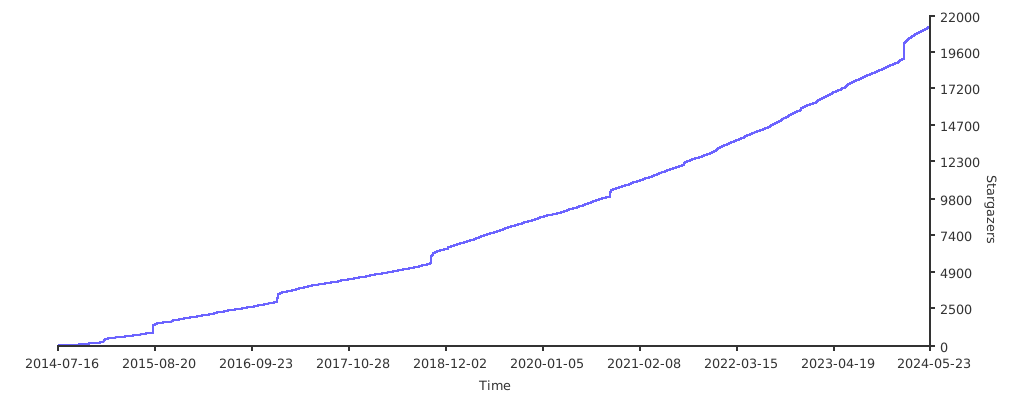
Stargazers over time