

 895d49b55b
* s3/iam: manage roles through the IAM API, with an opt-in persistent role store

Roles could only come from the IAM config file: the S3 server pinned the
role store to memory and the embedded IAM API had no role actions, so a
role could not be created, retrusted or revoked without editing the file
and restarting every gateway.

Role store
- Read the `roleStore` key (the IAMConfig field already existed). With an
  IAM config file the default stays memory; with none it is the filer, as
  for OIDC providers, so zero-config clusters keep runtime-created roles.
- Roles from the IAM config file never go into a persistent role store,
  which outlives the file and may be shared by S3 servers with different
  files. They are served from memory beneath the store, as OIDC providers
  are: a stored role of the same name takes precedence, and deleting it
  restores the file's. A config-file role cannot be changed or deleted
  through the API (UnmodifiableEntity), and removing one from the file
  removes it at the next start. An in-memory store holds them as records,
  as before. They have no creation time, so CreateDate is omitted rather
  than reporting when this server started. SetRoleStore installs a store
  the same way, so a store set after startup keeps the config-file roles,
  as SetOIDCProviderStore does for providers.
- Watch /etc/iam/roles and drop the cached role definitions on change. The
  cached filer store otherwise serves a peer's stale role for up to its 5m
  TTL, which keeps a revoked trust policy in force on the other gateways.
- Role stores wrap ErrRoleNotFound for a missing role; the filer store
  used to report any failed lookup as "role not found". CreateRole proceeds
  only on a confirmed absence, so an unreadable store cannot let it write
  over an existing role.

IAM actions
- CreateRole, GetRole, ListRoles, DeleteRole, UpdateAssumeRolePolicy,
  AttachRolePolicy, DetachRolePolicy, ListAttachedRolePolicies. The reads
  are allowed in read-only mode.
- A role defined in the config file is reloaded from it at every start, so
  changing or deleting it through the API is refused (UnmodifiableEntity)
  rather than silently reverted.
- DeleteRole with policies attached is refused (DeleteConflict), as on AWS.
- Role names follow AWS's rules ([\w+=,.@-]{1,64}); a role is stored as
  <name>.json in the filer, so this also keeps a name from leaving the role
  store's directory. At most 10 managed policies per role (AWS's default
  quota; MaxManagedPoliciesPerUser is 10 too), LimitExceeded beyond.
- DeletePolicy is refused (DeleteConflict) while a role attaches the
  policy, as it already is for users and groups: roles attach policies by
  name, so a policy created later under the deleted one's name would
  otherwise take effect on the role.
- Role paths other than "/" and role tags are not stored, so they are
  refused rather than dropped.

Role IDs and sessions
- Roles get a unique RoleId when first stored (random, AWS AROA form),
  kept across updates; a config-file role gets a stable ID derived from its
  name, since it is created again at every start.
- Sessions issued through AssumeRoleWithWebIdentity, AssumeRoleWithCredentials
  and AssumeRole carry the role's ID (claim "rid"), and a request under a role
  whose current ID differs is denied. Resolving a session's policies by role
  name let a session outlive its role: once a role was deleted, a role later
  created under the same name — with a different trust policy and different
  policies — revived every unexpired session of the old one with the new
  role's permissions. Sessions issued before this change carry no ID and are
  unaffected until they expire.

Integration test (test/s3/iam, run with `make start-services`):
TestWebIdentityWithProviderAndRoleManagedThroughIAMAPI configures an OIDC
provider, a managed policy and a role entirely through the IAM API against a
JWKS served by the test, then checks the trusted subject gets credentials
scoped to the attached policy; another subject, a token signed by another
key, an unsigned token and a token for another audience are refused; and UpdateAssumeRolePolicy moves the
trust at once.

Co-Authored-By: Claude Opus 5.5 (1M context) <noreply@anthropic.com>

* s3/iam: bind every role session to its role, and change roles atomically

Review follow-ups.

Session binding
- The role-ID check ran only when a session carried no policy names, and
  AssumeRole embeds the role's attached policies, so those sessions kept
  their permissions after the role was deleted or recreated. The check
  now runs for every session carrying a role ID, before policy selection.
- A named role that cannot be resolved at issuance gets no session,
  instead of one with no role ID (which nothing binds).
- A config-file role's ID is derived from its name and trust policy, not
  the name alone: a different role put in the file under the same name
  gets a new ID, while an unchanged role keeps its sessions across restarts.

Role writes
- RoleStore gains UpdateRole, a read-modify-write that lands only if the
  role is unchanged since the read, and otherwise re-reads and retries. The
  filer store uses the filer's write conditions (IF_NOT_EXISTS for a new
  role, IF_ENTRY_EQUAL otherwise). CreateRole, UpdateAssumeRolePolicy and
  Attach/DetachRolePolicy all go through it, so two gateways no longer
  overwrite each other's changes, a change racing a delete no longer
  writes the role back, and of two concurrent creates one gets
  EntityAlreadyExists.
- The filer store's ListRoles pages past 1,000 entries and fails on a
  broken stream instead of returning what arrived, so DeletePolicy's
  attachment check sees every role. ListRoles skips a role deleted between
  listing and reading it.
- CreateRole validates first; a failed write is ServiceFailure, not
  InvalidInput. Any Tags.* parameter is refused, not only the first key.
- ExecuteAction's skipPersist covers the S3ApiConfiguration only; the
  comment now says so. Role and OIDC provider actions write their own stores.

Each fix has a test that fails without it. Against a real filer with two
gateways, concurrent AttachRolePolicy calls lost 1-4 of 8 attachments per
run before this change and none after.

Co-Authored-By: Claude Opus 5.5 (1M context) <noreply@anthropic.com>

* s3/iam: one role snapshot per decision; DeleteRole is atomic; watch a custom role store path

Review follow-ups.

- Authorization evaluates the policies of the role definition the session's
  binding was checked against, instead of reading the role again: a role
  replaced in between cannot lend a session its policies.
- AssumeRole and AssumeRoleWithLDAPIdentity issue the session from the
  definition whose trust admits the caller (IAMManager.ResolveRoleForPrincipal),
  and take its ID, duration cap and embedded policies from that same
  definition. A role replaced after the caller's trust check by one that does
  not trust the caller now yields AccessDenied, not a session bound to the
  replacement.
- A RoleUpdate that returns nil deletes the role, on the same condition as a
  write: the filer store deletes with ObjectTransaction on IF_ENTRY_EQUAL,
  routed and locked like the conditional CreateEntry. DeleteRole decides
  against the role it deletes, so a policy attached meanwhile on another
  server is a DeleteConflict, and a delete never removes a role written
  after its check.
- S3 servers watch the role store's configured basePath, not only
  /etc/iam/roles, so a custom path also drops peers' cached roles on change.

Each has a test that fails without it. Live against a real filer: DeleteRole
refuses while a policy is attached and removes the entry once detached; all
test/s3/iam CI stages pass.

Co-Authored-By: Claude Opus 5.5 (1M context) <noreply@anthropic.com>

* s3/iam: state which roles DeletePolicy's attachment check can see

RolesAttachingPolicy sees the stored roles and this server's config-file
roles. A role defined only in another server's IAM config file is invisible
to it, so a config-file role that attaches a managed policy is protected
only on the servers whose file defines it. The doc comment now says so and
how to avoid it: keep such roles in every server's file, or attach only
config-file policies to config-file roles.

Co-Authored-By: Claude Opus 5.5 (1M context) <noreply@anthropic.com>

* iam: note that a role store set after startup is not watched for peer changes

S3 servers build their metadata watch list once, at startup, from the role
store installed then. SetRoleStore's doc now says that a filer-backed store
installed later with a different basePath is not watched, so peers' changes
to it reach this server's cached roles only when the cache expires.

Co-Authored-By: Claude Opus 5.5 (1M context) <noreply@anthropic.com>

---------

Co-authored-by: Claude Opus 5.5 (1M context) <noreply@anthropic.com>
SeaweedFS






SeaweedFS is a simple and highly scalable distributed file system. There are two objectives:
- to store billions of files!
- to serve the files fast!
One weed binary serves an S3 object store, a POSIX file system, and a lakehouse with S3 Tables, all over the same data. Each blob is one disk read away, capacity grows by starting another volume server, and cloud storage can be cached or tiered transparently. Both read and write operations have O(1) complexity and can run at the full speed supported by the underlying hardware.
- Download Binaries for different platforms
- Wiki Documentation
- HTTP REST API for the filer, master, and volume servers
- Community: Slack, Twitter, Telegram, Reddit, Mailing List
- SeaweedFS White Paper and introduction slides: 2025.5, 2021.5, 2019.3
Table of Contents
- Quick Start
- Why SeaweedFS
- Architecture
- Compared to Other Systems
- Benchmark
- Enterprise
- License
- Sponsors
Quick Start
One command
Download the latest binary from the releases page and unzip the single weed (or weed.exe) file, or let the install script put it in /usr/local/bin:
curl -fsSL https://raw.githubusercontent.com/seaweedfs/seaweedfs/master/install.sh | bash
Then start a ready-to-use S3 object store:
AWS_ACCESS_KEY_ID=admin \
AWS_SECRET_ACCESS_KEY=secret \
S3_BUCKET=my-bucket \
./weed mini -dir=./data
That's it. The S3 endpoint is at http://localhost:8333, my-bucket exists, and admin/secret are valid credentials:
AWS_ACCESS_KEY_ID=admin AWS_SECRET_ACCESS_KEY=secret \
  aws --endpoint-url http://localhost:8333 s3 cp README.md s3://my-bucket/
The same process also runs the master, a volume server, the filer, WebDAV, the Iceberg REST catalog, and the Admin UI. Add S3_TABLE_BUCKET=warehouse to also create an Iceberg table bucket, or warehouse:LANCE for a Lance one. Drop the AWS keys to run without authentication for development.
macOS: if the binary is quarantined, run
xattr -d com.apple.quarantine ./weedfirst.
weed mini is auto-tuned for one node and is fine for single-node production, such as an S3 gateway that issues presigned URLs. See Quick Start with weed mini.
Docker
docker run -p 8333:8333 -v weed-data:/data \
  -e AWS_ACCESS_KEY_ID=admin \
  -e AWS_SECRET_ACCESS_KEY=secret \
  -e S3_BUCKET=my-bucket \
  chrislusf/seaweedfs
Same behavior as the weed mini command above.
Docker Compose
To run master, volume server, filer, S3, and WebDAV as separate services:
wget https://raw.githubusercontent.com/seaweedfs/seaweedfs/master/docker/seaweedfs-compose.yml
wget -P prometheus https://raw.githubusercontent.com/seaweedfs/seaweedfs/master/docker/prometheus/prometheus.yml
docker compose -f seaweedfs-compose.yml -p seaweedfs up
Docker Compose for S3 adds credentials, and the docker/compose folder has variants for replication, mounts, message queues, and more.
Kubernetes with Helm
helm repo add seaweedfs https://seaweedfs.github.io/seaweedfs/helm
helm install seaweedfs seaweedfs/seaweedfs -n seaweedfs --create-namespace -f values.yaml
A production-shaped values.yaml for a three-node cluster: two copies of every write, three masters, and an S3 endpoint with credentials and a bucket.
global:
  seaweedfs:
    enableReplication: true
    replicationPlacement: "001"   # one extra copy on another server; "002" for two

master:
  replicas: 3
  data:
    type: persistentVolumeClaim   # the cluster's default storage class; add storageClass to pick one
    size: 1Gi

volume:
  replicas: 3                     # at least 1 + the sum of the replication digits
  dataDirs:
    - name: data
      type: persistentVolumeClaim
      size: 500Gi
      maxVolumes: 0               # size the volume count from the disk

filer:
  replicas: 2
  data:
    type: persistentVolumeClaim
    size: 20Gi

s3:
  enabled: true
  replicas: 2
  enableAuth: true
  credentials:
    admin:
      accessKey: admin
      secretKey: change-me
  createBuckets:
    - name: app-storage
The S3 endpoint is the seaweedfs-s3 service on port 8333. Helm Chart Recipes has values for a development cluster, a lakehouse with the Iceberg catalog exposed, filer metadata on PostgreSQL, and node-local disks. The SeaweedFS Operator and the CSI driver are the other Kubernetes paths.
Build from source
git clone https://github.com/seaweedfs/seaweedfs.git
cd seaweedfs/weed && make install
weed lands in $GOPATH/bin. Getting Started covers running master, volume, filer, and S3 as separate processes.
Scale out
Capacity is a volume server. Start one on any machine with disk and point it at the master:
weed volume -dir=/data -master=<master_host>:9333
Nothing rebalances until you ask it to. Throughput is a filer or S3 gateway; they are stateless, so run as many as you need behind a load balancer. Production Setup walks through a multi-node cluster.
Why SeaweedFS
Fast
- One disk read per blob. A small file is one blob; a large file is split into chunks of a few MB, each its own blob. A volume server keeps a 16-byte index entry per blob in memory and reads it in a single seek, also for erasure-coded data.
- The master is not in the read path. Clients cache the volume-to-server mapping and talk to volume servers directly.
- 40 bytes of metadata per file on disk. Small files are packed into append-only volume files, so there is no per-file inode, no per-file metadata file, no fragmentation, and writes are SSD friendly.
- Hot data is replicated; erasure coding is applied to warm data in the background, so writes never pay the encoding cost.
- The Rust volume server is a drop-in for higher throughput and lower tail latency on the same on-disk format.
On one laptop, weed benchmark writes 1KB files at 15,700 per second and reads them back at 47,000 per second, and a mixed S3 warp run totals 3.2 GiB/s. Numbers are in the Benchmark section; throughput grows with volume servers and gateways.
Scalable
- The master tracks volumes, not files. A cluster with billions of files has a few thousand volumes, so the master stays small. One master is enough for most clusters; run three for Raft failover.
- Adding a server adds capacity with no data reshuffle. Balancing, vacuum, erasure coding, and repair run on demand from
weed shellor the maintenance worker. - Filer and S3 gateways are stateless and scale linearly. Directory metadata lives in a store you already run: LevelDB, RocksDB, SQLite, MySQL, PostgreSQL, Cassandra, HBase, MongoDB, Redis, Elasticsearch, etcd, TiKV, FoundationDB, YDB, ArangoDB, Tarantool, and MySQL or PostgreSQL compatible databases such as TiDB, CockroachDB, and MemSQL.
- Rack and data center aware replication, tiered storage across disk types, and transparent cloud tiering for unlimited capacity.
- Files from a byte to tens of TB. Volumes up to 8TB with the large-disk build.
The most complete S3 API
The S3 gateway implements the object, bucket, S3 Tables, IAM, and STS APIs on one endpoint, so the AWS SDKs and CLI, rclone, restic, Spark, and Trino work unchanged.
| API | Operations |
|---|---|
| S3 bucket and object | 73 |
| S3 Tables | 36 |
| IAM | 39 |
| STS | 5 |
- Versioning, Object Lock with retention and legal hold, lifecycle rules, tagging, CORS, conditional reads and writes, checksums, presigned URLs, browser POST uploads, multipart uploads, and an atomic RenameObject.
- Bucket policies with conditions and variables; IAM users, groups, and policies; STS with OIDC, LDAP, and Kubernetes service accounts.
- SSE-S3, SSE-KMS, and SSE-C server-side encryption, with OpenBao and Vault, AWS KMS, Azure Key Vault, and GCP KMS as key providers.
- Audit log, bucket quota, and rate limiting.
- Each bucket is its own collection, so deleting a bucket is instant.
The full operation list is in Amazon S3 API, and Supported APIs vs MinIO compares. The S3 compatibility suite and the SDK, IAM, SSE, policy, and Spark integration tests run in CI on every change.
A data warehouse with S3 Tables
SeaweedFS is a lakehouse in one system. S3 Table Buckets hold Apache Iceberg tables by default, or Lance tables for vectors and multimodal data, and the built-in Iceberg REST Catalog and Lance namespace serve them directly. There is no Hive Metastore, Glue, or separate catalog service to deploy, secure, and back up.
- Query engines operate on the same tables at the same time: Spark, Trino, Dremio, DuckDB, Apache Doris, RisingWave, ClickHouse, and LanceDB. Catalog commits are atomic compare-and-swap, so concurrent writers are safe. Lakekeeper can front the same storage with STS-vended credentials.
- Automated table maintenance: compaction, snapshot expiration, orphan file removal, and manifest rewriting, configured per bucket or table through the S3 Tables maintenance APIs, and the same for Lance.
- IAM at the bucket, namespace, and table level with standard bucket policies, see S3 Tables Security.
- A Hadoop compatible file system for Spark, Flink, and HBase.
S3_TABLE_BUCKET=warehouse ./weed mini -dir=./data brings the whole stack up on a laptop.
A fast cache for cloud storage
Cloud Drive mounts a bucket from S3, Google Cloud Storage, Azure, Backblaze B2, Wasabi, Storj, or any S3-compatible store into SeaweedFS and serves it at local speed:
- Metadata is pulled once, so listing, stat, and directory walks cost no cloud API calls.
- File content is downloaded once, on first read or warmed by folder, name pattern, size, or age, and cached with the capacity of the whole cluster: cache everything, no churn.
- Local writes complete at local latency and are written back to the cloud asynchronously in the cloud's native layout, so other tools keep reading the bucket directly.
- Uncache by the same rules to free local disk while keeping the metadata.
Cloud Tier goes the other direction, moving whole warm volumes to cloud storage while keeping one-read access, and the Gateway to Remote Object Storage mirrors every bucket to a remote store. Faster and cheaper than reading the cloud directly.
Active-active replication and more
- Active-active or active-passive replication between clusters, continuous and resumable, for the whole tree or chosen folders, across data centers.
- Filer store replication for metadata HA, async backup to cloud storage, metadata backup, and change data capture with webhooks on every metadata event.
- The same data as a FUSE mount on Linux, macOS, and Windows, over WebDAV, SFTP, HDFS, HTTP, and TUS resumable uploads; on Kubernetes through the CSI driver and Operator.
- AES256-GCM encryption at rest, TLS and mTLS between components, JWT-signed volume access, and FIPS builds.
- Admin UI, Prometheus metrics, TTL per file or volume, automatic compression and compaction, and seaweed-up for bare-metal clusters.
Architecture
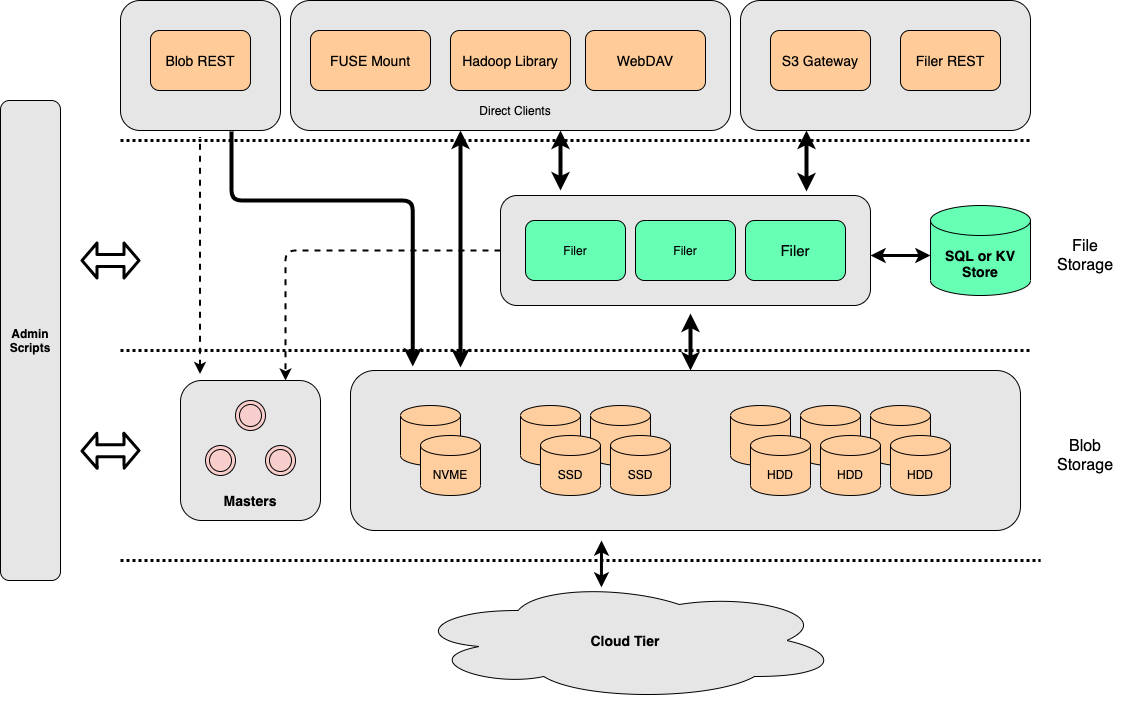
- Master servers, one or a Raft group of three, track which volume lives on which volume server and hand out file ids. They are not in the read path.
- Volume servers store blobs in append-only volume files, keep a 16-byte in-memory index per blob, and replicate or erasure-code at the volume level.
- Filer servers add directories and files on top, with metadata in a store of your choice, and expose HTTP, S3, WebDAV, SFTP, FUSE, and the table catalogs.
The blob store started from Facebook's Haystack, erasure coding takes ideas from f4, and the whole has a lot in common with Tectonic and Colossus. How file ids are assigned, written, and looked up, and why a master that tracks volumes scales, is in Blob Store Architecture; the services are in Components and the white paper.
Compared to Other Systems
Most other distributed file systems seem more complicated than necessary.
SeaweedFS is meant to be fast and simple, in both setup and operation. If you do not understand how it works when you reach here, we've failed! Please raise an issue with any questions or update this file with clarifications.
SeaweedFS is constantly moving forward. Same with other systems. These comparisons can be outdated quickly. Please help to keep them updated.
Compared to HDFS
HDFS uses the chunk approach for each file, and is ideal for storing large files.
SeaweedFS is ideal for serving relatively smaller files quickly and concurrently.
SeaweedFS can also store extra large files by splitting them into manageable data chunks, and store the file ids of the data chunks into a meta chunk. This is managed by "weed upload/download" tool, and the weed master or volume servers are agnostic about it.
Compared to GlusterFS, Ceph
The architectures are mostly the same. SeaweedFS aims to store and read files fast, with a simple and flat architecture. The main differences are
- SeaweedFS optimizes for small files, ensuring O(1) disk seek operation, and can also handle large files.
- SeaweedFS statically assigns a volume id for a file. Locating file content becomes just a lookup of the volume id, which can be easily cached.
- SeaweedFS Filer metadata store can be any well-known and proven data store, e.g., Redis, Cassandra, HBase, Mongodb, Elastic Search, MySql, Postgres, Sqlite, MemSql, TiDB, CockroachDB, Etcd, YDB etc, and is easy to customize.
- SeaweedFS Volume server also communicates directly with clients via HTTP, supporting range queries, direct uploads, etc.
| System | File Metadata | File Content Read | POSIX | REST API | Optimized for large number of small files |
|---|---|---|---|---|---|
| SeaweedFS | lookup volume id, cacheable | O(1) disk seek | Yes | Yes | |
| SeaweedFS Filer | Linearly Scalable, Customizable | O(1) disk seek | FUSE | Yes | Yes |
| GlusterFS | hashing | FUSE, NFS | |||
| Ceph | hashing + rules | FUSE | Yes | ||
| MooseFS | in memory | FUSE | No | ||
| MinIO | separate meta file per drive for each file | Yes | No | ||
| RustFS | separate meta file per drive for each file | Yes | No |
GlusterFS stores files, both directories and content, in configurable volumes called "bricks". It hashes the path and filename into ids, and assigned to virtual volumes, and then mapped to "bricks".
Compared to MooseFS
MooseFS chooses to neglect small file issue. From moosefs 3.0 manual, "even a small file will occupy 64KiB plus additionally 4KiB of checksums and 1KiB for the header", because it "was initially designed for keeping large amounts (like several thousands) of very big files"
MooseFS Master Server keeps all meta data in memory. Same issue as HDFS namenode.
Compared to Ceph
Ceph can be setup similar to SeaweedFS as a key->blob store. It is much more complicated, with the need to support layers on top of it. Here is a more detailed comparison
SeaweedFS has a centralized master group to look up free volumes, while Ceph uses hashing and metadata servers to locate its objects. Having a centralized master makes it easy to code and manage.
Ceph, like SeaweedFS, is based on the object store RADOS. Ceph is rather complicated with mixed reviews.
Ceph uses CRUSH hashing to automatically manage data placement, which is efficient to locate the data. But the data has to be placed according to the CRUSH algorithm. Any wrong configuration would cause data loss. Topology changes, such as adding new servers to increase capacity, will cause data migration with high IO cost to fit the CRUSH algorithm. SeaweedFS places data by assigning them to any writable volumes. If writes to one volume failed, just pick another volume to write. Adding more volumes is also as simple as it can be.
SeaweedFS is optimized for small files. Small files are stored as one continuous block of content, with at most 8 unused bytes between files. Small file access is O(1) disk read.
SeaweedFS Filer uses off-the-shelf stores, such as MySql, Postgres, Sqlite, Mongodb, Redis, Elastic Search, Cassandra, HBase, MemSql, TiDB, CockroachCB, Etcd, YDB, to manage file directories. These stores are proven, scalable, and easier to manage.
| SeaweedFS | comparable to Ceph | advantage |
|---|---|---|
| Master | MDS | simpler |
| Volume | OSD | optimized for small files |
| Filer | Ceph FS | linearly scalable, Customizable, O(1) or O(logN) |
Compared to MinIO, RustFS
Please note, as Apr 25, 2026 MinIO ceased development. It's strongly discouraged to use that unmaintained software with multiple security bugs. RustFS is a MinIO reimplementation in Rust, Apache 2.0 licensed and still developed, keeping MinIO's storage model down to a byte-compatible on-disk format. So the points below apply to both.
MinIO followed AWS S3 closely and was ideal for testing for S3 API. It had good UI, policies, versionings, etc. SeaweedFS is trying to catch up here.
The metadata are in simple files. Each file write incurs extra writes to the corresponding meta file, on every drive of the erasure set. Changing only tags or retention rewrites that meta file on all of them, so the write amplification does not shrink with object size.
There is no optimization for lots of small files. The files are simply stored as is to local disks. Plus the extra meta file and shards for erasure coding, it only amplifies the LOSF problem.
Multiple disk IO are needed to read one file. SeaweedFS has O(1) disk reads, even for erasure coded files.
Erasure coding is full-time. SeaweedFS uses replication on hot data for faster speed and optionally applies erasure coding on warm data.
No POSIX-like API support.
There are specific requirements on storage layout, which makes it hard to scale out and to maintain. An erasure set must be 2 to 16 drives and must divide the drive list symmetrically, and capacity grows or shrinks a whole pool at a time. In SeaweedFS, just start one volume server pointing to the master. That's all.
Benchmark
Unscientific single-machine numbers from a MacBook with an SSD. weed benchmark, 1 million 1KB files, concurrency 16:
| Requests per second | p50 | p99 | |
|---|---|---|---|
| Write | 15,708 | 0.8 ms | 2.6 ms |
| Random read | 47,019 | 0.3 ms | 0.7 ms |
make benchmark runs warp mixed S3 traffic against a local weed server:
Mixed operations.
Operation: DELETE, 10%, Concurrency: 20, Ran 42s.
 * Throughput: 55.13 obj/s

Operation: GET, 45%, Concurrency: 20, Ran 42s.
 * Throughput: 2477.45 MiB/s, 247.75 obj/s

Operation: PUT, 15%, Concurrency: 20, Ran 42s.
 * Throughput: 825.85 MiB/s, 82.59 obj/s

Operation: STAT, 30%, Concurrency: 20, Ran 42s.
 * Throughput: 165.27 obj/s

Cluster Total: 3302.88 MiB/s, 550.51 obj/s over 43s.
Read throughput is bounded by the random read speed of the disks, and grows with every volume server added. More numbers, including multi-node, FUSE, and Hadoop, are in Benchmarks, S3 API Benchmark, FIO benchmark, and Independent Benchmarks.
Enterprise
For enterprise users, please visit seaweedfs.com for the SeaweedFS Enterprise Edition, which has advanced features, including data recovery, self-healing storage, customizable erasure coding, EC vacuum and repair, etc.
License
Licensed under the Apache License, Version 2.0 (the "License"); you may not use this file except in compliance with the License. You may obtain a copy of the License at
http://www.apache.org/licenses/LICENSE-2.0
Unless required by applicable law or agreed to in writing, software distributed under the License is distributed on an "AS IS" BASIS, WITHOUT WARRANTIES OR CONDITIONS OF ANY KIND, either express or implied. See the License for the specific language governing permissions and limitations under the License.
Sponsors
Sponsor SeaweedFS via Patreon
SeaweedFS is an independent Apache-licensed open source project with its ongoing development made possible entirely thanks to the support of these awesome backers. If you'd like to grow SeaweedFS even stronger, please consider joining our sponsors on Patreon.
Your support will be really appreciated by me and other supporters!
Gold Sponsors




Star History
