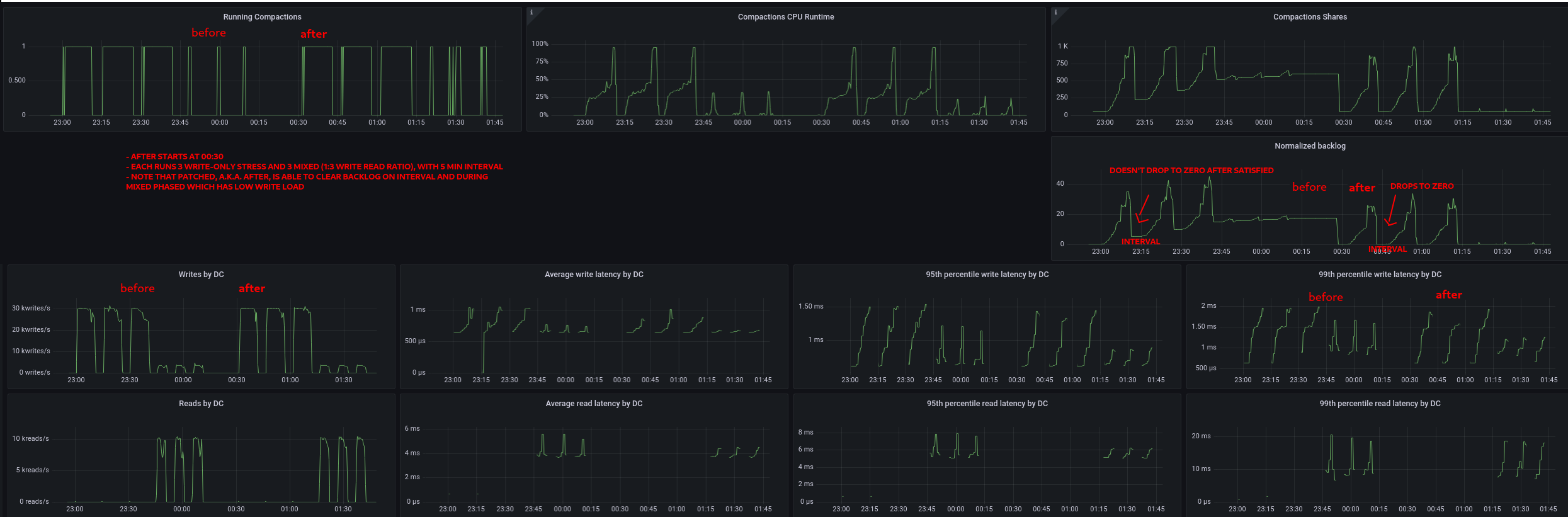
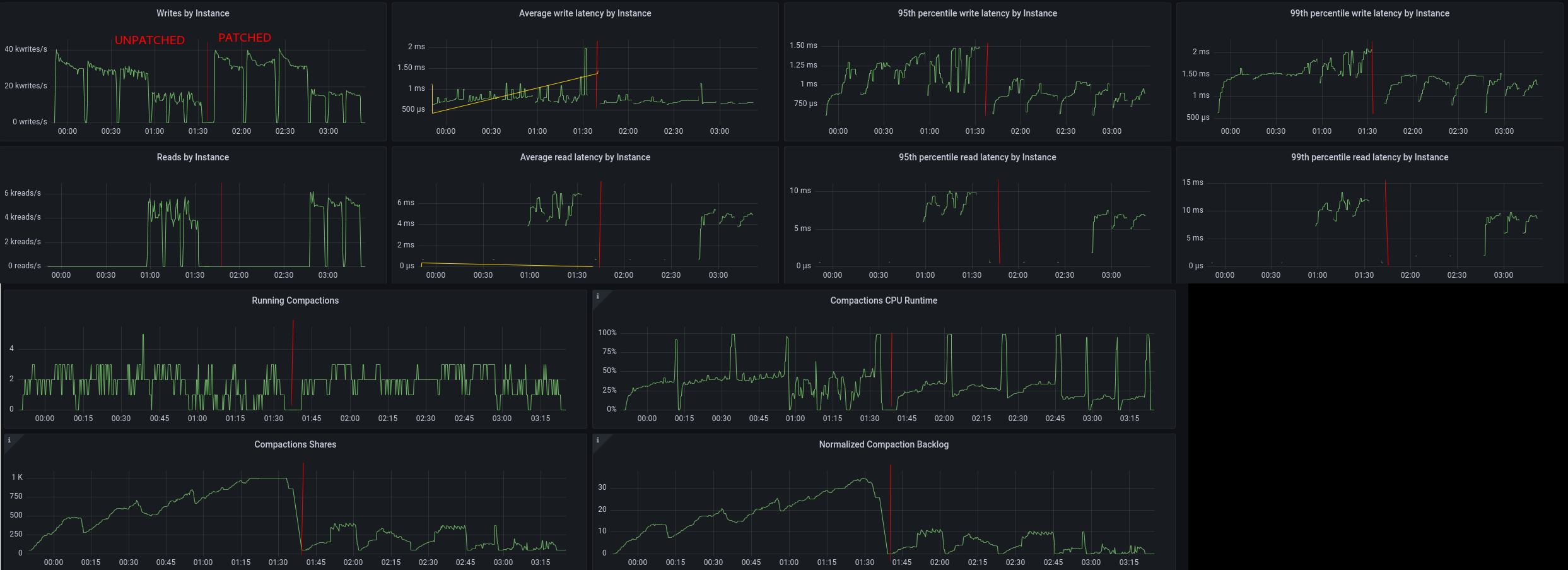
Incremented the components_memory_reclaim_threshold config's default
value to 0.2 as the previous value was too strict and caused unnecessary
eviction in otherwise healthy clusters.
Fixes#18607
Signed-off-by: Lakshmi Narayanan Sreethar <lakshmi.sreethar@scylladb.com>
(cherry picked from commit 3d7d1fa72a)
Closes#19011
PR https://github.com/scylladb/scylladb/pull/17771 introduced a threshold for the total memory used by all bloom filters across SSTables. When the total usage surpasses the threshold, the largest bloom filter will be removed from memory, bringing the total usage back under the threshold. This PR adds support for reloading such reclaimed bloom filters back into memory when memory becomes available (i.e., within the 10% of available memory earmarked for the reclaimable components).
The SSTables manager now maintains a list of all SSTables whose bloom filter was removed from memory and attempts to reload them when an SSTable, whose bloom filter is still in memory, gets deleted. The manager reloads from the smallest to the largest bloom filter to maximize the number of filters being reloaded into memory.
Backported from https://github.com/scylladb/scylladb/pull/18186 to 5.2.
Closes#18666
* github.com:scylladb/scylladb:
sstable_datafile_test: add testcase to test reclaim during reload
sstable_datafile_test: add test to verify auto reload of reclaimed components
sstables_manager: reload previously reclaimed components when memory is available
sstables_manager: start a fiber to reload components
sstable_directory_test: fix generation in sstable_directory_test_table_scan_incomplete_sstables
sstable_datafile_test: add test to verify reclaimed components reload
sstables: support reloading reclaimed components
sstables_manager: add new intrusive set to track the reclaimed sstables
sstable: add link and comparator class to support new instrusive set
sstable: renamed intrusive list link type
sstable: track memory reclaimed from components per sstable
sstable: rename local variable in sstable::total_reclaimable_memory_size
Even when configured to not do any validation at all, the validator still did some. This small series fixes this, and adds a test to check that validation levels in general are respected, and the validator doesn't validate more than it is asked to.
Fixes: #18662
(cherry picked from commit f6511ca1b0)
(cherry picked from commit e7b07692b6)
(cherry picked from commit 78afb3644c)
Refs #18667Closes#18723
* github.com:scylladb/scylladb:
test/boost/mutation_fragment_test.cc: add test for validator validation levels
mutation: mutation_fragment_stream_validating_filter: fix validation_level::none
mutation: mutation_fragment_stream_validating_filter: add raises_error ctor parameter
when we convert timestamp into string it must look like: '2017-12-27T11:57:42.500Z'
it concerns any conversion except JSON timestamp format
JSON string has space as time separator and must look like: '2017-12-27 11:57:42.500Z'
both formats always contain milliseconds and timezone specification
Fixes#14518Fixes#7997Closes#14726Fixes#16575
(cherry picked from commit ff721ec3e3)
Closes#18852
Despite its name, this validation level still did some validation. Fix
this, by short-circuiting the catch-all operator(), preventing any
validation when the user asked for none.
(cherry picked from commit e7b07692b6)
When set to false, no exceptions will be raised from the validator on
validation error. Instead, it will just return false from the respective
validator methods. This makes testing simpler, asserting exceptions is
clunky.
When true (default), the previous behaviour will remain: any validation
error will invoke on_internal_error(), resulting in either std::abort()
or an exception.
Backporting notes:
* Added const const mutation_fragment_stream_validating_filter&
param to on_validation_error()
* Made full_name() public
(cherry picked from commit f6511ca1b0)
Currently, if the fill ctor throws an exception,
the destructor won't be called, as it object is not fully constructed yet.
Call the default ctor first (which doesn't throw)
to make sure the destructor will be called on exception.
Fixes scylladb/scylladb#18635
- [x] Although the fixes is for a rare bug, it has very low risk and so it's worth backporting to all live versions
(cherry picked from commit 64c51cf32c)
(cherry picked from commit 88b3173d03)
(cherry picked from commit 4bbb66f805)
Refs #18636Closes#18680
* github.com:scylladb/scylladb:
chunked_vector_test: add more exception safety tests
chunked_vector_test: exception_safe_class: count also moved objects
utils: chunked_vector: fill ctor: make exception safe
We have to account for moved objects as well
as copied objects so they will be balanced with
the respective `del_live_object` calls called
by the destructor.
However, since chunked_vector requires the
value_type to be nothrow_move_constructible,
just count the additional live object, but
do not modify _countdown or, respectively, throw
an exception, as this should be considered only
for the default and copy constructors.
Signed-off-by: Benny Halevy <bhalevy@scylladb.com>
Currently, if the fill ctor throws an exception,
the destructor won't be called, as it object is not
fully constructed yet.
Call the default ctor first (which doesn't throw)
to make sure the destructor will be called on exception.
Fixesscylladb/scylladb#18635
Signed-off-by: Benny Halevy <bhalevy@scylladb.com>
When an SSTable is dropped, the associated bloom filter gets discarded
from memory, bringing down the total memory consumption of bloom
filters. Any bloom filter that was previously reclaimed from memory due
to the total usage crossing the threshold, can now be reloaded back into
memory if the total usage can still stay below the threshold. Added
support to reload such reclaimed filters back into memory when memory
becomes available.
Signed-off-by: Lakshmi Narayanan Sreethar <lakshmi.sreethar@scylladb.com>
(cherry picked from commit 0b061194a7)
Start a fiber that gets notified whenever an sstable gets deleted. The
fiber doesn't do anything yet but the following patch will add support
to reload reclaimed components if there is sufficient memory.
Signed-off-by: Lakshmi Narayanan Sreethar <lakshmi.sreethar@scylladb.com>
(cherry picked from commit f758d7b114)
The testcase uses an sstable whose mutation key and the generation are
owned by different shards. Due to this, when process_sstable_dir is
called, the sstable gets loaded into a different shard than the one that
was intended. This also means that the sstable and the sstable manager
end up in different shards.
The following patch will introduce a condition variable in sstables
manager which will be signalled from the sstables. If the sstable and
the sstable manager are in different shards, the signalling will cause
the testcase to fail in debug mode with this error : "Promise task was
set on shard x but made ready on shard y". So, fix it by supplying
appropriate generation number owned by the same shard which owns the
mutation key as well.
Signed-off-by: Lakshmi Narayanan Sreethar <lakshmi.sreethar@scylladb.com>
(cherry picked from commit 24064064e9)
Added support to reload components from which memory was previously
reclaimed as the total memory of reclaimable components crossed a
threshold. The implementation is kept simple as only the bloom filters
are considered reclaimable for now.
Signed-off-by: Lakshmi Narayanan Sreethar <lakshmi.sreethar@scylladb.com>
(cherry picked from commit 54bb03cff8)
When a compaction strategy uses garbage collected sstables to track
expired tombstones, do not use complete partition estimates for them,
instead, use a fraction of it based on the droppable tombstone ratio
estimate.
Fixes#18283
Signed-off-by: Lakshmi Narayanan Sreethar <lakshmi.sreethar@scylladb.com>
Closesscylladb/scylladb#18465
(cherry picked from commit d39adf6438)
Closes#18659
The new set holds the sstables from where the memory has been reclaimed
and is sorted in ascending order of the total memory reclaimed.
Signed-off-by: Lakshmi Narayanan Sreethar <lakshmi.sreethar@scylladb.com>
(cherry picked from commit 2340ab63c6)
Renamed the intrusive list link type to differentiate it from the set
link type that will be added in an upcoming patch.
Signed-off-by: Lakshmi Narayanan Sreethar <lakshmi.sreethar@scylladb.com>
(cherry picked from commit 3ef2f79d14)
Added a member variable _total_memory_reclaimed to the sstable class
that tracks the total memory reclaimed from a sstable.
Signed-off-by: Lakshmi Narayanan Sreethar <lakshmi.sreethar@scylladb.com>
(cherry picked from commit 02d272fdb3)
Renamed local variable in sstable::total_reclaimable_memory_size in
preparation for the next patch which adds a new member variable
_total_memory_reclaimed to the sstable class.
Signed-off-by: Lakshmi Narayanan Sreethar <lakshmi.sreethar@scylladb.com>
(cherry picked from commit a53af1f878)
The direct failure detector design is simplistic. It sends pings
sequentially and times out listeners that reached the threshold (i.e.
didn't hear from a given endpoint for too long) in-between pings.
Given the sequential nature, the previous ping must finish so the next
ping can start. We timeout pings that take too long. The timeout was
hardcoded and set to 300ms. This is too low for wide-area setups --
latencies across the Earth can indeed go up to 300ms. 3 subsequent timed
out pings to a given node were sufficient for the Raft listener to "mark
server as down" (the listener used a threshold of 1s).
Increase the ping timeout to 600ms which should be enough even for
pinging the opposite side of Earth, and make it tunable.
Increase the Raft listener threshold from 1s to 2s. Without the
increased threshold, one timed out ping would be enough to mark the
server as down. Increasing it to 2s requires 3 timed out pings which
makes it more robust in presence of transient network hiccups.
In the future we'll most likely want to decrease the Raft listener
threshold again, if we use Raft for data path -- so leader elections
start quickly after leader failures. (Faster than 2s). To do that we'll
have to improve the design of the direct failure detector.
Ref: scylladb/scylladb#16410
Fixes: scylladb/scylladb#16607
---
I tested the change manually using `tc qdisc ... netem delay`, setting
network delay on local setup to ~300ms with jitter. Without the change,
the result is as observed in scylladb/scylladb#16410: interleaving
```
raft_group_registry - marking Raft server ... as dead for Raft groups
raft_group_registry - marking Raft server ... as alive for Raft groups
```
happening once every few seconds. The "marking as dead" happens whenever
we get 3 subsequent failed pings, which is happens with certain (high)
probability depending on the latency jitter. Then as soon as we get a
successful ping, we mark server back as alive.
With the change, the phenomenon no longer appears.
(cherry picked from commit 8df6d10e88)
Closes#18558
The event is used in a loop.
Found by clang-tidy:
```
streaming/stream_result_future.cc:80:49: warning: 'event' used after it was moved [bugprone-use-after-move]
listener->handle_stream_event(std::move(event));
^
streaming/stream_result_future.cc:80:39: note: move occurred here
listener->handle_stream_event(std::move(event));
^
streaming/stream_result_future.cc:80:49: note: the use happens in a later loop iteration than the move
listener->handle_stream_event(std::move(event));
^
```
Fixes#18332
(cherry picked from commit 4fd4e6acf3)
Closes#18430
When reclaiming memory from bloom filters, do not remove them from
_recognised_components, as that leads to the on-disk filter component
being left back on disk when the SSTable is deleted.
Fixes#18398
Signed-off-by: Lakshmi Narayanan Sreethar <lakshmi.sreethar@scylladb.com>
Closesscylladb/scylladb#18400
(cherry picked from commit 6af2659b57)
Closes#18437
in handler.cc, `make_non_overlapping_ranges()` references a moved
instance of `ColumnSlice` when something unexpected happens to
format the error message in an exception, the move constructor of
`ColumnSlice` is default-generated, so the members' move constructors
are used to construct the new instance in the move constructor. this
could lead to undefined behavior when dereferencing the move instance.
in this change, in order to avoid use-after free, let's keep
a copy of the referenced member variables and reference them when
formatting error message in the exception.
this use-after-move issue was introduced in 822a315dfa, which implemented
`get_multi_slice` verb and this piece in the first place. since both 5.2
and 5.4 include this commit, we should backport this change to them.
Refs 822a315dfaFixes#18356
Signed-off-by: Kefu Chai <kefu.chai@scylladb.com>
(cherry picked from commit 1ad3744edc)
Closes#18373
Currently, we use the sum of the estimated_partitions from each
participant node as the estimated_partitions for sstable produced by
repair. This way, the estimated_partitions is the biggest possible
number of partitions repair would write.
Since repair will write only the difference between repair participant
nodes, using the biggest possible estimation will overestimate the
partitions written by repair, most of the time.
The problem is that overestimated partitions makes the bloom filter
consume more memory. It is observed that it causes OOM in the field.
This patch changes the estimation to use a fraction of the average
partitions per node instead of sum. It is still not a perfect estimation
but it already improves memory usage significantly.
Fixes#18140Closesscylladb/scylladb#18141
(cherry picked from commit 642f9a1966)
Added support to track and limit the memory usage by sstable components. A reclaimable component of an SSTable is one from which memory can be reclaimed. SSTables and their managers now track such reclaimable memory and limit the component memory usage accordingly. A new configuration variable defines the memory reclaim threshold. If the total memory of the reclaimable components exceeds this limit, memory will be reclaimed to keep the usage under the limit. This PR considers only the bloom filters as reclaimable and adds support to track and limit them as required.
The feature can be manually verified by doing the following :
1. run a single-node single-shard 1GB cluster
2. create a table with bloom-filter-false-positive-chance of 0.001 (to intentionally cause large bloom filter)
3. populate with tiny partitions
4. watch the bloom filter metrics get capped at 100MB
The default value of the `components_memory_reclaim_threshold` config variable which controls the reclamation process is `.1`. This can also be reduced further during manual tests to easily hit the threshold and verify the feature.
Fixes https://github.com/scylladb/scylladb/issues/17747
Backported from #17771 to 5.2.
Closes#18247
* github.com:scylladb/scylladb:
test_bloom_filter.py: disable reclaiming memory from components
sstable_datafile_test: add tests to verify auto reclamation of components
test/lib: allow overriding available memory via test_env_config
sstables_manager: support reclaiming memory from components
sstables_manager: store available memory size
sstables_manager: add variable to track component memory usage
db/config: add a new variable to limit memory used by table components
sstable_datafile_test: add testcase to verify reclamation from sstables
sstables: support reclaiming memory from components
Disabled reclaiming memory from sstable components in the testcase as it
interferes with the false positive calculation.
Signed-off-by: Lakshmi Narayanan Sreethar <lakshmi.sreethar@scylladb.com>
(cherry picked from commit d86505e399)
Reclaim memory from the SSTable that has the most reclaimable memory if
the total reclaimable memory has crossed the threshold. Only the bloom
filter memory is considered reclaimable for now.
Fixes#17747
Signed-off-by: Lakshmi Narayanan Sreethar <lakshmi.sreethar@scylladb.com>
(cherry picked from commit a36965c474)
The available memory size is required to calculate the reclaim memory
threshold, so store that within the sstables manager.
Signed-off-by: Lakshmi Narayanan Sreethar <lakshmi.sreethar@scylladb.com>
(cherry picked from commit 2ca4b0a7a2)
sstables_manager::_total_reclaimable_memory variable tracks the total
memory that is reclaimable from all the SSTables managed by it.
Signed-off-by: Lakshmi Narayanan Sreethar <lakshmi.sreethar@scylladb.com>
(cherry picked from commit f05bb4ba36)
A new configuration variable, components_memory_reclaim_threshold, has
been added to configure the maximum allowed percentage of available
memory for all SSTable components in a shard. If the total memory usage
exceeds this threshold, it will be reclaimed from the components to
bring it back under the limit. Currently, only the memory used by the
bloom filters will be restricted.
Signed-off-by: Lakshmi Narayanan Sreethar <lakshmi.sreethar@scylladb.com>
(cherry picked from commit e8026197d2)
Added support to track total memory from components that are reclaimable
and to reclaim memory from them if and when required. Right now only the
bloom filters are considered as reclaimable components but this can be
extended to any component in the future.
Signed-off-by: Lakshmi Narayanan Sreethar <lakshmi.sreethar@scylladb.com>
(cherry picked from commit 4f0aee62d1)
Repair memory limit includes only the size of frozen mutation
fragments in repair row. The size of other members of repair
row may grow uncontrollably and cause out of memory.
Modify what's counted to repair memory limit.
Fixes: https://github.com/scylladb/scylladb/issues/16710.
(cherry picked from commit a4dc6553ab)
(cherry picked from commit 51c09a84cc)
Refs https://github.com/scylladb/scylladb/pull/17785Closes#18237
* github.com:scylladb/scylladb:
test: add test for repair_row::size()
repair: fix memory accounting in repair_row
In repair, only the size of frozen mutation fragments of repair row
is counted to the memory limit. So, huge keys of repair rows may
lead to OOM.
Include other repair_row's members' memory size in repair memory
limit.
(cherry picked from commit a4dc6553ab)
Currently, Scylla logs a warning when it writes a cell, row or partition which are larger than certain configured sizes. These warnings contain the partition key and in case of rows and cells also the cluster key which allow the large row or partition to be identified. However, these keys can contain user-private, sensitive information. The information which identifies the partition/row/cell is also inserted into tables system.large_partitions, system.large_rows and system.large_cells respectivelly.
This change removes the partition and cluster keys from the log messages, but still inserts them into the system tables.
The logged data will look like this:
Large cells:
WARN 2024-04-02 16:49:48,602 [shard 3: mt] large_data - Writing large cell ks_name/tbl_name: cell_name (SIZE bytes) to sstable.db
Large rows:
WARN 2024-04-02 16:49:48,602 [shard 3: mt] large_data - Writing large row ks_name/tbl_name: (SIZE bytes) to sstable.db
Large partitions:
WARN 2024-04-02 16:49:48,602 [shard 3: mt] large_data - Writing large partition ks_name/tbl_name: (SIZE bytes) to sstable.db
Fixes#18041Closesscylladb/scylladb#18166
(cherry picked from commit f1cc6252fd)
before this change, `reclaim_timer::report()` calls
```c++
fmt::format(", at {}", current_backtrace())
```
which allocates a `std::string` on heap, so it can fail and throw. in
that case, `std::terminate()` is called. but at that moment, the reason
why `reclaim_timer::report()` gets called is that we fail to reclaim
memory for the caller. so we are more likely to run into this issue. anyway,
we should not allocate memory in this path.
in this change, a dedicated printer is created so that we don't format
to a temporary `std::string`, and instead write directly to the buffer
of logger. this avoids the memory allocation.
Fixes#18099
Signed-off-by: Kefu Chai <kefu.chai@scylladb.com>
Closesscylladb/scylladb#18100
(cherry picked from commit fcf7ca5675)
When a view update has both a local and remote target endpoint,
it extends the lifetime of its memory tracking semaphore units
only until the end of the local update, while the resources are
actually used until the remote update finishes.
This patch changes the semaphore transferring so that in case
of both local and remote endpoints, both view updates share the
units, causing them to be released only after the update that
takes longer finishes.
Fixes#17890
(cherry picked from commit 9789a3dc7c)
Closes#18104
Currently, when dividing memory tracked for a batch of updates
we do not take into account the overhead that we have for processing
every update. This patch adds the overhead for single updates
and joins the memory calculation path for batches and their parts
so that both use the same overhead.
Fixes#17854
(cherry picked from commit efcb718)
Closes#17999
before this change, we always cast the wait duration to millisecond,
even if it could be using a higher resolution. actually
`std::chrono::steady_clock` is using `nanosecond` for its duration,
so if we inject a deadline using `steady_clock`, we could be awaken
earlier due to the narrowing of the duration type caused by the
duration_cast.
in this change, we just use the duration as it is. this should allow
the caller to use the resolution provided by Seastar without losing
the precision. the tests are updated to print the time duration
instead of count to provide information with a higher resolution.
Fixes#15902
(cherry picked from commit 8a5689e7a7)
(cherry picked from commit 1d33a68dd7)
Closes#17911
* github.com:scylladb/scylladb:
tests: utils: error injection: print time duration instead of count
error_injection: do not cast to milliseconds when injecting timeout
In order to avoid running out of memory, we can't
underestimate the memory used when processing a view
update. Particularly, we need to handle the remote
view updates well, because we may create many of them
at the same time in contrast to local updates which
are processed synchronously.
After investigating a coredump generated in a crash
caused by running out of memory due to these remote
view updates, we found that the current estimation
is much lower than what we observed in practice; we
identified overhead of up to 2288 bytes for each
remote view update. The overhead consists of:
- 512 bytes - a write_response_handler
- less than 512 bytes - excessive memory allocation
for the mutation in bytes_ostream
- 448 bytes - the apply_to_remote_endpoints coroutine
started in mutate_MV()
- 192 bytes - a continuation to the coroutine above
- 320 bytes - the coroutine in result_parallel_for_each
started in mutate_begin()
- 112 bytes - a continuation to the coroutine above
- 192 bytes - 5 unspecified allocations of 32, 32, 32,
48 and 48 bytes
This patch changes the previous overhead estimate
of 256 bytes to 2288 bytes, which should take into
account all allocations in the current version of the
code. It's worth noting that changes in the related
pieces of code may result in a different overhead.
The allocations seem to be mostly captures for the
background tasks. Coroutines seem to allocate extra,
however testing shows that replacing a coroutine with
continuations may result in generating a few smaller
futures/continuations with a larger total size.
Besides that, considering that we're waiting for
a response for each remote view update, we need the
relatively large write_response_handler, which also
includes the mutation in case we needed to reuse it.
The change should not majorly affect workloads with many
local updates because we don't keep many of them at
the same time anyway, and an added benefit of correct
memory utilization estimation is avoiding evictions
of other memory that would be otherwise necessary
to handle the excessive memory used by view updates.
Fixes#17364
(cherry picked from commit 5ab3586135)
Closes#17858
instead of casting / comparing the count of duration unit, let's just
compare the durations, so that boost.test is able to print the duration
in a more informative and user friendly way (line wrapped)
test/boost/error_injection_test.cc(167): fatal error:
in "test_inject_future_disabled":
critical check wait_time > sleep_msec has failed [23839ns <= 10ms]
Refs #15902
Signed-off-by: Kefu Chai <kefu.chai@scylladb.com>
(cherry picked from commit 1d33a68dd7)
before this change, we always cast the wait duration to millisecond,
even if it could be using a higher resolution. actually
`std::chrono::steady_clock` is using `nanosecond` for its duration,
so if we inject a deadline using `steady_clock`, we could be awaken
earlier due to the narrowing of the duration type caused by the
duration_cast.
in this change, we just use the duration as it is. this should allow
the caller to use the resolution provided by Seastar without losing
the precision.
Fixes#15902
Signed-off-by: Kefu Chai <kefu.chai@scylladb.com>
(cherry picked from commit 8a5689e7a7)
Major compaction semantics is that all data of a table will be compacted
together, so user can expect e.g. a recently introduced tombstone to be
compacted with the data it shadows.
Today, it can happen that all data in maintenance set won't be included
for major, until they're promoted into main set by off-strategy.
So user might be left wondering why major is not having the expected
effect.
To fix this, let's perform off-strategy first, so data in maintenance
set will be made available by major. A similar approach is done for
data in memtable, so flush is performed before major starts.
The only exception will be data in staging, which cannot be compacted
until view building is done with it, to avoid inconsistency in view
replicas.
The serialization in comapaction manager of reshape jobs guarantee
correctness if there's an ongoing off-strategy on behalf of the
table.
Fixes#11915.
Signed-off-by: Raphael S. Carvalho <raphaelsc@scylladb.com>
Closesscylladb/scylladb#15792
(cherry picked from commit ea6c281b9f)
Signed-off-by: Raphael S. Carvalho <raphaelsc@scylladb.com>
Closes#17901
This commit updates the Upgrade ScyllaDB Image page.
- It removes the incorrect information that updating underlying OS packages is mandatory.
- It adds information about the extended procedure for non-official images.
(cherry picked from commit fc90112b97)
Closes#17885
The test in its original form relies on the
`error_injections_at_startup` feature, which 5.2 doesn't have, so I
adapted the test to enable error injections after bootstrapping nodes in
the backport (9c44bbce67). That is however
incorrect, it's important for the injection to be enabled while the
nodes are booting, otherwise the test will be flaky, as we observed.
Details in scylladb/scylladb#17749.
Remove the test from 5.2 branch.
Fixesscylladb/scylladb#17749Closes#17750
This is a backport of 0c376043eb and follow-up fix 57b14580f0 to 5.2.
We haven't identified any specific issues in test or field in 5.2/2023.1 releases, but the bug should be fixed either way, it might bite us in unexpected ways.
Closes#17640
* github.com:scylladb/scylladb:
migration_manager: only jump to shard 0 in migration_request during group 0 snapshot transfer
raft_group0_client: assert that hold_read_apply_mutex is called on shard 0
migration_manager: fix indentation after the previous patch.
messaging_service: process migration_request rpc on shard 0
migration_manager: take group0 lock during raft snapshot taking
A materialized view in CQL allows AT MOST ONE view key column that
wasn't a key column in the base table. This is because if there were
two or more of those, the "liveness" (timestamp, ttl) of these different
columns can change at every update, and it's not possible to pick what
liveness to use for the view row we create.
We made an exception for this rule for Alternator: DynamoDB's API allows
creating a GSI whose partition key and range key are both regular columns
in the base table, and we must support this. We claim that the fact that
Alternator allows neither TTL (Alternator's "TTL" is a different feature)
nor user-defined timestamps, does allow picking the liveness for the view
row we create. But we did it wrong!
We claimed in a comment - and implemented in the code before this patch -
that in Alternator we can assume that both GSI key columns will have the
*same* liveness, and in particular timestamp. But this is only true if
one modifies both columns together! In fact, in general it is not true:
We can have two non-key attributes 'a' and 'b' which are the GSI's key
columns, and we can modify *only* b, without modifying a, in which case
the timestamp of the view modification should be b's newer timestamp,
not a's older one. The existing code took a's timestamp, assuming it
will be the same as b's, which is incorrect. The result was that if
we repeatedly modify only b, all view updates will receive the same
timestamp (a's old timestamp), and a deletion will always win over
all the modifications. This patch includes a reproducing test written by
a user (@Zak-Kent) that demonstrates how after a view row is deleted
it doesn't get recreated - because all the modifications use the same
timestamp.
The fix is, as suggested above, to use the *higher* of the two
timestamps of both base-regular-column GSI key columns as the timestamp
for the new view rows or view row deletions. The reproducer that
failed before this patch passes with it. As usual, the reproducer
passes on AWS DynamoDB as well, proving that the test is correct and
should really work.
Fixes#17119
Signed-off-by: Nadav Har'El <nyh@scylladb.com>
Closesscylladb/scylladb#17172
(cherry picked from commit 21e7deafeb)
The test is booting nodes, and then immediately starts shutting down
nodes and removing them from the cluster. The shutting down and
removing may happen before driver manages to connect to all nodes in the
cluster. In particular, the driver didn't yet connect to the last
bootstrapped node. Or it can even happen that the driver has connected,
but the control connection is established to the first node, and the
driver fetched topology from the first node when the first node didn't
yet consider the last node to be normal. So the driver decides to close
connection to the last node like this:
```
22:34:03.159 DEBUG> [control connection] Removing host not found in
peers metadata: <Host: 127.42.90.14:9042 datacenter1>
```
Eventually, at the end of the test, only the last node remains, all
other nodes have been removed or stopped. But the driver does not have a
connection to that last node.
Fix this problem by ensuring that:
- all nodes see each other as NORMAL,
- the driver has connected to all nodes
at the beginning of the test, before we start shutting down and removing
nodes.
Fixes scylladb/scylladb#16373
(cherry picked from commit a68701ed4f)
Closes#17703
Jumping to shard 0 during group 0 snapshot transfer is required because
we take group 0 lock, onyl available on shard 0. But outside of Raft
mode it only pessimizes performance unnecessarily, so don't do it.
Repairs have to obtain a permit to the reader concurrency semaphore on
each shard they have a presence on. This is prone to deadlocks:
node1 node2
repair1_master (takes permit) repair1_follower (waits on permit)
repair2_master (waits for permit) repair2_follower (takes permit)
In lieu of strong central coordination, we solved this by making permits
evictable: if repair2 can evict repair1's permit so it can obtain one
and make progress. This is not efficient as evicting a permit usually
means discarding already done work, but it prevents the deadlocks.
We recently discovered that there is a window when deadlocks can still
happen. The permit is made evictable when the disk reader is created.
This reader is an evictable one, which effectively makes the permit
evictable. But the permit is obtained when the repair constrol
structrure -- repair meta -- is create. Between creating the repair meta
and reading the first row from disk, the deadlock is still possible. And
we know that what is possible, will happen (and did happen). Fix by
making the permit evictable as soon as the repair meta is created. This
is very clunky and we should have a better API for this (refs #17644),
but for now we go with this simple patch, to make it easy to backport.
Refs: #17644Fixes: #17591Closes#17646
(cherry picked from commit c6e108a)
Backport notes:
The fix above does not apply to 5.2, because on 5.2 the reader is
created immediately when the repair-meta is created. So we don't need
the game with a fake inactive read, we can just pause the already
created reader in the repair-reader constructor.
Closes#17730
key_view::explode() contains a blatant use-after-free:
unless the input is already linearized, it returns a view to a local temporary buffer.
This is rare, because partition keys are usually not large enough to be fragmented.
But for a sufficiently large key, this bug causes a corrupted partition_key down
the line.
Fixes#17625
(cherry picked from commit 7a7b8972e5)
Closes#17725
Store schema_ptr in reader permit instead of storing a const pointer to
schema to ensure that the schema doesn't get changed elsewhere when the
permit is holding on to it. Also update the constructors and all the
relevant callers to pass down schema_ptr instead of a raw pointer.
Fixes#16180
Signed-off-by: Lakshmi Narayanan Sreethar <lakshmi.sreethar@scylladb.com>
Closesscylladb/scylladb#16658
(cherry picked from commit 76f0d5e35b)
Closes#17694
Commit 0c376043eb added access to group0
semaphore which can be done on shard0 only. Unlike all other group0 rpcs
(that already always forwarded to shard0) migration_request does not
since it is an rpc that what reused from non raft days. The patch adds
the missing jump to shard0 before executing the rpc.
(cherry picked from commit 4a3c79625f)
Group0 state machine access atomicity is guaranteed by a mutex in group0
client. A code that reads or writes the state needs to hold the log. To
transfer schema part of the snapshot we used existing "migration
request" verb which did not follow the rule. Fix the code to take group0
lock before accessing schema in case the verb is called as part of
group0 snapshot transfer.
Fixesscylladb/scylladb#16821
(cherry picked from commit 0c376043eb)
Backport note: introduced missing
`raft_group0_client::hold_read_apply_mutex`
RPC calls lose information about the type of returned exception.
Thus, if a table is dropped on receiver node, but it still exists
on a sender node and sender node streams the table's data, then
the whole operation fails.
To prevent that, add a method which synchronizes schema and then
checks, if the exception was caused by table drop. If so,
the exception is swallowed.
Use the method in streaming and repair to continue them when
the table is dropped in the meantime.
Fixes: https://github.com/scylladb/scylladb/issues/17028.
Fixes: https://github.com/scylladb/scylladb/issues/15370.
Fixes: https://github.com/scylladb/scylladb/issues/15598.
Closes#17528
* github.com:scylladb/scylladb:
repair: handle no_such_column_family from remote node gracefully
test: test drop table on receiver side during streaming
streaming: fix indentation
streaming: handle no_such_column_family from remote node gracefully
repair: add methods to skip dropped table
The function `gms::version_generator::get_next_version()` can only be called from shard 0 as it uses a global, unsynchronized counter to issue versions. Notably, the function is used as a default argument for the constructor of `gms::versioned_value` which is used from shorthand constructors such as `versioned_value::cache_hitrates`, `versioned_value::schema` etc.
The `cache_hitrate_calculator` service runs a periodic job which updates the `CACHE_HITRATES` application state in the local gossiper state. Each time the job is scheduled, it runs on the next shard (it goes through shards in a round-robin fashion). The job uses the `versioned_value::cache_hitrates` shorthand to create a `versioned_value`, therefore risking a data race if it is not currently executing on shard 0.
The PR fixes the race by moving the call to `versioned_value::cache_hitrates` to shard 0. Additionally, in order to help detect similar issues in the future, a check is introduced to `get_next_version` which aborts the process if the function was called on other shard than 0.
There is a possibility that it is a fix for #17493. Because `get_next_version` uses a simple incrementation to advance the global counter, a data race can occur if two shards call it concurrently and it may result in shard 0 returning the same or smaller value when called two times in a row. The following sequence of events is suspected to occur on node A:
1. Shard 1 calls `get_next_version()`, loads version `v - 1` from the global counter and stores in a register; the thread then is preempted,
2. Shard 0 executes `add_local_application_state()` which internally calls `get_next_version()`, loads `v - 1` then stores `v` and uses version `v` to update the application state,
3. Shard 0 executes `add_local_application_state()` again, increments version to `v + 1` and uses it to update the application state,
4. Gossip message handler runs, exchanging application states with node B. It sends its application state to B. Note that the max version of any of the local application states is `v + 1`,
5. Shard 1 resumes and stores version `v` in the global counter,
6. Shard 0 executes `add_local_application_state()` and updates the application state - again - with version `v + 1`.
7. After that, node B will never learn about the application state introduced in point 6. as gossip exchange only sends endpoint states with version larger than the previous observed max version, which was `v + 1` in point 4.
Note that the above scenario was _not_ reproduced. However, I managed to observe a race condition by:
1. modifying Scylla to run update of `CACHE_HITRATES` much more frequently than usual,
2. putting an assertion in `add_local_application_state` which fails if the version returned by `get_next_version` was not larger than the previous returned value,
3. running a test which performs schema changes in a loop.
The assertion from the second point was triggered. While it's hard to tell how likely it is to occur without making updates of cache hitrates more frequent - not to mention the full theorized scenario - for now this is the best lead that we have, and the data race being fixed here is a real bug anyway.
Refs: #17493Closesscylladb/scylladb#17499
* github.com:scylladb/scylladb:
version_generator: check that get_next_version is called on shard 0
misc_services: fix data race from bad usage of get_next_version
(cherry picked from commit fd32e2ee10)
If no_such_column_family is thrown on remote node, then repair
operation fails as the type of exception cannot be determined.
Use repair::with_table_drop_silenced in repair to continue operation
if a table was dropped.
(cherry picked from commit cf36015591)
If no_such_column_family is thrown on remote node, then streaming
operation fails as the type of exception cannot be determined.
Use repair::with_table_drop_silenced in streaming to continue
operation if a table was dropped.
(cherry picked from commit 219e1eda09)
Schema propagation is async so one node can see the table while on
the other node it is already dropped. So, if the nodes stream
the table data, the latter node throws no_such_column_family.
The exception is propagated to the other node, but its type is lost,
so the operation fails on the other node.
Add method which waits until all raft changes are applied and then
checks whether given table exists.
Add the function which uses the above to determine, whether the function
failed because of dropped table (eg. on the remote node so the exact
exception type is unknown). If so, the exception isn't rethrown.
(cherry picked from commit 5202bb9d3c)
If index_reader isn't closed before it is destroyed, then ongoing
sstables reads won't be awaited and assertion will be triggered.
Close index_reader in has_partition_key before destroying it.
Fixes: https://github.com/scylladb/scylladb/issues/17232.
Closes#17532
* github.com:scylladb/scylladb:
test: add test to check if reader is closed
sstables: close index_reader in has_partition_key
If index_reader isn't closed before it is destroyed, then ongoing
sstables reads won't be awaited and assertion will be triggered.
Close index_reader in has_partition_key before destroying it.
(cherry picked from commit 5227336a32)
Before this PR, writes to the previous CDC generations would
always be rejected. After this PR, they will be accepted if the
write's timestamp is greater than `now - generation_leeway`.
This change was proposed around 3 years ago. The motivation was
to improve user experience. If a client generates timestamps by
itself and its clock is desynchronized with the clock of the node
the client is connected to, there could be a period during
generation switching when writes fail. We didn't consider this
problem critical because the client could simply retry a failed
write with a higher timestamp. Eventually, it would succeed. This
approach is safe because these failed writes cannot have any side
effects. However, it can be inconvenient. Writing to previous
generations was proposed to improve it.
The idea was rejected 3 years ago. Recently, it turned out that
there is a case when the client cannot retry a write with the
increased timestamp. It happens when a table uses CDC and LWT,
which makes timestamps permanent. Once Paxos commits an entry
with a given timestamp, Scylla will keep trying to apply that entry
until it succeeds, with the same timestamp. Applying the entry
involves writing to the CDC log table. If it fails, we get stuck.
It's a major bug with an unknown perfect solution.
Allowing writes to previous generations for `generation_leeway` is
a probabilistic fix that should solve the problem in practice.
Apart from this change, this PR adds tests for it and updates
the documentation.
This PR is sufficient to enable writes to the previous generations
only in the gossiper-based topology. The Raft-based topology
needs some adjustments in loading and cleaning CDC generations.
These changes won't interfere with the changes introduced in this
PR, so they are left for a follow-up.
Fixesscylladb/scylladb#7251Fixesscylladb/scylladb#15260Closesscylladb/scylladb#17134
* github.com:scylladb/scylladb:
docs: using-scylla: cdc: remove info about failing writes to old generations
docs: dev: cdc: document writing to previous CDC generations
test: add test_writes_to_previous_cdc_generations
cdc: generation: allow increasing generation_leeway through error injection
cdc: metadata: allow sending writes to the previous generations
(cherry picked from commit 9bb4482ad0)
Backport note: replaced `servers_add` with `server_add` loop in tests
replaced `error_injections_at_startup` (not implemented in 5.2) with
`enable_injection` post-boot
For efficiency, if a base-table update generates many view updates that
go the same partition, they are collected as one mutation. If this
mutation grows too big it can lead to memory exhaustion, so since
commit 7d214800d0 we split the output
mutation to mutations no longer than 100 rows (max_rows_for_view_updates)
each.
This patch fixes a bug where this split was done incorrectly when
the update involved range tombstones, a bug which was discovered by
a user in a real use case (#17117).
Range tombstones are read in two parts, a beginning and an end, and the
code could split the processing between these two parts and the result
that some of the range tombstones in update could be missed - and the
view could miss some deletions that happened in the base table.
This patch fixes the code in two places to avoid breaking up the
processing between range tombstones:
1. The counter "_op_count" that decides where to break the output mutation
should only be incremented when adding rows to this output mutation.
The existing code strangely incrmented it on every read (!?) which
resulted in the counter being incremented on every *input* fragment,
and in particular could reach the limit 100 between two range
tombstone pieces.
2. Moreover, the length of output was checked in the wrong place...
The existing code could get to 100 rows, not check at that point,
read the next input - half a range tombstone - and only *then*
check that we reached 100 rows and stop. The fix is to calculate
the number of rows in the right place - exactly when it's needed,
not before the step.
The first change needs more justification: The old code, that incremented
_op_count on every input fragment and not just output fragments did not
fit the stated goal of its introduction - to avoid large allocations.
In one test it resulted in breaking up the output mutation to chunks of
25 rows instead of the intended 100 rows. But, maybe there was another
goal, to stop the iteration after 100 *input* rows and avoid the possibility
of stalls if there are no output rows? It turns out the answer is no -
we don't need this _op_count increment to avoid stalls: The function
build_some() uses `co_await on_results()` to run one step of processing
one input fragment - and `co_await` always checks for preemption.
I verfied that indeed no stalls happen by using the existing test
test_long_skipped_view_update_delete_with_timestamp. It generates a
very long base update where all the view updates go to the same partition,
but all but the last few updates don't generate any view updates.
I confirmed that the fixed code loops over all these input rows without
increasing _op_count and without generating any view update yet, but it
does NOT stall.
This patch also includes two tests reproducing this bug and confirming
its fixed, and also two additional tests for breaking up long deletions
that I wanted to make sure doesn't fail after this patch (it doesn't).
By the way, this fix would have also fixed issue #12297 - which we
fixed a year ago in a different way. That issue happend when the code
went through 100 input rows without generating *any* output rows,
and incorrectly concluding that there's no view update to send.
With this fix, the code no longer stops generating the view
update just because it saw 100 input rows - it would have waited
until it generated 100 output rows in the view update (or the
input is really done).
Fixes#17117
Signed-off-by: Nadav Har'El <nyh@scylladb.com>
Closesscylladb/scylladb#17164
(cherry picked from commit 14315fcbc3)
For gnutls 3.8.3.
Since Fedora 37 is end-of-life, pick the package from Fedora 38. libunistring
needs to be updated to satisfy the dependency solver.
Fixes#17285.
Closesscylladb/scylladb#17287
Signed-off-by: Avi Kivity <avi@scylladb.com>
Closes#17411
The currently used version of "rustix" depency had a minor
security vulnerability. This patch updates the corresponding
crate.
The update was performed using "cargo update" on "rustix"
package and version "0.36.17"
relevant package and the corresponding version.
Refs #15772Closes#17408
While describing materialized view, print `synchronous_updates` option
only if the tag is present in schema's extensions map. Previously if the
key wasn't present, the default (false) value was printed.
Fixes: #14924Closes#14928
(cherry picked from commit b92d47362f)
The reason we introduced the tombstone-limit
(query_tombstone_page_limit), was to allow paged queries to return
incomplete/empty pages in the face of large tombstone spans. This works
by cutting the page after the tombstone-limit amount of tombstones were
processed. If the read is unpaged, it is killed instead. This was a
mistake. First, it doesn't really make sense, the reason we introduced
the tombstone limit, was to allow paged queries to process large
tombstone-spans without timing out. It does not help unpaged queries.
Furthermore, the tombstone-limit can kill internal queries done on
behalf of user queries, because all our internal queries are unpaged.
This can cause denial of service.
So in this patch we disable the tombstone-limit for unpaged queries
altogether, they are allowed to continue even after having processed the
configured limit of tombstones.
Fixes: #17241Closesscylladb/scylladb#17242
(cherry picked from commit f068d1a6fa)
* seastar 29badd99...ad0f2d5d (1):
> Merge "Slowdown IO scheduler based on dispatched/completed ratio" into branch-5.2
Signed-off-by: Pavel Emelyanov <xemul@scylladb.com>
This PR fixes the bug of certain calls to the `mintimeuuid()` CQL function which large negative timestamps could crash Scylla. It turns out we already had protections in place against very positive timestamps, but very negative timestamps could still cause bugs.
The actual fix in this series is just a few lines, but the bigger effort was improving the test coverage in this area. I added tests for the "date" type (the original reproducer for this bug used totimestamp() which takes a date parameter), and also reproducers for this bug directly, without totimestamp() function, and one with that function.
Finally this PR also replaces the assert() which made this molehill-of-a-bug into a mountain, by a throw.
Fixes#17035Closesscylladb/scylladb#17073
* github.com:scylladb/scylladb:
utils: replace assert() by on_internal_error()
utils: add on_internal_error with common logger
utils: add a timeuuid minimum, like we had maximum
test/cql-pytest: tests for "date" type
(cherry picked from commit 2a4b991772)
Backports required to fix scylladb/scylladb#16683 in 5.2:
- when creating first group 0 server, create a snapshot with non-empty ID, and start it at index 1 instead of 0 to force snapshot transfer to servers that join group 0
- add an API to trigger Raft snapshot
- use the API when we restart and see that the existing snapshot is at index 0, to trigger a new one --- in order to fix broken deployments that already bootstrapped with index-0 snapshot.
Closes#17087
* github.com:scylladb/scylladb:
test_raft_snapshot_request: fix flakiness (again)
test_raft_snapshot_request: fix flakiness
Merge 'raft_group0: trigger snapshot if existing snapshot index is 0' from Kamil Braun
Merge 'Add an API to trigger snapshot in Raft servers' from Kamil Braun
raft: server: add workaround for scylladb/scylladb#12972
raft: Store snapshot update and truncate log atomically
service: raft: force initial snapshot transfer in new cluster
raft_sys_table_storage: give initial snapshot a non zero value
Commit e81fc1f095 accidentally broke the control
flow of row_cache::do_update().
Before that commit, the body of the loop was wrapped in a lambda.
Thus, to break out of the loop, `return` was used.
The bad commit removed the lambda, but didn't update the `return` accordingly.
Thus, since the commit, the statement doesn't just break out of the loop as
intended, but also skips the code after the loop, which updates `_prev_snapshot_pos`
to reflect the work done by the loop.
As a result, whenever `apply_to_incomplete()` (the `updater`) is preempted,
`do_update()` fails to update `_prev_snapshot_pos`. It remains in a
stale state, until `do_update()` runs again and either finishes or
is preempted outside of `updater`.
If we read a partition processed by `do_update()` but not covered by
`_prev_snapshot_pos`, we will read stale data (from the previous snapshot),
which will be remembered in the cache as the current data.
This results in outdated data being returned by the replica.
(And perhaps in something worse if range tombstones are involved.
I didn't investigate this possibility in depth).
Note: for queries with CL>1, occurences of this bug are likely to be hidden
by reconciliation, because the reconciled query will only see stale data if
the queried partition is affected by the bug on on *all* queried replicas
at the time of the query.
Fixes#16759Closesscylladb/scylladb#17138
(cherry picked from commit ed98102c45)
At the end of the test, we wait until a restarted node receives a
snapshot from the leader, and then verify that the log has been
truncated.
To check the snapshot, the test used the `system.raft_snapshots` table,
while the log is stored in `system.raft`.
Unfortunately, the two tables are not updated atomically when Raft
persists a snapshot (scylladb/scylladb#9603). We first update
`system.raft_snapshots`, then `system.raft` (see
`raft_sys_table_storage::store_snapshot_descriptor`). So after the wait
finishes, there's no guarantee the log has been truncated yet -- there's
a race between the test's last check and Scylla doing that last delete.
But we can check the snapshot using `system.raft` instead of
`system.raft_snapshots`, as `system.raft` has the latest ID. And since
1640f83fdc, storing that ID and truncating
the log in `system.raft` happens atomically.
Closesscylladb/scylladb#17106
(cherry picked from commit c911bf1a33)
Add workaround for scylladb/python-driver#295.
Also an assert made at the end of the test was false, it is fixed with
appropriate comment added.
(cherry picked from commit 74bf60a8ca)
The persisted snapshot index may be 0 if the snapshot was created in
older version of Scylla, which means snapshot transfer won't be
triggered to a bootstrapping node. Commands present in the log may not
cover all schema changes --- group 0 might have been created through the
upgrade upgrade procedure, on a cluster with existing schema. So a
deployment with index=0 snapshot is broken and we need to fix it. We can
use the new `raft::server::trigger_snapshot` API for that.
Also add a test.
Fixesscylladb/scylladb#16683Closesscylladb/scylladb#17072
* github.com:scylladb/scylladb:
test: add test for fixing a broken group 0 snapshot
raft_group0: trigger snapshot if existing snapshot index is 0
(cherry picked from commit 181f68f248)
Backport note: test_raft_fix_broken_snapshot had to be removed because
the "error injections enabled at startup" feature does not yet exist in
5.2.
This allows the user of `raft::server` to cause it to create a snapshot
and truncate the Raft log (leaving no trailing entries; in the future we
may extend the API to specify number of trailing entries left if
needed). In a later commit we'll add a REST endpoint to Scylla to
trigger group 0 snapshots.
One use case for this API is to create group 0 snapshots in Scylla
deployments which upgraded to Raft in version 5.2 and started with an
empty Raft log with no snapshot at the beginning. This causes problems,
e.g. when a new node bootstraps to the cluster, it will not receive a
snapshot that would contain both schema and group 0 history, which would
then lead to inconsistent schema state and trigger assertion failures as
observed in scylladb/scylladb#16683.
In 5.4 the logic of initial group 0 setup was changed to start the Raft
log with a snapshot at index 1 (ff386e7a44)
but a problem remains with these existing deployments coming from 5.2,
we need a way to trigger a snapshot in them (other than performing 1000
arbitrary schema changes).
Another potential use case in the future would be to trigger snapshots
based on external memory pressure in tablet Raft groups (for strongly
consistent tables).
The PR adds the API to `raft::server` and a HTTP endpoint that uses it.
In a follow-up PR, we plan to modify group 0 server startup logic to automatically
call this API if it sees that no snapshot is present yet (to automatically
fix the aforementioned 5.2 deployments once they upgrade.)
Closesscylladb/scylladb#16816
* github.com:scylladb/scylladb:
raft: remove `empty()` from `fsm_output`
test: add test for manual triggering of Raft snapshots
api: add HTTP endpoint to trigger Raft snapshots
raft: server: add `trigger_snapshot` API
raft: server: track last persisted snapshot descriptor index
raft: server: framework for handling server requests
raft: server: inline `poll_fsm_output`
raft: server: fix indentation
raft: server: move `io_fiber`'s processing of `batch` to a separate function
raft: move `poll_output()` from `fsm` to `server`
raft: move `_sm_events` from `fsm` to `server`
raft: fsm: remove constructor used only in tests
raft: fsm: move trace message from `poll_output` to `has_output`
raft: fsm: extract `has_output()`
raft: pass `max_trailing_entries` through `fsm_output` to `store_snapshot_descriptor`
raft: server: pass `*_aborted` to `set_exception` call
(cherry picked from commit d202d32f81)
Backport notes:
- `has_output()` has a smaller condition in the backported version
(because the condition was smaller in `poll_output()`)
- `process_fsm_output` has a smaller body (because `io_fiber` had a
smaller body) in the backported version
- the HTTP API is only started if `raft_group_registry` is started
When a node joins the cluster, it closes connections after learning
topology information from other nodes, in order to reopen them with
correct encryption, compression etc.
In ScyllaDB 5.2, this mechanism may interrupt an ongoing Raft snapshot
transfer. This was fixed in later versions by putting some order into
the bootstrap process with 50e8ec77c6 but
the fix was not backported due to many prerequisites and complexity.
Raft automatically recovers from interrupted snapshot transfer by
retrying it eventually, and everything works. However an ERROR is
reported due to that one failed snapshot transfer, and dtests dont like
ERRORs -- they report the test case as failed if an ERROR happened in
any node's logs even if the test passed otherwise.
Here we apply a simple workaround to please dtests -- in this particular
scenario, turn the ERROR into a WARN.
When we upgrade a cluster to use Raft, or perform manual Raft recovery
procedure (which also creates a fresh group 0 cluster, using the same
algorithm as during upgrade), we start with a non-empty group 0 state
machine; in particular, the schema tables are non-empty.
In this case we need to ensure that nodes which join group 0 receive the
group 0 state. Right now this is not the case. In previous releases,
where group 0 consisted only of schema, and schema pulls were also done
outside Raft, those nodes received schema through this outside
mechanism. In 91f609d065 we disabled
schema pulls outside Raft; we're also extending group 0 with other
things, like topology-specific state.
To solve this, we force snapshot transfers by setting the initial
snapshot index on the first group 0 server to `1` instead of `0`. During
replication, Raft will see that the joining servers are behind,
triggering snapshot transfer and forcing them to pull group 0 state.
It's unnecessary to do this for cluster which bootstraps with Raft
enabled right away but it also doesn't hurt, so we keep the logic simple
and don't introduce branches based on that.
Extend Raft upgrade tests with a node bootstrap step at the end to
prevent regressions (without this patch, the step would hang - node
would never join, waiting for schema).
Fixes: #14066Closes#14336
(cherry picked from commit ff386e7a44)
Backport note: contrary to the claims above, it turns out that it is
actually necessary to create snapshots in clusters which bootstrap with
Raft, because of tombstones in current schema state expire hence
applying schema mutations from old Raft log entries is not really
idempotent. Snapshot transfer, which transfers group 0 history and
state_ids, prevents old entries from applying schema mutations over
latest schema state.
Ref: scylladb/scylladb#16683
We create a snapshot (config only, but still), but do not assign it any
id. Because of that it is not loaded on start. We do want it to be
loaded though since the state of group0 will not be re-created from the
log on restart because the entries will have outdated id and will be
skipped. As a result in memory state machine state will not be restored.
This is not a problem now since schema state it restored outside of raft
code.
Message-Id: <20230316112801.1004602-5-gleb@scylladb.com>
(cherry picked from commit a690070722)
Before returning task status, wait_task waits for it to finish with
done() method and calls get() on a resulting future.
If requested task fails, an exception will be thrown and user will
get internal server error instead of failed task status.
Result of done() method is ignored.
Fixes: #14914.
(cherry picked from commit ae67f5d47e)
Closes#16438
discard_result ignores only successful futures. Thus, if
perform_compaction<regular_compaction_task_executor> call fails,
a failure is considered abandoned, causing tests to fail.
Explicitly ignore failed future.
Fixes: #14971.
Closes#15000
(cherry picked from commit 7a28cc60ec)
Closes#16441
`system.raft` was using the "user memory pool", i.e. the
`dirty_memory_manager` for this table was set to
`database::_dirty_memory_manager` (instead of
`database::_system_dirty_memory_manager`).
This meant that if a write workload caused memory pressure on the user
memory pool, internal `system.raft` writes would have to wait for
memtables of user tables to get flushed before the write would proceed.
This was observed in SCT longevity tests which ran a heavy workload on
the cluster and concurrently, schema changes (which underneath use the
`system.raft` table). Raft would often get stuck waiting many seconds
for user memtables to get flushed. More details in issue #15622.
Experiments showed that moving Raft to system memory fixed this
particular issue, bringing the waits to reasonable levels.
Currently `system.raft` stores only one group, group 0, which is
internally used for cluster metadata operations (schema and topology
changes) -- so it makes sense to keep use system memory.
In the future we'd like to have other groups, for strongly consistent
tables. These groups should use the user memory pool. It means we won't
be able to use `system.raft` for them -- we'll just have to use a
separate table.
Fixes: scylladb/scylladb#15622Closesscylladb/scylladb#15972
(cherry picked from commit f094e23d84)
When a base table changes and altered, so does the views that might
refer to the added column (which includes "SELECT *" views and also
views that might need to use this column for rows lifetime (virtual
columns).
However the query processor implementation for views change notification
was an empty function.
Since views are tables, the query processor needs to at least treat them
as such (and maybe in the future, do also some MV specific stuff).
This commit adds a call to `on_update_column_family` from within
`on_update_view`.
The side effect true to this date is that prepared statements for views
which changed due to a base table change will be invalidated.
Fixes https://github.com/scylladb/scylladb/issues/16392
This series also adds a test which fails without this fix and passes when the fix is applied.
Closesscylladb/scylladb#16897
* github.com:scylladb/scylladb:
Add test for mv prepared statements invalidation on base alter
query processor: treat view changes at least as table changes
(cherry picked from commit 5810396ba1)
On some environment such as VMware instance, /dev/disk/by-uuid/<UUID> is
not available, scylla_raid_setup will fail while mounting volume.
To avoid failing to mount /dev/disk/by-uuid/<UUID>, fetch all available
paths to mount the disk and fallback to other paths like by-partuuid,
by-id, by-path or just using real device path like /dev/md0.
To get device path, and also to dumping device status when UUID is not
available, this will introduce UdevInfo class which communicate udev
using pyudev.
Related #11359Closesscylladb/scylladb#13803
(cherry picked from commit 58d94a54a3)
[syuu: renegerate tools/toolchain/image for new python3-pyudev package]
Closes#16938
When the reader is currently paused, it is resumed, fast-forwarded, then
paused again. The fast forwarding part can throw and this will lead to
destroying the reader without it being closed first.
Add a try-catch surrounding this part in the code. Also mark
`maybe_pause()` and `do_pause()` as noexcept, to make it clear why
that part doesn't need to be in the try-catch.
Fixes: #16606Closesscylladb/scylladb#16630
(cherry picked from commit 204d3284fa)
If std::vector is resized its iterators and references may
get invalidated. While task_manager::task::impl::_children's
iterators are avoided throughout the code, references to its
elements are being used.
Since children vector does not need random access to its
elements, change its type to std::list<foreign_task_ptr>, which
iterators and references aren't invalidated on element insertion.
Fixes: #16380.
Closesscylladb/scylladb#16381
(cherry picked from commit 9b9ea1193c)
Closes#16777
Table properties validation is performed on statement execution.
Thus, when one attempts to create a table with invalid options,
an incorrect command gets committed in Raft. But then its
application fails, leading to a raft machine being stopped.
Check table properties when create and alter statements are prepared.
Fixes: https://github.com/scylladb/scylladb/issues/14710.
Closes#16750
* github.com:scylladb/scylladb:
cql3: statements: delete execute override
cql3: statements: call check_restricted_table_properties in prepare
cql3: statements: pass data_dictionary::database to check_restricted_table_properties
Delete overriden create_table_statement::execute as it only calls its
direct parent's (schema_altering_statement) execute method anyway.
(cherry picked from commit 6c7eb7096e)
Table properties validation is performed on statement execution.
Thus, when one attempts to create a table with invalid options,
an incorrect command gets committed in Raft. But then its
application fails, leading to a raft machine being stopped.
Check table properties when create and alter statements are prepared.
The error is no longer returned as an exceptional future, but it
is thrown. Adjust the tests accordingly.
(cherry picked from commit 60fdc44bce)
Pass data_dictionary::database to check_restricted_table_properties
as an arguemnt instead of query_processor as the method will be called
from a context which does not have access to query processor.
(cherry picked from commit ec98b182c8)
TWCS tables require partition estimation adjustment as incoming streaming data can be segregated into the time windows.
Turns out we had two problems in this area that leads to suboptimal bloom filters.
1) With off-strategy enabled, data segregation is postponed, but partition estimation was adjusted as if segregation wasn't postponed. Solved by not adjusting estimation if segregation is postponed.
2) With off-strategy disabled, data segregation is not postponed, but streaming didn't feed any metadata into partition estimation procedure, meaning it had to assume the max windows input data can be segregated into (100). Solved by using schema's default TTL for a precise estimation of window count.
For the future, we want to dynamically size filters (see https://github.com/scylladb/scylladb/issues/2024), especially for TWCS that might have SSTables that are left uncompacted until they're fully expired, meaning that the system won't heal itself in a timely manner through compaction on a SSTable that had partition estimation really wrong.
Fixes https://github.com/scylladb/scylladb/issues/15704.
Closes scylladb/scylladb#15938
* github.com:scylladb/scylladb:
streaming: Improve partition estimation with TWCS
streaming: Don't adjust partition estimate if segregation is postponed
(cherry picked from commit 64d1d5cf62)
Signed-off-by: Raphael S. Carvalho <raphaelsc@scylladb.com>
Closes#16672
Fixes#15269
If segment being replayed is corrupted/truncated we can attempt skipping
completely bogues byte amounts, which can cause assert (i.e. crash) in
file_data_source_impl. This is not a crash-level error, so ensure we
range check the distance in the reader.
v2: Add to corrupt_size if trying to skip more than available. The amount added is "wrong", but at least will
ensure we log the fact that things are broken
Closesscylladb/scylladb#15270
(cherry picked from commit 6ffb482bf3)
The reader used to read the sstables was not closed. This could
sometimes trigger an abort(), because the reader was destroyed, without
it being closed first.
Why only sometimes? This is due to two factors:
* read_mutation_from_flat_mutation_reader() - the method used to extract
a mutation from the reader, uses consume(), which does not trigger
`set_close_is_required()` (#16520). Due to this, the top-level
combined reader did not complain when destroyed without close.
* The combined reader closes underlying readers who have no more data
for the current range. If the circumstances are just right, all
underlying readers are closed, before the combined reader is
destoyed. Looks like this is what happens for the most time.
This bug was discovered in SCT testing. After fixing #16520, all
invokations of `scylla-sstable`, which use this code would trigger the
abort, without this patch. So no further testing is required.
Fixes: #16519Closesscylladb/scylladb#16521
(cherry picked from commit da033343b7)
The schema version is updated by group0, so if group0 starts before
schema version observer is registered some updates may be missed. Since
the observer is used to update node's gossiper state the gossiper may
contain wrong schema version.
Fix by registering the observer before starting group0 and even before
starting gossiper to avoid a theoretical case that something may pull
schema after start of gossiping and before the observer is registered.
Fixes: #15078
Message-Id: <ZOYZWhEh6Zyb+FaN@scylladb.com>
(cherry picked from commit d1654ccdda)
Fixes#9405
`sync_point` API provided with incorrect sync point id might allocate
crazy amount of memory and fail with `std::bad_alloc`.
To fix this, we can check if the encoded sync point has been modified
before decoding. We can achieve this by calculating a checksum before
encoding, appending it to the encoded sync point, and compering it with
a checksum calculated in `db::hints::decode` before decoding.
Closes#14534
* github.com:scylladb/scylladb:
db: hints: add checksum to sync point encoding
db: hints: add the version_size constant
(cherry picked from commit eb6202ef9c)
The only difference from the original merge commit is the include
path of `xx_hasher.hh`. On branch 5.2, this file is in the root
directory, not `utils`.
Closes#16458
* tools/java e2aad6e3a0...d7ec9bf45f (1):
> Merge "build: take care of old libthrift" from Piotr Grabowski
Fixes: scylladb/scylla-tools-java#352
Closes#16464
Lists can grow very big. Let's use a chunked vector to prevent large contiguous
allocations.
Fixes: #15302.
Closesscylladb/scylladb#15428
(cherry picked from commit 62a8a31be7)
The default reconnection policy in Python Driver is an exponential
backoff (with jitter) policy, which starts at 1 second reconnection
interval and ramps up to 600 seconds.
This is a problem in tests (refs #15104), especially in tests that restart
or replace nodes. In such a scenario, a node can be unavailable for an
extended period of time and the driver will try to reconnect to it
multiple times, eventually reaching very long reconnection interval
values, exceeding the timeout of a test.
Fix the issue by using a exponential reconnection policy with a maximum
interval of 4 seconds. A smaller value was not chosen, as each retry
clutters the logs with reconnection exception stack trace.
Fixes#15104Closes#15112
(cherry picked from commit 17e3e367ca)
server_impl::apply_snapshot() assumes that it cannot receive a snapshots
from the same host until the previous one is handled and usually this is
true since a leader will not send another snapshot until it gets
response to a previous one. But it may happens that snapshot sending
RPC fails after the snapshot was sent, but before reply is received
because of connection disconnect. In this case the leader may send
another snapshot and there is no guaranty that the previous one was
already handled, so the assumption may break.
Drop the assert that verifies the assumption and return an error in this
case instead.
Fixes: #15222
Message-ID: <ZO9JoEiHg+nIdavS@scylladb.com>
(cherry picked from commit 55f047f33f)
Having values of the duration type is not allowed for clustering
columns, because duration can't be ordered. This is correctly validated
when creating a table but do not validated when we alter the type.
Fixes#12913Closesscylladb/scylladb#16022
(cherry picked from commit bd73536b33)
systemd man page says:
systemd-fstab-generator(3) automatically adds dependencies of type Before= to
all mount units that refer to local mount points for this target unit.
So "Before=local-fs.taget" is the correct dependency for local mount
points, but we currently specify "After=local-fs.target", it should be
fixed.
Also replaced "WantedBy=multi-user.target" with "WantedBy=local-fs.target",
since .mount are not related with multi-user but depends local
filesystems.
Fixes#8761Closesscylladb/scylladb#15647
(cherry picked from commit a23278308f)
Shard id is logged twice in repair (once explicitly, once added by logger).
Redundant occurrence is deleted.
shard_repair_task_impl::id (which contains global repair shard)
is renamed to avoid further confusion.
Fixes: https://github.com/scylladb/scylladb/issues/12955Closes#16439
* github.com:scylladb/scylladb:
repair: rename shard_repair_task_impl::id
repair: delete redundant shard id from logs
Alternator's implementation of TagResource, UntagResource and UpdateTimeToLive (the latter uses tags to store the TTL configuration) was unsafe for concurrent modifications - some of these modifications may be lost. This short series fixes the bug, and also adds (in the last patch) a test that reproduces the bug and verifies that it's fixed.
The cause of the incorrect isolation was that we separately read the old tags and wrote the modified tags. In this series we introduce a new function, `modify_tags()` which can do both under one lock, so concurrent tag operations are serialized and therefore isolated as expected.
Fixes#6389.
Closes#13150
* github.com:scylladb/scylladb:
test/alternator: test concurrent TagResource / UntagResource
db/tags: drop unsafe update_tags() utility function
alternator: isolate concurrent modification to tags
db/tags: add safe modify_tags() utility functions
migration_manager: expose access to storage_proxy
(cherry picked from commit dba1d36aa6)
Closes#16453
Backport the following patches to 5.2:
- gossiper: mark_alive: enter background_msg gate (#14791)
- gossiper: mark_alive: use deferred_action to unmark pending (#14839)
Closes#16452
* github.com:scylladb/scylladb:
gossiper: mark_alive: use deferred_action to unmark pending
gossiper: mark_alive: enter background_msg gate
The implementation of "SELECT TOJSON(t)" or "SELECT JSON t" for a column
of type "time" forgot to put the time string in quotes. The result was
invalid JSON. This is patch is a one-liner fixing this bug.
This patch also removes the "xfail" marker from one xfailing test
for this issue which now starts to pass. We also add a second test for
this issue - the existing test was for "SELECT TOJSON(t)", and the second
test shows that "SELECT JSON t" had exactly the same bug - and both are
fixed by the same patch.
We also had a test translated from Cassandra which exposed this bug,
but that test continues to fail because of other bugs, so we just
need to update the xfail string.
The patch also fixes one C++ test, test/boost/json_cql_query_test.cc,
which enshrined the *wrong* behavior - JSON output that isn't even
valid JSON - and had to be fixed. Unlike the Python tests, the C++ test
can't be run against Cassandra, and doesn't even run a JSON parser
on the output, which explains how it came to enshrine wrong output
instead of helping to discover the bug.
Fixes#7988
Signed-off-by: Nadav Har'El <nyh@scylladb.com>
Closesscylladb/scylladb#16121
(cherry picked from commit 8d040325ab)
Make sure _pending_mark_alive_endpoints is unmarked in
any case, including exceptions.
Fixes#14839
Signed-off-by: Benny Halevy <bhalevy@scylladb.com>
Closes#14840
(cherry picked from commit 1e7e2eeaee)
we compare the symbols lists of stripped ELF file ($orig.stripped) and
that of the one including debugging symbols ($orig.debug) to get a
an ELF file which includes only the necessary bits as the debuginfo
($orig.minidebug).
but we generate the symbol list of stripped ELF file using the
sysv format, while generate the one from the unstripped one using
posix format. the former is always padded the symbol names with spaces
so that their the length at least the same as the section name after
we split the fields with "|".
that's why the diff includes the stuff we don't expect. and hence,
we have tons of warnings like:
```
objcopy: build/node_exporter/node_exporter.keep_symbols:4910: Ignoring rubbish found on this line
```
when using objcopy to filter the ELF file to keep only the
symbols we are interested in.
so, in this change
* use the same format when dumping the symbols from unstripped ELF
file
* include the symbols in the text area -- the code, by checking
"T" and "t" in the dumped symbols. this was achieved by matching
the lines with "FUNC" before this change.
* include the the symbols in .init data section -- the global
variables which are initialized at compile time. they could
be also interesting when debugging an application.
Fixes#15513
Signed-off-by: Kefu Chai <kefu.chai@scylladb.com>
Closesscylladb/scylladb#15514
(cherry picked from commit 50c937439b)
If the constructor of row_cache throws, `_partitions` is cleared in the
wrong allocator, possibly causing allocator corruption.
Fix that.
Fixes#15632Closesscylladb/scylladb#15633
(cherry picked from commit 330d221deb)
For JSON objects represented as map<ascii, int>, don't treat ASCII keys
as a nested JSON string. We were doing that prior to the patch, which
led to parsing errors.
Included the error offset where JSON parsing failed for
rjson::parse related functions to help identify parsing errors
better.
Fixes: #7949
Signed-off-by: Michael Huang <michaelhly@gmail.com>
Closesscylladb/scylladb#15499
(cherry picked from commit 75109e9519)
before this change, when running into a zero chunk_len, scylla
crashes with `assert(chunk_size != 0)`. but we can do better than
printing a backtrace like:
```
scylla: sstables/compress.cc:158: void
sstables::compression::segmented_offsets::init(uint32_t): Assertion `chunk_size != 0' failed.
```
so, in this change, a `malformed_sstable_exception` is throw in place
of an `assert()`, which is supposed to verify the programming
invariants, not for identifying corrupted data file.
Fixes#15265
Signed-off-by: Kefu Chai <kefu.chai@scylladb.com>
Closes#15264
(cherry picked from commit 1ed894170c)
When a table is dropped, we delete its sstables, and finally try to delete
the table's top-level directory with the rmdir system call. When the
auto-snapshot feature is enabled (this is still Scylla's default),
the snapshot will remain in that directory so it won't be empty and will
cannot be removed. Today, this results in a long, ugly and scary warning
in the log:
```
WARN 2023-07-06 20:48:04,995 [shard 0] sstable - Could not remove table directory "/tmp/scylla-test-198265/data/alternator_alternator_Test_1688665684546/alternator_Test_1688665684546-4238f2201c2511eeb15859c589d9be4d/snapshots": std::filesystem::__cxx11::filesystem_error (error system:39, filesystem error: remove failed: Directory not empty [/tmp/scylla-test-198265/data/alternator_alternator_Test_1688665684546/alternator_Test_1688665684546-4238f2201c2511eeb15859c589d9be4d/snapshots]). Ignored.
```
It is bad to log as a warning something which is completely normal - it
happens every time a table is dropped with the perfectly valid (and even
default) auto-snapshot mode. We should only log a warning if the deletion
failed because of some unexpected reason.
And in fact, this is exactly what the code **tried** to do - it does
not log a warning if the rmdir failed with EEXIST. It even had a comment
saying why it was doing this. But the problem is that in Linux, deleting
a non-empty directory does not return EEXIST, it returns ENOTEMPTY...
Posix actually allows both. So we need to check both, and this is the
only change in this patch.
To confirm this that this patch works, edit test/cql-pytest/run.py and
change auto-snapshot from 0 to 1, run test/alternator/run (for example)
and see many "Directory not empty" warnings as above. With this patch,
none of these warnings appear.
Fixes#13538
Signed-off-by: Nadav Har'El <nyh@scylladb.com>
Closes#14557
(cherry picked from commit edfb89ef65)
before this change, we format a `long` using `{:f}`. fmtlib would
throw an exception when actually formatting it.
so, let's make the percentage a float before formatting it.
Fixes#14587
Signed-off-by: Kefu Chai <kefu.chai@scylladb.com>
Closes#14588
(cherry picked from commit 1eb76d93b7)
shard_repair_task_impl::id stores global repair id. To avoid confusion
with the task id, the field is renamed to global_repair_id.
(cherry picked from commit d889a599e8)
The problem was that the holder in with_gate
call was released too early. This happened
before the possible call to on_hint_send_failure
in then_wrapped. As a result, the effects of
on_hint_send_failure (segment_replay_failed flag)
were not visible in send_one_file after
ctx_ptr->file_send_gate.close(), so we could decide
that the segment was sent in full and delete
it even if sending of some hints led to errors.
Fixes#15110
(cherry picked from commit 9fd3df13a2)
before this change, we format a sstring with "{:d}", fmtlib would throw
`fmt::format_error` at runtime when formatting it. this is not expected.
so, in this change, we just print the int8_t using `seastar::format()`
in a single pass. and with the format specifier of `#02x` instead of
adding the "0x" prefix manually.
Fixes#14577
Signed-off-by: Kefu Chai <kefu.chai@scylladb.com>
Closes#14578
(cherry picked from commit 27d6ff36df)
before this change, `scylla sstable dump-statistics` prints the
"regular_columns" as a list of strings, like:
```
"regular_columns": [
"name",
"clustering_order",
"type_name",
"org.apache.cassandra.db.marshal.UTF8Type",
"name",
"column_name_bytes",
"type_name",
"org.apache.cassandra.db.marshal.BytesType",
"name",
"kind",
"type_name",
"org.apache.cassandra.db.marshal.UTF8Type",
"name",
"position",
"type_name",
"org.apache.cassandra.db.marshal.Int32Type",
"name",
"type",
"type_name",
"org.apache.cassandra.db.marshal.UTF8Type"
]
```
but according
https://opensource.docs.scylladb.com/stable/operating-scylla/admin-tools/scylla-sstable.html#dump-statistics,
> $SERIALIZATION_HEADER_METADATA := {
> "min_timestamp_base": Uint64,
> "min_local_deletion_time_base": Uint64,
> "min_ttl_base": Uint64",
> "pk_type_name": String,
> "clustering_key_types_names": [String, ...],
> "static_columns": [$COLUMN_DESC, ...],
> "regular_columns": [$COLUMN_DESC, ...],
> }
>
> $COLUMN_DESC := {
> "name": String,
> "type_name": String
> }
"regular_columns" is supposed to be a list of "$COLUMN_DESC".
the same applies to "static_columnes". this schema makes sense,
as each column should be considered as a single object which
is composed of two properties. but we dump them like a list.
so, in this change, we guard each visit() call of `json_dumper()`
with `StartObject()` and `EndObject()` pair, so that each column
is printed as an object.
after the change, "regular_columns" are printed like:
```
"regular_columns": [
{
"name": "clustering_order",
"type_name": "org.apache.cassandra.db.marshal.UTF8Type"
},
{
"name": "column_name_bytes",
"type_name": "org.apache.cassandra.db.marshal.BytesType"
},
{
"name": "kind",
"type_name": "org.apache.cassandra.db.marshal.UTF8Type"
},
{
"name": "position",
"type_name": "org.apache.cassandra.db.marshal.Int32Type"
},
{
"name": "type",
"type_name": "org.apache.cassandra.db.marshal.UTF8Type"
}
]
```
Fixes#15036
Signed-off-by: Kefu Chai <kefu.chai@scylladb.com>
Closes#15037
(cherry picked from commit c82f1d2f57)
This commit introduces a new boolean flag, `shutdown`, to the
forward_service, along with a corresponding shutdown method. It also
adds checks throughout the forward_service to verify the value of the
shutdown flag before retrying or invoking functions that might use the
messaging service under the hood.
The flag is set before messaging service shutdown, by invoking
forward_service::shutdown in main. By checking the flag before each call
that potentially involves the messaging service, we can ensure that the
messaging service is still operational. If the flag is false, indicating
that the messaging service is still active, we can proceed with the
call. In the event that the messaging service is shutdown during the
call, appropriate exceptions should be thrown somewhere down in called
functions, avoiding potential hangs.
This fix should resolve the issue where forward_service retries could
block the shutdown.
Fixes#12604Closes#13922
(cherry picked from commit e0855b1de2)
We had a redundant copy in receive_mutation_handler
forward_fn callback. This frozen_mutation is
dynamically allocated and can be arbitrary large.
Fixes: #12504
(cherry picked from commit 5adbb6cde2)
This is used for readiness API: /storage_service/rpc_server and the fix prevents from returning 'true' prematurely.
Some improvement for readiness was added in a51529dd15 but thrift implementation wasn't fully done.
Fixes https://github.com/scylladb/scylladb/issues/12376Closes#13319
* github.com:scylladb/scylladb:
thrift: return address in listen_addresses() only after server is ready
thrift: simplify do_start_server() with seastar:async
(cherry picked from commit 9a024f72c4)
Fix a few cases where instead of printing column names in error messages, we printed weird stuff like ASCII codes or the address of the name.
Fixes#13657Closes#13658
* github.com:scylladb/scylladb:
cql3: fix printing of column_specification::name in some error messages
cql3: fix printing of column_definition::name in some error messages
(cherry picked from commit a29b8cd02b)
This series introduces a new gossiper method: get_endpoints that returns a vector of endpoints (by value) based on the endpoint state map.
get_endpoints is used here by gossiper and storage_service for iterations that may preempt
instead of iterating direction over the endpoint state map (`_endpoint_state_map` in gossiper or via `get_endpoint_states()`) so to prevent use-after-free that may potentially happen if the map is rehashed while the function yields causing invalidation of the loop iterators.
\Fixes #13899
\Closes #13900
* github.com:scylladb/scylladb:
storage_service: do not preempt while traversing endpoint_state_map
gossiper: do not preempt while traversing endpoint_state_map
(cherry picked from commit d2d53fc1db)
Closes#16431
`clustering_key_columns()` returns a range view, and `front()` returns
the reference to its first element. so we cannot assume the availability
of this reference after the expression is evaluated. to address this
issue, let's capture the returned range by value, and keep the first
element by reference.
this also silences warning from GCC-13:
```
/home/kefu/dev/scylladb/db/schema_tables.cc:3654:30: error: possibly dangling reference to a temporary [-Werror=dangling-reference]
3654 | const column_definition& first_view_ck = v->clustering_key_columns().front();
| ^~~~~~~~~~~~~
/home/kefu/dev/scylladb/db/schema_tables.cc:3654:79: note: the temporary was destroyed at the end of the full expression ‘(& v)->view_ptr::operator->()->schema::clustering_key_columns().boost::iterator_range<__gnu_cxx::__normal_iterator<const column_definition*, std::vector<column_definition> > >::<anonymous>.boost::iterator_range_detail::iterator_range_base<__gnu_cxx::__normal_iterator<const column_definition*, std::vector<column_definition> >, boost::iterators::random_access_traversal_tag>::<anonymous>.boost::iterator_range_detail::iterator_range_base<__gnu_cxx::__normal_iterator<const column_definition*, std::vector<column_definition> >, boost::iterators::bidirectional_traversal_tag>::<anonymous>.boost::iterator_range_detail::iterator_range_base<__gnu_cxx::__normal_iterator<const column_definition*, std::vector<column_definition> >, boost::iterators::incrementable_traversal_tag>::front()’
3654 | const column_definition& first_view_ck = v->clustering_key_columns().front();
| ~~~~~~~~~~~~~~~~~~~~~~~~~~~~~~~~~^~
```
Fixes#13720
Signed-off-by: Kefu Chai <kefu.chai@scylladb.com>
Closes#13721
(cherry picked from commit 135b4fd434)
Currently, the reader might dereference a null pointer
if the input stream reaches eof prematurely,
and read_exactly returns an empty temporary_buffer.
Detect this condition before dereferencing the buffer
and sstables::malformed_sstable_exception.
Fixes#13599
Signed-off-by: Benny Halevy <bhalevy@scylladb.com>
Closes#13600
(cherry picked from commit 77b70dbdb7)
The previous version of wasmtime had a vulnerability that possibly
allowed causing undefined behavior when calling UDFs.
We're directly updating to wasmtime 8.0.1, because the update only
requires a slight code modification and the Wasm UDF feature is
still experimental. As a result, we'll benefit from a number of
new optimizations.
Fixes#13807Closes#13804
(cherry picked from commit 6bc16047ba)
The metric shows the opposite of what its name suggests.
It shows available memory rather than consumed memory.
Fix that.
Fixes#13810Closes#13811
(cherry picked from commit 0813fa1da0)
The use statement execution code can throw if the keyspace is
doesn't exist, this can be a problem for code that will use
execute in a fiber since the exception will break the fiber even
if `then_wrapped` is used.
Fixes#14449
Signed-off-by: Eliran Sinvani <eliransin@scylladb.com>
Closesscylladb/scylladb#14394
(cherry picked from commit c5956957f3)
reconcilable_result_builder passes range tombstone changes to _rt_assembler
using table schema, not query schema.
This means that a tombstone with bounds (a; b), where a < b in query schema
but a > b in table schema, will not be emitted from mutation_query.
This is a very serious bug, because it means that such tombstones in reverse
queries are not reconciled with data from other replicas.
If *any* queried replica has a row, but not the range tombstone which deleted
the row, the reconciled result will contain the deleted row.
In particular, range deletes performed while a replica is down will not
later be visible to reverse queries which select this replica, regardless of the
consistency level.
As far as I can see, this doesn't result in any persistent data loss.
Only in that some data might appear resurrected to reverse queries,
until the relevant range tombstone is fully repaired.
This series fixes the bug and adds a minimal reproducer test.
Fixes#10598Closesscylladb/scylladb#16003
* github.com:scylladb/scylladb:
mutation_query_test: test that range tombstones are sent in reverse queries
mutation_query: properly send range tombstones in reverse queries
(cherry picked from commit 65e42e4166)
When scanning our latest docker image using `trivy` (command: `trivy
image docker.io/scylladb/scylla-nightly:latest`), it shows we have OS
packages which are out of date.
Also removing `openssh-server` and `openssh-client` since we don't use
it for our docker images
Fixes: https://github.com/scylladb/scylladb/issues/16222
Closes scylladb/scylladb#16224
(cherry picked from commit 7ce6962141)
Closes#16360
The execution loop consumes permits from the _ready_list and executes
them. The _ready_list usually contains a single permit. When the
_ready_list is not empty, new permits are queued until it becomes empty.
The execution loops relies on admission checks triggered by the read
releasing resouces, to bring in any queued read into the _ready_list,
while it is executing the current read. But in some cases the current
read might not free any resorces and thus fail to trigger an admission
check and the currently queued permits will sit in the queue until
another source triggers an admission check.
I don't yet know how this situation can occur, if at all, but it is
reproducible with a simple unit test, so it is best to cover this
corner-case in the off-chance it happens in the wild.
Add an explicit admission check to the execution loop, after the
_ready_list is exhausted, to make sure any waiters that can be admitted
with an empty _ready_list are admitted immediately and execution
continues.
Fixes: #13540Closes#13541
(cherry picked from commit b790f14456)
Currently the cache updaters aren't exception safe
yet they are intended to be.
Instead of allowing exceptions from
`external_updater::execute` escape `row_cache::update`,
abort using `on_fatal_internal_error`.
Future changes should harden all `execute` implementations
to effectively make them `noexcept`, then the pure virtual
definition can be made `noexcept` to cement that.
\Fixes scylladb/scylladb#15576
\Closes scylladb/scylladb#15577
* github.com:scylladb/scylladb:
row_cache: abort on exteral_updater::execute errors
row_cache: do_update: simplify _prev_snapshot_pos setup
(cherry picked from commit 4a0f16474f)
Closesscylladb/scylladb#16256
Fixes#16153
* java e716e1bd1d...80701efa8d (1):
> NodeProbe: allow addressing table name with colon in it
/home/nyh/scylla/tools$ git submodule summary jmx | cat
* jmx bc4f8ea...f21550e (3):
> ColumnFamilyStore: only quote table names if necessary
> APIBuilder: allow quoted scope names
> ColumnFamilyStore: don't fail if there is a table with ":" in its name
Signed-off-by: Nadav Har'El <nyh@scylladb.com>
Closes#16296
This commit fixes the rollback procedure in
the 4.6-to-5.0 upgrade guide:
- The "Restore system tables" step is removed.
- The "Restore the configuration file" command
is fixed.
- The "Gracefully shutdown ScyllaDB" command
is fixed.
In addition, there are the following updates
to be in sync with the tests:
- The "Backup the configuration file" step is
extended to include a command to backup
the packages.
- The Rollback procedure is extended to restore
the backup packages.
- The Reinstallation section is fixed for RHEL.
Refs https://github.com/scylladb/scylladb/issues/11907
This commit must be backported to branch-5.4, branch-5.2, and branch-5.1
Closesscylladb/scylladb#16155
(cherry picked from commit 1e80bdb440)
This commit fixes the rollback procedure in
the 5.0-to-5.1 upgrade guide:
- The "Restore system tables" step is removed.
- The "Restore the configuration file" command
is fixed.
- The "Gracefully shutdown ScyllaDB" command
is fixed.
In addition, there are the following updates
to be in sync with the tests:
- The "Backup the configuration file" step is
extended to include a command to backup
the packages.
- The Rollback procedure is extended to restore
the backup packages.
- The Reinstallation section is fixed for RHEL.
Also, I've the section removed the rollback
section for images, as it's not correct or
relevant.
Refs https://github.com/scylladb/scylladb/issues/11907
This commit must be backported to branch-5.4, branch-5.2, and branch-5.1
Closesscylladb/scylladb#16154
(cherry picked from commit 7ad0b92559)
This commit fixes the rollback procedure in
the 5.1-to-5.2 upgrade guide:
- The "Restore system tables" step is removed.
- The "Restore the configuration file" command
is fixed.
- The "Gracefully shutdown ScyllaDB" command
is fixed.
In addition, there are the following updates
to be in sync with the tests:
- The "Backup the configuration file" step is
extended to include a command to backup
the packages.
- The Rollback procedure is extended to restore
the backup packages.
- The Reinstallation section is fixed for RHEL.
Also, I've the section removed the rollback
section for images, as it's not correct or
relevant.
Refs https://github.com/scylladb/scylladb/issues/11907
This commit must be backported to branch-5.4 and branch-5.2.
Closesscylladb/scylladb#16152
(cherry picked from commit 91cddb606f)
database_test is failing sporadically and the cause was traced back
to commit e3e7c3c7e5.
The commit forces a subset of tests in database_test, to run once
for each of predefined x_log2_compaction_group settings.
That causes two problems:
1) test becomes 240% slower in dev mode.
2) queries on system.auth is timing out, and the reason is a small
table being spread across hundreds of compaction groups in each
shard. so to satisfy a range scan, there will be multiple hops,
making the overhead huge. additionally, the compaction group
aware sstable set is not merged yet. so even point queries will
unnecessarily scan through all the groups.
Fixes#13660.
Signed-off-by: Raphael S. Carvalho <raphaelsc@scylladb.com>
Closes#13851
(cherry picked from commit a7ceb987f5)
Passing the gate_closed_exception to the task promise in start()
ends up with abandoned exception since no-one is waiting
for it.
Instead, enter the gate when the task is made
so it will fail make_task if the gate is already closed.
Fixesscylladb/scylladb#15211
Signed-off-by: Benny Halevy <bhalevy@scylladb.com>
(cherry picked from commit f9a7635390)
The copy assignment operator of _ck can throw
after _type and _bound_weight have already been changed.
This leaves position_in_partition in an inconsistent state,
potentially leading to various weird symptoms.
The problem was witnessed by test_exception_safety_of_reads.
Specifically: in cache_flat_mutation_reader::add_to_buffer,
which requires the assignment to _lower_bound to be exception-safe.
The easy fix is to perform the only potentially-throwing step first.
Fixes#15822Closesscylladb/scylladb#15864
(cherry picked from commit 93ea3d41d8)
Update node_exporter to 1.7.0.
The previous version (1.6.1) was flagged by security scanners (such as
Trivy) with HIGH-severity CVE-2023-39325. 1.7.0 release fixed that
problem.
[Botond: regenerate frozen toolchain]
Fixes#16085Closesscylladb/scylladb#16086Closesscylladb/scylladb#16090
(cherry picked from commit 321459ec51)
[avi: regenerate frozen toolchain]
* tools/jmx 88d9bdc...bc4f8ea (1):
> Merge "scylla-apiclient: update several Java dependencies" from Piotr Grabowski
* tools/java f8f556d802...e716e1bd1d (1):
> Merge 'build: update several dependencies' from Piotr Grabowski
Update build dependencies which were flagged by security scanners.
Refs: scylladb/scylla-jmx#220
Refs: scylladb/scylla-tools-java#351
Closes#16150
Currently, the API call recalculates only per-node schema version. To
workaround issues like #4485 we want to recalculate per-table
digests. One way to do that is to restart the node, but that's slow
and has impact on availability.
Use like this:
curl -X POST http://127.0.0.1:10000/storage_service/relocal_schemaFixes#15380Closes#15381
(cherry picked from commit c27d212f4b)
Currently, when said feature is enabled, we recalcuate the schema
digest. But this feature also influences how table versions are
calculated, so it has to trigger a recalculation of all table versions,
so that we can guarantee correct versions.
Before, this used to happen by happy accident. Another feature --
table_digest_insensitive_to_expiry -- used to take care of this, by
triggering a table version recalulation. However this feature only takes
effect if digest_insensitive_to_expiry is also enabled. This used to be
the case incidently, by the time the reload triggered by
table_digest_insensitive_to_expiry ran, digest_insensitive_to_expiry was
already enabled. But this was not guaranteed whatsoever and as we've
recently seen, any change to the feature list, which changes the order
in which features are enabled, can cause this intricate balance to
break.
This patch makes digest_insensitive_to_expiry also kick off a schema
reload, to eliminate our dependence on (unguaranteed) feature order, and
to guarantee that table schemas have a correct version after all features
are enabled. In fact, all schema feature notification handlers now kick
off a full schema reload, to ensure bugs like this don't creep in, in
the future.
Fixes: #16004Closesscylladb/scylladb#16013
(cherry picked from commit 22381441b0)
In 0c86abab4d `merge_schema` obtained a new flag, `reload`.
Unfortunately, the flag was assigned a default value, which I think is
almost always a bad idea, and indeed it was in this case. When
`merge_scehma` is called on shard different than 0, it recursively calls
itself on shard 0. That recursive call forgot to pass the `reload` flag.
Fix this.
(cherry picked from commit 48164e1d09)
Schema digest is calculated by querying for mutations of all schema
tables, then compacting them so that all tombstones in them are
dropped. However, even if the mutation becomes empty after compaction,
we still feed its partition key. If the same mutations were compacted
prior to the query, because the tombstones expire, we won't get any
mutation at all and won't feed the partition key. So schema digest
will change once an empty partition of some schema table is compacted
away.
Tombstones expire 7 days after schema change which introduces them. If
one of the nodes is restarted after that, it will compute a different
table schema digest on boot. This may cause performance problems. When
sending a request from coordinator to replica, the replica needs
schema_ptr of exact schema version request by the coordinator. If it
doesn't know that version, it will request it from the coordinator and
perform a full schema merge. This adds latency to every such request.
Schema versions which are not referenced are currently kept in cache
for only 1 second, so if request flow has low-enough rate, this
situation results in perpetual schema pulls.
After ae8d2a550d (5.2.0), it is more liekly to
run into this situation, because table creation generates tombstones
for all schema tables relevant to the table, even the ones which
will be otherwise empty for the new table (e.g. computed_columns).
This change inroduces a cluster feature which when enabled will change
digest calculation to be insensitive to expiry by ignoring empty
partitions in digest calculation. When the feature is enabled,
schema_ptrs are reloaded so that the window of discrepancy during
transition is short and no rolling restart is required.
A similar problem was fixed for per-node digest calculation in
c2ba94dc39e4add9db213751295fb17b95e6b962. Per-table digest calculation
was not fixed at that time because we didn't persist enabled features
and they were not enabled early-enough on boot for us to depend on
them in digest calculation. Now they are enabled before non-system
tables are loaded so digest calculation can rely on cluster features.
Fixes#4485.
Manually tested using ccm on cluster upgrade scenarios and node restarts.
Closes#14441
* github.com:scylladb/scylladb:
test: schema_change_test: Verify digests also with TABLE_DIGEST_INSENSITIVE_TO_EXPIRY enabled
schema_mutations, migration_manager: Ignore empty partitions in per-table digest
migration_manager, schema_tables: Implement migration_manager::reload_schema()
schema_tables: Avoid crashing when table selector has only one kind of tables
(cherry picked from commit cf81eef370)
Currently the code will assert because cl pointer will be null and it
will be null because there is no mutations to initialize it from.
Message-Id: <20230212144837.2276080-3-gleb@scylladb.com>
(cherry picked from commit 941407b905)
Backport needed by #4485.
Currently, it is started/stopped in the streaming/maintenance sg, which
is what the API itself runs in.
Starting the native transport in the streaming sg, will lead to severely
degraded performance, as the streaming sg has significantly less
CPU/disk shares and reader concurrency semaphore resources.
Furthermore, it will lead to multi-paged reads possibly switching
between scheduling groups mid-way, triggering an internal error.
To fix, use `with_scheduling_group()` for both starting and stopping
native transport. Technically, it is only strictly necessary for
starting, but I added it for stop as well for consistency.
Also apply the same treatment to RPC (Thrift). Although no one uses it,
best to fix it, just to be on the safe side.
I think we need a more systematic approach for solving this once and for
all, like passing the scheduling group to the protocol server and have
it switch to it internally. This allows the server to always run on the
correct scheduling group, not depending on the caller to remember using
it. However, I think this is best done in a follow-up, to keep this
critical patch small and easily backportable.
Fixes: #15485Closesscylladb/scylladb#16019
(cherry picked from commit dfd7981fa7)
$ID_LIKE = "rhel" works only on RHEL compatible OSes, not for RHEL
itself.
To detect RHEL correctly, we also need to check $ID = "rhel".
Fixes#16040Closesscylladb/scylladb#16041
(cherry picked from commit 338a9492c9)
When base write triggers mv write and it needs to be send to another
shard it used the same service group and we could end up with a
deadlock.
This fix affects also alternator's secondary indexes.
Testing was done using (yet) not committed framework for easy alternator
performance testing: https://github.com/scylladb/scylladb/pull/13121.
I've changed hardcoded max_nonlocal_requests config in scylla from 5000 to 500 and
then ran:
./build/release/scylla perf-alternator-workloads --workdir /tmp/scylla-workdir/ --smp 2 \
--developer-mode 1 --alternator-port 8000 --alternator-write-isolation forbid --workload write_gsi \
--duration 60 --ring-delay-ms 0 --skip-wait-for-gossip-to-settle 0 --continue-after-error true --concurrency 2000
Without the patch when scylla is overloaded (i.e. number of scheduled futures being close to max_nonlocal_requests) after couple seconds
scylla hangs, cpu usage drops to zero, no progress is made. We can confirm we're hitting this issue by seeing under gdb:
p seastar::get_smp_service_groups_semaphore(2,0)._count
$1 = 0
With the patch I wasn't able to observe the problem, even with 2x
concurrency. I was able to make the process hang with 10x concurrency
but I think it's hitting different limit as there wasn't any depleted
smp service group semaphore and it was happening also on non mv loads.
Fixes https://github.com/scylladb/scylladb/issues/15844Closesscylladb/scylladb#15845
(cherry picked from commit 020a9c931b)
We have observed do_repair_ranges() receiving tens of thousands of
ranges to repairs on occasion. do_repair_ranges() repairs all ranges in
parallel, with parallel_for_each(). This is normally fine, as the lambda
inside parallel_for_each() takes a semaphore and this will result in
limited concurrency.
However, in some instances, it is possible that most of these ranges are
skipped. In this case the lambda will become synchronous, only logging a
message. This can cause stalls beacuse there are no opportunities to
yield. Solve this by adding an explicit yield to prevent this.
Fixes: #14330Closesscylladb/scylladb#15879
(cherry picked from commit 90a8489809)
While looking for specific UDF/UDA, result of
`functions::functions::find()` needs to be filtered out based on
function's type.
Fixes: #14360
(cherry picked from commit d498451cdf)
These APIs may return stale or simply incorrect data on shards
other than 0. Newer versions of Scylla are better at maintaining
cross-shard consistency, but we need a simple fix that can be easily and
without risk be backported to older versions; this is the fix.
Add a simple test to check that the `failure_detector/endpoints`
API returns nonzero generation.
Fixes: scylladb/scylladb#15816Closesscylladb/scylladb#15970
* github.com:scylladb/scylladb:
test: rest_api: test that generation is nonzero in `failure_detector/endpoints`
api: failure_detector: fix indentation
api: failure_detector: invoke on shard 0
(cherry picked from commit 9443253f3d)
This `with` context is supposed to disable, then re-enable
autocompaction for the given keyspaces, but it used the wrong API for
it, it used the column_family/autocompaction API, which operates on
column families, not keyspaces. This oversight led to a silent failure
because the code didn't check the result of the request.
Both are fixed in this patch:
* switch to use `storage_service/auto_compaction/{keyspace}` endpoint
* check the result of the API calls and report errors as exceptions
Fixes: #13553Closes#13568
(cherry picked from commit 66ee73641e)
Before integration with task manager the state of one shard repair
was kept in repair_info. repair_info object was destroyed immediately
after shard repair was finished.
In an integration process repair_info's fields were moved to
shard_repair_task_impl as the two served the similar purposes.
Though, shard_repair_task_impl isn't immediately destoyed, but is
kept in task manager for task_ttl seconds after it's complete.
Thus, some of repair_info's fields have their lifetime prolonged,
which makes the repair state change delayed.
Release shard_repair_task_impl resources immediately after shard
repair is finished.
Fixes: #15505.
(cherry picked from commit 0474e150a9)
Closes#15875
scylla-sstable currently has two ways to obtain the schema:
* via a `schema.cql` file.
* load schema definition from memory (only works for system tables).
This meant that for most cases it was necessary to export the schema into a CQL format and write it to a file. This is very flexible. The sstable can be inspected anywhere, it doesn't have to be on the same host where it originates form. Yet in many cases the sstable is inspected on the same host where it originates from. In this cases, the schema is readily available in the schema tables on disk and it is plain annoying to have to export it into a file, just to quickly inspect an sstable file.
This series solves this annoyance by providing a mechanism to load schemas from the on-disk schema tables. Furthermore, an auto-detect mechanism is provided to detect the location of these schema tables based on the path of the sstable, but if that fails, the tool check the usual locations of the scylla data dir, the scylla confguration file and even looks for environment variables that tell the location of these. The old methods are still supported. In fact, if a schema.cql is present in the working directory of the tool, it is preferred over any other method, allowing for an easy force-override.
If the auto-detection magic fails, an error is printed to the console, advising the user to turn on debug level logging to see what went wrong.
A comprehensive test is added which checks all the different schema loading mechanisms. The documentation is also updated to reflect the changes.
This change breaks the backward-compatibility of the command-line API of the tool, as `--system-schema` is now just a flag, the keyspace and table names are supplied separately via the new `--keyspace` and `--table` options. I don't think this will break anybody's workflow as this tools is still lightly used, exactly because of the annoying way the schema has to be provided. Hopefully after this series, this will change.
Example:
```
$ ./build/dev/scylla sstable dump-data /var/lib/scylla/data/ks/tbl2-d55ba230b9a811ed9ae8495671e9e4f8/quarantine/me-1-big-Data.db
{"sstables":{"/var/lib/scylla/data/ks/tbl2-d55ba230b9a811ed9ae8495671e9e4f8/quarantine//me-1-big-Data.db":[{"key":{"token":"-3485513579396041028","raw":"000400000000","value":"0"},"clustering_elements":[{"type":"clustering-row","key":{"raw":"","value":""},"marker":{"timestamp":1677837047297728},"columns":{"v":{"is_live":true,"type":"regular","timestamp":1677837047297728,"value":"0"}}}]}]}}
```
As seen above, subdirectories like qurantine, staging etc are also supported.
Fixes: https://github.com/scylladb/scylladb/issues/10126Closes#13448
* github.com:scylladb/scylladb:
test/cql-pytest: test_tools.py: add tests for schema loading
test/cql-pytest: add no_autocompaction_context
docs: scylla-sstable.rst: remove accidentally added copy-pasta
docs: scylla-sstable.rst: remove paragraph with schema limitations
docs: scylla-sstable.rst: update schema section
test/cql-pytest: nodetool.py: add flush_keyspace()
tools/scylla-sstable: reform schema loading mechanism
tools/schema_loader: add load_schema_from_schema_tables()
db/schema_tables: expose types schema
(cherry picked from commit 952b455310)
Closes#15386
This is a backport of https://github.com/scylladb/scylladb/pull/14158 to branch 5.2
Closes#15872
* github.com:scylladb/scylladb:
migration_notifier: get schema_ptr by value
migration_manager: propagate listener notification exceptions
storage_service: keyspace_changed: execute only on shard 0
database: modify_keyspace_on_all_shards: execute func first on shard 0
database: modify_keyspace_on_all_shards: call notifiers only after applying func on all shards
database: add modify_keyspace_on_all_shards
schema_tables: merge_keyspaces: extract_scylla_specific_keyspace_info for update_keyspace
database: create_keyspace_on_all_shards
database: update_keyspace_on_all_shards
database: drop_keyspace_on_all_shards
Off-strategy suffers with a 100% space overhead, as it adopted
a sort of all or nothing approach. Meaning all input sstables,
living in maintenance set, are kept alive until they're all
reshaped according to the strategy criteria.
Input sstables in off-strategy are very likely to be mostly disjoint,
so it can greatly benefit from incremental compaction.
The incremental compaction approach is not only good for
decreasing disk usage, but also memory usage (as metadata of
input and output live in memory), and file desc count, which
takes memory away from OS.
Turns out that this approach also greatly simplifies the
off-strategy impl in compaction manager, as it no longer have
to maintain new unused sstables and mark them for
deletion on failure, and also unlink intermediary sstables
used between reshape rounds.
Fixes https://github.com/scylladb/scylladb/issues/14992.
Backport notes: relatively easy to backport, had to include
**replica: Make compaction_group responsible for deleting off-strategy compaction input**
and
**compaction/leveled_compaction_strategy: ideal_level_for_input: special case max_sstable_size==0**
Closes#15793
* github.com:scylladb/scylladb:
test: Verify that off-strategy can do incremental compaction
compaction/leveled_compaction_strategy: ideal_level_for_input: special case max_sstable_size==0
compaction: Clear pending_replacement list when tombstone GC is disabled
compaction: Enable incremental compaction on off-strategy
compaction: Extend reshape type to allow for incremental compaction
compaction: Move reshape_compaction in the source
compaction: Enable incremental compaction only if replacer callback is engaged
replica: Make compaction_group responsible for deleting off-strategy compaction input
To prevent use-after-free as seen in
https://github.com/scylladb/scylladb/issues/15097
where a temp schema_ptr retrieved from a global_schema_ptr
get destroyed when the notification function yielded.
Capturing the schema_ptr on the coroutine frame
is inexpensive since its a shared ptr and it makes sure
that the schema remains valid throughput the coroutine
life time.
\Fixes scylladb/scylladb#15097
Signed-off-by: Benny Halevy <bhalevy@scylladb.com>
\Closes #15098
(cherry picked from commit 0f54e24519)
1e29b07e40 claimed
to make event notification exception safe,
but swallawing the exceptions isn't safe at all,
as this might leave the node in an inconsistent state
if e.g. storage_service::keyspace_changed fails on any of the
shards. Propagating the exception here will cause abort,
but it is better than leaving the node up, but in an
inconsistent state.
We keep notifying other listeners even if any of them failed
Based on 1e29b07e40:
```
If one of the listeners throws an exception, we must ensure that other
listeners are still notified.
```
The decision about swallowing exceptions can't be
made in such a generic layer.
Specific notification listeners that may ignore exceptions,
like in transport/evenet_notifier, may decide to swallow their
local exceptions on their own (as done in this patch).
Refs #3389
Signed-off-by: Benny Halevy <bhalevy@scylladb.com>
(cherry picked from commit 825d617a53)
Previously all shards called `update_topology_change_info`
which in turn calls `mutate_token_metadata`, ending up
in quadratic complexity.
Now that the notifications are called after
all database shards are updated, we can apply
the changes on token metadata / effective replication map
only on shard 0 and count on replicate_to_all_cores to
propagate those changes to all other shards.
Signed-off-by: Benny Halevy <bhalevy@scylladb.com>
(cherry picked from commit a690f0e81f)
When creating or altering a keyspace, we create a new
effective_replication_map instance.
It is more efficient to do that first on shard 0
and then on all other shards, otherwise multiple
shards might need to calculate to new e_r_m (and reach
the same result). When the new e_r_m is "seeded" on
shard 0, other shards will find it there and clone
a local copy of it - which is more efficient.
Signed-off-by: Benny Halevy <bhalevy@scylladb.com>
(cherry picked from commit 13dd92e618)
When creating, updating, or dropping keyspaces,
first execute the database internal function to
modify the database state, and only when all shards
are updated, run the listener notifications,
to make sure they would operate when the database
shards are consistent with each other.
\Fixes #13137
Signed-off-by: Benny Halevy <bhalevy@scylladb.com>
(cherry picked from commit ba15786059)
Run all keyspace create/update/drop ops
via `modify_keyspace_on_all_shards` that
will standardize the execution on all shards
in the coming patches.
Signed-off-by: Benny Halevy <bhalevy@scylladb.com>
(cherry picked from commit 3b8c913e61)
Similar to create_keyspace_on_all_shards,
`extract_scylla_specific_keyspace_info` and
`create_keyspace_from_schema_partition` can be called
once in the upper layer, passing keyspace_metadata&
down to database::update_keyspace_on_all_shards
which now would only make the per-shard
keyspace_metadata from the reference it gets
from the schema_tables layer.
Signed-off-by: Benny Halevy <bhalevy@scylladb.com>
(cherry picked from commit dc9b0812e9)
Part of moving the responsibility for applying
and notifying keyspace schema changes from
schema_tables to the database so that the
database can control the order of applying the changes
across shards and when to notify its listeners.
Signed-off-by: Benny Halevy <bhalevy@scylladb.com>
(cherry picked from commit 3520c786bd)
Part of moving the responsibility for applying
and notifying keyspace schema changes from
schema_tables to the database so that the
database can control the order of applying the changes
across shards and when to notify its listeners.
Signed-off-by: Benny Halevy <bhalevy@scylladb.com>
(cherry picked from commit 53a6ea8616)
Part of moving the responsibility for applying
and notifying keyspace schema changes from
schema_tables to the database so that the
database can control the order of applying the changes
across shards and when to notify its listeners.
Signed-off-by: Benny Halevy <bhalevy@scylladb.com>
(cherry picked from commit 9d40305ef6)
before this change, `checksummed_file_data_sink_impl` just inherits the
`data_sink_impl::flush()` from its parent class. but as a wrapper around
the underlying `_out` data_sink, this is not only an unusual design
decision in a layered design of an I/O system, but also could be
problematic. to be more specific, the typical user of `data_sink_impl`
is a `data_sink`, whose `flush()` member function is called when
the user of `data_sink` want to ensure that the data sent to the sink
is pushed to the underlying storage / channel.
this in general works, as the typical user of `data_sink` is in turn
`output_stream`, which calls `data_sink.flush()` before closing the
`data_sink` with `data_sink.close()`. and the operating system will
eventually flush the data after application closes the corresponding
fd. to be more specific, almost none of the popular local filesystem
implements the file_operations.op, hence, it's safe even if the
`output_stream` does not flush the underlying data_sink after writing
to it. this is the use case when we write to sstables stored on local
filesystem. but as explained above, if the data_sink is backed by a
network filesystem, a layered filesystem or a storage connected via
a buffered network device, then it is crucial to flush in a timely
manner, otherwise we could risk data lost if the application / machine /
network breaks when the data is considerered persisted but they are
_not_!
but the `data_sink` returned by `client::make_upload_jumbo_sink` is
a little bit different. multipart upload is used under the hood, and
we have to finalize the upload once all the parts are uploaded by
calling `close()`. but if the caller fails / chooses to close the
sink before flushing it, the upload is aborted, and the partially
uploaded parts are deleted.
the default-implemented `checksummed_file_data_sink_impl::flush()`
breaks `upload_jumbo_sink` which is the `_out` data_sink being
wrapped by `checksummed_file_data_sink_impl`. as the `flush()`
calls are shortcircuited by the wrapper, the `close()` call
always aborts the upload. that's why the data and index components
just fail to upload with the S3 backend.
in this change, we just delegate the `flush()` call to the
wrapped class.
Fixes#15079
Signed-off-by: Kefu Chai <kefu.chai@scylladb.com>
Closes#15134
(cherry picked from commit d2d1141188)
The grammar mistakenly allows nothing to be parsed as an
intValue (itself accepted in LIMIT and similar clauses).
Easily fixed by removing the empty alternative. A unit test is
added.
Fixes#14705.
Closes#14707
(cherry picked from commit e00811caac)
Prevent div-by-zero byt returning const level 1
if max_sstable_size is zero, as configured by
cleanup_incremental_compaction_test, before it's
extended to cover also offstrategy compaction.
Signed-off-by: Benny Halevy <bhalevy@scylladb.com>
(cherry picked from commit b1e164a241)
Signed-off-by: Raphael S. Carvalho <raphaelsc@scylladb.com>
pending_replacement list is used by incremental compaction to
communicate to other ongoing compactions about exhausted sstables
that must be replaced in the sstable set they keep for tombstone
GC purposes.
Reshape doesn't enable tombstone GC, so that list will not
be cleared, which prevents incremental compaction from releasing
sstables referenced by that list. It's not a problem until now
where we want reshape to do incremental compaction.
Signed-off-by: Raphael S. Carvalho <raphaelsc@scylladb.com>
Off-strategy suffers with a 100% space overhead, as it adopted
a sort of all or nothing approach. Meaning all input sstables,
living in maintenance set, are kept alive until they're all
reshaped according to the strategy criteria.
Input sstables in off-strategy are very likely to mostly disjoint,
so it can greatly benefit from incremental compaction.
The incremental compaction approach is not only good for
decreasing disk usage, but also memory usage (as metadata of
input and output live in memory), and file desc count, which
takes memory away from OS.
Turns out that this approach also greatly simplifies the
off-strategy impl in compaction manager, as it no longer have
to maintain new unused sstables and mark them for
deletion on failure, and also unlink intermediary sstables
used between reshape rounds.
Fixes#14992.
Signed-off-by: Raphael S. Carvalho <raphaelsc@scylladb.com>
(cherry picked from commit 42050f13a0)
Signed-off-by: Raphael S. Carvalho <raphaelsc@scylladb.com>
That's done by inheriting regular_compaction, which implement
incremental compaction. But reshape still implements its own
methods for creating writer and reader. One reason is that
reshape is not driven by controller, as input sstables to it
live in maintenance set. Another reason is customization
of things like sstable origin, etc.
stop_sstable_writer() is extended because that's used by
regular_compaction to check for possibility of removing
exhausted sstables earlier whenever an output sstable
is sealed.
Also, incremental compaction will be unconditionally
enabled for ICS/LCS during off-strategy.
Signed-off-by: Raphael S. Carvalho <raphaelsc@scylladb.com>
(cherry picked from commit db9ce9f35a)
Signed-off-by: Raphael S. Carvalho <raphaelsc@scylladb.com>
That's in preparation to next change that will make reshape
inherit from regular compaction.
Signed-off-by: Raphael S. Carvalho <raphaelsc@scylladb.com>
That's needed for enabling incremental compaction to operate, and
needed for subsequent work that enables incremental compaction
for off-strategy, which in turn uses reshape compaction type.
Signed-off-by: Raphael S. Carvalho <raphaelsc@scylladb.com>
Compaction group is responsible for deleting SSTables of "in-strategy"
compactions, i.e. regular, major, cleanup, etc.
Both in-strategy and off-strategy compaction have their completion
handled using the same compaction group interface, which is
compaction_group::table_state::on_compaction_completion(...,
sstables::offstrategy offstrategy)
So it's important to bring symmetry there, by moving the responsibility
of deleting off-strategy input, from manager to group.
Another important advantage is that off-strategy deletion is now throttled
and gated, allowing for better control, e.g. table waiting for deletion
on shutdown.
Signed-off-by: Raphael S. Carvalho <raphaelsc@scylladb.com>
Closes#13432
(cherry picked from commit 457c772c9c)
Signed-off-by: Raphael S. Carvalho <raphaelsc@scylladb.com>
Commit 8c4b5e4 introduced an optimization which only
calculates max purgeable timestamp when a tombstone satisfy the
grace period.
Commit 'repair: Get rid of the gc_grace_seconds' inverted the order,
probably under the assumption that getting grace period can be
more expensive than calculating max purgeable, as repair-mode GC
will look up into history data in order to calculate gc_before.
This caused a significant regression on tombstone heavy compactions,
where most of tombstones are still newer than grace period.
A compaction which used to take 5s, now takes 35s. 7x slower.
The reason is simple, now calculation of max purgeable happens
for every single tombstone (once for each key), even the ones that
cannot be GC'ed yet. And each calculation has to iterate through
(i.e. check the bloom filter of) every single sstable that doesn't
participate in compaction.
Flame graph makes it very clear that bloom filter is a heavy path
without the optimization:
45.64% 45.64% sstable_compact sstable_compaction_test_g
[.] utils::filter::bloom_filter::is_present
With its resurrection, the problem is gone.
This scenario can easily happen, e.g. after a deletion burst, and
tombstones becoming only GC'able after they reach upper tiers in
the LSM tree.
Before this patch, a compaction can be estimated to have this # of
filter checks:
(# of keys containing *any* tombstone) * (# of uncompacting sstable
runs[1])
[1] It's # of *runs*, as each key tend to overlap with only one
fragment of each run.
After this patch, the estimation becomes:
(# of keys containing a GC'able tombstone) * (# of uncompacting
runs).
With repair mode for tombstone GC, the assumption, that retrieval
of gc_before is more expensive than calculating max purgeable,
is kept. We can revisit it later. But the default mode, which
is the "timeout" (i.e. gc_grace_seconds) one, we still benefit
from the optimization of deferring the calculation until
needed.
Cherry picked from commit 38b226f997
Signed-off-by: Raphael S. Carvalho <raphaelsc@scylladb.com>
Fixes#14091.
Closes#13908
Signed-off-by: Raphael S. Carvalho <raphaelsc@scylladb.com>
Closes#15744
This is a backport of PR https://github.com/scylladb/scylladb/pull/15740.
This commit removes the information about the recommended way of upgrading ScyllaDB images - by updating ScyllaDB and OS packages in one step. This upgrade procedure is not supported (it was implemented, but then reverted).
The scope of this commit:
- Remove the information from the 5.0-to.-5.1 upgrade guide and replace with general info.
- Remove the information from the 4.6-to.-5.1 upgrade guide and replace with general info.
- Remove the information from the 5.x.y-to.-5.x.z upgrade guide and replace with general info.
- Remove the following files as no longer necessary (they were only created to incorporate the (invalid) information about image upgrade into the upgrade guides.
/upgrade/_common/upgrade-image-opensource.rst
/upgrade/_common/upgrade-guide-v5-patch-ubuntu-and-debian-p1.rst
/upgrade/_common/upgrade-guide-v5-patch-ubuntu-and-debian-p2.rst
/upgrade/_common/upgrade-guide-v5-patch-ubuntu-and-debian.rst
Closes#15768
* github.com:scylladb/scylladb:
doc: remove wrong image upgrade info (5.x.y-to-5.x.y)
doc: remove wrong image upgrade info (4.6-to-5.0)
doc: remove wrong image upgrade info (5.0-to-5.1)
This commit removes the invalid information about
the recommended way of upgrading ScyllaDB
images (by updating ScyllaDB and OS packages
in one step) from the 5.x.y-to-5.x.y upgrade guide.
This upgrade procedure is not supported (it was
implemented, but then reverted).
Refs https://github.com/scylladb/scylladb/issues/15733
In addition, the following files are removed as no longer
necessary (they were only created to incorporate the (invalid)
information about image upgrade into the upgrade guides.
/upgrade/_common/upgrade-image-opensource.rst
/upgrade/_common/upgrade-guide-v5-patch-ubuntu-and-debian-p1.rst
/upgrade/_common/upgrade-guide-v5-patch-ubuntu-and-debian-p2.rst
/upgrade/_common/upgrade-guide-v5-patch-ubuntu-and-debian.rst
(cherry picked from commit dd1207cabb)
This commit removes the invalid information about
the recommended way of upgrading ScyllaDB
images (by updating ScyllaDB and OS packages
in one step) from the 4.6-to-5.0 upgrade guide.
This upgrade procedure is not supported (it was
implemented, but then reverted).
Refs https://github.com/scylladb/scylladb/issues/15733
(cherry picked from commit 526d543b95)
This commit removes the invalid information about
the recommended way of upgrading ScyllaDB
images (by updating ScyllaDB and OS packages
in one step) from the 5.0-to-5.1 upgrade guide.
This upgrade procedure is not supported (it was
implemented, but then reverted).
Refs https://github.com/scylladb/scylladb/issues/15733
(cherry picked from commit 9852130c5b)
The estimated_partitions is estimated after the repair_meta is created.
Currently, the default estimated_partitions was used to create the
write which is not correct.
To fix, use the updated estimated_partitions.
Reported by Petr Gusev
Closes#14179Fixes#15748
(cherry picked from commit 4592bbe182)
This commit removes the information about
the recommended way of upgrading ScyllaDB
images - by updating ScyllaDB and OS packages
in one step.
This upgrade procedure is not supported
(it was implemented, but then reverted).
The scope of this commit:
- Remove the information from the 5.1-to.-5.2
upgrade guide and replace with general info.
- Remove the information from the Image Upgrade
page.
- Remove outdated info (about previous releases)
from the Image Upgrade page.
- Rename "AMI Upgrade" as "Image Upgrade"
in the page tree.
Refs: https://github.com/scylladb/scylladb/issues/15733
(cherry picked from commit f6767f6d6e)
Closes#15754
Scylla can crash due to a complicated interaction of service level drop,
evictable readers, inactive read registration path.
1) service level drop invoke stop of reader concurrency semaphore, which will
wait for in flight requests
2) turns out it stops first the gate used for closing readers that will
become inactive.
3) proceeds to wait for in-flight reads by closing the reader permit gate.
4) one of evictable reads take the inactive read registration path, and
finds the gate for closing readers closed.
5) flat mutation reader is destroyed, but finds the underlying reader was
not closed gracefully and triggers the abort.
By closing permit gate first, evictable readers becoming inactive will
be able to properly close underlying reader, therefore avoiding the
crash.
Fixes#15534.
Signed-off-by: Raphael S. Carvalho <raphaelsc@scylladb.com>
Closesscylladb/scylladb#15535
(cherry picked from commit 914cbc11cf)
Modeled after get_live_members_synchronized,
get_unreachable_members_synchronized calls
replicate_live_endpoints_on_change to synchronize
the state of unreachable_members on all shards.
Fixes#12261Fixes#15088
Also, add rest_api unit test for those apis
Closes#15093
* github.com:scylladb/scylladb:
test: rest_api: add test_gossiper
gossiper: add get_unreachable_members_synchronized
(cherry picked from commit 57deeb5d39)
Backport note: `gossiper::lock_endpoint_update_semaphore` helper
function was missing, replaced with
`get_units(g._endpoint_update_semaphore, 1)`
It is possible that a gossip message from an old node is delivered
out of order during a slow boot and the raft address map overwrites
a new IP address with an obsolete one, from the previous incarnation
of this node. Take into account the node restart counter when updating
the address map.
A test case requires a parameterized error injection, which
we don't support yet. Will be added as a separate commit.
Fixes#14257
Refs #14357Closes#14329
(cherry picked from commit b9c2b326bc)
Backport note: replaced `gms::generation_type` with `int64_t` because
the branch is missing the refactor which introduced `generation_type`
(7f04d8231d)
Currently, when creating the table, permissions may be mistakenly
granted to the user even if the table is already existing. This
can happen in two cases:
The query has a IF NOT EXISTS clause - as a result no exception
is thrown after encountering the existing table, and the permission
granting is not prevented.
The query is handled by a non-zero shard - as a result we accept
the query with a bounce_to_shard result_message, again without
preventing the granting of permissions.
These two cases are now avoided by checking the result_message
generated when handling the query - now we only grant permissions
when the query resulted in a schema_change message.
Additionally, a test is added that reproduces both of the mentioned
cases.
CVE-2023-33972
Fixes#15467.
* 'no-grant-on-no-create' of github.com:scylladb/scylladb-ghsa-ww5v-p45p-3vhq:
auth: do not grant permissions to creator without actually creating
transport: add is_schema_change() method to result_message
(cherry picked from commit ab6988c52f)
Fixes https://github.com/scylladb/scylladb/issues/14490
This commit fixes mulitple links that were broken
after the documentation is published (but not in
the preview) due to incorrect syntax.
I've fixed the syntax to use the :docs: and :ref:
directive for pages and sections, respectively.
Closes#14664
(cherry picked from commit a93fd2b162)
This commit adds the information that ScyllaDB Enterprise
supports FIPS-compliant systems in versions
2023.1.1 and later.
The information is excluded from OSS docs with
the "only" directive, because the support was not
added in OSS.
This commit must be backported to branch-5.2 so that
it appears on version 2023.1 in the Enterprise docs.
Closes#15415
(cherry picked from commit fb635dccaa)
Today, we base compaction throughput on the amount of data written,
but it should be based on the amount of input data compacted
instead, to show the amount of data compaction had to process
during its execution.
A good example is a compaction which expire 99% of data, and
today throughput would be calculated on the 1% written, which
will mislead the reader to think that compaction was terribly
slow.
Fixes#14533.
Signed-off-by: Raphael S. Carvalho <raphaelsc@scylladb.com>
Closes#14615
(cherry picked from commit 3b1829f0d8)
We allow inserting column values using a JSON value, eg:
```cql
INSERT INTO mytable JSON '{ "\"myKey\"": 0, "value": 0}';
```
When no JSON value is specified, the query should be rejected.
Scylla used to crash in such cases. A recent change fixed the crash
(https://github.com/scylladb/scylladb/pull/14706), it now fails
on unwrapping an uninitialized value, but really it should
be rejected at the parsing stage, so let's fix the grammar so that
it doesn't allow JSON queries without JSON values.
A unit test is added to prevent regressions.
Refs: https://github.com/scylladb/scylladb/pull/14707
Fixes: https://github.com/scylladb/scylladb/issues/14709
Signed-off-by: Jan Ciolek <jan.ciolek@scylladb.com>
\Closes #14785
(cherry picked from commit cbc97b41d4)
The Alternator test test_ttl.py::test_ttl_expiration_gsi_lsi was flaky.
The test incorrectly assumes that when we write an already expired item,
it will be visible for a short time until being deleted by the TTL thread.
But this doesn't need to be true - if the test is slow enough, it may go
look or the item after it was already expired!
So we fix this test by splitting it into two parts - in the first part
we write a non-expiring item, and notice it eventually appears in the
GSI, LSI, and base-table. Then we write the same item again, with an
expiration time - and now it should eventually disappear from the GSI,
LSI and base-table.
This patch also fixes a small bug which prevented this test from running
on DynamoDB.
Fixes#14495
Signed-off-by: Nadav Har'El <nyh@scylladb.com>
Closes#14496
(cherry picked from commit 599636b307)
Permits added to `_ready_list` remain there until
executed by `execution_loop()`.
But `execution_loop()` exits when `_stopped == true`,
even though nothing prevents new permits from being added
to `_ready_list` after `stop()` sets `_stopped = true`.
Thus, if there are reads concurrent with `stop()`,
it's possible for a permit to be added to `_ready_list`
after `execution_loop()` has already quit. Such a permit will
never be destroyed, and `stop()` will forever block on
`_permit_gate.close()`.
A natural solution is to dismiss `execution_loop()` only after
it's certain that `_ready_list` won't receive any new permits.
This is guaranteed by `_permit_gate.close()`. After this call completes,
it is certain that no permits *exist*.
After this patch, `execution_loop()` no longer looks at `_stopped`.
It only exits when `_ready_list_cv` breaks, and this is triggered
by `stop()` right after `_permit_gate.close()`.
Fixes#15198Closes#15199
(cherry picked from commit 2000a09859)
Call replicate_live_endpoints on shard 0 to copy from 0 to the rest of
the shards. And get the list of live members from shard 0.
Move lock to the callers.
Signed-off-by: Alejo Sanchez <alejo.sanchez@scylladb.com>
Closes#13240
(cherry picked from commit da00052ad8)
Add an API call to wait for all shards to reach the current shard 0
gossiper version. Throws when timeout is reached.
Closes#12540
* github.com:scylladb/scylladb:
api: gossiper: fix alive nodes
gms, service: lock live endpoint copy
gms, service: live endpoint copy method
(cherry picked from commit b919373cce)
when the local_deletion_time is too large and beyond the
epoch time of INT32_MAX, we cap it to INT32_MAX - 1.
this is a signal of bad configuration or a bug in scylla.
so let's add more information in the logging message to
help track back to the source of the problem.
Fixes#15015
Signed-off-by: Kefu Chai <kefu.chai@scylladb.com>
(cherry picked from commit 9c24be05c3)
Closes#15150
Secondary index creation is asynchronous, meaning it
takes time for existing data to be reflected within
the index. However, new data added after the
index is created should appear in it immediately.
The test consisted of two parts. The first created
a series of indexes for one table, added
test data to the table, and then ran a series of checks.
In the second part, several new indexes were added to
the same table, and checks were made to make sure that
already existing data would appear in them. This
last part was flaky.
The patch just moves the index creation statements
from the second part to the first.
Fixes: #14076Closes#14090
(cherry picked from commit 0415ac3d5f)
Closes#15101
This mini-series backports the fix for #12010 along with low-risk patches it depends on.
Fixes: #12010Closes#15137
* github.com:scylladb/scylladb:
distributed_loader: process_sstable_dir: do not verify snapshots
utils/directories: verify_owner_and_mode: add recursive flag
utils: Restore indentation after previous patch
utils: Coroutinize verify_owner_and_mode()
Skip over verification of owner and mode of the snapshots
sub-directory as this might race with scylla-manager
trying to delete old snapshots concurrently.
Fixes#12010
Signed-off-by: Benny Halevy <bhalevy@scylladb.com>
(cherry picked from commit 845b6f901b)
Allow the caller to verify only the top level directories
so that sub-directories can be verified selectively
(in particular, skip validation of snapshots).
Signed-off-by: Benny Halevy <bhalevy@scylladb.com>
(cherry picked from commit 60862c63dd)
There's a helper verification_error() that prints a warning and returns
excpetional future. The one is converted into void throwing one.
Signed-off-by: Pavel Emelyanov <xemul@scylladb.com>
(cherry picked from commit 4ebb812df0)
Loop in shard_reshaping_compaction_task_impl::run relies on whether
sstables::compaction_stopped_exception is thrown from run_custom_job.
The exception is swallowed for each type of compaction
in compaction_manager::perform_task.
Rethrow an exception in perfrom task for reshape compaction.
Fixes: #15058.
(cherry picked from commit e0ce711e4f)
Closes#15122
This argument was dead since its introduction and 'discard' was
always configured regardless of its value.
This patch allows actually configuring things using this argument.
Fixes#14963Closes#14964
(cherry picked from commit e13a2b687d)
While repair requested by user is performed, some tables
may be dropped. When the repair proceeds to these tables,
it should skip them and continue with others.
When no_such_column_family is thrown during user requested
repair, it is logged and swallowed. Then the repair continues with
the remaining tables.
Fixes: #13045Closes#13068
* github.com:scylladb/scylladb:
repair: fix indentation
repair: continue user requested repair if no_such_column_family is thrown
repair: add find_column_family_if_exists function
(cherry picked from commit 9859bae54f)
We have had support for COUNTER columns for quite some time now, but some functionality was left unimplemented - various internal and CQL functions resulted in "unimplemented" messages when used, and the goal of this series is to fix those issues. The primary goal was to add the missing support for CASTing counters to other types in CQL (issue #14501), but we also add the missing CQL `counterasblob()` and `blobascounter()` functions (issue #14742).
As usual, the series includes extensive functional tests for these features, and one pre-existing test for CAST that used to fail now begins to pass.
Fixes#14501Fixes#14742Closes#14745
* github.com:scylladb/scylladb:
test/cql-pytest: test confirming that casting to counter doesn't work
cql: support casting of counter to other types
cql: implement missing counterasblob() and blobascounter() functions
cql: implement missing type functions for "counters" type
(cherry picked from commit a637ddd09c)
This is a translation of Cassandra's CQL unit test source file
validation/operations/CompactStorageTest.java into our cql-pytest
framework.
This very large test file includes 86 tests for various types of
operations and corner cases of WITH COMPACT STORAGE tables.
All 86 tests pass on Cassandra (except one using a deprecated feature
that needs to be specially enabled). 30 of the tests fail on Scylla
reproducing 7 already-known Scylla issues and 7 previously-unknown issues:
Already known issues:
Refs #3882: Support "ALTER TABLE DROP COMPACT STORAGE"
Refs #4244: Add support for mixing token, multi- and single-column
restrictions
Refs #5361: LIMIT doesn't work when using GROUP BY
Refs #5362: LIMIT is not doing it right when using GROUP BY
Refs #5363: PER PARTITION LIMIT doesn't work right when using GROUP BY
Refs #7735: CQL parser missing support for Cassandra 3.10's new "+=" syntax
Refs #8627: Cleanly reject updates with indexed values where value > 64k
New issues:
Refs #12471: Range deletions on COMPACT STORAGE is not supported
Refs #12474: DELETE prints misleading error message suggesting
ALLOW FILTERING would work
Refs #12477: Combination of COUNT with GROUP BY is different from
Cassandra in case of no matches
Refs #12479: SELECT DISTINCT should refuse GROUP BY with clustering column
Refs #12526: Support filtering on COMPACT tables
Refs #12749: Unsupported empty clustering key in COMPACT table
Refs #12815: Hidden column "value" in compact table isn't completely hidden
Signed-off-by: Nadav Har'El <nyh@scylladb.com>
Closes#12816
(cherry picked from commit 328cdb2124)
This is a translation of Cassandra's CQL unit test source file
functions/CastFctsTest.java into our cql-pytest framework.
There are 13 tests, 9 of them currently xfail.
The failures are caused by one recently-discovered issue:
Refs #14501: Cannot Cast Counter To Double
and by three previously unknown or undocumented issues:
Refs #14508: SELECT CAST column names should match Cassandra's
Refs #14518: CAST from timestamp to string not same as Cassandra on zero
milliseconds
Refs #14522: Support CAST function not only in SELECT
Curiously, the careful translation of this test also caused me to
find a bug in Cassandra https://issues.apache.org/jira/browse/CASSANDRA-18647
which the test in Java missed because it made the same mistake as the
implementation.
Signed-off-by: Nadav Har'El <nyh@scylladb.com>
Closes#14528
(cherry picked from commit f08bc83cb2)
This patch adds tests to reproduce issue #13551. The issue, discovered
by a dtest (cql_cast_test.py), claimed that either cast() or sum(cast())
from varint type broke. So we add two tests in cql-pytest:
1. A new test file, test_cast_data.py, for testing data casts (a
CAST (...) as ... in a SELECT), starting with testing casts from
varint to other types.
The test uncovers a lot of interesting cases (it is heavily
commented to explain these cases) but nothing there is wrong
and all tests pass on Scylla.
2. An xfailing test for sum() aggregate of +Inf and -Inf. It turns out
that this caused #13551. In Cassandra and older Scylla, the sum
returned a NaN. In Scylla today, it generates a misleading
error message.
As usual, the tests were run on both Cassandra (4.1.1) and Scylla.
Refs #13551.
Signed-off-by: Nadav Har'El <nyh@scylladb.com>
(cherry picked from commit 78555ba7f1)
The eps reference was reused to manipulate
the racks dictionary. This resulted in
assigning a set of nodes from the racks
dictionary to an element of the _dc_endpoints dictionary.
This is a backport of bcb1d7c to branch-5.2.
Refs: #14184Closes#14893
If semaphore mismatch occurs, check whether both semaphores belong
to user. If so, log a warning, log a `querier_cache_scheduling_group_mismatches` stat and drop cached reader instead of throwing an error.
Until now, semaphore mismatch was only checked in multi-partition queries. The PR pushes the check to `querier_cache` and perform it on all `lookup_*_querier` methods.
The mismatch can happen if user's scheduling group changed during
a query. We don't want to throw an error then, but drop and reset
cached reader.
This patch doesn't solve a problem with mismatched semaphores because of changes in service levels/scheduling groups but only mitigate it.
Refers: https://github.com/scylladb/scylla-enterprise/issues/3182
Refers: https://github.com/scylladb/scylla-enterprise/issues/3050Closes: #14770Closes#14736
* github.com:scylladb/scylladb:
querier_cache: add stats of scheduling group mismatches
querier_cache: check semaphore mismatch during querier lookup
querier_cache: add reference to `replica::database::is_user_semaphore()`
replica:database: add method to determine if semaphore is user one
(cherry picked from commit a8feb7428d)
before this change, there are chances that the temporary sstables
created for collecting the GC-able data create by a certain
compaction can be picked up by another compaction job. this
wastes the CPU cycles, adds write amplification, and causes
inefficiency.
in general, these GC-only SSTables are created with the same run id
as those non-GC SSTables, but when a new sstable exhausts input
sstable(s), we proactively replace the old main set with a new one
so that we can free up the space as soon as possible. so the
GC-only SSTables are added to the new main set along with
the non-GC SSTables, but since the former have good chance to
overlap the latter. these GC-only SSTables are assigned with
different run ids. but we fail to register them to the
`compaction_manager` when replacing the main sstable set.
that's why future compactions pick them up when performing compaction,
when the compaction which created them is not yet completed.
so, in this change,
* to prevent sstables in the transient stage from being picked
up by regular compactions, a new interface class is introduced
so that the sstable is always added to registration before
it is added to sstable set, and removed from registration after
it is removed from sstable set. the struct helps to consolidate
the regitration related logic in a single place, and helps to
make it more obvious that the timespan of an sstable in
the registration should cover that in the sstable set.
* use a different run_id for the gc sstable run, as it can
overlap with the output sstable run. the run_id for the
gc sstable run is created only when the gc sstable writer
is created. because the gc sstables is not always created
for all compactions.
please note, all (indirect) callers of
`compaction_task_executor::compact_sstables()` passes a non-empty
`std::function` to this function, so there is no need to check for
empty before calling it. so in this change, the check is dropped.
Fixes#14560
Signed-off-by: Kefu Chai <kefu.chai@scylladb.com>
Closes#14725
(cherry picked from commit fdf61d2f7c)
Closes#14827
In #14668, we have decided to introduce a new scylla.yaml variable
for the schema commitlog segment size. The segment size puts a limit
on the mutation size that can be written at once, and some schema
mutation writes are much larger than average, as shown in #13864.
Therefore, increasing the schema commitlog segment size is sometimes
necessary.
(cherry picked from commit 5b167a4ad7)
Te view updating consumer uses `_buffer_size` to decide when to flush the accumulated mutations, passing them to the actual view building code. This `_buffer_size` is incremented every time a mutation fragment is consumed. This is not exact, as e.g. range tombstones are represented differently in the mutation object, than in the fragment, but it is good enough. There is one flaw however: `_buffer_size` is not incremented when consuming a partition-start fragment. This is when the mutation object is created in the mutation rebuilder. This is not a big problem when partition have many rows, but if the partitions are tiny, the error in accounting quickly becomes significant. If the partitions are empty, `_buffer_size` is not bumped at all for empty partitions, and any number of these can accumulate in the buffer. We have recently seen this causing stalls and OOM as the buffer got to immense size, only containing empty and tiny partitions.
This PR fixes this by accounting the size of the freshly created `mutation` object in `_buffer_size`, after the partition-start fragment is consumed.
Fixes: #14819Closes#14821
* github.com:scylladb/scylladb:
test/boost/view_build_test: add test_view_update_generator_buffering_with_empty_mutations
db/view/view_updating_consumer: account for the size of mutations
mutation/mutation_rebuilder*: return const mutation& from consume_new_partition()
mutation/mutation: add memory_usage()
(cherry picked from commit 056d04954c)
LWT queries with empty clustering range used to cause a crash.
For example in:
```cql
UPDATE tab SET r = 9000 WHERE p = 1 AND c = 2 AND c = 2000 IF r = 3
```
The range of `c` is empty - there are no valid values.
This caused a segfault when accessing the `first` range:
```c++
op.ranges.front()
```
Cassandra rejects such queries at the preparation stage. It doesn't allow two `EQ` restriction on the same clustering column when an IF is involved.
We reject them during runtime, which is a worse solution. The user can prepare a query with `c = ? AND c = ?`, and then run it, but unexpectedly it will throw an `invalid_request_exception` when the two bound variables are different.
We could ban such queries as well, we already ban the usage of `IN` in conditional statements. The problem is that this would be a breaking change.
A better solution would be to allow empty ranges in `LWT` statements. When an empty range is detected we just wouldn't apply the change. This would be a larger change, for now let's just fix the crash.
Fixes: https://github.com/scylladb/scylladb/issues/13129Closes#14429
* github.com:scylladb/scylladb:
modification_statement: reject conditional statements with empty clustering key
statements/cas_request: fix crash on empty clustering range in LWT
(cherry picked from commit 49c8c06b1b)
It was found that cached_file dtor can hit the following assert
after OOM
cached_file_test: utils/cached_file.hh:379: cached_file::~cached_file(): Assertion _cache.empty()' failed.`
cached_file's dtor iterates through all entries and evict those
that are linked to LRU, under the assumption that all unused
entries were linked to LRU.
That's partially correct. get_page_ptr() may fetch more than 1
page due to read ahead, but it will only call cached_page::share()
on the first page, the one that will be consumed now.
share() is responsible for automatically placing the page into
LRU once refcount drops to zero.
If the read is aborted midway, before cached_file has a chance
to hit the 2nd page (read ahead) in cache, it will remain there
with refcount 0 and unlinked to LRU, in hope that a subsequent
read will bring it out of that state.
Our main user of cached_file is per-sstable index caching.
If the scenario above happens, and the sstable and its associated
cached_file is destroyed, before the 2nd page is hit, cached_file
will not be able to clear all the cache because some of the
pages are unused and not linked.
A page read ahead will be linked into LRU so it doesn't sit in
memory indefinitely. Also allowing for cached_file dtor to
clear all cache if some of those pages brought in advance
aren't fetched later.
A reproducer was added.
Fixes#14814.
Signed-off-by: Raphael S. Carvalho <raphaelsc@scylladb.com>
Closes#14818
(cherry picked from commit 050ce9ef1d)
In 10c1f1dc80 I fixed
`make_group0_history_state_id_mutation` to use correct timestamp
resolution (microseconds instead of milliseconds) which was supposed to
fix the flakiness of `test_group0_history_clearing_old_entries`.
Unfortunately, the test is still flaky, although now it's failing at a
later step -- this is because I was sloppy and I didn't adjust this
second part of the test to also use microsecond resolution. The test is
counting the number of entries in the `system.group0_history` table that
are older than a certain timestamp, but it's doing the counting using
millisecond resolution, causing it to give results that are off by one
sometimes.
Fix it by using microseconds everywhere.
Fixes#14653Closes#14670
(cherry picked from commit 9d4b3c6036)
The new test detected a stack-use-after-return when using table's
as_mutation_source_excluding_staging() for range reads.
This doesn't really affect view updates that generate single
key reads only. So the problem was only stressed in the recently
added test. Otherwise, we'd have seen it when running dtests
(in debug mode) that stress the view update path from staging.
The problem happens because the closure was feeded into
a noncopyable_function that was taken by reference. For range
reads, we defer before subsequent usage of the predicate.
For single key reads, we only defer after finished using
the predicate.
Fix is about using sstable_predicate type, so there won't
be a need to construct a temporary object on stack.
Fixes#14812.
Signed-off-by: Raphael S. Carvalho <raphaelsc@scylladb.com>
Closes#14813
(cherry picked from commit 0ac43ea877)
View building from staging creates a reader from scratch (memtable
+ sstables - staging) for every partition, in order to calculate
the diff between new staging data and data in base sstable set,
and then pushes the result into the view replicas.
perf shows that the reader creation is very expensive:
+ 12.15% 10.75% reactor-3 scylla [.] lexicographical_tri_compare<compound_type<(allow_prefixes)0>::iterator, compound_type<(allow_prefixes)0>::iterator, legacy_compound_view<compound_type<(allow_prefixes)0> >::tri_comparator::operator()(managed_bytes_basic_view<(mutable_view)0>, managed_bytes
+ 10.01% 9.99% reactor-3 scylla [.] boost::icl::is_empty<boost::icl::continuous_interval<compatible_ring_position_or_view, std::less> >
+ 8.95% 8.94% reactor-3 scylla [.] legacy_compound_view<compound_type<(allow_prefixes)0> >::tri_comparator::operator()
+ 7.29% 7.28% reactor-3 scylla [.] dht::ring_position_tri_compare
+ 6.28% 6.27% reactor-3 scylla [.] dht::tri_compare
+ 4.11% 3.52% reactor-3 scylla [.] boost::icl::interval_base_map<boost::icl::interval_map<compatible_ring_position_or_view, std::unordered_set<seastar::lw_shared_ptr<sstables::sstable>, std::hash<seastar::lw_shared_ptr<sstables::sstable> >, std::equal_to<seastar::lw_shared_ptr<sstables::sst+ 4.09% 4.07% reactor-3 scylla [.] sstables::index_consume_entry_context<sstables::index_consumer>::process_state
+ 3.46% 0.93% reactor-3 scylla [.] sstables::sstable_run::will_introduce_overlapping
+ 2.53% 2.53% reactor-3 libstdc++.so.6 [.] std::_Rb_tree_increment
+ 2.45% 2.45% reactor-3 scylla [.] boost::icl::non_empty::exclusive_less<boost::icl::continuous_interval<compatible_ring_position_or_view, std::less> >
+ 2.14% 2.13% reactor-3 scylla [.] boost::icl::exclusive_less<boost::icl::continuous_interval<compatible_ring_position_or_view, std::less> >
+ 2.07% 2.07% reactor-3 scylla [.] logalloc::region_impl::free
+ 2.06% 1.91% reactor-3 scylla [.] sstables::index_consumer::consume_entry(sstables::parsed_partition_index_entry&&)::{lambda()#1}::operator()() const::{lambda()#1}::operator()
+ 2.04% 2.04% reactor-3 scylla [.] boost::icl::interval_base_map<boost::icl::interval_map<compatible_ring_position_or_view, std::unordered_set<seastar::lw_shared_ptr<sstables::sstable>, std::hash<seastar::lw_shared_ptr<sstables::sstable> >, std::equal_to<seastar::lw_shared_ptr<sstables::sst+ 1.87% 0.00% reactor-3 [kernel.kallsyms] [k] entry_SYSCALL_64_after_hwframe
+ 1.86% 0.00% reactor-3 [kernel.kallsyms] [k] do_syscall_64
+ 1.39% 1.38% reactor-3 libc.so.6 [.] __memcmp_avx2_movbe
+ 1.37% 0.92% reactor-3 scylla [.] boost::icl::segmental::join_left<boost::icl::interval_map<compatible_ring_position_or_view, std::unordered_set<seastar::lw_shared_ptr<sstables::sstable>, std::hash<seastar::lw_shared_ptr<sstables::sstable> >, std::equal_to<seastar::lw_shared_ptr<sstables::
+ 1.34% 1.33% reactor-3 scylla [.] logalloc::region_impl::alloc_small
+ 1.33% 1.33% reactor-3 scylla [.] seastar::memory::small_pool::add_more_objects
+ 1.30% 0.35% reactor-3 scylla [.] seastar::reactor::do_run
+ 1.29% 1.29% reactor-3 scylla [.] seastar::memory::allocate
+ 1.19% 0.05% reactor-3 libc.so.6 [.] syscall
+ 1.16% 1.04% reactor-3 scylla [.] boost::icl::interval_base_map<boost::icl::interval_map<compatible_ring_position_or_view, std::unordered_set<seastar::lw_shared_ptr<sstables::sstable>, std::hash<seastar::lw_shared_ptr<sstables::sstable> >, std::equal_to<seastar::lw_shared_ptr<sstables::sst
+ 1.07% 0.79% reactor-3 scylla [.] sstables::partitioned_sstable_set::insert
That shows some significant amount of work for inserting sstables
into the interval map and maintaining the sstable run (which sorts
fragments by first key and checks for overlapping).
The interval map is known for having issues with L0 sstables, as
it will have to be replicated almost to every single interval
stored by the map, causing terrible space and time complexity.
With enough L0 sstables, it can fall into quadratic behavior.
This overhead is fixed by not building a new fresh sstable set
when recreating the reader, but rather supplying a predicate
to sstable set that will filter out staging sstables when
creating either a single-key or range scan reader.
This could have another benefit over today's approach which
may incorrectly consider a staging sstable as non-staging, if
the staging sst wasn't included in the current batch for view
building.
With this improvement, view building was measured to be 3x faster.
from
INFO 2023-06-16 12:36:40,014 [shard 0] view_update_generator - Processed keyspace1.standard1: 5 sstables in 963957ms = 50kB/s
to
INFO 2023-06-16 14:47:12,129 [shard 0] view_update_generator - Processed keyspace1.standard1: 5 sstables in 319899ms = 150kB/s
Refs #14089.
Fixes#14244.
Signed-off-by: Raphael S. Carvalho <raphaelsc@scylladb.com>
(cherry picked from commit 1d8cb32a5d)
Signed-off-by: Raphael S. Carvalho <raphaelsc@scylladb.com>
Closes#14764
Currently, scylla_fstrim_setup does not start scylla-fstrim.timer and
just enables it, so the timer starts only after rebooted.
This is incorrect behavior, we start start it during the setup.
Also, unmask is unnecessary for enabling the timer.
Fixes#14249Closes#14252
(cherry picked from commit c70a9cbffe)
Closes#14421
do_refresh_state() keeps iterators to rows_entry in a vector.
This vector might be resized during the procedure, triggering
memory reclaim and invalidating the iterators, which can cause
arbitrarily long loops and/or a segmentation fault during make_heap().
To fix this, do_refresh_state has to always be called from the allocating
section.
Additionally, it turns out that the first do_refresh_state is useless,
because reset_state() doesn't set _change_mark. This causes do_refresh_state
to be needlessly repeated during a next_row() or next_range_tombstone() which
happens immediately after it. Therefore this patch moves the _change_mark
assignment from maybe_refresh_state to do_refresh_state, so that the change mark
is properly set even after the first refresh.
Fixes#14696Closes#14697
Consider
- 10 repair instances take all the 10 _streaming_concurrency_sem
- repair readers are done but the permits are not released since they
are waiting for view update _registration_sem
- view updates trying to take the _streaming_concurrency_sem to make
progress of view update so it could release _registration_sem, but it
could not take _streaming_concurrency_sem since the 10 repair
instances have taken them
- deadlock happens
Note, when the readers are done, i.e., reaching EOS, the repair reader
replaces the underlying (evictable) reader with an empty reader. The
empty reader is not evictable, so the resources cannot be forcibly
released.
To fix, release the permits manually as soon as the repair readers are
done even if the repair job is waiting for _registration_sem.
Fixes#14676Closes#14677
(cherry picked from commit 1b577e0414)
Adds preemption points used in Alternator when:
- sending bigger json response
- building results for BatchGetItem
I've tested manually by inserting in preemptible sections (e.g. before `os.write`) code similar to:
auto start = std::chrono::steady_clock::now();
do { } while ((std::chrono::steady_clock::now() - start) < 100ms);
and seeing reactor stall times. After the patch they
were not increasing while before they kept building up due to no preemption.
Refs #7926Fixes#13689Closes#12351
* github.com:scylladb/scylladb:
alternator: remove redundant flush call in make_streamed
utils: yield when streaming json in print()
alternator: yield during BatchGetItem operation
(cherry picked from commit d2e089777b)
On connection setup, the isolation cookie of the connection is matched to the appropriate scheduling group. This is achieved by iterating over the known statement tenant connection types as well as the system connections and choosing the one with a matching name.
If a match is not found, it is assumed that the cluster is upgraded and the remote node has a scheduling group the local one doesn't have. To avoid demoting a scheduling group of unknown importance, in this case the default scheduling group is chosen.
This is problematic when upgrading an OSS cluster to an enterprise version, as the scheduling groups of the enterprise service-levels will match none of the statement tenants and will hence fall-back to the default scheduling group. As a consequence, while the cluster is mixed, user workload on old (OSS) nodes, will be executed under the system scheduling group and concurrency semaphore. Not only does this mean that user workloads are directly competing for resources with system ones, but the two workloads are now sharing the semaphore too, reducing the available throughput. This usually manifests in queries timing out on the old (OSS) nodes in the cluster.
This PR proposes to fix this, by recognizing that the unknown scheduling group is in fact a tenant this node doesn't know yet, and matching it with the default statement tenant. With this, order should be restored, with service-level connections being recognized as user connections and being executed in the statement scheduling group and the statement (user) concurrency semaphore.
I tested this manually, by creating a cluster of 2 OSS nodes, then upgrading one of the nodes to enterprise and verifying (with extra logging) that service level connections are matched to the default statement tenant after the PR and they indeed match to the default scheduling group before.
Fixes: #13841Fixes: #12552Closes#13843
* github.com:scylladb/scylladb:
message: match unknown tenants to the default tenant
message: generalize per-tenant connection types
(cherry picked from commit a7c2c9f92b)
Currently, when two cells have the same write timestamp
and both are alive or expiring, we compare their value first,
before checking if either of them is expiring
and if both are expiring, comparing their expiration time
and ttl value to determine which of them will expire
later or was written later.
This was based on an early version of Cassandra.
However, the Cassandra implementation rightfully changed in
e225c88a65 ([CASSANDRA-14592](https://issues.apache.org/jira/browse/CASSANDRA-14592)),
where the cell expiration is considered before the cell value.
To summarize, the motivation for this change is three fold:
1. Cassandra compatibility
2. Prevent an edge case where a null value is returned by select query when an expired cell has a larger value than a cell with later expiration.
3. A generalization of the above: value-based reconciliation may cause select query to return a mixture of upserts, if multiple upserts use the same timeastamp but have different expiration times. If the cell value is considered before expiration, the select result may contain cells from different inserts, while reconciling based the expiration times will choose cells consistently from either upserts, as all cells in the respective upsert will carry the same expiration time.
\Fixes scylladb/scylladb#14182
Also, this series:
- updates dml documentation
- updates internal documentation
- updates and adds unit tests and cql pytest reproducing #14182
\Closes scylladb/scylladb#14183
* github.com:scylladb/scylladb:
docs: dml: add update ordering section
cql-pytest: test_using_timestamp: add tests for rewrites using same timestamp
mutation_partition: compare_row_marker_for_merge: consider ttl in case expiry is the same
atomic_cell: compare_atomic_cell_for_merge: update and add documentation
compare_atomic_cell_for_merge: compare value last for live cells
mutation_test: test_cell_ordering: improve debuggability
(cherry picked from commit 87b4606cd6)
Closes#14649
Fixes#11017
When doing writes, storage proxy creates types deriving from abstract_write_response_handler.
These are created in the various scheduling groups executing the write inducing code. They
pick up a group-local reference to the various metrics used by SP. Normally all code
using (and esp. modifying) these metrics are executed in the same scheduling group.
However, if gossip sees a node go down, it will notify listeners, which eventually
calls get_ep_stat and register_metrics.
This code (before this patch) uses _active_ scheduling group to eventually add
metrics, using a local dict as guard against double regs. If, as described above,
we're called in a different sched group than the original one however, this
can cause double registrations.
Fixed here by keeping a reference to creating scheduling group and using this, not
active one, when/if creating new metrics.
Closes#14636
View update routines accept mutation objects.
But what comes out of staging sstable readers is a stream of mutation_fragment_v2 objects.
To build view updates after a repair/streaming, we have to convert the fragment stream into mutations. This is done by piping the stream to mutation_rebuilder_v2.
To keep memory usage limited, the stream for a single partition might have to be split into multiple partial mutation objects. view_update_consumer does that, but in improper way -- when the split/flush happens inside an active range tombstone, the range tombstone isn't closed properly. This is illegal, and triggers an internal error.
This patch fixes the problem by closing the active range tombstone (and reopening in the same position in the next mutation object).
The tombstone is closed just after the last seen clustered position. This is not necessary for correctness -- for example we could delay all processing of the range tombstone until we see its end bound -- but it seems like the most natural semantic.
Backported from c25201c1a3. `view_build_test.cc` needed some tiny adjustments for the backport.
Closes#14619Fixes#14503
* github.com:scylladb/scylladb:
test: view_build_test: add range tombstones to test_view_update_generator_buffering
test: view_build_test: add test_view_udate_generator_buffering_with_random_mutations
view_updating_consumer: make buffer limit a variable
view: fix range tombstone handling on flushes in view_updating_consumer
The discussion on the thread says, when we reformat a volume with another
filesystem, kernel and libblkid may skip to populate /dev/disk/by-* since it
detected two filesystem signatures, because mkfs.xxx did not cleared previous
filesystem signature.
To avoid this, we need to run wipefs before running mkfs.
Note that this runs wipefs twice, for target disks and also for RAID device.
wipefs for RAID device is needed since wipefs on disks doesn't clear filesystem signatures on /dev/mdX (we may see previous filesystem signature on /dev/mdX when we construct RAID volume multiple time on same disks).
Also dropped -f option from mkfs.xfs, it will check wipefs is working as we
expected.
Fixes#13737
Signed-off-by: Takuya ASADA <syuu@scylladb.com>
Closes#13738
(cherry picked from commit fdceda20cc)
In mutation_reader_merger and clustering_order_reader_merger, the
operator()() is responsible for producing mutation fragments that will
be merged and pushed to the combined reader's buffer. Sometimes, it
might have to advance existing readers, open new and / or close some
existing ones, which requires calling a helper method and then calling
operator()() recursively.
In some unlucky circumstances, a stack overflow can occur:
- Readers have to be opened incrementally,
- Most or all readers must not produce any fragments and need to report
end of stream without preemption,
- There has to be enough readers opened within the lifetime of the
combined reader (~500),
- All of the above needs to happen within a single task quota.
In order to prevent such a situation, the code of both reader merger
classes were modified not to perform recursion at all. Most of the code
of the operator()() was moved to maybe_produce_batch which does not
recur if it is not possible for it to produce a fragment, instead it
returns std::nullopt and operator()() calls this method in a loop via
seastar::repeat_until_value.
A regression test is added.
Fixes: scylladb/scylladb#14415
Closes#14452
(cherry picked from commit ee9bfb583c)
Closes#14605
This patch adds a full-range tombstone to the compacted mutation.
This raises the coverage of the test. In particular, it reproduces
issue #14503, which should have been caught by this test, but wasn't.
View update routines accept `mutation` objects.
But what comes out of staging sstable readers is a stream of
mutation_fragment_v2 objects.
To build view updates after a repair/streaming, we have to
convert the fragment stream into `mutation`s. This is done by piping
the stream to mutation_rebuilder_v2.
To keep memory usage limited, the stream for a single partition might
have to be split into multiple partial `mutation` objects.
view_update_consumer does that, but in improper way -- when the
split/flush happens inside an active range tombstone, the range
tombstone isn't closed properly. This is illegal, and triggers an
internal error.
This patch fixes the problem by closing the active range tombstone
(and reopening in the same position in the next `mutation` object).
The tombstone is closed just after the last seen clustered position.
This is not necessary for correctness -- for example we could delay
all processing of the range tombstone until we see its end
bound -- but it seems like the most natural semantic.
Fixes#14503
There was a bug that caused aggregates to fail when
used on column-sensitive columns.
For example:
```
SELECT SUM("SomeColumn") FROM ks.table;
```
would fail, with a message saying that there
is no column "somecolumn".
This is because the case-sensitivity got lost on the way.
For non case-sensitive column names we convert them to lowercase,
but for case sensitive names we have to preserve the name
as originally written.
The problem was in `forward_service` - we took a column name
and created a non case-sensitive `column_identifier` out of it.
This converted the name to lowercase, and later such column
couldn't be found.
To fix it, let's make the `column_identifier` case-sensitive.
It will preserve the name, without converting it to lowercase.
Fixes: https://github.com/scylladb/scylladb/issues/14307
Signed-off-by: Jan Ciolek <jan.ciolek@scylladb.com>
(cherry picked from commit 7fca350075)
This PR fixes the Restore System Tables section of the upgrade guides by adding a command to clean upgraded SStables during rollback or adding the entire section to restore system tables (which was missing from the older documents).
This PR fixes is a bug and must be backported to branch-5.3, branch-5.2., and branch-5.1.
Refs: https://github.com/scylladb/scylla-enterprise/issues/3046
- [x] 5.1-to-2022.2 - update command (backport to branch-5.3, branch-5.2, and branch-5.1)
- [x] 5.0-to-2022.1 - add "Restore system tables" to rollback (backport to branch-5.3, branch-5.2, and branch-5.1)
- [x] 4.3-to-2021.1 - add "Restore system tables" to rollback (backport to branch-5.3, branch-5.2, and branch-5.1)
(see https://github.com/scylladb/scylla-enterprise/issues/3046#issuecomment-1604232864)
Closes#14444
* github.com:scylladb/scylladb:
doc: fix rollback in 4.3-to-2021.1 upgrade guide
doc: fix rollback in 5.0-to-2022.1 upgrade guide
doc: fix rollback in 5.1-to-2022.2 upgrade guide
(cherry picked from commit 8a7261fd70)
with off-strategy, input list size can be close to 1k, which will
lead to unneeded reallocations when formatting the list for
logging.
in the past, we faced stalls in this area, and excessive reallocation
(log2 ~1k = ~10) may have contributed to that.
Signed-off-by: Raphael S. Carvalho <raphaelsc@scylladb.com>
Closes#13907
(cherry picked from commit 5544d12f18)
Fixesscylladb/scylladb#14071
Information was duplicated before and the version on this page was outdated - RBNO is enabled for replace operation already.
Closes#12984
(cherry picked from commit bd7caefccf)
`query_partition_range_concurrent` implements an optimization when
querying a token range that intersects multiple vnodes. Instead of
sending a query for each vnode separately, it sometimes sends a single
query to cover multiple vnodes - if the intersection of replica sets for
those vnodes is large enough to satisfy the CL and good enough in terms
of the heat metric. To check the latter condition, the code would take
the smallest heat metric of the intersected replica set and compare them
to smallest heat metrics of replica sets calculated separately for each
vnode.
Unfortunately, there was an edge case that the code didn't handle: the
intersected replica set might be empty and the code would access an
empty range.
This was catched by an assertion added in
8db1d75c6c by the dtest
`test_query_dc_with_rf_0_does_not_crash_db`.
The fix is simple: check if the intersected set is empty - if so, don't
calculate the heat metrics because we can decide early that the
optimization doesn't apply.
Also change the `assert` to `on_internal_error`.
Fixes#14284Closes#14300
(cherry picked from commit 732feca115)
Backport note: the original `assert` was never added to branch-5.2, but
the fix is still applicable, so I backported the fix and the
`on_internal_error` check.
Another node can stop after it joined the group0 but before it advertised itself
in gossip. `get_inet_addrs` will try to resolve all IPs and
`wait_for_peers_to_enter_synchronize_state` will loop indefinitely.
But `wait_for_peers_to_enter_synchronize_state` can return early if one of
the nodes confirms that the upgrade procedure has finished. For that, it doesn't
need the IPs of all group 0 members - only the IP of some nodes which can do
the confirmation.
This commit restructures the code so that IPs of nodes are resolved inside the
`max_concurrent_for_each` that `wait_for_peers_to_enter_synchronize_state` performs.
Then, even if some IPs won't be resolved, but one of the nodes confirms a
successful upgrade, we can continue.
Fixes#13543
(cherry picked from commit a45e0765e4)
This commit fixes the Restore System Tables section
in the 5.2-to-2023.1 upgrade guide by adding a command
to clean upgraded SStables during rollback.
This is a bug (an incomplete command) and must be
backported to branch-5.3 and branch-5.2.
Refs: https://github.com/scylladb/scylla-enterprise/issues/3046Closes#14373
(cherry picked from commit f4ae2c095b)
The evictable reader must ensure that each buffer fill makes forward progress, i.e. the last fragment in the buffer has a position larger than the last fragment from the previous buffer-fill. Otherwise, the reader could get stuck in an infinite loop between buffer fills, if the reader is evicted in-between.
The code guranteeing this forward progress had a bug: the comparison between the position after the last buffer-fill and the current last fragment position was done in the wrong direction.
So if the condition that we wanted to achieve was already true, we would continue filling the buffer until partition end which may lead to OOMs such as in #13491.
There was already a fix in this area to handle `partition_start` fragments correctly - #13563 - but it missed that the position comparison was done in the wrong order.
Fix the comparison and adjust one of the tests (added in #13563) to detect this case.
After the fix, the evictable reader starts generating some redundant (but expected) range tombstone change fragments since it's now being paused and resumed. For this we need to adjust mutation source tests which were a bit too specific. We modify `flat_mutation_reader_assertions` to squash the redundant `r_t_c`s.
Fixes#13491Closes#14375
* github.com:scylladb/scylladb:
readers: evictable_reader: don't accidentally consume the entire partition
test: flat_mutation_reader_assertions: squash `r_t_c`s with the same position
(cherry picked from commit 586102b42e)
Fixes https://github.com/scylladb/scylla-enterprise/issues/3036
This commit adds support for Ubuntu 22.04 to the list
of OSes supported by ScyllaDB Enterprise 2021.1.
This commit fixex a bug and must be backported to
branch-5.3 and branch-5.2.
Closes#14372
(cherry picked from commit 74fc69c825)
Fixes https://github.com/scylladb/scylladb/issues/14333
This commit replaces the documentation landing page with
the Open Source-only documentation landing page.
This change is required as now there is a separate landing
page for the ScyllaDB documentation, so the page is duplicated,
creating bad user experience.
(cherry picked from commit f60f89df17)
Closes#14370
The RPC server now has a lighter .shutdown() method that just does what
m.s. shutdown() needs, so call it. On stop call regular stop to finalize
the stopping process
Signed-off-by: Pavel Emelyanov <xemul@scylladb.com>
Make it do_with_servers() and make it accept method to call and message
to print. This gives the ability to reuse this helper in next patch
Signed-off-by: Pavel Emelyanov <xemul@scylladb.com>
Fixes https://github.com/scylladb/scylladb/issues/14097
This commit removes support for Ubuntu 18 from
platform support for ScyllaDB Enterprise 2023.1.
The update is in sync with the change made for
ScyllaDB 5.2.
This commit must be backported to branch-5.2 and
branch-5.3.
Closes#14118
(cherry picked from commit b7022cd74e)
After c7826aa910, sstable runs are cleaned up together.
The procedure which executes cleanup was holding reference to all
input sstables, such that it could later retry the same cleanup
job on failure.
Turns out it was not taking into account that incremental compaction
will exhaust the input set incrementally.
Therefore cleanup is affected by the 100% space overhead.
To fix it, cleanup will now have the input set updated, by removing
the sstables that were already cleaned up. On failure, cleanup
will retry the same job with the remaining sstables that weren't
exhausted by incremental compaction.
New unit test reproduces the failure, and passes with the fix.
Fixes#14035.
Signed-off-by: Raphael S. Carvalho <raphaelsc@scylladb.com>
Closes#14038
(cherry picked from commit 23443e0574)
Signed-off-by: Raphael S. Carvalho <raphaelsc@scylladb.com>
Signed-off-by: Raphael S. Carvalho <raphaelsc@scylladb.com>
Closes#14193
The previous implementation didn't actually do a read barrier, because
the statement failed on an early prepare/validate step which happened
before read barrier was even performed.
Change it to a statement which does not fail and doesn't perform any
schema change but requires a read barrier.
This breaks one test which uses `RandomTables.verify_schema()` when only
one node is alive, but `verify_schema` performs a read barrier. Unbreak
it by skipping the read barrier in this case (it makes sense in this
particular test).
Closes#13933
(cherry picked from commit 64dc76db55)
Backport note: skipped the test_snapshot.py change, as the test doesn't
exist on this branch.
`RandomTables.verify_schema` is often called in topology tests after
performing a schema change. It compares the schema tables fetched from
some node to the expected latest schema stored by the `RandomTables`
object.
However there's no guarantee that the latest schema change has already
propagated to the node which we query. We could have performed the
schema change on a different node and the change may not have been
applied yet on all nodes.
To fix that, pick a specific node and perform a read barrier on it, then
use that node to fetch the schema tables.
Fixes#13788Closes#13789
(cherry picked from commit 3f3dcf451b)
Raft replication doesn't guarantee that all replicas see
identical Raft state at all times, it only guarantees the
same order of events on all replicas.
When comparing raft state with gossip state on a node, first
issue a read barrier to ensure the node has the latest raft state.
To issue a read barrier it is sufficient to alter a non-existing
state: in order to validate the DDL the node needs to sync with the
leader and fetch its latest group0 state.
Fixes#13518 (flaky topology test).
Closes#13756
(cherry picked from commit e7c9ca560b)
This is a follow-up to #13399, the patch
addresses the issues mentioned there:
* linesep can be split between blocks;
* linesep can be part of UTF-8 sequence;
* avoid excessively long lines, limit to 256 chars;
* the logic of the function made simpler and more maintainable.
Closes#13427
* github.com:scylladb/scylladb:
pylib_test: add tests for read_last_line
pytest: add pylib_test directory
scylla_cluster.py: fix read_last_line
scylla_cluster.py: move read_last_line to util.py
(cherry picked from commit 70f2b09397)
server to see other servers after start/restart
When starting/restarting a server, provide a way to wait for the server
to see at least n other servers.
Also leave the implementation methods available for manual use and
update previous tests, one to wait for a specific server to be seen, and
one to wait for a specific server to not be seen (down).
Fixes#13147
Signed-off-by: Alejo Sanchez <alejo.sanchez@scylladb.com>
Closes#13438
(cherry picked from commit 11561a73cb)
Backport note: skipped the test_mutation_schema_change.py fix as the
test doesn't exist on this branch.
Helper to get list of gossiper alive endpoints from REST API.
Signed-off-by: Alejo Sanchez <alejo.sanchez@scylladb.com>
(cherry picked from commit 62a945ccd5)
For most tests there will be nodes down, increase replication factor to
3 to avoid having problems for partitions belonging to down nodes.
Use replication factor 1 for raft upgrade tests.
(cherry picked from commit 08d754e13f)
Make replication factor configurable for the RandomTables helper.
Signed-off-by: Alejo Sanchez <alejo.sanchez@scylladb.com>
(cherry picked from commit 3508a4e41e)
There are two occasions in scylla_cluster
where we read the node logs, and in both of
them we read the entire file in memory.
This is not efficient and may cause an OOM.
In the first case we need the last line of the
log file, so we seek at the end and move backwards
looking for a new line symbol.
In the second case we look through the
log file to find the expected_error.
The readlines() method returns a Python
list object, which means it reads the entire
file in memory. It's sufficient to just remove
it since iterating over the file instance
already yields lines lazily one by one.
This is a follow-up for #13134.
Closes#13399
(cherry picked from commit 09636b20f3)
When adding extra columns in a test, make them value column. Name them
with the "v_" prefix and use the value column number counter.
Signed-off-by: Alejo Sanchez <alejo.sanchez@scylladb.com>
Closes#13271
(cherry picked from commit 81b40c10de)
Sometimes when creating a node it's useful
to just install it and not start. For example,
we may want to try to start it later with
expected error.
The ScyllaServer.install method has been made
exception safe, if an exception occurs, it
reverts to the original state. This allows
to not duplicate the try/except logic
in two of its call sites.
(cherry picked from commit e407956e9f)
We are going to allow the
ScyllaCluster.add_server function not to
start the server if the caller has requested
that with a special parameter. The host_id
can only be obtained from a running node, so
add_server won't be able to return it in
this case. I've grepped the tests for host_id
and there doesn't seem to be any
reference to it in the code.
(cherry picked from commit 794d0e4000)
Sometimes it's useful to check that the node has failed
to start for a particular reason. If server_start can't
find expected_error in the node's log or if the
node has started without errors, it throws an exception.
(cherry picked from commit c1d0ee2bce)
Extract the function that encapsulates all the error
reporting logic. We are going to use it in several
other places to implement expected_error feature.
(cherry picked from commit a4411e9ec4)
The ScyllaServer expects cmd to be None if the
Scylla process is not running. Otherwise, if start failed
and the test called update_config, the latter will
try to send a signal to a non-existent process via cmd.
(cherry picked from commit 21b505e67c)
Instead of decommission of initial cluster, use custom cluster.
Signed-off-by: Alejo Sanchez <alejo.sanchez@scylladb.com>
Closes#13589
(cherry picked from commit ce87aedd30)
To allow tests with custom clusters, allow configuration of initial
cluster size of 0.
Add a proof-of-concept test to be removed later.
Signed-off-by: Alejo Sanchez <alejo.sanchez@scylladb.com>
Closes#13342
(cherry picked from commit e3b462507d)
Move long running topology tests out of `test_topology.py` and into their own files, so they can be run in parallel.
While there, merge simple schema tests.
Closes#12804
* github.com:scylladb/scylladb:
test/topology: rename topology test file
test/topology: lint and type for topology tests
test/topology: move topology ip tests to own file
test/topology: move topology test remove garbaje...
test/topology: move topology rejoin test to own file
test/topology: merge topology schema tests and...
test/topology: isolate topology smp params test
test/topology: move topology helpers to common file
(cherry picked from commit a24600a662)
Recently we enabled RBNO by default in all topology operations. This
made the operations a bit slower (repair-based topology ops are a bit
slower than classic streaming - they do more work), and in debug mode
with large number of concurrent tests running, they might timeout.
The timeout for bootstrap was already increased before, do the same for
decommission/removenode. The previously used timeout was 300 seconds
(this is the default used by aiohttp library when it makes HTTP
requests), now use the TOPOLOGY_TIMEOUT constant from ScyllaServer which
is 1000 seconds.
Closes#12765
* github.com:scylladb/scylladb:
test/pylib: use larger timeout for decommission/removenode
test/pylib: scylla_cluster: rename START_TIMEOUT to TOPOLOGY_TIMEOUT
(cherry picked from commit e55f475db1)
Existing helper with async context manager only worked for non one-shot
error injections. Fix it and add another helper for one-shot without a
context manager.
Fix tests using the previous helper.
Signed-off-by: Alejo Sanchez <alejo.sanchez@scylladb.com>
(cherry picked from commit 9ceb6aba81)
There was a check for immediate consistency after a decommission
operation has finished in one of the tests, but it turns out that also
after decommission it might take some time for token ring to be updated
on other nodes. Replace the check with a wait.
Also do the wait in another test that performs a sequence of
decommissions. We won't attempt to start another decommission until
every node learns that the previously decommissioned node has left.
Closes#12686
(cherry picked from commit 40142a51d0)
After topology changes like removing a node, verify that the set of
group 0 members and token ring members is the same.
Modify `get_token_ring_host_ids` to only return NORMAL members. The
previous version which used the `/storage_service/host_id` endpoint
might have returned non-NORMAL members as well.
Fixes: #12153Closes#12619
(cherry picked from commit fa9cf81af2)
If a server is stopped suddenly (i.e. not graceful), schema tables might
be in inconsistent state. Add a test case and enable Scylla
configuration option (force_schema_commit_log) to handle this.
Fixes#12218Closes#12630
* github.com:scylladb/scylladb:
pytest: test start after ungraceful stop
test.py: enable force_schema_commit_log
(cherry picked from commit 5eadea301e)
Improve logging by printing the cluster at the end of each test.
Stop performing operations like attempting queries or dropping keyspaces on dirty clusters. Dirty clusters might be completely dead and these operations would only cause more "errors" to happen after a failed test, making it harder to find the real cause of failure.
Mark cluster as dirty when a test that uses it fails - after a failed test, we shouldn't assume that the cluster is in a usable state, so we shouldn't reuse it for another test.
Rely on the `is_dirty` flag in `PythonTest`s and `CQLApprovalTest`s, similarly to what `TopologyTest`s do.
Closes#12652
* github.com:scylladb/scylladb:
test.py: rely on ScyllaCluster.is_dirty flag for recycling clusters
test/topology: don't drop random_tables keyspace after a failed test
test/pylib: mark cluster as dirty after a failed test
test: pylib, topology: don't perform operations after test on a dirty cluster
test/pylib: print cluster at the end of test
(cherry picked from commit 2653865b34)
With regards to closing the looked-up querier if an exception is thrown. In particular, this requires closing the querier if a semaphore mismatch is detected. Move the table lookup above the line where the querier is looked up, to avoid having to handle the exception from it. As a consequence of closing the querier on the error path, the lookup lambda has to be made a coroutine. This is sad, but this is executed once per page, so its cost should be insignificant when spread over an
entire page worth of work.
Also add a unit test checking that the mismatch is detected in the first place and that readers are closed.
Fixes: #13784Closes#13790
* github.com:scylladb/scylladb:
test/boost/database_test: add unit test for semaphore mismatch on range scans
partition_slice_builder: add set_specific_ranges()
multishard_mutation_query: make reader_context::lookup_readers() exception safe
multishard_mutation_query: lookup_readers(): make inner lambda a coroutine
(cherry picked from commit 1c0e8c25ca)
Due to a simple programming oversight, one of keyspace_metadata
constructors is using empty user_types_metadata instead of the
passed one. Fix that.
Fixes#14139Closes#14143
(cherry picked from commit 1a521172ec)
A long long time ago there was an issue about removing infinite timeouts
from distributed queries: #3603. There was also a fix:
620e950fc8. But apparently some queries
escaped the fix, like the one in `default_role_row_satisfies`.
With the right conditions and timing this query may cause a node to hang
indefinitely on shutdown. A node tries to perform this query after it
starts. If we kill another node which is required to serve this query
right before that moment, the query will hang; when we try to shutdown
the querying node, it will wait for the query to finish (it's a
background task in auth service), which it never does due to infinite
timeout.
Use the same timeout configuration as other queries in this module do.
Fixes#13545.
Closes#14134
(cherry picked from commit f51312e580)
Fixes https://github.com/scylladb/scylladb/issues/13915
This commit fixes broken links to the Enterprise docs.
They are links to the enterprise branch, which is not
published. The links to the Enterprise docs should include
"stable" instead of the branch name.
This commit must be backported to branch-5.2, because
the broken links are present in the published 5.2 docs.
Closes#13917
(cherry picked from commit 6f4a68175b)
This branch backports to branch-5.2 several fixes related to node operations:
- ba919aa88a (PR #12980; Fixes: #11011, #12969)
- 53636167ca (part of PR #12970; Fixes: #12764, #12956)
- 5856e69462 (part of PR #12970)
- 2b44631ded (PR #13028; Fixes: #12989)
- 6373452b31 (PR #12799; Fixes#12798)
Closes#13531
* github.com:scylladb/scylladb:
Merge 'Do not mask node operation errors' from Benny Halevy
Merge 'storage_service: Make node operations safer by detecting asymmetric abort' from Tomasz Grabiec
storage_service: Wait for normal state handler to finish in replace
storage_service: Wait for normal state handler to finish in bootstrap
storage_service: Send heartbeat earlier for node ops
Fixes https://github.com/scylladb/scylladb/issues/13857
This commit adds the OS support for ScyllaDB Enterprise 2023.1.
The support is the same as for ScyllaDB Open Source 5.2, on which
2023.1 is based.
After this commit is merged, it must be backported to branch-5.2.
In this way, it will be merged to branch-2023.1 and available in
the docs for Enterprise 2023.1
Closes: #13858
(cherry picked from commit 84ed95f86f)
range_tombstone_change_generator::flush() mishandles the case when two range
tombstones are adjacent and flush(pos, end_of_range=true) is called with pos
equal to the end bound of the lesser-position range tombstone.
In such case, the start change of the greater-position rtc will be accidentally
emitted, and there won't be an end change, which breaks reader assumptions by
ending the stream with an unclosed range tombstone, triggering an assertion.
This is due to a non-strict inequality used in a place where strict inequality
should be used. The modified line was intended to close range tombstones
which end exactly on the flush position, but this is unnecessary because such
range tombstones are handled by the last `if` in the function anyway.
Instead, this line caused range tombstones beginning right after the flush
position to be emitted sometimes.
Fixes https://github.com/scylladb/scylladb/issues/12462Closes#13894
* github.com:scylladb/scylladb:
tests: row_cache: Add reproducer for reader producing missing closing range tombstone
range_tombstone_change_generator: fix an edge case in flush()
static report:
sstables/mx/reader.cc:1705:58: error: invalid invocation of method 'operator*' on object 'schema' while it is in the 'consumed' state [-Werror,-Wconsumed]
legacy_reverse_slice_to_native_reverse_slice(*schema, slice.get()), pc, std::move(trace_state), fwd, fwd_mr, monitor);
Fixes#13394.
Signed-off-by: Raphael S. Carvalho <raphaelsc@scylladb.com>
(cherry picked from commit 213eaab246)
use-after-free in ctor, which potentially leads to a failure
when locating table from moved schema object.
static report
In file included from db/system_keyspace.cc:51:
./db/view/build_progress_virtual_reader.hh:202:40: warning: invalid invocation of method 'operator->' on object 's' while it is in the 'consumed' state [-Wconsumed]
_db.find_column_family(s->ks_name(), system_keyspace::v3::SCYLLA_VIEWS_BUILDS_IN_PROGRESS),
Fixes#13395.
Signed-off-by: Raphael S. Carvalho <raphaelsc@scylladb.com>
(cherry picked from commit 1ecba373d6)
static report:
./index/built_indexes_virtual_reader.hh:228:40: warning: invalid invocation of method 'operator->' on object 's' while it is in the 'consumed' state [-Wconsumed]
_db.find_column_family(s->ks_name(), system_keyspace::v3::BUILT_VIEWS),
Fixes#13396.
Signed-off-by: Raphael S. Carvalho <raphaelsc@scylladb.com>
(cherry picked from commit f8df3c72d4)
Variant used by
streaming/stream_transfer_task.cc: , reader(cf.make_streaming_reader(cf.schema(), std::move(permit_), prs))
as full slice is retrieved after schema is moved (clang evaluates
left-to-right), the stream transfer task can be potentially working
on a stale slice for a particular set of partitions.
static report:
In file included from replica/dirty_memory_manager.cc:6:
replica/database.hh:706:83: error: invalid invocation of method 'operator->' on object 'schema' while it is in the 'consumed' state [-Werror,-Wconsumed]
return make_streaming_reader(std::move(schema), std::move(permit), range, schema->full_slice());
Fixes#13397.
Signed-off-by: Raphael S. Carvalho <raphaelsc@scylladb.com>
(cherry picked from commit 04932a66d3)
Adds a reproducer for #12462.
The bug manifests by reader throwing:
std::logic_error: Stream ends with an active range tombstone: {range_tombstone_change: pos={position: clustered,ckp{},-1}, {tombstone: timestamp=-9223372036854775805, deletion_time=2}}
The reason is that prior to the fix range_tombstone_change_generator::flush()
was used with end_of_range=true to produce the closing range_tombstone_change
and it did not handle correctly the case when there are two adjacent range
tombstones and flush(pos, end_of_range=true) is called such that pos is the
boundary between the two.
Cherry-picked from a717c803c7.
range_tombstone_change_generator::flush() mishandles the case when two range
tombstones are adjacent and flush(pos, end_of_range=true) is called with pos
equal to the end bound of the lesser-position range tombstone.
In such case, the start change of the greater-position rtc will be accidentally
emitted, and there won't be an end change, which breaks reader assumptions by
ending the stream with an unclosed range tombstone, triggering an assertion.
This is due to a non-strict inequality used in a place where strict inequality
should be used. The modified line was intended to close range tombstones
which end exactly on the flush position, but this is unnecessary because such
range tombstones are handled by the last `if` in the function anyway.
Instead, this line caused range tombstones beginning right after the flush
position to be emitted sometimes.
Fixes#12462
The immediate mode is similar to timeout mode with gc_grace_seconds
zero. Thus, the gc_before returned should be the query_time instead of
gc_clock::time_point::max in immediate mode.
Setting gc_before to gc_clock::time_point::max, a row could be dropped
by compaction even if the ttl is not expired yet.
The following procedure reproduces the issue:
- Start 2 nodes
- Insert data
```
CREATE KEYSPACE ks2a WITH REPLICATION = { 'class' : 'SimpleStrategy',
'replication_factor' : 2 };
CREATE TABLE ks2a.tb (pk int, ck int, c0 text, c1 text, c2 text, PRIMARY
KEY(pk, ck)) WITH tombstone_gc = {'mode': 'immediate'};
INSERT into ks2a.tb (pk,ck, c0, c1, c2) values (10 ,1, 'x', 'y', 'z')
USING TTL 1000000;
INSERT into ks2a.tb (pk,ck, c0, c1, c2) values (20 ,1, 'x', 'y', 'z')
USING TTL 1000000;
INSERT into ks2a.tb (pk,ck, c0, c1, c2) values (30 ,1, 'x', 'y', 'z')
USING TTL 1000000;
```
- Run nodetool flush and nodetool compact
- Compaction drops all data
```
~128 total partitions merged to 0.
```
Fixes#13572Closes#13800
(cherry picked from commit 7fcc403122)
This is not really an error, so print it in debug log_level
rather than error log_level.
Fixes#13374
Signed-off-by: Benny Halevy <bhalevy@scylladb.com>
Closes#13462
(cherry picked from commit cc42f00232)
Courtersy of clang-tidy:
row_cache.cc:1191:28: warning: 'entry' used after it was moved [bugprone-use-after-move]
_partitions.insert(entry.position().token().raw(), std::move(entry), dht::ring_position_comparator{_schema});
^
row_cache.cc:1191:60: note: move occurred here
_partitions.insert(entry.position().token().raw(), std::move(entry), dht::ring_position_comparator{_schema});
^
row_cache.cc:1191:28: note: the use and move are unsequenced, i.e. there is no guarantee about the order in which they are evaluated
_partitions.insert(entry.position().token().raw(), std::move(entry), dht::ring_position_comparator{*_schema});
The use-after-move is UB, as for it to happen, depends on evaluation order.
We haven't hit it yet as clang is left-to-right.
Fixes#13400.
Signed-off-by: Raphael S. Carvalho <raphaelsc@scylladb.com>
Closes#13401
(cherry picked from commit d2d151ae5b)
Aggregation query on counter column is failing because forward_service is looking for function with counter as an argument and such function doesn't exist. Instead the long type should be used.
Fixes: #12939Closes#12963
* github.com:scylladb/scylladb:
test:boost: counter column parallelized aggregation test
service:forward_service: use long type when column is counter
(cherry picked from commit 61e67b865a)
Consider
- n1, n2, n3
- n3 is down
- n4 replaces n3 with the same ip address 127.0.0.3
- Inside the storage_service::handle_state_normal callback for 127.0.0.3 on n1/n2
```
auto host_id = _gossiper.get_host_id(endpoint);
auto existing = tmptr->get_endpoint_for_host_id(host_id);
```
host_id = new host id
existing = empty
As a result, del_replacing_endpoint() will not be called.
This means 127.0.0.3 will not be removed as a pending node on n1 and n2 when
replacing is done. This is wrong.
This is a regression since commit 9942c60d93
(storage_service: do not inherit the host_id of a replaced a node), where
replacing node uses a new host id than the node to be replaced.
To fix, call del_replacing_endpoint() when a node becomes NORMAL and existing
is empty.
Before:
n1:
storage_service - replace[cd1f187a-0eee-4b04-91a9-905ecc499cfc]: Added replacing_node=127.0.0.3 to replace existing_node=127.0.0.3, coordinator=127.0.0.3
token_metadata - Added node 127.0.0.3 as pending replacing endpoint which replaces existing node 127.0.0.3
storage_service - replace[cd1f187a-0eee-4b04-91a9-905ecc499cfc]: Marked ops done from coordinator=127.0.0.3
storage_service - Node 127.0.0.3 state jump to normal
storage_service - Set host_id=6f9ba4e8-9457-4c76-8e2a-e2be257fe123 to be owned by node=127.0.0.3
After:
n1:
storage_service - replace[28191ea6-d43b-3168-ab01-c7e7736021aa]: Added replacing_node=127.0.0.3 to replace existing_node=127.0.0.3, coordinator=127.0.0.3
token_metadata - Added node 127.0.0.3 as pending replacing endpoint which replaces existing node 127.0.0.3
storage_service - replace[28191ea6-d43b-3168-ab01-c7e7736021aa]: Marked ops done from coordinator=127.0.0.3
storage_service - Node 127.0.0.3 state jump to normal
token_metadata - Removed node 127.0.0.3 as pending replacing endpoint which replaces existing node 127.0.0.3
storage_service - Set host_id=72219180-e3d1-4752-b644-5c896e4c2fed to be owned by node=127.0.0.3
Tests: https://github.com/scylladb/scylla-dtest/pull/3126Closes#13677
Fixes: https://github.com/scylladb/scylla-enterprise/issues/2852
(cherry picked from commit a8040306bb)
The evictable reader must ensure that each buffer fill makes forward
progress, i.e. the last fragment in the buffer has a position larger
than the last fragment from the last buffer-fill. Otherwise, the reader
could get stuck in an infinite loop between buffer fills, if the reader
is evicted in-between.
The code guranteeing this forward change has a bug: when the next
expected position is a partition-start (another partition), the code
would loop forever, effectively reading all there is from the underlying
reader.
To avoid this, add a special case to ignore the progress guarantee loop
altogether when the next expected position is a partition start. In this
case, progress is garanteed anyway, because there is exactly one
partition-start fragment in each partition.
Fixes: #13491Closes#13563
(cherry picked from commit 72003dc35c)
I've no idea why the quotes are there at all, it works even without
them. However, with quotes gdb-13 fails to find the _all_threads static
thread-local variable _unless_ it's printed with gdb "p" command
beforehand.
fixes: #13125
Signed-off-by: Pavel Emelyanov <xemul@scylladb.com>
Closes#13132
(cherry picked from commit 537510f7d2)
This series handles errors when aborting node operations and prints them rather letting them leak and be exposed to the user.
Also, cleanup the node_ops logging formats when aborting different node ops
and add more error logging around errors in the "worker" nodes.
Closes#12799
* github.com:scylladb/scylladb:
storage_service: node_ops_signal_abort: print a warning when signaling abort
storage_service: s/node_ops_singal_abort/node_ops_signal_abort/
storage_service: node_ops_abort: add log messages
storage_service: wire node_ops_ctl for node operations
storage_service: add node_ops_ctl class to formalize all node_ops flow
repair: node_ops_cmd_request: add print function
repair: do_decommission_removenode_with_repair: log ignore_nodes
repair: replace_with_repair: get ignore_nodes as unordered_set
gossiper: get_generation_for_nodes: get nodes as unordered_set
storage_service: don't let node_ops abort failures mask the real error
(cherry picked from commit 6373452b31)
This patch fixes a problem which affects decommission and removenode
which may lead to data consistency problems under conditions which
lead one of the nodes to unliaterally decide to abort the node
operation without the coordinator noticing.
If this happens during streaming, the node operation coordinator would
proceed to make a change in the gossiper, and only later dectect that
one of the nodes aborted during sending of decommission_done or
removenode_done command. That's too late, because the operation will
be finalized by all the nodes once gossip propagates.
It's unsafe to finalize the operation while another node aborted. The
other node reverted to the old topolgy, with which they were running
for some time, without considering the pending replica when handling
requests. As a result, we may end up with consistency issues. Writes
made by those coordinators may not be replicated to CL replicas in the
new topology. Streaming may have missed to replicate those writes
depending on timing.
It's possible that some node aborts but streaming succeeds if the
abort is not due to network problems, or if the network problems are
transient and/or localized and affect only heartbeats.
There is no way to revert after we commit the node operation to the
gossiper, so it's ok to close node_ops sessions before making the
change to the gossiper, and thus detect aborts and prevent later aborts
after the change in the gossiper is made. This is already done during
bootstrap (RBNO enabled) and replacenode. This patch canges removenode
to also take this approach by moving sending of remove_done earlier.
We cannot take this approach with decommission easily, because
decommission_done command includes a wait for the node to leave the
ring, which won't happen before the change to the gossiper is
made. Separating this from decommission_done would require protocol
changes. This patch adds a second-best solution, which is to check if
sessions are still there right before making a change to the gossiper,
leaving decommission_done where it was.
The race can still happen, but the time window is now much smaller.
The PR also lays down infrastructure which enables testing the scenarios. It makes node ops
watchdog periods configurable, and adds error injections.
Fixes#12989
Refs #12969Closes#13028
* github.com:scylladb/scylladb:
storage_service: node ops: Extract node_ops_insert() to reduce code duplication
storage_service: Make node operations safer by detecting asymmetric abort
storage_service: node ops: Add error injections
service: node_ops: Make watchdog and heartbeat intervals configurable
(cherry picked from commit 2b44631ded)
Similar to "storage_service: Wait for normal state handler to finish in
bootstrap", this patch enables the check on the replace procedure.
(cherry picked from commit 5856e69462)
In storage_service::handle_state_normal, storage_service::notify_joined
will be called which drops the rpc connections to the node becomes
normal. This causes rpc calls with that node fail with
seastar::rpc::closed_error error.
Consider this:
- n1 in the cluster
- n2 is added to join the cluster
- n2 sees n1 is in normal status
- n2 starts bootstrap process
- notify_joined on n2 closes rpc connection to n1 in the middle of
bootstrap
- n2 fails to bootstrap
For example, during bootstrap with RBNO, we saw repair failed in a
test that sets ring_delay to zero and does not wait for gossip to
settle.
repair - repair[9cd0dbf8-4bca-48fc-9b1c-d9e80d0313a2]: sync data for
keyspace=system_distributed_everywhere, status=failed:
std::runtime_error ({shard 0: seastar::rpc::closed_error (connection is
closed)})
This patch fixes the race by waiting for the handle_state_normal handler
to finish before the bootstrap process.
Fixes#12764Fixes#12956
(cherry picked from commit 53636167ca)
Node ops has the following procedure:
1 for node in sync_nodes
send prepare cmd to node
2 for node in sync_nodes
send heartbeat cmd to node
If any of the prepare cmd in step 1 takes longer than the heartbeat
watchdog timeout, the heartbeat in step 2 will be too late to update the
watchdog, as a result the watchdog will abort the operation.
To prevent slow prepare cmd kills the node operations, we can start the
heartbeat earlier in the procedure.
Fixes#11011Fixes#12969Closes#12980
(cherry picked from commit ba919aa88a)
Cranelift-codegen 0.92.0 and wasmtime 5.0.0 have security issues
potentially allowing malicious UDFs to read some memory outside
the wasm sandbox. This patch updates them to versions 0.92.1
and 5.0.1 respectively, where the issues are fixed.
Fixes#13157Closes#13171
(cherry picked from commit aad2afd417)
Wasmtime added some improvements in recent releases - particularly,
two security issues were patched in version 2.0.2. There were no
breaking changes for our use other than the strategy of returning
Traps - all of them are now anyhow::Errors instead, but we can
still downcast to them, and read the corresponding error message.
The cxx, anyhow and futures dependency versions now match the
versions saved in the Cargo.lock.
Closes#12830
(cherry picked from commit 8b756cb73f)
Ref #13157
Undefined behavior because the evaluation order is undefined.
With GCC, where evaluation is right-to-left, schema will be moved
once it's forwarded to make_flat_mutation_reader_from_mutations_v2().
The consequence is that memory tracking of mutation_fragment_v2
(for tracking only permit used by view update), which uses the schema,
can be incorrect. However, it's more likely that Scylla will crash
when estimating memory usage for row, which access schema column
information using schema::column_at(), which in turn asserts that
the requested column does really exist.
Fixes#13093.
Signed-off-by: Raphael S. Carvalho <raphaelsc@scylladb.com>
Closes#13092
(cherry picked from commit 3fae46203d)
Fixes https://github.com/scylladb/scylladb/issues/13106
This commit removes the information that BYPASS CACHE
is an Enterprise-only feature and replaces that info
with the link to the BYPASS CACHE description.
Closes#13316
(cherry picked from commit 1cfea1f13c)
* tools/python3 279b6c1...cf7030a (1):
> dist: redhat: provide only a single version
s/%{version}/%{version}-%{release}/ in `Requires:` sections.
this enforces the runtime dependencies of exactly the same
releases between scylla packages.
Fixes#13222
Signed-off-by: Kefu Chai <kefu.chai@scylladb.com>
(cherry picked from commit 7165551fd7)
The REST test test_storage_service.py::test_toppartitions_pk_needs_escaping
was flaky. It tests the toppartition request, which unfortunately needs
to choose a sampling duration in advance, and we chose 1 second which we
considered more than enough - and indeed typically even 1ms is enough!
but very rarely (only know of only one occurance, in issue #13223) one
second is not enough.
Instead of increasing this 1 second and making this test even slower,
this patch takes a retry approach: The tests starts with a 0.01 second
duration, and is then retried with increasing durations until it succeeds
or a 5-seconds duration is reached. This retry approach has two benefits:
1. It de-flakes the test (allowing a very slow test to take 5 seconds
instead of 1 seconds which wasn't enough), and 2. At the same time it
makes a successful test much faster (it used to always take a full
second, now it takes 0.07 seconds on a dev build on my laptop).
A *failed* test may, in some cases, take 10 seconds after this patch
(although in some other cases, an error will be caught immediately),
but I consider this acceptable - this test should pass, after all,
and a failure indicates a regression and taking 10 seconds will be
the last of our worries in that case.
Fixes#13223.
Signed-off-by: Nadav Har'El <nyh@scylladb.com>
Closes#13238
(cherry picked from commit c550e681d7)
This patch increases the connection timeout in the get_cql_cluster()
function in test/cql-pytest/run.py. This function is used to test
that Scylla came up, and also test/alternator/run uses it to set
up the authentication - which can only be done through CQL.
The Python driver has 2-second and 5-second default timeouts that should
have been more than enough for everybody (TM), but in #13239 we saw
that in one case it apparently wasn't enough. So to be extra safe,
let's increase the default connection-related timeouts to 60 seconds.
Note this change only affects the Scylla *boot* in the test/*/run
scripts, and it does not affect the actual tests - those have different
code to connect to Scylla (see cql_session() in test/cql-pytest/util.py),
and we already increased the timeouts there in #11289.
Fixes#13239
Signed-off-by: Nadav Har'El <nyh@scylladb.com>
Closes#13291
(cherry picked from commit 4fdcee8415)
sleep_abortable() is aborted on success, which causes sleep_aborted
exception to be thrown. This causes scylla to throw every 100ms for
each pinged node. Throwing may reduce performance if happens often.
Also, it spams the logs if --logger-log-level exception=trace is enabled.
Avoid by swallowing the exception on cancellation.
Fixes#13278.
Closes#13279
(cherry picked from commit 99cb948eac)
before this change, we use `round(random.random(), 5)` for
the value of `bloom_filter_fp_chance` config option. there are
chances that this expression could return a number lower or equal
to 6.71e-05.
but we do have a minimal for this option, which is defined by
`utils::bloom_calculations::probs`. and the minimal false positive
rate is 6.71e-05.
we are observing test failures where the we are using 0 for
the option, and scylla right rejected it with the error message of
```
bloom_filter_fp_chance must be larger than 6.71e-05 and less than or equal to 1.0 (got 0)
```.
so, in this change, to address the test failure, we always use a number
slightly greater or equal to a number slightly greater to the minimum to
ensure that the randomly picked number is in the range of supported
false positive rate.
Fixes#13313
Signed-off-by: Kefu Chai <kefu.chai@scylladb.com>
Closes#13314
(cherry picked from commit 33f4012eeb)
Otherwise the null pointer is dereferenced.
Add a unit test reproducing the issue
and testing this fix.
Fixes#13636
Signed-off-by: Benny Halevy <bhalevy@scylladb.com>
(cherry picked from commit 12877ad026)
The tombstone_gc was documented as experimental in version 5.0.
It is no longer experimental in version 5.2.
This commit updates the information about the option.
Closes#13469
(cherry picked from commit a68b976c91)
in `make_group0_history_state_id_mutation`, when adding a new entry to
the group 0 history table, if the parameter `gc_older_than` is engaged,
we create a range tombstone in the mutation which deletes entries older
than the new one by `gc_older_than`. In particular if
`gc_older_than = 0`, we want to delete all older entries.
There was a subtle bug there: we were using millisecond resolution when
generating the tombstone, while the provided state IDs used microsecond
resolution. On a super fast machine it could happen that we managed to
perform two schema changes in a single millisecond; this happened
sometimes in `group0_test.test_group0_history_clearing_old_entries`
on our new CI/promotion machines, causing the test to fail because the
tombstone didn't clear the entry correspodning to the previous schema
change when performing the next schema change (since they happened in
the same millisecond).
Use microsecond resolution to fix that. The consecutive state IDs used
in group 0 mutations are guaranteed to be strictly monotonic at
microsecond resolution (see `generate_group0_state_id` in
service/raft/raft_group0_client.cc).
Fixes#13594Closes#13604
* github.com:scylladb/scylladb:
db: system_keyspace: use microsecond resolution for group0_history range tombstone
utils: UUID_gen: accept decimicroseconds in min_time_UUID
(cherry picked from commit 10c1f1dc80)
This patch backports https://github.com/scylladb/scylladb/pull/12710 to branch-5.2. To resolve the conflicts that it's causing, it also includes
* https://github.com/scylladb/scylladb/pull/12680
* https://github.com/scylladb/scylladb/pull/12681Closes#13542
* github.com:scylladb/scylladb:
uda: change the UDF used in a UDA if it's replaced
functions: add helper same_signature method
uda: return aggregate functions as shared pointers
udf: also check reducefunc to confirm that a UDF is not used in a UDA
udf: fix dropping UDFs that share names with other UDFs used in UDAs
pytest: add optional argument for new_function argument types
udt: disallow dropping a user type used in a user function
A problem in compaction reevaluation can cause the SSTable set to be left uncompacted for indefinite amount of time, potentially causing space and read amplification to be suboptimal.
Two revaluation problems are being fixed, one after off-strategy compaction ended, and another in compaction manager which intends to periodically reevaluate a need for compaction.
Fixes https://github.com/scylladb/scylladb/issues/13429.
Fixes https://github.com/scylladb/scylladb/issues/13430.
Closes#13431
* github.com:scylladb/scylladb:
compaction: Make compaction reevaluation actually periodic
replica: Reevaluate regular compaction on off-strategy completion
(cherry picked from commit 9a02315c6b)
The purpose of `_stop` is to remember whether the consumption of the
last partition was interrupted or it was consumed fully. In the former
case, the compactor allows retreiving the compaction state for the given
partition, so that its compaction can be resumed at a later point in
time.
Currently, `_stop` is set to `stop_iteration::yes` whenever the return
value of any of the `consume()` methods is also `stop_iteration::yes`.
Meaning, if the consuming of the partition is interrupted, this is
remembered in `_stop`.
However, a partition whose consumption was interrupted is not always
continued later. Sometimes consumption of a partitions is interrputed
because the partition is not interesting and the downstream consumer
wants to stop it. In these cases the compactor should not return an
engagned optional from `detach_state()`, because there is not state to
detach, the state should be thrown away. This was incorrectly handled so
far and is fixed in this patch, but overwriting `_stop` in
`consume_partition_end()` with whatever the downstream consumer returns.
Meaning if they want to skip the partition, then `_stop` is reset to
`stop_partition::no` and `detach_state()` will return a disengaged
optional as it should in this case.
Fixes: #12629Closes#13365
(cherry picked from commit bae62f899d)
Currently, if a UDA uses a UDF that's being replaced,
the UDA will still keep using the old UDF until the
node is restarted.
This patch fixes this behavior by checking all UDAs
when replacing a UDF and updating them if necessary.
Fixes#12709
(cherry picked from commit 02bfac0c66)
When deciding whether two functions have the same
signature, we have to check if they have the same name
and parameter types. Additionally, if they're represented
by pointers, we need to check if any of them is a nullptr.
This logic is used multiple times, so it's extracted to
a separate function.
To use this function, the `used_by_user_aggregate` method
takes now a function instead of name and types list - we
can do it because we always use it with an existing user
function (that we're trying to drop).
The method will also be useful when we'll be not dropping,
but replacing a user function.
(cherry picked from commit 58987215dc)
We will want to reuse the functions that we get from an aggregate
without making a deep copy, and it's only possible if we get
pointers from the aggregate instead of actual values.
(cherry picked from commit 20069372e7)
When dropping a UDF we're checking if it's not begin used in any UDAs
and fail otherwise. However, we're only checking its state function
and final function, and it may also be used as its reduce function.
This patch adds the missing checks and a test for them.
(cherry picked from commit ef1dac813b)
Currently, when dropping a function, we only check if there exist
an aggregate that uses a function with the same name as its state
function or final function. This may cause the drop to fail even
when it's just another UDF with the same name that's used in the
aggregate, even when the actual dropped function is not used there.
This patch fixes this by checking whether not only the name of the
UDA's sfunc and finalfunc, but also their argument types.
(cherry picked from commit 49077dd144)
When multiple functions with the same name but different argument types
are created, the default drop statement for these functions will fail
because it does not include the argument types.
With this change, this problem can be worked around by specifying
argument types when creating the function, as this will cause the drop
statement to include them.
(cherry picked from commit 8791b0faf5)
Currently, nothing prevents us from dropping a user type
used in a user function, even though doing so may make us
unable to use the function correctly.
This patch prevents this behavior by checking all function
argument and return types when executing a drop type statement
and preventing it from completing if the type is referenced
by any of them.
(cherry picked from commit 86c61828e6)
Related: https://github.com/scylladb/scylla-enterprise/issues/2794
This commit adds the information about the metric changes
in version 2023.1 compared to version 5.2.
This commit is part of the 5.2-to-2023.1 upgrade guide and
must be backported to branch-5.2.
Closes#13506
(cherry picked from commit 989a75b2f7)
The patch doesn't apply cleanly, so a targeted backport PR was necessary.
I also needed to cherry-pick two patches from https://github.com/scylladb/scylladb/pull/13255 that the backported patch depends on. Decided against backporting the entire https://github.com/scylladb/scylladb/pull/13255 as it is quite an intrusive change.
Fixes: https://github.com/scylladb/scylladb/issues/11803Closes#13515
* github.com:scylladb/scylladb:
reader_concurrency_semaphore: don't evict inactive readers needlessly
reader_concurrency_semaphore: add stats to record reason for queueing permits
reader_concurrency_semaphore: can_admit_read(): also return reason for rejection
Our documentation states that writing an item with "USING TTL 0" means it
should never expire. This should be true even if the table has a default
TTL. But Scylla mistakenly handled "USING TTL 0" exactly like having no
USING TTL at all (i.e., it took the default TTL, instead of unlimited).
We had two xfailing tests demonstrating that Scylla's behavior in this
is different from Cassandra. Scylla's behavior in this case was also
undocumented.
By the way, Cassandra used to have the same bug (CASSANDRA-11207) but
it was fixed already in 2016 (Cassandra 3.6).
So in this patch we fix Scylla's "USING TTL 0" behavior to match the
documentation and Cassandra's behavior since 2016. One xfailing test
starts to pass and the second test passes this bug and fails on a
different one. This patch also adds a third test for "USING TTL ?"
with UNSET_VALUE - it behaves, on both Scylla and Cassandra, like a
missing "USING TTL".
The origin of this bug was that after parsing the statement, we saved
the USING TTL in an integer, and used 0 for the case of no USING TTL
given. This meant that we couldn't tell if we have USING TTL 0 or
no USING TTL at all. This patch uses an std::optional so we can tell
the case of a missing USING TTL from the case of USING TTL 0.
Fixes#6447
Signed-off-by: Nadav Har'El <nyh@scylladb.com>
Closes#13079
(cherry picked from commit a4a318f394)
This patch fixes#12475, where an aggregation (e.g., COUNT(*), MIN(v))
of absolutely no partitions (e.g., "WHERE p = null" or "WHERE p in ()")
resulted in an internal error instead of the "zero" result that each
aggregator expects (e.g., 0 for COUNT, null for MIN).
The problem is that normally our aggregator forwarder picks the nodes
which hold the relevant partition(s), forwards the request to each of
them, and then combines these results. When there are no partitions,
the query is sent to no node, and we end up with an empty result set
instead of the "zero" results. So in this patch we recognize this
case and build those "zero" results (as mentioned above, these aren't
always 0 and depend on the aggregation function!).
The patch also adds two tests reproducing this issue in a fairly general
way (e.g., several aggregators, different aggregation functions) and
confirming the patch fixes the bug.
The test also includes two additional tests for COUNT aggregation, which
uncovered an incompatibility with Cassandra which is still not fixed -
so these tests are marked "xfail":
Refs #12477: Combining COUNT with GROUP by results with empty results
in Cassandra, and one result with empty count in Scylla.
Signed-off-by: Nadav Har'El <nyh@scylladb.com>
Closes#12715
(cherry picked from commit 3ba011c2be)
total disk space used metric is incorrectly telling the amount of
disk space ever used, which is wrong. It should tell the size of
all sstables being used + the ones waiting to be deleted.
live disk space used, by this defition, shouldn't account the
ones waiting to be deleted.
and live sstable count, shouldn't account sstables waiting to
be deleted.
Fix all that.
Fixes#12717.
Signed-off-by: Raphael S. Carvalho <raphaelsc@scylladb.com>
(cherry picked from commit 529a1239a9)
Some callees of update_pending_ranges use the variant of get_address_ranges()
which builds a hashmap of all <endpoint, owned range> pairs. For
everywhere_topology, the size of this map is quadratic in the number of
endpoints, making it big enough to cause contiguous allocations of tens of MiB
for clusters of realistic size, potentially causing trouble for the
allocator (as seen e.g. in #12724). This deserves a correction.
This patch removes the quadratic variant of get_address_ranges() and replaces
its uses with its linear counterpart.
Refs #10337
Refs #10817
Refs #10836
Refs #10837Fixes#12724
(cherry picked from commit 9e57b21e0c)
There was a missing check in validation of named
bind markers.
Let's say that a user prepares a query like:
```cql
INSERT INTO ks.tab (pk, ck, v) VALUES (:pk, :ck, :v)
```
Then they execute the query, but specify only
values for `:pk` and `:ck`.
We should detect that a value for :v is missing
and throw an invalid_request_exception.
Until now there was no such check, in case of a missing variable
invalid `query_options` were created and Scylla crashed.
Sadly it's impossible to create a regression test
using `cql-pytest` or `boost`.
`cql-pytest` uses the python driver, which silently
ignores mising named bind variables, deciding
that the user meant to send an UNSET_VALUE for them.
When given values like `{'pk': 1, 'ck': 2}`, it will automaticaly
extend them to `{'pk': 1, 'ck': 2, 'v': UNSET_VALUE}`.
In `boost` I tried to use `cql_test_env`,
but it only has methods which take valid `query_options`
as a parameter. I could create a separate unit tests
for the creation and validation of `query_options`
but it won't be a true end-to-end test like `cql-pytest`.
The bug was found using the rust driver,
the reproducer is available in the issue description.
Fixes: #12727
Signed-off-by: Jan Ciolek <jan.ciolek@scylladb.com>
Closes#12730
(cherry picked from commit 2a5ed115ca)
The test test_scan.py::test_scan_long_partition_tombstone_string
checks that a full-table Scan operation ends a page in the middle of
a very long string of partition tombstones, and does NOT scan the
entire table in one page (if we did that, getting a single page could
take an unbounded amount of time).
The test is currently flaky, having failed in CI runs three times in
the past two months.
The reason for the flakiness is that we don't know exactly how long
we need to make the sequence of partition tombstones in the test before
we can be absolutely sure a single page will not read this entire sequence.
For single-partition scans we have the "query_tombstone_page_limit"
configuration parameter, which tells us exactly how long we need to
make the sequence of row tombstones. But for a full-table scan of
partition tombstones, the situation is more complicated - because the
scan is done in parallel on several vnodes in parallel and each of
them needs to read query_tombstone_page_limit before it stops.
In my experiments, using query_tombstone_limit * 4 consecutive tombstones
was always enough - I ran this test hundreds of times and it didn't fail
once. But since it did fail on Jenkins very rarely (3 times in the last
two months), maybe the multiplier 4 isn't enough. So this patch doubles
it to 8. Hopefully this would be enough for anyone (TM).
This makes this test even bigger and slower than it was. To make it
faster, I changed this test's write isolation mode from the default
always_use_lwt to forbid_rmw (not use LWT). This leaves the test's
total run time to be similar to what it was before this patch - around
0.5 seconds in dev build mode on my laptop.
Fixes#12817
Signed-off-by: Nadav Har'El <nyh@scylladb.com>
Closes#12819
(cherry picked from commit 14cdd034ee)
Inactive readers should only be evicted to free up resources for waiting
readers. Evicting them when waiters are not admitted for any other
reason than resources is wasteful and leads to extra load later on when
these evicted readers have to be recreated end requeued.
This patch changes the logic on both the registering path and the
admission path to not evict inactive readers unless there are readers
actually waiting on resources.
A unit-test is also added, reproducing the overly-agressive eviction and
checking that it doesn't happen anymore.
Fixes: #11803Closes#13286
(cherry picked from commit bd57471e54)
When diagnosing problems, knowing why permits were queued is very
valuable. Record the reason in a new stats, one for each reason a permit
can be queued.
(cherry picked from commit 7b701ac52e)
After a failed topology operation, like bootstrap / decommission /
removenode, the cluster might contain a garbage entry in either token
ring or group 0. This entry can be cleaned-up by executing removenode on
any other node, pointing to the node that failed to bootstrap or leave
the cluster.
Document this procedure, including a method of finding the host ID of a
garbage entry.
Add references in other documents.
Fixes: #13122Closes#13186
(cherry picked from commit c2a2996c2b)
This commit removes the Enterprise upgrade guides from
the Open Source documentation. The Enterprise upgrade guides
should only be available in the Enterprise documentation,
with the source files stored in scylla-enterprise.git.
In addition, this commit:
- adds the links to the Enterprise user guides in the Enterprise
documentation at https://enterprise.docs.scylladb.com/
- adds the redirections for the removed pages to avoid
breaking any links.
This commit must be reverted in scylla-enterprise.git.
(cherry picked from commit 61bc05ae49)
Closes#13473
Related: https://github.com/scylladb/scylla-enterprise/issues/2770
This commit adds the upgrade guide from ScyllaDB Open Source 5.2
to ScyllaDB Enterprise 2023.1.
This commit does not cover metric updates (the metrics file has no
content, which needs to be added in another PR).
As this is an upgrade guide, this commit must be merged to master and
backported to branch-5.2 and branch-2023.1 in scylla-enterprise.git.
Closes#13294
(cherry picked from commit 595325c11b)
Fixes#12810
We did not update total_size_on_disk in commitlog totals when use o_dsync was off.
This means we essentially ran with no registered footprint, also causing broken comparisons in delete_segments.
Closes#12950
* github.com:scylladb/scylladb:
commitlog: Fix updating of total_size_on_disk on segment alloc when o_dsync is off
commitlog: change type of stored size
(cherry picked from commit e70be47276)
The `database::stop` method is sometimes hanging and it's always hard to spot where exactly it sleeps. Few more logging messages would make this much simpler.
refs: #13100
refs: #10941Closes#13141
* github.com:scylladb/scylladb:
database: Increase verbosity of database::stop() method
large_data_handler: Increase verbosity on shutdown
large_data_handler: Coroutinize .stop() method
(cherry picked from commit e22b27a107)
This reverts commit c6087cf3a0.
Said commit can cause a deadlock when 2 or more repairs compete for
locks on 2 or more nodes. Consider the following scenario:
Node n1 and n2 in the cluster, 1 shard per node, rf = 2, each shard has
1 available unit for the reader lock
n1 starts repair r1
r1-n1 (instance of r1 on node1) takes the reader lock on node1
n2 starts repair r2
r2-n2 (instance of r2 on node2) takes the reader lock on node2
r1-n2 will fail to take the reader lock on node2
r2-n1 will fail to take the reader lock on node1
As a result, r1 and r2 could not make progress and deadlock happens.
The complexity comes from the fact that a repair job needs lock on more
than one node. It is not guaranteed that all the participant nodes could
take the lock in one short.
There is no simple solution to this so we have to revert this locking
mechanism and look for another way to prevent reader trashing when
repairing nodes with mismatching shard count.
Fixes: #12693Closes#13266
(cherry picked from commit 7699904c54)
We currently don't clean up the system_distributed.view_build_status
table after removed nodes. This can cause false-positive check for
whether view update generation is needed for streaming.
The proper fix is to clean up this table, but that will be more
involved, it even when done, it might not be immediate. So until then
and to be on the safe side, filter out entries belonging to unknown
hosts from said table.
Fixes: #11905
Refs: #11836Closes#11860
(cherry picked from commit 84a69b6adb)
`paxos_response_handler::learn_decision` was calling
`cdc_service::augment_mutation_call` concurrently with
`storage_proxy::mutate_internal`. `augment_mutation_call` was selecting
rows from the base table in order to create the preimage, while
`mutate_internal` was writing rows to the table. It was therefore
possible for the preimage to observe the update that it accompanied,
which doesn't make any sense, because the preimage is supposed to show
the state before the update.
Fix this by performing the operations sequentially. We can still perform
the CDC mutation write concurrently with the base mutation write.
`cdc_with_lwt_test` was sometimes failing in debug mode due to this bug
and was marked flaky. Unmark it.
Fixes#12098
(cherry picked from commit 1ef113691a)
If request processing ended with an error, it is worth
sending the error to the client through
make_error/write_response. Previously in this case we
just wrote a message to the log and didn't handle the
client connection in any way. As a result, the only
thing the client got in this case was timeout error.
A new test_batch_with_error is added. It is quite
difficult to reproduce error condition in a test,
so we use error injection instead. Passing injection_key
in the body of the request ensures that the exception
will be thrown only for this test request and
will not affect other requests that
the driver may send in the background.
Closes: scylladb#12104
(cherry picked from commit a4cf509c3d)
Fixes https://github.com/scylladb/scylladb/issues/13138
Fixes https://github.com/scylladb/scylladb/issues/13153
This PR:
- Fixes outdated information about the recommended OS. Since version 5.2, the recommended OS should be Ubuntu 22.04 because that OS is used for building the ScyllaDB image.
- Adds the OS support information for version 5.2.
This PR (both commits) needs to be backported to branch-5.2.
Closes#13188
* github.com:scylladb/scylladb:
doc: Add OS support for version 5.2
doc: Updates the recommended OS to be Ubuntu 22.04
(cherry picked from commit f4b5679804)
This PR backports 2f4a793457 to branch-5.2. Said patch depends on some other patches that are not part of any release yet.
This PR should apply to 5.1 and 5.0 too.
Closes#13162
* github.com:scylladb/scylladb:
reader_concurrency_semaphore:: clear_inactive_reads(): defer evicting to evict()
reader_permit: expose operator<<(reader_permit::state)
reader_permit: add get_state() accessor
The series fixes the `make_nonforwardable` reader, it shouldn't emit `partition_end` for previous partition after `next_partition()` and `fast_forward_to()`
Fixes: #12249Closes#12978
* github.com:scylladb/scylladb:
flat_mutation_reader_test: cleanup, seastar::async -> SEASTAR_THREAD_TEST_CASE
make_nonforwardable: test through run_mutation_source_tests
make_nonforwardable: next_partition and fast_forward_to when single_partition is true
make_forwardable: fix next_partition
flat_mutation_reader_v2: drop forward_buffer_to
nonforwardable reader: fix indentation
nonforwardable reader: refactor, extract reset_partition
nonforwardable reader: add more tests
nonforwardable reader: no partition_end after fast_forward_to()
nonforwardable reader: no partition_end after next_partition()
nonforwardable reader: no partition_end for empty reader
row_cache: pass partition_start though nonforwardable reader
(cherry picked from commit 46efdfa1a1)
Instead of open-coding the same, in an incomplete way.
clear_inactive_reads() does incomplete eviction in severeal ways:
* it doesn't decrement _stats.inactive_reads
* it doesn't set the permit to evicted state
* it doesn't cancel the ttl timer (if any)
* it doesn't call the eviction notifier on the permit (if there is one)
The list goes on. We already have an evict() method that all this
correctly, use that instead of the current badly open-coded alternative.
This patch also enhances the existing test for clear_inactive_reads()
and adds a new one specifically for `stop()` being called while having
inactive reads.
Fixes: #13048Closes#13049
(cherry picked from commit 2f4a793457)
There was a bug in `expr::search_and_replace`.
It doesn't preserve the `order` field of binary_operator.
`order` field is used to mark relations created
using the SCYLLA_CLUSTERING_BOUND.
It is a CQL feature used for internal queries inside Scylla.
It means that we should handle the restriction as a raw
clustering bound, not as an expression in the CQL language.
Losing the SCYLLA_CLUSTERING_BOUND marker could cause issues,
the database could end up selecting the wrong clustering ranges.
Fixes: #13055
Signed-off-by: Jan Ciolek <jan.ciolek@scylladb.com>
Closes#13056
(cherry picked from commit aa604bd935)
EOF is only guarateed to be set if one tried to read past the end of the
file. So when checking for EOF, also try to read some more. This
should force the EOF flag into a correct value. We can then check that
the read yielded 0 bytes.
This should ensure that `validate_checksums()` will not falsely declare
the validation to have failed.
Fixes: #11190Closes#12696
(cherry picked from commit 693c22595a)
This commit makes the following changes to the docs landing page:
- Adds the ScyllaDB enterprise docs as one of three tiles.
- Modifies the three tiles to reflect the three flavors of ScyllaDB.
- Moves the "New to ScyllaDB? Start here!" under the page title.
- Renames "Our Products" to "Other Products" to list the products other
than ScyllaDB itself. In addtition, the boxes are enlarged from to
large-4 to look better.
The major purpose of this commit is to expose the ScyllaDB
documentation.
docs: fix the link
(cherry picked from commit 27bb8c2302)
Closes#13086
This PR adds a note to the Alternator TTL section to specify in which Open Source and Enterprise versions the feature was promoted from experimental to non-experimental.
The challenge here is that OSS and Enterprise are (still) **documented together**, but they're **not in sync** in promoting the TTL feature: it's still experimental in 5.1 (released) but no longer experimental in 2022.2 (to be released soon).
We can take one of the following approaches:
a) Merge this PR with master and ask the 2022.2 users to refer to master.
b) Merge this PR with master and then backport to branch-5.1. If we choose this approach, it is necessary to backport https://github.com/scylladb/scylladb/pull/11997 beforehand to avoid conflicts.
I'd opt for a) because it makes more sense from the OSS perspective and helps us avoid mess and backporting.
Closes#12295
* github.com:scylladb/scylladb:
doc: fix the version in the comment on removing the note
doc: specify the versions where Alternator TTL is no longer experimental
(cherry picked from commit d5dee43be7)
It's known that reading large cells in reverse cause large allocations.
Source: https://github.com/scylladb/scylladb/issues/11642
The loading is preliminary work for splitting large partitions into
fragments composing a run and then be able to later read such a run
in an efficiency way using the position metadata.
The splitting is not turned on yet, anywhere. Therefore, we can
temporarily disable the loading, as a way to avoid regressions in
stable versions. Large allocations can cause stalls due to foreground
memory eviction kicking in.
The default values for position metadata say that first and last
position include all clustering rows, but they aren't used anywhere
other than by sstable_run to determine if a run is disjoint at
clustering level, but given that no splitting is done yet, it
does not really matter.
Unit tests relying on position metadata were adjusted to enable
the loading, such that they can still pass.
Fixes#11642.
Signed-off-by: Raphael S. Carvalho <raphaelsc@scylladb.com>
Closes#12979
(cherry picked from commit d73ffe7220)
Currently all consumed range tombstone changes are unconditionally
forwarded to the validator. Even if they are shadowed by a higher level
tombstone and/or purgable. This can result in a situation where a range
tombstone change was seen by the validator but not passed to the
consumer. The validator expects the range tombstone change to be closed
by end-of-partition but the end fragment won't come as the tombstone was
dropped, resulting in a false-positive validation failure.
Fix by only passing tombstones to the validator, that are actually
passed to the consumer too.
Fixes: #12575Closes#12578
(cherry picked from commit e2c9cdb576)
Check the first fragment before dereferencing it, the fragment might be
empty, in which case move to the next one.
Found by running range scan tests with random schema and random data.
Fixes: #12821Fixes: #12823Fixes: #12708Closes#12824
(cherry picked from commit ef548e654d)
After 5badf20c7a applier fiber does not
stop after it gets abort error from a state machine which may trigger an
assertion because previous batch is not applied. Fix it.
Fixes#12863
(cherry picked from commit 9bdef9158e)
we should never return a reference to local variable.
so in this change, a reference to a static variable is returned
instead. this should address following warning from Clang 17:
```
/home/kefu/dev/scylladb/tools/schema_loader.cc:146:16: error: returning reference to local temporary object [-Werror,-Wreturn-stack-address]
return {};
^~
```
Fixes#12875
Signed-off-by: Kefu Chai <kefu.chai@scylladb.com>
Closes#12876
(cherry picked from commit 6eab8720c4)
We currently configure only TimeoutStartSec, but probably it's not
enough to prevent coredump timeout, since TimeoutStartSec is maximum
waiting time for service startup, and there is another directive to
specify maximum service running time (RuntimeMaxSec).
To fix the problem, we should specify RunTimeMaxSec and TimeoutSec (it
configures both TimeoutStartSec and TimeoutStopSec).
Fixes#5430Closes#12757
(cherry picked from commit bf27fdeaa2)
Related https://github.com/scylladb/scylladb/issues/12658.
This issue fixes the bug in the upgrade guides for the released versions.
Closes#12679
* github.com:scylladb/scylladb:
doc: fix the service name in the upgrade guide for patch releases versions 2022
doc: fix the service name in the upgrade guide from 2021.1 to 2022.1
(cherry picked from commit 325246ab2a)
Both patches are important to fix inefficiencies when updating the backlog tracker, which can manifest as a reactor stall, on a special event like schema change.
No conflicts when backporting.
Regression since 1d9f53c881, which is present in branch 5.1 onwards.
Closes#12851
* github.com:scylladb/scylladb:
compaction: Fix inefficiency when updating LCS backlog tracker
table: Fix quadratic behavior when inserting sstables into tracker on schema change
LCS backlog tracker uses STCS tracker for L0. Turns out LCS tracker
is calling STCS tracker's replace_sstables() with empty arguments
even when higher levels (> 0) *only* had sstables replaced.
This unnecessary call to STCS tracker will cause it to recompute
the L0 backlog, yielding the same value as before.
As LCS has a fragment size of 0.16G on higher levels, we may be
updating the tracker multiple times during incremental compaction,
which operates on SSTables on higher levels.
Inefficiency is fixed by only updating the STCS tracker if any
L0 sstable is being added or removed from the table.
This may be fixing a quadratic behavior during boot or refresh,
as new sstables are loaded one by one.
Higher levels have a substantial higher number of sstables,
therefore updating STCS tracker only when level 0 changes, reduces
significantly the number of times L0 backlog is recomputed.
Refs #12499.
Signed-off-by: Raphael S. Carvalho <raphaelsc@scylladb.com>
Closes#12676
(cherry picked from commit 1b2140e416)
Signed-off-by: Raphael S. Carvalho <raphaelsc@scylladb.com>
Each time backlog tracker is informed about a new or old sstable, it
will recompute the static part of backlog which complexity is
proportional to the total number of sstables.
On schema change, we're calling backlog_tracker::replace_sstables()
for each existing sstable, therefore it produces O(N ^ 2) complexity.
Fixes#12499.
Signed-off-by: Raphael S. Carvalho <raphaelsc@scylladb.com>
Closes#12593
(cherry picked from commit 87ee547120)
Signed-off-by: Raphael S. Carvalho <raphaelsc@scylladb.com>
The "cluster manager" used by the topology test suite uses a UNIX-domain
socket to communicate between the cluster manager and the individual tests.
The socket is currently located in the test directory but there is a
problem: In Linux the length of the path used as a UNIX-domain socket
address is limited to just a little over 100 bytes. In Jenkins run, the
test directory names are very long, and we sometimes go over this length
limit and the result is that test.py fails creating this socket.
In this patch we simply put the socket in /tmp instead of the test
directory. We only need to do this change in one place - the cluster
manager, as it already passes the socket path to the individual tests
(using the "--manager-api" option).
Tested by cloning Scylla in a very long directory name.
A test like ./test.py --mode=dev test_concurrent_schema fails before
this patch, and passes with it.
Fixes#12622Closes#12678
(cherry picked from commit 681a066923)
`ScyllaClusterManager` is used to run a sequence of test cases from
a single test file. Between two consecutive tests, if the previous test
left the cluster 'dirty', meaning the cluster cannot be reused, it would
free up space in the pool (using `steal`), stop the cluster, then get a
new cluster from the pool.
Between the `steal` and the `get`, a concurrent test run (with its own
instance of `ScyllaClusterManager` would start, because there was free
space in the pool.
This resulted in undesirable behavior when we ran tests with
`--repeat X` for a large `X`: we would start with e.g. 4 concurrent
runs of a test file, because the pool size was 4. As soon as one of the
runs freed up space in the pool, we would start another concurrent run.
Soon we'd end up with 8 concurrent runs. Then 16 concurrent runs. And so
on. We would have a large number of concurrent runs, even though the
original 4 runs didn't finish yet. All of these concurrent runs would
compete waiting on the pool, and waiting for space in the pool would
take longer and longer (the duration is linear w.r.t number of
concurrent competing runs). Tests would then time out because they would
have to wait too long.
Fix that by using the new `replace_dirty` function introduced to the
pool. This function frees up space by returning a dirty cluster and then
immediately takes it away to be used for a new cluster. Thanks to this,
we will only have at most as many concurrent runs as the pool size. For
example with --repeat 8 and pool size 4, we would run 4 concurrent runs
and start the 5th run only when one of the original 4 runs finishes,
then the 6th run when a second run finishes and so on.
The fix is preceded by a refactor that replaces `steal` with `put(is_dirty=True)`
and a `destroy` function passed to the pool (now the pool is responsible
for stopping the cluster and releasing its IPs).
Fixes#11757Closes#12549
* github.com:scylladb/scylladb:
test/pylib: scylla_cluster: ensure there's space in the cluster pool when running a sequence of tests
test/pylib: pool: introduce `replace_dirty`
test/pylib: pool: replace `steal` with `put(is_dirty=True)`
(cherry picked from commit 132af20057)
From reviews of https://github.com/scylladb/scylladb/pull/12569, avoid
using `async with` and access the `Pool` of clusters with
`get()`/`put()`.
Closes#12612
* github.com:scylladb/scylladb:
test.py: manual cluster handling for PythonSuite
test.py: stop cluster if PythonSuite fails to start
test.py: minor fix for failed PythonSuite test
(cherry picked from commit 5bc7f0732e)
If the after test check fails (is_after_test_ok is False), discard the cluster and raise exception so context manager (pool) does not recycle it.
Ignore exception re-raised by the context manager.
Fixes#12360Closes#12569
* github.com:scylladb/scylladb:
test.py: handle broken clusters for Python suite
test.py: Pool discard method
(cherry picked from commit 54f174a1f4)
`ScyllaCluster.server_stop` had this piece of code:
```
server = self.running.pop(server_id)
if gracefully:
await server.stop_gracefully()
else:
await server.stop()
self.stopped[server_id] = server
```
We observed `stop_gracefully()` failing due to a server hanging during
shutdown. We then ended up in a state where neither `self.running` nor
`self.stopped` had this server. Later, when releasing the cluster and
its IPs, we would release that server's IP - but the server might have
still been running (all servers in `self.running` are killed before
releasing IPs, but this one wasn't in `self.running`).
Fix this by popping the server from `self.running` only after
`stop_gracefully`/`stop` finishes.
Make an analogous fix in `server_start`: put `server` into
`self.running` *before* we actually start it. If the start fails, the
server will be considered "running" even though it isn't necessarily,
but that is OK - if it isn't running, then trying to stop it later will
simply do nothing; if it is actually running, we will kill it (which we
should do) when clearing after the cluster; and we don't leak it.
Closes#12613
(cherry picked from commit a0ff33e777)
Don't use a range scan, which is very inefficient, to perform a query for checking CQL availability.
Improve logging when waiting for server startup times out. Provide details about the failure: whether we managed to obtain the Host ID of the server and whether we managed to establish a CQL connection.
Closes#12588
* github.com:scylladb/scylladb:
test/pylib: scylla_cluster: better logging for timeout on server startup
test/pylib: scylla_cluster: use less expensive query to check for CQL availability
(cherry picked from commit ccc2c6b5dd)
If an endpoint handler throws an exception, the details of the exception
are not returned to the client. Normally this is desirable so that
information is not leaked, but in this test framework we do want to
return the details to the client so it can log a useful error message.
Do it by wrapping every handler into a catch clause that returns
the exception message.
Also modify a bit how HTTPErrors are rendered so it's easier to discern
the actual body of the error from other details (such as the params used
to make the request etc.)
Before:
```
E test.pylib.rest_client.HTTPError: HTTP error 500: 500 Internal Server Error
E
E Server got itself in trouble, params None, json None, uri http+unix://api/cluster/before-test/test_stuff
```
After:
```
E test.pylib.rest_client.HTTPError: HTTP error 500, uri: http+unix://api/cluster/before-test/test_stuff, params: None, json: None, body:
E Failed to start server at host 127.155.129.1.
E Check the log files:
E /home/kbraun/dev/scylladb/testlog/test.py.dev.log
E /home/kbraun/dev/scylladb/testlog/dev/scylla-1.log
```
Closes#12563
(cherry picked from commit 2f84e820fd)
When we obtained a new cluster for a test case after the previous test
case left a dirty cluster, we would release the old cluster's used IP
addresses (`_before_test` function). However, we would not release the
last cluster's IP after the last test case. We would run out of IPs with
sufficiently many test files or `--repeat` runs. Fix this.
Also reorder the operations a bit: stop the cluster (and release its
IPs) before freeing up space in the cluster pool (i.e. call
`self.cluster.stop()` before `self.clusters.steal()`). This reduces
concurrency a bit - fewer Scyllas running at the same time, which is
good (the pool size gives a limit on the desired max number of
concurrently running clusters). Killing a cluster is quick so it won't
make a significant difference for the next guy waiting on the pool.
Closes#12564
(cherry picked from commit 3ed3966f13)
If a cluster fails to boot, it saves the exception in
`self.start_exception` variable; the exception will be rethrown when
a test tries to start using this cluster. As explained in `before_test`:
```
def before_test(self, name) -> None:
"""Check that the cluster is ready for a test. If
there was a start error, throw it here - the server is
running when it's added to the pool, which can't be attributed
to any specific test, throwing it here would stop a specific
test."""
```
It's arguable whether we should blame some random test for a failure
that it didn't cause, but nevertheless, there's a problem here: the
`start_exception` will be rethrown and the test will fail, but then the
cluster will be simply returned to the pool and the next test will
attempt to use it... and so on.
Prevent this by marking the cluster as dirty the first time we rethrow
the exception.
Closes#12560
(cherry picked from commit 147dd73996)
Commitlog O_DSYNC is intended to make Raft and schema writes durable
in the face of power loss. To make O_DSYNC performant, we preallocate
the commitlog segments, so that the commitlog writes only change file
data and not file metadata (which would require the filesystem to commit
its own log).
However, in tests, this causes each ScyllaDB instance to write 384MB
of commitlog segments. This overloads the disks and slows everything
down.
Fix this by disabling O_DSYNC (and therefore preallocation) during
the tests. They can't survive power loss, and run with
--unsafe-bypass-fsync anyway.
Closes#12542
(cherry picked from commit 9029b8dead)
There was a small chance that we called `timeout_src.request_abort()`
twice in the `with_timeout` function, first by timeout and then by
shutdown. `abort_source` fails on an assertion in this case. Fix this.
Fixes: #12512Closes#12514
(cherry picked from commit 54170749b8)
before this change, we returns the total memory managed by Seastar
in the "total" field in system.memory. but this value only reflect
the total memory managed by Seastar's allocator. if
`reserve_additional_memory` is set when starting app_template,
Seastar's memory subsystem just reserves a chunk of memory of this
specified size for system, and takes the remaining memory. since
f05d612da8, we set this value to 50MB for wasmtime runtime. hence
the test of `TestRuntimeInfoTable.test_default_content` in dtest
fails. the test expects the size passed via the option of
`--memory` to be identical to the value reported by system.memory's
"total" field.
after this change, the "total" field takes the reserved memory
for wasm udf into account. the "total" field should reflect the total
size of memory used by Scylla, no matter how we use a certain portion
of the allocated memory.
Fixes#12522
Signed-off-by: Kefu Chai <kefu.chai@scylladb.com>
Closes#12573
(cherry picked from commit 4a0134a097)
Currently reverse types match the default case (false), even though they
might be wrapping a tuple type. One user-visible effect of this is that
a schema, which has a reversed<frozen<UDT>> clustering key component,
will have this component incorrectly represented in the schema cql dump:
the UDT will loose the frozen attribute. When attempting to recreate
this schema based on the dump, it will fail as the only frozen UDTs are
allowed in primary key components.
Fixes: #12576Closes#12579
(cherry picked from commit ebc100f74f)
Fixes#12601 (maybe?)
Sort the set of tables on ID. This should ensure we never
generate duplicates in a paged listing here. Can obviously miss things if they
are added between paged calls and end up with a "smaller" UUID/ARN, but that
is to be expected.
(cherry picked from commit da8adb4d26)
Since we're potentially searching the row_lock in parallel to acquiring
the read_lock on the partition, we're racing with row_locker::unlock
that may erase the _row_locks entry for the same clustering key, since
there is no lock to protect it up until the partition lock has been
acquired and the lock_partition future is resolved.
This change moves the code to search for or allocate the row lock
_after_ the partition lock has been acquired to make sure we're
synchronously starting the read/write lock function on it, without
yielding, to prevent this use-after-free.
This adds an allocation for copying the clustering key in advance
even if a row_lock entry already exists, that wasn't needed before.
It only us slows down (a bit) when there is contention and the lock
already existed when we want to go locking. In the fast path there
is no contention and then the code already had to create the lock
and copy the key. In any case, the penalty of copying the key once
is tiny compared to the rest of the work that view updates are doing.
This is required on top of 5007ded2c1 as
seen in https://github.com/scylladb/scylladb/issues/12632
which is closely related to #12168 but demonstrates a different race
causing use-after-free.
Fixes#12632
Signed-off-by: Benny Halevy <bhalevy@scylladb.com>
(cherry picked from commit 4b5e324ecb)
before this change, we construct a sstring from a comma statement,
which evaluates to the return value of `name.size()`, but what we
expect is `sstring(const char*, size_t)`.
in this change
* instead of passing the size of the string_view,
both its address and size are used
* `std::string_view` is constructed instead of sstring, for better
performance, as we don't need to perform a deep copy
the issue is reported by GCC-13:
```
In file included from cql3/selection/selectable.cc:11:
cql3/selection/field_selector.hh:83:60: error: ignoring return value of function declared with 'nodiscard' attribute [-Werror,-Wunused-result]
auto sname = sstring(reinterpret_cast<const char*>(name.begin(), name.size()));
^~~~~~~~~~
```
Signed-off-by: Kefu Chai <kefu.chai@scylladb.com>
Closes#12666
(cherry picked from commit 186ceea009)
Fixes#12739.
Currently, segment file removal first calls `f.remove_file()` and
does `total_size_on_disk -= f.known_size()` later.
However, `remove_file()` resets `known_size` to 0, so in effect
the freed space in not accounted for.
`total_size_on_disk` is not just a metric. It is also responsible
for deciding whether a segment should be recycled -- it is recycled
only if `total_size_on_disk - known_size < max_disk_size`.
Therefore this bug has dire performance consequences:
if `total_size_on_disk - known_size` ever exceeds `max_disk_size`,
the recycling of commitlog segments will stop permanently, because
`total_size_on_disk - known_size` will never go back below
`max_disk_size` due to the accounting bug. All new segments from this
point will be allocated from scratch.
The bug was uncovered by a QA performance test. It isn't easy to trigger --
it took the test 7 hours of constant high load to step into it.
However, the fact that the effect is permanent, and degrades the
performance of the cluster silently, makes the bug potentially quite severe.
The bug can be easily spotted with Prometheus as infinitely rising
`commitlog_total_size_on_disk` on the affected shards.
Fixes#12645Closes#12646
(cherry picked from commit fa7e904cd6)
New clusters that use a fresh conf/scylla.yaml will have `consistent_cluster_management: true`, which will enable Raft, unless the user explicitly turns it off before booting the cluster.
People using existing yaml files will continue without Raft, unless consistent_cluster_management is explicitly requested during/after upgrade.
Also update the docs: cluster creation and node addition procedures.
Fixes#12572.
Closes#12585
* github.com:scylladb/scylladb:
docs: mention `consistent_cluster_management` for creating cluster and adding node procedures
conf: enable `consistent_cluster_management` by default
(cherry picked from commit 5c886e59de)
Make it so that failures in `removenode`/`decommission` don't lead to reduced availability, and any leftovers in group 0 can be removed by `removenode`:
- In `removenode`, make the node a non-voter before removing it from the token ring. This removes the possibility of having a group 0 voting member which doesn't correspond to a token ring member. We can still be left with a non-voter, but that's doesn't reduce the availability of group 0.
- As above but for `decommission`.
- Make it possible to remove group 0 members that don't correspond to token ring members from group 0 using `removenode`.
- Add an API to query the current group 0 configuration.
Fixes#11723.
Closes#12502
* github.com:scylladb/scylladb:
test: test_topology: test for removing garbage group 0 members
test/pylib: move some utility functions to util.py
db: system_keyspace: add a virtual table with raft configuration
db: system_keyspace: improve system.raft_snapshot_config schema
service: storage_service: better error handling in `decommission`
service: storage_service: fix indentation in removenode
service: storage_service: make `removenode` work for group 0 members which are not token ring members
service/raft: raft_group0: perform read_barrier in wait_for_raft
service: storage_service: make leaving node a non-voter before removing it from group 0 in decommission/removenode
test: test_raft_upgrade: remove test_raft_upgrade_with_node_remove
service/raft: raft_group0: link to Raft docs where appropriate
service/raft: raft_group0: more logging
service/raft: raft_group0: separate function for checking and waiting for Raft
This test is frequently failing due to a timeout when we try to restart
one of the nodes. The shutdown procedure apparently hangs when we try to
stop the `hints_manager` service, e.g.:
```
INFO 2023-01-13 03:18:02,946 [shard 0] hints_manager - Asked to stop
INFO 2023-01-13 03:18:02,946 [shard 0] hints_manager - Stopped
INFO 2023-01-13 03:18:02,946 [shard 0] hints_manager - Asked to stop
INFO 2023-01-13 03:18:02,946 [shard 1] hints_manager - Asked to stop
INFO 2023-01-13 03:18:02,946 [shard 1] hints_manager - Stopped
INFO 2023-01-13 03:18:02,946 [shard 1] hints_manager - Asked to stop
INFO 2023-01-13 03:18:02,946 [shard 1] hints_manager - Stopped
INFO 2023-01-13 03:22:56,997 [shard 0] hints_manager - Stopped
```
observe the 5 minute delay at the end.
There is a known issue about `hints_manager` stop hanging: #8079.
Now, for some reason, this is the only test case that is hitting this
issue. We don't completely understand why. There is one significant
difference between this test case and others: this is the only test case
which kills 2 (out of 3) servers in the cluster and then tries to
gracefully shutdown the last server. There's a hypothesis that the last
server gets stuck trying to send hints to the killed servers. We weren't
able to prove/falsify it yet. But if it's true, then this patch will:
- unblock next promotions,
- give us some important information when we see that the issue stops
appearing.
In the patch we shutdown all servers gracefully instead of killing them,
like we do in the other test cases.
Closes#12548
The docs mention that method, but it doesn't exist. Instead, the
state_machine interface defines plain .apply() one.
Signed-off-by: Pavel Emelyanov <xemul@scylladb.com>
Closes#12541
Add a new virtual table `system.raft_state` that shows the currently
operating Raft configuration for each present group. The schema is the
same as `system.raft_snapshot_config` (the latter shows the config from
the last snapshot). In the future we plan to add more columns to this
table, showing more information (like the current leader and term),
hence the generic name.
Adding the table requires some plumbing of
`sharded<raft_group_registry>&` through function parameters to make it
accessible from `register_virtual_tables`, but it's mostly
straightforward.
Also added some APIs to `raft_group_registry` to list all groups and
find a given group (returning `nullptr` if one isn't found, not throwing
an exception).
Remove the `ip_addr` column which was not used. IP addresses are not
part of Raft configuration now and they can change dynamically.
Swap the `server_id` and `disposition` columns in the clustering key, so
when querying the configuration, we first obtain all servers with the
current disposition and then all servers with the previous disposition
(note that a server may appear both in current and previous).
Improve the error handling in `decommission` in case `leave_group0`
fails, informing the user what they should do (i.e. call `removenode` to
get rid of the group 0 member), and allowing decommission to finish; it
does not make sense to let the node continue to run after it leaves the
token ring. (And I'm guessing it's also not safe. Or maybe impossible.)
Due to failures we might end up in a situation where we have a group 0
member which is not a token ring member: a decommission/removenode
which failed after leaving/removing a node from the token ring but
before leaving / removing a node from group 0.
There was no way to get rid of such a group 0 member. A node that left
the token ring must not be allowed to run further (or it can cause data
loss, data resurrection and maybe other fun stuff), so we can't run
decommission a second time (even if we tried, it would just say that
"we're not a member of the token ring" and abort). And `removenode`
would also not work, because it proceeds only if the node requested to
be removed is a member of the token ring.
We modify `removenode` so it can run in this situation and remove the
group 0 member. The parts of `removenode` related to token ring
modification are now conditioned on whether the node was a member of the
token ring. The final `remove_from_group0` step is in its own branch. Some
minor refactors were necessary. Some log messages were also modified so
it's easier to understand which messages correspond the "token movement"
part of the procedure.
The `make_nonvoter` step happens only if token ring removal happens,
otherwise we can skip directly to `remove_from_group0`.
We also move `remove_from_group0` outside the "try...catch",
fixing #11723. The "node ops" part of the procedure is related strictly
to token ring movement, so it makes sense for `remove_from_group0` to
happen outside.
Indentation is broken in this commit for easier reviewability, fixed in
the following commit.
Fixes: #11723
Right now wait_for_raft is called before performing group 0
configuration changes. We want to also call it before checking for
membership, for that it's desirable to have the most recent information,
hence call read_barrier. In the existing use cases it's not strictly
necessary, but it doesn't hurt.
removenode currently works roughly like this:
1. stream/repair data so it ends up on new replica sets (calculated
without the node we want to remove)
2. remove the node from the token ring
3. remove the node from group 0 configuration.
If the procedure fails before after step 2 but before step 3 finishes,
we're in trouble: the cluster is left with an additional voting group 0
member, which reduces group 0's availability, and there is no way to
remove this member because `removenode` no longer considers it to be
part of the cluster (it consults the token ring to decide).
Improve this failure scenario by including a new step at the beginning:
make the node a non-voter in group 0 configuration. Then, even if we
fail after removing the node from the token ring but before removing it
from group 0, we'll only be left with a non-voter which doesn't reduce
availability.
We make a similar change for `decommission`: between `unbootstrap()` (which
streams data) and `leave_ring()` (which removes our tokens from the
ring), become a non-voter. The difference here is that we don't become a
non-voter at the beginning, but only after streaming/repair. In
`removenode` it's desirable to make the node a non-voter as soon as
possible because it's already dead. In decommission it may be desirable
for us to remain a voter if we fail during streaming because we're still
alive and functional in that case.
In a later commit we'll also make it possible to retry `removenode` to
remove a node that is only a group 0 member and not a token ring member.
The test would create a scenario where one node was down while the others
started the Raft upgrade procedure. The procedure would get stuck, but
it was possible to `removenode` the downed node using one of the alive
nodes, which would unblock the Raft upgrade procedure.
This worked because:
1. the upgrade procedure starts by ensuring that all peers can be
contacted,
2. `removenode` starts by removing the node from the token ring.
After removing the node from the token ring, the upgrade procedure
becomes able to contact all peers (the peers set no longer contains the
down node). At the end, after removing the node from the token ring,
`removenode` would actually get stuck for a while, waiting for the
upgrade procedure to finish before removing the peer from group 0.
After the upgrade procedure finished, `removenode` would also finish.
(so: first the upgrade procedure waited for removenode, then removenode
waited for the upgrade procedure).
We want to modify the `removenode` procedure and include a new step
before removing the node from the token ring: making the node a
non-voter. The purpose is to improve the possible failure scenarios.
Previously, if the `removenode` procedure failed after removing the node
from the token ring but before removing it from group 0, the cluster
would contain a 'garbage' group 0 member which is a voter - reducing
group 0's availability. If the node is made a non-voter first, then this
failure will not be as big of a problem, because the leftover group 0
member will be a non-voter.
However, to correctly perform group 0 operations including making
someone a nonvoter, we must first wait for the Raft upgrade procedure to
finish (or at least wait until everyone joins group 0). Therefore by
including this 'make the node a non-voter' step at the beginning of
`removenode`, we make it impossible to remove a token ring member in the
middle of the upgrade procedure, on which the test case relied. The test
case would get stuck waiting for the `removenode` operation to finish,
which would never finish because it would wait for the upgrade procedure
to finish, which would not finish because of the dead peer.
We remove the test case; it was "lucky" to pass in the first place. We
have a dedicated mechanism for handling dead peers during Raft upgrade
procedure: the manual Raft group 0 RECOVERY procedure. There are other
test cases in this file which are using that procedure.
leave_group0 and remove_from_group0 functions both start with the
following steps:
- if Raft is disabled or in RECOVERY mode, print a simple log message
and abort
- if Raft cluster feature flag is not yet enabled, print a complex log
message and abort
- wait for Raft upgrade procedure to finish
- then perform the actual group 0 reconfiguration.
Refactor these preparation steps to a separate function,
`wait_for_raft`. This reduces code duplication; the function will also
be used in more operations later (becoming a nonvoter or turning another
server into a nonvoter).
We also change the API so that the preparation function is called from
outside by the caller before they call the reconfiguration function.
This is because in later commits, some of the call sites (mainly
`removenode`) will want to check explicitly whether Raft is enabled and
wait for Raft's availabilty, then perform a sequence of steps related
to group 0 configuration depending on the result.
Also add a private function `raft_upgrade_complete()` which we use to
assert that Raft is ready to be used.
Currently, we create `forward_aggregates` inside a function that
returns the result of a future lambda that captures these aggregates
by reference. As a result, the aggregates may be destructed before
the lambda finishes, resulting in a heap use-after-free.
To prolong the lifetime of these aggregates, we cannot use a move
capture, because the lambda is wrapped in a with_thread_if_needed()
call on these aggregates. Instead, we fix this by wrapping the
entire return statement in a do_with().
Fixes#12528Closes#12533
Currently they are upgraded during learn on a replica. The are two
problems with this. First the column mapping may not exist on a replica
if it missed this particular schema (because it was down for instance)
and the mapping history is not part of the schema. In this case "Failed
to look up column mapping for schema version" will be thrown. Second lwt
request coordinator may not have the schema for the mutation as well
(because it was freed from the registry already) and when a replica
tries to retrieve the schema from the coordinator the retrieval will fail
causing the whole request to fail with "Schema version XXXX not found"
Both of those problems can be fixed by upgrading stored mutations
during prepare on a node it is stored at. To upgrade the mutation its
column mapping is needed and it is guarantied that it will be present
at the node the mutation is stored at since it is pre-request to store
it that the corresponded schema is available. After that the mutation
is processed using latest schema that will be available on all nodes.
Fixes#10770
Message-Id: <Y7/ifraPJghCWTsq@scylladb.com>
LCS reshape is compacting all levels if a single one breaks
disjointness. That's unnecessary work because rewriting that single
level is enough to restore disjointness. If multiple levels break
disjointness, they'll each be reshaped in its own iteration, so
reducing operation time for each step and disk space requirement,
as input files can be released incrementally.
Incremental compaction is not applied to reshape yet, so we need to
avoid "major compaction", to avoid the space overhead.
But space overhead is not the only problem, the inefficiency, when
deciding what to reshape when overlapping is detected, motivated
this patch.
Fixes#12495.
Signed-off-by: Raphael S. Carvalho <raphaelsc@scylladb.com>
Closes#12496
Some functions defined by a template in types.cc are used in other
translation units (via `cql3/untyped_result_set.hh`), but aren't
explicitly instantiated. Therefore their linking can fail, depending
on inlining decisions. (I experienced this when playing with compiler
options).
Fix that.
Closes#12539
As requested by issue #5619, commit 2150c0f7a2
added a sanity check for USING TIMESTAMP - the number specified in the
timestamp must not be more than 3 days into the future (when viewed as
a number of microseconds since the epoch).
This sanity checking helps avoid some annoying client-side bugs and
mis-configurations, but some users genuinely want to use arbitrary
or futuristic-looking timestamps and are hindered by this sanity check
(which Cassandra doesn't have, by the way).
So in this patch we add a new configuration option, restrict_future_timestamp
If set to "true", futuristic timestamps (more than 3 days into the future)
are forbidden. The "true" setting is the default (as has been the case
sinced #5619). Setting this option to "false" will allow using any 64-bit
integer as a timestamp, like is allowed Cassanda (and was allowed in
Scylla prior to #5619.
The error message in the case where a futuristic timestamp is rejected
now mentions the configuration paramter that can be used to disable this
check (this, and the option's name "restrict_*", is similar to other
so-called "safe mode" options).
This patch also includes a test, which works in Scylla and Cassandra,
with either setting of restrict_future_timestamp, checking the right
thing in all these cases (the futuristic timestamp can either be written
and read, or can't be written). I used this test to manually verify that
the new option works, defaults to "true", and when set to "false" Scylla
behaves like Cassandra.
Fixes#12527
Signed-off-by: Nadav Har'El <nyh@scylladb.com>
Closes#12537
Cassandra refuses a request with more than one relation to the same
clustering column, for example
DELETE FROM tbl WHERE p = ? and c = ? AND c > ?
complains that
c cannot be restricted by more than one relation if it includes an Equal
But it produces different error messages for different operators and
even order.
Currently, Scylla doesn't consider such requests an error. Whether or
not we should be compatible with Cassandra here is discussed in
issue #12472. But as long as we do accept these queries, we should be
sure we do the right thing: "WHERE c = 1 AND c > 2" should match
nothing, "WHERE c = 1 AND c > 0" should match the matches of c = 1,
and so on. This patch adds a test for verify that these requests indeed
yield correct results. The test is scylla_only because, as explained
above, Cassandra doesn't support these requests at all.
Refs #12472
Signed-off-by: Nadav Har'El <nyh@scylladb.com>
Closes#12498
remove unnecessary bashism, so that this script can be interpreted
by a POSIX shell.
/bin/sh is specified in the shebang line. on debian derivatives,
/bin/sh is dash, which is POSIX compliant. but this script is
written in the bash dialect.
before this change, we could run into following build failure
when building the tree on Debian:
[7/904] ./SCYLLA-VERSION-GEN
./SCYLLA-VERSION-GEN: 37: [[: not found
after this change, the build is able to proceed.
Signed-off-by: Kefu Chai <kefu.chai@scylladb.com>
Closes#12530
The CQL binary protocol introduced "unset" values in version 4
of the protocol. Unset values can be bound to variables, which
cause certain CQL fragments to be skipped. For example, the
fragment `SET a = :var` will not change the value of `a` if `:var`
is bound to an unset value.
Unsets, however, are very limited in where they can appear. They
can only appear at the top-level of an expression, and any computation
done with them is invalid. For example, `SET list_column = [3, :var]`
is invalid if `:var` is bound to unset.
This causes the code to be littered with checks for unset, and there
are plenty of tests dedicated to catching unsets. However, a simpler
way is possible - prevent the infiltration of unsets at the point of
entry (when evaluating a bind variable expression), and introduce
guards to check for the few cases where unsets are allowed.
This is what this long patch does. It performs the following:
(general)
1. unset is removed from the possible values of cql3::raw_value and
cql3::raw_value_view.
(external->cql3)
2. query_options is fortified with a vector of booleans,
unset_bind_variable_vector, where each boolean corresponds to a bind
variable index and is true when it is unset.
3. To avoid churn, two compatiblity structs are introduced:
cql3::raw_value{,_view}_vector_with_unset, which can be constructed
from a std::vector<raw_value{,_view/}>, which is what most callers
have. They can also be constructed with explicit unset vectors, for
the few cases they are needed.
(cql3->variables)
4. query_options::get_value_at() now throws if the requested bind variable
is unset. This replaces all the throwing checks in expression evaluation
and statement execution, which are removed.
5. A new query_options::is_unset() is added for the users that can tolerate
unset; though it is not used directly.
6. A new cql3::unset_operation_guard class guards against unsets. It accepts
an expression, and can be queried whether an unset is present. Two
conditions are checked: the expression must be a singleton bind
variable, and at runtime it must be bound to an unset value.
7. The modification_statement operations are split into two, via two
new subclasses of cql3::operation. cql3::operation_no_unset_support
ignores unsets completely. cql3::operation_skip_if_unset checks if
an operand is unset (luckily all operations have at most one operand that
tolerates unset) and applies unset_operation_guard to it.
8. The various sites that accept expressions or operations are modified
to check for should_skip_operation(). This are the loops around
operations in update_statement and delete_statement, and the checks
for unset in attributes (LIMIT and PER PARTITION LIMIT)
(tests)
9. Many unset tests are removed. It's now impossible to enter an
unset value into the expression evaluation machinery (there's
just no unset value), so it's impossible to test for it.
10. Other unset tests now have to be invoked via bind variables,
since there's no way to create an unset cql3::expr::constant.
11. Many tests have their exception message match strings relaxed.
Since unsets are now checked very early, we don't know the context
where they happen. It would be possible to reintroduce it (by adding
a format string parameter to cql3::unset_operation_guard), but it
seems not to be worth the effort. Usage of unsets is rare, and it is
explicit (at least with the Python driver, an unset cannot be
introduced by ommission).
I tried as an alternative to wrap cql3::raw_value{,_view} (that doesn't
recognize unsets) with cql3::maybe_unset_value (that does), but that
caused huge amounts of churn, so I abandoned that in favor of the
current approach.
Closes#12517
Allow replacing a node given its Host ID rather than its ip address.
This series adds a replace_node_first_boot option to db/config
and makes use of it in storage_service.
The new option takes priority over the legacy replace_address* options.
When the latter are used, a deprecation warning is printed.
Documentation updated respectively.
And a cql unit_test is added.
Ref #12277Closes#12316
* github.com:scylladb/scylladb:
docs: document the new replace_node_first_boot option
dist/docker: support --replace-node-first-boot
db: config: describe replace_address* options as deprecated
test: test_topology: test replace using host_id
test: pylib: ServerInfo: add host_id
storage_service: get rid of get_replace_address
storage_service: is_replacing: rely directly on config options
storage_service: pass replacement_info to run_replace_ops
storage_service: pass replacement_info to booststrap
storage_service: join_token_ring: reuse replacement_info.address
storage_service: replacement_info: add replace address
init: do not allow cfg.replace_node_first_boot of seed node
db: config: add replace_node_first_boot option
`forward_request` verb carried information about timeouts using
`lowres_clock::time_point` (that came from local steady clock
`seastar::lowres_clock`). The time point was produced on one node and
later compared against other node `lowres_clock`. That behavior
was wrong (`lowres_clock::time_point`s produced with different
`lowres_clock`s cannot be compared) and could lead to delayed or
premature timeout.
To fix this issue, `lowres_clock::time_point` was replaced with
`lowres_system_clock::time_point` in `forward_request` verb.
Representation to which both time point types serialize is the same
(64-bit integer denoting the count of elapsed nanoseconds), so it was
possible to do an in-place switch of those types using logic suggested
by @avikivity:
- using steady_clock is just broken, so we aren't taking anything
from users by breaking it further
- once all nodes are upgraded, it magically starts to work
Closes#12529
The PR adds an api call allowing to get the statuses of a given
task and all its descendants.
The parent-child tree is traversed in BFS order and the list of
statuses is returned to user.
Closes#12317
* github.com:scylladb/scylladb:
test: add test checking recursive task status
api: get task statuses recursively
api: change retrieve_status signature
The replace_address options are still supported
But mention in their description that they are now deprecated
and the user should use replace_node_first_boot instead.
While at it fix a typo in ignore_dead_nodes_for_replace
Signed-off-by: Benny Halevy <bhalevy@scylladb.com>
Add test cases exercising the --replace-node-first-boot option
by replacing nodes using their host_id rather
than ip address.
Signed-off-by: Benny Halevy <bhalevy@scylladb.com>
Populate replacement_info.address in prepare_replacement_info
as a first step towards getting rid of get_replace_address().
Signed-off-by: Benny Halevy <bhalevy@scylladb.com>
For replacing a node given its (now unique) Host ID.
The existing options for replace_address*
will be deprecated in the following patches
and eventually we will stop supporting them.
Signed-off-by: Benny Halevy <bhalevy@scylladb.com>
Rename `system.raft_config` to `system.raft_snapshot_config` to make it clearer
what the table stores.
Remove the `my_server_id` partition key column from
`system.raft_snapshot_config` and a corresponding column from
`system.raft_snapshots` which would store the Raft server ID of the local node.
It's unnecessary, all servers running on a given node in different groups will
use the same ID - the Raft ID of the node which is equal to its Host ID. There
will be no multiple servers running in a single Raft group on the same node.
Closes#12513
* github.com:scylladb/scylladb:
db: system_keyspace: remove (my_)server_id column from RAFT_SNAPSHOTS and RAFT_SNAPSHOT_CONFIG
db: system_keyspace: rename 'raft_config' to 'raft_snapshot_config'
Leave the guide for manual opening in though, the script might not work
in all cases.
Also update the version example, we changed how development versions
look like.
Closes#12511
Make it clear that the table stores the snapshot configuration, which is
not necessarily the currently operating configuration (the last one
appended to the log).
In the future we plan to have a separate virtual table for showing the
currently operating configuration, perhaps we will call it
`system.raft_config`.
The planned integration of cross-module optimizations in scylladb/scylladb-enterprise requires several changes to `configure.py`. To minimize the divergence between the `configure.py`s of both repositories, this series upstreams some of these changes to scylladb/scylladb.
The changes mostly remove dead code and fix some traps for the unaware.
Closes#12431
* github.com:scylladb/scylladb:
configure.py: prevent deduplication of seastar compile options
configure.py: rename clang_inline_threshold()
configure.py: rework the seastar_cflags variable
configure.py: hoist the pkg_config() call for seastar-testing.pc
configure.py: unify the libs variable for tests and non-tests
configure.py: fix indentation
configure.py: remove a stale code path for .a artifacts
Currently, we call cargo build every time we build scylla, even
when no rust files have been changed.
This is avoided by adding a depfile to the ninja rule for the rust
library.
The rust file is generated by default during cargo build,
but it uses the full paths of all depenencies that it includes,
and we use relative paths. This is fixed by specifying
CARGO_BUILD_DEP_INFO_BASEDIR='.', which makes it so the current
path is subtracted from all generated paths.
Instead of using 'always' when specifying when to run the cargo
build, a dependency on Cargo.lock is added additionally to the
depfile. As a result, the rust files are recompiled not only
when the source files included in the depfile are modified,
but also when some rust dependency is updated.
Cargo may put an old cached file as a result of the build even
when the Cargo.lock was recently updated. Because of that, the
the build result may be older than the Cargo.lock file even
if the build was just performed. This may cause ninja to rebuilt
the file every following time. To avoid this, we 'touch' the
build result, so that its last modification time is up to date.
Because the dependency on Cargo.lock was added, the new command
for the build does not modify it. Instead, the developer must
update it when modifying the dependencies - the docs are updated
to reflect that.
Closes#12489Fixes#12508
In its infinite wisdom, CMake deduplicates the options passed
to `target_compile_options`, making it impossible to pass options which require
duplication, such as -mllvm.
Passing e.g.
`-mllvm;-pgso=false;-mllvm;-inline-threshold=2500` invokes the compiler
`-mllvm -pgso=false -inline-threshold=2500`, breaking the options.
As a workaround, CMake added the `SHELL:` syntax, which makes it possible to
pass the list of options not as a CMake list, but as a shell-quoted string.
Let's use it, so we can pass multiple -mllvm options.
The name of this variable is misleading. What it really does is pass flags to
static libraries compiled by us, not just to seastar.
We will need this capability to implement cross-artifact optimizations in our
build.
We will also need to pass linker flags, and we will need to vary those flags
depending on the build mode.
This patch splits the seastar_cflags variable into per-mode lib_cflags and
lib_ldflags variables. It shouldn't change the resulting build.ninja for now,
but will be needed by later planned patches.
Put the pkg_config() for seastar-testing.pc in the same area as the call
for seastar.pc, outside of the loop.
This is a cosmetic change aimed at making following commits cleaner.
Scylla haven't had `.a` artifacts for a long time (since the Urchin days,
I believe), and the piece of code responsible for them is stale and untested.
Remove it.
In 424dbf43f ("transport: drop cql protocol versions 1 and 2"),
we dropped support for protocols 1 and 2, but some code remains
that checks for those versions. It is now dead code, so remove it.
Closes#12497
Our handling of NULLs in expressions is different from Cassandra's,
and more uniform. For example, the filter "WHERE x = NULL" is an
error in Cassandra, but supported in Scylla. Let's explain how and why.
Signed-off-by: Nadav Har'El <nyh@scylladb.com>
Closes#12494
Currently, no rule enforces that the cxx.h rust header
is generated before compiling the .cc files generated
from rust. This patch adds this dependency.
Closes#12492
Make it easy to see which clusters are operated on by which tests in which build modes and so on.
Add some additional logs.
These improvements would have saved me a lot of debugging time if I had them last week and we would have https://github.com/scylladb/scylladb/pull/12482 much faster.
Closes#12483
* github.com:scylladb/scylladb:
test.py: harmonize topology logs with test.py format
test/pylib: additional logging during cluster setup
test/pylib: prefix cluster/manager logs with the current test name
test/pylib: pool: pass *args and **kwargs to the build function from get()
test.py: include mode in ScyllaClusterManager logs
Sometimes to debug some task manager module, we may want to inspect
the whole tree of descendants of some task.
To make it easier, an api call getting a list of statuses of the requested
task and all its descendants in BFS order is added.
We need millisecond resolution in the log to be able to
correlate test log with test.py log and scylla logs. Harmonize
the log format for tests which actively manage scylla servers.
The log file produced by test.py combines logs coming from multiple
concurrent test runs. Each test has its own log file as well, but this
"global" log file is useful when debugging problems with topology tests,
since many events related to managing clusters are stored there.
Make the logs easier to read by including information about the test case
that's currently performing operations such as adding new servers to
clusters and so on. This includes the mode, test run name and the name
of the test case.
We do this by using custom `Logger` objects (instead of calling
`logging.info` etc. which uses the root logger) with `LoggerAdapter`s
that include the prefixes. A bit of boilerplate 'plumbing' through
function parameters is required but it's mostly straightforward.
This doesn't apply to all events, e.g. boost test cases which don't
setup a "real" Scylla cluster. These events don't have additional
prefixes.
Example:
```
17:41:43.531 INFO> [dev/topology.test_topology.1] Cluster ScyllaCluster(name: 7a414ffc-903c-11ed-bafb-f4d108a9e4a3, running: ScyllaServer(1, 127.40.246.1, 29c4ec73-8912-45ca-ae19-8bfda701a6b5), ScyllaServer(4, 127.40.246.4, 75ae2afe-ff9b-4760-9e19-cd0ed8d052e7), ScyllaServer(7, 127.40.246.7, 67a27df4-be63-4b4c-a70c-aeac0506304f), stopped: ) adding server...
17:41:43.531 INFO> [dev/topology.test_topology.1] installing Scylla server in /home/kbraun/dev/scylladb/testlog/dev/scylla-10...
17:41:43.603 INFO> [dev/topology.test_topology.1] starting server at host 127.40.246.10 in scylla-10...
17:41:43.614 INFO> [dev/topology.test_topology.2] Cluster ScyllaCluster(name: 7a497fce-903c-11ed-bafb-f4d108a9e4a3, running: ScyllaServer(2, 127.40.246.2, f59d3b1d-efbb-4657-b6d5-3fa9e9ef786e), ScyllaServer(5, 127.40.246.5, 9da16633-ce53-4d32-8687-e6b4d27e71eb), ScyllaServer(9, 127.40.246.9, e60c69cd-212d-413b-8678-dfd476d7faf5), stopped: ) adding server...
17:41:43.614 INFO> [dev/topology.test_topology.2] installing Scylla server in /home/kbraun/dev/scylladb/testlog/dev/scylla-11...
17:41:43.670 INFO> [dev/topology.test_topology.2] starting server at host 127.40.246.11 in scylla-11...
```
The batch constructor uses an unnecessarily complicated template,
where in fact it only vector<vector<raw_value | raw_value_view>>.
Simplify the constructor to allow exactly that. Delete some confusing
comments around it.
Closes#12488
This will be used to specify a custom logger when building new clusters
before starting tests, allowing to easily pinpoint which tests are
waiting for clusters to be built and what's happening to these
particular clusters.
The logs often mention the test run and the current test case in a given
run, such as `test_topology.1` and
`test_topology.1::test_add_server_add_column`. However, if we run
test.py in multiple modes, the different modes might be running the same
test case and the logs become confusing. To disambiguate, prefix the
test run/case names with the mode name.
Example:
```
Leasing Scylla cluster ScyllaCluster(name: 7a414ffc-903c-11ed-bafb-f4d108a9e4a3, running: ScyllaServer(1, 127.40.246.1, 29c4ec73-8912-45ca-ae19-8bfda701a6b5), ScyllaServer(4, 127.40.246.4, 75ae2afe-ff9b-4
760-9e19-cd0ed8d052e7), ScyllaServer(7, 127.40.246.7, 67a27df4-be63-4b4c-a70c-aeac0506304f), stopped: ) for test dev/topology.test_topology.1::test_add_server_add_column
```
Currently, UDAs can't be reused if Scylla has been
restarted since they have been created. This is
caused by the missing initialization of saved
UDAs that should have inserted them to the
cql3::functions::functions::_declared map, that
should store all (user-)created functions and
aggregates.
This patch adds the missing implementation in a way
that's analogous to the method of inserting UDF to
the _declared map.
Fixes#11309
Using lambda coroutines as arguments can lead to a use-after-free.
Currently, the way these lambdas were used in do_parse_schema_tables
did not lead to such a problem, but it's better to be safe and wrap
them in coroutine::lambda(), so that they can't lead to this problem
as long as we ensure that the lambda finishes in the
do_parse_schema_tables() statement (for example using co_await).
Closes#12487
This patch adds a few simple functional test for the SELECT DISTINCT
feature, and how it interacts with other features especiall GROUP BY.
2 of the 5 new tests are marked xfail, and reproduce one old and one
newly-discovered issue:
Refs #5361: LIMIT doesn't work when using GROUP BY (the test here uses
LIMIT and GROUP BY together with SELECT DISTINCT, so the
LIMIT isn't honored).
Refs #12479: SELECT DISTINCT doesn't refuse GROUP BY with clustering
column.
Signed-off-by: Nadav Har'El <nyh@scylladb.com>
Closes#12480
In test_apply_is_atomic, a basic form of exception testing is used.
There is failure_injecting_allocation_strategy, which however is not
used for any allocation, since for some reason,
`with_allocator(r.allocator()` is used instead of
`with_allocator(alloc`. Fix that.
Closes#12354
Regression introduced in 23e4c8315.
view_and_holder position_in_partiton::after_key() triggers undefined
behavior when the key was not full because the holder is moved, which invalidates the view.
Fixes#12367Closes#12447
The function underlying_type() returns an data_type by value,
but the code assigned it to a reference.
At first I was sure this is an error
(assigning temporary value to a reference), but it turns out
that this is most likely correct due to C++ lifetime
extension rules.
I think it's better to avoid such unituitive tricks.
Assigning to value makes it clearer that the code
is correct and there are no dangling references.
Signed-off-by: Jan Ciolek <jan.ciolek@scylladb.com>
Closes#12485
With sufficiently many test cases we would eventually run out of IP
addresses, because IPs (which are leased from a global host registry)
would only be released at the end of an entire test suite.
In fact we already hit this during next promotions, causing much pain
indeed.
Release IPs when a cluster, after being marked dirty, is stopped and
thrown away.
Closes#12482
Introduce a new "script" operation, which loads a script from the specified path, then feeds the mutation fragment stream to it. The script can then extract, process and present information from the sstable as it wishes.
For now only Lua scripts are supported for the simple reason that Lua is easy to write bindings for, it is simple and lightweight and more importantly we already have Lua included in the Scylla binary as it is used as the implementation language for UDF/UDA. We might consider WASM support in the future, but for now we don't have any language support in WASM available.
Example:
```lua
function new_stats(key)
return {
partition_key = key,
total = 0,
partition = 0,
static_row = 0,
clustering_row = 0,
range_tombstone_change = 0,
};
end
total_stats = new_stats(nil);
function inc_stat(stats, field)
stats[field] = stats[field] + 1;
stats.total = stats.total + 1;
total_stats[field] = total_stats[field] + 1;
total_stats.total = total_stats.total + 1;
end
function on_new_sstable(sst)
max_partition_stats = new_stats(nil);
if sst then
current_sst_filename = sst.filename;
else
current_sst_filename = nil;
end
end
function consume_partition_start(ps)
current_partition_stats = new_stats(ps.key);
inc_stat(current_partition_stats, "partition");
end
function consume_static_row(sr)
inc_stat(current_partition_stats, "static_row");
end
function consume_clustering_row(cr)
inc_stat(current_partition_stats, "clustering_row");
end
function consume_range_tombstone_change(crt)
inc_stat(current_partition_stats, "range_tombstone_change");
end
function consume_partition_end()
if current_partition_stats.total > max_partition_stats.total then
max_partition_stats = current_partition_stats;
end
end
function on_end_of_sstable()
if current_sst_filename then
print(string.format("Stats for sstable %s:", current_sst_filename));
else
print("Stats for stream:");
end
print(string.format("\t%d fragments in %d partitions - %d static rows, %d clustering rows and %d range tombstone changes",
total_stats.total,
total_stats.partition,
total_stats.static_row,
total_stats.clustering_row,
total_stats.range_tombstone_change));
print(string.format("\tPartition with max number of fragments (%d): %s - %d static rows, %d clustering rows and %d range tombstone changes",
max_partition_stats.total,
max_partition_stats.partition_key,
max_partition_stats.static_row,
max_partition_stats.clustering_row,
max_partition_stats.range_tombstone_change));
end
```
Running this script wilt yield the following:
```
$ scylla sstable script --script-file fragment-stats.lua --system-schema system_schema.columns /var/lib/scylla/data/system_schema/columns-24101c25a2ae3af787c1b40ee1aca33f/me-1-big-Data.db
Stats for sstable /var/lib/scylla/data/system_schema/columns-24101c25a2ae3af787c1b40ee1aca33f//me-1-big-Data.db:
397 fragments in 7 partitions - 0 static rows, 362 clustering rows and 28 range tombstone changes
Partition with max number of fragments (180): system - 0 static rows, 179 clustering rows and 0 range tombstone changes
```
Fixes: https://github.com/scylladb/scylladb/issues/9679Closes#11649
* github.com:scylladb/scylladb:
tools/scylla-sstable: consume_reader(): improve pause heuristincs
test/cql-pytest/test_tools.py: add test for scylla-sstable script
tools: add scylla-sstable-scripts directory
tools/scylla-sstable: remove custom operation
tools/scylla-sstable: add script operation
tools/sstable: introduce the Lua sstable consumer
dht/i_partitioner.hh: ring_position_ext: add weight() accessor
lang/lua: export Scylla <-> lua type conversion methods
lang/lua: use correct lib name for string lib
lang/lua: fix type in aligned_used_data (meant to be user_data)
lang/lua: use lua_State* in Scylla type <-> Lua type conversions
tools/sstable_consumer: more consistent method naming
tools/scylla-sstable: extract sstable_consumer interface into own header
tools/json_writer: add accessor to underlying writer
tools/scylla-sstable: fix indentation
tools/scylla-sstable: export mutation_fragment_json_writer declaration
tools/scylla-sstable: mutation_fragment_json_writer un-implement sstable_consumer
tools/scylla-sstable: extract json writing logic from json_dumper
tools/scylla-sstable: extract json_writer into its own header
tools/scylla-sstable: use json_writer::DataKey() to write all keys
tools/scylla-types: fix use-after-free on main lambda captures
Inferring shard from generation is long gone. We still use it in
some scripts, but that's no longer needed in Scylla, when loading
the SSTables, and it also conflicts with ongoing work of UUID-based
generations.
Signed-off-by: Raphael S. Carvalho <raphaelsc@scylladb.com>
Closes#12476
The CQL binary protocol version 3 was introduced in 2014. All Scylla
version support it, and Cassandra versions 2.1 and newer.
Versions 1 and 2 have 16-bit collection sizes, while protocol 3 and newer
use 32-bit collection sizes.
Unfortunately, we implemented support for multiple serialization formats
very intrusively, by pushing the format everywhere. This avoids the need
to re-serialize (sometimes) but is quite obnoxious. It's also likely to be
broken, since it's almost untested and it's too easy to write
cql_serialization_format::internal() instead of propagating the client
specified value.
Since protocols 1 and 2 are obsolete for 9 years, just drop them. It's
easy to verify that they are no longer in use on a running system by
examining the `system.clients` table before upgrade.
Fixes#10607Closes#12432
* github.com:scylladb/scylladb:
treewide: drop cql_serialization_format
cql: modification_statement: drop protocol check for LWT
transport: drop cql protocol versions 1 and 2
The consume loop had some heuristics in place to determine whether after
pausing, the consumer wishes to skip just the partition or the remaining
content of the sstable. This heuristics was flawed so replace it with a
non-heuristic method: track the last consumed fragment and look at this
to determine what should be done.
To test the script operation, we use some of the example scripts from
the example directory. Namely, dump.lua and slice.lua. These two scripts
together have a very good coverage of the entire script API. Testing
their functionality therefore also provides a good coverage of the lua
bindings. A further advantage is that since both scripts dump output in
identical format to that of the data-dump operation, it is trivial to do
a comparison against this already tested operation.
A targeted test is written for the sstable skip functionality of the
consumer API.
To be the home of example scripts for scylla-sstable. For now only a
README.md is added describing the directory's purpose and with links to
useful resources.
One example script is added in this patch, more will come later.
Loads the script from the specified path, then feeds the mutation
fragment stream to it. For now only Lua scripts are supported for the
simple reason that Lua is easy to write bindings for, it is simple and
lightweight and more importantly we already have Lua included in the
Scylla binary as it is used as the implementation language for UDF/UDA.
We might consider WASM support in the future, but for now we don't have
any language support in WASM available.
The Lua sstable consumer loads a script from the specified path then
feeds the mutation fragment stream to the script via the
sstable_consumer methods, each method of which the script is allowed to
define, effectively overloading the virtual method in Lua.
This allows for very wide and flexible customization opportunities for
what to extract from sstables and how to process and present them,
without the need to recompile the scylla-sstable tool.
Instead of the lua_slice_state which is local to this file. We want to
reuse the Scylla type <-> Lua type conversion functions but for that
they have to use the more generic lua_State*. No functionality or
convenience is lost with the switch, the code didn't make use of the
other fields bundled in lua_slice_state.
So it can be used in code outside scylla-sstable.cc. This source file is
quite large already, and as we have yet another large chunk of code to
add, we want to add it in a separate file.
There is no point in the former implementing said interface. For one it
is a futurized interface, which is not needed for something writing to
the stdout. Rename the methods to follow the naming convention of rjson
writers more closely.
We want to split this class into two parts: one with the actual logic
converting mutation fragments to json, and a wrapper over this one,
which implements the sstable_consumer interface.
As a first step we extract the class as is (no changes) and just forward
all-calls from now empty wrapper to it.
This method was renamed from its previous name of PartitionKey. Since in
json partition keys and clustering keys look alike, with the only
difference being that the former may also have a token, it makes to have
a single method to write them (with an optional token parameter). This
was the case at some point, json_dumper::write_key() taking this role.
However at a later point, json_writer::PartitionKey() was introduced and
now the code uses both. Standardize on the latter and give it a more
generic name.
The main lambda of scylla-types, the one passed to app_template::run()
was recently made a coroytine. app_template::run() however doesn't keep
this lambda alive and hence after the first suspention point, accessing
the lambda's captures triggers use-after-free.
The simple fix is to convert the coroutine into continuation chain.
Consider the following MVCC state of a partition:
v2: ==== <7> [entry2] ==== <9> ===== <last dummy>
v1: ================================ <last dummy> [entry1]
Where === means a continuous range and --- means a discontinuous range.
After two LRU items are evicted (entry1 and entry2), we will end up with:
v2: ---------------------- <9> ===== <last dummy>
v1: ================================ <last dummy> [entry1]
This will cause readers to incorrectly think there are no rows before
entry <9>, because the range is continuous in v1, and continuity of a
snapshot is a union of continuous intervals in all versions. The
cursor will see the interval before <9> as continuous and the reader
will produce no rows.
This is only temporary, because current MVCC merging rules are such
that the flag on the latest entry wins, so we'll end up with this once
v1 is no longer needed:
v2: ---------------------- <9> ===== <last dummy>
...and the reader will go to sstables to fetch the evicted rows before
entry <9>, as expected.
The bug is in rows_entry::on_evicted(), which treats the last dummy
entry in a special way, and doesn't evict it, and doesn't clear the
continuity by omission.
The situation is not easy to trigger because it requires certain
eviction pattern concurrent with multiple reads of the same partition
in different versions, so across memtable flushes.
Closes#12452
Sstable read related metrics are broken for a long time now. First, the introduction of inactive reads (https://github.com/scylladb/scylladb/issues/1865) diluted this metric, as it now also contained inactive reads (contrary to the metric's name). Then, after moving the semaphore in front of the cache (3d816b7c1) this metric became completely broken as this metric now contains all kinds of reads: disk, in-memory and inactive ones too.
This series aims to remedy this:
* `scylla_database_active_reads` is fixed to only include active reads.
* `scylla_database_active_reads_memory_consumption` is renamed to `scylla_database_reads_memory_consumption` and its description is brought up-to-date.
* `scylla_database_disk_reads` is added to track current reads that are gone to disk.
* `scylla_database_sstables_read` is added to track the number of sstables read currently.
Fixes: https://github.com/scylladb/scylladb/issues/10065Closes#12437
* github.com:scylladb/scylladb:
replica/database: add disk_reads and sstables_read metrics
sstables: wire in the reader_permit's sstable read count tracking
reader_concurrency_semaphore: add disk_reads and sstables_read stats
replica/database: fix active_reads_memory_consumption_metric
replica/database: fix active_reads metric
Azure metadata API may return empty zone sometimes. If that happens
shard-0 gets empty string as its rack, but propagates UNKNOWN_RACK to
other shards.
Empty zones response should be handled regardless.
refs: #12185
Signed-off-by: Pavel Emelyanov <xemul@scylladb.com>
Closes#12274
Cassandra refuses a request with more than one equality relation to the
same column, for example
DELETE FROM tbl WHERE partitionKey = ? AND partitionKey = ?
It complains that
partitionkey cannot be restricted by more than one relation if it
includes an Equal
Currently, Scylla doesn't consider such requests an error. Whether or
not we should be compatible with Cassandra here is discussed in
issue #12472. But as long as we do accept this query, we should be
sure we do the right thing: "WHERE p = 1 AND p = 2" should match
nothing (not the first, or last, value being tested..), and "WHERE p = 1
AND p = 1" should match the matches of p = 1. This patch adds a test
for verify that these requests indeed yield correct results. The
test is scylla_only because, as explained above, Cassandra doesn't
support this feature at all.
Refs #12472
Signed-off-by: Nadav Har'El <nyh@scylladb.com>
Closes#12473
* seastar ca586cfb8d...8889cbc198 (14):
> http: request_parser: fix grammar ambiguity in field_content
Fixes#12468
> sstring: use fold expression to simply copy_str_to()
> sstring: use fold expression to simply str_len()
> metrics: capture by move in make_function()
> metrics: replace homebrew is_callable<> with is_invocable_v<>
> reactor: use std::move() to avoid copy.
> reactor: remove redundant semicolon.
> reactor: use mutable to make std::move() work.
> build: install liburing explicitly on ArchLinux.
> reactor: use a for loop for submitting ios
> metrics: add spaces around '='
> parallel utils: align concept with implementation
> reactor: s/resize(0)/clear()/
> reactor: fix a typo in comment
Closes#12469
This commit removes consume_in_reverse::legacy_half_reverse, an option
once used to indicate that the given key ranges are sorted descending,
based on the clustering key of the start of the range, and that the
range tombstones inside partition would be sorted (descending, as all
the mutation fragments would) according to their end (but range
tombstone would still be stored according to their start bound).
As it turns out, mutation::consume, when called with legacy_half_reverse
option produces invalid fragment stream, one where all the row
tombstone changes come after all the clustering rows. This was not an
issue, since when constructing results from the query, Scylla would not
pass the tombstones to the client, but instead compact data beforehand.
In this commit, the consume_in_reverse::legacy_half_reverse is removed,
along with all the uses.
As for the swap out in mutation_partition.cc in query_mutation and
to_data_query_result:
The downstream was not prepared to deal with legacy_half_reverse.
mutation::consume contains
```
if (reverse == consume_in_reverse::yes) {
while (!(stop_opt = consume_clustering_fragments<consume_in_reverse::yes>(_ptr->_schema, partition, consumer, cookie, is_preemptible::yes))) {
co_await yield();
}
} else {
while (!(stop_opt = consume_clustering_fragments<consume_in_reverse::no>(_ptr->_schema, partition, consumer, cookie, is_preemptible::yes))) {
co_await yield();
}
}
```
So why did it work at all? to_data_query_result deals with a single slice.
The used consumer (compact_for_query_v2) compacts-away the range tombstone
changes, and thus the only difference between the consume_in_reverse::no
and consume_in_reverse::yes was that one was ordered increasing wrt. ckeys
and the second one was ordered decreasing. This property is maintained if
we swap out for the consume_in_reverse::yes format.
Refs: #12353Closes#12453
* github.com:scylladb/scylladb:
mutation{,_consumer,_partition}: remove consume_in_reverse::legacy_half_reverse
mutation_partition_view: treat query::partition_slice::option::reversed in to_data_query_result as consume_in_reverse::yes
mutation: move consume_in_reverse def to mutation_consumer.hh
Convert decompressed temporary buffers into tracked buffers just before
returning them to the upper layer. This ensures these buffers are known
to the reader concurrency semaphore and it has an accurate view of the
actual memory consumption of reads.
Fixes: #12448Closes#12454
The test would use a trick to start a separate Scylla cluster from the
one provided originally by the test framework. This is not supported by
the test framework and may cause unexpected problems.
Change the test to perform regular node operations. Instead of starting
a fresh cluster of 3 nodes, we join the first of these nodes to the
original framework-provided cluster, then decommission the original
nodes, then bootstrap the other 2 fresh nodes.
Also add some logging to the test.
Refs: #12438, #12442Closes#12457
This series adds the implementation and usage of rust wasmtime bindings.
The WASM UDFs introduced by this patch are interruptable and use memory allocated using the seastar allocator.
This series includes #11102 (the first two commits) because #11102 required disabling wasm UDFs completely. This patch disables them in the middle of the series, and enables them again at the end.
After this patch, `libwasmtime.a` can be removed from the toolchain.
This patch also removes the workaround for #https://github.com/scylladb/scylladb/issues/9387 but it hasn't been tested with ARM yet - if the ARM test causes issues I'll revert this part of the change.
Closes#11351
* github.com:scylladb/scylladb:
build: remove references to unused c bindings of wasmtime
test: assert that WASM allocations can fail without crashing
wasm: limit memory allocated using mmap
wasm: add configuration options for instance cache and udf execution
test: check that wasmtime functions yield
wasm: use the new rust bindings of wasmtime
rust: add Wasmtime bindings
rust: add build profiles more aligned with ninja modes
rust: adjust build according to cxxbridge's recommendations
tools: toolchain: dbuild: prepare for sharing cargo cache
In issue #3668, a discussion spanning several years theorized that several
things are wrong with the "timestamp" type. This patch begins by adding
several tests that demonstrate that Scylla is in fact behaving correctly,
and mostly identically to Cassandra except one esoteric error handling
case.
However, after eliminating the red herrings, we are left for the real
issue that prompted opening #3668, which is a duplicate of issues #2693
and #2694, and this patch also adds a reproducer for that. The issue is
that Cassandra 4 added support for arithmetic expressions on values,
and timestamps can be added durations, for example:
'2011-02-03 04:05:12.345+0000' - 1d
is a valid timestamp - and we don't currently support this syntax.
So the new test - which passes on Cassandra 4 and fails on Scylla
(or Cassandra 3) is marked xfail.
Refs #2693
Refs #2694
Signed-off-by: Nadav Har'El <nyh@scylladb.com>
Closes#12436
The line modified in this patch was supposed to increase the
optimization levels of parsers in debug mode to 1, because they
were too slow otherwise. But as a side effect, it also reduced the
optimization level in release mode to 1. This is not a problem
for the CQL frontend, because statement preparation is not
performance-sensitive, but it is a serious performance problem
for Alternator, where it lies in the hot path.
Fix this by only applying the -O1 to debug modes.
Fixes#12463Closes#12460
Before the changes intorducing the new wasmtime bindings we relied
on an downloaded static library libwasmtime.a. Now that the bindings
are introduced, we do not rely on it anymore, so all references to
it can be removed.
The main source of big allocations in the WASM UDF implementation
is the WASM Linear Memory. We do not want Scylla to crash even if
a memory allocation for the WASM Memory fails, so we assert that
an exception is thrown instead.
The wasmtime runtime does not actually fail on an allocation failure
(assuming the memory allocator does not abort and returns nullptr
instead - which our seastar allocator does). What happens then
depends on the failed allocation handling of the code that was
compiled to WASM. If the original code threw an exception or aborted,
the resulting WASM code will trap. To make sure that we can handle
the trap, we need to allow wasmtime to handle SIGILL signals, because
that what is used to carry information about WASM traps.
The new test uses a special WASM Memory allocator that fails after
n allocations, and the allocations include both memory growth
instructions in WASM, as well as growing memory manually using the
wasmtime API.
Signed-off-by: Wojciech Mitros <wojciech.mitros@scylladb.com>
The wasmtime runtime allocates memory for the executable code of
the WASM programs using mmap and not the seastar allocator. As
a result, the memory that Scylla actually uses becomes not only
the memory preallocated for the seastar allocator but the sum of
that and the memory allocated for executable codes by the WASM
runtime.
To keep limiting the memory used by Scylla, we measure how much
memory do the WASM programs use and if they use too much, compiled
WASM UDFs (modules) that are currently not in use are evicted to
make room.
To evict a module it is required to evict all instances of this
module (the underlying implementation of modules and instances uses
shared pointers to the executable code). For this reason, we add
reference counts to modules. Each instance using a module is a
reference. When an instance is destroyed, a reference is removed.
If all references to a module are removed, the executable code
for this module is deallocated.
The eviction of a module is actually acheved by eviction of all
its references. When we want to free memory for a new module we
repeatedly evict instances from the wasm_instance_cache using its
LRU strategy until some module loses all its instances. This
process may not succeed if the instances currently in use (so not
in the cache) use too much memory - in this case the query also
fails. Otherwise the new module is added to the tracking system.
This strategy may evict some instances unnecessarily, but evicting
modules should not happen frequently, and any more efficient
solution requires an even bigger intervention into the code.
Different users may require different limits for their UDFs. This
patch allows them to configure the size of their cache of wasm,
the maximum size of indivitual instances stored in the cache, the
time after which the instances are evicted, the fuel that all wasm
UDFs are allowed to consume before yielding (for the control of
latency), the fuel that wasm UDFs are allowed to consume in total
(to allow performing longer computations in the UDF without
detecting an infinite loop) and the hard limit of the size of UDFs
that are executed (to avoid large allocations)
The new implementation for WASM UDFs allows executing the UDFs
in pieces. This commit adds a test asserting that the UDF is in fact
divided and that each of the execution segments takes no longer than
1ms.
This patch replaces all dependencies on the wasmtime
C++ bindings with our new ones.
The wasmtime.hh and wasm_engine.hh files are deleted.
The libwasmtime.a library is no longer required by
configure.py. The SCYLLA_ENABLE_WASMTIME macro is
removed and wasm udfs are now compiled by default
on all architectures.
In terms of implementation, most of code using
wasmtime was moved to the Rust source files. The
remaining code uses names from the new bindings
(which are mostly unchanged). Most of wasmtime objects
are now stored as a rust::Box<>, to make it compatible
with rust lifetime requirements.
Signed-off-by: Wojciech Mitros <wojciech.mitros@scylladb.com>
The C++ bindings provided by wasmtime are lacking a crucial
capability: asynchronous execution of the wasm functions.
This forces us to stop the execution of the function after
a short time to prevent increasing the latency. Fortunately,
this feature is implemented in the native language
of Wasmtime - Rust. Support for Rust was recently added to
scylla, so we can implement the async bindings ourselves,
which is done in this patch.
The bindings expose all the objects necessary for creating
and calling wasm functions. The majority of code implemented
in Rust is a translation of code that was previously present
in C++.
Types exported from Rust are currently required to be defined
by the same crate that contains the bridge using them, so
wasmtime types can't be exported directly. Instead, for each
class that was supposed to be exported, a wrapper type is
created, where its first member is the wasmtime class. Note
that the members are not visible from C++ anyway, the
difference only applies to Rust code.
Aside from wasmtime types and methods, two additional types
are exported with some associated methods.
- The first one is ValVec, which is a wrapper for a rust Vec
of wasmtime Vals. The underlying vector is required by
wasmtime methods for calling wasm functions. By having it
exported we avoid multiple conversions from a Val wrapper
to a wasmtime Val, as would be required if we exported a
rust Vec of Val wrappers (the rust Vec itself does not
require wrappers if the type it contains is already wrapped)
- The second one is Fut. This class represents an computation
tha may or may not be ready. We're currently using it
to control the execution of wasm functions from C++. This
class exposes one method: resume(), which returns a bool
that signals whether the computation is finished or not.
Signed-off-by: Wojciech Mitros <wojciech.mitros@scylladb.com>
A cargo profile is created for each of build modes: dev, debug,
sanitize, realease and coverage. The names of cargo profiles are
prefixed by "rust-" because cargo does not allow separate "dev"
and "debug" profiles.
The main difference between profiles are their optimization levels,
they correlate to the levels used in configure.py. The debug info
is stripped only in the dev mode, and only this mode uses
"incremental" compilation to speed it up.
Currently, the rust build system in Scylla creates a separate
static library for each incuded rust package. This could cause
duplicate symbol issues when linking against multiple libraries
compiled from rust.
This issue is fixed in this patch by creating a single static library
to link against, which combines all rust packages implemented in
Scylla.
The Cargo.lock for the combined build is now tracked, so that all
users of the same scylla version also use the same versions of
imported rust modules.
Additionally, the rust package implementation and usage
docs are modified to be compatible with the build changes.
This patch also adds a new header file 'rust/cxx.hh' that contains
definitions of additional rust types available in c++.
Rust's cargo caches downloaded sources in ~/.cargo. However dbuild
won't provide access to this directory since it's outside the source
directory.
Prepare for sharing the cargo cache between the host and the dbuild
environment by:
- Creating the cache if it doesn't already exist. This is likely if
the user only builds in a dbuild environment.
- Propagating the cache directory as a mounted volume.
- Respecting the CARGO_HOME override.
It's been a long while since we built ScyllaDB for s390x, and in
fact the last time I checked it was broken on the ragel parser
generator generating bad source files for the HTTP parser. So just
drop it from the list.
I kept s390x in the architecture mapping table since it's still valid.
Closes#12455
This commit removes consume_in_reverse::legacy_half_reverse, an option
once used to indicate that the given key ranges are sorted descending,
based on the clustering key of the start of the range, and that the
range tombstones inside partition would be sorted (descending, as all
the mutation fragments would) according to their end (but range
tombstone would still be stored according to their start bound).
As it turns out, mutation::consume, when called with legacy_half_reverse
option produces invalid fragment stream, one where all the row
tombstone changes come after all the clustering rows. This was not an
issue, since when constructing results from the query, Scylla would not
pass the tombstones to the client, but instead compact data beforehand.
In this commit, the consume_in_reverse::legacy_half_reverse is removed,
along with all the uses.
As for the swap out in mutation_partition.cc in query_mutation and
to_data_query_result:
The downstream was not prepared to deal with legacy_half_reverse.
mutation::consume contains
```
if (reverse == consume_in_reverse::yes) {
while (!(stop_opt = consume_clustering_fragments<consume_in_reverse::yes>(_ptr->_schema, partition, consumer, cookie, is_preemptible::yes))) {
co_await yield();
}
} else {
while (!(stop_opt = consume_clustering_fragments<consume_in_reverse::no>(_ptr->_schema, partition, consumer, cookie, is_preemptible::yes))) {
co_await yield();
}
}
```
So why did it work at all? to_data_query_result deals with a single slice.
The used consumer (compact_for_query_v2) compacts-away the range tombstone
changes, and thus the only difference between the consume_in_reverse::no
and consume_in_reverse::yes was that one was ordered increasing wrt. ckeys
and the second one was ordered decreasing. This property is maintained if
we swap out for the consume_in_reverse::yes format.
Aborting of repair operation is fully managed by task manager.
Repair tasks are aborted:
- on shutdown; top level repair tasks subscribe to global abort source. On shutdown all tasks are aborted recursively
- through node operations (applies to data_sync_repair_task_impls and their descendants only); data_sync_repair_task_impl subscribes to node_ops_info abort source
- with task manager api (top level tasks are abortable)
- with storage_service api and on failure; these cases were modified to be aborted the same way as the ones from above are.
Closes#12085
* github.com:scylladb/scylladb:
repair: make top level repair tasks abortable
repair: unify a way of aborting repair operations
repair: delete sharded abort source from node_ops_info
repair: delete unused node_ops_info from data_sync_repair_task_impl
repair: delete redundant abort subscription from shard_repair_task_impl
repair: add abort subscription to data sync task
tasks: abort tasks on system shutdown
Similar to the way we allow aborting streaming-based
removenode, subscribe to storage_service::_abort_source
to request abort locally and pass a shared_ptr<abort_source>
to `node_ops_info`, used to abort removenode_with_repair
on shutdown.
Fixes#12429Closes#12430
* github.com:scylladb/scylladb:
storage_service: restore_replica_count: demote status_checker related logging to debug level
storage_service: restore_replica_count: allow aborting removenode_with_repair
storage_service: coroutinize restore_replica_count
storage_service: restore_replica_count: undefer stop_status_checker
storage_service: restore_replica_count: handle exceptions from stream_async and send_replication_notification
storage_service: restore_replica_count: coroutinize status_checker
Unlike other experimental feature we want to raft to be opt in even
after it leaves experimental mode. For that we need to have a separate
option to enable it. The patch adds the binary option "consistent-cluster-management"
for that.
* 'consistent-cluster-management-flag' of github.com:scylladb/scylla-dev:
raft: replace experimental raft option with dedicated flag
main: move supervisor notification about group registry start where it actually starts
Sometimes we may need task status to be nothrow move constructible.
httpd::task_manager_json::task_status does not satisfy this requirement.
retrieve_status returns future<full_task_status> instead of future<task_status>
to provide an intermediate struct with better properties. An argument
is passed by reference to prevent the necessity to copy foreign_ptr.
Fixes https://github.com/scylladb/scylladb/issues/12314
This PR adds the upgrade guide for ScyllaDB Enterprise - from version
2022.1 to 2022.2. Using this opportunity, I've replaced "Scylla" with
"ScyllaDB" in the upgrade-enterprise index file.
In previous releases, we added several upgrade guides - one per platform
(and version). In this PR, I've merged the information for different
platforms to create one generic upgrade guide. It is similar to what
@kbr- added for the Open Source upgrade guide from 5.0 to 5.1. See
https://docs.scylladb.com/stable/upgrade/upgrade-opensource/upgrade-guide-from-5.0-to-5.1/.
Closes#12339
* github.com:scylladb/scylladb:
docs: add the info about minor release
docs: add the new upgade guide 2022.1 to 2022.2 to the index and the toctree
docs: add the index file for the new upgrage guide from 2022.1 to 2022.2
docs: add the metrics update file to the upgrade guide 2022.1 to 2022.2
docs: add the upgrade guide for ScyllaDB Enterprise from 2022.1 to 2022.2
the status_checker is not the main line of business
of restore_replica_count, starting and stopping it
do nt seem to deserve info level logging, which
might have been useful in the past to debug issues
surrounding that.
Signed-off-by: Benny Halevy <bhalevy@scylladb.com>
Similar to the way we allow aborting streaming-based
removenode, subscribe to storage_service::_abort_source
to request abort locally and pass a shared_ptr<abort_source>
to `node_ops_info`, used to abort removenode_with_repair
on shutdown.
Fixes#12429
Signed-off-by: Benny Halevy <bhalevy@scylladb.com>
Now that all exceptions in the rest of the function
are swallowed, just execute the stop_status_checker
deferred action serially before returning, on the
wau to coroutinizing restore_replica_count (since
we can't co_await status_checker inside the deferred
action).
Signed-off-by: Benny Halevy <bhalevy@scylladb.com>
On the way to coroutinizing restore_replica_count,
extract awaiting stream_async and send_replication_notification
into a try/catch blocks so we can later undefer stop_status_checker.
The exception is still returned as an exceptional future
which is logged by the caller as warning.
Signed-off-by: Benny Halevy <bhalevy@scylladb.com>
There is no need to start a thread for the status_checker
and can be implemented using a background coroutine.
Signed-off-by: Benny Halevy <bhalevy@scylladb.com>
Timouts are benign, especially on a read-ahead that turned out to be not
needed at all. They just introduce noise in the logs, so silence them.
Fixes: #12435Closes#12441
raft_group0 used to register RPC verbs only on shard 0. This worked on
clusters with the same --smp setting on all nodes, since RPCs in this
case are processed on the same shard as the calling code, and
raft_group0 methods only run on shard 0.
A new test test_nodes_with_different_smp was added to identify the
problem. Since --smp can only be specified via the command line, a
corresponding parameter was added to the ManagerClient.server_add
method. It allows to override the default parameters set by the
SCYLLA_CMDLINE_OPTIONS variable by changing, adding or deleting
individual items.
Fixes: #12252Closes#12374
* github.com:scylladb/scylladb:
raft: raft_group0, register RPC verbs on all shards
raft: raft_append_entries, copy entries to the target shard
test.py, allow to specify the node's command line in test
Due to lack of NDEBUG macro inlining was disabled. It's
important for parsing and printing performance.
Testing with perf_simple_query shows that it reduced around
7000 insns/op, thus increasing median tps by 4.2% for the alternator frontend.
Because inlined functions are called for every character
in json this scales with request/response size. When
default write size is increased by around 7x (from ~180 to ~ 1255
bytes) then the median tps increased by 12%.
Running:
./build/release/test/perf/perf_simple_query_g --smp 1 \
--alternator forbid --default-log-level error \
--random-seed=1235000092 --duration=60 --write
Results before the patch:
median 46011.50 tps (197.1 allocs/op, 12.1 tasks/op, 170989 insns/op, 0 errors)
median absolute deviation: 296.05
maximum: 46548.07
minimum: 42955.49
Results after the patch:
median 47974.79 tps (197.1 allocs/op, 12.1 tasks/op, 163723 insns/op, 0 errors)
median absolute deviation: 303.06
maximum: 48517.53
minimum: 44083.74
The change affects both json parsing and printing.
Closes#12440
Run tests for parallelized aggregation with
`enable_parallelized_aggregation` set always to true, so the tests work
even if the default value of the option is false.
Closes#12409
Now that we don't accept cql protocol version 1 or 2, we can
drop cql_serialization format everywhere, except when in the IDL
(since it's part of the inter-node protocol).
A few functions had duplicate versions, one with and one without
a cql_serialization_format parameter. They are deduplicated.
Care is taken that `partition_slice`, which communicates
the cql_serialization_format across nodes, still presents
a valid cql_serialization_format to other nodes when
transmitting itself and rejects protocol 1 and 2 serialization\
format when receiving. The IDL is unchanged.
One test checking the 16-bit serialization format is removed.
Version 3 was introduced in 2014 (Cassandra 2.1) and was supported
in the very first version of Scylla (2a7da21481 "CQL binary protocol").
Cassandra 3.0 (2015) dropped protocols 1 and 2 as well.
It's safe enough to drop it now, 9 years after introduction of v3
and 7 years after Cassandra stopped supporting it.
Dropping it allows dropping cql_serialization_format, which causes
quite a lot of pain, and is probably broken. This will be dropped in the
following patch.
* seastar 3db15b5681...ca586cfb8d (28):
> reactor: trim returned buffer to received number of bytes
> util/process: include used header
> build: drop unused target_include_directories()
> build: use BUILD_IN_SOURCE instead chdir <SOURCE_DIR>
> build: specify CMake policy CMP0135 to new
> tests: only destroy allocated pending connections
> build: silence the output when generating private keys
> tests, httpd: Limit loopback connection factory sharding
> lw_shared_ptr: Add nullptr_t comparing operators
> noncopyable_function: Add concept for (Func func) constructor
> reactor: add process::terminate() and process::kill()
> Merge 'tests, include: include headers without ".." in path' from Kefu Chai
> build: customize toolset for building Boost
> build: use different toolset base on specified compiler
> allocator: add an option to reserve additional memory for the OS
> Merge 'build: pass cflags and ldflags to cooking.sh' from Kefu Chai
> build: build static library of cryptopp
> gate: add gate holders debugging
> build: detect debug build of yaml-cpp also
> build: do not use pkg_search_module(IMPORTED_TARGET) for finding yaml-cpp
> build: bump yaml-cpp to 0.7.0 in cooking_recipe
> build: bump cryptopp to 8.7.0 in cooking_recipe
> build: bump boost to 1.81.0 in cooking_recipe
> build: bump fmtlib to 9.1.0 in cooking_recipe
> shared_ptr: add overloads for fmt::ptr()
> chunked_fifo: const_iterator: use the base class ctor
> build: s/URING_LIBARIES/URING_LIBRARIES/
> build: export the full path of uring with URING_LIBRARIES
Closes#12434
test_ssl
In very slow debug builds the default driver timeouts are too low and
tests might fail. Bump up the values to a more reasonable time.
Signed-off-by: Alejo Sanchez <alejo.sanchez@scylladb.com>
Closes#12408
The alternator compatibility.md document mentions the missing ACL
(access control) feature, but unlike other missing features we
forgot to link to the open issue about this missing feature.
So let's add that link.
Refs #5047.
Signed-off-by: Nadav Har'El <nyh@scylladb.com>
Closes#12399
Fixes https://github.com/scylladb/scylladb/issues/12318
This PR removes all occurrences of the `auto_bootstrap` option in the docs.
In most cases, I've simply removed the option name and its definition, but sometimes additional changes were necessary:
- In node-joined-without-any-data.rst, I removed the `auto_bootstrap `option as one of the causes of the problem.
- In rebuild-node.rst, I removed the first step in the procedure (enabling the `auto_bootstrap `option).
- In admin. rst, I removed the section about manual bootstrapping - it's based on setting `auto_bootstrap` to false, which is not possible now.
Closes#12419
* github.com:scylladb/scylladb:
docs: remove the auto_bootstrap option from the admin procedures - involves removing the Manual Bootstraping section
docs: remove the auto_bootstrap option from the procedure to replace a dead node
docs: remove the auto_bootstrap option from the Troubleshooting article about a node joining with no data
docs: remove the auto_bootstrap option from the procedure to rebuild a node after losing the data volume
docs: remove the auto_bootstrap option from the procedures to create a cluster or add a DC
And the infrastructure to reader_permit to update them. The
infrastructure is not wired in yet.
These metrics will be used to count the number of reads gone to disk and
the number of sstables read currently respectively.
Rename to reads_memory_consumption and drop the "active" from the
description as well. This metric tracks the memory consumption of all
reads: active or inactive. We don't even currently have a way to track
the memory consumption of only active reads.
Drop the part of the description which explains the interaction with
other metrics: this part is outdated and the new interactions are much
more complicated, no way to explain in a metric description.
Also ask the semaphore to calculate the memory amount, instead of doing
it in the metric itself.
raft_group0 used to register RPC verbs only on shard 0.
This worked on clusters with the same --smp setting on
all nodes, since RPCs in this case are (usually)
processed on the same shard as the calling code,
and raft_group0 methods only run on shard 0.
A new test test_nodes_with_different_smp was added
to identify the problem.
Fixes: #12252
This metric has been broken for a long time, since inactive reads were
introduced. As calculated currently, it includes all permits that passed
admission, including inactive reads. On the other hand, it excludes
permits created bypassing admission.
Fix by using the newly introduced (in this patch)
reader_concurrency_semaphore::active_reads() as the basis of this
metric: this now includes all permits (reads) that are currently active,
excluding waiters and inactive reads.
If append_entries RPC was received on a non-zero shard, we may
need to pass it to a zero (or, potentially, some other) shard.
The problem is that raft::append_request contains entries in the form
of raft::log_entry_ptr == lw_shared_ptr<log_entry>, which doesn't
support cross-shard reference counting. In debug mode it contains
a special ref-counting facility debug_shared_ptr_counter_type,
which resorts to on_internal_error if it detects such a case.
To solve this, we just copy log entries to the target shard if it
isn't equal to the current one. In most cases, if --smp setting
is the same on all nodes, RPC will be handled on zero shard,
so there will be no overhead.
An optional parameter cmdline has been added to
the ManagerClient.server_add method.
It allows you to override the default parameters
set by the SCYLLA_CMDLINE_OPTIONS variable
by changing, adding or deleting individual
items. To change or add a parameter just specify
its name and value one after the other.
To remove parameter use the special keyword
__remove__ as a value. To set a parameter
without a value (such as --overprovisioned)
use the special keyword __missing__ as the value.
Add to test/cql-pytest/README.md an explanation of the philosophy
of the cql-pytest test suite, and some guideliness on how to write
good tests in that framework.
Signed-off-by: Nadav Har'El <nyh@scylladb.com>
Closes#12400
Unlike other experimental feature we want to raft to be optional even
after it leaves experimental mode. For that we need to have a separate
option to enable it. The patch adds the binary option "consistent-cluster-management"
for that.
The PR introduces changes to task manager api:
- extends tasks' list returned with get_tasks with task type,
keyspace, table, entity, and sequence number
- extends status returned with get_task_status and wait_task
with a list of children's ids
Closes#12338
* github.com:scylladb/scylladb:
api: extend status in task manager api
api: extend get_tasks in task manager api
Fixes https://github.com/scylladb/scylladb/issues/11999.
This PR adds a description of scylla-api-cli.
Closes#12392
* github.com:scylladb/scylladb:
docs: fix the description of the system log POST example
docs: uptate the curl tool name
docs: describe how to use the scylla-api-client tool
docs: fix the scylla-api-client tool name
docs: document scylla-api-cli
When closing _lower_bound and *_upper_bound
in the final close() call, they are currently left with
an engaged current_list member.
If the index_reader uses a _local_index_cache,
it is evicted with evict_gently which will, rightfully,
see the respective pages as referenced, and they won't be
evicted gently (only later when the index_reader is destroyed).
Reset index_bound.current_list on close(index_bound&)
to free up the reference.
Ref #12271
Signed-off-by: Benny Halevy <bhalevy@scylladb.com>
Closes#12370
Since [repair: Always use run_replace_ops](2ec1f719de), nodes no longer publish HIBERNATE state so we don't need to support handling it.
Replace is now always done using node operations (using repair or streaming).
so nodes are never expected to change status to HIBERNATE.
Therefore storage_service:handle_state_replacing is not needed anymore.
This series gets rid of it and updates documentation related to STATUS:HIBERNATE respectively.
Fixes#12330Closes#12349
* github.com:scylladb/scylladb:
docs: replace-dead-node: get rid of hibernate status
storage_service: get rid of handle_state_replacing
We already check is remote's node topology is missing before creating a
connection, but local node topology can be missing too when we will use
raft to manage it. Raft needs to be able to create connections before
topology is knows.
Message-Id: <20221228144944.3299711-7-gleb@scylladb.com>
database_test in timing out because it's having to run the tests calling
do_with_cql_env_and_compaction_groups 3x, one for each compaction group
setting. reduce it to 2 settings instead of 3 if running in debug mode.
Refs #12396.
Signed-off-by: Raphael S. Carvalho <raphaelsc@scylladb.com>
Closes#12421
This lets us carry fewer things and rely on the distribution
for maintenance.
The frozen toolchain is updated. Incidental updates include clang 15.0.6,
and pytest that doesn't need workarounds.
Closes#12397
This reverts commit ac2e2f8883. It causes
a regression ("std::bad_variant_access in load_view_build_progress").
Commit 2978052113 (a reindent) is also reverted as part of
the process.
Fixes#12395
In commit acfa180766 we added to
test/cql-pytest a mechanism to detect when Scylla crashes in the middle
of a test function - in which case we report the culprit test and exit
immediately to avoid having a hundred more tests report that they failed
as well just because Scylla was down.
However, if Scylla was *never* up - e.g., if the user ran "pytest" without
ever running Scylla - we still report hundreds of tests as having failed,
which is confusing and not helpful.
So with this patch, if a connection cannot be made to Scylla at all,
the test exits immediately, explaining what went wrong, not blaming
any specific test:
$ pytest
...
! _pytest.outcomes.Exit: Cannot connect to Scylla at --host=localhost --port=9042 !
============================ no tests ran in 0.55s =============================
Beyond being a helpful reminder for a developer who runs "pytest" without
having started Scylla first (or using test/cql-pytest/run or test.py to
start Scylla easily), this patch is also important when running tests
through test.py if it reuses an instance of Scylla that crashed during an
earlier pytest file's run.
This patch does not fix test.py - it can still try to run pytest with
a dead Scylla server without checking. But at least with this patch
pytest will notice this problem immediately and won't report hundreds of
test functions having failed. The only report the user will see will be
the last test which crashed Scylla, which will make it easier to find
this failure without being hidden between hundreds of spurious failures.
Fixes#12360
Signed-off-by: Nadav Har'El <nyh@scylladb.com>
Closes#12401
This patch enables offstrategy compaction for all classic streaming
based node ops. We can use this method because tables are streamed one
after another. As long as there is still streamed data for a given
table, we update the automatic trigger timer. When all the streaming has
finished, the trigger timer will timeout and fire the offstrategy
compaction for the given table.
I checked with this patch, rebuild is 3X faster. There was no compaction
in the middle of the streaming. The streamed sstables are compacted
together after streaming is done.
Time Before:
INFO 2022-11-25 10:06:08,213 [shard 0] range_streamer - Rebuild
succeeded, took 67 seconds, nr_ranges_remaining=0
Time After:
INFO 2022-11-25 09:42:50,943 [shard 0] range_streamer - Rebuild
succeeded, took 23 seconds, nr_ranges_remaining=0
Compaciton Before:
88 sstables were written -> 88 sstables were added into main set
Compaction After:
88 sstables written -> after offstretegy 2 sstables were added into main seet
Closes#11848
invoke_on_task is used in translation units where its definition is not
visible, yet it has no explicit instantiations. If the compiler always
decides to inline the definition, not to instantiate it implicitly,
linking invoke_on_task will fail. (It happened to me when I turned up
inline-threshold). Fix that.
Closes#12387
In very slow debug builds the default driver timeouts are too low and
tests might fail. Bump up the values to more reasonable time.
These timeout values are the same as used in topology tests.
Signed-off-by: Alejo Sanchez <alejo.sanchez@scylladb.com>
Closes#12405
When the mutation compactor has all the rows it needs for a page, it
saves the decision to stop in a member flag: _stop.
For single partition queries, the mutation compactor is kept alive
across pages and so it has a method, start_new_page() to reset its state
for the next page. This method didn't clear the _stop flag. This meant
that the value set at the end of the previous could cause the new page
and subsequently the entire query to be stopped prematurely.
This can happen if the new page starts with a row that is covered by a
higher level tombstone and is completely empty after compaction.
Reset the _stop flag in start_new_page() to prevent this.
This commit also adds a unit test which reproduces the bug.
Fixes: #12361Closes#12384
On some docker instance configuration, hostname resolution does not
work, so our script will fail on startup because we use hostname -i to
construct cqlshrc.
To prevent the error, we can use --rpc-address or --listen-address
for the address since it should be same.
Fixes#12011Closes#12115
In case a table is dropped, we should ignore it in the repair_updater,
since we can not update off strategy trigger for a dropped table.
Refs #12373Closes#12388
Every 1 hour, compaction manager will submit all registered table_state
for a regular compaction attempt, all without yielding.
This can potentially cause a reactor stall if there are 1000s of table
states, as compaction strategy heuristics will run on behalf of each,
and processing all buckets and picking the best one is not cheap.
This problem can be magnified with compaction groups, as each group
is represented by a table state.
This might appear in dashboard as periodic stalls, every 1h, misleading
the investigator into believing that the problem is caused by a
chronological job.
This is fixed by piggybacking on compaction reevaluation loop which
can yield between each submission attempt if needed.
Fixes#12390.
Signed-off-by: Raphael S. Carvalho <raphaelsc@scylladb.com>
Closes#12391
They are currently missing from the printout
when the a table is created, but they are determinal
to understanding the mode with which tombstones are to
be garbage-collected in the table. gcGraceSeconds alone
is no longer enough since the introduction of
tombstone_gc_option in a8ad385ecd.
Signed-off-by: Benny Halevy <bhalevy@scylladb.com>
Closes#12381
In issue #10767, concerned were raised that the CLUSTERING ORDER BY
clause is handled incorrectly in a CREATE MATERIALIZED VIEW definition.
The tests in this patch try to explore the different ways in which
CLUSTERING ORDER BY can be used in CREATE MATERIALIZED VIEW and allows
us to compare Scylla's behaivor to Cassandra, and to common sense.
The tests discover that the CLUSTERING ORDER BY feature in materialized
views generally works as expected, but there are *three* differences
between Scylla and Cassandra in this feature. We consider two differences
to be bugs (and hence the test is marked xfail) and one a Scylla extension:
1. When a base table has a reverse-order clustering column and this
clustering column is used in the materialized view, in Cassandra
the view's clustering order inherits the reversed order. In Scylla,
the view's clustering order reverts to the default order.
Arguably, both behaviors can be justified, but usually when in doubt
we should implement Cassandra's behavior - not pick a different
behavior, even if the different behavior is also reasonable. So
this test (test_mv_inherit_clustering_order()) is marked "xfail",
and a new issue was created about this difference: #12308.
If we want to fix this behavior to match Cassandra's we should also
consider backward compatibility - what happens if we change this
behavior in Scylla now, after we had the opposite behavior in
previous releases? We may choose to enshrine Scylla's Cassandra-
incompatible behavior here - and document this difference.
2. The CLUSTERING ORDER BY should, as its name suggests, only list
clustering columns. In Scylla, specifying other things, like regular
columns, partition-key columns, or non-existent columns, is silently
ignored, whereas it should result in an Invalid Request error (as it
does in Cassandra). So test_mv_override_clustering_order_error()
is marked "xfail".
This is the difference already discovered in #10767.
3. When a materialized view has several clustering columns, Cassandra
requires that a CLUSTERING ORDER BY clause, if present, must specify
the order of all of *all* clustering columns. Scylla, in contrast,
allows the user to override the order of only *some* of these columns -
and the rest get the default order. I consider this to be a
legitimate Scylla extension, and not a compatibility bug, so marked
the test with "scylla_only", and no issue was opened about it.
Refs #10767
Refs #12308
Signed-off-by: Nadav Har'El <nyh@scylladb.com>
Closes#12307
This patch adds a scylla_inject_error(), a context manager which tests
can use to temporarily enable some error injection while some test
code is running. It can be used to write tests that artificially
inject certain errors instead of trying to reach the elaborate (and
often requiring precise timing or high amounts of data) situation where
they occur naturally.
The error-injection API is Scylla-specific (it uses the Scylla REST API)
and does not work on "release"-mode builds (all other modes are supported),
so when Cassandra or release-mode build are being tested, the test which
uses scylla_inject_error() gets skipped.
Example usage:
```python
from rest_api import scylla_inject_error
with scylla_inject_error(cql, "injection_name", one_shot=True):
# do something here
...
```
Signed-off-by: Nadav Har'El <nyh@scylladb.com>
Closes#12264
Retrieves the configuration item with the given name and prints its
value as well as its metadata.
Example:
(gdb) scylla get-config-value compaction_static_shares
value: 100, type: "float", source: SettingsFile, status: Used, live: MustRestart
Closes#12362
* github.com:scylladb/scylladb:
scylla-gdb.py: add scylla get-config-value gdb command
scylla-gdb.py: extract $downcast_vptr logic to standalone method
test: scylla-gdb/run: improve diagnostics for failed tests
These options have been nonsense since 2017.
--pie and --so are ignored, --static disables (sic!) static linking of
libraries.
Remove them.
Closes#12366
Retrieves the configuration item with the given name and prints its
value as well as its metadata.
Example:
(gdb) scylla get-config-value compaction_static_shares
value: 100, type: "float", source: SettingsFile, status: Used, live: MustRestart
Due to an oversight, the local index cache isn't evicted gently
when _upper_bound existed. This is a source of reactor stalls.
Fix that.
Fixes#12271Closes#12364
The consume_in_reverse::legacy_half_reverse format is soon to be phased
out. This commit starts treating frozen_mutations from replicas for
reversed queries so that they are consumed with consume_in_reverse::yes.
Currently the scylla tools (`scylla-types` and `scylla-sstable`) have documentation in two places: high level documentation can be found at `docs/operating-scylla/admin-tools/scylla-{types,sstable}.rst`, while low level, more detailed documentation is embedded in the tool itself. This is especially pronounced for `scylla-sstable`, which only has a short description of its operations online, all details being found only in the command-line help.
We want to move away from this model, such that all documentation can be found online, with the command-line help being reserved to documenting how the various switches and flags work, on top of a short description of the operation and a link to the detailed online docs.
Closes#12284
* github.com:scylladb/scylladb:
tool/scylla-sstable: move documentation online
docs: scylla-sstable.rst: add sstable content section
docs: scylla-{sstable,types}.rst: drop Syntax section
Allows static configuration of number of compaction groups per table per shard.
To bootstrap the project, config option x_log2_compaction_groups was added which controls both number of groups and partitioning within a shard.
With a value of 0 (default), it means 1 compaction group, therefore all tokens go there.
With a value of 3, it means 8 compaction groups, and 3 most-significant-bits of tokens being used to decide which group owns the token.
And so on.
It's still missing:
- integration with repair / streaming
- integration with reshard / reshape.
perf/perf_simple_query --smp 1 --memory 1G
BEFORE
-----
median 61358.55 tps ( 71.1 allocs/op, 12.2 tasks/op, 56375 insns/op, 0 errors)
median 61322.80 tps ( 71.1 allocs/op, 12.2 tasks/op, 56391 insns/op, 0 errors)
median 61058.58 tps ( 71.1 allocs/op, 12.2 tasks/op, 56386 insns/op, 0 errors)
median 61040.94 tps ( 71.1 allocs/op, 12.2 tasks/op, 56381 insns/op, 0 errors)
median 61118.40 tps ( 71.1 allocs/op, 12.2 tasks/op, 56379 insns/op, 0 errors)
AFTER
-----
median 61656.12 tps ( 71.1 allocs/op, 12.2 tasks/op, 56486 insns/op, 0 errors)
median 61483.29 tps ( 71.1 allocs/op, 12.2 tasks/op, 56495 insns/op, 0 errors)
median 61638.05 tps ( 71.1 allocs/op, 12.2 tasks/op, 56494 insns/op, 0 errors)
median 61726.09 tps ( 71.1 allocs/op, 12.2 tasks/op, 56509 insns/op, 0 errors)
median 61537.55 tps ( 71.1 allocs/op, 12.2 tasks/op, 56491 insns/op, 0 errors)
Closes#12139
* github.com:scylladb/scylladb:
test: mutation_test: Test multiple compaction groups
test: database_test: Test multiple compaction groups
test: database_test: Adapt it to compaction groups
db: Add config for setting static number of compaction groups
replica: Introduce static compaction groups
test: sstable_test: Stop referencing single compaction group
api: compaction_manager: Stop a compaction type for all groups
api: Estimate pending tasks on all compaction groups
api: storage_service: Run maintenance compactions on all compaction groups
replica: table: Adapt assertion to compaction groups
replica: database: stop and disable compaction on behalf of all groups
replica: Introduce table::parallel_foreach_table_state()
replica: disable auto compaction on behalf of all groups
replica: table: Rework compaction triggers for compaction groups
replica: Adapt table::get_sstables_including_compacted_undeleted() to compaction groups
replica: Adapt table::rebuild_statistics() to compaction groups
replica: table: Perform major compaction on behalf of all groups
replica: table: Perform off-strategy compaction on behalf of all groups
replica: table: Perform cleanup compaction on behalf of all groups
replica: Extend table::discard_sstables() to operate on all compaction groups
replica: table: Create compound sstable set for all groups
replica: table: Set compaction strategy on behalf of all groups
replica: table: Return min memtable timestamp across all groups
replica: Adapt table::stop() to compaction groups
replica: Adapt table::clear() to compaction groups
replica: Adapt table::can_flush() to compaction groups
replica: Adapt table::flush() to compaction groups
replica: Introduce parallel_foreach_compaction_group()
replica: Adapt table::set_schema() to compaction groups
replica: Add memtables from all compaction groups for reads
replica: Add memtable_count() method to compaction_group
replica: table: Reserve reader list capacity through a callback
replica: Extract addition of memtables to reader list into a new function
replica: Adapt table::occupancy() to compaction groups
replica: Adapt table::active_memtable() to compaction groups
replica: Introduce table::compaction_groups()
replica: Preparation for multiple compaction groups
scylla-gdb: Fix backward compatibility of scylla_memtables command
Said mechanism broke tools and tests to some extent: the read it executes on sstable load time means that if the sstable is broken enough to fail this read, it will fail to load, preventing diagnostic tools to load it and examine it and preventing tests from producing broken sstables for testing purposes.
Closes#12359
* github.com:scylladb/scylladb:
sstables: allow bypassing first/last position metadata loading
sstables: sstable::{load,open_data}(): fix indentation
sstables: coroutinize sstable::open_data()
sstables: sstable::open_data(): use clear_gently() to clear token ranges
sstables: coroutinize sstable::load()
Type of the id of node operations is changed from utils::UUID
to node_ops_id. This way the id of node operations would be easily
distinguished from the ids of other entities.
Closes#11673
* seastar 3a5db04197...3db15b5681 (27):
> build: get the full path of c-ares
> build: unbreak pkgconfig output
> http: Add 206 Partial Content response code
> http: Carry integer content_length on reply
> tls_test: drop duplicated includes
> tls_test: remove duplicated test case
> reactor: define __NR_pidfd_open if not defined
> sockets: Wait on socket peer closing the connection
> tcp: Close connection when getting RST from server
> Merge 'Enhance rpc tester with delays, timeouts and verbosity' from Pavel Emelyanov
> Merge 'build: use pkg_search_module(.. IMPORTED_TARGET ..) ' from Kefu Chai
> build: define GnuTLS_{LIBRARIES, INCLUDE_DIRS} only if GnuTLS is found
> build: use pkg_search_module(.. IMPORTED_TARGET ..)
> addr2line: extend asan regex
> abort_source: move-assign operator: call base class unlink
> coroutine: correct syntax error in doxygen comment
> demo: Extend http connection demo with https
> test: temporarily disable warning for tests triggering warnings
> tests/unit/coroutine: Include <ranges>
> sstring: Document why sstring exists at all
> test: log error when read/write to pipe fails
> test: use executables in /bin
> tests: spawn_test: use BOOST_CHECK_EQUAL() for checking equality of temporary_buffer
> docker: bump up to clang {14,15} and gcc {11,12}
> shared_ptr: ignore false alarm from GCC-12
> build: check for fix of CWG2631
> circleci: use versioned container image
Closes#12355
In the past we had issue #7933 where very long strings of consecutive
tombstones caused Alternator's paging to take an unbounded amount of
time and/or memory for a single page. This issue was fixed (by commit
e9cbc9ee85) but the two tests we had
reproducing that issue were left with the "xfail" mark.
They were also marked "veryslow" - each taking about 100 seconds - so
they didn't run by default so nobody noticed they started to pass.
In this patch I make these tests much faster (taking less than a second
together), confirm that they pass - and remove the "xfail" mark and
improve their descriptions.
The trick to making these tests faster is to not create a million
tombstones like we used to: We now know that after string of just 10,000
tombstones ('query_tombstone_page_limit') the page should end, so
we can check specifically this number. The story is more complicated for
partition tombstones, but there too it should be a multiple of
query_tombstone_page_limit. To make the tests even faster, we change
run.py to lower the query_tombstone_page_limit from the default 10,000
to 1000. The tests work correctly even without this change, but they are
ten times faster with it.
Signed-off-by: Nadav Har'El <nyh@scylladb.com>
Closes#12350
* Update Nixpkgs base
* Clarify some comments
* Get rid of custom-packaged cxxbridge (it's now present in Nixpkgs as
cxx-rs)
* Add missing libraries (libdeflate, libxcrypt)
* Fix expected hash of the gdb patch
* Fix a couple of small build problems
Fixes#12259Closes#12346
* github.com:scylladb/scylladb:
build: fix Nix devenv
cql3: mark several private fields as maybe_unused
configure.py: link with more abseil libs
* Update Nixpkgs base
* Clarify some comments
* Get rid of custom-packaged cxxbridge (it's now present in Nixpkgs as
cxx-rs)
* Add missing libraries (libdeflate, libxcrypt)
* Fix expected hash of the gdb patch
* Bump Python driver to 3.25.20-scylla
Fixes#12259
Because they are indeed unused -- they are initialized, passed down
through some layers, but not actually used. No idea why only Clang 12
in debug mode in Nix devenv complains about it, though.
Specifically libabsl_strings{,_internal}.a.
This fixes failure to link tests in the Nix devenv; since presumably
all is good in other setups, it must be something weird having to do
with inlining?
The extra linked libraries shouldn't hurt in any case.
Extends mutation_test to run the tests with more than one
compaction group, in addition to a single one (default).
Piggyback on existing tests. Avoids duplication.
Signed-off-by: Raphael S. Carvalho <raphaelsc@scylladb.com>
Extends database_test to run the tests with more than one
compaction group, in addition to a single one (default).
Piggyback on existing tests. Avoids duplication.
Caught a bug when snapshotting, in implementation of
table::can_flush(), showing its usefulness.
Signed-off-by: Raphael S. Carvalho <raphaelsc@scylladb.com>
data_sync_repair_task_impl subscribes to corresponding node_ops_info
abort source and then, when requested, all its descedants are
aborted recursively. Thus, shard_repair_task_impl does not need
to subscribe to the node_ops_info abort source, since the parent
task will take care of aborting once it is requested.
abort_subscription and connected attributes are deleted from
the shard_repair_task_impl.
When node operation is aborted, same should happen with
the corresponding task manager's repair task.
Subscribe data_sync_repair_task_impl abort() to node_ops_info
abort_source.
This new option allows user to control the number of compaction groups
per table per shard. It's 0 by default which implies a single compaction
group, as is today.
Signed-off-by: Raphael S. Carvalho <raphaelsc@scylladb.com>
This is the initial support for multiple groups.
_x_log2_compaction_groups controls the number of compaction groups
and the partitioning strategy within a single table.
The value in _x_log2_compaction_groups refers to log base 2 of the
actual number of groups.
0 means 1 compaction group.
1 means 2 groups and 2 most significant bits of token being
used to pick the target group.
The group partitioner should be later abstracted for making tablet
integration easier in the future.
_x_log2_compaction_groups is still a constant but a config option
will come next.
Signed-off-by: Raphael S. Carvalho <raphaelsc@scylladb.com>
Estimates # of compaction jobs to be performed on a table.
Adaptation is done by adding estimation from all groups.
Signed-off-by: Raphael S. Carvalho <raphaelsc@scylladb.com>
With compaction group model, truncate_table_on_all_shards() needs
to stop and disable compaction for all groups.
replica::table::as_table_state() will be removed once no user
remains, as each table may map to multiple groups.
Signed-off-by: Raphael S. Carvalho <raphaelsc@scylladb.com>
This will replace table::as_table_state(). The latter will be
killed once its usage drops to zero.
Signed-off-by: Raphael S. Carvalho <raphaelsc@scylladb.com>
Allow table-wide compaction trigger, as well as fine-grained trigger
like after flushing a memtable on behalf of a single group.
Signed-off-by: Raphael S. Carvalho <raphaelsc@scylladb.com>
discard_sstables() runs on context of truncate, which is a table-wide
operation today, and will remain so with multiple static groups.
Signed-off-by: Raphael S. Carvalho <raphaelsc@scylladb.com>
clear() clears memtable content and cache.
Cache is shared by groups, therefore adaptation happens by only
clearing memtables of all groups.
Signed-off-by: Raphael S. Carvalho <raphaelsc@scylladb.com>
can_flush() is used externally to determine if a table has an active
memtable that can be flushed. Therefore, adaptation happens by
returning true if any of the groups can be flushed. A subsequent
flush request will flush memtable of all groups that are ready
for it.
Signed-off-by: Raphael S. Carvalho <raphaelsc@scylladb.com>
Adaptation of flush() happens by trigger flush on memtable of all
groups.
table::seal_active_memtable() will bail out if memtable is empty, so
it's not a problem to call flush on a group which memtable is empty.
Signed-off-by: Raphael S. Carvalho <raphaelsc@scylladb.com>
This variant will be useful when iterating through groups
and performing async actions on each. It guarantees that all
groups are alive by the time they're reached in the loop.
Signed-off-by: Raphael S. Carvalho <raphaelsc@scylladb.com>
set_schema() is used by the database to apply schema changes to
table components which include memtables.
Adaptation happens by setting schema to memtable(s) of all groups.
Signed-off-by: Raphael S. Carvalho <raphaelsc@scylladb.com>
Let's add memtables of all compaction groups. Point queries are
optimized by picking a single group.
Signed-off-by: Raphael S. Carvalho <raphaelsc@scylladb.com>
add_memtables_to_reader_list() will be adapted to compaction groups.
For point queries, it will add memtables of a single group.
With the callback, add_memtables_to_reader_list() can tell its
caller the exact amount of memtable readers to be added, so it
can reserve precisely the readers capacity.
Signed-off-by: Raphael S. Carvalho <raphaelsc@scylladb.com>
table::occupancy() provides accumulated occupancy stats from
memtables.
Adaptation happens by accumulating stats from memtables of
all groups.
Signed-off-by: Raphael S. Carvalho <raphaelsc@scylladb.com>
active_memtable() was fine to a single group, but with multiple groups,
there will be one active memtable per group. Let's change the
interface to reflect that.
Signed-off-by: Raphael S. Carvalho <raphaelsc@scylladb.com>
Useful for iterating through all groups. This is intermediary
implementation which requires allocation as only one group
is supported today.
Signed-off-by: Raphael S. Carvalho <raphaelsc@scylladb.com>
ea99750de7 ("test: give tests less-unique identifiers") made
the disambiguating ids only be unambiguous within a single test
case. This made all tests named "run" have the name name "run.1".
Fix that by adding the suite name everywhere: in test paths, and
in junit test case names.
Fixes#12310.
Closes#12313
`ranges_to_stream` is a map of ` std::unordered_multimap<dht::token_range, inet_address>` per keyspace.
On large clusters with a large number of keyspace, copying it may cause reactor stalls as seen in #12332
This series eliminates this copy by using std::move and also
turns `stream_ranges` into a coroutine, adding maybe_yield calls to avoid further stalls down the road.
Fixes#12332Closes#12343
* github.com:scylladb/scylladb:
storage_service: stream_ranges: unshare streamer
storage_service: stream_ranges: maybe_yield
storage_service: coroutinize stream_ranges
storage_service: unbootstrap: move ranges_to_stream_by_keyspace to stream_ranges
With replace using node operations, the HIBERNATE
gossip status is not used anymore.
This change updates documentation to reflect that.
During replace, the replacing nodes shows in gossipinfo
in STATUS:NORMAL.
Also, the replaced node shows as DN in `nodetool status`
while being replaced, so remove paragraph showing it's
not listed in `nodetool status`.
Plus. tidy up the text alignment.
Signed-off-by: Benny Halevy <bhalevy@scylladb.com>
Since 2ec1f719de nodes no longer
publish HIBERNATE state so we don't need to support handling it.
Replace is now always done using node operations (using
repair or streaming).
Signed-off-by: Benny Halevy <bhalevy@scylladb.com>
Now that stream_ranges is a coroutine
streamer can be an automatic variable on the
coroutine stack frame.
Signed-off-by: Benny Halevy <bhalevy@scylladb.com>
Avoid a potentially large memory copy causing
a reactor stall with a large number of keyspaces.
Fixes#12332
Signed-off-by: Benny Halevy <bhalevy@scylladb.com>
This is to define the API sstable needs from underlying storage. When implementing object-storage backend it will need to implement those. The API looks like
future<> snapshot(const sstable& sst, sstring dir, absolute_path abs) const;
future<> quarantine(const sstable& sst, delayed_commit_changes* delay);
future<> move(const sstable& sst, sstring new_dir, generation_type generation, delayed_commit_changes* delay);
void open(sstable& sst, const io_priority_class& pc); // runs in async context
future<> wipe(const sstable& sst) noexcept;
future<file> open_component(const sstable& sst, component_type type, open_flags flags, file_open_options options, bool check_integrity);
It doesn't have "list" or alike, because it's not a method of an individual sstable, but rather the one from sstables_manager. It will come as separate PR.
Closes#12217
* github.com:scylladb/scylladb:
sstable, storage: Mark dir/temp_dir private
sstable: Remove get_dir() (well, almost)
sstable: Add quarantine() method to storage
sstable: Use absolute/relative path marking for snapshot()
sstable: Remove temp_... stuff from sstable
sstable: Move open_component() on storage
sstable: Mark rename_new_sstable_component_file() const
sstable: Print filename(type) on open-component error
sstable: Reorganize new_sstable_component_file()
sstable: Mark filename() private
sstable: Introduce index_filename()
tests: Disclosure private filename() calls
sstable: Move wipe_storage() on storage
sstable: Remove temp dir in wipe_storage()
sstable: Move unlink parts into wipe_storage
sstable: Remove get_temp_dir()
sstable: Move write_toc() to storage
sstable: Shuffle open_sstable()
sstable: Move touch_temp_dir() to storage
sstable: Move move() to storage
sstable: Move create_links() to storage
sstable: Move seal_sstable() to storage
sstable: Tossing internals of seal_sstable()
sstable: Move remove_temp_dir() to storage
sstable: Move create_links_common() to storage
sstable: Move check_create_links_replay() to storage
sstable: Remove one of create_links() overloads
sstable: Remove create_links_and_mark_for_removal()
sstable: Indentation fix after prevuous patch
sstable: Coroutinize create_links_common()
sstable: Rename create_links_common()'s "dir" argument
sstable: Make mark_for_removal bool_class
sstable, table: Add sstable::snapshot() and use in table::take_snapshot
sstable: Move _dir and _temp_dir on filesystem_storage
sstable: Use sync_directory() method
test, sstable: Use component_basename in test
sstables: Move read_{digest|checksum} on sstable
Fix a bug in failure handling and log level.
Closes#12336
* github.com:scylladb/scylladb:
test.py: convert param to str
test.py: fix error level for CQL tests
Type of operation is related to a specific implementation
of a task. Then, it should rather be access with a virtual
method in tasks::task_manager::task::impl than be
its attribute.
Closes#12326
* github.com:scylladb/scylladb:
api: delete unused type parameter from task_manager_test api
tasks: repair: api: remove type attribute from task_manager::task::status
tasks: add type() method to task_manager::task::impl
repair: add reason attribute to repair_task
After commit a57724e711, off-strategy no longer races with view
building, therefore deletion code can be simplified and piggyback
on mechanism for deleting all sstables atomically, meaning a crash
midway won't result in some of the files coming back to life,
which leads to unnecessary work on restart.
Signed-off-by: Raphael S. Carvalho <raphaelsc@scylladb.com>
Closes#12245
The format_unidiff() function takes str, not pathlib PosixPath, so
convert it to str.
This prevented diff output of unexpected result to be shown in the log
file.
Signed-off-by: Alejo Sanchez <alejo.sanchez@scylladb.com>
Recently, the pytest script shipped by Fedora started invoking python
with the `-s` flag, which disables python considering user site
packages. This caused problems for our tests which install the cassandra
driver in the user site packages. This was worked around in e5e7780f32
by providing our own pytest interposer launcher script which does not
pass the above mentioned flag to python. Said patch fixed test.py but
not the run.py in cql-pytest. So if the cql-pytest suite is ran via
test.py it works fine, but if it is invoked via the run script, it fails
because it cannot find the cassandra driver. This patch patches run.py
to use our own pytest launcher script, so the suite can be run via the
run script as well.
Since run.py is shared with the alternator pytest suite, this patch also
fixes said test suite too.
Closes#12253
The inline-help of operations will only contain a short summary of the
operation and the link to the online documentation.
The move is not a straightforward copy-paste. First and foremost because
we move from simple markdown to RST. Informal references are also
replaced with proper RST links. Some small edits were also done on the
texts.
The intent is the following:
* the inline help serves as a quick reference for what the operation
does and what flags it has;
* the online documentation serves as the full reference manual,
explaining all details;
Provides a link to the architecture/sstable page for more details on the
sstable format itself. It also describes the mutation-fragment stream,
the parts of it that is relevant to the sstable operations.
The purpose of this section is to provide a target for links that want to
point to a common explanation on the topic. In particular, we will soon
move the detailed documentation of the scylla-sstable operations into
this file and we want to have a common explanation of the mutation
fragment stream that these operations can point to.
In both files, the section hierarchy is as follows:
Usage
Syntax
Sections with actual content
This scheme uses up 3 levels of hierarchy, leaving not much room to
expand the sections with actual content with subsections of their own.
Remove the Syntax level altogether, directly embedding the sections with
content under the Usage section.
This PR fixes several bugs related to handling of non-full
clustering keys.
One is in trim_clustering_row_ranges_to(), which is broken for non-full keys in reverse
mode. It will trim the range to position_in_partition_view::after_key(full_key) instead of
position_in_partition_view::before_key(key), hence it will include the
key in the resulting range rather than exclude it.
Fixes#12180
after_key() was creating a position which is after all keys prefixed
by a non-full key, rather than a position which is right after that
key.
This will issue will be caught by cql_query_test::test_compact_storage
in debug mode when mutation_partition_v2 merging starts inserting
sentinels at position after_key() on preemption.
It probably already causes problems for such keys as after_key() is used
in various parts in the read path.
Refs #1446Closes#12234
* github.com:scylladb/scylladb:
position_in_partition: Make after_key() work with non-full keys
position_in_partition: Introduce before_key(position_in_partition_view)
db: Fix trim_clustering_row_ranges_to() for non-full keys and reverse order
types: Fix comparison of frozen sets with empty values
Now all storage access via sstable happens with the help of storage
class API so its internals can be finally made private.
Signed-off-by: Pavel Emelyanov <xemul@scylladb.com>
The sstable::get_dir() is now gone, no callers know that sstable lives
in any path on a filesystem. There are only few callers left.
One is several places in code that need sstable datafile, toc and index
paths to print them in logs. The other one is sstable_directory that is
to be patched separately.
For both there's a storage.prefix() method that prepends component name
with where the sstable is "really" located.
Signed-off-by: Pavel Emelyanov <xemul@scylladb.com>
Moving sstable to quarantine has some specific -- if the sstable is in
staging/ directory it's anyway moved into root/quarantine dir, not into
the quarantine subdir of its current location.
Encapsulate this feture in storage class method.
Signed-off-by: Pavel Emelyanov <xemul@scylladb.com>
The snapshotting code uses full paths to files to manipulate snapshotted
sstables. Until this code is patched to use some proper snapshotting API
from sstable/ module, it will continue doing so.
Nowever, to remove the get_dir() method from sstable() the
seal_sstable() needs to put relative "backup" directory to
storage::snapshot() method. This patch adds a temporary bool_class for
this distinguishing.
Signed-off-by: Pavel Emelyanov <xemul@scylladb.com>
There's a bunch of helpers around XFS-specific temp-dir sitting in
publie sstable part. Drop it altogether, no code needs it for real.
Signed-off-by: Pavel Emelyanov <xemul@scylladb.com>
The file path is going to disappear soon, so print the filename() on
error. For now it's the same, but the meaning of the filename()
returning string is changing to become "random label for the log
reader".
Signed-off-by: Pavel Emelyanov <xemul@scylladb.com>
The helper consists of three stages:
1. open a file (probably in a temp dir)
2. decorate it with extentions and checked_file
3. optionally rename a file from temp dir
The latter is done to trigger XFS allocate this file in separate block
group if the file was created in temp dir on step 1.
This patch swaps steps 2 and 3 to keep filesystem-specific opening next
to each other.
Signed-off-by: Pavel Emelyanov <xemul@scylladb.com>
Currently the sstable::filename(Index) is used in several places that
get the filename as a printable or throwable string and don't treat is
as a real location of any file.
For those, add the index_filename() helper symmetrical to toc_filename()
and (in some sense) the get_filename() one.
Signed-off-by: Pavel Emelyanov <xemul@scylladb.com>
The sstable::filename() is going to become private method. Lots of tests
call it, but tests do call a lot of other sstable private methods,
that's OK. Make the sstable::filename() yet another one of that kind in
advance.
Signed-off-by: Pavel Emelyanov <xemul@scylladb.com>
Now when the filesystem cleaning code is sitting in one method, it can
finally be made the storage class one.
Exception-safe allocation of toc_name (spoiler: it's copied anyway one
step later, so it's "not that safe" actually) is moved into storage as
well. The caller is left with toc_filename() call in its exception
handler.
Signed-off-by: Pavel Emelyanov <xemul@scylladb.com>
When unlinking an sstable for whatever reason it's good to check if the
temp dir is handing around. In some cases it's not (compaction), but
keeping the whole wiping code together makes it easier to move it on
storage class in one go.
Signed-off-by: Pavel Emelyanov <xemul@scylladb.com>
This method initiates the sstable creation. Effectively it's the first
step in sstable creation transaction implemented on top of rename()
call. Thus this method is moved onto storage under respective name.
Signed-off-by: Pavel Emelyanov <xemul@scylladb.com>
When an sstable is prepared to be written on disk the .write_toc() is
called on it which created temporary toc file. Prior to this, the writer
code calls generate_toc() to collect components on the sstable.
This patch adds the .open_sstable() API call that does both. This
prepares the write_toc() part to be moved to storage, because it's not
just "write data into TOC file", it's the first step in transaction
implemeted on top of rename()s.
The test need care -- there's rewrite_toc_without_scylla_component()
thing in utils that doesn't want the generate_toc() part to be called.
It's not patched here and continues calling .write_toc().
Signed-off-by: Pavel Emelyanov <xemul@scylladb.com>
The sstable can be "moved" in two cases -- to move from staging or to
move to quarantine. Both operation are sstable API ones, but the
implementation is storage-specific. This patch makes the latter a method
of storage class.
One thing to note is that only quarantine() touched the target directly.
Now also the move_to_new_dir() happenning on load also does it, but
that's harmless.
Signed-off-by: Pavel Emelyanov <xemul@scylladb.com>
This method is currently used in two places: sstable::snapshot() and
sstable::seal_sstable(). The latter additionally touches the target
backup/ subdir.
This patch moves the whole thing on storage and adds touch for all the
cases. For snapshots this might be excessive, but harmless.
Tests get their private-disclosure way to access sstable._storage in
few places to call create_links directly.
Signed-off-by: Pavel Emelyanov <xemul@scylladb.com>
Now the sstable sealing is split into storage part, internal-state part
and the seal-with-backup kick.
This move makes remove_temp_dir() private.
Signed-off-by: Pavel Emelyanov <xemul@scylladb.com>
There are two of them -- one API call and the other one that just
"seals" it. The latter one also changes the _marked_for_deletion bit on
the sstable.
This patch makes the latter method prepared to be moved onto storage,
because sealing means comitting TOC file on disk with the help of rename
system call which is purely storage thing.
Signed-off-by: Pavel Emelyanov <xemul@scylladb.com>
Same as previous patch. This move makes the previously moved
check_create_links_replay() a private method of the storage class.
Signed-off-by: Pavel Emelyanov <xemul@scylladb.com>
It needs to get sstable const reference to get the filename(s) from it.
Other than that it's pure filesystem-accessing method.
Signed-off-by: Pavel Emelyanov <xemul@scylladb.com>
There are two -- one that accepts generation and the other one that does
not. The latter is only called by the former, so no need in keeping both.
Signed-off-by: Pavel Emelyanov <xemul@scylladb.com>
There's only one user of it, it can document its "and mark for removal"
intention via dedicated bool_class argument.
Signed-off-by: Pavel Emelyanov <xemul@scylladb.com>
Looks much shorter and easier-to-patch this way.
The dst_dir argument is made value from const reference, old code copied
it with do_with() anyway.
Indentation is deliberately left broken until next patch.
Signed-off-by: Pavel Emelyanov <xemul@scylladb.com>
The whole method is going to move onto newly introduced
filesystem_storage that already has field of the same name onboard. To
avoid confusion, rename the argument to dst_dir.
No functional changes, _just_ s/dir/dst_dir/g throughout the method.
Signed-off-by: Pavel Emelyanov <xemul@scylladb.com>
Its meaning is comment-documented anyway. Also, next patches will remove
the create_links_and_mark_for_removal() so callers need some verbose
meaning of this boolean in advance.
Signed-off-by: Pavel Emelyanov <xemul@scylladb.com>
The replica/ code now "knows" that snapshotting an sstable means
creating a bunch of hard-links on disk. Abstract that via
sstable::snapshot() method.
Signed-off-by: Pavel Emelyanov <xemul@scylladb.com>
Those two fields define the way sstable is stored as collection of
on-disk files. First step towards making the storage access abstract is
in moving the paths onto filesystem_storage embedded class.
Both are made public for now, the rest of the code is patched to access
them via _storage.<smth>. The rest of the set moves parts of sstable::
methods into the filesystem_storage, then marks the paths private.
Signed-off-by: Pavel Emelyanov <xemul@scylladb.com>
One case gets full sstable datafile path to get the basename from it.
There's already the basename helper on the class sstable.
Signed-off-by: Pavel Emelyanov <xemul@scylladb.com>
These methods access sstables as files on disk, in order to hide the
"path on filesystem" meaning of sstables::filename() the whole method
should be made sstable:: one.
Signed-off-by: Pavel Emelyanov <xemul@scylladb.com>
Now, with a44ca06906, is_normal_token_owner that replaced is_member
does not rely anymore on the pending status
of endpoints in topology.
With that we can get rid of this state and just keep all endpoints we know about in the topology.
Signed-off-by: Benny Halevy <bhalevy@scylladb.com>
Closes#12294
* github.com:scylladb/scylladb:
topology: get rid of pending state
topology: debug log update and remove endpoint
Refactor the existing stats tracking and updating
code into struct latency_stats_tracker and while at it,
count lock_acquisitions only on success.
Decrement operations_currently_waiting_for_lock in the destructor
so it's always balanced with the uncoditional increment
in the ctor.
As for updating estimated_waiting_for_lock, it is always
updated in the dtor, both on success and failure since
the wait for the lock happened, whether waiting
timed out or not.
Fixes#12190
Signed-off-by: Benny Halevy <bhalevy@scylladb.com>
Closes#12225
The schedule_repair() receives a bunch of endpoint:mutations pairs and tries to create handlers for those. When creating the handlers it re-obtains topology from schema->ks->effective_replication_map chain, but this new topology can be outdated as compared to the list of endpoints at hand.
The fix is to carry the e.r.m. pointer used by read executor reconciliation all the way down to repair handlers creation. This requires some manipulations with mutate_internal() and mutate_prepare() argument lists.
fixes: #12050 (it was the same problem)
Closes#12256
* github.com:scylladb/scylladb:
proxy: Carry replication map with repair mutation(s)
proxy: Wrap read repair entries into read_repair_mutation
proxy: Turn ref to forwardable ref in mutations iterator
This fixes a long standing bug related to handling of non-full
clustering keys, issue #1446.
after_key() was creating a position which is after all keys prefixed
by a non-full key, rather than a position which is right after that
key.
This will issue will be caught by cql_query_test::test_compact_storage
in debug mode when mutation_partition_v2 merging starts inserting
sentinels at position after_key() on preemption.
It probably already causes problems for such keys.
A complicated function (in continuation style) that benefits
from this simplification.
Closes#12289
* github.com:scylladb/scylladb:
sstables: update_info_for_opened_data: reindent
sstables: update_info_for_opened_data: coroutinize
Sometimes a single modification to a base partition requires updates to
a large number of view rows. A common example is deletion of a base
partition containing many rows. A large BATCH is also possible.
To avoid large allocations, we split the large amount of work into
batch of 100 (max_rows_for_view_updates) rows each. The existing code
assumed an empty result from one of these batches meant that we are
done. But this assumption was incorrect: There are several cases when
a base-table update may not need a view update to be generated (see
can_skip_view_updates()) so if all 100 rows in a batch were skipped,
the view update stopped prematurely. This patch includes two tests
showing when this bug can happen - one test using a partition deletion
with a USING TIMESTAMP causing the deletion to not affect the first
100 rows, and a second test using a specially-crafed large BATCH.
These use cases are fairly esoteric, but in fact hit a user in the
wild, which led to the discovery of this bug.
The fix is fairly simple: To detect when build_some() is done it is no
longer enough to check if it returned zero view-update rows; Rather,
it explicitly returns whether or not it is done as an std::optional.
The patch includes several tests for this bug, which pass on Cassandra,
failed on Scylla before this patch, and pass with this patch.
Fixes#12297.
Signed-off-by: Nadav Har'El <nyh@scylladb.com>
Closes#12305
The abseil and tools/java submodules were accidentally updated in
71bc12eecc
(merged to master in 51f867339e)
This series reverts those changes.
Closes#12311
* github.com:scylladb/scylladb:
Revert accidental update of tools/java submodule
Revert accidental update of abseil submodule
The create_write_response_handler() for read repair needs the e.r.m.
from the caller, because it effectively accepts list of endpoints from
it.
So this patch equips all read_repair_mutation-s with the e.r.m. pointer
so that the handler creation can use it. It's the same for all
mutations, so it's a waste of space, but it's not bad -- there's
typically few mutations in this range and the entry passed there is
temporary, so even lots of them won't occupy lots of memory for long.
Signed-off-by: Pavel Emelyanov <xemul@scylladb.com>
The schedule_repair() operates on a map of endpoint:mutations pairs.
Next patch will need to extend this entry and it's going to be easier if
the entry is wrapped in a helper structure in advance.
This is where the forwardable reference cursor from the previous patch
gets its user. The schedule_repair() produces a range of rvalue
wrappers, but the create_write_response_handler accepting it is OK, it
copies mutations anyway.
The printing operator is added to facilitate mutations logging from
mutate_internal() method.
Signed-off-by: Pavel Emelyanov <xemul@scylladb.com>
The mutate_prepare() is iterating over range of mutation with 'auto&'
cursor thus accepting only lvalues. This is very restrictive, the caller
of mutate_prepare() may as well provide rvalues if the target
create_write_response_handler() or lambda accepts it.
Signed-off-by: Pavel Emelyanov <xemul@scylladb.com>
This PR implements two things:
* Getting the value of a conjunction of elements separated by `AND` using `expr::evaluate`
* Preparing conjunctions using `prepare_expression`
---
`NULL` is treated as an "unkown value" - maybe `true` maybe `false`.
`TRUE AND NULL` evaluates to `NULL` because it might be `true` but also might be `false`.
`FALSE AND NULL` evaluates to `FALSE` because no matter what value `NULL` acts as, the result will still be `FALSE`.
Unset and empty values are not allowed.
Usually in CQL the rule is that when `NULL` occurs in an operation the whole expression becomes `NULL`, but here we decided to deviate from this behavior.
Treating `NULL` as an "unkown value" is the standard SQL way of handing `NULLs` in conjunctions.
It works this way in MySQL and Postgres so we do it this way as well.
The evaluation short-circuits. Once `FALSE` is encountered the function returns `FALSE` immediately without evaluating any further elements.
It works this way in Postgres as well, for example:
`SELECT true AND NULL AND 1/0 = 0` will throw a division by zero error,
but `SELECT false AND 1/0 = 0` will successfully evaluate to `FALSE`.
Closes#12300
* github.com:scylladb/scylladb:
expr_test: add unit tests for prepare_expression(conjunction)
cql3: expr: make it possible to prepare conjunctions
expr_test: add tests for evaluate(conjunction)
cql3: expr: make it possible to evaluate conjunctions
Fixes https://github.com/scylladb/scylladb/issues/11712
Updates added with this PR:
- Added a new section with the description of AzureSnitch (similar to others + examples and language improvements).
- Fixed the headings so that they render properly.
- Replaced "Scylla" with "ScyllaDB".
Closes#12254
* github.com:scylladb/scylladb:
docs: replace Scylla with ScyllaDB on the Snitches page
docs: fix the headings on the Snitches page
doc: add the description of AzureSnitch to the documentation
prepare_expression used to throw an error
when encountering a conjunction.
Now it's possible to use prepare_expression
to prepare an expression that contains
conjunctions.
Signed-off-by: Jan Ciolek <jan.ciolek@scylladb.com>
Previously it was impossible to use expr::evaluate()
to get the value of a conjunction of elements
separated by ANDs.
Now it has been implemented.
NULL is treated as an "unkown value" - maybe true maybe false.
`TRUE AND NULL` evaluates to NULL because it might be true but also might be false.
`FALSE AND NULL` evaluates to FALSE because no matter what value NULL acts as, the result will still be FALSE.
Unset and empty values are not allowed.
Usually in CQL the rule is that when NULL occurs in an operation the whole expression
becomes NULL, but here we decided to deviate from this behavior.
Treating NULL as an "unkown value" is the standard SQL way of handing NULLs in conjunctions.
It works this way in MySQL and Postgres so we do it this way as well.
The evaluation short-circuits. Once FALSE is encountered the function returns FALSE
immediately without evaluating any further elements.
It works this way in Postgres as well, for example:
`SELECT true AND NULL AND 1/0 = 0` will throw a division by zero error
but `SELECT false AND 1/0 = 0` will successfully evaluate to FALSE.
Signed-off-by: Jan Ciolek <jan.ciolek@scylladb.com>
The infinetely high time_point of `db_clock::time_point::max()`
used in ba42852b0e
is too high for some clients that can't represent
that as a date_time string.
Instead, limit it to 9999-12-31T00:00:00+0000,
that is practically sufficient to ensure truncation of
all sstables and should be within the clients' limits.
Fixes#12239
Signed-off-by: Benny Halevy <bhalevy@scylladb.com>
Closes#12273
Add instructions on how to backport a feature to on older version of Scylla.
It contains a detailed step-by-step instruction so that people unfamiliar with intricacies of Scylla's repository organization can easily get the hang of it.
This is the guide I wish I had when I had to do my first backport.
I put it in backport.md because that looks like the file responsible for this sort of information.
For a moment I thought about `CONTRIBUTING.md`, but this is a really short file with general information, so it doesn't really fit there. Maybe in the future there will be some sort of unification (see #12126)
Closes#12138
* github.com:scylladb/scylladb:
dev/docs: add additional git pull to backport docs
docs/dev: add a note about cherry-picking individual commits
docs/dev: use 'is merged into' instead of 'becomes'
docs/dev: mention that new backport instructions are for the contributor
docs/dev: Add backport instructions for contributors
Several snitch drivers make http requests to get
region/dc/zone/rack/whatever from the cloud provider. They blindly rely
on the response being successfull and read response body to parse the
data they need from.
That's not nice, add checks for requests finish with http OK statuses.
refs: #12185
Signed-off-by: Pavel Emelyanov <xemul@scylladb.com>
Closes#12287
Now, with a44ca06906,
is_normal_token_owner that replaced is_member
does not rely anymore on the pending status
of endpoints in topology.
With that we can get rid of this state and just keep
all endpoints we know about in the topology.
Signed-off-by: Benny Halevy <bhalevy@scylladb.com>
update_normal_tokens checks that that the endpoint is in topology. Currently we call update_topology on this path only if it's not a normal_token_owner, but there are paths when the endpoint could be a normal token owner but still
be pending in topology so always update it, just in case.
Signed-off-by: Benny Halevy <bhalevy@scylladb.com>
Closes#12080
* github.com:scylladb/scylladb:
storage_service: handle_state_normal: always update_topology before update_normal_tokens
storage_service: handle_state_normal: delete outdated comment regarding update pending ranges race
Thanks to #12250, Host IDs uniquely identify nodes. We can use them as Raft IDs which simplifies the code and makes reasoning about it easier, because Host IDs are always guaranteed to be present (while Raft IDs may be missing during upgrade).
Fixes: https://github.com/scylladb/scylladb/issues/12204Closes#12275
* github.com:scylladb/scylladb:
service/raft: raft_group0: take `raft::server_id` parameter in `remove_from_group0`
gms, service: stop gossiping and storing RAFT_SERVER_ID
Revert "gms/gossiper: fetch RAFT_SERVER_ID during shadow round"
service: use HOST_ID instead of RAFT_SERVER_ID during replace
service/raft: use gossiped HOST_ID instead of RAFT_SERVER_ID to update Raft address map
main: use Host ID as Raft ID
This series improves the add-node-to-cluster document, in particular around the documentation for the associated cleanup procedure, and the prerequisite steps.
It also removes information about outdated releases.
Closes#12210
* github.com:scylladb/scylladb:
docs: operating-scylla: add-node-to-cluster: deleted instructions for unsupported releases
docs: operating-scylla: add-node-to-cluster: cleanup: move tips to a note
docs: operating-scylla: add-node-to-cluster: improve wording of cleanup instructions
docs: operating-scylla: prerequisites: system_auth is a keyspace, not a table
docs: operating-scylla: prerequisites: no Authetication status is gathered
docs: operating-scylla: prerequisites: simplify grep commands
docs: operating-scylla: add-node-to-cluster: prerequisites: number sub-sections
docs: operating-scylla: add-node-to-cluster: describe other nodes in plural
Revert version change made by PR #11106, which increased it to `4.0.0`
to enable server-side describe on latest cqlsh.
Turns out that our tooling some way depends on it (eg. `sstableloader`)
and it breaks dtests.
Reverting only the version allows to leave the describe code unchanged
and it fixes the dtests.
cqlsh 6.0.0 will return a warning when running `DESC ...` commands.
Closes#12272
We no longer need to translate from IP to Raft ID using the address map,
because Raft ID is now equal to the Host ID - which is always available
at the call site of `remove_from_group0`.
It is equal to (if present) HOST_ID and no longer used for anything.
The application state was only gossiped if `experimental-features`
contained `raft`, so we can free this slot.
Similarly, `raft_server_id`s were only persisted in `system.peers` if
the `SUPPORTS_RAFT` cluster feature was enabled, which happened only
when `experimental-features` contained `raft`. The `raft_server_id`
field in the schema was also introduced recently in `master` and didn't
get to be in a release yet. Given either of these reasons, we can remove
this field safely.
Fixes /scylladb/scylla-enterprise/issues#1262
Changes the somewhat ambiguous "none" into "not set" to clarify that "none" is not an
option to be written out, but an absense of a choice (in which case you also have made
a choice).
Closes#12270
The Host ID now uniquely identifies a node (we no longer steal it during
node replace) and Raft is still experimental. We can reuse the Host ID
of a node as its Raft ID. This will allow us to remove and simplify a
lot of code.
With this we can already remove some dead code in this commit.
Script for "one-click" opening of coredumps.
It extracts the build-id from the coredump, retrieves metadata for that
build, downloads the binary package, the source code and finally
launches the dbuild container, with everything ready to load the
coredump.
The script is idempotent: running it after the prepartory steps will
re-use what is already donwloaded.
The script is not trying to provide a debugging environment that caters
to all the different ways and preferences of debugging. Instead, it just
sets up a minimalistic environment for debugging, while providing
opportunities for the user to customization according to their
preferred.
I'm not entirely sure, coredumps from master branch will work, but we
can address this later when we confirm they don't.
Example:
$ ~/ScyllaDB/scylla/worktree0/scripts/open-coredump.sh ./core.scylla.113.bac3650b616f4f09a4d1ab160574b6a5.4349.1669185225000000000000
Build id: 5009658b834aaf68970135bfc84f964b66ea4dee
Matching build is scylla-5.0.5 0.20221009.5a97a1060 release-x86_64
Downloading relocatable package from http://downloads.scylladb.com/downloads/scylla/relocatable/scylladb-5.0/scylla-x86_64-package-5.0.5.0.20221009.5a97a1060.tar.gz
Extracting package scylla-x86_64-package-5.0.5.0.20221009.5a97a1060.tar.gz
Cloning scylla.git
Downloading scylla-gdb.py
Copying scylla-gdb.py from /home/bdenes/ScyllaDB/storage/11961/open-coredump.sh.dir/scylla.repo
Launching dbuild container.
To examine the coredump with gdb:
$ gdb -x scylla-gdb.py -ex 'set directories /src/scylla' --core ./core.scylla.113.bac3650b616f4f09a4d1ab160574b6a5.4349.1669185225000000000000 /opt/scylladb/libexec/scylla
See https://github.com/scylladb/scylladb/blob/master/docs/dev/debugging.md for more information on how to debug scylla.
Good luck!
[root@fedora workdir]#
Closes#12223
We want to always be able to distinguish between
the replacing node and the replacee by using different,
unique, host identifiers.
This will allow us to use the host_id authoritatively
to identify the node (rather then its endpoint ip address)
for token mapping and node operations.
Also, it will be used in the following patch to never allow the
replaced node to rejoin the cluster, as its host_id should never
be reused.
This change does not affect #5523, the replaced node may still steal back its tokens if restarted.
Refs #9839
Refs #12040Closes#12250
* github.com:scylladb/scylladb:
docs: replace-dead-node: update host_id of replacing node
docs: replace-dead-node: fix alignment
db: system_keyspace: change set_local_host_id to private set_local_random_host_id
storage_service: do not inherit the host_id of a replaced a node
The generic task holds and destroyes a task::impl
but we want the derived class's destructor to be called
when the task is destroyed otherwise, for example,
member like abort_source subscription will not be destroyed
(and auto-unlinked).
Fixes#12183
Signed-off-by: Benny Halevy <bhalevy@scylladb.com>
Closes#12266
It is moved into the async thread so the encapsulating
function should be defined mutable to move the func
rather thna copying it.
Signed-off-by: Benny Halevy <bhalevy@scylladb.com>
Closes#12267
This patch includes a translation of two more test files from
Cassandra's CQL unit test directory cql3/validation/operations.
All tests included here pass on Cassandra. Several test fail on Scylla
and are marked "xfail". These failures discovered two previously-unknown
bugs:
#12243: Setting USING TTL of "null" should be allowed
#12247: Better error reporting for oversized keys during INSERT
And also added reproducers for two previously-known bugs:
#3882: Support "ALTER TABLE DROP COMPACT STORAGE"
#6447: TTL unexpected behavior when setting to 0 on a table with
default_time_to_live
Signed-off-by: Nadav Har'El <nyh@scylladb.com>
Closes#12248
We recently (commit 6a5d9ff261) started
to use std::source_location instead of std::experimental::source_location.
However, this does not work on clang 14, because libc++ 12's
<source_location> only works if __builtin_source_location, and that is
not available on clang 14.
clang 15 is just three months old, and several relatively-recent
distributions still carry clang 14 so it would be nice to support it
as well.
So this patch adds a trivial compatibility header file, which, when
included and compiled with clang 14, it aliases the functional
std::experimental::source_location to std::source_location.
It turns out it's enough to include the new header file from three
headers that included <source_location> - I guess all other uses
of source_location depend on those header files directly or indirectly.
We may later need to include the compatibility header file in additional
places, bug for now we don't.
Refs #12259
Signed-off-by: Nadav Har'El <nyh@scylladb.com>
Closes#12265
This PR adds server-side `DESCRIBE` statement, which is required in latest cqlsh version.
The only change from the user perspective is the `DESC ...` statement can be used with cqlsh version >= 6.0. Previously the statement was executed from client side, but starting with Cassandra 4.0 and cqlsh 6.0, execution of describe was moved to server side, so the user was unable to do `DESC ...` with Scylla and cqlsh 6.0.
Implemented describe statements:
- `DESC CLUSTER`
- `DESC [FULL] SCHEMA`
- `DESC [ONLY] KEYSPACE`
- `DESC KEYSPACES/TYPES/FUNCTIONS/AGGREGATES/TABLES`
- `DESC TYPE/FUNCTION/AGGREGATE/MATERIALIZED VIEW/INDEX/TABLE`
- `DESC`
[Cassandra's implementation for reference](https://github.com/apache/cassandra/blob/trunk/src/java/org/apache/cassandra/cql3/statements/DescribeStatement.java)
Changes in this patch:
- cql3::util: added `single_quite()` function
- added `data_dictionary::keyspace_element` interface
- implemented `data_dictionary::keyspace_element` for:
- keyspace_metadata,
- UDT, UDF, UDA
- schema
- cql3::functions: added `get_user_functions()` and `get_user_aggregates()` to get all UDFs/UDAs in specified keyspace
- data_dictionary::user_types_metadata: added `has_type()` function
- extracted `describe_ring()` from storage_service to standalone helper function in `locator/util.hh`
- storage_proxy: added `describe_ring()` (implemented using helper function mentioned above)
- extended CQL grammar to handle describe statement
- increased version in `version.hh` to 4.0.0, so cqlsh will use server-side describe statement
Referring: https://github.com/scylladb/scylla/issues/9571, https://github.com/scylladb/scylladb/issues/11475Closes#11106
* github.com:scylladb/scylladb:
version: Increasing version
cql-pytest: Add tests for server-side describe statement
cql-pytest: creating random elements for describe's tests
cql3: Extend CQL grammar with server-side describe statement
cql3:statements: server-side describe statement
data_dictonary: add `get_all_keyspaces()` and `get_user_keyspaces()`
storage_proxy: add `describe_ring()` method
storage_service, locator: extract describe_ring()
data_dictionary:user_types_metadata: add has_type() function
cql3:functions: `get_user_functions()` and `get_user_aggregates()`
implement `keyspace_element` interface
data_dictionary: add `keyspace_element` interface
cql3: single_quote() util function
view: row_lock: lock_ck: reindent
test/topology: enable replace tests
service/raft: report an error when Raft ID can't be found in `raft_group0::remove_from_group0`
service: handle replace correctly with Raft enabled
gms/gossiper: fetch RAFT_SERVER_ID during shadow round
service: storage_service: sleep 2*ring_delay instead of BROADCAST_INTERVAL before replace
The `current()` version in version.hh has to be increased to at
least 4.0.0, so server-side describe will be used. Otherwise,
cqlsh returns warning that client-side describe is not supported.
Add helper functions to create random elements (keyspaces, tables, types)
to increase the coverage of describe statment's tests.
This commit also adds `random_seed` fixture. The fixture should be
always used when using random functions. In case of test's failure, the
seed will be present in test's signature and the case can be easili
recreated.
After the test finishes, the fixture restores state of `random` to
before-test state.
Starting from cqlsh 6.0.0, execution of the describe statement was moved
from the client to the server.
This patch implements server-side describe statement. It's done by
simply fetching all needed keyspace elements (keyspace/table/index/view/UDT/UDF/UDA)
and generating the desired description or list of names of all elements.
The description of any element has to respect CQL restrictions(like
name's quoting) to allow quickly recreate the schema by simply copy-pasting the descritpion.
In order to execute `DESC CLUSTER`, there has to be a way to describe
ring. `storage_service` is not available at query execution. This patch
adds `describe_ring()` as a method of `storage_proxy()` (using helper
function from `locator/util.hh`).
`describe_ring()` was implemented as a method of `storage_service`. This
patch extracts it from there to a standalone helper function in
`locator/util.hh`.
A common interace for all keyspace elements, which are:
keyspace, UDT, UDF, UDA, tables, views, indexes.
The interface is to have a unified way to describe those elements.
`single_quote()` takes a string and transforms it to a string
which can be safely used in CQL commands.
Single quoting involves wrapping the name in single-quotes ('). A sigle-quote
character itself is quoted by doubling it.
Single quoting is necessary for dates, IP addresses or string literals.
Also simplify the code and improve logging in general.
The previous code did this: search for the ID in the address map. If it
couldn't be found, perform a read barrier and search again. If it again
couldn't be found, return.
This algorithm depended on the fact that IP addresses were stored in
group 0 configuration. The read barrier was used to obtain the most
recent configuration, and if the IP was not a part of address map after
the read barrier, that meant it's simply not a member of group 0.
This logic no longer applies so we can simplify the code.
Furthermore, when I was fixing the replace operation with Raft enabled,
at some point I had a "working" solution with all tests passing. But I
was suspicious and checked if the replaced node got removed from
group 0. It wasn't. So the replace finished "successfully", but we had
an additional (voting!) member of group 0 which didn't correspond to
a token ring member.
The last version of my fixes ensure that the node gets removed by the
replacing node. But the system is fragile and nothing prevents us from
breaking this again. At least log an error for now. Regression tests
will be added later.
We must place the Raft ID obtained during the shadow round in the
address map. It won't be placed by the regular gossiping route if we're
replacing using the same IP, because we override the application state
of the replaced node. Even if we replace a node with a different IP, it
is not guaranteed that background gossiping manages to update the
address map before we need it, especially in tests where we set
ring_delay to 0 and disable wait_for_gossip_to_settle. The shadow round,
on the other hand, performs a synchronous request (and if it fails
during bootstrap, bootstrap will fail - because we also won't be able to
obtain the tokens and Host ID of the replaced node).
Fetch the Raft ID of the replaced node in `prepare_replacement_info`,
which runs the shadow round. Return it in `replacement_info`. Then
`join_token_ring` passes it to `setup_group0`, which stores it in the
address map. It does that after `join_group0` so the entry is
non-expiring (the replaced node is a member of group 0). Later in the
replace procedure, we call `remove_from_group0` for the replaced node.
`remove_from_group0` will be able to reverse-translate the IP of the
replaced node to its Raft ID using the address map.
During the replace operation we need the Raft ID of the replaced node.
The shadow round is used for fetching all necessary information before
the replace operation starts.
Most of the sleeps related to gossiping are based on `ring_delay`,
which is configurable and can be set to lower value e.g. during tests.
But for some reason there was one case where we slept for a hardcoded
value, `service::load_broadcaster::BROADCAST_INTERVAL` - 60 seconds.
Use `2 * get_ring_delay()` instead. With the default value of
`ring_delay` (30 seconds) this will give the same behavior.
When we have a table with partition key p and an indexed regular column
v, the test included in this patch checks the query
SELECT p FROM table WHERE v = 1 AND TOKEN(p) > 17
This can work and not require ALLOW FILTERING, because the secondary index
posting-list of "v=1" is ordered in p's token order (to allow SELECT with
and without an index to return the same order - this is explained in
issue #7443). So this test should pass, and indeed it does on both current
Scylla, and Cassandra.
However, it turns out that this was a bug - issue #7043 - in older
versions of Scylla, and only fixed in Scylla 4.6. In older versions,
the SELECT wasn't accepted, claiming it requires ALLOW FILTERING,
and if ALLOW FILTERING was added, the TOKEN(p) > 17 part was silently
ignored.
The fix for issue #7043 actually included regression tests, C++ tests in
test/boost/secondary_index_test.cc. But in this patch we also add a Python
test in test/cql-pytest.
One of the benefits of cql-pytest is that we can (and I did) run the same
test on Cassandra to verify we're not implementing a wrong feature.
Another benefit is that we can run a new test on an old version, and
not even require re-compilation: You can run this new test on any
existing installation of Scylla to check if it still has issue #7043.
Signed-off-by: Nadav Har'El <nyh@scylladb.com>
Closes#12237
The replacing node no longer assumes the host_id
of the replacee. It will continue to use a random,
unique host_id.
Signed-off-by: Benny Halevy <bhalevy@scylladb.com>
Now that the local host_id is never changed externally
(by the storage_service upon replace-node),
the method can be made private and be used only for initializing the
local host_id to a random one.
Signed-off-by: Benny Halevy <bhalevy@scylladb.com>
We want to always be able to distinguish between
the replacing node and the replacee by using different,
unique, host identifiers.
This will allow us to use the host_id authoritatively
to identify the node (rather then its endpoint ip address)
for token mapping and node operations.
Also, it will be used in the following patch to never allow the
replaced node to rejoin the cluster, as its host_id should never
be reused.
Refs #9839
Refs #12040
Signed-off-by: Benny Halevy <bhalevy@scylladb.com>
Currently the header includes storage_proxy.hh and spreads this over the
code via raft_group0_client.hh -> group0_state_machine.hh -> lang.hh
Forward declaring proxy class it eliminates ~100 indirect dependencies on
storage_proxy.hh via this chain.
Signed-off-by: Pavel Emelyanov <xemul@scylladb.com>
Closes#12241
The latter is pretty popular test/lib header that disseminates the
former one over whole lot of unit tests. The former, in turn, naturally
includes sstables.hh thus making tons of unrelated tests depend on
sstables class unused by them.
However, simple removal doesn't work, becase of local_shard_only bool
class definition in sstable_utils.hh used in simple_schema.hh. This
thing, in turn, is used in keys making helpers that don't belong to
sstable utils, so these are moved into simple_schema as well.
When done, this affects the mutation_source_test.hh, which needs the
local_shard_only bool class (and helps spreading the sstables.hh
throughout more unrelated tests) and a bunch of .cc test sources that
used sstable_utils.hh to indirectly include various headers of their
demand.
After patching, sstables.hh touches 2x times less tests. As a side
effect the sstables_manager.hh also becomes 2x times less dependent
on by tests.
Continuation of 9bdea110a6
Signed-off-by: Pavel Emelyanov <xemul@scylladb.com>
Closes#12240
trim_clustering_row_ranges_to() is broken for non-full keys in reverse
mode. It will trim the range to
position_in_partition_view::after_key(full_key) instead of
position_in_partition_view::before_key(key), hence it will include the
key in the resulting range rather than exclude it.
Fixes#12180
Refs #1446
A frozen set can be part of the clustering key, and with compact
storage, the corresponding key component can have an empty value.
Comparison was not prepared for this, the iterator attempts to
deserialize the item count and will fail if the value is empty.
Fixes#12242
This pull request introduces support for global secondary indexes based on static columns.
Local secondary indexes based on secondary columns are not planned to be supported and are explicitly forbidden. Because there is only one static row per partition and local indexes require full partition key when querying, such indexes wouldn't be very useful and would only waste resources.
The index table for secondary indexes on static columns, unlike other secondary indexes, do not contain clustering keys from the base table. A static column's value determines a set of full partitions, so the clustering keys would only be unnecessary.
The already existing logic for querying using secondary indexes works after introducing minimal notifications. The view update generation path now works on a common representation of static and clustering rows, but the new representation allowed to keep most of the logic intact.
New cql-pytests are added. All but one of the existing tests for secondary indexes on static columns - ported from Cassandra - now work and have their `xfail` marks lifted; the remaining test requires support for collection indexing, so it will start working only after #2962 is fixed.
Materialized view with static rows as a key are __not__ implemented in this PR.
Fixes: #2963Closes#11166
* github.com:scylladb/scylladb:
test_materialized_view: verify that static columns are not allowed
test_secondary_index: add (currently failing) test for static index paging
test_secondary_index: add more tests for secondary indexes on static columns
cassandra_tests: enable existing tests for static columns
create_index_statement: lift restriction on secondary indexes on static rows
db/view: fetch and process static rows when building indexes
gms/feature_service: introduce SECONDARY_INDEXES_ON_STATIC_COLUMNS cluster feature
create_index_statement: disallow creation of local indexes with static columns
select_statement: prepare paging for indexes on static columns
select_statement: do not attempt to fetch clustering columns from secondary index's table
secondary_index_manager: don't add clustering key columns to index table of static column index
replica/table: adjust the view read-before-write to return static rows when needed
db/view: process static rows in view_update_builder::on_results
db/view: adjust existing view update generation path to use clustering_or_static_row
column_computation: adjust to use clustering_or_static_row
db/view: add clustering_or_static_row
deletable_row: add column_kind parameter to is_live
view_info: adjust view_column to accept column_kind
db/view: base_dependent_view_info: split non-pk columns into regular and static
abseil::hash depends on abseil::city and declareds CityHash32
as an external symbol. The city library static library, however,
precedes hash in the link list, which apparently makes the linker
simply drop it from the object list, since its symbols are not
used elsewhere.
Fix the linker ordering to help linker see that CityHash32
is used.
Closes#12231
Adds a test which verifies that static columns are not allowed in
materialized views. Although we added support for static columns in
secondary indexes, which share a lot of code with materialized views,
static columns in materialized views are not yet ready to use.
Currently, when executing queries accelerated by an index on a static
column, paging is unable to break base table partitions across pages and
is forced to return them in whole. This will cause problems if such a
query must return a very large base table partition because it will have
to be loaded into memory.
Fixing this issue will require a more sophisticated approach than what
was done in the PR. For the time being, an xfailing pytest is added
which should start passing after paging is improved.
This PR adds the link to the KB article about updating the mode after the upgrade to the 5.1 upgrade guide.
In addition, I have:
- updated the KB article to include the versions affected by that change.
- fixed the broken link to the page about metric updates (it is not related to the KB article, but I fixed it in the same PR to limit the number of PRs that need to be backported).
Related: https://github.com/scylladb/scylladb/pull/11122Closes#12148
* github.com:scylladb/scylladb:
doc: update the releases in the KB about updating the mode after upgrade
doc: fix the broken link in the 5.1 upgrade guide
doc: add the link to the 5.1-related KB article to the 5.1 upgrade guide
The reason is alloc-dealloc mismatch of position_in_partition objects
allocated by cursors inside coroutine object stored in the update
variable in row_cache::do_update()
It is allocated under cache region, but in case of exception it will
be destroyed under the standard allocator. If update is successful, it
will be cleared under region allocator, so there is not problem in the
normal case.
Fixes#12068Closes#12233
2.3 and 2018.1 ended their life and are long gone.
No need to have instructions for them in the master version of this
document.
Signed-off-by: Benny Halevy <bhalevy@scylladb.com>
"use `nodetool cleanup` cleanup command" repeats words, change to
"run the `nodetool cleanup` command".
Also, improve the description of the cleanup action
and how it relate to the bootstrapping process.
Signed-off-by: Benny Halevy <bhalevy@scylladb.com>
Fix the phrase referring to it as a table respectively.
Also, do some minor phrasing touch-ups in this area.
Signed-off-by: Benny Halevy <bhalevy@scylladb.com>
Authetication status isn't gathered from scylla.yaml,
only the authenticator, so change the caption respectively.
Signed-off-by: Benny Halevy <bhalevy@scylladb.com>
Writing `cat X | grep Y` is both inefficient and somewhat
unprofessional. The grep command works very well on a file argument
so `grep Y X` will do the job perfectly without the need for a pipe.
Signed-off-by: Benny Halevy <bhalevy@scylladb.com>
Typically data will be streamed from multiple existing nodes
to the new node, not from a single one.
Signed-off-by: Benny Halevy <bhalevy@scylladb.com>
We need to obtain the Raft ID of the replaced node during the shadow round and
place it in the address map. It won't be placed by the regular gossiping route
if we're replacing using the same IP, because we override the application state
of the replaced node. Even if we replace a node with a different IP, it is not
guaranteed that background gossiping manages update the address map before we
need it, especially in tests where we set ring_delay to 0 and disable
wait_for_gossip_to_settle. The shadow round, on the other hand, performs a
synchronous request (and if it fails during bootstrap, bootstrap will fail -
because we also won't be able to obtain the tokens and Host ID of the replaced
node).
Fetch the Raft ID of the replaced node in `prepare_replacement_info`,
which runs the shadow round. Return it in `replacement_info`. Then
`join_token_ring` passes it to `setup_group0`, which stores it in the
address map. It does that after `join_group0` so the entry is
non-expiring (the replaced node is a member of group 0). Later in the
replace procedure, we call `remove_from_group0` for the replaced node.
`remove_from_group0` will be able to reverse-translate the IP of the
replaced node to its Raft ID using the address map.
Also remove an unconditional 60 seconds sleep from the replace code. Make it
dependent on ring_delay.
Enable the replace tests.
Modify some code related to removing servers from group 0 which depended on
storing IP addresses in the group 0 configuration.
Closes#12172
* github.com:scylladb/scylladb:
test/topology: enable replace tests
service/raft: report an error when Raft ID can't be found in `raft_group0::remove_from_group0`
service: handle replace correctly with Raft enabled
gms/gossiper: fetch RAFT_SERVER_ID during shadow round
service: storage_service: sleep 2*ring_delay instead of BROADCAST_INTERVAL before replace
This change removes sstables.hh from some other headers replacing it
with version.hh and shared_sstable.hh. Also this drops
sstables_manager.hh from some more headers, because this header
propagates sstables.hh via self. That change is pretty straightforward,
but has a recochet in database.hh that needs disk-error-handler.hh.
Without the patch touch sstables/sstable.hh results in 409 targets
recompillation, with the patch -- 299 targets.
Signed-off-by: Pavel Emelyanov <xemul@scylladb.com>
Closes#12222
Tidy up namespaces, move code to the right file, and
move the whole thing to the replica module where it
belongs.
Closes#12219
* github.com:scylladb/scylladb:
dirty_memory_manager: move implementaton from database.cc
dirty_memory_manager: move to replica module
test: dirty_memory_manager_test: disambiguate classes named 'test_region_group'
dirty_memory_manager: stop using using namespace
There are two similarly named classes: ::test_region_group and
dirty_memory_manager_logalloc::test_region_group. Rename the
former to ::raii_region_group (that's what it's for) and the
latter to ::test_region_group, to reduce confusion.
Serializes the value that is an instance of a type. The opposite of `deserialize` (previously known as `print`).
All other actions operate on serialized values, yet up to now we were missing a way to go from human readable values to serialized ones. This prevented for example using `scylla types tokenof $pk` if one only had the human readable key value.
Example:
```
$ scylla types serialize -t Int32Type -- -1286905132
b34b62d4
$ scylla types serialize --prefix-compound -t TimeUUIDType -t Int32Type -- d0081989-6f6b-11ea-0000-0000001c571b 16
0010d00819896f6b11ea00000000001c571b000400000010
$ scylla types serialize --prefix-compound -t TimeUUIDType -t Int32Type -- d0081989-6f6b-11ea-0000-0000001c571b
0010d00819896f6b11ea00000000001c571b
```
Closes#12029
* github.com:scylladb/scylladb:
docs: scylla-types.rst: add mention of per-operation --help
tools/scylla-types: add serialize operation
tools/scylla-types: prepare for action handlers with string arguments
tools/scylla-types: s/print/deserialize/ operation
docs: scylla-types.rst: document tokenof and shardof
docs: scylla-types.rst: fix typo in compare operation description
Update the CODEOWNERS file with some people who joined different parts
of the project, and one person that left.
Note that despite is name, CODEOWNERS does not list "ownership" in any
strict sense of the word - it is more about who is willing and/or
knowledgeable enough to participate in reviewing changes to particular
files or directories. Github uses this file to automatically suggest
who should review a pull request.
Signed-off-by: Nadav Har'El <nyh@scylladb.com>
Closes#12216
The problematic scenario this patch fixes might happen due to
unfortunate serialization of locks/unlocks between lock_pk and lock_ck,
as follows:
1. lock_pk acquires an exclusive lock on the partition.
2.a lock_ck attempts to acquire shared lock on the partition
and any lock on the row. both cases currently use a fiber
returning a future<rwlock::holder>.
2.b since the partition is locked, the lock_partition times out
returning an exceptional future. lock_row has no such problem
and succeeds, returning a future holding a rwlock::holder,
pointing to the row lock.
3.a the lock_holder previously returned by lock_pk is destroyed,
calling `row_locker::unlock`
3.b row_locker::unlock sees that the partition is not locked
and erases it, including the row locks it contains.
4.a when_all_succeeds continuation in lock_ck runs. Since
the lock_partition future failed, it destroyes both futures.
4.b the lock_row future is destroyed with the rwlock::holder value.
4.c ~holder attempts to return the semaphore units to the row rwlock,
but the latter was already destroyed in 3.b above.
Acquiring the partition lock and row lock in parallel
doesn't help anything, but it complicates error handling
as seen above,
This patch serializes acquiring the row lock in lock_ck
after locking the partition to prevent the above race.
This way, erasing the unlocked partition is never expected
to happen while any of its rows locks is held.
Fixes#12168
Signed-off-by: Benny Halevy <bhalevy@scylladb.com>
Closes#12208
The diagnostics dumped by the reader concurrency semaphore are pretty
common-sight in logs, as soon as a node becomes problematic. The reason
is that the reader concurrency semaphore acts as the canary in the coal
mine: it is the first that starts screaming when the node or workload is
unhealthy. This patch adds documentation of the content of the
diagnostics and how to diagnose common problems based on it.
Fixes: #10471Closes#11970
Takes human readable values and converts them to serialized hex encoded
format. Only regular atomic types are supported for now, no
collection/UDT/tuple support, not even in frozen form.
Currently all action handlers have bytes arguments, parsed from
hexadecimal string representations. We plan on adding a serialize
command which will require raw string arguments. Prepare the
infrastructure for supporting both types of action handlers.
Soon we will have a serialize operation. Rename the current print
operation to deserialize in preparation to that. We want the two
operations (serialize and deserialize) to reflect their relation in
their names too.
Secondary indexes on static columns should work now. This commit lifts
the existing restriction after the cluster is fully upgraded to a
version which supports such indexes.
This commit modifies the view builder and its consumer so that static
rows are always fetched and properly processed during view build.
Currently, the view builder will always fetch both static and clustering
rows, regardless of the type of indexes being built. For indexes on
static columns this is wasteful and could be improved so that only the
types of rows relevant to indexes being built are fetched - however,
doing this sounds a bit complicated and I would rather start with
something simpler which has a better chance of working.
Local indexes on static columns don't make sense because there is only
one static row per partition. It's always better to just run SELECT
DISTINCT on the base table. Allowing for such an index would only make
such queries slower (due to double lookup), would take unnecessary space
and could pose potential consistency problems, so this commit explicitly
forbids them.
When performing a query on a table which is accelerated by a secondary
index, the paging state returned along with the query contains a
partition key and a clustering key of the secondary index table. The
logic wasn't prepared to handle the case of secondary indexes on static
columns - notably, it tried to put base table's clustering key columns
into the paging state which caused problems in other places.
This commit fixes the paging logic so that the PK and CK of a secondary
index table is calculated correctly. However, this solution has a major
drawback: because it is impossible to encode clustering key of the base
table in the paging state, partitions returned by queries accelerated by
secondary indexes on static columns will _not_ be split by paging. This
can be problematic in case there are large partitions in the base table.
The main advantage of this fix is that it is simple. Moreover, the
problem described above is not unique to static column indexes, but also
happens e.g. in case of some indexes on clustering columns (see case 2
of scylladb/scylla#7432). Fixing this issue will require a more
sophisticated solution and may affect more than only secondary indexes
on static columns, so this is left for a followup.
The previous commit made sure that the index table for secondary indexes
on static tables don't have columns corresponding to clustering rows in
the base table - therefore, we must make sure that we don't try to fetch
them when querying the index table.
The implementation of secondary indexes on static columns relies on the
fact that the index table only includes partition key columns of the
base table, but not clustering key columns. A static column's value
determines a set of full partitions, so including the clustering key
would only be redundant. It would also generate more work as a single
static column update would require a large portion of the index to be
updated.
This commit makes sure that clustering columns are not included in the
index table for indexes based on a static column.
Adjusts the read-before-write query issued in
`table::do_push_view_replica_updates` so that, when needed, requests
static columns and makes sure that the static row is present.
The `view_update_builder::on_results()` function is changed to react to
static rows when comparing read-before-write results with the base table
mutation.
Adjusts the column_computation interface so that it is able to accept
both clustering and static rows through the common
db::view::clustering_or_static_row interface.
Adds a `clustering_or_static_row`, which is a common, immutable
representation of either a static or clustering row. It will allow to
handle view update generation based on static or clustering rows in a
uniform way.
While deletable_row is used to hold regular columns of a clustering row,
its name or implementation doesn't suggest that it is a requirement. In
fact, some of its methods already take a column_kind parameter which is
used to interpret the kind of columns held in the row.
This commit removes the assumption about the column kind from the
`deletable_row::is_live` method.
The `view_info::view_column()` and `view_column` in view.cc allow to get
a view's column definition which corresponds to given base table's
column. They currently assume that the given column id corresponds to a
regular column. In preparation for secondary indexes based on static
columns, this commit adjusts those functions so that they accept other
kinds of columns, including static columns.
Currently, `base_dependent_view_info::_base_non_pk_columns_in_view_pk`
field keeps a list of non-primary-key columns from the base table which
are a part of the view's primary key. Because the current code does not
allow indexes on static columns yet, the columns kept in the
aforementioned field are always assumed to be regular columns of the
base table and are kept as `column_id`s which do not contain information
about the column kind.
This commit splits the `_base_non_pk_columns_in_view_pk` field into two,
one for regular columns and the other for static columns, so that it is
possible to keep both kinds of columns in `base_dependent_view_info` and
the structure can be used for secondary indexes on static columns.
Three lambdas were removed, simplifying the code.
Closes#12207
* github.com:scylladb/scylladb:
compaction_manager: reindent postponed_compactions_reevaluation()
compaction_manager: coroutinize postponed_compactions_reevaluation()
compaction_manager: make postponed_compactions_reevaluation() return a future
The first patch in this small series fixes a hang during shutdown when the expired-item scanning thread can hang in a retry loop instead of quitting. These hangs were seen in some test runs (issue #12145).
The second patch is a failsafe against additional bugs like those solved by the first patch: If any bugs causes the same page fetch to repeatedly time out, let's stop the attempts after 10 retries instead of retrying for ever. When we stop the retries, a warning will be printed to the log, Scylla will wait until the next scan period and start a new scan from scratch - from a random position in the database, instead of hanging potentially-forever waiting for the same page.
Closes#12152
* github.com:scylladb/scylladb:
alternator ttl: in scanning thread, don't retry the same page too many times
alternator: fix hang during shutdown of expiration-scanning thread
As it has a do_with(), coroutinizing it is an automatic win.
Closes#12195
* github.com:scylladb/scylladb:
cql3: batch_statement: reindent get_mutations()
cql3: batch_statement: coroutinize get_mutations()
postponed_compactions_reevaluation() runs until compaction_manager is
stopped, checking if it needs to launch new compactions.
Make it return a future instead of stashing its completion somewhere.
This makes is easier to convert it to a coroutine.
* abseil 7f3c0d78...4e5ff155 (125):
> Add a compilation test for recursive hash map types
> Add AbslStringify support for enum types in Substitute.
> Use a c++14-style constexpr initialization if c++14 constexpr is available.
> Move the vtable into a function to delay instantiation until the function is called. When the variable is a global the compiler is allowed to instantiate it more aggresively and it might happen before the types involved are complete. When it is inside a function the compiler can't instantiate it until after the functions are called.
> Cosmetic reformatting in a test.
> Reorder base64 unescape methods to be below the escaping methods.
> Fixes many compilation issues that come from having no external CI coverage of the accelerated CRC implementation and some differences bewteen the internal and external implementation.
> Remove static initializer from mutex.h.
> Import of CCTZ from GitHub.
> Remove unused iostream include from crc32c.h
> Fix MSVC builds that reject C-style arrays of size 0
> Remove deprecated use of absl::ToCrc32c()
> CRC: Make crc32c_t as a class for explicit control of operators
> Convert the full parser into constexpr now that Abseil requires C++14, and use this parser for the static checker. This fixes some outstanding bugs where the static checker differed from the dynamic one. Also, fix `%v` to be accepted with POSIX syntax.
> Write (more) directly into the structured buffer from StringifySink, including for (size_t, char) overload.
> Avoid using the non-portable type __m128i_u.
> Reduce flat_hash_{set,map} generated code size.
> Use ABSL_HAVE_BUILTIN to fix -Wundef __has_builtin warning
> Add a TODO for the deprecation of absl::aligned_storage_t
> TSAN: Remove report_atomic_races=0 from CI now that it has been fixed
> absl: fix Mutex TSan annotations
> CMake: Remove trailing commas in `AbseilDll.cmake`
> Fix AMD cpu detection.
> CRC: Get CPU detection and hardware acceleration working on MSVC x86(_64)
> Removing trailing period that can confuse a url in str_format.h.
> Refactor btree iterator generation code into a base class rather than using ifdefs inside btree_iterator.
> container.h: fix incorrect comments about the location of <numeric> algorithms.
> Zero encoded_remaining when a string field doesn't fit, so that we don't leave partial data in the buffer (all decoders should ignore it anyway) and to be sure that we don't try to put any subsequent operands in either (there shouldn't be enough space).
> Improve error messages when comparing btree iterators when generations are enabled.
> Document the WebSafe* and *WithPadding variants more concisely, as deltas from Base64Encode.
> Drop outdated comment about LogEntry copyability.
> Release structured logging.
> Minor formatting changes in preparation for structured logging...
> Update absl::make_unique to reflect the C++14 minimum
> Update Condition to allocate 24 bytes for MSVC platform pointers to methods.
> Add missing include
> Refactor "RAW: " prefix formatting into FormatLogPrefix.
> Minor formatting changes due to internal refactoring
> Fix typos
> Add a new API for `extract_and_get_next()` in b-tree that returns both the extracted node and an iterator to the next element in the container.
> Use AnyInvocable in internal thread_pool
> Remove absl/time/internal/zoneinfo.inc. It was used to guarantee availability of a few timezones for "time_test" and "time_benchmark", but (file-based) zoneinfo is now secured via existing Bazel data/env attributes, or new CMake environment settings.
> Updated documentation on use of %v Also updated documentation around FormatSink and PutPaddedString
> Use the correct Bazel copts in crc targets
> Run the //absl/time timezone tests with a data dependency on, and a matching ${TZDIR} setting for, //absl/time/internal/cctz:zoneinfo.
> Stop unnecessary clearing of fields in ~raw_hash_set.
> Fix throw_delegate_test when using libc++ with shared libraries
> CRC: Ensure SupportsArmCRC32PMULL() is defined
> Improve error messages when comparing btree iterators.
> Refactor the throw_delegate test into separate test cases
> Replace std::atomic_flag with std::atomic<bool> to avoid the C++20 deprecation of ATOMIC_FLAG_INIT.
> Add support for enum types with AbslStringify
> Release the CRC library
> Improve error messages when comparing swisstable iterators.
> Auto increase inlined capacity whenever it does not affect class' size.
> drop an unused dep
> Factor out the internal helper AppendTruncated, which is used and redefined in a couple places, plus several more that have yet to be released.
> Fix some invalid iterator bugs in btree_test.cc for multi{set,map} emplace{_hint} tests.
> Force a conservative allocation for pointers to methods in Condition objects.
> Fix a few lint findings in flags' usage.cc
> Narrow some _MSC_VER checks to not catch clang-cl.
> Small cleanups in logging test helpers
> Import of CCTZ from GitHub.
> Merge pull request abseil/abseil-cpp#1287 from GOGOYAO:patch-1
> Merge pull request abseil/abseil-cpp#1307 from KindDragon:patch-1
> Stop disabling some test warnings that have been fixed
> Support logging of user-defined types that implement `AbslStringify()`
> Eliminate span_internal::Min in favor of std::min, since Min conflicts with a macro in a third-party library.
> Fix -Wimplicit-int-conversion.
> Improve error messages when dereferencing invalid swisstable iterators.
> Cord: Avoid leaking a node if SetExpectedChecksum() is called on an empty cord twice in a row.
> Add a warning about extract invalidating iterators (not just the iterator of the element being extracted).
> CMake: installed artifacts reflect the compiled ABI
> Import of CCTZ from GitHub.
> Import of CCTZ from GitHub.
> Support empty Cords with an expected checksum
> Move internal details from one source file to another more appropriate source file.
> Removes `PutPaddedString()` function
> Return uint8_t from CappedDamerauLevenshteinDistance.
> Remove the unknown CMAKE_SYSTEM_PROCESSOR warning when configuring ABSL_RANDOM_RANDEN_COPTS
> Enforce Visual Studio 2017 (MSVC++ 15.0) minumum
> `absl::InlinedVector::swap` supports non-assignable types.
> Improve b-tree error messages when dereferencing invalid iterators.
> Mutex: Fix stall on single-core systems
> Document Base64Unescape() padding
> Fix sign conversion warnings in memory_test.cc.
> Fix a sign conversion warning.
> Fix a truncation warning on Windows 64-bit.
> Use btree iterator subtraction instead of std::distance in erase_range() and count().
> Eliminate use of internal interfaces and make the test portable and expose it to OSS.
> Fix various warnings for _WIN32.
> Disables StderrKnobsDefault due to order dependency
> Implement btree_iterator::operator-, which is faster than std::distance for btree iterators.
> Merge pull request abseil/abseil-cpp#1298 from rpjohnst:mingw-cmake-build
> Implement function to calculate Damerau-Levenshtein distance between two strings.
> Change per_thread_sem_test from size medium to size large.
> Support stringification of user-defined types in AbslStringify in absl::Substitute.
> Fix "unsafe narrowing" warnings in absl, 12/12.
> Revert change to internal 'Rep', this causes issues for gdb
> Reorganize InlineData into an inner Rep structure.
> Remove internal `VLOG_xxx` macros
> Import of CCTZ from GitHub.
> `absl::InlinedVector` supports move assignment with non-assignable types.
> Change Cord internal layout, which reduces store-load penalties on ARM
> Detects accidental multiple invocations of AnyInvocable<R(...)&&>::operator()&& by producing an error in debug mode, and clarifies that the behavior is undefined in the general case.
> Fix a bug in StrFormat. This issue would have been caught by any compile-time checking but can happen for incorrect formats parsed via ParsedFormat::New. Specifically, if a user were to add length modifiers with 'v', for example the incorrect format string "%hv", the ParsedFormat would incorrectly be allowed.
> Adds documentation for stringification extension
> CMake: Remove check_target calls which can be problematic in case of dependency cycle
> Changes mutex unlock profiling
> Add static_cast<void*> to the sources for trivial relocations to avoid spurious -Wdynamic-class-memaccess errors in the presence of other compilation errors.
> Configure ABSL_CACHE_ALIGNED for clang-like and MSVC toolchains.
> Fix "unsafe narrowing" warnings in absl, 11/n.
> Eliminate use of internal interfaces
> Merge pull request abseil/abseil-cpp#1289 from keith:ks/fix-more-clang-deprecated-builtins
> Merge pull request abseil/abseil-cpp#1285 from jun-sheaf:patch-1
> Delete LogEntry's copy ctor and assignment operator.
> Make sinks provided to `AbslStringify()` usable with `absl::Format()`.
> Cast unused variable to void
> No changes in OSS.
> No changes in OSS
> Replace the kPower10ExponentTable array with a formula.
> CMake: Mark absl::cord_test_helpers and absl::spy_hash_state PUBLIC
> Use trivial relocation for transfers in swisstable and b-tree.
> Merge pull request abseil/abseil-cpp#1284 from t0ny-peng:chore/remove-unused-class-in-variant
> Removes the legacy spellings of the thread annotation macros/functions by default.
Closes#12201
The cql server uses an execution stage to process and execute queries,
however, processing stage is best utilized when having a recurrent flow
that needs to be called repeatedly since it better utilizes the
instruction cache.
Up until now, every request was sent through the processing stage, but
most requests are not meant to be executed repeatedly with high volume.
This change processes and executes the data queries asynchronously,
through an execution stage, and all of the rest are processed one by
one, only continuing once the request has been done end to end.
Tests:
Unit tests in dev and debug.
Signed-off-by: Eliran Sinvani <eliransin@scylladb.com>
Closes#12202
This PR hits two goals for "object storage" effort
1. Sstables loader "knows" that sstables components are stored in a Linux directory and uses utils/lister to access it. This is not going to work with sstables over object storage, the loader should be abstracted from the underlying storage.
2. Currently class keyspace and class column_family carry "datadir" and "all_datadirs" on board which are path on local filesystem where sstable files are stored (those usually started with /var/lib/scylla/data). The paths include subsdirs like "snapshots", "staging", etc. This is not going to look nice for obejct storage, the /var/lib/ prefix is excessive and meaningless in this case. Instead, ks and cf should know their "location" and some other component should know the directory where in which the files are stored.
Said that, this PR prepares distributed_loader and sstables_directly to stop using Linux paths explicitly by making both call sstables_manager to list and open sstables object. After it will be possible to teach manager to list sstables from object storage. Also this opens the way to removing paths from keyspace and column_family classes and replacing those with relative "location"s.
Closes#12128
* github.com:scylladb/scylladb:
sstable_directory: Get components lister from manager
sstable_directory: Extract directory lister
sstable_directory: Remove sstable creation callback
sstable_directory: Call manager to make sstables
sstable_directory: Keep error handler generator
sstable_directory: Keep schema_ptr
sstable_directory: Use directory semaphore from manager
sstable_directory: Keep reference on manager
tests: Use sstables creation helper in some cases
sstables_manager: Keep directory semaphore reference
sstables, code: Wrap directory semaphore with concurrency
Currently if a node that is outside of the config tries to add an entry
or modify config transient error is returned and this causes the node
to retry. But the error is not transient. If a node tries to do one of
the operations above it means it was part of the cluster at some point,
but since a node with the same id should not be added back to a cluster
if it is not in the cluster now it will never be.
Return a new error not_a_member to a caller instead.
Message-Id: <Y42mTOx8bNNrHqpd@scylladb.com>
We currently try to detect a replaced node so to insert it to
endpoints_to_remove when it has no owned tokens left.
However, for each token we first generate a multimap using
get_endpoint_to_token_map_for_reading().
There are 2 problems with that:
1. unless the replaced node owns a single token, this map will not
be empty after erasing one token out of it, since the
token metadata has not changed yet (this is done later with
update_normal_tokens(owned_tokens, endpoint)).
2. generating this map for each token is inefficient, turning this
algorithm complexity to quadratic in the number of tokens...
This change copies the current token_to_endpoint map
to temporary map and erases replaced tokens from it,
while maintaining a set of candidates_for_removal.
After traversing all replaced tokens, we check again
the `token_to_endpoint_map` erasing from `candidates_for_removal`
any endpoint that still owns tokens.
The leftover candidates are endpoints the own no tokens
and so they are added to `hosts_to_remove`.
Fixes#12082
Signed-off-by: Benny Halevy <bhalevy@scylladb.com>
Closes#12141
Also simplify the code and improve logging in general.
The previous code did this: search for the ID in the address map. If it
couldn't be found, perform a read barrier and search again. If it again
couldn't be found, return.
This algorithm depended on the fact that IP addresses were stored in
group 0 configuration. The read barrier was used to obtain the most
recent configuration, and if the IP was not a part of address map after
the read barrier, that meant it's simply not a member of group 0.
This logic no longer applies so we can simplify the code.
Furthermore, when I was fixing the replace operation with Raft enabled,
at some point I had a "working" solution with all tests passing. But I
was suspicious and checked if the replaced node got removed from
group 0. It wasn't. So the replace finished "successfully", but we had
an additional (voting!) member of group 0 which didn't correspond to
a token ring member.
The last version of my fixes ensure that the node gets removed by the
replacing node. But the system is fragile and nothing prevents us from
breaking this again. At least log an error for now. Regression tests
will be added later.
We must place the Raft ID obtained during the shadow round in the
address map. It won't be placed by the regular gossiping route if we're
replacing using the same IP, because we override the application state
of the replaced node. Even if we replace a node with a different IP, it
is not guaranteed that background gossiping manages to update the
address map before we need it, especially in tests where we set
ring_delay to 0 and disable wait_for_gossip_to_settle. The shadow round,
on the other hand, performs a synchronous request (and if it fails
during bootstrap, bootstrap will fail - because we also won't be able to
obtain the tokens and Host ID of the replaced node).
Fetch the Raft ID of the replaced node in `prepare_replacement_info`,
which runs the shadow round. Return it in `replacement_info`. Then
`join_token_ring` passes it to `setup_group0`, which stores it in the
address map. It does that after `join_group0` so the entry is
non-expiring (the replaced node is a member of group 0). Later in the
replace procedure, we call `remove_from_group0` for the replaced node.
`remove_from_group0` will be able to reverse-translate the IP of the
replaced node to its Raft ID using the address map.
During the replace operation we need the Raft ID of the replaced node.
The shadow round is used for fetching all necessary information before
the replace operation starts.
Most of the sleeps related to gossiping are based on `ring_delay`,
which is configurable and can be set to lower value e.g. during tests.
But for some reason there was one case where we slept for a hardcoded
value, `service::load_broadcaster::BROADCAST_INTERVAL` - 60 seconds.
Use `2 * get_ring_delay()` instead. With the default value of
`ring_delay` (30 seconds) this will give the same behavior.
For now this is almost a no-op because manager just calls
sstables_directory code back to create the lister.
Signed-off-by: Pavel Emelyanov <xemul@scylladb.com>
Currently the utils/lister.cc code is in use to list regular files in a
directory. This patch wraps the lister into more abstract components
lister class.
Signed-off-by: Pavel Emelyanov <xemul@scylladb.com>
Now the directory code has everyhting it needs to create sstable object
and can stop using the external lambda.
Signed-off-by: Pavel Emelyanov <xemul@scylladb.com>
Yet another continuation to previous patch -- IO error handlers
generator is also needed to create sstables.
Signed-off-by: Pavel Emelyanov <xemul@scylladb.com>
Continuation of one-before-previous patch. In order to create sstable
without external lambda the directory code needs schema.
Signed-off-by: Pavel Emelyanov <xemul@scylladb.com>
After previous patch sstables_directory code may no longer require for
semaphore argument, because it can get one from manager. This makes the
directory API shorter and simpler.
Signed-off-by: Pavel Emelyanov <xemul@scylladb.com>
The sstables_directly accesses /var/lib/scylla/data in two ways -- lists
files in it and opens sstables. The latter is abdtracted with the help
of lambdas passed around, but the former (listing) is done by using
directory liters from utils.
Listing sstables components with directlry lister won't work for object
storage, the directory code will need to call some abstraction layer
instead. Opening sstables with the help of a lambda is a bit of
overkill, having sstables manager at hand could make it much simpler.
Said that, this patch makes sstables_directly reference sstables_manager
on start.
This change will also simplify directory semaphore usage (next patch).
Signed-off-by: Pavel Emelyanov <xemul@scylladb.com>
Several test cases push sstables creation lambda into
with_sstables_directory helper. There's a ready to use helper class that
does the same. Next patch will make additional use of that.
Signed-off-by: Pavel Emelyanov <xemul@scylladb.com>
Currently this is a sharded<semaphore> started/stopped in main and
referenced by database in order to be fed into sstables code. This
semaphore always comes with the "concurrency" parameter that limits the
parallel_for_each parallelizm.
This patch wraps both together into directory_semaphore class. This
makes its usage simpler and will allow extending it in the future.
Signed-off-by: Pavel Emelyanov <xemul@scylladb.com>
When repair master and followers have different shard count, the repair
followers need to create multi-shard readers. Each multi-shard reader
will create one local reader on each shard, N (smp::count) local readers
in total.
There is a hard limit on the number of readers who can work in parallel.
When there are more readers than this limit. The readers will start to
evict each other, causing buffers already read from disk to be dropped
and recreating of readers, which is not very efficient.
To optimize and reduce reader eviction overhead, a global reader permit
is introduced which considers the multi-shard reader bloats.
With this patch, at any point in time, the number of readers created by
repair will not exceed the reader limit.
Test Results:
1) with stream sem 10, repair global sem 10, 5 ranges in parallel, n1=2
shards, n2=8 shards, memory wanted =1
1.1)
[asias@hjpc2 mycluster]$ time nodetool -p 7200 repair ks2 (repair on n2)
[2022-11-23 17:45:24,770] Starting repair command #1, repairing 1
ranges for keyspace ks2 (parallelism=SEQUENTIAL, full=true)
[2022-11-23 17:45:53,869] Repair session 1
[2022-11-23 17:45:53,869] Repair session 1 finished
real 0m30.212s
user 0m1.680s
sys 0m0.222s
1.2)
[asias@hjpc2 mycluster]$ time nodetool repair ks2 (repair on n1)
[2022-11-23 17:46:07,507] Starting repair command #1, repairing 1
ranges for keyspace ks2 (parallelism=SEQUENTIAL, full=true)
[2022-11-23 17:46:30,608] Repair session 1
[2022-11-23 17:46:30,608] Repair session 1 finished
real 0m24.241s
user 0m1.731s
sys 0m0.213s
2) with stream sem 10, repair global sem no_limit, 5 ranges in
parallel, n1=2 shards, n2=8 shards, memory wanted =1
2.1)
[asias@hjpc2 mycluster]$ time nodetool -p 7200 repair ks2 (repair on n2)
[2022-11-23 17:49:49,301] Starting repair command #1, repairing 1
ranges for keyspace ks2 (parallelism=SEQUENTIAL, full=true)
[2022-11-23 17:52:01,414] Repair session 1
[2022-11-23 17:52:01,415] Repair session 1 finished
real 2m13.227s
user 0m1.752s
sys 0m0.218s
2.2)
[asias@hjpc2 mycluster]$ time nodetool repair ks2 (repair on n1)
[2022-11-23 17:52:19,280] Starting repair command #1, repairing 1
ranges for keyspace ks2 (parallelism=SEQUENTIAL, full=true)
[2022-11-23 17:52:42,387] Repair session 1
[2022-11-23 17:52:42,387] Repair session 1 finished
real 0m24.196s
user 0m1.689s
sys 0m0.184s
Comparing 1.1) and 2.1), it shows the eviction played a major role here.
The patch gives 73s / 30s = 2.5X speed up in this setup.
Comparing 1.1 and 1.2, it shows even if we limit the readers, starting
on the lower shard is faster 30s / 24s = 1.25X (the total number of
multishard readers is lower)
Fixes#12157Closes#12158
Split the simple (and common) case from the complex case,
and coroutinize the latter. Hopefully this generates better
code for the simple case, and it makes the complex case a
little nicer.
Closes#12194
* github.com:scylladb/scylladb:
cql3: select_statement: reindent process_results_complex()
cql3: select_statement: coroutinize process_results_complex()
cql3: select_statement: split process_results() into fast path and complex path
run_snapshot_list_operation() takes a continuation, so passing it
a lambda coroutine without protection is dangerous.
Protect the coroutine with coroutine::lambda so it doesn't lost its
contents.
Fixes#12192.
Closes#12193
Not a huge gain, since it's just a do_with, but still a little better.
Note the inner lambda is not a coroutine, so isn't susceptibe to
the lambda coroutine fiasco.
One of the prerequisites to make sstables reside on object-storage is not to let the rest of the code "know" the filesystem path they are located on (because sometimes they will not be on any filesystem path). This patch makes the methods that can reveal this path back private so that later they can be abstracted out.
Closes#12182
* github.com:scylladb/scylladb:
sstable: Mark some methods private
test: Don't get sstable dir when known
test: Use move_to_quarantine() helper
test: Use sstable::filename() overload without dir name
sstables: Reimplement batch directory sync after move
table, tests: Make use of move_to_new_dir() default arg
sstables: Remove fsync_directory() helper
table: Simplify take_snapshot()'s collecting sstables names
The test enables an error injection inside the Raft upgrade procedure
on one of the nodes which will cause the node to throw an exception
before entering `synchronize` state. Then it restarts other nodes with
Raft enabled, waits until they enter `synchronize` state, puts them in
RECOVERY mode, removes the error-injected node and creates a new Raft
group 0.
As soon as the other nodes enter `synchronize`, the test disabled the
error injection (the rest of the test was outside the `async with
inject_error(...)` block). There was a small chance that we disabled the
error injection before the node reached it. In that case the node also
entered `synchronize` and the cluster managed to finish the upgrade
procedure. We encountered this during next promotion.
Eliminate this possibility by extending the scope of the `async with
inject_error(...)` block, so that the RECOVERY mode steps on the other
nodes are performed within that block.
Closes#12162
There are several class sstable methods that reveal internal directory
path to caller. It's not object-storage-friendly. Fortunately, all the
callers of those methods had been patched not to work with full paths,
so these can be marked private.
Signed-off-by: Pavel Emelyanov <xemul@scylladb.com>
The sstable_move_test creates sstables in its own temp directories and
the requests these dirs' paths back from sstables. Test can come with
the paths it has at hand, no need to call sstables for it.
Signed-off-by: Pavel Emelyanov <xemul@scylladb.com>
Two places in tests move sstable to quarantine subdir by hand. There's
the class sstable method that does the same, so use it.
Signed-off-by: Pavel Emelyanov <xemul@scylladb.com>
The dir this place currently uses is the directory where the sstable was
created, so dropping this argument would just render the same path.
Signed-off-by: Pavel Emelyanov <xemul@scylladb.com>
There's a table::move_sstables_from_staging() method that gets a bunch
of sstables and moves them from staging subdit into table's root
datadir. Not to flush the root dir for every sstable move, it asks the
sstable::move_to_new_dir() not to flush, but collects staging dir names
and flushes them and the root dir at the end altothether.
In order to make it more friendly to object-storage and to remove one
more caller of sstable::get_dir() the delayed_commit_changes struct is
introduced. It collects _all_ the affected dir names in unordered_set,
then allows flushing them. By default the move_to_new_dir() doesn't
receive this object and flushes the directories instantly.
Signed-off-by: Pavel Emelyanov <xemul@scylladb.com>
The method in question accepts boolean bit whether or not it should sync
directories at the end. It's always true but in one case, so there's the
default value for it. Make use of it.
Anticipating the suggestion to replace bool with bool_class -- next
patch will replace it with something else.
Signed-off-by: Pavel Emelyanov <xemul@scylladb.com>
The one effectively wraps existing seastar sync_directory() helper into
two io_check-s. It's simpler just to call the latter directly.
Signed-off-by: Pavel Emelyanov <xemul@scylladb.com>
The method in question "snapshots" all sstables it can find, then writes
their Datafile names into the manifest file. To get the list of file
names it iterates over sstables list again and does silly conversion of
full file path to file name with the help of the directory path length.
This all can be made much simpler if just collecting component names
directly at the time sstable is hardlinked.
Signed-off-by: Pavel Emelyanov <xemul@scylladb.com>
compaction_state shouldn't be moved once emplaced. moving it could
theoretically cause task's gate holder to have a dangling pointer to
compaction_state's gate, but turns out gate's move ctor will actually
fail under this assertion:
assert(!_count && "gate reassigned with outstanding requests");
Cannot happen today, but let's make it more future proof.
Signed-off-by: Raphael S. Carvalho <raphaelsc@scylladb.com>
Closes#12167
We used GOSSIP_ECHO verb to perform failure detection. Now we use
a special verb DIRECT_FD_PING introduced for this purpose.
There are multiple reasons to do so.
One minor reason: we want to use the same connection as other Raft
verbs: if we can't deliver Raft append_entries or vote messages
somewhere, that endpoint should be marked dead; if we can, the
endpoint should be marked alive. So putting pings on the same
connection as the other Raft verbs is important when dealing with
weird situations where some connections are available but others are
not. Observe that in `do_get_rpc_client_idx`, we put the new verb in
the right place.
Another minor reason: we remove the awkward gossiper `echo_pinger`
abstraction which required storing and updating gossiper generation
numbers. This also removes one dependency from Raft service code to
gossiper.
Major reason 1: the gossip echo handler has a weird mechanism where a
replacing node returns errors during the replace operation to some of
the nodes. In Raft however, we want to mark servers as alive when they
are alive, including a server running on a node that's replacing
another node.
Major reason 2, related to the previous one: when server B is
replacing server A with the same IP, the failure detector will try to
ping both servers. Both servers are mapped to the same IP by the
address map, so pings to both servers will reach server B. We want
server B to respond to the pings destined for server B, but not to
pings destined for server A, so the sender can mark B alive but keep A
marked dead.
To do this, we include the destination's Raft ID in our RPCs. The
destination compares the received ID with its own. If it's different,
it returns a `wrong_destination` response, and the failure detector
knows that the ping did not reach the destination (it reached someone
else).
Yet another reason: removes "Not ready to respond gossip echo
message" log spam during replace.
Closes#12107
* github.com:scylladb/scylladb:
service/raft: specialized verb for failure detector pinger
db: system_keyspace: de-staticize `{get,set}_raft_server_id`
service/raft: make this node's Raft ID available early in group registry
According to seastar/doc/lambda-coroutine-fiasco.md lambda that
co_awaits once loses its capture frame. In distrobuted_loader
code there's at least one of that kind.
fixes: #12175
Signed-off-by: Pavel Emelyanov <xemul@scylladb.com>
Closes#12170
The method became unused since 70e5252a (table: no longer accept online
loading of SSTable files in the main directory) and the whole concept of
reshuffling sstables was dropped later by 7351db7c (Reshape upload files
and reshard+reshape at boot).
Signed-off-by: Pavel Emelyanov <xemul@scylladb.com>
Closes#12165
We used GOSSIP_ECHO verb to perform failure detection. Now we use
a special verb DIRECT_FD_PING introduced for this purpose.
There are multiple reasons to do so.
One minor reason: we want to use the same connection as other Raft
verbs: if we can't deliver Raft append_entries or vote messages
somewhere, that endpoint should be marked dead; if we can, the
endpoint should be marked alive. So putting pings on the same
connection as the other Raft verbs is important when dealing with
weird situations where some connections are available but others are
not. Observe that in `do_get_rpc_client_idx`, we put the new verb in
the right place.
Another minor reason: we remove the awkward gossiper `echo_pinger`
abstraction which required storing and updating gossiper generation
numbers. This also removes one dependency from Raft service code to
gossiper.
Major reason 1: the gossip echo handler has a weird mechanism where a
replacing node returns errors during the replace operation to some of
the nodes. In Raft however, we want to mark servers as alive when they
are alive, including a server running on a node that's replacing
another node.
Major reason 2, related to the previous one: when server B is
replacing server A with the same IP, the failure detector will try to
ping both servers. Both servers are mapped to the same IP by the
address map, so pings to both servers will reach server B. We want
server B to respond to the pings destined for server B, but not to
pings destined for server A, so the sender can mark B alive but keep A
marked dead.
To do this, we include the destination's Raft ID in our RPCs. The
destination compares the received ID with its own. If it's different,
it returns a `wrong_destination` response, and the failure detector
knows that the ping did not reach the destination (it reached someone
else).
Yet another reason: removes "Not ready to respond gossip echo
message" log spam during replace.
Raft ID was loaded or created late in the boot procedure, in
`storage_service::join_token_ring`.
Create it earlier, as soon as it's possible (when `system_keyspace`
is started), pass it to `raft_group_registry::start` and store it inside
`raft_group_registry`.
We will use this Raft ID stored in group registry in following patches.
Also this reduces the number of disk accesses for this node's Raft ID.
It's now loaded from disk once, stored in `raft_group_registry`, then
obtained from there when needed.
This moves `raft_group_registry::start` a bit later in the startup
procedure - after `system_keyspace` is started - but it doesn't make
a difference.
In a recent commit 757d2a4, we removed the "xfail" mark from the test
test_manual_requests.py::test_too_large_request_content_length
because it started to pass on more modern versions of Python, with a
urllib3 bug fixed.
Unfortunately, the celebration was premature: It turns out that although
the test now *usually* passes, it sometimes fails. This is caused by
a Seastar bug scylladb/seastar#1325, which I opened #12166 to track
in this project. So unfortunately we need to add the "xfail" mark back
to this test.
Note that although the test will now be marked "xfail", it will actually
pass most of the time, so will appear as "xpass" to people run it.
I put a note in the xfail reason string as a reminder why this is
happening.
Fixes#12143
Refs #12166
Refs scylladb/seastar#1325
Signed-off-by: Nadav Har'El <nyh@scylladb.com>
Closes#12169
The field was not used for anything. We can keep decommissioned server
in `stopped` field.
In fact it caused us a problem: since recently, we're using
`ScyllaCluster.uninstall` to clean-up servers after test suite finishes
(previously we were using `ScyllaServer.uninstall` directly). But
`ScyllaCluster.uninstall` didn't look into the `decommissioned` field,
so if a server got decommissioned, we wouldn't uninstall it, and it left
us some unnecessary artifacts even for successful tests. This is now
fixed.
Closes#12163
Mainly this PR removes global db::config and feature service that are used by sstables::test_env as dependencies for embedded sstables_manager. Other than that -- drop unused methods, remove nested test_env-s and relax few cases that use two temp dirs at a time for no gain.
Closes#12155
* github.com:scylladb/scylladb:
test, utils: Use only one tempdir
sstable_compaction_test: Dont create nested envs
mutation_reader_test: Remove unused create_sstable() helper
tests, lib: Move globals onto sstables::test_env
tests: Use sstables::test_env.db_config() to access config
features: Mark feature_config_from_db_config const
sstable_3_x_test: Use env method to create sst
sstable_3_x_test: Indentation fix after previous patch
sstable_3_x_test: Use sstable::test_env
test: Add config to sstable::test_env creation
config: Add constexpr value for default murmur ignore bits
There's a do_with_cloned_tmp_directory that makes two temp dirs to toss
sstables between them. Make it go with just one, all the more so it
would resemble existing manipulations aroung staging/ subdir
Signed-off-by: Pavel Emelyanov <xemul@scylladb.com>
The "compact" test case runs in sstables::test_env and additionally
wraps it with another instance provided by do_with_tmp_directory helper.
It's simpler to create the temp dir by hand and use outter env.
Signed-off-by: Pavel Emelyanov <xemul@scylladb.com>
There's a bunch of objects that are used by test_env as sstables_manager
dependencies. Now when no other code needs those globals they better sit
on the test_env next to the manager
Signed-off-by: Pavel Emelyanov <xemul@scylladb.com>
Currently some places use global test config, but it's going to be
removed soon, so switch to using config from environment
Signed-off-by: Pavel Emelyanov <xemul@scylladb.com>
It's in fact such. Other than that, next patch will call it with const
config at hand and fail to compile without this fix
Signed-off-by: Pavel Emelyanov <xemul@scylladb.com>
There are several cases there that construct sstables_manager by hand
with the help of a bunch of global dependencies. It's nicer to use
existing wrapper.
(indentation left broken until next patch)
Signed-off-by: Pavel Emelyanov <xemul@scylladb.com>
To make callers (tests) construct it with different options. In
particular, one test will soon want to construct it with custom large
data handler of its own.
Signed-off-by: Pavel Emelyanov <xemul@scylladb.com>
... and use in some places of sstable_compaction_test. This will allow
getting rid of global test_db_config thing later
Signed-off-by: Pavel Emelyanov <xemul@scylladb.com>
The PR introduces shard_repair_task_impl which represents a repair task
that spans over a single shard repair.
repair_info is replaced with shard_repair_task_impl, since both serve
similar purpose.
Closes#12066
* github.com:scylladb/scylladb:
repair: reindent
repair: replace repair_info with shard_repair_task_impl
repair: move repair_info methods to shard_repair_task_impl
repair: rename methods of repair_module
repair: change type of repair_module::_repairs
repair: keep a reference to shard_repair_task_impl in row_level_repair
repair: move repair_range method to shard_repair_task_impl
repair: make do_repair_ranges a method of shard_repair_task_impl
repair: copy repair_info methods to shard_repair_task_impl
repair: corutinize shard task creation
repair: define run for shard_repair_task_impl
repair: add shard_repair_task_impl
Since fixing issue #11737, when the expiration scanner times out reading
a page of data, it retries asking for the same page instead of giving up
on the scan and starting anew later. This retry was infinite - which can
cause problems if we have a bug in the code or several nodes down, which
can lead to getting hung in the same place in the scan for a very long
(potentially infinite) time without making any progress.
An example of such a bug was issue #12145, where we forgot to handle
shutdowns, so on shutdown of the cluster we just hung forever repeating
the same request that will never succeed. It's better in this case to
just give up on the current scan, and start it anew (from a random
position) later.
Refs #12145 (that issue was already fixed, by a different patch which
stops the iteration when shutting down - not waiting for an infinite
number of iterations and not even one more).
Signed-off-by: Nadav Har'El <nyh@scylladb.com>
The expiration-scanning thread is a long-running thread which can scan
data for hours, but checks for its abort-source before fetching each
page to allow for timely shutdown. Recently, we added the ability to
retry the page fetching in case of timeout, for forgot to check the
abort source in this new retry loop - which lead to an infinitely-long
shutdown in some tests while the retry loop retries forever.
In this patch we fix this bug by using sleep_abortable() instead of
sleep(). sleep_abortable() will throw an exception if the abort source
was triggered before or during the sleep - and this exception will
stop the scan immediately.
Fixes#12145
Signed-off-by: Nadav Har'El <nyh@scylladb.com>
Some people prefer to cherry-pick individual commits
so that they have less conflicts to resolve at once.
Add a comment about this possibility.
Signed-off-by: Jan Ciolek <jan.ciolek@scylladb.com>
This is the core of dynamic IP address support in Raft, moving out the
IP address sourcing from Raft Group 0 configuration to gossip. At start
of Raft, the raft id <> IP address translation map is tuned into the
gossiper notifications and learns IP addresses of Raft hosts from them.
The series intentionally doesn't contain the part which speeds up the
initial cluster assembly by persisting the translation cache and using
more sources besides gossip (discovery, RPC) to show correctness of the
approach.
Closes#12035
* github.com:scylladb/scylladb:
raft: (rpc) do not throw in case of a missing IP address in RPC
raft: (address map) actively maintain ip <-> raft server id map
The backport instructions said that after passing
the tests next `becomes` master, but it's more
exact to say that next `is merged into` master.
Signed-off-by: Jan Ciolek <jan.ciolek@scylladb.com>
Previously the section was called:
"How to backport a patch", which could be interpreted
as instructions for the maintainer.
The new title clearly states that these instructions
are for the contributor in case the maintainer couldn't
backport the patch by themselves.
Signed-off-by: Jan Ciolek <jan.ciolek@scylladb.com>
Since we switched scylla-machine-image locale to C.UTF-8 because
ubuntu-minimal image does not have en_US.UTF-8 by default, we should
do same on our docker image to reduce image size.
Verified #9570 does not occur on new image, since it is still UTF-8
locale.
Closes#12122
The site member is created in ScyllaCluster.start(), for startup failure
this might not be initialized, so check it's present before stop()ing
it. And delete it as it's not running and proper initialization should
call ScyllaCluster.start().
Signed-off-by: Alejo Sanchez <alejo.sanchez@scylladb.com>
Closes#11939
A question was raised on what fetch_size (the requested page size
in a paged scan) counts when there is a filter: does it count the
rows before filtering (as scanned from disk) or after filter (as
will be returned to the client)?
This patch adds a test which demonstrates that Cassandra and Scylla
behave differently in this respect: Cassandra counts post-filtering -
so fetch_size results are actually returned, while Scylla currently
counts pre-filtering.
It is arguable which behavior is the "correct" one - we discuss this in
issue #12102. But we have already had several users (such as #11340)
who complained about Scylla's behavior and expected Cassandra's behavior,
so if we decide to keep Scylla's behavior we should at least explain and
justify this decision in our documentation. Until then, let's have this
test which reminds us of this incompatibility. This test currently passes
on Cassandra and fails (xfail) on Scylla.
Refs #11340
Refs #12102
Signed-off-by: Nadav Har'El <nyh@scylladb.com>
Closes#12103
This patch adds a regression test for the old issue #65 which is about
a multi-column (tuple) clustering-column relation in a SELECT when one
these columns has reversed order. It turns out that we didn't notice,
but this issue was already solved - but we didn't have a regression test
for it. So this patch adds just a regression test. The test confirms that
Scylla now behaves like was desired when that issue was opened. The test
also passes on Cassandra, confirming that Scylla and Cassandra behave
the same for such requests.
Fixes#65
Signed-off-by: Nadav Har'El <nyh@scylladb.com>
Closes#12130
Better logging, less code, a minor fix.
Closes#12135
* github.com:scylladb/scylladb:
service/raft: raft_group0: less repetitive logging calls
service/raft: raft_group0: fix sleep_with_exponential_backoff
Add instructions on how to backport a feature
to on older version of Scylla.
It contains a detailed step-by-step instruction
so that people unfamiliar with intricacies
of Scylla's repository organization can
easily get the hang of it.
This is the guide I wish I had when I had
to do my first backport.
I put it in backport.md because that
looks like the file responsible
for this sort of information.
Signed-off-by: Jan Ciolek <jan.ciolek@scylladb.com>
Remove raft_address_map::get_inet_address()
While at it, coroutinize some rpc mehtods.
To propagate up the event of missing IP address, use coroutine::exception(
with a proper type (raft::transport_error) and a proper error message.
This is a building block from removing
raft_address_map::get_inet_address() which is too generic, and shifting
the responsibility of handling missing addresses to the address map
clients. E.g. one-way RPC shouldn't throw if an address is missing, but
just drop the message.
PS An attempt to use a single template function rendered to be too
complex:
- some functions require a gate, some don't
- some return void, some future<> and some future<raft::data_type>
1) make address map API flexible
Before this patch:
- having a mapping without an actual IP address was an
internal error
- not having a mapping for an IP address was an internal
error
- re-mapping to a new IP address wasn't allowed
After this patch:
- the address map may contain a mapping
without an actual IP address, and the caller must be prepared for it:
find() will return a nullopt. This happens when we first add an entry
to Raft configuration and only later learn its IP address, e.g. via
gossip.
- it is allowed to re-map an existing entry to a new address;
2) subscribe to gossip notifications
Learning IP addresses from gossip allows us to adjust
the address map whenever a node IP address changes.
Gossiper is also the only valid source of re-mapping, other sources
(RPC) should not re-map, since otherwise a packet from a removed
server can remap the id to a wrong address and impact liveness of a Raft
cluster.
3) prompt address map state with app state
Initialize the raft address map with initial
gossip application state, specifically IPs of members
of the cluster. With this, we no longer need to store
these IPs in Raft configuration (and update them when they change).
The obvious drawback of this approach is that a node
may join Raft config before it propagates its IP address
to the cluster via gossip - so the boot process has to
wait until it happens.
Gossip also doesn't tell us which IPs are members of Raft configuration,
so we subscribe to Group0 configuration changes to mark the
members of Raft config "non-expiring" in the address translation
map.
Thanks to the changes above, Raft configuration no longer
stores IP addresses.
We still keep the 'server_info' column in the raft_config system table,
in case we change our mind or decide to store something else in there.
Some log messages in retry loops in the Raft upgrade procedure included
a sentence like "sleeping before retrying..."; but not all of them.
With the recently added `sleep_with_exponential_backoff` abstraction we
can put this "sleeping..." message in a single place, and it's also easy
to say how long we're going to sleep.
I also enjoy using this `source_location` thing.
The SELECT JSON statement, just like SELECT, allows the user to rename
selected columns using an "AS" specification. E.g., "SELECT JSON v AS foo".
This specification was not honored: We simply forgot to look at the
alias in SELECT JSON's implementation (we did it correctly in regular
SELECT). So this patch fixes this bug.
We had two tests in cassandra_tests/validation/entities/json_test.py
that reproduced this bug. The checks in those tests now pass, but these
two tests still continue to fail after this patch because of two other
unrelated bugs that were discovered by the same tests. So in this patch
I also add a new test just for this specific issue - to serve as a
regression test.
Fixes#8078
Signed-off-by: Nadav Har'El <nyh@scylladb.com>
Closes#12123
* seastar 4f4cc00660...3a5db04197 (16):
> tls: add missing include <map>
> Merge 'util/process: use then_unpack to help automatically unpack tuple.' from Jianyong Chen
> HTTP: define formatter for status_type to fix build.
> fsnotifier: move it into namespace experimental and add docs.
> Move fsnotify.hh to the 'include' directory for public use.
> Merge 'reactor: define make_pipe() and use make_pipe() in reactor::spawn()' from Kefu Chai
> Merge 'Fix: error when compiling http_client_demo' from Amossss
> util/process: using `data_sink_impl::put`
> Merge 'dns: serialize UDP sends.' from Calle Wilund
> build: use correct version when finding liburing
> Merge 'Add simple http client' from Pavel Emelyanov
> future: use invoke_result instead of nested requirements
> Merge 'reactor: use separate calls in reactor and reactor_backend for read/write/sendmsg/recvmsg' from Kefu Chai
> util, core: add spawn_process() helper
> parallel utils: add note about shard-local parallelism
> shared_mutex: return typed exceptional future in with_* error handlers
Closes#12131
Some of the tests in test/alternator/test_ttl.py need an expiration scan
pass to complete and expire items. In development builds on developer
machines, this usually takes less than a second (our scanning period is
set to half a second). However, in debug builds on Jenkins each scan
often takes up to 100 (!) seconds (this is the record we've seen so far).
This is why we set the tests' timeout to 120.
But recently we saw another test run failing. I think the problem is
that in some case, we need not one, but *two* scanning passes to
complete before the timeout: It is possible that the test writes an
item right after the current scan passed it, so it doesn't get expired,
and then we a second scan at a random position, possibly making that
item we mention one of the last items to be considered - so in total
we need to wait for two scanning periods, not one, for the item to
expire.
So this patch increases the timeout from 120 seconds to 240 seconds -
more than twice the highest scanning time we ever saw (100 seconds).
Note that this timeout is just a timeout, it's not the typical test
run time: The test can finish much more quickly, as little as one
second, if items expire quickly on a fast build and machine.
Signed-off-by: Nadav Har'El <nyh@scylladb.com>
Closes#12106
Fix some issues found with gcc 12. Note we can't fully compile with gcc yet, due to [1].
[1] https://gcc.gnu.org/bugzilla/show_bug.cgi?id=98056Closes#12121
* github.com:scylladb/scylladb:
utils: observer: qualify seastar::noncopyable_function
sstables: generation_type: forgo constexpr on hash of generation_type
logalloc: disambiguate types and non-type members
task_manager: disambiguate types and non-type members
direct_failure_detector: don't change meaning of endpoint_liveness
schema: abort on illegal per column computation kind
database: abort on illegal per partition rate limit operation
mutation_fragment: abort on illegal fragment type
per_partition_rate_limit_options: abort on illegal operation type
schema: drop unused lambda
mutation_partition: drop unused lambda
cql3: create_index_statement: remove unused lambda
transport: prevent signed and unsigned comparison
database: don't compare signed and unsigned types
raft: don't compare signed and unsigned types
compaction: don't compare signed and unsigned compaction counts
bytes_ostream: don't take reference to packed variable
Test identifiers are very unique, but this makes them less
useful in Jenkins Test Result Analyzer view. For example,
counter_test can be counter_test.432 in one run and counter_test.442
in another. Jenkins considers them different and so we don't see
a trend.
Limit the id uniqueness within a test case, so that we'll have
counter_test.{1, 2, 3} consistently. Those test will be grouped
together so we can see pass/fail trends.
Closes#11946
Fix https://github.com/scylladb/scylla-docs/issues/4126Closes#11122
* github.com:scylladb/scylladb:
doc: add info about the time-consuming step due to resharding
doc: add the new KB to the toctree
doc: doc: add a KB about updating the mode in perftune.yaml after upgrade
Our `null` expression, after the prepare stage, is redundant with a
`constant` expression containing the value NULL.
Remove it. Its role in the unprepared stage is taken over by
untyped_constant, which gains a new type_class enumeration to
represent it.
Some subtleties:
- Usually, handling of null and untyped_constant, or null and constant
was the same, so they are just folded into each other
- LWT "like" operator now has to discriminate between a literal
string and a literal NULL
- prepare and test_assignment were folded into the corresponing
untyped_constant functions. Some care had to be taken to preserve
error messages.
Closes#12118
Currently, each data sync repair task is started (and hence run) twice.
Thus, when two running operations happen within a time frame long
enough, the following situation may occur:
- the first run finishes
- after some time (ttl) the task is unregistered from the task manager
- the second run finishes and attempts to finish the task which does
not exist anymore
- memory access causes a segfault.
The second call to start is deleted. A check is added
to the start method to ensure that each task is started at most once.
Fixes: #12089Closes#12090
In ad3d2ee47d, we replaced `bool` as an expression element
(representing a boolean constant) with `constant`. But a comment
and a concept continue to mention it.
Remove the comment and the concept fragment.
Closes#12119
Recent changes in topology restricted the get_dc/get_rack calls. Older
code was trying to locate the endpoint in gossiper, then in system
keyspace cache and if the endpoint was not found in both -- returned
"default" location.
New code generates internal error in this case. This approach already
helped to spot several BUGs in code that had been eventually fixed, but
echoes of that change still pop up.
This patch relaxes the "missing endpoint" case by printing a warning in
logs and returning back the "default" location like old code did.
tests: update_cluster_layout_tests.py::*
hintedhandoff_additional_test.py::TestHintedHandoff::test_hintedhandoff_rebalance
bootstrap_test.py::TestBootstrap::test_decommissioned_wiped_node_can_join
bootstrap_test.py::TestBootstrap::test_failed_bootstap_wiped_node_can_join
materialized_views_test.py::TestMaterializedViews::test_decommission_node_during_mv_insert_4_nodes
refs: #11900
refs: #12054fixes: #11870
Signed-off-by: Pavel Emelyanov <xemul@scylladb.com>
Closes#12067
std::hash isn't constexpr, so gcc refuses to make hash of generation_type
constexpr. It's pointless anyway since we never have a compile-time
sstable generation.
logalloc::tracker has some members with the same names as types from
namespace scope. gcc (rightfully) complains that this changes
the meaning of the name. Qualify the types to disambiguate.
task_manager has some members with the same names as types from
namespace scope. gcc (rightfully) complains that this changes
the meaning of the name. Qualify the types to disambiguate.
Without memory corruption it's not possible for the switch to
fall through, and the compiler will error if we forget to add
a case. The compiler however is obliged to consider that we might
store some other value in the variable.
Without memory corruption it's not possible for the switch to
fall through, and the compiler will error if we forget to add
a case. The compiler however is obliged to consider that we might
store some other value in the variable.
Without memory corruption it's not possible for the switch to
fall through, and the compiler will error if we forget to add
a case. The compiler however is obliged to consider that we might
store some other value in the variable.
Without memory corruption it's not possible for the switch to
fall through, and the compiler will error if we forget to add
a case. The compiler however is obliged to consider that we might
store some other value in the variable.
bytes_ostream is packed, so its _begin member is packed as well.
gcc (correctly) disallows taking a reference to an unaligned variable
in an aligned refernce, and complains.
Make it happy by open-coding the exchange operation.
The `add_server` function now takes an optional `ReplaceConfig` struct
(implemented using `NamedTuple`), which specifies the ID of the replaced
server and whether to reuse the IP address.
If we want to reuse the IP address, we don't allocate one using the host
registry. This required certain refactors: moving the code responsible
for allocation of IPs outside `ScyllaServer`, into `ScyllaCluster`.
Add two tests, but they are now skipped: one of them is failing (unability
for new node to join group 0) and both suffer from a hardcoded 60-second sleep
in Scylla.
Closes#12032
* github.com:scylladb/scylladb:
test/topology: simple node replace tests (currently disabled)
test/pylib: scylla_cluster: support node replace operation
test/pylib: scylla_cluster: move members initialization to constructor
test/pylib: scylla_cluster: (re)lease IP addr outside ScyllaServer
test/pylib: scylla_cluster: refactor create_server parameters to a struct
test.py: stop/uninstall clusters instead of servers when cleaning up
test/pylib: artifact_registry: replace `Awaitable` type with `Coroutine`
test.py: prepare for adding extra config from test when creating servers
test/pylib: manager_client: convert `add_server` to use `put_json`
test/pylib: rest_client: allow returning JSON data from `put_json`
test/pylib: scylla_cluster: don't import from manager_client
This reverts commit e2fe8559ca. I
ran all the release mode tests on aarch64 with it reverted, and
it passes. So it looks like whatever problems we had with it
were fixed.
Closes#12072
As a part of CQL rewrite we want to be able to perform filtering by calling `evaluate()` on an expression and checking if it evaluates to `true`. Currently trying to do that for a binary operator would result in an error.
Right now checking if a binary operation like `col1 = 123` is true is done using `is_satisfied_by`, which is able to check if a binary operation evaluates to true for a small set of predefined cases.
Eventually once the grammar is relaxed we will be able to write expressions like: `(col1 < col2) = (1 > ?)`, which doesn't fit with what `is_satisfied_by` is supposed to do.
Additionally expressions like `1 = NULL` should evaluate to `NULL`, not `true` or `false`. `is_satsified_by` is not able to express that properly.
The proper way to go is implementing `evaluate(binary_operator)`, which takes a binary operation and returns what the result of it would be.
Implementing `prepare_expression` for `binary_operator` requires us to be able to evaluate it first. In the next PR I will add support for `prepare_expression`.
Closes#12052
* github.com:scylladb/scylladb:
cql-pytest: enable two unset value tests that pass now
cql-pytest: reduce unset value error message
cql3: expr: change unset value error messages to lowercase
cql_pytest: ensure that where clauses like token(p) = 0 AND p = 0 are rejected
cql3: expr: remove needless braces around switch cases
cql3: move evaluation IS_NOT NULL to a separate function
expr_test: test evaluating LIKE binary_operator
expr_test: test evaluating IS_NOT binary_operator
expr_test: test evaluating CONTAINS_KEY binary_operator
expr_test: test evaluating CONTAINS binary_operator
expr_test: test evaluating IN binary_operator
expr_test: test evaluating GTE binary_operator
expr_test: test evaluating GT binary_operator
expr_test: test evaluating LTE binary_operator
expr_test: test evaluating LT binary_operator
expr_test: test evaluating NEQ binary_operator
expr_test: test evaluating EQ binary_operator
cql3: expr properly handle null in is_one_of()
cql3: expr properly handle null in like()
cql3: expr properly handle null in contains_key()
cql3: expr properly handle null in contains()
cql3: expr: properly handle null in limits()
cql3: expr: remove unneeded overload of limits()
cql3: expr: properly handle null in equality operators
cql3: expr: remove unneeded overload of equal()
cql3: expr: use evaluate(binary_operator) in is_satisfied_by
cql3: expr: handle IS NOT NULL when evaluating binary_operator
cql3: expr: make it possible to evaluate binary_operator
cql3: expr: accept expression as lhs argument to like()
cql3: expr: accept expression as lhs in contains_key
cql3: expr: accept expression as lhs argument to contains()
The Alternator TTL expiration scanner scans an entire table using many
small pages. If any of those pages time out for some reason (e.g., an
overload situation), we currently consider the entire scan to have failed
and wait for the next scan period (which by default is 24 hours) when
we start the scan from scratch (at a random position). There is a risk
that if these timeouts are common enough to occur once or more per
scan, the result is that we double or more the effective expiration lag.
A better solution, done in this patch, is to retry from the same position
if a single page timed out - immediately (or almost immediately, we add
a one-second sleep).
Fixes#11737
Signed-off-by: Nadav Har'El <nyh@scylladb.com>
Closes#12092
scylla-driver causes dtests to fail randomly (likely
due to incorrect handling of the USE statement). Revert
it.
* tools/java 73422ee114...1c06006447 (2):
> Revert "Add Scylla Cloud serverless support"
> Revert "Switch cqlsh to use scylla-driver"
update_normal_tokens checks that that the endpoint is in topology.
Currently we call update_topology on this path only if it's
not a normal_token_owner, but there are paths when the
endpoint could be a normal token owner but still
be pending in topology so always update it, just in case.
Signed-off-by: Benny Halevy <bhalevy@scylladb.com>
asias@scylladb.com said:
> This comments was moved up to the wrong place when tmptr->update_topology was added.
> There is no race now since we use the copy-update-replace method to update token_metadada.
Signed-off-by: Benny Halevy <bhalevy@scylladb.com>
Recently, clang started complaining about std::unexpected_handler being
deprecated:
```
In file included from utils/exceptions.cc:18:
./utils/abi/eh_ia64.hh:26:10: warning: 'unexpected_handler' is deprecated [-Wdeprecated-declarations]
std::unexpected_handler unexpectedHandler;
^
/usr/bin/../lib/gcc/x86_64-redhat-linux/12/../../../../include/c++/12/exception:84:18: note: 'unexpected_handler' has been explicitly marked deprecated here
typedef void (*_GLIBCXX11_DEPRECATED unexpected_handler) ();
^
/usr/bin/../lib/gcc/x86_64-redhat-linux/12/../../../../include/c++/12/x86_64-redhat-linux/bits/c++config.h:2343:32: note: expanded from macro '_GLIBCXX11_DEPRECATED'
^
/usr/bin/../lib/gcc/x86_64-redhat-linux/12/../../../../include/c++/12/x86_64-redhat-linux/bits/c++config.h:2334:46: note: expanded from macro '_GLIBCXX_DEPRECATED'
^
1 warning generated.
```
According to cppreference.com, it was deprecated in C++11 and removed in
C++17 (!).
This commit gets rid of the warning by inlining the
std::unexpected_handler typedef, which is defined as a pointer a
function with 0 arguments, returning void.
Fixes: #12022Closes#12074
On rare occassions a SELECT on a DROPpped table throws
cassandra.ReadFailure instead of cassandra.InvalidRequest. This could
not be reproduced locally.
Catch both exceptions as the table is not present anyway and it's
correctly marked as a failure.
Signed-off-by: Alejo Sanchez <alejo.sanchez@scylladb.com>
Closes#12027
Global index page caching, as introduced in 4.6
(078a6e422b and 9f957f1cf9) has proven to be misdesigned,
because it poses a risk of catastrophic performance regressions in
common workloads by flooding the cache with useless index entries.
Because of that risk, it should be disabled by default.
Refs #11202Fixes#11889Closes#11890
As a preparation to replacing repair_info with shard_repair_task_impl,
type of _repairs in repair module is changed from
std::unordered_map<int, lw_shared_ptr<repair_info>> to
std::unordered_map<int, tasks::task_id>.
As a part of replacing repair_info with shard_repair_task_impl,
instead of a reference to repair_info, row_level_repair keeps
a reference to shard_repair_task_impl.
Function do_repair_ranges is directly connected to shard repair tasks.
Turning it into shard_repair_task_impl method enables an access to tasks'
members with no additional intermediate layers.
Methods of repair_info are copied to shard_repair_task_impl. They are
not used yet, it's a preparation for replacing repair_info with
shard_repair_task_impl.
In system_keyspace::get_repair_history value of repair_uuid
is got from row as tasks::task_id.
tasks::task_id is represented by an abstract_type specific
for utils::UUID. Thus, since their typeids differ, bad_cast
is thrown.
repair_uuid is got from row as utils::UUID and then cast.
Since no longer needed, data_type_for<tasks::task_id> is deleted.
Fixes: #11966Closes#12062
While implementing evaluate(binary_operator)
missing checks for unset value were added
for comparisons in filtering code.
Because of that some tests for unset value
started passing.
There are still other tests for unset value
that are failing because Scylla doesn't
have all the checks that it should.
Signed-off-by: Jan Ciolek <jan.ciolek@scylladb.com>
When unset value appears in an invalid place
both Cassandra and Scylla throw an error.
The tests were written with Cassandra
and thus the expected error messages were
exactly the same as produced by Cassandra.
Scylla produces different error messages,
but both databases return messages with
the text 'unset value'.
Reduce the expected message text
from the whole message to something
that contains 'unset value'.
It would be hard to mimic Cassandra's
error messages in Scylla. There is no
point in spending time on that.
Instead it's better to modify the tests
so that they are able to work with
both Cassandra and Scylla.
Signed-off-by: Jan Ciolek <jan.ciolek@scylladb.com>
The messages used to contain UNSET_VALUE
in capital letters, but the tests
expect messages with 'unset value'.
Change the message so that it can
match the expected error text in tests.
Signed-off-by: Jan Ciolek <jan.ciolek@scylladb.com>
Add two node replace tests using the freshly added infrastructure.
One test replaces a node while using a different IP. It is disabled
because the replace operation has an unconditional 60-seconds sleep
(it doesn't depend on the ring_delay setting for some reason). The sleep
needs to be fixed before we can enable this test.
The other test replaces while reusing the replaced node's IP.
Additionally to the sleep, the test fails because the node cannot join
group 0; it's stuck in an infinite loop of trying to join:
```
INFO 2022-11-18 15:56:19,933 [shard 0] raft_group0 - server 8de951fd-a528-4a82-ac54-592ea269537f found no local group 0. Discovering...
INFO 2022-11-18 15:56:19,933 [shard 0] raft_group0 - server 8de951fd-a528-4a82-ac54-592ea269537f found group 0 with group id 25d2b050-6751-11ed-b534-c3c40c275dd3, leader b7047f7e-03e6-4797-a723-24054201f91d
INFO 2022-11-18 15:56:19,934 [shard 0] raft_group0 - Server 8de951fd-a528-4a82-ac54-592ea269537f is starting group 0 with id 25d2b050-6751-11ed-b534-c3c40c275dd3
WARN 2022-11-18 15:56:20,935 [shard 0] raft_group0 - failed to modify config at peer b7047f7e-03e6-4797-a723-24054201f91d: seastar::rpc::timeout_error (rpc call timed out). Retrying.
INFO 2022-11-18 15:56:21,937 [shard 0] raft_group0 - server 8de951fd-a528-4a82-ac54-592ea269537f found group 0 with group id 25d2b050-6751-11ed-b534-c3c40c275dd3, leader ee0175ea-6159-4d4c-9d7c-95c934f8a408
WARN 2022-11-18 15:56:22,937 [shard 0] raft_group0 - failed to modify config at peer ee0175ea-6159-4d4c-9d7c-95c934f8a408: seastar::rpc::timeout_error (rpc call timed out). Retrying.
INFO 2022-11-18 15:56:23,938 [shard 0] raft_group0 - server 8de951fd-a528-4a82-ac54-592ea269537f found group 0 with group id 25d2b050-6751-11ed-b534-c3c40c275dd3, leader ee0175ea-6159-4d4c-9d7c-95c934f8a408
WARN 2022-11-18 15:56:24,939 [shard 0] raft_group0 - failed to modify config at peer ee0175ea-6159-4d4c-9d7c-95c934f8a408: seastar::rpc::timeout_error (rpc call timed out). Retrying.
```
and so on.
The `add_server` function now takes an optional `ReplaceConfig` struct
(implemented using `NamedTuple`), which specifies the ID of the replaced
server and whether to reuse the IP address.
If we want to reuse the IP address, we don't allocate one using the host
registry.
Since now multiple servers can have the same IP, introduce a
`leased_ips` set to `ScyllaCluster` which is used when `uninstall`ing
the cluster - to make sure we don't `release_host` the same host twice.
Previously some members had to be initialized in `install` because
that's when we first knew the IP address.
Now we know the IP address during construction, which allows us to make
the code a bit shorter and simpler, and establish invariants: some
members (such as `self.config`) are now valid for the entire lifetime of
the server object.
`install()` is reduced to performing only side effects (creating
directories, writing config files), all calculation is done inside the
constructor.
`ScyllaServer`s were constructed without IP addresses. They leased an IP
address from `HostRegistry` and released them in `uninstall`.
This responsibility was now moved into `ScyllaCluster`, which leases an
IP address for a server before constructing it, and passes it to the
constructor. It releases the addresses of its serverswhen uninstalling
itself.
This will allow the cluster to reuse the IP address of an existing
server in that cluster when adding a new server which wants to replace
the existing one. Instead of leasing a new address, it will pass
the existing IP address to the new server's constructor.
The refactor is also nice in that it establishes an invariant for
`ScyllaServer`, simplifying reasoning about the class: now it has
an `ip_addr` field at all times.
`host_registry` was moved from `ScyllaServer` to `ScyllaCluster`.
`ScyllaCluster` constructor takes a function `create_server` which
itself takes 3 parameters now. Soon it will take a 4th. The list of
parameters is repeated at the constructor definition and the call site
of the constructor, with many parameters it begins being tiresome.
Refactor the list of parameters to a `NamedTuple`.
`self.artifacts` was calling `ScyllaServer.stop` and
`ScyllaServer.uninstall`. Now it calls `ScyllaCluster.stop` and
`ScyllaCluster.uninstall`, which underneath stops/uninstalls
servers in this cluster.
We must be a bit more careful now in case installing/starting a
server inside a cluster fails: there are no server cleanup artifacts,
and a server is added to cluster's `running` map only after
`install_and_start` finishes (until that happens,
`ScyllaCluster.stop/uninstall` won't catch this server).
So handle failures explicitly in `install_and_start`.
This commit does not logically change how the tests are running - every
started server belongs to some cluster, so it will be cleaned up
- but it's an important refactor.
It will allow us to move IP address (de)allocation code outside
`ScyllaServer`, into `ScyllaCluster`, which in turn will allow us to
implement node replace operation for the case where we want to reuse
the replaced node's IP.
Also, `ScyllaCluster.uninstall` was unused before this change, now it's
used.
Currently, TTL is listed as one of the experimental features: https://docs.scylladb.com/stable/alternator/compatibility.html#experimental-api-features
This PR moves the feature description from the Experimental Features section to a separate section.
I've also added some links and improved the formatting.
@tzach I've relied on your release notes for RC1.
Refs: https://github.com/scylladb/scylladb/issues/5060Closes#11997
* github.com:scylladb/scylladb:
Update docs/alternator/compatibility.md
doc: update the link to Enabling Experimental Features
doc: remove the note referring to the previous ScyllaDB versions and add the relevant limitation to the paragraph
doc: update the links to the Enabling Experimental Features section
doc: add the link to the Enabling Experimental Features section
doc: move the TTL Alternator feature from the Experimental Features section to the production-ready section
Until now, the Alternator TTL feature was considered "experimental",
and had to be manually enabled on all nodes of the cluster to be usable.
This patch removes this requirement and in essence GAs this feature.
Even after this patch, Alternator TTL is still a "cluster feature",
i.e., for this feature to be usable every node in the cluster needs
to support it. If any of the nodes is old and does not yet support this
feature, the UpdateTimeToLive request will not be accepted, so although
the expiration-scanning threads may exist on the newer nodes, they will
not do anything because none of the tables can be marked as having
expiration enabled.
This patch does not contain documentation fixes - the documentation
still suggests that the Alternator TTL feature is experimental.
The documentation patch will come separately.
Fixes#12037
Signed-off-by: Nadav Har'El <nyh@scylladb.com>
Closes#12049
The `cleanup_before_exit` method of `ArtifactRegistry` calls `close()`
on artifacts. mypy complains that `Awaitable` has no such method. In
fact, the `artifact` objects that we pass to `ArtifactRegistry`
(obtained by calling `async def` functions) do have a `close()` method,
and they are a particular case of `Awaitable`s, but in general not
all `Awaitable`s have `close()`.
Replace `Awaitable` with one of its subtypes: `Coroutine`. `Coroutine`s
have a `close()` method, and `async def` functions return objects of
this type. mypy no longer complains.
[PR](https://github.com/scylladb/scylladb/pull/9314) fixed a similar issue with regular insert statements
but missed the LWT code path.
It's expected behaviour of
`modification_statement::create_clustering_ranges` to return an
empty range in this case, since `possible_lhs_values` it
uses explicitly returns `empty_value_set` if it evaluates `rhs`
to null, and it has a comment about it (All NULL
comparisons fail; no column values match.) On the other hand,
all components of the primary key are required to be set,
this is checked at the prepare phase, in
`modification_statement::process_where_clause`. So the only
problem was `modification_statement::execute_with_condition`
was not expecting an empty `clustering_range` in case of
a null clustering key.
Also this patch contains a fix for the problem with wrong
column name in Scylla error messages. If `INSERT` or `DELETE`
statement is missing a non-last element of
the primary key, the error message generated contains
an invalid column name.
The problem occurs if the query contains a column with the list type,
otherwise
`statement_restrictions::process_clustering_columns_restrictions`
checks that all the components of the key are specified.
Closes#12047
* github.com:scylladb/scylladb:
cql: refactor, inline modification_statement::validate_primary_key_restrictions
cql: DELETE with null value for IN parameter should be forbidden
cql: add column name to the error message in case of null primary key component
cql: batch statement, inserting a row with a null key column should be forbidden
cql: wrong column name in error messages
modification_statement: fix LWT insert crash if clustering key is null
Release 5.1. introduced a new CQL extension that applies to the CREATE TABLE and ALTER TABLE statements. The ScyllaDB-specific extensions are described on a separate page, so the CREATE TABLE and ALTER TABLE should include links to that page and section.
Note: CQL extensions are described with Markdown, while the Data Definition page is RST. Currently, there's no way to link from an RST page to an MD subsection (using a section heading or anchor), so a URL is used as a temporary solution.
Related: https://github.com/scylladb/scylladb/pull/9810Closes#12070
* github.com:scylladb/scylladb:
doc: move the info about per-partition rate limit for the ALTER TABLE statemet from the paragraph to the list
doc: add the links to the per-partition rate limit extention to the CREATE TABLE and ALTER TABLE sections
Don't call get_datacenter(ep) without checking
first has_endpoint(ep) since the former may abort
on internal error if the endpoint is not listed
in topology.
Refs #11870
Signed-off-by: Benny Halevy <bhalevy@scylladb.com>
Closes#12054
If a DELETE statement contains an IN operator and the
parameter value for it is NULL, this should also trigger
an error. This is in line with how Cassandra
behaves in this case.
Regular INSERT statements with null values for primary key
components are rejected by Scylla since #9286 and #9314.
Batch statements missed a similar check, this patch
fixes it.
Fixes: #12060
If INSERT or DELETE statement is missing a non-last element of
the primary key, the error message generated contains
an invalid column name.
The problem occurs if the query contains a column with the list type,
otherwise
statement_restrictions::process_clustering_columns_restrictions
checks that all the components of the key are specified.
Fixes: #12046
Returns an unordered set of datacenter names
to be used by network_topology_replication_strategy
and for ks_prop_defs.
The set is kept in sync with _dc_endpoints.
Signed-off-by: Benny Halevy <bhalevy@scylladb.com>
Closes#12023
Since we moved all IaaS code to scylla-machine-image, we nolonger need
AMI variable on sysconfig file or --ami parameter on setup scripts,
and also never used /etc/scylla/ami_disabled.
So let's drop all of them from Scylla core core.
Related with scylladb/scylla-machine-image#61
Closes#12043
When started the sstable_directory is constructed with a bunch of booleans that control the way its process_sstable_dir method works. It's shorter and simpler to pass these booleans into method directly, all the more so there's another flag that's already passed like this.
Closes#12005
* github.com:scylladb/scylladb:
sstable_directory: Move all RAII booleans onto flags
sstable_directory: Convert sort-sstables argument to flags struct
sstable_directory: Drop default filter
Scylla doesn't support combining restrictions
on token with other restrictions on partition key columns.
Some pieces of code depend on the assumption
that such combinations are allowed.
In case they were allowed in the future
these functions would silently start
returning wrong results, and we would
return invalid rows.
Add a test that will start failing once
this restriction is removed. It will
warn the developer to change the
functions that used to depend
on the assumption.
Signed-off-by: Jan Ciolek <jan.ciolek@scylladb.com>
The PR introduces top level repair tasks representing repair and node operations
performed with repair. The actions performed as a part of these operations are
moved to corresponding tasks' run methods.
Also a small change to repair module is added.
Closes#11869
* github.com:scylladb/scylladb:
repair: define run for data_sync_repair_task_impl
repair: add data_sync_repair_task_impl
tasks: repair: add noexcept to task impl constructor
repair: define run for user_requested_repair_task_impl
repair: add user_requested_repair_task_impl
repair: allow direct access to max_repair_memory_per_range
Originally put braces around the cases because
there were local variables that I didn't want
to be shadowed.
Now there are no variables so the braces
can be removed without any problems.
Signed-off-by: Jan Ciolek <jan.ciolek@scylladb.com>
When evaluating a binary operation with
operations like EQUAL, LESS_THAN, IN
the logic of the operation is put
in a separate function to keep things clean.
IS_NOT NULL is the only exception,
it has its evaluate implementation
right in the evaluate(binary_operator)
function.
It would be cleaner to have it in
a separate dedicated function,
so it's moved to one.
Signed-off-by: Jan Ciolek <jan.ciolek@scylladb.com>
There is a more general version of limits()
which takes expressions as both the lhs and rhs
arguments.
There is no need for a specialized overload.
This specialized overload takes a tuple_constructor
as lhs, but we call evaluate() on both sides
of a binary operator before checking equality,
so this won't be useful at all.
Having multiple functions increases the risk
that one of them has a bug, while giving
dubious benfit.
Signed-off-by: Jan Ciolek <jan.ciolek@scylladb.com>
Expressions like:
123 = NULL
NULL = 123
NULL = NULL
NULL != 123
should be tolerated, but evaluate to NULL.
The current code assumes that a binary operator
can only evaluate to a boolean - true or false.
Now a binary operator can also evaluate to NULL.
This should happen in cases when one of the
operator's sides is NULL.
A special class is introduced to represent a value
that can be one of three things: true, false or null.
It's better than using std::optional<bool>,
because optional has implicit conversions to bool
that could cause confusion and bugs.
Signed-off-by: Jan Ciolek <jan.ciolek@scylladb.com>
When processing a query, we keep a pointer to an effective_replication_map.
In a couple places we used the latest topology instead of the one held by the effective_replication_map
that the query uses and that might lead to inconsistencies if, for example, a node is removed from topology after decommission that happens concurrently to the query.
This change gets the topology& from the e_r_m in those cases.
Fixes#12050Closes#12051
* github.com:scylladb/scylladb:
storage_proxy: pass topology& to sort_endpoints_by_proximity
storage_proxy: pass topology& to is_worth_merging_for_range_query
Currently the ctor of said class always allocates as it copies the
provided name string and it creates a new name via format().
We want to avoid this, now that the validator is used on the read path.
So defer creating the formatted name to when we actually want to log
something, which is either when log level is debug or when an error is
found. We don't care about performance in either case, but we do care
about it on the happy path.
Further to the above, provide a constructor for string literal names and
when this is used, don't copy the name string, just save a view to it.
Refs: #11174Closes#12042
Contains fixes requested in the issue (and some tiny extras), together with analysis why they don't affect the users (see commit messages).
Fixes [ #11800](https://github.com/scylladb/scylladb/issues/11800)
Closes#11926
* github.com:scylladb/scylladb:
alternator: add maybe_quote to secondary indexes 'where' condition
test/alternator: correct xfail reason for test_gsi_backfill_empty_string
test/alternator: correct indentation in test_lsi_describe
alternator: fix wrong 'where' condition for GSI range key
There's a bunch of booleans that control the behavior of sstable
directory scanning. Currently they are described as verbose
bool_class<>-es and are put into sstable_directory construction time.
However, these are not used outside of .process_sstable_dir() method and
moving them onto recently added flags struct makes the code much
shorter (29 insertions(+), 121 deletions(-))
Signed-off-by: Pavel Emelyanov <xemul@scylladb.com>
The sstable_directory::process_sstable_dir() accepts a boolean to
control its behavior when collecting sstables. Turn this boolean into a
structure of flags. The intention is to extend this flags set in the
future (next patch).
This boolean is true all the time, but one place sets it to true in a
"verbose" manner, like this:
bool sort_sstables_according_to_owner = false;
process_sstable_dir(directory, sort_sstables_according_to_owner).get();
the local variable is not used anymore. Using designated initializers
solves the verbosity in a nicer manner.
Signed-off-by: Pavel Emelyanov <xemul@scylladb.com>
It's used as default argument for .reshape() method, but callers specify
it explicitly. At the same time the filter is simple enough and is only
used in one place so that the caller can just use explicit lambda.
Signed-off-by: Pavel Emelyanov <xemul@scylladb.com>
There is a more general version of equal()
which takes expressions as both the lhs and rhs
arguments.
There is no need for a specialized overload.
This specialized overload takes a tuple_constructor
as lhs, but we call evaluate() on both sides
of a binary operator before checking equality,
so this won't be useful at all.
Having multiple functions increases the risk
that one of them has a bug, while giving
dubious benfit.
Signed-off-by: Jan Ciolek <jan.ciolek@scylladb.com>
It mustn't use the latest topology that may differ from the
one used by the query as it may be missing nodes
(e.g. after concurrent decommission).
Signed-off-by: Benny Halevy <bhalevy@scylladb.com>
It mustn't use the latest topology that may differ from the
one used by the query as it may be missing nodes
(e.g. after concurrent decommission).
Signed-off-by: Benny Halevy <bhalevy@scylladb.com>
PR #9314 fixed a similar issue with regular insert statements
but missed the LWT code path.
It's expected behaviour of
modification_statement::create_clustering_ranges to return an
empty range in this case, since possible_lhs_values it
uses explicitly returns empty_value_set if it evaluates rhs
to null, and it has a comment about it (All NULL
comparisons fail; no column values match.) On the other hand,
all components of the primary key are required to be set,
this is checked at the prepare phase, in
modification_statement::process_where_clause. So the only
problem was modification_statement::execute_with_condition
was not expecting an empty clustering_range in case of
a null clustering key.
Fixes: #11954
This bug doesn't affect anything, the reason is descibed in the commit:
'alternator: fix wrong 'where' condition for GSI range key'.
But it's theoretically correct to escape those key names and
the difference can be observed via CQL's describe table. Before
the patch 'where' condition is missing one double quote in variable
name making it mismatched with corresponding column name.
Otherwise I think assert is not executed in a loop. And I am not sure why lsi variable can be bound
to anything. As I tested it was pointing to the last element in lsis...
This bug doesn't manifest in a visible way to the user.
Adding the index to an existing table via GlobalSecondaryIndexUpdates is not supported
so we don't need to consider what could happen for empty values of index range key.
After the index is added the only interesting value user can set is omitting
the value (null or empty are not allowed, see test_gsi_empty_value and
test_gsi_null_value).
In practice no matter of 'where' condition the underlaying materialized
view code is skipping row updates with missing keys as per this comment:
'If one of the key columns is missing, set has_new_row = false
meaning that after the update there will be no view row'.
Thats why the added test passes both before and after the patch.
But it's still usefull to include it to exercise those code paths.
Fixes#11800
This patch includes a translation of several additional small test files
from Cassandra's CQL unit test directory cql3/validation/operations.
All tests included here pass on both Cassandra and Scylla, so they did
not discover any new Scylla bugs, but can be useful in the future as
regression tests.
Signed-off-by: Nadav Har'El <nyh@scylladb.com>
Closes#12045
Take advantage of the facts that both the owned ranges
and the initial non_owned_ranges (derived from the set of sstables)
are deoverlapped and sorted by start token to turn
the calculation of the final non_owned_ranges from
quadratic to linear.
Fixes#11922Closes#11903
* github.com:scylladb/scylladb:
dht: optimize subtract_ranges
compaction: refactor dht::subtract_ranges out of get_ranges_for_invalidation
compaction_manager: needs_cleanup: get first/last tokens from sstable decorated keys
is_satisfied_by has to check if a binary_operator is satisfied
by some values. It used to be impossible to evaluate
a binary_operator, so is_satisfied had code to check
if its satisfied for a limited number of cases
occuring when filtering queries.
Now evaluate(binary_operator) has been implemented
and is_satisfied_by can use it to check if a binary_operator
evaluates to true.
This is cleaner and reduces code duplication.
Additionally cql tests will test the new evalute() implementation.
There is one special case with token().
When is_satisfied_by sees a restriction on token
it assumes that it's satisfied because it's
sure that these token restrictions were used
to generate partition ranges.
I had to leave this special case in because it's impossible
to evaluate(token). Once this is implemented I will remove
the special case because it's risky and prone to cause
bugs.
Signed-off-by: Jan Ciolek <jan.ciolek@scylladb.com>
The code to evaluate binary operators
was copied from is_satisfied_by.
is_satisfied_by wasn't able to evaluate
IS NOT NULL restrictions, so when such restriction
is encountered it throws an exception.
Implement proper handling for IS NOT NULL binary operators.
The switch ensures that all variants of oper_t are handled,
otherwise there would be a compilation error.
Signed-off-by: Jan Ciolek <jan.ciolek@scylladb.com>
In order to support different storage kinds for sstable files (e.g. -- s3) it's needed to localize all the places that manipulate files on a POSIX filesystem so that custom storage could implement them in its own way. This set moves the deletion log manipulations to the sstable_directory.cc, which already "knows" that it works over a directory.
Closes#12020
* github.com:scylladb/scylladb:
sstables: Delete log file in replay_pending_delete_log()
sstables: Move deletion log manipulations to sstable_directory.cc
sstables: Open-code delete_sstables() call
sstables: Use fs::path in replay_pending_delete_log()
sstables: Indentation fix after previous patch
sstables: Coroutinize replay_pending_delete_log
sstables: Read pending delete log with one line helper
sstables: Dont write pending log with file_writer
evaluate() takes an expression and evaluates it
to a constant value. It wasn't possible to evalute
binary operators before, so it's added.
The code is based on is_satisfied_by,
which is currently used to check
whether a binary operator evaluates
to true or false.
It looks like is_satisfied_by and evalate()
do pretty much the same thing, one could be
implemented using the other.
In the future they might get merged
into a single function.
Signed-off-by: Jan Ciolek <jan.ciolek@scylladb.com>
like() used to only accept column_value as the lhs
to evaluate. Changed it to accept any generic expression.
This will allow to evaluate a more diverse set of
binary operators.
Signed-off-by: Jan Ciolek <jan.ciolek@scylladb.com>
contains_key() used to only accept column_value as the lhs
to evaluate. Changed it to accept any generic expression.
This will allow to evaluate a more diverse set of
binary operators.
Signed-off-by: Jan Ciolek <jan.ciolek@scylladb.com>
contains() used to only accept column_value as the lhs
to evaluate. Changed it to accept any generic expression.
This will allow to evaluate a more diverse set of
binary operators.
Signed-off-by: Jan Ciolek <jan.ciolek@scylladb.com>
Take advantage of the fact that both ranges and
ranges_to_subtract are deoverlapped and sorted by
to reduce the calculation complexity from
quadratic to linear.
Fixes#11922
Signed-off-by: Benny Halevy <bhalevy@scylladb.com>
The algorithm is generic and can be used elsewhere.
Add a unit test for the function before it gets
optimized in the following patch.
Signed-off-by: Benny Halevy <bhalevy@scylladb.com>
Currently, the function is inefficient in two ways:
1. unnecessary copy of first/last keys to automatic variables
2. redecorating the partition keys with the schema passed to
needs_cleanup.
We canjust use the tokens from the sstable first/last decorated keys.
Signed-off-by: Benny Halevy <bhalevy@scylladb.com>
The deletion log concept uses the fact that files are on a POSIX
filesystem. Support for another storage type will have to reimplement
this place, so keep the FS-specific code in _directory.cc file.
Signed-off-by: Pavel Emelyanov <xemul@scylladb.com>
It's no used by any other code, but to be used it requires the caller to
tranform TOC file names by prepending sstable directory to them. Things
get shorter and simpler if merging the helper code into the caller.
Signed-off-by: Pavel Emelyanov <xemul@scylladb.com>
It's called by a code that has fs::path at hand and internally uses
helpers that need fs::path too, so no need to convert it back and forth.
Signed-off-by: Pavel Emelyanov <xemul@scylladb.com>
It's a wrapper over output_stream with offset tracking and the tracking
is not needed to generate a log file. As a bonus of switching back we
get a stream.write(sstring) sugar.
Signed-off-by: Pavel Emelyanov <xemul@scylladb.com>
Fix https://github.com/scylladb/scylladb/issues/11598
This PR adds the troubleshooting article submitted by @syuu1228 in the deprecated _scylla-docs_ repo, with https://github.com/scylladb/scylla-docs/pull/4152.
I copied and reorganized the content and rewritten it a little according to the RST guidelines so that the page renders correctly.
@syuu1228 Could you review this PR to make sure that my changes didn't distort the original meaning?
Closes#11626
* github.com:scylladb/scylladb:
doc: apply the feedback to improve clarity
doc: add the link to the new Troubleshooting section and replace Scylla with ScyllaDB
doc: add the new page to the toctree
doc: add a troubleshooting article about the missing configuration files
There's a logical dependency from `manager_client` to `scylla_cluster`
(`ManagerClient` defined in `manager_client` talks to
`ScyllaClusterManager` defined in `scylla_cluster` over RPC). There is
no such dependency in the other way. Do not introduce it accidentally.
We can import these types from the `internal_types` module.
We had an xfailing test that reproduced a case where Alternator tried
to report an error when the request was too long, but the boto library
didn't see this error and threw a "Broken Pipe" error instead. It turns
out that this wasn't a Scylla bug but rather a bug in urllib3, which
overzealously reported a "Broken Pipe" instead of trying to read the
server's response. It turns out this issue was already fixed in
https://github.com/urllib3/urllib3/pull/1524
and now, on modern installations, the test that used to fail now passes
and reports "XPASS".
So in this patch we remove the "xfail" tag, and skip the test if
running an old version of urllib3.
Fixes#8195Closes#12038
Fragment reordering and fragment dropping bugs have been plaguing us since forever. To fight them we added a validator to the sstable write path to prevent really messed up sstables from being written.
This series adds validation to the mutation compactor. This will cover reads and compaction among others, hopefully ridding us of such bugs on the read path too.
This series fixes some benign looking issues found by unit tests after the validator was added -- although how benign a producer emitting two partition-ends depends entirely on how the consumer reacts to it, so no such bug is actually benign.
Fixes: https://github.com/scylladb/scylladb/issues/11174Closes#11532
* github.com:scylladb/scylladb:
mutation_compactor: add validator
mutation_fragment_stream_validator: add a 'none' validation level
test/boost/mutation_query_test: test_partition_limit: sort input data
querier: consume_page(): use partition_start as the sentinel value
treewide: use ::for_partition_end() instead of ::end_of_partition_tag_t{}
treewide: use ::for_partition_start() instead of ::partition_start_tag_t{}
position_in_partition: add for_partition_{start,end}()
Adds unit tests for the function `expr::prepare_expression`.
Three minor bugs were found by these tests, both fixed in this PR.
1. When preparing a map, the type for tuple constructor was taken from an unprepared tuple, which has `nullptr` as its type.
2. Preparing an empty nonfrozen list or set resulted in `null`, but preparing a map didn't. Fixed this inconsistency.
3. Preparing a `bind_variable` with `nullptr` receiver was allowed. The `bind_variable` ended up with a `nullptr` type, which is incorrect. Changed it to throw an exception,
Closes#11941
* github.com:scylladb/scylladb:
test preparing expr::usertype_constructor
expr_test: test that prepare_expression checks style_type of collection_constructor
expr_test: test preparing expr::collection_constructor for map
prepare_expr: make preparing nonfrozen empty maps return null
prepare_expr: fix a bug in map_prepare_expression
expr_test: test preparing expr::collection_constructor for set
expr_test: test preparing expr::collection_constructor for list
expr_test: test preparing expr::tuple_constructor
expr_test: test preparing expr::untyped_constant
expr_test_utils: add make_bigint_raw/const
expr_test_utils: add make_tinyint_raw/const
expr_test: test preparing expr::bind_variable
cql3: prepare_expr: forbid preparing bind_variable without a receiver
expr_test: test preparing expr::null
expr_test: test preparing expr::cast
expr_test_utils: add make_receiver
expr_test_utils: add make_smallint_raw/const
expr_test: test preparing expr::token
expr_test: test preparing expr::subscript
expr_test: test preparing expr::column_value
expr_test: test preparing expr::unresolved_identifier
expr_test_utils: mock data_dictionary::database
We had a test that used to fail because of issue #8745. But this issue
was alread fixed, and we forgot to remove the "xfail" marker. The test
now passes, so let's remove the xfail marker.
Signed-off-by: Nadav Har'El <nyh@scylladb.com>
Closes#12039
Add new guide for upgrading 5.1 to 5.2.
In this new upgrade doc, include additional steps for enabling
Raft using the `consistent_cluster_management` flag. Note that we don't
have this flag yet but it's planned to replace the experimental flag in
5.2.
In the "Raft in ScyllaDB" document, add sections about:
- enabling Raft in existing clusters in Scylla 5.2,
- verifying that the internal Raft upgrade procedure finishes
successfully,
- recovering from a stuck Raft upgrade procedure or from a majority loss
situation.
Fix some problems in the documentation, e.g. it is not possible to
enable Raft in an existing cluster in 5.0, but the documentation claimed
that it is.
Follow-up items:
- if we decide for a different name for `consistent_cluster_management`,
use that name in the docs instead
- update the warnings in Scylla to link to the Raft doc
- mention Enterprise versions once we know the numbers
- update the appropriate upgrade docs for Enterprise versions
once they exist
Closes#11910
* github.com:scylladb/scylladb:
docs: describe the Raft upgrade and recovery procedures
docs: add upgrade guide 5.1 -> 5.2
We recently (in 7fbad8de87) made sure all admission paths can trigger the eviction of inactive reads. As reader eviction happens in the background, a mechanism was added to make sure only a single eviction fiber was running at any given time. This mechanism however had a preemption point between stopping the fiber and releasing the evict lock. This gave an opportunity for either new waiters or inactive readers to be added, without the fiber acting on it. Since it still held onto the lock, it also prevented from other eviction fibers to start. This could create a situation where the semaphore could admit new reads by evicting inactive ones, but it still has waiters. Since an empty waitlist is also an admission criteria, once one waiter is wrongly added, many more can accumulate.
This series fixes this by ensuring the lock is released in the instant the fiber decides there is no more work to do.
It also fixes the assert failure on recursive eviction and adds a detection to the inactive/waiter contradiction.
Fixes: #11923
Refs: #11770Closes#12026
* github.com:scylladb/scylladb:
reader_concurrency_semaphore: do_wait_admission(): detect admission-waiter anomaly
reader_concurrency_semaphore: evict_readers_in_the_background(): eliminate blind spot
reader_concurrency_semaphore: do_detach_inactive_read(): do a complete detach
This series contains a mixed bag of improvements to `scylla sstable dump-data`. These improvements are mostly aimed at making the json output clearer, getting rid of any ambiguities.
Closes#12030
* github.com:scylladb/scylladb:
tools/scylla-sstable: traverse sstables in argument order
tools/scylla-sstable: dump-data docs: s/clustering_fragments/clustering_elements
tools/scylla-sstable: dump-data/json: use Null instead of "<unknown>"
tools/scylla-sstable: dump-data/json: use more uniform format for collections
tools/scylla-sstable: dump-data/json: make cells easier to parse
Since recently the framework uses a separate set of unique IDs to
identify servers, but the log file and workdir is still named using the
last part of the IP address.
This is confusing: the test logs sometimes don't provide the IP addr
(only the ID), and even if they do, the reader of the test log may not
know that they need to look at the last part of the IP to find the
node's log/workdir.
Also using ID will be necessary if we want to reuse IP addresses (e.g.
during node replace, or simply not to run out of IP addresses during
testing).
So use the ID instead to name the workdir and log file.
Also, when starting a test case, print the used cluster. This will make
it easier to map server IDs to their IP addresses when browsing through
the test logs.
Closes#12018
* github.com:scylladb/scylladb:
test/pylib: manager_client: print used cluster when starting test case
test/pylib: scylla_cluster: use server ID to name workdir and log file, not IP address
BOOST_CHECK_EQUAL is a weaker form of assertion, it reports an error
and will cause the test case to fail but continues. This makes the
test harder to debug because there's no obvious way to catch the
failure in GDB and the test output is also flooded with things which
happen after the failed assertion.
Message-Id: <20221119171855.2240225-1-tgrabiec@scylladb.com>
When filtering with multi column restriction present all other restrictions were ignored.
So a query like:
`SELECT * FROM WHERE pk = 0 AND (ck1, ck2) < (0, 0) AND regular_col = 0 ALLOW FILTERING;`
would ignore the restriction `regular_col = 0`.
This was caused by a bug in the filtering code:
2779a171fc/cql3/selection/selection.cc (L433-L449)
When multi column restrictions were detected, the code checked if they are satisfied and returned immediately.
This is fixed by returning only when these restrictions are not satisfied. When they are satisfied the other restrictions are checked as well to ensure all of them are satisfied.
This code was introduced back in 2019, when fixing #3574.
Perhaps back then it was impossible to mix multi column and regular columns and this approach was correct.
Fixes: #6200Fixes: #12014Closes#12031
* github.com:scylladb/scylladb:
cql-pytest: add a reproducer for #12014, verify that filtering multi column and regular restrictions works
boost/restrictions-test: uncomment part of the test that passes now
cql-pytest: enable test for filtering combined multi column and regular column restrictions
cql3: don't ignore other restrictions when a multi column restriction is present during filtering
The table UUIDs are the same on all shards
so we might as well get them on shard 0
(as we already do) and reuse them on other shards.
It is more efficient and accurate to lookup the table
eventually on the shard using its uuid rather than
its name. If the table was dropped and recreated
using the same name in the background, the new
table will have a new uuid and do the api function
does not apply to it anymore.
A following change will handle the no_such_column_family
cases.
Signed-off-by: Benny Halevy <bhalevy@scylladb.com>
In issue #12014 a user has encountered an instance of #6200.
When filtering a WHERE clause which contained
both multi-column and regular restrictions,
the regular restrictions were ignored.
Add a test which reproduces the issue
using a reproducer provided by the user.
This problem is tested in another similar test,
but this one reproduces the issue in the exact
way it was found by the user.
Signed-off-by: Jan Ciolek <jan.ciolek@scylladb.com>
A part of the test was commented out due to #6200.
Now #6200 has been fixed and it can be uncommented.
Signed-off-by: Jan Ciolek <jan.ciolek@scylladb.com>
The test test_multi_column_restrictions_and_filtering was marked as xfail,
because issue #6200 wasn't fixed. Now that filtering
multi column and other restrictions together has been fixed
the test passes.
Signed-off-by: Jan Ciolek <jan.ciolek@scylladb.com>
When filtering with multi column restriction present all other restrictions were ignored.
So a query like:
`SELECT * FROM WHERE pk = 0 AND (ck1, ck2) < (0, 0) AND regular_col = 0 ALLOW FILTERING;`
would ignore the restriction `regular_col = 0`.
This was caused by a bug in the filtering code:
2779a171fc/cql3/selection/selection.cc (L433-L449)
When multi column restrictions were detected,
the code checked if they are satisfied and returned immediately.
This is fixed by returning only when these restrictions
are not satisfied. When they are satisfied the other
restrictions are checked as well to ensure all
of them are satisfied.
This code was introduced back in 2019, when fixing #3574.
Perhaps back then it was impossible to mix multi column
and regular columns and this approach was correct.
Fixes: #6200Fixes: #12014
Signed-off-by: Jan Ciolek <jan.ciolek@scylladb.com>
The currently used "<unknown>" marker for invalid values/types is
undistinguishable from a normal value in some cases. Use the much more
distinct and unique json Null instead.
Instead of trying to be clever and switching the output on the type of
collection, use the same format always: a list of objects, where the
object has a key and value attribute, containing to the respective
collection item key and values. This makes processing much easier for
machines (and humans too since the previous system wasn't working well).
There are several slightly different cell types in scylla: regular
cells, collection cells (frozen and non-frozen) and counter cells
(update and shards). In C++ code the type of the cell is always
available for code wishing to make out exactly what kind of cell a cell
is. In the JSON output of the dump-data this is currently really hard to
do as there is not enough information to disambiguate all the different
cell types. We wish to make the JSON output self-sufficient so in this
patch we introduce a "type" field which contains one of:
* regular
* counter-update
* counter-shards
* frozen-collection
* collection
Furthermore, we bring the different types closer by also printing the
counter shards under the 'value' key, not under the 'shards' key as
before. The separate 'shards' is no longer needed to disambiguate.
The documentation and the write operation is also updated to reflect the
changes.
Some tests may take longer than a few seconds to run. We want to
mark such tests in some way, so that we can run them selectively.
This patch proposes to use pytest markers for this. The markers
from the test.py command line are passed to pytest
as is via the -m parameter.
By default, the marker filter is not applied and all tests
will be run without exception. To exclude e.g. slow tests
you can write --markers 'not slow'.
The --markers parameter is currently only supported
by Python tests, other tests ignore it. We intend to
support this parameter for other types of tests in the future.
Another possible improvement is not to run suites for which
all tests have been filtered out by markers. The markers are
currently handled by pytest, which means that the logic in
test.py (e.g., running a scylla test cluster) will be run
for such suites.
Closes#11713
This reverts commit 22f13e7ca3, and reinstates
commit df8e1da8b2 ("Merge 'cql3: select_statement:
coroutinize indexed_table_select_statement::do_execute_base_query()' from
Avi Kivity"). The original commit was reverted due to failures in debug
mode on aarch64, but after commit 224a2877b9
("build: disable -Og in debug mode to avoid coroutine asan breakage"), it
works again.
Closes#12021
We plan to stop storing IP addresses in Raft configuration, and instead
use the information disseminated through gossip to locate Raft peers.
Implement patches that are building up to that:
* improve Raft API of configuration change notifications
* disseminate raft host id in Gossip
* avoid using Raft addresses from Raft configuraiton, and instead
consistently use the translation layer between raft server id <-> IP
address
Closes#11953
* github.com:scylladb/scylladb:
raft: persist the initial raft address map
raft: (upgrade) do not use IP addresses from Raft config
raft: (and gossip) begin gossiping raft server ids
raft: change the API of conf change notifications
The lister accepts sort of a filter -- what kind of entries to list, regular, directories or both. It currently uses unordered_set, but enum_set is shorter and better describes the intent.
Closes#12017
* github.com:scylladb/scylladb:
lister: Make lister::dir_entry_types an enum_set
database: Avoid useless local variable
The semaphore should admit readers as soon as it can. So at any point in
time there should be either no waiters, or the semaphore shouldn't be
able to admit new reads. Otherwise something went wrong. Detect this
when queuing up reads and dump the diagnostics if detected.
Even though tests should ensure this should never happen, recently we've
seen a race between eviction and enqueuing producing such situations.
This is very hard to write tests for, so add built-in detection and
protection instead. Detecting this is very cheap anyway.
Said method has a protection against concurrent (recursive more like)
calls to itself, by setting a flag `_evicting` and returning early if
this flag is set. The evicting loop however has at least one preemption
point between deciding there is nothing more to evict and resetting said
flag. This window provides opporunity for new inactive reads or waiters
to be queued without this loop noticing, while denying any other
concurrent invocations at that time from reacting too.
Eliminate this by using repeat() instead of do_until() and setting
`_evicting = false` the moment the loop's run condition becomes false.
Currently this method detaches the inactive read from the handle and
notifies the permit, calls the notify handler if any and does some stat
bookkeeping. Extend it to do a complete detach: unlink the entry from
the inactive reads list and also cancel the ttl timer.
After this, all that is left to the caller is to destroy the entry.
This will prevent any recursive eviction from causing assertion failure.
Although recursive eviction shouldn't happen, it shouldn't trigger an
assert.
Since commit a980f94 (token_metadata: impl: keep the set of normal token owners as a member), we have a set, _normal_token_owners, which contains all the nodes in the ring.
We can use _normal_token_owners to check if a node is part of the ring directly instead of going through the _toplogy indirectly.
Fixes#11935Closes#11936
* github.com:scylladb/scylladb:
token_metadata: Rename is_member to is_normal_token_owner
token_metadata: Add docs for is_member
token_metadata: Do not use topology info for is_member check
token_metadata: Check node is part of the topology instead of the ring
Since commit a980f94 (token_metadata: impl: keep the set of normal token
owners as a member), we have a set, _normal_token_owners, which contains
all the nodes in the ring.
We can use _normal_token_owners to check if a node is part of the ring
directly instead of going through the _toplogy indirectly.
Fixes#11935
update_normal_tokens is the way to add a new node into the ring. We
should not require a new node to already be in the ring to be able to
add it to the ring. The current code works accidentally because
is_member is checking if a node is in the topology
We should use _topology.has_endpoint to check if a node is part of the
topology explicitly.
In Scylla and Cassandra inserting an empty collection
that is not frozen, is interpreted as inserting a null value.
list_prepare_expression and set_prepare_expression
have an if which handles this behavior, but there
wasn't one in map_prepare_expression.
As a result preparing empty list or set would result in null,
but preparing an empty map wouldn't. This is inconsistent,
it's better to return null in all cases of empty nonfrozen
collections.
Signed-off-by: Jan Ciolek <jan.ciolek@scylladb.com>
map_prepare_expression takes a collection_constructor
of unprepared items and prepares it.
Elements of a map collection_constructor are tuples (key and value).
map_prepare_expression creates a prepared collection_constructor
by preparing each tuple and adding it to the result.
During this preparation it needs to set the type of the tuple.
There was a bug here - it took the type from unprepared
tuple_constructor and assigned it to the prepared one.
An unprepared tuple_constructor doesn't have a type
so it ended up assigning nullptr.
Instead of that it should create a tuple_type_impl instance
by looking at the types of map key and values,
and use this tuple_type_impl as the type of the prepared tuples.
Signed-off-by: Jan Ciolek <jan.ciolek@scylladb.com>
prepare_expression treats receiver as an optional argument,
it can be set to nullptr and the preparation should
still succeed when it's possible to infer the type of an expression.
preparing a bind_variable requires the receiver to be present,
because it doesn't contain any information about the type
of the bound value.
Added a check that the receiver is present.
Allowing to prepare a bind_variable without
the receiver present was a bug.
Signed-off-by: Jan Ciolek <jan.ciolek@scylladb.com>
task_manager::task::impl contains an abort source which can
be used to check whether it is aborted and an abort method
which aborts the task (request_abort on abort_source) and all
its descendants recursively.
When the start method is called after the task was aborted,
then its state is set to failed and the task does not run.
Fixes: #11995Closes#11996
* github.com:scylladb/scylladb:
tasks: do not run tasks that are aborted
tasks: delete unused variable
tasks: add abort_source to task_manager::task::impl
`get_rpc_client` calculates a `topology_ignored` field when creating a
client which says whether the client's endpoint had topology information
when this client was created. This is later used to check if that client
needs to be dropped and replaced with a new client which uses the
correct topology information.
The `topology_ignored` field was incorrectly calculated as `true` for
pending endpoints even though we had topology information for them. This
would lead to unnecessary drops of RPC clients later. Fix this.
Remove the default parameter for `with_pending` from
`topology::has_endpoint` to avoid similar bugs in the future.
Apparently this fixes#11780. The verbs used by decommission operation
use RPC client index 1 (see `do_get_rpc_client_idx` in
message/messaging_service.cc). From local testing with additional
logging I found that by the time this client is created (i.e. the first
verb in this group is used), we already know the topology. The node is
pending at that point - hence the bug would cause us to assume we don't
know the topology, leading us to dropping the RPC client later, possibly
in the middle of a decommission operation.
Fixes: #11780Closes#11942
* github.com:scylladb/scylladb:
message: messaging_service: check for known topology before calling is_same_dc/rack
test: reenable test_topology::test_decommission_node_add_column
test/pylib: util: configurable period in wait_for
message: messaging_service: fix topology_ignored for pending endpoints in get_rpc_client
message: messaging_service: topology independent connection settings for GOSSIP verbs
It's interesting that prepare_expression
for column identifiers doesn't require a receiver.
I hope this won't break validation in the future.
Signed-off-by: Jan Ciolek <jan.ciolek@scylladb.com>
Add a function which creates a mock instance
of data_dictionary::database.
prepare_expression requires a data_dictionary::database
as an argument, so unit tests for it need something
to pass there. make_data_dictionary_database can
be used to create an instance that is sufficient for tests.
Signed-off-by: Jan Ciolek <jan.ciolek@scylladb.com>
This type is currently an unordered_set, but only consists of at most
two elements. Making it an enum_set renders it into a size_t variable
and better describes the intention.
Signed-off-by: Pavel Emelyanov <xemul@scylladb.com>
It's used to run lister::scan_dir() with directory_entry_type::directory
only, but for that is copied around on lambda captures. It's simpler
just to use the value directly.
Signed-off-by: Pavel Emelyanov <xemul@scylladb.com>
Since recently the framework uses a separate set of unique IDs to
identify servers, but the log file and workdir is still named using the
last part of the IP address.
This is confusing: the test logs sometimes don't provide the IP addr
(only the ID), and even if they do, the reader of the test log may not
know that they need to look at the last part of the IP to find the
node's log/workdir.
Also using ID will be necessary if we want to reuse IP addresses (e.g.
during node replace, or simply not to run out of IP addresses during
testing).
As described in #11993 per-shard repair_info instances get the effective_replication_map on their own with no centralized synchronization.
This series ensures that the effective replication maps used by repair (and other associated structures like the token metadata and topology) are all in sync with the one used to initiate the repair operation.
While at at, the series includes other cleanups in this area in repair and view that are not fixes as the calls happen in synchronous functions that do not yield.
Fixes#11993Closes#11994
* github.com:scylladb/scylladb:
repair: pass erm down to get_hosts_participating_in_repair and get_neighbors
repair: pass effective_replication_map down to repair_info
repair: coroutinize sync_data_using_repair
repair: futurize do_repair_start
effective_replication_map: add global_effective_replication_map
shared_token_metadata: get_lock is const
repair: sync_data_using_repair: require to run on shard 0
repair: require all node operations to be called on shard 0
repair: repair_info: keep effective_replication_map
repair: do_repair_start: use keyspace erm to get keyspace local ranges
repair: do_repair_start: use keyspace erm for get_primary_ranges
repair: do_repair_start: use keyspace erm for get_primary_ranges_within_dc
repair: do_repair_start: check_in_shutdown first
repair: get_db().local() where needed
repair: get topology from erm/token_metdata_ptr
view: get_view_natural_endpoint: get topology from erm
Always use raft address map to obtain the IP addresses
of upgrade peers. Right now the map is populated
from Raft configuration, so it's an equivalent transformation,
but in the future raft address map will be populated from other sources:
discovery and gossip, hence the logic of upgrade will change as well.
Do not proceed with the upgrade if an address is
missing from the map, since it means we failed to contact a raft member.
This series moves the topology code from locator/token_metadata.{cc,hh} out to localtor/topology.{cc,hh}
and introduces a shared header file: locator/types.hh contains shared, low level definitions, in anticipation of https://github.com/scylladb/scylladb/pull/11987
While at it, the token_metadata functions are turned into coroutines
and topology copy constructor is deleted. The copy functionality is moved into an async `clone_gently` function that allows yielding while copying the topology.
Closes#12001
* github.com:scylladb/scylladb:
locator: refactor topology out of token_metadata
locator: add types.hh
topology: delete copy constructor
token_metadata: coroutinize clone functions
compaction_manager::task (and thus compaction_data) can be stopped
because of many different reasons. Thus, abort can be requested more
than once on compaction_data abort source causing a crash.
To prevent this before each request_abort() we check whether an abort
was requested before.
Closes#12004
An unordered_set is more efficient and there is no need
to return an ordered set for this purpose.
This change facilitates a follow-up change of adding
topology::get_datacenters(), returning an unordered_set
of datacenter names.
Refs #11987
Signed-off-by: Benny Halevy <bhalevy@scylladb.com>
Closes#12003
Fix a typo introduced by the the recent patch fixing the spelling of
Barrett. The patch introduced a typo in the aarch64 version of the code,
which wasn't found by promotion, as that only builds on X86_64.
Closes#12006
We plan to use gossip data to educate Raft RPC about IP addresses
of raft peers. Add raft server ids to application state, so
that when we get a notification about a gossip peer we can
identify which raft server id this notification is for,
specifically, we can find what IP address stands for this server
id, and, whenever the IP address changes, we can update Raft
address map with the new address.
On the same token, at boot time, we now have to start Gossip
before Raft, since Raft won't be able to send any messages
without gossip data about IP addresses.
Pass a change diff into the notification callback,
rather than add or remove servers one by one, so that
if we need to persist the state, we can do it once per
configuration change, not for every added or removed server.
For now still pass added and removed entries in two separate calls
per a single configuration change. This is done mainly to fulfill the
library contract that it never sends messages to servers
outside the current configuration. The group0 RPC
implementation doesn't need the two calls, since it simply
marks the removed servers as expired: they are not removed immediately
anyway, and messages can still be delivered to them.
However, there may be test/mock implementations of RPC which
could benefit from this contract, so we decided to keep it.
And make sure the token_metadata ring version is same as the
reference one (from the erm on shard 0), when starting the
repair on each shard.
Refs #11993
Signed-off-by: Benny Halevy <bhalevy@scylladb.com>
Turn it into a coroutine to prepare for the next path
that will co_await make_global_effective_replication_map.
Signed-off-by: Benny Halevy <bhalevy@scylladb.com>
Class to hold a coherent view of a keyspace
effective replication map on all shards.
To be used in a following patch to pass the sharded
keyspace e_r_m:s to repair.
Signed-off-by: Benny Halevy <bhalevy@scylladb.com>
Now that our toolchain is based on Fedora 37, we can rely on its
libdeflate rather than have to carry our own in a submodule.
Frozen toolchain is regenerated. As a side effect clang is updated
from 15.0.0 to 15.0.4.
Closes#12000
And with that do_sync_data_using_repair can be folded into
sync_data_using_repair.
This will simplify using the effective_replication_map
throughout the operation.
Signed-off-by: Benny Halevy <bhalevy@scylladb.com>
Rather than calling db.get_keyspace_local_ranges that
looks up the keyspace and its erm again.
We want all the inforamtion derived from the erm to
be based on the same source.
The function is synchronous so this changes doesn't
fix anything, just cleans up the code.
Signed-off-by: Benny Halevy <bhalevy@scylladb.com>
Ensure that the primary ranges are in sync with the
keyspace erm.
The function is synchronous so this change doesn't fix anything,
it just cleans up the code.
Signed-off-by: Benny Halevy <bhalevy@scylladb.com>
Ensure the erm and topology are in sync.
The function is synchronous so this change doesn't fix
anything, just cleans up the code.
Fix mistake in comment while at it.
Signed-off-by: Benny Halevy <bhalevy@scylladb.com>
In several places we get the sharded database using get_db()
and then we only use db.local(). Simplify the code by keeping
reference only to the local database upfront.
Signed-off-by: Benny Halevy <bhalevy@scylladb.com>
We want the topology to be synchronized with the respective
effective_replication_map / token_metadata.
Signed-off-by: Benny Halevy <bhalevy@scylladb.com>
Get the topology for the effective replication map rather
than from the storage_proxy to ensure its synchronized
with the natural endpoints.
Since there's no preemption between the two calls
currently there is no issue, so this is merely a clean up
of the code and not supposed to fix anything.
Signed-off-by: Benny Halevy <bhalevy@scylladb.com>
This patch adds a reproducer for issue #11954: Attempting an
"IF NOT EXISTS" (LWT) write with a null key crashes Scylla,
instead of producing a simple error message (like happens
without the "IF NOT EXISTS" after #7852 was fixed).
The test passed on Cassandra, but crashes Scylla. Because of this
crash, we can't just mark the test "xfail" and it's temporarily
marked "skip" instead.
Refs #11954.
Signed-off-by: Nadav Har'El <nyh@scylladb.com>
Closes#11982
When `modify_config` or `add_entry` is forwarded to the leader, it may
reach the node at "inappropriate" time and result in an exception. There
are two reasons for it - the leader is changing and, in case of
`modify_config`, other `modify_config` is currently in progress. In both
cases the command is retried, but before this patch there was no delay
before retrying, which could led to a tight loop.
The patch adds a new exception type `transient_error`. When the client
receives it, it is obliged to retry the request after some delay.
Previously leader-side exceptions were converted to `not_a_leader`,
which is strange, especially for `conf_change_in_progress`.
Fixes: #11564Closes#11769
* github.com:scylladb/scylladb:
raft: rafactor: remove duplicate code on retries delays
raft: use wait_for_next_tick in read_barrier
raft: wait for the next tick before retrying
Currently in start() method a task is run even if it was already
aborted.
When start() is called on an aborted task, its state is set to
task_manager::task_state::failed and it doesn't run.
As P. T. Barnoom famously said, "write what you like but spell my name
correctly". Following that, we correct the spelling of Barrett's name
in the source tree.
Closes#11989
Topology is copied only from token_metadata_impl::clone_only_token_map
which copies the token_metadata_impl with yielding to prevent reactor
stalls. This should apply to topology as well, so
add a clone_gently function for cloning the topology
from token_metadata_impl::clone_only_token_map.
Signed-off-by: Benny Halevy <bhalevy@scylladb.com>
`is_same_dc` and `is_same_rack` assume that the peer's topology is
known. If it's unknown, `on_internal_error` will be called inside
topology.
When these functions are used in `get_rpc_client`, they are already
protected by an earlier check for knowing the peer's topology
(the `has_topology()` lambda).
Another use is in `do_start_listen()`, where we create a filter for RPC
module to check if it should accept incoming connections. If cross-dc or
cross-rack encryption is enabled, we will reject connections attempts to
the regular (non-ssl) port from other dcs/rack using `is_same_dc/rack`.
However, it might happen that something (other Scylla node or otherwise)
tries to contact us on the regular port and we don't know that thing's
topology, which would result in `on_internal_error`. But this is not a
fatal error; we simply want to reject that connection. So protect these
calls as well.
Finally, there's `get_preferred_ip` with an unprotected `is_same_dc`
call which, for a given peer, may return a different IP from preferred IP
cache if the endpoint resides in the same DC. If there is not entry in
the preferred IP cache, we return the original (external) IP of the
peer. We can do the same if we don't know the peer's topology. It's
interesting that we didn't see this particular place blowing up. Perhaps
the preferred IP cache is always populated after we know the topology.
Also improve the test to increase the probability of reproducing #11780
by injecting sleeps in appropriate places.
Without the fix for #11780 from the earlier commit, the test reproduces
the issue in roughly half of all runs in dev build on my laptop.
`get_rpc_client` calculates a `topology_ignored` field when creating a
client which says whether the client's endpoint had topology information
when topology was created. This is later used to check if that client
needs to be dropped and replaced with a new client which uses the
correct topology information.
The `topology_ignored` field was incorrectly calculated as `true` for
pending endpoints even though we had topology information for them. This
would lead to unnecessary drops of RPC clients later. Fix this.
Remove the default parameter for `with_pending` from
`topology::has_endpoint` to avoid similar bugs in the future.
Apparently this fixes#11780. The verbs used by decommission operation
use RPC client index 1 (see `do_get_rpc_client_idx` in
message/messaging_service.cc). From local testing with additional
logging I found that by the time this client is created (i.e. the first
verb in this group is used), we already know the topology. The node is
pending at that point - hence the bug would cause us to assume we don't
know the topology, leading us to dropping the RPC client later, possibly
in the middle of a decommission operation.
Fixes: #11780
The gossip verbs are used to learn about topology of other nodes.
If inter-dc/rack encryption is enabled, the knowledge of topology is
necessary to decide whether it's safe to send unencrypted messages to
nodes (i.e., whether the destination lies in the same dc/rack).
The logic in `messaging_service::get_rpc_client`, which decided whether
a connection must be encrypted, was this (given that encryption is
enabled): if the topology of the peer is known, and the peer is in the
same dc/rack, don't encrypt. Otherwise encrypt.
However, it may happen that node A knows node B's topology, but B
doesn't know A's topology. A deduces that B is in the same DC and rack
and tries sending B an unencrypted message. As the code currently
stands, this would cause B to call `on_internal_error`. This is what I
encountered when attempting to fix#11780.
To guarantee that it's always possible to deliver gossiper verbs (even
if one or both sides don't know each other's topology), and to simplify
reasoning about the system in general, choose connection settings that
are independent of the topology - for the connection used by gossiper
verbs (other connections are still topology-dependent and use complex
logic to handle the situation of unknown-and-later-known topology).
This connection only contains 'rare' and 'cheap' verbs, so it's not a
performance problem to always encrypt it (given that encryption is
configured). And this is what already was happening in the past; it was
at some point removed during topology knowledge management refactors. We
just bring this logic back.
Fixes#11992.
Inspired by xemul/scylla@45d48f3d02.
When we write to a materialized view, we need to know some information
defined in the base table such as the columns in its schema. We have
a "view_info" object that tracks each view and its base.
This view_info object has a couple of mutable attributes which are
used to lazily-calculate and cache the SELECT statement needed to
read from the base table. If the base-table schema ever changes -
and the code calls set_base_info() at that point - we need to forget
this cached statement. If we don't (as before this patch), the SELECT
will use the wrong schema and writes will no longer work.
This patch also includes a reproducing test that failed before this
patch, and passes afterwords. The test creates a base table with a
view that has a non-trivial SELECT (it has a filter on one of the
base-regular columns), makes a benign modification to the base table
(just a silly addition of a comment), and then tries to write to the
view - and before this patch it fails.
Fixes#10026Fixes#11542
This PR is V2 of the[ PR created by @psarna.](https://github.com/scylladb/scylladb/pull/11560).
I have:
- copied the content.
- applied the suggestions left by @nyh.
- made minor improvements, such as replacing "Scylla" with "ScyllaDB", fixing punctuation, and fixing the RST syntax.
Fixes https://github.com/scylladb/scylladb/issues/11378Closes#11984
* github.com:scylladb/scylladb:
doc: label user-defined functions as Experimental
doc: restore the note for the Count function (removed by mistatke)
doc: document user defined functions (UDFs)
Despite docs discourage from using INADDR_ANY as listen address, this is not disabled in code. Worse -- some snitch drivers may gossip it around as the INTERNAL_IP state. This set prevents this from happening and also adds a sanity check not to use this value if it somehow sneaks in.
Closes#11846
* github.com:scylladb/scylladb:
messaging_service: Deny putting INADD_ANY as preferred ip
messaging_service: Toss preferred ip cache management
gossiping_property_file_snitch: Dont gossip INADDR_ANY preferred IP
gossiping_property_file_snitch: Make _listen_address optional
When we translate from docker/go arch names to the kernel arch
names, we use an associative array hack using computed variable
names "{$!variable_name}". But it turns out bash has real
associative arrays, introduced with "declare -A". Use the to make
the code a little clearer.
Closes#11985
Fix https://github.com/scylladb/scylla-docs/issues/4144Closes#11226
* github.com:scylladb/scylladb:
Update docs/getting-started/system-requirements.rst
doc: specify the recommended AWS instance types
doc: replace the tables with a generic description of support for Im4gn and Is4gen instances
doc: add support for AWS i4g instances
doc: extend the list of supported CPUs
As indicated in #11816, we'd like to enable deserializing vectors in reverse.
The forward deserialization is achieved by reading from an input_stream. The
input stream internally is a singly linked list with complicated logic. In order to
allow for going through it in reverse, instead when creating the reverse vector
initializer, we scan the stream and store substreams to all the places that are a
starting point for a next element. The iterator itself just deserializes elements
from the remembered substreams, this time in reverse.
Fixes#11816Closes#11956
* github.com:scylladb/scylladb:
test/boost/serialization_test.cc: add test for reverse vector deserializer
serializer_impl.hh: add reverse vector serializer
serializer_impl: remove unneeded generic parameter
As noted in issue #11979, Scylla inconsistently (and unlike Cassandra)
requires "IS NOT NULL" one some but not all materialized-view key
columns. Specifically, Scylla does not require "IS NOT NULL" on the
base's partition key, while Cassandra does.
This patch is a test which demonstrates this inconsistency. It currently
passes on Cassandra and fails on Scylla, so is marked xfail.
Refs #11979
Signed-off-by: Nadav Har'El <nyh@scylladb.com>
Closes#11980
The get_live_token_owners returns the nodes that are part of the ring
and live.
The get_unreachable_token_owners returns the nodes that are part of the ring
and is not alive.
The token_metadata::get_all_endpoints returns nodes that are part of the
ring.
The patch changes both functions to use the more authoritative source to
get the nodes that are part of the ring and call is_alive to check if
the node is up or down. So that the correctness does not depend on
any derived information.
This patch fixes a truncate issue in storage_proxy::truncate_blocking
where it calls get_live_token_owners and get_unreachable_token_owners to
decide the nodes to talk with for truncate operation. The truncate
failed because incorrect nodes were returned.
Fixes#10296Fixes#11928Closes#11952
This PR is a follow-up to https://github.com/scylladb/scylladb/pull/11918.
With this PR:
- The "ScyllaDB Enterprise" label is added to all the features that are only available in ScyllaDB Enterprise.
- The previous Enterprise-only note is removed (it was included in multiple files as _/rst_include/enterprise-only-note.rst_ - this file is removed as it is no longer used anywhere in the docs).
- "Scylla Enterprise" was removed from `versionadded `because now it's clear that the feature was added for Enterprise.
Closes#11975
* github.com:scylladb/scylladb:
doc: remove the enterprise-only-note.rst file, which was replaced by the ScyllaDB Enterprise label and is not used anymore
doc: add the ScyllaDB Enterprise label to the descriptions of Enterprise-only features
The helper is already widely used, one (last) test case can benefit from using it too
Closes#11978
* github.com:scylladb/scylladb:
test: Indentation fix after previous patch
test: Wse with_sstable_directory() helper
We use Barrett tables (misspelled in the code unfortunately) to fold
crc computations of multiple buffers into a single crc. This is important
because it turns out to be faster to compute crc of three different buffers
in parallel rather than compute the crc of one large buffer, since the crc
instruction has latency 3.
Currently, we have a separate code generation step to compute the
fold tables. The step generates a new C++ source files with the tables.
But modern C++ allows us to do this computation at compile time, avoiding
the code generation step. This simplifies the build.
This series does that. There is some complication in that the code uses
compiler intrinsics for the computation, and these are not constexpr friendly.
So we first introduce constexpr-friendly alternatives and use them.
To prove the transformation is correct, I compared the generated code from
before the series and from just before the last step (where we use constexpr
evaluation but still retain the generated file) and saw no difference in the values.
Note that constexpr is not strictly needed - we could have run the code in the
global variables' initializer. But that would cause a crash if we run on a pre-clmul
machine, and is not as fun.
Closes#11957
* github.com:scylladb/scylladb:
test: crc: add unit tests for constexpr clmul and barrett fold
utils: crc combine table: generate at compile time
utils: barrett: inline functions in header
utils: crc combine table: generate tables at compile time
utils: crc combine table: extract table generation into a constexpr function
utils: crc combine table: extract "pow table" code into constexpr function
utils: crc combine table: store tables std::arrray rather than C array
utils: barrett: make the barrett reduction constexpr friendly
utils: clmul: add 64-bit constexpr clmul
utils: barrett: extract barrett reduction constants
utils: barrett: reorder functions
utils: make clmul() constexpr
Introduce a templated function do_on_leader_with_retries,
use it in add_entries/modify_config/read_barrier. The
function implements the basic logic of retries with aborts
and leader changes handling, adds a delay between
iterations to protect against tight loops.
Replaced the yield on transport_error
with wait_for_next_tick. Added delays for retries, similar
to add_entry/modify_config: we postpone the next
call attempt if we haven't received new information
about the current leader.
When modify_config or add_entry is forwarded
to the leader, it may reach the node at
"inappropriate" time and result in an exception.
There are two reasons for it - the leader is
changing and, in case of modify_config, other
modify_config is currently in progress. In
both cases the command is retried, but before
this patch there was no delay before retrying,
which could led to a tight loop.
The patch adds a new exception type transient_error.
When the client node receives it, it is obliged to retry
the request, possibly after some delay. Previously, leader-side
exceptions were converted to not_a_leader exception,
which is strange, especially for conf_change_in_progress.
We add a delay before retrying in modify_config
and add_entry if the client hasn't received any new
information about the leader since the last attempt.
This can happen if the server
responds with a transient_error with an empty leader
and the current node has not yet learned the new leader.
We neglect an excessive delay if the newly elected leader
is the same as the previous one, this supposed to be a rare.
Fixes: #11564
It's already used everywhere, but one test case wires up the
sstable_directory by hand. Fix it too, but keep in mind, that the caller
fn stops the directory early.
(indentation is deliberately left broken)
Signed-off-by: Pavel Emelyanov <xemul@scylladb.com>
Currently when we want to deserialize mutation in reverse, we unfreeze
it and consume from the end. This new reverse vector deserializer
goes through input stream remembering substreams that contain a given
output range member, and while traversing from the back, deserialize
each substream.
Currently, when replacing a node ip, keeping the old host,
we might end up with the the old endpoint in system.peers
if it is inserted back into the topology by `handle_state_normal`
when on_join is called with the old endpoint.
Then, later on, on_change sees that:
```
if (get_token_metadata().is_member(endpoint)) {
co_await do_update_system_peers_table(endpoint, state, value);
```
As described in #11925.
Fixes#11925Closes#11930
* github.com:scylladb/scylladb:
storage_service, system_keyspace: add debugging around system.peers update
storage_service: handle_state_normal: update topology and notify_joined endpoint only if not removed
Today, compaction_backlog_tracker is managed in each compaction_strategy
implementation. So every compaction strategy is managing its own
tracker and providing a reference to it through get_backlog_tracker().
But this prevents each group from having its own tracker, because
there's only a single compaction_strategy instance per table.
To remove this limitation, compaction_strategy impl will no longer
manage trackers but will instead provide an interface for trackers
to be created, such that each compaction_group will be allowed to
create its own tracker and manage it by itself.
Now table's backlog will be the sum of all compaction_group backlogs.
The normalization factor is applied on the sum, so we don't have
to adjust each individual backlog to any factor.
Closes#11762
* github.com:scylladb/scylladb:
replica: Allow one compaction_backlog_tracker for each compaction_group
compaction: Make compaction_state available for compaction tasks being stopped
compaction: Implement move assignment for compaction_backlog_tracker
compaction: Fix compaction_backlog_tracker move ctor
compaction: Use table_state's backlog tracker in compaction_read_monitor_generator
compaction: kill undefined get_unimplemented_backlog_tracker()
replica: Refactor table::set_compaction_strategy for multiple groups
Fix exception safety when transferring ongoing charges to new backlog tracker
replica: move_sstables_from_staging: Use tracker from group owning the SSTable
replica: Move table::backlog_tracker_adjust_charges() to compaction_group
replica: table::discard_sstables: Use compaction_group's backlog tracker
replica: Disable backlog tracker in compaction_group::stop()
replica: database_sstable_write_monitor: use compaction_group's backlog tracker
replica: Move table::do_add_sstable() to compaction_group
test/sstable_compaction_test: Switch to table_state::get_backlog_tracker()
compaction/table_state: Introduce get_backlog_tracker()
Check that the constexpr variants indeed match the runtime variants.
I verified manually that exactly one computation in each test is
executed at run time (and is compared against a constant).
By now the crc combine tables are generated at compile time,
but still in a separate code generation step. We now eliminate
the code generation step and instead link the global variables
directly into the main executable. The global variables have
been conveniently named exactly as the code generation step
names them, so we don't need to touch any users.
Move the tables into global constinit variables that are
generated at compile time. Note the code that creates
the generated crc32_combine_table.cc is still called; it
transorms compile-time generated tables into a C++ source
that contains the same values, as literals.
If we generate a diff between gen/utils/gz/crc_combine_table.cc
before this series and after this patch, we see the only change
in the file is the type of the variable (which changed to
std::array), proving our constexpr code is correct.
Move the code to a constexpr function, so we can later generate the tables at
compile time. Note that although the function is constexpr, it is still
evaluated at runtime, since the calling function (main()) isn't constexpr
itself.
A "pow table" is used to generate the Barrett fold tables. Extract its
code into a constexpr function so we can later generate the fold tables
at compile time.
C arrays cannot be returned from functions and therefore aren't suitable
for constexpr processing. std::array<> is a regular value and so is
constexpr friendly.
This is used when generating the Barrett reduction tables, and also when
applying the Barrett reduction at runtime, so we need it to be constexpr
friendly.
clmul() is a pure function and so should already be constexpr,
but it uses intrinsics that aren't defined as constexpr and
so the compiler can't really compute it at compile time.
Fix by defining a constexpr variant and dispatching based
on whether we're being constant-evaluated or not.
The implementation is simple, but in any case proof that it
is correct will be provided later on.
Today, compaction_backlog_tracker is managed in each compaction_strategy
implementation. So every compaction strategy is managing its own
tracker and providing a reference to it through get_backlog_tracker().
But this prevents each group from having its own tracker, because
there's only a single compaction_strategy instance per table.
To remove this limitation, compaction_strategy impl will no longer
manage trackers but will instead provide an interface for trackers
to be created, such that each compaction group will be allowed to
have its own tracker, which will be managed by compaction manager.
On compaction strategy change, table will update each group with
the new tracker, which is created using the previously introduced
ompaction_group_sstable_set_updater.
Now table's backlog will be the sum of all compaction_group backlogs.
The normalization factor is applied on the sum, so we don't have
to adjust each individual backlog to any factor.
Signed-off-by: Raphael S. Carvalho <raphaelsc@scylladb.com>
compaction_backlog_tracker will be managed by compaction_manager, in the
per table state. As compaction tasks can access the tracker throughout
its lifetime, remove() can only deregister the state once we're done
stopping all tasks which map to that state.
remove() extracted the state upfront, then performed the stop, to
prevent new tasks from being registered and left behind. But we can
avoid the leak of new tasks by only closing the gate, which waits
for all tasks (which are stopped a step earlier) and once closed,
prevents new tasks from being registered.
Signed-off-by: Raphael S. Carvalho <raphaelsc@scylladb.com>
Luckily it's not used anywhere. Default move ctor was picked but
it won't clear _manager of old object, meaning that its destructor
will incorrectly deregister the tracker from
compaction_backlog_manager.
Signed-off-by: Raphael S. Carvalho <raphaelsc@scylladb.com>
Refactoring the function for it to accomodate multiple compaction
groups.
To still provide strong exception guarantees, preparation and
execution of changes will be separated.
Once multiple groups are supported, each group will be prepared
first, and the noexcept execution will be done as a last step.
Signed-off-by: Raphael S. Carvalho <raphaelsc@scylladb.com>
When setting a new strategy, the charges of old tracker is transferred
to the new one.
The problem is that we're not reverting changes if exception is
triggered before the new strategy is successfully set.
To fix this exception safety issue, let's copy the charges instead
of moving them. If exception is triggered, the old tracker is still
the one used and remain intact.
Signed-off-by: Raphael S. Carvalho <raphaelsc@scylladb.com>
When moving SSTables from staging directory, we'll conditionally add
them to backlog tracker. As each group has its own tracker, a given
sstable will be added to the tracker of the group that owns it.
Signed-off-by: Raphael S. Carvalho <raphaelsc@scylladb.com>
Procedures that call this function happen to be in compaction_group,
so let's move it to group. Simplifies the change where the procedure
retrieves tracker from the group itself.
Signed-off-by: Raphael S. Carvalho <raphaelsc@scylladb.com>
As we're moving backlog tracker to compaction group, we need to
stop the tracker there too. We're moving it a step earlier in
table::stop(), before sstables are cleared, but that's okay
because it's still done after the group was deregistered
from compaction manager, meaning no compactions are running.
Signed-off-by: Raphael S. Carvalho <raphaelsc@scylladb.com>
All callers of do_add_sstable() live in compaction_group, so it
should be moved into compaction_group too. It also makes easier
for the function to retrieve the backlog tracker from the group.
Signed-off-by: Raphael S. Carvalho <raphaelsc@scylladb.com>
This interface will be helpful for allowing replica::table, unit
tests and sstables::compaction to access the compaction group's tracker
which will be managed by the compaction manager, once we complete
the decoupling work.
Signed-off-by: Raphael S. Carvalho <raphaelsc@scylladb.com>
In commit 544ef2caf3 we fixed a bug where
a reveresed clustering-key order caused problems using a secondary index
because of incorrect type comparison. That commit also included a
regression test for this fix.
However, that fix was incomplete, and improved later in commit
c8653d1321. That later fix was labeled
"better safe than sorry", and did not include a test demonstrating
any actual bug, so unsurprisingly we never backported that second
fix to any older branches.
Recently we discovered that missing the second patch does cause real
problems, and this patch includes a test which fails when the first
patch is in, but the second patch isn't (and passes when both patches
are in, and also passes on Cassandra).
Signed-off-by: Nadav Har'El <nyh@scylladb.com>
Closes#11943
The mutation compactor is used on most read-paths we have, so adding a
validator to it gives us a good coverage, in particular it gives us full
coverage of queries and compaction.
The validator validates mutation token (and mutation fragment kind)
monotonicity as that is quite cheap, while it is enough to catch the
most common problems. As we already have a validator on the compaction
path (in the sstable writer), the validator is disabled when the
mutation compactor is instantiated for compaction.
We should probably make this configurable at some point. The addition
of this validator should prevent the worst of the fragment reordering
bugs to affect reads.
Which, as its name suggests, makes the validating filter not validate
anything at all. This validation level can be used effectively to make
it so as if the validator was not there at all.
The test's input data is currently out-of-order, violating a fundamental
invariant of data always being sorted. This doesn't cause any problems
right now, but soon it will. Sort it to avoid it.
Said method calls `compact_mutation_state::start_new_page()` which
requires the kind of the next fragment in the reader. When there is no
fragment (reader is at EOS), we use partition-end. This was a poor
choice: if the reader is at EOS, partition-kind was the last fragment
kind, if the stream were to continue the next fragment would be a
partition-start.
Instead of using assigned IP addresses, use a local integer ID for
managing servers. IP address can be reused by a different server.
While there, get host ID (UUID). This can also be reused with `node
replace` so it's not good enough for tracking.
Closes#11747
* github.com:scylladb/scylladb:
test.py: use internal id to manage servers
test.py: rename hostname to ip_addr
test.py: get host id
test.py: use REST api client in ScyllaCluster
test.py: remove unnecessary reference to web app
test.py: requests without aiohttp ClientSession
In the 5.1 -> 5.2 upgrade doc, include additional steps for enabling
Raft using the `consistent_cluster_management` flag. Note that we don't
have this flag yet but it's planned to replace the experimental flag in
5.2.
In the "Raft in ScyllaDB" document, add sections about:
- enabling Raft in existing clusters in Scylla 5.2,
- verifying that the internal Raft upgrade procedure finishes
successfully,
- recovering from a stuck Raft upgrade procedure or from a majority loss
situation.
Fix some problems in the documentation, e.g. it is not possible to
enable Raft in an existing cluster in 5.0, but the documentation claimed
that it is.
Follow-up items:
- if we decide for a different name for `consistent_cluster_management`,
use that name in the docs instead
- update the warnings in Scylla to link to the Raft doc
- mention Enterprise versions once we know the numbers
- update the appropriate upgrade docs for Enterprise versions
once they exist
It's a copy-paste from the 5.0 -> 5.1 guide with substitutions:
s/5.1/5.2,
s/5.0/5.1
The metric update guide is not written, I left a TODO.
Also I didn't include the guide in
docs/upgrade/upgrade-opensource/index.rst, since 5.2 is not released
yet.
The guide can be accessed by manually following the link:
/upgrade/upgrade-opensource/upgrade-guide-from-5.1-to-5.2/
Instead of using assigned IP addresses, use an internal server id.
Define types to distinguish local server id, host ID (UUID), and IP
address.
This is needed to test servers changing IP address and for node replace
(host UUID).
Signed-off-by: Alejo Sanchez <alejo.sanchez@scylladb.com>
The code explicitly manages an IP as string, make it explicit in the
variable name.
Define its type and test for set in the instance instead of using an
empty string as placeholder.
Signed-off-by: Alejo Sanchez <alejo.sanchez@scylladb.com>
When initializing a ScyllaServer, try to get the host id instead of only
checking the REST API is up.
Use the existing aiohttp session from ScyllaCluster.
In case of HTTP error check the status was not an internal error (500+).
Signed-off-by: Alejo Sanchez <alejo.sanchez@scylladb.com>
Move the REST api client to ScyllaCluster. This will allow the cluster
to query its own servers.
Signed-off-by: Alejo Sanchez <alejo.sanchez@scylladb.com>
The aiohttp.web.Application only needs to be passed, so don't store a
reference in ScyllaCluster object.
Signed-off-by: Alejo Sanchez <alejo.sanchez@scylladb.com>
Simplify REST helper by doing requests without a session.
Reusing an aiohttp.ClientSession causes knock-on effects on
`rest_api/test_task_manager` due to handling exceptions outside of an
async with block.
Requests for cluster management and Scylla REST API don't need session,
anyway.
Raise HTTPError with status code, text reason, params, and json.
In ScyllaCluster.install_and_start() instead of adding one more custom
exception, just catch all exceptions as they will be re-raised later.
While there avoid code duplication and improve sanity, type checking,
and lint score.
Signed-off-by: Alejo Sanchez <alejo.sanchez@scylladb.com>
Currently when we set a single value we need
to call broadcast_to_all_shards to let observers on all
shards get notified of the new value.
However, the latter broadcasts all value to all shards
so it's terribly inefficient.
Instead, add async set_value_on_all_shards functions
to broadcast a value to all shards.
Use those in system_keyspace for db_config_table virtual table
and in task_manager_test to update the task_manager ttl.
Refs #7316Closes#11893
* github.com:scylladb/scylladb:
tests: check ttl on different shards
utils: config_src: add set_value_on_all_shards functions
utils: config_file: add config_source::API
This mini-series introduces dht::tokens_filter and uses it for consuming staging sstable in the view_update_generator.
The tokens_filter uses the token ranges owned by the current node, as retrieved by get_keyspace_local_ranges.
Refs #9559Closes#11932
* github.com:scylladb/scylladb:
db: view_update_generator: always clean up staging sstables
compaction: extract incremental_owned_ranges_checker out to dht
This reverts commit ba6186a47f.
Said commit violates the widely held assumption that sstables
generations can be used as sstable identity. One known problem caused
this is potential OOO partition emitted when reading from sstables
(#11843). We now also have a better fix for #11789 (the bug this commit
was meant to fix): 4aa0b16852. So we can
revert without regressions.
Fixes: #11843Closes#11886
Wrong access to an uninitialized token instead of the actual
generated string caused the parser to crash, this wasn't
detected by the ANTLR3 compiler because all the temporary
variables defined in the ANTLR3 statements are global in the
generated code. This essentialy caused a null dereference.
Tests: 1. The fixed issue scenario from github.
2. Unit tests in release mode.
Fixes#11774
Signed-off-by: Eliran Sinvani <eliransin@scylladb.com>
Message-Id: <20190612133151.20609-1-eliransin@scylladb.com>
Closes#11777
Currently, when replacing a node ip, keeping the old host,
we might end up with the the old endpoint in system.peers
if it is inserted back into the topology by `handle_state_normal`
when on_join is called with the old endpoint.
Then, later on, on_change sees that:
```
if (get_token_metadata().is_member(endpoint)) {
co_await do_update_system_peers_table(endpoint, state, value);
```
As described in #11925.
Fixes#11925
Signed-off-by: Benny Halevy <bhalevy@scylladb.com>
Currently when we set a single value we need
to call broadcast_to_all_shards to let observers on all
shards get notified of the new value.
However, the latter broadcasts all value to all shards
so it's terribly inefficient.
Instead, add async set_value_on_all_shards functions
to broadcast a value to all shards.
Use those in system_keyspace for db_config_table virtual table
and in task_manager_test to update the task_manager ttl.
Refs #7316
Signed-off-by: Benny Halevy <bhalevy@scylladb.com>
Since they are currently not cleaned up by cleanup compaction
filter their tokens, processing only tokens owned by the
current node (based on the keyspace replication strategy).
Refs #9559
Signed-off-by: Benny Halevy <bhalevy@scylladb.com>
It is currently used by cleanup_compaction partition filter.
Factor it out so it can be used to filter staging sstables in
the next patch.
Signed-off-by: Benny Halevy <bhalevy@scylladb.com>
When a class inherits from multiple virtual base classes, pointers to
instances of this class via one of its base classes, might point to
somewhere into the object, not at its beginning. Therefore, the simple
method employed currently by $downcast_vptr() of casting the provided
pointer to the type extracted from the vtable name fails. Instead when
this situation is detected (detectable by observing that the symbol name
of the partial vtable is not to an offset of +16, but larger),
$downcast_vptr() will iterate over the base classes, adjusting the
pointer with their offsets, hoping to find the true start of the object.
In the one instance I tested this with, this method worked well.
At the very least, the method will now yield a null pointer when it
fails, instead of a badly casted object with corrupt content (which the
developer might or might not attribute to the bad cast).
Closes#11892
This PR adds the "ScyllaDB Enterprise" label to highlight the Enterprise-only features on the following pages:
- Encryption at Rest - the label indicates that the entire page is about an Enterprise-only feature.
- Compaction - the labels indicate the sections that are Enterprise-only.
There are more occurrences across the docs that require a similar update. I'll update them in another PR if this PR is approved.
Closes#11918
* github.com:scylladb/scylladb:
doc: fix the links to resolve the warnings
doc: add the Enterprise label on the Compaction page (to a subheading and on a list of strategies) to replace the info box
doc: add the Enterprise label to the Encryption at Rest page (the entire page) to replace the info box
Prior to off-strategy compaction, streaming / repair would place
staging files into main sstable set, and wait for view building
completion before they could be selected for regular compaction.
The reason for that is that view building relies on table providing
a mutation source without data in staging files. Had regular compaction
mixed staging data with non-staging one, table would have a hard time
providing the required mutation source.
After off-strategy compaction, staging files can be compacted
in parallel to view building. If off-strategy completes first, it
will place the output into the main sstable set. So a parallel view
building (on sstables used for off-strategy) may potentially get a
mutation source containing staging data from the off-strategy output.
That will mislead view builder as it won't be able to detect
changes to data in main directory.
To fix it, we'll do what we did before. Filter out staging files
from compaction, and trigger the operation only after we're done
with view building. We're piggybacking on off-strategy timer for
still allowing the off-strategy to only run at the end of the
node operation, to reduce the amount of compaction rounds on
the data introduced by repair / streaming.
Fixes#11882.
Signed-off-by: Raphael S. Carvalho <raphaelsc@scylladb.com>
Closes#11919
create-relocatable-package.py collects shared libraries used by
executables for packaging. It also adds libthread-db.so to make
debugging possible. However, the name it uses has changed in glibc,
so packaging fails in Fedora 37.
Switch to the version-agnostic names, libthread-db.so. This happens
to be a symlink, so resolve it.
Closes#11917
--online-discard option defined as string parameter since it doesn't
specify "action=", but has default value in boolean (default=True).
It breaks "provisioning in a similar environment" since the code
supposed boolean value should be "action='store_true'" but it's not.
We should change the type of the option to int, and also specify
"choices=[0, 1]" just like --io-setup does.
Fixes#11700Closes#11831
Whenever a Raft configuration change is performed, `raft::server` calls
`raft_rpc::add_server`/`raft_rpc::remove_server`. Our `raft_rpc`
implementation has a function, `_on_server_update`, passed in the
constructor, which it called in `add_server`/`remove_server`;
that function would update the set of endpoints detected by the
direct failure detector. `_on_server_update` was passed an IP address
and that address was added to / removed from the failure detector set
(there's another translation layer between the IP addresses and internal
failure detector 'endpoint ID's; but we can ignore it for the purposes
of this commit).
Therefore: the failure detector was pinging a certain set of IP
addresses. These IP addresses were updated during Raft configuration
changes.
To implement the `is_alive(raft::server_id)` function (required by
`raft::failure_detector` interface), we would translate the ID using
the Raft address map, which is currently also updated during
configuration changes, to an IP address, and check if that IP address is
alive according to the direct failure detector (which maintained an
`_alive_set` of type `unordered_set<gms::inet_address>`).
This all works well but it assumes that servers can be identified using
IP addresses - it doesn't play well with the fact that servers may
change their IP addresses. The only immutable identifier we have for a
server is `raft::server_id`. In the future, Raft configurations will not
associate IP addresses with Raft servers; instead we will assume that IP
addresses can change at any time, and there will be a different
mechanism that eventually updates the Raft address map with the latest
IP address for each `raft::server_id`.
To prepare us for that future, in this commit we no longer operate in
terms of IP addresses in the failure detector, but in terms of
`raft::server_id`s. Most of the commit is boilerplate, changing
`gms::inet_address` to `raft::server_id` and function/variable names.
The interesting changes are:
- in `is_alive`, we no longer need to translate the `raft::server_id` to
an IP address, because now the stored `_alive_set` already contains
`raft::server_id`s instead of `gms::inet_address`es.
- the `ping` function now takes a `raft::server_id` instead of
`gms::inet_address`. To send the ping message, we need to translate
this to IP address; we do it by the `raft_address_map` pointer
introduced in an earlier commit.
Thus, there is still a point where we have to translate between
`raft::server_id` and `gms::inet_address`; but observe we now do it at
the last possible moment - just before sending the message. If we
have no translation, we consider the `ping` to have failed - it's
equivalent to a network failure where no route to a given address was
found.
Closes#11759
* github.com:scylladb/scylladb:
direct_failure_detector: get rid of complex `endpoint_id` translations
service/raft: ping `raft::server_id`s, not `gms::inet_address`es
service/raft: store `raft_address_map` reference in `direct_fd_pinger`
gms: gossiper: move `direct_fd_pinger` out to a separate service
gms: gossiper: direct_fd_pinger: extract generation number caching to a separate class
This PR introduces the following changes to the documentation landing page:
- The " New to ScyllaDB? Start here!" box is added.
- The "Connect your application to Scylla" box is removed.
- Some wording has been improved.
- "Scylla" has been replaced with "ScyllaDB".
Closes#11896
* github.com:scylladb/scylladb:
Update docs/index.rst
doc: replace Scylla with ScyllaDB on the landing page
doc: improve the wording on the landing page
doc: add the link to the ScyllaDB Basics page to the documentation landing page
There were 4 different pages for upgrading Scylla 5.0 to 5.1 (and the
same is true for other version pairs, but I digress) for different
environments:
- "ScyllaDB Image for EC2, GCP, and Azure"
- Ubuntu
- Debian
- RHEL/CentOS
THe Ubuntu and Debian pages used a common template:
```
.. include:: /upgrade/_common/upgrade-guide-v5-ubuntu-and-debian-p1.rst
.. include:: /upgrade/_common/upgrade-guide-v5-ubuntu-and-debian-p2.rst
```
with different variable substitutions.
The "Image" page used a similar template, with some extra content in the
middle:
```
.. include:: /upgrade/_common/upgrade-guide-v5-ubuntu-and-debian-p1.rst
.. include:: /upgrade/_common/upgrade-image-opensource.rst
.. include:: /upgrade/_common/upgrade-guide-v5-ubuntu-and-debian-p2.rst
```
The RHEL/CentOS page used a different template:
```
.. include:: /upgrade/_common/upgrade-guide-v4-rpm.rst
```
This was an unmaintainable mess. Most of the content was "the same" for
each of these options. The only content that must actually be different
is the part with package installation instructions (e.g. calls to `yum`
vs `apt-get`). The rest of the content was logically the same - the
differences were mistakes, typos, and updates/fixes to the text that
were made in some of these docs but not others.
In this commit I prepare a single page that covers the upgrade and
rollback procedures for each of these options. The section dependent on
the system was implemented using Sphinx Tabs.
I also fixed and changed some parts:
- In the "Gracefully stop the node" section:
Ubuntu/Debian/Images pages had:
```rst
.. code:: sh
sudo service scylla-server stop
```
RHEL/CentOS pages had:
```rst
.. code:: sh
.. include:: /rst_include/scylla-commands-stop-index.rst
```
the stop-index file contained this:
```rst
.. tabs::
.. group-tab:: Supported OS
.. code-block:: shell
sudo systemctl stop scylla-server
.. group-tab:: Docker
.. code-block:: shell
docker exec -it some-scylla supervisorctl stop scylla
(without stopping *some-scylla* container)
```
So the RHEL/CentOS version had two tabs: one for Scylla installed
directly on the system, one for Scylla running in Docker - which is
interesting, because nothing anywhere else in the upgrade documents
mentions Docker. Furthermore, the RHEL/CentOS version used `systemctl`
while the ubuntu/debian/images version used `service` to stop/start
scylla-server. Both work on modern systems.
The Docker option is completely out of place - the rest of the upgrade
procedure does not mention Docker. So I decided it doesn't make sense to
include it. Docker documentation could be added later if we actually
decide to write upgrade documentation when using Docker... Between
`systemctl` and `service` I went with `service` as it's a bit
higher-level.
- Similar change for "Start the node" section, and corresponding
stop/start sections in the Rollback procedure.
- To reuse text for Ubuntu and Debian, when referencing "ScyllaDB deb
repo" in the Debian/Ubuntu tabs, I provide two separate links: to
Debian and Ubuntu repos.
- the link to rollback procedure in the RPM guide (in 'Download and
install the new release' section) pointed to rollback procedure from
3.0 to 3.1 guide... Fixed to point to the current page's rollback
procedure.
- in the rollback procedure steps summary, the RPM version missed the
"Restore system tables" step.
- in the rollback procedure, the repository links were pointing to the
new versions, while they should point to the old versions.
There are some other pre-existing problems I noticed that need fixing:
- EC2/GCP/Azure option has no corresponding coverage in the rollback
section (Download and install the old release) as it has in the
upgrade section. There is no guide for rolling back 3rd party and OS
packages, only Scylla. I left a TODO in a comment.
- the repository links assume certain Debian and Ubuntu versions (Debian
10 and Ubuntu 20), but there are more available options (e.g. Ubuntu
22). Not sure how to deal with this problem. Maybe a separate section
with links? Or just a generic link without choice of platform/version?
Closes#11891
Flush the memtable before cleaning up the table so not to leave any disowned tokens in the memtable
as they might be resurrected if left in the memtable.
Fixes#1239Closes#11902
* github.com:scylladb/scylladb:
table: perform_cleanup_compaction: flush memtable
table: add perform_cleanup_compaction
api: storage_service: add logging for compaction operations et al
Coroutines and asan don't mix well on aarch64. This was seen in
22f13e7ca3 (" Revert "Merge 'cql3: select_statement: coroutinize
indexed_table_select_statement::do_execute_base_query()' from Avi
Kivity"") where a routine coroutinization was reverted due to failures
on aarch64 debug mode.
In clang 15 this is even worse, the existing code starts failing.
However, if we disable optimization (-O0 rather than -Og), things
begin to work again. In fact we can reinstate the patch reverted
above even with clang 12.
Fix (or rather workaround) the problem by avoiding -Og on aarch64
debug mode. There's the lingering fear that release mode is
miscompiled too, but all the tests pass on clang 15 in release mode
so it appears related to asan.
Closes#11894
We don't explicitly cleanup the memtable, while
it might hold tokens disowned by the current node.
Flush the memtable before performing cleanup compaction
to make sure all tokens in the memtable are cleaned up.
Note that non-owned ranges are invalidate in the cache
in compaction_group::update_main_sstable_list_on_compaction_completion
using desc.ranges_for_cache_invalidation.
Fixes#1239
Signed-off-by: Benny Halevy <bhalevy@scylladb.com>
Move the integration with compaction_manager
from the api layer to the tabel class so
it can also make sure the memtable is cleaned up in the next patch.
Signed-off-by: Benny Halevy <bhalevy@scylladb.com>
The test runs remove_node command with background ddl workload.
It was written in an attempt to reproduce scylladb#11228 but seems to have
value on its own.
The if_exists parameter has been added to the add_table
and drop_table functions, since the driver could retry
the request sent to a removed node, but that request
might have already been completed.
Function wait_for_host_known waits until the information
about the node reaches the destination node. Since we add
new nodes at each iteration in main, this can take some time.
A number of abort-related options was added
SCYLLA_CMDLINE_OPTIONS as it simplifies
nailing down problems.
Closes#11734
The direct failure detector operates on abstract `endpoint_id`s for
pinging. The `pigner` interface is responsible for translating these IDs
to 'real' addresses.
Earlier we used two types of addresses: IP addresses in 'production'
code (`gms::gossiper::direct_fd_pinger`) and `raft::server_id`s in test
code (in `randomized_nemesis_test`). For each of these use cases we
would maintain mappings between `endpoint_id`s and the address type.
In recent commits we switched the 'production' code to also operate on
Raft server IDs, which are UUIDs underneath.
In this commit we switch `endpoint_id`s from `unsigned` type to
`utils::UUID`. Because each use case operates in Raft server IDs, we can
perform a simple translation: `raft_id.uuid()` to get an `endpoint_id`
from a Raft ID, `raft::server_id{ep_id}` to obtain a Raft ID from
an `endpoint_id`. We no longer have to maintain complex sharded data
structures to store the mappings.
Whenever a Raft configuration change is performed, `raft::server` calls
`raft_rpc::add_server`/`raft_rpc::remove_server`. Our `raft_rpc`
implementation has a function, `_on_server_update`, passed in the
constructor, which it called in `add_server`/`remove_server`;
that function would update the set of endpoints detected by the
direct failure detector. `_on_server_update` was passed an IP address
and that address was added to / removed from the failure detector set
(there's another translation layer between the IP addresses and internal
failure detector 'endpoint ID's; but we can ignore it for the purposes
of this commit).
Therefore: the failure detector was pinging a certain set of IP
addresses. These IP addresses were updated during Raft configuration
changes.
To implement the `is_alive(raft::server_id)` function (required by
`raft::failure_detector` interface), we would translate the ID using
the Raft address map, which is currently also updated during
configuration changes, to an IP address, and check if that IP address is
alive according to the direct failure detector (which maintained an
`_alive_set` of type `unordered_set<gms::inet_address>`).
This all works well but it assumes that servers can be identified using
IP addresses - it doesn't play well with the fact that servers may
change their IP addresses. The only immutable identifier we have for a
server is `raft::server_id`. In the future, Raft configurations will not
associate IP addresses with Raft servers; instead we will assume that IP
addresses can change at any time, and there will be a different
mechanism that eventually updates the Raft address map with the latest
IP address for each `raft::server_id`.
To prepare us for that future, in this commit we no longer operate in
terms of IP addresses in the failure detector, but in terms of
`raft::server_id`s. Most of the commit is boilerplate, changing
`gms::inet_address` to `raft::server_id` and function/variable names.
The interesting changes are:
- in `is_alive`, we no longer need to translate the `raft::server_id` to
an IP address, because now the stored `_alive_set` already contains
`raft::server_id`s instead of `gms::inet_address`es.
- the `ping` function now takes a `raft::server_id` instead of
`gms::inet_address`. To send the ping message, we need to translate
this to IP address; we do it by the `raft_address_map` pointer
introduced in an earlier commit.
Thus, there is still a point where we have to translate between
`raft::server_id` and `gms::inet_address`; but observe we now do it at
the last possible moment - just before sending the message. If we
have no translation, we consider the `ping` to have failed - it's
equivalent to a network failure where no route to a given address was
found.
In later commit `direct_fd_pinger` will operate in terms of
`raft::server_id`s. Decouple it from `gossiper` since we don't want to
entangle `gossiper` with Raft-specific stuff.
`gms::gossiper::direct_fd_pinger` serves multiple purposes: one of them
is to maintain a mapping between `gms::inet_address`es and
`direct_failure_detector::pinger::endpoint_id`s, another is to cache the
last known gossiper's generation number to use it for sending gossip
echo messages. The latter is the only gossiper-specific thing in this
class.
We want to move `direct_fd_pinger` utside `gossiper`. To do that, split the
gossiper-specific thing -- the generation number management -- to a
smaller class, `echo_pinger`.
`echo_pinger` is a top-level class (not a nested one like
`direct_fd_pinger` was) so we can forward-declare it and pass references
to it without including gms/gossiper.hh header.
* seastar f32ed00954...e0dabb361f (12):
> sstring: define formatter
> file: Dont violate API layering
> Add compile_commands.json to gitignore
> Merge 'Add an allocation failure metric' from Travis Downs
> Use const test objects
> Ragel chunk parser: compilation err, unused var
> build: do not expose Valgrind in SeastarTargets.cmake
> defer: mark deferred_* with [[nodiscard]]
> Log selected reactor backend during startup
> http: mark str with [[maybe_unused]]
> Merge 'reactor: open fd without O_NONBLOCK when using io_uring backend' from Kefu Chai
> reactor: add accept and connect to io_uring backend
Closes#11895
Replicating `raft_address_map` entries is needed for the following use
cases:
- the direct failure detector - currently it assumes a static mapping of
`raft::server_id`s to `gms::inet_address`es, which is obtained on Raft
group 0 configuration changes. To handle dynamic mappings we need to
modify the failure detector so it pings `raft::server_id`s and obtains
the `gms::inet_address` before sending the message from
`raft_address_map`. The failure detector is sharded, so we need the
mappings to be available on all shards.
- in the future we'll have multiple Raft groups running on different
shards. To send messages they'll need `raft_address_map`.
Initially I tried to replicate all entries - expiring and non-expiring.
The implementation turned out to be very complex - we need to handle
dropping expired entries and refreshing expiring entries' timestamps
across shards, and doing this correctly while accounting for possible
races is quite problematic.
Eventually I arrived at the conclusion that replicating only
non-expiring entries, and furthermore allowing non-expiring entries to
be added only on shard 0, is good enough for our use cases:
- The direct failure detector is pinging group 0 members only; group
0 members correspond exactly to the non-expiring entries.
- Group 0 configuration changes are handled on shard 0, so non-expiring
entries are added/removed on shard 0.
- When we have multiple Raft groups, we can reuse a single Raft server
ID for all Raft servers running on a single node belonging to
different groups; they are 'namespaced' by the group IDs. Furthermore,
every node has a server that belongs to group 0. Thus for every Raft
server in every group, it has a corresponding server in group 0 with
the same ID, which has a non-expiring entry in `raft_address_map`,
which is replicated to all shards; so every group will be able to
deliver its messages.
With these assumptions the implementation is short and simple.
We can always complicate it in the future if we find that the
assumptions are too strong.
Closes#11791
* github.com:scylladb/scylladb:
test/raft: raft_address_map_test: add replication test
service/raft: raft_address_map: replicate non-expiring entries to other shards
service/raft: raft_address_map: assert when entry is missing in drop_expired_entries
service/raft: turn raft_address_map into a service
We capture `key` by reference, but it is in a another continuation.
Capture it by value, and avoid the default capture specification.
Found by clang 15 + asan + aarch64.
Closes#11884
To fix CVE-2022-24675, we need to a binary compiled in <= golang 1.18.1.
Only released version which compiled <= golang 1.18.1 is node_exporter
1.4.0, so we need to update to it.
See scylladb/scylla-enterprise#2317
Closes#11400
[avi: regenerated frozen toolchain]
Closes#11879
Starting from https://github.com/scylladb/scylla-pkg/pull/3035 we
removed all old tar.gz prefix from uploading to S3 or been used by
downstream jobs.
Hence, there is no point building those tar.gz files anymore
Closes#11865
Fix https://github.com/scylladb/scylla-doc-issues/issues/864
This PR:
- updates the introduction to add information about AArch64 and rewrite the content.
- replaces "Scylla" with "ScyllaDB".
Closes#11778
* github.com:scylladb/scylladb:
Update docs/getting-started/system-requirements.rst
doc: fix the link to the OS Support page
doc: replace Scylla with ScyllaDB
doc: update the info about supported architecture and rewrite the introduction
This patch adds a reproducing test for issue #11588, which is still open
so the test is expected to fail on Scylla ("xfail), and passes on Cassandra.
The test shows that Scylla allows an out-of-range value to be written to
timestamp column, but then it can't be read back.
Signed-off-by: Nadav Har'El <nyh@scylladb.com>
Closes#11864
The PR prepares repair for task manager integration:
- Creates repair_module
- Keeps repair_module in repair_service
- Moves tracker methods to repair_module
- Changes UUID to task_id in repair module
Closes#11851
* github.com:scylladb/scylladb:
repair: check shutdown with abort source in repair module
repair: use generic module gate for repair module operations
repair: move tracker to repair module
repair: move next_repair_command to repair_module
repair: generate repair id in repair module
repair: keep shard number in repair_uniq_id
repair: change UUID to task_id
repair: add task_manager::module to repair_service
repair: create repair module and task
Repair module uses a gate to prevent starting new tasks on shutdown.
Generic module's gate serves the same purpose, thus we can
use it also in repair specific context.
Since both tracker and repair_module serve similar purpose,
it is confusing where we should seek for methods connected to them.
Thus, to make it more transparent, tracker class is deleted and all
its attributes and methods are moved to repair_module.
Number of the repair operation was counted both with
next_repair_command from tracer and sequence number
from task_manager::module.
To get rid of redundancy next_repair_command was deleted and all
methods using its value were moved to repair_module.
Execution shard is one of the traits specific to repair tasks.
Child task should freely access shard id of its parent. Thus,
the shard number is kept in a repair_uniq_id struct.
Create repair_task_impl and repair_module inheriting from respectively
task manager task_impl and module to integrate repair operations with
task manager.
We currently avoid compiling C code in "pip3 install scylla-driver", but
we actually providing portable binary distributions of the package,
so we should use it by "pip3 install --only-binary=:all: scylla-driver".
The binary distribution contains dependency libraries, so we won't have
problem loading it on relocatable python3.
Closes#11852
Replicating `raft_address_map` entries is needed for the following use
cases:
- the direct failure detector - currently it assumes a static mapping of
`raft::server_id`s to `gms::inet_address`es, which is obtained on Raft
group 0 configuration changes. To handle dynamic mappings we need to
modify the failure detector so it pings `raft::server_id`s and obtains
the `gms::inet_address` before sending the message from
`raft_address_map`. The failure detector is sharded, so we need the
mappings to be available on all shards.
- in the future we'll have multiple Raft groups running on different
shards. To send messages they'll need `raft_address_map`.
Initially I tried to replicate all entries - expiring and non-expiring.
The implementation turned out to be very complex - we need to handle
dropping expired entries and refreshing expiring entries' timestamps
across shards, and doing this correctly while accounting for possible
races is quite problematic.
Eventually I arrived at the conclusion that replicating only
non-expiring entries, and furthermore allowing non-expiring entries to
be added only on shard 0, is good enough for our use cases:
- The direct failure detector is pinging group 0 members only; group
0 members correspond exactly to the non-expiring entries.
- Group 0 configuration changes are handled on shard 0, so non-expiring
entries are added/removed on shard 0.
- When we have multiple Raft groups, we can reuse a single Raft server
ID for all Raft servers running on a single node belonging to
different groups; they are 'namespaced' by the group IDs. Furthermore,
every node has a server that belongs to group 0. Thus for every Raft
server in every group, it has a corresponding server in group 0 with
the same ID, which has a non-expiring entry in `raft_address_map`,
which is replicated to all shards; so every group will be able to
deliver its messages.
With these assumptions the implementation is short and simple.
We can always complicate it in the future if we find that the
assumptions are too strong.
The PR adds changes to task manager that allow more convenient integration with modules.
Introduced changes:
- adds internal flag in task::impl that allows user to filter too specific tasks
- renames `parent_data` to more appropriate name `task_info`
- creates `tasks/types.hh` which allows using some types connected with task manager without the necessity to include whole task manager
- adds more flexible version of `make_task` method
Closes#11821
* github.com:scylladb/scylladb:
tasks: add alternative make_task method
tasks: rename parent_data to task_info and move it
tasks: move task_id to tasks/types.hh
tasks: add internal flag for task_manager::task::impl
Prevent copying shared_ptr across shards
in do_sync_data_using_repair by allocating
a shared_ptr<abort_source> per shard in
node_ops_meta_data and respectively in node_ops_info.
Fixes#11826
Signed-off-by: Benny Halevy <bhalevy@scylladb.com>
Closes#11827
* github.com:scylladb/scylladb:
repair: use sharded abort_source to abort repair_info
repair: node_ops_info: add start and stop methods
storage_service: node_ops_abort_thread: abort all node ops on shutdown
storage_service: node_ops_abort_thread: co_return only after printing log message
storage_service: node_ops_meta_data: add start and stop methods
repair: node_ops_info: prevent accidental copy
Currently, to_string() recursively calls itself for engaged optionals.
Eliminate it. Also, use the std_optional wrapper instead of accessing
std::optional internals directly.
Scylla fiber uses a crude method of scanning inbound and outbound
references to/from other task objects of recognized type. This method
cannot detect user instantiated promise<> objects. Add a note about this
to the printout, so users are beware of this.
We collect already seen tasks in a set to be able to detect perceived
task loops and stop when one is seen. Initialize this set with the
starting task, so if it forms a loop, we won't repeat it in the trace
before cutting the loop.
Currently there is two loops and a separate line printing the starting
task, all duplicating the formatting logic. Define a method for it and
use it in all 3 places instead.
Shard boundaries can be crossed in one direction currently: when looking
for waiters on a task, but not in the other direction (looking for
waited-on tasks). This patch fixes that.
Currently seastar threads end any attempt to follow waited-on-futures.
Seastar threads need special handling because it allocates the wake up
task on its stack. This patch adds this special handling.
scylla_ptr.analyze() switches to the thread the analyzed object lives
on, but forgets to switch back. This was very annoying as any commands
using it (which is a bunch of them) were prone to suddenly and
unexpectedly switching threads.
This patch makes sure that the original thread context is switched back
to after analyzing the pointer.
Rename to scylla tables. Less typing and more up-to-date.
By default it now only lists tables from local shard. Added flag -a
which brings back old behaviour (lists on all shards).
Added -u (only list user tables) and -k (list tables of provided
keyspace only) filtering options.
The lsa-segment command tries to walk LSA segment objects by decoding
their descriptors and (!) object sizes as well. Some objects in LSA have
dynamic sizes, i.e. those depending on the object contents. The script
tries to drill down the object internals to get this size, but bad news
is that nowadays there are many dynamic objects that are not covered.
Once stepped upon unsupported object, scylla-gdb likely stops because
the "next" descriptor happens to be in the middle of the object and its
parsing throws.
This patch fixes this by taking advantage of the virtual size() call of
the migrate_fn_type all LSA objects are linked with (indirectly). It
gets the migrator object, the LSA object itself and calls
((migrate_fn_type*)<migrator_ptr>)->size((const void*)<object_ptr>)
with gdb. The evaluated value is the live dynamic size of the object.
fixes: #11792
refs: #2455
Signed-off-by: Pavel Emelyanov <xemul@scylladb.com>
Closes#11847
Currently, when specifying nodes to ignore for replace or removenode,
we support specifying them only using their ip address.
As discussed in https://github.com/scylladb/scylladb/issues/11839 for removenode,
we intentionally require the host uuid for specifying the node to remove,
so the nodes to ignore (that are also done, otherwise we need not ignore them),
should be consistent with that and be specified using their host_id.
The series extends the apis and allows either the nodes ip address or their host_id
to be specified, for backward compatibility.
We should deprecate the ip address method over time and convert the tests and management
software to use the ignored nodes' host_id:s instead.
Closes#11841
* github.com:scylladb/scylladb:
api: doc: remove_node: improve summary
api, service: storage_service: removenode: allow passing ignore_nodes as uuid:s
storage_service: get_ignore_dead_nodes_for_replace: use tm.parse_host_id_and_endpoint
locator: token_metadata: add parse_host_id_and_endpoint
api: storage_service: remove_node: validate host_id
The current summary of the operation is obscure.
It refers to a token in the ring and the endpoint associated with it,
while the operation uses a host_id to identify a whole node.
Instead, clarify the summary to refer to a node in the cluster,
consistent with the description for the host_id parameter.
Also, describe the effect the call has on the data the removed node
logically owned.
Signed-off-by: Benny Halevy <bhalevy@scylladb.com>
Currently the api is inconsistent: requiring a uuid for the
host_id of the node to be removed, while the ignored nodes list
is given as comma-separated ip addresses.
Instead, support identifying the ignored_nodes either
by their host_id (uuid) or ip address.
Also, require all ignore_nodes to be of the same kind:
either UUIDs or ip addresses, as a mix of the 2 is likely
indicating a user error.
Signed-off-by: Benny Halevy <bhalevy@scylladb.com>
To be used for specifying nodes either by their
host_id or ip address and using the token_metadata
to resolve the mapping.
Signed-off-by: Benny Halevy <bhalevy@scylladb.com>
The node to be removed must be identified by its host_id.
Validate that at the api layer and pass the parsed host_id
down to storage_service::removenode.
Signed-off-by: Benny Halevy <bhalevy@scylladb.com>
Currently, --disks options does not allow symlinks such as
/dev/disk/by-uuid/* or /dev/disk/azure/*.
To allow using them, is_unused_disk() should resolve symlink to
realpath, before evaluating the disk path.
Fixes#11634Closes#11646
It seems like distribution original sysconfig files does not use double
quote to set the parameter when the value does not contain space.
Adding function to detect spaces in the value, don't usedouble quote
when it not detected.
Fixes#9149Closes#9153
* github.com:scylladb/scylladb:
scylla_util.py: adding unescape for sysconfig_parser
scylla_util.py: on sysconfig_parser, don't use double quote when it's possible
Even though previous patch makes scylla not gossip this as internal_ip,
an extra sanity check may still be useful. E.g. older versions of scylla
may still do it, or this address can be loaded from system_keyspace.
refs: #11502
Signed-off-by: Pavel Emelyanov <xemul@scylladb.com>
Make it call cache_preferred_ip() even when the cache is loaded from
system_keyspace and move the connection reset there. This is mainly to
prepare for the next patch, but also makes the code a bit shorter
Signed-off-by: Pavel Emelyanov <xemul@scylladb.com>
Gossiping 0.0.0.0 as preferred IP may break the peer as it will
"interpret" this address as <myself> which is not what peer expects.
However, g.p.f.s. uses --listen-address argument as the internal IP
and it's not prohibited to configure it to be 0.0.0.0
It's better not to gossip the INTERNAL_IP property at all if the listen
address is such.
fixes: #11502
Signed-off-by: Pavel Emelyanov <xemul@scylladb.com>
Currently we use a single shared_ptr<abort_source>
that can't be copied across shards.
Instead, use a sharded<abort_source> in node_ops_info so that each
repair_info instance will use an (optional) abort_source*
on its own shard.
Added respective start and stop methodsm plus a local_abort_source
getter to get the shard-local abort_source (if available).
Fixes#11826
Signed-off-by: Benny Halevy <bhalevy@scylladb.com>
Prepare for adding a sharded<abort_source> member.
Wire start/stop in storage_service::node_ops_meta_data.
Signed-off-by: Benny Halevy <bhalevy@scylladb.com>
A later patch adds a sharded<abort_source> to node_ops_info.
On shutdown, we must orderly stop it, so use node_ops_abort_thread
shutdown path (where node_ops_singal_abort is called will a nullopt)
to abort (and stop) all outstanding node_ops by passing
a null_uuid to node_ops_abort, and let it iterate over all
node ops to abort and stop them.
Signed-off-by: Benny Halevy <bhalevy@scylladb.com>
Currently the function co_returns if (!uuid_opt)
so the log info message indicating it's stopped
is not printed.
Signed-off-by: Benny Halevy <bhalevy@scylladb.com>
Delete node_ops_info copy and move constructors before
we add a sharded<abort_source> member for the per-shard repairs
in the next patch.
Signed-off-by: Benny Halevy <bhalevy@scylladb.com>
Even we have __escape() for escaping " middle of the value to writing
sysconfig file, we didn't unescape for reading from sysconfig file.
So adding __unescape() and call it on get().
It seems like distribution original sysconfig files does not use double
quote to set the parameter when the value does not contain space.
Adding function to detect spaces in the value, don't usedouble quote
when it not detected.
Fixes#9149
Task manager tasks should be created with make_task method since
it properly sets information about child-parent relationship
between tasks. Though, sometimes we may want to keep additional
task data in classes inheriting from task_manager::task::impl.
Doing it with existing make_task method makes it impossible since
implementation objects are created internally.
The commit adds a new make_task that allows to provide a task
implementation pointer created by caller. All the fields except
for the one connected with children and parent should be set before.
parent_data struct contains info that is common for each task,
not only in parent-child relationship context. To use it this way
without confusion, its name is changed to task_info.
In order to be able to widely and comfortably use task_info,
it is moved from tasks/task_manager.hh to tasks/types.hh
and slightly extended.
It is convenient to create many different tasks implementations
representing more and more specific parts of the operation in
a module. Presenting all of them through the api makes it cumbersome
for user to navigate and track, though.
Flag internal is added to task_manager::task::impl so that the tasks
could be filtered before they are sent to user.
When doing shadow round for replacement the bootstrapping node needs to
know the dc/rack info about the node it replaces to configure it on
topology. This topology info is later used by e.g. repair service.
fixes: #11829
Signed-off-by: Pavel Emelyanov <xemul@scylladb.com>
Closes#11838
After calling filter_for_query() the extra_replica to speculate to may
be left default-initialized which is :0 ipv6 address. Later below this
address is used as-is to check if it belongs to the same DC or not which
is not nice, as :0 is not an address of any existing endpoint.
Recent move of dc/rack data onto topology made this place reveal itself
by emitting the internal error due to :0 not being present on the
topology's collection of endpoints. Prior to this move the dc filter
would count :0 as belonging to "default_dc" datacenter which may or may
not match with the dc of the local node.
The fix is to explicitly tell set extra_replica from unset one.
fixes: #11825
Signed-off-by: Pavel Emelyanov <xemul@scylladb.com>
Closes#11833
On most of the software distribution tar.gz, it has sub-directory to contain
everything, to prevent extract contents to current directory.
We should follow this style on our unified package too.
To do this we need to increment relocatable package version to '3.0'.
Fixes#8349Closes#8867
We added UUID device file existance check on #11399, we expect UUID
device file is created before checking, and we wait for the creation by
"udevadm settle" after "mkfs.xfs".
However, we actually getting error which says UUID device file missing,
it probably means "udevadm settle" doesn't guarantee the device file created,
on some condition.
To avoid the error, use var-lib-scylla.mount to wait for UUID device
file is ready, and run the file existance check when the service is
failed.
Fixes#11617Closes#11666
Since the end bound is exclusive, the end position should be
before_key(), not after_key().
Affects only tests, as far as I know, only there we can get an end
bound which is a clustering row position.
Would cause failures once row cache is switched to v2 representation
because of violated assumptions about positions.
Introduced in 76ee3f029cCloses#11823
We should scan all sstables in the table directory and its
subdirectories to determine the highest sstable version and generation
before using it for creating new sstables (via reshard or reshape).
Otherwise, the generations of new sstables created when populating staging (via reshard or reshape) may collide with generations in the base directory, leading to https://github.com/scylladb/scylladb/issues/11789
Refs scylladb/scylladb#11789
Fixes scylladb/scylladb#11793
Closes#11795
* github.com:scylladb/scylladb:
distributed_loader: populate_column_family: reindent
distributed_loader: coroutinize populate_column_family
distributed_loader: table_population_metadata: start: reindent
distributed_loader: table_population_metadata: coroutinize start_subdir
distributed_loader: table_population_metadata: start_subdir: reindent
distributed_loader: pre-load all sstables metadata for table before populating it
As described in issue #11801, we saw in Alternator when a GSI has both partition and sort keys which were non-key attributes in the base, cases where updating the GSI-sort-key attribute to the same value it already had caused the entire GSI row to be deleted.
In this series fix this bug (it was a bug in our materialized views implementation) and add a reproducing test (plus a few more tests for similar situations which worked before the patch, and continue to work after it).
Fixes#11801Closes#11808
* github.com:scylladb/scylladb:
test/alternator: add test for issue 11801
MV: fix handling of view update which reassign the same key value
materialized views: inline used-once and confusing function, replace_entry()
The storage_service::stop() calls repair_service::abort_repair_node_ops() but at that time the sharded<repair_service> is already stopped and call .local() on it just crashes.
The suggested fix is to remove explicit storage_service -> repair_service kick. Instead, the repair_infos generated for the sake of node-ops are subscribed on the node_ops_meta_data's abort source and abort themselves automatically.
fixes: #10284Closes#11797
* github.com:scylladb/scylladb:
repair: Remove ops_uuid
repair: Remove abort_repair_node_ops() altogether
repair: Subscribe on node_ops_info::as abortion
repair: Keep abort source on node_ops_info
repair: Pass node_ops_info arg to do_sync_data_using_repair()
repair: Mark repair_info::abort() noexcept
node_ops: Remove _aborted bit
node_ops: Simplify construction of node_ops_metadata
main: Fix message about repair service starting
The test wants to see that no allocations larger than 128k are present,
but sets the warning threshold to exactly 128k. Due to an off-by-one in
Seastar, this went unnoticed. However, now that the off-by-one in Seastar
is fixed [1], this test starts to fail.
Fix by setting the warning threshold to 128k + 1.
[1] 429efb5086Closes#11817
The vector(initializer_list<T>) constructor copies the T since
initializer_list is read-only. Move the mutation instead.
This happens to fix a use-after-return on clang 15 on aarch64.
I'm fairly sure that's a miscompile, but the fix is worthwhile
regardless.
Closes#11818
This PR adds some unit tests for the `expr::evaluate()` function.
At first I wanted to add the unit tests as part of #11658, but their size grew and grew, until I decided that they deserve their own pull request.
I found a few places where I think it would be better to behave in a different way, but nothing serious.
Closes#11815
* github.com:scylladb/scylladb:
test/boost: move expr_test_utils.hh to .hh and .cc in test/lib
cql3: expr: Add unit tests for bind_variable validation of collections
cql3: expr: Add test for subscripted list and map
cql3: expr: Add test for usertype_constructor
cql3: expr: Add test for tuple_constructor
cql3: expr: Add tests for evaluation of collection constructors
cql3: expr: Add tests for evaluation of column_values and bind_variables
cql3: expr: Add constant evaluation tests
test/boost: Add expr_test_utils.hh
cql3: Add ostream operator for raw_value
cql3: add is_empty_value() to raw_value and raw_value_view
expr_test_utils.hh was a header file with helper methods for
expression tests. All functions were inline, because I didn't
know how to create and link a .cc file in test/boost.
Now the header is split into expr_test_utils.hh and expr_test_utils.cc
and moved to test/lib, which is designed to keep this kind of files.
Signed-off-by: Jan Ciolek <jan.ciolek@scylladb.com>
"
Snitch was the junction of several services' deps because it was the
holder of endpoint->dc/rack mappings. Now this information is all on
topology object, so snitch can be finally made main-local
"
* 'br-deglobalize-snitch' of https://github.com/xemul/scylla:
code: Deglobalize snitch
tests: Get local reference on global snitch instance once
gossiper: Pass current snitch name into checker
snitch: Add sharded<snitch_ptr> arg to reset_snitch()
api: Move update_snitch endpoint
api: Use local snitch reference
api: Unset snitch endpoints on stop
storage_service: Keep local snitch reference
system_keyspace: Don't use global snitch instance
snitch: Add const snitch_ptr::operator->()
These cannot be meaningfully define for a vector value like resources.
To prevent instinctive misuse, remove them. Operator bool is replaced
with `non_zero()` which hopefully better expresses what to expected.
The comparison operator is just removed and inlined into its own user,
which actually help said user's readability.
Closes#11813
evaluating a bind variable should validate
collection values.
Test that bound collection values are validated,
even in case of a nested collection.
Signed-off-by: Jan Ciolek <jan.ciolek@scylladb.com>
Test that evaluate(tuple_constructor) works
as expected.
It was necessary to implement a custom function
for serializing tuples, because some tests
require the tuple to contain unset_value
or an empty value, which is impossible
to express using the exisiting code.
Signed-off-by: Jan Ciolek <jan.ciolek@scylladb.com>
Test that evaluate(collection_constructor) works as expected.
Added a bunch of utility methods for creating
collection values to expr_test_utils.hh.
I was forced to write custom serialization of
collections. I tried to use data_value,
but it doesn't allow to express unset_value
and empty values.
The custom serialization isnt actually used
in this specific commit, but it's needed
in the following ones.
Signed-off-by: Jan Ciolek <jan.ciolek@scylladb.com>
All uses of snitch not have their own local referece. The global
instance can now be replaced with the one living in main (and tests)
Signed-off-by: Pavel Emelyanov <xemul@scylladb.com>
Some tests actively use global snitch instance. This patch makes each
test get a local reference and use it everywhere. Next patch will
replace global instance with local one
Signed-off-by: Pavel Emelyanov <xemul@scylladb.com>
Gossiper makes sure local snitch name is the same as the one of other
nodes in the ring. It now gets global snitch to get the name, this patch
passes the name as an argument, because the caller (storage_service) has
snitch instance local reference
Signed-off-by: Pavel Emelyanov <xemul@scylladb.com>
The method replaces snitch instance on the existing sharded<snitch_ptr>
and the "existing" is nowadays the global instance. This patch changes
it to use local reference passed from API code
Signed-off-by: Pavel Emelyanov <xemul@scylladb.com>
It's now living in storage_service.cc, but non-global snitch is
available in endpoint_snitch.cc so move the endpoint handler there
Signed-off-by: Pavel Emelyanov <xemul@scylladb.com>
The snitch/name endpoint needs snitch instance to get the name from.
Also the storage_service/reset_snitch endpoint will also need snitch
instance to call reset on.
This patch carries local snitch reference all thw way through API setup
and patches the get_name() call. The reset_snitch() will come in the
next patch
Signed-off-by: Pavel Emelyanov <xemul@scylladb.com>
Some time soon snitch API handlers will operate on local snitch
reference capture, so those need to be unset before the target local
variable variable goes away
Signed-off-by: Pavel Emelyanov <xemul@scylladb.com>
Storage service uses snitch in several places:
- boot
- snitch-reconfigured subscription
- preferred IP reconnection
At this point it's worth adding storage_service->snitch explicit
dependency and patch the above to use local reference
Signed-off-by: Pavel Emelyanov <xemul@scylladb.com>
There are two places to patch: .start() and .setup() and both only need
snitch to get local dc/rack from, nothing more. Thus both can live with
the explicit argument for now
Signed-off-by: Pavel Emelyanov <xemul@scylladb.com>
Until now, authentication in alternator served only two purposes:
- refusing clients without proper credentials
- printing user information with logs
After this series, this user information is passed to lower layers, which also means that users are capable of attaching service levels to roles, and this service level configuration will be effective with alternator requests.
tests: manually by adding more debug logs and inspecting that per-service-level timeout value was properly applied for an authenticated alternator user
Fixes#11379Closes#11380
* github.com:scylladb/scylladb:
alternator: propagate authenticated user in client state
client_state: add internal constructor with auth_service
alternator: pass auth_service and sl_controller to server
This reverts commit df8e1da8b2, reversing
changes made to 4ff204c028. It causes
a crash in debug mode on aarch64 (likely a coroutine miscompile).
Fixes#11809.
The return from DescribeTable which describes GSIs and LSIs is missing
the Projection field. We do not yet support all the settings Projection
(see #5036), but the default which we support is ALL, and DescribeTable
should return that in its description.
Fixes#11470Closes#11693
To prevent stalls due to large number of tables.
Fixes scylladb/scylladb#11574
Closes#11689
* github.com:scylladb/scylladb:
schema_tables: merge_tables_and_views reindent
schema_tables: limit paralellism
Allowing to change the total or initial resources the semaphore has. After calling `set_resources()` the semaphore will look like as if it was created with the specified amount of resources when created.
Use the new method in `replica::database::revert_initial_system_read_concurrency_boost()` so it doesn't lead to strange semaphore diagnostics output. Currently the system semaphore has 90/100 count units when there are no reads against it, which has led to some confusion.
I also plan on using the new facility in enterprise.
Closes#11772
* github.com:scylladb/scylladb:
replica/database: revert initial boost to system semaphore with set_resources()
reader_concurrency_semaphore: add set_resources()
When moving a SSTable from staging to base dir, we reused the generation
under the assumption that no SSTable in base dir uses that same
generation. But that's not always true.
When reshaping staging dir, reshape compaction can pick a generation
taken by a SSTable in base dir. That's because staging dir is populated
first and it doesn't have awareness of generations in base dir yet.
When that happens, view building will fail to move SSTable in staging
which shares the same generation as another in base dir.
We could have played with order of population, populating base dir
first than staging dir, but the fragility wouldn't be gone. Not
future proof at all.
We can easily make this safe by picking a new generation for the SSTable
being moved from staging, making sure no clash will ever happen.
Fixes#11789.
Signed-off-by: Raphael S. Carvalho <raphaelsc@scylladb.com>
Closes#11790
This patch adds a test reproducing issue #11801, and confirming that
the previous patch fixed it. Before the previous patch, the test passed
on DynamoDB but failed on Alternator.
The patch also adds four more passing tests which demonstrate that
issue #11801 only happened in the very specific case where:
1. A GSI has two key attributes which weren't key attributes in the
base, and
2. An update sets the second of those attributes to the same value
which it already had.
This bug was originally discovered and explained by @fee-mendes.
Refs #11801.
Signed-off-by: Nadav Har'El <nyh@scylladb.com>
We should scan all sstables in the table directory and its
subdirectories to determine the highest sstable version and generation
before using it for creating new sstables (via reshard or reshape).
Fixesscylladb/scylladb#11793
Note: table_population_metadata::start_subdir is called
in a seastar thread to facilitate backporting to old versions
that do not support coroutines yet.
Signed-off-by: Benny Halevy <bhalevy@scylladb.com>
When a materialized view has a key (in Alternator, this can be two
keys) which was a regular column in the base table, and a base
update modifies that regular column, there are two distinct cases:
1. If the old and new key values are different, we need to delete the
old view row, and create a new view row (with the different key).
2. If the old and new key values are the same, we just need to update
the pre-existing row.
It's important not to confuse the two cases: If we try to delete and
create the *same* view row in the same timestamp, the result will be
that the row will be deleted (a tombstone wins over data if they have the
same timestamp) instead of updated. This is what we saw in issue #11801.
We had a bug that was seen when an update set the view key column to
the old value it already had: To compare the old and new key values
we used the function compare_atomic_cell_for_merge(), but this compared
not just they values but also incorrectly compared the metadata such as
a the timestamp. Because setting a column to the same value changes its
timestamp, we wrongly concluded that these to be different view keys
and used the delete-and-create code for this case, resulting in the
view row being deleted (as explained above).
The simple fix is to compare just the key values - not looking at
the metadata.
See tests reproducing this bug and confirming its fix in the next patch.
Fixes#11801
Signed-off-by: Nadav Har'El <nyh@scylladb.com>
The replace_entry() function is nothing more than a convenience for
calling delete_old_entry() and then create_entry(). But it is only used
once in the code, and we can just open-code the two calls instead of
the one.
The reason I want to change it now is that the shortcut replace_entry()
helped hide a bug (#11801) - replace_entry() works incorrectly if the
old and new row have the same key, because if they do we get a deletion
and creation of the same row with the same timestamp - and the deletion
wins. Having the two calls not hidden by a convenience function makes
this potential problem more apparent.
Signed-off-by: Nadav Har'El <nyh@scylladb.com>
Add tests which test that evaluate(column_value)
and evaluate(bind_variable) work as expected.
values of columns and bind variables are
kept in evaluation_inputs, so we need to mock
them in order for evaluate() to work.
Signed-off-by: Jan Ciolek <jan.ciolek@scylladb.com>
Add unit test for evaluating expr::constant values.
evaluate(constant) just returns constant.value,
so there is no point in trying all the possible combinations.
Signed-off-by: Jan Ciolek <jan.ciolek@scylladb.com>
It was supposed to be fix for #2455, but eventually it turned out that #11792 blocks this progress but takes more efforts. So for now only a couple of small improvements (not to lose them by chance)
Closes#11794
* github.com:scylladb/scylladb:
scylla-gdb: Make regions iterable object
scylla-gdb: Dont print 0x0x
"
There's an ongoing effort to move the endpoint -> {dc/rack} mappings
from snitch onto topology object and this set finalizes it. After it the
snitch service stops depending on gossiper and system keyspace and is
ready for de-globalization. As a nice side-effect the system keyspace no
longer needs to maintain the dc/rack info cache and its starting code gets
relaxed.
refs: #2737
refs: #2795
"
* 'br-snitch-dont-mess-with-topology-data-2' of https://github.com/xemul/scylla: (23 commits)
system_keyspace: Dont maintain dc/rack cache
system_keyspace: Indentation fix after previous patch
system_keyspace: Coroutinuze build_dc_rack_info()
topology: Move all post-configuration to topology::config
snitch: Start early
gossiper: Do not export system keyspace
snitch: Remove gossiper reference
snitch: Mark get_datacenter/_rack methods const
snitch: Drop some dead dependency knots
snitch, code: Make get_datacenter() report local dc only
snitch, code: Make get_rack() report local rack only
storage_service: Populate pending endpoint in on_alive()
code: Populate pending locations
topology: Put local dc/rack on topology early
topology: Add pending locations collection
topology: Make get_location() errors more verbose
token_metadata: Add config, spread everywhere
token_metadata: Hide token_metadata_impl copy constructor
gosspier: Remove messaging service getter
snitch: Get local address to gossip via config
...
Add a header file which will contain
utilities for writing expression tests.
For now it contains simple functions
like make_int_constant(), but there
are many more to come.
I feel like it's cleaner to put
all these functions in a separate
file instead of having them spread randomly
between tests.
It also enables code reuse so that
future expression tests can reuse
these functions instead of writing
them from scratch.
Signed-off-by: Jan Ciolek <jan.ciolek@scylladb.com>
It's possible to print raw_value_view,
but not raw_value. It would be useful
to be able to print both.
Implement printing raw_value
by creating raw_value_view from it
and printing the view.
Signed-off-by: Jan Ciolek <jan.ciolek@scylladb.com>
An empty value is a value that is neither null nor unset,
but has 0 bytes of data.
Such values can be created by the user using
certain CQL functions, for example an empty int
value can be inserted using blobasint(0x).
Add a method to raw_value and raw_value_view,
which allows to check whether the value is empty.
This will be used in many places in which
we need to validate that a value isn't empty.
Signed-off-by: Jan Ciolek <jan.ciolek@scylladb.com>
It used to be used to abort repair_info by the corresponding node-ops
uuid, but this code is no longer there, so it's good to drop the uuid as
well
Signed-off-by: Pavel Emelyanov <xemul@scylladb.com>
When node_ops_meta_data aborts it also kicks repair to find and abort
all relevant repair_infos. Now it can be simplified by subscribing
repair_meta on the abort source and aborting it without explicit kick
Signed-off-by: Pavel Emelyanov <xemul@scylladb.com>
Next patches will need to subscribe on node_ops_meta_data's abort source
inside repair code, so keep the pointer on node_ops_info too. At the
same time, the node_ops_info::abort becomes obsolete, because the same
check can be performed via the abort_source->abort_requested()
Signed-off-by: Pavel Emelyanov <xemul@scylladb.com>
Next patches will need to know more than the ops_uuid. The needed info
is (well -- will be) sitting on node_ops_info, so pass it along
Signed-off-by: Pavel Emelyanov <xemul@scylladb.com>
Next patch will call it inside abort_source subscription callback which
requires the calling code to be noexcept
Signed-off-by: Pavel Emelyanov <xemul@scylladb.com>
A short cleanup "while at it" -- the node_ops_meta_data doesn't need to
carry dedicated _aborted boolean -- the abort source that sets it is
available instantly
Signed-off-by: Pavel Emelyanov <xemul@scylladb.com>
The semaphore currently has two admission paths: the
obtain_permit()/with_permit() methods which admits permits on user
request (the front door) and the maybe_admit_waiters() which admits
permits based on internal events like memory resource being returned
(the back door). The two paths used their own admission conditions
and naturally this means that they diverged in time. Notably,
maybe_admit_waiters() did not look at inactive readers assuming that if
there are waiters there cannot be inactive readers. This is not true
however since we merged the execution-stage into the semaphore. Waiters
can queue up even when there are inactive reads and thus
maybe_admit_waiters() has to consider evicting some of them to see if
this would allow for admitting new reads.
To avoid such divergence in the future, the admission logic was moved
into a new method can_admit_read() which is now shared between the two
method families. This method now checks for the possibility of evicting
inactive readers as well.
The admission logic was tuned slightly to only consider evicting
inactive readers if there is a real possibility that this will result
in admissions: notably, before this patch, resource availability was
checked before stalls were (used permits == blocked permits), so we
could evict readers even if this couldn't help.
Because now eviction can be started from maybe_admit_waiters(), which is
also downstream from eviction, we added a flag to avoid recursive
evict -> maybe admit -> evict ... loops.
Fixes: #11770Closes#11784
The loop terminates when we run out of keys. There are extra
conditions such as for short read or page limit, but these are
truly discovered during the loop and qualify as special
conditions, if you squint enough.
It was just a crutch for do_with(), and now can be replaced with
ordinary coroutine-protected variables. The member names were renamed
to the final names they were assigned within the do_with().
Indentation and "infinite" for-loop left for later cleanup.
Note the last check for a utils::result<> failure is no longer needed,
since the previous checks for failure resulted in an immediate co_return
rather than propagating the failure into a variable as with continuations.
The lambda coroutine is stabilized with the new seastar::coroutine::lambda
facility.
This series is a step towards non-LRU cache algorithms.
Our cache items are able to unlink themselves from the LRU list. (In other words, they can be unlinked solely via a pointer to the item, without access to the containing list head). Some places in the code make use of that, e.g. by relying on auto-unlink of items in their destructor.
However, to implement algorithms smarter than LRU, we might want to update some cache-wide metadata on item removal. But any cache-wide structures are unreachable through an item pointer, since items only have access to themselves and their immediate neighbours. Therefore, we don't want items to unlink themselves — we want `cache.remove(item)`, rather than `item.remove_self()`, because the former can update the metadata in `cache`.
This series inserts explicit item unlink calls in places that were previously relying on destructors, gets rid of other self-unlinks, and adds an assert which ensures that every item is explicitly unlinked before destruction.
Closes#11716
* github.com:scylladb/scylladb:
utils: lru: assert that evictables are unlinked before destruction
utils: lru: remove unlink_from_lru()
cache: make all cache unlinks explicit
Previous patches introduce the assumption that evictables are manually unlinked
before destruction, to allow for correct bookkeeping within the cache.
This assert assures that this assumptions is correct.
This is particularly important because the switch from automatic to explicit
unlinking had to be done manually. Destructor calls are invisible, so it's
possible that we have missed some automatic destruction site.
unlink_from_lru() allows for unlinking elements from cache without notifying
the cache. This messes up any potential cache bookkeeping.
Improved that by replacing all uses of unlink_from_lru() with calls to
lru::remove(), which does have access to cache's metadata.
Our LSA cache is implemented as an auto_unlink Boost intrusive list, meaning
that elements of the list unlink themselves from the list automatically on
destruction. Some parts of the code rely on that, and don't unlink them
manually.
However, this precludes accurate bookkeeping about the cache. Elements only have
access to themselves and their neighbours, not to any bookkeeping context.
Therefore, a destructor cannot update the relevant metadata.
In this patch, we fix this by adding explicit unlink calls to places where it
would be done by a destructor. In a following patch, we will add an assert to
the destructor to check that every element is unlinked before destruction.
This patch has two reproducing tests for issue #7432, which are cases
where a paged query with a restriction backed by a secondary-index
returns pages larger than the desired page size. Because these tests
reproduce a still-open bug, they are both marked "xfail". Both tests
pass on Cassandra.
The two tests involve quite dissimilar casess - one involves requesting
an entire partition (and Scylla forgetting to page through it), and the
other involves GROUP BY - so I am not sure these two bugs even have the
same underlying cause. But they were both reported in #7432, so let's
have reproducers for both.
Refs #7432
Signed-off-by: Nadav Har'El <nyh@scylladb.com>
Closes#11586
Unlike the current method (which uses consume()), this will also adjust the
initial resources, adjusting the semaphore as if it was created with the
reduced amount of resources in the first place. This fixes the confusing
90/100 count resources seen in diagnostics dump outputs.
Allowing to change the total or initial resources the semaphore has.
After calling `set_resources()` the semaphore will look like as if it
was created with the specified amount of resources when created.
Modern (as of Fedora 37) pytest has the "-sP" flags in the Python command
line, as found in /usr/bin/pytest. This means it will reject the
site-packages directory, where we install the Scylla Python driver. This
causes all the tests to fail.
Work around it by supplying an alternative pytest script that does not
have this change.
Closes#11764
The tests in test_permissions.py use the new_session() utility function
to create a new connection with a different logged-in user.
It models the new connection on the existing one, but incorrectly
assumed that the connection is NOT ssl. This made this test failed
with cql-pytest/run is passed the "--ssl" option.
In this patch we correctly infer the is_ssl state from the existing
cql fixture, instead of assuming it is false. After this pass,
"cql-pytest/run --ssl" works as expected for this test.
Signed-off-by: Nadav Har'El <nyh@scylladb.com>
Closes#11742
The test verifies that a row which participated in earlier merge, and
its cells lost on the timestamp check, behaves exactly like an empty
row and can accept any mutation.
This wasn't the case in versions prior to f006acc.
Closes#11787
It turned out that boost/tracing test is not run because its name doesn't match the *_test.cc pattern. While fixing it it turned out that the test cannot even start, because it uses future<>.get() calls outside of seastar::thread context. While patching this place the trace-backend registry was removed for simplicity. And, while at it, few more cleanups "while at it"
Closes#11779
* github.com:scylladb/scylladb:
tracing: Wire tracing test back
tracing: Indentation fix after previous patch
tracing: Move test into thread
tracing: Dismantle trace-backend registry
tracing: Use class-registrator for backends
tracing: Add constraint to trace_state::begin()
tracing: Remove copy-n-paste comments from test
tracing: Outline may_create_new_session
Fix https://github.com/scylladb/scylladb/issues/11773
This PR fixes the notes by removing repetition and improving the clairy of the notes on the OS Support page.
In addition, "Scylla" was replaced with "ScyllaDB" on related pages.
Closes#11783
* github.com:scylladb/scylladb:
doc: replace Scylla with ScyllaDB
doc: add a comment to remove in future versions any information that refers to previous releases
doc: rewrite the notes to improve clarity
doc: remove the reperitions from the notes
Following up on 69aea59d97, which added fencing support
for simple reads and writes, this series does the same for the
complex ops:
- partition scan
- counter mutation
- paxos
With this done, the coordinator knows about all in-flight requests and
can delay topology changes until they are retired.
Closes#11296
* github.com:scylladb/scylladb:
storage_proxy: hold effective_replication_map for the duration of a paxos transaction
storage_proxy: move paxos_response_handler class to .cc file
storage_proxy: deinline paxos_response_handler constructor/destructor
storage_proxy: use consistent effective_replication_map for counter coordinator
storage_proxy: improve consistency in query_partition_key_range{,_concurrent}
storage_proxy: query_partition_key_range_concurrent: reduce smart pointer use
storage_proxy: query_partition_key_range_concurrent: improve token_metadata consistency
storage_proxy: query_singular: use fewer smart pointers
storage_proxy: query_singular: simplify lambda captures
locator: effective_replication_map: provide non-smart-pointer accessor to token_metadata
storage_proxy: use consistent token_metadata with rest of singular read
A collection of small cleanups, and a bug fix.
Closes#11750
* github.com:scylladb/scylladb:
dirty_memory_manager: move region_group data members to top-of-class
dirty_memory_manager: update region_group comment
dirty_memory_manager: remove outdated friend
dirty_memory_manager: fold region_group::push_back() into its caller
dirty_memory_manager: simplify blocked calculation in region_group::run_when_memory_available
dirty_memory_manager: remove unneeded local from region_group::run_when_memory_is_available
dirty_memory_manager: tidy up region_group::execution_permitted()
dirty_memory_manager: reindent region_group::release_queued_allocations()
dirty_memory_manager: convert region_group::release_queued_allocations() to a coroutine
dirty_memory_manager: move region_group::_releaser after _shutdown_requested
dirty_memory_manager: move region_group queued allocation releasing into a function
dirty_memory_manager: fold allocation_queue into region_group
dirty_memory_manager: don't ignore timeout in allocation_queue::push_back()
The `raft_address_map` code was "clever": it used two intrusive data structures and did a lot of manual lifetime management; raw pointer manipulation, manual deletion of objects... It wasn't clear who owns which object, who is responsible for deleting what. And there was a lot of code.
In this PR we replace one of the intrusive data structures with a good old `std::unordered_map` and make ownership clear by replacing the raw pointers with `std::unique_ptr`. Furthermore, some invariants which were not clear and enforced in runtime are now encoded in the type system.
The code also became shorter: we reduced its length from ~360 LOC to ~260 LOC.
Closes#11763
* github.com:scylladb/scylladb:
service/raft: raft_address_map: get rid of `is_linked` checks
service/raft: raft_address_map: get rid of `to_list_iterator`
service/raft: raft_address_map: simplify ownership of `expiring_entry_ptr`
service/raft: raft_address_map: move _last_accessed field from timestamped_entry to expiring_entry_ptr
service/raft: raft_address_map: don't use intrusive set for timestamped entries
service/raft: raft_address_map: store reference to `timestamped_entry` in `expiring_entry_ptr`
The boost/tracing test is not run, because test.py boost suite collects
tests that match *_test.cc pattern. The tracing one apparently doesn't
Signed-off-by: Pavel Emelyanov <xemul@scylladb.com>
The test calls future<>.get()'s in its lambda which is only allowed in
seastar threads. It's not stepped upon because (surprise, surprise) this
test is not run at all. Next patch fixes it.
Meanwhile, the fix is in using cql_env_thread thing for the whole lambda
which runs in it seastar::async() context
Signed-off-by: Pavel Emelyanov <xemul@scylladb.com>
Currently the code uses its own class registration engine, but there's a
generic one in utils/ that applies here too. In fact, the tracing
backend registry is just a transparent wrapper over the generic one :\
Signed-off-by: Pavel Emelyanov <xemul@scylladb.com>
It's a private method used purely in tracing.cc, no need in compiling it
every time the header is met somewhere else.
Signed-off-by: Pavel Emelyanov <xemul@scylladb.com>
The owner of `expiring_entry_ptr` was almost uniquely its corresponding
`timestamp_entry`; it would delete the expiring entry when it itself got
destroyed. There was one call to explicit `unlink_and_dispose`, which
made the picture unclear.
Make the picture clear: `timestamped_entry` now contains a `unique_ptr`
to its `expiring_entry_ptr`. The `unlink_and_dispose` was replaced with
`_lru_entry = nullptr`.
We can also get rid of the back-reference from `expiring_entry_ptr` to
`timestamped_entry`.
The code becomes shorter and simpler.
If a removenode is run for a recently stopped node,
the gossiper may not yet know that the node is down,
and the removenode will fail with a Stream failed error
trying to stream data from that node.
In this patch we explicitly reject removenode operation
if the gossiper considers the leaving node up.
Closes#11704
This add support stripped binary installation for relocatable package.
After this change, scylla and unified packages only contain stripped binary,
and introduce "scylla-debuginfo" package for debug symbol.
On scylla-debuginfo package, install.sh script will extract debug symbol
at /opt/scylladb/<dir>/.debug.
Note that we need to keep unstripped version of relocatable package for rpm/deb,
otherwise rpmbuild/debuild fails to create debug symbol package.
This version is renamed to scylla-unstripped-$version-$release.$arch.tar.gz.
See #8918
Signed-off-by: Takuya ASADA <syuu@scylladb.com>
Closes#9005
- Start n1, n2, n3 (127.0.0.3)
- Stop n3
- Change ip address of n3 to 127.0.0.33 and restart n3
- Decommission n3
- Start new node n4
The node n4 will learn from the gossip entry for 127.0.0.3 that node
127.0.0.3 is in shutdown status which means 127.0.0.3 is still part of
the ring.
This patch prevents this by checking the status for the host id on all
the entries. If any of the entries shows the node with the host id is in
LEFT status, reject to put the node in NORMAL status.
Fixes#11355Closes#11361
Requests like `col IN NULL` used to cause
an error - Invalid null value for colum col.
We would like to allow NULLs everywhere.
When a NULL occurs on either side
of a binary operator, the whole operation
should just evaluate to NULL.
Signed-off-by: Jan Ciolek <jan.ciolek@scylladb.com>
Closes#11775
Luckily, all topology calculations are done in get_paxos_participants(),
so all we have to do is it hold the effective_replication_map for the
duration of the transaction, and pass it to get_paxos_participants().
This ensures that the coordinator knows about all in-flight requests
and can fence them from topology changes.
Hold the effective_replication_map while talking to the counter leader,
to allow for fencing in the future. The code is somewhat awkward because
the API allows for multiple keyspaces to be in use.
The error code generation, already broken as it doesn't use the correct
table, continues to be broken in that it doesn't use the correct
effective_replication_map, for the same reason.
query_partition_key_range captures a token_metadata_ptr and uses
it consistently in sequential calls to query_partition_key_range_concurrent
(via tail recursion), but each invocation of
query_partition_key_range_concurrent captures its own
effective_replication_map_ptr. Since these are captured at different times,
they can be inconsistent after the first iteration.
Fix by capturing it once in the caller and propagating it everywhere.
Derive the token_metadata from the effective_replication_map rather than
getting it independently. Not a real bug since these were in the same
continuation, but safer this way.
Capture token_metadata by reference since we're protecting it with
the mighty effective_replication_map_ptr. This saves a few instructions
to manage smart pointers.
The lambdas in query_singular do not outlive the enclosing coroutine,
so they can capture everything by reference. This simplifies life
for a future update of the lambda, since there's one thing less to
worry about.
token_metadata is protected by holders of an effective_replication_map_ptr,
so it's just as safe and less expensive for them to obtain a reference
to token_metadata rather than a smart pointer, so give them that option with
a new accessor.
query_singular() uses get_token_metadata_ptr() and later, in
get_read_executor(), captures the effective_replication_map(). This
isn't a bug, since the two are captured in the same continuation and
are therefore consistent, but a way to ensure it stays so is to capture
the effective_replication_map earlier and derive the token_metadata from
it.
Nicer and faster. We have a rare case where we hold a lock for the duration
of a call but we don't want to hold it until the future it returns is
resolved, so we have to resort to a minor trick.
The function that is attached to _releaser depends on
_shutdown_requested. There is currently now use-before-init, since
the function (release_queued_allocations) starts with a yield(),
moving the first use to until after the initialization.
Since I want to get rid of the yield, reorder the fields so that
they are initialized in the right order.
Today, we're completely blind about the progress of view updating
on Staging files. We don't know how long it will take, nor how much
progress we've made.
This patch adds visibility with a new metric that will inform
the number of bytes to be processed from Staging files.
Before any work is done, the metric tell us the total size to be
processed. As view updating progresses, the metric value is
expected to decrease, unless work is being produced faster than
we can consume them.
We're piggybacking on sstables::read_monitor, which allows the
progress metric to be updated whenever the SSTable reader makes
progress.
Signed-off-by: Raphael S. Carvalho <raphaelsc@scylladb.com>
Closes#11751
std::experimental::source_location is provided by <experimental/source_location>,
not <source_location>. libstdc++ 12 insists, so change the header.
Closes#11766
EC2 instance metadata service can be busy, ret's retry to connect with
interval, just like we do in scylla-machine-image.
Fixes#10250
Signed-off-by: Takuya ASADA <syuu@scylladb.com>
Closes#11688
`timestamped_entry` had two fields:
```
optional<clock_time_point> _last_accessed
expiring_entry_ptr* _lru_entry
```
The `raft_address_map` data structure maintained an invariant:
`_last_accessed` is set if and only if `_lru_entry` is not null.
This invariant could be broken for a while when constructing an expiring
`timestamped_entry`: the constructor was given an `expiring = true`
flag, which set the `_last_accessed` field; this was redundant, because
immediately after a corresponding `expiring_entry_ptr` was constructed
which again reset the `_last_accessed` field and set `_lru_entry`.
The code becomes simpler and shorter when we move `_last_accessed` field
into `expiring_entry_ptr`. The invariant is now guaranteed by the type
system: `_last_accessed` is no longer `optional`.
Intrusive data structures are harder to reason about. In
`raft_address_map` there's a good reason to use an intrusive list for
storing `expiring_entry_ptr`s: we move the entries around in the list
(when their expiration times change) but we want for the objects to stay
in place because `timestamped_entry`s may point to them (although we
could simply update the pointers using the existing back-reference...)
However, there's not much reason to store `timestamped_entry` in an
intrusive set. It was basically used in one place: when dropping expired
entries, we iterate over the list of `expiring_entry_ptr`s and we want
to drop the corresponding `timestamped_entry` as well, which is easy
when we have a pointer to the entry and it's a member of an intrusive
container. But we can deal with it when using non-intrusive containers:
just `find` the element in the container to erase it.
The code becomes shorter with this change.
I also use a map instead of a set because we need to modify the
`timestamped_entry` which wouldn't be possible if it was used as an
`unordered_set` key. In fact using map here makes more sense: we were
using the intrusive set similarly to a map anyway because all lookups
were performed using the `_id` field of `timestamped_entry` (now the
field was moved outside the struct, it's used as the map's key).
When code was moved to the new directory, a bug was reintroduced with `ssl` local hiding `ssl` module. Fix again.
Closes#11755
* github.com:scylladb/scylladb:
test.py: improve pylint score for conftest
test.py: fix variable name collision with ssl
fmt 9 deprecates automatic fallback to std::ostream formatting.
We should migrate, but in order to do so incrementally, first enable
the deprecated fallback so the code continues to compile.
Closes#11768
Abseil is not under our control, so if a header generates a
warning, we can do nothing about it. So far this wasn't a problem,
but under clang 15 it spews a harmless deprecation warning. Silence
the warning by treating the header as a system header (which it is,
for us).
Closes#11767
- Start a cluster with n1, n2, n3
- Full cluster shutdown n1, n2, n3
- Start n1, n2 and keep n3 as shutdown
- Add n4
Node n4 will learn the ip and uuid of n3 but it does not know the gossip
status of n3 since gossip status is published only by the node itself.
After full cluster shutdown, gossip status of n3 will not be present
until n3 is restarted again. So n4 will not think n3 is part of the
ring.
In this case, it is better to reject the bootstrap.
With this patch, one would see the following when adding n4:
```
ERROR 2022-09-01 13:53:14,480 [shard 0] init - Startup failed:
std::runtime_error (Node 127.0.0.3 has gossip status=UNKNOWN. Try fixing it
before adding new node to the cluster.)
```
The user needs to perform either of the following before adding a new node:
1) Run nodetool removenode to remove n3
2) Restart n3 to get it back to the cluster
Fixes#6088Closes#11425
Refactor the existing upgrade tests, extracting some common functionality to
helper functions.
Add more tests. They are checking the upgrade procedure and recovery from
failure in scenarios like when a node fails causing the procedure to get stuck
or when we lose a majority in a fully upgraded cluster.
Add some new functionalities to `ScyllaRESTAPIClient` like injecting errors and
obtaining gossip generation numbers.
Extend the removenode function to allow ignoring dead nodes.
Improve checking for CQL availability when starting nodes to speed up testing.
Closes#11725
* github.com:scylladb/scylladb:
test/topology_raft_disabled: more Raft upgrade tests
test/topology_raft_disabled: refactor `test_raft_upgrade`
test/pylib: scylla_cluster: pass a list of ignored nodes to removenode
test/pylib: rest_client: propagate errors from put_json
test/pylib: fix some type hints
test/pylib: scylla_cluster: don't create and drop keyspaces to check if cql is up
In preparation for supporting IP address changes of Raft Group 0:
1) Always use start_server_for_group0() to start a server for group 0.
This will provide a single extension point when it's necessary to
prompt raft_address_map with gossip data.
2) Don't use raft::server_address in discovery, since going forward
discovery won't store raft::server_address. On the same token stop
using discovery::peer_set anywhere outside discovery (for persistence),
use a peer_list instead, which is easier to marshal.
Closes#11676
* github.com:scylladb/scylladb:
raft: (discovery) do not use raft::server_address to carry IP data
raft: (group0) API refactoring to avoid raft::server_address
raft: rename group0_upgrade.hh to group0_fwd.hh
raft: (group0) move the code around
raft: (discovery) persist a list of discovered peers, not a set
raft: (group0) always start group0 using start_server_for_group0()
- Start n1, n2, n3
- Apply network nemesis as below:
+ Block gossip traffic going from nodes 1 and 2 to node 3.
+ All the other rpc traffic flows normally, including gossip traffic
from node 3 to nodes 1 and 2 and responses to node_ops commands from
nodes 1 and 2 to node 3.
- Decommission n3
Currently, the decommission will be successful because all the network
traffic is ok. But n3 could not advertise status STATUS_LEFT to the rest
of the cluster due to the network nemesis applied. As a result, n1 and
n3 could not move the n3 from STATUS_LEAVING to STATUS_LEFT, so n3 will
stay in DL forever.
I know why the node stays DL forever. The problem is that with
node_ops_cmd based node operation, we still rely on the gossip status of
STATUS_LEFT from the node being decommissioned to notify other nodes
this node has finished decommission and can be moved from STATUS_LEAVING
to STATUS_LEFT.
This patch fixes by checking gossip liveness before running
decommission. Reject if required peer nodes are down.
With the fix, the decommission of n3 will fail like this:
$ nodetool decommission -p 7300
nodetool: Scylla API server HTTP POST to URL
'/storage_service/decommission' failed: std::runtime_error
(decommission[adb3950e-a937-4424-9bc9-6a75d880f23d]: Rejected
decommission operation, removing node=127.0.0.3, sync_nodes=[127.0.0.2,
127.0.0.3, 127.0.0.1], ignore_nodes=[], nodes_down={127.0.0.1})
Fixes#11302Closes#11362
"
There's one via the database's compaction manager and large data handler
sub-services. Both need system keyspace to put their info into, but the
latter needs database naturally via query_processor->storage_proxy link.
The solution is to make c.m. | l.d.h. -> sys.ks. dependency be weak with
the help of shared_from_this(), described in details in patch #2 commit
message.
As a (not-that-)side effect this set removes a bunch of global qctx
calls.
refs: #11684 (this set seem to increase the chance of stepping on it)
"
* 'br-sysks-async-users' of https://github.com/xemul/scylla:
large_data_handler: Use local system_keyspace to update entries
system_keyspace: De-static compaction history update
compaction_manager: Relax history paths
database: Plug/unplug system_keyspace
system_keyspace: Add .shutdown() method
This patch adds a couple of simple tests for the USE statement: that
without USE one cannot create a table without explicitly specifying
a keyspace name, and with USE, it is possible.
Beyond testing these specific feature, this patch also serves as an
example of how to write more tests that need to control the effective USE
setting. Specifically, it adds a "new_cql" function that can be used to
create a new connection with a fresh USE setting. This is necessary
in such tests, because if multiple tests use the same cql fixture
and its single connection, they will share their USE setting and there
is no way to undo or reset it after being set.
Signed-off-by: Nadav Har'El <nyh@scylladb.com>
Closes#11741
Some good news finally. The saved dc/rack info about the ring is now
only loaded once on start. So the whole cache is not needed and the
loading code in storage_service can be greatly simplified
Signed-off-by: Pavel Emelyanov <xemul@scylladb.com>
Because of snitch ex-dependencies some bits on topology were initialized
with nasty post-start calls. Now it all can be removed and the initial
topology information can be provided by topology::config
Signed-off-by: Pavel Emelyanov <xemul@scylladb.com>
Snitch code doesn't need anything to start working, but it is needed by
the low-level token-metadata, so move the snitch to start early (and to
stop late)
Signed-off-by: Pavel Emelyanov <xemul@scylladb.com>
No users of it left. Despite the gossiper->system_keyspace dependency is
not needed either, keep it alive because gossiper still updates system
keyspace with feature masks, so chances are it will be reactivated some
time later.
Signed-off-by: Pavel Emelyanov <xemul@scylladb.com>
It doesn't need gossiper any longer. This change will allow starting
snitch early by the next patch, and eventually improving the
token-metadata start-up sequence
Signed-off-by: Pavel Emelyanov <xemul@scylladb.com>
They are in fact such, but wasn't marked as const before because they
wanted to talk to non-const gossiper and system_keyspaces methods and
updated snitch internal caches
Signed-off-by: Pavel Emelyanov <xemul@scylladb.com>
After previous patches and merged branches snitch no longer needs its
method that gets dc/rack for endpoints from gossiper, system keyspace
and its internal caches.
This cuts the last but the biggest snitch->gossiper dependency.
Also this removes implicit snitch->system_keyspace dependency loop
Signed-off-by: Pavel Emelyanov <xemul@scylladb.com>
The continuation of the previous patch -- all the code uses
topology::get_datacenter(endpoint) to get peers' dc string. The topology
still uses snitch for that, but it already contains the needed data.
Signed-off-by: Pavel Emelyanov <xemul@scylladb.com>
All the code out there now calls snitch::get_rack() to get rack for the
local node. For other nodes the topology::get_rack(endpoint) is used.
Since now the topology is properly populated with endpoints, it can
finally be patched to stop using snitch and get rack from its internal
collections
Signed-off-by: Pavel Emelyanov <xemul@scylladb.com>
A special-purpose add-on to the previous patch.
When messaging service accepts a new connection it sometimes may want to
drop it early based on whether the client is from the same dc/rack or
not. However, at this stage the information might have not yet had
chances to be spread via storage service pending-tokens updating paths,
so here's one more place -- the on_alive() callback
Signed-off-by: Pavel Emelyanov <xemul@scylladb.com>
Previous patches added the concept of pending endpoints in the topology,
this patch populates endpoints in this state.
Also, the set_pending_ranges() is patched to make sure that the tokens
added for the enpoint(s) are added for something that's known by the
topology. Same check exists in update_normal_tokens()
Signed-off-by: Pavel Emelyanov <xemul@scylladb.com>
Startup code needs to know the dc/rack of the local node early, way
before nodes starts any communication with the ring. This information is
available when snitch activates, but it starts _after_ token-metadata,
so the only way to put local dc/rack in topology is via a startup-time
special API call. This new init_local_endpoint() is temporary and will
be removed later in this set
Signed-off-by: Pavel Emelyanov <xemul@scylladb.com>
Nowadays the topology object only keeps info about nodes that are normal
members of the ring. Nodes that are joining or bootstrapping or leaving
are out of it. However, one of the goals of this patchset is to make
topology object provide dc/rack info for _all_ nodes, even those in
transitive state.
The introduced _pending_locations is about to hold the dc/rack info for
transitive endpoints. When a node becomes member of the ring it is moved
from pending (if it's there) to current locations, when it leaves the
ring it's moved back to pending.
For now the new collection is just added and the add/remove/get API is
extended to maintain it, but it's not really populated. It will come in
the next patch
Signed-off-by: Pavel Emelyanov <xemul@scylladb.com>
Currently if topology.get_location() doesn't find an entry in its
collection(s) it throws standard out-of-range exception which's very
hard to debug.
Also, next patches will extend this method, the introduced here if
(_current_locations.contains()) makes this future change look nicer.
Signed-off-by: Pavel Emelyanov <xemul@scylladb.com>
Next patches will need to provide some early-start data for topology.
The standard way of doing it is via service config, so this patch adds
one. The new config is empty in this patch, to be filled later
Signed-off-by: Pavel Emelyanov <xemul@scylladb.com>
Copying of token_metadata_impl is heavy operation and it's performed
internally with the help of the dedicated clone_async() method. This
method, in turn, doesn't copy the whole object in its copy-ctor, but
rather default-initializes it and carries the remaining fields later.
Having said that, the standart copy-ctor is better to be made private
and, for the sake of being more explicit, marked as shallow-copy-ctor
Signed-off-by: Pavel Emelyanov <xemul@scylladb.com>
The property-file snitch gossips listen_address as internal-IP state. To
get this value it gets it from snitch->gossiper->messaging_service
chain. This change provides the needed value via config thus cutting yet
another snitch->gossiper dependency and allowing gossiper not to export
messaging service in the future
Signed-off-by: Pavel Emelyanov <xemul@scylladb.com>
No functional changes, just keep some conditions from if()s as local
variables. This is the churn-reducing preparation for one of the the
next patches
Signed-off-by: Pavel Emelyanov <xemul@scylladb.com>
When an endpoint is not in ring the snitch/get_{rack|datacenter} API
still return back some value. The value is, in fact, the default one,
because this is how snitch resolves it -- when it cannot find a node in
gossiper and system keyspace it just returns defaults.
When this happens the API should better return some error (bad param?)
but there's a bug in nodetool -- when the 'status' command collects info
about the ring it first collects the endpoints, then gets status for
each. If between getting an endpoint and getting its status the endpoint
disappears, the API would fail, but nodetool doesn't handle it.
Next patches will make .get_rack/_dc calls use in-topology collections
that don't fall-back to default values if the entry is not found in it,
so prepare the API in advance to return back defaults.
refs: #11706
Signed-off-by: Pavel Emelyanov <xemul@scylladb.com>
We plan to remove IP information from Raft addresses.
raft::server_address is used in Raft configuration and
also in discovery, which is a separate algorithm, as a handy data
structure, to avoid having new entities in RPC.
Since we plan to remove IP addresses from Raft configuration,
using raft::server_address in discovery and still storing
IPs in it would create ambiguity: in some uses raft::server_address
would store an IP, and in others - would not.
So switch to an own data structure for the purposes of discovery,
discovery_peer, which contains a pair ip, raft server id.
Note to reviewers: ideally we should switch to URIs
in discovery_peer right away. Otherwise we may have to
deal with incompatible changes in discovery when adding URI
support to Scylla.
The l._d._h.'s way to update system keyspace is not like in other code.
Instead of a dedicated helper on the system_keyspace's side it executes
the insertion query directly with the help of qctx.
Now when the l._d._h. has the weak system keyspace reference it can
execute queries on _it_ rather than on the qctx.
Just like in previous patch, it needs to keep the sys._k.s. weak
reference alive until the query's future resolves.
Signed-off-by: Pavel Emelyanov <xemul@scylladb.com>
Compaction manager now has the weak reference on the system keyspace
object and can use it to update its stats. It only needs to take care
and keep the shared pointer until the respective future resolves.
Signed-off-by: Pavel Emelyanov <xemul@scylladb.com>
There's a virtual method on table_state to update the entry in system
keyspace. It's an overkill to facilitate tests that don't want this.
With new system_keyspace weak referencing it can be made simpled by
moving the updating call to the compaction_manager itself.
Signed-off-by: Pavel Emelyanov <xemul@scylladb.com>
There's a circular dependency between system_keyspace and database. The
former needs the latter because it needs to execula local requests via
query_processor. The latter needs the former via compaction manager and
large data handler, database depends on both and these too need to
insert their entries into system keyspace.
To cut this loop the compaction manager and large data handler both get
a weak reference on the system keysace. Once system keyspace starts is
activcates this reference via the database call. When system keyspace is
shutdown-ed on stop, it deactivates the reference.
Technically the weak reference is implemented by marking the system_k.s.
object as async_sharded_service, and the "reference" in question is the
shared_from_this() pointer. When compaction manager or large data
handler need to update a system keyspace's table, they both hold an
extra reference on the system keyspace until the entry is committed,
thus making sure that sys._k.s. doesn't stop from under their feet. At
the same time, unplugging the reference on shutdown makes sure that no
new entries update will appear and the system_k.s. will eventually be
released.
It's not a C++ classical reference, because system_keyspace starts after
and stops before database.
Signed-off-by: Pavel Emelyanov <xemul@scylladb.com>
Replace raft::server_address in a few raft_group0 API
calls with raft::server_id.
These API calls do not need raft::server_address, i.e. the
address part, anyway, and since going forward raft::server_address
will not contain the IP address, stop using it in these calls.
This is a beginning of a multi-patch series to reduce
raft::server_address usage to core raft only.
Move load/store functions for discovered peers up,
since going forward they'll be used to in start_server_for_group0(),
to extend the address map prior to start (and thus speed up
bootstrap).
We plan to reuse the discovery table to store the peers
after discovery is over, so load/store API must be generalized
to use outside discovery. This includes sending
the list of persisted peers over to a new member of the cluster.
When IP addresses are removed from raft::configuration, it's key
to initialize raft_address_map with IP addresses before we start group
0. Best place to put this initialization is start_server_for_group0(),
so make sure all paths which create group 0 use
start_server_for_group0().
The tests are checking the upgrade procedure and recovery from failure
in scenarios like when a node fails causing the procedure to get stuck
or when we lose a majority in a fully upgraded cluster.
Added some new functionalities to `ScyllaRESTAPIClient` like injecting
errors and obtaining gossip generation numbers.
Many services out there have one (sometimes called .drain()) that's
called early on stop and that's responsible for prearing the service for
stop -- aborting pending/in-flight fibers and alike.
Signed-off-by: Pavel Emelyanov <xemul@scylladb.com>
The `removenode` operation normally requires the removing node to
contact every node in the cluster except the one that is being removed.
But if more than 1 node is down it's possible to specify a list of nodes
to ignore for the operation; the `/storage_service/remove_node` endpoint
accepts an `ignore_nodes` param which is a comma-separated list of IPs.
Extend `ScyllaRESTAPIClient`, `ScyllaClusterManager` and `ManagerClient`
so it's possible to pass the list of ignored nodes.
We also modify the `/cluster/remove-node` Manager endpoint to use
`put_json` instead of `get_text` and pass all parameters except the
initiator IP (the IP of the node who coordinates the `removenode`
operation) through JSON. This simplifies the URL greatly (it was already
messy with 3 parameters) and more closely resembles Scylla's endpoint.
Change variable name to avoid collision with module ssl.
This bug was reintroduced when moving code.
Signed-off-by: Alejo Sanchez <alejo.sanchez@scylladb.com>
This method just jumps into topology.has_endpoint(). The change is
for consistency with other users of it and as a preparation for
topology.has_endpoint() future enhancements
Signed-off-by: Pavel Emelyanov <xemul@scylladb.com>
There is a flaw in how the raft rpc endpoints are
currently managed. The io_fiber in raft::server
is supposed to first add new servers to rpc, then
send all the messages and then remove the servers
which have been excluded from the configuration.
The problem is that the send_messages function
isn't synchronous, it schedules send_append_entries
to run after all the current requests to the
target server, which can happen
after we have already removed the server from address_map.
In this patch the remove_server function is changed to mark
the server_id as expiring rather than synchronously dropping it.
This means all currently scheduled requests to
that server will still be able to resolve
the ip address for that server_id.
Fixes: #11228Closes#11748
It's nicer to see a function release_queued_allocations() in a stack
trace rather than start_releaser(), which has done its work during
initialization.
allocation_queue was extracted out of region_group in
71493c253 and 34d532236. But now that region_group refactoring is
mostly done, we can move them back in. allocation_queue has just one
user and is not useful standalone.
In 34d5322368 ("dirty_memory_manager: move more allocation_queue
functions out of region_group") we accidentally started ignoring the
timeout parameter. Fix that.
No release branch has the breakage.
The `add_entry` and `modify_config` methods sometimes do an rpc to
execute the request on the current leader. If the tcp connection
was broken, a `seastar::rpc::closed_error` would be thrown to the client.
This exception was not documented in the method comments and the
client could have missed handling it. For example, this exception
was not handled when calling `modify_config` in `raft_group0`,
which sometimes broke the `removenode` command.
An `intermittent_connection_error` exception was added earlier to
solve a similar problem with the `read_barrier` method. In this patch it
is renamed to `transport_error`, as it seems to better describe the
situation, and an explicit specification for this exception
was added - the rpc implementation can throw it if it is not known
whether the call reached the destination and whether any mutations were made.
In case of `read_barrier` it does not matter and we just retry, in case
of `add_entry` and `modify_config` we cannot retry because of possible mutations,
so we convert this exception to `commit_status_unknown`, which
the client has to handle.
Explicit comments have also been added to `raft::server` methods
describing all possible exceptions.
Closes#11691
* github.com:scylladb/scylladb:
raft_group0: retry modify_config on commit_status_unknown
raft: convert raft::transport_error to raft::commit_status_unknown
modify_config can throw commit_status_unknown in case
of a leader change or when the leader is unavailable,
but the information about it has not yet reached the
current node. In this patch modify_config is run
again after some time in this case.
The add_entry and modify_config methods sometimes do an rpc to
execute the request on the current leader. If the tcp connection
was broken, a seastar::rpc::closed_error would be thrown to the client.
This exception was not documented in the method comments and the
client could have missed handling it. For example, this exception
was not handled when calling modify_config in raft_group0,
which sometimes broke the removenode command.
An intermittent_connection_error exception was added earlier to
solve a similar problem with the read_barrier method. In this patch it
is renamed to transport_error, as it seems to better describe the
situation, and an explicit specification for this exception
was added - the rpc implementation can throw it if it is not known
whether the call reached the target node and whether any
actions were performed on it.
In case of read_barrier it does not matter and we just retry. In case
of add_entry and modify_config we cannot retry
because the rpc calls are not idempotent, so we convert this
exception to commit_status_unknown, which the client has to handle.
Explicit comments have also been added to raft::server methods
describing all possible exceptions.
Yet another user of global qctx object. Making the method(s) non-static requires pushing the system_keyspace all the way down to size_estimate_virtual_reader and a small update of the cql_test_env
Closes#11738
* github.com:scylladb/scylladb:
system_keyspace: Make get_{local|saved}_tokens non static
size_estimates_virtual_reader: Pass sys_ks argument to get_local_ranges()
cql_test_env: Keep sharded<system_keyspace> reference
size_estimate_virtual_reader: Keep system_keyspace reference
system_keyspace: Pass sys_ks argument to install_virtual_readers()
system_keyspace: Make make() non-static
distributed_loader: Pass sys_ks argument to init_system_keyspace()
system_keyspace: Remove dangling forward declaration
do_with() is a sure indicator for coroutinization, since it adds
an allocation (like the coroutine does with its frame). Therefore
translating a function with do_with is at least a break-even, and
usually a win since other continuations no longer allocate.
This series converts most of storage_proxy's function that have
do_with to coroutines. Two remain, since they are not simple
to convert (the do_with() is kept running in the background and
its future is discarded).
Individual patches favor minimal changes over final readability,
and there is a final patch that restores indentation.
The patches leave some moves from coroutine reference parameters
to the coroutine frame, this will be cleaned up in a follow-up. I wanted
this series not to touch headers to reduce rebuild times.
Closes#11683
* github.com:scylladb/scylladb:
storage_proxy: reindent after coroutinization
storage_proxy: convert handle_read_digest() to a coroutine
storage_proxy: convert handle_read_mutation_data() to a coroutine
storage_proxy: convert handle_read_data() to a coroutine
storage_proxy: convert handle_write() to a coroutine
storage_proxy: convert handle_counter_mutation() to a coroutine
storage_proxy: convert query_nonsingular_mutations_locally() to a coroutine
In August 2022, DynamoDB added a "S3 Import" feature, which we don't yet
support - so let's document this missing feature in the compatibility
document.
Refs #11739.
Signed-off-by: Nadav Har'El <nyh@scylladb.com>
Closes#11740
This series adds support for detecting collections that have too many items
and recording them in `system.large_cells`.
A configuration variable was added to db/config: `compaction_collection_items_count_warning_threshold` set by default to 10000.
Collections that have more items than this threshold will be warned about and will be recorded as a large cell in the `system.large_cells` table. Documentation has been updated respectively.
A new column was added to system.large_cells: `collection_items`.
Similar to the `rows` column in system.large_partition, `collection_items` holds the number of items in a collection when the large cell is a collection, or 0 if it isn't. Note that the collection may be recorded in system.large_cells either due to its size, like any other cell, and/or due to the number of items in it, if it cross the said threshold.
Note that #11449 called for a new system.large_collections table, but extending system.large_cells follows the logic of system.large_partitions is a smaller change overall, hence it was preferred.
Since the system keyspace schema is hard coded, the schema version of system.large_cells was bumped, and since the change is not backward compatible, we added a cluster feature - `LARGE_COLLECTION_DETECTION` - to enable using it.
The large_data_handler large cell detection record function will populate the new column only when the new cluster feature is enabled.
In addition, unit tests were added in sstable_3_x_test for testing large cells detection by cell size, and large_collection detection by the number of items.
Closes#11449Closes#11674
* github.com:scylladb/scylladb:
sstables: mx/writer: optimize large data stats members order
sstables: mx/writer: keep large data stats entry as members
db: large_data_handler: dynamically update config thresholds
utils/updateable_value: add transforming_value_updater
db/large_data_handler: cql_table_large_data_handler: record large_collections
db/large_data_handler: pass ref to feature_service to cql_table_large_data_handler
db/large_data_handler: cql_table_large_data_handler: move ctor out of line
docs: large-rows-large-cells-tables: fix typos
db/system_keyspace: add collection_elements column to system.large_cells
gms/feature_service: add large_collection_detection cluster feature
test: sstable_3_x_test: add test_sstable_too_many_collection_elements
test: lib: simple_schema: add support for optional collection column
test: lib: simple_schema: build schema in ctor body
test: lib: simple_schema: cql: define s1 as static only if built this way
db/large_data_handler: maybe_record_large_cells: consider collection_elements
db/large_data_handler: debug cql_table_large_data_handler::delete_large_data_entries
sstables: mx/writer: pass collection_elements to writer::maybe_record_large_cells
sstables: mx/writer: add large_data_type::elements_in_collection
db/large_data_handler: get the collection_elements_count_threshold
db/config: add compaction_collection_elements_count_warning_threshold
test: sstable_3_x_test: add test_sstable_write_large_cell
test: sstable_3_x_test: pass cell_threshold_bytes to large_data_handler
test: sstable_3_x_test: large_data_handler: prepare callback for testing large_cells
test: sstable_3_x_test: large_data tests: use BOOST_REQUIRE_[GL]T
test: sstable_3_x_test: test_sstable_log_too_many_rows: use tests::random
What's contained in this series:
- Refactored compaction tests (and utilities) for integration with multiple groups
- The idea is to write a new class of tests that will stress multiple groups, whereas the existing ones will still stress a single group.
- Fixed a problem when cloning compound sstable set (cannot be triggered today so I didn't open a GH issue)
- Many changes in replica::table for allowing integration with multiple groups
Next:
- Introduce for_each_compaction_group() for iterating over groups wherever needed.
- Use for_each_compaction_group() in replica::table operations spanning all groups (API, readers, etc).
- Decouple backlog tracker from compaction strategy, to allow for backlog isolation across groups
- Introduce static option for defining number of compaction groups and implement function to map a token to its respective group.
- Testing infrastructure for multiple compaction groups (helpful when testing the dynamic behavior: i.e. merging / splitting).
Closes#11592
* github.com:scylladb/scylladb:
sstable_resharding_test: Switch to table_for_tests
replica: Move compacted_undeleted_sstables into compaction group
replica: Use correct compaction_group in try_flush_memtable_to_sstable()
replica: Make move_sstables_from_staging() robust and compaction group friendly
test: Rename column_family_for_tests to table_for_tests
sstable_compaction_test: Use column_family_for_tests::as_table_state() instead
test: Don't expose compound set in column_family_for_tests
test: Implement column_family_for_tests::table_state::is_auto_compaction_disabled_by_user()
sstable_compaction_test: Merge table_state_for_test into column_family_for_tests
sstable_compaction_test: use table_state_for_test itself in fully_expired_sstables()
sstable_compaction_test: Switch to table_state in compact_sstables()
sstable_compaction_test: Reduce boilerplate by switching to column_family_for_tests
Instead of `test.py.log`, use:
`test.py.dev.log`
when running with `--mode dev`,
`test.py.dev-release.log`
when running with `--mode dev --mode release`,
and so on.
This is useful in Jenkins which is running test.py multiple times in
different modes; a later run would overwrite a previous run's test.py
file. With this change we can preserve the test.py files of all of these
runs.
Closes#11678
The test was added recently and since then causes CI failures.
We suspect that it happens if the node being removed was the Raft group
0 leader. The removenode coordinator tries to send to it the
`remove_from_group0` request and fails.
A potential fix is in review: #11691.
Now all callers have system_keyspace reference at hand. This removes one
more user of the global qctx object
Signed-off-by: Pavel Emelyanov <xemul@scylladb.com>
This method static calls system_keyspace::get_local_tokens(). Having the
system_keyspace reference will make this method non-static
Signed-off-by: Pavel Emelyanov <xemul@scylladb.com>
There's a test_get_local_ranges() call in size-estimate reader which
will need system keyspace reference. There's no other place for tests to
get it from but the cql_test_env thing
Signed-off-by: Pavel Emelyanov <xemul@scylladb.com>
The s._e._v._reader::fill_buffer() method needs system keyspace to get
node's local tokens. Now it's a static method, having system_keyspace
reference will make it non-static
Signed-off-by: Pavel Emelyanov <xemul@scylladb.com>
The size-estimate-virtual-reader will need it, now it's available as
"this" from system_keyspace::make() method
Signed-off-by: Pavel Emelyanov <xemul@scylladb.com>
This helper needs system_keyspace reference and using "this" as this
looks natural. Also this de-static-ification makes it possible to put
some sense into the invoke_on_all() call from init_system_keyspace()
Signed-off-by: Pavel Emelyanov <xemul@scylladb.com>
It's final destination is virtual tabls registration code called from
init_system_keyspace() eventually
Signed-off-by: Pavel Emelyanov <xemul@scylladb.com>
It doesn't match the real system_keyspace_make() definition and is in
fact not needed, as there's another "real" one in database.hh
Signed-off-by: Pavel Emelyanov <xemul@scylladb.com>
Fixes a regression introduced in 80917a1054:
"scylla_prepare: stop generating 'mode' value in perftune.yaml"
When cpuset.conf contains a "full" CPU set the negation of it from
the "full" CPU set is going to generate a zero mask as a irq_cpu_mask.
This is an illegal value that will eventually end up in the generated
perftune.yaml, which in line will make the scylla service fail to start
until the issue is resolved.
In such a case a irq_cpu_mask must represent a "full" CPU set mimicking
a former 'MQ' mode.
Fixes#11701
Tested:
- Manually on a 2 vCPU VM in an 'auto-selection' mode.
- Manually on a large VM (48 vCPUs) with an 'MQ' manually
enforced.
Message-Id: <20221004004237.2961246-1-vladz@scylladb.com>
Currently doing `CONTAINS NULL` or `CONTAINS KEY NULL` on a collection evaluates to `true`.
This is a really weird behaviour. Collections can't contain `NULL`, even if they wanted to.
Any operation that has a NULL on either side should evaluate to `NULL`, which is interpreted as `false`.
In Cassandra trying to do `CONTAINS NULL` causes an error.
Fixes: #10359
The only problem is that this change is not backwards compatible. Some existing code might break.
Closes#11730
* github.com:scylladb/scylladb:
cql3: Make CONTAINS KEY NULL return false
cql3: Make CONTAINS NULL return false
The removenode_abort logic that follows the warning
may throw, in which case information about
the original exception was lost.
Fixes: #11722Closes#11735
To keep the idl definition of plan_id from
getting out of sync with the one in stream_fwd.hh.
Signed-off-by: Benny Halevy <bhalevy@scylladb.com>
Closes#11720
The raft_group0 code needs system_keyspace and now it gets one from gossiper. This gossiper->system_keyspace dependency is in fact artificial, gossiper doesn't need system ks, it's there only to let raft and snitch call gossiper.get_system_keyspace().
This makes raft use system ks directly, snitch is patched by another branch
Closes#11729
* github.com:scylladb/scylladb:
raft_group0: Use local reference
raft_group0: Add system keyspace reference
Commit aba475fe1d accidentally fixed a race, which happens in
the following sequence of events:
1) storage service starts drain() via API for example
2) main's abort source is triggered, calling compaction_manager's do_stop()
via subscription.
2.1) do_stop() initiates the stop but doesn't wait for it.
2.2) compaction_manager's state is set to stopped, such that
compaction_manager::stop() called in defer_verbose_shutdown()
will wait for the stop and not start a new one.
3) drain() calls compaction_manager::drain() changing the state from
stopped to disabled.
4) main calls compaction_manager::stop() (as described in 2.2) and
incorrectly tries to stop the manager again, because the state was
changed in step 3.
aba475fe1d accidentally fixed this problem because drain() will no
longer take place if it detects the shutdown process was initiated
(it does so by ignoring drain request if abort source's subscription
was unlinked).
This shows us that looking at the state to determine if stop should be
performed is fragile, because once the state changes from A to B,
manager doesn't know the state was A. To make it robust, we can instead
check if the future that stores stop's promise is engaged, meaning that
the stop was already initiated and we don't have to start a new one.
Signed-off-by: Raphael S. Carvalho <raphaelsc@scylladb.com>
Closes#11711
This series undoes some recent damage to clarity, then
goes further by renaming terms around dirty_memory_manager
to be clearer. Documentation is added.
Closes#11705
* github.com:scylladb/scylladb:
dirty_memory_manager: re-term "virtual dirty" to "unspooled dirty"
dirty_memory_manager: rename _virtual_region_group
api: column_family: fix memtable off-heap memory reporting
dirty_memory_manager: unscramble terminology
This is the continuation of the a980510654 that tries to catch ENOSPCs reported via storage_io_error similarly to how defer_verbose_shutdown() does on stop
Closes#11664
* github.com:scylladb/scylladb:
table: Handle storage_io_error's ENOSPC when flushing
table: Rewrap retry loop
Compacted undeleted sstables are relevant for avoiding data resurrection
in the purge path. As token ranges of groups won't overlap, it's
better to isolate this data, so to prevent one group from interfering
with another.
Signed-off-by: Raphael S. Carvalho <raphaelsc@scylladb.com>
We need to pass the compaction_group received as a param, not the one
retrieved via as_table_state(). Needed for supporting multiple
groups.
Signed-off-by: Raphael S. Carvalho <raphaelsc@scylladb.com>
Off-strategy can happen in parallel to view building.
A semaphore is used to ensure they don't step on each other's
toe.
If off-strategy completes first, then move_sstables_from_staging()
won't find the SSTable alive and won't reach code to add
the file to the backlog tracker.
If view building completes first, the SSTable exists, but it's
not reshaped yet (has repair origin) and shouldn't be
added to the backlog tracker.
Off-strategy completion code will make sure new sstables added
to main set are accounted by the backlog tracker, so
move_sstables_from_staging() only need to add to tracker files
which are certainly not going through a reshape compaction.
So let's take these facts into account to make the procedure
more robust and compaction group friendly. Very welcome change
for when multiple groups are supported.
Signed-off-by: Raphael S. Carvalho <raphaelsc@scylladb.com>
That's important for multiple compaction groups. Once replica::table
supports multiple groups, there will be no table::as_table_state(),
so for testing table with a single group, we'll be relying on
column_family_for_tests::as_table_state().
Signed-off-by: Raphael S. Carvalho <raphaelsc@scylladb.com>
The compound set shouldn't be exposed in main_sstables() because
once we complete the switch to column_family_for_tests::table_state,
can happen compaction will try to remove or add elements to its
set snapshot, and compound set isn't allowed to either ops.
Signed-off-by: Raphael S. Carvalho <raphaelsc@scylladb.com>
Needed once we switch to column_family_for_tests::table_state, so unit
tests relying on correct value will still work
Signed-off-by: Raphael S. Carvalho <raphaelsc@scylladb.com>
This change will make table_state_for_test the table_state of
column_family_for_tests. Today, an unit test has to keep a reference
to them both and logically couple them, but that's error prone.
This change is also important when replica::table supports multiple
compaction groups, so unit tests won't have to directly reference
the table_state of table, but rather use the one managed by
column_family_for_tests.
Signed-off-by: Raphael S. Carvalho <raphaelsc@scylladb.com>
The switch is important once we have multiple compaction groups,
as a single table may own several groups. There will no longer be
a replica::table::as_table_state().
Signed-off-by: Raphael S. Carvalho <raphaelsc@scylladb.com>
Lots of boilerplate is reduced, and will also help to complete the
switch from replica::table to compaction::table_state in the unit
tests.
Signed-off-by: Raphael S. Carvalho <raphaelsc@scylladb.com>
A binary operator like this:
{1: 2, 3: 4} CONTAINS KEY NULL
used to evaluate to `true`.
This is wrong, any operation involving null
on either side of the operator should evaluate
to NULL, which is interpreted as false.
This change is not backwards compatible.
Some existing code might break.
partially fixes: #10359
Signed-off-by: Jan Ciolek <jan.ciolek@scylladb.com>
A binary operator like this:
[1, 2, 3] CONTAINS NULL
used to evaluate to `true`.
This is wrong, any operation involving null
on either side of the operator should evaluate
to NULL, which is interpreted as false.
This change is not backwards compatible.
Some existing code might break.
partially fixes: #10359
Signed-off-by: Jan Ciolek <jan.ciolek@scylladb.com>
It now grabs one from gossiper which is weird. A bit later it will be
possible to remove gossiper->system_keyspace dependency
Signed-off-by: Pavel Emelyanov <xemul@scylladb.com>
All calls in the try block have been noexcept for some time.
Remove the try...catch and the associated misleading comment to avoid confusing
source code readers.
Closes#11715
Since `_partition_size_entry` and `_rows_in_partition_entry`
are accessed at the same time when updated, and similarly
`_cell_size_entry` and `_elements_in_collection_entry`,
place the member pairs closely together to improve data
cache locality.
Follow the same order when preparing the
`scylla_metadata::large_data_stats` map.
Signed-off-by: Benny Halevy <bhalevy@scylladb.com>
To save the map lookup on the hot write path,
keep each large data stats entry as a member in the writer
object and build a map for storing the disk_hash in the
scylla metadata only when finalizing it in consume_end_of_stream.
Fixes#11686
Signed-off-by: Benny Halevy <bhalevy@scylladb.com>
make the various large data thresholds live-updateable
and construct the observers and updaters in
cql_table_large_data_handler to dynamically update
the base large_data_handler class threshold members.
Fixes#11685
Signed-off-by: Benny Halevy <bhalevy@scylladb.com>
Automatically updates a value from a utils::updateable_value
Where they can be of different types.
An optional transfom function can provide an additional transformation
when updating the value, like multiplying it by a factor for unit conversion,
for example.
To be used for auto-updating the large data thresholds
from the db::config.
Signed-off-by: Benny Halevy <bhalevy@scylladb.com>
This fixes a regression introduced by 1e7a444, where table::get_sstable_set() isn't exposing all sstables, but rather only the ones in the main set. That causes user of the interface, such as get_sstables_by_partition_key() (used by API to return sstable name list which contains a particular key), to miss files in the maintenance set.
Fixes https://github.com/scylladb/scylladb/issues/11681.
Closes#11682
* github.com:scylladb/scylladb:
replica: Return all sstables in table::get_sstable_set()
sstables: Fix cloning of compound_sstable_set
get_sstable_set() as its name implies is not confined to the main
or maintenance set, nor to a specific compaction group, so let's
make it return the compound set which spans all groups, meaning
all sstables tracked by a table will be returned.
This is a regression introduced in 1e7a444. It affects the API
to return sstable list containing a partition key, as sstables
in maintenance would be missed, fooling users of the API like
tools that could trust the output.
Each compaction group is returning the main and maintenance set
in table_state's main_sstable_set() and maintenance_sstable_set(),
respectively.
Fixes#11681.
Signed-off-by: Raphael S. Carvalho <raphaelsc@scylladb.com>
The intention was that its clone() would actually clone the content
of an existing set into a new one, but the current impl is actually
moving the sets instead of copying them. So the original set
becomes invalid. Luckily, this problem isn't triggered as we're
not exposing the compound set in the table's interface, so the
compound_sstable_set::clone() method isn't being called.
Signed-off-by: Raphael S. Carvalho <raphaelsc@scylladb.com>
The "virtual dirty" term is not very informative. "Virtual" means
"not real", but it doesn't say in which way it isn't real.
In this case, virtual dirty refers to real dirty memory, minus
the portion of memtables that has been written to disk (but not
yet sealed - in that case it would not be dirty in the first
place).
I chose to call "the portion of memtables that has been written
to disk" as "spooled memory". At least the unique term will cause
people to look it up and may be easier to remember. From that
we have "unspooled memory".
I plan to further change the accounting to account for spooled memory
rather than unspooled, as that is a more natural term, but that is left
for later.
The documentation, config item, and metrics are adjusted. The config
item is practically unused so it isn't worth keeping compatibility here.
We report virtual memory used, but that's not a real accounting
of the actual memory used. Use the correct real_memory_used() instead.
Note that this isn't a recent regression and was probably broken forever.
However nobody looks at this measure (and it's usually close to the
correct value) so nobody noticed.
Since it's so minor, I didn't bother filing an issue.
Before 95f31f37c1 ("Merge 'dirty_memory_manager: simplify
region_group' from Avi Kivity"), we had two region_group
objects, one _real_region_group and another _virtual_region_group,
each with a set of "soft" and "hard" limits and related functions
and members.
In 95f31f37c1, we merged _real_region_group into _virtual_region_group,
but unfortunately the _real_region_group members received the "hard"
prefix when they got merged. This overloads the meaning of "hard" -
is it related to soft/hard limit or is it related to the real/virtual
distinction?
This patch applied some renaming to restore consistency. Anything
that came from _virtual_region_group now has "virtual" in its name.
Anything that came from _real_region_group now has "real" in its name.
The terms are still pretty bad but at least they are consistent.
- Separate `aiohttp` client code
- Helper to access Scylla server REST API
- Use helper both in `ScyllaClusterManager` (test.py process) and `ManagerClient` (pytest process)
- Add `removenode` and `decommission` operations.
Closes#11653
* github.com:scylladb/scylladb:
test.py: Scylla REST methods for topology tests
test.py: rename server_id to server_ip
test.py: HTTP client helper
test.py: topology pass ManagerClient instead of...
test.py: delete unimplemented remove server
test.py: fix variable name ssl name clash
This class exists for one purpose only: to serve as glue code between
dht::ring_position and boost::icl::interval_map. The latter requires
that keys in its intervals are:
* default constructible
* copyable
* have standalone compare operations
For this reason we have to wrap `dht::ring_position` in a class,
together with a schema to provide all this. This is
`compatible_ring_position`. There is one further requirement by code
using the interval map: it wants to do lookups without copying the
lookup key(s). To solve this, we came up with
`compatible_ring_position_or_view` which is a union of a key or a key
view + schema. As we recently found out, boost::icl copies its keys **a
lot**. It seems to assume these keys are cheap to copy and carelessly
copies them around even when iterating over the map. But
`compatible_ring_position_or_view` is not cheap to copy as it copies a
`dht::ring_position` which allocates, and it does that via an
`std::optional` and `std::variant` to add insult to injury.
This patch make said class cheap to copy, by getting rid of the variant
and storing the `dht::ring_position` via a shared pointer. The view is
stored separately and either points to the ring position stored in the
shared pointer or to an outside ring position (for lookups).
Fixes: #11669Closes#11670
The decision to reject a read operation can either be made by replicas,
or by the coordinator. In the second case, the
scylla_storage_proxy_coordinator_read_rate_limited
metric was not incremented, but it should. This commit fixes the issue.
Fixes: #11651Closes#11694
The seastar defer_stop() helper is cool, but it forwards any exception from the .stop() towards the caller. In case the caller is main() the exception causes Scylla to abort(). This fires, for example, in compaction_manager::stop() when it steps on ENOSPC
Signed-off-by: Pavel Emelyanov <xemul@scylladb.com>
Closes#11662
* github.com:scylladb/scylladb:
compaction_manager: Swallow ENOSPCs in ::stop()
exceptions: Mark storage_io_error::code() with noexcept
The test `test_metrics.py::test_ttl_stats` tests the metrics associated
with Alternator TTL expiration events. It normally finishes in less than a
second (the TTL scanning is configured to run every 0.5 seconds), so we
arbitrarily set a 60 second timeout for this test to allow for extremely
slow test machines. But in some extreme cases even this was not enough -
in one case we measured the TTL scan to take 63 seconds.
So in this patch we increase the timeout in this test from 60 seconds
to 120 seconds. We already did the same change in other Alternator TTL
tests in the past - in commit 746c4bd.
Fixes#11695
Signed-off-by: Nadav Har'El <nyh@scylladb.com>
Closes#11696
When the large_collection_detection cluster feature is enabled,
select the internal_record_large_cells_and_collections method
to record the large collection cell, storing also the collection_elements
column.
We want to do that only when the cluster feature is enabled
to facilitate rollback in case rolling upgrade is aborted,
otherwise system.large_cells won't be backward compatible
and will have to be deleted manually.
Delete the sstable from system.large_cells if it contains
elements_in_collection above threshold.
Closes#11449
Signed-off-by: Benny Halevy <bhalevy@scylladb.com>
For recording collection_elements of large_collections when
the large_collection_detection feature is enabled.
Signed-off-by: Benny Halevy <bhalevy@scylladb.com>
And bump the schema version offset since the new schema
should be distinguishable from the previous one.
Refs scylladb/scylladb#11660
Signed-off-by: Benny Halevy <bhalevy@scylladb.com>
And a corresponding db::schema_feature::SCYLLA_LARGE_COLLECTIONS
We want to enable the schema change supporting collection_elements
only when all nodes are upgraded so that we can roll back
if the rolling upgrade process is aborted.
Signed-off-by: Benny Halevy <bhalevy@scylladb.com>
Keep the with_static ctor parameter as private member
to be used by the cql() method to define s1 either as static or not.
Signed-off-by: Benny Halevy <bhalevy@scylladb.com>
Detect large_collections when the number of collection_elements
is above the configured threshold.
Next step would be to record the number of collection_elements
in the system.large_cells table, when the respective
cluster feature is enabled.
Signed-off-by: Benny Halevy <bhalevy@scylladb.com>
And update the sstable elements_in_collection
stats entry.
Next step would be to forward it to
large_data_handler().maybe_record_large_cells().
Signed-off-by: Benny Halevy <bhalevy@scylladb.com>
Add a new large_data_stats type and entry for keeping
the collection_elements_count_threshold and the maximum value
of collection_elements.
Signed-off-by: Benny Halevy <bhalevy@scylladb.com>
`set_group0_upgrade_state` writes the on-disk state first, then
in-memory state second, both under a write lock.
`get_group0_upgrade_state` would only take the lock if the in-memory
state was `use_pre_raft_procedures`.
If there's an external observer who watches the on-disk state to decide
whether Raft upgrade finished yet, the following could happen:
1. The node wrote `use_post_raft_procedures` to disk but didn't update
the in-memory state yet, which is still `synchronize`.
2. The external client reads the table and sees that the state is
`use_post_raft_procedures`, and deduces that upgrade has finished.
3. The external client immediately tries to perform a schema change. The
schema change code calls `get_group0_upgrade_state` which does not
take the read lock and returns `synchronize`. The schema change gets
denied because schema changes are not allowed in `synchronize`.
Make sure that `get_group0_upgrade_state` cannot execute in-between
writing to disk and updating the in-memory state by always taking the
read lock before reading the in-memory state. As it was before, it will
immediately drop the lock if the state is not `use_pre_raft_procedures`.
This is useful for upgrade tests, which read the on-disk state to decide
whether upgrade has finished and often try to perform a schema change
immediately afterwards.
Closes#11672
Provide a helper client for Scylla REST requests. Use it on both
ScyllaClusterManager (e.g. remove node, test.py process) and
ManagerClient (e.g. get uuid, pytest process).
For now keep using IPs as key in ScyllaCluster, but this will be changed
to UUID -> IP in the future. So, for now, pass both independently. Note
the UUID must be obtained from the server before stopping it.
Refresh client driver connection when decommissioning or removing
a node.
Signed-off-by: Alejo Sanchez <alejo.sanchez@scylladb.com>
In ScyllaCluster currently servers are tracked by the host IP. This is
not the host id (UUID). Fix the variable name accordingly
Signed-off-by: Alejo Sanchez <alejo.sanchez@scylladb.com>
Split aiohttp client to a shared helper file.
While there, move aiohttp session setup back to constructors. When there
were teardown issues it looked it could be caused by aiohttp session
being created outside a coroutine. But this is proven not to be the case
after recent fixes. So move it back to the ManagerClient constructor.
On th other hand, create a close() coroutine to stop the aiohttp session.
Signed-off-by: Alejo Sanchez <alejo.sanchez@scylladb.com>
cql connection
When there are topology changes, the driver needs to be updated. Instead
of passing the CassandraCluster.Connection, pass the ManagerClient
instance which manages the driver connection inside of it.
Remove workaround for test_raft_upgrade.
Signed-off-by: Alejo Sanchez <alejo.sanchez@scylladb.com>
The do_with() makes it at least a break-even, but there's some allocating
continuations that make it a win.
A variable named cmd had two different definitions (a value and a
lw_shared_ptr) that lived in different scopes. I renamed one to cmd1
to disambiguate. We should probably move that to the caller, but that
is not done here.
The do_with() makes it at least a break-even, but there's some allocating
continuations that make it a win.
A variable named cmd had two different definitions (a value and a
lw_shared_ptr) that lived in different scopes. I renamed one to cmd1
to disambiguate. We should probably move that to the caller, but that
is not done here.
The do_with() makes it at least a break-even, but there's some allocating
continuations that make it a win.
A variable named cmd had two different definitions (a value and a
lw_shared_ptr) that lived in different scopes. I renamed one to cmd1
to disambiguate. We should probably move that to the caller, but that
is not done here.
A do_with() makes this at least a break-even.
Some internal lambdas were not converted since they commonly
do not allocate or block.
A finally() continuation is converted to seastar::defer().
The do_with means the coroutine conversion is free, and conversion
of parallel_for_each to coroutine::parallel_for_each saves a
possible allocation (though it would not have been allocated usually.
An inner continuation is not converted since it usually doesn't
block, and therefore doesn't allocate.
When being stopped compaction manager may step on ENOSPC. This is not a
reason to fail stopping process with abort, better to warn this fact in
logs and proceed as if nothing happened
refs: #11245
Signed-off-by: Pavel Emelyanov <xemul@scylladb.com>
It was passed to `raft_group_registry::direct_fd_proxy` by value. That
is a bug, we want to pass a reference to the instance that is living
inside `gossiper`.
Fortunately this bug didn't cause problems, because the pinger is only
used for one function, `get_address`, which looks up an address in a map
and if it doesn't find it, accesses the map that lives inside
`gossiper` on shard 0 (and then caches it in the local copy).
Explicitly delete the copy constructor of `direct_fd_pinger` so this
doesn't happen again.
Closes#11661
The low-level `mutation_fragment_stream_validator` gets `reset()` methods that until now only the high-level `mutation_fragment_stream_validating_filter` had.
Active tombstone validation is pushed down to the low level validator.
The low level validator, which was a pain to use until now due to being very fussy on which subset of its API one used, is made much more robust, not requiring the user to stick to a subset of its API anymore.
Closes#11614
* github.com:scylladb/scylladb:
mutation_fragment_stream_validator: make interface more robust
mutation_fragment_stream_validator: add reset() to validating filter
mutation_fragment_stream_validator: move active tomsbtone validation into low level validator
region_group evolved as a tree, each node of which contains some
regions (memtables). Each node has some constraints on memory, and
can start flushing and/or stop allocation into its memtables and those
below it when those constraints are violated.
Today, the tree has exactly two nodes, only one of which can hold memtables.
However, all the complexity of the tree remains.
This series applies some mechanical code transformations that remove
the tree structure and all the excess functionality, leaving a much simpler
structure behind.
Before:
- a tree of region_group objects
- each with two parameters: soft limit and hard limit
- but only two instances ever instantiated
After:
- a single region_group object
- with three parameters - two from the bottom instance, one from the top instance
Closes#11570
* github.com:scylladb/scylladb:
dirty_memory_manager: move third memory threshold parameter of region_group constructor to reclaim_config
dirty_memory_manager: simplify region_group::update()
dirty_memory_manager: fold region_group::notify_hard_pressure_relieved into its callers
dirty_memory_manager: clean up region_group::do_update_hard_and_check_relief()
dirty_memory_manager: make do_update_hard_and_check_relief() a member of region_group
dirty_memory_manager: remove accessors around region_group::_under_hard_pressure
dirty_memory_manager: merge memory_hard_limit into region_group
dirty_memory_manager: rename members in memory_hard_limit
dirty_memory_manager: fold do_update() into region_group::update()
dirty_memory_manager: simplify memory_hard_limit's do_update
dirty_memory_manager: drop soft limit / soft pressure members in memory_hard_limit
dirty_memory_manager: de-template do_update(region_group_or_memory_hard_limit)
dirty_memory_manager: adjust soft_limit threshold check
dirty_memory_manager: drop memory_hard_limit::_name
dirty_memory_manager: simplify memory_hard_limit configuration
dirty_memory_manager: fold region_group_reclaimer into {memory_hard_limit,region_group}
dirty_memory_manager: stop inheriting from region_group_reclaimer
dirty_memory_manager: test: unwrap region_group_reclaimer
dirty_memory_manager: change region_group_reclaimer configuration to a struct
dirty_memory_manager: convert region_group_reclaimer to callbacks
dirty_memory_manager: consolidate region_group_reclaimer constructors
dirty_memory_manager: rename {memory_hard_limit,region_group}::notify_relief
dirty_memory_manager: drop unused parameter to memory_hard_limit constructor
dirty_memory_manager: drop memory_hard_limit::shutdown()
dirty_memory_manager: split region_group hierarchy into separate classes
dirty_memory_manager: extract code block from region_group::update
dirty_memory_manager: move more allocation_queue functions out of region_group
dirty_memory_manager: move some allocation queue related function definitions outside class scope
dirty_memory_manager: move region_group::allocating_function and related classes to new class allocation_queue
dirty_memory_manager: remove support for multiple subgroups
The view builder builds the views from a given base table in
view_builder::batch_size batches of rows. After processing this many
rows, it suspends so the view builder can switch to building views for
other base tables in the name of fairness. When resuming the build step
for a given base table, it reuses the reader used previously (also
serving the role of a snapshot, pinning sstables read from). The
compactor however is created anew. As the reader can be in the middle of
a partition, the view builder injects a partition start into the
compactor to prime it for continuing the partition. This however only
included the partition-key, crucially missing any active tombstones:
partition tombstone or -- since the v2 transition -- active range
tombstone. This can result in base rows covered by either of this to be
resurrected and the view builder to generate view updates for them.
This patch solves this by using the detach-state mechanism of the
compactor which was explicitly developed for situations like this (in
the range scan code) -- resuming a read with the readers kept but the
compactor recreated.
Also included are two test cases reproducing the problem, one with a
range tombstone, the other with a partition tombstone.
Fixes: #11668Closes#11671
* abseil 9e408e05...7f3c0d78 (193):
> Allows absl::StrCat to accept types that implement AbslStringify()
> Merge pull request #1283 from pateldeev:any_inovcable_rename_true
> Cleanup: SmallMemmove nullify should also be limited to 15 bytes
> Cleanup: implement PrependArray and PrependPrecise in terms of InlineData
> Cleanup: Move BitwiseCompare() to InlineData, and make it layout independent.
> Change kPower10Table bounds to be half-open
> Cleanup some InlineData internal layout specific details from cord.h
> Improve the comments on the implementation of format hooks adl tricks.
> Expand LogEntry method docs.
> Documentation: Remove an obsolete note about the implementation of `Cord`.
> `absl::base_internal::ReadLongFromFile` should use `O_CLOEXEC` and handle interrupts to `read`
> Allows absl::StrFormat to accept types which implement AbslStringify()
> Add common_policy_traits - a subset of hash_policy_traits that can be shared between raw_hash_set and btree.
> Split configuration related to cycle clock into separate headers
> Fix -Wimplicit-int-conversion and -Wsign-conversion warnings in btree.
> Implement Eisel-Lemire for from_chars<float>
> Import of CCTZ from GitHub.
> Adds support for "%v" in absl::StrFormat and related functions for bool values. Note that %v prints bool values as "true" and "false" rather than "1" and "0".
> De-pointerize LogStreamer::stream_, and fix move ctor/assign preservation of flags and other stream properties.
> Explicitly disallows modifiers for use with %v.
> Change the macro ABSL_IS_TRIVIALLY_RELOCATABLE into a type trait - absl::is_trivially_relocatable - and move it from optimization.h to type_traits.h.
> Add sparse and string copy constructor benchmarks for hash table.
> Make BTrees work with custom allocators that recycle memory.
> Update the readme, and (internally) fix some export processes to better keep it up-to-date going forward.
> Add the fact that CHECK_OK exits the program to the comment of CHECK_OK.
> Adds support for "%v" in absl::StrFormat and related functions for numeric types, including integer and floating point values. Users may now specify %v and have the format specifier deduced. Integer values will print according to %d specifications, unsigned values will use %u, and floating point values will use %g. Note that %v does not work for `char` due to ambiguity regarding the intended output. Please continue to use %c for `char`.
> Implement correct move constructor and assignment for absl::strings_internal::OStringStream, and mark that class final.
> Add more options for `BM_iteration` in order to see better picture for choosing trade off for iteration optimizations.
> Change `EndComparison` benchmark to not measure iteration. Also added `BM_Iteration` separately.
> Implement Eisel-Lemire for from_chars<double>
> Add `-llog` to linker options when building log_sink_set in logging internals.
> Apply clang-format to btree.h.
> Improve failure message: tell the values we don't like.
> Increase the number of per-ObjFile program headers we can expect.
> Fix "unsafe narrowing" warnings in absl, 8/n.
> Fix format string error with an explicit cast
> Add a case to detect when the Bazel compiler string is explicitly set to "gcc", instead of just detecting Bazel's default "compiler" string.
> Fix "unsafe narrowing" warnings in absl, 10/n.
> Fix "unsafe narrowing" warnings in absl, 9/n.
> Fix stacktrace header includes
> Add a missing dependency on :raw_logging_internal
> CMake: Require at least CMake 3.10
> CMake: install artifacts reflect the compiled ABI
> Fixes bug so that `%v` with modifiers doesn't compile. `%v` is not intended to work with modifiers because the meaning of modifiers is type-dependent and `%v` is intended to be used in situations where the type is not important. Please continue using if `%s` if you require format modifiers.
> Convert algorithm and container benchmarks to cc_binary
> Merge pull request #1269 from isuruf:patch-1
> InlinedVector: Small improvement to the max_size() calculation
> CMake: Mark hash_testing as a public testonly library, as it is with Bazel
> Remove the ABSL_HAVE_INTRINSIC_INT128 test from pcg_engine.h
> Fix ClangTidy warnings in btree.h and btree_test.cc.
> Fix log StrippingTest on windows when TCHAR = WCHAR
> Refactors checker.h and replaces recursive functions with iterative functions for readability purposes.
> Refactors checker.h to use if statements instead of ternary operators for better readability.
> Import of CCTZ from GitHub.
> Workaround for ASAN stack safety analysis problem with FixedArray container annotations.
> Rollback of fix "unsafe narrowing" warnings in absl, 8/n.
> Fix "unsafe narrowing" warnings in absl, 8/n.
> Changes mutex profiling
> InlinedVector: Correct the computation of max_size()
> Adds support for "%v" in absl::StrFormat and related functions for string-like types (support for other builtin types will follow in future changes). Rather than specifying %s for strings, users may specify %v and have the format specifier deduced. Notably, %v does not work for `const char*` because we cannot be certain if %s or %p was intended (nor can we be certain if the `const char*` was properly null-terminated). If you have a `const char*` you know is null-terminated and would like to work with %v, please wrap it in a `string_view` before using it.
> Fixed header guards to match style guide conventions.
> Typo fix
> Added some more no_test.. tags to build targets for controlling testing.
> Remove includes which are not used directly.
> CMake: Add an option to build the libraries that are used for writing tests without requiring Abseil's tests be built (default=OFF)
> Fix "unsafe narrowing" warnings in absl, 7/n.
> Fix "unsafe narrowing" warnings in absl, 6/n.
> Release the Abseil Logging library
> Switch time_state to explicit default initialization instead of value initialization.
> spinlock.h: Clean up includes
> Fix minor typo in absl/time/time.h comment: "ToDoubleNanoSeconds" -> "ToDoubleNanoseconds"
> Support compilers that are unknown to CMake
> Import of CCTZ from GitHub.
> Change bit_width(T) to return int rather than T.
> Import of CCTZ from GitHub.
> Merge pull request #1252 from jwest591:conan-fix
> Don't try to enable use of ARM NEON intrinsics when compiling in CUDA device mode. They are not available in that configuration, even if the host supports them.
> Fix "unsafe narrowing" warnings in absl, 5/n.
> Fix "unsafe narrowing" warnings in absl, 4/n.
> Import of CCTZ from GitHub.
> Update Abseil platform support policy to point to the Foundational C++ Support Policy
> Import of CCTZ from GitHub.
> Add --features=external_include_paths to Bazel CI to ignore warnings from dependencies
> Merge pull request #1250 from jonathan-conder-sm:gcc_72
> Merge pull request #1249 from evanacox:master
> Import of CCTZ from GitHub.
> Merge pull request #1246 from wxilas21:master
> remove unused includes and add missing std includes for absl/status/status.h
> Sort INTERNAL_DLL_TARGETS for easier maintenance.
> Disable ABSL_HAVE_STD_IS_TRIVIALLY_ASSIGNABLE for clang-cl.
> Map the absl::is_trivially_* functions to their std impl
> Add more SimpleAtod / SimpleAtof test coverage
> debugging: handle alternate signal stacks better on RISCV
> Revert change "Fix "unsafe narrowing" warnings in absl, 4/n.".
> Fix "unsafe narrowing" warnings in absl, 3/n.
> Fix "unsafe narrowing" warnings in absl, 4/n.
> Fix "unsafe narrowing" warnings in absl, 2/n.
> debugging: honour `STRICT_UNWINDING` in RISCV path
> Fix "unsafe narrowing" warnings in absl, 1/n.
> Add ABSL_IS_TRIVIALLY_RELOCATABLE and ABSL_ATTRIBUTE_TRIVIAL_ABI macros for use with clang's __is_trivially_relocatable and [[clang::trivial_abi]].
> Merge pull request #1223 from ElijahPepe:fix/implement-snprintf-safely
> Fix frame pointer alignment check.
> Fixed sign-conversion warning in code.
> Import of CCTZ from GitHub.
> Add missing include for std::unique_ptr
> Do not re-close files on EINTR
> Renamespace absl::raw_logging_internal to absl::raw_log_internal to match (upcoming) non-raw logging namespace.
> Check for negative return values from ReadFromOffset
> Use HTTPS RFC URLs, which work regardless of the browser's locale.
> Avoid signedness change when casting off_t
> Internal Cleanup: removing unused internal function declaration.
> Make Span complain if constructed with a parameter that won't outlive it, except if that parameter is also a span or appears to be a view type.
> any_invocable_test: Re-enable the two conversion tests that used to fail under MSVC
> Add GetCustomAppendBuffer method to absl::Cord
> debugging: add hooks for checking stack ranges
> Minor clang-tidy cleanups
> Support [[gnu::abi_tag("xyz")]] demangling.
> Fix -Warray-parameter warning
> Merge pull request #1217 from anpol:macos-sigaltstack
> Undo documentation change on erase.
> Improve documentation on erase.
> Merge pull request #1216 from brjsp:master
> string_view: conditional constexpr is no longer needed for C++14
> Make exponential_distribution_test a bigger test (timeout small -> moderate).
> Move Abseil to C++14 minimum
> Revert commit f4988f5bd4176345aad2a525e24d5fd11b3c97ea
> Disable C++11 testing, enable C++14 and C++20 in some configurations where it wasn't enabled
> debugging: account for differences in alternate signal stacks
> Import of CCTZ from GitHub.
> Run flaky test in fewer configurations
> AnyInvocable: Move credits to the top of the file
> Extend visibility of :examine_stack to an upcoming Abseil Log.
> Merge contiguous mappings from the same file.
> Update versions of WORKSPACE dependencies
> Use ABSL_INTERNAL_HAS_SSE2 instead of __SSE2__
> PR #1200: absl/debugging/CMakeLists.txt: link with libexecinfo if needed
> Update GCC floor container to use Bazel 5.2.0
> Update GoogleTest version used by Abseil
> Release absl::AnyInvocable
> PR #1197: absl/base/internal/direct_mmap.h: fix musl build on mips
> absl/base/internal/invoke: Ignore bogus warnings on GCC >= 11
> Revert GoogleTest version used by Abseil to commit 28e1da21d8d677bc98f12ccc7fc159ff19e8e817
> Update GoogleTest version used by Abseil
> explicit_seed_seq_test: work around/disable bogus warnings in GCC 12
> any_test: expand the any emplace bug suppression, since it has gotten worse in GCC 12
> absl::Time: work around bogus GCC 12 -Wrestrict warning
> Make absl::StdSeedSeq an alias for std::seed_seq
> absl::Optional: suppress bogus -Wmaybe-uninitialized GCC 12 warning
> algorithm_test: suppress bogus -Wnonnull warning in GCC 12
> flags/marshalling_test: work around bogus GCC 12 -Wmaybe-uninitialized warning
> counting_allocator: suppress bogus -Wuse-after-free warning in GCC 12
> Prefer to fallback to UTC when the embedded zoneinfo data does not contain the requested zone.
> Minor wording fix in the comment for ConsumeSuffix()
> Tweak the signature of status_internal::MakeCheckFailString as part of an upcoming change
> Fix several typos in comments.
> Reformulate documentation of ABSL_LOCKS_EXCLUDED.
> absl/base/internal/invoke.h: Use ABSL_INTERNAL_CPLUSPLUS_LANG for language version guard
> Fix C++17 constexpr storage deprecation warnings
> Optimize SwissMap iteration by another 5-10% for ARM
> Add documentation on optional flags to the flags library overview.
> absl: correct the stack trace path on RISCV
> Merge pull request #1194 from jwnimmer-tri:default-linkopts
> Remove unintended defines from config.h
> Ignore invalid TZ settings in tests
> Add ABSL_HARDENING_ASSERTs to CordBuffer::SetLength() and CordBuffer::IncreaseLengthBy()
> Fix comment typo about absl::Status<T*>
> In b-tree, support unassignable value types.
> Optimize SwissMap for ARM by 3-8% for all operations
> Release absl::CordBuffer
> InlinedVector: Limit the scope of the maybe-uninitialized warning suppression
> Improve the compiler error by removing some noise from it. The "deleted" overload error is useless to users. By passing some dummy string to the base class constructor we use a valid constructor and remove the unintended use of the deleted default constructor.
> Merge pull request #714 from kgotlinux:patch-2
> Include proper #includes for POSIX thread identity implementation when using that implementation on MinGW.
> Rework NonsecureURBGBase seed sequence.
> Disable tests on some platforms where they currently fail.
> Fixed typo in a comment.
> Rollforward of commit ea78ded7a5f999f19a12b71f5a4988f6f819f64f.
> Add an internal helper for logging (upcoming).
> Merge pull request #1187 from trofi:fix-gcc-13-build
> Merge pull request #1189 from renau:master
> Allow for using b-tree with `value_type`s that can only be constructed by the allocator (ignoring copy/move constructors).
> Stop using sleep timeouts for Linux futex-based SpinLock
> Automated rollback of commit f2463433d6c073381df2d9ca8c3d8f53e5ae1362.
> time.h: Use uint32_t literals for calls to overloaded MakeDuration
> Fix typos.
> Clarify the behaviour of `AssertHeld` and `AssertReaderHeld` when the calling thread doesn't hold the mutex.
> Enable __thread on Asylo
> Add implementation of is_invocable_r to absl::base_internal for C++ < 17, define it as alias of std::is_invocable_r when C++ >= 17
> Optimize SwissMap iteration for aarch64 by 5-6%
> Fix detection of ABSL_HAVE_ELF_MEM_IMAGE on Haiku
> Don’t use generator expression to build .pc Libs lines
> Update Bazel used on MacOS CI
> Import of CCTZ from GitHub.
Closes#11687
To recap: the Nix devenv ({default,shell,flake}.nix and friends) in Scylla is a nicer (for those who consider it so, that is) alternative to dbuild: a completely deterministic build environment without Docker.
In theory we could support much more (creating installable packages, container images, various deployment affordances, etc. -- Nix is, among other things, a kind of parallel-to-everything-else devops realm) but there is clearly no demand and besides duplicating the work the release team is already doing (and doing just fine, needless to say) would be pointless and wasteful.
This PR reflects the accumulated changes that I have been carrying locally for the past year or so. The version currently in master _probably_ can still build Scylla, but that Scylla certainly would not pass unit tests.
What the previous paragraph seems to mean is, apparently I'm the only active user of Nix devenv for Scylla. Which, in turn, presents some obvious questions for the maintainers:
- Does this need to live in the Scylla source at all? (The changes to non-Nix-specific parts are minimal and unobtrusive, but they are still changes)
- If it's left in, who is going to maintain it going forward, should more users somehow appear? (I'm perfectly willing to fix things up when alerted, but no timeliness guarantees)
Closes#9557
* github.com:scylladb/scylladb:
nix: add README.md
build: improvements & upgrades to Nix dev environment
build: allow setting SCYLLA_RELEASE from outside
The combination is hard to read and modify.
Closes#11665
* github.com:scylladb/scylladb:
readers/multishard: restore shard_reader_v2::do_fill_buffer() indentation
readers/multishard: convert shard_reader_v2::do_fill_buffer() to a pure coroutine
Include the unique test name (the unique name distinguishes between different test repeats) and the test case name where possible. Improve printing of clusters: include the cluster name and stopped servers. Fix some logging calls and add new ones.
Examples:
```
------ Starting test test_topology ------
```
became this:
```
------ Starting test test_topology.1::test_add_server_add_column ------
```
This:
```
INFO> Leasing Scylla cluster {127.191.142.1, 127.191.142.2, 127.191.142.3} for test test_add_server_add_column
```
became this:
```
INFO> Leasing Scylla cluster ScyllaCluster(name: 02cdd180-40d1-11ed-8803-3c2c30d32d96, running: {127.144.164.1, 127.144.164.2, 127.144.164.3}, stopped: {}) for test test_topology.1::test_add_server_add_column
```
Closes#11677
* github.com:scylladb/scylladb:
test/pylib: scylla_cluster: improve cluster printing
test/pylib: don't pass test_case_name to after-test endpoint
test/pylib: scylla_cluster: track current test case name and print it
test.py: pass the unique test name (e.g. `test_topology.1`) to cluster manager
test/pylib: scylla_cluster: pass the test case name to `before_test`
test/pylib: use "test_case_name" variable name when talking about test cases
reclaim_timer uses a coarse clock, but does not account for
the measurement error introduced by that -- it can falsely
report reclaims as stalls, even if they are shorter by a full
coarse clock tick from the requested threshold
(blocked-reactor-notify-ms).
Notably, if the stall threshold happens to be smaller or equal to coarse
clock resolution, Scylla's log gets spammed with false stall reports.
The resolution of coarse clocks in Linux is 1/CONFIG_HZ. This is
typically equal to 1 ms or 4 ms, and stall thresholds of this order
can occur in practice.
Eliminate false positives by requiring the measured reclaim duration to
be at least 1 clock tick longer than the configured threshold for it to
be considered a stall.
Fixes#10981Closes#11680
"
This series adds a long waited transition of our auto-generation
code to irq_cpu_mask instead of 'mode' in perftune.yaml.
And then it fixes a regression in scylla_prepare perftune.yaml
auto-generation logic.
"
* 'scylla_prepare_fix_regression-v1' of https://github.com/vladzcloudius/scylla:
scylla_prepare + scylla_cpuset_setup: make scylla_cpuset_setup idempotent without introducing regressions
scylla_prepare: stop generating 'mode' value in perftune.yaml
* Add some more useful stuff to the shell environment, so it actually
works for debugging & post-mortem analysis.
* Wrap ccache & distcc transparently (distcc will be used unless
NODISTCC is set to a non-empty value in the environment; ccache will
be used if CCACHE_DIR is not empty).
* Package the Scylla Python driver (instead of the C* one).
* Catch up to misc build/test requirements (including optional) by
requiring or custom-packaging: wasmtime 0.29.0, cxxbridge,
pytest-asyncio, liburing.
* Build statically-linked zstd in a saner and more idiomatic fashion.
* In pure builds (where sources lack Git metadata), derive
SCYLLA_RELEASE from source hash.
* Refactor things for more parameterization.
* Explicitly stub out installPhase (seeing that "nix build" succeeds
up to installPhase means we didn't miss any dependencies).
* Add flake support.
* Add copious comments.
Signed-off-by: Michael Livshin <michael.livshin@scylladb.com>
The extant logic for deriving the value of SCYLLA_RELEASE from the
source tree has those assumptions:
* The tree being built includes Git metadata.
* The value of `date` is trustworthy and interesting.
* There are no uncommitted changes (those relevant to building,
anyway).
The above assumptions are either irrelevant or problematic in pure
build environments (such as the sandbox set up by `nix-build`):
* Pure builds use cleaned-up sources with all timestamps reset to Unix
time 0. Those cleaned-up sources are saved (in the Nix store, for
example) and content-hashed, so leaving the (possibly huge) Git
metadata increases the time to copy the sources and wastes disk
space (in fact, Nix in flake mode strips `.git` unconditionally).
* Pure builds run in a sandbox where time is, likewise, reset to Unix
time 0, so the output of `date` is neither informative nor useful.
Now, the only build step that uses Git metadata in the first place is
the SCYLLA_RELEASE value derivation logic. So, essentially, answering
the question "is the Git metadata needed to build Scylla" is a matter
of definition, and is up to us. If we elect to ignore Git metadata
and current time, we can derive SCYLLA_RELEASE value from the content
hash of the cleaned-up tree, regardless of the way that tree was
arrived at.
This change makes it possible to skip the derivation of SCYLLA_RELEASE
value from Git metadata and current time by way of setting
SCYLLA_RELEASE in the environment.
Signed-off-by: Michael Livshin <michael.livshin@scylladb.com>
We notice there are two separate conditions controlling a call to
a single outcome, notify_pressure_relief(). Merge them into a single
boolean variable.
It started life as something shared between memory_hard_limit and
region_group, but now that they are back being the same thing, we
can make it a member again.
The two classes always have a 1:1 or 0:1 relationship, and
so we can just move all the members of memory_hard_limit
into region_group, with the functions that track the relationship
(memory_hard_limit::{add,del}()) removed.
The 0:1 relationship is maintained by initializing the
hard limit parameter with std::numeric_limits<size_t>::max().
The _hard_total_memory variable is always checked if it is
greater than this parameter in order to do anything, and
with this default it can never be.
In preparation for merging memory_hard_limit into region_group,
disambiguate similarly named members by adding the word "hard" in
random places.
memory_hard_limit and region_group are candidates for merging
because they constantly reference each other, and memory_hard_limit
does very little by itself.
do_full_buffer() is an eclectic mix of coroutines and continuations.
That makes it hard to follow what is running sequentially and
concurrently.
Convert it into a pure coroutine by changing internal continuations
to lambda coroutines. These lambda coroutines are guarded with
seastar::coroutine::lambda. Furthermore, a future that is co_awaited
is converted to immediate co_await (without an intermediate future),
since seastar::coroutine::lambda only works if the coroutine is awaited
in the same statement it is defined on.
Print the cluster name and stopped servers in addition to the running
servers.
Fix a logging call which tried to print a server in place of a cluster
and even at that it failed (the server didn't have a hostname yet so it
printed as an empty string). Add another logging call.
Use `_before_test` calls to track the current test case name.
Concatenate it with the unique test name like this:
`test_topology.1::test_add_server_add_column`, and print it
instead of the test case name.
We pass the test case name to `after_test` - so make it consistent.
Arguably, the test case name is more useful (as it's more precise) than
the test name.
Reduce the false dependencies on db/large_data_handler.hh by
not including it from commonly used header files, and rather including
it only in the source files that actually need it.
The is in preparation for https://github.com/scylladb/scylladb/issues/11449Closes#11654
* github.com:scylladb/scylladb:
test: lib: do not include db/large_data_handler.hh in test_service.hh
test: lib: move sstable test_env::impl ctor out of line
sstables: do not include db/large_data_handler.hh in sstables.hh
api/column_family: add include db/system_keyspace.hh
The generator was first setting the marker then applied tombstones.
The marker was set like this:
row.marker() = random_row_marker();
Later, when shadowable tombstones were applied, they were compacted
with the marker as expected.
However, the key for the row was chosen randomly in each iteration and
there are multiple keys set, so there was a possibility of a key clash
with an earlier row. This could override the marker without applying
any tombstones, which is conditional on random choice.
This could generate rows with markers uncompacted with shadowable tombstones.
This broken row_cache_test::test_concurrent_reads_and_eviction on
comparison between expected and read mutations. The latter was
compacted because it went through an extra merge path, which compacts
the row.
Fix by making sure there are no key clashes.
Closes#11663
The `server_remove` function did a very weird thing: it shut down a
server and made the framework 'forget' about it. From the point of view
of the Scylla cluster and the driver the server was still there.
Replace the function's body with `raise NotImplementedError`. In the
future it can be replaced with an implementation that calls
`removenode` on the Scylla cluster.
Remove `test_remove_server_add_column` from `test_topology`. It
effectively does the same thing as `test_stop_server_add_column`, except
that the framework also 'forgets' about the stopped server. This could
lead to weird situations because the forgotten server's IP could be
reused in another test that was running concurrently with this test.
Closes#11657
Commit a9805106 (table: seal_active_memtable: handle ENOSPC error)
made memtable flushing code stand ENOSPC and continue flusing again
in the hope that the node administrator would provide some free space.
However, it looks like the IO code may report back ENOSPC with some
exception type this code doesn't expect. This patch tries to fix it
refs: #11245
Signed-off-by: Pavel Emelyanov <xemul@scylladb.com>
The existing loop is very branchy in its attempts to find out whether or
not to abort. The "allowed_retries" count can be a good indicator of the
decision taken. This makes the code notably shorter and easier to extend
Signed-off-by: Pavel Emelyanov <xemul@scylladb.com>
It was needed for defining and referencing nop_lp_handler
and in sstable_3_x_test for testing the large_data_handler.
Remove the include from the commonly used header file
to reduce the false dependencies on large_data_handler.hh
Signed-off-by: Benny Halevy <bhalevy@scylladb.com>
The logic to reject explicit snapshot of views/indexes was improved in aa127a2dbb. However, we never implemented auto-snapshot of
view/indexes when taking a snapshot of the base table.
This is implemented in this patch.
The implementation is built on top of
ba42852b0e
so it would be hard to backport to 5.1 or earlier
releases.
Fixes#11612
Signed-off-by: Benny Halevy <bhalevy@scylladb.com>
Closes#11616
* github.com:scylladb/scylladb:
database: automatically take snapshot of base table views
api: storage_service: reject snapshot of views in api layer
For db::system_keyspace::load_view_build_progress that currently
indirectly satisfied via sstables/sstables.hh ->
db/large_data_handler.hh
Signed-off-by: Benny Halevy <bhalevy@scylladb.com>
Due to issue #11567, Alternator do not yet support adding a GSI to an
existing table via UpdateTable with the GlobalSecondaryIndexUpdates
parameter.
However, currently, we print a misleading error message in this case,
complaining about the AttributeDefinitions parameter. This parameter
is also required with GlobalSecondaryIndexUpdates, but it's not the
main problem, and the user is likely to be confused why the error message
points to that specific paramter and what it means that this parameter
is claimed to be "not supported" (while it is supported, in CreateTable).
With this patch, we report that GlobalSecondaryIndexUpdates is not
supported.
This patch does not fix the unsupported feature - it just improves
the error message saying that it's not supported.
Refs #11567
Signed-off-by: Nadav Har'El <nyh@scylladb.com>
Closes#11650
When walking through the ranges, we should yield to prevent stalls. We
do similar yield in other node operations.
Fix a stall in 5.1.dev.20220724.f46b207472a3 with build-id
d947aaccafa94647f71c1c79326eb88840c5b6d2
```
!INFO | scylla[6551]: Reactor stalled for 10 ms on shard 0. Backtrace:
0x4bbb9d2 0x4bba630 0x4bbb8e0 0x7fd365262a1f 0x2face49 0x2f5caff
0x36ca29f 0x36c89c3 0x4e3a0e1
````
Fixes#11146Closes#11160
Extend the cql3 truncate statement to accept attributes,
similar to modification statements.
To achieve that we define cql3::statements::raw::truncate_statement
derived from raw::cf_statement, and implement its pure virtual
prepare() method to make a prepared truncate_statement.
The latter is no longer derived from raw::cf_statement,
and just stores a schema_ptr to get to the keyspace and column_family.
`test_truncate_using_timeout` cql-pytest was added to test
the new USING TIMEOUT feature.
Fixes#11408
Also, update docs/cql/ddl.rst truncate-statement section respectively.
Closes#11409
* github.com:scylladb/scylladb:
docs: cql-extensions: add TRUNCATE to USING TIMEOUT section.
docs: cql: ddl: add support for TRUNCATE USING TIMEOUT
cql3, storage_proxy: add support for TRUNCATE USING TIMEOUT
cql3: selectStatement: restrict to USING TIMEOUT in grammar
cql3: deleteStatement: restrict to USING TIMEOUT|TIMESTAMP in grammar
The series contains fixes for system.large_* log warning and respective documentation.
This prepares the way for adding a new system.large_collections table (See #11449):
Fixes#11620Fixes#11621Fixes#11622
the respective fixes should be backported to different release branches, based on the respective patches they depend on (mentioned in each issue).
Closes#11623
* github.com:scylladb/scylladb:
docs: adjust to sstable base name
docs: large-partition-table: adjust for additional rows column
docs: debugging-large-partition: update log warning example
db/large_data_handler: print static cell/collection description in log warning
db/large_data_handler: separate pk and ck strings in log warning with delimiter
Fix the type of `create_server`, rename `topology_for_class` to `get_cluster_factory`, simplify the suite definitions and parameters passed to `get_cluster_factory`
Closes#11590
* github.com:scylladb/scylladb:
test.py: replace `topology` with `cluster_size` in Topology tests
test.py: rename `topology_for_class` to `get_cluster_factory`
test/pylib: ScyllaCluster: fix create_server parameter type
The test was disabled due to a bug in the Python driver which caused the
driver not to reconnect after a node was restarted (see
scylladb/python-driver#170).
Introduce a workaround for that bug: we simply create a new driver
session after restarting the nodes. Reenable the test.
Closes#11641
Extended the queries language to support bind variables which are bound in the
execution stage, before creating a raft command.
Adjusted `test_broadcast_tables.py` to prepare statements at the beginning of the test.
Fixed a small bug in `strongly_consistent_modification_statement::check_access`.
Closes#11525
Before this patch we could get an OOM if we
received several big commands. The number of
commands was small, but their total size
in bytes was large.
snapshot_trailing_size is needed to guarantee
progress. Without this limit the fsm could
get stuck if the size of the next item is greater than
max_log_size - (size of trailing entries).
Closes#11397
* github.com:scylladb/scylladb:
raft replication_test, make backpressure test to do actual backpressure
raft server, shrink_to_fit on log truncation
raft server, release memory if add_entry throws
raft server, log size limit in bytes
When there are errors starting the first cluster(s) the logs of the server logs are needed. So move `.start()` to the `try` block in `test.py` (out of `asynccontextmanager`).
While there, make `ScyllaClusterManager.start()` idempotent.
Closes#11594
* github.com:scylladb/scylladb:
test.py: fix ScyllaClusterManager start/stop
test.py: fix topology init error handling
We don't want to keep memory we don't use, shrink_to_fit guarantees that.
In fact, boost::deque frees up memory when items are deleted, so this change has little effect at the moment, but it may pay off if we change the container in the future.
List the queries that support the TIMEOUT parameter.
Mention the newly added support for TRUNCATE
USING TIMEOUT.
Signed-off-by: Benny Halevy <bhalevy@scylladb.com>
Extend the cql3 truncate statement to accept attributes,
similar to modification statements.
To achieve that we define cql3::statements::raw::truncate_statement
derived from raw::cf_statement, and implement its pure virtual
prepare() method to make a prepared truncate_statement.
The latter, statements::truncate_statement, is no longer derived
from raw::cf_statement, and just stores a schema_ptr to get to the
keyspace and column_family names.
`test_truncate_using_timeout` cql-pytest was added to test
the new USING TIMEOUT feature.
Fixes#11408
Signed-off-by: Benny Halevy <bhalevy@scylladb.com>
It is preferred to reject USING TLL / TIMESTAMP at the grammar
level rather than functionally validating the USING attributes.
test_using_timeout was adjusted respectively to expect the
`SyntaxException` error rather than `InvalidRequest`.
Note that cql3::statements::raw::select_statement validate_attrs
now asserts that the ttl or the timestamp attributes aren't set.
Signed-off-by: Benny Halevy <bhalevy@scylladb.com>
It is preferred to reject USING TLL / TIMESTAMP at the grammar
level rather than functionally validating the USING attributes.
test_using_timeout was adjusted respectively to expect the
`SyntaxException` error rather than `InvalidRequest`.
Note that now delete_statement ctor asserts that the ttl
attribute is not set.
Signed-off-by: Benny Halevy <bhalevy@scylladb.com>
First, a reminder of a few basic concepts in Scylla:
- "topology" is a mapping: for each node, its DC and Rack.
- "replication strategy" is a method of calculating replica sets in
a cluster. It is not a cluster-global property; each keyspace can have
a different replication strategy. A cluster may have multiple
keyspaces.
- "cluster size" is the number of nodes in a cluster.
Replication strategy is orthogonal to topology. Cluster size can be
derived from topology and is also orthogonal to replication strategy.
test.py was confusing the three concepts together. For some reason,
Topology suites were specifying a "topology" parameter which contained
replication strategy details - having nothing to do with topology. Also
it's unclear why a test suite would specify anything to do with
replication strategies - after all, a test may create keyspaces with
different replication strategies, and a suite may contain multiple
different tests.
Get rid of the "topology" parameter, replace it with a simple
"cluster_size". In the future we may re-introduce it when we actually
implement the possibility to start clusters with custom topologies
(which involves configuring the snitch etc.) Simplify the test.py code.
The validator has several API families with increasing amount of detail.
E.g. there is an `operator()(mutation_fragment_v2::kind)` and an
overload also taking a position. These different API families
currently cannot be mixed. If one uses one overload-set, one has to
stick with it, not doing so will generate false-positive failures.
This is hard to explain in documentation to users (provided they even
read it). Instead, just make the validator robust enough such that the
different API subsets can be mixed in any order. The validator will try
to make most of the situation and validate as much as possible.
Behind the scenes all the different validation methods are consolidated
into just two: one for the partition level, the other for the
intra-partition level. All the different overloads just call these
methods passing as much information as they have.
A test is also added to make sure this works.
The previous name had nothing to do with what the function calculated
and returned (it returned a `create_cluster` function; the standard name
for a function that constructs objects would be 'factory', so
`get_cluster_factory` is an appropriate name for a function that returns
cluster factories).
The only usage of `ScyllaCluster` constructor passed a `create_server`
function which expected a `List[str]` for the second parameter, while
the constructor specified that the function should expect an
`Optional[List[str]]`. There was no reason for the latter, we can easily
fix this type error.
Also give a type hint for `create_cluster` function in
`PythonTestSuite.topology_for_class`. This is actually what catched the
type error.
Before this patch we could get an OOM if we
received several big commands. The number of
commands was small, but their total size
in bytes was large.
snapshot_trailing_size is needed to guarantee
progress. Without this limit the fsm could
get stuck if the size of the next item is
greater than max_log_size - (size of trailing entries).
The logic to reject explicit snapshot of views/indexes
was improved in aa127a2dbb.
However, we never implemented auto-snapshot of
view/indexes when taking a snapshot of the base table.
This is implemented in this patch.
The implementation is built on top of
ba42852b0e
so it would be hard to backport to 5.1 or earlier
releases.
Fixes#11612
Signed-off-by: Benny Halevy <bhalevy@scylladb.com>
Rather than pushing the check to
`snapshot_ctl::take_column_family_snapshot`, just check
that explcitly when taking a snapshot of a particular
table by name over the api.
Other paths that call snapshot_ctl::take_column_family_snapshot
are internal and use it to snap views already.
With that, we can get rid of the allow_view_snapshots flag
that was introduced in aab4cd850c.
Signed-off-by: Benny Halevy <bhalevy@scylladb.com>
Allow the high level filtering validator to be reset() to a certain
position, so it can be used in situations where the consumption is not
continuous (fast-forwarding or paging).
Currently the active range tombstone change is validated in the high
level `mutation_fragment_stream_validating_stream`, meaning that users of
the low-level `mutation_fragment_stream_validator` don't benefit from
checking that tombstones are properly closed.
This patch moves the validation down to the low-level validator (which
is what the high-level one uses under the hood too), and requires all
users to pass information about changes to the active tombstone for each
fragment.
This test reproduces issue #10365: It shows that although "IS NOT NULL" is
not allowed in regular SELECT filters, in a materialized view it is allowed,
even for non-key columns - but then outright ignored and does not actually
filter out anything - a fact which already surprised several users.
The test also fails on Cassandra - it also wrongly allows IS NOT NULL
on the non-key columns but then ignores this in the filter. So the test
is marked with both xfail (known to fail on Scylla) and cassandra_bug
(fails on Cassandra because of what we consider to be a Cassandra bug).
Refs #10365
Refs #11606
Signed-off-by: Nadav Har'El <nyh@scylladb.com>
Closes#11615
The goal is not to default initialize an object when its fields are about to be immediately overwritten by the consecutive code.
Closes#11619
* github.com:scylladb/scylladb:
replication_strategy: Construct temp tokens in place
topology: Define copy-sonctructor with init-lists
boolean_factors is a function that takes an expression
and extracts all children of the top level conjunction.
The problem is that it returns a vector<expression>,
which is inefficent.
Sometimes we would like to iterate over all boolean
factors without allocations. for_each_boolean_factor
is implemented for this purpose.
boolean_factors() can be implemented using
for_each_boolean_factor, so it's done to
reduce code duplication.
Signed-off-by: Jan Ciolek <jan.ciolek@scylladb.com>
Snitch uses gossiper for several reasons, one of is to re-gossip the topology-related app states when property-file snitch config changes. This set cuts this link by moving re-gossiping into the existing storage_service::snitch_reconfigured() subscription. Since initial snitch state gossiping happens in storage service as well, this change is not unreasonable.
Closes#11630
* github.com:scylladb/scylladb:
storage_service: Re-gossiping snitch data in reconfiguration callback
storage_service: Coroutinize snitch_reconfigured()
storage_service: Indentation fix after previous patch
storage_service: Reshard to shard-0 earlier
storage_service: Refactor snitch reconfigured kick
Since 244df07771 (scylla 5.1),
only the sstable basename is kept in the large_* system tables.
The base path can be determined from the keyspace and
table name.
Fixes#11621
Adjust the examples in documentation respectively.
Signed-off-by: Benny Halevy <bhalevy@scylladb.com>
Since a7511cf600 (scylla 5.0),
sstables containing partitions with too many rows are recorded in system.large_partitions.
Adjust the doc respectively.
Fixes#11622
Signed-off-by: Benny Halevy <bhalevy@scylladb.com>
The log warning format has changed since f3089bf3d1
and was fixed in the previous patch to include
a delimiter between the partition key, clustering key, and
column name.
Signed-off-by: Benny Halevy <bhalevy@scylladb.com>
When warning about a large cell/collection in a static row,
print that fact in the log warning to make it clearer.
Signed-off-by: Benny Halevy <bhalevy@scylladb.com>
Currently (since f3089bf3d1),
when printing a warning to the log about large rows and/or cells
the clustering key string is concatenated to the partition key string,
rendering the warning confsing and much less useful.
This patch adds a '/' delimiter to separate the fields,
and also uses one to separate the clustering key from the column name
for large cells. In case of a static cell, the clustering key is null
hence the warning will look like: `pk//column`.
This patch does NOT change anything in the large_* system
table schema or contents. It changes only the log warning format
that need not be backward compatible.
Fixes#11620
Signed-off-by: Benny Halevy <bhalevy@scylladb.com>
Nowadays it's done inside snitch, and snitch needs to carry gossiper
refernece for that. There's an ongoing effort in de-globalizing snitch
and fixing its dependencies. This patch cuts this snitch->gossiper link
to facilitate the mentioned effort.
Signed-off-by: Pavel Emelyanov <xemul@scylladb.com>
Next patch will add more sleeping code to it and it's simpler if the new
call is co_await-ed rather than .then()-ed
Signed-off-by: Pavel Emelyanov <xemul@scylladb.com>
The snitch_reconfigured calls update_topology with local node bcast
address argument. Things get simpler if the callee gets the address
itself.
Signed-off-by: Pavel Emelyanov <xemul@scylladb.com>
Add cassandra functional - show warn/err when tombstone_warn_threshold/tombstone_failure_threshold reached on select, by partitions. Propagate raw query_string from coordinator to replicas.
Closes#11356
* github.com:scylladb/scylladb:
add utf8:validate to operator<< partition_key with_schema.
Show warn message if `tombstone_warn_threshold` reached on querier.
Otherwise, the token_metadata object is default-initialized, then it's
move-assigned from another object.
Signed-off-by: Pavel Emelyanov <xemul@scylladb.com>
Otherwise the topology is default-constructed, then its fields
are copy-assigned with the data from the copy-from reference.
Signed-off-by: Pavel Emelyanov <xemul@scylladb.com>
Found by a fragment stream validator added to the mutation-compactor (https://github.com/scylladb/scylladb/pull/11532). As that PR moves very slowly, the fixes for the issues found are split out into a PR of their own.
The first two of these issues seems benign, but it is important to remember that how benign an invalid fragment stream is depends entirely on the consumer of said stream. The present consumer of said streams may swallow the invalid stream without problem now but any future change may cause it to enter into a corrupt state.
The last one is a non-benign problem (again because the consumer reacts badly already) causing problems when building query results for range scans.
Closes#11604
* github.com:scylladb/scylladb:
shard_reader: do_fill_buffer(): only update _end_of_stream after buffer is copied
readers/mutation_readers: compacting_reader: remember injected partition-end
db/view: view_builder::execute(): only inject partition-start if needed
When querier read page with tombstones more than `tombstone_warn_threshold` limit - warning message appeared in logs.
If `tombstone_warn_threshold:0` feature disabled.
Refs scylladb#11410
do_update() has an output parameter (top_relief) which can either
be set to an input parameter or left alone. Simplify it by returning
bool and letting the caller reuse the parameter's value instead.
They are write-only.
This corresponds to the fact that memory_hard_limit does not do
flushing (which is initiated by crossing the soft limit), it only
blocks new allocations.
We have added the finished percentage for repair based node operations.
This patch adds the finished percentage for node ops using the old
streaming.
Example output:
scylla_streaming_finished_percentage{ops="bootstrap",shard="0"} 1.000000
scylla_streaming_finished_percentage{ops="decommission",shard="0"} 1.000000
scylla_streaming_finished_percentage{ops="rebuild",shard="0"} 0.561945
scylla_streaming_finished_percentage{ops="removenode",shard="0"} 1.000000
scylla_streaming_finished_percentage{ops="repair",shard="0"} 1.000000
scylla_streaming_finished_percentage{ops="replace",shard="0"} 1.000000
In addition to the metrics, log shows the percentage is added.
[shard 0] range_streamer - Finished 2698 out of 2817 ranges for rebuild, finished percentage=0.95775646
Fixes#11600Closes#11601
We made this function a template to prevent code duplication, but now
memory_hard_limit was sufficiently simplified so that the implementations
can start to diverge.
Use `>` rather than `>=` to match the hard limit check. This will
aid simplification, since for memory_hard_limit the soft and hard limits
are identical.
This should not cause any material behavior change, we're not sensitive
to single byte accounting. Typical limits are on the order of gigabytes.
We observe that memory_hard_limit's reclaim_config is only ever
initialized as default, or with just the hard_limit parameter.
Since soft_limit defaults to hard_limit, we can collapse the two
into a limit. The reclaim callbacks are always left as the default
no-op functions, so we can eliminate them too.
This fits with memory_hard_limit only being responsible for the hard
limit, and for it not having any memtables to reclaim on its own.
region_group_reclaimer is used to initialize (by reference) instances of
memory_hard_limit and region_group. Now that it is a final class, we
can fold it into its users by pasting its contents into those users,
and using the initializer (reclaim_config) to initialize the users. Note
there is a 1:1 relationship between a region_group_reclaimer instance
and a {memory_hard_limit,region_group} instance.
It may seem like code duplication to paste the contents of one class into
two, but the two classes use region_group_reclaimer differently, and most
of the code is just used to glue different classes together, so the
next patches will be able to get rid of much of it.
Some notes:
- no_reclaimer was replaced by a default reclaim_config, as that's how
no_reclaimer was initialized
- all members were added as private, except when a caller required one
to be public
- an under_presssure() member already existed, forwarding to the reclaimer;
this was just removed.
This inheritance makes it harder to get rid of the class. Since
there are no longer any virtual functions in the class (apart from
the destructor), we can just convert it to a data member. In a few
places, we need forwarding functions to make formerly-inherited functions
visible to outside callers.
The virtual destructor is removed and the class is marked final to
verify it is no longer a base class anywhere.
In one test, region_group_reclaimer is wrapped in another class just
to toggle a bool, but with the new callbacks it's easy to just use
a bool instead.
It's just so much nicer.
The "threshold" limit was renamed to "hard_limit" to contrast it with
"soft_limit" (in fact threshold is a good name for soft_limit, since
it's a point where the behavior begins to change, but that's too much
of a change).
region_group_reclaimer is partially policy (deciding when to reclaim)
and partially mechanism (implementing reclaim via virtual functions).
Move the mechanism to callbacks. This will make it easy to fold the
policy part into region_group and memory_hard_limit. This folding is
expected to simplify things since most of region_group_reclaimer is
cross-class communication.
It clashes with region_group_reclaimer::notify_relief, which does something
different. Since we plan to merge region_group_reclaimer into
memory_hard_limit and region_group (this can simplify the code), we
need to avoid duplicate function names.
Currently, region_group forms a hierarchy. Originally it was a tree,
but previous work whittled it down to a parent-child relationship
(with a single, possible optional parent, and a single child).
The actual behavior of the parent and child are very different, so
it makes sense to split them. The main difference is that the parent
does not contain any regions (memtables), but the child does.
This patch mechanically splits the class. The parent is named
memory_hard_limit (reflecting its role to prevent lsa allocation
above the memtable configured hard limit). The child is still named
region_group.
Details of the transformation:
- each function or data member in region_group is either moved to
memory_hard_limit, duplicated in memory_hard_limit, or left in
region_group.
- the _regions and _blocked_requests members, which were always
empty in the parent, were not duplicated. Any member that only accessed
them was similarly left alone.
- the "no_reclaimer" static member which was only used in the parent
was moved there. Similarly the constructor which accepted it
was moved.
- _child was moved to the parent, and _parent was kept in the child
(more or less the defining change of the split) Similarly
add(region_group*) and del(region_group*) (which manage _child) were moved.
- do_for_each_parent(), which iterated to the top of the tree, was removed
and its callers manually unroll the loop. For the parent, this is just
a single iteration (since we're iterating towards the root), for the child,
this can be two iterations, but the second one is usually simpler since
the parent has many members removed.
- do_update(), introduced in the previous patch, was made a template that
can act on either the parent or the child. It will be further simplified
later.
- some tests that check now-impossible topologies were removed.
- the parent's shutdown() is trivial since it has no _blocked_requests,
but it was kept to reduce churn in the callers.
A mechanical transformation intended to allow reuse later. The function
doesn't really deserve to exist on its own, so it will be swallowed back
by its callers later.
region_group currently fulfills two roles: in one role, when instantiated
as dirty_memory_manager::_virtual_region_group, it is responsible
for holding functions that allocate memtable memory (writes) and only
allowing them to run when enough dirty memory has been flushed from other
memtables. The other role, when instantiated as
dirty_memory_manager::_real_region_group, is to provide a hard stop when
the total amount of dirty memory exceeds the limit, since the other limit
is only estimated.
We want to simplify the whole thing, which means not using the same class
for two different roles (or rather, we can use it for both roles if we
simplify the internals significantly).
As a first step towards clarifying what functionality is used in what
role, move some classes related to holding allocating functions to a new
class allocation_queue. We will gradually move move content there, reducing
the amount of role confusion in region_group.
Type aliases are added to reduce churn.
We only have one parent/child relationship in the region group
hierarchy, so support for more is unneeded complexity. Replace
the subgroup vector with a single pointer, and delete a test
for the removed functionality.
Commit 8ab57aa added a yield to the buffer-copy loop, which means that
the copy can yield before done and the multishard reader might see the
half-copied buffer and consider the reader done (because
`_end_of_stream` is already set) resulting in the dropping the remaining
part of the buffer and in an invalid stream if the last copied fragment
wasn't a partition-end.
Fixes: #11561
Currently injecting a partition-end doesn't update
`_last_uncompacted_kind`, which will allow for a subsequent
`next_partition()` call to trigger injecting a partition-end, leading to
an invalid mutation fragment stream (partition-end after partition-end).
Fix by changing `_last_uncompacted_kind` to `partition_end` when
injecting a partition-end, making subsequent injection attempts noop.
Fixes: #11608
When resuming a build-step, the view builder injects the partition-start
fragment of the last processed partition, to bring the consumer
(compactor) into the correct state before it starts to consume the
remainder of the partition content. This results in an invalid fragment
stream when the partition was actually over or there is nothing left for
the build step. Make the inject conditional on when the reader contains
more data for the partition.
Fixes: #11607
Update several aspects of the alternator/getting-started.md which were
not up-to-date:
* When the documented was written, Alternator was moving quickly so we
recommended running a nightly version. This is no longer the case, so
we should recommend running the latest stable build.
* The link to the download link is no longer helpful for getting Docker
instructions (it shows some generic download options). Instead point to
our dockerhub page.
* Replace mentions of "Scylla" by the new official name, "ScyllaDB".
* Miscelleneous copy-edits.
Fixes#11218
Signed-off-by: Nadav Har'El <nyh@scylladb.com>
Closes#11605
We had quite a few tests for Alternator TTL in test/alternator, but most
of them did not run as part of the usual Jenkins test suite, because
they were considered "very slow" (and require a special "--runveryslow"
flag to run).
In this series we enable six tests which run quickly enough to run by
default, without an additional flag. We also make them even quicker -
the six tests now take around 2.5 seconds.
I also noticed that we don't have a test for the Alternator TTL metrics
- and added one.
Fixes#11374.
Refs https://github.com/scylladb/scylla-monitoring/issues/1783Closes#11384
* github.com:scylladb/scylladb:
test/alternator: insert test names into Scylla logs
rest api: add a new /system/log operation
alternator ttl: log warning if scan took too long.
alternator,ttl: allow sub-second TTL scanning period, for tests
test/alternator: skip fewer Alternator TTL tests
test/alternator: test Alternator TTL metrics
The mutation fragment stream validator filter has a detailed debug log
in its constructor. To avoid putting together this message when the log
level is above debug, it is enclosed in an if, activated when log level
is debug or trace... at least that was intended. Actually the if is
activated when the log level is debug or above (info, warn or error) but
is only actually logged if the log level is exactly debug. Fix the logic
to work as intended.
Closes#11603
The token_metadata::calculate_pending_ranges_for_bootstrap() makes a
clone of itself and adds bootstrapping nodes to the clone to calculate
ranges. Currently added nodes lack the dc/rack which affects the
calculations the bad way.
Unfortunately, the dc/rack for those nodes is not available on topology
(yet) and needs pretty heavy patching to have. Fortunately, the only
caller of this method has gossiper at hand to provide the dc/rack from.
fixes: #11531
Signed-off-by: Pavel Emelyanov <xemul@scylladb.com>
Closes#11596
applier_fiber could create multiple snapshots between
io_fiber run. The fsm_output.snp variable was
overwritten by applier_fiber and io_fiber didn't drop
the previous snapshot.
In this patch we introduce the variable
fsm_output.snps_to_drop, store in it
the current snapshot id before applying
a new one, and then sequentially drop them in
io_fiber after storing the last snapshot_descriptor.
_sm_events.signal() is added to fsm::apply_snapshot,
since this method mutates the _output and thus gives a
reason to run io_fiber.
The new test test_frequent_snapshotting demonstrates
the problem by causing frequent snapshots and
setting the applier queue size to one.
Closes#11530
For some reason, the test is currently flaky on Jenkins. Apparently the
Python driver does not reconnect to the cluster after the cluster
restarts (well it does, but then it disconnects from one of the nodes
and never reconnects again). This causes the test to hang on "waiting
until driver reconnects to every server" until it times out.
Disable it for now so it doesn't block next promotion.
Fix https://github.com/scylladb/scylladb/issues/11373
- Updated the information on the "Counting all rows in a table is slow" page.
- Added COUNT to the list of selectors of the SELECT statement (somehow it was missing).
- Added the note to the description of the COUNT() function with a link to the KB page for troubleshooting if necessary. This will allow the users to easily find the KB page.
Closes#11417
* github.com:scylladb/scylladb:
doc: add a comment to remove the note in version 5.1
doc: update the information on the Countng all rows page and add the recommendation to upgrade ScyllaDB
doc: add a note to the description of COUNT with a reference to the KB article
doc: add COUNT to the list of acceptable selectors of the SELECT statement
Check existing is_running member to avoid re-starting.
While there, set it to false after stopping.
Signed-off-by: Alejo Sanchez <alejo.sanchez@scylladb.com>
Start ScyllaClusterManager within error handling so the ScyllaCluster
logs are available in case of error starting up.
Signed-off-by: Alejo Sanchez <alejo.sanchez@scylladb.com>
Tools want to be as little disrupting to the environment they run in as possible, because they might be run in a production environment, next to a running scylladb production server. As such, the usual behavior of seastar applications w.r.t. memory is an anti-pattern for tools: they don't want to reserve most of the system memory, in fact they don't want to reserve any amount, instead consuming as much as needed on-demand.
To achieve this, tools want to use the standard allocator. To achieve this they need a seastar option to to instruct seastar to *not* configure and use the seastar allocator and they need LSA to cooperate with the standard allocator.
The former is provided by https://github.com/scylladb/seastar/pull/1211.
The latter is solved by introducing the concept of a `segment_store_backend`, which abstracts away how the memory arena for segments is acquired and managed. We then refactor the existing segment store so that the seastar allocator specific parts are moved to an implementation of this backend concept, then we introduce another backend implementation appropriate to the standard allocator.
Finally, tools configure seastar with the newly introduced option to use the standard allocator and similarly configure LSA to use the standard allocator appropriate backend.
Refs: https://github.com/scylladb/scylladb/issues/9882
This is the last major code piece in scylla for making tools production ready.
Closes#11510
* github.com:scylladb/scylladb:
test/boost: add alternative variant of logalloc test
tools: use standard allocator
utils/logalloc: add use_standard_allocator_segment_pool_backend()
utils/logalloc: introduce segment store backend for standard allocator
utils/logalloc: rebase release segment-store on segment-store-backend
utils/logalloc: introduce segment_store_backend
utils/logalloc: push segment alloc/dealloc to segment_store
test/boost/logalloc_test: make test_compaction_with_multiple_regions exception-safe
Fix https://github.com/scylladb/scylladb/issues/11376
This PR adds the upgrade guide from version 5.0 to 5.1. It involves adding new files (5.0-to-5.1) and language/formatting improvements to the existing content (shared by several upgrade guides).
Closes#11577
* github.com:scylladb/scylladb:
doc: upgrade the command to upgrade the ScyllaDB image from 5.0 to 5.1
doc: add the guide to upgrade ScyllaDB from 5.0 to 5.1
This PR adds the missing upgrade guides for upgrading the ScyllaDB image to a patch release:
- ScyllaDB 5.0: /upgrade/upgrade-opensource/upgrade-guide-from-5.x.y-to-5.x.z/upgrade-guide-from-5.x.y-to-5.x.z-image/
- ScyllaDB Enterprise: /upgrade/upgrade-enterprise/upgrade-guide-from-2021.1-to-2022.1/upgrade-guide-from-2022.1-to-2022.1-image/ (the file name is wrong and will be fixed with another PR)
In addition, the section regarding the recommended upgrade procedure has been improved.
Fixes https://github.com/scylladb/scylladb/issues/11450
Fixes https://github.com/scylladb/scylladb/issues/11452Closes#11460
* github.com:scylladb/scylladb:
doc: update the commands to upgrade the ScyllaDB image
doc: fix the filename in the index to resolve the warnings and fix the link
doc: apply feedback by adding she step fo load the new repo and fixing the links
doc: fix the version name in file upgrade-guide-from-2021.1-to-2022.1-image.rst
doc: rename the upgrade-image file to upgrade-image-opensource and update all the links to that file
doc: update the Enterprise guide to include the Enterprise-onlyimage file
doc: update the image files
doc: split the upgrade-image file to separate files for Open Source and Enterprise
doc: clarify the alternative upgrade procedures for the ScyllaDB image
doc: add the upgrade guide for ScyllaDB Image from 2022.x.y. to 2022.x.z
doc: add the upgrade guide for ScyllaDB Image from 5.x.y. to 5.x.z
It points to a private scylladb repo, which has no place in user-facing
documentation. For now there is no public replacement, but a similar
functionality is in the works for Scylla Manager.
Fixes: #11573Closes#11580
Scylla's Bloom filter implementation has a minimal false-positive rate
that it can support (6.71e-5). When setting bloom_filter_fp_chance any
lower than that, the compute_bloom_spec() function, which writes the bloom
filter, throws an exception. However, this is too late - it only happens
while flushing the memtable to disk, and a failure at that point causes
Scylla to crash.
Instead, we should refuse the table creation with the unsupported
bloom_filter_fp_chance. This is also what Cassandra did six years ago -
see CASSANDRA-11920.
This patch also includes a regression test, which crashes Scylla before
this patch but passes after the patch (and also passes on Cassandra).
Fixes#11524.
Signed-off-by: Nadav Har'El <nyh@scylladb.com>
Closes#11576
Changes done to avoid pitfalls and fix issues of sstable-related unit tests
Closes#11578
* github.com:scylladb/scylladb:
test: Make fake sstables implicitly belong to current shard
test: Make it clearer that sstables::test::set_values() modify data size
The test changes the servers' configuration to include `raft`
in the `experimental-features` list, then restarts them.
It waits until driver reconnects to every server after restarting.
Then it checks that upgrade eventually finishes on every server by
querying `group0_upgrade_state` key in `system.scylla_local`. Finally,
it performs a schema change and verifies that a corresponding entry has
appeared in `system.group0_history`.
The commit also increases the number of clusters in the suite cluster
pool. Since the suite contains only one test at this time this only has
an effect if we run the test multiple times (using `--repeat`).
Closes#11563
* github.com:scylladb/scylladb:
test/topology_raft_disabled: write basic raft upgrade test
test: setup logging in topology suites
Fake SSTables will be implicitly owned by the shard that created them,
allowing them to be called on procedures that assert the SSTables
are owned by the current shard, like the table's one that rebuilds
the sstable set.
Signed-off-by: Raphael S. Carvalho <raphaelsc@scylladb.com>
By adding a param with default value, we make it clear in the interface
that the procedure modifies sstable data size.
It can happen one calls this function without noticing it overrides
the data size previously set using a different function.
Signed-off-by: Raphael S. Carvalho <raphaelsc@scylladb.com>
The test changes the servers' configuration to include `raft`
in the `experimental-features` list, then restarts them.
It waits until driver reconnects to every server after restarting.
Then it checks that upgrade eventually finishes on every server by
querying `group0_upgrade_state` key in `system.scylla_local`. Finally,
it performs a schema change and verifies that a corresponding entry has
appeared in `system.group0_history`.
The commit also increases the number of clusters in the suite cluster
pool. Since the suite contains only one test at this time this only has
an effect if we run the test multiple times (using `--repeat`).
Make it possible to use logging from within tests in the topology
suites. The tests are executed using `pytest`, which uses a `pytest.ini`
file for logging configuration.
Also cleanup the `pytest.ini` files a bit.
In compatibility.md where we refer to the missing ability to add a GSI
to an existing table - let's refer to a new issue specifically about this
feature, instead of the old bigger issue about UpdateItem.
Signed-off-by: Nadav Har'El <nyh@scylladb.com>
Closes#11568
when using ":attrs" attribute' from Nadav Har'El
This PR improves the testing for issue #5009 and fixes most of it (but
not all - see below). Issue #5009 is about what happens when a user
tries to use the name `:attrs` for an attribute - while Alternator uses
a map column with that name to hold all the schema-less attributes of an
item. The tests we had for this issue were partial, and missed the
worst cases which could result in Scylla crashing on specially-crafted
PutItem or UpdateItem requests.
What the tests missed were the cases that `:attrs` is used as a
**non-key**. So in this PR we add additional tests for this case,
several of them fail or even crash Scylla, and then we fix all these
cases.
Issue #5009 remains open because using `:attrs` as the name of a **key**
is still not allowed. But because it results in a clean error message
when attempting to create a table with such a key, I consider this
remaining problem very minor.
Refs #5009.
Closes#11572
* github.com:scylladb/scylladb:
alternator: fix crashes an errors when using ":attrs" attribute
alternator: improve tests for reserved attribute name ":attrs"
Alternator uses a single column, a map, with the deliberately strange
name ":attrs", to hold all the schema-less attributes of an item.
The existing code is buggy when the user tries to write to an attribute
with this strange name ":attrs". Although it is extremely unlikely that
any user would happen to choose such a name, it is nevertheless a legal
attribute name in DynamoDB, and should definitely not cause Scylla to crash
as it does in some cases today.
The bug was caused by the code assuming that to check whether an attribute
is stored in its own column in the schema, we just need to check whether
a column with that name exists. This is almost true, except for the name
":attrs" - a column with this name exists, but it is a map - the attribute
with that name should be stored *in* the map, not as the map. The fix
is to modify that check to special-case ":attrs".
This fix makes the relevant tests, which used to crash or fail, now pass.
This fix solves most of #5009, but one point is not yet solved (and
perhaps we don't need to solve): It is still not allowed to use the
name ":attrs" for a **key** attribute. But trying to do that fails cleanly
(during the table creation) with an appropriate error message, so is only
a very minor compatibility issue.
Refs #5009
Signed-off-by: Nadav Har'El <nyh@scylladb.com>
As explained in issue #5009, Alternator currently forbids the special
attribute name ":attrs", whereas DynamoDB allows any string of approriate
length (including the specific string ":attrs") to be used.
We had only a partial test for this incompatibility, and this patch
improves the testing of this issue. In particular, we were missing a
test for the case that the name ":attrs" was used for a non-key
attribute (we only tested the case it was used as a sort key).
It turns out that Alternator crashes on the new test, when the test tries
to write to a non-key attribute called ":attrs", so we needed to mark
the new test with "skip". Moreover, it turns out that different code paths
handle the attribute name ":attrs" differently, and also crash or fail
in other ways - so we added more than one xfailing and skipped tests
that each fails in a different place (and also a few tests that do pass).
As usual, the new tests we checked to pass on DynamoDB.
Refs #5009
Signed-off-by: Nadav Har'El <nyh@scylladb.com>
This tiny series fixes some small error and out-of-date information in Alternator documentation and code comments.
Closes#11547
* github.com:scylladb/scylladb:
alternator ttl: comment fixes
docs/alternator: fix mention of old alternator-test directory
Some tests mark clusters as 'dirty', which makes them non-reusable by
later tests; we don't want to return them to the pool of clusters.
This use-case was covered by the `add_one` function in the `Pool` class.
However, it had the unintended side effect of creating extra clusters
even if there were no more tests that were waiting for new clusters.
Rewrite the implementation of `Pool` so it provides 3 interface
functions:
- `get` borrows an object, building it first if necessary
- `put` returns a borrowed object
- `steal` is called by a borrower to free up space in the pool;
the borrower is then responsible for cleaning up the object.
Both `put` and `steal` wake up any outstanding `get` calls. Objects are
built only in `get`, so no objects are built if none are needed.
Closes#11558
Which intializes LSA with use_standard_allocator_segment_pool_backend()
running the logalloc_test suite on the standard allocator segment pool
backend. To avoid duplicating the test code, the new test-file pulls in
the test code via #include. I'm not proud of it, but it works and we
test LSA with both the debug and standard memory segment stores without
duplicating code.
"
Messaging service checks dc/rack of the target node when creating a
socket. However, this information is not available for all verbs, in
particular gossiper uses RPC to get topology from other nodes.
This generates a chicken-and-egg problem -- to create a socket messaging
service needs topology information, but in order to get one gossiper
needs to create a socket.
Other than gossiper, raft starts sending its APPEND_ENTRY messages early
enough so that topology info is not avaiable either.
The situation is extra-complicated with the fact that sockets are not
created for individual verbs. Instead, verbs are groupped into several
"indices" and socket is created for it. Thus, the "gossiping" index that
includes non-gossiper verbs will create topology-less socket for all
verbs in it. Worse -- raft sends messages w/o solicited topology, the
corresponding socket is created with the assumption that the peer lives
in default dc and rack which doesn't matchthe local nodes' dc/rack and
the whole index group gets the "randomly" configured socket.
Also, the tcp-nodelay tries to implement similar check, but uses wrong
index of 1, so it's also fixed here.
"
* 'br-messaging-topology-ignoring-clients' of https://github.com/xemul/scylla:
messaging_service: Fix gossiper verb group
messaging_service: Mind the absence of topology data when creating sockets
messaging_service: Templatize and rename remove_rpc_client_one
Use the new seastar option to instruct seastar to not initialize and use
the seastar allocator, relying on the standard allocator instead.
Configure LSA with the standard allocator based segment store backend:
* scylla-types reserves 1MB for LSA -- in theory nothing here should use
LSA, but just in case...
* scylla-sstable reserves 100MB for LSA, to avoid excessive trashing in
the sstable index caches.
With this, tools now should allocate memory on demand, without reserving
a large chunk of (or all of) the available memory, as regular seastar
apps do.
Creating a standard-memory-allocator backend for the segment store.
This is targeted towards tools, which want to configure LSA with a
segment store backend that is appropriate for the standard allocator
(which they want to use).
We want to be able to use this in both release and debug mode. The
former will be used by tools and the latter will be used to run the
logalloc tests with this new backend, making sure it works and doesn't
regress. For this latter, we have to allow the release and debug stores
to coexist in the same build and for the debug store to be able to
delegate to the release store when the standard allocator backend is
used.
There's a bunch of helpers for CDC gen service in db/system_keyspace.cc. All are static and use global qctx to make queries. Fortunately, both callers -- storage_service and cdc_generation_service -- already have local system_keyspace references and can call the methods via it, thus reducing the global qctx usage.
Closes#11557
* github.com:scylladb/scylladb:
system_keyspace: De-static get_cdc_generation_id()
system_keyspace: De-static cdc_is_rewritten()
system_keyspace: De-static cdc_set_rewritten()
system_keyspace: De-static update_cdc_generation_id()
- Raise on response not HTTP 200 for `.get_text()` helper
- Fix API paths
- Close and start a fresh driver when restarting a server and it's the only server in the cluster
- Fix stop/restart response as text instead of inspecting (errors are status 500 and raise exceptions)
Closes#11496
* github.com:scylladb/scylladb:
test.py: handle duplicate result from driver
test.py: log server restarts for topology tests
test.py: log actions for topology tests
Revert "test.py: restart stopped servers before...
test.py: ManagerClient API fix return text
test.py: ManagerClient raise on HTTP != 200
test.py: ManagerClient fix paths to updated resource
Rebase the seastar allocator based segment store implementation on the
recently introduced segment store backend which is now abstracts away
how memory for segments is obtained.
This patch also introduces an explicit `segment_npos` to be used for
cases when a segment -> index mapping fails (segment doesn't belong to
the store). Currently the seastar allocator based store simply doesn't
handle this case, while the standard allocator based store uses 0 as the
implicit invalid index.
We want to make it possible to select the segment-store to be used for
LSA -- the seastar allocator based one or the standard allocator based
on -- at runtime. Currently this choice is made at compile time via
preprocessor switches.
The current standard memory based store is specialized for debug build,
we want something more similar to the seastar standard memory allocator
based one. So we introduce a segment store backend for the current
seastar allocator based store, which abstracts how the backing memory
for all segments is allocated/freed, while keeping the segment <-> index
mapping common. In the next patches we will rebase the current seastar
allocator based segment store on this backend and later introduce
another backend for standard allocator, targeted for release builds.
Currently the actual alloc/dealloc of memory for segments is located
outside the segment stores. We want to abstract away how segments are
allocated, so we move this logic too into the segment store. For now
this results in duplicate code in the two segment store implementations,
but this will soon be gone.
Said test creates two vectors, the vector storage being allocated with
the default allocator, while its content being allocated on LSA. If an
exception is thrown however, both are freed via the default allocator,
triggering an assert in LSA code. Move the cleanup into a `defer()` so
the correct cleanup sequence is executed even on exceptions.
When cross-shard barrier is abort()-ed it spawns a background fiber
that will wake-up other shards (if they are sleeping) with exception.
This fiber is implicitly waited by the owning sharded service .stop,
because barrier usage is like this:
sharded<service> s;
co_await s.invoke_on_all([] {
...
barrier.abort();
});
...
co_await s.stop();
If abort happens, the invoke_on_all() will only resolve _after_ it
queues up the waking lambdas into smp queues, thus the subseqent stop
will queue its stopping lambdas after barrier's ones.
However, in debug mode the queue can be shuffled, so the owning service
can suddenly be freed from under the barrier's feet causing use after
free. Fortunately, this can be easily fixed by capturing the shared
pointer on the shared barrier instead of a regular pointer on the
shard-local barrier.
fixes: #11303
Signed-off-by: Pavel Emelyanov <xemul@scylladb.com>
Closes#11553
The test is supposed to give a helpful error message when the user forgets to
run --populate before the benchmark. But this must have become broken at some
point, because execute_cql() terminates the program with an unhelpful
("unconfigured table config") message, which doesn't mention --populate.
Fix that by catching the exception and adding the helpful tip.
Closes#11533
The logger is proof against allocation failures, except if
--abort-on-seastar-bad-alloc is specified. If it is, it will crash.
The reclaim stall report is likely to be called in low memory conditions
(reclaim's job is to alleviate these conditions after all), so we're
likely to crash here if we're reclaiming a very low memory condition
and have a large stall simultaneously (AND we're running in a debug
environment).
Prevent all this by disabling --abort-on-seastar-bad-alloc temporarily.
Fixes#11549Closes#11555
Long-term index caching in the global cache, as introduced in 4.6, is a major
pessimization for workloads where accesses to the index are (spacially) sparse.
We want to have a way to disable it for the affected workloads.
There is already infrastructure in place for disabling it for BYPASS CACHE
queries. One way of solving the issue is hijacking that infrastructure.
This patch adds a global flag (and a corresponding CLI option) which controls
index caching. Setting the flag to `false` causes all index reads to behave
like they would in BYPASS CACHE queries.
Consequences of this choice:
- The per-SSTable partition_index_cache is unused. Every index_reader has
its own, and they die together. Independent reads can no longer reuse the
work of other reads which hit the same index pages. This is not crucial,
since partition accesses have no (natural) spatial locality. Note that
the original reason for partition_index_cache -- the ability to share
reads for the lower and upper bound of the query -- is unaffected.
- The per-SSTable cached_file is unused. Every index_reader has its own
(uncached) input stream from the index file, and every
bsearch_clustered_cursor has its own cached_file, which dies together with
the cursor. Note that the cursor still can perform its binary search with
caching. However, it won't be able to reuse the file pages read by
index_reader. In particular, if the promoted index is small, and fits inside
the same file page as its index_entry, that page will be re-read.
It can also happen that index_reader will read the same index file page
multiple times. When the summary is so dense that multiple index pages fit in
one index file page, advancing the upper bound, which reads the next index
page, will read the same index file page. Since summary:disk ratio is 1:2000,
this is expected to happen for partitions with size greater than 2000
partition keys.
Fixes#11202
Sometimes the driver calls twice the callback on ready done future with
a None result. Log it and avoid setting the local future twice.
Signed-off-by: Alejo Sanchez <alejo.sanchez@scylladb.com>
Introduces support to split large partitions during compaction. Today, compaction can only split input data at partition boundary, so a large partition is stored in a single file. But that can cause many problems, like memory pressure (e.g.: https://github.com/scylladb/scylladb/issues/4217), and incremental compaction can also not fulfill its promise as the file storing the large partition can only be released once exhausted.
The first step was to add clustering range metadata for first and last partition keys (retrieved from promoted index), which is crucial to determine disjointness at clustering level, and also the order at which the disjoint files should be opened for incremental reading.
The second step was to extend sstable_run to look at clustering dimension, so a set of files storing disjoint ranges for the same partition can live in the same sstable run.
The final step was to introduce the option for compaction to split large partition being written if it has exceeded the size threshold.
What's next? Following this series, a reader will be implemented for sstable_run that will incrementally open the readers. It can be safely built on the assumption of the disjoint invariant after the second step aforementioned.
Closes#11233
* github.com:scylladb/scylladb:
test: Add test for large partition splitting on compaction
compaction: Add support to split large partitions
sstable: Extend sstable_run to allow disjointness on the clustering level
sstables: simplify will_introduce_overlapping()
test: move sstable_run_disjoint_invariant_test into sstable_datafile_test
test: lib: Fix inefficient merging of mutations in make_sstable_containing()
sstables: Keep track of first partition's first pos and last partition's last pos
sstables: Rename min/max position_range to a descriptive name
sstables_manager: Add sstable metadata reader concurrency semaphore
sstables: Add ability to find first or last position in a partition
teardown..."
This reverts commit df1ca57fda.
In order to prevent timeouts on teardown queries, the previous commit
added functionality to restart servers that were down. This issue is
fixed in fc0263fc9b so there's no longer need to restart stopped servers
on test teardown.
For ManagerClient request API, don't return status, raise an exception.
Server side errors are signaled by status 500, not text body.
Signed-off-by: Alejo Sanchez <alejo.sanchez@scylladb.com>
Halted background fibers render raft server effectively unusable, so
report this explicitly to the clients.
Fix: #11352Closes#11370
* github.com:scylladb/scylladb:
raft server, status metric
raft server, abort group0 server on background errors
raft server, provide a callback to handle background errors
raft server, check aborted state on public server public api's
Pool.get() might have waiting callers, so if an item is not returned
to the pool after use, tell the pool to add a new one and tell the pool
an entry was taken (used for total running entries, i.e. clusters).
Use it when a ScyllaCluster is dirty and not returned.
While there improve logging and docstrings.
Issue reported by @kbr-.
Signed-off-by: Alejo Sanchez <alejo.sanchez@scylladb.com>
Closes#11546
These two are just getting in the way when touching inter-components
dependencies around messaging service. Without it m.-s. start/stop
just looks like any other service out there
Signed-off-by: Pavel Emelyanov <xemul@scylladb.com>
Closes#11535
It's been ~1 year (2bf47c902e) since we set restrict_dtcs
config option to WARN, meaning users have been warned about the
deprecation process of DTCS.
Let's set the config to TRUE, meaning that create and alter statements
specifying DTCS will be rejected at the CQL level.
Existing tables will still be supported. But the next step will
be about throwing DTCS code into the shadow realm, and after that,
Scylla will automatically fallback to STCS (or ICS) for users which
ignored the deprecation process.
Refs #8914.
Signed-off-by: Raphael S. Carvalho <raphaelsc@scylladb.com>
Closes#11458
When a server is down, the driver expects multiple schema timeouts
within the same request to handle it properly.
Found by @kbr-
Signed-off-by: Alejo Sanchez <alejo.sanchez@scylladb.com>
Closes#11544
If user stops off-strategy via API, compaction manager can decide
to give up on it completely, so data will sit unreshaped in
maintenance set, preventing it from being compacted with data
in the main set. That's problematic because it will probably lead
to a significant increase in read and space amplification until
off-strategy is triggered again, which cannot happen anytime
soon.
Let's handle it by moving data in maintenance set into main one,
even if unreshaped. Then regular compaction will be able to
continue from where off-strategy left off.
Fixes#11543.
Signed-off-by: Raphael S. Carvalho <raphaelsc@scylladb.com>
Closes#11545
This patch fixes a few errors and out-of-date descriptions in comments
in alternator/ttl.cc. No functional changes.
Signed-off-by: Nadav Har'El <nyh@scylladb.com>
The directory that used to be called alternator-test is now (and has
been for a long time) really test/alternator. So let's fix the
references to it in docs/alternator/alternator.md.
Signed-off-by: Nadav Har'El <nyh@scylladb.com>
When configuring tcp-nodelay unconditionally, messaging service thinks
gossiper uses group index 1, though it had changed some time ago and now
those verbs belong to group 0.
fixes: #11465
Signed-off-by: Pavel Emelyanov <xemul@scylladb.com>
When a socket is created to serve a verb there may be no topology
information regarding the target node. In this case current code
configures socket as if the peer node lived in "default" dc and rack of
the same name. If topology information appears later, the client is not
re-connected, even though it could providing more relevant configuration
(e.g. -- w/o encryption)
This patch checks if the topology info is needed (sometimes it's not)
and if missing it configures the socket in the most restrictive manner,
but notes that the socket ignored the topology on creation. When
topology info appears -- and this happens when a node joins the cluster
-- the messaging service is kicked to drop all sockets that ignored the
topology, so thay they reconnect later.
The mentioned "kick" comes from storage service on-join notification.
More correct fix would be if topology had on-change notification and
messaging service subscribed on it, but there are two cons:
- currently dc/rack do not change on the fly (though they can, e.g. if
gossiping property file snitch is updated without restart) and
topology update effectively comes from a single place
- updating topology on token-metadata is not like topology.update()
call. Instead, a clone of token metadata is created, then update
happens on the clone, then the clone is committed into t.m. Though
it's possible to find out commit-time which nodes changed their
topology, but since it only happens on join this complexity likely
doesn't worth the effort (yet)
fixes: #11514fixes: #11492fixes: #11483
Signed-off-by: Pavel Emelyanov <xemul@scylladb.com>
It actually finds and removes a client and in its new form it also
applies filtering function it, so some better name is called for
Signed-off-by: Pavel Emelyanov <xemul@scylladb.com>
Adds support for splitting large partitions during compaction.
Large partitions introduce many problems, like memory overhead and
breaks incremental compaction promise. We want to split large
partitions across fixed-size fragments. We'll allow a partition
to exceed size limit by 10%, as we don't want to unnecessarily split
partitions that just crossed the limit boundary.
To avoid having to open a minimal of 2 fragments in a read, partition
tombstone will be replicated to every fragment storing the
partition.
The splitting isn't enabled by default, and can be used by
strategies that are run aware like ICS. LCS still cannot support
it as it's still using physical level metadata, not run id.
An incremental reader for sstable runs will follow soon.
Signed-off-by: Raphael S. Carvalho <raphaelsc@scylladb.com>
After commit 0796b8c97a, sstable_run won't accept a fragment
that introduces key overlapping. But once we split large partitions,
fragments in the same run may store disjoint clustering ranges
of the same partition. So we're extending sstable_run to look
at clustering dimension, so fragments storing disjoint clustering
ranges of the same large partition can co-exist in the same run.
Signed-off-by: Raphael S. Carvalho <raphaelsc@scylladb.com>
An element S1 is completely ordered before S2, if S1's last key is
lower than S2's first key.
Signed-off-by: Raphael S. Carvalho <raphaelsc@scylladb.com>
make_sstable_containing() was absurdly slow when merging thousands of
mutations belonging to the same key, as it was unnecessarily copying
the mutation for every merge, producing bad complexity.
Signed-off-by: Raphael S. Carvalho <raphaelsc@scylladb.com>
With first partition's first position and last partition's last
partition, we'll be able to determine which fragments composing a
sstable run store a large partition that was split.
Then sstable run will be able to detect if all fragments storing
a given large partition are disjoint in the clustering level.
Fixes#10637.
Signed-off-by: Raphael S. Carvalho <raphaelsc@scylladb.com>
The new descriptive name is important to make a distinction when
sstable stores position range for first and last rows instead
of min and max.
Signed-off-by: Raphael S. Carvalho <raphaelsc@scylladb.com>
Let's introduce a reader_concurrency_semaphore for reading sstable
metadata, to avoid an OOM due to unlimited concurrency.
The concurrency on startup is not controlled, so it's important
to enforce a limit on the amount of memory used by the parallel
readers.
Signed-off-by: Raphael S. Carvalho <raphaelsc@scylladb.com>
This new method allows sstable to load the first row of the first
partition and last row of last partition.
That's useful for incremental reading of sstable run which will
be split at clustering boundary.
To get the first row, it consumes the first row (which can be
either a clustering row or range tombstone change) and returns
its position_in_partition.
To get the last row, it does the same as above but in reverse
mode instead.
Signed-off-by: Raphael S. Carvalho <raphaelsc@scylladb.com>
We introduce `server_get_config` to fetch the entire configuration dict
and `update_config` to update a value under the given key.
Closes#11493
* github.com:scylladb/scylladb:
test/pylib: APIs to read and modify configuration from tests
test/pylib: ScyllaServer: extract _write_config_file function
test/pylib: ScyllaCluster: extend ActionReturn with dict data
test/pylib: ManagerClient: introduce _put_json
test/pylib: ManagerClient: replace `_request` with `_get`, `_get_text`
test: pylib: store server configuration in `ScyllaServer`
`_request` performed a GET request and extracted a text body out of the
response.
Split it into `_get`, which only performs the request, and `_get_text`,
which calls `_get` and extracts the body as text.
Also extract a `_resource_uri` function which will be used for other
request types.
Add a suite which is basically equivalent to `topology` except that it
doesn't start servers with Raft enabled.
The suite will be used to test the Raft upgrade procedure.
The suite contains a basic test just to check the suite itself can run;
the test will be removed when 'real' tests are added.
Closes#11487
* github.com:scylladb/scylladb:
test.py: PythonTestSuite: sum default config params with user-provided ones
test: add a topology suite with Raft disabled
test: pylib: use Python dicts to manipulate `ScyllaServer` configuration
test: pylib: store `config_options` in `ScyllaServer`
The intention was for these logs to be printed during the
database shutdown sequence, but it was overlooked that it's not
the only place where commitlog::shutdown is called.
Commitlogs are started and shut down periodically by hinted handoff.
When that happens, these messages spam the log.
Fix that by adding INFO commitlog shutdown logs to database::stop,
and change the level of the commitlog::shutdown log call to DEBUG.
Fixes#11508Closes#11536
Due to slow debug machines timing out, bump up all timeouts
significantly.
The cause was ExecutionProfile request_timeout. Also set a high
heartbeat timeout and bump already set timeouts to be safe, too.
Signed-off-by: Alejo Sanchez <alejo.sanchez@scylladb.com>
Closes#11516
Per-partition rate limiting added a new error type which should be
returned when Scylla decides to reject an operation due to per-partition
rate limit being exceeded. The new error code requires drivers to
negotiate support for it, otherwise Scylla will report the error as
`Config_error`. The existing error code override logic works properly,
however due to a mistake Scylla will report the `Config_error` code even
if the driver correctly negotiated support for it.
This commit fixes the problem by specifying the correct error code in
`rate_limit_exception`'s constructor.
Tested manually with a modified version of the Rust driver which
negotiates support for the new error. Additionally, tested what happens
when the driver doesn't negotiate support (Scylla properly falls back to
`Config_error`).
Branches: 5.1
Fixes: #11517Closes#11518
This series introduces two configurable options when working with TWCS tables:
- `restrict_twcs_default_ttl` - a LiveUpdate-able tri_mode_restriction which defaults to WARN and will notify the user whenever a TWCS table is created without a `default_time_to_live` setting
- `twcs_max_window_count` - Which forbids the user from creating TWCS tables whose window count (buckets) are past a certain threshold. We default to 50, which should be enough for most use cases, and a setting of 0 effectively disables the check.
Refs: #6923Fixes: #9029Closes#11445
* github.com:scylladb/scylladb:
tests: cql_query_test: add mixed tests for verifying TWCS guard rails
tests: cql_query_test: add test for TWCS window size
tests: cql_query_test: add test for TWCS tables with no TTL defined
cql: add configurable restriction of default_time_to_live when for TimeWindowCompactionStrategy tables
cql: add max window restriction for TimeWindowCompactionStrategy
time_window_compaction_strategy: reject invalid window_sizes
cql3 - create/alter_table_statement: Make check_restricted_table_properties accept a schema_ptr
* seastar 2b2f6c08...cbb0e888 (10):
> memory: allow user to select allocator to be used at runtime
> perftune.py: correct typos
> Merge 'seastar-addr2line: support more flexible syslog-style backtraces' from Benny Halevy
> Fix instruction count for start_measuring_time
> build: s/c-ares::c-ares/c-ares::cares/
> Merge 'shared_ptr_debug_helper: turn assert into on_internal_error_abort' from Benny Halevy
> test: fix use after free in the loopback socket
> doc/tutorial.md: fix docker command for starting hello-world_demo
> httpd: add a ctor without addr parameter
> dns: dns_resolver: sock_entry: move-construct tcp/udp entries in place
Closes#11526
"
This set makes messaging service notify connection drop listeners
when connection is dropped for _any_ reason and cleans things up
around it afterwards
"
* 'br-messaging-notify-connection-drop' of https://github.com/xemul/scylla:
messaging_service: Relax connection drop on re-caching
messaging_service: Simplify remove_rpc_client_one()
messaging_service: Notify connection drop when connection is removed
`feature_service` provided two sets of features: `known_feature_set` and
`supported_feature_set`. The purpose of both and the distinction between
them was unclear and undocumented.
The 'supported' features were gossiped by every node. Once a feature is
supported by every node in the cluster, it becomes 'enabled'. This means
that whatever piece of functionality is covered by the feature, it can
by used by the cluster from now on.
The 'known' set was used to perform feature checks on node start; if the
node saw that a feature is enabled in the cluster, but the node does not
'know' the feature, it would refuse to start. However, if the feature
was 'known', but wasn't 'supported', the node would not complain. This
means that we could in theory allow the following scenario:
1. all nodes support feature X.
2. X becomes enabled in the cluster.
3. the user changes the configuration of some node so feature X will
become unsupported but still known.
4. The node restarts without error.
So now we have a feature X which is enabled in the cluster, but not
every node supports it. That does not make sense.
It is not clear whether it was accidental or purposeful that we used the
'known' set instead of the 'supported' set to perform the feature check.
What I think is clear, is that having two sets makes the entire thing
unnecessarily complicated and hard to think about.
Fortunately, at the base to which this patch is applied, the sets are
always the same. So we can easily get rid of one of them.
I decided that the name which should stay is 'supported', I think it's
more specific than 'known' and it matches the name of the corresponding
gossiper application state.
Closes#11512
Since we fail to write files to $USER/.config on Jenkins jobs, we need
an option to skip installing systemd units.
Let's add --without-systemd to do that.
Also, to detect the option availability, we need to increment
relocatable package version.
See scylladb/scylla-dtest#2819
Closes#11345
Previously, if the suite.yaml file provided
`extra_scylla_config_options` but didn't provide values for `authorizer`
or `authenticator` inside the config options, the harness wouldn't give
any defaults for these keys. It would only provide defaults for these
keys if suite.yaml didn't specify `extra_scylla_config_options` at all.
It makes sense to give the user the ability to provide extra options
while relying on harness defaults for `authenticator` and `authorizer`
if the user doesn't care about them.
Add a suite which is basically equivalent to `topology` except that it
doesn't start servers with Raft enabled.
The suite will be used to test the Raft upgrade procedure.
The suite contains a basic test just to check the suite itself can run;
the test will be removed when 'real' tests are added.
Previously we used a formattable string to represent the configuration;
values in the string were substituted by Python's formatting mechanism
and the resulting string was stored to obtain the config file.
This approach had some downsides, e.g. it required boilerplate work to
extend: to add a new config options, you would have to modify this
template string.
Instead we can represent the configuration as a Python dictionary. Dicts
are easy to manipulate, for example you can sum two dicts; if a key
appears in both, the second dict 'wins':
```
{1:1} | {1:2} == {1:2}
```
This makes the configuration easy to extend without having to write
boilerplate: if the user of `ScyllaServer` wants to add or override a
config option, they can simply add it to the `config_options` dict and
that's it - no need to modify any internal template strings in
`ScyllaServer` implementation like before. The `config_options` dict is
simply summed with the 'base' config dict of `ScyllaServer`
(`config_options` is the right summand so anything in there overrides
anything in the base dict).
An example of this extensibility is the `authenticator` and `authorizer`
options which no longer appear in `scylla_cluster.py` module after this
change, they only appear in the suite.yaml file.
Also, use "workdir" option instead of specifying data dir, commitlog
dir etc. separately.
Previously the code extracted `authenticator` and `authorizer` keys from
the config options and stored them.
Store the entire dict instead. The new code is easier to extend if we
want to make more options configurable.
When messaging_service::get_rpc_client() picks up cached socket and
notices error on it, it drops the connection and creates a new one. The
method used to drop the connection is the one that re-lookups the verb
index again, which is excessive. Tune this up while at it
Signed-off-by: Pavel Emelyanov <xemul@scylladb.com>
The output of test/alternator/run ends in Scylla's full log file, where
it is hard to understand which log messages are related to which test.
In this patch, we add a log message (using the new /system/log REST API)
every time a test is started and ends.
The messages look like this:
INFO 2022-08-29 18:07:15,926 [shard 0] api - /system/log:
test/alternator: Starting test_ttl.py::test_describe_ttl_without_ttl
...
INFO 2022-08-29 18:07:15,930 [shard 0] api - /system/log:
test/alternator: Ended test_ttl.py::test_describe_ttl_without_ttl
Signed-off-by: Nadav Har'El <nyh@scylladb.com>
Add a new REST API operation, taking a log level and a message, and
printing it into the Scylla log.
This can be useful when a test wants to mark certain positions in the
log (e.g., to see which other log messages we get between the two
positions). An alternative way to achieve this could have been for the
test to write directly into the log file - but an on-disk log file is
only one of the logging options that Scylla support, and the approach
in this patch allows to add log message regardless of how Scylla keeps
the logs.
In motivation of this feature is that in the following patch the
test/alternator framework will add log messages when starting and
ending tests, which can help debug test failures.
Signed-off-by: Nadav Har'El <nyh@scylladb.com>
Currently, we log at "info" level how much time remained at the end of
a full TTL scan until the next scanning period (we sleep for that time).
If the scan was slower than the period, we didn't print anything.
Let's print a warning in this case - it can be useful for debugging,
and also users should know when their desired scan period is not being
honored because the full scan is taking longer than the desired scan
period.
Signed-off-by: Nadav Har'El <nyh@scylladb.com>
Alternator has the "alternator_ttl_period_in_seconds" parameter for
controlling how often the expiration thread looks for expired items to
delete. It is usually a very large number of seconds, but for tests
to finish quickly, we set it to 1 second.
With 1 second expiration latency, test/alternator/test_ttl.py took 5
seconds to run.
In this patch, we change the parameter to allow a floating-point number
of seconds instead of just an integer. Then, this allows us to halve the
TTL period used by tests to 0.5 seconds, and as a result, the run time of
test_ttl.py halves to 2.5 seconds. I think this is fast enough for now.
I verified that even if I change the period to 0.1, there is no noticable
slowdown to other Alternator tests, so 0.5 is definitely safe.
Signed-off-by: Nadav Har'El <nyh@scylladb.com>
Most of the Alternator TTL tests are extremely slow on DynamoDB because
item expiration may be delayed up to 24 hours (!), and in practice for
10 to 30 minutes. Because of this, we marked most of these tests
with the "veryslow" mark, causing them to be skipped by default - unless
pytest is given the "--runveryslow" option.
The result was that the TTL tests were not run in the normal test runs,
which can allow regressions to be introduced (luckily, this hasn't happened).
However, this "veryslow" mark was excessive. Many of the tests are very
slow only on DynamoDB, but aren't very slow on Scylla. In particular,
many of the tests involve waiting for an item to expire, something that
happens after the configurable alternator_ttl_period_in_seconds, which
is just one second in our tests.
So in this patch, we remove the "veryslow" mark from 6 tests of Alternator TTL
tests, and instead use two new fixtures - waits_for_expiration and
veryslow_on_aws - to only skip the test when running on DynamoDB or
when alternator_ttl_period_in_seconds is high - but in our usual test
environment they will not get skipped.
Because 5 of these 6 tests wait for an item to expire, they take one
second each and this patch adds 5 seconds to the Alternator test
runtime. This is unfortunate (it's more than 25% of the total Alternator
test runtime!) but not a disaster, and we plan to reduce this 5 second
time futher in the following patch, but decreasing the TTL scanning
period even further.
This patch also increases the timeout of several of these tests, to 120
seconds from the previous 10 seconds. As mentioned above, normally,
these tests should always finish in alternator_ttl_period_in_seconds
(1 second) with a single scan taking less than 0.2 seconds, but in
extreme cases of debug builds on overloaded test machines, we saw even
60 seconds being passed, so let's increase the maximum. I also needed
to make the sleep time between retries smaller, not a function of the
new (unrealistic) timeout.
4 more tests remain "veryslow" (and won't run by default) because they
are take 5-10 seconds each (e.g., a test which waits to see that an item
does *not* get expired, and a test involving writing a lot of data).
We should reconsider this in the future - to perhaps run these tests in
our normal test runs - but even for now, the 6 extra tests that we
start running are a much better protection against regressions than what
we had until now.
Fixes#11374
Signed-off-by: Nadav Har'El <nyh@scylladb.com>
x
Signed-off-by: Nadav Har'El <nyh@scylladb.com>
This patch adds a test for the metrics generated by the background
expiration thread run for Alternator's TTL feature.
We test three of the four metrics: scylla_expiration_scan_passes,
scylla_expiration_scan_table and scylla_expiration_items_deleted.
The fourth metric, scylla_expiration_secondary_ranges_scanned, counts the
number of times that this node took over another node's expiration duty.
so requires a multi-node cluster to test, and we can't test it in the
single-node cluster test framework.
To see TTL expiration in action this test may need to wait up to the
setting of alternator_ttl_period_in_seconds. For a setting of 1
second (the default set by test/alternator/run), this means this
test can take up to 1 second to run. If alternator_ttl_period_in_seconds
is set higher, the test is skipped unless --runveryslow is requested.
Signed-off-by: Nadav Har'El <nyh@scylladb.com>
The purpose of this PR is to update the information about the default SStable format.
It
Closes#11431
* github.com:scylladb/scylladb:
doc: simplify the information about default formats in different versions
doc: update the SSTables 3.0 Statistics File Format to add the UUID host_id option of the ME format
doc: add the information regarding the ME format to the SSTables 3.0 Data File Format page
doc: fix additional information regarding the ME format on the SStable 3.x page
doc: add the ME format to the table
add a comment to remove the information when the documentation is versioned (in 5.1)
doc: replace Scylla with ScyllaDB
doc: fix the formatting and language in the updated section
doc: fix the default SStable format
"
The test in question plays with snitches to simulate the topology
over which tokens are spread. This set replaces explicit snitch
usage with temporary topology object.
Some snitch traces are still left, but those are for token_metadata
internal which still call global snitch for DC/RACK.
"
* 'br-tests-use-topology-not-snitch' of https://github.com/xemul/scylla:
network_topology_strategy_test: Use topology instead of snitch
network_topology_strategy_test: Populate explicit topology
dirty_memory_manager tracks lsa regions (memtables) under region_group:s,
in order to be able to pick up the largest memtable as a candidate for
flushing.
Just as region_group:s contain regions, they can also contain other
region_group:s in a nested structure. It also tracks the nested region_group
that contains the largest region in a binomial heap.
This latter facility is no longer used. It saw use when we had the system
dirty_memory_manager nested under the user dirty_memory_manager, but
that proved too complicated so it was undone. We still nest a virtual
region_group under the real region_group, and in fact it is the
virtual region_group that holds the memtables, but it is accessed
directly to find the largest memtable (region_group::get_largest_region)
and so all the mechanism that sorts region_group:s is bypassed.
Start to dismantle this house of cards by removing the subgroup
sorting. Since the hierarchy has exactly one parent and one child,
it's clearly useless. This is seen by the fact that we can just remove
everything related.
We still need the _subgroups member to hold the virtual region_group;
it's replaced by a vector. I verified that the non-intrusive vector
is exception safe since push_back() happens at the very end; in any
case this is early during setup where we aren't under memory pressure.
A few tests that check the removed functionality are deleted.
Closes#11515
Compaction group can be defined as a set of files that can be compacted together. Today, all sstables belonging to a table in a given shard belong to the same group. So we can say there's one group per table per shard. As we want to eventually allow isolation of data that shouldn't be mixed, e.g. data from different vnodes, then we want to have more than one group per table per shard. That's why compaction groups is being introduced here.
Today, all memtables and sstables are stored in a single structure per table. After compaction groups, there will be memtables and sstables for each group in the table.
As we're taking an incremental approach, table still supports a single group. But work was done on preparing table for supporting multiple groups. Completing that work is actually the next step. Also, a procedure for deriving the group from token is introduced, but today it always return the single group owned by the table. Once multiple groups are supported, then that procedure should be implemented to map a token to a group.
No semantics was changed by this series.
Closes#11261
* github.com:scylladb/scylladb:
replica: Move memtables to compaction_group
replica: move compound SSTable set to compaction group
replica: move maintenance SSTable set to compaction_group
replica: move main SSTable set to compaction_group
replica: Introduce compaction_group
replica: convert table::stop() into coroutine
compaction_manager: restore indentation
compaction_manager: Make remove() and stop_ongoing_compactions() noexcept
test: sstable_compaction_test: Don't reference main sstable set directly
test: sstable_utils: Set data size fields for fake SSTable
test: sstable_compaction_test: remove needless usage of column_family_test::add_sstable
Task manager for observing and managing long-running, asynchronous tasks in Scylla
with the interface for the user. It will allow listing of tasks, getting detailed
task status and progression, waiting for their completion, and aborting them.
The task manager will be configured with a “task ttl” that determines how long
the task status is kept in memory after the task completes.
At first it will support repair and compaction tasks, and possibly more in the future.
Currently:
Sharded `task_manager` is started in `main.cc` where it is further passed
to `http_context` for the purpose of user interface.
Task manager's tasks are implemented in two two layers: the abstract
and the implementation one. The latter is a pure virtual class which needs
to be overriden by each module. Abstract layer provides the methods that
are shared by all modules and the access to module-specific methods.
Each module can access task manager, create and manage its tasks through
`task_manager::module` object. This way data specific to a module can be
separated from the other modules.
User can access task manager rest api interface to track asynchronous tasks.
The available options consist of:
- getting a list of modules
- getting a list of basic stats of all tasks in the requested module
- getting the detailed status of the requested task
- aborting the requested task
- waiting for the requested task to finish
To enable testing of the provided api, test specific task implementation and module
are provided. Their lifetime can be simulated with the standalone test api.
These components are compiled and the tests are run in all but release build modes.
Fixes: #9809Closes#11216
* github.com:scylladb/scylladb:
test: task manager api test
task_manager: test api layer implementation
task_manager: add test specific classes
task_manager: test api layer
task_manager: api layer implementation
task_manager: api layer
task_manager: keep task_manager reference in http_context
start sharded task manager
task_manager: create task manager object
This patch adds set of 10 cenarios that have been unveiled during additional testing.
In particular, most of the scenarios cover ALTER TABLE statements, which - if not handled -
may break the guardrails safe-mode. The situations covered are:
- STCS->TWCS with no TTL defined
- STCS->TWCS with small TTL
- STCS->TWCS with large TTL value
- TWCS table with small to large TTL
- No TTL TWCS to large TTL and then small TTL
- twcs_max_window_count LiveUpdate - Decrease TTL
- twcs_max_window_count LiveUpdate - Switch CompactionStrategy
- No TTL TWCS table to STCS
- Large TTL TWCS table, modify attribute other than compaction and default_time_to_live
- Large TTL STCS table, fail to switch to TWCS with no TTL explicitly defined
This patch adds a test for checking the validity of tables using TimeWindowCompactionStrategy
with an incorrect number of compaction windows.
The twcs_max_window_count LiveUpdate-able parameter is also disabled during the execution of the
test in order to ensure that users can effectively disable the enforcement, should they want.
This patch adds a testcase for TimeWindowCompactionStrategy tables created with no
default_time_to_live defined. It makes use of the LiveUpdate-able restrict_twcs_default_ttl
parameter in order to determine whether TWCS tables without TTL should be forbidden or not.
The test replays all 3 possible variations of the tri_mode_restriction and verifies tables
are correctly created/altered according to the current setting on the replica which receives
the request.
TimeWindowCompactionStrategy (TWCS) tables are known for being used explicitly for time-series workloads. In particular, most of the time users should specify a default_time_to_live during table creation to ensure data is expired such as in a sliding window. Failure to do so may create unbounded windows - which - depending on the compaction window chosen, may introduce severe latency and operational problems, due to unbounded window growth.
However, there may be some use cases which explicitly ingest data by using the `USING TTL` keyword, which effectively has the same effect. Therefore, we can not simply forbid table creations without a default_time_to_live explicitly set to any value other than 0.
The new restrict_twcs_without_default_ttl option has three values: "true", "false", and "warn":
We default to "warn", which will notify the user of the consequences when creating a TWCS table without a default_time_to_live value set. However, users are encouraged to switch it to "true", as - ideally - a default_time_to_live value should always be expected to prevent applications failing to ingest data against the database ommitting the `USING TTL` keyword.
The number of potential compaction windows (or buckets) is defined by the default_time_to_live / sstable_window_size ratio. Every now and then we end up in a situation on where users of TWCS end up underestimating their window buckets when using TWCS. Unfortunately, scenarios on which one employs a default_time_to_live setting of 1 year but a window size of 30 minutes are not rare enough.
Such configuration is known to only make harm to a workload: As more and more windows are created, the number of SSTables will grow in the same pace, and the situation will only get worse as the number of shards increase.
This commit introduces the twcs_max_window_count option, which defaults to 50, and will forbid the Creation or Alter of tables which get past this threshold. A value of 0 will explicitly skip this check.
Note: this option does not forbid the creation of tables with a default_time_to_live=0 as - even though not recommended - it is perfectly possible for a TWCS table with default TTL=0 to have a bound window, provided any ingestion statements make use of 'USING TTL' within the CQL statement, in addition to it.
Scylla mistakenly allows an user to configure an invalid TWCS window_size <= 0, which effectively breaks the notion of compaction windows.
Interestingly enough, a <= 0 window size should be considered an undefined behavior as either we would create a new window every 0 duration (?) or the table would behave as STCS, the reader is encouraged to figure out which one of these is true. :-)
Cassandra, on the other hand, will properly throw a ConfigurationException when receiving such invalid window sizes and we now match the behavior to the same as Cassandra's.
Refs: #2336
Now memtables live in compaction_group. Also introduced function
that selects group based on token, but today table always return
the single group managed by it. Once multiple groups are supported,
then the function should interpret token content to select the
group.
Signed-off-by: Raphael S. Carvalho <raphaelsc@scylladb.com>
The group is now responsible for providing the compound set.
table still has one compound set, which will span all groups for
the cases we want to ignore the group isolation.
Signed-off-by: Raphael S. Carvalho <raphaelsc@scylladb.com>
This commit is restricted to moving maintenance set into compaction_group.
Next, we'll introduce compound set into it.
Signed-off-by: Raphael S. Carvalho <raphaelsc@scylladb.com>
This commit is restricted to moving main set into compaction_group.
Next, we'll move maintenance set into it and finally the memtable.
A method is introduced to figure out which group a sstable belongs
to, but it's still unimplemented as table is still limited to
a single group.
Signed-off-by: Raphael S. Carvalho <raphaelsc@scylladb.com>
Compaction group is a new abstraction used to group SSTables
that are eligible to be compacted together. By this definition,
a table in a given shard has a single compaction group.
The problem with this approach is that data from different vnodes
is intermixed in the same sstable, making it hard to move data
in a given sstable around.
Therefore, we'll want to have multiple groups per table.
A group can be thought of an isolated LSM tree where its memtable
and sstable files are isolated from other groups.
As for the implementation, the idea is to take a very incremental
approach.
In this commit, we're introducing a single compaction group to
table.
Next, we'll migrate sstable and maintenance set from table
into that single compaction group. And finally, the memtable.
Cache will be shared among the groups, for simplicity.
It works due to its ability to invalidate a subset of the
token range.
There will be 1:1 relationship between compaction_group and
table_state.
We can later rename table_state to compaction_group_state.
Signed-off-by: Raphael S. Carvalho <raphaelsc@scylladb.com>
await_pending_ops() is today marked noexcept, so doesn't have to
be implemented with finally() semantics.
Signed-off-by: Raphael S. Carvalho <raphaelsc@scylladb.com>
stop_ongoing_compactions() is made noexcept too as it's called from
remove() and we want to make the latter noexcept, to allow compaction
group to qualify its stop function as noexcept too.
Signed-off-by: Raphael S. Carvalho <raphaelsc@scylladb.com>
Preparatory change for main sstable set to be moved into compaction
group. After that, tests can no longer direct access the main
set.
Signed-off-by: Raphael S. Carvalho <raphaelsc@scylladb.com>
So methods that look at data size and require it to be higher than 0
will work on fake SSTables created using set_values().
Signed-off-by: Raphael S. Carvalho <raphaelsc@scylladb.com>
column_family_test::add_sstable will soon be changed to run in a thread,
and it's not needed in this procedure, so let's remove its usage.
Signed-off-by: Raphael S. Carvalho <raphaelsc@scylladb.com>
Otherwise it crashes some python versions.
The cast was there before a2dd64f68f
explicitly dropped one while moving the code between files.
Signed-off-by: Pavel Emelyanov <xemul@scylladb.com>
Closes#11511
It was not and won't be used for anything.
Note that the feature was always disabled or masked so no node ever
announced it, thus it's safe to get rid of.
Closes#11505
This std::function causes allocations, both on construction
and in other operations. This costs ~2200 instructions
for a DC-local query. Fix that.
Closes#11494
Option names given in db/config.cc are handled for the command line by passing
them to boost::program_options, and by YAML by comparing them with YAML
keys.
boost::program_options has logic for understanding the
long_name,short_name syntax, so for a "workdir,W" option both --workdir and -W
worked, as intended. But our YAML config parsing doesn't have this logic
and expected "workdir,W" verbatim, which is obviously not intended. Fix that.
Fixes#7478Fixes#9500Fixes#11503Closes#11506
Broadcast tables are tables for which all statements are strongly
consistent (linearizable), replicated to every node in the cluster and
available as long as a majority of the cluster is available. If a user
wants to store a “small” volume of metadata that is not modified “too
often” but provides high resiliency against failures and strong
consistency of operations, they can use broadcast tables.
The main goal of the broadcast tables project is to solve problems which
need to be solved when we eventually implement general-purpose strongly
consistent tables: designing the data structure for the Raft command,
ensuring that the commands are idempotent, handling snapshots correctly,
and so on.
In this MVP (Minimum Viable Product), statements are limited to simple
SELECT and UPDATE operations on the built-in table. In the future, other
statements and data types will be available but with this PR we can
already work on features like idempotent commands or snapshotting.
Snapshotting is not handled yet which means that restarting a node or
performing too many operations (which would cause a snapshot to be
created) will give incorrect results.
In a follow-up, we plan to add end-to-end Jepsen tests
(https://jepsen.io/). With this PR we can already simulate operations on
lists and test linearizability in linear complexity. This can also test
Scylla's implementation of persistent storage, failure detector, RPC,
etc.
Design doc: https://docs.google.com/document/d/1m1IW320hXtsGulzSTSHXkfcBKaG5UlsxOpm6LN7vWOc/edit?usp=sharingCloses#11164
* github.com:scylladb/scylladb:
raft: broadcast_tables: add broadcast_kv_store test
raft: broadcast_tables: add returning query result
raft: broadcast_tables: add execution of intermediate language
raft: broadcast_tables: add compilation of cql to intermediate language
raft: broadcast_tables: add definition of intermediate language
db: system_keyspace: add broadcast_kv_store table
db: config: add BROADCAST_TABLES feature flag
The implementation of a test api that helps testing task manager
api. It provides methods to simulate the operations that can happen
on modules and theirs task. Through the api user can: register
and unregister the test module and the tasks belonging to the module,
and finish the tasks with success or custom error.
The test api that helps testing task manager api. It can be used
to simulate the operations that can happen on modules and theirs
task. Through the api user can: register and unregister the test
module and the tasks belonging to the module, and finish the tasks
with success or custom error.
The implementation of a task manager api layer. It provides
methods to list the modules registered in task_manager, list
tasks belonging to the given module, abort, wait for or retrieve
a status of the given task.
The task manager api layer. It can be used to list the modules
registered in task_manager, list tasks belonging to the given
module, abort, wait for or retrieve a status of the given task.
Implementation of a task manager that allows tracking
and managing asynchronous tasks.
The tasks are represented by task_manager::task class providing
members common to all types of tasks. The methods that differ
among tasks of different module can be overriden in a class
inheriting from task_manager::task::impl class. Each task stores
its status containing parameters like id, sequence number, begin
and end time, state etc. After the task finishes, it is kept
in memory for configurable time or until it is unregistered.
Tasks need to be created with make_task method.
Each module is represented by task_manager::module type and should
have an access to task manager through task_manager::module methods.
That allows to easily separate and collectively manage data
belonging to each module.
There are two methods to close an RPC socket in m.s. -- one that's
called on error path of messaging_service::send_... and the other one
that's called upon gossiper down/leave/cql-off notifications. The former
one notifies listeners about connection drop, the latter one doesn't.
The only listener is the storage-proxy which, in turn, kicks database to
release per-table cache hitrate data. Said that, when a node goes down
(or when an operator shuts down its transport) the hit-rate stats
regarding this node are leaked.
This patch moves notification so that any socket drop calls notification
and thus releases the hitrates.
fixes: #11497
Signed-off-by: Pavel Emelyanov <xemul@scylladb.com>
- To isolate the different pytest suites, remove the top level conftest
and move needed contents to existing `test/pylib/cql_repl/conftest.py`
and `test/topology/conftest.py`.
- Add logging to CQL and Python suites.
- Log driver version for CQL and topology tests.
Closes#11482
* github.com:scylladb/scylladb:
test.py: enable log capture for Python suite
test.py: log driver name/version for cql/topology
test.py: remove top level conftest.py
Test queries scylla with following statements:
* SELECT value FROM system.broadcast_kv_store WHERE key = CONST;
* UPDATE system.broadcast_kv_store SET value = CONST WHERE key = CONST;
* UPDATE system.broadcast_kv_store SET value = CONST WHERE key = CONST IF value = CONST;
where CONST is string randomly chosen from small set of random strings
and half of conditional updates has condition with comparison to last
written value.
Intermediate language added new layer of abstraction between cql
statement and quering mutations, thus this commit adds new layer of
abstraction between mutations and returning query result.
Result can't be directly returned from `group0_state_machine::apply`, so
we decided to hold query results in map inside `raft_group0_client`. It can
be safely read after `add_entry_unguarded`, because this method waits
for applying raft command. After translating result to `result_message`
or in case of exception, map entry is erased.
Extended `group0_command` to enable transmission of `raft::broadcast_tables::query`.
Added `add_entry_unguarded` method in `raft_group0_client` for dispatching raft
commands without `group0_guard`.
Queries on group0_kv_store are executed in `group_0_state_machine::apply`,
but for now don't return results. They don't use previous state id, so they will
block concurrent schema changes, but these changes won't block queries.
In this version snapshots are ignored.
We decided to extend `cql_statement` hierarchy with `strongly_consistent_modification_statement`
and `strongly_consistent_select_statement`. Statements operating on
system.broadcast_kv_store will be compiled to these new subclasses if
BROADCAST_TABLES flag is enabled.
If the query is executed on a shard other than 0 it's bounced to that shard.
An instance may be invalidated before we try to recycle it.
We perform this by setting its value to a nullopt.
This patch adds a check for it when calculating its size.
This behavior didn't cause issues before because the catch
clause below caught errors caused by calling value() on
a nullopt, even though it was intended for errors from
get_instance_size.
Signed-off-by: Wojciech Mitros <wojciech.mitros@scylladb.com>
Closes#11500
With EverywhereStrategy, we know that all tokens will be on the same node and the data is typically sparse like LocalStrategy.
Result of testing the feature:
Cluster: 2 DC, 2 nodes in each DC, 256 tokens per nodes, 14 shards per node
Before: 154 scanning operations
After: 14 scanning operations (~10x improvement)
On bigger cluster, it will probably be even more efficient.
Closes#11403
In broadcast tables, raft command contains a whole program to be executed.
Sending and parsing on each node entire CQL statement is inefficient,
thus we decided to compile it to an intermediate language which can be
easily serializable.
This patch adds a definition of such a language. For now, only the following
types of statements can be compiled:
* select value where key = CONST from system.broadcast_kv_store;
* update system.broadcast_kv_store set value = CONST where key = CONST;
* update system.broadcast_kv_store set value = CONST where key = CONST if value = CONST;
where CONST is string literal.
sstable::get_filename() constructs the filename from components, which
takes some work. It happens to be called on every
index_reader::index_reader() call even though it's only used for TRACE
logs. That's 1700 instructions (~1% of a full query) wasted on every
SSTable read. Fix that.
Closes#11485
Change a8ad385ecd introduced
```
thread_local std::unordered_map<utils::UUID, seastar::lw_shared_ptr<repair_history_map>> repair_history_maps;
```
We're trying to avoid global scoped variables as much as we can so this should probably be embedded in some sharded service.
This series moves the thread-local `repair_history_maps` instances to `compaction_manager`
and passes a reference to the shard compaction_manager to functions that need it for compact_for_query
and compact_for_compaction.
Since some paths don't need it and don't have access to the compactio_manager,
the series introduced `utils::optional_reference<T>` that allows to pass nullopt.
In this case, `get_gc_before_for_key` behaves in `tombstone_gc_mode::repair` as if the table wasn't repaired and tombstones are not garbage-collected.
Fixes#11208Closes#11366
* github.com:scylladb/scylladb:
tombstone_gc: deglobalize repair_history_maps
mutation_compactor: pass tombstone_gc_state to compact_mutation_state
mutation_partition: compact_for_compaction_v2: get tombstone_gc_state
mutation_partition: compact_for_compaction: get tombstone_gc_state
mutation_readers: pass tombstone_gc_state to compating_reader
sstables: get_gc_before_*: get tombstone_gc_state from caller
compaction: table_state: add virtual get_tombstone_gc_state method
db: view: get_tombstone_gc_state from compaction_manager
db: view: pass base table to view_update_builder
repair: row_level: repair_update_system_table_handler: get get_tombstone_gc_state for db compaction_manager
replica: database: get_tombstone_gc_state from compaction_manager
compaction_manager: add tombstone_gc_state
replica: table: add get_compaction_manager function
tombstone_gc: introduce tombstone_gc_state
repair_service: simplify update_repair_time error handling
tombstone_gc: update_repair_time: get table_id rather than schema_ptr
tombstone_gc: delete unused forward declaration
database: do not drop_repair_history_map_for_table in detach_column_family
The scope of this PR:
- Removing support for Ubuntu 16.04 and Debian 9.
- Adding support for Debian 11.
Closes#11461
* github.com:scylladb/scylladb:
doc: remove support for Debian 9 from versions 2022.1 and 2022.2
doc: remove support for Ubuntu 16.04 from versions 2022.1 and 2022.2
doc: add support for Debian 11 to versions 2022.1 and 2022.2
Enable pytest log capture for Python suite. This will help debugging
issues in remote machines.
Signed-off-by: Alejo Sanchez <alejo.sanchez@scylladb.com>
Remove top level conftest so different suites have their own (as it was
before).
Move minimal functionality into existing test/pylib/cql_repl/conftest.py
so cql tests can run on their own.
Move param setting into test/topology/conftest.py.
Use uuid module for unique keyspace name for cql tests.
Signed-off-by: Alejo Sanchez <alejo.sanchez@scylladb.com>
Before/after test checks are done per test case, there's no longer need
to check after pytest finishes.
Signed-off-by: Alejo Sanchez <alejo.sanchez@scylladb.com>
Closes#11489
As check_restricted_table_properties() is invoked both within CREATE TABLE and ALTER TABLE CQL statements,
we currently have no way to determine whether the operation was either a CREATE or ALTER. In many situations,
it is important to be able to distinguish among both operations, such as - for example - whether a table already has
a particular property set or if we are defining it within the statement.
This patch simply adds a std::optional<schema_ptr> to check_restricted_table_properties() and updates its caller.
Whenever a CREATE TABLE statement is issued, the method is called as a std::nullopt, whereas if an ALTER TABLE is
issued instead, we call it with a schema_ptr.
When importing from `pylib`, don't modify `sys.path` but use the fact
that both `test/` and `test/pylib/` directories contain an `__init__.py`
file, so `test.pylib` is a valid module if we start with `test/` as the
Python package root.
Both `pytest` and `mypy` (and I guess other tools) understand this
setup.
Also add an `__init__.py` to `test/topology/` so other modules under the
`test/` directory will be able to import stuff from `test/topology/`
(i.e. from `test.topology.X import Y`).
Closes#11467
I created new issues for each missing field in DescribeTable's
response for GSIs and LSIs, so in this patch we edit the xfail
messages in the test to refer to these issues.
Additionally, we only had a test for these fields for GSIs, so this
patch also adds a similar test for LSIs. I turns out there is a
difference between the two tests - the two fields IndexStatus and
ProvisionedThroughput are returned for GSIs, but not for LSIs.
Refs #7750
Refs #11466
Refs #11470
Refs #11471
Signed-off-by: Nadav Har'El <nyh@scylladb.com>
Closes#11473
Move the thread-local instances of the
per-table repair history maps into compaction_manager.
Fixes#11208
Signed-off-by: Benny Halevy <bhalevy@scylladb.com>
Pass the tombstone_gc_state from the compaction_strategy
to sstables get_gc_before_* functions using the table state
to get to the tombstone_gc_state.
Signed-off-by: Benny Halevy <bhalevy@scylladb.com>
and override it in table::table_state to get the tombstone_gc_state
from the table's compaction_manager.
It is going to be used in the next patched to pass the gc state
from the compaction_strategy down to sstables and compaction.
table_state_for_test was modified to just keep a null
tombstone_gc_state.
Signed-off-by: Benny Halevy <bhalevy@scylladb.com>
To be used by generate_update() for getting the
tombstone_gc_state via the table's compaction_manager.
Signed-off-by: Benny Halevy <bhalevy@scylladb.com>
Add a tombstone_gc_state member and methods to get it.
Currently the tombstone_gc_state is default constructed,
but a following patch will move the thread-local
repair history maps into the compaction_manager as a member
and then the _tombstone_gc_state member will be initialized
from that member.
Signed-off-by: Benny Halevy <bhalevy@scylladb.com>
and use it to access the repair history maps.
At this introductory patch, we use default-constructed
tombstone_gc_state to access the thread-local maps
temporarily and those use sites will be replaced
in following patches that will gradually pass
the tombstone_gc_state down from the compaction_manager
to where it's used.
Signed-off-by: Benny Halevy <bhalevy@scylladb.com>
There's no need for per-shard try/catch here.
Just catch exceptions from the overall sharded operation
to update_repair_time.
Also, update warning to indicate that only updating the repair history
time failed, not "Loading repair history".
Signed-off-by: Benny Halevy <bhalevy@scylladb.com>
drop_repair_history_map_for_table is called on each shard
when database::truncate is done, and the table is stopped.
dropping it before the table is stopped is too early.
Signed-off-by: Benny Halevy <bhalevy@scylladb.com>
Fix https://github.com/scylladb/scylla-doc-issues/issues/816
Fix https://github.com/scylladb/scylla-docs/issues/1613
This PR fixes the CQL version in the Interfaces page, so that it is the same as in other places across the docs and in sync with the version reported by the ScyllaDB (see https://github.com/scylladb/scylla-doc-issues/issues/816#issuecomment-1173878487).
To make sure the same CQL version is used across the docs, we should use the `|cql-version| `variable rather than hardcode the version number on several pages.
The variable is specified in the conf.py file:
```
rst_prolog = """
.. |cql-version| replace:: 3.3.1
"""
```
Closes#11320
* github.com:scylladb/scylladb:
doc: add the Cassandra version on which the tools are based
doc: fix the version number
doc: update the Enterprise version where the ME format was introduced
doc: add the ME format to the Cassandar Compatibility page
doc: replace Scylla with ScyllaDB
doc: rewrite the Interfaces table to the new format to include more information about CQL support
doc: remove the CQL version from pages other than Cassandra compatibility
doc: fix the CQL version in the Interfaces table
Most of the test's cases use rack-inferring snitch driver and get
DC/RACK from it via the test_dc_rack() helper. The helper was introduced
in one of the previous sets to populate token metadata with some DC/RACK
as normal tokens manipulations required respective endpoint in topology.
This patch removes the usage of global snitch and replaces it with the
pre-populated topology. The pre-population is done in rack-inferring
snitch like manner, since token_metadata still uses global snitch and
the locations from snitch and this temporary topology should match.
Signed-off-by: Pavel Emelyanov <xemul@scylladb.com>
There's a test case that makes its own snitch driver that generates
pre-claculated DC/RACK data for test endpoints. This patch replaces this
custom snitch driver with a standalone topology object.
Note: to get DC/RACK info from this topo the get_location() is used
since the get_rack()/get_datacenter() are still wrappers around global
snitch.
Signed-off-by: Pavel Emelyanov <xemul@scylladb.com>
Currently abort-mode scrub exits with a message which basically says
"some problem was found", with no details on what problem it found. Add
a detailed error report on the found problem before aborting the scrub.
Closes#11418
`tokenof` calculates and prints the token of a partition-key.
`shardof` calculates the token and finds the owner shard of a partition-key. The number of shards has to be provided by the `--sharads` parameter. Ignore msb bits param can be tweaked with the `--ignore-msb-bits` parameter, which defaults to 12.
Examples:
```
$ scylla types tokenof --full-compound -t UTF8Type -t SimpleDateType -t UUIDType 000d66696c655f696e7374616e63650004800049190010c61a3321045941c38e5675255feb0196
(file_instance, 2021-03-27, c61a3321-0459-41c3-8e56-75255feb0196): -5043005771368701888
$ scylla types shardof --full-compound -t UTF8Type -t SimpleDateType -t UUIDType --shards=7 000d66696c655f696e7374616e63650004800049190010c61a3321045941c38e5675255feb0196
(file_instance, 2021-03-27, c61a3321-0459-41c3-8e56-75255feb0196): token: -5043005771368701888, shard: 1
```
Closes#11436
* github.com:scylladb/scylladb:
tools/scylla-types: add shardof action
tools/scylla-types: pass variable_map to action handlers
tools/scylla-types: add tokenof action
tools/scylla-types: extract printing code into functions
Continuation to debfcc0e (snitch: Move sort_by_proximity() to topology).
The passed addresses are not modified by the helper. They are not yet
const because the method was copy-n-pasted from snitch where it wasn't
such.
tests: unit(dev)
Signed-off-by: Pavel Emelyanov <xemul@scylladb.com>
Message-Id: <20220906074708.29574-1-xemul@scylladb.com>
The mutable get_datacenter_endpoints() and get_datacenter_racks() are
dangerous since they expose internal members without enforcing class
invariants. Fortunately they are unused, so delete them.
Closes#11454
"
There are two helpers on snitch that manipulate lists of nodes taking their
dc/rack into account. This set moves these methods from snitch to topology
and storage proxy.
"
* 'br-snitch-move-proximity-sorters' of https://github.com/xemul/scylla:
snitch: Move sort_by_proximity() to topology
topology: Add "enable proximity sorting" bit
code: Call sort_endpoints_by_proximity() via topology
snitch, code: Remove get_sorted_list_by_proximity()
snitch: Move is_worth_merging_for_range_query to proxy
There's one corner case in nodes sorting by snitch. The simple snitch
code overloads the call and doesn't sort anything. The same behavior
should be preserved by (future) topology implementation, but it doesn't
know the snitch name. To address that the patch adds a boolean switch on
topology that's turned off by main code when it sees the snitch is
"simple" one.
Signed-off-by: Pavel Emelyanov <xemul@scylladb.com>
The method is about to be moved from snitch to topology, this patch
prepares the rest of the code to use the latter to call it. The
topology's method just calls snitch, but it's going to change in the
next patch.
Signed-off-by: Pavel Emelyanov <xemul@scylladb.com>
There are two sorting methods in snitch -- one sorts the list of
addresses in place, the other one creates a sorted copy of the passed
const list (in fact -- the passed reference is not const, but it's not
modified by the method). However, both callers of the latter anyway
create their own temporary list of address, so they don't really benefit
from snitch generating another copy.
So this patch leaves just one sorting method -- the in-place one.
Signed-off-by: Pavel Emelyanov <xemul@scylladb.com>
Proxy is the only place that calls this method. Also the method name
suggests it's not something "generic", but rather an internal logic of
proxy's query processing.
Signed-off-by: Pavel Emelyanov <xemul@scylladb.com>
On #11399, I mistakenly committed bug fix of first patch (40134ef) to second one (8835a34).
So the script will broken when 40134ef only, it's not looks good when we backport it to older version.
Let's revert commits and make them single commit.
Closes#11448
* github.com:scylladb/scylladb:
scylla_raid_setup: prevent mount failed for /var/lib/scylla
Revert "scylla_raid_setup: check uuid and device path are valid"
Revert "scylla_raid_setup: prevent mount failed for /var/lib/scylla"
First implementation of strongly consistent everywhere tables operates on simple table
representing string to string map.
Add hard-coded schema for broadcast_kv_store table (key text primary key,
value text). This table is under system keyspace and is created if and only if
BROADCAST_TABLES feature is enabled.
Add experimental flag 'broadcast-tables' for enabling BROADCAST_TABLES feature.
This feature requires raft group0, thus enabling it without RAFT will cause an error.
Just like 4a8ed4c, we also need to wait for udev event completion to
create /dev/disk/by-uuid/$UUID for newly formatted disk, to mount the
disk just after formatting.
Also added code to check make sure uuid and uuid based device path are valid.
Fixes#11359
Signed-off-by: Takuya ASADA <syuu@scylladb.com>
From now on, when an alternator user correctly passed an authentication
step, their assigned client_state will have that information,
which also means proper access to service level configuration.
Previously the username was only used in tracing.
The constructor can be used as backdoor from frontends other than
CQL to create a session with an authenticated user, with access
to its attached service level information.
Fix https://github.com/scylladb/scylladb/issues/11430
@tzach I've added support for Ubuntu 22.04 to the row for version 2022.2. Does that version support Debian 11? That information is also missing (it was only added to OSS 5.0 and 5.1).
Closes#11437
* github.com:scylladb/scylladb:
doc: add support for Ubuntu 22.04 to the Enterprise table
doc: rename the columns in the Enterpise section to be in sync with the OSS section
Decorates a partition key and calculates which shard it belongs to,
given the shard count (--shards) and the ignore msb bits
(--ignore-msb-bits) parameters. The latter is optional and is defaulted to
12.
Example:
$ scylla types shardof --full-compound -t UTF8Type -t SimpleDateType -t UUIDType --shards=7 000d66696c655f696e7374616e63650004800049190010c61a3321045941c38e5675255feb0196
(file_instance, 2021-03-27, c61a3321-0459-41c3-8e56-75255feb0196): token: -5043005771368701888, shard: 1
Said method currently emits a partition-end. This method is only called
when the last fragment in the stream is a range tombstone change with a
position after all clustered rows. The problem is that
consume_partition_end() is also called unconditionally, resulting in two
partition-end fragments being emitted. The fix is simple: make this
method a no-op, there is nothing to do there.
Also add two tests: one targeted to this bug and another one testing the
crawling reader with random mutations generated for random schema.
Fixes: #11421Closes#11422
Instead of the entire object. Repair meta is a large object, its
printout floods the output of the command. Print only its address, the
user can print the objects it is interested in.
Closes#11428
Ubuntu 20.04 has less than 3 years of OS support remaining.
We should switch to Ubuntu 22.04 to reduce the need for OS upgrades in newly installed clusters.
Closes#11440
"
Messaging needs to know DC/RACK for nodes to decide whether it needs to
do encryption or compression depending on the options. As all the other
services did it still uses snitch to get it, but simple switch to use
topology needs extra care.
The thing is that messaging can use internal IP instead of endpoints.
Currently it's snitch who tries har^w somehow to resolve this, in
particular -- if the DC/RACK is not found for the given argument it
assumes that it might be internal IP and calls back messaging to convert
it to the endpoint. However, messaging does know when it uses which
address and can do this conversion itself.
So this set eliminates few more global snitch usages and drops the
knot tieing snitch, gossiper and messaging with each-other.
"
* 'br-messaging-use-topology-1.2' of https://github.com/xemul/scylla:
messaging: Get DC/RACK from topology
messaging, topology: Keep shared_token_metadata* on messaging
messaging: Add is_same_{dc|rack} helpers
snitch, messaging: Dont relookup dc/rack on internal IP
Recent change in topology (commit 4cbe6ee9 titled
"topology: Require entry in the map for update_normal_tokens()")
made token_metadata::update_normal_tokens() require the entry presense
in the embedded topology object. Respectively, the commit in question
equipped most callers of update_normal_tokens() with preceeding
topology update call to satisfy the requirement.
However, tokens are put into token_metadata not only for normal state,
but also for bootstrapping, and one place that added bootstrapping
tokens errorneously got topology update. This is wrong -- node must
not be present in the topology until switching into normal state. As
the result several tests with bootstrapping nodes started to fail.
The fix removes topology update for bootstrapping nodes, but this
change reveals few other places that piggy-backed this mistaken
update, so noy _they_ need to update topology themselves.
tests: https://jenkins.scylladb.com/job/releng/job/Scylla-CI/2040/
update_cluster_layout_tests.py::test_simple_add_new_node_while_schema_changes_with_repair
update_cluster_layout_tests.py::test_simple_kill_new_node_while_bootstrapping_with_parallel_writes_in_multidc
repair_based_node_operations_test.py::test_lcs_reshape_efficiency
Signed-off-by: Pavel Emelyanov <xemul@scylladb.com>
Message-Id: <20220902082753.17827-1-xemul@scylladb.com>
* seastar f2d70c4a17...2b2f6c080e (4):
> perftune.py: special case a former 'MQ' mode in the new auto-detection code
> iostream: Generalize flush and batched flush
> Merge "Equip sharded<>::invoke_on_all with unwrap_sharded_args" from Pavel E
> Merge "perftune.py: cosmetic fixes" from VladZ
Closes#11434
Fix https://github.com/scylladb/scylladb/issues/11393
- Rename the tool names across the docs.
- Update the examples to replace `scylla-sstable` and `scylla-types` with `scylla sstable` and `scylla types`, respectively.
Closes#11432
* github.com:scylladb/scylladb:
doc: update the tool names in the toctree and reference pages
doc: rename the scylla-types tool as Scylla Types
doc: rename the scylla-sstable tool as Scylla SStable
Messaging will need to call topology methods to compare DC/RACK of peers
with local node. Topology now resides on token metadata, so messaging
needs to get the dependency reference.
However, messaging only needs the topology when it's up and running, so
instead of producing a life-time reference, add a pointer, that's set up
on .start_listen(), before any client pops up, and is cleared on
.shutdown() after all connections are dropped.
Signed-off-by: Pavel Emelyanov <xemul@scylladb.com>
When getting dc/rack snitch may perform two lookups -- first time it
does it using the provided IP, if nothing is found snitch assumes that
the IP is internal one, gets the corresponding public one and searches
again.
The thing is that the only code that may come to snitch with internal
IP is the messaging service. It does so in two places: when it tries
to connect to the given endpoing and when it accepts a connection.
In the former case messaging performs public->internal IP conversion
itself and goes to snitch with the internal IP value. This place can get
simpler by just feeding the public IP to snich, and converting it to the
internal only to initiate the connection.
In the latter case the accepted IP can be either, but messaging service
has the public<->private map onboard and can do the conversion itself.
Signed-off-by: Pavel Emelyanov <xemul@scylladb.com>
Just like 4a8ed4cc6f, we also need to wait for udev event completion to
create /dev/disk/by-uuid/$UUID for newly formatted disk, to mount the
disk just after formatting.
Also added code to check make sure uuid and uuid based device path are valid.
Fixes#11359Closes#11399
* github.com:scylladb/scylladb:
scylla_raid_setup: prevent mount failed for /var/lib/scylla
scylla_raid_setup: check uuid and device path are valid
this setting was removed back in
dcdd207349, so despite that we are still
passing `storage_service_config` to the ctor of `storage_service`,
`storage_service::storage_service()` just drops it on the floor.
in this change, `storage_service_config` class is removed, and all
places referencing it are updated accordingly.
Signed-off-by: Kefu Chai <tchaikov@gmail.com>
Closes#11415
Google Groups recently started rewriting the From: header, garbaging
our git log. This script rewrites it back, using the Reply-To header
as a still working source.
Closes#11416
It was pointed out to me that our description of the synchronous_updates
materialized-view option does not make it clear enough what is the
default setting, or why a user might want to use this option.
This patch changes the description to (I hope) better address these
issues.
Signed-off-by: Nadav Har'El <nyh@scylladb.com>
Closes#11404
* github.com:scylladb/scylladb:
doc: cql-extensions.md: replace "Scylla" by "ScyllaDB"
doc: cql-extensions.md: improve description of synchronous views
This is a very important aspect of the tool that was completely missing from the document before. Also add a comparison with SStableDump.
Fixes: https://github.com/scylladb/scylladb/issues/11363Closes#11390
* github.com:scylladb/scylladb:
docs: scylla-sstable.rst: add comparison with SStableDump
docs: scylla-sstable.rst: add section about providing the schema
It was recently decided that the database should be referred to as
"ScyllaDB", not "Scylla". This patch changes existing references
in docs/cql/cql-extensions.md.
Signed-off-by: Nadav Har'El <nyh@scylladb.com>
It was pointed out to me that our description of the synchronous_updates
materialized-view option does not make it clear enough what is the
default setting, or why a user might want to use this option.
This patch changes the description to (I hope) better address these
issues.
Signed-off-by: Nadav Har'El <nyh@scylladb.com>
"
The topology object maintains all sort of node/DC/RACK mappings on
board. When new entries are added to it the DC and RACK are taken
from the global snitch instance which, in turn, checks gossiper,
system keyspace and its local caches.
This set make topology population API require DC and RACK via the
call argument. In most of the cases the populating code is the
storage service that knows exactly where to get those from.
After this set it will be possible to remove the dependency knot
consiting of snitch, gossiper, system keyspace and messaging.
"
* 'br-topology-dc-rack-info' of https://github.com/xemul/scylla:
toplogy: Use the provided dc/rack info
test: Provide testing dc/rack infos
storage_service: Provide dc/rack for snitch reconfiguration
storage_service: Provide dc/rack from system ks on start
storage_service: Provide dc/rack from gossiper for replacement
storage_service: Provide dc/rack from gossiper for remotes
storage_service,dht,repair: Provide local dc/rack from system ks
system_keyspace: Cache local dc-rack on .start()
topology: Some renames after previous patch
topology: Require entry in the map for update_normal_tokens()
topology: Make update_endpoint() accept dc-rack info
replication_strategy: Accept dc-rack as get_pending_address_ranges argument
dht: Carry dc-rack over boot_strapper and range_streamer
storage_service: Make replacement info a real struct
* seastar f9f5228b74...f2d70c4a17 (51):
> cmake: attach property to Valgrind not to hwloc
> Create the seastar_memory logger in all builds
> drop unused parameters
> Merge "Unify pollable_fd shutdown and abort_{reader|writer}" from Pavel E
> > pollable_fd: Replace two booleans with a mask
> > pollable_fd: Remove abort_reader/_writer
> Merge "Improve Rx channels assignment" from Vlad
> > perftune.py: fix comments of IRQ ordering functors
> > perftune.py: add VIRTIO fast path IRQs ordering functor
> > perftune.py: reduce number of Rx channels to the number of IRQ CPUs
> > perftune.py: introduce a --num-rx-queues parameter
> program_options: enable optional selection_value
> .gitignore: ignore the directories generated by VS Code and CLion.
> httpd: compare the Connection header value in a case-insensitive manner.
> httpd: move the logic of keepalive to a separate method.
> register one default priority class for queue
> Reset _total_stats before each run
> log: add colored logging support
> Merge "perftune.py: add NUMA aware auto-detection for big machines" from Vlad
> > perftune.py: mention 'irq_cpu_mask' in the description of the script operation
> > perftune.py: NetPerfTuner: fix bits counting in self.irqs_cpu_mask wider than 32 bits
> > perftune.py: PerfTuneBase.cpu_mask_is_zero(cpu_mask): cosmetics: fix a comment and a variable name
> > perftune.py: PerfTuneBase.cpu_mask_is_zero(cpu_mask): take into account omitted zero components of the mask
> > perftune.py: PerfTuneBase.compute_cpu_mask_for_mode(): cosmetics: fix a variable name
> > perftune.py: stop printing 'mode' in --dump-options-file
> > perftune.py: introduce a generic auto_detect_irq_mask(cpu_mask) function
> > perftune.py: DiskPerfTuner: use self.irqs_cpu_mask for tuning non-NVME disks
> > perftune.py: stop auto-detecting and using 'mode' internally
> > perftune.py: introduce --get-irq-cpu-mask command line parameter
> > perftune.py: introduce --irq-core-auto-detection-ratio parameter
> build: add a space after function name
> Update HACKING.md
> log: do not inherit formatter<seastar::log_level> from formatter<string_view>
> Merge "Mark connected_socket::shutdown_...'s internals noexcept" from Pavel E
> > native-stack: Mark tcp::in_state() (and its wrappers) const noexcept
> > native-stack: Mark tcb::close and tcb::abort_reader noexcept
> > native-stack: Mark tcp::connection::close_{read|write}() noexcept
> > native-stack: Mark tcb::clear_delayed_ack() and tcb::stop_retransmit_timer() noexcept
> > tls: Mark session::close() noexcept
> > file_desc: Add fdinfo() helper
> > posix-stack: Mark posix_connected_socket_impl::shutdown_{input|output}() noexcept
> > tests: Mark loopback_buffer::shutdown() noexcept
> Merge "Enhance RPC connection error injector" from Pavel E
> > loopback_socket: Shuffle error injection
> > loopback_socket: Extend error injection
> > loopback_socket: Add one-shot errors
> > loopback_socket: Add connection error injection
> > rpc_test: Extend error injector with kind
> > rpc_test: Inject errors on all paths
> > rpc_test: Use injected connect error
> > rpc_test: De-duplicate test socket creation
> Merge 'tls: vec_push: handle async errors rather than throwing on_internal_error' from Benny Halevy
> > tls: do_handshake: handle_output_error of gnutls_handshake
> > tls: session: vec_push: return output_pending error
> > tls: session: vec_push: reindent
> log: disambiguate formatter<log_level> from operator<<
> tls_test: Fix spurious fail in test_x509_client_with_builder_system_trust_multiple (et al)
Fixes scylladb/scylladb#11252
Closes#11401
This PR is related to https://github.com/scylladb/scylla-docs/issues/4124 and https://github.com/scylladb/scylla-docs/issues/4123.
**New Enterprise Upgrade Guide from 2021.1 to 2022.2**
I've added the upgrade guide for ScyllaDB Enterprise image. In consists of 3 files:
/upgrade/_common/upgrade-guide-v2022-ubuntu-and-debian-p1.rst
upgrade/_common/upgrade-image.rst
/upgrade/_common/upgrade-guide-v2022-ubuntu-and-debian-p2.rst
**Modified Enterprise Upgrade Guides 2021.1 to 2022.2**
I've modified the existing guides for Ubuntu and Debian to use the same files as above, but exclude the image-related information:
/upgrade/_common/upgrade-guide-v2022-ubuntu-and-debian-p1.rst + /upgrade/_common/upgrade-guide-v2022-ubuntu-and-debian-p2.rst = /upgrade/_common/upgrade-guide-v2022-ubuntu-and-debian.rst
To make things simpler and remove duplication, I've replaced the guides for Ubuntu 18 and 20 with a generic Ubuntu guide.
**Modified Enterprise Upgrade Guides from 4.6 to 5.0**
These guides included a bug: they included the image-related information (about updating OS packages), because a file that includes that information was included by mistake. What's worse, it was duplicated. After the includes were removed, image-related information is no longer included in the Ubuntu and Debian guides (this fixes https://github.com/scylladb/scylla-docs/issues/4123).
I've modified the index file to be in sync with the updates.
Closes#11285
* github.com:scylladb/scylladb:
doc: reorganize the content to list the recommended way of upgrading the image first
doc: update the image upgrade guide for ScyllaDB image to include the location of the manifest file
doc: fix the upgrade guides for Ubuntu and Debian by removing image-related information
doc: update the guides for Ubuntu and Debian to remove image information and the OS version number
doc: add the upgrade guide for ScyllaDB image from 2021.1 to 2022.1
Having an error while pinging a peer is not a critical error. The code
retires and move on. Lets log the message with less severity since
sometimes those error may happen (for instance during node replace
operation some nodes refuse to answer to pings) and dtest complains that
there are unexpected errors in the logs.
Message-Id: <Ywy5e+8XVwt492Nc@scylladb.com>
on_compaction_completion() is not very descriptive. let's rename
it, following the example of
update_sstable_lists_on_off_strategy_completion().
Also let's coroutinize it, so to remove the restriction of running
it inside a thread only.
Signed-off-by: Raphael S. Carvalho <raphaelsc@scylladb.com>
Closes#11407
Test teardown involves dropping the test keyspace. If there are stopped servers occasionally we would see timeouts.
Start stopped servers after a test is finished (and passed).
Revert previous commit making teardown async again.
Closes#11412
* github.com:scylladb/scylladb:
test.py: restart stopped servers before teardown...
Revert "test.py: random tables make DDL queries async"
Said command is broken since 4.6, as the type of `reader_concurrency_semaphore::_permit_list` was changed without an accompanying update to this command. This series updates said command and adds it to the list of tested commands so we notice if it breaks in the future.
Closes#11389
* github.com:scylladb/scylladb:
test/scylla-gdb: test scylla read-stats
scylla-gdb.py: read_stats: update w.r.t. post 4.5 code
scylla-gdb.py: improve string_view_printer implementation
This PR change the CentOS 8 support to Rocky, and add 5.1 and 2022.1, 2022.2 rows to the list of Scylla releases
Closes#11383
* github.com:scylladb/scylladb:
OS support page: use CentOS not Centos
OS support page: add 5.1, 2022.1 and 2022.2
OS support page: Update CentOS 8 to Rocky 8
for topology tests
Test teardown involves dropping the test keyspace. If there are stopped
servers occasionally we would see timeouts.
Start stopped servers after a test is finished.
Signed-off-by: Alejo Sanchez <alejo.sanchez@scylladb.com>
Issuing two CREATE TABLE statements with a different name for one of
the partition key columns leads to the following assertion failure on
all replicas:
scylla: schema.cc:363: schema::schema(const schema::raw_schema&, std::optional<raw_view_info>): Assertion `!def.id || def.id == id - column_offset(def.kind)' failed.
The reason is that once the create table mutations are merged, the
columns table contains two entries for the same position in the
partition key tuple.
If the schemas were the same, or not conflicting in a way which leads
to abort, the current behavior would be to drop the older table as if
the last CREATE TABLE was preceded by a DROP TABLE.
The proposed fix is to make CREATE TABLE mutation include a tombstone
for all older schema changes of this table, effectively overriding
them. The behavior will be the same as if the schemas were not
different, older table will be dropped.
Fixes#11396Closes#11398
* github.com:scylladb/scylladb:
db: schema_tables: Make table creation shadow earlier concurrent changes
db: schema_tables: Fix formatting
db: schema_mutations: Make operator<<() print all mutations
schema_mutations: Make it a monoid by defining appropriate += operator
Issuing two CREATE TABLE statements with a different name for one of
the partition key columns leads to the following assertion failure on
all replicas:
scylla: schema.cc:363: schema::schema(const schema::raw_schema&, std::optional<raw_view_info>): Assertion `!def.id || def.id == id - column_offset(def.kind)' failed.
The reason is that once the create table mutations are merged, the
columns table contains two entries for the same position in the
partition key tuple.
If the schemas were the same, or not conflicting in a way which leads
to abort, the current behavior would be to drop the older table as if
the last CREATE TABLE was preceded by a DROP TABLE.
The proposed fix is to make CREATE TABLE mutation include a tombstone
for all older schema changes of this table, effectively overriding
them. The behavior will be the same as if the schemas were not
different, older table will be dropped.
Fixes#11396
Patch 765d2f5e46 did not
evaluate the #if SCYLLA_BUILD_MODE directives properly
and it always matched SCYLLA_BULD_MODE == release.
This change fixes that by defining numerical codes
for each build mode and using macro expansion to match
the define SCYLLA_BUILD_MODE against these codes.
Also, ./configure.py was changes to pass SCYLLA_BUILD_MODE
to all .cc source files, and makes sure it is defined
in build_mode.hh.
Support was added for coverage build mode,
and an #error was added if SCYLLA_BUILD_MODE
was not recognized by the #if ladder directives.
Additional checks verifying the expected SEASTAR_DEBUG
against SCYLLA_BUILD_MODE were added as well,
Signed-off-by: Benny Halevy <bhalevy@scylladb.com>
Closes#11387
There are async timeouts for ALTER queries. Seems related to othe issues
with the driver and async.
Make these queries synchronous for now.
Signed-off-by: Alejo Sanchez <alejo.sanchez@scylladb.com>
Closes#11394
This commit introduces the following changes to Alternator compability doc:
* As of https://github.com/scylladb/scylladb/pull/11298 Alternator will return ProvisionedThroughput in DescribeTable API calls. We add the fact that tables will default to a BillingMode of PAY_PER_REQUEST (this wasn't made explicit anywhere in the docs), and that the values for RCUs/WCUs are hardcoded to 0.
* Mention the fact that ScyllaDB (thus Alternator) hashing function is different than AWS proprietary implementation for DynamoDB. This is mostly of an implementation aspect rather than a bug, but it may cause user confusion when/if comparing the ResultSet between DynamoDB and Alternator returned from Table Scans.
Refs: https://github.com/scylladb/scylladb/issues/11222
Fixes: https://github.com/scylladb/scylladb/issues/11315Closes#11360
Just like 4a8ed4c, we also need to wait for udev event completion to
create /dev/disk/by-uuid/$UUID for newly formatted disk, to mount the
disk just after formatting.
Fixes#11359
Commitlog imposes a limit on the size of mutations
and throws an exception if it's exceeded. In case of
schema changes before raft this exception was delivered
to the client. Now it happens while saving the raft
command in io_fiber in persistence->store_log_entries
and what the client gets is just a timeout exception,
which doesn't say much about the cause of the problem.
This patch introduces an explicit command size limit
and provides a clear error message in this case.
Closes#11318
* github.com:scylladb/scylladb:
raft, use max_command_size to satisfy commitlog limit
raft, limit for command size
Previous patches made all the callers of topology.update_endpoint()
(via token_metadata.update_topology()) provide correct dc/rack info
for the endpoint. It's now possible to stop using global snitch by
topology and just rely on the dc/rack argument.
Signed-off-by: Pavel Emelyanov <xemul@scylladb.com>
There's a test that's sensitive to correct dc/rack info for testing
entries. To populate them it uses global rack-inferring snitch instance
or a special "testing" snitch. To make it continue working add a helper
that would populate the topology properly (spoiler: next branch will
replace it with explicitly populated topology object).
Signed-off-by: Pavel Emelyanov <xemul@scylladb.com>
When snitch reconfigures (gossiper-property-file one) it kicks storage
service so that it updates itself. This place also needs to update the
dc/rack info about itself, the correct (new) values are taken from the
snitch itself.
There's a bug here -- system.local table it not update with new data
until restart.
Signed-off-by: Pavel Emelyanov <xemul@scylladb.com>
When a node starts it loads the information about peers from
system.peers table and populates token metadata and topology with this
information. The dc/rack are taken from the sys-ks cache here.
Signed-off-by: Pavel Emelyanov <xemul@scylladb.com>
When a node it started to replace another node it updates token metadata
and topology with the target information eary. The tokens are now taken
from gossiper shadow round, this patch makes the same for dc/rack info.
Signed-off-by: Pavel Emelyanov <xemul@scylladb.com>
When a node is notified about other nodes state change it may want to
update the topology information about it. In all those places the
dc/rack into about the peer is provided by the gossiper.
Basically, these updates mirror the relevant updates of tokens on the
token metadata object.
Signed-off-by: Pavel Emelyanov <xemul@scylladb.com>
When a node starts it adds itself to the topology. Mostly it's done in
the storage_service::join_cluster() and whoever it calls. In all those
places the dc/rack for the added node is taken from the system keyspace
(it's cache was populated with local dc/rack by the previous patch).
Signed-off-by: Pavel Emelyanov <xemul@scylladb.com>
There's a cache of endpoint:{dc,rack} on system keyspace cache, but the
local node is not there, because this data is populated from the peers
table, while local node's dc/rack is in snitch (or system.local table).
At the same time, storage_service::join_cluster() and whoever it calls
(e.g. -- the repair) will need this info on start and it's convenient
to have this data on sys-ks cache.
It's not on the peers part of the cache because next branch removes this
map and it's going to be very clumsy to have a whole container with just
one enty in it.
There's a peer code in system_keyspace::setup() that gets the local node
dc/rack and committs it into the system.local table. However, putting
the data into cache is done on .start(). This is because cql-test-env
needs this data cached too, but it doesn't call sys_ks.setup(). Will be
cleaned some other day.
Signed-off-by: Pavel Emelyanov <xemul@scylladb.com>
The topology::update_endpoint() is now a plain wrapper over private
::add_endpoint() method of the same class. It's simpler to merge them
Signed-off-by: Pavel Emelyanov <xemul@scylladb.com>
The method in question tries to be on the safest side and adds the
enpoint for which it updates the tokens into the topology. From now on
it's up to the caller to put the endpoint into topology in advance.
So most of what this patch does is places topology.update_endpoint()
into the relevant places of the code.
Signed-off-by: Pavel Emelyanov <xemul@scylladb.com>
The method in question populates topology's internal maps with endpoint
vs dc/rack relations. As for today the dc/rack values are taken from the
global snitch object (which, in turn, goes to gossiper, system keyspace
and its internal non-updateable cache for that).
This patch prepares the ground for providing the dc/rack externally via
argument. By now it's just and argument with empty strings, but next
patches will populate it with real values (spoiler: in 99% it's storage
service that calls this method and each call will know where to get it
from for sure)
Signed-off-by: Pavel Emelyanov <xemul@scylladb.com>
The method creates a copy of token metadata and pushes an endpoint (with
some tokens) into it. Next patches will require providing dc/rack info
together with the endpoint, this patch prepares for that.
Signed-off-by: Pavel Emelyanov <xemul@scylladb.com>
Both classes may populate (temporarly clones of) token metadata object
with endpoint:tokens pairs for the endpoint they work with. Next patches
will require that endpoint comes with the dc/rack info. This patch makes
sure dht classes have the necessary information at hand (for now it's
just empty pair of strings).
Signed-off-by: Pavel Emelyanov <xemul@scylladb.com>
scylla_read_stats is not up-to-date wr.r.t. the type of
`reader_concurrency_semaphore::_permit_list`, which was changed in 4.6.
Bring it up-to-date, keeping it backwards compatible with 4.5 and older
releases.
The `_M_str` member of an `std::string_view` is not guaranteed to be a
valid C string (.e.g. be null terminated). Printing it directly often
resulted in printing partial strings or printing gibberish, effecting in
particular the semaphore diagnostics dumps (scylla read-stats).
Use a more reliable method: read `_M_len` amount of bytes from `_M_str`
and decode as UTF-8.
This patch fixes the regression introduced by 3a51e78 which broke
a very important contract: perftune.yaml should not be "touched"
by Scylla scriptology unless explicitly requested.
And a call for scylla_cpuset_setup is such an explicit request.
The issue that the offending patch was intending to fix was that
cpuset.conf was always generated anew for every call of
scylla_cpuset_setup - even if a resulting cpuset.conf would come
out exactly the same as the one present on the disk before tha call.
And since the original code was following the contract mentioned above
it was also deleting perftune.yaml every time too.
However, this was just an unavoidable side-effect of that cpuset.conf
re-generation.
The above also means that if scylla_cpuset_setup doesn't write to cpuset.conf
we should not "touch" perftune.yaml and vise versa.
This patch implements exactly that together with reverting the dangerous
logic introduced by 3a51e78.
Fixes#11385Fixes#10121
Modern perftune.py supports a more generic way of defining IRQ CPUs:
'irq_cpu_mask'.
This patch makes our auto-generation code create a perftune.yaml
that uses this new parameter instead of using outdated 'mode'.
As a side effect, this change eliminates the notion of "incorrect"
value in cpuset.conf - every value is valid now as long as it fits into
the 'all' CPU set of the specific machine.
Auto-generated 'irq_cpu_mask' is going to include all bits from 'all'
CPU mask except those defined in cpuset.conf.
Fixes#9903
Currently SCYLLA_BULD_MODE is defined as a string by the cxxflags
generated by configure.py. This is not very useful since one cannot use
it in a @if preprocessor directive.
Instead, use -DSCYLLA_BULD_MODE=release, for example, and define a
SCYLLA_BULD_MODE_STR as the dtirng representation of it.
In addition define the respective
SCYLLA_BUILD_MODE_{RELEASE,DEV,DEBUG,SANITIZE} macros that can be easily
used in @ifdef (or #ifndef :)) for conditional compilation.
The planned use case for it is to enable a task_manager test module only
in non-release modes.
Signed-off-by: Benny Halevy <bhalevy@scylladb.com>
Closes#11357
Currently, if a keyspace has an aggregate and the keyspace
is dropped, the keyspace becomes corrupted and another keyspace
with the same name cannot be created again
This is caused by the fact that when removing an aggregate, we
call create_aggregate() to get values for its name and signature.
In the create_aggregate(), we check whether the row and final
functions for the aggregate exist.
Normally, that's not an issue, because when dropping an existing
aggregate alone, we know that its UDFs also exist. But when dropping
and entire keyspace, we first drop the UDFs, making us unable to drop
the aggregate afterwards.
This patch fixes this behavior by removing the create_aggregate()
from the aggregate dropping implementation and replacing it with
specific calls for getting the aggregate name and signature.
Additionally, a test that would previously fail is added to
cql-pytest/test_uda.py where we drop a keyspace with an aggregate.
Fixes#11327Closes#11375
Changing configuration involves two entries in the log: a 'joint
configuration entry' and a 'non-joint configuration entry'. We use
`wait_for_entry` to wait on the joint one. To wait on the non-joint one,
we use a separate promise field in `server`. This promise wasn't
connected to the `abort_source` passed into `set_configuration`.
The call could get stuck if the server got removed from the
configuration and lost leadership after committing the joint entry but
before committing the non-joint one, waiting on the promise. Aborting
wouldn't help. Fix this by subscribing to the `abort_source` in
resolving the promise exceptionally.
Furthermore, make sure that two `set_configuration` calls don't step on
each other's toes by one setting the other's promise. To do that, reset
the promise field at the end of `set_configuration` and check that it's
not engaged at the beginning.
Fixes#11288.
Closes#11325
* github.com:scylladb/scylladb:
test: raft: randomized_nemesis_test: additional logging
raft: server: handle aborts when waiting for config entry to commit
"
On token_metadata there are two update_normal_tokens() overloads --
one updates tokens for a single endpoint, another one -- for a set
(well -- std::map) of them. Other than updating the tokens both
methods also may add an endpoint to the t.m.'s topology object.
There's an ongoing effort in moving the dc/rack information from
snitch to topology, and one of the changes made in it is -- when
adding an entry to topology, the dc/rack info should be provided
by the caller (which is in 99% of the cases is the storage service).
The batched tokens update is extremely unfriendly to the latter
change. Fortunately, this helper is only used by tests, the core
code always uses fine-grained tokens updating.
"
* 'br-tokens-update-relax' of https://github.com/xemul/scylla:
token_metadata: Indentation fix after prevuous patch
token_metadata: Remove excessive empty tokens check
token_metadata: Remove batch tokens updating method
tests: Use one-by-one tokens updating method
Some cases in test_wasm.py assumed that all cases
are ran in the same order every time and depended
on values that should have been added to tables in
previous cases. Because of that, they were sometimes
failing. This patch removes this assumption by
adding the missing inserts to the affected cases.
Additionally, an assert that confirms low miss
rate of udfs is more precise, a comment is added
to explain it clearly.
Closes#11367
It could happen that we accessed failure detector service after it was
stopped if a reconfiguration happened in the 'right' moment. This would
resolve in an assertion failure. Fix this.
Closes#11326
Start with a cluster with Raft disabled, end up with a cluster that performs
schema operations using group 0.
Design doc:
https://docs.google.com/document/d/1PvZ4NzK3S0ohMhyVNZZ-kCxjkK5URmz1VP65rrkTOCQ/
(TODO: replace this with .md file - we can do it as a follow-up)
The procedure, on a high level, works as follows:
- join group 0
- wait until every peer joined group 0 (peers are taken from `system.peers`
table)
- enter `synchronize` upgrade state, in which group 0 operations are disabled
- wait until all members of group 0 entered `synchronize` state or some member
entered the final state
- synchronize schema by comparing versions and pulling if necessary
- enter the final state (`use_new_procedures`), in which group 0 is used for
schema operations.
With the procedure comes a recovery mode in case the upgrade procedure gets
stuck (and it may if we lose a node during recovery - the procedure, to
correctly establish a single group 0 cluster, requires contacting every node).
This recovery mode can also be used to recover clusters with group 0 already
established if they permanently lose a majority of nodes - killing two birds with
one stone. Details in the last commit message.
Read the design doc, then read the commits in topological order
for best reviewing experience.
---
I did some manual tests: upgrading a cluster, using the cluster to add nodes,
remove nodes (both with `decommission` and `removenode`), replacing nodes.
Performing recovery.
As a follow-up, we'll need to implement tests using the new framework (after
it's ready). It will be easy to test upgrades and recovery even with a single
Scylla version - we start with a cluster with the RAFT flag disabled, then
rolling-restart while enabling the flag (and recovery is done through simple
CQL statements).
Closes#10835
* github.com:scylladb/scylladb:
service/raft: raft_group0: implement upgrade procedure
service/raft: raft_group0: extract `tracker` from `persistent_discovery::run`
service/raft: raft_group0: introduce local loggers for group 0 and upgrade
service/raft: raft_group0: introduce GET_GROUP0_UPGRADE_STATE verb
service/raft: raft_group0_client: prepare for upgrade procedure
service/raft: introduce `group0_upgrade_state`
db: system_keyspace: introduce `load_peers`
idl-compiler: introduce cancellable verbs
message: messaging_service: cancellable version of `send_schema_check`
After the previous patch empty passed tokens make the helper co_return
early, so this if is the dead code
Signed-off-by: Pavel Emelyanov <xemul@scylladb.com>
No users left.
The endpoint_tokens.empty() check is removed, only tests could trigger
it, but they didn't and are patched out.
Indentation is left broken
Signed-off-by: Pavel Emelyanov <xemul@scylladb.com>
Tests are the only users of batch tokens updating "sugar" which
actually makes things more complicated
Signed-off-by: Pavel Emelyanov <xemul@scylladb.com>
The get_pending_address_ranges() accepting a single token is not in use,
its peer that accepts a set of tokens is
Signed-off-by: Pavel Emelyanov <xemul@scylladb.com>
Closes#11358
Currently the state of LSA is scattered across a handful of global variables. This series consolidates all these into a single one: the shard tracker. Beyond reducing the number of globals (the less globals, the better) this paves the way for a planned de-globalization of the shard tracker itself.
There is one separate global left, the static migrators registry. This is left as-is for now.
Closes#11284
* github.com:scylladb/scylladb:
utils/logalloc: remove reclaim_timer:: globals
utils/logalloc: make s_sanitizer_report_backtrace global a member of tracker
utils/logalloc: tracker_reclaimer_lock: get shard tracker via constructor arg
utils/logalloc: move global stat accessors to tracker
utils/logalloc: allocating_section: don't use the global tracker
utils/logalloc: pass down tracker::impl reference to segment_pool
utils/logalloc: move segment pool into tracker
utils/logalloc: add tracker member to basic_region_impl
utils/logalloc: make segment independent of segment pool
Aborting too soon on ENOSPC is too harsh, leading to loss of
availability of the node for reads, while restarting it won't
solve the ENOSPC condition.
Fixes#11245
Signed-off-by: Benny Halevy <bhalevy@scylladb.com>
Closes#11246
When `io_fiber` fetched a batch with a configuration that does not
contain this node, it would send the entries committed in this batch to
`applier_fiber` and proceed by any remaining entry dropping waiters (if
the node was no longer a leader).
If there were waiters for entries committed in this batch, it could
either happen that `applier_fiber` received and processed those entries
first, notifying the waiters that the entries were committed and/or
applied, or it could happen that `io_fiber` reaches the dropping waiters
code first, causing the waiters to be resolved with
`commit_status_unknown`.
The second scenario is undesirable. For example, when a follower tries
to remove the current leader from the configuration using
`modify_config`, if the second scenario happens, the follower will get
`commit_status_unknown` - this can happen even though there are no node
or network failures. In particular, this caused
`randomized_nemesis_test.remove_leader_with_forwarding_finishes` to fail
from time to time.
Fix it by serializing the notifying and dropping of waiters in a single
fiber - `applier_fiber`. We decided to move all management of waiters
into `applier_fiber`, because most of that management was already there
(there was already one `drop_waiters` call, and two `notify_waiters`
calls). Now, when `io_fiber` observes that we've been removed from the
config and no longer a leader, instead of dropping waiters, it sends a
message to `applier_fiber`. `applier_fiber` will drop waiters when
receiving that message.
Improve an existing test to reproduce this scenario more frequently.
Fixes#11235.
Closes#11308
* github.com:scylladb/scylladb:
test: raft: randomized_nemesis_test: more chaos in `remove_leader_with_forwarding_finishes`
raft: server: drop waiters in `applier_fiber` instead of `io_fiber`
raft: server: use `visit` instead of `holds_alternative`+`get`
Fixes#11349
In 7396de7 (and refactorings before it) the set of prioritized keyspaces (and processing thereof)
was removed, due to apparent non-usage (which is true for open-source version).
This functionality is however required for certain features of the enterprise version (ear).
As such is needs to be restored and reenabled. This patch set does so, adapted
to the recent version of this file.
Closes#11350
* github.com:scylladb/scylladb:
distributed_loader: Restore separate processing of keyspace init prio/normal
Revert "distributed_loader: Remove unused load-prio manipulations"
A listener is created inside `raft_group0` for acting when the
SUPPORTS_RAFT feature is enabled. The listener is established after the
node enters NORMAL status (in `raft_group0::finish_setup_after_join()`,
called at the end of `storage_service::join_cluster()`).
The listener starts the `upgrade_to_group0` procedure.
The procedure, on a high level, works as follows:
- join group 0
- wait until every peer joined group 0 (peers are taken from
`system.peers` table)
- enter `synchronize` upgrade state, in which group 0 operations are
disabled (see earlier commit which implemented this logic)
- wait until all members of group 0 entered `synchronize` state or some
member entered the final state
- synchronize schema by comparing versions and pulling if necessary
- enter the final state (`use_new_procedures`), in which group 0 is used
for schema operations (only those for now).
The devil lies in the details, and the implementation is ugly compared
to this nice description; for example there are many retry loops for
handling intermittent network failures. Read the code.
`leave_group0` and `remove_group0` were adjusted to handle the upgrade
procedure being run correctly; if necessary, they will wait for the
procedure to finish.
If the upgrade procedure gets stuck (and it may, since it requires all
nodes to be available to contact them to correctly establish a single
group 0 raft cluster); or if a running cluster permanently loses a
majority of nodes, causing group 0 unavailability; the cluster admin
is not left without help.
We introduce a recovery mode, which allows the admin to
completely get rid of traces of existing group 0 and restart the
upgrade procedure - which will establish a new group 0. This works even
in clusters that never upgraded but were bootstrapped using group 0 from
scratch.
To do that, the admin does the following on every node:
- writes 'recovery' under 'group0_upgrade_state' key
in `system.scylla_local` table,
- truncates the `system.discovery` table,
- truncates the `system.group0_history` table,
- deletes group 0 ID and group 0 server ID from `system.scylla_local`
(the keys are `raft_group0_id` and `raft_server_id`
then the admin performs a rolling restart of their cluster. The nodes
restart in a "group 0 recovery mode", which simply means that the nodes
won't try to perform any group 0 operations. Then the admin calls
`removenode` to remove the nodes that are down. Finally, the admin
removes the `group0_upgrade_state` key from `system.scylla_local`,
rolling-restarts the cluster, and the cluster should establish group 0
anew.
Note that this recovery procedure will have to be extended when new
stuff is added to group 0 - like topology change state. Indeed, observe
that a minority of nodes aren't able to receive committed entries from a
leader, so they may end up in inconsistent group 0 states. It wouldn't
be safe to simply create group 0 on those nodes without first ensuring
that they have the same state from which group 0 will start.
Right now the state only consist of schema tables, and the upgrade
procedure ensures to synchronize them, so even if the nodes started in
inconsistent schema states, group 0 will correctly be established.
(TODO: create a tracking issue? something needs to remind us of this
whenever we extend group 0 with new stuff...)
Add some more logging to `randomized_nemesis_test` such as logging the
start and end of a reconfiguration operation in a way that makes it easy
to find one given the other in the logs.
Changing configuration involves two entries in the log: a 'joint
configuration entry' and a 'non-joint configuration entry'. We use
`wait_for_entry` to wait on the joint one. To wait on the non-joint one,
we use a separate promise field in `server`. This promise wasn't
connected to the `abort_source` passed into `set_configuration`.
The call could get stuck if the server got removed from the
configuration and lost leadership after committing the joint entry but
before committing the non-joint one, waiting on the promise. Aborting
wouldn't help. Fix this by subscribing to the `abort_source` in
resolving the promise exceptionally.
Furthermore, make sure that two `set_configuration` calls don't step on
each other's toes by one setting the other's promise. To do that, reset
the promise field at the end of `set_configuration` and check that it's
not engaged at the beginning.
Fixes#11288.
Fixes#11349
In 7396de7 (and refactorings before it) the set of prioritized keyspaces (and processing thereof)
was removed, due to apparent non-usage (which is true for open-source version).
This functionality is however required for certain features of the enterprise version (ear).
As such is needs to be restored and reenabled. This patch and revert before it does so, adapted
to the recent version of this file.
This reverts commit 7396de72b1.
In 7396de7 (and refactorings before it) the set of prioritized keyspaces (and processing thereof)
was removed, due to apparent non-usage (which is true for open-source version).
This functionality is however required for certain features of the enterprise version (ear).
As such is needs to be restored and reenabled. This reverts the actual commit, patch after
ensures we use the prio set.
This series turns plan_id from a generic UUID into a strong type so it can't be used interchangeably with other uuid's.
While at it, streaming/stream_fwd.hh was added for forward declarations and the definition of plan_id.
Also, `stream_manager::update_progress` parameter name was renamed to plan_id to represent its assumed content, before changing its type to `streaming::plan_id`.
Closes#11338
* github.com:scylladb/scylladb:
streaming: define plan_id as a strong tagged_uuid type
stream_manager: update_progress: rename cf_id param to plan_id
streaming: add forward declarations in stream_fwd.hh
Commitlog imposes a limit on the size of mutations
and throws an exception if it's exceeded. In case of
schema changes before raft this exception was delivered
to the client. Now it happens while saving the raft
command in io_fiber in persistence->store_log_entries
and what the client gets is just a timeout exception,
which doesn't say much about the cause of the problem.
This patch introduces an explicit command size limit
and provides a clear error message in this case.
Reversing the whole range_tombstone_list
into reversed_range_tombstones is inefficient
and can lead to reactor stalls with a large number of
range tombstones.
Instead, iterate over the range_tombsotne_list in reverse
direction and reverse each range_tombstone as we go,
keeping the result in the optional cookie.reversed_rt member.
While at it, this series contains some other cleanups on this path
to improve the code readability and maybe make the compiler's life
easier as for optimizing the cleaned-up code.
Closes#11271
* github.com:scylladb/scylladb:
mutation: consume_clustering_fragments: get rid of reversed_range_tombstones;
mutation: consume_clustering_fragments: reindent
mutation: consume_clustering_fragments: shuffle emit_rt logic around
mutation: consume, consume_gently: simplify partition_start logic
mutation: consume_clustering_fragments: pass iterators to mutation_consume_cookie ctor
mutation: consume_clustering_fragments: keep the reversed schema in cookie
mutation: clustering_iterators: get rid of current_rt
mutation_test: test_mutation_consume_position_monotonicity: test also consume_gently
We want to consolidate all the logalloc state into a single object: the
shard tracker. Replacing this global with a member in said object is
part of this effort.
These are pretend free functions, accessing globals in the background,
make them a member of the tracker instead, which everything needed
locally to compute them. Callers still have to access these stats
through the global tracker instance, but this can be changed to happen
through a local instance. Soon....
Instead, get the tracker instance from the region. This requires adding
a `region&` parameter to `with_reserve()`.
This brings us one step closer to eliminating the global tracker.
Instead of a separate global segment pool instance, make it a member of
the already global tracker. Most users are inside the tracker instance
anyway. Outside users can access the pool through the global tracker
instance.
For now this member is initialized from the global tracker instance. But
it allows the members of region impl to be detached from said global,
making a step towards removing it.
segment has some members, which simply forward the call to a
segment_pool method, via the global segment_pool instance. Remove these
and make the callers use the segment pool directly instead.
Topology tests do async requests using the Python driver. The driver's
API for async doesn't use the session timeout.
Pass 60 seconds timeout (default is 10) to match the session's.
Fixes https://github.com/scylladb/scylladb/issues/11289Closes#11348
* github.com:scylladb/scylladb:
test.py: bump schema agreement timeout for topology tests
test.py: bump timeout of async requests for topology
test.py: fix bad indent
Currently, frozen_mutation is not consumed in position_in_partition
order as all range tombstones are consumed before all rows.
This violates the range_tombstone_generator invariants
as its lower_bound needs to be monotonically increasing.
Fix this by adding mutation_partition_view::accept_ordered
and rewriting do_accept_gently to do the same,
both making sure to consume the range tombstones
and clustering rows in position_in_partition order,
similar to the mutation consume_clustering_fragments function.
Add a unit test that verifies that.
Fixes#11198Closes#11269
* github.com:scylladb/scylladb:
mutation_partition_view: make mutation_partition_view_virtual_visitor stoppable
frozen_mutation: consume and consume_gently in-order
frozen_mutation: frozen_mutation_consumer_adaptor: rename rt to rtc
frozen_mutation: frozen_mutation_consumer_adaptor: return early when flush returns stop_iteration::yes
frozen_mutation: frozen_mutation_consumer_adaptor: consume static row unconditionally
frozen_mutation: frozen_mutation_consumer_adaptor: flush current_row before rt_gen
Topology tests do async requests using the Python driver. The driver's
API for async doesn't use the session timeout.
Pass 60 seconds timeout (default is 10) to match the session's.
This will hopefully will fix timeout failures on debug mode.
Signed-off-by: Alejo Sanchez <alejo.sanchez@scylladb.com>
So that the frozen_mutation consumer can return
stop_iteration::yes if it wishes to stop consuming at
some clustering position.
In this case, on_end_of_partition must still be called
so a closing range_tombstone_change can be emitted to the consumer.
Signed-off-by: Benny Halevy <bhalevy@scylladb.com>
Currently, frozen_mutation is not consumed in position_in_partition
order as all range tombstones are consumed before all rows.
This violates the range_tombstone_generator invariants
as its lower_bound needs to be monotonically increasing.
Fix this by adding mutation_partition_view::accept_ordered
and rewriting do_accept_gently to do the same,
both making sure to consume the range tombstones
and clustering rows in position_in_partition order,
similar to the mutation consume_clustering_fragments function.
Add a unit test that verifies that.
Fixes#11198
Signed-off-by: Benny Halevy <bhalevy@scylladb.com>
Improve the randomness of this test, making it a bit easier to
reproduce the scenarios that the test aims to catch.
Increase timeouts a bit to account for this additional randomness.
When `io_fiber` fetched a batch with a configuration that does not
contain this node, it would send the entries committed in this batch to
`applier_fiber` and proceed by any remaining entry dropping waiters (if
the node was no longer a leader).
If there were waiters for entries committed in this batch, it could
either happen that `applier_fiber` received and processed those entries
first, notifying the waiters that the entries were committed and/or
applied, or it could happen that `io_fiber` reaches the dropping waiters
code first, causing the waiters to be resolved with
`commit_status_unknown`.
The second scenario is undesirable. For example, when a follower tries
to remove the current leader from the configuration using
`modify_config`, if the second scenario happens, the follower will get
`commit_status_unknown` - this can happen even though there are no node
or network failures. In particular, this caused
`randomized_nemesis_test.remove_leader_with_forwarding_finishes` to fail
from time to time.
Fix it by serializing the notifying and dropping of waiters in a single
fiber - `applier_fiber`. We decided to move all management of waiters
into `applier_fiber`, because most of that management was already there
(there was already one `drop_waiters` call, and two `notify_waiters`
calls). Now, when `io_fiber` observes that we've been removed from the
config and no longer a leader, instead of dropping waiters, it sends a
message to `applier_fiber`. `applier_fiber` will drop waiters when
receiving that message.
Fixes#11235.
In `std::holds_alternative`+`std::get` version, the `get` performs a
redundant check. Also `std::visit` gives a compile-time exhaustiveness
check (whether we handled all possible cases of the `variant`).
Reversing the whole range_tombstone_list
into reversed_range_tombstones is inefficient
and can lead to reactor stalls with a large number of
range tombstones.
Instead, iterator over the range_tombsotne_list in reverse
direction and reverse each range_tombstone as we go,
keeping the result in the optional cookie.reversed_rt member.
Signed-off-by: Benny Halevy <bhalevy@scylladb.com>
DescribeTable is currently hard-coded to return PAY_PER_REQUEST billing
mode. Nevertheless, even in PAY_PER_REQUEST mode, the DescribeTable
operation must return a ProvisionedThroughput structure, listing both
ReadCapacityUnits and WriteCapacityUnits as 0. This requirement is not
stated in some DynamoDB documentation but is explictly mentioned in
https://docs.aws.amazon.com/amazondynamodb/latest/APIReference/API_ProvisionedThroughput.html
Also in empirically, DynamoDB returns ProvisionedThroughput with zeros
even in PAY_PER_REQUEST mode. We even had an xfailing test to confirm this.
The ProvisionedThroughput structure being missing was a problem for
applications like DynamoDB connectors for Spark, if they implicitly
assume that ProvisionedThroughput is returned by DescribeTable, and
fail (as described in issue #11222) if it's outright missing.
So this patch adds the missing ProvisionedThroughput structure, and
the xfailing test starts to pass.
Note that this patch doesn't change the fact that attempting to set
a table to PROVISIONED billing mode is ignored: DescribeTable continues
to always return PAY_PER_REQUEST as the billing mode and zero as the
provisioned capacities.
Fixes#11222
Signed-off-by: Nadav Har'El <nyh@scylladb.com>
Closes#11298
On recent version of systemd, StandardOutput=syslog is obsolete.
We should use StandardOutput=journal instead, but since it's default value,
so we can just drop it.
Fixes#11322Closes#11339
Provides separate control over debuginfo for perf tests
since enabling --tests-debuginfo affects both today
causing the Jenkins archives of perf tests binaries to
inflate considerably.
Refs https://github.com/scylladb/scylla-pkg/issues/3060
Signed-off-by: Benny Halevy <bhalevy@scylladb.com>
Closes#11337
Before changing its type to streaming::plan_id
this patch clarifies that the parameter actually represents
the plan id and not the table id as its name suggests.
For reference, see the call to update_progress in
`stream_transfer_task::execute`, as well as the function
using _stream_bytes which map key is the plan id.
Signed-off-by: Benny Halevy <bhalevy@scylladb.com>
from Tomasz Grabiec
This series fixes lack of mutation associativity which manifests as
sporadic failures in
row_cache_test.cc::test_concurrent_reads_and_eviction due to differences
in mutations applied and read.
No known production impact.
Refs https://github.com/scylladb/scylladb/issues/11307Closes#11312
* github.com:scylladb/scylladb:
test: mutation_test: Add explicit test for mutation commutativity
test: random_mutation_generator: Workaround for non-associativity of mutations with shadowable tombstones
db: mutation_partition: Drop unnecessary maybe_shadow()
db: mutation_partition: Maintain shadowable tombstone invariant when applying a hard tombstone
mutation_partition: row: make row marker shadowing symmetric
Now, whether an 'group 0 operation' (today it means schema change) is
performed using the old or new methods, doesn't depend on the local RAFT
fature being enabled, but on the state of the upgrade procedure.
In this commit the state of the upgrade is always
`use_pre_raft_procedures` because the upgrade procedure is not
implemented yet. But stay tuned.
The upgrade procedure will need certain guarantees: at some point it
switches from `use_pre_raft_procedures` to `synchronize` state. During
`synchronize` schema changes must be disabled, so the procedure can
ensure that schema is in sync across the entire cluster before
establishing group 0. Thus, when the switch happens, no schema change
can be in progress.
To handle all this weirdness we introduce `_upgrade_lock` and
`get_group0_upgrade_state` which takes this lock whenever it returns
`use_pre_raft_procedures`. Creating a `group0_guard` - which happens at
the start of every group 0 operation - will take this lock, and the lock
holder shall be stored inside the guard (note: the holder only holds the
lock if `use_pre_raft_procedures` was returned, no need to hold it for
other cases). Because `group0_guard` is held for the entire duration of
a group 0 operation, and because the upgrade procedure will also have to
take this lock whenever it wants to change the upgrade state (it's an
rwlock), this ensures that no group 0 operation that uses the old ways
is happening when we change the state.
We also implement `wait_until_group0_upgraded` using a condition
variable. It will be used by certain methods during upgrade (later
commits; stay tuned).
Some additional comments were written.
Define an enum class, `group0_upgrade_state`, describing the state of
the upgrade procedure (implemented in later commits).
Provide IDL definitions for (de)serialization.
The node will have its current upgrade state stored on disk in
`system.scylla_local` under the `group0_upgrade_state` key. If the key
is not present we assume `use_pre_raft_procedures` (meaning we haven't
started upgrading yet or we're at the beginning of upgrade).
Introduce `system_keyspace` accessor methods for storing and retrieving
the on-disk state.
The compiler allowed passing a `with_timeout` flag to a verb definition;
it then generated functions for sending and handling RPCs that accepted
a timeout parameter.
We would like to generate functions that accept an `abort_source` so an
RPC can be cancelled from the sender side. This is both more and less
powerful than `with_timeout`. More powerful because you can abort on
other conditions than just reaching a certain point in time. Less
powerful because you can't abort the receiver. In any case, sometimes
useful.
For this the `cancellable` flag was added.
You can't use `with_timeout` and `cancellable` at the same verb.
Note that this uses an already existing function in RPC module,
`send_message_cancellable`.
This RPC will be used during the Raft upgrade procedure during schema
synchronization step.
Make a version which can be cancelled when the upgrade procedure gets
aborted.
- Remove `ScyllaCluster.__getitem__()` (pending request by @kbr- in a previous pull request), for this remove all direct access to servers from caller code
- Increase Python driver timeouts (req by @nyh)
- Improve `ManagerClient` API requests: use `http+unix://<sockname>/<resource>` instead of `http://localhost/<resource>` and callers of the helper method only pass the resource
- Improve lint and type hints
Closes#11305
* github.com:scylladb/scylladb:
test.py: remove ScyllaCluster.__getitem__()
test.py: ScyllaCluster check kesypace with any server
test.py: ScyllaCluster server error log method
test.py: ScyllaCluster read_server_log()
test.py: save log point for all running servers
test.py: ScyllaCluster provide endpoint
test.py: build host param after before_test
test.py: manager client disable lint warnings
test.py: scylla cluster lint and type hint fixes
test.py: increase more timeouts
test.py: ManagerClient improve API HTTP requests
Dtest fails if it sees an unknown errors in the logs. This series
reduces severity of some errors (since they are actually expected during
shutdown) and removes some others that duplicate already existing errors
that dtest knows how to deal with. Also fix one case of unhandled
exception in schema management code.
* 'dtest-fixes-v1' of github.com:gleb-cloudius/scylla:
raft: getting abort_requested_exception exception from a sm::apply is not a critical error
schema_registry: fix abandoned feature warning
service: raft: silence rpc::closed_errors in raft_rpc
Given 3 row mutations:
m1 = {
marker: {row_marker: dead timestamp=-9223372036854775803},
tombstone: {row_tombstone: {shadowable tombstone: timestamp=-9223372036854775807, deletion_time=0}, {tombstone: none}}
}
m2 = {
marker: {row_marker: timestamp=-9223372036854775805}
}
m3 = {
tombstone: {row_tombstone: {shadowable tombstone: timestamp=-9223372036854775806, deletion_time=2}, {tombstone: none}}
}
We get different shadowable tombstones depending on the order of merging:
(m1 + m2) + m3 = {
marker: {row_marker: dead timestamp=-9223372036854775803},
tombstone: {row_tombstone: {shadowable tombstone: timestamp=-9223372036854775806, deletion_time=2}, {tombstone: none}}
m1 + (m2 + m3) = {
marker: {row_marker: dead timestamp=-9223372036854775803},
tombstone: {row_tombstone: {shadowable tombstone: timestamp=-9223372036854775807, deletion_time=0}, {tombstone: none}}
}
The reason is that in the second case the shadowable tombstone in m3
is shadwed by the row marker in m2. In the first case, the marker in
m2 is cancelled by the dead marker in m1, so shadowable tombstone in
m3 is not cancelled (the marker in m1 does not cancel because it's
dead).
This wouldn't happen if the dead marker in m1 was accompanied by a
hard tombstone of the same timestamp, which would effectively make the
difference in shadowable tombstones irrelevant.
Found by row_cache_test.cc::test_concurrent_reads_and_eviction.
I'm not sure if this situation can be reached in practice (dead marker
in mv table but no row tombstone).
Work it around for tests by producing a row tombstone if there is a
dead marker.
Refs #11307
When the row has a live row marker which shadows the shadowable
tombstone, the shadowable tombstone should not be effective. The code
assumes that _shadowable always reflects the current tombstone, so
maybe_shadow() needs to be called whenever marker or regular tombstone
changes. This was not ensured by row::apply(tombstone).
This causes problems in tests which use random_mutation_generator,
which generates mutations which would violate this invariant, and as a
result, mutation commutativity would be violated.
I am not aware of problems in production code.
Currently row marker shadowing the shadowable tombstone is only checked
in `apply(row_marker)`. This means that shadowing will only be checked
if the shadowable tombstone and row marker are set in the correct order.
This at the very least can cause flakyness in tests when a mutation
produced just the right way has a shadowable tombstone that can be
eliminated when the mutation is reconstructed in a different way,
leading to artificial differences when comparing those mutations.
This patch fixes this by checking shadowing in
`apply(shadowable_tombstone)` too, making the shadowing check symmetric.
There is still one vulnerability left: `row_marker& row_marker()`, which
allow overwriting the marker without triggering the corresponding
checks. We cannot remove this overload as it is used by compaction so we
just add a comment to it warning that `maybe_shadow()` has to be manually
invoked if it is used to mutate the marker (compaction takes care of
that). A caller which didn't do the manual check is
mutation_source_test: this patch updates it to use `apply(row_marker)`
instead.
Fixes: #9483
Tests: unit(dev)
Closes#9519
and set crs and rts only in the block where they are used,
so we can get rid of reversed_range_tombstones.
Signed-off-by: Benny Halevy <bhalevy@scylladb.com>
Rather than reversing the schema on every call
just keep the potentially reversed schema in cookie.
Othwerwise, cookie.schema was write only.
Signed-off-by: Benny Halevy <bhalevy@scylladb.com>
Provide server error logs to caller (test.py).
Avoids direct access to list of servers.
To be done later: pick the failed server. For now it just provides the
log of one server.
While there, fix type hints.
Signed-off-by: Alejo Sanchez <alejo.sanchez@scylladb.com>
Instead of accessing the first server, now test.py asks ScyllaCluster
for the server log.
In a later commit, ScyllaCluster will pick the appropriate server.
Also removes another direct access to the list of servers we want to get
rid of.
For error reporting, before a test a mark of the log point in time is
saved. Previously, only the log of the first server was saved. Now it's
done for all running servers.
While there, remove direct access to servers on test.py.
Signed-off-by: Alejo Sanchez <alejo.sanchez@scylladb.com>
If no server started, there is no server in the cluster list. So only
build the pytest --host param after before_test check is done.
Signed-off-by: Alejo Sanchez <alejo.sanchez@scylladb.com>
Increase Python driver connection timeouts to deal with extreme cases
for slow debug builds in slow machines as done (and explained) in
95bd02246a.
Signed-off-by: Alejo Sanchez <alejo.sanchez@scylladb.com>
Use the AF Unix socket name as host name instead of localhost and avoid
repeating the full URL for callers of _request() for the Manager API
requests from the client.
Signed-off-by: Alejo Sanchez <alejo.sanchez@scylladb.com>
If the consumer return stop_iteration::yes for a flushed
row (static or clustered, we should return early and
no consume any more fragments, until `on_end_of_partition`,
where we may still consume a closing range_tombstone_change
past the last consumed row.
Signed-off-by: Benny Halevy <bhalevy@scylladb.com>
Consuming the static row is the first ooportunity for
the consumer to return stop_iteration::yes, so there's no
point in checking `_stop_consuming` before consuming it.
Signed-off-by: Benny Halevy <bhalevy@scylladb.com>
We already flushed rt_gen when building the current_row
When we get to flush_rows_and_tombstones, we should
just consume it, as the passed position is not if the
current_row but rather a position following it.
Signed-off-by: Benny Halevy <bhalevy@scylladb.com>
In commit 7eda6b1e90, we increased the
request_timeout parameter used by cql-pytest tests from the default of
10 seconds to 120 seconds. 10 seconds was usually more than enough for
finishing any Scylla request, but it turned out that in some extreme
cases of a debug build running on an extremely over-committed machine,
the default timeout was not enough.
Recently, in issue #11289 we saw additional cases of timeouts which
the request_timeout setting did *not* solve. It turns out that the Python
CQL driver has two additional timeout settings - connect_timeout and
control_connection_timeout, which default to 5 seconds and 2 seconds
respectively. I believe that most of the timeouts in issue #11289
come from the control_connection_timeout setting - by changing it
to a tiny number (e.g., 0.0001) I got the same error messages as those
reported in #11289. The default of that timeout - 2 seconds - is
certainly low enough to be reached on an extremely over-committed
machine.
So this patch significantly increases both connect_timeout and
control_connection_timeout to 60 seconds. We don't care that this timeout
is ridiculously large - under normal operations it will never be reached.
There is no code which loops for this amount of time, for example.
Refs #11289 (perhaps even Fixes, we'll need to see that the test errors
go away).
NOTE: This patch only changes test/cql-pytest/util.py, which is only
used by the cql-pytest test suite. We have multiple other test suites which
copied this code, and those test suites might need fixing separately.
Signed-off-by: Nadav Har'El <nyh@scylladb.com>
Closes#11295
Right now, if there's a node for which we don't know the features
supported by this node (they are neither persisted locally, nor gossiped
by that node), we would skip this node in calculating the set
of enabled features and potentially enable a feature which shouldn't be
enabled - because that node may not know it. We should only enable a
feature when we know that all nodes have upgraded and know the feature.
This bug caused us problems when we tried to move RAFT out of
experimental. There are dtests such as `partitioner_tests.py` in which
nodes would enable features prematurely, which caused the Raft upgrade
procedure to break (the procedure starts only when all nodes upgrade
and announce that they know the SUPPORTS_RAFT cluster feature).
Closes#11225
This pull request introduces global secondary-indexing for non-frozen collections.
The intent is to enable such queries:
```
CREATE TABLE test(int id, somemap map<int, int>, somelist<int>, someset<int>, PRIMARY KEY(id));
CREATE INDEX ON test(keys(somemap));
CREATE INDEX ON test(values(somemap));
CREATE INDEX ON test(entries(somemap));
CREATE INDEX ON test(values(somelist));
CREATE INDEX ON test(values(someset));
-- index on test(c) is the same as index on (values(c))
CREATE INDEX IF NOT EXISTS ON test(somelist);
CREATE INDEX IF NOT EXISTS ON test(someset);
CREATE INDEX IF NOT EXISTS ON test(somemap);
SELECT * FROM test WHERE someset CONTAINS 7;
SELECT * FROM test WHERE somelist CONTAINS 7;
SELECT * FROM test WHERE somemap CONTAINS KEY 7;
SELECT * FROM test WHERE somemap CONTAINS 7;
SELECT * FROM test WHERE somemap[7] = 7;
```
We use here all-familiar materialized views (MVs). Scylla treats all the
collections the same way - they're a list of pairs (key, value). In case
of sets, the value type is dummy one. In case of lists, the key type is
TIMEUUID. When describing the design, I will forget that there is more
than one collection type. Suppose that the columns in the base table
were as follows:
```
pkey int, ckey1 int, ckey2 int, somemap map<int, text>, PRIMARY KEY(pkey, ckey1, ckey2)
```
The MV schema is as follows (the names of columns which are not the same
as in base might be different). All the columns here form the primary
key.
```
-- for index over entries
indexed_coll (int, text), idx_token long, pkey int, ckey1 int, ckey2 int
-- for index over keys
indexed_coll int, idx_token long, pkey int, ckey1 int, ckey2 int
-- for index over values
indexed_coll text, idx_token long, pkey int, ckey1 int, ckey2 int, coll_keys_for_values_index int
```
The reason for the last additional column is that the values from a collection might not be unique.
Fixes#2962Fixes#8745Fixes#10707
This patch does not implement **local** secondary indexes for collection columns: Refs #10713.
Closes#10841
* github.com:scylladb/scylladb:
test/cql-pytest: un-xfail yet another passing collection-indexing test
secondary index: fix paging in map value indexing
test/cql-pytest: test for paging with collection values index
cql, view: rename and explain bytes_with_action
cql, index: make collection indexing a cluster feature
test/cql-pytest: failing tests for oversized key values in MV and SI
cql: fix secondary index "target" when column name has special characters
cql, index: improve error messages
cql, index: fix default index name for collection index
test/cql-pytest: un-xfail several collecting indexing tests
test/cql-pytest/test_secondary_index: verify that local index on collection fails.
docs/design-notes/secondary_index: add `VALUES` to index target list
test/cql-pytest/test_secondary_index: add randomized test for indexes on collections
cql-pytest/cassandra_tests/.../secondary_index_test: fix error message in test ported from Cassandra
cql-pytest/cassandra_tests/.../secondary_index_on_map_entries,select_test: test ported from Cassandra is expected to fail, since Scylla assumes that comparison with null doesn't throw error, just evaluates to false. Since it's not a bug, but expected behavior from the perspective of Scylla, we don't mark it as xfail.
test/boost/secondary_index_test: update for non-frozen indexes on collections
test/cql-pytest: Uncomment collection indexes tests that should be working now
cql, index: don't use IS NOT NULL on collection column
cql3/statements/select_statement: for index on values of collection, don't emit duplicate rows
cql/expr/expression, index/secondary_index_manager: needs_filtering and index_supports_expression rewrite to accomodate for indexes over collections
cql3, index: Use entries() indexes on collections for queries
cql3, index: Use keys() and values() indexes on collections for queries.
types/tuple: Use std::begin() instead of .begin() in tuple_type_impl::build_value_fragmented
cql3/statements/index_target: throw exception to signalize that we didn't miss returning from function
db/view/view.cc: compute view_updates for views over collections
view info: has_computed_column_depending_on_base_non_primary_key
column_computation: depends_on_non_primary_key_column
schema, index/secondary_index_manager: make schema for index-induced mv
index/secondary_index_manager: extract keys, values, entries types from collection
cql3/statements/: validate CREATE INDEX for index over a collection
cql3/statements/create_index_statement,index_target: rewrite index target for collection
column_computation.hh, schema.cc: collection_column_computation
column_computation.hh, schema.cc: compute_value interface refactor
Cql.g, treewide: support cql syntax `INDEX ON table(VALUES(collection))`
Commit 23acc2e848 broke the "--ssl" option of test/cql-pytest/run
(which makes Scylla - and cqlpytest - use SSL-encrypted CQL).
The problem was that there was a confusion between the "ssl" module
(Python's SSL support) and a new "ssl" variable. A rename and a missing
"import" solves the breakage.
We never noticed this because Jenkins does *not* run cql-pytest/run
with --ssl (actually, it no longer runs cql-pytest/run at all).
It is still a useful option for checking SSL-related problems in Scylla
and Seastar.
Signed-off-by: Nadav Har'El <nyh@scylladb.com>
Closes#11292
Test schema changes when there was an underlying topology change.
- per test case checks of cluster health and cycling
- helper class to do cluster manager API requests
- tests can perform topology changes: stop/start/restart servers
- modified clusters are marked dirty and discarded after the test case
- cql connection is updated per topology change and per cluster change
Closes#11266
* github.com:scylladb/scylladb:
test.py: test topology and schema changes
test.py: ClusterManager API mark cluster dirty
test.py: call before/after_test for each test case
test.py: handle driver connection in ManagerClient
test.py: ClusterManager API and ManagerClient
test.py: improve topology docstring
Currently, when detaching the table from the database, we force-evict all queriers for said table. This series broadens the scope of this force-evict to include all inactive reads registered at the semaphore. This ensures that any regular inactive read "forgotten" for any reason in the semaphore, will not end up in said readers accessing a dangling table reference when destroyed later.
Fixes: https://github.com/scylladb/scylladb/issues/11264Closes#11273
* github.com:scylladb/scylladb:
querier: querier_cache: remove now unused evict_all_for_table()
database: detach_column_family(): use reader_concurrency_semaphore::evict_inactive_reads_for_table()
reader_concurrency_semaphore: add evict_inactive_reads_for_table()
It should have had one, derived instances are stored and destroyed via
the base-class. The only reason this haven't caused bugs yet is that
derived instances happen to not have any non-trivial members yet.
Closes#11293
A mixed bag of improvements developed as part of another PR (https://github.com/scylladb/scylladb/pull/10736). Said PR was closed so I'm submitting these improvements separately.
Closes#11294
* github.com:scylladb/scylladb:
test/lib: move convenience table config factory to sstable_test_env
test/lib/sstable_test_env: move members to impl struct
test/lib/sstable_utils: use test_env::do_with_async()
Instead of querier_cache::evict_all_for_table(). The new method cover
all queriers and in addition any other inactive reads registered on the
semaphore. In theory by the time we detach a table, no regular inactive
reads should be in the semaphore anymore, but if there is any still, we
better evict them before the table is destroyed, they might attempt to
access it in when destroyed later.
All users of `column_family_test_config()`, get the semaphore parameter
for it from `sstable_test_env`. It is clear that the latter serves as
the storage space for stable objects required by the table config. This
patch just enshrines this fact by moving the config factory method to
`sstable_test_env`, so it can just get what it needs from members.
All present members of sstable_test_env are std::unique_ptr<>:s because
they require stable addresses. This makes their handling somewhat
awkward. Move all of them into an internal `struct impl` and make that
member a unique ptr.
Fixes#11184Fixes#11237
In prev (broken) fix for https://github.com/scylladb/scylladb/issues/11184 we added the footprint for left-over
files (replay candidates) to disk footprint on commitlog init.
This effectively prevents us from creating segments iff we have tight limits. Since we nowadays do quite a bit of inserts _before_ commitlog replay (system.local, but...) we can end up in a situation where we deadlock start because we cannot get to the actual replay that will eventually free things.
Another, not thought through, consequence is that we add a single footprint to _all_ commitlog shard instances - even though only shard 0 will get to actually replay + delete (i.e. drop footprint).
So shards 1-X would all be either locked out or performance degraded.
Simplest fix is to add the footprint in delete call instead. This will lock out segment creation until delete call is done, but this is fast. Also ensures that only replay shard is involved.
To further emphasize this, don't store segments found on init scan in all shard instances,
instead retrieve (based on low time-pos for current gen) when required. This changes very little, but we at last don't store
pointless string lists in shards 1 to X, and also we can potentially ask for the list twice.
More to the point, goes better hand-in-hand with the semantics of "delete_segments", where any file sent in is
considered candidate for recycling, and included in footprint.
Closes#11251
* github.com:scylladb/scylladb:
commitlog: Make get_segments_to_replay on-demand
commitlog: Revert/modify fac2bc4 - do footprint add in delete
Fix https://github.com/scylladb/scylladb/issues/11197
This PR adds a new page where specifying workload attributes with service levels is described and adds it to the menu.
Also, I had to fix some links because of the warnings.
Closes#11209
* github.com:scylladb/scylladb:
doc: remove the reduntant space from index
doc: update the syntax for defining service level attributes
doc: rewording
doc: update the links to fix the warnings
doc: add the new page to the toctree
doc: add the descrption of specifying workload attributes with service levels
doc: add the definition of workloads to the glossary
In preparation for effective_replication_map hygiene, convert
some counter functions to coroutines to simplify the changes.
Closes#11291
* github.com:scylladb/scylladb:
storage_proxy: mutate_counters_on_leader: coroutinize
storage_proxy: mutate_counters: coroutinize
storage_proxy: mutate_counters: reorganize error handling
Simplify ahead of refactoring for consistent effective_replication_map.
This is probably a pessimization of the error case, but the error case
will be terrible in any case unless we resultify it.
Move the error handling function where it's used so the code
is more straightforward.
Due to some std::move()s later, we must still capture the schema early.
Move the termination condition to the front of the loop so it's
clear why we're looping and when we stop.
It's less than perfectly clean since we widen the scope of some variables
(from loop-internal to loop-carried), but IMO it's clearer.
It's much easier to maintain this way. Since it uses ranges_to_vnodes,
it interacts with topology and needs integration into
effective_replication_map management.
The patch leaves bad indentation and an infinite-looking loop in
the interest of minimization, but that will be corrected later.
Note, the test for `!r.has_value()` was eliminated since it was
short-circuited by the test for `!rqr.has_value()` returning from
the coroutine rather than propagating an error.
We use result_wrap() in two places, but that makes coroutinizing the
containing function a little harder, since it's composed of more lambdas.
Remove the wrappers, gaining a bit of performance in the error case.
The function `check_exists` checks whether a given table exists, giving
an error otherwise. It previously used `on_internal_error`.
`check_exists` is used in some old functions that insert CDC metadata to
CDC tables. These tables are no longer used in newer Scylla versions
(they were replaced with other tables with different schema), and this
function is no longer called. The table definitions were removed and
these tables are no longer created. They will only exists in clusters
that were upgraded from old versions of Scylla (4.3) through a sequence
of upgrades.
If you tried to upgrade from a very old version of Scylla which had
neither the old or the new tables to a modern version, say from 4.2 to
5.0, you would get `on_internal_error` from this `check_exists`
function. Fortunately:
1. we don't support such upgrade paths
2. `on_internal_error` in production clusters does not crash the system,
only throws. The exception would be catched, printed, and the system
would run (just without CDC - until you finished upgrade and called
the propoer nodetool command to fix the CDC module).
Unfortunately, there is a dtest (`partitioner_tests.py`) which performs
an unsupported upgrade scenario - it starts Scylla from Cassandra (!)
work directories, which is like upgrading from a very old version of
Scylla.
This dtest was not failing due to another bug which masked the problem.
When we try to fix the bug - see #11225 - the dtest starts hitting the
assertion in `check_exists`. Because it's a test, we configure
`on_internal_error` to crash the system.
The point of this commit is to not crash the system in this rare
scenario which happens only in some weird tests. We now throw
`std::runtime_error` instead of calling `on_internal_error`. In the
dtest, we already ignore the resulting CDC error appearing in the logs
(see scylladb/scylla-dtest#2804). Together with this change, we'll be
able to fix the #11225 bug and pass this test.
Closes#11287
After collection indexing has been implemented, yet another test which
failed because of #2962 now passes. So remove the "xfail" marker.
Refs #2962
Signed-off-by: Nadav Har'El <nyh@scylladb.com>
When indexing a map column's *values*, if the same value appears more
than once, the same row will appear in the index more than once. We had
code that removed these duplicates, but this deduplication did not work
across page boundaries. We had two xfailing tests to demonstrate this bug.
In this patch we fix this bug by looking at the page's start and not
generating the same row again, thereby getting the same deduplication
we had inside pages - now across pages.
The previously-xfailing tests now pass, and their xfail tag is removed.
I also added another test, for the case where the base table has only
partition keys without clustering keys. This second test is important
because the code path for the partition-key-only case is different,
and the second test exposed a bug in it as well (which is also fixed
in this patch).
Signed-off-by: Nadav Har'El <nyh@scylladb.com>
If a map has several keys with the same value, then the "values(m)" index
must remember all of them as matching the same row - because later we may
remove one of these keys from the map but the row would still need to
match the value because of the remaining keys.
We already had a test (test_index_map_values) that although the same row
appears more than once for this value, when we search for this value the
result only returns the row once. Under the hood, Scylla does find the
same value multiple times, but then eliminates the duplicate matched raw
and returns it only once.
But there is a complication, that this de-duplication does not easily
span *paging*. So in this patch we add a test that checks that paging
does not cause the same row to be returned more than once.
Unfortunately, this test currently fails on Scylla so marked "xfail".
It passes on Cassandra.
Signed-off-by: Nadav Har'El <nyh@scylladb.com>
The structure "bytes_with_action" was very hard to understand because of
its mysterious and general-sounding name, and no comments.
In this patch I add a large comment explaining its purpose, and rename
it to a more suitable name, view_key_and_action, which suggests that
each such object is about one view key (where to add a view row), and
an additional "action" that we need to take beyond adding the view row.
This is the best I can do to make this code easier to understand without
completely reorganizing it.
Signed-off-by: Nadav Har'El <nyh@scylladb.com>
Prevent a user from creating a secondary index on a collection column if
the cluster has any nodes which don't support this feature. Such nodes
will not be able to correctly handle requests related to this index,
so better not allow creating one.
Attempting to create an index on a collection before the entire cluster
supports this feature will result in the error:
Indexing of collection columns not supported by some older nodes
in this cluster. Please upgrade them.
Tested by manually disabling this feature in feature_service.cc and
seeing this error message during collection indexing test.
Signed-off-by: Nadav Har'El <nyh@scylladb.com>
In issue #9013, we noticed that if a value larger than 64 KB is indexed,
the write fails in a bad way, and we fixed it. But the test we wrote
when fixing that issue already suggested that something was still wrong:
Cassandra failed the write cleanly, with an InvalidRequest, while Scylla
failed with a mysterious WriteFailure (with a relevant error message
only in the log).
This patch adds several xfailing tests which demonstrate what's still
wrong. This is also summarized in issue #8627:
1. A write of an oversized value to an indexed column returns the wrong
error message.
2. The same problem also exists when indexing a collection, and the indexed
key or value is oversized.
3. The situation is even less pleasant when adding an index to a table
with pre-existing data and an oversized value. In this case, the
view building will fail on the bad row, and never finish.
4. We have exactly the same bugs not just with indexes but also with
materialized views. Interestingly, Cassandra has similar bugs in
materialized views as well (but not in the secondary index case,
where Cassandra does behave as expected).
Refs #8627.
Signed-off-by: Nadav Har'El <nyh@scylladb.com>
Unfortunately, we encode the "target" of a secondary index in one of
three ways:
1. It can be just a column name
2. It can be a string like keys(colname) - for the new type of
collection indexes introduced in this series.
3. It can be a JSON map ({ ... }). This form is used for local indexes.
The code parsing this target - target_parser::parse() - needs not to
confuse these different formats. Before this patch, if the column name
contains special characters like braces or parentheses (this is allowed
in CQL syntax, via quoting), we can confuse case 1, 2, and 3: A column
named "keys(colname)" will be confused for case 2, and a column named
"{123}" will be confused with case 3.
This problem can break indexing of some specially-crafted column names -
as reproduced by test_secondary_index.py::test_index_quoted_names.
The solution adopted in this patch is that the column name in case 1
should be escaped somehow so it cannot be possibly confused with either
cases 2 and 3. The way we chose is to convert the column name to CQL (with
column_definition::as_cql_name()). In other words, if the column name
contains non-alphanumeric characters, it is wrapped in quotes and also
quotes are doubled, as in CQL. The result of this can't be confused
with case 2 or 3, neither of which may begin with a quote.
This escaping is not the minimal we could have done, but incidentally it
is exactly what Cassandra does as well, so I used it as well.
This change is *mostly* backward compatible: Already-existing indexes will
still have unescaped column names stored for their "target" string,
and the unescaping code will see they are not wrapped in quotes, and
not change them. Backward compatibility will only fail on existing indexes
on columns whose name begin and end in the quote characters - but this
case is extremely unlikely.
This patch illustrates how un-ideal our index "target" encoding is,
but isn't what made it un-ideal. We should not have used three different
formats for the index target - the third representation (JSON) should
have sufficed. However, two two other representations are identical
to Cassandra's, so using them when we can has its compatibility
advantages.
The patch makes test_secondary_index.py::test_index_quoted_names pass.
Fixes#10707.
Signed-off-by: Nadav Har'El <nyh@scylladb.com>
Before this patch, trying to create an index on entries(x) where x is
not a map results in an error message:
Cannot create index on index_keys_and_values of column x
The string "index_keys_and_values" is strange - Cassandra prints the
easier to understand string "entries()" - which better corresponds to
what the user actually did.
It turns out that this string "index_keys_and_values" comes from an
elaborate set of variables and functions spanning multiple source files,
used to convert our internal target_type variable into such a string.
But although this code was called "index_option" and sounded very
important, it was actually used just for one thing - error messages!
So in this patch we drop the entire "index_option" abstraction,
replacing it by a static trivial function defined exactly where
it's used (create_index_statement.cc), which prints a target type.
While at it, we print "entries()" instead of "index_keys_and_values" ;-)
After this patch, the
test_secondary_index.py::test_index_collection_wrong_type
finally passes (the previous patch fixed the default table names it
assumes, and this patch fixes the expected error messages), so its
"xfail" tag is removed.
Signed-off-by: Nadav Har'El <nyh@scylladb.com>
When creating an index "CREATE INDEX ON tbl(keys(m))", the default name
of the index should be tbl_m_idx - with just "m". The current code
incorrectly used the default name tbl_m_keys_idx, so this patch adds
a test (which passes on Cassandra, and after this patch also on Scylla)
and fixes the default name.
It turns out that the default index name was based on a mysterious
index_target::as_string(), which printed the target "keys(m)" as
"m_keys" without explaining why it was so. This method was actually
used only in three places, and all of them wanted just the column
name, without the "_keys" suffix! So in this patch we rename the
mysterious as_string() to column_name(), and use this function instead.
Now that the default index name uses column_name() and gets just
column_name(), the correct default index name is generated, and the
test passes.
Signed-off-by: Nadav Har'El <nyh@scylladb.com>
After the previous patches implemented collection indexing, several
tests in test/cql-pytest/test_secondary_index.py that were marked
with "xfail" started to pass - so here we remove the xfail.
Only three collection indexing tests continue to xfail:
test_secondary_index.py::test_index_collection_wrong_type
test_secondary_index.py::test_index_quoted_names (#10707)
test_secondary_index.py::test_local_secondary_index_on_collection (#10713)
Signed-off-by: Nadav Har'El <nyh@scylladb.com>
collection fails.
Collection indexing is being tracked by #2962. Global secondary index
over collection is enabled by #10123. Leave this test to track this
behaviour.
Related issue: #10713
ported from Cassandra is expected to fail, since Scylla assumes that
comparison with null doesn't throw error, just evaluates to false. Since
it's not a bug, but expected behavior from the perspective of Scylla, we
don't mark it as xfail.
When the secondary-index code builds a materialized view on column x, it
adds "x IS NOT NULL" to the where-clause of the view, as required.
However, when we index a collection column, we index individual pieces
of the collection (keys, values), the the entire collection, so checking
if the entire collection is null does not make sense. Moreover, for a
collection column x, "x IS NOT NULL" currently doesn't work and throws
errors when evaluating that expression when data is written to the table.
The solution used in this patch is to simply avoid adding the "x IS NOT
NULL" when creating the materialized view for a collection index.
Everything works just fine without it.
Signed-off-by: Nadav Har'El <nyh@scylladb.com>
don't emit duplicate rows
The index on collection values is special in a way, as its' clustering key contains not only the
base primary key, but also a column that holds the keys of the cells in the collection, which
allows to distinguish cells with different keys but the same value.
This has an unwanted consequence, that it's possible to receive two identical base table primary
keys from indexed_table_select_statement::find_index_clustering_rows. Thankfully, the duplicate
primary keys are guaranteed to occur consequently.
Previous commit added the ability to use GSI over non-frozen collections in queries,
but only the keys() and values() indexes. This commit adds support for the missing
index type - entries() index.
Signed-off-by: Karol Baryła <karol.baryla@scylladb.com>
Signed-off-by: Nadav Har'El <nyh@scylladb.com>
Previous commits added the possibility of creating GSI on non-frozen collections.
This (and next) commit allow those indexes to actually be used by queries.
This commit enables both keys() and values() indexes, as they are pretty similar.
didn't miss returning from function
GCC doesn't consider switches over enums to be exhaustive. Replace
bogous return value after a switch where each of the cases return, with
an exception.
For collection indexes, logic of computing values for each of the column
needed to change, since a single particular column might produce more
than one value as a result.
The liveness info from individual cells of the collection impacts the
liveness info of resulting rows. Therefore it is needed to rewrite the
control flow - instead of functions getting a row from get_view_row and
later computing row markers and applying it, they compute these values
by themselves.
Signed-off-by: Nadav Har'El <nyh@scylladb.com>
In case of secondary indexes, if an index does not contain any column from
the base which makes up for the primary key, then it is assumed that
during update, a change to some cells from the base table cannot cause
that we're dealing with a different row in the view. This however
doesn't take into account the possibility of computed columns which in
fact do depend on some non-primary-key columns. Introduce additional
property of an index,
has_computed_column_depending_on_base_non_primary_key.
depends_on_non_primary_key_column for a column computation is needed to
detect a case where the primary key of a materialized view depends on a
non primary key column from the base table, but at the same time, the view
itself doesn't have non-primary key columns. This is an issue, since as
for now, it was assumed that no non-primary key columns in view schema
meant that the update cannot change the primary key of the view, and
therefore the update path can be simplified.
Indexes over collections use materialized views. Supposing that we're
dealing with global indexes, and that pk, ck were the partition and
clustering keys of the base table, the schema of the materialized view,
apart from having idx_token (which is used to preserve the order on the
entries in the view), has a computed column coll_value (the name is not
guaranteed to be exactly) and potentially also
coll_keys_for_values_index, if the index was over collection values.
This is needed, since values in a specific collection need not be
unique.
To summarize, the primary key is as follows:
coll_value, idx_token, pk, ck, coll_keys_for_values_index?
where coll_value is the computed value from the collection, be it a key
from the collection, a value from the collection, or the tuple containing
both.
These functions are relevant for indexes over collections (creating
schema for a materialized view related to the index).
Signed-off-by: Michał Radwański <michal.radwanski@scylladb.com>
Signed-off-by: Nadav Har'El <nyh@scylladb.com>
Allow CQL like this:
CREATE INDEX idx ON table(some_map);
CREATE INDEX idx ON table(KEYS(some_map));
CREATE INDEX idx ON table(VALUES(some_map));
CREATE INDEX idx ON table(ENTRIES(some_map));
CREATE INDEX idx ON table(some_set);
CREATE INDEX idx ON table(VALUES(some_set));
CREATE INDEX idx ON table(some_list);
CREATE INDEX idx ON table(VALUES(some_list));
This is needed to support creating indexes on collections.
The syntax used for creating indexes on collections that is present in
Cassandra is unintuitive from the internal representation point of view.
For instance, index on VALUES(some_set) indexes the set elements, which
in the internal representation are keys of collection. Rewrite the index
target after receiving it, so that the index targets are consistent with
the representation.
This type of column computation will be used for creating updates to
materialized views that are indexes over collections.
This type features additional function, compute_values_with_action,
which depending on an (optional) old row and new row (the update to the
base table) returns multiple bytes_with_action, a vector of pairs
(computed value, some action), where the action signifies whether a
deletion of row with a specific key is needed, or creation thereby.
The compute_value function of column_computation has had previously the
following signature:
virtual bytes_opt compute_value(const schema& schema, const partition_key& key, const clustering_row& row) const override;
This is superfluous, since never in the history of Scylla, the last
parameter (row) was used in any implentation, and never did it happen
that it returned bytes_opt. The absurdity of this interface can be seen
especially when looking at call sites like following, where dummy empty
row was created:
```
token_column.get_computation().compute_value(
*_schema, pkv_linearized, clustering_row(clustering_key_prefix::make_empty()));
```
Brings support of cql syntax `INDEX ON table(VALUES(collection))`, even
though there is still no support for indexes over collections.
Previously, index_target::target_type::values was refering to values of
a regular (non-collection) column. Rename it to `regular_values`.
Fixes#8745.
Previously, the `system.local`'s `rpc_address` column kept local node's
`rpc_address` from the scylla.yaml configuration. Although it sounds
like it makes sense, there are a few reasons to change it to the value
of scylla.yaml's `broadcast_rpc_address`:
- The `broadcast_rpc_address` is the address that the drivers are
supposed to connect to. `rpc_address` is the address that the node
binds to - it can be set for example to 0.0.0.0 so that Scylla listens
on all addresses, however this gives no useful information to the
driver.
- The `system.peers` table also has the `rpc_address` column and it
already keeps other nodes' `broadcast_rpc_address`es.
- Cassandra is going to do the same change in the upcoming version 4.1.
Fixes: #11201Closes#11204
* github.com:scylladb/scylladb:
db/system_keyspace: fix indentation after previous patch
db/system_keyspace: in system.local, use broadcast_rpc_address in rpc_address column
Currently, the initial values of UDA accumulators are converted
to strings using the to_string() method and from strings using the
from_string() method. The from_string() method is not implemented
for collections, and it can't be implemented without changing the
string format, because in that format, we cannot differentiate
whether a separator is a part of a value or is an actual separator
between values. In particular, the separators are not escaped
in the collection values.
Instead of from_string()/to_string() the cql parser is used
for creating a value from a string (the same , and to_parsable_string()
is used to converting a value into a string.
A test using a list as an accumulator is added to
cql-pytest/test_uda.py.
Signed-off-by: Wojciech Mitros <wojciech.mitros@scylladb.com>
Closes#11250
* github.com:scylladb/scylladb:
cql3: enable collections as UDA accumulators
cql3: extend implementation of to_bytes for raw_value
Fix https://github.com/scylladb/scylla-doc-issues/issues/438
In addition, I've replaced "Scylla" with "ScyllaDB" on that page.
Closes#11281
* github.com:scylladb/scylladb:
doc: replace Scylla with ScyllaDB on the Fault Tolerance page
doc: fis the typo in the note
This patch fixes the test test_scan.py::test_scan_paging_missing_limit
which failed in a Jenkins run once (that we know of).
That test verifies that an Alternator Scan operation *without* an explicit
"Limit" is nevertheless paged: DynamoDB (and also Scylla) wanted this page
size to be 1 MB, but it turns out (see #10327) that because of the details
of how Scylla's scan works, the page size can be larger than 1 MB. How much
larger? I ran this test hundreds of times and never saw it exceed a 3 MB
page - so the test asserted the page must be smaller than 4 MB. But now
in one run - we got to this 4 MB and failed the test.
So in this patch we increase the table to be scanned from 4 MB to 6 MB,
and assert the page size isn't the full 6 MB. The chance that this size will
eventually fail as well should be (famous last words...) very small for
two reasons: First because 6 MB is even higher than I the maximum I saw
in practice, and second because empirically I noticed that adding more
data to the table reduces the variance of the page size, so it should
become closer to 1 MB and reduce the chance of it reaching 6 MB.
Refs #10327
Signed-off-by: Nadav Har'El <nyh@scylladb.com>
Closes#11280
Fix https://github.com/scylladb/scylla-doc-issues/issues/857Closes#11253
* github.com:scylladb/scylladb:
doc: language improvemens to the Counrers page
doc: fix the external link
doc: clarify the disclaimer about reusing deleted counter column values
Fix https://github.com/scylladb/scylla-doc-issues/issues/867
Plus some language, formatting, and organization improvements.
Closes#11248
* github.com:scylladb/scylladb:
doc: language, formatting, and organization improvements
doc: add a disclaimer about not supporting local counters by SSTableLoader
Replication is a mix of several inputs: tokens and token->node mappings (topology),
the replication strategy, replication strategy parameters. These are all captured
in effective_replication_map.
However, if we use effective_replication_map:s captured at different times in a single
query, then different uses may see different inputs to effective_replication_map.
This series protects against that by capturing an effective_replication_map just
once in a query, and then using it. Furthermore, the captured effective_replication_map
is held until the query completes, so topology code can know when a topology is no
longer is use (although this isn't exploited in this series).
Only the simple read and write paths are covered. Counters and paxos are left for
later.
I don't think the series fixes any bugs - as far as I could tell everything was happening
in the same continuation. But this series ensures it.
Closes#11259
* github.com:scylladb/scylladb:
storage_proxy: use consistent topology
storage_proxy: use consistent replication map on read path
storage_proxy: use consistent replication map on write path
storage_proxy: convert get_live{,_sorted}_endpoints() to accept an effective_replication_map
consistency_level: accept effective_replication_map as parameter, rather than keyspace
consistency_level: be more const when using replication_strategy
Add support for topology changes: add/stop/remove/restart/replace node.
Test simple schema changes when changing topology.
Signed-off-by: Alejo Sanchez <alejo.sanchez@scylladb.com>
Preparing for topology tests with changing clusters, run before and
after checks per test case.
Change scope of pytest fixtures to function as we need them per test
casse.
Add server and client API logic.
Signed-off-by: Alejo Sanchez <alejo.sanchez@scylladb.com>
Add an API via Unix socket to Manager so pytests can query information
about the cluster. Requests are managed by ManagerClient helper class.
The socket is placed inside a unique temporary directory for the
Manager (as safe temporary socket filename is not possible in Python).
Initial API services are manager up, cluster up, if cluster is dirty,
cql port, configured replicas (RF), and list of host ids.
Signed-off-by: Alejo Sanchez <alejo.sanchez@scylladb.com>
Derive the topology from captured and stable effective_replication_map
instead of getting a fresh topology from storage_proxy, since the
fresh topology may be inconsistent with the running query.
digest_read_resolver did not capture an effective_replication_map, so
that is added.
Capture a replication map just once in
abstract_read_executor::_effective_replication_map_ptr. Although it isn't
used yet, it serves to keep a reference count on topology (for fencing),
and some accesses to topology within reads still remain, which can be
converted to use the member in a later patch.
Capture a replication map just once in
abstract_write_handler::_effective_replication_map_ptr and use it
in all write handlers. A few accesses to get the topology still remain,
they will be fixed up in a later patch.
A keyspace is a mutable object that can change from time to time. An
effective_replication_map captures the state of a keyspace at a point in
time and can therefore be consistent (with care from the caller).
Change consistency_level's functions to accept an effective_replication_map.
This allows the caller to ensure that separate calls use the same
information and are consistent with each other.
Current callers are likely correct since they are called from one
continuation, but it's better to be sure.
Currently, the initial values of UDA accumulators are converted
to strings using the to_string() method and from strings using the
from_string() method. The from_string() method is not implemented
for collections, and it can't be implemented without changing the
string format, because in that format, we cannot differentiate
whether a separator is a part of a value or is an actual separator
between values. In particular, the separators are not escaped
in the collection values. For example, a list with string elements:
'a, b', 'c' would be represented as a string 'a, b, c', while now
it is represented as "['a, b', 'c']".
Some types that were parsable are now represented in a different
way. For example, a tuple ('a', null, 0) was represented as
"a:\@:0", and now it is "('a', null, 0)".
Instead of from_string()/to_string() the cql parser is used
for creating a value from a string (the same , and to_parsable_string()
is used to converting a value into a string.
A test using a list as an accumulator is added to
cql-pytest/test_uda.py.
Signed-off-by: Wojciech Mitros <wojciech.mitros@scylladb.com>
For replication strategies like "everywhere"
and "local" that return the same set of endpoints
for all tokens, we can call rs->calculate_natural_endpoints
one once and reuse the result for all token.
Note that ideally the replication_map could contain only
a single token range for this case, but that does't seem to work yet.
Add `maybe_yield()` calls to the tight loop
to prevent reactor stalls on large clusters when copying
a long vector returned by everywhere_replication_strategy
to potentially 1000's of tokens in the map.
Nicholas Peshek wrote in
https://github.com/scylladb/scylladb/issues/10337#issuecomment-1211152370
about similar patch by Geoffrey Beausire:
994c6ecf3c
> Yep. That dropped our startup from 3000+ seconds to about 40.
Fixes#10337Closes#11277
* github.com:scylladb/scylladb:
abstract_replication_strategy: calculate_effective_replication_map: optimize for static replication strategies
abstract_replication_strategy: add has_uniform_natural_endpoints
During shutdown it is normal to get abort_requested_exception exception
from a state machine "apply" method. Do not rethrow it as
state_machine_error, just abort an applier loop with an info message.
Before the patch if an RPC connection was established already then the
close error was reported by the RPC layer and then duplicated by
raft_rpc layer. If a connection cannot be established because the remote
node is already dead RPC does not report the error since we decided that
in that case gossiper and failure detector messages can be used to
detect the dead node case and there is no reason to pollute the logs
with recurring errors. This aligns raft behaviour with what we already
have in storage_proxy that does not report closed errors as well.
If the leader was unavailable during read_barrier,
closed_error occurs, which was not handled in any way
and eventually reached the client. This patch adds retries in this case.
Fix: scylladb#11262
Refs: #11278Closes#11263
This patch reduces the number of metrics ScyllaDB generates.
Motivation: The combination of per-shard with per-scheduling group
generates a lot of metrics. When combined with histograms, which require
many metrics, the problem becomes even bigger.
The two tools we are going to use:
1. Replace per-shard histograms with summaries
2. Do not report unused metrics.
The storage_proxy stats holds information for the API and the metrics
layer. We replaced timed_rate_moving_average_and_histogram and
time_estimated_histogram with the unfied
timed_rate_moving_average_summary_and_histogram which give us an option
to report per-shard summaries instead of histogram.
All the counters, histograms, and summaries were marked as
skip_when_empty.
The API was modified to use
timed_rate_moving_average_summary_and_histogram.
Closes#11173
For replication strategies like "everywhere"
and "local" that return the same set of endpoints
for all tokens, we can call rs->calculate_natural_endpoints
one once and reuse the result for all token.
Note that ideally the replication_map could contain only
a single token range for this case, but that does't seem to work yet.
Add maybe_yield() calls to the tight loop
to prevent reactor stalls on large clusters when copying
a long vector returned by everywhere_replication_strategy
to potentially 1000's of tokens in the map.
Nicholas Peshek wrote in
https://github.com/scylladb/scylladb/issues/10337#issuecomment-1211152370
about similar patch by Geoffrey Beausire:
994c6ecf3c
> Yep. That dropped our startup from 3000+ seconds to about 40.
Fixes#10337
Signed-off-by: Benny Halevy <bhalevy@scylladb.com>
So that using calaculate_natural_endpoints can be optimized
for strategies that return the same endpoints for all tokens,
namely everywhere_replication_strategy and local_strategy.
Signed-off-by: Benny Halevy <bhalevy@scylladb.com>
Refs #11237
Don't store segments found on init scan in all shard instances,
instead retrieve (based on low time-pos for current gen) when
required. This changes very little, but we at last don't store
pointless string lists in shards 1 to X, and also we can potentially
ask for the list twice. More to the point, goes better hand-in-hand
with the semantics of "delete_segments", where any file sent in is
considered candidate for recycling, and included in footprint.
This reverts commit 8e892426e2 and fixes
the code in a different way:
That commit moved the scylla_inject_error function from
test/alternator/util.py to test/cql-pytest/util.py and renamed
test/alternator/util.py. I found the rename confusing and unnecessary.
Moreover, the moved function isn't even usable today by the test suite
that includes it, cql-pytest, because it lacks the "rest_api" fixture :-)
so test/cql-pytest/util.py wasn't the right place for it anyway.
test/rest_api/rest_util.py could have been a good place for this function,
but there is another complication: Although the Alternator and rest_api
tests both had a "rest_api" fixture, it has a different type, which led
to the code in rest_api which used the moved function to have to jump
through hoops to call it instead of just passing "rest_api".
I think the best solution is to revert the above commit, and duplicate
the short scylla_inject_error() function. The duplication isn't an
exact copy - the test/rest_api/rest_util.py version now accepts the
"rest_api" fixture instead of the URL that the Alternator version used.
In the future we can remove some of this duplication by having some
shared "library" code but we should do it carefully and starting with
agreeing on the basic fixtures like "rest_api" and "cql", without that
it's not useful to share small functions that operate on them.
Signed-off-by: Nadav Har'El <nyh@scylladb.com>
Closes#11275
When called with a null_value or an unset_value,
raw_value::to_bytes() threw an std::get error for
wrong variant. This patch adds a description for
the errors thrown, and adds a to_bytes_opt() method
that instead of throwing returns a std::nullopt.
Many tombstones in a partition is a problem that has been plaguing queries since the inception of Scylla (and even before that as they are a pain in Apache Cassandra too). Tombstones don't count towards the query's page limit, neither the size nor the row number one. Hence, large spans of tombstones (be that row- or range-tombstones) are problematic: the query can time out while processing this span of tombstones, as it waits for more live rows to fill the page. In the extreme case a partition becomes entirely unreadable, all read attempts timing out, until compaction manages to purge the tombstones.
The solution proposed in this PR is to pass down a tombstone limit to replicas: when this limit is reached, the replica cuts the page and marks it as short one, even if the page is empty currently. To make this work, we use the last-position infrastructure added recently by 3131cbea62, so that replicas can provide the position of the last processed item to continue the next page from. Without this no forward progress could be made in the case of an empty page: the query would continue from the same position on the next page, having to process the same span of tombstones.
The limit can be configured with the newly added `query_tombstone_limit` configuration item, defaulted to 10000. The coordinator will pass this to the newly added `tombstone_limit` field of `read_command`, if the `replica_empty_pages` cluster feature is set.
Upgrade sanity test was conducted as following:
* Created cluster of 3 nodes with RF=3 with master version
* Wrote small dataset of 1000 rows.
* Deleted prefix of 980 rows.
* Started read workload: `scylla-bench -mode=read -workload=uniform -replication-factor=3 -nodes 127.0.0.1,127.0.0.2,127.0.0.3 -clustering-row-count=10000 -duration=10m -rows-per-request=9000 -page-size=100`
* Also did some manual queries via `cqlsh` with smaller page size and tracing on.
* Stopped and upgraded each node one-by-one. New nodes were started by `--query-tombstone-page-limit=10`.
* Confirmed there are no errors or read-repairs.
Perf regression test:
```
build/release/test/perf/perf_simple_query_g -c1 -m2G --concurrency=1000 --task-quota-ms 10 --duration=60
```
Before:
```
median 133665.96 tps ( 62.0 allocs/op, 12.0 tasks/op, 43007 insns/op, 0 errors)
median absolute deviation: 973.40
maximum: 135511.63
minimum: 104978.74
```
After:
```
median 129984.90 tps ( 62.0 allocs/op, 12.0 tasks/op, 43181 insns/op, 0 errors)
median absolute deviation: 2979.13
maximum: 134538.13
minimum: 114688.07
```
Diff: +~200 instruction/op.
Fixes: https://github.com/scylladb/scylla/issues/7689
Fixes: https://github.com/scylladb/scylla/issues/3914
Fixes: https://github.com/scylladb/scylla/issues/7933
Refs: https://github.com/scylladb/scylla/issues/3672Closes#11053
* github.com:scylladb/scylladb:
test/cql-pytest: add test for query tombstone page limit
query-result-writer: stop when tombstone-limit is reached
service/pager: prepare for empty pages
service/storage_proxy: set smallest continue pos as query's continue pos
service/storage_proxy: propagate last position on digest reads
query: result_merger::get() don't reset last-pos on short-reads and last pages
query: add tombstone-limit to read-command
service/storage_proxy: add get_tombstone_limit()
query: add tombstone_limit type
db/config: add config item for query tombstone limit
gms: add cluster feature for empty replica pages
tree: don't use query::read_command's IDL constructor
Fix https://github.com/scylladb/scylla-doc-issues/issues/842
This PR changes the default for the `overprovisioned` option from `disabled` to `enabled`, according to https://github.com/scylladb/scylla-doc-issues/issues/842.
In addition, I've used this opportunity to replace "Scylla" with "ScyllaDB" on the updated page.
Closes#11256
* github.com:scylladb/scylladb:
doc: replace Scylla with ScyllaDB in the product name
doc: change the default for the overprovisioned option
Give cluster control to pytests. While there add missing stop gracefully and add server to ScyllaCluster.
Clusters can be marked dirty but they are not recycled yet. This will be done in a later series.
Closes#11219
* github.com:scylladb/scylladb:
test.py: ScyllaCluster add_server() mark dirty
test.py: ScyllaCluster add server management
test.py: improve seeds for new servers
test.py: Topology tests and Manager for Scylla clusters
test.py: rename scylla_server to scylla_cluster
test.py: function for python driver connection
test.py: ScyllaCluster add_server helper
test.py: shutdown control connection during graceful shutdown
test.py: configurable authenticator and authorizer
test.py: ScyllaServer stop gracefully
test.py: FIXME for bad cluster log handling logic
Currently messaging_service.o takes the longest of all core objects to
compile. For a full build of build/release/scylla, with current ninja
scheduling, on a 32-hyperthread machine, the last ~16% of the total
build time is spent just waiting on messaging_service.o to finish
compiling.
Moving the file to the top of the list makes ninja start its compilation
early and gets rid of that single-threaded tail, improving the total build
time.
Closes#11255
Fixes#11184Fixes#11237
In prev (broken) fix for #11184 we added the footprint for left-over
files (replay candidates) to disk footprint on commitlog init.
This effectively prevents us from creating segments iff we have tight
limits. Since we nowadays do quite a bit of inserts _before_ commitlog
replay (system.local, but...) we can end up in a situation where we
deadlock start because we cannot get to the actual replay that will
eventually free things.
Another, not thought through, consequence is that we add a single
footprint to _all_ commitlog shard instances - even though only
shard 0 will get to actually replay + delete (i.e. drop footprint).
So shards 1-X would all be either locked out or performance degraded.
Simplest fix is to add the footprint in delete call instead. This will
lock out segment creation until delete call is done, but this is fast.
Also ensures that only replay shard is involved.
Check that the replica returns empty pages as expected, when a large
tombstone prefix/span is present. Large = larger than the configured
query_tombstone_limit (using a tiny value of 10 in the test to avoid
having to write many tombstones).
The query result writer now counts tombstones and cuts the page (marking
it as a short one) when the tombstone limit is reached. This is to avoid
timing out on large span of tombstones, especially prefixes.
In the case of unpaged queries, we fail the read instead, similarly to
how we do with max result size.
If the limit is 0, the previous behaviour is used: tombstones are not
taken into consideration at all.
The pager currently assumes that an empty pages means the query is
exhausted. Lift this assumption, as we will soon have empty short
pages.
Also, paging using filtering also needs to use the replica-provided
last-position when the page is empty.
We expect each replica to stop at exactly the same position when the
digests match. Soon however, if replicas have a lot of tombstones, some
may stop earlier then the others. As long as all digests match, this is
fine but we need to make sure we continue from the smallest such
positions on the next page.
We want to transmit the last position as determined by the replica on
both result and digest reads. Result reads already do that via the
query::result, but digest reads don't yet as they don't return the full
query::result structure, just the digest field from it. Add the last
position to the digest read's return value and collect these in the
digest resolver, along with the returned digests.
When merging multiple query-results, we use the last-position of the
last result in the combined one as the combined result's last position.
This only works however if said last result was included fully.
Otherwise we have to discard the last-position included with the result
and the pager will use the position of the last row in the combined
result as the last position.
The commit introducing the above logic mistakenly discarded the last
position when the result is a short read or a page is not full. This is
not necessary and even harmful as it can result in an empty combined
result being delivered to the pager, without a last-position.
When changing topology, tests will add servers. Make add_server mark the
cluster dirty. But mark the cluster as not dirty after calling
add_server when installing the cluster.
Signed-off-by: Alejo Sanchez <alejo.sanchez@scylladb.com>
Preparing for topology changes, implement the primitives for managing
ScyllaServers in ScyllaCluster. The states are started, stopped, and
removed. Started servers can be stopped or restarted. Stopped servers
can be started. Stopped servers can be removed (destroyed).
Signed-off-by: Alejo Sanchez <alejo.sanchez@scylladb.com>
Instead of only using last started server as seed, use all started
servers as seed for new servers.
This also avoids tracking last server's state.
Pass empty list instead of None.
Signed-off-by: Alejo Sanchez <alejo.sanchez@scylladb.com>
Preparing to cycle clusters modified (dirty) and use multiple clusters
per topology pytest, introduce Topology tests and Manager class to
handle clusters.
Signed-off-by: Alejo Sanchez <alejo.sanchez@scylladb.com>
Isolate python driver connection on its own function. Preparing for
harness client fixture to handle the connection.
Signed-off-by: Alejo Sanchez <alejo.sanchez@scylladb.com>
For scylla servers, keep default PasswordAuthenticator and
CassandraAuthorizer but allow this to be configurable per test suite.
Use AllowAll* for topology test suite.
Disabling authentication avoids complications later for topology tests
as system_auth kespace starts with RF=1 and tests take down nodes. The
keyspace would need to change RF and run repair. Using AllowAll avoids
this problem altogether.
A different cql fixture is created without auth for topology tests.
Topology tests require servers without auth from scylla.yaml conf.
Signed-off-by: Alejo Sanchez <alejo.sanchez@scylladb.com>
The code in test.py using a ScyllaCluster is getting a server id and
taking logs from only the first server.
If there is a failure in another server it's not reported properly.
And CQL connection will go only to the first server.
Also, it might be better to have ScyllaCluster to handle these matters
and be more opaque.
Signed-off-by: Alejo Sanchez <alejo.sanchez@scylladb.com>
This series converts the synchronous `effective_replication_map::get_range_addresses` to async
by calling the replication strategy async entry point with the same name, as its callers are already async
or can be made so easily.
To allow it to yield and work on a coherent view of the token_metadata / topology / replication_map,
let the callers of this patch hold a effective_replication_map per keyspace and pass it down
to the (now asynchronous) functions that use it (making affected storage_service methods static where possible
if they no longer depend on the storage_service instance).
Also, the repeated calls to everywhere_replication_strategy::calculate_natural_endpoints
are optimized in this series by introducing a virtual abstract_replication_strategy::has_static_natural_endpoints predicate
that is true for local_strategy and everywhere_replication_strategy, and is false otherwise.
With it, functions repeatedly calling calculate_natural_endpoints in a loop, for every token, will call it only once since it will return the same result every time anyhow.
Refs #11005
Doesn't fix the issue as the large allocation still remains until we make change dht::token_range_vector chunked (chunked_vector cannot be used as is at the moment since we require the ability to push also to the front when unwrapping)
Closes#11009
* github.com:scylladb/scylladb:
effective_replication_map: make get_range_addresses asynchronous
range_streamer: add_ranges and friends: get erm as param
storage_service: get_new_source_ranges: get erm as param
storage_service: get_changed_ranges_for_leaving: get erm as param
storage_service: get_ranges_for_endpoint: get erm as param
repair: use get_non_local_strategy_keyspaces_erms
database: add get_non_local_strategy_keyspaces_erms
database: add get_non_local_strategy_keyspaces
storage_service: coroutinize update_pending_ranges
effective_replication_map: add get_replication_strategy
effective_replication_map: get_range_addresses: use the precalculated replication_map
abstract_replication_strategy: get_pending_address_ranges: prevent extra vector copies
abstract_replication_strategy: reindent
utils: sequenced_set: expose set and `contains` method
abstract_replication_strategy: calculate_natural_endpoints: return endpoint_set
utils: sequenced_set: templatize VectorType
utils: sanitize sequenced_set
utils: sequenced_set: delete mutable get_vector method
Ubuntu 22.04 is supported by both ScyllaDB Open Source 5.0 and Enterprise 2022.1.
Closes#11227
* github.com:scylladb/scylladb:
doc: add the redirects from Ubuntu version specific to version generic pages
doc: remove version-speific content for Ubuntu and add the generic page to the toctree
doc: rename the file to include Ubuntu
doc: remove the version number from the document and add the link to Supported Versions
doc: add a generic page for Ubuntu
doc: add the upgrade guide from 5.0 to 2022.1 on Ubuntu 2022.1
1) Start node1,2,3
2) Stop node3
3) Run nodetool removenode $host_id_of_node3
4) Restart node3
Step 4 is wrong and not allowed. If it happens it will bring back node3
to the cluster.
This patch adds a check during node restart to detect such operation
error and reject the restart.
With this patch, we would see the following in step 4.
```
init - Startup failed: std::runtime_error (The node 127.0.0.3 with
host_id fa7e500a-8617-4de4-8efd-a0e177218ee8 is removed from the
cluster. Can not restart the removed node to join the cluster again!)
```
Refs #11217Closes#11244
Scenario:
cache = [
row(pos=2, continuous=false),
row(pos=after(2), dummy=true)
]
Scanning read starts, starts populating [-inf, before(2)] from sstables.
row(pos=2) is evicted.
cache = [
row(pos=after(2), dummy=true)
]
Scanning read finishes reading from sstables.
Refreshes cache cursor via
partition_snapshot_row_cursor::maybe_refresh(), which calls
partition_snapshot_row_cursor::advance_to() because iterators are
invalidated. This advances the cursor to
after(2). no_clustering_row_between(2, after(2)) returns true, so
advance_to() returns true, and maybe_refresh() returns true. This is
interpreted by the cache reader as "the cursor has not moved forward",
so it marks the range as complete, without emitting the row with
pos=2. Also, it marks row(pos=after(2)) as continuous, so later reads
will also miss the row.
The bug is in advance_to(), which is using
no_clustering_row_between(a, b) to determine its result, which by
definition excludes the starting key.
Discovered by row_cache_test.cc::test_concurrent_reads_and_eviction
with reduced key range in the random_mutation_generator (1024 -> 16).
Fixes#11239Closes#11240
* github.com:scylladb/scylladb:
test: mvcc: Fix illegal use of maybe_refresh()
tests: row_cache_test: Add test_eviction_of_upper_bound_of_population_range()
tests: row_cache_test: Introduce one_shot mode to throttle
row_cache: Fix missing row if upper bound of population range is evicted and has adjacent dummy
We can use std::in_place_type<> to avoid constructing op before
calling emplace_back(). As a reuslt, we can avoid reserving space. The
reserving was there to avoid the need to roll-back in case
emplace_back() throws.
Kudos to Kamil for suggesting this.
Closes#11238
This reverts commit bcadd8229b, reversing
changes made to cf528d7df9. Since
4bd4aa2e88 ("Merge 'memtable, cache: Eagerly
compact data with tombstones' from Tomasz Grabiec"), memtable is
self-compacting and the extra compaction step only reduces throughput.
The unit test in memtable_test.cc is not reverted as proof that the
revert does not cause a regression.
Closes#11243
avoid about log2(256)=8 reallocations when pushing partition ranges to
be fetched. additionally, also avoid copying range into ranges
container. current_range will not contain the last range, after
moved, but will still be engaged by the end of the loop, allowing
next iteration to happen as expected.
Signed-off-by: Raphael S. Carvalho <raphaelsc@scylladb.com>
Closes#11242
To be used by coordinator side code to determine the correct tombstone
limit to pass to read-command (tombstone limit field added in the next
commit). When this limit is non-zero, the replica will start cutting
pages after the tombstone limit is surpassed.
This getter works similarly to `get_max_result_size()`: if the cluster
feature for empty replica pages is set, it will return the value
configured via db::config::query_tombstone_limit. System queries always
use a limit of 0 (unlimited tombstones).
This will be the value used to break pages, after processing the
specified amount of tombstones. The page will be cut even if empty.
We could maybe use the already existing tombstone_{warn,fail}_threshold
instead and use them as a soft/hard limit pair, like we did with page
sizes.
It is not type safe: has multiple limits passed to it as raw ints, as
well as other types that ints implicitly convert to. Furthermore the row
limit is passed in two separate fields (lower 32 bits and upper 32
bits). All this make this constructor a minefield for humans to use. We
have a safer constructor for some time but some users of the old one
remain. Move them to the safe one.
maybe_refresh() can only be called if the cursor is pointing at a row.
The code was calling it before the cursor was advanced, and was
thus relying on implementation detail.
Scenario:
cache = [
row(pos=2, continuous=false),
row(pos=after(2), dummy=true)
]
Scanning read starts, starts populating [-inf, before(2)] from sstables.
row(pos=2) is evicted.
cache = [
row(pos=after(2), dummy=true)
]
Scanning read finishes reading from sstables.
Refreshes cache cursor via
partition_snapshot_row_cursor::maybe_refresh(), which calls
partition_snapshot_row_cursor::advance_to() because iterators are
invalidated. This advances the cursor to
after(2). no_clustering_row_between(2, after(2)) returns true, so
advance_to() returns true, and maybe_refresh() returns true. This is
interpreted by the cache reader as "the cursor has not moved forward",
so it marks the range as complete, without emitting the row with
pos=2. Also, it marks row(pos=after(2)) as continuous, so later reads
will also miss the row.
The bug is in advance_to(), which is using
no_clustering_row_between(a, b) to determine its result, which by
definition excludes the starting key.
Discovered by row_cache_test.cc::test_concurrent_reads_and_eviction
with reduced key range in the random_mutation_generator (1024 -> 16).
Fixes#11239
Rather than getting it in the callee, let the caller
(e.g. storage_service)
hold the erm and pass it down to potentially multiple
async functions.
Signed-off-by: Benny Halevy <bhalevy@scylladb.com>
Rather than getting it in the callee, let the caller
hold the erm and pass it down to potentially multiple
async functions.
Signed-off-by: Benny Halevy <bhalevy@scylladb.com>
Rather than getting it in the callee, let the caller
hold the erm and pass it down to potentially multiple
async functions.
Signed-off-by: Benny Halevy <bhalevy@scylladb.com>
Let its caller Pass the effective_replication_map ptr
so we can get it at the top level and keep it alive
(and coherent) through multiple asynchronous calls.
Signed-off-by: Benny Halevy <bhalevy@scylladb.com>
Use get_non_local_strategy_keyspaces_erms for getting
a coherent set of keyspace names and their respective
effective replication strategy.
Signed-off-by: Benny Halevy <bhalevy@scylladb.com>
To be used for getting a coheret set of all keyspaces
with non-local replication strategy and their respective
effective_replication_map.
As an example, use it in this patch in
storage_service::update_pending_ranges.
Signed-off-by: Benny Halevy <bhalevy@scylladb.com>
For node operations, we currently call get_non_system_keyspaces
but really want to work on all keyspace that have non-local
replication strategy as they are replicated on other nodes.
Reflect that in the replica::database function name.
Signed-off-by: Benny Halevy <bhalevy@scylladb.com>
And use it in storage_service::get_changed_ranges_for_leaving.
A following patch will pass the e_r_m to
storage_service::get_changed_ranges_for_leaving, rather than
getting it there.
Signed-off-by: Benny Halevy <bhalevy@scylladb.com>
There is no need to call get_natural_endpoints for every token
in sorted_tokens order, since we can just get the precalculated
per-token endpoints already in the _replication_map member.
Signed-off-by: Benny Halevy <bhalevy@scylladb.com>
Reduce large allocations and reactor stalls seen in #11005
by open coding `get_address_ranges` and using std::vector::insert
to efficiently appending the ranges returned by `get_primary_ranges_for`
onto the returned token_range_vector in contrast to building
an unordered_multimap<inet_address, dht::token_range> first in
`get_address_ranges` and traversing it and adding one token_range
at a time.
Signed-off-by: Benny Halevy <bhalevy@scylladb.com>
And use that in sights using the endpoint set
returned by abstract_replication_strategy::calculate_natural_endpoints.
Signed-off-by: Benny Halevy <bhalevy@scylladb.com>
And templatize its Vector type so it can be used
with a small_vector for inet_address_vector_replica_set.
Mark the methods const/noexcept as needed.
Signed-off-by: Benny Halevy <bhalevy@scylladb.com>
It is dangerous to use since modifying the
sequenced_set vector will make it go out of sync
with the associated unordered_set member, making
the object unusable.
Signed-off-by: Benny Halevy <bhalevy@scylladb.com>
When starting `Build` job we have a situation when `x86` and `arm`
starting in different dates causing the all process to fail
As suggested by @avikivity , adding a date-stamp parameter and will pass
it through downstream jobs to get one release for each job
Ref: scylladb/scylla-pkg#3008
Closes#11234
We would like to define more distinct types
that are currently defined as aliases to utils::UUID to identify
resources in the system, like table id and schema
version id.
As with counter_id, the motivation is to restrict
the usage of the distinct types so they can be used
(assigned, compared, etc.) only with objects of
the same type. Using with a generic UUID will
then require explicit conversion, that we want to
expose.
This series starts with cleaning up the idl header definition
by adding support for `import` and `include` statements in the idl-compiler.
These allow the idl header to become self-sufficient
and then remove manually-added includes from source files.
The latter usually need only the top level idl header
and it, in turn, should include other headers if it depends on them.
Then, a UUID_class template was defined as a shared boiler plate
for the various uuid-class. First, we convert counter_id to use it,
rather than mimicking utils::UUID on its own.
On top of utils::UUID_class<T>, we define table_id,
table_schema_version, and query_id.
Following up on this series, we should define more commonly used
types like: host_id, streaming_plan_id, paxos_ballot_id.
Fixes#11207Closes#11220
* github.com:scylladb/scylladb:
query-request, everywhere: define and use query_id as a strong type
schema, everywhere: define and use table_schema_version as a strong type
schema, everywhere: define and use table_id as a strong type
schema: include schema_fwd.hh in schema.hh
system_keyspace: get_truncation_record: delete unused lambda capture
utils: uuid: define appending_hash<utils::tagged_uuid<Tag>>
utils: tagged_uuid: rename to_uuid() to uuid()
counters: counter_id: use base class create_random_id
counters: base counter_id on utils::tagged_uuid
utils: tagged_uuid: mark functions noexcept
utils: tagged_uuid: bool: reuse uuid::bool operator
raft: migrate tagged_id definition to utils::tagged_uuid
utils: uuid: mark functions noexcept
counters: counter_id delete requirement for triviality
utils: bit_cast: require TriviallyCopyable To
repair: delete unused include of utils/bit_cast.hh
bit_cast: use std::bit_cast
idl: make idl headers self-sufficient
db: hints: sync_point: do not include idl definition file
db/per_partition_rate_limit: tidy up headers self-sufficiency
idl-compiler: include serialization impl and visitors in generated dist.impl.hh files
idl-compiler: add include statements
idl_test: add a struct depending on UUID
Define table_schema_version as a distinct tagged_uuid class,
So it can be differentiated from other uuid-class types,
in particular table_id.
Added reversed(table_schema_version) for convenience
and uniformity since the same logic is currently open coded
in several places.
Signed-off-by: Benny Halevy <bhalevy@scylladb.com>
Define table_id as a distinct utils::tagged_uuid modeled after raft
tagged_id, so it can be differentiated from other uuid-class types,
in particular from table_schema_version.
Fixes#11207
Signed-off-by: Benny Halevy <bhalevy@scylladb.com>
Rather than defining generate_random,
and use respectively in unit tests.
(It was inherited from raft::internal::tagged_id.)
This allows us to shorten counter_id's definition
to just using utils::tagged_uuid<struct counter_id_tag>.
Signed-off-by: Benny Halevy <bhalevy@scylladb.com>
Use the common base class for uuid-based types.
tagged_uuid::to_uuid defined here for backward
compatibility, but it will be renamed in the next patch
to uuid().
Signed-off-by: Benny Halevy <bhalevy@scylladb.com>
So it can be used for other types in the system outside
of raft, like counter_id, table_id, table_schema_version,
and more.
Signed-off-by: Benny Halevy <bhalevy@scylladb.com>
This stemmed from utils/bit_cast overly strict requirement.
Now that it was relaxed, these is no need for this static assert
as counter_id is trivially copyable, and that is checked
by bit_cast {read,write}_unaligned
Signed-off-by: Benny Halevy <bhalevy@scylladb.com>
Now that scylla requries c++20 there's no
need to define our own implementation in utils/bit_cast.hh
Signed-off-by: Benny Halevy <bhalevy@scylladb.com>
Add include statements to satisfy dependencies.
Delete, now unneeded, include directives from the upper level
source files.
Signed-off-by: Benny Halevy <bhalevy@scylladb.com>
idl definition files are not intended for direct
inclusion in .cc files.
Data types it represents are supposed to be defined
in regular C++ header, so define them in db/hints/scyn_point.hh
and include it rather then idl/hinted_handoff.idl.hh.
Signed-off-by: Benny Halevy <bhalevy@scylladb.com>
They are generally required by the serialization implementation.
This will simplify using them without having to hand pick
what header to include in the .cc file that includes them.
Signed-off-by: Benny Halevy <bhalevy@scylladb.com>
For generating #include directives in the generated files,
so we don't have to hand-craft include the dependencies
in the right order.
Signed-off-by: Benny Halevy <bhalevy@scylladb.com>
This series is aimed at fixing #11132.
To get there, the series untangles the functions that currently depend on the the cross-shard coordination in table::snapshot,
namely database::truncate and consequently database::drop_column_family.
database::get_table_on_all_shards is added here as a helper to get a foreign shared ptr of the the table shard from all shards,
and it is later used by multiple functions to truncate and then take a snapshot of the sharded table.
database::truncate_table_on_all_shards is defined to orchestrate the truncate process end-to-end, flushing or clearing all table shards before taking a snapshot if needed, using the newly defined table::snapshot_on_all_shards, and by that leaving only the discard_sstables job to the per-shard database::truncate function.
The latter, snapshot_on_all_shards, orchestrates the snapshot process on all shards - getting rid of the per-shard table::snapshot function (after refactoring take_snapshot and finalize_snapshot out of it), and the associated dreaded data structures: snapshot_manager and pending_snapshots.
Fixes#11132.
Closes#11133
* github.com:scylladb/scylladb:
table: reindent write_schema_as_cql
table: coroutinize write_schema_as_cql
table: seal_snapshot: maybe_yield when iterating over the table names
table: reindent seal_snapshot
table: coroutinize seal_snapshot
table: delete unused snapshot_manager and pending_snapshots
table: delete unused snapshot function
table: snapshot_on_all_shards: orchestrate snapshot process
table: snapshot: move pending_snapshots.erase from seal_snapshot
table: finalize_snapshot: take the file sets as a param
table: make seal_snapshot a static member
table: finalize_snapshot: reindent
table: refactor finalize_snapshot out of snapshot
table: snapshot: keep per-shard file sets in snapshot_manager
table: take_snapshot: return foreign unique ptr
table: take_snapshot: maybe yield in per-sstable loop
table: take_snapshot: simplify tables construction code
table: take_snapshot: reindent
table: take_snapshot: simplify error handling
table: refactor take_snapshot out of snapshot
utils: get rid of joinpoint
database: get rid of timestamp_func
database: truncate: snapshot table in all-shards layer
database: truncate: flush table and views in all-shards layer
database: truncate: stop and disable compaction in all-shards layer
database: truncate: move call to set_low_replay_position_mark to all-shards layer
database: truncate: enter per-shard table async_gate in all-shards layer
database: truncate: move check for schema_tables keyspace to all-shards layer.
database: snapshot_table_on_all_shards: reindent
table: add snapshot_on_all_shards
database: add snapshot_table_on_all_shards
database: rename {flush,snapshot}_on_all and make static
database: drop_table_on_all_shards: truncate and stop table in upper layer
database: drop_table_on_all_shards: get all table shards before drop_column_family on each
database: drop_column_family: define table& cf
database: drop_column_family: reuse uuid for evict_all_for_table
database: drop_column_family: move log message up a layer
database: truncate: get rid of the unused ks param
database: add truncate_table_on_all_shards
database: drop_table_on_all_shards: do not accept a truncated_at timestamp_func
database: truncate: get optional snapshot_name from caller
database: truncate: fix assert about replay_position low_mark
database_test: apply_mutation on the correct db shard
Add maybe_yield calls in tight loop, potentially
over thousands of sstable names to prevent reactor stalls.
Although the per-sstable cost is very small, we've experienced
stalls realted to printing in O(#sstables) in compaction.
Signed-off-by: Benny Halevy <bhalevy@scylladb.com>
Handle exceptions, making sure the output
stream is properly closed in all cases,
and an intermediate error, if any, is returned as the
final future.
Signed-off-by: Benny Halevy <bhalevy@scylladb.com>
Now that snapshot orchestration in snapshot_on_all_shards
doesn't use snapshot_manager, get rid of the data structure.
Signed-off-by: Benny Halevy <bhalevy@scylladb.com>
Now that snapshot orchestration is done solely
in snapshot_on_all_shards, the per-shard
snapshot function can be deleted.
Signed-off-by: Benny Halevy <bhalevy@scylladb.com>
Call take_snapshot on each shard and collect the
returns snapshot_file_set.
When all are done, move the vector<snapshot_file_set>
to finalize_snapshot.
All that without resorting to using the snapshot_manager
nor calling table::snapshot.
Both will deleted in the following patches.
Fixes#11132
Signed-off-by: Benny Halevy <bhalevy@scylladb.com>
Now that seal_snapshot doesn't need to lookup
the snapshot_manager in pending_snapshots to
get to the file_sets, erasing the snapshot_manager
object can be done in table::snapshot which
also inserted it there.
This will make it easier to get rid of it in a later patch.
Signed-off-by: Benny Halevy <bhalevy@scylladb.com>
and pass it to seal_snapshot, so that the latter won't
need to lookup and access the snapshot_manager object.
Signed-off-by: Benny Halevy <bhalevy@scylladb.com>
Write schema.cql and the files manifest in finalize_snapshot.
Currently call it from table::snapshot, but it will
be called in a later patch by snapshot_on_all_shards.
Signed-off-by: Benny Halevy <bhalevy@scylladb.com>
To simplify processing of the per-shard file names
for generating the manifest.
We only need to print them to the manifest at the
end of the process, so there's no point in copying
them around in the process, just move the
foreign unique unordered_set.
Signed-off-by: Benny Halevy <bhalevy@scylladb.com>
Currently copying the sstable file names are created
and destroyed on each shard and are copied by the
"coordinator" shards using submit_to, while the
coroutine holds the source on its stack frame.
To prepare for the next patches that refactor this
code so that the coordinator shard will submit_to
each shard to perform `take_snapshot` and return
the set of sstrings in the future result, we need
to wrap the result in a foreign_ptr so it gets
freed on the shard that created it.
Signed-off-by: Benny Halevy <bhalevy@scylladb.com>
There could be thousands of sstables so we better
cosider yielding in the tight loop that copies
the sstable names into the unordered_set we return.
Signed-off-by: Benny Halevy <bhalevy@scylladb.com>
Don't catch exception but rather just return
them in the return future, as the exception
is handled by the caller.
Signed-off-by: Benny Halevy <bhalevy@scylladb.com>
Do the actual snapshot-taking code in a per-shard
take_snapshot function, to be called from
snapshot_on_all_shards in a following patch.
Signed-off-by: Benny Halevy <bhalevy@scylladb.com>
Pass an optional truncated_at time_point to
truncate_table_on_all_shards instead of the over-complicated
timestamp_func that returns the same time_point on all shards
anyhow, and was only used for coordination across shards.
Since now we synchronize the internal execution phase in
truncate_table_on_all_shards, there is no longer need
for this timestamp_func.
Signed-off-by: Benny Halevy <bhalevy@scylladb.com>
With that the database layer does no longer
need to invoke the private table::snapshot function,
so it can be defriended from class table.
Signed-off-by: Benny Halevy <bhalevy@scylladb.com>
Start moving the per-shard state establishment logic
to truncate_table_on_all_shards, so that we would evetually
do only the truncate logic per-se in the per-shard truncate function.
Signed-off-by: Benny Halevy <bhalevy@scylladb.com>
Now that the per-shard truncate function is called
only from truncate_table_on_all_shards, we can reject the schema_tables
keyspace in the upper layer. There's no need to check that on each shard.
While at it, reuse `is_system_keyspace`.
Signed-off-by: Benny Halevy <bhalevy@scylladb.com>
Called from the respective database entry points.
Will be called also from the database drop / truncate path
and will be used for central coordination of per-shard
table::snapshot so we don't have to depend on the snapshot_manager
mechanism that is fragile and currently causes abort if we fail
to allocate it.
Signed-off-by: Benny Halevy <bhalevy@scylladb.com>
truncate the table on all shards then stop it on shards
in the upper layer rather than in the per-shard drop_column_family()
function, so we can further refactor truncate later, flushing
and taking snapshot on all shards, before truncating.
With that, rename drop_column_family to detach_columng_family
as now it only deregisters the column family from containers
that refer to it (even via its uuid) and then its caller
is reponsible to take it from there.
Signed-off-by: Benny Halevy <bhalevy@scylladb.com>
cf->schema()->id() is the same one returned
by find_uuid(ks_name, cf_name);
As a follow up, we should define a concrete
table_id type and rename schema::id() to schema::table_id()
to return it.
Signed-off-by: Benny Halevy <bhalevy@scylladb.com>
Print once on "coordinator" shard.
And promote to info level as it's important to log
when we're dropping a table (and if we're going to take a snapshot).
Signed-off-by: Benny Halevy <bhalevy@scylladb.com>
timestamp_func
Since in the drop_table case we want to discard ALL
sstables in the table, not only those with `max_data_age()`
up until drop started.
Fixes#11232
Signed-off-by: Benny Halevy <bhalevy@scylladb.com>
Before we change drop_table_on_all_shards to always
pass db_clock::time_point::max() in the next patch,
let it pass a unique snapshot name, otherwise
the snapshot name will always be based on the constant, max
time_point.
Refs #11232
Signed-off-by: Benny Halevy <bhalevy@scylladb.com>
This assert was tweaked several times:
Introduced in 83323e155e,
then fixed in b2b1a1f7e1 to account
for no rp from discard_sstables, then in
9620755c7f to account for
cases we do not flush the table, then again in
71c5dc82df to make that more accurate.
But, the assert wasn't correct in the first place
in the sense that we first get `low_mark` which
represents the highest replay_position at the time truncate
was called, but then we call discard_sstables with a time_point
of `truncated_at` that we get from the caller via the timestamp_func,
and that one could be in the past, before truncate was called -
hence discard_sstables with that timestamp may very well
return a replay_position from older sstables, prior to flush
that can be smaller than the low_mark.
Fix this assert to account for that case.
The real fix to this issue is to have a truncate_tombstone
that will carry an authoritative api::timstamp (#11230)
Fixes#11231
Signed-off-by: Benny Halevy <bhalevy@scylladb.com>
Following up on 1c26d49fba,
apply mutations on the correct db shard in all test cases
before we define and use database::truncate_table_on_all_shards.
Signed-off-by: Benny Halevy <bhalevy@scylladb.com>
Range tombstones are kept in memory (cache/memtable) in
range_tombstone_list. It keeps them deoverlapped, so applying a range
tombstone which covers many range tombstones will erase existing range
tombstones from the list. This operation needs to be exception-safe,
so range_tombstone_list maintains an undo log. This undo log will
receive a record for each range tombstone which is removed. For
exception safety reasons, before pushing an undo log entry, we reserve
space in the log by calling std::vector::reserve(size() + 1). This is
O(N) where N is the number of undo log entries. Therefore, the whole
application is O(N^2).
This can cause reactor stalls and availability issues when replicas
apply such deletions.
This patch avoids the problem by reserving exponentially increasing
amount of space. Also, to avoid large allocations, switches the
container to chunked_vector.
Fixes#11211Closes#11215
These are the first commits out of #10815.
It starts by moving pytest logic out of the common `test/conftest.py`
and into `test/topology/conftest.py`, including removing the async
support as it's not used anywhere else.
There's a fix of a bug of leaving tables in `RandomTables.tables` after
dropping all of them.
Keyspace creation is moved out of `conftest.py` into `RandomTables` as
it makes more sense and this way topology tests avoid all the
workarounds for old version (topology needs ScyllaDB 5+ for Raft,
anyway).
And a minor fix.
Closes#11210
* github.com:scylladb/scylladb:
test.py: fix type hint for seed in ScyllaServer
test.py: create/drop keyspace in tables helper
test.py: RandomTables clear list when dropping all tables
test.py: move topology conftest logic to its own
test.py: async topology tests auto run with pytest_asyncio
Since all topology test will use the helper, create the keyspace in the
helper.
Avoid the need of dropping all tables per test and just drop the
keyspace.
While there, use blocking CQL execution so it can be used in the
constructor and avoids possible issues with scheduling on cleanup. Also,
creation and drop should happen only once per cluster and no test should
be running changes (either not started or finished).
All topology tests are for Scylla with Raft. So don't use the Cassandra
this_dc workaround as it's unnecessary for Scylla.
Remove return type of random_tables fixture to match other fixtures
everywhere else.
Signed-off-by: Alejo Sanchez <alejo.sanchez@scylladb.com>
Clear the list of active tables when dropping them.
While there do the list element exchange atomically across active and
removed tables lists.
Signed-off-by: Alejo Sanchez <alejo.sanchez@scylladb.com>
Move asyncio, Raft checks, and RandomTables to topology test suite's own
conftest file.
While there, use non-async version of pre-checks to avoid unnecessary
complexity (we want async tests, not async setup, for now).
Signed-off-by: Alejo Sanchez <alejo.sanchez@scylladb.com>
Async tests and fixtures in the topology directory are expected to run
with pytest_asyncio (not other async frameworks). Force this with auto
mode.
CI has an older pytest_asyncio version lacking pytest_asyncio.fixture.
Auto mode helps avoiding the need of it and tests and fixtures can just
be marked with regular @pytest.mark.async.
This way tests can run in both older and newer versions of the packages.
Signed-off-by: Alejo Sanchez <alejo.sanchez@scylladb.com>
"
There are several helpers in this .cc file that need to get datacenter
for endpoints. For it they use global snitch, because there's no other
place out there to get that data from.
The whole dc/rack info is now moving to topology, so this set patches
the consistency_level.cc to get the topology. This is done two ways.
First, the helpers that have keyspace at hand may get the topology via
ks's effective_replication_map.
Two difficult cases are db::is_local() and db.count_local_endpoints()
because both have just inet_address at hand. Those are patched to be
methods of topology itself and all their callers already mess with
token metadata and can get topology from it.
"
* 'br-consistency-level-over-topology' of https://github.com/xemul/scylla:
consistency_level: Remove is_local() and count_local_endpoints()
storage_proxy: Use topology::local_endpoints_count()
storage_proxy: Use proxy's topology for DC checks
storage_proxy: Keep shared_ptr<proxy> on digest_read_resolver
storage_proxy: Use topology local_dc_filter in its methods
storage_proxy: Mark some digest_read_resolver methods private
forwarding_service: Use topology local_dc_filter
storage_service: Use topology local_dc_filter
consistency_level: Use topology local_dc_filter
consitency-level: Call count_local_endpoints from topology
consistency_level: Get datacenter from topology
replication_strategy: Remove hold snitch reference
effective_replication_map: Get datacenter from topology
topology: Add local-dc detection shugar
No code uses them now -- switched to use topology -- so thse two can be
dropped together with their calls for global snitch
Signed-off-by: Pavel Emelyanov <xemul@scylladb.com>
A continuation of the previous patches -- now all the code that needs
this helper have proxy pointer at hand
Signed-off-by: Pavel Emelyanov <xemul@scylladb.com>
Several proxy helper classes need to filter endpoints by datacenter.
Since now the have shared_ptr<proxy> on-board, they can get topology
via proxy's token metadata
Signed-off-by: Pavel Emelyanov <xemul@scylladb.com>
It will be needed to get token metadata from proxy. The resolver in
question is created and maintained by abstract_read_executor which
already has shared_ptr<proxy>, so it just gives its copy
Signed-off-by: Pavel Emelyanov <xemul@scylladb.com>
The proxy has token metadata pointer, so it can use its topology
reference to filter endpoints by datacenter
Signed-off-by: Pavel Emelyanov <xemul@scylladb.com>
The service needs to filter out non-local endpoints for its needs. The
service carries token metadata pointer and can get topology from it to
fulfill this goal
Signed-off-by: Pavel Emelyanov <xemul@scylladb.com>
The storage-service API calls use db::is_local() helper to filter out
tokens from non-local datacenter. In all those places topology is
available from the token metadata pointer
Signed-off-by: Pavel Emelyanov <xemul@scylladb.com>
Similar to previous patch, in those places with keyspace object at
hand the topology can be obtained from ks' replication map
Signed-off-by: Pavel Emelyanov <xemul@scylladb.com>
In some of db/consistency_level.cc helpers the topology can be
obtained from keyspace's effective replication map
Signed-off-by: Pavel Emelyanov <xemul@scylladb.com>
When the strategy is constructed there's no place to get snitch from
so the global instance is used. However, after previous patch the
replication strategy no longer needs snitch, so this dependency can
be dropped
Signed-off-by: Pavel Emelyanov <xemul@scylladb.com>
Now it gets it from snitch, but the dc/rack info is being relocated
onto topology. The topology is in turn already there
Signed-off-by: Pavel Emelyanov <xemul@scylladb.com>
Fixes#11184
Not including it here can cause our estimate of "delete or not" after replay
to be skewed in favour of retaining segments as (new) recycles (or even flip
a counter), and if we have repeated crash+restarts we could be accumulating
an effectivly ever increasing segment footprint
Closes#11205
Introduce a `remote` class that handles all remote communication in `storage_proxy`: sending and receiving RPCs, checking the state of other nodes by accessing the gossiper, and fetching schema.
The `remote` object lives inside `storage_proxy` and right now it's initialized and destroyed together with `storage_proxy`.
The long game here is to split the initialization of `storage_proxy` into two steps:
- the first step, which constructs `storage_proxy`, initializes it "locally" and does not require references to `messaging_service` and `gossiper`.
- the second step will take those references and add the `remote` part to `storage_proxy`.
This will allow us to remove some cycles from the service (de)initialization order and in general clean it up a bit. We'll be able to start `storage_proxy` right after the `database` (without messaging/gossiper). Similar refactors are planned for `query_processor`.
Closes#11088
* github.com:scylladb/scylladb:
service: storage_proxy: pass `migration_manager*` to `init_messaging_service`
service: storage_proxy: `remote`: make `_gossiper` a const reference
gms: gossiper: mark some member functions const
db: consistency_level: `filter_for_query`: take `const gossiper&`
replica: table: `get_hit_rate`: take `const gossiper&`
gms: gossiper: move `endpoint_filter` to `storage_proxy` module
service: storage_proxy: pass `shared_ptr<gossiper>` to `start_hints_manager`
service: storage_proxy: establish private section in `remote`
service: storage_proxy: remove `migration_manager` pointer
service: storage_proxy: remove calls to `storage_proxy::remote()` from `remote`
service: storage_proxy: remove `_gossiper` field
alternator: ttl: pass `gossiper&` to `expiration_service`
service: storage_proxy: move `truncate_blocking` implementation to `remote`
service: storage_proxy: introduce `is_alive` helper
service: storage_proxy: remove `_messaging` reference
service: storage_proxy: move `connection_dropped` to `remote`
service: storage_proxy: make `encode_replica_exception_for_rpc` a static function
service: storage_proxy: move `handle_write` to `remote`
service: storage_proxy: move `handle_paxos_prune` to `remote`
service: storage_proxy: move `handle_paxos_accept` to `remote`
service: storage_proxy: move `handle_paxos_prepare` to `remote`
service: storage_proxy: move `handle_truncate` to `remote`
service: storage_proxy: move `handle_read_digest` to `remote`
service: storage_proxy: move `handle_read_mutation_data` to `remote`
service: storage_proxy: move `handle_read_data` to `remote`
service: storage_proxy: move `handle_mutation_failed` to `remote`
service: storage_proxy: move `handle_mutation_done` to `remote`
service: storage_proxy: move `handle_paxos_learn` to `remote`
service: storage_proxy: move `receive_mutation_handler` to `remote`
service: storage_proxy: move `handle_counter_mutation` to `remote`
service: storage_proxy: remove `get_local_shared_storage_proxy`
service: storage_proxy: (de)register RPC handlers in `remote`
service: storage_proxy: introduce `remote`
Previously, if pytest itself failed (e.g. bad import or unexpected
parameter), there was no output file but test.py tried to copy it and
failed.
Change the logic of handling the output file to first check if the
file is there. Then if it's worth keeping it, *move* it to the test
directory for easier comparison and maintenance. Else, if it's not worth
keeping, discard it.
Signed-off-by: Alejo Sanchez <alejo.sanchez@scylladb.com>
Closes#11193
When update_streams_description() fails it spawns a fiber and retries
the update in the background once every 60s. If the sleeping between
attempts is aborted, the respective exceptional future happens to be
ignored and warned in logs.
fixes: #11192
Signed-off-by: Pavel Emelyanov <xemul@scylladb.com>
Message-Id: <20220802132148.20688-1-xemul@scylladb.com>
`migration_manager` lifetime is longer than the lifetime of "storage
proxy's messaging service part" - that is, `init_messaging_service` is
called after `migration_manager` is started, and `uninit_messaging_service`
is called before `migration_manager` is stopped. Thus we don't need to
hold an owning pointer to `migration_manager` here.
Later, when `init_messaging_service` will actually construct `remote`,
this will be a reference, not a pointer.
Also observe that `_mm` in `remote` is only used in handlers, and
handlers are unregistered before `_mm` is nullified, which ensures that
handlers are not running when `_mm` is nullified. (This argument shows
why the code made sense regardless of our switch from shared_ptr to raw
ptr).
The function only uses one public function of `gossiper` (`is_alive`)
and is used only in one place in `storage_proxy`.
Make it a static function private to the `storage_proxy` module.
The function used a `default_random_engine` field in `gossiper` for
generating random numbers. Turn this field into a static `thread_local`
variable inside the function - no other `gossiper` members used the
field.
Access `gossiper` through `_remote`.
Later, all those accesses will handle missing `remote`.
Note that there are also accesses through the `remote()` internal getter.
The plan is as follows:
- direct accesses through `_remote` will be modified to handle missing
`_remote` (these won't cause an error)
- `remote()` will throw if `_remote` is missing (`remote()` is only used
for operations which actually need to send a message to a remote node).
The truncate operation always truncates a table on the entire cluster,
even for local tables. And it always does it by sending RPCs (the node
sends an RPC to itself too). Thus it fits in the remote class.
If we want to add a possibility to "truncate locally only" and/or change
the behavior for local tables, we can add a branch in
`storage_proxy::truncate_blocking`.
Refs: #11087
A helper is introduced both in `remote` and in `storage_proxy`.
The `storage_proxy` one calls the `remote` one. In the future it will
also handle a missing `remote`. Then it will report only the local node
to be alive and other nodes dead while `remote` is missing.
The change reduces the number of functions using the `_gossiper` field
in `storage_proxy`.
"
The helper is in charge of receiving INTERNAL_IP app state from
gossiper join/change notifications, updating system.peers with it
and kicking messaging service to update its preferred ip cache
along with initiating clients reconnection.
Effectively this helper duplicates the topology tracking code in
storage-service notifiers. Removing it makes less code and drops
a bunch of unwanted cross-components dependencies, in particular:
- one qctx call is gone
- snitch (almost) no longer needs to get messaging from gossiper
- public:private IP cache becomes local to messaging and can be
moved to topology at low cost
Some nice minor side effect -- this helper was left unsubscribed
from gossiper on stop and snitch rename. Now its all gone.
"
* 'br-remove-reconnectible-snitch-helper-2' of https://github.com/xemul/scylla:
snitch: Remove reconnectable snitch helper
snitch, storage_service: Move reconnect to internal_ip kick
snitch, storage_service: Move system.peers preferred_ip update
snitch: Export prefer-local
Implementing json2sstable functionality. It allows generating an sstable from a JSON description of its content. Uses identical schema to dump-data, so it is possible to regenerate an existing sstable, by feeding the output of dump-data to write.
Most of the scylla storage engine features are supported. The only non-supported features are counters and non-strictly atomic data types (including frozen collections, tuples and UDTs).
Example invocation:
```
scylla sstable write --system-schema system_schema.columns --input-file ./input.json --generation 0
```
Refs: https://github.com/scylladb/scylladb/issues/9681
Future plans:
* Complete support for remaining features (counters and non-atomic types).
* Make sstable format configurable on the command line.
Closes#11181
* github.com:scylladb/scylladb:
test/cql-pytest: test_tools.py: add test for sstable write
test/cql-pytest: test-tools.py actually test with multiple sstables
test/cql-pytest: test_tools.py: reduce the number of test-cases
tools/scylla-sstable: introduce the write operation
tools/scylla-sstable: add support for writer operations
tools/scylla-sstable: dump-data: write bound-weight as int
tools/scylla-sstable: dump-data: always write deletion time for cell tombstones
tools/scylla-sstable: dump-data: add timezone to deletion_time
types: publish timestamp_from_string()
Some segments of code using wasmtime were not under an
ifdef SCYLLA_ENABLE_WASMTIME, making Scylla unable to compile
on machines without wasmtime. This patch adds the ifdef where
needed.
Closes#11200
Previously, the `system.local`'s `rpc_address` column kept local node's
`rpc_address` from the scylla.yaml configuration. Although it sounds
like it makes sense, there are a few reasons to change it to the value
of scylla.yaml's `broadcast_rpc_address`:
- The `broadcast_rpc_address` is the address that the drivers are
supposed to connect to. `rpc_address` is the address that the node
binds to - it can be set for example to 0.0.0.0 so that Scylla listens
on all addresses, however this gives no useful information to the
driver.
- The `system.peers` table also has the `rpc_address` column and it
already keeps other nodes' `broadcast_rpc_address`es.
- Cassandra is going to do the same change in the upcoming version 4.1.
Fixes: #11201
We can now do a full circle: dump an sstable to json, generate an
sstable from it, then dump again and compare to the original json.
Expand the existing simple_no_clustering_table and
simple_clustering_table schema/data to improve coverage of things like
TTL, tombstones and static rows.
The test-cases in this suite have a parameter to run with one or
multiple input sstables. This was broken as each test table generated a
single sstable. Fix this so we actually get single/multiple input
sstable coverage.
Currently this test-case exercises all the available component dumpers
with many different schemas. This doesn't add any value for most of the
dumpers, save for the dump-data one. It does have a cost however in
run-time of these test-cases. Test the dumpers which are mostly
indifferent to the schema with just a single one, cutting the number of
generated test-cases from 70 to 30.
Allows generating an sstable based on a JSON description of its content.
Uses identical schema to dump-data, so it is possible to regenerate an
existing sstable, by feeding the output of dump-data to write.
Most of the scylladb storage engine features is supported, with the
exception of the following:
* counters
* non-strictly atomic types, including frozen collections, tuples or
UDTs.
Currently it is assumed that all operations read sstables. They get a
non-empty list of sstables as input and have no means to create
sstable-writers.
We want to add support for operations that write sstables. For this, we
relax the current top-level check about the sstable list not being
empty. We defer this empty-check for operations that actually need input
sstables. Furthermore, the operation_func gains an sstable_manager&
argument, to allow operations to create sstable writers.
Operations are now read-write capable.
In addition to the above the documentation language is adjusted to not
assume read-only operations.
Deletion time is always in UTC but whoever looks at the JSON has no way
to know that. In particular date-time parsers assume local timezone in
its absence which of course results incorrect deletion_time after
parsing.
Even on the environment which causes error during initalize Scylla,
"scylla --version" should be able to run without error.
To do so, we need to parse and execute these options before
initializing Scylla/Seastar classes.
Fixes#11117Closes#11179
Its remaining uses are trivial to remove.
Note: in `handle_counter_mutation` we had this piece of code:
```
}).then([trace_state_ptr = std::move(trace_state_ptr), &mutations, cl, timeout] {
auto sp = get_local_shared_storage_proxy();
return sp->mutate_counters_on_leader(...);
```
Obtaining a `shared_ptr` to `storage_proxy` at this point is
no different from obtaining a regular pointer:
- The pointer is obtained inside `then` lambda body, not in the capture
list. So if the goal of obtaining a `shared_ptr` here was to keep
`storage_proxy` alive until the `then` lambda body is executed, that
goal wasn't achieved because the pointer was obtained too late.
- The `shared_ptr` is destroyed as soon as `mutate_counters_on_leader`
returns, it's not stored anywhere. So it doesn't prolong the lifetime
of the service.
I replaced this with a simple capture of `this` in the lambda.
Start compaction_manager as a sharded service
and pass a reference to it to the database rather
than having the database construct its own compaction_manager.
This is part of the wider scope effort to decouple compaction from replica database and table.
Closes#11099
* github.com:scylladb/scylladb:
compaction_manager: perform_cleanup, perform_sstable_upgrade: use a lw_shared_ptr for owned token ranges
compaction: cleanup, upgrade: use a lw_shared_ptr for owned token ranges
main: start compaction_manager as a sharded service
compaction_manager: keep config as member
backlog_controller: keep scheduling_group by value
backlog_controller: scheduling_group: keep io_priority_class by value
backlog_controller: scheduling_group: define default member initializers
backlog_controller: get rid of _interval member
token_metadata: impl: keep the set of normal token owners as a member
We don't need to recalculate the unique set of normal token
everytime we change `_token_to_endpoint_map`.
Similarly, this doesn't have to be done in `get_all_endpoints`.
Instead we can maintain it inexpensively in
`remove_endpoint`, and let `count_normal_token_owners`
just return its size and `get_all_endpoints` just return
the saved set.
Closes#11128Fixes#11146Closes#11158
* github.com:scylladb/scylladb:
token_metadata: allow update_normal_token_owners to yield
token_metadata: get_all_endpoints: return const unordered_set<inet_address>&
token_metadata: impl: keep the set of normal token owners as a member
When stopping the read, the multishard reader will dismantle the
compaction state, pushing back (unpopping) the currently processed
partition's header to its originating reader. This ensures that if the
reader stops in the middle of a partition, on the next page the
partition-header is re-emitted as the compactor (and everything
downstream from it) expects.
It can happen however that there is nothing more for the current
partition in the reader and the next fragment is another partition.
Since we only push back the partition header (without a partition-end)
this can result in two partitions being emitted without being separated
by a partition end.
We could just add the missing partition-end when needed but it is
pointless, if the partition has no more data, just drop the header, we
won't need it on the next page.
The missing partition-end can generate an "IDL frame truncated" message
as it ends up causing the query result writer to create a corrupt
partition entry.
Fixes: https://github.com/scylladb/scylladb/issues/9482Closes#11175
* github.com:scylladb/scylladb:
test/cql-pytest: add regression test for "IDL frame truncated" error
mutation_compactor: detach_state(): make it no-op if partition was exhausted
querier: use full_position in shard_mutation_querier
When the last non-dummy row is evicted from a partition, the partition
entry is evicted as well. The existing logic in on_evicted() leaves
the last dummy row in the partition version before evicting the
partition entry. This row may still be attached to the LRU. Eviction
of partition entry goes through mutation_cleaner::clear_gently(). If
this is preempted, the destruction may proceed in the background. If
evicition happens on the remaining row in that entry before it's
destroyed, the code will hit undefined behavior. on_evicted() calls
partition_version::is_referenced_from_entry(), which is unspecified
when the version is enqueued in the mutation_cleaner. It returns
incorrect value for the last item remaining in the LRU (middle entires evict fine).
In that case, eviction will try to access non-existent containing partition_entry,
causing undefined behavior.
Caught by debug-mode cql_query_test.test_clustering_filtering with
raft enabled. Where it manifested like this:
partition_version.hh:328:16: runtime error: load of value 7, which is not a valid value for type 'bool'
SUMMARY: UndefinedBehaviorSanitizer: undefined-behavior partition_version.hh:328:16 in
Aborting on shard 0.
Instances of this issue outside of the unit test environment are not
known as of yet.
This change makes is_referenced_from_entry() return the correct value
even for versions which are queued in the mutation cleaner.
Fixes https://github.com/scylladb/scylladb/issues/11140
The series also contains some related cleanups and minor fixes for issues which
could come up later.
Closes#11187
* github.com:scylladb/scylladb:
cache_tracker: Make clear() leave no garbage
partition_snapshot_row_cursor: Fix over-counting of rows
row_cache: Fix undefined behavior during eviction under some conditions
Calling WebAssembly UDFs requires wasmtime instance. Creating such an instance is expensive,
but these instances can be reused for subsequent calls of the same UDF on various inputs.
This patch introduces a way of reusing wasmtime instances: a wasm instance cache.
The cache stores a wasmtime instance for each UDF and scheduling group. The instances are
evicted using LRU strategy and their size is based on the size of their wasm memories.
The instances stored in the cache are also dropped when the UDF is dropped itself. For that reason,
the first patch modifies the current implementation of UDF dropping, so that the instance dropping may be added
later. The patch also removes the need of compiling the UDF again when dropping it.
The second patch contains the implementation and use of the new cache. The cache is implemented
in `lang/wasm_instance_cache.hh` and the main ways of using it are the `run_script` methods from `wasm.hh`
The third patch adds tests to `test_wasm.py` that check the correctness and performance of the new
cache. The tests confirm the instance reuse, size limits, instance eviction after timeout and after dropping the UDF.
Closes#10306
* github.com:scylladb/scylladb:
wasm: test instances reuse
wasm: reuse UDF instances
schema_tables: simplify merge_functions and avoid extra compilation
In this PR, I have:
- removed the docs for Manager (including the sources for Manager 2.1 and the upgrade guides).
- added redirects to https://manager.docs.scylladb.com/.
- replaced the internal links with external links to https://manager.docs.scylladb.com/.
Closes#11162
* github.com:scylladb/scylladb:
doc: update the link to fix the warning about duplicate targets
Update docs/kb/gc-grace-seconds.rst
Update docs/_utils/redirects.yaml
doc: update the links to Manager
doc: add the link to manager.docs.scylladb.com to the toctree
doc: remove the docs for Manager - the Manager page, the guide for Manager 2.1, Manger upgrade guides
doc: add redirections from Manager 2.1 to the Manager docs
doc: add redirections to manager.docs.scylladb.com
insert_before() may need to allocate memory for a btree, so may
fail. Call cache_tracker::insert() only after successful instance so
that row counters reflect the correct state. On failure, the entry
will be unlinked automatically by rows_entry destructor, but row
counters in the cache_tracker will not be automatically decremented.
Given #11146, we see a 10ms stall when calculate_natural_endpoints
calls get_all_endpoints that up until this patch performed a
similar loop on the `_token_to_endpoint_map`, so to prevent such
a stall with large number of tokens, turn update_normal_token_owners
async, and allow yielding in the per-token tight loop.
Signed-off-by: Benny Halevy <bhalevy@scylladb.com>
We don't need to recalculate the unique set of normal token
everytime we change `_token_to_endpoint_map`.
Similarly, this doesn't have to be done in `get_all_endpoints`.
Instead we can maintain it inexpensively in
`remove_endpoint`, and let `count_normal_token_owners`
just return its size and `get_all_endpoints` just return
the saved set.
Note that currently topology is not updated accurately
in update_normal_token() and it may contain endpoint
that do no longer own any tokens.
If we did update topology accurately there, we
could use its locations map instead as its keys are equivalent
to the unordered_set<inet_address> we implement here.
Closes#11128
Signed-off-by: Benny Halevy <bhalevy@scylladb.com>
Currently they are copied for the get_sstables function
so this change reduces copies.
Also, it will allow further decoupling of compaction_manager
from replica::database, by letting the caller of
perform_cleanup and perform_sstable_upgrade get the
owned token ranges from db and pass it to the perform_*
functions in the following patch.
Signed-off-by: Benny Halevy <bhalevy@scylladb.com>
And pass a reference to it to the database rather
than having the database construct its own compaction_manager.
Signed-off-by: Benny Halevy <bhalevy@scylladb.com>
There is no need to keep a mutable reference to the
scheduling_group passed at construction time since
setting / updating shares is using the schedulig_group /
io_priority_class id as a handle, and the id itself is never
changed by the backlog_controller.
Note that the class names are misleading, in hind sight,
they would better be called scheduling_group_id
and io_priority_class_id, respectively.
Signed-off-by: Benny Halevy <bhalevy@scylladb.com>
Exactly like the cpu scheduling_group, io_priority_class
contains the class id, which is a handle to the io_priority_class
and so can be kept by value, rather than by reference,
and be safely copied around.
Signed-off-by: Benny Halevy <bhalevy@scylladb.com>
To prepare for the next patch, implement default initialization
of the scheduling_group and io_priority_class, to the default values.
Signed-off-by: Benny Halevy <bhalevy@scylladb.com>
detach_state() allows the user to resume a compaction process later,
without having to keep the compactor object alive. This happens by
generating and returning the mutation fragments the user has to re-feed
to a newly constructed compactor to bring it into the exact same state
the current compactor was at the point of stopping the compaction.
This state includes the partition-header (partition-start and static-row
if any) and the currently active range tombstone.
Detaching the state is pointless however when the compaction was stopped
such that the currently compacted partition was completely exhausted.
Allowing the state to be detached in this case seems benign but it
caused a subtle bug in the main user of this feature: the partition
range scan algorithm, where the fragments included in the detached state
were pushed back into the reader which produced them. If the partition
happened to be exhausted -- meaning the next fragment in the reader was
a partition-start or EOS -- this resulted in the partition being
re-emitted later without a partition-end, resulting in corrupt
query-result being generated, in turn resulting in an obscure "IDL frame
truncated" error.
This patch solves this seemingly benign but sinister bug by making the
return value of `detach_state()` an std::optional and returning a
disengaged optional when the partition was exhausted.
Instead of a separate partition key and position-in-partition.
This continues the recently started effort to standardize storing of
full positions on `full_position`.
This patch is also a hidden preparation for read_context::save_readers()
multishard_mutation_query.cc) no longer being able to get partition key
from compaction state in the future.
Fix https://github.com/scylladb/scylla-docs/issues/4125
I've added the upgrade guides from 5.0 to 2022.1. They are based on the previous upgrade guides from Open Source to Enterprise.
Closes#11108
* github.com:scylladb/scylladb:
doc: apply feedback about scylla-enterprise-machine-image
doc: update the note about installing scylla-enterprise-machine-image
update the info about installing scylla-enterprise-machine-image during upgrade
doc: add the requirement to install scylla-enterprise-machine-image if the previous version was installed with an image
doc: update the info about metrics in 2022.1 compared to 5.0
doc: minor formatting and language fixes
doc: add the new guide to the toctree
doc: add the upgrade guide from 5.0 to 2022.1
I created this branch to remove the external docs (Manager, Monitoring, Operator) from the core ScyllaDB documentation.
However, to make reviewing easier, this PR only covers removing the docs for ScyllaDB Monitoring Stack. I'm going to send other PRs to cover Manager and Operator.
In this PR, I have:
- removed the docs for ScyllaDB Monitoring Stack (including the sources for old versions).
- added redirects to https://monitoring.docs.scylladb.com/.
- replaced the internal links with external links to https://monitoring.docs.scylladb.com/.
Closes#11151
* github.com:scylladb/scylladb:
doc: fix the link to the Monitoring Stack
doc: fix the links in the manager section
doc: add the external link to Monitoring Stack to the menu
doc: replace the links to Monitoring Stack
doc: add the redirections for Monitoring Stack
doc: delete the Monitoring Stack documentation form the ScyllaDB docs and remove it from the toctree
When the last non-dummy row is evicted from a partition, the partition
entry is evicted as well. The existing logic in on_evicted() leaves
the last dummy row in the partition version before evicting the
partition entry. This row may still be attached to the LRU. Eviction
of partition entry goes through mutation_cleaner::clear_gently(). If
this is preempted, the destruction may proceed in the background. If
evicition happens on the remaining row in that entry before it's
destroyed, the code will hit undefined behavior. on_evicted() calls
partition_version::is_referenced_from_entry(), which is unspecified
when the version is enqueued in the mutation_cleaner. It returns
incorrect value for the last item remaining in the LRU. In that case
eviction will try to access non-existent containing partition_entry,
causing undefined behavior.
Caught by debug-mode cql_query_test.test_clustering_filtering with
raft enabled. Where it manifested like this:
partition_version.hh:328:16: runtime error: load of value 7, which is not a valid value for type 'bool'
SUMMARY: UndefinedBehaviorSanitizer: undefined-behavior partition_version.hh:328:16 in
Aborting on shard 0.
Instances of this issue outside of the unit test environment are not
known as of yet.
This change makes is_referenced_from_entry() return the correct value
even for versions which are queued in the mutation cleaner.
Fixes#11140
Today, mutation_reader_merger drops unneeded readers in batches of 4,
meaning that the merger is having to keep the memory used by 3
unneeded readers in addition to the ones being currently read from.
As each may own a lot of memory, the combined effect of this waste,
coming from parallel reads, can potentially cause memory pressure.
This batching behavior was introduced in b524f96a74,
when readers had to be destroyed synchronously, as flat_mutation_reader
lacked an async close interface. But we have gone a long way since
then. Readers can be closed asynchronously and outstanding I/O
requests will be cancelled on close.
Now, we'll close readers as soon they're uneeded, one at a time,
using a continuation chain. If we're submitting close calls faster
than we can retire them, then we wait for their completion,
preventing memory usage from growing unbounded.
The benefit of this new approach will be very good when combining
disjoint readers, where only one is active at a time for producing
fragments. As soon as we're done with the current one, then it will
be closed allowing its memory to be released, before we move on
to the next reader that follows.
Refs #11040.
Signed-off-by: Raphael S. Carvalho <raphaelsc@scylladb.com>
Closes#11167
The forward service uses a vector of ranges owned by a particular
shard in order to split and delegate the work. The number can
grow large though, which can cause large allocations.
This commit limits the number of ranges handled at a time to 256.
Fixes#10725Closes#11182
and return status over the rest api' from Aleksandra Martyniuk
Currently, scrub returns to user the number indicating operation
result as follows:
- 1 when the operation was aborted;
- 3 in validate and segregate modes when validation errors were found
(and in segregate mode - fixed);
- 0 if operation ended successfully.
To achieve so, if an operation was aborted in abort mode, then
the exception is propagated to storage_service.cc. Also the number
of validation errors for current scrub is gathered and summed
from each shard there.
The number of validation errors is counted and registered in metrics.
Metrics provide common counters for all scrub operation within
a compaction manager, though. Thus, to check the exact number
of validation errors, the comparison of counter value before and after
scrub operation needs to be done.
Closes#11074
* github.com:scylladb/scylladb:
scrub compaction: return status indicating aborted operations over the rest api
test: move scylla_inject_error from alternator/ to cql-pytest/
scrub compaction: count validation errors and return status over the rest api
scrub compaction: count validation errors for specific scrub task
compaction: extract statistics in compaction_result
scrub compaction: register validation errors in metrics
scrub compaction: count validation errors
"
Commit 829b4c14 (repair: Make removenode safe by default) turned these
two to be read only (in fact, erase- and clear- from too).
"
* 'br-dangling-replicating-nodes' of https://github.com/xemul/scylla:
storage_service: Relax confirm_replication()
storage_service: Remove _removing_node
storage_service: Remove _replicating_nodes
This PR removes the existing Operator documentation pages from the core ScyllaDB docs. I have:
- removed the Operator page and replaced it with the link to the Operator documentation.
- created a redirect.
- updated the links to the Operator.
Closes#11154
* github.com:scylladb/scylladb:
Update docs/operating-scylla/index.rst
doc: fix the link to Operator
add the redirect to the Operator
replace the internal links with the external link to Operator
add the external link to Operator to the toctree
doc: remove the Operator docs from the core documentation
The goal is to put .svg files under git grep's radar. Otherwise a
pretty innocent 'git grep db::is_local' dumps the contents of the
docs/kb/flamegraph.svg on the screen, because it a) contains the
grep pattern and b) is looooong one-liner
Signed-off-by: Pavel Emelyanov <xemul@scylladb.com>
Message-Id: <20220730090026.8537-1-xemul@scylladb.com>
This reverts commit c3bad157e5, reversing
changes made to e66809d051. The checks it
adds are triggered by some dtests. While it's possible the check is
triggered due to an existing problem, better to investigate it out-of-tree.
Fixes#11169.
It's often needed to check if an endpoint sits in the same DC as the
current node. It can be done by
topo.get_datacenter() == topo.get_datacenter(endpoint)
but in some cases a RAII filter function can be helpful.
Also there's a db::count_local_endpoints() that is surprisingly in use,
so add it to topology as well. Next patches will make use of both.
Signed-off-by: Pavel Emelyanov <xemul@scylladb.com>
This method is called from REPLICATION_FINISHED handler and now just
logs a message. The verb is probably worth keeping for compatibility
at least for some time. The logging itself can be moved into handler's
lambda
Signed-off-by: Pavel Emelyanov <xemul@scylladb.com>
over the rest api
Performing compaction scrub user did not know whether an operation
was aborted.
If compaction scrub is aborted, return status the user gets over
rest api is set to 1.
Move scylla_inject_error from alternator/ to cql-pytest/ so it
can be reached from various tests dirs. alternator/util.py is
renamed to alternator/alternator_util.py to avoid name shadowing.
Performing compaction scrub user did not know whether any validation
errors were encountered.
The number of validation errors per given compaction scrub is gathered
and summed from each shard. Basing on that value return status over
the rest api is set to 3 if any validation errors were encountered.
The number of validation errors is registered in metrics. Metrics
provide common counters for all scrub operation within a compaction
manager, though. Thus, to check the exact number of validation errors,
the comparison of counters before and after scrub operation needs
to be done.
Currently, if token_metadata_impl::update_normal_tokens
throws an exception before it's done, it leaves the
token_metadata_impl members partially updated
and we have no way of recovering from that.
The existing use cases take that into account
and always call it on a cloned, temporary copy of the token
metadata, so if it throws, the temporary copy is tossed away
without being applied back.
So just cement this, by adding cautions in the token_metadata
class declaration.
Closes#11127
Signed-off-by: Benny Halevy <bhalevy@scylladb.com>
Message-Id: <20220728144821.130518-1-bhalevy@scylladb.com>
When stopping the read, the multishard reader will dismantle the
compaction state, pushing back (unpopping) the currently processed
partition's header to its originating reader. This ensures that if the
reader stops in the middle of a partition, on the next page the
partition-header is re-emitted as the compactor (and everything
downstream from it) expects.
It can happen however that there is nothing more for the current
partition in the reader and the next fragment is another partition.
Since we only push back the partition header (without a partition-end)
this can result in two partitions being emitted without being separated
by a partition end.
We could just add the missing partition-end when needed but it is
pointless, if the partition has no more data, just drop the header, we
won't need it on the next page.
The missing partition-end can generate an "IDL frame truncated" message
as it ends up causing the query result writer to create a corrupt
partition entry.
Fixes: https://github.com/scylladb/scylla/issues/9482Closes#11137
* github.com:scylladb/scylladb:
test/cql-pytest: add regression test for "IDL frame truncated" error
query: query_result_builder: add check for missing partition-end
mutation_compactor: detach_state(): make it no-op if partition was exhausted
querier: use full_position in shard_mutation_querier
Called from try_flush_memtable_to_sstable,
maybe_wait_for_sstable_count_reduction will wait for
compaction to catch up with memtable flush if there
the bucket to compact is inflated, having too many
sstables. In that case we don't want to add fuel
to the fire by creating yet another sstable.
Fixes#4116Closes#10954
* github.com:scylladb/scylla:
table: Add test where compaction doesn't keep up with flush rate.
compaction_manager: add maybe_wait_for_sstable_count_reduction
time_window_compaction_strategy: get_sstables_for_compaction: clean up code
time_window_compaction_strategy: make get_sstables_for_compaction idempotent
time_window_compaction_strategy: get_sstables_for_compaction: improve debug messages
leveled_manifest: pass compaction_counter as const&
Currently logalloc::region is relying on boost binomial_heap handle to properly move listeners registration when the region (when derived from dirty_memory_manager_logalloc::size_tracked_region) is moved, like boost::intrusive link hooks do -
hence 81e20ceaab/dirty_memory_manager.cc (L89-L90) does nothing.
Unfortunately, this doesn't work as expected.
This series adds a unit test that verifies the move semantics
and a fix to size_tracked_region and region_group code to make it pass.
Also "logalloc: region: get_impl might be called on disengaged _impl when moved"
fixes a couple corner cases where the shared _impl could be dereferenced when disengaged, and
the change also adds a unit test for that too.
Closes#11141
* github.com:scylladb/scylla:
logalloc: region: properly track listeners when moved
logalloc: region_impl: add moved method
logalloc: region: merge: optimize getting other impl
logalloc: region: merge: call region_impl::unlisten
logalloc: region: call unlisten rather than open coding it
logalloc: region move-ctor: initialize _impl
logalloc: region: get_impl might be called on disengaged _impl when moved
The test simulates a situation where 2 threads issue flushes to 2
tables. Both issue small flushes, but one has injected reactor stalls.
This can lead to a situation where lots of small sstables accumulate on
disk, and, if compaction never has a chance to keep up, resources can be
exhausted.
(cherry picked from commit b5684aa96d)
(cherry picked from commit 25407a7e41)
Called from try_flush_memtable_to_sstable,
maybe_wait_for_sstable_count_reduction will wait for
compaction to catch up with memtable flush if there
the bucket to compact is inflated, having too many
sstables. In that case we don't want to add fuel
to the fire by creating yet another sstable.
Fixes#4116
Signed-off-by: Benny Halevy <bhalevy@scylladb.com>
To make sure fully_expired sstables are not missed
if get_sstables_for_compaction is called just heuristically,
change the state by setting _last_expired_check
to the current time only when no fully_expired_sstables are found
among the candidates.
Signed-off-by: Benny Halevy <bhalevy@scylladb.com>
Print the compaction_strategy `this` pointer
so we can distinguish between different instance of the
compaction_strategy object (some code paths copy it and
some may instantiate a branch new compaction_strategy object).
The motivation is detecting when the side effects of this function are
applied on the "master" instance, stored in the table shard.
Signed-off-by: Benny Halevy <bhalevy@scylladb.com>
The purpose of this PR is to update the README file in the `docs` folder to:
- Explain the contents of the folder (user docs vs developer docs).
- Add more information to help contributors.
- Remove outdated information.
Closes#11134
* github.com:scylladb/scylla:
docs: remove outdated information -Vale support, Lint, warning about livereload
doc: improve the section about knowledge base articles in README
doc: replace distribution names with a generic phrase: Linux distributions
doc: remove irrelevant guidelines for contributors from README
doc: language improvements in the doc's README
doc: reogrganize the content in the doc's README
doc: update the Prerequisites section in the doc's README
doc: remove redundant information from README in the docs folder
doc: add key information to the introduction in README in the docs folder
consume_clustering_fragments already ignores dummy rows, but does it in
the wrong place. Currently they're ignored after comparing them with
range tombstones. This change skips them before any useful work is done
with them.
Consider a simplified mutation reversal scenario scenario (ckp is
clustering key prefix, -1, 0, 1 are bound_weights):
schema_ptr s = schema_builder{"ks", "cf"}
.with_column("pk", bytes_type, column_kind::partition_key)
.with_column("ck1", bytes_type, column_kind::clustering_key)
.build();
Input range tombstone positions:
{clustered, ckp{}, before}
{clustered, ckp{1}, after}
Clustering rows:
{clustered, ckp{2}, equal}
{clustered, ckp{}, after} // dummy row
During reversal, clustering rows are read backwards, and reversed range
tombstone positions are read forwards (because the range tombstones are
reversed and applied backwards). The read order in the example above is:
Reversed range tombstone positions:
1: {clustered, ckp{}, before}
2: {clustered, ckp{1}, before}
Clustering rows read backwards:
3: {clustered, ckp{}, after} // dummy row
4: {clustered, ckp{2}, equal}
Then we effectively do the merge part of merge sort, trying to put all
fragments in order according to their positions from the two lists
above. However, the dummy row is used in the comparison, and it compares
to be gt each of the reversed range tombstone positions. Then we
try to emit the clustering row, but only at that point we notice it's
dummy and should be skipped. Subsequent row with ckp{2} is compared to
the last used range tombstone position and the fragments are out of
order (in reversed schema, ckp{2} should come before ckp{1}).
The solution is to move the logic skipping the dummy clustering rows to
the beginning of the loop, so they can be ignored before they're used.
Fixes: https://github.com/scylladb/scylla/issues/11147Closes#11129
* github.com:scylladb/scylla:
mutation: Add test if mutations are consumed in order
test: Move validating_consumer to test/lib/mutation_assertions.hh
mutation: Ignore dummy rows when consuming clustering fragments
Don't open-code calling the region_impl
_listeners->moved() in region move-constructor
and move-assignment op.
The other._impl->_region might be different then &other
post region::merge so let the region_impl
decide which region* is moved from.
The new_region is also set to region_impl->_region
so need to open-code that either in the said call sites.
Signed-off-by: Benny Halevy <bhalevy@scylladb.com>
The other _impl is presumed to be engaged already,
so just call other.get_impl() once for both use cases.
Signed-off-by: Benny Halevy <bhalevy@scylladb.com>
We can't be sure that the other_impl->_region == &other
since it could be a result of a previous merge,
so don't decide for it which region to unlisten to,
let it use its current _region.
Signed-off-by: Benny Halevy <bhalevy@scylladb.com>
Current ~region and region::operator= open-code
region_impl::unlisten. Just call it so it will be
easier to maintain.
Signed-off-by: Benny Halevy <bhalevy@scylladb.com>
First check if _impl is engaged before accessing it
to set its _region = this in the move constructor and
move assignment operator.
Add unit test for these odd orner cases.
Signed-off-by: Benny Halevy <bhalevy@scylladb.com>
If the reader feeding the result builder is missing a partition-end
between two partition, or at end-of-stream, the result builder will
write a corrupt partition-entry into the result, ending up in an
"IDL Frame truncated" error.
It is trivial to add a check for this and this will result in a much
more clear error message, then the mysterious frame truncated error
mentioned above.
detach_state() allows the user to resume a compaction process later,
without having to keep the compactor object alive. This happens by
generating and returning the mutation fragments the user has to re-feed
to a newly constructed compactor to bring it into the exact same state
the current compactor was at the point of stopping the compaction.
This state includes the partition-header (partition-start and static-row
if any) and the currently active range tombstone.
Detaching the state is pointless however when the compaction was stopped
such that the currently compacted partition was completely exhausted.
Allowing the state to be detached in this case seems benign but it
caused a subtle bug in the main user of this feature: the partition
range scan algorithm, where the fragments included in the detached state
were pushed back into the reader which produced them. If the partition
happened to be exhausted -- meaning the next fragment in the reader was
a partition-start or EOS -- this resulted in the partition being
re-emitted later without a partition-end, resulting in corrupt
query-result being generated, in turn resulting in an obscure "IDL frame
truncated" error.
This patch solves this seemingly benign but sinister bug by making the
return value of `detach_state()` an std::optional and returning a
disengaged optional when the partition was exhausted.
Instead of a separate partition key and position-in-partition.
This continues the recently started effort to standardize storing of
full positions on `full_position`.
This patch is also a hidden preparation for read_context::save_readers()
multishard_mutation_query.cc) no longer being able to get partition key
from compaction state in the future.
Broken since the v2 output support was introduced (ad435dc).
No known adverse affects, besides mutation reads stopping a little later
than desired (on the next non-range-tombstone-change fragment) and hence
consuming more memory than the limit set for them.
Fixes: #11138Closes#11139
This series is the first step in the effort to reduce the number of metrics reported by Scylla.
The series focuses on the per-table metrics.
The combination of histograms, per-tables, and per shard makes the number of metrics in a cluster explode.
The following series uses multiple tools to reduce the number of metrics.
1. Multiple metrics should only be reported for the user tables and the condition that checked it was not updated when more non-user keyspaces were added.
2. Second, instead of a histogram, per table, per shard, it will report a summary per table, per shard, and a single histogram per node.
3. Histograms, summaries, and counters will be reported only if they are used (for example, the cas-related metrics will not be reported for tables that are not using cas).
Closes#11058
* github.com:scylladb/scylla:
Add summary_test
database: Reduce the number of per-table metrics
replica/table.cc: Do not register per-table metrics for system
histogram_metrics_helper.hh: Add to_metrics_summary function
Unified histogram, estimated_histogram, rates, and summaries
Split the timed_rate_moving_average into data and timer
utils/histogram.hh: should_sample should use a bitmask
estimated_histogram: add missing getter method
The series unifies memtable flush error handling into table::seal_active_memtable
following up on f6d9d6175f.
The goal here is to prevent an infinite retry loop as in #10498
by aborting on any error that is not bad_alloc.
Fixes#10498Closes#10691
* github.com:scylladb/scylla:
test: memtable_test: failed_flush_prevents_writes: notify_soft_pressure only once
test: memtable_test: failed_flush_prevents_writes: extend error injection
table: seal_active_memtable: abort if retried for too long
table: seal_active_memtable: abort on unexpected error
table: try_flush_memtable_to_sstable: propagate errors to seal_active_memtable
dirty_memory_manager: flush_when_needed: move error handling to flush_one/seal_active_memtable
dirty_memory_manager: flush_permit: add has_sstable_write_permit
dirty_memory_manager: flush_permit: release_sstable_write_permit: mark noexcept
dirty_memory_manager: flush_permit: make _sstable_write_permit optional
table: reindent seal_active_memtable
table: coroutinize seal_active_memtable
memtable_list: mark functions noexcept
commitlog: make discard_completed_segments and friends noexcept
dirty_memory_manager: flush_when_needed: target error handling at flush_one
database: delete unused seal_delayed_fn_type
dirty_memory_manager: mark functions noexcept
memtable: mark functions noexcept
memtable: memtable_encoding_stats_collector: mark functions noexcept
encoding_state: mark functions noexcept
logalloc: mark free functions noexcept
logalloc: allocating_section: mark functions noexcept
logalloc: allocating_section: guard: mark constructor noexcept
logalloc: reclaim_lock: mark functions noexcept
logalloc: tracker_reclaimer_lock: mark constructor noexcept
logalloc: mark shard_tracker noexcept
logalloc: region: mark functions const/noexcept
logalloc: basic_region_impl: mark functions noexcept
logalloc: region_impl: mark functions noexcept
utils: log_heap: mark functions noexcept
logalloc: region_impl: object_descriptor: mark functions noexcept
logalloc: region_group: mark functions noexcept
logalloc: tracker: mark functions const/noexcept
logalloc: tracker::impl: make region_occupancy and friends const
logalloc: tracker::impl: occupancy: get rid of reclaiming_lock
logalloc: tracker::impl: mark functions noexcept
logalloc: segment: mark functions const / noexcept
logalloc: segment_pool: add const variant of descriptor method
logalloc: segment_pool: move descriptor method to class definition
logalloc: segment_pool: mark functions const/noexcept
logalloc: segment_pool: delete unused free_or_restore_to_reserve method
utils: dynamic_bitset: mark functions noexcept
utils: dynamic_bitset: delete unused members
logalloc: segment_store, segment_pool: idx_from_segment: get a const segment* in const overload
logalloc: segment_store, segment_pool: return const segment* from segment_from_idx() const
logalloc: segment_store: make can_allocate_more_segments const
logalloc: segment_store: mark functions noexcept
logalloc: segment_descriptor: mark functions noexcept
logalloc: occupancy_stats: mark functions noexcept
min_max_tracker: mark functions noexcept
gc_clock, db_clock: mark functions noexcept
dirty_memory_manager: region_group: mark functions noexcept
dirty_memory_manager: region_group: make simple constructor noexcept
dirty_memory_manager: region_group_reclaimer mark functions noexcept
logalloc: lsa_buffer: mark functions noexcept
This patch reduces the number of metrics that is reported per table, when
the per-table flag is on.
When possible, it moves from time_estimated_histogram and
timed_rate_moving_average_and_histogram to use the unified timer.
Instead of a histogram per shard, it will now report a summary per shard
and a histogram per node.
Counters, histograms, and summaries will not be reported if they were
never used.
The API was updated accordingly so it would not break.
Signed-off-by: Amnon Heiman <amnon@scylladb.com>
There is a set of per-table metrics that should only be registered for
user tables.
As time passes there are more keyspaces that are not for the user
keyspace and there is now a function that covers all those cases.
This patch replaces the implementation to use is_internal_keyspace.
Signed-off-by: Amnon Heiman <amnon@scylladb.com>
The to_metrics_summary is a helper function that create a metrics type
summary from a timed_rate_moving_average_with_summary object.
Signed-off-by: Amnon Heiman <amnon@scylladb.com>
Currently, there are two metrics reporting mechanisms: the metrics layer
and the API. In most cases, they use the same data sources. The main
difference is around histograms and rate.
The API calculates an exponentially weighted moving average using a
timer that decays the average on each time tick. It calculates a
poor-man histogram by holding the last few entries (typically the last
256 entries). The caller to the API uses those last entries to build a
histogram.
We want to add summaries to Scylla. Similar to the API rate and
histogram, summaries are calculated per time interval.
This patch creates a unified mechanism by introducing an object that
would hold both the old-style histogram and the new
(estimated_histogram). On each time tick, a summary would be calculated.
In the future, we'll replace the API to report summaries instead of the
old-style histogram and deprecate the old style completely.
summary_calculator uses two estimated_histogram to calculate a summary.
timed_rate_moving_average_summary_and_histogram is a unifed class for
ihistogram, rates, summary, and estimated_histogram and will replace
timed_rate_moving_average_and_histogram.
Follow-up patches would move code from using
timed_rate_moving_average_and_histogram to
timed_rate_moving_average_summary_and_histogram. By keeping the API it
would make the transition easy.
Signed-off-by: Amnon Heiman <amnon@scylladb.com>
This series refactors the code to get rid of unnecessary
allocations by extracing a helper requires_thread() function,
as well as by removing std::optional usage in forward_result,
now that it's possible to merge empty results with each other,
both ways (#11064).
Closes#11120
* github.com:scylladb/scylla:
forward_service: remove redundant optional from forward_service
forward_service: open-code running a Sestar thread
forward_service: add requires_thread helper
=== Setup ===
1) start node1 with
```
scylla --num-tokens 20000 --smp 1
```
The large number of tokens per node is used to simulate large number of nodes in the cluster (large total number of tokens for the cluster).
2) start node2 with
```
scylla --num-tokens 20000 --smp 1
```
3) Measure the time to finish bootstrap
=== Result ===
1) With speed up patch:
```
node1 (16s)
INFO 2022-06-21 14:30:00,038 [shard 0] init - Scylla version 5.1.dev-0.20220621.a7b927bda764 with build-id d78b6233e8227975cc26259280ceabf2cf7817b9 starting ...
INFO 2022-06-21 14:30:16,019 [shard 0] init - Scylla version 5.1.dev-0.20220621.a7b927bda764 initialization completed.
node2 (bootstrap node,174s)
INFO 2022-06-21 14:30:40,954 [shard 0] init - Scylla version 5.1.dev-0.20220621.a7b927bda764 with build-id d78b6233e8227975cc26259280ceabf2cf7817b9 starting ...
INFO 2022-06-21 14:33:34,899 [shard 0] init - Scylla version 5.1.dev-0.20220621.a7b927bda764 initialization completed.
```
2) Without speed up patch:
```
node1 (171s)
INFO 2022-06-21 14:38:49,065 [shard 0] init - Scylla version 5.1.dev-0.20220621.6f4bfea99431 with build-id f22bfa5a75887258ab48ee092ec49b5299365168 starting ...
INFO 2022-06-21 14:41:40,601 [shard 0] init - Scylla version 5.1.dev-0.20220621.6f4bfea99431 initialization completed.
node2 (bootstrap node, 1181s)
INFO 2022-06-21 14:41:46,997 [shard 0] init - Scylla version 5.1.dev-0.20220621.6f4bfea99431 with build-id f22bfa5a75887258ab48ee092ec49b5299365168 starting ...
INFO 2022-06-21 15:01:27,507 [shard 0] init - Scylla version 5.1.dev-0.20220621.6f4bfea99431 initialization completed.
```
The improvements for bootstrap time:
node1: 171s / 16s = 10.68X
node2: 1181s / 174s = 6.78X
Refs #10337
Refs #10817
Refs #10836
Refs #10837Closes#10850
* github.com:scylladb/scylla:
locator: Speed up abstract_replication_strategy::get_address_ranges
locator: Speed up simple_strategy::calculate_natural_endpoint
token_metadata: Speed up count_normal_token_owners
We know that sstable_run is supposed to contain disjoint files only,
but this assumption can temporarily break when switching strategies
as TWCS, for example, can incorrectly pick the same run id for
sstables in different windows during segregation. So when switching
from TWCS to ICS, it could happen a sstable_run won't contain disjoint
files. We should definitely fix TWCS and any other strategy doing
that, but sstable_run should have disjointness as actual invariant,
not be relaxed on it. Otherwise, we cannot build readers on this
assumption, so more complicated logic have to be added to merge
overlapping files.
After this patch, sstable_run will reject insertion of a file that
will cause the invariant to break, so caller will have to check
that and push that file into a different sstable run.
Closes#11116
Now that memtable flush error handling was moved entirely
to table::seal_active_memtable, we don't need to notify_soft_pressure
to keep retry going. The inifinite retry loop should
eventually either succeed or die (by isolating the node or aborting)
on its own.
Signed-off-by: Benny Halevy <bhalevy@scylladb.com>
If we haven't been able to flush the memtable
in ~30 minutes (based on the number of retries)
just abort assuming that the OOM
condition is permanent rather than transient.
Refs #4344
Signed-off-by: Benny Halevy <bhalevy@scylladb.com>
Currently when we can't write the flushed sstable
due to corruption in the memtable we get into
an infinite retry loop (see #10498).
Until we can go into maintenance mode, the next best thing
would be to abort, though there is still a risk that
commitlog replay will reproduce the corruption in the
memtable and we's end up with an infinite crash loop.
(hence #10498 is not Fixed with this patch)
Signed-off-by: Benny Halevy <bhalevy@scylladb.com>
And let seal_active_memtable decide about how to handle them
as now all flush error handling logic is implemented there.
In particular, unlike today, sstable write errors will
cause internal error rather than loop forever.
Also, check for shutdown earlier to ignore errors
like semaphore_broken that might happen when
the table is stopped.
Refs #10498
(The issue will be considered fixed when going
into maintenance mode on write errors rather than
throwing internal error and potentially retrying forever)
Signed-off-by: Benny Halevy <bhalevy@scylladb.com>
Currently flush is retried both by dirty_memory_manager::flush_when_needed
and table::seal_active_memtable, which may be called by other paths
like table::flush.
Unify the retry logic into seal_active_memtable so that
we have similar error handling semantics on all paths.
Refs #4174
Refs #10498
Signed-off-by: Benny Halevy <bhalevy@scylladb.com>
So we can safely test whether it was released or not
by release_sstable_write_permit in a following patch.
Signed-off-by: Benny Halevy <bhalevy@scylladb.com>
Now that everything prior to flush_one is noexcept
make table::seal_active_memtable and the paths that call it
noexcept, making sure that any errors are returned only
as exceptional futures, and handle them in flush_when_needed().
The original handle_exception had a broader scope than now needed,
so this change is mostly technical, to show that we can narrow down
the error handling to the continuation of flush_one - and verify that
the unit test is not broken.
A later patch moves this error handling logic away to seal_active_memtable.
Signed-off-by: Benny Halevy <bhalevy@scylladb.com>
It was added in d20fae96a2
as a precaution not to invalidate iterators while
traversing _regions. However it is not requried as no allocation
is done on this synchronous path - therefore there is no
point in preventing reclaim.
This will allow making the respective functions const
as they merely return stats and do not modify the tracker impl.
Signed-off-by: Benny Halevy <bhalevy@scylladb.com>
To make the implementation inline and to prepare
for the next patch that adds a const overload of
this method.
Signed-off-by: Benny Halevy <bhalevy@scylladb.com>
Some methods were also marked inline when declared in the class
definition and in the ir definition site to provide a hint to
the compiler to inline them.
Signed-off-by: Benny Halevy <bhalevy@scylladb.com>
dynamic_bitset allocates only when constructed.
then on it doesn't throw.
Though not that accessing bits out of range
is undefined behavior.
Signed-off-by: Benny Halevy <bhalevy@scylladb.com>
Maintain the const chain by returning a const segment*
from segment_from_idx() const overload.
And add a respective mutable overload to return a mutable segment*.
This is done for a similar change in idx_from_segment.
Signed-off-by: Benny Halevy <bhalevy@scylladb.com>
Add a const noexcept overload of `find_empty()` so that
can_allocate_more_segments can be const noexcept as well.
Signed-off-by: Benny Halevy <bhalevy@scylladb.com>
consume_clustering_fragments already ignores dummy rows, but does it in
the wrong place. Currently they're ignored after comparing them with
range tombstones. This change skips them before any useful work is done
with them.
Consider a simplified mutation reversal scenario scenario (ckp is
clustering key prefix, -1, 0, 1 are bound_weights):
schema_ptr s = schema_builder{"ks", "cf"}
.with_column("pk", bytes_type, column_kind::partition_key)
.with_column("ck1", bytes_type, column_kind::clustering_key)
.build();
Range tombstones:
range_tombstone rt1{ckp{}, bound_kind::incl_start, ckp{1}, bound_kind::incl_end, tombstone{ts + 0, tp}};
range_tombstone rt2{ckp{1}, bound_kind::excl_start, ckp{}, bound_kind::incl_end, tombstone{ts + 1, tp}};
Input range tombstone positions:
{clustered, ckp{}, before}
{clustered, ckp{1}, after}
Clustering rows:
{clustered, ckp{2}, equal}
{clustered, ckp{}, after} // dummy row
During reversal, clustering rows are read backwards, and reversed range
tombstone positions are read forwards (because the range tombstones are
reversed and applied backwards). Position of rows is not
reversed, as regular rows always have equal positions (which does not
hold for dummy rows, which causes the problem in this case).
The read order in the example above is:
Reversed range tombstone positions:
1: {clustered, ckp{}, before}
2: {clustered, ckp{1}, before}
Clustering rows read backwards:
3: {clustered, ckp{}, after} // dummy row
4: {clustered, ckp{2}, equal}
Then we effectively do the merge part of merge sort, trying to put all
fragments in order according to their positions from the two lists
above. However, the dummy row is used in the comparison, and it compares
to be gt each of the reversed range tombstone positions. Then we
try to emit the clustering row, but only at that point we notice it's
dummy and should be skipped. Subsequent row with ckp{2} is compared to
the last used range tombstone position and the fragments are out of
order (in reversed schema, ckp{2} should come before ckp{1}).
The solution is to move the logic skipping the dummy clustering rows to
the beginning of the loop, so they can be ignored before they're used.
logalloc manages regions of log-structured allocated memory, and region_groups
containing such regions and other region_groups. region_groups were introduced
for accounting purposes - first to limit the amount of memory in memtables, then to
match new dirty memory allocation rate with memtable flushing rate so we never
hit a situation where allocation rate exceeded flush rate, and we exceed our limit.
The problem is that the abstraction is very weak - if we want to change anything
in memtable flush control we'll need to change region_groups too - and also
expensive to maintain.
The solution is to break the abstraction and move region_groups to memtable
dirty memory management code. Instead introduce a new, simpler abstraction,
the region_listener, which communicates changes in region memory consumption
to an external piece of code, which can then choose to do with it what it likes.
The long term plan is to completely remove region_groups and fold them into dirty_memory_manager:
- make each memtable a region_listener so it gets called back after size changes
- make memtables inform their dirty_memory_manager about the size to dirty_memory_manager can decide to throttle writes and which memtable to pick to flush
Closes#10839
* github.com:scylladb/scylla:
logalloc: drop region_impl public accessors
logalloc, dirty_memory_manager: move size-tracking binomial heap out of logalloc
logalloc: relax lifetime rules around region_listener
logalloc, dirty_memory_manager: move region_group and associated code
logalloc: expose tracker_reclaimer_lock
logalloc: reimplement tracker_reclaim_lock to avoid using hidden classes
logalloc: reduce friendship between region and region_group
logalloc: decouple region_group from region
memtable: stop using logalloc::region::group() to test for flushed memtables
This patch split the timed_rate_moving_average functionality into two, a
data class: rates_moving_average, and a wrapper class
timed_rate_moving_average that uses a timer to update the rates
periodically.
To make the transition as simple as possible timed_rate_moving_average,
takes the original API.
A new helper class meter_timer was introduced to handle the timer update
functionality.
This change required minimal code adaptation in some other parts of the
code.
Signed-off-by: Amnon Heiman <amnon@scylladb.com>
This patch fixes a bug in should_sample that uses its bitmask
incorrectly.
basic_ihistogram has a feature that allows it to sample values instead
of taking a timer each time.
To decide if it should sample or not, it uses a bitmask. The bitmask
is of the form 2^n-1, which means 1 out of 2^n will be sampled.
For example, if the mask is 0x1 (2^2-1) 1 out of 2 will be sampled.
If the mask is 0x7 (2^3-1) 1 out of 8 will be sampled.
There was a bug in the should_sampled() method.
The correct form is (value&mask) == mask
Ref #2747
It does not solve all of #2747, just the bug part of it.
Signed-off-by: Amnon Heiman <amnon@scylladb.com>
This pull request introduces a "synchronous mode" for global views. In this mode, all view updates are applied synchronously as if the view was local.
Marking view as a synchronous one can be done using `CREATE MATERIALIZED VIEW` and `ALTER MATERIALIZED VIEW`. E.g.:
```cql
ALTER MATERIALIZED VIEW ks.v WITH synchronous_updates = true;
```
Marking view as a synchronous one was done using tags (originally used by alternator). No big modifications in the view's code were needed.
Fixes: https://github.com/scylladb/scylla/issues/10545Closes#11013
* github.com:scylladb/scylla:
cql-pytest: extend synchronous mv test with new cases
cql-pytest: allow extra parameters in new_materialized_view
docs: add a paragraph on view synchronous updates
test/boost/cql_query_test: add test setting synchronous updates property
test: cql-pytest: add a test for synchronous mode materialized views
db: view: react to synchronous updates tag
cql3: statements: cf_prop_defs: apply synchronous updates tag
alternator, db: move the tag code to db/tags
cql3: statements: add a synchronous_updates property
To get the list of tokens for a given node, we loop through all the
tokens and calculate the nodes that are responsible for the token.
In case of the everywhere_topology, we know any node that is part of the
the ring will be responsible for all tokens.
This patch adds a fast path for everywhere_topology to avoid calculating
natural endpoints.
Refs #10337
Refs #10817
Refs #10836
Refs #10837
If the number of nodes in the cluster is smaller than the desired
replication factor we should return the loop when endpoints already
contains all the nodes in the cluster because no more nodes could be
added to endpoints lists
Refs #10337
Refs #10817
Refs #10836
Refs #10837
Currently, a set of nodes is built from _token_to_endpoint_map to get
the number of nodes in _token_to_endpoint_map.
To make it faster so we can call it on a fast path in the following
patch, a _nr_normal_token_owners member is introduced to track the
number.
Refs #10337
Refs #10817
Refs #10836
Refs #10837
The same thing as in previous patch -- when gossiper issues
on_join/_change notification, storage service can kick messaging
service to update its internal_ip cache and reconnect to the peer.
Signed-off-by: Pavel Emelyanov <xemul@scylladb.com>
Currently the INTERNAL_IP state is updated using reconnectable helper
by subscribing on on_join/on_change events from gossiper. The same
subscription exists in storage service (it's a bit more elaborated by
checking if the node is the part of the ring which is OK).
Signed-off-by: Pavel Emelyanov <xemul@scylladb.com>
The boolean bit says whether "the system" should prefer connecting to
the address gossiper around via INTERNAL_IP. Currently only gossiping
property file snitch allows to tune it and ec2-multiregion snitch
prefers internal IP unconditionally.
So exporting consists of 2 pieces:
- add prefer_local() snitch method that's false by default or returns
the (existing) _prefer_local bit for production snitch base
- set the _prefer_local to true by ec2-multiregion snitch
While at it the _prefer_local is moved to production_snitch_base for
uniformity with the new prefer_local() call
Signed-off-by: Pavel Emelyanov <xemul@scylladb.com>
This commit refactors the code to get rid of unnecessary
std::optional usage in forward_result, since now it's possible
to merge empty results with each other, both ways (#11064).
Fix mixing of log filename and log summary in error reporting for
CQLApprovalTest and PythonTest.
Signed-off-by: Alejo Sanchez <alejo.sanchez@scylladb.com>
Closes#11125
With the region heap handle removed from logalloc::region, there is
nothing remaining there that needs violation of the abstraction
boundary, so we can drop these hacks.
The region_group mechanism used an intrusive heap handle embedded in
logalloc::region to allow region_group:s to track the largest region. But
with region_group moved out of logalloc, the handle is out of place.
Move it out, introducing a new intermediate class size_tracked_region
to hold the heap handle. We might eventually merge the new class into
memtable (which derives from it), but that requires a large rearrangement
of unit tests, so defer that.
Currently, a region_listener is added during construction and removed
during destruction. This was done to mimick the old region(region_group&)
constructor, as region_listener replaces region_group.
However, this makes moving the binomial heap handle outside logalloc
difficult. The natural place for the handle is in a derived class
of logalloc::region (e.g. memtable), but members of this derived class
will be destroyed earlier than the logalloc::region here. We could play
trickes with an earlier base class but it's better to just decouple
region lifecycle from listener lifecycle.
Do that be adding listen()/unlisten() methods. Some small awkwardness
remains in that merge() implicitly unlistens (see comment in
region::unlisten).
Unit tests are adjusted.
region_group is an abstraction that allows accounting for groups of
regions, but the cost/benefit ratio of maintaining the abstraction
is poor. Each time we need to change decision algorithm of memtable
flushing (admittedly rarely), we need to distill that into an abstraction
for region_groups and then use it. An example is virtual regions groups;
we wanted to account for the partially flushed memtables and had to
invent region groups to stand in their place.
Rather than continuing to invest in the abstraction, break it now
and move it to the memtable dirty memory manager which is responsible
for making those decisions. The relevant code is moved to
dirty_memory_manager.hh and dirty_memory_manager.cc (new file), and
a new unit test file is added as well.
A downside of the change is that unit testing will be more difficult.
Right now tracker_reclaim_lock uses tracker::impl::reclaiming_lock,
which won't be visible if we want to expose tracker_reclaim_lock and
use it from another translation unit. However, it's simple to switch
to an implementation that doesn't require an unknown-size data member,
and instead increment a counter via a pointer, so do that.
- add conversions between region and region_impl
- add accessor for the binomial heap handle
- add accessor for region_impl::id()
- remove friend declarations
This helps in moving region_group to a different source file, where
the definitions of region_impl will not be visible.
As a first step in moving region_group away from logalloc, decouple
communications between region and region_group. We introduce region_listener,
that listens for the events that region passed directly to region_group.
A region_group now installs a region_listener in a region, instead of
having region know about the region_group directly.
This decoupling is still leaky:
- merge() chooses to forget the merged-from region's region_listener.
This happens to be suitable for the only user of merge().
- We're still embedding the binomial heap handle, used by region_group
to keep track of region sizes, in regions. A complete decoupling would
transfer that responsibility to region_group.
Currently, the memtable reader uses logalloc::region::group() to test
for whether a memtable has been flushed. If a memtable doesn't belong
to a region group (from dirty_memory_manager), it is flushed.
This is quite tortuous - logalloc::region::merge() makes the merged-from
region identical to the merged-to region. The merged-to region, the cache,
doesn't have a group, so the check works.
Since we're making region groups part of dirty_memory_manager, the cache
will no longer have this indirect way of communication with memtable. But
instead we can use a direct callback it already has -
on_detach_from_region_group(). Use that to set a flag, and examine it in
the read path.
Previous interface forced the caller to allocate forward_aggregates
in order to be able to conditionally run the merging code inside
a Seastar thread, which is suboptimal. By open-coding the condition,
it's possible to drop the do_with, saving an allocation.
Prevent stalls in this path as seen in performance testing.
Also, add a respective rest_api test.
Fixes#11114Closes#11115
* github.com:scylladb/scylla:
storage_service: reserve space in get_range_to_address_map and friends
storage_service: coroutinize get_range_to_address_map and friends
storage_service: pass replication map to get_range_to_address_map and friends
storage_service: get_range_to_address_map: move selection of arbitrary ks to api layer
test: rest_api: test range_to_endpoint_map and describe_ring
Merging empty results was already allowed, but in one way only:
empty.merge(nonempty, r); // was permitted
nonempty.merge(empty, r); // not permitted
With this commit, both methods are permitted.
In order to remove copying, the other result is now taken
by rvalue reference, with all call sites being updated
accordingly.
Fixes#10446Fixes#10174Closes#11064
* round up reported time to microseconds
* add backtrace if stall detected
* add call site name (hierarchical when timers are nested)
* put timers in more places
* reduce possible logspam in nested timers by making sure to report on things only once and to not report on durations smaller than those already reported on
Closes#10576
* github.com:scylladb/scylla:
utils: logalloc: fix indentation
utils: logalloc: split the reclaim_timer in compact_and_evict_locked()
utils: logalloc: report segment stats if reclaim_segments() times out
utils: logalloc: reclaim_timer: add optional extra log callback
utils: logalloc: reclaim_timer: report non-decreasing durations
utils: logalloc: have reclaim_timer print reserve limits
utils: logalloc: move reclaim timer destructor for more readability
utils: logalloc: define a proper bundle type for reclaim_timer stats
utils: logalloc: add arithmetic operations to segment_pool::stats
utils: logalloc: have reclaim timers detect being nested
utils: logalloc: add more reclaim_timers
utils: logalloc: move reclaim_timer to compact_and_evict_locked
utils: logalloc: pull reclaim_timer definition forward
utils: logalloc: reclaim_timer make tracker optional
utils: logalloc: reclaim_timer: print backtrace if stall detected
utils: logalloc: reclaim_timer: get call site name
utils: logalloc: reclaim_timer: rename set_result
utils: logalloc: reclaim_timer: rename _reserve_segments member
utils: logalloc: reclaim_timer round up microseconds
And add calls to maybe_yield to prevent stalls in this path
as seen in performance testing.
Also, add a respective rest_api test.
Fixes#11114
Signed-off-by: Benny Halevy <bhalevy@scylladb.com>
A series of refactors to the `raft_group0` service.
Read the commits in topological order for best experience.
This PR is more or less equivalent to the second-to-last commit of PR https://github.com/scylladb/scylla/pull/10835, I split it so we could have an easier time reviewing and pushing it through.
Closes#11024
* github.com:scylladb/scylla:
service: storage_service: additional assertions and comments
service/raft: raft_group0: additional logging, assertions, comments
service/raft: raft_group0: pass seed list and `as_voter` flag to `join_group0`
service/raft: raft_group0: rewrite `remove_from_group0`
service/raft: raft_group0: rewrite `leave_group0`
service/raft: raft_group0: split `leave_group0` from `remove_from_group0`
service/raft: raft_group0: introduce `setup_group0`
service/raft: raft_group0: introduce `load_my_addr`
service/raft: raft_group0: make some calls abortable
service/raft: raft_group0: remove some temporary variables
service/raft: raft_group0: refactor `do_discover_group0`.
service/raft: raft_group0: rename `create_server_for_group` to `create_server_for_group0`
service/raft: raft_group0: extract `start_server_for_group0` function
service/raft: raft_group0: create a private section
service/raft: discovery: `seeds` may contain `self`
Before they are made asynchronous in the next patch,
so they work on a coherent snapshot of the token_metadata and
replication map as their caller.
Signed-off-by: Benny Halevy <bhalevy@scylladb.com>
We could yield between updating the list of servers in raft/fsm
and updating the raft_address_map, e.g. in case of a set_configuration.
If tick_leader happens before the raft_address_map is updated,
is_alive will be called with server_id that is not in the map yet.
Fix: scylladb/scylla-dtest#2753
Closes#11111
It is only needed for the "storage_service/describe_ring" api
and service/storage_service shouldn't bother with it.
It's an api sugar coating.
Signed-off-by: Benny Halevy <bhalevy@scylladb.com>
Currently, the WHERE clause grammar is constrained to a conjunction of
relations: `WHERE a = ? AND b = ? AND c > ?`. The restriction happens in three
places:
1. the grammar will refuse to parse anything else
2. our filtering code isn't prepared for generic expressions
3. the interface between the grammar and the rest of the cql3 layer is via a vector of terms rather than an expression
While most of the work will be in extending the filtering code, this series tackles the
interface; it changes the `whereClause` production to return an expression rather than
a vector. Since much of cql3 layer is interested in terms, a new boolean_factors() function
is introduced to convert an expression to its boolean terms.
Closes#11105
* github.com:scylladb/scylla:
cql3: grammar: make where clause return an expression
cql3: util: deinline where clause utilities
cql3: util: change where clause utilities to accept a single expression rather than a vector of terms
cql3: statement_restrictions: accept a single expression rather than a vector
cql3: statement_restrictions: merge `if` and `for`
cql3: select_statement: remove wrong but harmless std::move() in prepare_restrictions
cql3: expr: add boolean_factors() function to factorize an expression
cql3: expression: define operator==() for expressions
cql3: values: add operator==() for raw_value
The new cases cover:
- a materialized view created with synchronous updates from the start
- a materialized view created with synchronous updates,
but then alter to not have synchronous updates anymore
The test verifies if a synchronous updates code path was triggered in a
view that had synchronous_updates property set to true.
Done by inspecting query traces.
Code that waited for all remote view updates was already there. This
commit modifies the conditions of this wait to take into account the
"synchronous mode" (enabled when db::SYNCHRONOUS_VIEW_UPDATES_TAG_KEY is
set).
This commit defines a new tag key (SYNCHRONOUS_VIEW_UPDATES_TAG_KEY) to
be used for marking "synchronous mode" views. This key is used in
`cf_prop_defs::apply_to_builder` if the properties contain
KW_SYNCHRONOUS_UPDATES.
Tags are a useful mechanism that could be used outside of alternator
namespace. My motivation to move tags_extension and other utilities to
db/tags/ was that I wanted to use them to mark "synchronous mode" views.
I have extracted `get_tags_of_table`, `find_tag` and `update_tags`
method to db/tags/utils.cc and moved alternator/tags_extension.hh to
db/tags/.
The signature of `get_tags_of_table` was changed from `const
std::map<sstring, sstring>&` to `const std::map<sstring, sstring>*`
Original behavior of this function was to throw an
`alternator::api_error` exception. This was undesirable, as it
introduced a dependency on the alternator module. I chose to change it
to return a potentially null value, and added a wrapper function to the
alternator module - `get_tags_of_table_or_throw` to keep the previous
throwing behavior.
This property can be used with CREATE MATERIALIZED VIEW and ALTER
MATERIALIZED VIEW statements. Setting it allows global views to enter
"synchronous mode". In this mode, all view updates are also applied
synchronously as if the view was local. This may reduce their
availability, but has the benefit of propagating a potential
inconsistency risk (in form of a write error) to the user, who can
respond to it appropriately (e.g. retry the write or fix the view
later).
"scylla task_histogram" and "scylla fiber" will now show coroutine "promises".
Refs #10894Closes#11071
* github.com:scylladb/scylla:
test: gdb: test that "task_histogram -a" finds some coroutines
scylla-gdb.py: recognize coroutine-related symbols as task types
scylla-gdb.py: whitelist the .text section for task "vtables"
scylla-gdb.py: fix an error message
The cql-pytest cassandra_tests/validation/operations/select_test.py::
testSelectWithAlias uses a TTL but not because it wants to test the TTL
feature - it just wants to check the SELECT aliasing feature. The test
writes a TTL of 100 and then reads it back using an alias. We would
normally expect to read back 100 or 99, but to guard against a very slow
test machine, the test verified that we read back something between 70
and 100. I thought that allowing a ridiculous 30 second delay between
the write and the read requests was more than enough.
But in one run of the aarch64 debug build, this ridiculous 30 seconds
wasn't ridiculous enough - the delay ended up 35 seconds, and the
test failed!
So in this patch, I just make it even more ridiculous - we write 1000
and expect to read something over 100 - allowing a 900 second delay
in the test.
Note that neither the earlier 30-second or current 900-second delay
slows down the test in any way - this test will normally complete in
milliseconds.
Signed-off-by: Nadav Har'El <nyh@scylladb.com>
Closes#11085
In preparation of the relaxation of the grammar to return any expression,
change the whereClause production to return an expression rather than
terms. Note that the expression is still constrained to be a conjunction
of relations, and our filtering code isn't prepared for more.
Before the patch, if the WHERE clause was optional, the grammar would
pass an empty vector of expressions (which is exactly correct). After
the patch, it would pass a default-constructed expression. Now that
happens to be an empty conjunction, which is exactly what's needed, but
it is too accidental, so the patch changes optional WHERE clauses to
explicitly generate an empty conjunction if the WHERE clause wasn't
specified.
Move closer to the goal of accepting a generic expression for WHERE
clause by accepting a generic expression in statement_restrictions. The
various callers will synthesize it from a vector of terms.
std::move(_where_clause) is wrong, because _where_clause is used later
(when analyzing GROUP BY), but also harmless (because the
statement_restrictions constructor accepts it by const reference).
To avoid confusion in the next patch where we'll pass _where_clause
to a different function, remove the bad std::move() in advance here.
When analyzing a WHERE clause, we want to separate individual
factors (usually relations), and later partition them into
partition key, clustering key, and regular column relations. The
first step is separation, for which this helper is added.
Currently, it is not required since the grammar supplies the
expression in separated form, but this will not work once it is
relaxed to allow any expression in the WHERE clause.
A unit test is added.
This is useful for implementing operator==() for expressions, which in
turn require comparing constants, which contain raw_values.
Note that this is not CQL comparison (that would be implemented
in cql3::expr::evaluate() and would return a CQL boolean, not a C++
boolean, but a traditional C++ value comparison.
Fix https://github.com/scylladb/scylla-docs/issues/4041
I've added the upgrade guides from 2022.x.y to 2022.x.z. They are based on the previous upgrade guides for patch releases.
Closes#11104
* github.com:scylladb/scylla:
doc: add the new upgrade guide to the toctree
doc: add the upgrage guides from 2022.x.y to 2022.x.z
The criteria is too permissive because coroutine symbols (those
without the "[clone .resume]" part at the end, anyway) look like
normal function names; hopefully this won't give too many false
positives to become a problem.
Signed-off-by: Michael Livshin <michael.livshin@scylladb.com>
Actual vtables do not reside there, but coroutine object vptrs point
at the actual coroutine code, which is.
Signed-off-by: Michael Livshin <michael.livshin@scylladb.com>
Expiring entries are added when a message is received from an unknown
host. If the host is later added to the raft configuration they become
non expiring. After that they can only be removed when the host is
dropped from the configuration, but they should never become expiring
again.
Refs #10826
This patch avoids unncessary CACHE_HITRATES updates through gossip.
After this patch:
Publish CACHE_HITRATES in case:
- We haven't published it at all
- The diff is bigger than 1% and we haven't published in the last 5 seconds
- The diff is really big 10%
Note: A peer node can know the cache hitrate through read_data
read_mutation_data and read_digest RPC verbs which have cache_temperature in
the response. So there is no need to update CACHE_HITRATES through gossip in
high frequency.
We do the recalculation faster if the diff is bigger than 0.01. It is useful to
do the calculation even if we do not publish the CACHE_HITRATES though gossip,
since the recalculation will call the table->set_global_cache_hit_rate to set
the hitrate.
Fixes#5971Closes#11079
In issue #10966, a user noticed that Alternator writes may be reordered
(a later write to an item is ignored with the earlier write to the same
item "winning") if Scylla nodes do not have synchronized time and if
always_use_lwt write isolation mode is not used.
In this patch I add to docs/alternator/compatibility.md a section about
this issue, what causes it, and how to solve or at least mitigate it.
Fixes#10966
Signed-off-by: Nadav Har'El <nyh@scylladb.com>
Closes#11094
Move some rare logs from TRACE to INFO level.
Add some assertions.
Write some more comments, including FIXMEs and TODOs.
Remove unnecessary `_shutdown_gate.hold()` (this is not a background
task).
Group 0 discovery would internally fetch the seed list from gossiper.
Gossiper would return the seed list from conf/scylla.yaml. This seed
list is proper for the bootstrapping scenario - we specify the initial
contact points for a node that joins a cluster.
We'll have to use a different list of seeds for group 0 discovery for
the upgrade scenario. Prepare for that by taking the seed list as a
parameter.
In the bootstrap scenario we'll pass the seed list down from
`storage_service::join_cluster`.
Additionally, `join_group0` now takes an `as_voter` flag, which is
`false` in the bootstrap scenario (we initially join as a non-voter) but
will be `true` in the upgrade scenario.
See previous commit. `remove_from_group0` had a similar problem as
`leave_group0`: it would handle the case where `raft_group0::_group0`
variant was not `raft::group_id` (i.e. we haven't joined group 0), but
RAFT local feature was enabled - i.e. the yet-unimplemented upgrade case
- by running discovery and calling `send_group0_modify_config`.
Instead, if we see that we've joined group 0 before, assume that we're
still a member and simply use the Raft `modify_config` API to remove
another server. If we're not a member it means we either decommissioned
or were removed by someone else; then we have no business trying to
remove others. There's also the unimplemented upgrade case but that will
come in another pull request.
Finally, add some logic for handling an edge case: suppose we joined
group 0 recently and we still didn't fully update our RPC address map
(it's being updated asynchronously by Raft's io_fiber). Thus we may fail
to find a member of group 0 in the address map. To handle this, ensure
we're up-to-date by performing a Raft read barrier.
State some assumptions in a comment.
Add a TODO for handling failures.
Remove unnecessary `_shutdown_gate.hold()` (this is not a background
task).
One of the following cases is true:
1. RAFT local feature is disabled. Then we don't do anything related to
group 0.
2. RAFT local feature is enabled and when we bootstrapped, we joined
group 0. Then `raft_group0::_group0` variant holds the
`raft::group_id` alternative.
3. RAFT local feature is enabled and when we bootstrapped we didn't join
group 0. This means the RAFT local feature was disabled when we
bootstrapped and we're in the (unimplemented yet) upgrade scenario.
`raft_group0::_group0` variant holds the `std::monostate` alternative.
The problem with the previous implementation was that it checked for the
conditions of the third case above - that RAFT local feature is enabled
but `_group0` does not hold `raft::group_id` - and if those conditions
were true, it executed some logic that didn't really make sense: it ran
the discovery algorithm and called `send_group0_modify_config` RPC.
In this rewrite I state some assumptions that `leave_group0` makes:
- we've finished the startup procedure.
- we're being run during decommission - after the node entered LEFT
status.
In the new implementation, if `_group0` does not hold `raft::group_id`
(checked by the internal `joined_group0()` helper), we simply return.
This is the yet-unimplemented upgrade case left for a follow-up PR.
Otherwise we fetch our Raft server ID (at this point it must be present
- otherwise it's a fatal error) and simply call `modify_config` from the
`raft::server` API.
Remove unnecessary call to `_shutdown_gate.hold()` (this is not a
background task).
`leave_group0` was responsible for both removing a different node from
group 0 and removing ourselves (leaving) group 0. The two scenarios are
a bit different and the handling will be rewritten in following commits.
Split `leave_group0` into two functions. Remove the incorrect comment
about idempotency - saying that the procedure is idempotent is an
oversimplification, one could argue it's incorrect since the second call
simply hangs, at least in the case of leaving group 0; following commits
will state what's happening more precisely.
Add some additional logging and assertions where the two functions are
called in `storage_service`.
Contains all logic for deciding to join (or not join) group 0.
Prepare for the case where we don't want to join group 0 immediately on
startup - the upgrade scenario (will be implemented in a follow-up).
Move the group 0 setup step earlier in `storage_service::join_cluster`.
`join_group0()` is now a private member of `raft_group0`. Some more
comments were written.
Compared to `load_or_create_my_addr` this function assumes that
the address is already present on disk; if not, it's a fatal error.
Use it in places where it would indeed be a fatal error
if the address was missing.
There are some calls to `modify_config` which should react to aborts
(e.g. when we shutdown Scylla).
There are also calls to `send_group0_modify_config` which should
probably also react to aborts, but the functions don't take
an abort_source parameter. This is fixable but I left TODOs for now.
The function no longer accesses the `_group0` variant directly, instead
it is made a member of `service::persistent_discovery`; the caller
guarantees that `persistent_discovery` is not destroyed before the
function finishes.
The function is now named `run`. A short comment was written at the
declaration site.
Make some members of `persistent_discovery` private, as they are only
used by `run`.
Simplify `struct tracker`, store the discovery output separately
(`struct tracker` is now responsible for a single thing).
Enclose the `parallel_for_each` over requests in a common coroutine
which keeps alive all the necessary things for the loop body and
performs the last step which was previously inside a `then`.
The set of seeds passed to the discovery algorithm may contain `self`.
The implementation will filter the `self` out (it calls `step(seeds)`;
`step` iterates over the given list of peers and ignores `_self`).
Specify this at the `discovery` constructor declaration site.
Simplify the code constructing `persistent_discovery` in
`raft_group0::discover_group0` using this assumption.
Add a test for a wasm aggregate function
which uses the new metrics to check if the cache has
been hit at least once.
Also check that the cache can get reused on different
queries, by testing that the number of queries is
higher than the number of cache misses.
Signed-off-by: Wojciech Mitros <wojciech.mitros@scylladb.com>
When executing a wasm UDF, most of the time is spent on
setting up the instance. To minimize its cost, we reuse
the instance using wasm::instance_cache.
This patch adds a wasm instance cache, that stores
a wasmtime instance for each UDF and scheduling group.
The instances are evicted using LRU strategy. The
cache may store some entries for the UDF after evicting
the instance, but they are evicted when the corresponding
UDF is dropped, which greatly limits their number.
The size of stored instances is estimated using the size
of their WASM memories. In order to be able to read the
size of memory, we require that the memory is exported
by the client.
Signed-off-by: Wojciech Mitros <wojciech.mitros@scylladb.com>
Currently, we have 2 mere_functions methods, where one is only the only
call to the other. We can replace them with a simple one.
The merge_functions method compiles a UDF (using create_func) only to
read its signature. We can avoid that by reading it from the row ourselves.
Signed-off-by: Wojciech Mitros <wojciech.mitros@scylladb.com>
The Scylla Alternator documentation is now part of the Scylla user documentation (previously it was dev documentation).
This PR updates the links to the Alternator documentation.
Closes#11089
* github.com:scylladb/scylla:
doc: update the link to Alternator for DynamoDB users
doc: fix the links to Alternator
This PR removes all code that used classes `restriction`, `restrictions` and their children.
There were two fields in `statement_restrictions` that needed to be dealt with: `_clustering_columns_restrictions` and `_nonprimary_key_restrictions`.
Each function was reimplemented to operate on the new expression representaiion and eventually these fields weren't needed anymore.
After that the restriction classes weren't used anymore and could be deleted as well.
Now all of the code responsible for analyzing WHERE clause and planning a query works on expressions.
Closes#11069
* github.com:scylladb/scylla:
cql3: Remove all remaining restrictions code
cql3: Move a function from restrictions class to the test
cql3: Remove initial_key_restrictions
cql3: expr: Remove convert_to_restriction
cql3: Remove _new from _new_nonprimary_key_restrictions
cql3: Remove _nonprimary_key_restrictions field
cql3: Reimplement uses of _nonprimary_key_restrictions using expression
cql3: Keep a map of single column nonprimary key restrictions
cql3: Remove _new from _new_clustering_columns_restrictions
cql3: Remove _clustering_columns_restrictions from statement_restrictions
cql3: Use a variable instead of dynamic cast
cql3: Use the new map of single column clustering restrictions
cql3: Keep a map of single column clustering key restrictions
cql3: Return an expression in get_clustering_columns_restrctions()
cql3: Reimplement _clustering_columns_restrictions->has_supporting_index()
cql3: Don't create single element conjunction
cql3: Add expr::index_supports_some_column
cql3: Reimplement has_unrestricted_components()
cql3: Reimplement _clustering_columns_restrictions->need_filtering()
cql3: Reimplement num_prefix_columns_that_need_not_be_filtered
cql3: Use the new clustering restrictions field instead of ->expression
cql3: Reimplement _clustering_columns_restrictions->size() using expressions
cql3: Reimplement _clustering_columns_restrictions->get_column_defs() using expressions
cql3: Reimplement _clustering_columns_restrictions->is_all_eq() using expressions
cql3: expr: Add has_only_eq_binops function
cql3: Reimplement _clustering_columns_restrictions->empty() using expressions
This PR is V2 of https://github.com/scylladb/scylla/pull/11065.
The scope of updates:
- Created a _/cql/_ folder.
- Moved all the CQL-related pages from _/getting-started/_ to _/cql/_ .
- Moved the _cql-extensions.md_ file from _/dev/_ to _/cql/_ .
- Removed the outdated files and references.
- Updated the links to the CQL-related pages.
Closes#11083
* github.com:scylladb/scylla:
doc: update the links following the content reorganization
doc: remove the outdated cql pages and delete them from the indexes
doc: add index.rst for the cql folder and add it to toctree
doc: move cql-extensions.md from the dev docs to the cql folder
doc: move the CQL pages from getting-started to cql
doc: add redirections for the CQL pages
* seastar 6d4a0cb7a3...1d4432ed28 (11):
> rpc: Ignore failed future in connection::send()
> install-dependencies: centos-{7,8}: use {DTS,GTS}-11 instead of {DTS,GTS}-9
> coroutine: change access specifier of seastar::task member
> Merge 'build: try to enable io_uring if it is not specified' from Kefu Chai
> build: find_package() only if necessary
> Merge "rpc: handle connection negotiation error during stream sink creation " from Gleb
> build: try to enable io_uring if it is not specified
> test: rpc: add test that inject error during stream connection negotiation.
> test: rpc: inject errors only on streaming connections
> test: rpc: allow specifying after what limit a connection start producing errors
> rpc: do not destroy stream connection without stopping in case of negotiation failure
Fixes#10943Closes#11082
query_result was the wrong place to put last position into. It is only
included in data-responses, but not on digest-responses. If we want to
support empty pages from replicas, both data and digest responses have
to include the last position. So hoist up the last position to the
parent structure: query::result. This is a breaking change inter-node
ABI wise, but it is fine: the current code wasn't released yet.
Closes#11072
Whether a server can vote in a Raft configuration is not part of the
address. `server_address` was used in many context where `can_vote` is
irrelevant.
Split the struct: `server_address` now contains only `id` and
`server_info` as it did before `can_vote` was introduced. Instead we
have a `config_member` struct that contains a `server_address` and the
`can_vote` field.
Also remove an "unsafe" constructor from `server_address` where `id` was
provided but `server_info` was not. The constructor was used for tests
where `server_info` is irrelevant, but it's important not to forget
about the info in production code. Replace the constructor with helper
functions which specify in comments that they are supposed to be used in
tests or in contexts where `info` doesn't matter (e.g. when checking
presence in an `unordered_set`, where the equality operator and hash
operate only on the `id`).
Closes#11047
* github.com:scylladb/scylla:
raft: fsm: fix `entry_size` calculation for config entries
raft: split `can_vote` field from `server_address` to separate struct
serializer_impl: generalize (de)serialization of `unordered_set`
to_string: generalize `operator<<` for `unordered_set`
The node operations using node_ops_cmd have the following procedure:
1) Send node_ops_cmd::replace_prepare to all nodes
2) Send node_ops_cmd::replace_heartbeat to all nodes
In a large cluster 1) might take a long time to finish, as a result when
the node starts to perform 2), the heartbeat timer on the peer nodes which
is 30s might have already timed out. This fails the whole node
opeartions.
We have patches to make 1) more efficient and faster.
https://github.com/scylladb/scylla/pull/10850https://github.com/scylladb/scylla/pull/10822
In addition to that, this patch increases the heartbeat timeout to reduce
the false positive of timeout.
Refs #10337
Refs #11078Closes#11081
The classes restriction, restrictions and its children
aren't used anywhere now and can be safely removed.
Some includes need to be modified for the code to compile.
Signed-off-by: Jan Ciolek <jan.ciolek@scylladb.com>
statement_restrictions_test uses a function that is defined
in multi_column_restriction.hh.
This file will be removed soon and for the test to still work
the function is moved to the test source.
Signed-off-by: Jan Ciolek <jan.ciolek@scylladb.com>
initial_key restrictions was a class used by statement_restrictions
to represent empty restrictions of different types and simplify
restriction merging logic. They are not used anymore and can
be removed.
Signed-off-by: Jan Ciolek <jan.ciolek@scylladb.com>
The _new prefix was used to distinguish the new field
from the old represenation.
Now the new field has fully replaced the old one
and _new can be removed from its name.
Signed-off-by: Jan Ciolek <jan.ciolek@scylladb.com>
All code that made use of _nonprimary_key_restrictions
has been modified to use _new_nonprimary_key_restrictions
instead.
The field can be removed.
Additionally the old code responsible for adding new restrictions
can be fully removed, everything is now done using add_restriction.
Signed-off-by: Jan Ciolek <jan.ciolek@scylladb.com>
All parts of the code that use _nonprimary_key_restrictions
are changed to use _new_nonprimary_key_restrictions instead.
I decided not to split this into multiple commits,
as there isn't a lot of changes and they are
analogous to the ones done before for partition
and clustering columns.
Signed-off-by: Jan Ciolek <jan.ciolek@scylladb.com>
Keep a map of extracted restrictions for each restricted nonprimar column.
This map will be useful, just like the ones for clustering and partition
columns.
Signed-off-by: Jan Ciolek <jan.ciolek@scylladb.com>
The _new was used to distinguish from the old field
during transition. Now the old field has been deleted
and the new one can take its place.
Signed-off-by: Jan Ciolek <jan.ciolek@scylladb.com>
Currently, all the mutations this test generates are applied on shard 0.
In rare cases, this may lead to the following crash, when the flushed
sstable doesn't contain any key that belongs to the current shard,
as seen in https://jenkins.scylladb.com/job/releng/job/Scylla-CI/1390/artifact/testlog/x86_64/dev/database_test.test_truncate_without_snapshot_during_writes.114.log
```
WARN 2022-07-17 17:41:36,630 [shard 0] sstable - create_sharding_metadata: range=[{-468459073612751032, pk{00046b657930}}, {-468459073612751032, pk{00046b657930}}] has no intersection with shard=0 first_key={key: pk{00046b657930}, token:-468459073612751032} last_key={key: pk{00046b657930}, token:-468459073612751032} ranges_single_shard=[] ranges_all_shards={{1, {[{-468459073612751032, pk{00046b657930}}, {-468459073612751032, pk{00046b657930}}]}}}
ERROR 2022-07-17 17:41:36,630 [shard 0] table - failed to write sstable /jenkins/workspace/releng/Scylla-CI/scylla/testlog/x86_64/dev/scylla-e2b694c7-db4f-4f9d-9940-9c6c21850888/ks/cf-8f74aba005de11ed92fa8661a0ed7890/me-2-big-Data.db: std::runtime_error (Failed to generate sharding metadata for /jenkins/workspace/releng/Scylla-CI/scylla/testlog/x86_64/dev/scylla-e2b694c7-db4f-4f9d-9940-9c6c21850888/ks/cf-8f74aba005de11ed92fa8661a0ed7890/me-2-big-Data.db)
ERROR 2022-07-17 17:41:36,631 [shard 0] table - Memtable flush failed due to: std::runtime_error (Failed to generate sharding metadata for /jenkins/workspace/releng/Scylla-CI/scylla/testlog/x86_64/dev/scylla-e2b694c7-db4f-4f9d-9940-9c6c21850888/ks/cf-8f74aba005de11ed92fa8661a0ed7890/me-2-big-Data.db). Aborting, at 0x329e28e 0x329e780 0x329ea88 0xf5bc69 0xf956b1 0x3196dc4 0x3198037 0x319742a 0x32be2e4 0x32bd8e1 0x32ba01c 0x317f97d /lib64/libpthread.so.0+0x92a4 /lib64/libc.so.6+0x100322
```
Instead, generate random keys and apply them on their
owning shard, and truncate all database shards.
Signed-off-by: Benny Halevy <bhalevy@scylladb.com>
Closes#11066
* github.com:scylladb/scylla:
database_test: test_truncate_without_snapshot_during_writes: apply mutation on the correct shard
table: try_flush_memtable_to_sstable: consume: close reader on error
All code using the _clustering_columns_restrictions field
has been modified to instead use _new_clustering_columns_restrictions
expression representation.
The old field can now be removed.
Signed-off-by: Jan Ciolek <jan.ciolek@scylladb.com>
There is a dynamic cast used to determine whether
clustering columns are restricted by a multi column
restriction.
Instead of doing that we can just use the _has_multi_column
variable.
It's also used a few lines higher, which means that
it should be already initialized.
Signed-off-by: Jan Ciolek <jan.ciolek@scylladb.com>
This PR extends #9209. It consists of 2 main points:
To enable parallelization of user-defined aggregates, reduction function was added to UDA definition. Reduction function is optional and it has to be scalar function that takes 2 arguments with type of UDA's state and returns UDA's state
All currently implemented native aggregates got their reducible counterpart, which return their state as final result, so it can be reduced with other result. Hence all native aggregates can now be distributed.
Local 3-node cluster made with current master. `node1` updated to this branch. Accessing node with `ccm <node-name> cqlsh`
I've tested belowed things from both old and new node:
- creating UDA with reduce function - not allowed
- selecting count(*) - distributed
- selecting other aggregate function - not distributed
Fixes: #10224Closes#10295
* github.com:scylladb/scylla:
test: add tests for parallelized aggregates
test: cql3: Add UDA REDUCEFUNC test
forward_service: enable multiple selection
forward_service: support UDA and native aggregate parallelization
cql3:functions: Add cql3::functions::functions::mock_get()
cql3: selection: detect parallelize reduction type
db,cql3: Move part of cql3's function into db
selection: detect if selectors factory contains only simple selectors
cql3: reducible aggregates
DB: Add `scylla_aggregates` system table
db,gms: Add SCYLLA_AGGREGATES schema features
CQL3: Add reduce function to UDA
gms: add UDA_NATIVE_PARALLELIZED_AGGREGATION feature
"
Same thing was done for compaction class some time ago, now
it's time for streaming to keep repair-generated IO in bounds.
This set mostly resembles the one for compaction IO class with
the exception that boot-time reshard/reshape currently runs in
streaming class, but that's nod great if the class is throttled,
so the set also moves boot-time IO into default IO class.
"
* 'br-streaming-class-throttling-2' of https://github.com/xemul/scylla:
distributed_loader: Populate keyspaces in default class
streaming: Maintain class bandwidth
streaming: Pass db::config& to manager constructor
config: Add stream_io_throughput_mb_per_sec option
sstables: Keep priority class on sstable_directory
Having this map is useful in a bunch of places.
To keep code simple it could be created from scratch each time,
but it's also used in do_filter, so this could actually
affect performance.
Signed-off-by: Jan Ciolek <jan.ciolek@scylladb.com>
get_clustering_columns_restrctions() used to return
a shared pointer to the clustering_restrictions class.
Now everything is being converted to expression,
so it should return an expression as well.
Signed-off-by: Jan Ciolek <jan.ciolek@scylladb.com>
Currently, all the mutations this test generates are applied on shard 0.
In rare cases, this may lead to the following crash, when the flushed
sstable doesn't contain any key that belongs to the current shard,
as seen in https://jenkins.scylladb.com/job/releng/job/Scylla-CI/1390/artifact/testlog/x86_64/dev/database_test.test_truncate_without_snapshot_during_writes.114.log
```
WARN 2022-07-17 17:41:36,630 [shard 0] sstable - create_sharding_metadata: range=[{-468459073612751032, pk{00046b657930}}, {-468459073612751032, pk{00046b657930}}] has no intersection with shard=0 first_key={key: pk{00046b657930}, token:-468459073612751032} last_key={key: pk{00046b657930}, token:-468459073612751032} ranges_single_shard=[] ranges_all_shards={{1, {[{-468459073612751032, pk{00046b657930}}, {-468459073612751032, pk{00046b657930}}]}}}
ERROR 2022-07-17 17:41:36,630 [shard 0] table - failed to write sstable /jenkins/workspace/releng/Scylla-CI/scylla/testlog/x86_64/dev/scylla-e2b694c7-db4f-4f9d-9940-9c6c21850888/ks/cf-8f74aba005de11ed92fa8661a0ed7890/me-2-big-Data.db: std::runtime_error (Failed to generate sharding metadata for /jenkins/workspace/releng/Scylla-CI/scylla/testlog/x86_64/dev/scylla-e2b694c7-db4f-4f9d-9940-9c6c21850888/ks/cf-8f74aba005de11ed92fa8661a0ed7890/me-2-big-Data.db)
ERROR 2022-07-17 17:41:36,631 [shard 0] table - Memtable flush failed due to: std::runtime_error (Failed to generate sharding metadata for /jenkins/workspace/releng/Scylla-CI/scylla/testlog/x86_64/dev/scylla-e2b694c7-db4f-4f9d-9940-9c6c21850888/ks/cf-8f74aba005de11ed92fa8661a0ed7890/me-2-big-Data.db). Aborting, at 0x329e28e 0x329e780 0x329ea88 0xf5bc69 0xf956b1 0x3196dc4 0x3198037 0x319742a 0x32be2e4 0x32bd8e1 0x32ba01c 0x317f97d /lib64/libpthread.so.0+0x92a4 /lib64/libc.so.6+0x100322
```
Instead, generate random keys and apply them on their
owning shard, and truncate all database shards.
Fixes#11076
Signed-off-by: Benny Halevy <bhalevy@scylladb.com>
In case the expression is empty and we want to merge it
with a new restriction we can just set the expression
to the new restriction.
Later this will make it easier to distinguish which case
of multi column restrictions are we dealing with.
IN and EQ can only have a single binary operator,
but slice might have two.
Signed-off-by: Jan Ciolek <jan.ciolek@scylladb.com>
Add a function that checks if there is an index
which supports one of the columns present in
the given expression.
This functionality will soon be needed for
clustering and nonprimary columns so it's
good to separate into a reusable function.
Signed-off-by: Jan Ciolek <jan.ciolek@scylladb.com>
If an exception is throws in `consume` before
write_memtable_to_sstable is called or if the latter fails,
we must close the reader passed to it.
Fixes#11075
Signed-off-by: Benny Halevy <bhalevy@scylladb.com>
This patch makes memtable_flush_static_shares liveupdateable
to avoid having to restart the cluster after updating
this config.
Signed-off-by: Igor Ribeiro Barbosa Duarte <igor.duarte@scylladb.com>
This patch makes compaction_static_shares liveupdateable
to avoid having to restart the cluster after updating
this config.
Signed-off-by: Igor Ribeiro Barbosa Duarte <igor.duarte@scylladb.com>
This patch adds the _static_shares variable to the backlog_controller so that
instead of having to use a separate constructor when controller is disabled,
we can use a single constructor and periodically check on the adjust method
if we should use the static shares or the controller. This will be useful on
the next patches to make compaction_static_shares and memtable_flush_static_shares
live updateable.
Signed-off-by: Igor Ribeiro Barbosa Duarte <igor.duarte@scylladb.com>
Currently, we use following naming convention for relocatable package
filename:
${package_name}-${arch}-package-${version}.${release}.tar.gz
But this is very different with Linux standard packaging system such as
.rpm and .deb.
Let's align the convention to .rpm style, so new convention should be:
${package_name}-${version}-${release}.${arch}.tar.gz
Closes#9799Closes#10891
* tools/java de8289690e...d0143b447c (1):
> build_reloc.sh: rename relocatable packages
* tools/jmx fe351e8...06f2735 (1):
> build_reloc.sh: rename relocatable packages
* tools/python3 e48dcc2...bf6e892 (1):
> reloc/build_reloc.sh: rename relocatable packages
The streaming class throughput can be limitd with the respective option.
Doing boot-time reshard/reshape doesn't need to obey it, as the node is
not yet up but instead should get there as soon as possible.
Signed-off-by: Pavel Emelyanov <xemul@scylladb.com>
The stream_manager will bookkeep the streaming bandwidth option, to
subscribe on its changes it needs the config reference. It would be
better if it was stream_manager::config, but currently subscription on
db::config::<stuff> updates is not very shard-friendly, so we need to
carry the config reference itself around.
Similar trouble is there for compaction_manager. The option is passed
through its own config, but the config is created on each shard by
database code. Stream manager config would be created once by main code
on shard 0.
Signed-off-by: Pavel Emelyanov <xemul@scylladb.com>
It's going to control the bandwidth for the streaming prio class.
For now it's jsut added but does't work for real
Signed-off-by: Pavel Emelyanov <xemul@scylladb.com>
Current code accepts priotity class as an argument to various functions
that need it and all its callers use streaming class. Next patches will
needs to sometimes use default class, but it will require heavy patching
of the distributed loader. Things get simpler if the priority class is
kept on sstable_directory on start.
This change also simplifies the ongoing effort on unification of sched
and IO classes.
Signed-off-by: Pavel Emelyanov <xemul@scylladb.com>
When collecting a histogram of smp-queues population empty queues also
count, but it makes the output very long and not very informative.
Skipping empty queues increases signal / noise ratio.
v2:
- print the number of omitted empty queues
Signed-off-by: Pavel Emelyanov <xemul@scylladb.com>
Message-Id: <20220718180912.2931-1-xemul@scylladb.com>
We want to print the backwards fiber in reverse, starting with the
furthest-away task in the chain. For this, the task list returned by
`_walk()` has to be reversed.
Closes#11062
We forgot about `can_vote`.
Stumbled on this while separating `can_vote` to separate struct.
Note that `entry_size` is still inaccurate (#11068) but the patch is an
improvement.
Refs: #11068
Whether a server can vote in a Raft configuration is not part of the
address. `server_address` was used in many context where `can_vote` is
irrelevant.
Split the struct: `server_address` now contains only `id` and
`server_info` as it did before `can_vote` was introduced. Instead we
have a `config_member` struct that contains a `server_address` and the
`can_vote` field.
Also remove an "unsafe" constructor from `server_address` where `id` was
provided but `server_info` was not. The constructor was used for tests
where `server_info` is irrelevant, but it's important not to forget
about the info in production code. The constructor was used for two
purposes:
- Invoking set operations such as `contains`. To solve this we use C++20
transparent hash and comparator functions, which allow invoking
`contains` and similar functions by providing a different key type (in
this case `raft::server_id` in set of addresses, for example).
- constructing addresses without `info`s in tests. For this we provide
helper functions in the test helpers module and use them.
The code is copied from:
single_column_primary_key_restrictions<clustering_key>
::num_prefix_columns_that_need_not_be_filtered
Signed-off-by: Jan Ciolek <jan.ciolek@scylladb.com>
Instead of writing
_clustering_columns_restrictions->expression
It's better to use the new field:
_new_clustering_columns_restrictions
These expressions should be the same.
It removes another use of the unwanted restrictions field.
Signed-off-by: Jan Ciolek <jan.ciolek@scylladb.com>
Add a function which checks that an expression
contains only binary operators with '='.
Right now this check is done only in a single place,
but soon the same check will have to be done
for clustering columns as well, so the code
is moved to a separate function to prevent duplication.
Signed-off-by: Jan Ciolek <jan.ciolek@scylladb.com>
All occurences of _clustering_columns_restrictions->empty()
have been replaced with code that operates on the new
expression representation: _new_clustering_columns_restrictions.
Signed-off-by: Jan Ciolek <jan.ciolek@scylladb.com>
Enables parallelization of query like `SELECT MIN(x), MAX(x)`.
Compatibility is ensured under the same cluster feature as
UDA and native aggregates parallelization. (UDA_NATIVE_PARALLELIZED_AGGREGATION)
Enables parallelization of UDA and native aggregates. The way the
query is parallelized is the same as in #9209. Separate reduction
type for `COUNT(*)` is left for compatibility reason.
`mock_get` was created only for forward_service use, thus it only checks for
aggregate functions if no declared function was found.
The reason for this function is, there is no serialization of `cql3::selection::selection`,
so functions lying underneath these selections has to be refound.
Most of this code is copied from `functions::get()`, however `functions::get()` is not used because it requires to
mock or serialize expressions and `functions::find()` is not enough,
because it does not search for dynamic aggregate functions
Moving `function`, `function_name` and `aggregate_function` into
db namespace to avoid including cql3 namespace into query-request.
For now, only minimal subset of cql3 function was moved to db.
Because `selection` is not serializable and it has to be send via network
to parallelize query, we have to mock the selection. To simplify
the mocking, for now only single selectors for aggregate's arguments
are allowed (no casting or other functions as arguments).
This work gets us a step closer to compaction groups.
Everything in compaction layer but compaction_manager was converted to table_state.
After this work, we can start implementing compaction groups, as each group will be represented by its own table_state. User-triggered operations that span the entire table, not only a group, can be done by calling the manager operation on behalf of each group and then merging the results, if any.
Closes#11028
* github.com:scylladb/scylla:
compaction: remove forward declaration of replica::table
compaction_manager: make add() and remove() switch to table_state
compaction_manager: make run_custom_job() switch to table_state
compaction_manager: major: switch to table_state
compaction_manager: scrub: switch to table_state
compaction_manager: upgrade: switch to table_state
compaction: table_state: add get_sstables_manager()
compaction_manager: cleanup: switch to table_state
compaction_manager: offstrategy: switch to table_state()
compaction_manager: rewrite_sstables(): switch to table_state
compaction_manager: make run_with_compaction_disabled() switch to table_state
compaction_manager: compaction_reenabler: switch to table_state
compaction_manager: make submit(T) switch to table_state
compaction_manager: task: switch to table_state
compaction: table_state: Add is_auto_compaction_disabled_by_user()
compaction: table_state: Add on_compaction_completion()
compaction: table_state: Add make_sstable()
compaction_manager: make can_proceed switch to table_state
compaction_manager: make stop compaction procedures switch to table_state
compaction_manager: make get_compactions() switch to table_state
compaction_manager: change task::update_history() to use table_state instead
compaction_manager: make can_register_compaction() switch to table_state
compaction_manager: make get_candidates() switch to table_state
compaction_manager: make propagate_replacement() switch to table_state
compaction: Move table::in_strategy_sstables() and switch to table_state
compaction: table_state: Add maintenance sstable set
compaction_manager: make has_table_ongoing_compaction() switch to table_state
compaction_manager: make compaction_disabled() switch to table_state
compaction_manager: switch to table_state for mapping of compaction_state
compaction_manager: move task ctor into source
Fix https://github.com/scylladb/scylla-docs/issues/4040
Fix https://github.com/scylladb/scylla-docs/issues/4128
This PR adds the upgrade guides from ScyllaDB Enterprise 2021.1 to 2022.1. They are based on the previous guides.
Closes#11036
* github.com:scylladb/scylla:
doc: add the description of the new metrics in 2022.1
doc: remove the upgrade guide for Ubuntu 16.04 (no longer supported in version 2022.1)
doc: remove the outdated warning
Update docs/upgrade/_common/upgrade-guide-from-2021.1-to-2022.1-ubuntu-and-debian.rst
Update docs/upgrade/_common/upgrade_to_2022_warning.rst
doc: add a space on line 60 to fix the warning
doc: document metric update for 2022.1
doc: add the upgrade guide from 2021.1 to 2022.1
This series adds removal of dropped table directory when it has no remaining snapshots.
There are 2 code paths that take of that:
1. when the table is dropped and there are no active snapshots for it (typically when auto_snapshot disabled).
2. or when the last snapshot is cleared, leaving no other snapshot for a dropped table.
Unit tests were extended to covert these scenarios.
Fixes#10896Closes#11001
* github.com:scylladb/scylla:
legacy_schema_migrator: simplify drop_legacy_tables
database: clear_snapshot: remove dropped table directory when it has no remaining snapshots
database: clear_snapshot: make it a coroutine and use thread
database_test: add clear_multiple_snapshots test
database: make drop_column_family private
schema_tables: merge_tables_and_views: use drop_table_on_all_shards
database_test: drop_table_with_snapshots: test auto_snapshot
database_test: populate_from_quarantine_works: pass optional db:config to do_with_some_data
database: drop_table_on_all_shards: remove table directory having no snapshots
sstables: define table_subdirectories
sstables: officially define pending_delete_dir
database: add drop_table_on_all_shards
There is no need for utils::make_joinpoint now
that the function calls replica::database::drop_table_on_all_shards.
Signed-off-by: Benny Halevy <bhalevy@scylladb.com>
and use an async thread around `directory_lister`
rather than `lister::scan_dir` to simplify the implementation.
Signed-off-by: Benny Halevy <bhalevy@scylladb.com>
Based on the `clear_snapshot` test.
Test with multiple snapshots and different
combinations of parameters to database::clear_snapshot.
Signed-off-by: Benny Halevy <bhalevy@scylladb.com>
So that the dropped table's directory can be
removed after it has been dropped on all shards
if it has no snapshots.
Signed-off-by: Benny Halevy <bhalevy@scylladb.com>
Refactor test_drop_table_with_auto_snapshot out of
drop_table_with_snapshots, adding a auto_snapshot param,
controlling how to configure the cql_test_env db:.config::auto_snapshot,
so we can test both cases - auto_snapshot enabled and disabled.
Signed-off-by: Benny Halevy <bhalevy@scylladb.com>
Instead of just `tmpdir_for_data`, so we can easily set auto_snapshot
for `drop_table_with_snapshots` in the next patch.
Signed-off-by: Benny Halevy <bhalevy@scylladb.com>
If the table to remove has no snapshots then
completely remove its directory on storage
as the left-over directory slows down operations on the keyspace
and makes searching for live tables harder.
Fixes#10896
Signed-off-by: Benny Halevy <bhalevy@scylladb.com>
Rather than using the "pending_delete" string
in `pending_delete_dir_basename()`, so it can
be orderly removed in the next patch.
Signed-off-by: Benny Halevy <bhalevy@scylladb.com>
Runs drop_column_family on all database shards.
Will be extended later to consider removing the table directory.
Signed-off-by: Benny Halevy <bhalevy@scylladb.com>
compaction_manager.cc still cannot stop including replica/database.hh
because upgrade and scrub still take replica::database as param,
but I'll remove it soon in another series.
Signed-off-by: Raphael S. Carvalho <raphaelsc@scylladb.com>
rewrite_sstables() is used by maintenance compactions that perform
an operation on a single file at a time.
Signed-off-by: Raphael S. Carvalho <raphaelsc@scylladb.com>
Now that submit() switched to table_state, compaction_reenabler
and friends can switch to table_state too.
Signed-off-by: Raphael S. Carvalho <raphaelsc@scylladb.com>
auto_compaction_disabled_by_user is a configuration that can be enabled
or disabled on a particular table. We're adding this interface to
avoid having to push the configuration for every compaction_state,
which would result in redundant information as the configuration
value is the same for all table states.
Signed-off-by: Raphael S. Carvalho <raphaelsc@scylladb.com>
The idea is that we'll have a single on-completion interface for both
"in-strategy" and off-strategy compactions, so not to pollute table_state
with one interface for each.
replica::table::on_compaction_completion is being moved into private namespace.
Signed-off-by: Raphael S. Carvalho <raphaelsc@scylladb.com>
compaction_manager needs this interface when setting the sstable
creation lambda in compaction_descriptor, which is then forwarded
into the actual compaction procedure.
Signed-off-by: Raphael S. Carvalho <raphaelsc@scylladb.com>
they're used to stop all ongoing compaction on behalf of a given table
T. Today, each table has a single table_state representing it, but after
we implement compaction groups, we'll need to call the procedure for
each group in a table. But the discussion doesn't belong here, as
compaction group work will only come later. By the time being, we're
only making compaction manager fully switch to table_state.
Signed-off-by: Raphael S. Carvalho <raphaelsc@scylladb.com>
The only external user of get_compactions() doesn't use any filtering,
so after table_state switch, one will be allowed to get all jobs
running associated with a table_state.
Signed-off-by: Raphael S. Carvalho <raphaelsc@scylladb.com>
propagate_replacement is used by incremental compaction to notify
ongoing compaction about sstable list updates, such that the
ongoing job won't hold reference to exhausted sstables.
So it needs to switch to table_state, too.
Signed-off-by: Raphael S. Carvalho <raphaelsc@scylladb.com>
in_strategy_sstables() doesn't have to be implemented in table, as it's
simply about main set with maintenance and staging files filtered out.
Also, let's make it switch to table_state as part of ongoing work.
Signed-off-by: Raphael S. Carvalho <raphaelsc@scylladb.com>
manager stores a state for each table. As we're transitioning towards
table_state, the mapping of a table to compaction state will now use
table_state ptr as key. table_state ptr is stable and its lifetime
is the same as table.
we're temporarily adding a ptr to compaction_state, as there's lots
of dependency on replica::table, but we'll get rid of it once
we complete the transition.
Signed-off-by: Raphael S. Carvalho <raphaelsc@scylladb.com>
That's to be able to get table_state from table in subsequent patch,
as table only has a forward declaration to it in compaction_manager.hh
to avoid including database.hh.
Once everything is moved to table_state, then ctor can be moved
back into header.
Signed-off-by: Raphael S. Carvalho <raphaelsc@scylladb.com>
storage_service/keyspaces?type=user along with user keyspaces returned
the keyspaces that were internal but non-system.
The list of the keyspaces for the user option
(storage_service/keyspaces?type=user) contains neither system nor
internal but only user keyspaces.
Fixes: #11042Closes#11049
Rename reclaim_timer::_reserve_segments to _segments_to_release
as it is clearer and more suitable for later patches
that will add reclaim_timers in more functions.
Signed-off-by: Benny Halevy <bhalevy@scylladb.com>
Remove some stale entries, add new entries for docs/.
Closes#11046
* github.com:scylladb/scylla:
CODEOWNERS: add owners for docs/
CODEOWNERS: remove @haaawk
User documentation was recently migrated to scylla.git, and this is
maintained by non scylla-core people. Add entries for docs/ so they are
notified when somebody submits changes to docs/.
These are cleanups needed for upcoming series that will make manager switch to table abstraction.
Closes#11037
* github.com:scylladb/scylla:
compaction_manager: remove unused variable in rewrite_sstable()
table: remove ref from on_compaction_completion() signature
table: use compaction_completion_desc to describe changes for off-strategy
compaction_manager: rename table_state's get_sstable_set to main_sstable_set
* seastar 7d8d846b26...6d4a0cb7a3 (18):
> io: Adjust IO latency goal on fair-queue level
Fixes#10927
> coroutine: exception: deprecate return_exception(exception_ptr)
> Merge "Make fair-queue class manipulations noexcept" from Pavel E
> lowres_timers: Put timeout to infinity if no timers armed
> util/conversion: support IEC prefix like "Ki"
> util/conversion: use string_view instead of string
> thread: fix backtrace termination for s390x on clang
> *: add fmt::ostream_formatter<> so {fmt} can use operator<<
> net: Remove operator<< for ipv4_addr
> rpc-impl: Log "caught exception" when catching exception
> rpc: Don't format non-trivial types with format specifier
> sharded: use std::invoke() to call mapper function
> Merge 'Avoid false-positive warnings in Gcc 12.1.1' from Nadav Har'El
> tls_test: Remove dns bottle neck + improve read loop in google connect test
> Revert "sstring: restore compatibility with std::string"
> sstring: restore compatibility with std::string
> tls_test: Make google https connect routine loop buffer reads
> coroutine: add buffer support to async generator
Closes#11033
Now update_sstable_lists_on_off_strategy_completion() and
on_compaction_completion() can be called from the same unified
interface.
Signed-off-by: Raphael S. Carvalho <raphaelsc@scylladb.com>
To make it possible to add a single interface in table_state for
updating sstable list on behalf of both off-strategy and in-strategy
compactions, update_sstable_lists_on_off_strategy_completion() will
work with compaction_completion_desc too for describing sstable set
changes.
Signed-off-by: Raphael S. Carvalho <raphaelsc@scylladb.com>
With compaction_manager switching to table_state, we'll need to
introduce a method in table_state to return maintenance set.
So better to have a descriptive name for main set.
Signed-off-by: Raphael S. Carvalho <raphaelsc@scylladb.com>
- bytes_ostream has a default initial chunk size of 512.
- let's say we call bytes_ostream::write() to write 500 bytes.
- as next_alloc_size() takes into account space to hold chunk metadata
(24 bytes) + chunk data, then 512 bytes is not enough, so it returns
500 + 24 instead to be allocated.
- when allocating next chunk, next_alloc_size() will use the size of
existing chunk, which is 500 bytes (without metadata) and multiply it
to 2 (growth factor), so 1000 bytes is allocated for it.
So allocations can be non power-of-two, resulting in memory waste.
When seastar is allocating from small pools, the waste is not terrible
(although accumulated small wastes can be problematic), but once
allocations pass the large threshold (16k), then alignment is 4k
(page size) and the waste is not negligible.
Signed-off-by: Raphael S. Carvalho <raphaelsc@scylladb.com>
Closes#11027
cql-pytest contains subdirectories with tests
ported from Cassandra. It's desirable to preserve
the same layout and file names for these tests as in
the original source tree. To do that, add support for recursive
search of tests to PythonTestSuite. The log files for
the tests which are found recursively are created in subdirs
of the test tmpdir.
While implementing the feature, switch to using pathlib,
since a) it supports rglob (recursive glob) and b) it
was requested in one of the earlier reviews.
Closes#11018
This patch adds several more tests for Alternator's UpdateItem operation.
These tests verify a few simple cases that, surprisingly, never had test
coverage. The new tests pass (on both DynamoDB and Alternator) so did not
expose any bug.
Signed-off-by: Nadav Har'El <nyh@scylladb.com>
Closes#11025
If the compaction_descriptor returned by `time_window_compaction_strategy::get_sstables_for_compaction`
is marked with `has_only_fully_expired::yes` it should always be compacted
since `time_window_compaction_strategy::get_sstables_for_compaction` is not idempotent.
It sets `_last_expired_check` and if compaction is postponed and retried before
`expired_sstable_check_frequency` has passed, it will not look for those fully-expired
sstables again. Plus, compacting them is the cheapest possible as it does not require
reading anything, just deleting the input sstables, so there's no reason not postpone it.
Also, extend `max_ongoing_compaction_test` to test serialization of compaction jobs with the same weight.
Fixes#10989Closes#10990
* github.com:scylladb/scylla:
compaction_manager: always register descriptor with fully expired sstables for compaction
test: max_ongoing_compaction_test: test serialization of regular compaction with same weight
test: max_ongoing_compaction_test: reindent refactored code
test: max_ongoing_compaction_test: define compact_all_tables lambda
test: max_ongoing_compaction_test: refactor make_table_with_single_fully_expired_sstable
test: max_ongoing_compaction_test: reduce number of tables
This series adds the infrastructure needed for testing user permissions, like the ability to create temporary roles and CQL sessions which log in as different users, and a few initial test cases for granting and revoking permissions.
Closes#10998
* github.com:scylladb/scylla:
cql-pytest: add a case for granting/revoking data permissions
cql-pytest: add new_user and new_session utils
cql-pytest: speed up permissions refresh period for tests
Said parameter is a convenience so downstream consumers of the
mutation compactors don't have to check the `bool is_live` already
passed to them. This convenience however causes a template parameter and
additional logic for the compactor. As the most prominent of these
consumers (the query result builder) will soon have to switch to
`emit_only_live_rows::no` for other reasons anyway (it will want to count
tombstones), we take the opportunity to switch everybody to ::no. This
can be done with very little additional complexity to these consumers --
basically an additional if or two. With everybody using the `::no` variant
of the compactor, we can remove this template parameter and the logic
associated with it altogether.
Closes#10931
* github.com:scylladb/scylla:
multishard_mutation_query: remove now pointless compact_for_result_state typedef
mutation_compactor: remove only-live related logic
mutation_compactor: remove emit_only_live_rows template parameter
mutation_compactor: remove unused compact_mutation_state::parameters
querier: remove {data,mutation}_querier aliases
querier: remove now pointless emit_only_live_rows template parameter
tree: use emit_only_live_rows::no
querier: querier_cache: de-override insert() methods
This is part of support installing executables from PIP package,
now we support installing executable from PIP package but it will
install under /opt/scylladb/python3/bin.
To call these commands without speciying full path, we also need to install
symlink to /usr/bin.
To do this, we need new list which specifies command name for symlink.
Closes#10748
This series includes an assortment of loosely related improvements developed for a recent investigation. The changes include:
* Fix broken `std_deque` wrapper.
* Make `scylla smp-queues` fast.
* Teach `scylla smp-queues` to filter for both sender CPU (`--from`) and receiver CPU (`--to`) or both.
* Teach `scylla smp-queues` to make histogram over content of the queues -- i.e. the type of tasks in the smp queues.
* Teach `scylla smp-queues` to filter for tasks belonging to a certain scheduling group.
* Teach `scylla task_histogram` to include only tasks in the histogram.
* Teach `scylla task_histogram` to filter for tasks belonging to a certain scheduling group.
* Teach `scylla-fiber` to walk in both directions.
And some refactoring.
Fixes: https://github.com/scylladb/scylla/issues/7059Closes#11019
* github.com:scylladb/scylla:
docs/dev/debugging.md: update continuation chain traversal guide
scylla-gdb.py: scylla fiber: walk continuation chain in both directions
scylla-gdb.py: scylla fiber: allow passing analyzed pointers to _probe_pointer()
scylla-gdb.py: scylla fiber: hoist preparatory code out of _walk()
scylla-gdb.py: scylla task_histogram: add --scheduling-groups option
scylla-gdb.py: scylla task_histogram: add --filter-tasks option
scylla-gdb.py: scylla task_histogram: use histogram class
scylla-gdb.py: scylla-fiber: extract symbol matching logic
scylla-gdb.py: histogram: add limit feature
scylla-gdb.py: histogram: handle formatting errors
scylla-gdb.py: intrusive_slist: avoid infinite recursion in __len__()
scylla-gdb.py: scylla smp-queues: add --scheduling-group option
scylla-gdb.py: scylla smp-queues: add --content switch
scylla-gdb.py: smp-queue: add filtering capability
scylla-gdb.py: make scylla smp-queues fast
scylla-gdb.py: fix disagreement between std_deque len() and iter()
If the compaction_descriptor returned by time_window_compaction_strategy::get_sstables_for_compaction
is marked with has_only_fully_expired::yes it should always be compacted
since time_window_compaction_strategy::get_sstables_for_compaction is not idempotent.
It sets _last_expired_check and if compaction is postponed and retried before
expired_sstable_check_frequency has passed, it will not look for those fully-expired
sstables again. Plus, compacting them is the cheapest possible as it does not require
reading anything, just deleting the input sstables, so there's no reason not postpone it.
Fixes#10989
Signed-off-by: Raphael S. Carvalho <raphaelsc@scylladb.com>
Signed-off-by: Benny Halevy <bhalevy@scylladb.com>
To test both expired and non-expired sstables scenarios
we need to pass this helper function the expected number
of sstables before compaction and after compaction.
When compaction a set of fully-expired sstables,
we expect none to remain, while when the set of sstables
is not fully expired, we'll expect 1 output sstable
after compaction.
Signed-off-by: Benny Halevy <bhalevy@scylladb.com>
So we can use the lower-level build blocks to
test compaction serialization of both fully-expired
and non-fully-expired sstables scenarios in the following patches.
Signed-off-by: Benny Halevy <bhalevy@scylladb.com>
The command wasn't tested fully,
and when tested, started failing scylla-gdb test.
Before Raft, the list of connections to print in a single-node setup
was always empty, so a mistake in the gdb script command 'scylla netw'
didn't lead to a test failure.
With raft, there is always an RPC connection to self after initial
bootstrap, and the test begins to print connections (and fail, because
there is a bug in the printing code).
Fix that bug.
Closes#11012
Now that we use emit_only_live_rows::no everywhere we can remove this
template parameters. Only the template parameter is removed, the
internal logic around it is left in place (will be removed in a next
patch), by hard-wiring `only_live()`.
emit_only_live_rows is a convenience so downstream consumers of the
mutation compactors don't have to check the `bool is_live` already
passed to them. This convenience however causes a template parameter and
additional logic for the compactor. As the most prominent of these
consumers (the query result builder) will soon have to switch to
emit_only_live_rows::no for other reasons anyway (it will want to count
tombstones), we take the opportunity to switch everybody to ::no. This
can be done with very little additional complexity to these consumer --
basically an additional if or two.
This prepares the ground for removing this template parameter and the
associate logic from the compactor.
Soon, the currently two distinct types of queriers will be merged, as
the template parameter differentiating them will be gone. This will make
using type based overload for insert() impossible, as 2 out of the 3
types will be the same. Use different names instead.
Parameterize _walk() with a method that does the actual walking. This is
a trivial change as it was already delegating all the walking logic to
_do_walk(). The latter is renamed to _walk_forward() and we add a new
method called _walk_backward() which implements walking the continuation
chain backwards (towards tasks waited on by the queried task).
The starting task is now printed at index #0, tasks waited on by the
starting task have negative indexes, tasks waiting on the starting task
have positive indexes (like before).
With this scylla fiber can be used to dump an entire fiber (barring any
difficulties detecting following more special tasks like threads).
We soon want to teach _walk() to walk in both directions. In preparation
to that, we extract all generic preparatory code that is related to the
starting task and combining arguments. This now resides in invoke(),
_walk() should only be concerned with traversing the continuation chain.
This PR introduces improvements to `expr::to_restriction` and prepares the validation part for restriction classes removal.
`expr::to_restriction` is currently used to take a restriction from the WHERE clause, prepare it, perform some validation checks and finally convert it to an instance of the restriction class.
Soon we will get rid of the restriction class.
In preparation for that `expr::to_restriction` is split into two independent parts:
* The part that prepares and validates a binary_operator
* The part that converts a binary_operator to restriction
Thanks to this split getting rid of restriction class will be painless, we will just stop using the second part.
`to_restriction.cc` is replaced by `restrictions.hh/cc`. In the future we can put all the restriction expressions code there to avoid clutter in `expression.hh/cc`.
This change made it much easier to fix#10631, so I did that as well.
Fixes: #10631Closes#10979
* github.com:scylladb/scylla:
cql-pytest: Test that IS NOT only accepts NULL
cql-pytest: Enable testInvalidCollectionNonEQRelation
cql3: Move single element IN restrictions handling
cql3: Check for disallowed operators early
cql3: Simplify adding restrictions
cql3: Reorganize to_restriction code
cql3: Fix IS NOT NULL check in to_restriction
cql3: Swap order of arguments in error message
bytes_ostream is an incremental builder for a discontiguous byte container.
managed_bytes is a non-incremental (size must be known up front) byte
container, that is also compatible with LSA. So far, conversion between
them involves copying. This is unfortunate, since query_result is generated
as a bytes_ostream, but is later converted to managed_bytes (today, this
is done in cql3::expr::get_non_pk_values() and
compound_view_wrapper::explode(). If the two types could be made compatible,
we could use managed_bytes_view instead of creating new objects and avoid
a copy. It's also nicer to have one less vocabulary type.
This patch makes bytes_ostream use managed_bytes' internal representation
(blob_storage instead of bytes_ostream::chunk) and provides a conversion
to managed_bytes. All bytes_ostream users are left in place, but the goal
is to make bytes_ostream a write-only type with the only observer a conversion
to managed_bytes.
It turns out to be relatively simple. The internal representations were
already similar. I made blob_storage::ref_type self-initializing to
reduce churn (good practice anyway) and added a private constructor
to managed_bytes for the conversion.
Note that bytes_ostream can only be used to construct a non-LSA managed_bytes,
but LSA uses of managed_bytes are very strictly controlled (the entry
points to memtable and cache) so that's not a problem.
A unit test is added.
Closes#10986
After acquiring the _compaction_state write lock,
select all sstables using get_candidates and register them
as compacting, then unlock the _compaction_state lock
to let regular compaction run in parallel.
Also, run major compaction in maintenance scheduling group.
We should separate the scheduling groups used for major compaction
from the the regular compaction scheduling group so that
the latter can be affected by the backlog tracker in case
backlog accumulates during a long running major compaction.
Fixes#10961Closes#10984
* github.com:scylladb/scylla:
compaction_manager: major_compaction_task: run in maintenance scheduling groupt
compaction_manager: allow regular compaction to run in parallel to major
The IS_NOT operator can only be used during materialized view creation
and it can only be used to express IS NOT NULL.
Trying to write something like IS NOT 42 should cause an error.
Signed-off-by: Jan Ciolek <jan.ciolek@scylladb.com>
Restrictions like
col IN (1)
get converted to
col = 1
as an optimization/simplification.
This used to be done in prepare_binary_operator,
but it fits way better inside of
validate_and_prepare_new_restriction.
When it was being done in prepare_binary_operator
the conversion happened before validation checks
and the error messages would describe an equality
restriction despite the user making an IN restriction.
Now the conversion happens after all validation
is finished, which ensures that all checks are
being done on the original expression.
Fixes: #10631
Signed-off-by: Jan Ciolek <jan.ciolek@scylladb.com>
Move checking for disallowed operators
earlier in the code flow.
This is needed to pass some tests that
expect one error message instead of the other.
Signed-off-by: Jan Ciolek <jan.ciolek@scylladb.com>
The code that adds restrictions in statement_restrictions.cc
is unnecessarily convoluted.
The code to handle IS NOT NULL is actually repeated twice,
once in the constructor and once in add_is_not_restriction.
I missed this when I orignally modified this code.
There is no need to keep duplicate code, we can just
use the new add_is_not_restriction.
Signed-off-by: Jan Ciolek <jan.ciolek@scylladb.com>
expr::to_restriction is currently used to
take a restriction from the WHERE clause,
prepare it, perform some validation checks
and finally convert it to an instance of
the restriction class.
Soon we will get rid of the restriction class.
In preparation for that expr::to_restriction
is split into two independent parts:
* The part that prepares and validates a binary_operator
* The part that converts a binary_operator to restriction
Thanks to this split getting rid of restriction class
will be painless, we will just stop using the
second part.
This commit splits expr::to_restriction into two functions;
* validate_and_prepare_new_restriction
* convert_to_restriction
that handle each of those parts.
All helper validation methods in the anonymous namespace
are copied from the to_restriction.cc file.
to_restriction.cc isn't the best filename for the new functionality,
so it has been renamed to restrictions.hh/cc.
In the future all the code regarding restrictions could be
put there to reduce clutter in expression.hh/cc
Signed-off-by: Jan Ciolek <jan.ciolek@scylladb.com>
expr::to_restriction performs a check to see if
the restriction is of form: `col IS NOT NULL`
There is a mistake in this check.
It uses is<null>(prepared_binop.rhs)
to determine if the right hand side of binary operator
is a null, but the binary operator is already prepared.
During preparation expr::null is converted to expr::constant
and that wouldn't be detected by this check.
The check has been changed to check for null constant instead
of expr::null.
Signed-off-by: Jan Ciolek <jan.ciolek@scylladb.com>
The error message displays two arguments in
a specific order, but the tests actually
expect them to be swapped.
Swap the arguments to match the expected
error messages in tests.
It wasn't detected earlier because the
check was never reached, but this will change
soon in the following commits.
Signed-off-by: Jan Ciolek <jan.ciolek@scylladb.com>
Causing the histogram to be made from the scheduling groups of the found
tasks. Allows for finding out which scheduling group dominates in-memory
tasks. This currently cannot be determined, scylla task-queues only
includes ready tasks.
Allowing to include only task objects in the histogram. Leads to
histograms with less noise but might exclude potentially important items
due to the filtering being inexact.
Both the content and the formatter method is caller-provided. Mistakes
are easy to come by. Instead of aborting the entire operation, just a
print an error if an item fails to format.
Said method currently uses a list() to iterate over all elements,
determining the length. Passing `self` to `list()` will however make
call `len()` first, causing infinite recursion.
When present on the command line, the histogram is created over the
content of the queues, rather than the number of items in them.
It is possible to filter in combination with --content. In particular it
can be used to see the content of a single queue when all three of
`--to`, `--from` and `--content` is present on the command line.
This PR migrates the ScyllaDB end-user documentation from the [scylla-docs](https://github.com/scylladb/scylla-docs/) repository, according to the [migration plan](https://docs.google.com/document/d/15yBf39j15hgUVvjeuGR4MCbYeArqZrO1ir-z_1Urc6A/edit?usp=sharing). All the files are added to the `docs` subfolder.
**This PR does not cover any content changes.**
How to test this PR:
1. Go to `scylla/docs`.
2. Run `make preview`. The docs should build without any warnings.
3. Open http://127.0.0.1:5500/ in your browser. You should see the documentation landing page:
Closes#10976
* github.com:scylladb/scylla:
doc: fix errors -fix the indent in the conf.py file
doc: fix the path to Alternator
doc: fix errors - add Alternator to the toctree
doc: fix errors- update the conf.py file
doc: fix errors - remove the CNAME file
doc: add the CNAME and robots files
doc: move index and README from scylla-docs repo
doc: move the documentation from the scylla-docs repo
doc: remove the old index file
Currently scylla smp-queues has O(count(vobjects)) time complexity as it
works by scanning all objects with a vptr and searching them for a
pointer to one of the smp message queues. This is very inefficient and
unnecessary. It much better to just look at the queues themselves and
sum up the number of items in them. This completes in 1-2 seconds on a
core where the old algorithm didn't complete in 2h+.
std_deque implementation was broken, with __len__() and __iter__()
disagreeing about the size of the container. Turns out both are wrong in
certain situations. Fix the iteration logic and re-base both __len__()
and __iter__() on the same node iteration code to prevent future
disagreements.
This PR gets rid of exception throws/rethrows on the replica side for writes and single-partition reads. This goal is achieved without using `boost::outcome` but rather by replacing the parts of the code which throw with appropriate seastar idioms and by introducing two helper functions:
1.`try_catch` allows to inspect the type and value behind an `std::exception_ptr`. When libstdc++ is used, this function does not need to throw the exception and avoids the very costly unwind process. This based on the "How to catch an exception_ptr without even try-ing" proposal mentioned in https://github.com/scylladb/scylla/issues/10260.
This function allows to replace the current `try..catch` chains which inspect the exception type and account it in the metrics.
Example:
```c++
// Before
try {
std::rethrow_exception(eptr);
} catch (std::runtime_exception& ex) {
// 1
} catch (...) {
// 2
}
// After
if (auto* ex = try_catch<std::runtime_exception>(eptr)) {
// 1
} else {
// 2
}
```
2. `make_nested_exception_ptr` which is meant to be a replacement for `std::throw_with_nested`. Unlike the original function, it does not require an exception being currently thrown and does not throw itself - instead, it takes the nested exception as an `std::exception_ptr` and produces another `std::exception_ptr` itself.
Apart from the above, seastar idioms such as `make_exception_future`, `co_await as_future`, `co_return coroutine::exception()` are used to propagate exceptions without throwing. This brings the number of exception throws to zero for single partition reads and writes (tested with scylla-bench, --mode=read and --mode=write).
Results from `perf_simple_query`:
```
Before (719724e4df):
Writes:
Normal:
127841.40 tps ( 56.2 allocs/op, 13.2 tasks/op, 50042 insns/op, 0 errors)
Timeouts:
94770.81 tps ( 53.1 allocs/op, 5.1 tasks/op, 78678 insns/op, 1000000 errors)
Reads:
Normal:
138902.31 tps ( 65.1 allocs/op, 12.1 tasks/op, 43106 insns/op, 0 errors)
Timeouts:
62447.01 tps ( 49.7 allocs/op, 12.1 tasks/op, 135984 insns/op, 936846 errors)
After (d8ac4c02bfb7786dc9ed30d2db3b99df09bf448f):
Writes:
Normal:
127359.12 tps ( 56.2 allocs/op, 13.2 tasks/op, 49782 insns/op, 0 errors)
Timeouts:
163068.38 tps ( 52.1 allocs/op, 5.1 tasks/op, 40615 insns/op, 1000000 errors)
Reads:
Normal:
151221.15 tps ( 65.1 allocs/op, 12.1 tasks/op, 43028 insns/op, 0 errors)
Timeouts:
192094.11 tps ( 41.2 allocs/op, 12.1 tasks/op, 33403 insns/op, 960604 errors)
```
Closes#10368
* github.com:scylladb/scylla:
database: avoid rethrows when handling exceptions from commitlog
database: convert throw_commitlog_add_error to use make_nested_exception_ptr
utils: add make_nested_exception_ptr
storage_proxy: don't rethrow when inspecting replica exceptions on write path
database: don't rethrow rate_limit_exception
storage_proxy: don't rethrow the exception in abstract_read_resolver::error
utils/exceptions.cc: don't rethrow in is_timeout_exception
utils/exceptions: add try_catch
utils: add abi/eh_ia64.hh
storage_proxy: don't rethrow exceptions from replicas when accounting read stats
message: get rid of throws in send_message{,_timeout,_abortable}
database/{query,query_mutations}: don't rethrow read semaphore exceptions
The default refresh period for permissions in both Scylla and Cassandra
is 2 seconds, which is usually perfectly fine for production
environments, but it introduces a significant delay in automatic
test cases. The refresh period is hereby set to 100ms, which allows
test_permissions.py cases to run in around 1s for Scylla instead of
tens of seconds.
Recently we noticed a regression where with certain versions of the fmt
library,
SELECT value FROM system.config WHERE name = 'experimental_features'
returns string numbers, like "5", instead of feature names like "raft".
It turns out that the fmt library keep changing their overload resolution
order when there are several ways to print something. For enum_option<T> we
happen to have to conflicting ways to print it:
1. We have an explicit operator<<.
2. We have an *implicit* convertor to the type held by T.
We were hoping that the operator<< always wins. But in fmt 8.1, there is
special logic that if the type is convertable to an int, this is used
before operator<<()! For experimental_features_t, the type held in it was
an old-style enum, so it is indeed convertible to int.
The solution I used in this patch is to replace the old-style enum
in experimental_features_t by the newer and more recommended "enum class",
which does not have an implicit conversion to int.
I could have fixed it in other ways, but it wouldn't have been much
prettier. For example, dropping the implicit convertor would require
us to change a bunch of switch() statements over enum_option (and
not just experimental_features_t, but other types of enum_option).
Going forward, all uses of enum_option should use "enum class", not
"enum". tri_mode_restriction_t was already using an enum class, and
now so does experimental_features_t. I changed the examples in the
comments to also use "enum class" instead of enum.
This patch also adds to the existing experimental_features test a
check that the feature names are words that are not numbers.
Fixes#11003.
Signed-off-by: Nadav Har'El <nyh@scylladb.com>
Closes#11004
Fix two cql-pytest that have been "XPASS"ing (unexpectedly passing)
by removing the "xfail" (expecting failure) mark from them:
One test was for an issue that has already been fixed (refs #10081).
The second test was a translated Cassandra test that should never
have failed because it doesn't trigger the issue that supposedly failed
it (that test sets a large value for a non-indexed column, so doesn't
trigger the problem we have with large values in an indexed column).
Closes#11006
When running test/cql-pytest, pytest prints one warning at the end:
/home/nyh/scylla/test/cql-pytest/test_secondary_index.py:82: DeprecationWarning: ResultSet indexing support will be removed in 4.0.
Consider using ResultSet.one() to get a single row.
assert any([index_name in event.description for event in cql.execute(query, trace=True).get_query_trace().events])
So in this patch I do exactly what the warning recommends - use one().
Signed-off-by: Nadav Har'El <nyh@scylladb.com>
Closes#11002
Python has deprecated the distutils package. In several places in the
Alternator and Redis test suites, we used distutils.version to check if
the library is new enough for running the test (and skip the test if
it's too old). On new versions of Python, we started getting deprecation
warnings such as:
DeprecationWarning: The distutils package is deprecated and slated for
removal in Python 3.12. Use setuptools or check PEP 632 for potential
alternatives
PEP 632 recommends using package.version instead of distutils.version,
and indeed it works well. After applying this patch, Alternator and
Redis test runs no long end in silly deprecation warnings.
Signed-off-by: Nadav Har'El <nyh@scylladb.com>
Closes#11007
This new test suite is expected to gather all kinds of permissions
tests - granting, revoking, authorizing, and so on.
Right now it contains a single minimal test which ensures that
the default superuser can be granted applicable permissions,
which they already have anyway.
The test suite added in this pull request will also be useful
when developing #10633 - permissions for UDF/UDA infrastructure.
Closes#10991
* github.com:scylladb/scylla:
cql-pytest: add initial permissions test suite
cql-pytest: enable CassandraAuthorizer for Scylla and Cassandra
There was a bug which caused incorrect results of limits()
for columns with reversed clustering order.
Such columns have reversed_type as their type and this
needs to be taken into account when comparing them.
It was introduced in 6d943e6cd0.
This commit replaced uses of get_value_comparator
with type_of. The difference between them is that
get_value_comparator applied ->without_reversed()
on the result type.
Because the type was reversed, comparisons like
1 < 2 evaluated to false.
This caused the test testIndexOnKeyWithReverseClustering
to fail, but sadly it wasn't caught by CI because
the CI itself has a bug that makes it skip some tests.
The test passes now, although it has to be run manually
to check that.
Fixes: #10918
Signed-off-by: cvybhu <jan.ciolek@scylladb.com>
Closes#10994
Scylla's coding standard requires that each header is self-sufficient,
i.e., it includes whatever other headers it needs - so it can be included
without having to include any other header before it.
We have a test for this, "ninja dev-headers", but it isn't run very
frequently, and it turns out our code deviated from this requirement
in a few places. This patch fixes those places, and after it
"ninja dev-headers" succeeds again.
Fixes#10995
Signed-off-by: Nadav Har'El <nyh@scylladb.com>
Closes#10997
Currently, applying schema mutations involves flushing all schema
tables so that on restart commit log replay is performed on top of
latest schema (for correctness). The downside is that schema merge is
very sensitive to fdatasync latency. Flushing a single memtable
involves many syncs, and we flush several of them. It was observed to
take as long as 30 seconds on GCE disks under some conditions.
This patch changes the schema merge to rely on a separate commit log
to replay the mutations on restart. This way it doesn't have to wait
for memtables to be flushed. It has to wait for the commitlog to be
synced, but this cost is well amortized.
We put the mutations into a separate commit log so that schema can be
recovered before replaying user mutations. This is necessary because
regular writes have a dependency on schema version, and replaying on
top of latest schema satisfies all dependencies. Without this, we
could get loss of writes if we replay a write which depends on the
latest schema on top of old schema.
Also, if we have a separate commit log for schema we can delay schema
parsing for after the replay and avoid complexity of recognizing
schema transactions in the log and invoking the schema merge logic.
I reproduced bad behavior locally on my machine with a tired (high latency)
SSD disk, load driver remote. Under high load, I saw table alter (server-side part) taking
up to 10 seconds before. After the patch, it takes up to 200 ms (50:1 improvement).
Without load, it is 300ms vs 50ms.
Fixes#8272Fixes#8309Fixes#1459Closes#10333
* github.com:scylladb/scylla:
config: Introduce force_schema_commit_log option
config: Introduce unsafe_ignore_truncation_record
db: Avoid memtable flush latency on schema merge
db: Allow splitting initiatlization of system tables
db: Flush system.scylla_local on change
migration_manager: Do not drop system.IndexInfo on keyspace drop
Introduce SCHEMA_COMMITLOG cluster feature
frozen_mutation: Introduce freeze/unfreeze helpers for vectors of mutations
db/commitlog: Improve error messages in case of unknown column mapping
db/commitlog: Fix error format string to print the version
db: Introduce multi-table atomic apply()
Convert most use sites from `co_return coroutine::make_exception`
to `co_await coroutine::return_exception{,_ptr}` where possible.
In cases this is done in a catch clause, convert to
`co_return coroutine::exception`, generating an exception_ptr
if needed.
Signed-off-by: Benny Halevy <bhalevy@scylladb.com>
Closes#10972
This new test suite is expected to gather all kinds of permissions
tests - granting, revoking, authorizing, and so on.
Right now it contains a single minimal test which ensures that
the default superuser can be granted applicable permissions,
which they already have anyway.
In order to be able to test permissions, an authorizer different
than AllowAllAuthorizer (default) must be set.
CassandraAuthorizer is thus enabled - it works on default user/password
pair, so it doesn't introduce any regressions to the test suite.
"
The option controlls the IO bandwidth of the compaction sched class.
It's not set to be 16MB/s, but is unused. This set makes it 0 by
default (which means unlimited), live-updateable and plugs it to the
seastar sched group IO throttling.
branch: https://github.com/xemul/scylla/tree/br-compaction-throttling-3
tests: unit(dev),
v2: https://jenkins.scylladb.com/job/releng/job/Scylla-CI/1010/ ,
v2: manual config update
"
* 'br-compaction-throttling-3-a' of https://github.com/xemul/scylla:
compaction_manager: Add compaction throughput limit
updateable_value: Support dummy observing
serialized_action: Allow being observer for updateable_value
config: Tune the config option
The node now refuses to boot if schema tables were truncated.
This adds a config option to ignore truncation records as a
workaround if user truncated them manually.
Currently, applying schema mutations involves flushing all schema
tables so that on restart commit log replay is performed on top of
latest schema (for correctness). The downside is that schema merge is
very sensitive to fdatasync latency. Flushing a single memtable
involves many syncs, and we flush several of them. It was observed to
take as long as 30 seconds on GCE disks under some conditions.
This patch changes the schema merge to rely on a separate commit log
to replay the mutations on restart. This way it doesn't have to wait
for memtables to be flushed. It has to wait for the commitlog to be
synced, but this cost is well amortized.
We put the mutations into a separate commit log so that schema can be
recovered before replaying user mutations. This is necessary because
regular writes have a dependency on schema version, and replaying on
top of latest schema satisfies all dependencies. Without this, we
could get loss of writes if we replay a write which depends on the
latest schema on top of old schema.
Also, if we have a separate commit log for schema we can delay schema
parsing for after the replay and avoid complexity of recognizing
schema transactions in the log and invoking the schema merge logic.
One complication with this change is that replay_position markers are
commitlog-domain specific and cannot cross domains. They are recorded
in various places which survive node restart: sstables are annotated
with the maximum replay position, and they are present inside
truncation records. The former annotation is used by "truncate"
operation to drop sstables. To prevent old replay positions from being
interpreted in the context in the new schema commitlog domain, the
change refuses to boot if there are truncation records, and also
prohibits truncation of schema tables.
The boot sequence needs to know whether the cluster feature associated
with this change was enabled on all nodes. Fetaures are stored in
system.scylla_local. Because we need to read it before initializing
schema tables, the initialization of tables now has to be split into
two phases. The first phase initializes all system tables except
schema tables, and later we initialize schema tables, after reading
stored cluster features.
The commitlog domain is switched only when all nodes are upgraded, and
only after new node is restarted. This is so that we don't have to add
risky code to deal with hot-switching of the commitlog domain. Cold
switching is safer. This means that after upgrade there is a need for
yet another rolling restart round.
Fixes#8272Fixes#8309Fixes#1459
It's not needed anymore because system.IndexInfo is a virtual table
calculated from view info.
The drop accesses a table which is outside system_schema keyspace
so crosses commit log domain. This will trigger an internal from
database::apply() on schema merge once the code switches to use
the schema commit log and require that all mutations which are
part of the schema change belong to a single commit log domain.
We could theoretically move system.IndexInfo to the schema commit log
domain. It's not easy though because table initialization at boot
needs to be split, and current functions for initailization work
at keyspace granularity, not table granularity.
We should separate the scheduling groups used for major compaction
from the the regular compaction scheduling group so that
the latter can be affected by the backlog tracker in case
backlog accumulates during a long running major compaction.
Signed-off-by: Benny Halevy <bhalevy@scylladb.com>
After acquiring the _compaction_state write lock,
select all sstables using get_candidates and register them
as compacting, then unlock the _compaction_state lock
to let regular compaction run in parallel.
Signed-off-by: Benny Halevy <bhalevy@scylladb.com>
Leader which ceases to be a leader as a result of a
execute_modify_config cannot wait for a dummy record to be
committed because io_fiber aborts current waiters as soon as it
detects a lost of leadership.
This commit excludes dummy entries from the configuration change
procedure. A special promise is set on io_fiber when it gets a
non-joint configuration, and set_configuration just waits for
the corresponding future instead of a dummy record.
Fixes: #10010Closes#10905
This reverts commit aa8f135f64, reversing
changes made to 9a88bc260c. The patch
causes hangs during flush.
Also reverts parts of 411231da75 that impacted the unit test.
Fixes#10897.
In a large cluster, a node would receive frequent and periodic gossip
application state updates like CACHE_HITRATES or VIEW_BACKLOG from peer
nodes. Those states are not critical. They should not be counted for the
_msg_processing counter which is used to decide if gossip is settled.
This patch fixes the long settle on every restart issue reported by
users.
Refs #10337Closes#10892
Re-use eisting compaction_throughput_mb_per_sec option, push it down to
compaction manager via config and update the nderlying compaction sched
class when the option is (live)updated.
Signed-off-by: Pavel Emelyanov <xemul@scylladb.com>
An updateable_value() may come without source attached. One of the
options how this can happen is if the value sits on a service config.
It's a good option to make the config have some default initialization
for the option, but in this case observe()ing an option by the service
would step on null pointer dereference.
Said that, if a value without source is tried to be observed -- assume
that it's OK, but the value would never change, so a dummy observer is
to be provided.
Signed-off-by: Pavel Emelyanov <xemul@scylladb.com>
Live-updating an option may involve running some action when the option
changes, not just getting its new value into somewhere. The action is
nice to be run as serialized action to batch config updates.
Said that, here's a sugar to write
serialized_action _foo = [this] { return foo(); };
observer<> _o = option.observe(_foo.make_observer());
instead of
serialized_action _foo = [this] { return foo(); };
observer<> _o = option.observe([this] {
// waited with .join on stop
(void)_foo.trigger();
});
Signed-off-by: Pavel Emelyanov <xemul@scylladb.com>
Native types were parsed directly to data_type, where varchar and text were
parsed to utf8_type. To get the name of the type there was a call to
the data_type method thus getting the name of the varchar type returns "text".
To fix this, added new nonterminal type_unreserved_keyword, which parse native
types to their names. It replaced native_or_internal_type in unreserved_function_keyword.
unreserved_function_keyword is also used to parse usernames, keyspace names, index names,
column identifieres, service levels and role names, so this bug was repaired also in them.
Fixes: #10642Closes#10960
Now, throw_commitlog_add_error is renamed to throw_commitlog_add_error.
Instead of wrapping the currently executing exception and rethrowing it,
it takes an std::exception_ptr, wraps it and also returns
std::exception_ptr.
The utils::make_nested_exception_ptr function works similar to
std::throw_with_nested, but instead of storing the currently thrown
exception as the nested exception and then immediately throwing the new
exception, it receives the nested exception as an std::exception_ptr and
also returns an std::exception_ptr.
If the standard library supports it, the function does not perform any
throws. Otherwise the fallback logic performs two throws.
Introduces a utility function which allows obtaining a pointer to the
exception data held behind an std::exception_ptr if the data matches the
requested type. It can be used to implement manual but concise
try..catch chains.
The `try_catch` has the best performance when used with libstdc++ as it
uses the stdlib specific functions for simulating a try..catch without
having to actually throw. For other stdlibs, the implementation falls
back to a throw surrounded by an actual try..catch.
Recently a change to Scylla's expression implementation changed the standard
error message copied from Cassandra:
Cannot execute this query as it might involve data filtering and thus
may have unpredictable performance. If you want to execute this query
despite the performance unpredictability, use ALLOW FILTERING
In the special case where the filter is on the partition key, we changed
the message to:
Only EQ and IN relation are supported on the partition key (unless you
use the token() function or allow filtering)
We had a cql-pytest test translated from Cassandra's unit test that checked
the old message, and started to fail. Unfortunately nobody noticed because
a bug in test.py caused it to stop running these translated unit tests.
So in this patch, we trivially fix the test to pass again. Instead of
insisting on the old message, we check jsut for the string "allow
filtering", in lowercase or uppercase. After this patch, the tests
passes as expected on both Scylla and Cassandra.
Refs #10918 (this test failing is one of the failures reported there)
Refs #10962 (test.py stopped running this test)
Signed-off-by: Nadav Har'El <nyh@scylladb.com>
Closes#10964
Current debug log is bit difficult to collect in CI, to find the debug log
we must know which script caused Exception.
Because the filename does not include prefix, and also specified
directory is shared with other programs.
To make things more easily, let's change debug log directory to /var/tmp/scylla.
Closes#10730
This mini-series adds an _async_gate to storage_service that is closed on stop()
and it performs restore_replica_count under this gate so it can be orderly waited on in stop()
Fixes#10672Closes#10922
* github.com:scylladb/scylla:
storage_service: handle_state_removing: restore_replica_count under _async_gate
storage_service: add async_gate for background work
A recent change added `--security-opt label:disable` to the docker
options. There are examples of this syntax on the web, but podman
and docker manuals don't mention it and it doesn't work on my machine.
Fix it into `--security-opt label=disable`, as described by the manuals.
Closes#10965
Adds a header for utility functions/structures, based on the Itanium ABI
for C++, necessary for us to inspect exceptions behind
std::exception_ptr without having to actually rethrow the exception.
Adds measuring the apparent delta vector of footprint added/removed within
the timer time slice, and potentially include this (if influx is greater
than data removed) in threshold calculation. The idea is to anticipate
crossing usage threshold within a time slice, so request a flush slightly
earlier, hoping this will give all involved more time to do their disk
work.
Obviously, this is very akin to just adjusting the threshold downwards,
but the slight difference is that we take actual transaction rate vs.
segment free rate into account, not just static footprint.
Note: this is a very simplistic version of this anticipation scheme,
we just use the "raw" delta for the timer slice.
A more sophisiticated approach would perhaps do either a lowpass
filtered rate (adjust over longer time), or a regression or whatnot.
But again, the default persiod of 10s is something of an eternity,
so maybe that is superfluous...
Closes#10651
* github.com:scylladb/scylla:
commitlog: Add (internal) measurement of byte rates add/release/flush-req
commitlog: Add counters for # bytes released/flush requested
commitlog: Keep track of last flush high position to avoid double request
commitlog: Fix counter descriptor language
"
On stop there's a rather long log-less gap in the middle of
storage_service::drain_on_shutdown(). This set adds log in
interesting places and while at it tosses the patched code.
refs: #10941
"
* 'br-shutdown-logging' of https://github.com/xemul/scylla:
batchlog_manager: Add drain and stop logging
batchlog_manager: Coroutinize drain and stop
batchlog_manager: Drain it with shared future
commitlog: Add shutdown message
database: Move flushing logging
compaction_manager: Add logging around drain
compaction_manager: Coroutinize drain
storage_service: Sanitize stop_transport()
Google group started replacing sender email with the group email
recently. Here's the list of spoiled entries combined from seastar
and scylla repos
Signed-off-by: Pavel Emelyanov <xemul@scylladb.com>
Message-Id: <20220701160252.11967-1-xemul@scylladb.com>
This is not identical change, if drain() resolves with exception we end
up skipping the gate closing, but since it's stop why bother
Signed-off-by: Pavel Emelyanov <xemul@scylladb.com>
The .drain() method can be called from several places, each needs to
wait for its completion. Now this is achieved with the help of a gate,
but there's a simpler way
Signed-off-by: Pavel Emelyanov <xemul@scylladb.com>
It happens in database::drain(), we know when it starts after keyspaces
are flushed, now it's good to know when it completes
Signed-off-by: Pavel Emelyanov <xemul@scylladb.com>
Now it happens before calling database::drain() but drain is not only
flushing it does lots of other things. More elaborated logging is better
Signed-off-by: Pavel Emelyanov <xemul@scylladb.com>
with several Java versions
The test/cql-pytest/run-cassandra script runs our cql-pytest tests against
Cassandra. Today, Cassandra can only run correctly on Java 8 or 11
(see https://issues.apache.org/jira/browse/CASSANDRA-16895) but recent
Linux distributions have switched to newer versions of Java - e.g., on
my Fedora 36 installation, the default "java" is Java 17. Which can't
run Cassandra.
So what I do in this patch is to check if "java" has the right version,
and if it doesn't, it looks at several additional locations if it can
find a Java of the right version. By the way, we are sure that Java 8
must be installed because our install-dependencies.sh installs it.
After this patch, test/cql-pytest/run-cassandra resumes working on
Fedora 36.
Fixes#10946
Signed-off-by: Nadav Har'El <nyh@scylladb.com>
Closes#10947
Method reponsible for creating a token of given values is not meant to be
used with empty optionals. Thus, having requested a token of the columns
containing null values resulted with an exception being thrown. This kind
of behaviour was not compatible with the one applied in cassandra.
To fix this, before the computation of a token, it is checked whether
no null value is contained. If any value in the processed vector is null,
null value is returned.
Fixes: #10594Closes#10942
If a single-patch pull request fails cherry-picking, it's still possible
to recover it (if it's a simple conflict). Give the maintainer the option
by opening a subshell and instructing them to either complete the cherry-pick
or abort it.
Closes#10949
* seastar 9c016aeebf...7d8d846b26 (16):
> Merge 'coroutine: exception: retain exception_ptr type' from Benny Halevy
> core: log in on_internal_error even when throwing
> sched_group: Report the sched group that exceeded the limit
Fixes#8226.
> Add .mailmap
> prometheus: make the help string optional
> core: lw_shared_ptr: allow defining `lw_shared_ptr<T>` class member without knowing the definition of `T`
> ci: build and test in debug and dev modes
> Merge 'Added summaries, remove empty, and aggregation to Prometheus' from Amnon Heiman
> Merge 'net/tls: vec_push: call on_internal_error if _output_pending already failed' from Benny Halevy
Fixes#10127
> Merge 'CI: build and test with both gcc and clang ' from Beni Peled
> Merge "Initialize lowres_clock::_now earlier" from Pavel E
Ref #10743
> reactor: don't count make_exception_future etc. in cpp_exceptions metric
> file: Deprecate file lifetime hint calls
> foreign_ptr: fix doc.
> cmake: fix mention of FindLibUring.cmake in install target
> semaphore: derive named_semaphore_aborted exception from semaphore_aborted
Fixes#10666.
Closes#10951
In order to allow our Scylla OSS customers the ability to select a version for their documentation, we are migrating the Scylla docs content to the Scylla OSS repository. This PR covers the following points of the [Migration Plan](https://docs.google.com/document/d/15yBf39j15hgUVvjeuGR4MCbYeArqZrO1ir-z_1Urc6A/edit#):
1. Creates a subdirectory for dev docs: /docs/dev
2. Moves the existing dev doc content in the scylla repo to /docs/dev, but keep Alternator docs in /docs.
3. Flattens the structure in /docs/dev (remove the subfolders).
4. Adds redirects from `scylla.docs.scylladb.com/<version>/<document>` to `https://github.com/scylladb/scylla/blob/master/docs/dev/<document>.md`
5. Excludes publishing docs for /docs/devs.
1. Enter the docs folder with `cd docs`.
2. Run `make redirects`.
3. Enter the docs folder and run `make preview`. The docs should build without warnings.
4. Open http://127.0.0.1:5500 in your browser. You shoul donly see the alternator docs.
5. Open http://127.0.0.1:5500/stable/design-notes/IDL.html in your browser. It should redirect you to https://github.com/scylladb/scylla/blob/master/docs/dev/IDL.md and raise a 404 error since this PR is not merged yet.
6. Surf the `docs/dev` folder. It should have all the scylla project internal docs without subdirectories.
Closes#10873
* github.com:scylladb/scylla:
Update docs/conf.py
Update docs/dev/protocols.md
Update docs/dev/README.md
Update docs/dev/README.md
Update docs/conf.py
Fix broken links
Remove source folder
Add redirections
Move dev docs to docs/dev
After compiling to WASM, UDFs become much larger than the
source code. When they're included in test_wasm.py, it
becomes difficult to navigate in the file. Moving them
to another place does not make understanding the test
scripts harder, because the source code is still included.
This problem will become even more severe when testing
UDFs using WASI.
Signed-off-by: Wojciech Mitros <wojciech.mitros@scylladb.com>
Closes#10934
By default, Docker uses SELinux to prevent malicious code in the container
from "escaping" and touching files outside the container: The container
is only allowed to touch files with a special SELinux label, which the
outside files simply do not have. However, this means that if you want
to "mount" outside files into the container, Docker needs to add the
special label to them. This is why one needs to use the ":z" option
when mounting an outside file inside docker - it asks docker to "relabel"
the directory to be usable in Docker.
But this relabeling process is slow and potentially harmful if done to
large directories such as your home directory, where you may theoretically
have SELinux labels for other reasons. The relabling is also unnecessary -
we don't really need the SELinux protection in dbuild. Dbuild was meant
to provide a common toolchain - it was never meant to protect the build
host from a malicious build script.
The alternative we use in this patch is "--security-opt label=disable".
This allows the container to access any file in the host filesystem,
but as usual - only if it's explicitly "mounted" into the container.
All ":z" we added in the past can be removed.
Signed-off-by: Nadav Har'El <nyh@scylladb.com>
Closes#10945
This PR removes some restrictions classes and replaces them with expression.
* `single_column_restriction` has been removed altogether.
* `partition_key_restrictions` field inside `statement_restrictions` has been replaced with `expression`
`clustering_key_restrictions` are not replaced yet, but this PR already has 30 commits so it's probably better to merge this before adding any more changes.
Luckily most of these commits are implementations of small helper functions.
`single_column_restriction` was pretty easy to remove. This class holds the `expression` that describes the restriction and `column_definition` of the restricted column.
It inherits from `restriction` - the base class of all restrictions.
I wasn't able to replace it with plain `expression` just yet, because a lot of times a `shared_ptr<single_column_restriction>` is being cast to `shared_ptr<restriction>`.
Instead I replaced all instances of `single_column_restriction` with `restriction`.
To decide if a `restriction` is a `single_column_restriction` we can use a helper method that works on expressions.
Same with acquiring the restricted `column_definition`.
This change has two advantages:
* One less restriction class -> moving towards 0
* Preparing towards one generic `restriction/expression` type and using functions to distinguish the type of expression that we're dealing with.
`partition_key_restrictions` is a class used to keep restrictions on the partition key inside `statement_restrictions`.
Removing it required two major steps.
First I had to implement taking all the binary operators and making sure that they are valid together.
Before the change this was the `merge_to` method. It ensures that for example there are no token and regular restrictions occurring at the same time.
This has been implemented as `statement_restrictions::add_restriction`.
It detects which case it's dealing with and mimics `merge_to` from the right restrictions class.
Then I implemented all methods of `partition_key_restrictions` but operating on plain `expressions`.
While doing that I was able to gradually shift the responsibility to the brand new functions.
Finally `partition_key_restrictions` wasn't used anywhere at all and I was able to remove it.
Here's the inheritance tree of all restriction classes for context:
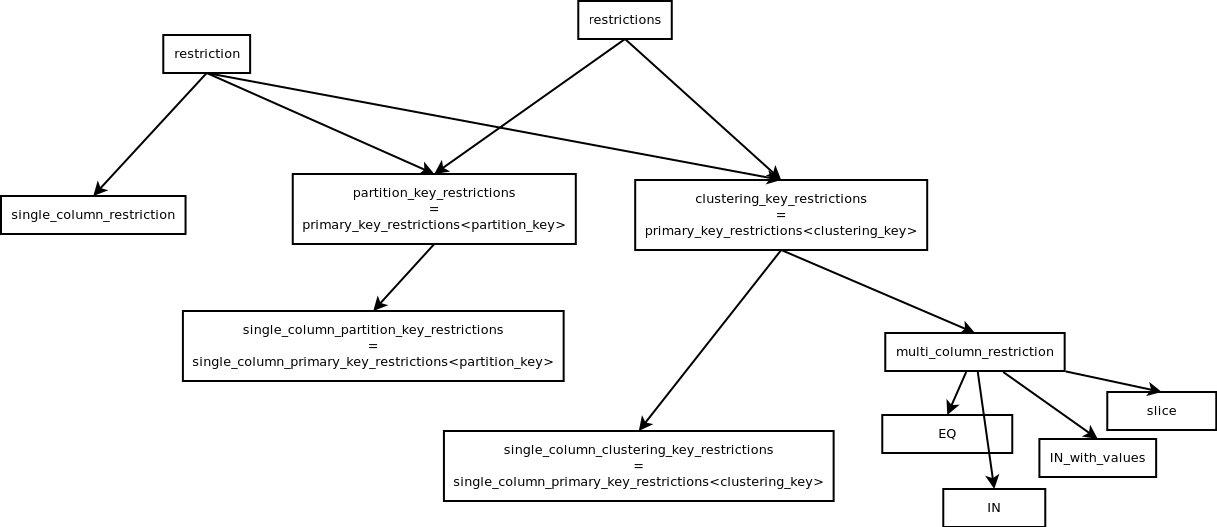
For now this is marked as a draft.
I just put all this together in a readable way and wanted to put it out for you to see.
I will have another look at the code and maybe do some improvements.
Closes#10910
* github.com:scylladb/scylla:
cql3: Remove _new from _new_partition_key_restrictions
cql3: Remove _partition_key_restrictions from statement_restrictions
cql3: Use expression for index restrictions
cql3: expr: Add contains_multi_column_restriction
cql3: Add expr::value_for
cql3: Use the new restrictions map in another place
cql3: use the new map in get_single_column_partition_key_restrictions
cql3: Keep single column restrictions map inside statement restrictions
cql3: Use expression instead of _partition_key_restrictions in the remaining code
cql3: Replace partition_key_restrictions->has_supporting_index()
cql3: Replace statement_restrictions->get_column_defs()
cql3: Replace partition_key_restrictions->needs_filtering()
cql3: Replace partition_key_restrictions->size()
cql3: Replace partition_key_restrictions->is_all_eq()
cql3: Replace parition_key_restriction->has_unrestricted_components()
cql3: Replace parition_key_restrictions->empty()
cql3: Keep restrictions as expressions inside statement_restrictions
cql3: Handle single value INs inside prepare_binary_operator
cql3: Add get_columns_in_commons
cql3: expr: Add is_empty_restriction
cql3: Replicate column sorting functionality using expressions
cql3: Remove single_column_restriction class
cql3: Replace uses of single_column_restriction with restriction
cql3: expr: Add get_the_only_column
cql3: expr: Add is_single_column_restriction
cql3: expr: Add for_each_expression
cql3: Remove some unsued methods
_new_partition_key_restrictions was a temporary name
used during the transition from restrictions to expressions.
Now that restrictions aren't used anymore it can be changed
back to _partition_key_restrictions.
Signed-off-by: Jan Ciolek <jan.ciolek@scylladb.com>
Now that all functionality of partition_key_restrictions
has been implemented using expressions we can remove
this field from statement_restrictions.
_new_partition_key_restrictions will be used for
everything instead.
Signed-off-by: Jan Ciolek <jan.ciolek@scylladb.com>
Restrictions that might be used by an index
are currently being kept as shared_ptr<restrictions>.
This stand in the way of replacing _parition_key_restrictions
with an expression as an expression can't be cast to
shared_ptr<restriction>.
Change shared_ptr<restriction> to expression everywhere
where necessary in index operations.
Signed-off-by: Jan Ciolek <jan.ciolek@scylladb.com>
value_for is a method from the restriction class
which finds the value for a given column.
Under the hood it makes use of possible_lhs_values.
It will be needed to implement some functionality
that was implemented using restrictions before.
Signed-off-by: Jan Ciolek <jan.ciolek@scylladb.com>
Some parts of the code make use of a map keeping single column restrictions
for each partition key column. One of this places is inside do_filter,
so it could be a performance problem to create such a map from scratch
each time.
After adding all restrictions from the where clause the new
map is created and can be used for various purposes.
Signed-off-by: Jan Ciolek <jan.ciolek@scylladb.com>
There are still some places that use partition_key_restrictions
instead of _new_partition_key_restrictions in statement_restrictions.
Change them to use the new representation
Signed-off-by: Jan Ciolek <jan.ciolek@scylladb.com>
To remove partition_key_restrictions all of its
methods have to be implemented using the new expression
representation.
The first to go is empty() as it's easy to implement.
Signed-off-by: Jan Ciolek <jan.ciolek@scylladb.com>
Currently restrictions on partition, clustering and nonprimary columns
are kept inside special purpose restriction objects.
We want to remove all the restrictions classes so these objects
will be removed as well.
In the future each of these restrictions will be kept in
an expression.
Add new fields to statement_restrictions class which
will keep the right restrictions.
Currently restrictions from where clause are
added one by one using merge_to method of
the restrictions class.
This functionality will be replaced by statement_restrictions::add_restriction.
Functions for adding restrictions perform validation and
add new restrictions to the right field inside the class.
The checks that are done in add_*_restriction methods
correspond to the checks performed by merge_to
in respective restriction classes.
Signed-off-by: Jan Ciolek <jan.ciolek@scylladb.com>
Currently expr::to_restriction is the only place where
prepare_binary_operator is called.
In case of a single-value IN restriction like:
mycol IN (1)
this expression is converted to
mycol = 1
by expr::to_restriction.
Once restriction is removed expr::to_restriction
will be removed as well so its functionality has to
be moved somewhere else.
Move handling single value INs inside
prepare_binary_operator.
Signed-off-by: Jan Ciolek <jan.ciolek@scylladb.com>
Add a function that finds common columns
between two expressions.
It's used in error messages in the original
restrictions code so it must be included
in the new code as well for compatibility.
Signed-off-by: Jan Ciolek <jan.ciolek@scylladb.com>
Restrictions code keeps restrictions for each column
in a map sorted by their position in the schema.
Then there are methods that allow to access
the restricted column in the correct order.
To replicate this in upcoming code
we need functions that implement this functionality.
The original comparator can be found in:
cql3/restrictions/single_column_restrictions.hh
For primary key columns this comparator compares their
positions in the schema.
For non-primary columns the position is assumed to
be clustering_key_size(), which seems pretty random.
To avoid passing the schema to the comparator
for nonprimary columns I just assume the
position is u32::max(). This seems to be
as good of a choice as clustering_key_size().
Orignally Cassandra used -1:
bc8a260471/src/java/org/apache/cassandra/config/ColumnDefinition.java (L79-L86)
We never end up comparing columns of different kind using this comparator anyway.
Signed-off-by: Jan Ciolek <jan.ciolek@scylladb.com>
Now that all uses of this class have been
replaced by the generic restriction
the class is not used anywhere and can be removed.
Signed-off-by: Jan Ciolek <jan.ciolek@scylladb.com>
single_column_restriction is a class used to represent
restrictions in a single column.
The class is very simple - it's basically an expression
with some additional information.
As a step towards removing all restriction classes
all uses of this class are replaced by uses of
the generic restriction class.
All functionality of this class has been implemented
using free standing functions operating on expressions.
Signed-off-by: Jan Ciolek <jan.ciolek@scylladb.com>
Add a function that gets the only column
from a single column restriction expression.
The code would be very similiar to
is_single_column_restriction, so a new
function is introducted to reduce duplication.
Signed-off-by: Jan Ciolek <jan.ciolek@scylladb.com>
Add a function that checks whether an expression
contains restrictions on exactly one column.
This a "single_column_restriction"
in the same way that instances of
"class single_column_restriction" are.
It will be used later to distinguish cases
later once this class is removed
Signed-off-by: Jan Ciolek <jan.ciolek@scylladb.com>
To call a UDF that is using WASI, we need to properly
configure the wasmtime instance that it will be called
on. The configuration was missing from udf_cache::load(),
so we add it here.
The free function does not return any value, so we should use
a calling method that does not expect any returns.
This patch adds such a method and uses it.
A test that did not pass without this fix and does pass after
is added.
Signed-off-by: Wojciech Mitros <wojciech.mitros@scylladb.com>
Closes#10935
cookie only when reading CQL tables' from Botond Dénes
Recently, we added full position-in-partition support to alternator's
paging cookie, so it can support stopping at arbitrary positions. This
support however is only really needed when tables have range tombstones
and alternator tables never have them. So to avoid having to make the
new fields in 'ExclusiveStartKey' reserved, we avoid filling these in
when reading an alternator table, as in this case it is safe to assume
the position is `after_key($clustring_key)`. We do include these new
members however when reading CQL tables through alternator. As this is
only supported for system tables, we can also be sure that the elaborate
names we used for these fields are enough to avoid naming clashes.
Fixes: https://github.com/scylladb/scylla/issues/10903Closes#10920
* github.com:scylladb/scylla:
alternator: use position-in-partition in paging cookie only when reading CQL tables
alternator: make is_alternator_keyspace() a standalone method
test/scylla-gdb tests Scylla's gdb debugging tools, and cannot work if
Scylla was compiled without debug information (i.e, the "dev" build mode).
In the past, test/scylla-gdb/run detected this case and printed a clear error:
Scylla executable was compiled without debugging information (-g)
so cannot be used to test gdb. Please set SCYLLA environment variable.
Unfortunately, since recently this detection fails, because even when
Scylla is compiled without debug information we link into it a library
(libwasmtime.a) which has *some* debug information. As a result, instead
of one clear error message, we get all scylla-gdb tests running -
and each of them failing separately. This is ugly and unhelpful.
Each of the tests fail because our "gdb" test fixture tries to load
scylla-gdb.py and fails when the symbols it needs (e.g., "size_t")
cannot be found. So in this patch, we check once for the existance
of this symbol - and if missing we exit pytest instead of failing each
individual test.
Moreover, if loading scylla-gdb.py fails for some other unexpected
reason, let's exit the test as well, instead of failing each individual
test.
Fixes#10863.
Signed-off-by: Nadav Har'El <nyh@scylladb.com>
Closes#10937
Closes#10930
* github.com:scylladb/scylla:
test: perf_row_cache_update: Flush std output after each line
test: perf_row_cache_update: Drain background cleaner before starting the test
test: perf_row_cache_update: Measure memtable filling time
test: perf_row_cache_update: Respect preemption when applying mutations
test: perf_row_cache_update: Drop unused pk variable
Recently, we added full position-in-partition support to alternator's
paging cookie, so it can support stopping at arbitrary positions. This
support however is only really needed when tables have range tombstones
and alternator tables never have them. So to avoid having to make the
new fields in 'ExclusiveStartKey' reserved, we avoid filling these in
when reading an alternator table, as in this case it is safe to assume
the position is `after_key($clustring_key)`. We do include these new
members however when reading CQL tables through alternator. As this is
only supported for system tables, we can also be sure that the elaborate
names we used for these fields are enough to avoid naming clashes.
The condition in the code implementing this is actually even more
general: it only includes the region/weight members when the position
differs from that of a normal alternator one.
for_each_expression is a function that
can be used to iterate over all expressions
inside an expression recursively and perform
some operation on each of them.
For example:
for_each_expression<column_vaue>(e, [](const column_value& cval) {std::cout << cval << '\n';});
Will print all column values in an expression
It's awkward to do this using recurse_until or find_in_expression
because these functions are meant for slightly different purposes.
Having a dedicated function for this purpose will make the code
cleaner and easier to understand.
Signed-off-by: Jan Ciolek <jan.ciolek@scylladb.com>
The option is used, but is not implemented. If attaching implementation
to it right a once the compaction will slow down to 16MB/s on all nodes.
Make it zero (unbound) by default and mard live-updateable while at it.
Signed-off-by: Pavel Emelyanov <xemul@scylladb.com>
Before this patch, the test cql-pytest/test_tools.py left behind
a temporary file in /tmp. It used pytest's "tmp_path_factory" feature,
but it doesn't remove temporary files it creates.
This patch removes the temporary file when the fixture using it ends,
but moreover, it puts the temporary file not in /tmp but rather next
to Scylla's data directory. That directory will be eventually removed
entirely, so even if we accidentally leave a file there, it will
eventually be deleted.
Fixes#10924
Signed-off-by: Nadav Har'El <nyh@scylladb.com>
Closes#10929
There is a bug introduced in e74c3c8 (4.6.0) which makes memtable
reader skip one a range tombstone for a certain pattern of deletions
and under certain sequence of events.
_rt_stream contains the result of deoverlapping range tombstones which
had the same position, which were sipped from all the versions. The
result of deoverlapping may produce a range tombstone which starts
later, at the same position as a more recent tombstone which has not
been sipped from the partition version yet. If we consume the old
range tombstone from _rt_stream and then refresh the iterators, the
refresh will skip over the newer tombstone.
The fix is to drop the logic which drains _rt_stream so that
_rt_stream is always merged with partition versions.
For the problem to trigger, there have to be multiple MVCC versions
(at least 2) which contain deletions of the following form:
[a, c] @ t0
[a, b) @ t1, [b, d] @ t2
c > b
The proper sequence for such versions is (assuming d > c):
[a, b) @ t1,
[b, d] @ t2
Due to the bug, the reader will produce:
[a, b) @ t1,
[b, c] @ t0
The reader also needs to be preempted right before processing [b, d] @
t2 and iterators need to get invalidated so that
lsa_partition_reader::do_refresh_state() is called and it skips over
[b, d] @ t2. Otherwise, the reader will emit [b, d] @ t2 later. If it
does emit the proper range tombstone, it's possible that it will violate
fragment order in the stream if _rt_stream accumulated remainders
(possible with 3 MVCC versions).
The problem goes away once MVCC versions merge.
Fixes#10913Fixes#10830Closes#10914
The commits here were extracted from PR https://github.com/scylladb/scylla/pull/10835 which implements upgrade procedure for Raft group 0.
They are mostly refactors which don't affect the behavior of the system, except one: the commit 4d439a16b3 causes all schema changes to be bounced to shard 0. Previously, they would only be bounced when the local Raft feature was enabled. I do that because:
1. eventually, we want this to be the default behavior
2. in the upgrade PR I remove the `is_raft_enabled()` function - the function was basically created with the mindset "Raft is either enabled or not" - which was right when we didn't support upgrade, but will be incorrect when we introduce intermediate states (when we upgrade from non-raft-based to raft-based operations); the upgrade PR introduces another mechanism to dispatch based on the upgrade state, but for the case of bouncing to shard 0, dispatching is simply not necessary.
Closes#10864
* github.com:scylladb/scylla:
service/raft: raft_group_registry: add assertions when fetching servers for groups
service/raft: raft_group_registry: remove `_raft_support_listener`
service/raft: raft_group0: log adding/removing servers to/from group 0 RPC map
service/raft: raft_group0: move group 0 RPC handlers from `storage_service`
service/raft: messaging: extract raft_addr/inet_addr conversion functions
service: storage_service: initialize `raft_group0` in `main` and pass a reference to `join_cluster`
treewide: remove unnecessary `migration_manager::is_raft_enabled()` calls
test/boost: memtable_test: perform schema operations on shard 0
test/boost: cdc_test: remove test_cdc_across_shards
message: rename `send_message_abortable` to `send_message_cancellable`
message: change parameter order in `send_message_oneway_timeout`
There effectively are several test-cases in this test, each calls the
scylla_sstable() to prepare, thus each creates a type in the same scylla
instance. The 2nd attempt ends up with the "already exists" error:
E cassandra.InvalidRequest: Error from server: code=2200 [Invalid query] message="A user type of name cql_test_1656396925652.type1 already exists"
tests: unit(dev)
https://jenkins.scylladb.com/job/releng/job/Scylla-CI/1075/fixes: #10872
Signed-off-by: Pavel Emelyanov <xemul@scylladb.com>
Message-Id: <20220628081459.12791-1-xemul@scylladb.com>
A number of improvements in test.py as requested by maintainers:
* don't capture pytest output
* stick to the specific server in control connections
* support --log-level option and pass it to logging module
* when checking if CQL is up, ignore timeout errors
* no longer force schema migration when starting the server
* use test uname, not id, in log output
* improve logging of ScyllaServer
* log what cluster is used for a test
* extend xml output with logs
On the same token, remove mypy warnings and make linter pass on test.py, as well as add some type checking.
Fixes#10871Fixes#10785Closes#10902
* github.com:scylladb/scylla:
test.py: extend xml output with logs
test.py: log what cluster is used for a test
test.py: improve logging of ScyllaServer
test.py: use test uname, not id, in log output
test.py: support --log-level option and pass it to logging module
test.py: make ScyllaServer more reliable and fast
test.py: don't capture pytest output
test.py: add type annotations
test.py: convert log_filename to pathlib
test.py: please linter
test.py: remove mypy warnings
Currently, for users who have permissions_cache configs set to very high
values (and thus can't wait for the configured times to pass) having to restart
the service every time they make a change related to permissions or
prepared_statements cache (e.g. Adding a user and changing their permissions)
can become pretty annoying.
This patch series make permissions_validity_in_ms, permissions_update_interval_in_ms
and permissions_cache_max_entries live updateable so that restarting the
service is not necessary anymore for these cases.
It also adds an API for flushing the cache to make it easier for users who
don't want to modify their permissions_cache config.
branch: https://github.com/igorribeiroduarte/scylla/tree/make_permissions_cache_live_updateable
CI: https://jenkins.scylladb.com/job/releng/job/Scylla-CI/1005/
dtests: https://github.com/igorribeiroduarte/scylla-dtest/tree/test_permissions_cache
* https://github.com/igorribeiroduarte/scylla/make_permissions_cache_live_updateable:
loading_cache_test: Test loading_cache::reset and loading_cache::update_config
api: Add API for resetting authorization cache
authorization_cache: Make permissions cache and authorized prepared statements cache live updateable
auth_prep_statements_cache: Make aut_prep_statements_cache accept a config struct
utils/loading_cache.hh: Add update_config method
utils/loading_cache.hh: Rename permissions_cache_config to loading_cache_config and move it to loading_cache.hh
utils/loading_cache.hh: Add reset method
Track the background restore_replica_count fiber
so it be awaited on in stop() by closing the
_async_gate.
Fixes#10672
Signed-off-by: Benny Halevy <bhalevy@scylladb.com>
Validate that the size of the cache is zero after calling the
reset method and that the config is being updated correctly
after calling update_config.
Signed-off-by: Igor Ribeiro Barbosa Duarte <igor.duarte@scylladb.com>
For cases where we have very high values set to permissions_cache validity and
update interval (E.g.: 1 day), whenever a change to permissions is made it's
necessary to update scylla config and decrease these values, since waiting for
all this time to pass wouldn't be viable.
This patch adds an API for resetting the authorization cache so that changing
the config won't be mandatory for these cases.
Usage:
$ curl -X POST http://localhost:10000/authorization_cache/reset
Signed-off-by: Igor Ribeiro Barbosa Duarte <igor.duarte@scylladb.com>
Currently, for users who have permissions_cache configs set to very high
values (and thus can't wait for the configured times to pass) having to restart
the service every time they make a change related to permissions or
prepared_statements cache(e.g.: Adding a user) can become pretty annoying.
This patch make permissions_validity_in_ms, permissions_update_interval_in_ms
and permissions_cache_max_entries live updateable so that restarting the
service is not necessary anymore for these cases.
Signed-off-by: Igor Ribeiro Barbosa Duarte <igor.duarte@scylladb.com>
This patch makes authorized_prepared_statements_cache acccept a config struct,
similarly to permissions_cache. This will make it easier to make this cache
live updateable on the next patch.
Signed-off-by: Igor Ribeiro Barbosa Duarte <igor.duarte@scylladb.com>
This patch adds an update_config method in order to allow live updating the
config for permissions_cache. This method is going to be used in the next
patches after making permissions_cache config live updateable.
Signed-off-by: Igor Ribeiro Barbosa Duarte <igor.duarte@scylladb.com>
This patch renames the permissions_cache_config struct to loading_cache_config
and moves it to utils/loading_cache.hh. This will make it easier to handle
config updates to the authorization caches on the next patches
Signed-off-by: Igor Ribeiro Barbosa Duarte <igor.duarte@scylladb.com>
Change tests to use async mode and add helpers and tests for schema changes.
These test series will be expanded with topology changes.
Closes#10550
* github.com:scylladb/scylla:
test.py topology: repro for issue #1207
test.py: port fixture fails_without_raft
test.py topology: table methods to add/remove index
test.py topology: add/drop table column helpers
test.py topology: insert sequential row
test.py: remove deprecated test test_null
test.py: managed random tables
test.py: test_keyspace fixture async
test.py: rename fixture test_keyspace to keyspace
test.py topology: test with asyncio
This PR adds necessary modifications to perf_simple_query so that it can be used to test performance of the timeout handling path. With an appropriate combination of flags, it is possible to consistently trigger timeouts on every operation.
The following flags are added:
- `--stop-on-error` - if true (which is the default), the test stops after encountering the first exception and reports it; otherwise it causes errors to be counted and reported at the end.
- `--timeout <x>` - allows to use `USE TIMEOUT <x>` in the benchmark query/statement.
- `--bypass-cache` - uses `BYPASS CACHE` in the benchmark query (relevant only to reads).
Examples:
```
./build/release/test/perf/perf_simple_query --smp=1 --operations-per-shard=1000000 --write
131023.65 tps ( 56.2 allocs/op, 13.2 tasks/op, 49784 insns/op, 0 errors)
./build/release/test/perf/perf_simple_query --smp=1 --operations-per-shard=1000000 --write --stop-on-error=false --timeout=0s
97163.73 tps ( 53.1 allocs/op, 5.1 tasks/op, 78687 insns/op, 1000000 errors)
./build/release/test/perf/perf_simple_query --smp=1 --operations-per-shard=1000000
154060.36 tps ( 63.1 allocs/op, 12.1 tasks/op, 42998 insns/op, 0 errors)
./build/release/test/perf/perf_simple_query --smp=1 --operations-per-shard=1000000 --stop-on-error=false --flush --bypass-cache --timeout=0s
30127.43 tps ( 48.2 allocs/op, 14.3 tasks/op, 312416 insns/op, 1000000 errors)
```
Refs: #2363Closes#10899
* github.com:scylladb/scylla:
test: perf: add bypass cache argument
test: perf: add timeout argument
test: perf: count errors and report the count in results
test: perf: add stop-on-error argument
test: perf: coroutinize run_worker()
test: perf: fix crash on exception in time_parallel_ex
This fixes a quadratic behavior in case lots of snapshots with range
tombstones are queued for merging. Before the change, new snapshots
were inserted at the front, which is also where the worker looks
at. Merging a version has a linear component in complexity function
which depends on the number of range tombstones. If we merge snapshots
starting from the latest to oldest then the whole process becomes
quadratic because the version which is merged accumulates an
increasing amont of tombstones, ones which were already merged
before. We should instead merge starting from the oldest snapshots,
this way each tombstone is applied exactly once during merge.
This bug got wose after 4bd4aa2e88,
which makes merging tombstones more expensive.
Closes#10916
When the run scripts for tests of cql-pytest, alternator, redis, etc.,
run Scylla, they should set the UBSAN_OPTIONS and ASAN_OPTIONS so that
if the executable is built with sanitizers enabled, it will ignore false
positives that we know about, and fail on real errors.
The change in this patch affects all test/*/run scripts which use the
this shared Scylla-starting code. test.py already had the same settings,
and it affected the tests that it knows to run directly (unit tests,
cql-pytest, etc.).
Fixes#10904
Signed-off-by: Nadav Har'El <nyh@scylladb.com>
Closes#10915
Add test and server logs, as well as the unidiff, to
XML output. This makes jenkins reports nicer.
While on it, debug & fix bugs in handling of flaky tests:
- the reset would reset a flaky test even after the last attempt
fails, so it would be impossible to see what happened to it
- the args needed to be reset as well, since execution modifies
them
- we would say that we're going to retry the flaky test when in
fact it was the last attempt to run it and no more retries were
planned
1) Stick to the specific server in control connections.
It could happen that, when starting a cluster and checking
if a specific node is up, the check would actually execute
against an already running node. Prevent this from happening
by setting a white list connection balancing policy for control
connections.
2) When checking if CQL is up, ignore timeout errors
Scylla in debug mode can easily time out on a DDL query,
and the timeout error at start up would lead to the entire cluster
marked as broken. This is too harsh, allow timeouts at start.
3) No longer force schema migration when starting the server
By default, Raft is on, so the nodes are getting schema
through Raft leader. Schema migration significantly slows
down cluster start in debug mode (60 seconds -> 100 seconds),
and even though it was a great test that helped discover
several bugs in Scylla, it shouldn't be part of normal
cluster boot, so disable it.
Repro for bug in concurrent schema changes for many tables and indexing
involved.
Do alter tables by doing in parallel new table creation, alter a table
(_alter), and index other tables (_index).
Original repro had sets of 20 of those and slept for 20 seconds to
settle. This repro does it for Scylla with just 1 set and 1 second.
This issue goes away once Raft is enabled.
https://github.com/scylladb/scylla/issues/1207
Originally at https://issues.apache.org/jira/browse/CASSANDRA-10250
Signed-off-by: Alejo Sanchez <alejo.sanchez@scylladb.com>
Port fails_without_raft to higher level conftest file for future use in
topology pytests.
While there, make it async.
Signed-off-by: Alejo Sanchez <alejo.sanchez@scylladb.com>
For each table keep a counter and insert rows with sequential values
generated correspondingly by each column's type.
Signed-off-by: Alejo Sanchez <alejo.sanchez@scylladb.com>
Helpers to create keyspace and manange randomized tables.
Fixture drops all created tables still active after the test finishes.
Includes helper methods to verify schema consistency.
These helpers will be used in Raft schema changes tests coming later.
Signed-off-by: Alejo Sanchez <alejo.sanchez@scylladb.com>
Run test async using a wrapper for Cassandra python driver's future.
The wrapper was suggested by a user and brought forward by @fruch.
It's based on https://stackoverflow.com/a/49351069 .
Redefine pytest event_loop fixture to avoid issues with fixtures with
scope bigger than function (like keyspace).
See https://github.com/pytest-dev/pytest-asyncio/issues/68
Convert sample test_null to async. More useful test cases will come
afterwards.
Signed-off-by: Alejo Sanchez <alejo.sanchez@scylladb.com>
They are removed because they are not used anywhere
and they contain code that would have to be modified
in the following commits.
Signed-off-by: Jan Ciolek <jan.ciolek@scylladb.com>
- Use `sstables::generation_type` in more places
- Enforce conceptual separation of `sstables::generation_type` and `int64_t`
- Fix `extremum_tracker` so that `sstables::generation_type` can be non-default-constructible
Fixes#10796.
Closes#10844
* github.com:scylladb/scylla:
sstables: make generation_type an actual separate type
sstables: use generation_type more soundly
extremum_tracker: do not require default-constructible value types
Fixes#9367
The CL counters pending_allocations and requests_blocked_memory are
exposed in graphana (etc) and often referred to as metrics on whether
we are blocking on commit log. But they don't really show this, as
they only measure whether or not we are blocked on the memory bandwidth
semaphore that provides rate back pressure (fixed num bytes/s - sortof).
However, actual tasks in allocation or segment wait is not exposed, so
if we are blocked on disk IO or waiting for segments to become available,
we have no visible metrics.
While the "old" counters certainly are valid, I have yet to ever see them
be non-zero in modern life.
Closes#9368
Currently in docs/alternator/compatibility.md experimental features
and unimplemented features are bunched together under one heading
("unimplemented features"). In this patch we separate them into two
sections. This makes the "unimplemented features" section shorter,
and also allows us to link to the new "experimental features" section
separately.
Signed-off-by: Nadav Har'El <nyh@scylladb.com>
Closes#10893
A scan over range tombstones will ignore preemption, which may cause
reactor stalls or read failure due to std::bad_alloc.
This is a regression introduced in
5e97fb9fc4. _lower_bound_changed was
always set to false, which is later checked at preemption point and
inhibits yielding.
Closes#10900
Adds the "--timeout" argument which allows specifying a timeout used in
all operations. It works by inserting "USING <timeout>" in appropriate
place in the query.
The flag is most useful when set to zero - with an appropriate
combination of other flags (flush, bypass cache) it guarantees that each
operation will time out and performance of the timeout handling logic
can be measured.
Adds the "--stop-on-error" argument to perf_simple_query. When enabled
(and it is enabled by default), the benchmark will propagate exceptions
if any occur in the tested function. Otherwise, errors will be ignored.
Converts the executor::run_worker() method to a coroutine. This will
allow extending the function in further commits without having to
allocate continuations.
The `time_parallel_ex` function creates a sharded<executor> and uses it
to run the benchmark on multiple shards in parallel. However, if the
benchmarking function throws an exception, the sharded<executor> will be
destroyed without being stopped, which triggers an assertion in
sharded<T> destructor.
This commit makes sure that the executor is stopped before being
destroyed by putting `exec.stop()` into a `seastar::defer`.
* seastar ff46af9ae0...9c016aeebf (8):
> Merge "Handle overflow in token bucket replenisher" from Pavel E
Fixes#10743Fixes#10846
> abort_source: request_abort: restore legacy no-args method
> configure.py: do not use distutils
> configure.py: drop unused "import sys"
> Revert "Use recv syscall instead of read in do_read_some()"
> Use recv syscall instead of read in do_read_some()
> Merge 'Add initial support for websocket protocol' from Andrzej Stalke
> Merge 'abort_source: request_abort: allow passing exception to subscribers' from Benny Halevy
Closes#10898
While we're iterating over the fetched keyspace names, some of these
keyspaces may get dropped. Handle that by checking if the keyspace still
exists.
Also, when retrieving the replication strategy from the keyspace, store
the pointer (which is an `lw_shared_ptr`) to the strategy to keep it
alive, in case the keyspace that was holding it gets dropped.
Closes#10861
Consider this:
- User starts a repair job with http api
- User aborts all repair
- The repair_info object for the repair job is created
- The repair job is not aborted
In this patch, the repair uuid is recorded before repair_info object is
created, so that repair can now abort repair jobs in the early stage.
Fixes#10384Closes#10428
Otherwise cql_transport::additional_options_for_proto_ext() complains
about inability to format the enum class value
Introduced by efc3953c (transport: add rate_limit_error)
Fmt version 8.1.1-5.fc35, fresher one must have it out of the box
Fixes#10884
Signed-off-by: Pavel Emelyanov <xemul@scylladb.com>
Message-Id: <20220627052703.32024-1-xemul@scylladb.com>
Currently, we use the last row in the query result set as the position where the query is continued from on the next page. Since only live rows make it into query result set, this mandates the query to be stopped on a live row on the replica, lest any dead rows or tombstones processed after the live rows, would have to be re-processed on the next page (and the saved reader would have to be thrown away due to position mismatch). This requirement of having to stop on a live row is problematic with datasets which have lots of dead rows or tombstones, especially if these form a prefix. In the extreme case, a query can time out before it can process a single live row and the data-set becomes effectively unreadable until compaction gets rid of the tombstones.
This series prepares the way for the solution: it allows the replica to determine what position the query should continue from on the next page. This position can be that of a dead row, if the query stopped on a dead row. For now, the replica supplies the same position that would have been obtained with looking at the last row in the result set, this series merely introduces the infrastructure for transferring a position together with the query result, and it prepares the paging logic to make use of this position. If the coordinator is not prepared for the new field, it will simply fall-back to the old way of looking at the last row in the result set. As I said for now this is still the same as the content of the new field so there is no problem in mixed clusters.
Refs: https://github.com/scylladb/scylla/issues/3672
Refs: https://github.com/scylladb/scylla/issues/7689
Refs: https://github.com/scylladb/scylla/issues/7933
Tests: manual upgrade test.
I wrote a data set with:
```
./scylla-bench -mode=write -workload=sequential -replication-factor=3 -nodes 127.0.0.1,127.0.0.2,127.0.0.3 -clustering-row-count=10000 -clustering-row-size=8096 -partition-count=1000
```
This creates large, 80MB partitions, which should fill many pages if read in full. Then I started a read workload:
```
./scylla-bench -mode=read -workload=uniform -replication-factor=3 -nodes 127.0.0.1,127.0.0.2,127.0.0.3 -clustering-row-count=10000 -duration=10m -rows-per-request=9000 -page-size=100
```
I confirmed that paging is happening as expected, then upgraded the nodes one-by-one to this PR (while the read-load was ongoing). I observed no read errors or any other errors in the logs.
Closes#10829
* github.com:scylladb/scylla:
query: have replica provide the last position
idl/query: add last_position to query_result
mutlishard_mutation_query: propagate compaction state to result builder
multishard_mutation_query: defer creating result builder until needed
querier: use full_position instead of ad-hoc struct
querier: rely on compactor for position tracking
mutation_compactor: add current_full_position() convenience accessor
mutation_compactor: s/_last_clustering_pos/_last_pos/
mutation_compactor: add state accessor to compact_mutation
introduce full_position
idl: move position_in_partition into own header
service/paging: use position_in_partition instead of clustering_key for last row
alternator/serialization: extract value object parsing logic
service/pagers/query_pagers.cc: fix indentation
position_in_partition: add to_string(partition_region) and parse_partition_region()
mutation_fragment.hh: move operator<<(partition_region) to position_in_partition.hh
Change 8f39547d89 added
`handle_exception_type([] (const semaphore_aborted& e) {})`,
but it turned out that `named_semaphore_aborted` isn't
derived from `semaphore_aborted`, but rather from
`abort_requested_exception` so handle the base exception
instead.
Fixes#10666
Signed-off-by: Benny Halevy <bhalevy@scylladb.com>
Closes#10881
As reported in #10867, newer versions of the fmt library
format %Y using 4-characters width, 0-padding the prefix
when needed, while older versions don't do that.
This change moves away from using %Y and friends
fmt specifiers to using explicit numeric-based formatting
conforming to ISO 8601 and making sure the year field
has at least 4 digits and is zero padded. When
negative, the width is upped to 5 so it would show as -0001
rather than -001.
The unit test was updated respectively.
Fixes#10867
Signed-off-by: Benny Halevy <bhalevy@scylladb.com>
Closes#10870
Currently, the `_reader` member is explicitly
initialized with the result of the call to `make_reader`.
And `make_reader`, as a side effect, assigns a value
to the `_reader_handle` member.
Since C++ initializes class members sequentially,
in the order they are defined, the assignment to `_reader_handle`
in `make_reader()` happens before `_reader_handle` is initialized.
This patch fixes that by changing the definition order,
and consequently, the member initialization order
in the constructor so that `_reader_handle` will be (default-)initialized
before the call to `make_reader()`, avoiding the undefined behavior.
Fixes#10882
Signed-off-by: Benny Halevy <bhalevy@scylladb.com>
Closes#10883
The API uses the http server to serve two directories: the api_ui_dir
where the swagger-ui directory is found and the api_doc_dir where the
swagger definition files are found.
Internally, the API uses the httpd::directory_handler that append the
files it gets from the path to the base directory name.
A user can override the default configuration and set a directory name
that will not end with a backslash. This will result with files not
found.
This patch check if that backslash is missing, and if it is, adds it to
the API configuration.
Fixes#10700
Signed-off-by: Amnon Heiman <amnon@scylladb.com>
Closes#10877
Evaluating Python code from within gdb is priceless,
especially that all helper classes and functions sourced from
scylla-gdb.py can be used in there. This commit adds a paragraph
in debugging.md mentioning this tool.
Closes#10869
Static columns are not currently allowed in a materialized view. If the
base table has a static column and one tries to create a view with a
"SELECT *", the following error message is printed today:
Unable to include static column 'ColumnDefinition{name=s,
type=org.apache.cassandra.db.marshal.Int32Type, kind=STATIC,
componentIndex=null, droppedAt=-9223372036854775808}' which would
be included by Materialized View SELECT * statement
It is completely unnecessary to include all these details about the
column definition - just its name would have sufficed. In other words,
we should print def.name_as_text(), not the entire def. This is what
other error messages in the same file do as well.
After this patch the error message becomes nicer and clearer:
Unable to include static column 's' which would be included by
Materialized View SELECT * statement
Signed-off-by: Nadav Har'El <nyh@scylladb.com>
Closes#10854
This series decouples the staging sstables from the table's sstable set.
The current behavior keeps the sstables in the staging directory until view building is done. They are readable as any other sstable, but fenced off from compaction, so they don't go away in the meanwhile.
Currently, when views are built, the sstables are moved into the main table directory where they will then be compacted normally.
The problem with this design is that the staging sstables are never compacted, in particular they won't get cleaned up or scrubbed.
The cleanup scenario open a backdoor for data resurrection when the staging sstables are moved after view building while possibly containing stale partitions (#9559) which will not be cleaned up until next time cleanup compaction is performed.
With this series, SSTables that are created in or moved to the staging sub-directory are "cloned" into the base table directory by hard-linking the components there and creating a new sstable object which loads the cloned files.
The former, in the staging directory is used solely for view building and is not added to the table's sstable set, while the latter, its clone, behaves like any other sstable and is added either to the regular or maintenance set and is read and compacted normally.
When view building is done, instead of moving the staging sstable into the table's base directory, it is simply unlinked.
If its "clone" wasn't compacted away yet, then it will just remain where it is, exactly like it would be after it was moved there in the present state of things. If it was already compacted and no longer exists, then unlinking will then free its storage.
Note that snapshot is based on the sstables listed by the table, which do not include the staging sstables with this change.
But that shouldn't matter since even today, the sstables in the snapshot has no notion of "staging" directory and it is expected that the MV's are either updated view `nodetool refresh` if restoring sstables from snapshot using the uploads dir, or if restoring the whole table from backup - MV's are effectively expected to be rebuilt from scratch (they are not included in automatic snapshots anyway since we don't have snapshot-coherency across tables).
A fundamental infrastructure change was done to achieve that which is to change the sstable_list which was a std::unordered_set<shared_sstable> into a std::unordered_map<generation_type, shared_sstable> that keeps the shared_sstable objects indexed by generation number (that must be unique). With this model, sstables are supposed to be searched by the generation number, not by their pointer, since when the staging sstable is clones, there will be 2 shared_sstable objects with the same generation (and different `dir()`) and we must distinguish between them.
Special care was taken to throw a runtime_error exception if when looking up a shared sstable and finding another one with the same generation, since they must never exist in the same sstable_map.
Fixes#9559Closes#10657
* github.com:scylladb/scylla:
table: clone staging sstables into table dir
view_update_generator: discover_staging_sstables: reindent
table: add get_staging_sstables
view_update_generator: discover_staging_sstables: get shared table ptr earlier
distributed_loader: populate table directory first
sstables: time_series_sstable_set: insert: make exception safe
sstables: move_to_new_dir: fix debug log message
This series moves the logic to not perform off-strategy compaction if the maintenance set is empty from the table layer down to the compaction_manager layer since it is the one that needs to make the decision.
With that compaction_manager::perform_offstrategy will return a future<bool> which resolves to true
iff off-strategy compaction was required and performed.
The sstable_compaction_test was adjusted and a new compaction_manager_for_testing class was added
to make sure the compaction manager is enabled when constructed (it wasn't so test_offstrategy_sstable_compaction didn't perform any off-strategy compactions!) and stopped before destroyed.
Closes#10848
* github.com:scylladb/scylla:
table: perform_offstrategy_compaction: move off-strategy logic to compaction_manager
compaction_manager: offstrategy_compaction_task: refactor log printouts
test: sstable_compaction: compaction_manager_for_testing
Due to its sharded and token-based architecture, Scylla works best when the user workload is more or less uniformly balanced across all nodes and shards. However, a common case when this assumption is broken is the "hot partition" - suddenly, a single partition starts getting a lot more reads and writes in comparison to other partitions. Because the shards owning the partition have only a fraction of the total cluster capacity, this quickly causes latency problems for other partitions within the same shard and vnode.
This PR introduces per-partition rate limiting feature. Now, users can choose to apply per-partition limits to their tables of choice using a schema extension:
```
ALTER TABLE ks.tbl
WITH per_partition_rate_limit = {
'max_writes_per_second': 100,
'max_reads_per_second': 200
};
```
Reads and writes which are detected to go over that quota are rejected to the client using a new RATE_LIMIT_ERROR CQL error code - existing error codes didn't really fit well with the rate limit error, so a new error code is added. This code is implemented as a part of a CQL protocol extension and returned to clients only if they requested the extension - if not, the existing CONFIG_ERROR will be used instead.
Limits are tracked and enforced on the replica side. If a write fails with some replicas reporting rate limit being reached, the rate limit error is propagated to the client. Additionally, the following optimization is implemented: if the coordinator shard/node is also a replica, we account the operation into the rate limit early and return an error in case of exceeding the rate limit before sending any messages to other replicas at all.
The PR covers regular, non-batch writes and single-partition reads. LWT and counters are not covered here.
Results of `perf_simple_query --smp=1 --operations-per-shard=1000000`:
- Write mode:
```
8f690fdd47 (PR base):
129644.11 tps ( 56.2 allocs/op, 13.2 tasks/op, 49785 insns/op)
This PR:
125564.01 tps ( 56.2 allocs/op, 13.2 tasks/op, 49825 insns/op)
```
- Read mode:
```
8f690fdd47 (PR base):
150026.63 tps ( 63.1 allocs/op, 12.1 tasks/op, 42806 insns/op)
This PR:
151043.00 tps ( 63.1 allocs/op, 12.1 tasks/op, 43075 insns/op)
```
Manual upgrade test:
- Start 3 nodes, 4 shards each, Scylla version 8f690fdd47
- Create a keyspace with scylla-bench, RF=3
- Start reading and writing with scylla-bench with CL=QUORUM
- Manually upgrade nodes one by one to the version from this PR
- Upgrade succeeded, apart from a small number of operations which failed when each node was being put down all reads/writes succeeded
- Successfully altered the scylla-bench table to have a read and write limit and those limits were enforced as expected
Fixes: #4703Closes#9810
* github.com:scylladb/scylla:
storage_proxy: metrics for per-partition rate limiting of reads
storage_proxy: metrics for per-partition rate limiting of writes
database: add stats for per partition rate limiting
tests: add per_partition_rate_limit_test
config: add add_per_partition_rate_limit_extension function for testing
cf_prop_defs: guard per-partition rate limit with a feature
query-request: add allow_limit flag
storage_proxy: add allow rate limit flag to get_read_executor
storage_proxy: resultize return type of get_read_executor
storage_proxy: add per partition rate limit info to read RPC
storage_proxy: add per partition rate limit info to query_result_local(_digest)
storage_proxy: add allow rate limit flag to mutate/mutate_result
storage_proxy: add allow rate limit flag to mutate_internal
storage_proxy: add allow rate limit flag to mutate_begin
storage_proxy: choose the right per partition rate limit info in write handler
storage_proxy: resultize return types of write handler creation path
storage_proxy: add per partition rate limit to mutation_holders
storage_proxy: add per partition rate limit info to write RPC
storage_proxy: add per partition rate limit info to mutate_locally
database: apply per-partition rate limiting for reads/writes
database: move and rename: classify_query -> classify_request
schema: add per_partition_rate_limit schema extension
db: add rate_limiter
storage_proxy: propagate rate_limit_exception through read RPC
gms: add TYPED_ERRORS_IN_READ_RPC cluster feature
storage_proxy: pass rate_limit_exception through write RPC
replica: add rate_limit_exception and a simple serialization framework
docs: design doc for per-partition rate limiting
transport: add rate_limit_error
It did nothing.
It will be readded in `raft_group0` and it will do something, stay
tuned.
With this we can remove the `feature_service` reference from
`raft_group_registry`.
`raft_group0` was constructed at the beginning of `join_cluster`, which
required passing references to 3 additional services to `join_cluster`
used only for that purpose (group 0 client, raft group registry, and
query processor).
Now we initialize `raft_group0` in main - like all other services - and
pass a reference to `join_cluster` so `storage_service` can store a
pointer to group 0.
We initialize `raft_group0` before we start listening for RPCs in
`messaging_service`. In a later commit we'll move the initialization
of group 0 related verbs to the constructor of `raft_group0` from
`storage_service`, so they will be initialized before we start
listening for RPCs.
In schema_altering_statement: we will bounce statements to shard 0
whether Raft is enabled or not.
In migration_manager, when we're sending a group 0 snapshot: well, if
we're sending a group 0 snapshot, Raft must be enabled; the check is
redundant.
The test checked if creating a table with CDC enabled on shard other
than 0 would create the CDC log table as well; it was a regression test
for #5582. However we will soon bounce all schema change requests to
shard 0, so the test's purpose is gone.
I need to remove this test because `cquery_nofail` does not handle the
bouncing correctly: it silently accepts the bounce message, assumes that
the query was successful and returns. So after we change the code to
start bouncing all requests to shard 0, if a query was ran inside test
code using `cquery_nofail` on a shard different than 0 it would do
nothing and following queries executed on shard 0 would fail because they
depended on the effect of the aforementioned query.
It's not possible to abort an RPC call entirely, since the remote part
continues running (if the message got out). Calling the provided abort
source does the following:
1. if the message is still in the outgoing queue, drop it,
2. resolve waiter callbacks exceptionally.
Using the word "cancellable" is more appropriate.
Also write a small comment at `send_message_cancellable`.
Make it consistent with the other 'send message' functions.
Simplify code generation logic in idl-compiler.
Interestingly this function is not used anywhere so I didn't have to fix
any call sites.
clone staging sstables so their content may be compacted while
views are built. When done, the hard-linked copy in the staging
subdirectory will be simply unlinked.
Fixes#9559
Signed-off-by: Benny Halevy <bhalevy@scylladb.com>
We don't have to go over all sstables in the table to select the
staging sstables out of them, we can get it directly from the
_sstables_staging map.
Signed-off-by: Benny Halevy <bhalevy@scylladb.com>
It's potentially a bit more efficient since
t.get_sstables is called only once, while
t.shared_from_this() is called per staging sstable.
Also, prepare for the following patches that modify
this function further.
Signed-off-by: Benny Halevy <bhalevy@scylladb.com>
Need to erase the shared sstable from _sstables
if insertion to _sstables_reversed fails.
Fixes#10787
Signed-off-by: Benny Halevy <bhalevy@scylladb.com>
Make it account for all the changes done in the compaction manager
recently. 5.0 is not affected. So does not merit a backport.
(gdb) scylla compaction-tasks
1 type=sstables::compaction_type::Reshard, state=compaction_manager::task::state::active, "keyspace1"."standard1"
Total: 1 instances of compaction_manager::task
Signed-off-by: Raphael S. Carvalho <raphaelsc@scylladb.com>
Message-Id: <20220621225600.20359-1-raphaelsc@scylladb.com>
The command is quite straightforward, but it didn't offer
any documentation when calling `help scylla shard`, so it's
hereby added. As a small bonus, a more comprehensive message
is printed when the argument is not an integer.
Message-Id: <9b958a4befce1c7baa6f86504ab74b93840b37e9.1655984258.git.sarna@scylladb.com>
`scylla thread` command is extended with a non-intrusive
option for dumping saved registers from the jmp_buf structure
in an unmangled form.
It can later be useful, e.g. for peeking into thread's instruction
pointer or reasoning about its stack.
Example debugging session:
(gdb) scylla threads
[shard 1] (seastar::thread_context*) 0x6010000d9e00, stack: 0x601004f00000
[shard 1] (seastar::thread_context*) 0x6010000daf00, stack: 0x601004e00000
(gdb) scylla thread --print-regs 0x6010000d9e00
rbx: 0x601004f1fd00
rbp: 0x601004f1fc20
r12: 0x6010000d9e20
r13: 0x6010002a3190
r14: 0x601004f1fd08
r15: 0x6010000d9e10
rsp: 0x601004f1fbb0
rip: 0x2f0aea6
(gdb) disassemble 0x2f0aea6
Dump of assembler code for function _ZN7seastar12jmp_buf_link10switch_outEv:
0x0000000002f0ae90 <+0>: push %rax
0x0000000002f0ae91 <+1>: mov 0xc8(%rdi),%rax
0x0000000002f0ae98 <+8>: mov %rax,%fs:0xfffffffffffe5dc8
0x0000000002f0aea1 <+17>: call 0x30333d0 <_setjmp@plt>
0x0000000002f0aea6 <+22>: test %eax,%eax
0x0000000002f0aea8 <+24>: je 0x2f0aeac <_ZN7seastar12jmp_buf_link10switch_outEv+28>
0x0000000002f0aeaa <+26>: pop %rax
0x0000000002f0aeab <+27>: ret
0x0000000002f0aeac <+28>: mov %fs:0xfffffffffffe5dc8,%rdi
0x0000000002f0aeb5 <+37>: mov $0x1,%esi
0x0000000002f0aeba <+42>: call 0x30333c0 <longjmp@plt>
End of assembler dump.
Message-Id: <553c1ed76987776916d5261ed13866650e84df34.1655984258.git.sarna@scylladb.com>
In order to cover more code paths, the test case
now places filtering on various combinations of base columns,
including both primary keys and regular columns.
It also makes the test scylla_only, as filtering is an extension
not supported in Cassandra right now.
Closes#10860
Use the recently introduced query-result facility to have the replica
set the position where the query should continue from. For now this is
the same as what the implicit position would have been previously (last
row in result), but it opens up the possibility to stop the query at a
dead row.
To be used to allow the replica to specify the last position in the
stream, where the query was left off. Currently this is always
the same as the implicit position -- the last row in the result-set --
but this requires only stopping the read on a live row, which is a
requirement we want to lift: we want to be able to stop on a tombstone.
As tombstones are not included in the query result, we have to allow the
replica to overwrite the last seen position explicitly.
This patch introduces the new field in the query-result IDL but it is
not written to yet, nor is it read, that is left for the next patches.
Currently the result builder is created two frames above the method in
which actually needed. Push down a factory method instead and create it
where actually used. This allows us to pass it arguments that are
present only in the method which uses it.
A simple struct containing a full position, including a partition key
and a position in partition. Two variants are introduced: an owning
version and a view. This is to replace all the ad-hoc structures
introduced for the same purpose: std::pair() and std::tuple() of
partition key and clustering key, and other similar small structs
scattered around the code.
This patch does not replace any of the above mentioned construcs with
the new full_position, it merely introduces it to enable incremental
standardization.
The former allows for expressing more positions, like a position
before/after a clustering key. This practically enables the coordinator
side paging logic, for a query to be stopped at a tombstone (which can
have said positions).
chunked_vector was headed by short comment which didn't really explain
why it exists and how and why it really differs from std::dequeue.
Moreover, it made the vague claim that it "limits" contiguous
allocations, which it really doesn't (at least not in the asymptotic
sense).
In this patch I wrote a much longer comment, which I hope will clearly
explain exactly what chunked_vector is, how it really differs in its
contiguous allocations from std::deque, and what it guarantees and
doesn't guarantee.
Signed-off-by: Nadav Har'El <nyh@scylladb.com>
Closes#10857
To make scylla setup scripts easier to handle in Ansible, stop deleting
perftune.yaml and detect cpuset.conf changes by mtime of the file.
Also, skip update cpuset.conf when same parameter specified.
Fixes#10121Closes#10312
"
The way dc/rack info is maintained is very intricate.
The dc/rack strings originate at snitch, get propagated via gossiper,
get notified to storage service which, in turn, stores them into the
system keyspace and token metadata. Code that needs to get dc/rack
for a given endpoint calls snitch which tries to get the data from
gossiper and if failed goes and loads it from system keyspace cache.
Also there's "internal IP" thing hanging arond that loops messaging
service in both -- updating and getting the info.
The plan is to make topology (that currently sits on token metadata)
stay the only "source of truth" regarding the endpoints' dc/rack and
internal IP info. The dc/rack mappings are put into topology already,
but it cannot yet fully replace snitch for two reasons:
- it doesn't map internal IP to endpoint
- it doesn't get data stored in system keyspace
So what this patch set does is patches most of the dc/rack getters
to call topology methods. The topology is temporarily patched to
just call the respective snitch methods. This removes a big portion
of calls for global snitch instance.
After the set the places that still explicitly rely on snitch to
provide dc/rack are
- messaging service: needs internal IP knowledge on topology
- db/consistency_level: is all "global", needs heavier patching
- tests: just later
"
* 'br-get-dc-rack-from-topology-2' of https://github.com/xemul/scylla:
proxy stats: Get rack/datacenter from topology
proxy stats: Push topology arg to get_ep_stats
api: Get rack/datacenter from topology
hints: Remove snitch dependency
hints: Get rack/datacenter from topology
alternator: Get rack/datacenter from topology
range_streamer: Get rack/datacenter from topology
repair: Get rack/datacenter from topology
view: Get rack/datacenter from topology
storage_service: Get rack/datacenter from topology
proxy: Get rack/datacenter from topology
topology: Add get_rack/_datacenter methods
compaction_manager needs to decide about running off-strategy
compaction or not based on the maintenance_set, not partly
in table::trigger_offstrategy_compaction and part in
the compaction_manager layer as it is done today.
So move the logic down to performa_offstrategy
that now returns future<bool> to return true
iff it performed offstrategy compaction.
Signed-off-by: Benny Halevy <bhalevy@scylladb.com>
Move logging from run_offstrategy_compaction to do_run
so that in the next patch we can skip run_offstrategy_compaction
if the maintenance set is empty (but still log it,
for the sake of dtests.
Signed-off-by: Benny Halevy <bhalevy@scylladb.com>
Make the compaction manager for testing using
this class.
Makes sure to enable the compaction manager
and to stop it before it's destroyed.
Signed-off-by: Benny Halevy <bhalevy@scylladb.com>
This patch adds a reset method which is going to be used in the next patches
for updating the loadind_cache config and also to be able to flush the cache
without having to update scylla config
Signed-off-by: Igor Ribeiro Barbosa Duarte <igor.duarte@scylladb.com>
Adds a metric "read_rate_limited" which indicates how many times a read
operation was rejected due to per-partition rate limiting. The metric
differentiates between reads rejected by the coordinator and reads
rejected by replicas.
Adds a metric "write_rate_limited" which indicates how many times a
write operation was rejected due to per-partition rate limiting. The
metric differentiates between writes rejected by the coordinator and
writes rejected by replicas.
Adds statistics which count how many times a replica has decided to
reject a write ("total_writes_rate_limited") or a read
("total_reads_rate_limited").
Adds the per_partition_rate_limit_test.cc file. Currently, it only
contains a test which verifies that the feature correctly switches off
rate limiting for internal queries (!allow_limit || internal sg).
The per-partition rate limit feature requires all nodes in the cluster
to support it in order to work well. This commit adds a check which
disallows creating/altering tables with per-partition rate limit until
the node is sure that all nodes in the cluster support it.
Adds a flag to get_read_executor which decides whether the read should
be rate limited or not. The read executors were modified to choose the
appropriate per partition rate limit info parameter and send it to the
replicas.
Now, get_read_executor is able to return coordinator exceptions without
throwing them. In an upcoming commit, it will start returning rate limit
exception in some cases and it is preferable to return them without
throwing.
The query_result_local and query_result_local_digest methods were
updated to accept db::per_partition_rate_limit::info structure and pass
it on to database::accept.
Now, mutate/mutate_result accept a flag which decides whether the write
should be rate limited or not.
The new parameter is mandatory and all call sites were updated.
The mutate_prepare and create_write_response_handler(_helper) functions
are modified to be able to return exceptions without throwing them. In
an upcoming commit, create_write_response_handler will sometimes return
rate limit exception, and it is preferable to return them without
throwing.
Adds the `db::rate_limiter` to the `database` class and modifies the
`query` and `apply` methods so that they account the read/write
operations in the rate limiter and optionally reject them.
Moves the classify_query higher and renames it to classify_request. The
function will be reused in further commits to protect non-user queries
from accidentally being rate limited.
Adds the new `per_partition_rate_limit` schema extension. It has two
parameters: `max_writes_per_second` and `max_reads_per_second`.
In the future commits they will control how many operations of given
type are allowed for each partition in the given table.
Introduces the rate_limiter, a replica-side data structure meant for
tracking the frequence with which each partition is being accessed
(separately for reads and writes) and deciding whether the request
should be accepted and processed further or rejected.
The limiter is implemented as a statically allocated hashmap which keeps
track of the frequency with which partitions are accessed. Its entries
are incremented when an operation is admitted and are decayed
exponentially over time.
If a partition is detected to be accessed more than its limit allows,
requests are rejected with a probability calculated in such a way that,
on average, the number of accepted requests is kept at the limit.
The structure currently weights a bit above 1MB and each shard is meant
to keep a separate instance. All operations are O(1), including the
periodic timer.
This commit modifies the read RPC and the storage_proxy logic so that
the coordinator knows whether a read operation failed due to rate limit
being exceeded, and returns `exceptions::rate_limit_exception` if that
happens.
We would like to extend the read RPC to return an optional, second value
which indicates an exception - seastar type-erases exception on the RPC
handler boundary and we need to differentiate rate_limit_exception from
others. However, it may happen that a replica with an up-to-date version
of Scylla tries to return an exception in this way to a coordinator with
an old version and the coordinator will drop the error, thinking that
the request succeeded.
In order to protect from that, we introduce the
`TYPED_ERROR_IN_READ_RPC` feature. Only after it is enabled replicas
will start returning exceptions in the new way, and until then all
exceptions will be reported using seastar's type-erasure mechanism.
This commit modifies the storage_proxy logic so that the coordinator
knows whether a write operation failed due to rate limit being exceeded,
and returns `exceptions::rate_limit_exception` when that happens.
Introduces `replica::rate_limit_exception` - an exceptions that is
supposed to be thrown/returned on the replica side when the request is
rejected due to the exceeding the per-partition rate limit.
Additionally, introduces the `exception_variant` type which allows to
transport the new exception over RPC while preserving the type
information. This will be useful in later commits, as the coordinator
will have to know whether a replica has failed due to rate limit being
exceeded or another kind of error.
The `exception_variant` currently can only either hold "other exception"
(std::monostate) or the aforementioned `rate_limit_exception`, but can
be extended in a backwards-compatible way in the future to be able to
hold more exceptions that need to be handled in a different way.
Adds a CQL protocol extension which introduces the rate_limit_error. The
new error code will be used to indicate that the operation failed due to
it exceeding the allowed per-partition rate limit.
The error code is supposed to be returned only if the corresponding CQL
extension is enabled by the client - if it's not enabled, then
Config_error will be returned in its stead.
The code which applied view filtering (i.e. a condition placed
on a view column, e.g. "WHERE v = 42") erroneously used a wildcard
selection, which also assumes that static columns are needed,
if the base table contains any such columns.
The filtering code currently assumes that no such columns are fetched,
so the selection is amended to only ask for regular columns
(primary key columns are sent anyway, because they are enabled
via slice options, so no need to ask for them explicitly).
Fixes#10851Closes#10855
The time point is multiplied by an adjustment factor of 1000
for boost::posix_time::time_duration::ticks_per_second() = 1000000
when calling boost::posix_time::milliseconds(count)
and that may lead to integer overflow as reported
by the UndefinedBehaviorSanitizer.
See https://github.com/scylladb/scylla/issues/10830#issuecomment-1158899187
This change checks for possible overflow in advance and
prints the raw counter value in this case, along with
an explanation.
Refs #10830
Signed-off-by: Benny Halevy <bhalevy@scylladb.com>
Closes#10831
* github.com:scylladb/scylla:
test: types: add test cases for timestamp_type to_string format
types: time_point_to_string: harden against out of range timestamps
The reference is already at hand. The get_ep_stats() calls another
helper that also maps endpoint to datacenter, but it can get the
obtained dc sstring via argument.
Signed-off-by: Pavel Emelyanov <xemul@scylladb.com>
The latter will need it to get dc info from. All the callers are either
storage proxy or have storage proxy pointer/reference to get topology
from.
Signed-off-by: Pavel Emelyanov <xemul@scylladb.com>
After previous patch hints manager class gets unused dependency on
snitch. While removing it it turns out that several unrelated places
get needed headers indirectly via host_filter.hh -> snitsh_base.hh
inclusion.
Signed-off-by: Pavel Emelyanov <xemul@scylladb.com>
It's needed in source filter classes so range-streamer passes the
topology reference into its methods.
Nice side effect -- snitch header goes away from range-streamer one.
Signed-off-by: Pavel Emelyanov <xemul@scylladb.com>
Repair gets token metadata from its local database reference. Not
perfect, repair should better have its own private token meta reference,
but it's OK for now.
The change obsoletes static get_local_dc helper.
Signed-off-by: Pavel Emelyanov <xemul@scylladb.com>
The view code already gets token metadata from global proxy instance. Do
the same to get topology object.
Signed-off-by: Pavel Emelyanov <xemul@scylladb.com>
Proxy has shared token metadata from which it can get the topology.
This change obsoletes static get_local_dc() helper.
Signed-off-by: Pavel Emelyanov <xemul@scylladb.com>
For now they just forward the request to snitch. Once topology is
properly updated boot-time dc/rack info and knows internal IP
it will be able to serve request on its own.
For convenience overloads without arguments return dc/rack for
current node.
Signed-off-by: Pavel Emelyanov <xemul@scylladb.com>
* seastar 443e6a9b77...ff46af9ae0 (15):
> rpc: Take care of client::send() future in send_helper
> test: futures: add test_get_on_exceptional_promise
> compile_commands.json generation in configure
> condition-variable: use an empty loop for spinning CPU
> byteorder: use boost::endian to do the conversion.
> Merge "Replace RPC outgoing queue with continuation chain" from Pavel E
> test_runner: use std::endl to ensure messages are flushed
> memory: realloc: defer to malloc if ptr is null
> cmake: require boost 1.73 for building with C++20
> reactor: backend: io_uring: disable on old kernels if RAID devices exist
> Move function in invoke_on_all
> core/loop: drop unused parameters
> net/api: add connected_socket::operator bool()
> fix cpuset count is zero after shift
> docker: add pandoc package
Closes#10845
Now that `generation_type` is used properly (at least in some places),
we turn to the compiler to help keep the generation/value separation
intact.
Fixes#10796.
Signed-off-by: Michael Livshin <michael.livshin@scylladb.com>
Following the previous patch that changed time_point_to_string
we should cement the different edge cases for the next
time this function changes.
Signed-off-by: Benny Halevy <bhalevy@scylladb.com>
The grammar now checks that UPDATEs don't clash (for example,
updates to the same column). The checks are good, but the grammar
isn't the right place for them - better to concentrate all the checks
in the prepare() code so it's easy to see all the checks.
Move the checks to raw::update_statement::prepare_internal(). This
exposes that the checks are quadratic, so add a comment. It could be
fixed with a stable_sort() first, but that is left to later.
Closes#10820
If the len2 argument to crc32_combine() is zero, then the crc2
argument must also be zero.
fast_crc32_combine() explicitly checks for len2==0, in which case it
ignores crc2 (which is the same as if it were zero).
zlib's crc32_combine() used to have that check prior to version
1.2.12, but then lost it, making its necessary for callers to be more
careful.
Also add the len2==0 check to the dummy fast_crc32_combine()
implementation, because it delegates to zlib's.
Signed-off-by: Michael Livshin <michael.livshin@scylladb.com>
Closes#10731
Due to implementation details, all `deletable_row`s used in `row()` are copied twice, even though the only need to be copied/applied once.
This is unnecessary work.
`perf_simple_query_g --enable-cache=1 --flush --smp 1 --duration 30`
Before:
median 158516.17 tps ( 64.1 allocs/op, 12.1 tasks/op, 45010 insns/op)
After:
median 164307.76 tps ( 62.1 allocs/op, 12.1 tasks/op, 43220 insns/op)
Closes#10509
* github.com:scylladb/scylla:
partition_snapshot_row_cursor: construct the clustering_row directly in row()
mutation_fragment: add a "from deletable_row" constructor to clustering_row
mutation_fragment: pass the applied row by reference in clustering_row::apply()
"
In order to wire-in the compaction_throughput_mb_per_sec the compaction
creation and stopping will need to be patched. Right now both places are
quite hairy, this set coroutinizes stop() for simpler adding of stopping
bits, unifies all the compaction manager constructors and adds the
compaction_manager::config for simpler future extending.
As a side effect the backlog_controller class gets an "abstract" sched
group it controlls which in turn will facilitate seastar sched groups
unification some day.
"
* 'br-compaction-manager-start-stop-cleanup' of https://github.com/xemul/scylla:
compaction_manager: Introduce compaction_manager::config
backlog_controller: Generalize scheduling groups
database: Keep compound flushing sched group
compaction_manager: Swap groups and controller
compaction_manager: Keep compaction_sg on board
compaction_manager: Unify scheduling_group structures
compaction_manager: Merge static/dynamic constructors
compaction_manager: Coroutinuze really_do_stop()
compaction_manager: Shuffle really_do_stop()
compaction_manager: Remove try-catch around logger
The sstable set param isn't being used anywhere, and it's also buggy
as sstable run list isn't being updated accordingly. so it could happen
that set contains sstables but run list is empty, introducing
inconsistency.
we're fortunate that the bug wasn't activated as it would've been
a hard one to catch. found this while auditting the code.
Signed-off-by: Raphael S. Carvalho <raphaelsc@scylladb.com>
Message-Id: <20220617203438.74336-1-raphaelsc@scylladb.com>
The time point is multiplied by an adjustment factor of 1000
for boost::posix_time::time_duration::ticks_per_second() = 1000000
when calling boost::posix_time::milliseconds(count).
That may lead to integer overflow as reported by the
UndefinedBehaviorSanitizer.
See https://github.com/scylladb/scylla/issues/10830#issuecomment-1158899187
This change uses gmtime_r to convert seconds since unix epoch
to std::tm and the fmt library to format the iso representation
of the time_point to avoid exceptions and undefined behavior.
gmtime_r may still detect an overflow "when the year does not fit into
an integer" (see ctime(3)). In this case we return a backward
compatible representation of "{count} milliseconds (out of range)".
Refs #10830
Signed-off-by: Benny Halevy <bhalevy@scylladb.com>
`generation_type` is (supposed to be) conceptually different from
`int64_t` (even if physically they are the same), but at present
Scylla code still largely treats them interchangeably.
In addition to using `generation_type` in more places, we
provide (no-op) `generation_value()` and `generation_from_value()`
operations to make the smoke-and-mirrors more believable.
The churn is considerable, but all mechanical. To avoid even
more (way, way more) churn, unit test code is left untreated for
now, except where it uses the affected core APIs directly.
Signed-off-by: Michael Livshin <michael.livshin@scylladb.com>
Adds measuring the apparent delta vector of footprint added/removed within
the timer time slice, and potentially include this (if influx is greater
than data removed) in threshold calculation. The idea is to anticipate
crossing usage threshold within a time slice, so request a flush slightly
earlier, hoping this will give all involved more time to do their disk
work.
Obviously, this is very akin to just adjusting the threshold downwards,
but the slight difference is that we take actual transaction rate vs.
segment free rate into account, not just static footprint.
Note: this is a very simplistic version of this anticipation scheme,
we just use the "raw" delta for the timer slice.
A more sophisiticated approach would perhaps do either a lowpass
filtered rate (adjust over longer time), or a regression or whatnot.
But again, the default period of 10s is something of an eternity,
so maybe that is superfluous...
Adds "bytes_released" and "bytes_flush_requested", representing
total bytes released from disk as a result of segment release
(as allocation bytes + overhead - not counting unused "waste"),
resp. total size we've requested flush callbacks to release data,
also counted as actual used bytes in segments we request be made
released.
These counters, together with bytes_written, should in ideal use
cases be at an equilibrium (actually equal), thus observing them
should give an idea on whether we are imbalanced in managing to
release bytes in same rate as they are allocated (i.e. transaction
rate).
Apparent mismerge or something. We already have an unused "_flush_position",
intended to keep track of the last requested high rp.
Now actually update and use it. The latter to avoid sending requests for
segments/cf id:s we've already requested external flush of. Also enables
us to ensure we don't do double bookkeep here.
The current maintainer.md lacks any guidelines on what patches to accept/reject. Instead maintainers are expected to observe the unwritten rules as exercised by more senior maintainers, as well as use their own judgement or ask when in doubt. This has worked well as maintainers are all people who either worked at the company for a long time and hence had time to observe how things work, and/or have previous experience maintaining open-source projects. Nevertheless, many times I have wished we had a guideline I could glance at to make sure I considered all the angles and to make sure I did not forget some important unwritten rule.
This series attempts to concisely summarize these unwritten rules in the form of a checklist, without attempting to cover all exceptions and corner-cases. This should already be enough for a maintainer-in-doubt to be able to quickly go over the checklist and see if they forgot to check anything (especially when evaluating backports).
/cc @scylladb/scylla-maint
Closes#10806
* github.com:scylladb/scylla:
docs/contribute/maintainer.md: add merging and backporting guidelines
docs/contribute/CONTRIBUTING.md: add reference to review checklist:
docs/contribute/review-checklist.md: add section about patch organization
docs/contribute/maintainer.md: expand section on git submodule sync
Currently row() creates an empty clustering_row, then applies deletable_rows
from the cursor to the empty clustering_row.
But the apply logic is unnecessary for the first apply(), and it's cheaper
to simply copy the row.
Currently, construction of clustering_row from deletable_row is done by
applying the deletable_row to an empty clustering_row.
Direct construction is a slightly cheaper alternative.
Currently, clustering_row::apply() takes deletable_row by reference, but
copies it before passing it to deletable_row::apply(). This is more expensive
than passing the reference down (by about 1800 instructions for
perf_simple_query rows).
If there are zero leaving nodes, no need to calculate anything. This
saves time for calculating pending ranges in large clusters
significantly to avoid unnecessary calculation.
Refs #10337Closes#10822
from Nadav Har'El
This small series improves Alternator's BatchGetItem performance by
grouping requests to the same partition together (Fixes#10753) and also
improves error checking when the same item is requested more than once
(Fixes#10757).
Closes#10834
* github.com:scylladb/scylla:
alternator: make BatchGetItem group reads by partition
test/alternator: additional test for BatchGetItem
Today, if you want to reproduce a rare condition using the same RNG seed
reported, you cannot use test.py which provides useful infrastructure
and will have to run the tests manually instead.
So let's extend test.py to allow optional forwarding of RNG seed to
boost tests only, as other suites don't support the seed option.
Signed-off-by: Raphael S. Carvalho <raphaelsc@scylladb.com>
Message-Id: <20220615223657.142110-1-raphaelsc@scylladb.com>
DynamoDB API's BatchGetItem invokes a number (up to 25) of read requests
in parallel, returning when all results are available. Alternator naively
implemented this by sending all read requests in parallel, no matter which
requests these were.
That implementation was inefficient when all the requests are to different
items (clustering rows) of the same partition. In a multi-node setup this
will end up sending 25 separate requests to the same remote node(s). Even
on a single-node setup, this may result in reading from disk more than
once, and even if the partition is cached - doing an O(logN) search in
each multiple times.
What we do in this patch, instead, is to group all the BatchGetItem
requests that aimed at the same partition into a single read request
asking for a (sorted) list of clustering keys. This is similar to an
"IN" request in CQL.
As an example of the performance benefit of this patch, I tried a
BatchGetItem request asking for 20 random items from a 10-million item
partition. I measured the latency of this request on a single-node
Scylla. Before this patch, I saw a latency of 17-21 ms (the lower number
is when the request is retried and the requested items are already in
the cache). After this patch, the latency is 10-14 ms. The performance
improvement on multi-node clusters are expected to be even higher.
Unfortunately the patch is less trivial than I hoped it would be,
because some of the old code was organized under the assumption that
each read request only returned one item (and if it failed, it means
only one item failed), so this part of the code had to be reorganized
(and, for making the code more readable, coroutinized).
An unintended benefit of the code reorganization is that it also gave
me an opportunity to fail an attempt to ask BatchGetItem the same
item more than once (issue #10757).
The patch also adds a few more corner cases in the tests, to be even
more sure that the code reorganization doesn't introduce a regression
in BatchGetItem.
Fixes#10753Fixes#10757
Signed-off-by: Nadav Har'El <nyh@scylladb.com>
Before it was possible for a race condition to happen where the failure_detector_loop is started before the gossiper._enabled is set to true on every shard.
This change ensure that _enabled is set to true before moving forward
Closes#10548
Commit e739f2b779 ("cql3: expr: make evaluate() return a
cql3::raw_value rather than an expr::constant") introduced
raw_value::view() as a synonym to raw_value::to_view() to reduce
churn. To fix this duplication, we now remove raw_value::to_view().
raw_value::to_view() was picked for removal because is has fewer
call sites, reducing churn again.
Closes#10819
A named bind-variable can be reused:
SELECT * FROM tab
WHERE a = :var AND b = :var
Currently, the grammar just ignores the possibility and creates
a new variable with the same name. The new variable cannot be
referenced by name since the first one shadows it.
Catch variable reuse by maintaining a map from bind variable names
to indexed, and check that when reusing a bind variable the types
match.
A unit test is added.
Fixes#10810Closes#10813
When evaluating an LWT condition involving both static and non-static
cells, and matching no regular row, the static row must be used UNLESS
the IF condition is IF EXISTS/IF NOT EXISTS, in which case special rules
apply.
Before this fix, Scylla used to assume a row doesn't exist if there is
no matching primary key. In Cassandra, if there is a
non-empty static row in the partition, a regular row based
on the static row' cell values is created in this case, and then this
row is used to evaluate the condition.
This problem was reported as gh-10081.
The reason for Scylla behaviour before the patch was that when
implementing LWT I tried to converge Cassandra data model (or lack of
thereof) with a relational data model, and assumed a static row is a
"shared" portion of a regular row, i.e. a storage level concept intended
to save space, and doesn't have independent existence.
This was an oversimplification.
This patch fixes gh-10081, making Scylla semantics match the one of
Cassandra.
I will now list other known examples when a static row has an own
independent existence as part of a table, for cataloguing purposes.
SELECT * from a partition which has a partition key
and a static cell set returns 1 row. If later a regular row is added
to the partition, the SELECT would still return 1 row, i.e.
the static row will disappear, and a regular row will appear instead.
Another example showing a static row has an independent existence below:
CREATE TABLE t (p int, c int, s int static, PRIMARY KEY(p, c));
INSERT INTO t (p, c) VALUES(1, 1);
INSERT INTO t (p, s) VALUES(1, 1) IF NOT EXISTS;
In Cassandra (and Scylla), IF NOT EXISTS evaluates to TRUE, even though both
the regular row and the partition exist. But the static cells are not
set, and the insert only provides a partition key, so the database assumes the
insert is operating against a static row.
It would be wrong to assume that a static row exists when the partition
key exists:
INSERT INTO t (p, c, s) VALUES(1, 1, 1) IF NOT EXISTS;
[applied] | p | c | s
-----------+---+---+------
False | 1 | 1 | null
evaluates to False, i.e. the regular row does exist when p and c exist.
Issue
CREATE TABLE t (p INT, c INT, r INT, s INT static, PRIMARY KEY(p, c))
INSERT INTO t (p, s) VALUES (1, 1);
UPDATE t SET s=2, r=1 WHERE p=1 AND c=1 IF s=1 and r=null;
- in this case, even though the regular row doesn't exist, the static
row does, and should be used for condition evaluation.
In other words, IF EXISTS/IF NOT EXISTS have contextual semantics.
They apply to the regular row if clustering key is used in the WHERE
clause, otherwise they apply to static row.
One analogy for static rows is that it is like a static member of C++ or
Java class. It's an attribute of the class (assuming class = partition),
which is accessible through every object of the class (object = regular
row). It is also present if there are no objects of the class, but the
class itself exists: i.e. a partition could have no regular rows, but
some static cells set, in this case it has a static row.
*Unlike C++/Java static class members* a static row is an optional
attribute of the partition. A partition may exist, but the static row
may be absent (e.g. no static cell is set). If the static row does exist,
all regular rows share its contents, *even if they do not exist*.
A regular row exists when its clustering key is present
in the table. A static row exists when at least one static cell is set.
Tests are updated because now when no matching row is found
for the update we show the value of the static row as the previous
value, instead of a non-matching clustering row.
Changes in v2:
- reworded the commit message
- added select tests
Closes#10711
Our simple test for BatchGetItem on a table with sort keys still has
requests with just one sort key per partition, so if BatchGetItem has
a bug with requesting multiple sort keys from the same partition,
such bug won't be caught by the simple tests. So in this test we add a
test that does. This will be useful for the next patch, we are planning
to refactor BatchGetItem's handling of multiple sort keys in the same
partition - so it will be useful to have more regression tests.
The tests test_batch_get_item_large and test_batch_get_item_partial
would actually also catch such bugs, but they are more elaborate tests
and it's nice to have smaller tests more focused on checking specific
features.
Signed-off-by: Nadav Har'El <nyh@scylladb.com>
This is to make it constructible in a way most other services are -- all
the "scalar" parameters are passed via a config.
With this it will be much shorter to add compaction bandwidth throttling
option by just extending the config itself, not the list of constructor
arguments (and all its callers).
Signed-off-by: Pavel Emelyanov <xemul@scylladb.com>
Make struct scheduling_group be sub-class of the backlog controller. Its
new meaning is now -- the group under controller maintenance. Both
database and compaction manager derive their sched groups from this one.
This makes backlog controller construction simpler, prepares the ground
for sched groups unification in seastar and facilitates next patch.
Signed-off-by: Pavel Emelyanov <xemul@scylladb.com>
Similar to previous patch that made the same for compaction manager. The
newly introduced private scheduling_group class is temporary and will go
away in next patch
Signed-off-by: Pavel Emelyanov <xemul@scylladb.com>
This is mainly to make next patch simpler. Also this makes the backlog
controller API smaller by removing its sg() method.
Signed-off-by: Pavel Emelyanov <xemul@scylladb.com>
The only difference between those two are in the way backlog controller
is created. It's much simpler to have the controller construction logic
in compaction manager instead. Similar "trick" is used to construct
flush controller for the database.
Signed-off-by: Pavel Emelyanov <xemul@scylladb.com>
This way it's more compact and easier to extend.
Also it's small enough to fix indentation right at once.
Signed-off-by: Pavel Emelyanov <xemul@scylladb.com>
Make it the future-returning method and setup the _stop_future in its
only caller. Makes next patch much simpler
Signed-off-by: Pavel Emelyanov <xemul@scylladb.com>
This patch set
- adds log before and after batch log replay
- removes a duplicated call to trigger batch log replay
- removes obsoletes log
Closes#10800
* github.com:scylladb/scylla:
storage_service: Remove obsolete log
storage_service: Do not call do_batch_log_replay again in unbootstrap
storage_service: Add log for start and stop of batchlog replay
A pre-scrub view snapshot cannot be attributed to user error, so no
call to bail out.
Closes#10760.
Signed-off-by: Michael Livshin <michael.livshin@scylladb.com>
Closes#10783
* github.com:scylladb/scylla:
api-doc: correct spelling
allow pre-scrub snapshots of materialized views and secondary indices
When memtable receives a tombstone it can happen under some workloads
that it covers data which is still in the memtable. Some workloads may
insert and delete data within a short time frame. We could reduce the
rate of memtable flushes if we eagerly drop tombstoned data.
One workload which benefits is the raft log. It stores a row for each
uncommitted raft entry. When entries are committed they are
deleted. So the live set is expected to be short under normal
conditions.
Fixes#652.
Closes#10807
* github.com:scylladb/scylla:
memtable: Add counters for tombstone compaction
memtable, cache: Eagerly compact data with tombstones
memtable: Subtract from flushed memory when cleaning
mvcc: Introduce apply_resume to hold state for partition version merging
test: mutation: Compare against compacted mutations
compacting_reader: Drop irrelevant tombstones
mutation_partition: Extract deletable_row::compact_and_expire()
mvcc: Apply mutations in memtable with preemption enabled
test: memtable: Make failed_flush_prevents_writes() immune to background merging
This patch adds an extensive array of tests for the Cassandra feature
that Scylla hasn't implemented yet (issues #2962, #8745, #10707) of
indexing the keys, values or entries of a collection column.
The goal of these tests is to explicitly exercise every corner case
I could think of by looking at the documentation of this feature and
considering its possible implementation - and as usual, making sure
that the tests actually pass on Cassandra.
These tests overlap some of the existing unit tests that we translated
from Cassandra, as well as some randomized tests that do not necessarily
cover the same edge cases as these tests cover.
All tests added in this patch pass on Cassandra, but currently fail
on Scylla due to the above issues.
Signed-off-by: Nadav Har'El <nyh@scylladb.com>
Closes#10771
The most time-consuming part is invoking "ninja -t compdb", and there
is no need to repeat that for every mode.
Signed-off-by: Michael Livshin <michael.livshin@scylladb.com>
Closes#10733
`sstable_directory::process_sstables_dir` may hit an exception when calling `handle_component`.
In this case we currently destroy the `sstable_dir_lister` variable without closing the `directory_lister` first -
leading to terminate in `~directory_lister` as seen in #10697.
This mini-series handles this exception and always closes the `directory_lister`.
Add unit test to reproduce this issue.
Fixes#10697Closes#10754
* github.com:scylladb/scylla:
sstable_directory: process_sstable_dir: fixup indentation
sstable_directory: process_sstable_dir: close directory_lister on error
Before the change, the test artificiallu set the soft pressure
condition hoping that the background flusher will flush the
memtable. It won't happen if by the time the background flusher runs
the LSA region is updated and soft pressure (which is not really
there) is lifted. Once apply() becomes preemptibe, backgroun partition
version merging can lift the soft pressure, making the memtable flush
not occur and making the test fail.
Fix by triggering soft pressure on retries.
Fixes#10801
Refs #10793
(cherry picked from commit 0e78ad50ea)
Closes#10802
If we reach a situation where flush rate exceeds compaction rate, we may
end up with arbitrarily large number of sstables on disk. If a read is
executed in such case, the amount of memory required is proportional to
the number of sstables for the given shard, which in extreme cases can
lead to OOM.
In the wild, this was observed in 2 scenarios:
- A node with >10 shards creates a keyspace with thousands of tables,
drops the keyspace and shuts down before compaction finishes. Dropping
keyspace drops tables, and each dropped table is smp::count writes to
system.local table with flush after write, which creates tens of
thousands of sstables. Bootstrap read from system.local will run OOM.
- A failure to agree on table schema (due to a code bug) between nodes
during repair resulted in excessive flushing of small sstables which
compaction couldn't keep up with.
In the unit test introduced in this patch series it can be proved that
even hard setting maximum shares for compaction and minimum shares for
flushing doesn't tilt the balance towards compaction enough to prevent
the problem. Since it's a fast producer, slow consumer problem, the
remaining solution is to block producer until the consumer catches up.
If there are too many table runs originating from memtable, we block the
current flush until the number of sstables is reduced (via ongoing
compaction or a truncate operation).
Fixes https://github.com/scylladb/scylla/issues/4116
Changelog:
v5:
- added a nicer way of timing the stalls caused by waiting for flush
- added predicate on signal when waiting for reduction of the number of sstables to correctly handle spurious wake ups
- added comment why we trigger compaction before waiting for sstable count reduction
- removed unnecessary cv.signal from table::stop
v4:
- removed conversion of table::stop to coroutines. It's an orthogonal change and doesn't need to go into this patchset
v3:
- removed unnecessary change to scheduling groups from v2
- moved sstables_changed signalling to suggested place in table::stop
- added log how long the table flush was blocked for
- changed the threshold to max(schema()->max_compaction_threshold(), 32) and comparison to <=
v2:
- Reimplemented waiting algorithm based on reviewers' feedback. It's confined to the table class and it waits in a loop until the number of sstable runs goes below threshold. It uses condition variable which is signaled on sstable set refresh. It handles node shutdown as well.
- Converted table::stop to coroutines.
- Reordered commits so that test is committed after fix, so it doesn't trip up bisection.
Closes#10717
* github.com:scylladb/scylla:
table: Add test where compaction doesn't keep up with flush rate.
random_mutation_generator: Add option to specify ks_name and cf_name
table: Prevent creating unbounded number of sstables
Otherwise, if we don't consume all lister's entries,
~directory_lister terminates since the
directory_lister is destroyed without being closed.
Add unit test to reproduce this issue.
Fixes#10697
Signed-off-by: Benny Halevy <bhalevy@scylladb.com>
When memtable receives a tombstone it can happen under some workloads
that it covers data which is still in the memtable. Some workloads may
insert and delete data within a short time frame. We could reduce the
rate of memtable flushes if we eagerly drpo tombstoned data.
One workload which benefits is the raft log. It stores a row for each
uncommitted raft entry. When entries are committed they are
deleted. So the live set is expected to be short under normal
conditions.
Fixes#652.
This patch prevents virtual dirty from going negative during memtable
flush in case partition version merging erases data previously
accounted by the flush reader. There is an assert in
~flush_memory_accounter which guards for this.
This will start happening after tombstones are compacted with rows on
partition version merging.
This problem is prevented by the patch by having the cleaner notify
the memtable layer via callback about the amount of dirty memory released
during merging, so that the memtable layer can adjust its accounting.
Partition version merging is preemptable. It may stop in the middle
and be resumed later. Currently, all state is kept inside the versions
themselves, in the form of elements in the source version which are
yet to be moved. This will change once we add compaction (tombstones
with rows) into the merging algorithm. There, state cannot be encoded
purley within versions. Consider applying a partition tombstone over
large number of rows.
This patch introduces apply_rows object to hold the necessary state to
make sure forward progress in case of preemption.
No change in behavior yet.
Memtables and cache will compact eagerly, so tests should not expect
readers to produce exact mutations written, only those which are
equivalant after applying copmaction.
The compacting reader created using make_compacting_reader() was not
dropping range_tombstone_change fragments which were shadowed by the
partition tombstones. As a result the output fragment stream was not
minimal.
Lack of this change would cause problems in unit tests later in the
series after the change which makes memtables lazily compact partition
versions. In test_reverse_reader_reads_in_native_reverse_order we
compare output of two readers, and assume that compacted streams are
the same. If compacting reader doesn't produce minimal output, then
the streams could differ if one of them went through the compaction in
the memtable (which is minimal).
Preerequisite for eagerly applying tombstones, which we want to be
preemptible. Before the patch, apply path to the memtable was not
preemptible.
Because merging can now be defered, we need to involve snapshots to
kick-off background merging in case of preemption. This requires us to
propagate region and cleaner objects, in order to create a snapshot.
Before the change, the test artificiallu set the soft pressure
condition hoping that the background flusher will flush the
memtable. It won't happen if by the time the background flusher runs
the LSA region is updated and soft pressure (which is not really
there) is lifted. Once apply() becomes preemptibe, backgroun partition
version merging can lift the soft pressure, making the memtable flush
not occur and making the test fail.
Fix by triggering soft pressure on retries.
The test simulates a situation where 2 threads issue flushes to 2
tables. Both issue small flushes, but one has injected reactor stalls.
This can lead to a situation where lots of small sstables accumulate on
disk, and, if compaction never has a chance to keep up, resources can be
exhausted.
If we reach a situation where flush rate exceeds compaction rate, we may
end up with arbitrarily large number of sstables on disk. If a read is
executed in such case, the amount of memory required is proportional to
the number of sstables for the given shard, which in extreme cases can
lead to OOM.
In the wild, this was observed in 2 scenarios:
- A node with >10 shards creates a keyspace with thousands of tables,
drops the keyspace and shuts down before compaction finishes. Dropping
keyspace drops tables, and each dropped table is smp::count writes to
system.local table with flush after write, which creates tens of
thousands of sstables. Bootstrap read from system.local will run OOM.
- A failure to agree on table schema (due to a code bug) between nodes
during repair resulted in excessive flushing of small sstables which
compaction couldn't keep up with.
In the unit test introduced in this patch series it can be proved that
even hard setting maximum shares for compaction and minimum shares for
flushing doesn't tilt the balance towards compaction enough to prevent
the problem. Since it's a fast producer, slow consumer problem, the
remaining solution is to block producer until the consumer catches up.
If there are too many table runs originating from memtable, we block the
current flush until the number of sstables is reduced (via ongoing
compaction or a truncate operation).
The series fixes a couple of crashes that were found during starting and
stopping Scylla with raft while doing ddl operations. Most of them
related to shutdown order between different components.
Also in scylla-dev gleb/group0-fixes-v1
CI https://jenkins.scylladb.com/job/releng/job/Scylla-CI/749/
* origin-dev/gleb/group0-fixes-v1:
migration manager: remove unused code
db/system_distributed_keyspace: do not announce empty schema
main: stop raft before the migration manager
storage_service: do not pass the raft group manager to storage_service constructor
main: destroy the group0_client after stopping the group0
Previously, any attempt to take a materialized view or secondary index
snapshot was considered a mistake and caused the snapshot operation to
abort, with a suggestion to snapshot the base table instead.
But an automatic pre-scrub snapshot of a view cannot be attributed to
user error, so the operation should not be aborted in that case.
(It is an open question whether the more correct thing to do during
pre-scrub snapshot would be to silently ignore views. Or perhaps they
should be ignored in all cases except when the user explicitly asks to
snapshot them, by name)
Closes#10760.
Signed-off-by: Michael Livshin <michael.livshin@scylladb.com>
An expr::constant is an expression that happens to represent a constant,
so it's too heavyweight to be used for evaluation. Right now the extra
weight is just a type (which causes extra work by having to maintain
the shared_ptr reference count), but it will grow in the future to include
source location (for error reporting) and maybe other things.
Prior to e9b6171b5 ("Merge 'cql3: expr: unify left-hand-side and
right-hand-side of binary_operator prepares' from Avi Kivity"), we had
to use expr::constant since there was not enough type infomation in
expressions. But now every expression carries its type (in programming
language terms, expressions are now statically typed), so carrying types
in values is not needed.
So change evaluate() to return cql3::raw_value. The majority of the
patch just changes that. The rest deals with some fallout:
- cql3::raw_value gains a view() helper to convert to a raw_value_view,
and is_null_or_unset() to match with expr::constant and reduce further
churn.
- some helpers that worked on expr::constant and now receive a
raw_value now need the type passed via an additional argument. The
type is computed from the expression by the caller.
- many type checks during expression evaluation were dropped. This is
a consequence of static typing - we must trust the expression prepare
phase to perform full type checking since values no longer carry type
information.
Closes#10797
This reverts commit e0670f0bb5, reversing
changes made to 605ee74c39. It causes failures
in debug mode in
database_test.test_database_with_data_in_sstables_is_a_mutation_source_plain,
though with low probability.
Fixes#10780Reopens#652.
active_memtable().empty() becomes true once seal_active_memtable
succeeds with _memtables->add_memtable(), not when it is able
to flush the (once active) memtable.
In contrast, min_memtable_timestamp() returns api::max_timestamp
only if there is no data in any memtable.
Fixes#10793
Backport notes:
- Introduced in f6d9d6175f (currently in
branch-5.0)
- backport requires also 0e78ad50ea
Signed-off-by: Benny Halevy <bhalevy@scylladb.com>
Closes#10798
and LSIs' from Nadav Har'El
This series includes three small fixes (and of course, tests) for
various edge cases of GSI and LSI handling in Alternator:
1. We add the IndexArn that were missing in DescribeTable for indexes
(GSI and LSI)
2. We forbid the same name to be used for both GSI and LSI (allowing it
was a bug, not a feature)
3. We improve the error handling when trying to tag a GSI or LSI, which
is not currently allowed (it's also not allowed in DynamoDB).
Closes#10791
* github.com:scylladb/scylla:
alternator: improve error handling when trying to tag a GSI or LSI
alternator: forbid duplicate index (LSI and GSI) names
alternator: add ARN for indexes (LSI and GSI)
The left-hand-side of a binary_operator is currently evaluated via
a get_value() function that receives the row values. On the other hand,
the right hand side is evaluated via evaluate(), which receives query_options
in order to resolve bind variables.
This series unifies the two paths into evaluate(), and standardizes the different
inputs into a new evaluation_inputs struct. The old hacks column_value_eval_bag
and column_maybe_subscripted are removed.
Closes#10782
* github.com:scylladb/scylla:
cql3: expr: drop column_maybe_subscripted
cql3: expr: possible_lhs_values(): open-code get_value_comparator()
cql3: expr: rationalize lhs/rhs argument order
cql3: expr: don't rely on grammar when comparing tuples
cql3: expr: wire column_value and subscript to evaluate()
cql3: get_value(subscript): remove gratuitous pointer
cql3: expr: reindent get_value(subscript)
cql3: expr: extract get_value(subscript) from get_value(column_maybe_subscripted)
cql3: raw_value: add missing conversion from managed_bytes_opt&&
cql3: prepare_expr: prepare subscript type
cql3: expr: drop internal 'column_value_eval_bag'
cql3: expr: change evalute() to accept evaluation_inputs
cql3: expr: make evaluate(<expression subtype>) static
cql3: expr: push is_satisfied_by regular and static column extraction to callers
cql3: expr: convert is_satisfied_by() signature to evaluation_inputs
cql3: expr: introduce evaluation_inputs
In issue #10786, we raised the idea of maybe allowing to tag (with
TagResource) GSIs and LSIs, not just base tables. However, currently,
neither DynamoDB nor Syclla allows it. So in this patch we add a
test that confirms this. And while at it, we fix Alternator to
return the same error message as DynamoDB in this case.
Refs #10786.
Signed-off-by: Nadav Har'El <nyh@scylladb.com>
Adding an LSI and GSI with the same name to the same Alternator table
should be forbidden - because if both exists only one of them (the GSI)
would actually be usable. DynamoDB also forbids such duplicate name.
So in this patch we add a test for this issue, and fix it.
Since the patch involves a few more uses of the IndexName string,
we also clean up its handling a bit, to use std::string_view instead
of the old-style std::string&.
Fixes#10789
Signed-off-by: Nadav Har'El <nyh@scylladb.com>
DynamoDB gives an ARN ("Amazon Resource Name") to LSIs and GSIs. These
look like BASEARN/index/INDEXNAME, where BASEARN is the ARN of the base
table, and INDEXNAME is the name of the LSI or the GSI.
These ARNs should be returned by DescribeTable as part of its
description of each index, and this patch adds that missing IndexArn
field.
The ARN we're adding here is hardly useful (e.g., as explained in
issue #10786, it can't be used to add tags to the index table),
but nevertheless should exist for compatibility with DynamoDB.
Signed-off-by: Nadav Har'El <nyh@scylladb.com>
Older versions of the Python Cassandra driver had a bug where a single empty
page aborts a scan.
The test test_secondary_index.py::test_filter_and_limit uses filtering and deliberately
tiny pages, so it turns out that some of them are empty, so the test breaks on buggy
versions of the driver, which cause the test to fail when run by developers who happen
to have old versions of the driver.
So in this small series we skip this test when running on a buggy version of the driver.
Fixes#10763Closes#10766
* github.com:scylladb/scylla:
test/cql-pytest: skip another test on older, buggy, drivers
test/cql-pytest: de-duplicate code checking for an old buggy driver
update_history can take a long time compared to compaction, as a call
issued on shard S1 can be handled on shard S2. If the other shard is
under heavy load, we may unnecessarily block kicking off a new
compaction. Normally it isn't a problem, as compactions aren't super
frequent, but there were edge cases where the described behaviour caused
compaction to fail to keep up with excessive flushing, leading to too
many sstables on disk and OOM during a read.
There is no need to wait with next compaction until history is updated,
so release the weight earlier to remove unnecessary serialization.
Changelog:
v3:
- explicitly call deregister instead of moving the weight RAII object to release weight
- mark compaction as finished when sstables are compacted, without waiting for history to update
v2:
- Split the patches differently for easier review
- Rebased agains newer master, which contains fixes that failed the debug version of the test
- Removed the test, as it will be provided by [PR#10717](https://github.com/scylladb/scylla/pull/10717)
Closes#10507
* github.com:scylladb/scylla:
compaction: Release compaction weight before updating history.
compaction: Inline compact_sstables_and_update_history call.
compaction: Extract compact_sstables function
compaction: Rename compact_sstables to compact_sstables_and_update_history
compaction: Extract update_history function
compaction: Extract should_update_history function.
compaction: Fetch start_size from compaction_result
compaction: Add tracking start_size in compaction_result.
On 48b6aec16a we mistakenly allowed
check=True on systemd_unit.is_active(), it should be check=False.
We check unit's status by "systemctl is-active" output string,
it returns "active" or "inactive".
But systemctl command returns non-zero status when it returning
"inactive", so we are getting Exception here.
To fix this, we need new option "ignore_error=True" for out(),
and use it in systemd_unit.is_active().
Fixes#10455Closes#10467
After 93b765f655, our pull_github_pr.sh script tries to detect
a non-orthodox remote repo name, but it also adds an assumption
which breaks on some configurations (by some I mean mine).
Namely, the script tries to parse the repo name from the upstream
branch, assuming that current HEAD actually points to a branch,
which is not the way some users (by some I mean me) work with
remote repositories. Therefore, to make the script also work
with detached HEAD, it now has two fallback mechanisms:
1. If parsing @{upstream} failed, the script tries to parse
master@{upstream}, under the assumption that the master branch
was at least once used to track the remote repo.
2. If that fails, `origin/master` is used as last resort solution.
This patch allows some users (guess who) to get back to using
scripts/pull_github_pr.sh again without using a custom patched version.
Closes#10773
Clang up to version 13 supports the coroutines technical specification
(in std::experimental). 15 and above support standard coroutines (in
namespace std). Clang 14 supports both, but with a warning for the
technical specification coroutines.
To avoid the warning, change the threshold for selecting standard
coroutines from clang 15 to clang 14. This follow seastar commit
070ab101e2.
Closes#10647
column_maybe_subscripted is a variant<column_value*, subscript*> that
existed for two reasons:
1. evaluation of subscripts and of columns took different paths.
2. calculation of the type of column or column[sub] took different paths.
Now that all evaluations go through evaluate(), and the types are
present in the expression itself, there is no need for column_maybe_subscripted
and it is replaced with plain expressions.
Some functions accept the right-hand-side as the first argument
and the left-hand-side as the second argument. This is now confusing,
but at least safe-ish, as the arguments have different types. It's
going to become dangerous when we switch to expressions for both sides,
so let's rationalize it by always starting with lhs.
Some parameters were annotated with _lhs/_rhs when it was not clear.
The grammar only allows comparing tuples of clustering columns, which
are non-null, but let's not rely on that deep in expression evaluation
as it can be relaxed.
is_satisfied_by() used an internal column_value_eval_bag type that
was more awkwardly named (and more awkward to use due to more nesting)
than evaluation_inputs. Drop it and use evaluation_inputs throughout.
The thunk is_satisified_by(evaluation_inputs) that just called
is_satisified_by(column_value_eval_bag) is dropped.
Currently, evaluate() accepts only query_options, which makes
it not useful to evaluate columns. As a result some callers
(column_condition) have to call it directly on the right-hand-side
of binary expressions instead of evaluating the binary expression
itself.
Change it to accept evaluation_input as a parameter, but keep
the old signature too, since it is called from many places that
don't have rows.
is_satisfied_by() rearranges the static and regular columns from
query::result_row_view form (which is a use-once iterator) to
std::vector<managed_bytes_opt> (which uses the standard value
representation, and allows random access which expression
evaluation needs). Doing it in is_saitisfied_by() means that it is
done every time an expression is evaluated, which is wasteful. It's
also done even if the expression doesn't need it at all.
Push it out to callers, which already eliminates some calls.
We still pass cql3::expr::selection, which is a layering violation,
but that is left to another time.
Note that in view.cc's check_if_matches(), we should have been
able to move static_and_regular_columns calculation outside the
loop. However, we get crashes if we do. This is likely due to a
preexisting bug (which the zero iterations loop avoids). However,
in selection.cc, we are able to avoid the computation when the code
claims it is only handling partition keys or clustering keys.
Callers are converted, but the internals are kept using the old
conventions until more APIs are converted.
Although the new API allows passing no query_options, the view code
keeps passing dummy query_options and improvement is left as a FIXME.
An expression may refer to values provided externally: the partition
and clusterinng keys, the static and regular row (all providing
column values), and the query options (providing values for bind
variables). Currently, different evaluation functions
(evaluate(), get_value(), and is_satisfied_by()) receive different
subsets of these values.
As a first step towards unifying the various ways to evaluate an
expression, collect the parameters in a single structure. Since
different evaluation contexts have different subsets, make everything
optional (via a pointer). Note that callers are expected to verify
using the grammar or prepare phase that they don't refer to values
that are not provided.
The cql3::selection::selection parameter is provided to translate
from query::result_row_view to schema column indexes. This is pretty
bad since it means the translation needs to be done for every
evaluation and is therefore a candidate for removal, but is kept here
since that's how it's currently done.
Marking a test as flaky allows to keep running it in CI rather than disable it when it's discovered that a test is flaky.
Flaky tests, if they fail, show up as flaky in the output, but don't fail the CI.
```
kostja@hulk:~/work/scylla/scylla$ ./test.py cdc_with --repeat=30 --verbose
Found 30 tests.
================================================================================
[N/TOTAL] SUITE MODE RESULT TEST
------------------------------------------------------------------------------
[1/30] cql debug [ FLKY ] cdc_with_lwt_test.2 9.36s
[2/30] cql debug [ FLKY ] cdc_with_lwt_test.1 9.53s
[3/30] cql debug [ PASS ] cdc_with_lwt_test.7 9.37s
[4/30] cql debug [ PASS ] cdc_with_lwt_test.8 9.41s
[5/30] cql debug [ PASS ] cdc_with_lwt_test.10 9.76s
[6/30] cql debug [ FLKY ] cdc_with_lwt_test.9 9.71s
```
Closes#10721
* github.com:scylladb/scylla:
test.py: add support for flaky tests
test.py: make Test hierarchy resettable
test.py: proper suite name in the log
test.py: shutdown cassandra-python connection before exit
The idea is that a flaky test can be marked as flaky
rather than disabled to make sure it passes in CI.
This reduces chances of a regression being added
while the flakiness is being resolved and the number
of disabled tests doesn't grow.
Introduce reset() hierarchy, which is similar to __init__(),
i.e. allows to reset test execution state before retrying it.
Useful for retrying flaky tests.
Use a nice suite name rather than an internal Python
object key in the log. Fixes a regression introduced
when addressing a style-related review remark.
Shutdown cassandra-python connections before exit, to avoid
warnings/exceptions at shutdown.
Cassandra-python runs a thread pool and if
connections are not shut down before exit, there could
be a warning that the thread pool is not destroyed
before exiting main.
CDC tables use a custom partitioner, which is not reflected in schema dumps (`CREATE TABLE ...`) and currently it is not possible to fix this properly, as we have no syntax to set the partitioner for a table. To work around this, the schema loader determines whether a table is a cdc table based on its name (does it end with `_scylla_cdc_table`) and sets the partitioner manually if it is the case.
Fixes: https://github.com/scylladb/scylla/issues/9840Closes#10774
* github.com:scylladb/scylla:
tools/schema_loader: add support for CDC tables
cdc/log.hh: expose is_log_name()
Change port type passed to Cassandra Python driver to int to avoid format errors in exceptions.
Manually shutdown connections to avoid reconnects after tests are done (required by upcoming async pytests).
Tests: (dev)
Closes#10722
* github.com:scylladb/scylla:
test.py: shutdown connection manually
test.py: fix port type passed to Cassandra driver
CDC tables use a custom partitioner, which is not reflected in schema
dumps (`CREATE TABLE ...`) and currently it is not possible to fix this
properly, as we have no syntax to set the partitioner for a table.
To work around this, the schema loader determines whether a table is a
cdc table based on its name (does it end with `_scylla_cdc_table`) and
sets the partitioner manually if it is the case.
Allow outside code to use it to determine whether a table is cdc or not.
This is currently the most reliable method if the custom partitioner is
not set on the schema of the investigated table.
"
This series is a consequence of the work started by:
"compaction: LCS: Fix inefficiency when pushing SSTables to higher levels"
9de7abdc80
"Redefine Compaction Backlog to tame compaction aggressiveness" d8833de3bb
The backlog definition for leveled is incorrectly built on the assumption that
the world must reach the state of zero amplification, i.e. everything in the
last level. The actual goal is space amplification of 1.1.
In reality, LCS just wants that for every level L, level L is fan_out=10 times
larger than L-1. See more in commit 9de7abdc80 which adjusts LCS to conform
to this goal.
If level 3 = 1000G, level 2 = 100G, level 1 = 10G, level 0 = 1G, that should
return zero backlog as space amplification is (1000+100+10+1)/1000 = ~1.1
But today, LCS calculates high backlog for the layout above, as it will only be
satisfied once everything is promoted to the maximum level. That's completely
disconnected from what the strategy actually wants. Therefore, a mismatch.
With today's definition, the backlog for any SSTable is:
sizeof(sstable) * (Lmax - levelof(sstable)) * fan_out
where Lmax = maximum level,
and fan_out = LCS' fan out which is 10 by default
That's essentially calculating the total cost for data in the SSTable to climb
up to the maximum level. Of course, if a SSTable is at the maximum level,
(Lmax - levelof(sstable)) returns zero, therefore backlog for it is zero.
Take a look at this example:
If L0 sstable is 0.16G, then its backlog = 0.16G * (3 - 0) * 10 = 4.8G
0.16G = LCS' default fragment size
Maximum level (Lmax in formula) can be easily 3 as:
log10 of (30G/0.16G=~187 sstables)) = ~2.27
~2.27 means that data has exceeded level 2 capacity and so needs 3 levels.
So 3 L0 sstables could add ~15G of backlog. With 1G memory per shard (30:1 disk
memory ratio), that's normalized backlog of ~15, which translates into
additional ~500 shares. That's halfway to full compaction speed.
With more files in higher levels, we can easily get to a normalized backlog
above 30, resulting in 1k shares.
The suboptimal backlog definition causes either table using LCS or coexisting
tables to run with more shares than needed, causing compaction to steal
resources, resulting in higher latency and reduced throughput.
To solve this problem, a new formula is used which will basically calculate
the amount of work needed to achieve the layout goal. We no longer want to
promote everything to the last level, but instead we'll incrementally calculate
the backlog in each level L, which is the amount of work needed such that the
next level L + 1 is at least fan_out times bigger.
Fixes#10583.
Results
=====
image:
https://user-images.githubusercontent.com/1409139/168713675-d5987d09-7011-417c-9f91-70831c069382.png
The patched version correctly clears the backlog, meaning that once LCS is
satisfied, backlog is 0. Therefore, next compaction either from this table or
another won't run unnecessarily aggressive.
p99 read and write latency have clearly improved. throughput is also more
stable.
"
* 'LCS_backlog_revamp' of https://github.com/raphaelsc/scylla:
tests: sstable_compaction_test: Adjust controller unit test for LCS
compaction: Redefine Leveled compaction backlog
The controller unit test for LCS was only creating level 0 SSTables.
As level 0 falls back to STCS controller, it means that we weren't actually
testing LCS controller.
So let's adjust the unit test to account for LCS fan_out, which is 10
instead of 4, and also allow creation of SSTables on higher levels.
Signed-off-by: Raphael S. Carvalho <raphaelsc@scylladb.com>
The backlog definition for leveled is incorrectly built on the assumption that
the world must reach the state of zero amplification, i.e. everything in the
last level. The actual goal is space amplification of 1.1.
In reality, LCS just wants that for every level L, level L is fan_out=10 times
larger than L-1. See more in commit 9de7abdc80 which adjusts LCS to conform
to this goal.
If level 3 = 1000G, level 2 = 100G, level 1 = 10G, level 0 = 1G, that should
return zero backlog as space amplification is (1000+100+10+1)/1000 = ~1.1
But today, LCS calculates high backlog for the layout above, as it will only be
satisfied once everything is promoted to the maximum level. That's completely
disconnected from what the strategy actually wants. Therefore, a mismatch.
With today's definition, the backlog for any SSTable is:
sizeof(sstable) * (Lmax - levelof(sstable)) * fan_out
where Lmax = maximum level,
and fan_out = LCS' fan out which is 10 by default
That's essentially calculating the total cost for data in the SSTable to climb
up to the maximum level. Of course, if a SSTable is at the maximum level,
(Lmax - levelof(sstable)) returns zero, therefore backlog for it is zero.
Take a look at this example:
If L0 sstable is 0.16G, then its backlog = 0.16G * (3 - 0) * 10 = 4.8G
0.16G = LCS' default fragment size
Maximum level (Lmax in formula) can be easily 3 as:
log10 of (30G/0.16G=~187 sstables)) = ~2.27
~2.27 means that data has exceeded level 2 capacity and so needs 3 levels.
So 3 L0 sstables could add ~15G of backlog. With 1G memory per shard (30:1 disk
memory ratio), that's normalized backlog of ~15, which translates into
additional ~500 shares. That's halfway to full compaction speed.
With more files in higher levels, we can easily get to a normalized backlog
above 30, resulting in 1k shares.
The suboptimal backlog definition causes either table using LCS or coexisting
tables to run with more shares than needed, causing compaction to steal
resources, resulting in higher latency and reduced throughput.
To solve this problem, a new formula is used which will basically calculate
the amount of work needed to achieve the layout goal. We no longer want to
promote everything to the last level, but instead we'll incrementally calculate
the backlog in each level L, which is the amount of work needed such that the
next level L + 1 is at least fan_out times bigger.
Fixes#10583.
Signed-off-by: Raphael S. Carvalho <raphaelsc@scylladb.com>
Since commit 3dc9a81d02 (repair: Repair
table by table internally), a table is always repaired one after
another. This means a table will be repaired in a continuous manner.
Unlike before a table will be repaired again after other tables have
finished the same range.
```
for range in ranges
for table in tables
repair(range, table)
```
The wait interval can be large so we can not utilize the assumption if
there is no repair traffic, the whole table is finished.
After commit 3dc9a81d02, we can utilize
the fact that a table is repaired continuously property and trigger off
strategy automatically when no repair traffic for a table is present.
This is especially useful for decommission operation with multiple
tables. Currently, we only notify the peer node the decommission is done
and ask the peer to trigger off strategy compaction. With this
patch, the peer node will trigger automatically after a table is
finished, reducing the number of temporary sstables on disk.
Refs #10462Closes#10761
messaging_service.hh is a switchboard - it includes many things,
and many things include it. Therefore, changes in the things it
includes affect many translation units.
Reduce the dependencies by forward-declaring as much as possible.
This isn't pretty, but it reduces compile time and recompilations.
Other headers adjusted as needed so everything (including
`ninja dev-headers`) still compile.
Closes#10755
Currently, preparing the left-hand-side of a binary operator and the
right-hand-side use different code paths. The left-hand-side derives
the type of the expression from the expression itself, while the
right-hand-side imposes the type on the expression (allowing the types
of bind variables to be inferred).
This series unifies the two, by making the imposed type (the "receiver")
optional, and by allowing prepare to fail gracefully if we were not able
to infer the type. The old prepare_binop_lhs() is removed and replaced
with prepare_expression, already used for the right hand side.
There is one step remaining, and that is to replace prepare_binary_operator
with prepare_expression, but that is more involved and is left for a follow-up.
Closes#10709
* github.com:scylladb/scylla:
cql3: expr: drop prepare_binop_lhs()
cql3: expr: move implementation of prepare_binop_lhs() to try_prepare_expression()
cql3: expr: use recursive descent when preparing subscripts
cql3: expr: allow prepare of tuple_constructor with no receiver
cql3: expr: drop no longer used printable_relation parameter from prepare_binop_lhs()
cql3: expr: print only column name when failing to resolve column
cql3: expr: pass schema to prepare_expression
cql3: expr: prepare_binary_operator: drop unused argument ctx
cql3: expr: stub type inference for prepare_expression
cql3: expr: introduce type_of() to fetch the type of an expression
cql3: expr: keep type information in casts
cql3: expr: add type field to subscript, field_selection, and null expressions
cql3: expr: cast: use data_type instead of cql3_type for the prepared form
Older versions of the Python Cassandra driver had a bug, detected by
the driver_bug_1 fixture, where a single empty page aborts a scan.
The test test_secondary_index.py::test_filter_and_limit uses filtering
and deliberately tiny pages, so it turns out that some of them are
empty, so the test breaks on buggy versions of the driver, which causes
the test to fail when run by developers who happen to have old versions
of the driver.
So in this patch we use the driver_bug_1 fixture, to skip this test
when running on a buggy version of the driver.
Fixes#10763
Signed-off-by: Nadav Har'El <nyh@scylladb.com>
We have in test_filtering.py two tests which fail when running on an old
version of the Python driver which has a specific bug, so we skip those
tests if the buggy driver is installed.
But the code to check the driver version is duplicated twice, so in this
patch we move the version-checking-and-skipping code to a fixture, which
we can use twice.
The motivation is that in the next patch we will want to introduce a
third use of the same code - and a fixture is cleaner than a third
duplicate.
This patch is supposed to be code-movement only, without functional
changes.
Signed-off-by: Nadav Har'El <nyh@scylladb.com>
Reduce the storage_service's dependency on the raft group manager. The
group manager is needed only during bootstrap and in an rpc handler, so
pass it to those functions directly.
The group0_client uses the group0 internally and cannot be destroyed
until the group0 is stopped to guaranty no ongoing calls into it by the
group0_client.
It turns out that DynamoDB forbids requesting the same item more than
once in a GetBatchItem request. Trying to do it would obviously be a
waste, but DynamoDB outright refuses it - and Alternator currently
doesn't (refs #10757).
The test currently passes on DynamoDB and fails on Alternator, so it
is marked xfail.
Signed-off-by: Nadav Har'El <nyh@scylladb.com>
Closes#10758
As seen in https://github.com/scylladb/scylla/issues/10738,
compaction::setup might stall when processing a large number of sstables.
Make it a coroutine and maybe_yield to prevent those stalls.
Closes#10750
* github.com:scylladb/scylla:
compaction: setup: reserve space for _input_sstable_generations
compaction: coroutinize setup and maybe yield
This series converts try/catch blocks in coroutines for multishard_mutation_query to use coroutine::as_future to get and handle errors, reducing exception handling costs (that are expected on timeouts).
It was previously sent to the mailing list.
This version (v2) is just a rebase of the v1 series,
with one patch dropped as it was already merged to master independentally.
Closes#10727
* github.com:scylladb/scylla:
multishard_mutation_query: do_query: couroutinize save_readers lambda
multishard_mutation_query: do_query: prevent exceptions using coroutine::as_future
multishard_mutation_query: read_page: prevent exceptions using coroutine::as_future
multishard_mutation_query: save_readers: fixup indentation
multishard_mutation_query: coroutinize save_readers
multishard_mutation_query: lookup_readers: make noexcept
multishard_mutation_query: optimize lookup_readers
We know in advance the maximum number of
sstable generations to track, so reserve space for it
to prevent vector reallocation for large number of sstables.
Signed-off-by: Benny Halevy <bhalevy@scylladb.com>
Optimize error handling by preventing
exception try/catch using coroutine::as_future
to get query::consume_page's result.
Signed-off-by: Benny Halevy <bhalevy@scylladb.com>
And use smp::invoke_on_all rather than a home-brewed
version of parallel_for_each over all shard ids.
Signed-off-by: Benny Halevy <bhalevy@scylladb.com>
Sot it can be co_awaited efficiently using coroutine::as_future,
othwise, any exceptions will escape `as_future`.
Signed-off-by: Benny Halevy <bhalevy@scylladb.com>
No need to call _db.invoke_on inside a parallel_for_each
loop over all shards. Just use _db.invoke_on_all instead.
Besides that, there's no need for a .then continuation
for assigning the per-shard reader in _readers[shard].
It can be done by the functor running on each db shard.
Signed-off-by: Benny Halevy <bhalevy@scylladb.com>
Found with scylla --blocked-reactor-notify-ms 1 during replace operation with rbno turned on.
The stalls showed without this patch were gone after this path set.
Closes#10737
* github.com:scylladb/scylla:
repair: Avoid stall in working_row_hashes
repair: Avoid stall in apply_rows_on_master_in_thread
* seastar 2be9677d6e...1424d34c93 (22):
> Use tls socket to retrieve distinguished name
> perftune.py: remove duplicates in 'append' parameters when we dump an options file
> rpc: add an option for an asynchronous connection isolation function
> Merge "Add more facilities to RPC tester" from Pavel E
> json: wait for writing final characters of a json document
> Revert "Use tls socket to retrieve distinguished name"
> future.hh: drop unused parameters
> core/scollected: initialize _buf explicitly
> rpc: remove recursion in do_unmarshall()
> coroutine: Fix generator clang compilation
> core: Reduce the default blocked-reactor-notify-ms to 25ms
> build: group "CMAKE_CXX_*" options together
> doc: s/c++dialect/c++-standard/
> test: coroutines: adjust coroutine generator test for gcc
> Use tls socket to retrieve distinguished name
> coroutine: add an async generator
> net/api: s/server_socket::is_listening()/operator bool()/
> net/api: let "server_socket::local_address()" always return an addr
> tls_test: Remove unsupported prio string from test case
> Merge 'abort_source: assert request_abort called exactly once' from Benny Halevy
> coroutines/all: stop using std::aligned_union_t
> coroutines/all: ensure the template argument deduction work with clang-15
Closes#10739
update_history can take a long time compared to compaction, as a call
issued on shard S1 can be handled on shard S2. If the other shard is
under heavy load, we may unnecessarily block kicking off a new
compaction. Normally it isn't a problem, as compactions aren't super
frequent, but there were edge cases where the described behaviour caused
compaction to fail to keep up with excessive flushing, leading to too
many sstables on disk and OOM during a read.
There is no need to wait with next compaction until history is updated,
so release the weight earlier to remove unnecessary serialization.
Compaction is marked as finished as soon as sstables are compacted
(without waiting for history update).
The issue is about handling errors when the user specifies something strange instead of a type, e.g. CREATE TABLE try1 (a int PRIMARY KEY, b list<zzz>):
* the error message only talks about collections, while zzz could also be an UDT;
* the same error message is given even when zzz is not a valid collection or UDT name.
The first point has already been fixed, now Scylla says 'Non-frozen user types or collections are not allowed inside collections: list<zzz>'. This commit fixes the second.
Whether the type is a valid UDT or not is checked in cql3_type::raw_ut::prepare_internal, but 'non-frozen' check triggers first in cql3_type::raw_collection::prepare_internal, before we recursively get to the argument types of the collection. The patch reverses the order here, first thing we recurse and ensure that the collection argument types are valid, and only then we apply the collection checks. A side effect of this is that the error messages of the checks in raw_collection will include the keyspace name, because it will now be assigned in raw_ut::prepare_internal before them.
The patch affects the validation order, so in case of list<zzz<xxx>> the message could be different, but it doesn't seem to be possible according to the Cql grammar.
Examples:
create type ut2 (a int, b list<ut1>); --> error('Unknown type ks.ut1')
create type ut1 (a int);
create type ut2 (a int, b list<ut1>); --> error('Non-frozen user types or collections are not allowed inside collections: list<ks.ut1>')
create type ut2 (a int, b list<frozen<ut1>>); --> OK
Fixes: scylladb#3541
Closes#10726
In 69af7a830b ("tools: toolchain: prepare: build arch images in parallel"),
we added parallel image generation. But it turns out that buildah can
do this natively (with the --platform option to specify architectures
and --jobs parameter to allow parallelism). This is simpler and likely
has better error handling than an ad-hoc bash script, so switch to it.
Closes#10734
Storage field of "coredumpctl info" changed at systemd-v248, it added
"(present)" on the end of line when coredump file available.
Fixes#10669Closes#10714
When memtable receives a tombstone it can happen under some workloads
that it covers data which is still in the memtable. Some workloads may
insert and delete data within a short time frame. We could reduce the
rate of memtable flushes if we eagerly drop tombstoned data.
One workload which benefits is the raft log. It stores a row for each
uncommitted raft entry. When entries are committed they are
deleted. So the live set is expected to be short under normal
conditions.
Fixes#652.
Closes#10612
* github.com:scylladb/scylla:
memtable: Add counters for tombstone compaction
memtable, cache: Eagerly compact data with tombstones
memtable: Subtract from flushed memory when cleaning
mvcc: Introduce apply_resume to hold state for partition version merging
test: mutation: Compare against compacted mutations
compacting_reader: Drop irrelevant tombstones
mutation_partition: Extract deletable_row::compact_and_expire()
mvcc: Apply mutations in memtable with preemption enabled
test: memtable: Make failed_flush_prevents_writes() immune to background merging
When memtable receives a tombstone it can happen under some workloads
that it covers data which is still in the memtable. Some workloads may
insert and delete data within a short time frame. We could reduce the
rate of memtable flushes if we eagerly drpo tombstoned data.
One workload which benefits is the raft log. It stores a row for each
uncommitted raft entry. When entries are committed they are
deleted. So the live set is expected to be short under normal
conditions.
Fixes#652.
This patch prevents virtual dirty from going negative during memtable
flush in case partition version merging erases data previously
accounted by the flush reader. There is an assert in
~flush_memory_accounter which guards for this.
This will start happening after tombstones are compacted with rows on
partition version merging.
This problem is prevented by the patch by having the cleaner notify
the memtable layer via callback about the amount of dirty memory released
during merging, so that the memtable layer can adjust its accounting.
Partition version merging is preemptable. It may stop in the middle
and be resumed later. Currently, all state is kept inside the versions
themselves, in the form of elements in the source version which are
yet to be moved. This will change once we add compaction (tombstones
with rows) into the merging algorithm. There, state cannot be encoded
purley within versions. Consider applying a partition tombstone over
large number of rows.
This patch introduces apply_rows object to hold the necessary state to
make sure forward progress in case of preemption.
No change in behavior yet.
Memtables and cache will compact eagerly, so tests should not expect
readers to produce exact mutations written, only those which are
equivalant after applying copmaction.
The compacting reader created using make_compacting_reader() was not
dropping range_tombstone_change fragments which were shadowed by the
partition tombstones. As a result the output fragment stream was not
minimal.
Lack of this change would cause problems in unit tests later in the
series after the change which makes memtables lazily compact partition
versions. In test_reverse_reader_reads_in_native_reverse_order we
compare output of two readers, and assume that compacted streams are
the same. If compacting reader doesn't produce minimal output, then
the streams could differ if one of them went through the compaction in
the memtable (which is minimal).
Preerequisite for eagerly applying tombstones, which we want to be
preemptible. Before the patch, apply path to the memtable was not
preemptible.
Because merging can now be defered, we need to involve snapshots to
kick-off background merging in case of preemption. This requires us to
propagate region and cleaner objects, in order to create a snapshot.
Before the change, the test artificiallu set the soft pressure
condition hoping that the background flusher will flush the
memtable. It won't happen if by the time the background flusher runs
the LSA region is updated and soft pressure (which is not really
there) is lifted. Once apply() becomes preemptibe, backgroun partition
version merging can lift the soft pressure, making the memtable flush
not occur and making the test fail.
Fix by triggering soft pressure on retries.
To prevent async scheduling issues of reconnection after tests are done,
manually close the connection after fixture ends.
Signed-off-by: Alejo Sanchez <alejo.sanchez@scylladb.com>
To provide a reasonably-definitive answer to "what exact version of
Scylla wrote this?".
Signed-off-by: Michael Livshin <michael.livshin@scylladb.com>
Closes#10712
* github.com:scylladb/scylla:
docs: document recently-added Scylla sstable metadata sections
sstables: save Scylla version & build id in metadata
scylla_sstable: generalize metadata visitor for disk_string
build_id: cache the value
- Introduce a simpler substitute for `flat_mutation_reader`-resulting-from-a-downgrade that is adequate for the remaining uses but is _not_ a full-fledged reader (does not redirect all logic to an `::impl`, does not buffer, does not really have `::peek()`), so hopefully carries a smaller performance overhead. The name `mutation_fragment_v1_stream` is kind of a mouthful but it's the best I have
- (not tests) Use the above instead of `downgrade_to_v1()`
- Plug it in as another option in `mutation_source`, in and out
- (tests) Substitute deliberate uses of `downgrade_to_v1()` with `mutation_fragment_v1_stream()`
- (tests) Replace all the previously-overlooked occurrences of `mutation_source::make_reader()` with `mutation_source::make_reader_v2()`, or with `mutation_source::make_fragment_v1_stream()` where deliberate or still required (see below)
- (tests) This series still leaves some tests with `mutation_fragment_v1_stream` (i.e. at v1) where not called for by the test logic per se, because another missing piece of work is figuring out how to properly feed `mutation_fragment_v2` (i.e. range tombstone changes) to `mutation_partition`. While that is not done (and I think it's better to punt on it in this PR), we have to produce `mutation_fragment` instances in tests that `apply()` them to `mutation_partition`, thus we still use downgraded readers in those tests
- Remove the `flat_mutation_reader` class and things downstream of it
Fixes#10586Closes#10654
* github.com:scylladb/scylla:
fix "ninja dev-headers"
flat_mutation_reader ist tot
tests: downgrade_to_v1() -> mutation_fragment_v1_stream()
tests: flat_reader_assertions: refactor out match_compacted_mutation()
tests: ms.make_reader() -> ms.make_fragment_v1_stream()
repair/row_level: mutation_fragment_v1_stream() instead of downgrade_to_v1()
stream_transfer_task: mutation_fragment_v1_stream() instead of downgrade_to_v1()
sstables_loader: mutation_fragment_v1_stream() instead of downgrade_to_v1()
mutation_source: add ::make_fragment_v1_stream()
introduce mutation_fragment_v1_stream
tests: ms.make_reader() -> ms.make_reader_v2()
tests: remove test_downgrade_to_v1_clear_buffer()
mutation_source_test: fix indentation
tests: remove some redundant calls to downgrade_to_v1()
tests: remove some to-become-pointless ms.make_reader()-using tests
tests: remove some to-become-pointless reader downgrade tests
The test sometimes fails because the order of rows in the SELECT results
depends on how stream IDs for the different partition keys get generated.
In some runs the stream ID for pk=1 may go before the stream ID for
pk=4, in some runs the other way.
The fix is to use the same partition key but different clustering keys
for the different rows.
Refs: #10601Closes#10718
Replace:
Compressed chunk checksum mismatch at chunk {}, offset {}, for chunk of size {}: expected={}, actual={}
With:
Compressed chunk checksum mismatch at offset {}, for chunk #{} of size {}: expected={}, actual={}
This is a follow-up for #10693. Also bring the uncompressed chunk
checksum check messages up to date with the compressed one (which #10693
forgot to do).
Another change included is merging the advancement of the chunk index
with the iteration over the chunks, so we don't maintain two counters
(one in the iterator and an explicit one).
Closes#10715
Some metadata fields have interesting types, and some are just
strings. There can be more than one string field, which the visitor
would not be able to distinguish from one another by type alone, so no
reason to make `scylla_metadata::sstable_origin` special.
Signed-off-by: Michael Livshin <michael.livshin@scylladb.com>
The CPU cost of iterating over the relevant ELF structures is probably
negligible (despite the amount of code involved), but there is no need
to keep the containing page mapped in RAM when it doesn't have to be.
Signed-off-by: Michael Livshin <michael.livshin@scylladb.com>
To avoid a discrepancy about underlying generation type once something other than integer is allowed for the sstable generation.
Also simplifies one generic writer interface for sealing sstable statistics.
Closes#10703
* github.com:scylladb/scylla:
sstables: Use generation_type for compaction ancestors
sstables: Make compaction ancestors optional when sealing statistics
This unifies the left-hand-side and right-hand-side of expression preparation.
The contents of the visitor in prepare_binop_lhs() is moved to the
visitor in try_prepare_expression(). This usually replaces an
on_internal_error() branch.
An exception is tuple_constructor, which is valid in both the left-hand-side
and right-hand-side (e.g. WHERE (x, y) IN (?, ?, ?)). We previously
enhanced this case to support not having a a column_specification, so
we just delete the branch from prepare_binop_lhs.
When encountering a subscript as the left-hand-side of a binary operator,
we assume the subscripted value is a column and process it directly.
As a step towards de-specializing the left-hand-side of binary operators,
use recursive descent into prepare_binop_lhs() instead. This requires
generating a column_specification for arbitrary expressions, so we
add a column_specification_of() function for that. Currently it will
return a good representation for columns (the only input allowed by
the grammar) and a bad representation (the text representation of the
expression) for other expressions. We'll have to improve that when we
relax the grammar.
Currently the only expression form that can appear on both the left
hand side of an expression and the right hand side is a tuple constructor,
so consequently it must support both modes of type processing - either
deriving the type from the expression, or imposing a type on the expression.
As an example, in
WHERE (A, B) = (:a, :b)
the first tuple derives its type from the column types, while the
second tuple has the type of the first tuple imposed on it.
So, we adjust tuple_constructor_prepare_nontuple to support both forms.
This means allowing the receiver not to be present, and calculating the
tuple type if that is the case.
resolve_column() is part of the prepare stage, and tries to
resolve a column name in a query against the table's columns.
If it fails, it prints the containing binary_expression as
context. However, that's unnecessary - the unresolved
column name is sufficient context. So print that.
The motivation is to unify preparation of binary_operator
left-hand-side and right-hand-side - prepare_expression()
doesn't have the extra parameter and it wouldn't make sense
to add it, as expressions might not be children of binary_operators.
Currently prepare_expression is never used where a schema is needed -
it is called for the right-hand-side of binary operators (where we
don't accept columns) or for attributes like WRITETIME or TTL. But
when we unify expression preparation it will need to handle columns
too, and these need the schema to look up the column.
So pass the schema as a parameter. It is optional (a pointer) since
not all contexts will have a schema (for example CREATE AGGREGATE).
In CQL (and SQL) types flow in different directions in expression
components. In an expression
A[:x] = :y
The type of A is known, the type of :x is derived from the type of A,
and the type of :y is derived from the type of A[:x].
Currently prepare_expression() only supports the second mode - an
expression's type is dictated by its caller via the column_specification
parameter. But this means it can only be used to evaluate the
right-hand-side of binary expressions, since the left-hand-side uses
the first mode, where the type is derived from the column, not
imposed by the caller.
To support both modes, make the column_specification parameter optional
(it is already a pointer so just accept null) and also make the returned
expression optional, to indicate failure to infer the type if the
column_specification was not given.
This patch only arranges for the new calling convention (as a new
try_prepare_expression call), it does not actually implement anything.
For most types, we just return the type field. A few expressions have
other methods to access the type, and some expressions cannot survive
prepare and so calling type_of() on them is illegal.
Currently, preparing a cast drops the cast completely (as the
types are verified to be binary compatibile). This means we lose
the casted-to type. Since we wish to keep type infomation, keep the
cast in the prepared expression tree (and therefore the casted-to
type).
Once we do that, we must extend evaluate() to support cast
expressions.
Almost all expressions either already have a type field or
have an O(1) way of reaching the type (for example, column_value
can access the type via its column_definition).
Add a type field to the few expression types that don't already
have it. Since prepare_expr() doesn't yet generate these expressions,
we don't have any place to populate it, so it remains null.
A cast expression naturally includes a data type indicating what type
we are casting into. Right now the prepared form uses cql3_type.
Change it to data_type which is what other expressions use to reduce
friction. Since cql3_type is a thin wrapper around data_type, the
change is minimal.
The change propagates to selectable::with_cast, but again it is
minimal.
At this point, none of the remaining uses of
`flat_mutation_reader` (all of which are results of calling
`downgrade_to_v1()` anyway) actually need a full-featured flat
mutation reader with its own separate buffer etc.
`mutation_fragment_v1_stream` can only be constructed by wrapping a
`flat_mutation_reader_v2`, contains enough functionality for the
remaining consumers of `mutation_fragment_v1` sources and unit tests
and no more, and does not buffer.
Signed-off-by: Michael Livshin <michael.livshin@scylladb.com>
The projected limited replacement of downgraded v1 mutation reader
will not do its own buffering, so this test will be pointless.
Signed-off-by: Michael Livshin <michael.livshin@scylladb.com>
mutation_source are going to be created only from v2 readers and the
::make_reader() method family is scheduled for removal.
Signed-off-by: Michael Livshin <michael.livshin@scylladb.com>
Let's also use generation_type for compaction ancestors, so once we
support something other than integer for SSTable generation, we
won't have discrepancy about what the generation type is.
Signed-off-by: Raphael S. Carvalho <raphaelsc@scylladb.com>
Compaction ancestors is only available in versions older than mx,
therefore we can make it optional in seal_statistics(). The motivation
is that mx writer will no longer call sstable::compaction_ancestors()
which return type will be soon changed to type generation_type, so the
returned value can be something other than an integer, e.g. uuid.
We could kill compaction_ancestors in seal_statistics interface, but
given that most generic write functions still work for older versions,
if there were still a writer for them, I decided to not do it now.
Signed-off-by: Raphael S. Carvalho <raphaelsc@scylladb.com>
Fixes#10489
Killing the CDC log table on CDC disable is unhelpful in many ways,
partly because it can cause random exceptions on nodes trying to
do a CDC-enabled write at the same time as log table is dropped,
but also because it makes it impossible to collect data generated
before CDC was turned off, but which is not yet consumed.
Since data should be TTL:ed anyway, retaining the table should not
really add any overhead beyond the compaction to eventually clear
it. And user did set TTL=0 (disabled), then he is already responsible
for clearing out the data.
This also has the nice feature of meshing with the alternator streams
semantics.
Closes#10601
The change
- adds a test which exposes a problem of a peculiar setup of
tombstones that trigger a mutation fragment stream validation exception
- fixes the problem
Applying tombstones in the order:
range_tombstone_change pos(ck1), after_all_prefixed, tombstone_timestamp=1
range_tombstone_change pos(ck2), before_all_prefixed, tombstone=NONE
range_tombstone_change pos(NONE), after_all_prefixed, tombstone=NONE
Leads to swapping the order of mutations when written and read from
disk via sstable writer. This is caused by conversion of
range_tombstone_change (in memory representation) to range tombstone
marker (on disk representation) and back.
When this mutation stream is written to disk, the range tombstone
markers type is calculated based on the relationship between
range_tombstone_changes. The RTC series as above produces markers
(start, end, start). When the last marker is loaded from disk, it's kind
gets incorrectly loaded as before_all_prefixed instead of
after_all_prefixed. This leads to incorrect order of mutations.
The solution is to skip writing a new range_tombstone_change with empty
tombstone if the last range_tombstone_change already has empty
tombstone. This is redundant information and can be safely removed,
while the logic of encoding RTCs as markers doesn't handle such
redundancy well.
Closes#10643
I noticed that `column_condition` (used in LWT `IF` clause) supports lists.
As part of the Grand Expression Unification we'll need to migrate that to
expressions, so we'll need to support list subscripts.
Use the opportunity to relax the normal filtering to allow filtering on
list subscripts: `WHERE my_list[:index] = :value`.
Closes#10645
* github.com:scylladb/scylla:
test: cql-pytest: add test for list subscript filtering
doc: document list subscripts usable in WHERE clause
cql3: expr: drop restrictions on list subscripts
cql3: expr: prepare_expr: support subscripted lists
cql3: expressions: reindent get_value()
cql3: expression: evaluate() support subscripting lists
coroutine::parallel_for_each avoids an allocation and is therefore preferred. The lifetime
of the function object is less ambiguous, and so it is safer. Replace all eligible
occurences (i.e. caller is a coroutine).
One case (storage_service::node_ops_cmd_heartbeat_updater()) needed a little extra
attention since there was a handle_exception() continuation attached. It is converted
to a try/catch.
Closes#10699
This two-patch series makes two improvements to configure.py:
The first patch fixes, yet again, issue #4706 where interrupting ninja's rebuild of build.ninja can leave it without any build.ninja at all. The patch uses a different approach from the previous pull-request #10671 that aimed to solve the same problem.
The second patch makes the output of configure.py more reproducible, not resulting in a different random order every time. This is useful especially when debugging configure.py and wanting to check if anything changed in its output.
Closes#10696
* github.com:scylladb/scylla:
configure.py: make build.ninja the same every time
configure.py: don't delete build.ninja when rebuild is interrupted
* seastar 96bb3a1b8...2be9677d6 (37):
> Merge 'stream_range_as_array: always close output stream' from Benny Halevy
Fixes#10592
> net/api: add "server_socket::is_listening()"
> src/net/proxy: remove unused variable
> coroutine: parallel_for_each: relax contraints
> native-stack: do not use 0 as ip address if !_dhcp
> coroutine: fix a typo in comment
> std-coroutine: include for LLVM-14
> tutorial: use non-variadic version of when_all_succeed()
> scripts: Fix build.sh to use new --c++-standard config option
> core/thread: initialize work::pr and work::th explicitly
> util/log-impl: remove "const" qualifier in return type
> map_reduce: remove redundant move() in return statement
> util: mark unused parameter with [[maybe_unused]]
> drop unused parameters
> build: use "20" for the default CMAKE_CXX_STANDARD
> build: make CMAKE_CXX_STANDARD a string
> utils: log: don't crash on allocation failure while extending log buffer
> tests: unix_domain_test: fix thread/future confusion in client_round()
> compat: do not use std::source_location if it is broken
> build: use CMAKE_CXX_STANDARD instead of Seastar_CXX_DIALECT
> Merge 'Add hello-world demo from tutorial' from Pavel
> rpc_tester: Put client/server sides into correct sched groups
> reactor_backend: Use _r reference, not engine() method
> future.hh: #include std-compat.hh for SEASTAR_COROUTINES_ENABLED
> Merge "Add more CPU-hog facilities to RPC-tester" from Pavel E
> Merge "io: Enlighten queued_request" from Pavel E
> Correct swapped AIO detection/setup calls
> sharded: De-duplicate map-reduce overloads
> file: don't trample on xfs flags when setting xfs size hint
> Merge "Per-class IO bandwidth limits" from Pavel E
> Merge 'sstring: fix format and optimize the performance of sstring::find().' from Jianyong Chen
> reactor_backend: Mark reactor_backend_aio::poll() private
> scripts/build.sh: Mind if not running on a terminal
> test, rpc: Don't work with large buffers
> test, futures: Don't expect ready future to resolve immediately
> source_location compatibility: Fix an unused private field error when treat warning as errors
> file: Remove try-catch around noexcept calls
Currently it works, but the newer version of seastar's map_reduce()
is compiled in a way to trigger use-after-free on accessing captured
value.
tests: unit(dev), unit.alternator(debug on v1)
Fixes#10689
Signed-off-by: Pavel Emelyanov <xemul@scylladb.com>
Message-Id: <20220523095409.6078-1-xemul@scylladb.com>
When logging a failed checksum on a compressed chunk.
Currently, only the offset is logged, but the index of the chunk whose
checksum failed to validate is also interesting.
Closes#10693
In several places, configure.py uses unsorted sets which results in
its output being in different order every time - both a different
order of targets, and a different order in dependencies of each
target.
This is both strange, and annoying when trying to debug configure.py
and trying to understand when, if at all, its output changes.
So in this patch, we use "sorted(...)" in the right places that
are needed to guarantee a fixed order. This fixed order is alphabetical,
but that's not the goal of this patch - the goal is to ensure a fixed
order.
Signed-off-by: Nadav Har'El <nyh@scylladb.com>
In commit 9cc9facbea, I fixed issue #4706.
That issue about what happens when interrupting a rebuild of build.ninja
(which happens automatically when you run "ninja" after configure.py
changed). We don't want to leave behind a half-built build.ninja,
or leave it deleted.
The solution in that commit was for configure.py to build a temporary file
(build.ninja.tmp), and only as the very last step rename it build.ninja.
Unfortunately, since that time, we added more last steps after what
used to be that very last step :-(
If this new code running after the rename takes a noticable amount of
time, and if the user is unlucky enough to interrupt it during that
time, ninja will see a modified output file (build.ninja) and a failed
rule, and will delete the output file!
The solution is to move the rename out of configure.py. Instead, we
add a "--out=filename" option to configure.py which allows it to write
directly to a different file name, not build.ninja. When rebuilding
build.ninja, the rule will now call configure.py with "--out=build.ninja.new"
and then rename it back to build.ninja. Any failure or interrupt at any
stage of configure.py will leave build.ninja untouched, so ninja will
not delete it - it will just delete the temporary build.ninja.new.
Fixes#4706 (again)
Signed-off-by: Nadav Har'El <nyh@scylladb.com>
We modify the `reconfigure` and `modify_config` APIs to take a vector of
<server_id, bool> pairs (instead of just a vector of server_ids), where
the bool indicates whether the server is a voter in the modified config.
The `reconfiguration` operation would previously shuffle the set of
servers and split it into two parts: members and non-members. Now it
partitions it into three parts: voters, non-voters, and non-members.
The PR also includes fixes for some liveness problems stumbled upon
during testing.
Closes#10640
* github.com:scylladb/scylla:
test: raft: randomized_nemesis_test: include non-voters during reconfigurations
raft: server: if `add_entry` with `wait_type::applied` successfully returns, ensure `state_machine::apply` is called for this entry
raft: tracker: fix the definition of `voters()`
raft: when printing `raft::server_address`, include `can_vote`
The messages only dumps the last sealed fragment, but it should dump
all the output fragments replacing the exhausted input ones.
Let's print origin of output fragments, so we can differ between
files with compaction and garbage-collection origin.
Signed-off-by: Raphael S. Carvalho <raphaelsc@scylladb.com>
Message-Id: <20220524232232.119520-1-raphaelsc@scylladb.com>
"
Azure snitch tries to replicate db/rack info from all shards to all
other shards. This may lead to use-after-free when shard A gets "this"
from shard B, starts copying its _dc field and the shard A destructs
its _dc from under B because it's receiving one from shard C.
Also polish replication code a little bit while at it.
"
* 'br-azure-snitch-serialize' of https://github.com/xemul/scylla:
snitch: Use invoke_on_others() to replicate
snitch: Merge set_my_dc and set_my_rack into one
azure_snitch: Do nothing on non-io-cpu
Restriction validation forbids lists (somewhat oddly, it talks about
indexes; validation should make a soft check about indexes (since it
can fall back to filtering) and a hard check about supported filtering
expressions), and enforces a map in another place. Remove the first
restriction and relax the second to allow lists as well as maps as
subscript operands.
Some validation messages are adjusted to reflect that lists are supported.
Infer the type of a list index as int32_type.
The error message when a non-subscriptable type is provided is
changed, so the corresponding test is changed too.
We already support subscripting maps (for filtering WHERE m[3] = 6),
so adding list subscript support is easy. Most of the code is shared.
Differences are:
- internal list representation is a vector of values, not of key/values
- key type is int32_type, not defined by map
- need to check index bounds
is not supported' from Nadav Har'El
This small series implements the DescribeTimeToLive and
DescribeContinuousBackups operations in Alternator. Even if the
corresponding features aren't implemented, it can help applications that
we implement just the Describe operation that can say that this feature
is in fact currently disabled.
Fixes #10660Closes#10670
* github.com:scylladb/scylla:
alternator: remove dead code
alternator: implement DescribeContinuousBackups operation
alternator: allow DescribeTimeToLive even without TTL enabled
This patch contains five tests which reproduce three old bugs in
Scylla's handling of multi-column restrictions like (c1,c2)<(1,2).
These old bugs are:
Refs #64 (yes, a two-digit issue!)
Refs #4244
Refs #6200
The three github issues are closely intertwined, exposing the same
or similar bugs in our internal implementation, and I suspect that
eventually most of them could be fixed together.
In writing these tests, I carefully read all three issues and the
various failure scenarios described in them, tried to distill and
simplify the scenarios, and also consider various other broken
variants of the scenarios. The resulting tests are heavily commented,
explaining the motivation of each test and exactly which of the
above bugs it reproduces.
All five tests included in this patch pass on Cassandra and currently
fail on Scylla, so are marked "xfail".
Signed-off-by: Nadav Har'El <nyh@scylladb.com>
Closes#10675
It's an `int64_t` that needs to be explicitly initialized, otherwise the
value is undefined.
This is probably the cause of #10639, although I'm not sure - I couldn't
reproduce it (the bug is dependent on how the binary is compiled, so
that's probably it). We'll see if it reproduces with this fix, and if
it will, close the issue.
Closes#10681
"
The table keeps references on sstables_ and compaction_ managers
(among other things), but the latter sits as a pointer on table's
config while the former -- as on-table direct reference.
This set unifies both by turning sstables manager on-config pointer
into on-table reference.
branch: https://github.com/xemul/scylla/tree/br-table-vs-sstables-manager
tests: https://jenkins.scylladb.com/job/releng/job/Scylla-CI/574/
"
* 'br-table-vs-sstables-manager' of https://github.com/xemul/scylla:
tests: Remove sstables_manager& from column_family_test_config()
table: Move sstables_manager from config onto table itself
table, db, tests: Pass sstables_manager& into table constructor
`raft_group0` does not own the source and is not responsible for calling
`request_abort`. The source comes from top-level `stop_signal` (see
main.cc) and that's where it's aborted.
Fixes#10668.
Closes#10678
In issues #7944 and #10625 it was noticed that by assigning an empty
string to a non-string type (int, date, etc.) using INSERT or
INSERT JSON, some combinations of the above can create "empty" values
while they should produce a clear error.
The tests added in this patch explore the different combinations of
types and insert modes, and reproduce several buggy cases in Scylla
(resulting in xfail'ing tests) as well as Cassandra.
We feared that there might be a way using those buggy statements to
create a partition with an empty key - something which used to kill
older versions of Scylla. But the tests show that this is not possible -
while a user can use the buggy statements to create an empty value,
Scylla refuses it when it is used as a single-column partition key.
Refs #10625
Refs #7944
Signed-off-by: Nadav Har'El <nyh@scylladb.com>
Closes#10628
In 10dd08c9 ("messaging_service: supply and interpret rpc isolation_cookies",
4.2), we added a mechanism to perform rpc calls in remote scheduling groups
based on the connection identity (rather than the verb), so that
connection processing itself can run in the correct group (not just
verb processing), and so that one verb can run in different groups according
to need.
In 16d8cdadc ("messaging_service: introduce the tenant concept", 4.2), we
changed the way isolation cookies are sent:
scheduling_group
messaging_service::scheduling_group_for_verb(messaging_verb verb) const {
return _scheduling_info_for_connection_index[get_rpc_client_idx(verb)].sched_group;
@@ -665,11 +694,14 @@ shared_ptr<messaging_service::rpc_protocol_client_wrapper> messaging_service::ge
if (must_compress) {
opts.compressor_factory = &compressor_factory;
}
opts.tcp_nodelay = must_tcp_nodelay;
opts.reuseaddr = true;
- opts.isolation_cookie = _scheduling_info_for_connection_index[idx].isolation_cookie;
+ // We send cookies only for non-default statement tenant clients.
+ if (idx > 3) {
+ opts.isolation_cookie = _scheduling_info_for_connection_index[idx].isolation_cookie;
+ }
This effectively disables the mechanism for the default tenant. As a
result some verbs will be executed in whatever group the messaging
service listener was started in. This used to be the main group,
but in 554ab03 ("main: Run init_server and join_cluster inside
maintenance scheduling group", 4.5), this was change to the maintenance
group. As a result normal read/writes now compete with maintenance
operations, raising their latency significantly.
Fix by sending the isolation cookie for all connections. With this,
a 2-node cassandra-stress load has 99th percentile increase by just
3ms during repair, compared to 10ms+ before.
Fixes#9505.
Closes#10673
The purpose of this series is to introduce infrastructure
for managed scylla processes into test.py,
switch some existing suites to use test.py managed processes
and introduce cluster tests.
All of this is expected to make possible to test Raft topology
changes and schema changes using an easy to use and fast tool
such as test.py. In general this will allow testing Scylla clusters
from within the development test harness.
Branch URL: kostja/test.py.v5
Closes#10406
* github.com:scylladb/scylla:
test: disable topology/test_null
test.py: disable cdc_with_lwt_test it's flaky in debug mode
test.py: workaround for a python bug
test: cleanup (drop keyspace) in two cql tests to support --repeat
test.py: respect --verbose even if output is a tty
test: remove tools/cql_repl
test.py: switch cql/ suite to pytest/tabular output
test: remove a flaky test case
test.py: implement CQL approval tests over pytest
test.py: implement cql_repl
test.py: add topology suite
test.py: add common utility functions to test/pylib
test.py: switch cql-pytest and rest_api suites to PythonTestSuite
test.py: introduce PythonTest and PythonTestSuite
test.py: use artifact registry
test.py: temporarily disable raft
test.py: (pylib) add Scylla Server and Artifact Registry
test.py: (pylib) add Host Registry to track used server hosts
test.py: (pylib) add a pool of scylla servers (or clusters)
The manager reference is already available in constructor and thus
can be copied to on-table member.
The code that chooses the manager (user/system one) should be moved
from make_column_family_config() into add_column_family() method.
Once this happens, the get_sstables_manager() should be fixed to
return the reference from its new location. While at it -- mark the
method in question noexcept and add it's mutable overload.
Signed-off-by: Pavel Emelyanov <xemul@scylladb.com>
In core code there's only one place that constructs table -- in
database.cc -- and this place currently has the sstables_manager pointer
sitting on table config (despite it's a pointer, it's always non-null).
All the tests always use the manager from one of _env's out there.
For now the new contructor arg is unused.
Signed-off-by: Pavel Emelyanov <xemul@scylladb.com>
We modify the `reconfigure` and `modify_config` APIs to take a vector of
<server_id, bool> pairs (instead of just a vector of server_ids), where
the bool indicates whether the server is a voter in the modified config.
The `reconfiguration` operation would previously shuffle the set of
servers and split it into two parts: members and non-members. Now it
partitions it into three parts: voters, non-voters, and non-members.
Previously it could happen that `add_entry` returned successfully but
`state_machine::apply` was never called by the server for this entry,
even though `wait_type::applied` was used, if the server loaded
a snapshot that contained this entry in just the right moment. Some
clients may find this behavior surprising, even though we may argue that
it's not technically incorrect.
For example, the nemesis test assumed that if `add_entry` returned
successfully (with `wait_type::applied`), the local state machine
applied the entry; the test uses `apply` to obtain an output - the
result of the command - from the state machine.
It's not a problem to give a stronger guarantee, so we do it in this
commit. In the scenario where a snapshot causes Raft to skip over the
entry, `add_entry` will finish exceptionally with
`commit_status_unknown`.
The previous implementation was weird, and it's not even clear if
the C++ standard defined what the result would be (because it used
`std::unordered_set::insert(iterator, iterator)`, where the iterators
pointed to a sequence of elements with elements that already had
equivalent elements in the set; cppreference does not specify which
elements end up in the set in this case).
In any case, in testing, the resulting set did not give the desired
result: if the configuration was joint, and a server was a voter in
the previous config but a non-voter in the current one, it would
not be a member of this set. This would cause the server to not vote for
itself when it became a candidate, which could lead to cluster
unavailability.
The new definition is simple: a server belongs to `voters()` iff it is
a voter in current or previous configuration. This fixes the problem
described above.
Fixes#10618.
This patch adds reproducing tests for wrong handling of LIMIT in a query
which uses a secondary index *and* filtering, described in issue #10649.
In that case, Scylla incorrectly limits the number of rows found in the
index *before* the filtering, while it should limit the number of rows
*after* the filtering.
The tests in this patch (which xfail on Scylla, and pass on Cassandra)
go beyond the minimum required to reproduce this bug. It turns out that
there are different sub-cases of this problem that go through different
code paths, namely whether the base table has clustering keys or just
partition keys, and whether the overall LIMITed result spans more than
one page. So these tests attempt to also cover all these sub-cases.
Without all these test sub-cases, an incomplete and incorrect fix of this
bug may, by chance, cause the original test to succeed.
Refs #10649
Signed-off-by: Nadav Har'El <nyh@scylladb.com>
Closes#10658
Introduce a new operation, `raft_read`, which calls `read_barrier`
on a server, reads the state of the server's state machine, and returns
that state.
Extend the generator in `basic_generator_test` to generate `raft_read`s.
Only do it if forwarding is enabled (although it may make sense to test
read barriers in non-forwarding scenario as well - we may think about it
and do it in a follow-up).
Check the consistency of the read results by comparing them with the model
and using the result to extend the model with any newly observed elements.
The patchset includes some fixes for correctness (#10578)
and liveness (handling aborts correctly).
Closes#10561
* github.com:scylladb/scylla:
test: raft: randomized_nemesis_test: check consistency of reads
test: raft: randomized_nemesis_test: perform linearizable reads using read_barriers
test: raft: randomized_nemesis_test: add flags for disabling nemeses
raft: server: in `abort()`, abort read barriers before waiting for rpc abort
raft: server: handle aborts correctly in `read_barrier`
raft: fsm: don't advance commit index further than match_idx during read_quorum
Remove the function make_keyspace_name() that was never used.
We *could* have used this function, but we didn't, and it had
had an inconvenient API. If we later want to de-duplicate the
several copies of "executor::KEYSPACE_NAME_PREFIX + table_name"
we have in the code, we can do it with a better API.
Signed-off-by: Nadav Har'El <nyh@scylladb.com>
Although we don't yet support the DynamoDB API's backup features (see
issue #5063), we can already implement the DescribeContinuousBackups
operation. It should just say that continuous backups, and point-in-time
restores, and disabled.
This will be useful for client code which tries to inquire about
continuous backups, even if not planning to use them in practice
(e.g., see issue #10660).
Refs #5063
Refs #10660
Signed-off-by: Nadav Har'El <nyh@scylladb.com>
Scylla has a bug that only fires ones in a hundred runs in debug mode
when a schema change parallel to a topology change leads to a lost
keyspace and internal error. Disable the tests until Raft is enabled for
schema.
We still consider the TTL support in Alternator to be experimental, so we
don't want to allow a user to enable TTL on a table without turning on a
"--experimental-features" flag. However, there is no reason not to allow
the DescribeTimeToLive call when this experimental flag is off - this call
would simply reply with the truth - that the TTL feature is disabled for
the table!
This is important for client code (such as the Terraform module
described in issue #10660) which uses DescribeTimeToLive for
information, even when it never intends to actually enable TTL.
The patch is trivial - we simply remove the flag check in
DescribeTimeToLive, the code works just as before.
After this patch, the following test now works on Scylla without
experimental flags turned on:
test/alternator/run test_ttl.py::test_describe_ttl_without_ttl
Refs #10660
Signed-off-by: Nadav Har'El <nyh@scylladb.com>
If output is a not a tty, verbose is set automatically.
If the output is a tty, one has to request --verbose.
However, a part of test.py verbosity was ignoring --verbose
and looking only at the terminal type.
When we append an entry to a list with the same user-defined
timestamp, the behaviour is actually undefined. If the append
is processed by the same coordinator as the one that accepted
the existing entry, then it gets the same timeuuid as the list key,
and replaces (potentially) the existing list valiue. Then it
gets a timeuuid which maybe both larger and smaller than the existing
key's timeuuid, and then turns either to an append or a prepend.
The part of the timestamp responsible for the result is the shard
id's spoof node address implemented in scope of fixing Scylla's
timeuuid uniqueness. When the test was implemented all spoof node ids
where 0 on all shards and all coordinators. Later the difference
in behaviour was dormant because cql_repl would always execute
the append on the same shard.
We could fix Scylla to use a zero spoof node address in case a user
timestamp is supplied, but the purpose of this is unclear, it
may actually be to the contrary of the user's intent.
Before this patch, approval tests (test/cql/*) were using a C++
application called cql_repl, which is a seastar app running
Scylla, reading commands from the standard input and producing
results in Json format in the standard output. The rationale for
this was to avoid running a standalone Scylla which could leak
more resources such as open sockets.
Now that other suites already start and stop Scylla servers, it
makes more sense to run CQL commands in approval tests against an
existing running server. It saves us from building a one more
binary and allows to better format the output. Specifically, we
would like to see Scylla output in tabular format in approval
tests, which is difficult to do when C++ formatting libraries
are used.
Implement a pytest which would run CQL commands against
a scylla server and pretty print server output.
Will be used in existing Approval tests in subsequent patches.
Manage scylla servers for rest_api and cql-pytest suites
using PythonTestSuite. The pool size determines the max
number of servers test.py would run concurrently per
suite. For tiny suites (rest_api) the cost of starting
the servers overweights the cost of running tests so keep
it at a minimum. cql-pytest cas dozens of tests, so run them
in 4 parallel tracks.
Track running tests in the suite.
Cleanup after each suite (after all tests
in the suite end).
Cleanup all artifacts before exit. Don't drop server logs if
there is at least one failed test.
Allow starting clusters of Scylla servers. Chain up the next
server start to the end of the previous one, and set the next
server's seed to the previous server.
As a workaround for a race between token dissemination through
gossip and streaming, change schema version to force a gossip
round and make sure all tokens end up at the joining node in time.
Make sure scylla start is not race prone.
auth::standard_role_manager creates "cassandra" role in an async loop
auth::do_after_system_ready(), which retries role creation with an
exponential back-off. In other words, even after CQL port is up, Scylla
may still be initializing.
This race condition could lead to spurious errors during cluster
bootstrap or during a test under CI.
When the role is ready, queries begin to work, so rely on this "side
effect".
To start or stop servers, use a new class, ScyllaCluster,
which encapsulates multiple servers united into a cluster.
In it, validate that a test case cleans up after itself.
Additionally, swallow startup errors and throw them when
the test is actually used.
The test would perform `read_barrier`s but not check the correctness
of the reads: whether the state observed by a read is consistent with
the model and recent enough (in short, check linearizability).
This commit adds the correctness checks.
Introduce a new operation, `raft_read`, which calls `read_barrier`
on a server, reads the state of the server's state machine, and returns
that state.
Extend the generator in `basic_generator_test` to generate `raft_read`s.
Only do it if forwarding is enabled (although it may make sense to test
read barriers in non-forwarding scenario as well - we may think about it
and do it in a follow-up).
For now, we don't check the consistency of the results of the reads.
They do return the observed state, but we don't compare it yet with the
model. For now we simply issue the reads concurrently with other
operations to introduce some more chaos to the cluster and check
liveness and consistency of existing operations.
`rpc::abort` may need to wait until all read barriers finish, so abort
read barrier before waiting for `rpc::abort` to finish to avoid a
deadlock on shutdown.
`rpc::abort` is still called before the read barriers are aborted, only
waited for after. Calling it first prevents new read barriers from being
started by `rpc` (see `rpc::abort` comment).
Also prevent new read barriers from being started after abort starts
directly on a leader by checking the `_aborted` flag at the beginning
of `execute_read_barrier`.
Finally, use the opportunity to remove some compiler-dependent code.
Add column_index_auto_scale_threshold_in_kb to the configuration (defaults to 10MB).
When the promoted index (serialized) size gets to this
threshold, it's halved by merging each two adjacent blocks
into one and doubling the desired_block_size.
Fixes#4217
Signed-off-by: Benny Halevy <bhalevy@scylladb.com>
Closes#10646
* github.com:scylladb/scylla:
sstables: mx: add pi_auto_scale_events metric
sstables: mx/writer: auto-scale promoted index
When entry loading fails and there is another request blocked on the
same page, attempt to erase the failed entry will abort because that
would violate entry_ptr guarantees, which is supposed to keep the
entry alive.
The fix in 92727ac36c was incomplete. It
only helped for the case of a single loader. This patch makes a more
general approach by relaxing the assert.
The assert manifested like this:
scylla: ./sstables/partition_index_cache.hh:71: sstables::partition_index_cache::entry::~entry(): Assertion `!is_referenced()' failed.
Fixes#10617Closes#10653
The docs test dislike the gdbinit link because it refers out of
the source tree. Unconfuse the tests by removing the link. It's
sad, but the file is more easily used by referring to it rather
than viewing it, so give a hint about that too.
Closes#10650
msg_proc_guard is a guard that makes sure _msg_processing is always
decreased. We can use regular defer() to achieve the same.
Message-Id: <YoZTQPbTMWAdCObs@scylladb.com>
Extend the reconfiguration nemesis to send `modify_config` requests as
well as `reconfigure` requests. It chooses one or the other with
probability 1/2.
Fix a bunch of problems that surfaced during testing.
Closes#10544
* github.com:scylladb/scylla:
test: raft: randomized_nemesis_test: send `modify_config` requests in reconfiguration nemsesis
test: raft: randomized_nemesis_test: fix `rpc` reply ID generation
test: raft: randomized_nemesis_test: during bouncing call, allow a leader to reroute to itself
test: raft: randomized_nemesis_test: handle timed_out_error from modify_config
service: raft: rpc: don't call `execute...` functions after `abort()`
raft: server: fix bad_variant_access in `modify_config`
Counts the number of promoted index auto-scale events.
A large number of those, relative to `partition_writes`,
indicates that `column_index_size_in_kb` should be increased.
Signed-off-by: Benny Halevy <bhalevy@scylladb.com>
Add column_index_auto_scale_threshold_in_kb to the configuration
(defaults to 10MB).
When the promoted index (serialized) size gets to this
threshold, it's halved by merging each two adjacent blocks
into one and doubling the desired_block_size.
Fixes#4217
Signed-off-by: Benny Halevy <bhalevy@scylladb.com>
Extend the reconfiguration nemesis to send `modify_config` requests as
well as `reconfigure` requests. It chooses one or the other with
probability 1/2.
When `rpc` wants to perform a two-way RPC call it sends a message
containing a `reply_id`. The other side will send the `reply_id` back
when answering, so the original side can match the response to the promise
corresponding to the future being waited on by the RPC caller.
Previously each instance of `rpc` generated reply IDs independently as
increasing integers starting from 0. The network delivers messages
based on Raft server IDs. A response message may thus be delievered not
to the original instance which invoked the RPC, but to a new instance
which uses the same Raft server ID (after we simulated a server
crash/stop and restart, creating a new server with the same ID that
reuses the previous instance's `persistence` instance but has a new `rpc`).
The new instance could have started a new RPC call using the same
`reply_id` as one currently being in-flight that was started by the
previous instance. The new instance could then receive and handle a
response that was intended for the previous instance, leading to weird
bugs.
Fix this by replacing the local reply ID counters by a global counter so
that every two-way RPC call gets a unique reply ID.
A server executing a `modify_config` call, even if it initially was a
leader and accepted the request, may end up throwing a `not_a_leader`
error, rerouting the caller to a new leader - but this new leader may be
that same server. This happens because `execute_modify_config`
translates certain errors that it considers transient (such as
`conf_change_in_progress`) into `not_a_leader{last_known_leader}`,
in attempt to notify the caller that they should retry the request; but
when this translation happens, the `last_known_leader` may be that same
server (it could have even lost leadership and then regained it back
while the request was being handled).
This is not strictly an error, and it should be safe for the client to
retry the request by sending it to the same server. The nemesis test
assumed that a server never returns `not_a_leader{itself}`; this commit
drops the assumption.
An alternative solution would be to extend the error types that are now
translated to `not_a_leader` so they include information about the last
known leader. This way the client does not lose information about the
original error and still gets a potential contact point for retry.
The functions are called from RPC when a follower forwards a request to
a leader (`add_entry`, `modify_config`, `read_barrier`). The call may be
attempted during shutdown. The Raft shutdown code cleans up data structures
created by those requests. Make sure that they are not updated
concurrently with shutdown. This can lead to problems such as using the
server object after it was aborted, or even destroyed.
After this change, the RPC implementation may wait for a `execute_modify_config`
call to finish before finishing abort. That call in turn may be stuck on
`wait_for_entry`. Thus the waiter may prevent RPC from aborting. Fix
this be moving the wait on the future returned from `_rpc->abort()` in
`server::abort()` until after waiters were destroyed.
`modify_config` would call `execute_modify_config` or
`_rpc->send_modify_config`, which returned a reply of type
`add_entry_reply`. This is a variant of 3 options: `entry_id`,
`not_a_leader`, or `commit_status_unknown`. The code would check
for the `entry_id` option and otherwise assume that it was `not_a_leader`.
During nemesis testing however, the reply was sometimes
`commit_status_unknown`, which caused a `bad_variant_access` exception
during `std::get` call. Fix this.
There is a similar piece of code in `add_entry`, but there it should be
impossible to obtain `commit_status_unknown` even though the types don't
enforce it. Make it more explicit with a comment and an assertion.
Scylla has a long-standing bug (issue #7620) where having many
tombstones in the schema table significantly slows down further
schema operations.
Many cql-pytest tests use new_test_table() to create a temporary test
table with a specific schema. Before this patch, each temporary table
was created with a random name, and deleted after the test. When
running many tests on the same Scylla server, this results in a lot
of tombstones in the schema tables, and really slow schema operations.
For example, look at home much time it takes to run the same test file
N times:
$ test/cql-pytest/run --count N test_filtering.py
N=25 - 16 seconds (total time for the N repetitions)
N=50 - 41 seconds
N=100 - 122 seconds
Notice how progressively slower each repetition is becoming - the
total test time should have been linear in N, but it isn't!
In this patch, we keep a cache of already-deleted table names (not the
tables, just their names!) so as to reuse the same name when we can
instead of inventing a new random name. With this patch, the performance
improvement after some repetitions is amazing (compare to the table above):
N=25 - 14 seconds
N=50 - 29 seconds
N=100 - 46 seconds
Note how the testing time is now more-or-less linear in the number of
repetitions, as expected.
The table-name recycling trick is the same trick I already used in the
past for the translated Cassandra tests (test/cql-pytest/cassandra_tests).
The problem was even more obvious there because those tests create a
lot of different tables. But the same problem also exists in cql-pytest
in general, so let's solve it here too.
Refs #7620
Signed-off-by: Nadav Har'El <nyh@scylladb.com>
Closes#10635
Consider:
- n1 and n2 in the cluster
- n3 bootstraps to join
- n1 does not hear gossip update from n3 due to network issue
- n1 removes n3 from gossip and pending node list
- stream between n1 and n3 fails
- n1 and n3 network issue is fixed
- n3 retry the stream with n1
- n3 finishes the stream with n1
- n3 advertises normal to join the cluster
The problem is that n1 will not treat n3 as the pending node so writes
will not route to n3 once n1 removes n3.
Another problem is that when n1 gets normal gossip status update from
n3. The gossip listener will fail because n1 has removed n3 so n1 could
not find the host id for n3. This will cause n1 to abort.
To fix, disable the retry logic in range_streamer so that once a stream
with existing fails the bootstrap fails.
The downside is that we lose the ability to restream caused by temporary
network issue but since we have repair based node operation. We can use
it to resume the previous failed node operations.
Fixes: #9805Closes#9806
Currently we support queries like:
```cql
SELECT * FROM ks.tab WHERE p IN (1, 2, null, 4);
```
Nothing can be equal to null so this is equivalent to:
```cql
SELECT * FROM ks.tab WHERE p IN (1, 2, 4);
```
Cassandra doesn't support it at all.
```cql
> SELECT * FROM ks.tab WHERE p IN (1, 2, null, 4)
Error: DbError(Invalid, "Invalid null value in condition for column p")
> SELECT * FROM ks.tab WHERE p IN (1, 2, ?, 4) # ? is NULL
Error: DbError(Invalid, "Invalid null value in condition for column p")
> SELECT * FROM ks.tab WHERE p IN ? # ? is (1, 2, null, 4)
Error: DbError(Invalid, "Invalid null value in condition for column p")
```
It makes little sense to send a null inside list of IN values and supporting it is a bit cumbersome.
Supporting it causes trouble because internally the values are represented as a list, not a tuple, and lists can't contain nulls.
Because of that code requires exceptions because in this single case there can be a null inside of a collection.
This PR starts treating a llist of IN values the same as any other list and as result nulls are forbidden inside them.
In case of a null the message is the same as any other collection:
```
null is not supported inside collections
```
I'm not entirely happy about it - someone could be confused if they received this message after a query that didn't involve any collections.
The problem with making a prettier error message is that once again we would have to give `evaluate` additional information that it's now evaluating a list of IN values. And we would end up back with `evaluate_IN_list`
I think we could consider adding some kind of generic context to evaluate. The context would contain the whole expression and a mark on the part that we are currently evaluating. Then in case of error we could use this context and use it to create more helpful error messages, e.g. point to the part of the expression where a problem occured. But that's outside of the scope of this PR.
Fixes#10579Closes#10620
* github.com:scylladb/scylla:
cql: Add test for null in IN list
cql: Forbid null in lists of IN values
We used to allow nulls in lists of IN values,
i.e. a query like this would be valid:
SELECT * FROM tab WHERE pk IN (1, null, 2);
This is an old feature that isn't really used
and is already forbidden in Cassandra.
Additionally the current implementation
doesn't allow for nulls inside the list
if it's sent as a bound value.
So something like:
SELECT * FROM tab WHERE pk IN ?;
would throw an error if ? was (1, null, 2).
This is inconsistent.
Allowing it made writing code cumbersome because
this was the only case where having a null
inside of a collection was allowed.
Because of it there needed to be
separate code paths to handle regular lists
and lists of NULL values.
Forbidding it makes the code nicer and consistent
at the cost of a feature that isn't really
important.
Signed-off-by: Jan Ciolek <jan.ciolek@scylladb.com>
This patch set adds two commits to allow trigger off strategy early for node operations.
*) repair: Repair table by table internally
This patch changes the way a repair job walks through tables and ranges
if multiple tables and ranges are requested by users.
Before:
```
for range in ranges
for table in tables
repair(range, table)
```
After:
```
for table in tables
for range in ranges
repair(range, table)
```
The motivation for this change is to allow off-strategy compaction to trigger
early, as soon as a table is finished. This allows to reduce the number of
temporary sstables on disk. For example, if there are 50 tables and 256 ranges
to repair, each range will generate one sstable. Before this change, there will
be 50 * 256 sstables on disk before off-strategy compaction triggers. After this
change, once a table is finished, off-strategy compaction can compact the 256
sstables. As a result, this would reduce the number of sstables by 50X.
This is very useful for repair based node operations since multiple ranges and
tables can be requested in a single repair job.
Refs: #10462
*) repair: Trigger off strategy compaction after all ranges of a table is repaired
When the repair reason is not repair, which means the repair reason is
node operations (bootstrap, replace and so on), a single repair job contains all
the ranges of a table that need to be repaired.
To trigger off strategy compaction early and reduce the number of
temporary sstable files on disk, we can trigger the compaction as soon
as a table is finished.
Refs: #10462Closes#10551
* github.com:scylladb/scylla:
repair: Trigger off strategy compaction after all ranges of a table is repaired
repair: Repair table by table internally
"
There are several issues with it
- it's scattered between main() and storage_service methods
- yet another incarnation of it also sits in the cql-test-env
- the prepare_to_join() and join_token_ring() names are lying to readers,
as sometimes node joins the ring in prepare- stage
- storage service has to carry several private fields to keep the state
between prepare- and join- parts
- some storage service dependencies are only needed to satisfy joining,
but since they cannot start early enough, they are pushed to storage
service uninitialized "in the hope" that it won't use them until join
This patch puts joining steps in one place and enlightens storage service
not to carry unneeded dependencies/state onboard. And eliminates one more
usage of global proxy instance while at it.
branch: https://github.com/xemul/scylla/tree/br-merge-init-server-and-join-cluster
tests: https://jenkins.scylladb.com/job/releng/job/Scylla-CI/466/
refs: #2795
"
* 'br-merge-init-server-and-join-cluster' of https://github.com/xemul/scylla:
storage_service: Remove global proxy call
storage_service: Remove sys_dist_ks from storage_service dependencies
storage_service: Remove cdc_gen_service from storage_service dependencies
storage_service: Make _cdc_gen_id local variable
storage_service: Make _bootstrap_tokens local variable
storage_service: Merge prepare- and join- private members
storage_service: Move some code up the file
storage_service: Coroutinize join_token_ring
storage_service: Fix indentation after previous patch
storage_service: Execute its .bootstrap() into async()
storage_service: Dont assume async context in mark_existing_views_as_built
storage_service: Merge init-server and join-cluster
main, storage_service: Move wait for gossip to settle
main, storage_service: Move passive announce subscription
main, storage_service: Move early group0 join call
An overload of storage_proxy::query_mutations_locally was declared in
a35136533d which takes a vector of
partition ranges as an argument, but it was never defined. This commit
removes the unused overload declaration.
Closes#10610
Since 9b49d27a8 ("cql3: expr: Remove shape_type from bind_variable"),
bind variables no longer remember their context (e.g. if they are
in a scalar or vector comparison, or if they are in an IN or
other relation. Exploit that my merging all of the productions that
generate a bind variables (that are now exactly equal) into a single
marker production.
Closes#10624
Storage service needs it to calculate schema version on join. The proxy
at this point can be passed as an argument to the joining helper.
Signed-off-by: Pavel Emelyanov <xemul@scylladb.com>
The service in question is only needed join_cluster-time, no need to
keep it in the dependencies list. This also solves the dependency
trouble -- the distributed keyspace is sharded::start-ed after it's
passed to storage_service initialization.
Signed-off-by: Pavel Emelyanov <xemul@scylladb.com>
This service is only needed join-time, it's better to pass it as
argument to join_cluster(). This solves current reversed dependency
issuse -- the cdc_gen_svc is now started after it's passed to storage
service initialization.
Signed-off-by: Pavel Emelyanov <xemul@scylladb.com>
Same as with _bootstrap_tokens -- this variable is only needed
throughout a single function invocation, so it doesn't have to be a
class member.
Signed-off-by: Pavel Emelyanov <xemul@scylladb.com>
Now it's a member on storage_service, but it was such just to carry the
set of tokens between to subsequent calls. Now when all the joining
happens in one function, the set can become local variable.
Signed-off-by: Pavel Emelyanov <xemul@scylladb.com>
These two are the real code that does preparation and joining. They are
called in async() context by public storage_service methods that had
been merged recently, so this patch merges the internals.
Signed-off-by: Pavel Emelyanov <xemul@scylladb.com>
No logic change, this is to keep join_token_ring next to
prepare_to_join so that the patch merging them becomes clean and small.
Signed-off-by: Pavel Emelyanov <xemul@scylladb.com>
Next patch will merge this method with prepare_to_join() which is
already coroutinized. To make it happen -- coroutinize it in advance.
Signed-off-by: Pavel Emelyanov <xemul@scylladb.com>
Next patches will coroutinize join_cluster(), so the .bootstrap() method
should return a future. It's worth coroutinizing it as well, but that's
a huge change, so for now -- keep it in its own explicit async().
Signed-off-by: Pavel Emelyanov <xemul@scylladb.com>
Now they always follow one another both in main and cql-test-env.
Also, despite the name, init-server does joins the cluster when it's
just a normal node restarting, so join-cluster is called when the
cluster is already joind. This merge make the function be named as
what it really does.
Signed-off-by: Pavel Emelyanov <xemul@scylladb.com>
And make cql-test-env configure to skip it not to slow down tests in
vain. Another side effect is that cql-test-env would trigger features
enabling at this point, but that's OK, they are enabled anyway.
Signed-off-by: Pavel Emelyanov <xemul@scylladb.com>
Storage service already has a vector of random subscription scope
holders, this becomes yet another one. This partially reverts
e4f35e2139, which's half-step backwards, but so far I've no better
ideas where to track that scope guard.
Signed-off-by: Pavel Emelyanov <xemul@scylladb.com>
It happens right after the prepare to join, moving it at the end of the
latter call doesn't change the code logic. A side effect -- this removes
a silly join_group0() one-line helper.
Signed-off-by: Pavel Emelyanov <xemul@scylladb.com>
When a user runs a script and presses control-C, a SIGINT (signal 2)
gets sent to every process in the script's "process group". By default,
every subprocess started by a script joins the parent's process group.
Our test/*/run test-runner scripts typically start two processes: scylla
and pytest. If we keep them in the same process group, a control-C
would kill them in a random order and that is ugly - if Scylla is
killed before pytest, we'll see a few test failures before pytest
is finally killed. So the existing code put Scylla in its own process
group, and killed it on exit after killing pytest.
But there were a few inconsistencies in our implementation, leading
to some annoying behaviors:
1. Doing "kill -2" to the runner's process (not a control-C which sends
a signal to the process group) caused scylla and pytest to be killed
on exit. So far so good. But, we should kill their entire process
groups, not just the one process. This is important when pytest starts
its own subprocesses (as happens in cql-pytest/test_tools.py),
otherwise they just remain running.
We need to call pgkill() instead of kill(), but also we forgot
to start a new process group for the pytest run - so this patch
fixes it.
2. Our exit handler - which kills the subprocesses - only gets called
on signals which Python catches, and this is only SIGINT. Killing
the test runner with SIGTERM or SIGHUP before this patch caused
the subprocesses to be left running. In this patch we also catch
SIGTERM and SIGHUP, so our exit handler is also run in that case.
Signed-off-by: Nadav Har'El <nyh@scylladb.com>
Closes#10629
This small series includes a few more CQL tests in the cql-pytest
framework.
The main patch is a translation of a unit test from Cassandra that
checks the behavior of restrictions (WHERE expressions, filtering) in
different cases. It turns out that Cassandra didn't implement some
cases - for example filtering on unfrozen UDTs - but Scylla does
implement them. So in the translated test, the
checks-that-these-features-generate-an-error from Cassandra are
commented out, and this series also includes separate tests for these
Scylla-unique features to check that they actually work correctly and
not just that they exist.
Closes#10611
* github.com:scylladb/scylla:
cql-pytest: translate Cassandra's tests for relations
test/cql-pytest: add test for filtering UDTs
test/cql-pytest: tests for IN restrictions and filtering
test/cql-pytest: test more cases of overlapping restrictions
* abseil f70eadad...9e408e05 (109):
> Cord: workaround a GCC 12.1 bug that triggers a spurious warning
> Change workaround for MSVC bug regarding compile-time initialization to trigger from MSC_VER 1910 to 1930. 1929 is the last _MSC_VER for Visual Studio 2019.
> Don't default to the unscaled cycle clock on any Apple targets.
> Use SSE instructions for prefetch when __builtin_prefetch is unavailable
> Replace direct uses of __builtin_prefetch from SwissTable with the wrapper functions.
> Cast away an unused variable to play nice with -Wunused-but-set-variable.
> Use NullSafeStringView for const char* args to absl::StrCat, treating null pointers as "" Fixes#1167
> raw_logging: Extract the inlined no-hook-registered behavior for LogPrefixHook to a default implementation.
> absl: fix use-after-free in Mutex/CondVar
> absl: fix live-lock in CondVar
> Add a stress test for base_internal::ThreadIdentity reuse.
> Improve compiler errors for mismatched ParsedFormat inputs.
> Internal change
> Fix an msan warning in cord_ringbuffer_test
> Fix spelling error "charachter"
> Document that Consume(Prefix|Suffix)() don't modify the input on failure
> Fixes for C++20 support when not using std::optional.
> raw_logging: Document that AbortHook's buffers live for as long as the process remains alive.
> raw_logging: Rename SafeWriteToStderr to indicate what about it is safe (answer: it's async-signal-safe).
> Correct the comment about the probe sequence. It's (i/2 + i)/2 not (i/2 - i)/2.
> Improve analysis of the number of extra `==` operations, which was overly complicated, slightly incorrect.
> In btree, move rightmost_ into the CompressedTuple instead of root_.
> raw_logging: Rename LogPrefixHook to reflect the other half of it's job (filtering by severity).
> Don't construct/destroy object twice
> Rename function_ref_benchmark.cc into more generic function_type_benchmark.cc, add missing includes
> Fixed typo in `try_emplace` comment.
> Fix a typo in a comment.
> Adds ABSL_CONST_INIT to initializing declarations where it is missing
> Automated visibility attribute cleanup.
> Fix typo in absl/time/time.h
> Fix typo: "a the condition" -> "a condition".
> Export of internal Abseil changes
> Export of internal Abseil changes
> Export of internal Abseil changes
> Export of internal Abseil changes
> Export of internal Abseil changes
> Export of internal Abseil changes
> Export of internal Abseil changes
> Export of internal Abseil changes
> Export of internal Abseil changes
> Fix build with uclibc-ng (#1145)
> Export of internal Abseil changes
> Export of internal Abseil changes
> Replace the implementation of the Mix function in arm64 back to 128bit multiplication (#1094)
> Support for QNX (#1147)
> Export of internal Abseil changes
> Export of internal Abseil changes
> Export of internal Abseil changes
> Exclude unsupported x64 intrinsics from ARM64EC (#1135)
> Export of internal Abseil changes
> Export of internal Abseil changes
> Export of internal Abseil changes
> Export of internal Abseil changes
> Export of internal Abseil changes
> Add NetBSD support (#1121)
> Export of internal Abseil changes
> Export of internal Abseil changes
> Export of internal Abseil changes
> Some trivial OpenBSD-related fixes (#1113)
> Export of internal Abseil changes
> Export of internal Abseil changes
> Export of internal Abseil changes
> Add support of loongarch64 (#1110)
> Export of internal Abseil changes
> Export of internal Abseil changes
> Export of internal Abseil changes
> Export of internal Abseil changes
> Export of internal Abseil changes
> Export of internal Abseil changes
> Export of internal Abseil changes
> Export of internal Abseil changes
> Export of internal Abseil changes
> Disable ABSL_INTERNAL_ENABLE_FORMAT_CHECKER under VsCode/Intellisense (#1097)
> Export of internal Abseil changes
> Export of internal Abseil changes
> Export of internal Abseil changes
> Export of internal Abseil changes
> Export of internal Abseil changes
> Export of internal Abseil changes
> macos: support Apple Universal 2 builds (#1086)
> cmake: make `random_mocking_bit_gen` library public. (#1084)
> cmake: use target aliases from local Google Test checkout. (#1083)
> Export of internal Abseil changes
> Export of internal Abseil changes
> Export of internal Abseil changes
> Export of internal Abseil changes
> Export of internal Abseil changes
> Export of internal Abseil changes
> Export of internal Abseil changes
> cmake: add ABSL_BUILD_TESTING option (#1057)
> Export of internal Abseil changes
> Export of internal Abseil changes
> Export of internal Abseil changes
> Export of internal Abseil changes
> Export of internal Abseil changes
> Export of internal Abseil changes
> Export of internal Abseil changes
> Export of internal Abseil changes
> Fix googletest URL in CMakeLists.txt (#1062)
> Export of internal Abseil changes
> Export of internal Abseil changes
> Export of internal Abseil changes
> Export of internal Abseil changes
> Export of internal Abseil changes
> Export of internal Abseil changes
> Export of internal Abseil changes
> Export of internal Abseil changes
> Fix Randen and PCG on Big Endian platforms (#1031)
> Export of internal Abseil changes
Closes#10630
The 'relation' production is self-contained, except for its interface
to the rest of the grammar where it appends to a vector of expressions
(that happens to represent a conjunction of relations). Make it stand-
alone by returning an expression, and move the responsibility for
appending to an expression vector to the whereClause production (later
we can make it build a conjunction expression rather than a vector
of expressions, paving the way for more boolean operators).
Closes#10623
This is a translation of Cassandra's CQL unit test source file
validation/operations/SelectSingleColumnRelationTest.java into our
cql-pytest framework.
This test file includes 23 tests for various types of SELECT operations
which involve relations, a.k.a expressions (i.e., WHERE).
All 23 tests pass on Cassandra. 3 of the tests fail on Scylla
reproducing 2 already known Scylla issues and three minor
previously-unknown issues:
Previously known issues:
Refs #2962: Collection column indexing
Refs #10358: Comparison with UNSET_VALUE should produce an error
Three new (and minor) issue:
Refs #10577: Is max-clustering-key-restrictions-per-query too low?
Refs #10631: Invalid IN restriction is reported as a '=' restriction
Refs #10632: Column name printed in a strange way in error message
NOTE: Scylla supports some expressions which Cassandra does not. In some
cases the Cassandra unit test had checks that certain constructs are not
allowed, and I had to comment out such checks when the expression *does*
work in Scylla. But of course, in such cases, it is not enough to comment
out a check - we also need to verify that Scylla's unique behavior
is the correct one. For that, we will have separate cql-pytest test for
those features - they won't be in the translated Cassandra unit tests
(of course). For example, in this test I had to comment out a check
that filtering on *non*-frozen UDTs is not allowed. In a separate
patch which I'm sending in parallel, I added a new test -
test_filter_UDT_restriction_nonfrozen - which will verify that what
Scylla does in that case is the correct behavior.
Signed-off-by: Nadav Har'El <nyh@scylladb.com>
Both Scylla and Cassandra support filtering on frozen UDTs, which are
compared using lexicographical order. This patch adds a test to verify
that the behavior here is the same - and indeed it is.
For *non*-frozen UDTs, Cassandra does not allow filtering on them (this
was decided in CASSANDRA-13247), but Scylla does. So we also add a test
on how non-frozen UDTs work - that passes on Scylla (and of course not
in Cassandra).
The two tests here - for frozen and non-frozen UDTs - are identical
(they just call the same function) - to ensure these two cases work the
same. This is important because we can't judge the correctness of the
non-frozen test by comparison to Cassandra - because it can't run there.
Signed-off-by: Nadav Har'El <nyh@scylladb.com>
Cassandra only allows IN restrictions on primary key columns.
With filtering (ALLOW FILTERING), this limitation makes little
sense, and it turns out that Scylla does not have limitation.
So this patch adds a test that we support such queries *correctly*
(we can't compare to Cassandra because it doesn't implement this).
Another test checks IN restrictions on an *indexed* column
(without ALLOW FILTERING). We could have implemented this - the
indexed column behaves like a partition key - but we didn't,
so this test xfails. It also fails on Cassandra because as mentioned
above, Cassandra didn't implement IN except for primary key columns.
Signed-off-by: Nadav Har'El <nyh@scylladb.com>
As noted by test_filtering.py::test_multiple_restrictions_on_same_column
Cassandra WHERE does not allow specifying two restrictions on the the
same column, but Scylla does allow it, and this test verifies that the
results are correct (conflicting restrictions would lead to no results,
but overlapping restrictions can return some results).
In this patch we add yet another example of multiple restrictions
on the same column that was seen in a Cassandra unit test - this time
one of the restrictions involves a IN. These patch helps confirm that
the expression evaluation is done correct (and, again, differently from
Cassandra - Cassandra results in an error in this case).
Signed-off-by: Nadav Har'El <nyh@scylladb.com>
The replication happens on all shards but current one. There's a special
helper in seastar for such cases
Signed-off-by: Pavel Emelyanov <xemul@scylladb.com>
All snitch drivers are supposed to snitch info on some shard and
replicate the dc/rack info across others. All, but azure really do so.
The azure one gets dc/rack on all shards, which's excessive but not
terrible, but when all shards start to replicate their data to all the
others, this may lead to use-after-frees.
fixes: #10494
Signed-off-by: Pavel Emelyanov <xemul@scylladb.com>
Without that there's use-after-free when called from
distributed_loader::make_sstables_available where
func is turned into a coroutine and the shared_sstable parameter
is not explicitly copied and captured for the continuation
of sst->move_to_new_dir.
Signed-off-by: Benny Halevy <bhalevy@scylladb.com>
The handle must not point at this reader implementation after it's destroyed.
This fixes use-after-free when the queue_reader_v2
is destroyed first as repair_writer_impl::_queue_reader,
before repair_writer_impl::_mq is destroyed.
The issue was introduced in 39205917a8
in the definition of `repair_writer_impl`.
Fixes#10528
While at it, fix also an ignored exceptional future seen in the test:
`repair_additional_test.py::TestRepairAdditional::test_repair_kill_3`
Closes#10591
* github.com:scylladb/scylla:
mutation_readers: queue_reader_v2: detach from handle when destroyed
messaging_service: do_make_sink_source: handle failed source future
Off-strategy works on maintenance sstable set using maintenance
scheduling group, whereas "in-strategy" works on main sstable set
and uses compaction group.
Today, it can happen that off-strategy has to wait for an "in-strategy"
maintenance compaction, e.g. cleanup, to complete before getting
a chance to run. But that's not desired behavior as off-strategy uses
maintenance group, and its candidates don't add to the backlog that
influences "in-strategy" bandwidth. Therefore, "in-strategy" and
off-strategy should be decoupled, with off-strategy having its own
semaphore for guaranteeing serialization across tables.
Signed-off-by: Raphael S. Carvalho <raphaelsc@scylladb.com>
Closes#10595
To run scylla-housekeeping we currently use "sudo -u scylla <cmd>" to switch
scylla user, but it fails on some environment.
Since recent version of Python 3 supports to switch user on subprocess module,
let's use python native way and drop sudo.
Fixes#10483Closes#10538
Currently, the idl-generated deserialization code, e.g. mutation_partition_view::rows() deserializes and returns a complete utils::chunked_vector<deletable_row_view> . And that could be arbitrarily long.
To consume it gently, we don't need the whole vector in advance, but rather we can consume it one element at a time (and in a nested way for cells in a row in the future).
Use `range_deserializer` to consume range tombstones and rows one item at a time.
We may consider in the future also gently iterating over cells
in a row and then dipping into collection cells that might also
contain a large number of items.
Fixes#10558Closes#10566
* github.com:scylladb/scylla:
ser: use vector_deserializer by default for all idl vectors
mutation_partition_view: do_accept_gently: use the range based deserializers
idl-compiler: generate *_range methods using vector_deserializer
serializer_impl: add vector_deserializer
test: frozen_mutation_test: test_writing_and_reading_gently: log detailed error
This series is split from another, bigger RFC series which provides
manual remedies to deal with inconsistencies between the base table
and its views. This part deals with ghost rows by providing a statement
which fetches view rows from a given range, then reads its corresponding
rows from the base table (cl=ALL), and finally removes rows which were
not present in the base table at all, qualifying them as ghost rows.
Motivations for introducing such a statement:
* in case of detected inconsistencies, it can be used to fix
materialized views without recreating them from scratch, which can
take days and generates lots of throughput
* a tool which periodically scrubs a materialized view can be easily
created on top of this statement, especially that it's possible
to remove ghost rows from a user-defined view token range;
This series comes with a unit test.
The reason for digging up this series is because it's still possible to end up with ghost rows in certain rather improbable scenarios, and we lack a way of fixing them without rebuilding the whole view. For instance, in case of a failed synchronous update to a local view, the user will be notified that the query failed, but a ghost row can be created nonetheless. The pruning statement introduced in this series would allow healing the failure locally, without rebuilding the whole view.
Tests: unit(dev)
Closes#10426
* github.com:scylladb/scylla:
docs: add a paragraph on PRUNE MATERIALIZED VIEW statement
service,test: add a test case for error during pruning
tests: add ghost row deletion test case
cql3: enable ghost row deletion via CQL
cql3: add a statement for deleting ghost rows
cql3: convert is_json statement parameter to enum
pager: add ghost row deleting pager
db,view: add delete ghost rows visitor
Writing into the group0 raft group on a client side involves locking
the state machine, choosing a state id and checking for its presence
after operation completes. The code that does it resides now in the
migration manager since the currently it is the only user of group0. In
the near future we will have more client for group0 and they all will
have to have the same logic, so the patch moves it to a separate class
raft_group0_client that any future user of group0 can use to write
into it.
Message-Id: <YoYAJwdTdbX+iCUn@scylladb.com>
"
There's an explicit barrier in main that waits for the sstable format
selector to finish selecting it by the time node start to join a cluter.
(Actually -- not quite, when restarting a normal node it joins cluster
in prepare_to_join()).
This explicit barrier is not needed, the sync point already exists in
the way features are enabled, the format-selector just needs to use it.
branch: https://github.com/xemul/scylla/tree/br-format-selector-sync
tests: https://jenkins.scylladb.com/job/releng/job/Scylla-CI/351/
refs: #2795
"
* 'br-format-selector-sync' of https://github.com/xemul/scylla:
format-selector: Remove .sync() point
format-selector: Coroutinize maybe_select_format()
format-selector: Coroutinize simple methods
This series adds two commands:
* scylla sstable-summary
* scylla sstable-index-cache
The former dumps the content of the sstable summary. This component is kept in memory in its entirety, so this can be easily done. The latter command dumps the content of the sstable index cache. This contains all the index-pages that are currently cached. The promoted index is not dumped yet and there is no indication of whether a given entry is in the LRU or not, but this already allows at seeing what pages are in the cache and what aren't.
Closes#10546
* github.com:scylladb/scylla:
scylla-gdb.py: add scylla sstable-index-cache command
scylla-gdb.py: add scylla sstable-summary command
test/scylla-gdb: add sstable fixture
scylla-gdb.py: make chunked_vector a proper container wrapper"
scylla-gdb.py: make small_vector a proper container wrapper"
scylla-gdb.py: add sstring container wrapper
scylla-gdb.py: add chunked_managed_vector container wrapper
scylla-gdb.py: add managed_vector container wrapper
scylla-gdb.py: std_variant: add workaround for clang template bug
scylla-gdb.py: add bplus_tree container wrapper
The handle must not point at this reader implementation
after it's destroyed.
This fixes use-after-free when the queue_reader_v2
is destroyed first as repair_writer_impl::_queue_reader,
before repair_writer_impl::_mq is destroyed.
The issue was introduced in 39205917a8
in the definition of `repair_writer_impl`.
Fixes#10528
Signed-off-by: Benny Halevy <bhalevy@scylladb.com>
We have a check for whether we can use standard coroutines (in namespace
std) or the technical specification (in std::experimental), but it doesn't
work since Clang doesn't report the correct standard version. Use a
compiler versionspecific check, inspired by Seastar's check.
This allows building with clang 14.
Closes#10603
Let's say we have a query like:
```cql
INSERT INTO ks.t (list_column) VALUES (?);
```
And the driver sends a list with null inside as the bound value, something like `[1, 2, null, 4]`.
In such case we should throw `invalid_request_exception` because `nulls` are not allowed inside collections.
Currently when a query like this gets executed Scylla throws an ugly marshalling error.
This is because the validation code reads size of the next element, interprets it as an unsigned integer and tries to read this much.
In case of `null` element the size is `-1`, which when converted to unsigned `size_t` gives 18446744073709551615 and it fails to read this much.
This PR adds proper validation checks to make the error message better.
I also added some tests.
I originally tried to write them in python, but python driver really doesn't like sending invalid values.
Trying to send `[1, None, 2]` results in a list with empty value instead of null.
Trying to send `[1, UNSET_VALUE, 2]` Fails before query even leaves the driver.
Fixes#10580Closes#10599
* github.com:scylladb/scylla:
cql3: Add tests for null and unset inside collections
cql3: Add null and unset checks in collection validation
The tests checks if manually injected ghost rows are properly deleted
by the ghost row delete statement - and, that non-ghost regular rows
are left intact.
This commit allows accepting a CQL request to clear ghost rows
from a given view partition range. Currently its syntax is a purposely
convoluted mix of existing keywords, which makes sure that the statement
is never issued by mistake. Example runs:
-- try deleting all ghost rows, effectively performs a paged full scan
PRUNE MATERIALIZED VIEW my_mv;
-- try deleting ghost rows from a single view partition
PRUNE MATERIALIZED VIEW my_mv WHERE mv_pk = 3;
-- try deleting ghost rows from a token range (effective full scans)
PRUNE MATERIALIZED VIEW my_mv WHERE TOKEN(mv_pk) > 7 AND TOKEN(mv_pk) < 42
In order to expose the API for deleting ghost rows from a view,
a CQL statement is created. It is loosely based on select_statement,
as its first step is to select view table rows.
Right now is_json is used to decide if the statement needs to be treated
in a special way. For two types (regular statement and JSON statement),
a boolean is enough, but this series extends it for two more types,
so the flag is converted to an enum.
The visitor is used to traverse view rows, and if it detects
a ghost row it qualifies it for deletion. Qualification is based
on a base table read with cl=ALL: if the corresponding row is not
present in the base table, it is considered a ghost.
Add a bunch of tests that test what happens
when there is a null or unset value inside collections.
They are not allowed so every such attempt
should end with invalid_request_exception
with proper message.
I had to write a new function for collection serialization.
I tried to use data_value and its methods, but it's impossible
to create a data_value that represents an unset value.
Signed-off-by: cvybhu <jan.ciolek@scylladb.com>
Currently use the range_deserializer for range tombstones and rows.
We may consider in the future also gently iterating over cells
in a row and then dipping into collection cells that might also
contain a large number of items.
Fixes#10558
Test: frozen_mutation_test(dev, debug)
Signed-off-by: Benny Halevy <bhalevy@scylladb.com>
Generate code for *_range methods that return a
vector_deserializer rather than constructing the complete
vector of views.
This would be useful for streamed mutation unfreezing
in the following patch.
Later, we should just use vector_deserializer for all vectors.
Signed-off-by: Benny Halevy <bhalevy@scylladb.com>
To be used for streaming through a serialized
vector, deserializing the items as we go
when dereferencing or incrementing the iterator.
Signed-off-by: Benny Halevy <bhalevy@scylladb.com>
Reapply: "disable_auto_compaction: stop ongoing compactions"
This is a reapplication of a former commit
4affa801a5 which was reverted by
8e8dc2c930.
This commit is a fixed version of the original where a call to the
compaction_manager constructor accidentally issued (`compaction_manager()`)
instead a call to retrieve a compaction manager reference
(`get_compaction_manager()`), we don't use this function because it
doesn't exist anymore - it existed at the time the patch was written
bu was removed in 9066224cf4 later on,
instead, we just use the private table member _compaction_manager which refs
the compaction manager.
The explanation for the bad effect is probably that a `this` pointer
capture down the call chain, resulted in a use after free which had
an unknown effect on the system. (memory corruption at startup).
Test: unit (dev,debug)
write performance test as the one used to find the bug.
A screenshot of the performance test can be found at
https://github.com/scylladb/scylla/issues/10146/#issuecomment-1129578381
Fixes https://github.com/scylladb/scylla/issues/9313
Refs https://github.com/scylladb/scylla/issues/10146
For completeness, the original commit message was:
The api call disables new regular compaction jobs from starting
but it doesn't wait for ongoing compaction to stop and so it's
much less useful.
Returning after stopping regular compaction jobs and waiting
for them to stop guarantees that no regular compactions job are
running when nodetool disableautocompaction returns successfully.
Signed-off-by: Eliran Sinvani <eliransin@scylladb.com>
Closes#10597
* github.com:scylladb/scylla:
compaction_manager: Make invoking the empty constructor more explicit
Reapply: "disable_auto_compaction: stop ongoing compactions"
The compaction manager's empty constructor is supposed to be invoked
only in testing environment, however, it is easy to invoke it by mistake
from production code.
Here we add a more verbose constructor and making the default compaction
private, the verbose compiler need to be invoked with a tag
for_testing_tag, this will ensure that this constructor will be invoked
only when intended.
The unit tests were changed according to this new paradigm.
Tests: unit (dev)
Signed-off-by: Eliran Sinvani <eliransin@scylladb.com>
This is a reapplication of a former commit
4affa801a5 which was reverted by
8e8dc2c930.
This commit is a fixed version of the original where a call to the
compaction_manager constructor accidentally issued (`compaction_manager()`)
instead a call to retrieve a compaction manager reference
(`get_compaction_manager()`), we don't use this function because it
doesn't exist anymore - it existed at the time the patch was written
bu was removed in 9066224cf4 later on,
instead, we just use the private table member _compaction_manager which refs
the compaction manager.
The explanation for the bad effect is probably that a `this` pointer
capture down the call chain, resulted in a use after free which had
an unknown effect on the system. (memory corruption at startup).
Test: unit (dev,debug)
write performance test as the one used to find the bug.
A screenshot of the performance test can be found at
https://github.com/scylladb/scylla/issues/10146/#issuecomment-1129578381Fixes#9313
Refs #10146
For completeness, the original commit message was:
The api call disables new regular compaction jobs from starting
but it doesn't wait for ongoing compaction to stop and so it's
much less useful.
Returning after stopping regular compaction jobs and waiting
for them to stop guarantees that no regular compactions job are
running when nodetool disableautocompaction returns successfully.
Signed-off-by: Eliran Sinvani <eliransin@scylladb.com>
Validating a collection should ensure that there
are no null or unset values inside the collection.
The validation already fails in case of such values,
but it does so in an ugly way.
Length of null and unset value is negative but is
cast to unsigned size_t. Then it tries to read
a really large value and fails with marshalling error.
The new checks are a better way to handle this.
Signed-off-by: cvybhu <jan.ciolek@scylladb.com>
This test started failing sporadically of late. This failure is seen
quite often in CI tests but is very hard to reproduce locally. The
problem seems to be timing related, as the same seeds that fail in CI
don't fail locally. This patch is a speculative fix. The test has a
single time-related components: `gc_clock::now()`. This is invoked in 4
different places during a single iteration, giving ample opportunity for
off-by-one errors to appear. Although there is no solid proof for this
being the problem, this is a good candidate. This patch replaces all
those different invocations, with a single one per test: this value is
then propagated to all places that need it.
Fixes: #10554
Marking the patch as a fix for the issue, if the problem re-surfaces
after this patch we'll re-poen it.
Closes#10589
Using traceback_with_variables module, generate more detail traceback
with variables into debug log.
This will help fixing bugs which is hard to reproduce.
Closes#10472
[avi: regenerate frozen toolchain]
Today, aborting a maintenance compaction like major, which is waiting for
its turn to run, can take lots of time because compaction manager will
only be able to bail out the task once it gets the "permit" from the
serialization mechanism, i.e. semaphore. Meaning that the command that
started the task will only complete after all this time waiting for
the "permit".
To allow a pending maintenance compaction to be quickly aborted, we
can use the abortable variant of get_units(). So when user submits an
abortion request, get_units() will be able to return earlier through
the abort exception.
Refs #10485.
Signed-off-by: Raphael S. Carvalho <raphaelsc@scylladb.com>
Closes#10581
Before this change parser used to output instances of the `relation` class, which were later converted to `restrction`.
`relation` took care of initial processing such as preparing and some validation checks.
This PR aims to remove the `relation` class and perform it's functionality using only `expression`.
This is a step towards removing the legacy classes and converting all AST analysis to work on `expressions`.
Closes#10409
* github.com:scylladb/scylla:
cql3: Remove scalar from bind_variable_scalar_prepare_expression
cql3: expr: Remove shape_type from bind_variable
cql3: Remove prepare_expression_multi_column
cql3: Remove relation class
cql3: Add more tests for expr::printer
cql3: Make parser output expression for relations
cql3: expr: add printer for expression
cql3: expr: expr::to_restriction: Handle token relations
cql3: expr: expr::to_restriction: Handle multi column relations
cql3: expr: Add expr::to_restriction for single column relations
cql3: expr: Add prepare_binary_operator
cql3: expr: Change how prepare_expression handles bind_variable
clq3: expr: Add columns to expr::token struct
cql3: expr: Modify list_prepare_expression to handle lists of IN values
cql3: expr: Add expr::as_if for non-const expressions
Currently our error message on scylla_prepare says "Exception occurred
while creating perftune.yaml", even perftune.yaml is already generated,
and error occurred after that.
To describe error more correctly, add another error message after
perftune.yaml generated.
see scylladb/scylla-enterprise#2201
Closes#10575
shape_type was used in prepare_expression to differentiate
between a few cases and create the correct receivers.
This was used by the relation class.
Now creating the correct receiver has been delegated to the caller
of prepare_expression and all bind_variables can be handled
in the same simple way.
shape_type is not needed anymore.
Not having it is better because it simplifies things.
Signed-off-by: cvybhu <jan.ciolek@scylladb.com>
This function was used by multi_column_relation.hh,
but now it isn't needed anymore.
The only way to prepare a bind_variable is now the standard prepare_expression.
Signed-off-by: cvybhu <jan.ciolek@scylladb.com>
Functionality of the relation class has been replaced by
expr::to_restriction.
Relation and all classes deriving from it can now be removed.
Signed-off-by: cvybhu <jan.ciolek@scylladb.com>
Now that parser outputs expressions
it's much easier to check whether
expression printer works correctly.
We can prepare a bunch of strings
which will be parsed and then printed
back to string.
Then we can compare those strings.
It's much easier than creating
expresions to print manually.
The only downside is that this tests
only unprepared version of expression,
so instead of column_value there will
be unresolved identifier, insted of constant
untyped_constant etc.
Signed-off-by: cvybhu <jan.ciolek@scylladb.com>
Parser used to output the where clause as a vector of relations,
but now we can change it to a vector of expressions.
Cql.g needs to be modified to output expressions instead
of relations.
The WHERE clause is kept in a few places in the code that
need to be changed to vector<expression>.
Finally relation->to_restriction is replaced by expr::to_restriction
and the expressions are converted to restrictions where required.
The relation class isn't used anywhere now and can be removed.
Signed-off-by: cvybhu <jan.ciolek@scylladb.com>
expression::printer is used to print CQL expressions
in a pretty way that allows them to be parsed back
to the same representation.
There is a bunch of things that need to be changed when
compared to the current implementation of opreatorr<<(expression)
to output something parsable.
column names should be printed without 'unresolved_identifier()'
and sometimes they need to be quoted to perserve case sensitivity.
I needed to write new code for printing constant values
because the current one did debug printing
(e.g. a set was printed as '1; 2; 3').
A list of IN values should be printed inside () intead of [],
but because it is internally represented as a list it is
by default printed with [].
To fix this a temporary tuple_constructor is created and printed.
Signed-off-by: cvybhu <jan.ciolek@scylladb.com>
Implement converting token relations to expressions.
The code is mostly tekken from functions in token_relation.hh,
because we are replicating functionliaty of the functions called
token_relation::new_XX_restrictions.
Signed-off-by: cvybhu <jan.ciolek@scylladb.com>
Implement converting multi column relations to expressions.
The code is mostly taken from functions in multi_column_relation.hh,
because we are replicating functionality of the functions called
multi_column_relation::new_XX_restriction.
Signed-off-by: cvybhu <jan.ciolek@scylladb.com>
Add a function that will be used to convert expressions
received from the parser to restrictions.
Currently parser creates relations with expressions inside
and then those relations are converted to restrictions.
Once this function is implemented we will be able to skip
creating relations altogether and convert straight from
expression to restriction. This will allow us to remove
the relation class.
Further functionality will be implemented in the following commits.
This commit implements converting single column relations to expressions.
The code is mostly taken from functions in single_column_relation.hh,
because we are replicating functionality of the functions called
single_column_relation::new_XX_restriction.
Signed-off-by: cvybhu <jan.ciolek@scylladb.com>
Add a function that allows to prepare
a binary_operator received from the parser.
It resolves columns on the LHS, calculates type of LHS,
and prepares RHS with the correct type.
It will be used by expr::to_restriction.
Some basic type checks are performed, but more throughout
checks will be required in expr::to_restriction to fully
validate a relation.
Signed-off-by: cvybhu <jan.ciolek@scylladb.com>
The situation with preparing bind_variable is a bit strange,
there are four shapes of bind variables and receiver behaviour
is not in line with other types.
To prepare a bind_variable for a list of IN values for an int column
the current code requires us to pass a receiver of type int.
This is counterintuitive, to prepare a string we pass
a receiver with string type, so to prepare list<int> we should
pass a receiver of type list<int>, not just int.
This commit changes the behaviour in two ways:
- Shape of bind_variable doesn't matter anymore
- The bind_variable gets the receiver passed to prepare_expression,
no more list<receiver> magic.
Other variants of bind_variable_x_prepare_expression are not removed yet
because they are needed by prepare_expression_mutlti_column.
They will be removed later, along with bind_variable::shape_type.
Signed-off-by: cvybhu <jan.ciolek@scylladb.com>
The expr::token struct is created when something
like token(p1, p2) occurs in the WHERE clause.
Currently expr::token doesn't keep columns passed
as arguemnts to the token function.
They weren't needed because token() validation
was done inside token_relation.
Now that we want to use only expressions
we need to have columns inside the token struct
and validate that those are the correct columns.
Signed-off-by: cvybhu <jan.ciolek@scylladb.com>
The standard CQL list type doesn't allow for nulls inside the collection.
However lists of IN values are the exception where bind nullsare allowed,
for example in restrictions like: p IN (1, 2, null)
To be able to use list_prepare_expression with lists of IN values
a flag is added to specify whether nulls should be allowed.
Signed-off-by: cvybhu <jan.ciolek@scylladb.com>
expr::as_if is our wrapper for std::get_if.
There was a version for const expression*,
but there weren't one for mutable expression*.
Add the mutable version,
it will be needed in the following commits.
Signed-off-by: cvybhu <jan.ciolek@scylladb.com>
The feature listener callbacks are waited upon to finish in the
middle of the cluster joining process. I particular -- before
actually joining the cluster the format should have being selected.
For that there's a .sync() method that locks the semaphore thus
making sure that any update is finished and it's called right after
the wait_for_gossip_to_settle() finishes.
However, features are enabled inside the wait_for_gossip_to_settle()
in a seastar::async() context that's also waited upon to finish. This
waiting makes it possible for any feature listener to .get() any of
its futures that should be resolved until gossip is settled.
Said that, the format selection barrier can be moved -- instead of
waiting on the semaphore, the respective part of the selection code
can be .get()-ed (it all runs in async context). One thing to care
about -- the remainder should continue running with the gate held.
Signed-off-by: Pavel Emelyanov <xemul@scylladb.com>
This method is run when a feature is enabled. It's a bit trickier than
the others, also there are two methods actually, that are merged into
one by this patch. By and large most of the care is about the _sel
gate and _sem semaphore.
The gate protects the whole selection code from the selector being freed
from underneath it on stop. The semaphore is only needed to keep two
different format selections from each other -- each update the system
keyspace, local variable and replica::database instance on all shards.
In the end there's a gossiper update, but it happens outside of the
semaphore.
Signed-off-by: Pavel Emelyanov <xemul@scylladb.com>
Our documentation for SELECT,
https://docs.scylladb.com/getting-started/dml/#ordering-results
says that:
"The ORDER BY clause lets you select the order of the returned results.
It takes as argument a list of column names along with the order for
the column (ASC for ascendant and DESC for descendant,
**omitting the order being equivalent to ASC**)."
The test in this patch confirms that the last emphasized line is not
accurate - The default order for SELECT is the default order of the table
being read - NOT always ascending order. If the table was created with
descending WITH CLUSTERING ORDER BY, then a SELECT not specifying
an ORDER BY will get this descending order by default.
The test passes on both Scylla and Cassandra, demonstrating that this
behavior is expected and correct - regardless of what our docs say.
Signed-off-by: Nadav Har'El <nyh@scylladb.com>
Message-Id: <20220515115030.775813-1-nyh@scylladb.com>
When split from service/storage_service.hh (4ca2ae13) it accidentally
changed license. Change it back (since it does not contain
Apache derived code, constrain it to AGPL-3.0-or-later).
Closes#10572
The bytes_stream param is passed by value from `write_promoted_index`
(since 0d8463aba5)
causing an uneeded copy.
This can lead to OOM if the promoted index is extremely large.
Pass the bytes_ostream by reference instead to prevent this copy.
Fixes#10569
Signed-off-by: Benny Halevy <bhalevy@scylladb.com>
Closes#10570
Current code already assumes (correctly), that shrink() does not
throw, otherwise we risk leaking memory allocated in get_ptr():
```
ts_value_lru_entry* new_lru_entry = Alloc().template allocate_object<ts_value_lru_entry>();
// Remove the least recently used items if map is too big.
shrink();
```
Let's be explicit and mark shrink() and a few helper methods
that it uses as noexcept. Ultimately they are all noexcept anyway,
because polymorphic allocator's deallocation routines don't throw,
and neither do boost intrusive list iterators.
Closes#10565
It turns out that there is a difference between how Scylla and Cassandra
handle multiple restrictions on the same column - for example "WHERE
c = 0 and c >0". Cassandra treats all such cases as invalid queries,
whereas Scylla *allows* them.
This test demonstrates this difference (it is marked "scylla_only"
because it's a Scylla-only feature), and also verifies that the results
of such queries on Scylla are correct - i.e., if the two restrictions
conflict the result is empty, and if the two restrictions overlap,
the result can be non-empty.
The test passes, verifying that although Scylla differs from Cassandra
on this, its behavior is correct.
Signed-off-by: Nadav Har'El <nyh@scylladb.com>
Message-Id: <20220512165107.644932-1-nyh@scylladb.com>
Recently Abseil started to ask to enable ABSL_PROPAGATE_CXX_STD,
warning that it will do so itself in the future. Do so, and
specify that we use C++20 to avoid inconsistencies.
Closes#10563
After fcb8d040 ("treewide: use Software Package Data Exchange
(SPDX) license identifiers"), many dual-licensed files were
left with empty comments on top. Remove them to avoid visual
noise.
Closes#10562
"Almost" because 2 uses of the v1 asserter remain (as they are deliberate).
Closes#10518
* github.com:scylladb/scylla:
tests: remove obsolete utility functions
tests: less trivial flat_reader_assertions{,_v2} conversions
tests: trivial flat_reader_assertions{,_v2} conversions
flat_mutation_reader_assertions_v2: improve range tombstone support
This reverts commit 4affa801a5.
In issue #10146 a write throughput drop of ~50% was reported, after
bisect it was found that the change that caused it was adding some
code to the table::disable_auto_compaction which stops ongoing
compactions and returning a future that resolves once all the compaction
tasks for a table, if any, were terminated. It turns out that this function
is used only at startup (and in REST api calls which are not used in the test)
in the distributed loader just before resharding and loading of
the sstable data. It is then reanabled after the resharding and loading
is done.
For still unknown reason, adding the extra logic of stopping ongoing
compactions made the write throughput drop to 50%.
Strangely enough this extra logic **should** (still unvalidated) not
have any side effects since no compactions for a table are supposed to
be running prior to loading it.
This regains the performance but also undo a change which eventually
should get in once we find the actual culprit.
Signed-off-by: Eliran Sinvani <eliransin@scylladb.com>
Closes#10559Reopens#9313.
We're hitting a unit test failure as in
https://jenkins.scylladb.com/view/master/job/scylla-master/job/build/1010/artifact/testlog/aarch64_dev/frozen_mutation_test.test_writing_and_reading_gently.918.log
```
unknown location(0): fatal error: in "test_writing_and_reading_gently": std::_Nested_exception<std::runtime_error>: frozen_mutation::unfreeze_gently(): failed unfreezing mutation pk{00801806000000000000000000000000000000000000000000000000000000000000000000000000000000000000000000000000000000000000000000000000000000000000000000000000000000000000000000000000000000000000000000000000000000000000000000000000000000000000000000000000000000000000} of ks.cf
```
on aarch64 clang 12.0.1, in release and dev modes (but not debug).
This turned out to be a miscompilation
in `position_in_partition_view::for_key(cr.key())`
that returns a position_in_partition_view of the
clustering_key_prefix rvalue that cr.key() returns.
The latter is lost on aarch64 in release mode.
Keeping the key on the stack allows to safely pass
a view to it.
Fixes#10555
Signed-off-by: Benny Halevy <bhalevy@scylladb.com>
The main reason for adding rust dependency to scylla is the
wasmtime library, which is written in rust. Although there
exist c++ bindings, they don't expose all of its features,
so we want to do that ourselves using rust's cxx.
The patch also includes an example rust source to be used in
c++, and its example use in tests/boost/rust_test.
The usage of wasmtime has been slightly modified to avoid
duplicate symbol errors, but as a result of adding a Rust
dependency, it is going to be removed from `configure.py`
completely anyway
Signed-off-by: Wojciech Mitros <wojciech.mitros@scylladb.com>
Closes#10341
* github.com:scylladb/scylla:
docs: document rust
tests: add rust example
Only for reasons other than "no such KS", i.e. when the failure is
presumed transient and the batch in question is not deleted from
batchlog and will be retried in the future.
(Would info be more appropriate here than warning?)
Signed-off-by: Michael Livshin <michael.livshin@scylladb.com>
Closes#10556
When the repair reason is not repair, which means the repair reason is
node operations (bootstrap, replace and so on), a single repair job contains all
the ranges of a table that need to be repaired.
To trigger off strategy compaction early and reduce the number of
temporary sstable files on disk, we can trigger the compaction as soon
as a table is finished.
Refs: #10462
This patch changes the way a repair job walks through tables and ranges
if multiple tables and ranges are requested by users.
Before:
```
for range in ranges
for table in tables
repair(range, table)
```
After:
```
for table in tables
for range in ranges
repair(range, table)
```
The motivation for this change is to allow off-strategy compaction to trigger
early, as soon as a table is finished. This allows to reduce the number of
temporary sstables on disk. For example, if there are 50 tables and 256 ranges
to repair, each range will generate one sstable. Before this change, there will
be 50 * 256 sstables on disk before off-strategy compaction triggers. After this
change, once a table is finished, off-strategy compaction can compact the 256
sstables. As a result, this would reduce the number of sstables by 50X.
This is very useful for repair based node operations since multiple ranges and
tables can be requested in a single repair job.
Refs: #10462
Using Rust in Scylla is not intuitive, the doc explains the entire
process of adding new Rust source files to Scylla. What happens
during compilation is also explained.
Signed-off-by: Wojciech Mitros <wojciech.mitros@scylladb.com>
The patch includes an example rust source to be used in
c++, and its example use in tests/boost/rust_test.
Signed-off-by: Wojciech Mitros <wojciech.mitros@scylladb.com>
This series update debugging.md with:
- add an example .gdbinit file
- update recommendation for finding the relocatable packages using a build-id on http://backtrace.scylladb.com/Closes#10492
* github.com:scylladb/scylla:
docs: debugging.md: update instructions regarding backtrace.scylladb.com
docs: debugging.md: add a sample gdbinit file
Drop the section about non-relocatable packages. They are not a thing anymore.
Also tweaked the instructions for launching the toolchain container.
Closes#10539
* github.com:scylladb/scylla:
docs/debugging.md: adjust instructions for using the toolchain
docs/debugging.md: drop section about handling binaries from non-relocatable packages
Seems like 59adf05 has a bug, the regex pattern only handles first
32CPUs cpuset pattern, and ignores rest.
We should extend regex pattern to handle all CPUs.
Fixes#10523Closes#10524
to Scylla itself to make it still compile - see below
* seastar 5e863627...96bb3a1b (18):
> install-dependencies: add rocky as a supported distro
> circleci: relax docker limits to allow running with new toolchain
> core: memory: Add memory::free_memory() also in Debug mode
> build: bump up zlib to 1.2.12
> cmake: add FindValgrind.cmake
> Merge 'seastar-addr2line: support sct syslogs' from Benny Halevy
> rpc: lower log level for 'failed to connect' errors
> scripts: Build validation
> perftune.py: remove rx_queue_count from mode condition.
> memory: add attributes to memalign for compatibility with glibc 2.35
> condition-variable: Fix timeout "when" potentially not killing timer
> Merge "tests: perf: measure coroutines performance" from Benny
> Merge: Refine COUNTER metrics
> Revert "Merge: Refine COUNTER metrics"
> reactor: document intentional bitwise-on-bool op in smp_pollfn::poll()
> Merge: Refine COUNTER metrics
> SLES: additionally check irqbalance.service under /usr/lib
> rpc_tester: job_cpu: mark virtual methods override
Changes to Scylla also included in this merge:
1. api: Don't export DERIVEs (Pavel Emelyanov)
Newer seastar doesn't have DERIVE metrics, but does have REAL_COUNTER
one. Teach the collectd getter the change.
(for the record: I don't understand how this endpoing works at all,
there's a HISTOGRAM metrics out there that would be attempted to get
exposed with the v.ui() call which's totally wrong)
2. test: use linux_perf_events.{cc,hh} from Seastar
Seastar now has linux_perf_events.{cc,hh}. Remove Scylla's version
of the same files and use Seastar's. Without this change, Scylla
fails to compile when some source files end up including both
versions and seeing double definitions.
Signed-off-by: Nadav Har'El <nyh@scylladb.com>
No functional changes intended - this series is quite verbose,
but after it's in, it should be considerably easier to change
the type of SSTable generations to something else - e.g. a string
or timeUUID.
Closes#10533
Commit e8f3d7dd13 added eof() checks to public partition-level
advance_to() methods, to ensure we do not attempt to re-read the last
page of the index when at eof(). It was noted however that this check
would be safer in advance_to(index_bound&, dht::ring_position_view)
because that is the method that all these higher-level methods end up
calling. Placing the check there would guarantee safety for all such
operations. This path does exactly that: it pushes down the check to
said method. One change needed for this to work is to check eof on the
bound that is currently advanced, instead of unconditionally checking
the lower bound.
Closes#10531
We introduce a new service that performs failure detection by periodically pinging
endpoints. The set of pinged endpoints can be dynamically extended and
shrinked. To learn about liveness of endpoints, user of the service
registers a listener and chooses a threshold - a duration of time which
has to pass since the last successful ping in order to mark an endpoint
as dead. When an endpoint responds it's immediately marked as alive.
Endpoints are identified using abstract integer identifiers.
The method of performing a ping is a dependency of the service provided
by the user through the `pinger` interface. The implementation of `pinger` is
responsible for translating the abstract endpoint IDs to 'real'
addresses. For example, production implementation may map endpoint IDs
to IP addresses and use TCP/IP to perform the ping, while a test/simulation
implementation may use a simulated network that also operates on
abstract identifiers.
Similarly, the method of measuring time is a dependency provided by the
user using the `clock` interface. The service operates on abstract time
intervals and timepoints. So, for example, in a production
implementation time can be measured using a stopwatch, while in
test/simulation we can use a logical clock.
The service distributes work across different shards. When an endpoint
is added to the set of detected endpoints, the service will choose a
shard with the smallest amount of workers and create a worker that is
responsible for periodically pinging this endpoint on that shard and
sending notifications to listeners.
We modify the randomized nemesis test to use the new service.
The service is sharded, but for simplicity of implementation in the test
we implement rpcs and sleeps by routing the requests to shard 0, where
logical timers and network live. rpcs are using the existing simulated
network and clock using the existing logical timers.
We also integrate the service with production code. There,
`pinger` is implemented using existing GOSSIP_ECHO verb. The gossip echo
message requires the node's gossip generation number. We handle this by
embedding the pinger implementation inside `gossiper`, and making
`gossiper` update the generation number (cached inside the pinger class)
periodically.
Production `clock` is a simple implementation which uses
`std::chrono::steady_clock` and `seastar::sleep_until` underneath.
Translating `steady_clock` durations to `direct_fd::clock` durations happens
by taking the number of ticks.
We connect the group 0 raft server rpc implementation to the new service,
so that when servers are added or removed from the the group 0 configuration,
corresponding endpoints are added to the direct failure detector service.
Thus the set of detected endpoints will be equal to the group 0 configuration.
On each shard, we register a listener for the service.
The listener maintains a set of live addresses; on mark_alive it adds a
server to the set and on mark_dead it removes it. This set is then used
to implement the `raft::failure_detector` interface, consisting of
`is_alive()` function, which simply checks set membership.
---
v6:
- remove `_alive_start_index`. Instead, keep a map of `bool`s to track liveness of each endpoint. See the code for details (`listeners_liveness` struct and its usage in `ping_fiber()`, `notify_fiber()`, `add/remove_worker`, `add/remove_listener`). The diff is easy to read: f617aeca62..d4b225437c
v5:
- renamed `rpc` to `pinger`
- replaced `bool` with `enum class endpoint_update` (with values `added` and `removed`) in `_endpoint_updates`
- replaced `unsigned` with `shard_id`
- fixed definition of `threshold(size_t n)` (it didn't use `n`, but `_alive_start`; fortunately all uses passed `_alive_start` as `n` so the bug wouldn't affect the behavior)
- improve `_num_workers` assertions
- signal `_alive_start_changed` only when `_alive_start` indeed changed
- renamed `{_marked}_alive_start` to `{_marked}_alive_start_index`
v4:
- rearrange ping_fiber(). Remove the loop at the end of the big `while`
which was timing out listeners (after the sleep). Instead:
- rely on the loop before the sleep for timing out listeners
- before calling ping(), check if there is a timed out listener,
if so abandon the ping, immediately proceed to the timing-out-listeners
loop, and then immediately proceed to the next iteration of the big `while`
(without sleeping)
- inline send_mark_dead() and send_mark_alive(); each was used in
exactly one place after the rearrangement
- when marking alive, instead of repeatedly doing `--_alive_start` and
signalling the condition variable, just do `_alive_start = 0` and signal
the condition variable once
- fix the condition for stopping `endpoint_worker::notify_fiber()`: before, it was
`_as.abort_requested()`, now it is `_as.abort_requested() && _alive_start == _fd._listeners.size()`.
Indeed, we want to wait for the stopping code (`destroy_worker()`)
to set `_alive_start = _fd._listeners.size()` before `notify_fiber()`
finishes so `notify_fiber()` can send the final `mark_dead`
notifications for this endpoint. There was a race before where
`notify_fiber()` could finish before it sent those notifications
(because it finished as soon as it noticed `_as.abort_requested()`)
- fix some waits in the unit test; they depended on particular ordering
of tasks by the Scylla reactor, the test could sometimes hang in debug
mode which randomizes task order
- fix `rpc::ping()` in randomized_nemesis_test so it doesn't give an
exceptional discarded future in some cases
v3:
- fix a race in failure_detector::stop(): we must first wait for _destroy_subscriptions fiber to finish on all shards, only then we can set _impl to nullptr on any shard
- invoke_abortable_on was moved from randomized_nemesis_test to raft/helpers
- add a unit test (second patch)
v2:
- rename `direct_fd` namespace to `direct_failure_detector`
- move gms/direct_failure_detector.{cc,hh} to direct_failure_detector/failure_detector.{cc,hh}
- cleaned license comments
- removed _mark_queue for sending notifications from ping_fiber() to notify_fiber(). Instead:
- _listeners is now a boost::container::flat_multimap (previously it was std::multimap)
- _alive_start is no longer an iterator to _listeners, but an index (size_t)
- _mark_queue was replaced with a second index to _listeners, _marked_alive_start, together with a condition variable, _alive_start_changed
- ping_fiber() signals _alive_start_changed when it changes _alive_start
- notify_fiber() waits on _alive_start_changed. When it wakes up, it compares _marked_alive_start to _alive_start, sends notifications to listeners appropriately, and updates _marked_alive_start
- replacing _mark_queue with index + condition variable allowed some better exception specifications: send_mark_alive and send_mark_dead are now noexcept, ping_fiber() is specified to not return exceptional futures other than sleep_aborted which can only happen when we destroy the worker (previously, ping_fiber() could silently stop due to exception happening when we insert to _mark_queue - it could probably only be bad_alloc, but still)
- _shard_workers is now unordered_map<endpoint_id, endpoint_worker> instead of unordered_map<endpoint_id, unique_ptr<endpoint_worker>> (after learning how to construct map values in place - using either `emplace`+`forward_as_tuple` or `try_emplace`)
- `failure_detector::impl::add_endpoint` now gives strong exception guarantee: if an exception is thrown, no state changes
- same for `failure_detector::impl::remove_endpoint`
- `failure_detector::impl::create_worker` now uses `on_internal_error` when it detects that there is a worker for this endpoint already - thanks to the strong exception guarantees of `add_endpoint` and `remove_endpoint` this should never happen
- comment at _num_workers definition why we maintain this statistic (to pick a shard with smallest number of workers)
- remove unnecessary `if (_as.abort_requested())` in `ping_fiber()`
- in ping_fiber(), after a ping, we send notifications to listeners which we know will time-out before the next ping starts. Before, we would sleep until the threshold is actually passed by the clock. Now we send it immediately - we know ahead of time that the listener will time-out and we can notify it immediately.
- due to above, comment at `register_listener` was adjusted, with the following note added: "Note: the `mark_dead` notification may be sent earlier if we know ahead of time that `threshold` will be crossed before the next `ping()` can start."
- `register_listener` now takes a `listener&`, not `listener*`
- at `register_listener` comment why we allow different thresholds (second to last paragraph)
- at `register_listener` mention that listeners can be registered on any shard (last paragraph)
- add protected destructors to rpc, clock, listener, and mention that these objects are not owned/destroyed by `failure_detector`.
- replaced _endpoint_queue (seastar::queue<pair<endpoint_id, bool>>) with unordered_map<endpoint_id, bool> + condition variable. When user calls add/remove_endpoint, an entry is inserted to this map, or existing entry is updated, and the condition variable is signaled. update_endpoint_fiber() waits on the condition variable, performs the add/remove operation, and removes entries from this map. Compared to the previous solution:
- the new solution has at most one entry for a given endpoint, so the number of entries is bounded by the number of different endpoints (so in the main Scylla use case, by the number of different nodes that ever exist); the previous solution could in theory have a backlog of unprocessed events, with updates for a given endpoint appearing multiple times in the queue at once
- when the add/remove operation fails in update_endpoint_fiber(), we don't remove the entry from the map so the operation can be retried later. Previously we would always remove the entry from the queue so it doesn't grow too big in presence of failures.
- when the add/remove operation fails in update_endpoint_fiber(), we sleep for 10*ping_period before retrying. Note that this codepath should not be reached in practice, it can basically only happen on bad_alloc
- commented that `clock::sleep_until` should signalize aborts using `sleep_aborted`
- `clock::now()` is `noexcept`
- `add/remove_endpoint` can be called after `stop()`, they just won't do anything in that case. Reason: next item
- in randomized_nemesis_test, stop failure detector before raft server (it was the other way before), so it stops using server's RPC before server is aborted. Before, the log was spammed with errors from failure detector because failure detector was getting gate_closed_exceptions from the RPC when the server was stopped. A side effect is that the raft server may continue adding/removing endpoints when the failure detector is stopped, which is fine due to above item
- randomized_nemesis_test: direct_fd_clock::sleep_until translates abort_requested_exception to sleep_aborted (so sleep_until satisfies the interface specification)
- message/rpc_protocol_impl: send_message_abortable: if abort_source::subscribe returns null, immediately throw abort_requested_exception (before we would send the message out and not react to an abort if it happened before we were called)
- rebase
Closes#10437
* github.com:scylladb/scylla:
service: raft: remove `raft_gossip_failure_detector`
service: raft: raft_group_registry: use direct failure detector notifications for raft server liveness
service: raft: add/remove direct failure detector endpoints on group 0 configuration changes
main: start direct failure detector service
messaging_service: abortable version of `send_gossip_echo`
message: abortable version of `send_message`
test: raft: randomized_nemesis_test: remove old failure_detector
test: raft: randomized_nemesis_test: use `direct_failure_detector::failure_detector`
test: raft: randomized_nemesis_test: ping all shards on each tick
test: unit test for new failure detector service
direct_failure_detector: introduce new failure detector service
Clang and GDB don't see eye to eye on the template arguments of
std::variants. Executables generated by clang are known to yield 0
template arguments when one queries them via the GDB python API.
This patch adds a workaround to the std_variant wrapper, allowing a
caller who knows the type to brute-force getting the variant member with
the known type.
The attached volume doesn't need to be relabeled anymore (`:z` not
needed at the end of the volume attach instructions). This also allows
dropping the `sudo` from the invocation.
Dealing with the handful of tests that check range tombstones in
interesting ways and need more than search-and-replace.
Signed-off-by: Michael Livshin <michael.livshin@scylladb.com>
* Track the active range tombstone.
* Add `may_produce_tombstones()`.
* Flesh out `produces_row_with_key()`.
* Add more trace logs.
Signed-off-by: Michael Livshin <michael.livshin@scylladb.com>
This series refactors `table::snapshot` and moves the responsibility
to flush the table before taking the snapshot to the caller.
`flush_on_all` and `snapshot_on_all` helpers are added to replica::database
(by making it a peering_sharded_service) and upper layers,
including api and snapshot-ctl now call it instead of calling cf.snapshot directly.
With that, error are handed in table::snapshot and propagated
back to the callers.
Failure to allocate the `snapshot_manager` object is fatal,
similar to failure to allocate a continuation, since we can't
coordinate across the shards without it.
Test: unit(dev), rest_api(debug)
Fixes#10500Closes#10513
* github.com:scylladb/scylla:
table: snapshot: handle errors
table: snapshot: get rid of skip_flush param
database: truncate: skip flush when taking snapshot
test: rest_api: storage_service: verify_snapshot_details: add truncate
database: snapshot_on_all: flush before snapshot if needed
table: make snapshot method private
database: add snapshot_on_all
snapshot-ctl: run_snapshot_modify_operation: reject views and secondary index using the schema
snapshot-ctl: refactor and coroutinize take_snapshot / take_column_family_snapshot
api: storage_service: increase visibility of snapshot ops in the log
api: storage_service: coroutinize take_snapshot and del_snapshot
api: storage_service: take_snapshot: improve api help messages
test: rest_api: storage_service: add test_storage_service_snapshot
database: add flush_on_all variants
test: rest_api: add test_storage_service_flush
Turn table::snapshot into a coroutine,
catch exceptions, and return them to the caller.
Make sure that coordination across shards
would not break even if any of the shards hits
an error, by always signaling semaphores other
shards wait on.
All errors except for failing to allocate
the snapshot_manager objects are caught
and propagated back.
Failing to allocate the snapshot_manager is fatal
similar to failing to allocate a continuation
since we can't coordinate across the shards without it,
so abort that fails.
Fixes#10500
Signed-off-by: Benny Halevy <bhalevy@scylladb.com>
database::truncate already flushes the table
on auto_snapshot so there is never a reason
to flush it again in table::snapshot.
Note that cf.can_flush() is false only if memtables
are empty so there nothing to flush or there is
is no seal_immediate_fn and then table::snapshot
wouldn't be able to flush either.
Signed-off-by: Benny Halevy <bhalevy@scylladb.com>
flush_on_all shards before taking the snapshot if !skip_flush
so we can get rid of flushing in table::snapshot.
Refs #10500
Signed-off-by: Benny Halevy <bhalevy@scylladb.com>
And move the logic from snapshot-ctl down to the
replica::database layer.
A following patch will move the flush phase
from the replica::table::snapshot layer
out to the caller.
Signed-off-by: Benny Halevy <bhalevy@scylladb.com>
Detecting a secondary index by checking for a dot
in the table name is wrong as tables generated by Alternator
may contain a dot in their name.
Instead detect bot hmaterialized view and secondary indexes
using the schema()->is_view() method.
Fixes#10526
Signed-off-by: Benny Halevy <bhalevy@scylladb.com>
snapshot operations over the api are rare
but they contain significant state on disk in the
form of sstables hard-linked to the snapshot directories.
Also, we've seen snapshot operations hang in the field,
requiring a core dump to analyse the issue,
while there were no records in the log indicating
when previous snapshot operations were last executed.
This change promotes logging to info level
when take_snapshot and del_snapshot start,
and logs errors if in case they fail.
Signed-off-by: Benny Halevy <bhalevy@scylladb.com>
Test the snapshot operations via the rest api.
Added test/rest_api/rest_util.py with
new_test_snapshot that creates a new test snapshot
and automagically deletes it when the `with` block
if exited, similar to new_test_keyspace and new_test_table.
Signed-off-by: Benny Halevy <bhalevy@scylladb.com>
Allowing bind markers in collection literals is a change which causes minor differences in behavior between Scylla and Cassandra. Despite such an undesirable effect, I think allowing them is a good idea because it makes [refactoring work made by cvybhu](https://github.com/scylladb/scylla/pull/10409) easier - 469d03f8c2.
Also, making Scylla accept a superset of valid Cassandra cql expressions does not make us less compatible (maybe apart from test suit compatibility).
Closes#10457
* github.com:scylladb/scylla:
test/boost: cql_query_test: allow bound variables in test_list_of_tuples_with_bound_var
test/boost: cql_query_test: test bound variables in collection literals
cql3: expr: do not allow unset values inside collections
cql3: expr: prepare_expr: allow bind markers in collection literals
"
There's a cql_type_parser::parse() method that needs to get user
types for a keyspace by its name. For this it uses the global
storage proxy instance as a place to get database from. This set
introduces an abstract user_types_storage helper object that's
responsible in providing the user types for the caller.
This helper, in turn, is provided to the parse() method by the
database itself or by the schema_ctxt object that needs parse()
to unfreeze schemas and doesn't have database at those times.
This removes one more get_storage_proxy() call.
"
* 'br-user-types-storage' of https://github.com/xemul/scylla:
cql_type_parser: Require user_types_storage& in parse()
schame_tables: Add db/ctxt args here and there
user_types: Carry storage on database and schema_ctxt
data_dictionary: Introduce user types storage
When pull_github_pr.sh uses git cherry-pick to merge a single-patch
pull request, this cherry-pick can fail. A typical example is trying
to merge a patch that has actually already been merged in the past,
so cherry-pick reports that the patch, after conflict resolution,
is empty.
When cherry-pick fails, it leaves the working directory in an annoying
mid-cherry-pick state, and today the user needs to manually call
"git cherry-pick --abort" to return to the normal state. The script
should it automatically - so this is what we do in this patch.
Signed-off-by: Nadav Har'El <nyh@scylladb.com>
When repair_meta stops it does so in the background and reports back
a shared future into whose shared promise peer it resolves that
background activity. There's a shorter way to forward a future result
into another, even shared, promise. And this method doesn't need to
discard a future.
tests: https://jenkins.scylladb.com/job/releng/job/Scylla-CI/253
Signed-off-by: Pavel Emelyanov <xemul@scylladb.com>
The lcs at those places are explicitly start()ed beforehand. The
is_start() check is necessary when using the latency_counter with a
histogram that may or may not start the counter (this is the case
in several class table methods).
tests: unit(dev)
Signed-off-by: Pavel Emelyanov <xemul@scylladb.com>
propagate_replacement() is an internal function that shouldn't be in
the public interface. No one besides an unit test for incremental
compaction needs it. In the future, I want to revisit incremental
compaction unit test to stop using it and only rely on public
interfaces
Signed-off-by: Raphael S. Carvalho <raphaelsc@scylladb.com>
Message-Id: <20220506171647.81063-1-raphaelsc@scylladb.com>
On each shard, we register a listener for the new direct failure detector service.
The listener maintains a set of live addresses; on mark_alive it adds a
server to the set and on mark_dead it removes it. This set is then used
to implement the `raft::failure_detector` interface, consisting of
`is_alive()` function, which simply checks set membership.
There is some complexity in between, because we need to translate
direct_failure_detector endpoint_ids to inet_addresses and raft::server_ids
to inet_addreses, but all building blocks are already there.
We connect the group 0 raft server rpc implementation to the new direct
failure detector service, so that when servers are added or removed from
the the group 0 configuration, corresponding endpoints are added to the
direct failure detector service. Thus the set of detected endpoints will
be equal to the group 0 configuration.
This causes the failure detector service to start pinging endpoints,
but no listeners are registered yet. The following commit changes that.
We add the new direct failure detector to the list of services started
in the Scylla process.
To start the service, we need an implementation of `pinger` and `clock`.
`pinger` is implemented using existing GOSSIP_ECHO verb. The gossip echo
message requires the node's gossip generation number. We handle this by
embedding the pinger implementation inside `gossiper`, and making
`gossiper` update the generation number (cached inside the pinger class)
periodically.
`clock` is a simple implementation which uses `std::chrono::steady_clock`
and `seastar::sleep_until` underneath. Translating `steady_clock`
durations to `direct_failure_detector::clock` durations happens by taking
the number of ticks.
The service is currently not used, just initialized; no endpoints are
added and no listeners are registered yet, but the following commits
change that.
Use the new `send_message_abortable` function to implement an abortable
version of `send_gossip_echo`.
These echo messages will be used for direct failure detection.
I want to be able to timeout `send_message`, but not through the
existing `send_message_timeout` API which forces me to use a particular
clock/duration/timepoint type. Introduce a more general
`send_message_abortable` API which gets an `abort_source&`, subscribes
to it, and uses the `rpc::cancellable` interface to cancel the RPC on
abort.
The function is 90% copy-pasta from `send_message{_timeout}`, only the
abort part is new.
Until now the nemesis test used its own failure detector implementation
which used one-way heartbeats.
Switch it to use the new direct failure detection service, which will
also be used in production code. Integrating it does require some work
however as we need to implement the `pinger` and `clock` interfaces
for the failure detector.
The service is sharded, but for simplicity of implementation we
implement rpcs and sleeps by routing the requests to shard 0, where
logical timers and network live.
Right now the test is running entirely on shard 0, but we want to
introduce a sharded service to the test. The initial naive attempt of
doing that failed because the test would time out (reach the tick limit)
before any work distributed to other shards could even start. The
solution in this commit solves that by synchronizing the shards on each
tick.
When the test is ran with smp=1, the behavior is as before.
The new service performs failure detection by periodically pinging
endpoints. The set of pinged endpoints can be dynamically extended and
shrinked. To learn about liveness of endpoints, user of the service
registers a listener and chooses a threshold - a duration of time which
has to pass since the last successful ping in order to mark an endpoint
as dead. When an endpoint responds it's immediately marked as alive.
Endpoints are identified using abstract integer identifiers.
The method of performing a ping is a dependency of the service provided
by the user through the `pinger` interface. The implementation of `pinger`
is responsible for translating the abstract endpoint IDs to 'real'
addresses. For example, production implementation may map endpoint IDs
to IP addresses and use TCP/IP to perform the ping, while a test/simulation
implementation may use a simulated network that also operates on
abstract identifiers.
Similarly, the method of measuring time is a dependency provided by the
user using the `clock` interface. The service operates on abstract time
intervals and timepoints. So, for example, in a production
implementation time can be measured using a stopwatch, while in
test/simulation we can use a logical clock.
The service distributes work across different shards. When an endpoint
is added to the set of detected endpoints, the service will choose a
shard with the smallest amount of workers and create a worker that is
responsible for periodically pinging this endpoint on that shard and
sending notifications to listeners.
Endpoints can be added or removed only through the shard 0 instance of
the service and shard 0 is responsible for coordinating the endpoint
workers. Listeners can be registered on any shard.
"
There's a enpoint->state map member of the gossiper class. First
ugly thing about it is that the member is public.
Next, there's a whole bunch of helpers around that map that export
various bits of information from it. All of those helpers reshard
to shard-0 to read from the state mape ignoring the fact that the
map is replicated on all shards internally. Also, some of those
helpers effectively duplicate each other for no real gain. Finally,
most of them are specific to api/ code, and open-coding them often
makes api/ handlers shorter and simpler.
This set removes the unused, api-only or trivial state map accessors
and marks the state map itself private (underscore prefix included).
tests: https://jenkins.scylladb.com/job/releng/job/Scylla-CI/233/
"
* 'br-gossiper-sanitize-api-2' of https://github.com/xemul/scylla:
gossiper: Add underscores to new private members
code: Indentation fix after previous patch
gossiper, code: Relax get_up/down/all_counters() helpers
api: Fix indentation after previous patch
gossiper, api: Remove get_arrival_samples()
gossiper, api: Remove get/set phi convict threshold helpers
gossiper, api: Move get_simple_states() into API code
gossiper: In-line std::optional<> get_endpoint_state_for_endpoint() overload
gossiper, api: Remove get_endpoint_state() helpers
gossiper: Make state and locks maps private
gossiper: Remove dead code
Attempting to call advance_to() on the index, after it is positioned at EOF, can result in an assert failure, because the operation results in an attempt to move backwards in the index-file (to read the last index page, which was already read). This only happens if the index cache entry belonging to the last index page is evicted, otherwise the advance operation just looks-up said entry and returns it. To prevent this, we add an early return conditioned on eof() to all the partition-level advance-to methods.
A regression unit test reproducing the above described crash is also added.
Fixes: #10403Closes#10491
* github.com:scylladb/scylla:
sstables/index_reader: short-circuit fast-forward-to when at EOF
test/lib/random_schema: add a simpler overload for fixed partition count
One user observed this assertion fail, but it's an extremely rare event.
The root cause - interlacing of processing STARTUP and OPTIONS messages -
is still there, but now it's harmless enough to leave it as is.
Fixes#10487Closes#10503
This series fixes a few issue on the table truncate path:
- "memtable_list: safely futurize clear_and_add"
- reinstates an async version of table::clear_and_add, just safe against #10421
- a unit test reproducing #10421 was added to make sure the new version is indeed safe.
- "table: clear: serialize with ongoing flush" fixes#10423
- a unit test reproducing #10423 was added
Fixes#10281Fixes#10423
Test: unit(dev), database_test. test_truncate_without_snapshot_during_{writes,flushes} (debug)
Closes#10424
* github.com:scylladb/scylla:
test: database_test: add test_truncate_without_snapshot_during_writes
memtable_list: safely futurize clear_and_add
table: clear: serialize with ongoing flush
primitive_consumer::read_bytes() destroys and creates a vector for every value it reads.
This happens for every cell.
We can save a bit of work by reusing the vector.
Closes#10512
* github.com:scylladb/scylla:
sstables: consumer: reuse the fragmented_temporary_buffer in read_bytes()
utils: fragmented_temporary_buffer: add release()
Dtest triggers the problem by:
1) creating table with LCS
2) disabling regular compaction
3) writing a few sstables
4) running maintenance compaction, e.g. cleanup
Once the maintenance compaction completes, disengaged optional _last_compacted_keys
triggers an exception in notify_completion().
_last_compacted_keys is used by regular for its round-robin file picking
policy. It stores the last compacted key for each level. Meaning it's
irrelevant for any other compaction type.
Regular compaction is responsible for initializing it when it runs for
the first time to pick files. But with it disabled, notify_completion()
will find it uninitialized, therefore resulting in bad_optional_access.
To fix this, the procedure is skipped if _last_compacted_keys is
disengaged. Regular compaction, once re-enabled, will be able to
fill _last_compacted_keys by looking at metadata of the files.
compaction_test.py::TestCompaction::test_disable_autocompaction_doesnt_
block_user_initiated_compactions[CLEANUP-LeveledCompactionStrategy]
now passes.
Fixes#10378.
Signed-off-by: Raphael S. Carvalho <raphaelsc@scylladb.com>
Closes#10508
SSTable was moved into descriptor, so on failure, it couldn't be used
without resulting in a segfault. Fix it by not moving sst, and changing
signature to make it explicit we don't want to move the content.
Fixes#10505.
Signed-off-by: Raphael S. Carvalho <raphaelsc@scylladb.com>
Closes#10506
These helpers count elements in the endpoint state map. It makes sense
to keep them in gossiper API, but it's worth removing the wrappers that
do invoke_on(0). This makes code shorter.
Signed-off-by: Pavel Emelyanov <xemul@scylladb.com>
The API method in question just tries to scan the state map. There's no
need in doing invoke_on(0) and in a separate helper method in gossiper,
the creation of the json return value can happen in the API handler.
Signed-off-by: Pavel Emelyanov <xemul@scylladb.com>
The method helps updating enpoint state in handle_major_state_change by
returning a copy of an endpoint state that's kept while the map's entry
is being replaced with the new state. It can be replaced with a shorter
code.
Signed-off-by: Pavel Emelyanov <xemul@scylladb.com>
There are two of them -- one to do invoke_on(0) the other one to get the
needed data. The former one is not needed -- the scanned endpoint state
map is replicated accross shards and is the same everywhere. The latter
is not needed, because there's only one user of it -- the API -- which
can work with the existing gossiper API.
Signed-off-by: Pavel Emelyanov <xemul@scylladb.com>
Locks are not needed outside gossiper, state map is sometimes read from,
but there a const getter for such cases. Both methods now desrve the
underbar prefix, but it doesn't come with this short patch.
Signed-off-by: Pavel Emelyanov <xemul@scylladb.com>
This series futurizes two synchronous functions used for data reconciliation:
`data_read_resolver::resolve` and `to_data_query_result` and does so
by introducing lower-level asynchronous infrastructure:
`mutation_partition_view::accept_gently`,
`frozen_mutation::unfreeze_gently` and `frozen_mutation::consume_gently`,
and `mutation::consume_gently`.
This trades some cycles on this cold path to prevent known reactor stalls.
Fixes#2361Fixes#10038Closes#10482
* github.com:scylladb/scylla:
mutation: add consume_gently
frozen_mutation: add consume_gently
query: coroutinize to_data_query_result
frozen_mutation: add unfreeze_gently
mutation_partition_view: add accept_gently methods
storage_proxy: futurize data_read_resolver::resolve
Attempting to call advance_to() on the index, after it is positioned at
EOF, can result in an assert failure, because the operation results in
an attempt to move backwards in the index-file (to read the last index
page, which was already read). This only happens if the index cache
entry belonging to the last index page is evicted, otherwise the advance
operation just looks-up said entry and returns it.
To prevent this, we add an early return conditioned on eof() to all the
partition-level advance-to methods.
A regression unit test reproducing the above described crash is also
added.
Currently, adding a cluster feature requires editing several files and
repeating the new feature name several times. This series reduces
the boilerplate to a single line (for non-experimental features), and
perhaps three for experimental features.
Closes#10488
* github.com:scylladb/scylla:
gms: feature_service: remove variable/helper function duplication
gms: feature: make `operator bool` implicit
gms: feature_service: remove feature variable duplication in enable()
gms: feature_service: remove feature variable declaration/definition duplication
gms: features: de-quadruplicate active feature names
gms: features: de-quadruplicate deprecated feature names
gms: feature_service: avoid duplicating feature names when listing known features
Reduce stalls by maybe yielding in-between partitions,
and by awaiting unfreeze_gently where possible.
Refs #10038
Signed-off-by: Benny Halevy <bhalevy@scylladb.com>
Allow yielding when consuming mutation_partition_view.
To be used in later patches by a new unfreeze_gently function
and frozen_mutation::consume.
Signed-off-by: Benny Halevy <bhalevy@scylladb.com>
Allow yielding in data_read_resolver::resolve to
prevent reactor stalls.
TODO: unfreeze_gently, to prevent stalls due
to large partitions.
Refs #2361
Signed-off-by: Benny Halevy <bhalevy@scylladb.com>
Right now to get user types the method in question gets global proxy
instance to get database from it and then peek a keyspace, its metadata
and, finally, the user types. There's also a safety check for proxy not
being initialized, which happens in tests.
Instead of messing with the proxy, the parse() method now accepts the
user_types_storage reference from which it gets the types. All the
callers already have the needed storage at hand -- in most of the cases
it's one shared between the database and schema_ctxt. In case of tests
is's a dummy storage, in case of schema-loader it's its local one.
The get_column_mapping() is special -- it doesn't expect any user-types
to be parsed and passes "" keyspace into it, neither it has db/ctxt to
get types storage from, so it can safely use the dummy one.
Signed-off-by: Pavel Emelyanov <xemul@scylladb.com>
This is to have them in places that call cql_type_parser::parse.
Pure churn reduction for the next patch.
Signed-off-by: Pavel Emelyanov <xemul@scylladb.com>
The user types storage is needed in cql_type_parser::parse which is in
turn called with either replica::database or scema_ctxt at hand.
To facilitate the former case replica::database has its own user types
storage created in database constructor.
The latter case is a bit trickier. In many cases the ctxt is created as
a temporary object and the database is available at those places. Also
the ctxt object lives on the schema_registry instance which doesn't have
database nearby. However, that ctxt lifetime is the same as the registry
instance one and when it's created there's a database at hand (it's the
database constructor that calls schema_registry.init() passing "this"
into it). Thus, the solution is to make database's user types storage be
a shared pointer that's shared between database itself and all the ctxts
out there including the one that lives on schema_registry instance.
When database goes away it .deactivate()s its user types storage so that
any ctxts that may share it stay on the safe side and don't use database
after free. This part will go away when the schema_registry will be
deglobalized.
Signed-off-by: Pavel Emelyanov <xemul@scylladb.com>
The interface in question will be used by cql type parser to get user
types. There are already three possible implementations of it:
- dummy, when no user types are in use (e.g. tests)
- schema-loader one, which gets user types from keyspaces that are
collected on its implementation of the database
- replica::database one, which does the same, but uses the real
database instance and that will be shared between scema_ctxts
Signed-off-by: Pavel Emelyanov <xemul@scylladb.com>
Each feature has a private variable and a public accessor. Since the
accessor effectively makes the variable public, avoid the intermediary
and make the variable public directly.
To ease mechanical translation, the variable name is chosen as
the function name (without the cluster_supports_ prefix).
References throughout the codebase are adjusted.
Features are usually used as booleans, so forcing allowing them
to implicitly decay to bool is not a mistake. In fact a bunch
of helper functions exist to cast feature variables to bool.
Prepare to reduce this boilerplate by allowing automatic conversion
to bool.
Active feature names are present four or five times in the code:
a delaration in feature.hh, a definition and initialization (two copies)
in feature_service.cc, a use in feature_service.cc, and a possible
reference in feature_service.cc if the feature is conditionally enabled.
Switch to just one copy or two, using the "foo"sv operator (and "foo"s)
to generate a string_view (string) as before.
Note that a few features had different external and C++ names; we
preserve the external name.
This patch does cause literal strings to be present in two places,
making them vulnerable to misspellings. But since feature names
are immutable, there is little risk that one will change without
the other.
Deprecated features are unused, but are present four times in the code:
a delaration in feature.hh, a definition and initialization (two copies)
in feature_service.cc, and a use in feature_service.cc. Switch to just
one copy, using the "foo"sv operator to generate a string_view as before.
Note that a few features had different external and C++ names; we
preserve the external name.
If we are redefining the log table, we need to ensure any dropped
columns are registered in "dropped_columns" table, otherwise clients will not
be able to read data older than now.
Includes unit test.
Should probably be backported to all CDC enabled versions.
Fixes#10473Closes#10474
When updating an updateable value via CQL the new value comes as a
string that's then boost::lexical_cast-ed to the desired value. If the
cast throws the respective exception is printed in logs which is very
likely uncalled for.
fixes: #10394
tests: manual
Signed-off-by: Pavel Emelyanov <xemul@scylladb.com>
Message-Id: <20220503142942.8145-1-xemul@scylladb.com>
"
- Alternator gets gossiper for its proxy dependency
- Forward service method that takes global gossiper can re-use
proxy method (forward -> proxy reference is already there)
- Table code is patched to require gossiper argument
- Snitch gets a dependency reference on snitch_ptr and some extra
care for snitch driver vs snitch-ptr interaction and gossip test
- Cql test env should carry gossiper reference on-board
- Few places can re-use the existing local gossiper reference
- Scylla-gdb needs to get gossiper from debug namespace and needs
_not_ to get feature service from gossiper
"
* 'br-gossiper-deglobal-2' of https://github.com/xemul/scylla:
code: De-globalize gossiper
scylla-gdb, main: Get feature service without gossiper help
test: Use cql-test-env gossiper
cql test env: Keep gossiper reference on board
code: Use gossiper reference where possible
snitch: Use local gossiper in drivers
snitch: Keep gossiper reference
test: Remove snitch from manual gossip test
gossiper: Use container() instead of the global pointer
main, cql_test_env: Start snitch later
snitch: Move snitch_base::get_endpoint_info()
forward service: Re-use proxy's helper with duplicated code
table: Don't use global gossiper
alternator: Don't use global gossiper
This is a translation of Cassandra's CQL unit test source file
validation/operations/SelectTest.java into our our cql-pytest framework.
This large test file includes 78 tests for various types of SELECT
operations. Four additional tests require UDF in Java syntax,
and were skipped.
All 78 tests pass on Cassandra. 25 of the tests fail on Scylla
reproducing 3 already known Scylla issues and 8 previously-unknown
issues:
Previously known issues:
Refs #2962: Collection column indexing
Refs #4244: Add support for mixing token, multi- and single-column
restrictions
Refs #8627: Cleanly reject updates with indexed values where
value > 64k
Newly-discovered issues:
Refs #10354: SELECT DISTINCT should allow filter on static columns,
not just partition keys
Refs #10357: Spurious static row returned from query with filtering,
despite not matching filter
Refs #10358: Comparison with UNSET_VALUE should produce an error
Refs #10359: "CONTAINS NULL" and "CONTAINS KEY NULL" restrictions
should match nothing
Refs #10361: Null or UNSET_VALUE subscript should generate an
invalid request error
Refs #10366: Enforce Key-length limits during SELECT
Refs #10443: SELECT with IN and ORDER BY orders rows per partition
instead of for the entire response
Refs #10448: The CQL token() function should validate its parameters
Signed-off-by: Nadav Har'El <nyh@scylladb.com>
Closes#10449
No code uses global gossiper instance, it can be removed. The main and
cql-test-env code now have their own real local instances.
This change also requires adding the debug:: pointer and fixing the
scylle-gdb.py to find the correct global location.
Signed-off-by: Pavel Emelyanov <xemul@scylladb.com>
This is needed not to mess with removed global gossiper in the next
patch. Other than this, it's better to access services by their own
debug:: pointers, not via under-the-good dependencies chains.
Signed-off-by: Pavel Emelyanov <xemul@scylladb.com>
There's yet another -test-env -- the alternator- one -- which needs
gossiper. It now uses global reference, but can grab gossiper reference
from the cql-test-env which partitipates in initialization.
Signed-off-by: Pavel Emelyanov <xemul@scylladb.com>
The reference is already available at the env initialization, but it's
not kept on the env instance itself. Will be used by the next patch.
Signed-off-by: Pavel Emelyanov <xemul@scylladb.com>
Some places in the code has function-local gossiper reference but
continue to use global instance. Re-use the local reference (it's going
to become sharded<> instance soon).
Signed-off-by: Pavel Emelyanov <xemul@scylladb.com>
Each driver has a pointer to this shard snitch_ptr which, in turn, has
the reference on gossiper. This lets drivers stop using the global
gossiper instance.
Signed-off-by: Pavel Emelyanov <xemul@scylladb.com>
The reference is put on the snitch_ptr because this is the sharded<>
thing and because gossiper reference is the same for different snitch
drivers. Also, getting gossiper from snitch_ptr by driver will look
simpler than getting it from any base class.
Signed-off-by: Pavel Emelyanov <xemul@scylladb.com>
Snitch depends on gossiper and system keyspace, so it needs to be
started after those two do.
fixes#10402
Signed-off-by: Pavel Emelyanov <xemul@scylladb.com>
The get_live_endpoints matches the same method on the proxy side. Since
the forward service carries proxy reference, it can use its method
(which needs to be made public for that sake).
Signed-off-by: Pavel Emelyanov <xemul@scylladb.com>
The table::get_hit_rate needs gossiper to get hitrates state from.
There's no way to carry gossiper reference on the table itself, so it's
up to the callers of that method to provide it. Fortunately, there's
only one caller -- the proxy -- but the call chain to carry the
reference it not very short ... oh, well.
Signed-off-by: Pavel Emelyanov <xemul@scylladb.com>
"
Today, both operations are picking the highest level as the ideal level for
placing the output, but the size of input should be used instead.
The formula for calculating the ideal level is:
ceil(log base(fan_out) of (total_input_size / max_fragment_size))
where fan_out = 10 by default,
total_input_size = total size of input data and
max_fragment_size = maximum size for fragment (160M by default)
such that 20 fragments will be placed at level 2, as level 1
capacity is 10 fragments only.
By placing the output in the incorrect level, tons of backlog will be generated
for LCS because it will either have to promote or demote fragments until the
levels are properly balanced.
"
* 'optimize_lcs_major_and_reshape/v2' of https://github.com/raphaelsc/scylla:
compaction: LCS: avoid needless work post major compaction completion
compaction: LCS: avoid needless work post reshape completion
compaction: LCS: extract calculation of ideal level for input
compaction: LCS: Fix off-by-one in formula used to calculate ideal level
This series enforces a minimum size of the unprivileged section when
performing `shrink()` operation.
When the cache is shrunk, we still drop entries first from unprivileged
section (as before this commit), however, if this section is already small
(smaller than `max_size / 2`), we will drop entries from the privileged
section.
This is necessary, as before this change the unprivileged section could
be starved. For example if the cache could store at most 50 entries and
there are 49 entries in privileged section, after adding 5 entries (that would
go to unprivileged section) 4 of them would get evicted and only the 5th one
would stay. This caused problems with BATCH statements where all
prepared statements in the batch have to stay in cache at the same time
for the batch to correctly execute.
To correctly check if the unprivileged section might get too small after
dropping an entry, `_current_size` variable, which tracked the overall size
of cache, is changed to two variables: `_unprivileged_section_size` and
`_privileged_section_size`, tracking section sizes separately.
New tests are added to check this new behavior and bookkeeping of the section
sizes. A test is added, that sets up a CQL environment with a very small
prepared statement cache, reproduces issue in #10440 and stresses the cache.
Fixes#10440.
Closes#10456
* github.com:scylladb/scylla:
loading_cache_test: test prepared stmts cache
loading_cache: force minimum size of unprivileged
loading_cache: extract dropping entries to lambdas
loading_cache: separately track size of sections
loading_cache: fix typo in 'privileged'
This series gets rid of the remaining usage of flat_mutation_reader v1 in compaction
Test: sstable_compaction_test
Closes#10454
* github.com:scylladb/scylla:
compaction: sanitize headers from flat_mutation_reader v1
flat_mutation_reader: get rid of class filter
compaction: cleanup_compaction: make_partition_filter: return flat_mutation_reader_v2::filter
There was some doubts about which internal prepared statements are cached and which aren't.
In addition some queries that should have been cached (IMO), weren't. This PR adds some verbosity
to the caching enabling parameter as well as adding caching to some queries.
As a followup I would suggest to have internal queries as a compile time strings that have a compile time hash, this
will make the cache lookup not be dependent on the query textual length as it is today, this makes sense given that the
queries are static even today.
Closes#10465Fixes#10335.
* github.com:scylladb/scylla:
internal queries: add caching to some queries
query_processor: remove default internal query caching behavior
query_processor: make execute_internal caching parameter more verbose
Some of the internal queries didn't have caching enabled even though
there are chances of the query executing in large bursts or relatively
often, example of the former is `default_authorized::authorize` and for
the later is `system_distributed_keyspace::get_service_levels`.
Fixes#10335
Signed-off-by: Eliran Sinvani <eliransin@scylladb.com>
Also, pass `node_ops_cmd` by value to get rid of lifetime issues
when converting to coroutine.
Signed-off-by: Pavel Solodovnikov <pa.solodovnikov@scylladb.com>
When executing internal queries, it is important that the developer
will decide if to cache the query internally or not since internal
queries are cached indefinitely. Also important is that the programmer
will be aware if caching is going to happen or not.
The code contained two "groups" of `query_processor::execute_internal`,
one group has caching by default and the other doesn't.
Here we add overloads to eliminate default values for caching behaviour,
forcing an explicit parameter for the caching values.
All the call sites were changed to reflect the original caching default
that was there.
Signed-off-by: Eliran Sinvani <eliransin@scylladb.com>
`execute_internal` has a parameter to indicate if caching a prepared
statement is needed for a specific call. However this parameter was a
boolean so it was easy to miss it's meaning in the various call sites.
This replaces the parameter type to a more verbose one so it is clear
from the call site what decision was made.
Said method has to evict all querier cache entries, belonging to the to-be-dropped table. This is already the case, but there was a window where new entries could sneak in, causing a stale reference to the table to be de-referenced later when they are evicted due to TTL. This window is now closed, the entries are evicted after the method has waited for all ongoing operations on said table to stop.
Fixes: #10450Closes#10451
* github.com:scylladb/scylla:
replica/database: drop_column_family(): drop querier cache entries after waiting for ops
replica/database: finish coroutinizing drop_column_family()
replica/database: make remove(const column_family&) private
Fix hangs on Scylla node startup with Raft enabled that were caused by:
- a deadlock when enabling the USES_RAFT feature,
- a non-voter server forgetting who the leader is and not being able to forward a `modify_config` entry to become a voter.
Read the commit messages for details.
Fixes: #10379
Refs: #10355Closes#10380
* github.com:scylladb/scylla:
raft: actively search for a leader if it is not known for a tick duration
raft: server: return immediately from `wait_for_leader` if leader is known
service: raft: don't support/advertise USES_RAFT feature
Add a new test that sets up a CQL environment with a very small prepared
statements cache. The test reproduces a scenario described in #10440,
where a privileged section of prepared statement cache gets large
and that could possibly starve the unprivileged section, making it
impossible to execute BATCH statements. Additionally, at the end of the
test, prepared statements/"simulated batches" with prepared statements
are executed a random number of times, stressing the cache.
To create a CQL environment with small prepared cache, cql_test_config
is extended to allow setting custom memory_config value.
This patch enforces a minimum size of unprivileged section when
performing shrink() operation.
When the cache is shrank, we still drop entries first from unprivileged
section (as before this commit), however if this section is already small
(smaller than max_size / 2), we will drop entries from the privileged
section.
For example if the cache could store at most 50 entries and there are 49
entries in privileged section, after adding 5 entries (that would go to
unprivileged section) 4 of them would get evicted and only the 5th one
would stay. This caused problems with BATCH statements where all
prepared statements in the batch have to stay in cache at the same time
for the batch to correctly execute.
New tests are added to check this behavior and bookkeeping of section
sizes.
Fixes#10440.
This patch splits _current_size variable, which tracked the overall size
of cache, to two variables: _unprivileged_section_size and
_privileged_section_size.
Their sum is equal to the old _current_size, but now you can get the
size of each section separately.
lru_entry's cache_size() is replaced with owning_section_size() which
references in which counter the size of lru_entry is currently stored.
That's done by picking the ideal level for the input, such
that LCS won't have to either promote or demote data, because
the output level is not the best candidate for having the
size of the output data.
Signed-off-by: Raphael S. Carvalho <raphaelsc@scylladb.com>
That's done by picking the ideal level for reshape input, such
that LCS won't have to either promote or demote data, because
the output level is not the best candidate for having the
size of the output data.
Signed-off-by: Raphael S. Carvalho <raphaelsc@scylladb.com>
ideal level is calculated as:
ceil(log base10 of ((input_size + max_fragment_size - 1) / max_fragment_size))
such that 20 fragments will be placed at level 2, as level 1
capacity is 10 fragments only.
The goal of extracting it is that the formula will be useful for
major in addition to reshape.
Signed-off-by: Raphael S. Carvalho <raphaelsc@scylladb.com>
To calculate ideal level, we use the formula:
log 10 (input_size / max_fragment_size)
input_size / max_fragment_size is calculating number of fragments.
the problem is that the calculation can miss the last fragment, so
wrong level may be picked if last fragment would cause the target
level to exceed its capacity.
To fix it, let's tweak the formula to:
log 10 ((input_size + max_fragment_size - 1) / max_fragment_size)
such that the actual # of fragments will be calculated.
If wrong level is picked, it can cause unnecessary writeamp as,
LCS will later have to promote data into the next level.
Problem spotted by Benny Halevy.
Fixes#10458.
Signed-off-by: Raphael S. Carvalho <raphaelsc@scylladb.com>
Semantic of unset values inside collections is undefined.
Previous behavior of transforming list with unset value into unset value
was removed, because I couldn't find a reason for its existence.
"
After the recent conversion of the row-cache, two v1 mutation sources
remained: the memtable and the kl sstable reader.
This series converts both to a native v2 implementation. The conversion
is shallow: both continue to read and process the underlying (v1) data
in v1, the fragments are converted to v2 right before being pushed to
the reader's buffer. This conversion is simple, surgical and low-risk.
It is also better than the upgrade_to_v2() used previously.
Following this, the remaining v1 reader implementations are removed,
with the exception of the downgrade_to_v1(), which is the only one left
at this point. Removing this requires converting all mutation sinks to
accept a v2 stream.
upgrade_to_v2() is now not used in any production code. It is still
needed to properly test downgrade_to_v1() (which is till used), so we
can't remove it yet. Instead it hidden as a private method of
mutation_source. This still allows for the above mentioned testing to
continue, while preventing anyone from being tempted to introduce new
usage.
tests: https://jenkins.scylladb.com/job/releng/job/Scylla-CI/191
"
* 'convert-remaining-v1-mutation-sources/v2' of https://github.com/denesb/scylla:
readers: make upgrade_to_v2() private
test/lib/mutation_source_test: remove upgrade_to_v2 tests
readers: remove v1 forwardable reader
readers: remove v1 empty_reader
readers: remove v1 delegating_reader
sstables/kl: make reader impl v2 native
sstables/kl: return v2 reader from factory methods
sstables: move mp_row_consumer_reader_k_l to kl/reader.cc
partition_snapshot_reader: convert implementation to native v2
mutation_fragment_v2: range_tombstone_change: add minimal_memory_usage()
flat_mutation_reader make_scrubbing_reader no longer exists
and there is no need to include flat_mutation_reader.hh
nor forward declare the class.
Signed-off-by: Benny Halevy <bhalevy@scylladb.com>
We filter only on the parittion key, so it doesn't matter,
but we want to get rid of flat_mutation_reader v1.
Signed-off-by: Benny Halevy <bhalevy@scylladb.com>
If SSTable write fails, it will leave a partial sst which contains
a temporary TOC in addition to other components partially written.
temporary TOC content is written upfront, to allow us from deleting
all partial components using the former content if write fails.
After commit e5fc4b6, partial sst cannot be deleted because it is
incorrectly assuming all files being deleted unconditionally has
TOC, but that's not true for partial files that need to be removed.
The consequence of this is that space of partial files cannot be
reclaimed, making it worse for Scylla to recover from ENOSPC,
which could happen by selecting a set of files for compaction with
higher chance of suceeeding given the free space.
Let's fix this by taking into account temp TOC for partial files.
Fixes#10410.
Signed-off-by: Raphael S. Carvalho <raphaelsc@scylladb.com>
Closes#10411
* github.com:scylladb/scylla:
sstables: Fix deletion of partial SSTables
sstables: Fix fsync_directory()
sstables: Rename dirname() to a more descriptive name
Slice restrictions on the "duration" type are not allowed, and also if
we have a collection, tuple or UDT of durations. We made an effort to
print helpful messages on the specific case encountered, such as "Slice
restrictions are not supported on UDTs containing duration".
But the if()s were reverse, meaning that a UDT - which is also a tuple -
will be reported as a tuple instead of UDT as we intended (and as Cassandra
reports it).
The wrong message was reproduced in the unit test translated from
Cassandra, select_test.py::testFilteringOnUdtContainingDurations
Signed-off-by: Nadav Har'El <nyh@scylladb.com>
Message-Id: <20220428071807.1769157-1-nyh@scylladb.com>
The only user is the tests of downgrade_to_v1(), which uses it through
mutation source. To avoid any new users popping up, we make it a private
method of the latter. In the process the pass-through optimization is
dropped, it is not needed for tests anyway.
We don't have any upgrade_to_v2() left in production code, so no need to
keep testing it. Removing it from this test paves the way for removing
it for good (not in this series).
The only user is row level repair: it is replaced with
downgrade_to_v1(make_empty_flat_reader_v2()). The row level reader has
lots of downgrade_to_v1() calls, we will deal with these later all at
once.
Another use is the empty mutation source, this is trivially converted to
use the v2 variant.
The conversion is shallow: the meat of the logic remains v1, fragments
are converted to v2 right before being pushed into the buffer. This
approach is simple, surgical and is still better then a full
upgrade_to_v2().
This just moves the upgrade_to_v2() calls to the other side of said
factory methods, preparing the ground for converting the kl reader impl
to a native v2 one.
The underlying mutation representation is still v1, so the
implementation still has to do conversion. This happens right above the
lsa reader component.
Reads (part of operations) running concurrent to `drop_column_family()`
can create querier cache entries while we wait for them to finish in
`await_pending_ops()`. Move the cache entry eviction to after this, to
ensure such entries are also cleaned up before destroying the table
object.
This moves the `_querier_cache.evict_all_for_table()` from
`database::remove()` to `database::drop_column_family()`. With that the
former doesn't have to return `future<>` anymore. While at it (changing
the signature) also rename `column_family` -> `table`.
Also add a regression unit test.
Said method was already coroutinized, but only halfway, possibly because
of the difficulty in expressing `finally()` with coroutines. We now have
`coroutines::as_future()` which makes this easier, so finish the job.
These bring in wasm.hh (though they really shouldn't) and make
everyone suffer. Forward declare instead and add missing includes
where needed.
Closes#10444
Minor fixlets to make `ninja dev-headers` pass.
Closes#10445
* github.com:scylladb/scylla:
readers/from_mutations_v2.hh: make self-contained
data_dictionary/storage_options.hh: make self-contained
Reduce #include load by standardizing on std::any.
In keys.cc, we just drop the unneeded include.
One instance of boost::any remains in config_file, due to a tie-in with
other boost components.
Closes#10441
We don't need the database to determine the shard of the mutation,
only its schema. So move the implementation to the respecive
definitions of mutation and frozen_mutation.
Signed-off-by: Benny Halevy <bhalevy@scylladb.com>
Closes#10430
DynamoDB limits partition-key length to 2048 bytes and sort-key length
to 1024 bytes. Alternator currently has no such limits officially, but
if a user tries a key length of over 64 KB, the result will be an
"internal server error" as Alternator runs into Scylla's low-level key
length limit of 64 KB.
In this patch we add (mostly xfailing) tests confirming all the above
observations. The tests include extensive comments on what they are
testing and why. Some of these tests (specifically, the ones checking
what happens above 64 KB) should pass once Alternator is fixed. Other
tests - requiring that the limits be exactly what they are in DynamoDB -
may either not pass or change in the future, depending on what we decide
the limits should be in Alternator.
Refs #10347
Signed-off-by: Nadav Har'El <nyh@scylladb.com>
Closes#10438
If SSTable write fails, it will leave a partial sst which contains
a temporary TOC in addition to other components partially written.
temporary TOC content is written upfront, to allow us from deleting
all partial components using the former content if write fails.
After commit e5fc4b6, partial sst cannot be deleted because deletion
procedure is incorrectly assuming all SSTs being deleted unconditionally
have TOC, but partial SSTs only have TMP TOC instead.
That happens because parent_path() requires all path components to
exist due to its usage of fs::path::canonical.
The consequence of this is that space of partial files cannot be
reclaimed, making it worse for Scylla to recover from ENOSPC,
which could happen by selecting a set of files for compaction with
higher chance of suceeeding given the free space.
This is fixed by only calling parent_path() on TMP TOC, which is
guaranteed to exist prior to calling fsync_directory().
Fixes#10410.
Signed-off-by: Raphael S. Carvalho <raphaelsc@scylladb.com>
fsync_directory() is broken because it's unconditionally performing
fsync on parent directory, not on the directory that it was called
with. To fix, let's remove wrong parent_path() usage.
Signed-off-by: Raphael S. Carvalho <raphaelsc@scylladb.com>
dirname() is confusing because if it's called on a directory, parent
path is retrieved. By renaming it to parent_path(), it's clearer
what the function will do exactly.
Signed-off-by: Raphael S. Carvalho <raphaelsc@scylladb.com>
Seastar is an external library from Scylla's point of view so
we should use the angle bracket #include style. Most of the source
follows this, this patch fixes a few stragglers.
Also fix cases of #include which reached out to seastar's directory
tree directly, via #include "seastar/include/sesatar/..." to
just refer to <seastar/...>.
Closes#10433
On acaf0bb we applied out() just for perftune.py because we had issue #10390
with this script.
But the issue can happen with other commands too, let's apply it to all
commands which uses capture_output.
related #10390Closes#10414
_estimated_remaining_tasks gets updated via get_next_non_expired_sstables ->
get_compaction_candidates, but otherwise if we return earlier from
get_sstables_for_compaction, it does not get updated and may go out of sync.
Refs #10418
(to be closed when the fix reaches branch-4.6)
Signed-off-by: Benny Halevy <bhalevy@scylladb.com>
Closes#10419
lookup_readers might fail after populating some readers
and those better be closed before returning the exception.
Fixes#10351
Signed-off-by: Benny Halevy <bhalevy@scylladb.com>
Closes#10425
"
The method in question performs node bootstrap in several different
modes
(regular, replacing, rnbo) and several subsequent if-else branches just
duplicate each-other. This set merges them making the code easier to
read.
"
* 'br-less-branchy-bootstrap' of https://github.com/xemul/scylla:
storage_service: Remove pointless check in replace-bootstrap
storage_service: Generalize wait for range setup
storage_service: Merge common if-else branches in bootstrap
storage_service: Move tables bootstrap-ON upwards
The doc is being updated to reflect the changes in the commit
d8833de3bb ("Redefine Compaction Backlog to tame
compaction aggressiveness").
Signed-off-by: Raphael S. Carvalho <raphaelsc@scylladb.com>
Following a4be927e23
that reverted 2325c566d9
due to #10421, this patch reintroduces an async version
of memtable_list::clear_and_add that calls clear_gently
safely after replacing the _memtables vector with a new one
so that writes and flushes can continue in he foreground
while the old memtables are cleared.
Fixes#10281
Signed-off-by: Benny Halevy <bhalevy@scylladb.com>
Get all flush permits to serialize with any
ongoing flushes and preventing further flushes
during table::clear, in particular calling
discard_completed_segments for every table and
clearing the memtables in clear_and_add.
Fixes#10423
Signed-off-by: Benny Halevy <bhalevy@scylladb.com>
For a follower to forward requests to a leader the leader must be known.
But there may be a situation where a follower does not learn about
a leader for a while. This may happen when a node becomes a follower while its
log is up-to-date and there are no new entries submitted to raft. In such
case the leader will send nothing to the follower and the only way to
learn about the current leader is to get a message from it. Until a new
entry is added to the raft's log a follower that does not know who the
leader is will not be able to add entries. Kind of a deadlock. Note that
the problem is specific to our implementation where failure detection is
done by an outside module. In vanilla raft a leader sends messages to
all followers periodically, so essentially it is never idle.
The patch solves this by broadcasting specially crafted append reject to all
nodes in the cluster on a tick in case a leader is not known. The leader
responds to this message with an empty append request which will cause the
node to learn about the leader. For optimisation purposes the patch
sends the broadcast only in case there is actually an operation that
waits for leader to be known.
Fixes#10379
Currently an exception is thrown in the apply stage
when the schema is not synced, but it is too late
since returning an error doesn't pinpoint which code
path was using an unsync'ed schema so move the check
earlier, before _apply_stage is called.
We need to make sure the schema is synced earlier
when the mutation is applied so call on_internal_error
to generate a backtrace in testing and still throw
an error in production.
Typically storage_proxy::mutate_locally implicitly
ensures the schema is synced by making a global_schema_ptr
for it.
Signed-off-by: Benny Halevy <bhalevy@scylladb.com>
Message-Id: <20220424110057.3957597-1-bhalevy@scylladb.com>
In the filtering expression "WHERE m[?] = 2", our implementation was buggy when either the map, or the subscript, was NULL (and also when the latter was an UNSET_VALUE). Our code ended up dereferencing null objects, yielding bizarre errors when we were lucky, or crashes when we were less lucky - see examples of both in issues #10361, #10399, #10401. The existing test `test_null.py::test_map_subscript_null` reproduced all these bugs sporadically.
In this series we improve the test to reproduce the separate bugs separately, and also reproduce additional problems (like the UNSET_VALUE). We then **define** both `m[NULL]` and `NULL[2]` to result in NULL instead of the existing undefined (and buggy, and crashing) behavior. This new definition is consistent with our usual SQL-inspired tradition that NULL "wins" in expressions - e.g., `NULL < 2` is also defined as resulting in NULL.
However, this decision differs from Cassandra, where `m[NULL]` is considered an error but `NULL[2]` is allowed. We believe that making `m[NULL]` be a NULL instead of an error is more consistent, and moreover - necessary if we ever want to support more complicate expressions like `m[a]`, where the column `a` can be NULL for some rows and non-NULL for others, and it doesn't make sense to return an "invalid query" error in the middle of the scan.
Fixes#10361Fixes#10399Fixes#10401Closes#10420
* github.com:scylladb/scylla:
expressions: don't dereference invalid map subscript in filter
expressions: fix invalid dereference in map subscript evaluation
test/cql-pytest: improve tests for map subscripts and nulls
Currently, if a table is dropped during streaming, the streaming would
fail with no_such_column_family error.
Since the table is dropped anyway, it makes more sense to ignore the
streaming result of the dropped table, whether it is successful or
failed.
This allows users to drop tables during node operations, e.g., bootstrap
or decommission a node.
This is especially useful for the cloud users where it is hard to
coordinate between a node operation by admin and user cql change.
This patch also fixes a possible user after free issue by not passing
the table reference object around.
Fixes#10395Closes#10396
If we have the filter expression "WHERE m[?] = 2", the existing code
simply assumed that the subscript is an object of the right type.
However, while it should indeed be the right type (we already have code
that verifies that), there are two more options: It can also be a NULL,
or an UNSET_VALUE. Either of these cases causes the existing code to
dereference a non-object as an object, leading to bizarre errors (as
in issue #10361) or even crashes (as in issue #10399).
Cassandra returns a invalid request error in these cases: "Unsupported
unset map key for column m" or "Unsupported null map key for column m".
We decided to do things differently:
* For NULL, we consider m[NULL] to result in NULL - instead of an error.
This behavior is more consistent with other expressions that contain
null - for example NULL[2] and NULL<2 both result in NULL as well.
Moreover, if in the future we allow more complex expressions, such
as m[a] (where a is a column), we can find the subscript to be null
for some rows and non-null for other rows - and throwing an "invalid
query" in the middle of the filtering doesn't make sense.
* For UNSET_VALUE, we do consider this an error like Cassandra, and use
the same error message as Cassandra. However, the current implementation
checks for this error only when the expression is evaluated - not
before. It means that if the scan is empty before the filtering, the
error will not be reported and we'll silently return an empty result
set. We currently consider this ok, but we can also change this in the
future by binding the expression only once (today we do it on every
evaluation) and validating it once after this binding.
Fixes#10361Fixes#10399
Signed-off-by: Nadav Har'El <nyh@scylladb.com>
When we have an filter such as "WHERE m[2] = 3" (where m is a map
column), if a row had a null value for m, our expression evaluation
code incorrectly dereferences an unset optional, and continued
processing the result of this dereference which resulted in undefined
behavior - sometimes we were lucky enough to get "marshaling error"
but other times Scylla crashed.
The fix is trivial - just check before dereferencing the optional value
of the map. We return null in that case, which means that we consider
the result of null[2] to be null. I think this is a reasonable approach
and fits our overall approach of making null dominate expressions (e.g.,
the value of "null < 2" is also null).
The test test_filtering.py::test_filtering_null_map_with_subscript,
which used to frequently fail with marshaling errors or crashes, now
passes every time so its "xfail" mark is removed.
Fixes#10417
Signed-off-by: Nadav Har'El <nyh@scylladb.com>
The test test_null.py::test_map_subscript_null turned out to reproduce
multiple bugs related to using map subscripts in filtering expressions.
One was issue #10361 (m[null] resulted in a bizarre error) or #10399
(m[null] resulted in a crash), and a different issue was #10401 (m[2]
resulted in a bizarre error or a crash if m itself was null). Moreover,
the same test uncovered different bugs depending how it was run - alone
or with other tests - because it was using a shared table.
In this patch we introduce two separate tests in test_filtering.py
which are designed to reproduce these separate bugs instead of mixing
them into one test. The new tests also cover a few more corners which
the previous test (which focused on nulls) missed - such as UNSET_VALUE.
The two new tests (and the old test_map_subscript_null) pass on
Cassandra so still assume that the Cassandra behavior - that m[null]
should be an error - is the correct behavior. We may want to change
the desired behavior (e.g., to decide that m[null] be null, not an
error), and change the tests accordingly later - but for now the
tests follow Cassandra's behavior exactly, and pass on Cassandra
and fail on Scylla (so are marked xfail).
The bugs reproduced by these tests involve randomness or reading
uninitialized memory, so these tests sometimes pass, sometimes fail,
and sometimes even crash (as reported in #10399 and #10401). So to
reproduce these bugs run the tests multiple times. For example:
test/cql-pytest/run --count 100 --runxfail
test_filtering.py::test_filtering_null_map_with_subscript
Refs #10361
Refs #10399
Refs #10401
Signed-off-by: Nadav Har'El <nyh@scylladb.com>
"
cache_flat_mutation_reader gets a native v2 implementation. The
underlying mutation representation is not changed: range deletions are
still stored as v1 range_tombstones in mutation_partition. These are
converted to range tombstone changes during reading.
This allows for separating the change of a native v2 reader
implementation and a native v2 in-memory storage format, enabling the
two to be done at separate times and incrementally.
This means there is still conversion ingoing when reading from cache and
when populating, but when reading from underlying, the stream can now be
passed through as-is without conversions.
Also, any future v2 related changes to the in-memory storage will now be
limited to the cache reader implementation itself.
In the process, the non-forwarding reader, whose only user is the cache,
is also converted to v2.
"
Performance results reported by Botond:
"
build/release/test/perf/perf_simple_query -c1 -m2G --flush --
duration=20
BEFORE
median 130421.76 tps ( 71.1 allocs/op, 12.1 tasks/op, 47462
insns/op)
median absolute deviation: 319.64
maximum: 131028.33
minimum: 127502.55
AFTER
median 133297.41 tps ( 64.1 allocs/op, 12.2 tasks/op, 45406
insns/op)
median absolute deviation: 2964.24
maximum: 137581.56
minimum: 123739.4
Getting rid of those upgrade/downgrade was good for allocs and ops.
Curiously there is a 0.1 rise in number of tasks though.
"
* 'row-cache-readers-v2/v1' of https://github.com/denesb/scylla:
row_cache: update reader implementations to v2
range_tombstone_change_generator: flush(): add end_of_range
readers/nonforwardable: convert to v2
read_context: fix indentation
read_context: coroutinize move_to_next_partition()
row_cache: cache_entry::read(): return v2 reader
row_cache: return v2 readers from make_reader*()
readers/delegating_v2: s/make_delegating_reader_v2/make_delegating_reader/
cache_flat_mutation_reader gets a native v2 implementation. The
underlying mutation representation is not changed: range deletions are
still stored as v1 range_tombstones in mutation_partition. These are
converted to range tombstone changes during reading.
This allows for separating the change of a native v2 reader
implementation and a native v2 in-memory storage format, enabling the
two to be done at separate times and incrementally.
Allowing to flush all range tombstone changes, including those that have
a position equal to the passed in upper bound, when finishing off a
read-range, e.g. a clustering range from a slice.
It has a single user, the row cache, which for now has to
upgrade/downgrade around the nonforwardable reader, but this will go
away in the next patches when the row cache readers are converted to v2
proper.
The patchset embeds the mutation_fragment upgrading logic from v1 to v2 into the mutation_fragment_queue. This way the mutation fragments coming to the mutation_fragment_queue can be v1, but the underlying query_reader receives mutation_fragment_v2, eliminating the last usage of query_reader (v1). The last commit removes query_reader, query_reader_handle and associated factory functions.
tests: unit(dev), dtest(incremental_repair_test, read_repair_test, repair_additional_test, repair_test)
Closes#10371
* github.com:scylladb/scylla:
readers: Remove queue_reader v1 and associated code.
repair: Make mutation_fragment_queue internally upgrade fragments to v2
repair: Make mutation_fragment_queue::impl a seastar::shared_ptr
It makes mutation_fragment_queue copyable and makes the pointer to
pending mutation fragments in next commit stable. This allows moving the
mutation_fragment_queue without breaking the underlying
upgrading_consumer.
And adjust callers. The factory functions just sprinkle upgrade_to_v2()
on returned readers for now.
One test in row_cache_test.cc had to be disabled, because the upgrade to
v2 wrapper we now have over cache readers doesn't allow it to directly
control the reader's buffer size and so the test fails. There is a FIXME
left in the test code and the test will be re-enabled once a native v2
reader implementation allows us to get rid of the upgrade wrapper.
It turns out that Cassandra does not allow IN restrictions together with
filtering, except, curiously, when the restriction is on a clustering key.
There is no real reason for this limitation - the error message even says
it is not *yet* supported.
Scylla, on the other hand, does support this case. Of course it's not
enough that we support it - we need to support it correctly... But we don't
have a full regression test that this support is correct - in
filtering_test.cc we test it with clustering and regular columns - but not
partition key columns.
So this patch adds a simple cql-pytest test that this sort of filtering
works in Scylla correctly for partition, clustering and regular columns
(and also confirms that these cases don't work, yet, on Cassandra).
Signed-off-by: Nadav Har'El <nyh@scylladb.com>
Message-Id: <20220420075553.1008062-1-nyh@scylladb.com>
The method in question is called in the branch where the replace address
is checked to be present, no need in extra explicit check.
Signed-off-by: Pavel Emelyanov <xemul@scylladb.com>
Both the if is_replacing()/else branches call gossiper wating method as
their first steps. Can be done once.
Signed-off-by: Pavel Emelyanov <xemul@scylladb.com>
There are three modes in there -- bootstrap, b.s. with RBNO and b.s. for
replacing. All three are checked two times in a row, but can be done
once.
Signed-off-by: Pavel Emelyanov <xemul@scylladb.com>
This call just places a boolean flag on all. It won't hurt if it lasts
while the node is performing pre-bootstrap checks, but it allows making
the whole method less branchy.
Signed-off-by: Pavel Emelyanov <xemul@scylladb.com>
The do_with() means we have an unconditional allocation, so we can
justify the coroutine's allocation (replacing it). Meanwhile,
coroutine::parallel_for_each() reduces an allocation if mutate_locally()
blocks.
Closes#10387
gcc 12 checks some things that clang doesn't, resulting in compile errors.
This series fixes some of theses issues, but still builds (and tests) with clang.
Unfortunately, we still don't have a clean gcc build due to an outstanding bug [1].
[1] https://gcc.gnu.org/bugzilla/show_bug.cgi?id=98056Closes#10386
* github.com:scylladb/scylla:
build: disable warnings that cause false-positive errors with gcc 12
utils: result_loop: remove invalid and incorrect constraint
service: forward_service: avoid using deprecated std::bind1st and std::not1
repair: explicityl ignore tombstone gc update response
treewide: abort() after switch in formatters
db: view: explicitly ignore unused result
compaction: leveled_compaction_strategy: avoid compares between signed and unsigned
compaction_manager: compaction_reenabler: disambiguate compaction_state
api: avoid function specialization in req_param
alternator: ttl: avoid specializing class templates in non-namespace scope
alternator: executor: fix signed/unsigned comparison in is_big()
Currently, rpc handlers are all lambdas inside
storage_proxy::init_messaging_service(). This means any stack trace
refers to storage_proxy::init_messaging_service::lambda#n instead of
a meaningful function name, and it makes init_messaging_service()
very intimidating.
Fix that by moving all such lambdas to regular member functions. The
first two patches remove unnecessary captures to make it easy; the
final patch coverts the lambdas to member functions.
Closes#10388
* github.com:scylladb/scylla:
storage_proxy: convert rpc handlers from lambdas to member functions
storage_proxy: don't capture messaging_service in server callbacks
storage_proxy: don't capture migration_manager in server callbacks
We currently does not able to get any error message from subprocess when we specified capture_output=True on subprocess.run().
This is because CalledProcessError does not print stdout/stderr when it raised, and we don't catch the exception, we just let python to cause Traceback.
Result of that, we only able to know exit status and failed command but
not able to get stdout/stderr.
This is problematic especially working on perftune.py bug, since the
script should caused Traceback but we never able to see it.
To resolve this, add wrapper function "out()" for capture output, and
print stdout/stderr with error message inside the function.
Fixes#10390Closes#10391
Checking a concept in a requires-expression requires an additional
requires keyword. Moreover, the constraint is incorrect (at least
all callers pass a T, not a result<T>), so remove it.
Found by gcc 12.
It is typical in switch statements to select on an enum type and
rely on the compliler to complain if an enum value was missed. But
gcc isn't satisified since the enum could have a value outside the
declared list. Call abort() in this impossible situation to pacify
it.
Function specializations are not allowed (you're supposed to use
overloads), but clang appears to allow them.
Here, we can't use an overload since the type doesn't appear in the
parameter list. Use a constraint instead.
The C++ standard disallows class template specialization in non-namespace
scopes. Clang apparently allows it as an extension.
Fix by not using a template - there are just two specializations and
no generic implementation. Use regular classes and std::conditional_t
to choose between the two.
Signed/unsigned comparisons are subject to C promotion rules. In is_big()
in this case the comparison is safe, but gcc warns. Use a cast to silence
the warning.
The sign/unsigned mix and int/size_t size differences still look bad, it
would be good to revisit this code, but that is left for another patch.
Series 59d56a3fd7 introduced
an accidental backward incompatible regression by adding
a column to system_schema.keyspaces and then not even using
it for anything. It's a leftover from the original hackathon
implementation and should never reach master in the first place.
Fortunately, the series isn't part of any stable release yet.
Fixes#10376
Tests: manual, verifying that the system_schema.keyspaces table
no longer contains the extraneous column.
Closes#10377
Currently, rpc handlers are all lambdas inside
storage_proxy::init_messaging_service(). This means any stack trace
refers to storage_proxy::init_messaging_service::lambda#n instead of
a meaningful function name, and it makes init_messaging_service()
very intimidating.
Fix that by moving all such lambdas to regular member functions.
This is easy now that they don't capture anything except `this`,
which we provide during registration via std::bind_front().
A few #includes and forward declarations had to be added to
storage_proxy.hh. This is unfortunate, but can only be solved
by splitting storage_proxy into a client part and a server part.
We'd like to make the server callbacks member functions, rather
than lambdas, so we need to eliminate their captures. This patch
eliminats 'ms' by referringn to the already existing member '_messaging'
instead.
We'd like to make the server callbacks member functions, rather
than lambdas, so we need to eliminate their captures. This patch
eliminates 'mm' by making it a member variable and capturing 'this'
instead. In one case 'mm' was used by a handle_write() intermediate
lambda so we have to make that non-static and capture it too.
uninit_messaging_service() clears the member variable to preserve
the same lifetime 'mm' had before, in case that's important.
* seastar acf7e3523b...5e86362704 (10):
> Merge "Respect taskset-configured cpumask" from Pavel E
Ref #9505.
> rpc_tester: Run CPU hogs on server side too
> std-coroutine: include <coroutine> for LLVM-15
> Revert "Merge "tests: perf: measure coroutines performance" from Benny"
> test: perf_tests: remove [[gnu::always_inline]] attribute from coroutine perf tests
> Merge "tests: perf: measure coroutines performance" from Benny
> Merge "Extend RPC tester" from Pavel E
> rpc: Mark connection trivial getters const noexcept
> seastar-addr2line: Allow use of llvm-addr2line as the command
> file: append_challenged_posix_file: Serialize allocate() to not block concurrent reads or writes
The code would advertise the USES_RAFT feature when the SUPPORTS_RAFT
feature was enabled through a listener registered on the SUPPORTS_RAFT
feature.
This would cause a deadlock:
1. `gossiper::add_local_application_state(SUPPORTED_FEATURES, ...)`
locks the gossiper (it's called for the first time from sstables
format selector).
2. The function calls `on_change` listeners.
3. One of the listeners is the one for SUPPORTS_RAFT.
4. The listener calls
`gossiper::add_local_application_state(SUPPORTED_FEATURES, ...)`.
5. This tries to lock the gossiper.
In turn, depending on timing, this could hang the startup procedure,
which calls `add_local_application_state` multiple times at various
points, trying to take the lock inside gossiper.
This prevents us from testing raft / group 0, new schema change
procedures that use group 0, etc.
For now, simply remove the code that advertises the USES_RAFT feature.
Right now the feature has no other effect on the system than just
becoming enabled. In fact, it's possible that we don't need this second
feature at all (SUPPORTS_RAFT may be enough), but that's
work-in-progress. If needed, it will be easy to bring the enabling code
back (in a fixed form that doesn't cause a deadlock). We don't remove
the feature definitions yet just in case.
Refs: #10355
We start the memory threshold guard (that enables large memory allocation
warnings post-boot) but don't wait for it. I can't imagine it can hurt,
but it does carry a FIXME label.
Closes#10375
This patch series splits up parts of repair pipeline to allow unit testing
various bits of code without having to run full dtest suite. The reason why
repair pipeline has no unit tests is that by definition repair requires multiple
nodes, while unit test environment works only for a single node.
However, it is possible to explicitly define interfaces between various parts of the
pipeline, inject dependencies and test them individually. This patch series is focused
on taking repair_rows_on_wire (frozen mutation representation of changes coming from
another node) and flushing them to an sstable.
The commits are split into the following parts:
- pulling out classes to separate headers so that they can be included (potentially indirectly) from the test,
- pulling out repair_meta::to_repair_rows_list and part of repair_meta::flush_rows_in_working_row_buf so that they can be tested,
- refactoring repair_writer so that the actual writing logic can be injected as dependency,
- creating the unit test.
tests: unit(dev), dtest(incremental_repair_test, read_repair_test, repair_additional_test, repair_test)
Closes#10345
* github.com:scylladb/scylla:
repair: Add unit test for flushing repair_rows_on_wire to disk.
repair: Extract mutation_fragment_queue and repair_writer::impl interfaces.
repair: Make parts of repair_writer interface private.
repair: Rename inputs to flush_rows.
repair: Make repair_meta::flush_rows a free function.
repair: Split flush_rows_in_working_row_buf to two functions and make one static.
repair: Rename inputs to to_repair_rows_list.
repair: Make to_repair_rows_list a free function.
repair: Make repair_meta::to_repair_rows_list a static function
repair: Fix indentation in repair_writer.
repair: Move repair_writer to separate header.
repair: Move repair_row to a separate header.
repair: Move repair_sync_boundary to a separate header.
repair: Move decorated_key_with_hash to separate header.
repair: Move row_repair hashing logic to separate class and file.
* 'raft_group0_early_startup_v3' of https://github.com/ManManson/scylla:
main: allow joining raft group0 before waiting for gossiper to settle
service: raft_group0: make `join_group0` re-entrant
service: storage_service: add `join_group0` method
raft_group_registry: update gossiper state only on shard 0
raft: don't update gossiper state if raft is enabled early or not enabled at all
gms: feature_service: add `cluster_uses_raft_mgmt` accessor method
db: system_keyspace: add `bootstrap_needed()` method
db: system_keyspace: mark getter methods for bootstrap state as "const"
"
Optimize consuming from a single partition.
This gives us significant improvement with single, small mutations,
as shown with perf_mutation_readers, compared to the vector-based
flat_mutation_reader_from_mutations_v2.
These are expected to be common on the write path,
and can be optimized for view building.
results from: perf_mutation_readers -c1 --random-seed=840478750
(userspace cpu-frequency governer, 2.2GHz)
test iterations median mad min max
Before:
combined.one_row 720118 825.668ns 1.020ns 824.648ns 827.750ns
After:
combined.one_mutation 881482 751.157ns 0.397ns 750.211ns 751.912ns
combined.one_row 843270 756.553ns 0.303ns 755.889ns 757.911ns
The grand plan is to follow up
with make_flat_mutation_reader_from_frozen_mutation_v2
so that we can read directly from either a mutation
or frozen_mutation without having to unfreeze it e.g. in
table::push_view_replica_updates.
Test: unit(dev)
Perf: perf_mutation_readers(release)
"
* tag 'flat_mutation_reader_from_mutation-v3' of https://github.com/bhalevy/scylla:
perf: perf_mutation_readers: add one_mutation case
test: mutation_query_test: make make_source static
mutation readers: refactor make_flat_mutation_reader_from_mutation*_v2
mutation readers: add make_flat_mutation_reader_from_mutation_v2
readers: delete slice_mutation.hh
test: flat_mutation_reader_test: mock_consumer: add debug logging
test: flat_mutation_reader_test: mock_consumer: make depth counter signed
"
There's a generic way to start-stop services in scylla, that includes
5 "actions" (some are optional and/or implicit though)
service_config cfg = ...
sharded<service>.start(cfg)
service.invoke_on_all(&service::start)
service.invoke_on_all(&service::shutdown)
service.invoke_on_all(&servuce::stop)
sharded<service>.stop()
and most of the service out there conforms to that scheme. Not snitch
(spoiler: and not tracing), for which there's a couple of helpers that
do all that magic behind the scenes, "configuring" snitch is done with
the help of overloaded constructors. The latter is extra complicated
with the need to register snitch drivers in class-registry for each
constructor overload. Also there's an external shards synchronization
on stop.
This set brings snitch start/stop code to the described standard: the
create/stop helpers are removed, creation acceps the config structure,
per-shard start/stop (snitch has no drain for now) happens in the
simple invoke-on-all manner.
The intended side effect of this change is the ability to add explicit
dependencies to snitch (in the future, not in this set).
tests: unit(dev)
"
* 'br-snitch-config' of https://github.com/xemul/scylla:
snitch: Remove create_snitch/stop_snitch
snitch: Simplify stop (and pause_io)
snitch: Move io_is_stopped to property-file driver
snitch: Remove init_snitch_obj()
snitch: Move instance creation into snitch_ptr constructor
snitch: Make config-based construction of all drivers
snitch: Declare snitch_ptr peering and rework container() method
snitch: Introduce container() method
A node can join group0 without waiting for gossiper if
it is either a fresh node, or it's an existing node, which
is already part of some group0 (i.e. have `group0_id` persisted
in system tables).
In that case the second `join_group0()` call inside the
`storage_service::join_token_ring` will be a no-op.
Signed-off-by: Pavel Solodovnikov <pa.solodovnikov@scylladb.com>
Measure performance of the single-mutation reader:
make_flat_mutation_reader_from_mutation_v2.
Comparable to the `one_row` case that consumes the
single mutation using the multi-mutatio reader:
make_flat_mutation_reader_from_mutations_v2
perf_mutation_readers shows ~20-30% improvement of
make_flat_mutation_reader_from_mutation_v2
the same single mutation, just given as a single-item vector
to make_flat_mutation_reader_from_mutations_v2.
test iterations median mad min max
Before:
combined.one_row 720118 825.668ns 1.020ns 824.648ns 827.750ns
After:
combined.one_mutation 881482 751.157ns 0.397ns 750.211ns 751.912ns
combined.one_row 843270 756.553ns 0.303ns 755.889ns 757.911ns
Signed-off-by: Benny Halevy <bhalevy@scylladb.com>
Extract the common parts of the single mutation reader
and the vector-based variant into mutation_reader_base
and reuse from both readers.
Signed-off-by: Benny Halevy <bhalevy@scylladb.com>
slice_mutations() is currently used only by readers/mutation_readers.cc
so there's no need to expose it.
Signed-off-by: Benny Halevy <bhalevy@scylladb.com>
We want to return stop_iteration::yes once we crossed
the initial depth threshold, with an unsigned depth counter,
it might wraparound and look > 1.
Signed-off-by: Benny Halevy <bhalevy@scylladb.com>
The test will now, with probability 1/2, enable forwarding of entries by
followers to leaders. This is possible thanks to the new abort_source&
APIs which we use to ensure that no operations are running on servers
before we destroy them.
Some adjustments were required to the server abort procedure in order to
prevent rare hangs (see first patch). We also translate some low-level
exceptions coming from seastar primitives to high-level Raft API
exceptions (second patch).
* kbr/nemesis-enable-fd-v1:
test: raft: randomized_nemesis_test: enable entry forwarding
test: raft: randomized_nemesis_test: increase logging level on some rare operations
raft: server: translate abort_requested_exception to raft::request_aborted
raft: fsm: when stopping, become follower to reject new requests
This pull request adds support for retrying failed forwarder calls
(currently used to parallelize `select count(*) from ...` queries).
Failed-to-forward sub-queries will be executed locally (on a
super-coordinator). This local execution is meant as a fallback for a
forward_requests that could not be sent to its destined coordinator
(e.g. due gossiper not reacting fast enough). Local execution was chosen
as the safest one - it does not require sending data to another
coordinator.
Due to problems with misscompilations, some parts of the
`forward_service` were uncoroutinized.
Fixes: #10131Closes#10329
* github.com:scylladb/scylla:
forward_service: uncoroutinize dispatch method
forward_service: uncoroutinize retrying_dispatcher
forward_service: rety a failed forwarder call
forward_service: copy arguments/captured vars to local variables
The restriction "WHERE m[NULL] = 2" should result in an invalid request
error, but currently results in an ugly internal server error.
This test reproduces it, and since the bug is still in the code - is
marked as xfail.
Refs #10361
Signed-off-by: Nadav Har'El <nyh@scylladb.com>
Message-Id: <20220412134118.829671-1-nyh@scylladb.com>
This is a reproducer for issue #10359 that a "CONTAINS NULL" and
"CONTAINS KEY NULL" restrictions should not match any set, but currently
do match non-empty or all sets.
The tests currently fail on Scylla, so marked xfail. They also fails on
Cassandra because Cassandra considers such a request an error, which
we consider a mistake (see #4776) - so the tests are marked "cassandra_bug".
Refs #10359.
Signed-off-by: Nadav Har'El <nyh@scylladb.com>
Message-Id: <20220412130914.823646-1-nyh@scylladb.com>
We already have a test showing that WHERE v=NULL ALLOW FILTERING is
allowed in Scylla (unlike Cassandra), and matches nothing. Here
we add two further tests that confirm that:
1. Not only is v=NULL allowed - v<NULL, v<=NULL, and so on, is also
allowed and matches nothing.
2. The ALLOW FILTERING is required in in those requests. Without it,
both Scylla and Cassandra generate the same "ALLOW FILTERING is
required" error.
Signed-off-by: Nadav Har'El <nyh@scylladb.com>
Message-Id: <20220411214503.770413-1-nyh@scylladb.com>
Protocol v4 added WRITE_FAILURE and READ_FAILURE. When running under v3
we downgrade these exceptions to WRITE_TIMEOUT and READ_TIMEOUT (since
the client won't understand the v4 errors), but we still send the new
error codes. This causes the client to become confused.
Fix by updating the error codes.
A better fix is to move the error code from the constructor parameter
list and hard-code it in the constructor, but that is left for a follow-up
after this minimal fix.
Fixes#5610.
Closes#10362
"
Repair code keeps its history in system keyspace and uses the qctx
global thing to update and query it. This set replaces the qctx with
the explicit reference on the system_keyspace object.
tests: unit(dev), dtest.repair_test(dev)
"
* 'br-repair-vs-qctx' of https://github.com/xemul/scylla:
repair, system_keyspace: Query repair_history with a helper
repair: Update loader code to use system_keyspace entry
repair, system_keyspace: Update repair_history with a helper
repair: Keep system keyspace reference
Fixes the case of make_room() invoked with last_chunk_capacity_deficit
but _size not in the last reserved chunk.
Found during code review, no user impact.
Fixes#10364.
Message-Id: <20220411224741.644113-1-tgrabiec@scylladb.com>
Fixes the case of make_room() invoked with last_chunk_capacity_deficit
but _size not in the last reserved chunk.
Found during code review, no known user impact.
Fixes#10363.
Message-Id: <20220411222605.641614-1-tgrabiec@scylladb.com>
This miniseries rewrites a few unnecessary throws into forwarding the exception directly. It's partially possible thanks to the new `co_await coroutine::return_exception` mechanism which allows returning from a coroutine early, without explicitly calling co_return (d5843f6e88).
Closes#10360
* github.com:scylladb/scylla:
sstables: : remove unnecessary throws
schema_tables: remove unnecessary throws
Querying the table is now done with the help of qctx directly. This
patch replaces it with a querying helper that calls the consumer
function with the entry struct as the argument.
After this change repair code can stop including query_context and
mess with untyped_result_set.
Signed-off-by: Pavel Emelyanov <xemul@scylladb.com>
Patch the history entry loader to use the recently introduced
history entry. This is just to reduce the churn in the next patch
Signed-off-by: Pavel Emelyanov <xemul@scylladb.com>
Current code works directly on the qctx which is not nice. Instead,
make it use the system keyspace reference. To make it work, the patch
adds a helper method and introduces a helper struct for the table
entry. This struct will also be used to query the table (next patch).
Signed-off-by: Pavel Emelyanov <xemul@scylladb.com>
Repair updates (and queries on start) the system.repair_history table
and thus depends on the system_keyspace object
Signed-off-by: Pavel Emelyanov <xemul@scylladb.com>
Adds a "named_file" wrapper type in commitlog, encapsulating file and disk size, the latter being updated automatically on write/truncate/allocate/delete operations. Use this instead of loose vars in segments, and also in recycle/delete lists.
Having the data propagate with the objects means we can dispose of re-reading sizes from disk, which in turn means we know what "our" view of the file sizes is when we try to delete/recycle them -> we can bookkeep accurately (from our view point) without having to resort to the rather horrible recalculation of disk footprint.
This series also drops non-recycled segment handling, since it is not used anywhere, and just makes things harder.
It also adds a parameter to set flush threshold.
These two first patches could be broken out into separate PR:s if need be.
Closes#10084
* github.com:scylladb/scylla:
commitlog: Fold named_file continuations into caller coroutine frame
commitlog: Use named named_file objects in delete/dispose/recycle lists
commitlog: Use named_file size tracking instead of segment var
commitlog: Use named_file in segment
commitlog: Add "named_file" file wrapping type
commitlog: Make flush threshold a config parameter
commitlog: kill non-recycled segment management
With off-strategy, we no longer need LCS explicitly switching to STCS
mode, and even without off-strategy, the dynamic fan-in approach
in compaction manager will cause LCS to automatically switch to
STCS under heavy write load.
Signed-off-by: Raphael S. Carvalho <raphaelsc@scylladb.com>
Message-Id: <20220411181322.192830-1-raphaelsc@scylladb.com>
The unit test executes a simplified repair scenario by:
- producing a random stream of mutation mutation_fragments,
- convering them to repair_rows_on_wire,
- convering them to list of repair_rows using the conversion logic
extracted in previous commits from repair_meta,
- flushing the rows to an sstable using the logic extracted in previous
commits from repair_meta,
- comparing the sstable contents with the originally produced mutation
fragments.
The test checks only the flushing part and is not concerned with any
other piece of the repair pipeline.
It allows pulling out the logic of writing internal representation
of repair mutations to disk. This in turn is needed to unit test
this functionality without spinning up clusters, which significantly
improves developer iteration time.
It allows pulling out the logic of convering on-the-wire representation
of repair mutations to an internal representation used later for
flushing repair mutations to disk. This in turn is needed to unit test
the functionality without spinning up clusters, which significantly
improves developer iteration time.
Saves a continuation. That matters very little. But...
Uses a special awaiter type on returns from the "then(...)"-wrapping
named_file methods (which use a then([...update]) to keep internal
size counters up-to-date, making the continuation instead a stored func
into the returned awaiter, executed on successul resume of the caller
co_await.
Changes delete/close queue, as well as deletetion queue into one, using
named_file objects + marker. Recycle list now also contains said named
file type.
This removes the need to re-eval file sizes on disk when deleting etc,
which in turn means we can dispose of recalculate_footprint on errors,
thus making things simpler and safer.
This commit makes subscript an invalid argument to possible_lhs_values.
Previously this function simply ignored subscripts
and behaved as if it was called on the subscripted column
without a subscript.
This behaviour is unexpected and potentially
dangerous so it would be better to forbid
passing subscript to possible_lhs_values entirely.
Trying to handle subscript correctly is impossible
without refactoring the whole function.
The first argument is a column for which we would
like to know the possible values.
What are possible values of a subscripted column c where c[0] = 1?
All lists that have 1 on 0th position?
If we wanted to handle this nicely we would have to
change the arguments.
Such refectoring is best left until the time
when this functionality is actually needed,
right now it's hard to predict what interface
will be needed then.
Signed-off-by: cvybhu <jan.ciolek@scylladb.com>
Closes#10228
Filtering remote rpc errors based on exception type did not work because
the remote errors were reported as std::runtime_error and all rpc
exceptions inherit from it. New rpc propagates remote errors using
special type rpc::remote_verb_error now, so we can filter on that
instead.
Fixes#10339
Message-Id: <YlQYV5G6GksDytGp@scylladb.com>
This series speeds up tools/toolchain/prepare in a few ways:
- builds images in parallel
- allows running on any arch as host
- reduces work in building the image
- removes unneeded layers
Closes#10348
* github.com:scylladb/scylla:
tools: toolchain: prepare: sqush intermediate container layers
tools: toolchain: update container image first thing
tools: toolchain: prepare: build arch images in parallel
tools: toolchain: prepare: aloow running on non-x86
After previous patches both, create_snitch() and stop_snitch() no look
like the classica sharded service start/stop sequence. Finally both
helpers can be removed and the rest of the user can just call start/stop
on locally obtained sharded references.
Signed-off-by: Pavel Emelyanov <xemul@scylladb.com>
Both first stop/pause snitch driver on io-ing shard, then proceed with
the rest. This sequence is pretty pointless and here's why.
The only non-trivial stop()/pause_io() method out there is in the
property-file snitch driver. In it, both methods check if the current
shard is the io-ing one, if no -- return back the resolved future, if
yes -- go ahead and stop/pause some IO. With this, for all shards but
io-ing one there's no point in starting after io-ing one is stopped,
they all can start (and finish) in parallel.
So what this patch does is just removes the pre-stop/pause kicking of
the io-ing shard.
Signed-off-by: Pavel Emelyanov <xemul@scylladb.com>
Current API to create snitch is not like other services -- there's a
dedicated helper that does sharded<>.start() + invoke_on_all(&start)
calls. These helpers complicate do-globalization of snitch and rework
of services start-stop sequence, things get simpler if snitch uses
the same start-stop API as all the others. The first step towards this
change is moving the non-waiting parts of snitch initialization code
from init_snitch_obj() into snitch_ptr constructor.
A note on this change: after patch #2 the snitch_ptr<->driver linkage
connects local objects with each other, not container() of any. This
is important, because connecting container() would be impossible inside
constructor, as the container pointer is initialized by seastar _after_
the service constructor itself.
Signed-off-by: Pavel Emelyanov <xemul@scylladb.com>
Currently snitch drivers register themselves in class-registry with all
sorts of construction options possible. All those different constuctors
are in fact "config options".
When later snitch will declare its dependencies (gossiper and system
keyspace), it will require patching all this registrations, which's very
inconvenient.
This patch introduces the snitch_config struct and replaces all the
snitch constructors with the snitch_driver(snitch_config cfg) one.
Signed-off-by: Pavel Emelyanov <xemul@scylladb.com>
This patch makes the snitch base class reference local snitch_ptr, not
its sharded<> container and, respectively, makes the base container()
method return _backreference->container() instead.
The motivation of this change is, again, in the next patch, which will
move snitch_ptr<->driver_object linkage into snitch_ptr constructor.
Signed-off-by: Pavel Emelyanov <xemul@scylladb.com>
Some snitch drivers want the peering_sharded_service::container()
functionality, but they can't directly use it, because the driver
class is in fact the pimplification behind the sharded<snitch_ptr>
service. To overcome this there's a _my_distributed pointer on the
driver base class that points back to sharded<snitch_ptr> object.
This patch replaces the direct _my_distributed usage with the
container() method that does it and also asserts that the pointer
in question is initialized (some drivers already do it, some don't).
Other than making the code more peering_sharded_service-like, this
patch allows changing _my_distributed into _backreference that
points to this shard's snitch_ptr, see next patch.
Signed-off-by: Pavel Emelyanov <xemul@scylladb.com>
"
The database::shutdown() and ::drain() methods are called inside the
invoke_on_all()s synchronizing with each other via the cross-shard
_stop_barrier.
If either shard throws in between all others may get stuck waiting for
the barrier to collect all arrivals. To fix it the throwing shard
should wake up others, resolving the wait somehow.
The fix is actually patch #4, the first and the second are the abort()
method for the barrier itself.
Fixes: #10304
tests: unit(dev), manual
"
* 'br-barrier-exception-2' of https://github.com/xemul/scylla:
database: Abort barriers on exception
database: Coroutinize close_tables
test: Add test for cross_shard_barrier::abort()
cross-shard-barrier: Add .abort() method
The database::shutdown() and ::drain() methods are called inside the
container().invoke_on_all() and synchronize with each other via the
cross-shard _stop_barrier. If either shard throws in between all others
may get stuck waiting for the barrier to collect all arrivals.
The fix is to abort the barrier on exception thus making all the
shards sitting in shutdown or drain to bail out with exceptions too.
Signed-off-by: Pavel Emelyanov <xemul@scylladb.com>
* seastar 2a2a1305...05cdfc2d (5):
> Revert "core: reactor: fix a typo in `smp_pollfn::poll()`"
> core: reactor: fix a typo in `smp_pollfn::poll()`
> coroutine/exception: make it work with co_await
> perftune.py: arfs: allow toggling on/off and allow auto-detection
> coroutine: introduce as_future
Recently I added a test that verified that blobAsInt() accepts a zero-
byte blob and return an "empty" integer. I was asked by one of the
reviewers - what happens if we try to pass a *three* byte blob to
blobAsInt()? Here is a new test that demonstrates that the answer is:
Besides the 0-byte blob, blobAsInt() only allows a 4-byte blob. Trying
3 or 5 bytes will result in an invalid query error being returned.
The test passes on both Cassandra and Scylla, confirming their behavior
is the same. The test checks all fixed-sized integer types - int (4
bytes), bigint (8 bytes), smallint (2 bytes) and tinyint (1 byte).
Signed-off-by: Nadav Har'El <nyh@scylladb.com>
Message-Id: <20220411093803.651881-1-nyh@scylladb.com>
This patch implements the previously-unimplemented Select option of the
Query and Scan operators.
The most interesting use case of this option is Select=COUNT which means
we should only count the items, without returning their actual content.
But there are actually four different Select settings: COUNT,
ALL_ATTRIBUTES, SPECIFIC_ATTRIBUTES, and ALL_PROJECTED_ATTRIBUTES.
Five previously-failing tests now pass, and their xfail mark is removed:
* test_query.py::test_query_select
* test_scan.py::test_scan_select
* test_query_filter.py::test_query_filter_and_select_count
* test_filter_expression.py::test_filter_expression_and_select_count
* test_gsi.py::test_gsi_query_select_1
These tests cover many different cases of successes and errors, including
combination of Select and other options. E.g., combining Select=COUNT
with filtering requires us to get the parts of the items needed for the
filtering function - even if we don't need to return them to the user
at the end.
Because we do not yet support GSI/LSI projection (issue #5036), the
support for ALL_PROJECTED_ATTRIBUTES is a bit simpler than it will need
to be in the future, but we can only finish that after #5036 is done.
Fixes#5058.
The most intrusive part of this patch is a change from attrs_to_get -
a map of top-level attributes that a read needs to fetch - to an
optional<attrs_to_get>. This change is needed because we also need
to support the case that we want to read no attributes (Select=COUNT),
and attrs_to_get.empty() used to mean that we want to read *all*
attributes, not no attributes. After this patch, an unset
optional<attrs_to_get> means read *all* attributes, a set but empty
attrs_to_get means read *no* attributes, and a set and non-empty
attrs_to_get means read those specific attributes.
Signed-off-by: Nadav Har'El <nyh@scylladb.com>
Message-Id: <20220405113700.9768-2-nyh@scylladb.com>
In DynamoDB one can retrieve only a subset of the attributes using the
AttributesToGet or ProjectionExpression paramters to read requests.
Neither allows an empty list of attributes - if you don't want any
attributes, you should use Select=COUNT instead.
Currently we correctly refuse an empty ProjectionExpression - and have
a test for it:
test_projection_expression.py::test_projection_expression_toplevel_syntax
However, Alternator is missing the same empty-forbidding logic for
AttributesToGet. An empty AttributesToGet is currently allowed, and
basically says "retrieve everything", which is sort of unexpected.
So this patch adds the missing logic, and the missing test (actually
two tests for the same thing - one using GetItem and the other Query).
Fixes#10332
Signed-off-by: Nadav Har'El <nyh@scylladb.com>
Message-Id: <20220405113700.9768-1-nyh@scylladb.com>
In the existing test we noticed that list_append(if_not_exists(...))
is allowed, but list_append(list_append(...)) is not. I wasn't sure
whether if_not_exists(if_not_exists(..)) will be allowed - and this
test verifies that it is - it works on both Scylla and DynamoDB, and
gives the same results on both.
Signed-off-by: Nadav Har'El <nyh@scylladb.com>
Message-Id: <20220407122729.155648-1-nyh@scylladb.com>
We had in test_null.py a mixture of tests for null values and the
"null" CQL keyword - and tests for empty values. Null and empty
values are *not* the same thing, and there is no reason to keep the
tests for the two things in the same file and further confuse these
two distinct concepts.
This patch just moves code from test_null.py into a new test_empty.py -
there are no functional changes.
Signed-off-by: Nadav Har'El <nyh@scylladb.com>
Message-Id: <20220407090348.137583-2-nyh@scylladb.com>
In https://github.com/scylladb/scylla-rust-driver/issues/278 we noted
that beyond the concept of a null integer value (which has size -1),
there is also an empty integer value (size 0). This patch adds a test
that it works as expected. And we see that it does - Scylla stores such
a value fine, and the Python driver retrieves it the same as a null
(arguably, this is fine - the important point is to see that we don't
get a crash or an error).
The test passes - I just added it as a regression test for the future.
Signed-off-by: Nadav Har'El <nyh@scylladb.com>
Message-Id: <20220407090348.137583-1-nyh@scylladb.com>
Otherwise, rpm dependency resolution starts by installing an older
version of gcc (to satisfy an older preinstalled libgcc dependency),
then updates it. After the change, we install the updated gcc in
the first place.
`prepare` builds a multiarch image using qemu emulation. It turns
out that aarch64 emulation is slowest (due to emulating pointer
authentication) so it makes sense to run it on an aarch64 host. To do
that, we need only to adjust the check for qemu installation.
Unfortunately, docker arch names and Linux arch names are different,
so we have to add an ungainly translation, but otherwise it is a
simple loop.
This series is part of the shared storage project.
The STORAGE option is designed to hold a map of options
used for customizing storage for given keyspace.
The option is kept in a system_schema.scylla_keyspaces table.
This option is guarded with a schema feature, because it's kept in a new schema table: `system_schema.scylla_keyspaces`.
Example of the contents of the new table:
```cql
cassandra@cqlsh> select * from system_schema.scylla_keyspaces;
keyspace_name | storage_options | storage_type
---------------+------------------------------------------------+--------------
ksx | {'bucket': '/tmp/xx', 'endpoint': 'localhost'} | S3
```
Native storage options are not kept in the table, as this format doesn't hold any extra options and it would therefore just be a waste of storage.
Closes#10144
* github.com:scylladb/scylla:
test: regenerate schema_change_test for storage options case
test: improve output of schema_change_test regeneration
docs: add a paragraph on keyspace storage options
test: add test cases for keyspace storage options
database,cql3: add STORAGE option to keyspaces
db: add keyspace-storage-options experimental feature
db,schema_tables: add scylla_keyspaces table
db,gms: add SCYLLA_KEYSPACE schema feature
db,gms: add KEYSPACE_STORAGE_OPTIONS feature
Simplify view_update_builder::build_some by turning it into a coroutine,
and make view_updates::move_to async (also using a coroutine) so it may yield in-between building the updates, since freezing each mutation can be cpu intensive and preparing many updates synchronously may cause reactor stalls.
Test: unit(dev)
DTest: materialized_views_test.py(dev)
Closes#10344
* github.com:scylladb/scylla:
db: view_updates: coroutinize move_to
db: view_update_builder: build_some: maybe yield between updates
db: view_update_builder: build_some: fixup indentation
db: view_update_builder: coroutinize build_some
While reviewing "utils/chunked_managed_vector: Fix corruption in case there is more
than one chunk", I was worried that there could be a correctness issue
when pop_back() pops off the first element of the last chunk, but turns
out I made an off-by-one error in my theory. Anyway, I wrote a unit test
to verify my assumption and I found worth submitting it upstream.
Signed-off-by: Raphael S. Carvalho <raphaelsc@scylladb.com>
Message-Id: <20220408133555.12397-2-raphaelsc@scylladb.com>
Keyspace storage options series adds a new schema table:
system_schema.scylla_keyspaces. The regenerated cases ensure
that this new table is taken into account when the schema feature
is available.
Schema change test operates on pre-generated sstables, and sometimes
this set of sstables needs to be regenerated. In order to make the
regeneration process more ergonomic, the output is now directly
copyable as valid C++ representation of UUIDs.
The test cases check if it's possible to set and/or alter
storage options for keyspaces with CQL, and whether the changes
are reflected in the schema tables.
The STORAGE option is designed to hold a map of options
used for customizing storage for given keyspace.
The option is kept in a system_schema.scylla_keyspaces table.
The option is only available if the whole cluster is aware
of it - guarded by a cluster feature.
Example of the table contents:
```
cassandra@cqlsh> select * from system_schema.scylla_keyspaces;
keyspace_name | storage_options | storage_type
---------------+------------------------------------------------+--------------
ksx | {'bucket': '/tmp/xx', 'endpoint': 'localhost'} | S3
```
The table holds scylla-specific information on keyspaces.
The first columns include storage_type and storage_options,
which will be used later to store storage information.
The feature represents the ability to store storage options
in keyspace metadata: represented as a map of options,
e.g. storage type, bucket, authentication details, etc.
If reserve() allocates more than one chunk, push_back() should not
work with the last chunk. This can result in items being pushed to the
wrong chunk, breaking internal invariants.
Also, pop_back() should not work with the last chunk. This breaks when
there is more than one chunk.
Currently, the container is only used in the sstable partition index
cache.
Manifests by crashes in sstable reader which touch sstables which have
partition index pages with more than 1638 partition entries.
Introduced in 78e5b9fd85 (4.6.0)
Fixes#10290
Message-Id: <20220407174023.527059-1-tgrabiec@scylladb.com>
Just delegates work to `service::raft_group0::join_group0()`
so that it can be used in `main` to activate raft group0
early in some cases (before waiting for gossiper to settle).
Signed-off-by: Pavel Solodovnikov <pa.solodovnikov@scylladb.com>
Since `gossiper::add_local_application_state` is not
safe to call concurrently from multiple shards (which
will cause a deadlock inside the method), call this
only on shard 0 in `_raft_support_listener`.
This fixes sporadic hangs when starting a fresh node in an
empty cluster where node hangs during startup.
Tests: unit(dev), manual
Signed-off-by: Pavel Solodovnikov <pa.solodovnikov@scylladb.com>
There is a listener in the `raft_group_registry`,
which makes the gossiper to re-publish supported
features app state to the cluster.
We don't need to do this in case `USES_RAFT_CLUSTER_MANAGEMENT`
feature is enabled before the usual time, i.e. before the
gossiper settles. So, short-circuit the listener logic in
that case and do nothing.
Also, don't do anything if raft group registry is not enabled
at all, this is just a generic safeguard.
Signed-off-by: Pavel Solodovnikov <pa.solodovnikov@scylladb.com>
The main reason for adding rust dependency to scylla is the
wasmtime library, which is written in rust. Although there
exist c++ bindings, they don't expose all of its features,
so we want to do that ourselves using rust's cxx.
Signed-off-by: Wojciech Mitros <wojciech.mitros@scylladb.com>
[avi: update toolchain]
[avi: remove example, saving for a follow-on]
Colordiff is problematic when writing the diff into a file for later
examination. Use regular diff instead. One can still get syntax
highlighting by writing the output into `.diff` file (which most editors
will recognize).
Signed-off-by: Botond Dénes <bdenes@scylladb.com>
Message-Id: <20220407080944.324108-1-bdenes@scylladb.com>
There's a public call on replica::table to get back the compaction
manager reference. It's not needed, actually. The users of the call are
distributed loader which already has database at hand, and a test that
creates itw own instance of compaction manager for its testing tables
and thus also has it available.
tests: unit(dev)
Signed-off-by: Pavel Emelyanov <xemul@scylladb.com>
Message-Id: <20220406171351.3050-1-xemul@scylladb.com>
The tests runs a loop of arrivals each of which can randomly
throw before arriving. As the result the test expects all shards
to resolve into exception in the same phase.
Signed-off-by: Pavel Emelyanov <xemul@scylladb.com>
The method makes all the .arrive_and_wait()s in the current phase
to resolve with barrier_aborted_exception() exceptional future.
The barrier turns into a broken state and is not supposed to serve
any subsequence arrivals anyhow reasonably.
The .abort() method is re-entrable in two senses. The first is that
more than one shard can abort a barrier, which is pretty natural.
The second is that the exception-safety fuses like that imply that
if the arrive_and_wait() resolves into exception the caller will try
to abort() the barrier as well, even though the phase would be over.
This case is also "supported".
Signed-off-by: Pavel Emelyanov <xemul@scylladb.com>
"
Gossiper calls snitch->gossiper_starting() when being enabled. This
generates a dependency loop -- snitch needs gossiper to gossip its
states and get DC/RACK, gossiper needs snitch to do this kick.
This set removes this notification. The new approach is to kick the
snitch to gossip its states in the same places where gossiper is
enabled() so that only the snitch->gossiper dependency remains.
As a side effect the set ditches a bunch of references to global
snitch instance.
tests: unit(dev)
"
* 'br-snitch-gossiper-starting' of https://github.com/xemul/scylla:
snitch: Remove gossiper_starting()
snitch: Remove gossip_snitch_info()
property-file snitch: Re-gossip states with the help of .get_app_states()
property-file snitch: Reload state in .start()
ec2 multi-region snitch: Register helper in .start()
snitch, storage service: Gossip snitch info once
snitch: Introduce get_app_states() method
property-file snitch: Use _my_distributed to re-shard
storage service: Shuffle snitch name gossiping
Makes final function and initial condition to be optional while
creating UDA. No final function means UDA returns final state
and default initial condition is `null`.
Both items were optional in cql's grammar but they were treated as required in code.
Additionally I've added check if state function returns state.
Fixes#10324Closes#10331
* github.com:scylladb/scylla:
CQL3: check sfunc return type in UDA
cql-pytest: UDA no final_func/initcond tests
cql3: allow no final_func and no initcond in UDA
Failed-to-forward sub-queries will be executed locally (on a
super-coordinator). This local execution is meant as a fallback for
forward_requests that could not be sent to its destined coordinator
(e.g. due gossiper not reacting fast enough). Local execution was chosen
as the safest one - it does not require sending data to another
coordinator.
Adds sub-template for time_parallel with templated result type + optional per-iteration post-process func. Idea is that Res may be a subtype of perf_result, with additional stats, initiated on init, and post-process function can fix up and apply stats -> we can add stats to result.
Then uses this mighty construct to add some IO stats to CL perf.
Closes#10334
* github.com:scylladb/scylla:
perf_commitlog: Add bytes + bytes written stats
perf: Add aio_writes mixin for perf_results
test/perf/perf.hh: Make templated version of test routine to allow extended stats
We had a Python typo ("false" instead of "False") which prevented
tests with the fails_without_raft marker for running on Cassandra.
Signed-off-by: Nadav Har'El <nyh@scylladb.com>
Message-Id: <20220405170337.36321-1-nyh@scylladb.com>
Makes final function and initial condition to be optional while
creating UDA. No final function means UDA returns final state
and defeult initial condition is `null`.
Fixes: #10324
The test will now, with probability 1/2, enable forwarding of entries by
followers to leaders. This is possible thanks to the new abort_source&
APIs which we use to ensure that no operations are running on servers
before we destroy them.
When testing Scylla, cql-pytest does *not* need an external nodetool
command - it uses the REST API instead because it is much faster and
there is no need to install anything. However, if cql-pytest is run
against Cassandra, the tests do want to use the "nodetool" utility and
want to know what it is. The tests use either the NODETOOL environment
variable, or if that doesn't exist, look for "nodetool" in the path.
If nodetool wasn't found in that way, before this patch, we got an ugly
error message with long irrelevant Python backtraces. It wasn't easy
to understand that what actually happened was that the user forgot
to set the NODETOOL environment variable.
This patch cleans up this error handling. Now, if nodetool cannot be
found, every test that tries to run nodetool will report just a one-
line error message, clearly explaining what went wrong and how to
fix it:
Error: Can't find nodetool. Please set the NODETOOL
environment variable to the path of the nodetool utility.
To reiterate, when testing Scylla, nodetool is *not* needed even after
this patch. These errors will not happen even if you don't have the
nodetool utility. You only need nodetool if you plan to test Cassandra.
Signed-off-by: Nadav Har'El <nyh@scylladb.com>
Message-Id: <20220405171835.43992-1-nyh@scylladb.com>
Increase the logging level on the few operations which happen at the end
of the test but make debugging a bit easier if the test hangs for some
reason.
The `wait_for_leader` function would throw a low-level
`abort_requested_aborted` exception from seastar::shared_promise.
Translate it to the high-level raft::request_aborted so we can reduce
the number of different exception types which cross the Raft API
boundary.
Also, add comments on Raft API functions about the exception thrown when
requests are aborted.
After enabling add_entry forwarding in randomized_nemesis_test, the test
would sometimes hang on _rpc->abort() call due to add_entry messages
from followers which waited on log_limiter_semaphore on the leader
preventing _rpc from finishing the abort; the log_limter_semaphore would
not get unblocked because the part of the server was already stopped.
Prevent log_limiter_semaphore from being waited on when stopping the
server by becoming a follower in fsm::stop.
Adds sub-template for time_parallel with templated result type + optional
per-iteration post-process func. Idea is that Res may be a subtype of
perf_result, with additional stats, initiated on init, and post-process
function can fix up and apply stats -> we can add stats to result.
"
Examining sstables of system tables is quite a common task. Having to
dump the schemas of such tables into a schema.cql is annoying knowing
that these schemas are readily available in scylla, as they are
hardcoded. This mini-series adds a method to make use of this fact, by
adding a new option: `--system-schema`, which takes the name of a system
table and looks up its schema.
Tests: unit(dev)
"
* 'scylla-sstable-system-schema/v1' of https://github.com/denesb/scylla:
tools/scylla-sstable: add alternative schema load method for system tables
tools/schema_loader: add load_system_schema()
db/system_distributed_keyspace: add all tables methods
tools/scylla-sstable: reorganize main help text
Allowing to consume the frozen_mutation directly
to a stream rather than unfreezing it first
and then consuming the unfrozen mutation.
Streaming directly from the frozen_mutation
saves both cpu and memory, and will make it
easier to be made async as a follow, to allow
yielding, e.g. between rows.
This is used today only in to_data_query_result
which is invoked on the read-repair path.
Refs #10038Fixes#10021
Test: unit(release)
Signed-off-by: Benny Halevy <bhalevy@scylladb.com>
Message-Id: <20220405055807.1834494-1-bhalevy@scylladb.com>
We had an old TODO in the Alternator "Scan" operation code which
suggested that we may need to do something to limit the size of pages
when a row limit ("Limit") isn't given.
But we do already have a built-in limit on page sizes (1 MB),
so this TODO isn't needed and can be removed.
But I also wanted to make sure we have a test that this limit works:
We already had a test that this 1 MB limit works for a single-partition
Query (test_query.py::test_query_reverse_longish - tested both forward
and reversed queries). In this patch I add a similar test for a whole-
table Scan. It turns out that although page size is limited in this case
as well, it's not exactly 1 MB... For small tables can even reach 3 MB.
I consider this "good enough" and that we can drop the TODO, but also
opened issue #10327 to document this surprising (for me) finding.
Signed-off-by: Nadav Har'El <nyh@scylladb.com>
Message-Id: <20220404145240.354198-1-nyh@scylladb.com>
This patch adds two xfailing tests for issue #7933. That issue is about
what Scan or Query paging does when encountering a very long string of
consecutive tombstones (partition or row tombstones). Ideally, in that
case the scan could stop on one of these tombstones after already
processing too many. But as these two tests demonstrate, the scan can't
stop in the middle of a long string of tombstones - and as a result
retrieving a single page can take an unbounded amount of time, which is
wrong.
Currently the tests are marked `@veryslow` (they each take more than a
minute) because they each create a huge number of tombstones to
demonstrate a huge amount of work for a single page. When we fix
issue #7933 and have a much smaller limit on the number of tombstones
processed in a single page, we can hopefully make these tests much
shorter and remove the `@veryslow` tag. The `@veryslow` tags means
that although these tests can be used manually (with `--runveryslow`)
they will not yet be run as part of the usual regression tests.
Signed-off-by: Nadav Har'El <nyh@scylladb.com>
Message-Id: <20220403070706.250147-1-nyh@scylladb.com>
Bucket awareness in cleanup was introduced in a69d98c3d0.
STCS and TWCS already support it, and now LCS will receive it.
The goal of bucket awareness is to reduce writeamp in cleanup,
therefore reducing operation time. Additionally, garbage collection
becomes more efficient as shadowed data can now be potentially
compacted with the data that shadows it, assuming they're on
the same level.
The implementation for LCS is simple. Will reuse the procedure
for STCS for returning jobs in level 0. And one job will be
returned for each non-empty level > 0. What allows us to do it
is our incremental selection approach used in compaction,
that sets a limit on memory usage and disk space requirement.
Fixes#10097.
Signed-off-by: Raphael S. Carvalho <raphaelsc@scylladb.com>
Message-Id: <20220331173417.211257-1-raphaelsc@scylladb.com>
When the highest tombstone is open ended, we must
emit a closing range_tombstone_change at
position_in_partition::after_all_clustered_rows().
Since all consumers need to do it, implement the logic
in the range_tombstone_change_generator itself.
It turned out that mutation::consume doesn't do that,
hence this series, and 5a09e5234ef4e1ee673bc7fca481defbbb2c0384 in particular,
fix the issue.
Change 028b2a8cdfdc12721b2be23d175cbc756d2507de exposes the issue
by generating a richer set of random range_tombstone that include open-ended
range tombstones.
Fixes#10316
Test: unit(dev)
Signed-off-by: Benny Halevy <bhalevy@scylladb.com>
Closes#10317
* github.com:scylladb/scylla:
test: random_mutation_generator: make more interesting range tombstones
reader: upgrading_consumer: let range_tombstone_change_generator emit last closing change
range_tombstone_change_generator: flush: emit end_position when upper limit is after all clustered rows
range_tombstone_change_generator: flush: use tri_compare rather than less
range_tombstone_change_generator: flush: return early if empty
Copying captured variables into local variables (that live in a
coroutine's frame) is a mitigation of suspected lifetime issues.
Arguments of forward_service::dispatch are also copied (to prevent
potential undefined behavior or miss-compilation triggered by
referencing the arguments in a capture list of a lambda that produces a
coroutine).
Add missing include of "<list>" which caused compile errors on GCC:
In file included from generic_server.cc:9:
generic_server.hh:91:10: error: ‘list’ in namespace ‘std’ does not name a template type
91 | std::list<gentle_iterator> _gentle_iterators;
| ^~~~
generic_server.hh:19:1: note: ‘std::list’ is defined in header ‘<list>’; did you forget to ‘#include <list>’?
18 | #include <seastar/net/tls.hh>
+++ |+#include <list>
19 |
Note that there are some GCC compilation problems still left apart from
this one.
Closes#10328
Tests for warning and error lines in logfile when user executes
big batch (above preconfigured thresholds in scylla.yaml).
Signed-off-by: Lukasz Sojka <lukasz.sojka@scylladb.com>
Closes#10232
Previous versions of Docker image runs scylla as root, but cb19048
accidently modified it to scylla user.
To keep compatibility we need to revert this to root.
Fixes#10261Closes#10325
A node that runs DDL query while its cluster does not have a quorum
cannot be shutdown since the query is not abortable. The series makes it
abortable and also fixes the order in which components are shutdown to
avoid the deadlock.
* gleb/raft_shutdown_v4 of git@github.com:scylladb/scylla-dev.git:
migration_manager: drain migration manager before stopping protocol servers on shutdown
migration_manager: pass abort source to raft primitives
storage_proxy: relax some read error reporting
When flushing range tombstones up to
position_in_partition::after_all_clustered_rows(),
the range_tombstone_change_generator now emits
the closing range_tombstone_change, so there's
no need for the upgrading_consumer to do so too.
Signed-off-by: Benny Halevy <bhalevy@scylladb.com>
When the highest tombstone is open ended, we must
emit a closing range_tombstone_change at
position_in_partition::after_all_clustered_rows().
Since all consumers need to do it, implement the logic
int the range_tombstone_change_generator itself.
Signed-off-by: Benny Halevy <bhalevy@scylladb.com>
less is already using tri_compare internally,
and we'll use tri_compare for equality in the next patch.
Signed-off-by: Benny Halevy <bhalevy@scylladb.com>
We changed supervisor service name at cb19048, but this breaks
compatibility with scylla-operator.
To fix the issue we need to revert the service name to previous one.
Fixes#10269Closes#10323
Related issue scylladb/sphinx-scylladb-theme#395
ScyllaDB Sphinx Theme 1.2 is now released partying_face
We’ve added automatic checks for broken links and introduced numerous UI updates.
You can read more about all notable changes here.
Closes#10313
When a Raft API call such as `add_entry`, `set_configuration` or
`modify_config` takes too long, we need to time-out. There was no way to
abort these calls previously so we would do that by discarding the futures.
Recently the APIs were extended with `abort_source` parameters. Use this.
Also improve debuggability if the functions throw an exception type that
we don't expect. Previously if they did, a cryptic assert would fail
somewhere deep in the generator code, making the problem hard to debug.
Also collect some statistics in the test about the number of successful
and failed ops. I used it to manually check whether there was a
difference in how often operations fail with using the out timeout
method and the new timeout method (there doesn't seem to be any).
* kbr/nemesis-abort-source:
test: raft: randomized_nemesis_test: on timeout, abort calls instead of discarding them
raft: server: translate semaphore_aborted to request_aborted
test: raft: logical_timer: add abortable version of `sleep_until`
test: raft: randomized_nemesis_test: collect statistics on successful and failed ops
Only users are internal and tests.
Tests: unit(dev)
* replica-table-remove-make-reader-v1/v2 of github.com/denesb/scylla.git
replica/table: remove v1 reader factory methods
tests: move away from table::make_reader()
replica/table: add short make_reader_v2() variant:
This is the last place that still uses gossip_snitch_info(). It
can be reworked to use the get_app_states(), then the former
helper can be removed.
Another motivation for this is to stop using the _gossiper_started
boolean from the base class. This, in turn, will allow to remove
the whole gossiper_starting() notification altogether.
Signed-off-by: Pavel Emelyanov <xemul@scylladb.com>
In its .start() helper the property-file driver does everything but
registers the reconnectable helper (like the ec2 m.r. one from the
previous patch did). Similarly to ec2 m.r. snitch this one can also
register its helper in .start(), before gossiper_starting() is called.
One thing to care about in this driver is that some tests start this
snitch without starting gossiper, thus an extra protection against
not initialized gossiper is needed.
Signed-off-by: Pavel Emelyanov <xemul@scylladb.com>
This driver registers reconnectable helper in it gossiper_starting()
callback. It can be done earlier -- in the snitch .start() one, as
gossiper doesn't notify listeners until its started for real (event
its shardow round doesn't kick them).
Signed-off-by: Pavel Emelyanov <xemul@scylladb.com>
Nowadays snitch states are put into gossiper via .gossiper_starting()
call by gossiper. This, in turn, happens in two places -- on node
ring join code and on re-enabling gossiper via the API call.
The former can be performed by the ring joining code with the help of
recently introduced snitch.get_app_states() helper.
The latter call is in fact not needed. Re-gossiped are DC, RACK and
for some drivers the INTERNAL_IP states that don't change throughout
snitch lifetime and are preserved in the gossiper pre-loaded states.
Thus, once the snitch states are applied by storage service ring join
code, the respective states udpate can be removed from the snitch
gossiper_starting() implementations.
Signed-off-by: Pavel Emelyanov <xemul@scylladb.com>
This virtual method returns back the list of app states that snitch
drivers need to gossip around. The exact implementation copies the
gossip_snitch_info() logic of the respective drivers and is unused.
Next patches will make use of it (spoiler: the latter method will be
removed after that).
Signed-off-by: Pavel Emelyanov <xemul@scylladb.com>
The driver in question wants to execute some of its actions on shard 0
and it calls smp::invoke(0, ...) for this. The invoked lambda thus needs
to refer to global snitch instance.
There's nicer and shorter way of re-sharding for snith drivers -- the
sharded<snith_ptr>* _my_distributed field on the base class.
Signed-off-by: Pavel Emelyanov <xemul@scylladb.com>
No functional changes, just have the local snitch reference in
the ring joining code. This simplifies next patching.
Signed-off-by: Pavel Emelyanov <xemul@scylladb.com>
In test_tracing.py and util.py, we already have three duplicates of code
which looks for the Scylla REST API. We'll soon want to add even more uses
of this REST API, so it's good time to add a single fixture, "rest_api",
which can be use in all tests that need the Scylla REST API instead of
duplicating the same code.
A test using the "rest_api" fixture will be skipped if the server isn't
Scylla, or its port 10000 is not available or not responsive.
Signed-off-by: Nadav Har'El <nyh@scylladb.com>
Message-Id: <20220331195337.64352-1-nyh@scylladb.com>
Currently the main help is a big wall of text. This makes it hard to
quickly jump to the section of interest. This patch reorganizes it into
clear sections, each with a title. Sections are now also ordered
according to the part they reference in the command-line.
This should make it easier for answers to questions regarding a certain
topic to be quickly found, without having to read a lot of text.
There are at least 1 actual and 1 potential users for it; this
change converts the existing one.
Signed-off-by: Michael Livshin <michael.livshin@scylladb.com>
"
First migrate all users to the v2 variant, all of which are tests.
However, to be able to properly migrate all tests off it, a v2 variant
of the restricted reader is also needed. All restricted reader users are
then migrated to the freshly introduced v2 variant and the v1 variant is
removed.
Users include:
* replica::table::make_reader_v2()
* streaming_virtual_table::as_mutation_source()
* sstables::make_reader()
* tests
This allows us to get rid of a bunch of conversions on the query path,
which was mostly v2 already.
With a few tests we did kick the can down the road by wrapping the v2
reader in `downgrade_to_v1()`, but this series is long enough already.
Tests: unit(dev), unit(boost/flat_mutation_reader_test:debug)
"
* 'remove-reader-from-mutations-v1/v3' of https://github.com/denesb/scylla:
readers: remove now unused v1 reader from mutations
test: move away from v1 reader from mutations
test/boost/mutation_reader_test: use fragment_scatterer
test/boost/mutation_fragment_test: extract fragment_scatterer into a separate hh
test/boost: mutation_fragment_test: refactor fragment_scatterer
readers: remove now unused v1 reversing reader
test/boost/flat_mutation_reader_test: convert to v2
frozen_mutation: fragment_and_freeze(): convert to v2
frozen_mutation: coroutinize fragment_and_freeze()
readers: migrate away from v1 reversing reader
db/virtual_table: use v2 variant of reversing and forwardable readers
replica/table: use v2 variant of reversing reader
sstables/sstable: remove unused make_crawling_reader_v1()
sstables/sstable: remove make_reader_v1()
readers: add v2 variant of reversing reader
readers/reversing: remove FIXME
readers: reader from mutations: use mutation's own schema when slicing
This patch adds importing the `malloc` and `free` method from the wasm client, and using them for allocating wasm memory for UDF arguments and freeing its result. When the methods are not exported, the old behaviour is used instead. To make that possible, this patch also includes a fix to the usage of pages in wasm memory (methods `size` and `grow`) that were used for allocating memory for arguments until now. (The source codes for the examples didn't work on my machine in their original form, so when updating paging I've also added small unrelated modifications)
Tests:unit(dev)
Closes#10234
* github.com:scylladb/scylla:
wasm: add wasm ABI version 2
wasm: add WASI handling
wasm: add documentation
wasm: add _scylla_abi export for specifying abi for wasm udfs
wasm: update ABI for passing parameters to wasm UDFs
wasm: move common code to a separate function
wasm: use wasm pages for wasm memory
As the name suggests, for UDFs defined as RETURNS NULL ON NULL
INPUT, we sometimes want to return nulls. However, currently
we do not return nulls. Instead, we fail on the null check in
init_arg_visitor. Fix by adding null handling before passing
arguments, same as in lua.
Signed-off-by: Wojciech Mitros <wojciech.mitros@scylladb.com>
Closes#10298
When a query contains IN restriction on its partition key,
it's currently not eligible for indexing. It was however
erroneously qualified as such, which lead to fetching incorrect
results. This commit fixes the issue by not allowing such queries
to undergo indexing, and comes with a regression test.
Fixes#10300Closes#10302
We have a test for the LIKE restriction with ALLOW FILTERING.
Cassandra does not yet support this combination (it only supports LIKE
with SASI indexes), so this test fails on Cassandra, suggesting either
the test is wrong, or Cassandra is wrong. In this case, Cassandra is
wrong - they have an issue requesting this to be fixed -
https://issues.apache.org/jira/browse/CASSANDRA-17198, and even an
implementation which is being reviewed.
So let's mark this test with "cassandra_bug", meaning it is expected
to fail (xfail) when running against Cassandra. When CASSANDRA-17198
is fixed, we can remove the cassandra_bug mark.
Signed-off-by: Nadav Har'El <nyh@scylladb.com>
Message-Id: <20220330211734.4103691-1-nyh@scylladb.com>
Instead of taking an output parameter in the constructor, take just the
desired number of mutations to build and return the mutation list from
`consume_end_of_stream()`.
When protocol servers are stopping they wait for all active queries to
complete, but DDL queries use migration manager internally, so if they
hang there protocol servers will not be able to stop since migration
manager is drained afterwords. The patch moves the migration manager
draining before protocol servers stoppage.
Since after the patch migration managers is drained before messaging
service is stopped we need to make sure that no rpc request triggers new
migration manager requests. We do it by making sure that any attempt to
issue such a request after aborted will return abort_requested_exception.
We want to be able to abort raft operations on migration manager drain.
MM already has an abort source that is signaled on drain, so all that is
left is to pass it to raft calls.
Silence request_aborted read error since it is expected to happen suring
shutdown and report remote rpc errors as warnings instead of errors since
if they are indeed server they should be handled by the rpc client, but
OTOH some non critical errors do expect to happen during shutdown.
The only internal user is the v1 make reader from mutations, we use a
downgrade/upgrade to be able to use the v2 reversing reader there. This
is ugly but the v1 reader from mutations is going away soon too, so not
a real problem.
No external users, only used internally, by make_reader(), who delegates
cases currently unsupported by v2 to it. The code needed from
make_reader_v1() is inlined into make_reader() and the former is
removed.
The v2 format allows for a much simpler reversing mechanism since
clustering fragments can simply be reversed as they are read. Fragments
are directly pushed in the reader's buffer eliminating a separate move
phase.
Existing reverse reader unit tests are converted to test the v2 one.
Instead of the schema that is used for the reader. The schema of
individual mutations might be different (albeit compatible) and in debug
mode this can trigger an assert in mutation partition.
A user pointed out a misleading error message produced when
an indexed column is queried along with an IN relation
on the partition key. The message suggests that such queries are
not supported, but they are supported - just without indexing.
In particular, with ALLOW FILTERING, such queries are perfectly
fine.
Closes#10299
The error message incorrectly stated that the timeout value cannot
be longer than 24h, but it can - the actual restriction is that the
value cannot be expressed in units like days or months, which was done
in order to significantly simplify the parsing routines (and the fact
that timeouts counted in days are not expected to be common).
Fixes#10286Closes#10294
If exception is caught while updating backlog tracker, the backlog
tracker will be disabled for the underlying table, potentially
causing compaction to fall behind.
That being said, let's raise the log level to error, to give it
its due importance and allow tests to detect the problem.
Signed-off-by: Raphael S. Carvalho <raphaelsc@scylladb.com>
Message-Id: <20220330151421.49054-1-raphaelsc@scylladb.com>
Because the only available version of wasm ABI did not allow
freeing any allocated memory, a new version of the ABI is
introduced. In this version, the host is required to export
_scylla_malloc and _scylla_free methods, which are later used
for the memory management.
Signed-off-by: Wojciech Mitros <wojciech.mitros@scylladb.com>
One of the issues that comes with compiling programs to WebAssembly
is the lack of a default implementation of a memory allocator. As
a result, the only available solutions to the need of memory allocation
are growing the wasm memory for each new allocated segment, or
implementing one's own memory allocator. To avoid both of these
approaches, for many languages, the user may compile a program to
a WASI target. By doing so, the compiler adds default implementations
of malloc and free methods, and the user can use them for dynamic
memory management.
This patch enables executing programs compiled with WASI by enabling
it in the wasmtime runtime.
Signed-off-by: Wojciech Mitros <wojciech.mitros@scylladb.com>
The ABI of wasm UDFs changed since the last time the documentation
was written, so it's being update in this patch.
Signed-off-by: Wojciech Mitros <wojciech.mitros@scylladb.com>
The method checks that bootstrap state is equal to
`NEEDS_BOOTSTRAP`. This will be used later to check
if we are in the state of "fresh" start (i.e. starting
a node from scratch).
Signed-off-by: Pavel Solodovnikov <pa.solodovnikov@scylladb.com>
The `bootstrap_complete()`, `bootstrap_in_progress()`,
`was_decommissioned()` and `get_bootstrap_state()` don't
modify internal state, so eligible to be marked as `const`.
Signed-off-by: Pavel Solodovnikov <pa.solodovnikov@scylladb.com>
Different languages may require different ABIs for passing
parameters, etc. This patch adds a requirement for all wasm
UDFs to export an _scylla_abi symbol, that is an 32-bit integer
with a value specifying the ABI version.
Signed-off-by: Wojciech Mitros <wojciech.mitros@scylladb.com>
WebAssembly uses 32-bit address space, while also
having 64-bit integers as it native types. As a result,
when passing size of an object in memory and its address,
it can be combined into one 64-bit value. As a bonus,
if the object is null, we can signal it by passing -1 as
its size.
This patch implements handling of this new ABI and adjusts
expamples in test_wasm.py.
Signed-off-by: Wojciech Mitros <wojciech.mitros@scylladb.com>
Both init_nullable_arg_visitor and, in case
of abstract_type, init_arg_visitor were
the same method with one difference. The
common part was moved to init_abstract_arg,
and the difference remained in the operator()
method.
Signed-off-by: Wojciech Mitros <wojciech.mitros@scylladb.com>
The memory.grow and memory.size wasm methods return
the memory size in pages, and memory.size takes its
argument in the number of pages. A WebAssembly page
has a size of 64KiB, so during memory allocation
we have to divide our desired size in bytes by page
size and round up. Similarly, when reading memory
size we need to multiply the result by 64KiB to
get the size in bytes.
The change affects current naive allocator for
arguments when calling wasm UDFs and the examples
in wasm_test.py - both commented code and compiled
wasm in text representation.
Signed-off-by: Wojciech Mitros <wojciech.mitros@scylladb.com>
"
Following up on the recent split of flat_mutation_reader.hh and friends,
this series applies the same treatment to mutation_reader.hh. Each
readers gets its own header, while definitions are moved into
readers/mutation_readers.cc. There are two exceptions to this: the
combined and multishard reader families each make up more than 1K SLOC,
so these get their own source file, to avoid a SLOC explosion in
mutation_readers.cc.
This series is almost completely mechanical, moving code and patching
inclusion sites.
Tests: unit(dev)
"
* 'mutation-reader-hh-split/v1' of https://github.com/denesb/scylla:
readers: merge fmr_logger and mrlog
tree: remove now empty mutation_reader.{hh,cc}
tree: remove mutation_reader.hh include
mutation_reader: move mrlog (mutation reader logger) to readers/
mutation_reader: move compacting reader into readers/
mutation_reader: move queue reader to readers/
mutation_reader: move mutation source into readers/
mutation_reader: move slicing filtering reader into readers/
mutation_reader: move filtering reader into readers/
readers: move multishard reader & friends to reader/multishard.cc
mutation_reader: remove unused remote_fill_buffer_result
readers: move combined reader into readers/
By folding the former to the latter. Now that all the readers are nicely
co-located in the same folder, no point in having two distinct logger
for them.
In most files it was unused. We should move these to the patch which
moved out the last interesting reader from mutation_reader.hh (and added
the corresponding new header include) but its probably not worth the
effort.
Some other files still relied on mutation_reader.hh to provide reader
concurrency semaphore and some other misc reader related definitions.
"
Quoting patch 3/4:
"This continues the work in a69d98c3d0,
by implementing the cleanup method in TWCS to make it bucket aware.
Till now, the default impl was used which cleanups on file at a
time, starting from the smallest.
The cleanup strategy for TWCS is simple. It's simply calling the
size tiered cleanup method for each bucket, so there will be
one job for each tier in each window.
The next strategies to receive this improvement are LCS and ICS
(the latter one being only available in enterprise).
Refs #10097."
** Simply put, the goal is to reduce writeamp when performing cleanup
on a TWCS table, therefore reducing the operation time. **
tests: unit(dev).
"
* 'twcs_cleanup_bucket_aware/v1' of https://github.com/raphaelsc/scylla:
tests: sstable_compaction_test: Add test for TWCS' bucket-aware cleanup
compaction: TWCS: Implement cleanup method for bucket awareness
compaction: TWCS: change get_buckets() signature to work with const qualified functions
compaction_strategy: get_cleanup_compaction_jobs: accept candidates by value
With v2 having individual bounds of range tombstone as separate
fragments, out-of-order fragments become more difficult to handle,
especially in the presence of active range tombstone.
Scrub in both SKIP and SEGREGATE mode closes the partition on
seeing the first invalid fragment (SEGREAGE re-opens it immediately).
If there is an active range tombstone, scrub now also has to take care
of closing said tombstone when closing the partition. In a normal stream
it could just use the last position-in-partition to create a closing
bound. But when out-of-order fragments are on the table this is not
possible: the closing bound may be found later in the stream, with a
position smaller than that of the current position-in-partition.
To prevent extending range tombstone changes like that, Scrub now aborts
the compaction on the first invalid fragment seen *inside* an active
range tombstone.
Fixing a v2 stream with range tombstone changes is definitely possible,
but non-trivial, so we defer it until there is demand for it.
This series also makes the mutation fragment stream validator check for
open range tombstones on partition-end and adds a comprehensive
test-suite for the validator.
Fixes: #10168
Tests: unit(dev)
* scrub-rtc-handling-fix/v2 of github.com/denesb/scylla.git:
compaction/compaction: abort scrub when attempting to rectify stream with active tombstone
test/boost/mutation_test: add test for mutation_fragment_stream_validator
mutation_fragment_stream_validator: validate range tombstone changes
When a Raft API call such as `add_entry`, `set_configuration` or
`modify_config` takes too long, we need to time-out. There was no way to
abort these calls previously so we would do that by discarding the futures.
Recently the APIs were extended with `abort_source` parameters. Use this.
Also improve debuggability if the functions throw an exception type that
we don't expect. Previously if they did, a cryptic assert would fail
somewhere deep in the generator code, making the problem hard to debug.
This continues the work in a69d98c3d0,
by implementing the cleanup method in TWCS to make it bucket aware.
Till now, the default impl was used which cleanups on file at a
time, starting from the smallest.
The cleanup strategy for TWCS is simple. It's simply calling the
size tiered cleanup method for each bucket, so there will be
one job for each tier in each window.
The next strategies to receive this improvement are LCS and ICS
(the latter one being only available in enterprise).
Refs #10097.
Signed-off-by: Raphael S. Carvalho <raphaelsc@scylladb.com>
Then caller can decide whether to copy or move candidate set into the
function. cleanup_sstables_compaction_task can move candidates as
it's no longer needed once it retrieves all descriptors.
Signed-off-by: Raphael S. Carvalho <raphaelsc@scylladb.com>
Currently, we just passes entire output of perftune.py when getting CPU
mask from the script, but it may cause parse error since the script may
also print warning message.
To avoid that, we need to extract CPU mask from the output.
Fixes#10082Closes#10107
This patch adds a reproducer for the JSON encoding in issue #9061.
The bug was already fixed (it was a Seastar bug, and Seastar was
updated in commit 5d4213e1b8), but
I verified that the test fails before that patch - and passes today.
It is useful to have such a test for regressions, as well as for
testing backports.
Unfortunately, the test isn't pretty. The test uses the toppartitions
API, which instead of having a "start" and "stop" request has a single
synchronous "start for a given duration" request, and we need to run
it with some fixed duration (we took 1 second), and in parallel, one
request.
Refs #9061.
Signed-off-by: Nadav Har'El <nyh@scylladb.com>
Message-Id: <20220323180855.3307931-1-nyh@scylladb.com>
The way our boot-time service "controllers" are written, if a
controller's start_server() finds an error and throws, it cannot
the caller (main.cc) to call stop_server(), and must clean up
resources already created (e.g., sharded services) before returning
or risk crashes on assertion failures.
This patch fixes such a mistake in Alternator's initialization.
As noted in issue #10025, if the Alternator TLS configuration is
broken - especially the certificate or key files are missing -
Scylla would crash on an assertion failure, instead of reporting
the error as expected. Before this patch such a misconfiguration
will result in the unintelligible:
<alternator::server>::~sharded() [Service = alternator::server]:
Assertion `_instances.empty()' failed. Aborting on shard 0.
After this patch we get the right error message:
ERROR 2022-03-21 15:25:07,553 [shard 0] init - Startup failed:
std::_Nested_exception<std::runtime_error> (Failed to set up Alternator
TLS credentials): std::_Nested_exception<std::runtime_error> (Could not
read certificate file conf/scylla.crt): std::filesystem::__cxx11::
filesystem_error (error system:2, filesystem error: open failed:
No such file or directory [conf/scylla.crt])
Arguably this error message is a bit ugly, so I opened
https://github.com/scylladb/seastar/issues/1029, but at least it says
exactly what the error is.
Fixes#10025
Signed-off-by: Nadav Har'El <nyh@scylladb.com>
Message-Id: <20220321133323.3150939-1-nyh@scylladb.com>
In commit 964500e47a, in the middle of
a larger series, I fixed a small Alternator bug that I found while working
on that series. The bug was that the ReturnValues=ALL_NEW feature moved out
the read previous_item, which breaks operations that need previous_item,
e.g., an ADD operation. Unfortunately, we never had a regression test for
this fix bug, so in this patch I add one.
This bug was re-discovered on an old branch by a user, at which point
I noticed that we don't have a test for it - so I want to add it now,
even though the bug itself is long gone from Scylla master.
I verified that the new test indeed fails on old versions of Scylla
before the aforementioned commit, and passes when backporting only that
commit.
Signed-off-by: Nadav Har'El <nyh@scylladb.com>
Message-Id: <20220327074928.3608576-1-nyh@scylladb.com>
"
There's a static global sharded<local_cache> variable in system keyspace
the keeps several bits on board that other subsystems need to get from
the system keyspace, but what to have it in future<>-less manner.
Some time ago the system_keyspace became a classical sharded<> service
that references the qctx and the local cache. This set removes the global
cache variable and makes its instances be unique_ptr's sitting on the
system keyspace instances.
The biggest obstacle on this route is the local_host_id that was cached,
but at some point was copied onto db::config to simplify getting the value
from sstables manager (there's no system keyspace at hand there at all).
So the first thing this set does is removes the cached host_id and makes
all the users get it from the db::config.
(There's a BUG with config copy of host id -- replace node doesn't
update it. This set also fixes this place)
De-globalizing the cache is the prerequisite for untangling the snitch-
-messaging-gossiper-system_keyspace knot. Currently cache is initialized
too late -- when main calls system_keyspace.start() on all shards -- but
before this time messaging should already have access to it to store
its preferred IP mappings.
tests: unit(dev), dtest.simple_boot_shutdown(dev)
"
* 'br-trade-local-hostid-for-global-cache' of https://github.com/xemul/scylla:
system_keyspace: Make set_local_host_id non-static
system_keyspace: Make load_local_host_id non-static
system_keyspace: Remove global cache instance
system_keyspace: Make it peering service
system_keyspace,snitch: Make load_dc_rack_info non-static
system_keyspace,cdc,storage_service: Make bootstrap manipulations non-static
system_keyspace: Coroutinize set_bootstrap_state
gossiper: Add system keyspace dependency
cdc_generation_service: Add system keyspace dependency
system_keyspace: Remove local host id from local cache
storage_service: Update config.host_id on replace
storage_service: Indentation fix after previous patch
storage_service: Coroutinize prepare_replacement_info()
system_distributed_keyspace: Indentation fix after previous patch
code,system_keyspace: Relax system_keyspace::load_local_host_id() usage
code,system_keyspace: Remove system_keyspace::get_local_host_id()
"
By way of having an implementation of `data_dictionary` and using that.
The schema loader only needs a database to parse cql3 statements, which
are all coordinator-side objects and hence been largely migrated to use
data dictionary instead.
A few hard-dependencies on replica:: objects were found and resolved:
* index::secondary_index_manager
* tombstone_gc
The former was migrated to use `data_dictionary::table` instead of
`replica::table`. This in turn requires disentangling
`replica::data_dictionary_impl` from `replica::database`, as currently
the former can only really be used by the latter.
What all of this achieves us is that we no longer have to instantiate a
`replica::database` object in `tools::load_schema()`. We want to use the
standard allocator in tools, which means they cannot use LSA memory at
all. Database on the other hand creates memtable and row-cache instances
so it had to go.
Refs: #9882
Tests: unit(dev, schema_loader_test:debug,
cql-pytest/test_tools.py:debug)
"
* 'tools-schema-loader-database-impl/v2' of https://github.com/denesb/scylla:
tools/schema_loader: use own data dictionary impl
tombstone_gc: switch to using data dictionary
index/secondary_index_manager: switch to using data dictionary
replica/table: add as_data_dictionary()
replica: disentangle data_dictionary_impl from database
replica: move data_dictionary_impl into own header
In the DynamoDB API, error responses are in JSON format with specific
fields ("__type" and "message" in the x-amz-json-1.0 format currently
used). Alternator tried to be clever and build the string representation
of this JSON itself, instead of using RapidJSON. But this optimization
was a mistake - if the error message contains characters that need
escaping (such as double quotes and newlines), they weren't escaped,
and the resulting JSON was malformed. When the client library boto3
read this malformed JSON it got confused, cosidered the entire error
response to be a string, which resulted in an ugly error message.
The fix is easy - just build the JSON output as usual with RapidJSON
instead of trying to optimize using string operation.
The patch also includes two tests reproducing this bug and checking its
fix. The first test uses boto3 and shows it got confused on the type
of error (not understanding that it is a ValidationException). The
second test bypasses boto3 and shows exactly where the bug happens -
the response is an unparsable JSON.
Fixes#10278
Signed-off-by: Nadav Har'El <nyh@scylladb.com>
Message-Id: <20220327132705.3707979-1-nyh@scylladb.com>
Since our Docker image moved to Ubuntu, we mistakenly copy
dist/docker/etc/sysconfig/scylla-server to /etc/sysconfig, which is not
used in Ubuntu (it should be /etc/default).
So /etc/default/scylla-server is just default configuration of
scylla-server .deb package, --log-to-stdout is 0, same as normal installation.
We don't want keep the duplicated configuration file anyway,
so let's drop dist/docker/etc/sysconfig/scylla-server and configure
/etc/default/scylla-server in build_docker.sh.
Fixes#10270Closes#10280
This reverts commit 37dc31c429. There is no
reason to suppose compacting different tables concurently on different shards
reduces space requirements, apart from non-deterministically pausing
random shards.
However, when data is badly distributed and there are many tables, it will
slow down major compaction considerably. Consider a case where there are
100 tables, each with a 2GB large partition on some shard. This extra
200GB will be compacted on just one shard. With compation rate of 40 MB/s,
this adds more than an hour to the process. With the existing code, these
compactions would overlap if the badly distributed data was not all in one
shard.
It is also counter to tablets, where data is not equally ditributed on
purpose.
Closes#10246
"
Cleanup compaction works by rewriting all sstables that need clean up, one at
a time.
This approach can cause bad write amplification because the output data is
being made incrementally available for regular compaction.
Cleanup is a long operation on large data sets, and while it's happening,
new data can be written to buckets, triggering regular compaction.
Cleanup fighting for resources with regular compaction is a known problem.
With cleanup adding one file at a time to buckets, regular may require multiple
rounds to compact the data in a given bucket B, producing bad writeamp.
To fix this problem, cleanup will be made bucket aware. As each compaction
strategy has its own definition of bucket, strategies will implement their
own method to retrieve cleanup jobs. The method will be implemented such that
all files in a bucket B will be cleaned up together, and on completion,
they'll be made available for regular at once.
For STCS / ICS, a bucket is a size tier.
For TWCS, a bucket is a window.
For LCS, a bucket is a level.
In this way, writeamp problem is fixed as regular won't have to perform
multiple rounds to compact the data in a given bucket. Additionally, cleanup
will now be able to deduplicate data and will become way more efficient at
garbage collecting expired data.
The space requirement shouldn't be an issue, as compacting an entire bucket
happens during regular compaction anyway.
With leveled strategy, compacting an entire level is also not a problem because
files in a level L don't overlap and therefore incremental compaction is
employed to limit the space requirement.
By the time being, only STCS cleanup was made bucket aware. The others will be
using a default method, where one file is cleaned up at a time. Making cleanup
of other strategies bucket aware is relatively easy now and will be done soon.
Refs #10097.
"
* 'cleanup-compaction-revamp/v3' of https://github.com/raphaelsc/scylla:
test: sstable_compaction_test: Add test for strategy cleanup method
compaction: STCS: Implement cleanup strategy
compaction_manager: Wire cleanup task into the strategy cleanup method
compaction_strategy: Allow strategies to define their own cleanup strategy
compaction: Introduce compaction_descriptor::sstables_size
compaction: Move decision of garbage collection from strategy to task type
This implements cleanup strategy for STCS. It will return one descriptor
for each size tier. If a given tier has more than max_threshold
elements, more than 1 job will be returned for that tier. Token
contiguity is preserved by sorting elements of a tier by token.
Signed-off-by: Raphael S. Carvalho <raphaelsc@scylladb.com>
As the cleanup process can now be driven by the compaction strategy,
let's move cleanup into a new task type that uses the new
compaction_strategy::get_cleanup_compaction_jobs().
By the time being all strategies are using the default method that
returns one descriptor for each sstable that needs clean up.
Signed-off-by: Raphael S. Carvalho <raphaelsc@scylladb.com>
And pass it to the cql3 layer when parsing statements. This allows the
schema loader to cut itself from replica::database, using a local, much
simpler database implementation. This not only makes the code much
simpler but also opens up the way to using the standard allocator in
tools. The real database uses LSA which is incompatible with the
standard allocator (in release builds that is).
The callers are system_keyspace.load_local_host_id and storage service.
The former is non-static since previous patch, the latter has its own
sys.ks. reference.
Signed-off-by: Pavel Emelyanov <xemul@scylladb.com>
No users of this variable left, all the code relies on system_keyspace
"this" to get it. Respectively, the cache can be a unique_ptr<> on the
system_keyspace instance and the global sharded variable can be removed.
Signed-off-by: Pavel Emelyanov <xemul@scylladb.com>
And remove a bunch of (_local)?_cache.invoke_on_all() calls. This
is the preparation for removing the global cache instance.
Signed-off-by: Pavel Emelyanov <xemul@scylladb.com>
It's snitch code that needs it. It now takes messaging service
from gossiper, so it can do the same with system keyspace. This
change removes one user of the global sys.ks. cache instance.
Signed-off-by: Pavel Emelyanov <xemul@scylladb.com>
The users of get_/set_bootstrap_sate and aux helpers are CDC and
storage service. Both have local system_keyspace references and can
just use them. This removes some users of global system ks. cache
and the qctx thing.
Signed-off-by: Pavel Emelyanov <xemul@scylladb.com>
The gossiper reads peer features from system keyspace. Also the snitch
code needs system keyspace, and since now it gets all its dependencies
from gossiper (will be fixed some day, but not now), it will do the same
for sys.ks.. Thus it's worth having gossiper->system_keyspace explicit
dependency.
Signed-off-by: Pavel Emelyanov <xemul@scylladb.com>
But only on the surface, the only internal function needing the database
(`needs_repair_before_gc()`) still gets a real database because the
replication factor cannot be obtained from the data dictionary
currently. Although this might not look like an improvement, it is
enough to avoid a `real_database()` call for tables that don't have
tombstone gc mode set to repair.
The service uses system keyspace to, e.g., manage the generation id,
thus it depends on the system_keyspace instance and deserves the
explicit reference.
Signed-off-by: Pavel Emelyanov <xemul@scylladb.com>
The config.host_id value is loaded early on start, but when the
storage service prepares to join the cluster to replace a node,
it will change that value (with the host id of the target). This
change only affect the system keyspace, but not the config copy
which is a BUG.
fixes: #10243
Signed-off-by: Pavel Emelyanov <xemul@scylladb.com>
The method is nowadays called from several places:
- API
- sys.dist.ks. (to udpate view building info)
- storage service prepare_to_join()
- set up in main
They all, but the last, can use db::config cached value, because
it's loaded earlier than any of them (but the last -- that's the
loading part itself).
Once patched, the load_local_host_id() can avoid checking the cache
for that value -- it will not be there for sure.
Signed-off-by: Pavel Emelyanov <xemul@scylladb.com>
The host id is cached on db::config object that's available in
all the places that need it. This allows removing the method in
question from the system_keyspace and not caring that anyone that
needs host_id would have to depend on system_keyspace instance.
Signed-off-by: Pavel Emelyanov <xemul@scylladb.com>
Make it a standalone class, instead of private subclass of database.
Unfriend database and instead make wrap/unwrap methods public, so anyone
can use them.
The test runners cql-pytest/run et al. try to automatically find the
last-compile Scylla executable, but this decision can be overriden by
the SCYLLA environment variable. If the user sets by mistake SCYLLA to
something which is not a valid path of an executable, the result was a
long and obscure Python stack trace.
So after this patch, if SCYLLA points to something which is not an
executable, a clear error is produced immediately, directing the user
to set it this variable to a correct executable
Signed-off-by: Nadav Har'El <nyh@scylladb.com>
Message-Id: <20220323164427.3301828-1-nyh@scylladb.com>
Today, all compaction strategies will clean up their files using the
incremental approach of one sstable being rewritten at a time.
Turns out that's not the best approach performance wise. Let's take
STCS for example. As cleanup finishes rewriting one file, the output
file is placed into the sstable set. Regular now can compact that
file with another that was already there (e.g. produced by flush after
cleanup started). Inefficient compactions like this can keep happening
as cleanup incrementally places output file into the candidate list
for regular.
This method will allow strategies to clean up their files in batches.
For example, STCS can clean up all files in smallest tiers in single
round, allowing the output data to be added at once. So next compaction
rounds can be more efficient in terms of writeamp. Another benefit is
that deduplication and GC can happen more efficiently.
The drawback is the space requirement, as we no longer compact one file
a a time. However, the impact is minimized by cleaning up the smallest
tier first. With leveled strategy for example, even though 90% of data
is in highest level, the space requirement is not a problem because
we can apply the incremental compaction on its behalf. The same applies
to ICS. With STCS, the requirement is the size of the tier being
compacted, but that's already expected by its users anyway.
By the time being, all strategies have it unimplemented. so they still
use the old behavior where files are rewritten on at a time.
This will allow us to incrementally implement the cleanup method for
all compaction strategies.
Refs #10097.
Signed-off-by: Raphael S. Carvalho <raphaelsc@scylladb.com>
Based on perf_simple_query, just bashes data into CL using
normal distribution min/max data chunk size, allowing direct
freeing of segments, _but_ delayed by a normal dist as well,
to "simulate" secondary delay in data persistance.
Needs more stuff.
Some baseline measurements on master:
--min-flush-delay-in-ms 10 --max-flush-delay-in-ms 200
--commitlog-use-hard-size-limit true
--commitlog-total-space-in-mb 10000 --min-data-size 160 --max-data-size 1024
--smp1
median 2065648.59 tps ( 1.1 allocs/op, 0.0 tasks/op, 1482 insns/op)
median absolute deviation: 48752.44
maximum: 2161987.06
minimum: 1984267.90
--min-data-size 256 --max-data-size 16384
median 269385.25 tps ( 2.2 allocs/op, 0.7 tasks/op, 3244 insns/op)
median absolute deviation: 15719.13
maximum: 323574.43
minimum: 228206.28
--min-data-size 4096 --max-data-size 61440
median 67734.22 tps ( 6.4 allocs/op, 2.9 tasks/op, 9153 insns/op)
median absolute deviation: 2070.93
maximum: 82833.17
minimum: 61473.57
--min-data-size 61440 --max-data-size 1843200
median 2281.37 tps ( 79.7 allocs/op, 43.5 tasks/op, 202963 insns/op)
median absolute deviation: 128.87
maximum: 3143.84
minimum: 2140.80
--min-data-size 368640 --max-data-size 6144000
median 679.76 tps (225.5 allocs/op, 116.3 tasks/op, 662700 insns/op)
median absolute deviation: 39.30
maximum: 1148.95
minimum: 586.86
Actual throughput obviously meaningless, as it is run on my slow
machine, but IPS might be relevant.
Note that transaction throughput plummets as we increase median data
sizes above ~200k, since we then more or less always end up replacing
buffers in every call.
Closes#10230
There's a script to automate fetching submodule changes. However, this
script alays fetches remote master branch, which's not always the case.
For example, for branch-5.0/next-5.0 pair the correct scylla-seastar
branch would be the branch-5.0 one, not master.
With this change updating a submodule from a custom branch would be like
refresh-submodules.sh <submodule>:<branch>
Signed-off-by: Pavel Emelyanov <xemul@scylladb.com>
Message-Id: <20220322093623.15748-1-xemul@scylladb.com>
This reverts commit 87df37792c.
Scylla branches are not mapped to seastar branches 1-1, so getting
the upstream scylla branch doesn't point to the correct seastar one.
"
The only real user is view building, which is converted to v2 and then
the v1 version of the mutation from fragments reader is removed.
Tests: unit(dev, release)
"
* 'v2-only-from-fragments-mutations/v1' of https://github.com/denesb/scylla:
readers: remove now unused v1 reader from fragments
test/boost: flat_mutation_reader_test: remove reader from fragments test
replica/table: migrate generate_and_propagate_view_updates() to v2
replica/table: migrate populate_views() to v2
db/view: convert view_update_builder interface to v2
db/view: migrate view_update_builder to v2
For compaction to be able to purge expired data, like tombstones, a
sstable set snapshot is set in the compaction descriptor.
That's a decision that belongs to task type. For example, all regular
compaction enable GC, whereas scrub for example doesn't for safety
reasons.
The problem is that the decision is being made by every instantiation
of compaction_descriptor in the strategies, which is both unnecessary
and also adds lots of boilerplate to the code, making it hard to
understand and work with.
As sstable set snapshot is an implementation detail, a new method
is being added to compaction_descriptor to make the intention
clearer, making the interface easier to understand.
can_purge_tombstones, used previously by rewrite task only, is being
reused for communicating GC intention into task::compact_sstables().
The boilerplate was a pain when adding a new strategy method for
the ongoing work on cleanup, described by issue #10097.
Another benefit is that we'll now only create a set snapshot when
compaction will really run. Before, it could happen that the snapshot
would be discarded if the compaction attempt had to be postponed,
which is a waste of cpu cycles.
Signed-off-by: Raphael S. Carvalho <raphaelsc@scylladb.com>
On aarch64 the `std::move(mf)` seems to be reordered w.r.t.
`flush_tombstones()` in certain circumstances. These circumstances
are not clear yet, but while further investigation happens, this patch
makes the tests pass on aarch64, unclogging the promotion pipeline.
Refs: #10248
Signed-off-by: Botond Dénes <bdenes@scylladb.com>
Message-Id: <20220321122209.71685-1-bdenes@scylladb.com>
In CQL, table names are limited to so-called word characters (letters,
numbers and underscores), but column names don't have such a limitation.
When we create a secondary index, its default name is constructed from
the column name - so can contain problematic characters. It can include
even the "/" character. The problem is that the index name is then used,
like a table name, to create a directory with that name.
The test included in this patch demonstrates that before this patch, this
can be misused to create subdirectories anywhere in the filesystem, or to
crash Scylla when it fails to create a directory (which it considers an
unrecoverable I/O error).
In this patch we do what Cassandra does - remove all non-word
characters from the indexed column name before constructing the default
index name. In the included test - which can run on both Scylla and
Cassandra - we verify that the constructed index name is the same as
in Cassandra, which is useful to know (e.g., because knowing the index
name is needed to DROP the index).
Also, this patch adds a second line of defense against the security problem
described above: It is now an error to create a schema with a slash or
null (the two characters not allowed in Unix filenames) in the keyspace
or table names. So if the first line of defense (CQL checking the validity
of its commands) fails, we'll have that second line of defense. I verified
that if I revert the default-index-name fix, the second line of defense
kicks in, and the index creation is aborted and cannot create files in
the wrong place to crash Scylla.
Fixes#3403
Signed-off-by: Nadav Har'El <nyh@scylladb.com>
Message-Id: <20220320162543.3091121-1-nyh@scylladb.com>
On e1b15ba, we introduce user-friendly error message when Exception
occured while generating perftune.yaml.
However, it becomes difficult to investigate bugs since we dropped
traceback.
To resolve this problem, let's print both traceback and user-friendly
messages.
Related #10050Closes#10140
Prior to the change, `USES_RAFT_CLUSTER_MANAGEMENT` feature wasn't
properly advertised upon enabling `SUPPORTS_RAFT_CLUSTER_MANAGEMENT`
raft feature.
This small series consists of 3 parts to fix the handling of supported
features for raft:
1. Move subscription for `SUPPORTS_RAFT_CLUSTER_MANAGEMENT` to the
`raft_group_registry`.
2. Update `system.local#supported_features` directly in the
`feature_service::support()` method.
3. Re-advertise gossiper state for `SUPPORTED_FEATURES` gossiper
value in the support callback within `raft_group_registry`.
* manmanson/track_supported_set_recalculation_v7:
raft: re-advertise gossiper features when raft feature support changes
raft: move tracking `SUPPORTS_RAFT_CLUSTER_MANAGEMENT` feature to raft
gms: feature_service: update `system.local#supported_features` when feature support changes
test: cql_test_env: enable features in a `seastar::thread`
Move the listener from feature service to the `raft_group_registry`.
Enable support for the `USES_RAFT_CLUSTER_MANAGEMENT`
feature when the former is enabled.
Signed-off-by: Pavel Solodovnikov <pa.solodovnikov@scylladb.com>
Also, change the signature of `support()` method to return
`future<>` since it's now a coroutine. Adjust existing call sites.
Signed-off-by: Pavel Solodovnikov <pa.solodovnikov@scylladb.com>
Each feature can have an associated `when_enabled` callback
registered, which is assumed to run in the thread context,
so wrap the `enable()` call in a seastar thread.
Tests: unit(dev)
Signed-off-by: Pavel Solodovnikov <pa.solodovnikov@scylladb.com>
Flushing the base table triggers view building
and corresponding compactions on the view tables.
Temporarily disable compaction on both the base
table and all its view before flush and snapshot
since those flushed sstables are about to be truncated
anyway right after the snapshot is taken.
This should make truncate go faster.
In the process, this series also embeds `database::truncate_views`
into `truncate` and coroutinizes both
Refs #6309
Test: unit(dev)
Closes#10203
* github.com:scylladb/scylla:
replica/database: truncate: fixup indentation
replica/database: truncate: temporarily disable compaction on table and views before flush
replica/database: truncate: coroutinize per-view logic
replica/database: open-code truncate_view in truncate
replica/database: truncate: coroutinize run_with_compaction_disabled lambda
replica/database: coroutinize truncate
compaction_manager: add disable_compaction method
There's a script to automate fetching submodule changes. However, this
script alays fetches remote master branch, which's not always the case.
The correct branch can be detected by checking the current remote
tracking scylla branch which should coincide with the submodule one.
Signed-off-by: Pavel Emelyanov <xemul@scylladb.com>
Message-Id: <20220317085018.11529-1-xemul@scylladb.com>
"
The generating reader is a reader which converts a functor returning
mutation fragments to a mutation reader.
We currently have 2 generating reader implementations: one operating
with a v1 functor and one with a v2 one. This patch-set converts the v1
functor based one to a v2 reader, by adapting the v1 functor to a v2
functor and reusing the v2 reader implementation.
Tests are also added to both variants.
Tests: unit(dev)
"
* 'generating-reader-v2/v1' of https://github.com/denesb/scylla:
test/boost: mutation_reader_test: add tests for generating reader
test: export squash_mutations() into lib/mutation_source_test.hh
readers: add next partition adaptor
readers: implement generating_reader from v1 generator via adaptor
readers: upgrade_to_v2(): reimplement in terms of upgrading_consumer
readers: add upgrading_consumer
readers: generating_reader: use noncopyable_function<>
readers: merge generating.hh into generating_v2.hh
readers/generating.hh: return v2 reader from make_generating_reader()
"
Making the system-keyspace into a standard sharded instance will
help to fix several dependency knots.
First, the global qctx and local-cache both will be moved onto the
sys-ks, all their users will be patched to depend on system-keyspace.
Now it's not quite so, but we're moving towards this state.
Second, snitch instance now sits in the middle of another dependency
loop. To untie one the preferred ip and dc/rack info should be
moved onto system keyspace altogether (now it's scattered over several
places). The sys-ks thus needs to be a sharded service with some
state.
This set makes system-keyspace sharded instance, equipps it with all
the dependencies it needs and passes it as dependency into storage
service, migration manager and API. This helps eliminating a good
portion of global qctx/cache usage and prepares the ground for snitch
rework.
tests: unit(dev)
v1: unit(debug), dtest.simple_boot_shutdown(dev)
"
* 'br-sharded-system-keyspace-instance-2' of https://github.com/xemul/scylla: (25 commits)
system_keyspace: Make load_host_ids non-static
system_keyspace: Make load_tokens non-static
system_keyspace: Make remove_endpoint and update_tokens non-static
system_keyspace: Coroutinize update_tokens
system_keyspace: Coroutinize remove_endpoint
system_keyspace: Make update_cached_values non-static
system_keyspace: Coroutinuze update_peer_info
system_keyspace: Make update_schema_version non-static
schema_tables: Add sharded<system_keyspace> argument to update_schema_version_and_announce
replica: Push sharded<system_keyspace> down to parse_system_tables
api: Carry sharded<system_keyspace> reference along
storage_service: Keep sharded<system_keyspace> reference
migration_manager: Keep sharded<system_keyspace> reference
system_keyspace: Remove temporary qp variable
system_keyspace: Make get_preferred_ips non-static
system_keyspace: Make cache_truncation_record non-static
system_keyspace: Make check_health non-static
system_keyspace: Make build_bootstrap_info non-static
system_keyspace: Make build_dc_rack_info non-static
system_keyspace: Make setup_version non-static
...
This method used to be a static one in
boost/flat_mutation_reader_test.cc. Turns out it is useful for other
tests based on the mutation source test suite, so move it into the
header of the latter to make it accessible.
Adaptor converts the
`noncopyable_function<future<mutation_fragment_opt>>` to the v2
equivalent, so we can have a single generating reader implementation.
The adaptor uses the upgrading_consumer reusable upgrade component to
implement the actual upgrade.
Upgrading a v1 stream to a v2 one is a common task that currently
requires duplicating the upgrade logic in all components that wan to do
this. This patch extract the upgrade logic from `upgrade_to_v2()` into a
reusable component to promote code reuse.
std::function<> requires the functor it wraps to be copyable, which is
an unnecessarily strict requirement. To relax this, we use
noncopyable_function<> instead. Since the former seems to lack some
disambiguation magic of the latter, we add `_v1` and `_v2` postfixes to
manually disambiguate.
This patch adds an ability to pass abort_source to raft request APIs (
add_entry, modify_config) to make them abortable. A request issuer not
always want to wait for a request to complete. For instance because a
client disconnected or because it no longer interested in waiting
because of a timeout. After this patch it can now abort waiting for such
requests through an abort source. Note that aborting a request only
aborts the wait for it to complete, it does not mean that the request
will not be eventually executed.
Message-Id: <YjHivLfIB9Xj5F4g@scylladb.com>
In https://github.com/scylladb/scylla/issues/10218
we see off-strategy compaction happening on a table
during the initial phases of
`distributed_loader::populate_column_family`.
It is caused by triggering offtrategy compaction
too early, when sstables are populated from the staging
directory in a144d30162.
We need to trigger offstrategy compaction only of the base
table directory, never the staging or quarantine dirs.
Fixes#10218
Test: unit(dev)
DTest: materialized_views_test.py::TestInterruptBuildProcess
Signed-off-by: Benny Halevy <bhalevy@scylladb.com>
Message-Id: <20220316152812.3344634-1-bhalevy@scylladb.com>
Depending on the bound weight of the position of the last fragment we
expect to read. Currently the range is unconditionally exclusive, which
might lead to an artificial difference between the read and expected
data, due to a fragment being possibly omitted.
Fixes#10229.
Tests: unit(boost/flat_mutation_reader_test:test_flat_mutation_reader_consume_single_partition)
Signed-off-by: Botond Dénes <bdenes@scylladb.com>
Message-Id: <20220304133515.74586-1-bdenes@scylladb.com>
"
This patchset adds two new operations to scylla-sstable:
* validate-checksums - helps identifying whether an sstable is intact or
not, but checking the digest and the per-chunk checksums against the
data on disk.
* decompress - helps when one wants to manually examine the content of a
compressed sstable.
Refs: #497
Tests: unit(dev)
"
* 'scylla-sstable-validate-checksums-decompress/v3' of https://github.com/denesb/scylla:
tools/scylla-sstable: consume_sstables(): s/no_skips/use_crawling_reader/
tools/scylla-sstable: add decompress operation
tools/scylla-sstables: add validate-checksums operation
sstables/sstable: add validate_checksums()
sstables/sstable: add raw_stream option to data_stream()
sstables/sstable: make data_stream() and data_read() public
utils/exceptions: add maybe_rethrow_exception()
"
This mini-series contains a few trivial fixes to be able
to build scylla on Fedora 36 Pre-Release, which will
soon enter "Beta" state.
It's mostly fixes due to some changes to external dependencies,
e.g. boost.outcome and libfmt.
Tests: unit(dev)
"
* 'fc36_build_fixes_v1' of https://github.com/ManManson/scylla:
schema: fix build issues with libstdc++ 12
treewide: fix compilation issues with fmtlib 8.1.0+
utils/result.hh: add missing header includes for boost.outcome
The update_table() helper template too. And the update_peer_info as
well. It can stop using global qctx and cache after that
Signed-off-by: Pavel Emelyanov <xemul@scylladb.com>
It's called from two places -- .setup() and schema_tables code. Both
have the instance hanging around, so the method can be de-marked
static and set free from global qctx
Signed-off-by: Pavel Emelyanov <xemul@scylladb.com>
All its (indirect) callers had been patched to have it, now it's
possible to have the argument in it. Next patch will make use of it
Signed-off-by: Pavel Emelyanov <xemul@scylladb.com>
The method needs to call merge_schema() that will need system keyspace
instance at hand. The parse_s._t. method is boot-time one, pushing the
main-local instance through it is fine
Signed-off-by: Pavel Emelyanov <xemul@scylladb.com>
The main target here is system_keyspace::update_schema_version() which
is now static, but needs to have system_keyspace at "this". Migration
manager is one of the places that calls that method indirectly.
Signed-off-by: Pavel Emelyanov <xemul@scylladb.com>
This one is a bit more tricky that its four preceeders. The qctx's
qp().execute_cql() is replaced with qp().execute_internal() for
symmetry with the rest. Without data args it's the same.
Signed-off-by: Pavel Emelyanov <xemul@scylladb.com>
Yet another same step. Drop static keyword and patch out globals.
Get config.cluster_name from _db while at it.
Signed-off-by: Pavel Emelyanov <xemul@scylladb.com>
Just remove static mark and stop using global qctx.
Grab config from _db instead of argument while at it.
Signed-off-by: Pavel Emelyanov <xemul@scylladb.com>
Before patching system_keyspace methods to use query processor from
its instance, the respective call is needed.
Signed-off-by: Pavel Emelyanov <xemul@scylladb.com>
It's called only on start and actively uses both qctx and local
cache. Next patches will fix the whole setup code to stop using
global qctx/cache.
For now setup invocation is left in its place, but it must really
happen in start() method. More patching is needed to make it work.
Signed-off-by: Pavel Emelyanov <xemul@scylladb.com>
For now it's a reference, but all users of the cache will be
eventually switched into using system_keyspace.
In cql-test-env cache starting happens earlier than it was
before, but that's OK, it just initializes empty instances.
In main cache starts at the same time as before patching.
Signed-off-by: Pavel Emelyanov <xemul@scylladb.com>
Start happens at exactly the same place. One thing to take care
of is that it happens on all shards.
Signed-off-by: Pavel Emelyanov <xemul@scylladb.com>
The db::system_keyspace was made a class some time ago, time to create
a standard sharded<> object out of it. It needs query processor and
database. None of those depensencies is started early enough, so the
object for now starts in two steps -- early instances creation and
late start.
The instances will carry qctx and local_cache on board and all the
services that need those two will depend on system-keyspace. Its start
happens at exactly the same place where system_keyspace::setup happens
thus any service that will use system_keyspace will be on the same
safe side as it is now.
In the further future the system_keyspace will be equpped with its
own query processor backed by local replica database instance, instead
of the whole storage proxy as it is now.
Signed-off-by: Pavel Emelyanov <xemul@scylladb.com>
Switch from using `std::map::insert` to `std::map::emplace`
in the `get_sharder()` function, since we are constructing
a temporary value anyway.
Also, use `std::make_pair` instead of initializer list because
for some reason Clang 13 w/ libstdc++ 12 argues about not
being able to find a suitable overload.
Signed-off-by: Pavel Solodovnikov <pa.solodovnikov@scylladb.com>
Due to fd62fba985
scoped enums are not automatically converted to integers anymore,
this is the intended behavior, according to the fmtlib devs.
A bit nicer solution would be to use `std::to_underlying`
instead of a direct `static_cast`, but it's not available until
C++23 and some compilers are still missing the support for it.
Tests: unit(dev)
Signed-off-by: Pavel Solodovnikov <pa.solodovnikov@scylladb.com>
Looks like internal boost.outcome headers don't include some
of needed dependencies, so do that manually in our headers.
For some reason it worked before, but started to fail when
building on Fedora 36 setup.
Signed-off-by: Pavel Solodovnikov <pa.solodovnikov@scylladb.com>
The atomicity was lost in commit a2a5e530f0.
Registration of compacting SSTables now happens in rewrite_sstables_compaction_task
ctor, but that's risky because a regular compaction could pick those
same files if run_with_compaction_disabled() defers after the callback
passed to it returns, and before run__w__c__d() caller has a chance to
run. The deferring point is very much possible, because submit()
(submits a regular job) is called when run__w__c__d() reenables compaction
internally.
Signed-off-by: Raphael S. Carvalho <raphaelsc@scylladb.com>
Message-Id: <20220315182857.121479-1-raphaelsc@scylladb.com>
Compaction manager is calling back the table to run off-strategy compaction,
but the logic clearly belongs to manager which should perform the
operation independently and only call table to update its state with the
result.
Signed-off-by: Raphael S. Carvalho <raphaelsc@scylladb.com>
Message-Id: <20220315174504.107926-2-raphaelsc@scylladb.com>
is_supported_by checks whether a given restriction
can be supported by some index.
Currently when a subscripted value, e.g `m[1]` is encountered,
we ignore the fact that there is a subscript and ask
whether an index can support the `m` itself.
This looks like unintentional behaviour leftover
from the times when column_value had a sub field,
which could be easily forgotten about.
Scylla doesn't support indexes on collection elements at all,
so simply returning false there seems like a good idea.
Signed-off-by: Jan Ciolek <jan.ciolek@scylladb.com>
Closes#10227
Sstables have two kind of checksums: per-chunk checksums and
full-checksum (digest) calculated over the entire content of Data.db.
The full-checksum (digest) is stored in Digest.crc
(component_type::Digest).
When compression is used, the per-chunk checksum is stored directly
inside Data.db, after each compressed chunk. These are validated on
read, when decompressing the respective chunks.
When no compression is used, the per-chunk checksum is stored separately
in CRC.db (component_type::CRC). Chunk size is defined and stored in said
component as well.
In both compressed and uncompressed sstables, checksums are calculated
on the data that is actually written to disk, so in case of compressed
data, on the compressed data.
This method validates both the full checksum and the per-chunk checksum
for the entire Data.db.
Permits have to wait for re-admission after having been evicted. This
happens via `reader_permit::maybe_wait_readmission()`. The user of this
method -- the evictable reader -- uses it to re-wait admission when the
underlying reader was evicted. There is one tricky scenario however,
when the underlying reader is created for the first time. When the
evictable reader is part of a multishard query stack, the created reader
might in fact be a resumed, saved one. These readers are kept in an
inactive state until actually resumed. The evictable reader shares it
permit with the to-be-resumed reader so it can check whether it has been
evicted while saved and needs to wait readmission before being resumed.
In this flow it is critical that there is no preemption point between
this check and actually resuming the reader, because if there is, the
reader might end up actually recreated, without having waited for
readmission first.
To help avoid this situation, the existing `maybe_wait_readmission()` is
split into two methods:
* `bool reader_permit::needs_readmission()`
* `future<> reader_permit::wait_for_readmission()`
The evictable reader can now ensure there is no preemption point between
`needs_readmission()` and resuming the reader.
Fixes: #10187
Tests: unit(release)
Signed-off-by: Botond Dénes <bdenes@scylladb.com>
Message-Id: <20220315105851.170364-1-bdenes@scylladb.com>
"
Namely the query result writer and the reconcilable result builder, used
for building results for regular queries and mutation queries (used in
read repair) respectively.
With this, there are no users left for the v1 output of the compactor,
so we remove that, making the compactor v2 all-the-way (and simpler).
This means that for regular queries, a downgrade phase is eliminated
completely, as regular queries don't store range tombstone in their
result, so no need to convert them.
Tests: unit(dev, release, debug)
"
* 'result-builders-v2/v1' of https://github.com/denesb/scylla:
reconcilable_result_builder: remove v1 support
query_result_builder: remove v1 support
mutation_compactor: drop v1 related code-paths
mutation_compactor: drop v1 support altogether from the API
tree: migrate to the v2 consumer APIs
test/boost/mutation_test: remove v1 specific test code
querier: switch to v2 compactor output
reconcilable_result_builder: add v2 support
query_result_writer: add v2 support
query_result_builder: make consume(range_tombstone) noop
Flushing the base table triggers view building
and corresponding compactions on the view tables.
Temporarily disable compaction on both the base
table and all its view before flush and snapshot
since those flushed sstables are about to be truncated
anyway right after the snapshot is taken.
This should make truncate go faster.
Refs #6309
Test: unit(dev)
Signed-off-by: Benny Halevy <bhalevy@scylladb.com>
truncate-views is called only internally from database::truncate.
Next step will be to disable compactions on the base
table and view before flush and snapshot.
Signed-off-by: Benny Halevy <bhalevy@scylladb.com>
The `result_try` and `result_futurize_try` are supposed to handle both
failed results and exceptions in a way similar to a try..catch block.
In order to catch exceptions, the metaprogramming machinery invokes the
fallible code inside a stack of try..catch blocks, each one of them
handling one exception. This is done instead of creating a single
try..catch block, as to my knowledge it is not possible to create
a try..catch block with the number of "catch" clauses depending on a
variadic template parameter pack.
Unfortunately, a "try" with multiple "catches" is not functionally
equivalent to a "try block stack". Consider the following code:
try {
try {
return execute_try_block();
} catch (const derived_exception&) {
// 1
}
} catch (const base_exception&) {
// 2
}
If `execute_try_block` throws `derived_exception` and the (1) catch
handler rethrows this exception, it will also be handled in (2), which
is not the same behavior as if the try..catch stack was "flat".
This causes wrong behavior in `result_try` and `result_futurize_try`.
The following snippet has the same, wrong behavior as the previous one:
return utils::result_try([&] {
return execute_try_block();
}, utils::result_catch<derived_exception>([&] (const auto&& ex) {
// 1
}), utils::result_catch<base_exception>([&] (const auto&& ex) {
// 2
});
This commit fixes the problem by adding a boolean flag which is set just
before a catch handler is executed. If another catch handler is
accidentally matched due to exception rethrow, the catch handler is
skipped and exception is automatically rethrown.
Tests: unit(dev, debug)
Fixes: #10211Closes#10216
Returns a RAII class compaction_reenabler
that conditionally reenables compaction
for the given table when destroyed.
Signed-off-by: Benny Halevy <bhalevy@scylladb.com>
In commit afab1a97c6, we added
test_tools.py - tests for the various tools embedded in the Scylla
executable. These tests need to know where the Scylla executable is,
and also where its sstables are stored. For this, the commit added two
test parameters - "--scylla-path" and "--workdir" - with which the
"run" script communicated this knowledge to the test.
However, that implementation meant that these tests only work if the
test was run via the test/cql-pytest/run script - they won't work if
the user ran Scylla/pytest manually, or through some other script not
passing these options.
This patch drops the "--scylla-path" and "--workdir" parameters, and
instead the test figures out this information on its own:
1. To find the Scylla executable, we begin by looking (using the
local_process_id(cql) function from the previous patch) for a
local process which listens to our CQL connection, and then find
the executable's path using /proc.
2. To find the Scylla data directory (which is what we really need, not
workdir which is just a shortcut to set all directories!), we
retrieve this configuration from the system.config table through CQL.
I tested that test_tools.py now works not only through test/cql-pytest/run
but also if I run Scylla manually and then run "pytest test_tools.py"
without any extra parameters.
Fixes#10209
Signed-off-by: Nadav Har'El <nyh@scylladb.com>
Message-Id: <20220314151125.2737815-2-nyh@scylladb.com>
Generally, cql-pytest tests do not, and *should not* rely on looking up
messages in the Scylla log file: Relying on such messages makes it
impossible to run the same test against Cassandra or even a remotely-
installed Scylla, and the tests tend to break when logging (which is not
considered part of our API) changes. Moreover, usually what our dtests
achieve by looking at the log - e.g., figuring out when some event has
happened - can be achieved through official CQL APIs, and this is what
normal users do anyway (users don't normally dig through the log to
figure out when their operation completed).
However, sometimes we do want to write a test to confirm that during a
certain operation, a certain log message gets written to Scylla's log.
A desire to do this was raised by @fruch and @soyacz, so in this patch
I provide a mechanism to do this, and a trivial example - which checks
that a "Creating ..." message appears on the log whenever a table is
created, and "Dropping ..." when the table is deleted.
As is explained in detail in patches in the comment, Scylla's log file
is found automatically, without relying on Scylla's runner (such as
the script test/cql-pytest/run) communicating to the test where the log
file is. If the log file can't be found - e.g., we're testing a remote
Scylla, or if this isn't Scylla, the tests are skipped.
I would like all logfile-testing tests to be in the same file,
test_logs.py. As I explained above, I think it is a mistake for general
tests to check the log file just because they can. I think that the only
tests that should use the log file are tests deliberately written to
check what gets logged - and those can be collected in the same file.
As part of this patch, we add the utility function local_process_id(cql)
to find (if we can) the local process which listens to the connection
"cql". This utility function will later be useful in more places - for
example test_tools.py needs to find Scylla's executable.
Signed-off-by: Nadav Har'El <nyh@scylladb.com>
Message-Id: <20220314151125.2737815-1-nyh@scylladb.com>
To make major compaction more resilient to low-
disk space conditions, 342bfbd65a
sorted the tables based on their live disk space used.
However, each shard still makes progress in its own pace.
This change serializes major compaction between tables
so we still compact in parallel on all shards, but one
(distributed) table at a time.
As a follow-up, we can consider serializing even at the single shard
level when disk space is critically low, so we can't even risk
parallel compaction across all shards.
Refs scylladb/scylla-dtest#2653
Test: unit(dev)
Signed-off-by: Benny Halevy <bhalevy@scylladb.com>
Message-Id: <20220313153814.2203660-1-bhalevy@scylladb.com>
With compact_sstables() now living in compaction_manager::task,
release_exhausted no longer has to live inside compaction_descriptor,
which is a good direction because implementation detail is being
removed from the interface.
Signed-off-by: Raphael S. Carvalho <raphaelsc@scylladb.com>
Message-Id: <20220311023410.250149-2-raphaelsc@scylladb.com>
Table submits compaction request into manager, which in turn calls
back table to run the compaction when the time has come, i.e.:
table -> compaction manager -> table -> execute compaction
But manager should not rely on table to run compaction, as compaction
execution procedure sits one layer below the manager and should be
accessed directly by it, i.e:
table -> compaction manager -> execute compaction
This makes code easier to understand and update_compaction_history()
can now be noop for unit tests using table_state.
Signed-off-by: Raphael S. Carvalho <raphaelsc@scylladb.com>
Message-Id: <20220311023410.250149-1-raphaelsc@scylladb.com>
"
This series hardens raft_group_registry::stop_servers
and uses it to drain_on_shutdown, called before
the database is stopped in cql_test_env.
(Not needed for main).
raft_group_registry deferred_stop is introduced right after
the service is started to make sure it's properly stopped
even if there's an exception at any point while starting.
Test: unit(dev)
"
* tag 'raft_group_registry-drain_on_shutdown-v1' of https://github.com/bhalevy/scylla:
cql_test_env: raft_group_registry::drain_on_shutdown before stopping the database
raft_group_registry: harden stop_servers
raft_group_registry: delete unused _shutdown_gate
When row_cache::make_reader() and memtable::make_flat_reader() see that the query result is empty, they return empty_flat_reader, which is a trivial implementation of flat_mutation_reader.
Even though empty_flat_reader doesn't do anything meaningful, it still needs to be created, handled in merging_reader and destroyed. Turns out this is costly.
This patch series replaces hot path uses of empty_flat_reader with an empty optional.
Performance effects:
`perf_simple_query --smp 1`
TPS: 138k -> 168k
allocs/op: 80.2 -> 71.1
insns/op: 49.9k -> 45.1k
`perf_simple_query --smp 1 --enable-cache=1 --flush`
TPS: 125k -> 150k
allocs/op: 79.2 -> 71.1
insns/op: 51.7k -> 47.2k
For a cassandra-stress benchmark (localhost, 100% cache reads) this translates to a TPS increase from ~42k to ~48k per hyperthread.
Note that this optimization is effective for single-partition reads where the queried partition is only in cache/sstables or only in memtables. Other queries (e.g. where the partition is in both cache in memtables and needs to be merged) are unaffected.
Closes#10204
* github.com:scylladb/scylla:
replica: Prefer row_cache::make_reader_opt() to row_cache::make_reader()
row_cache: Add row_cache::make_reader_opt()
replica: Prefer memtable::make_flat_reader_opt() to memtable::make_flat_reader()
memtable: Add memtable::make_flat_reader_opt()
[avi: adjust #include for readers/ split]
The flat_mutation_reader files were conflated and contained multiple
readers, which were not strictly necessary. Splitting optimizes both
iterative compilation times, as touching rarely used readers doesn't
recompile large chunks of codebase. Total compilation times are also
improved, as the size of flat_mutation_reader.hh and
flat_mutation_reader_v2.hh have been reduced and those files are
included by many file in the codebase.
With changes
real 29m14.051s
user 168m39.071s
sys 5m13.443s
Without changes
real 30m36.203s
user 175m43.354s
sys 5m26.376s
Closes#10194
When there is nothing to read, make_flat_reader() returns an empty (no-op)
reader. But it turns out that constructing, combining and destroying that
empty reader is quite costly.
As an optimization, add an alternative version which returns an empty optional
instead.
database
We're currently stopping raft_gr before
shutting the database down, but we fail to do that if
anything goes wrong before that, e.g. if
distributed_loader::init_non_system_keyspaces fails.
This change splits drain_on_shutdown out of stop()
to stop the raft groups before the database is stopped
and does the rest in a deferred_stop placed right
after the rafr_gr registry is strated.
Signed-off-by: Benny Halevy <bhalevy@scylladb.com>
stop_servers should never fail since it's called on
the shutdown path.
Use a local gate in stop_servers() to wait on all
background raft group server aborts.
Also, handle theoretical exceptions from server::abort()
to guarantee success.
Signed-off-by: Benny Halevy <bhalevy@scylladb.com>
Recent PR #10092 (propagating read timeouts on coordinator without
throwing) accidentally removed a line which cancelled
`abstract_read_resolver`'s `_timeout` timer after a read failure.
Because of that, it might happen that after a read failure the timer is
triggered and the `_done_promise` is set twice which triggers an assert
in seastar.
This commit brings back the line which cancels the timeout timer.
Fixes: #10193Closes#10206
This is a translation of Cassandra's CQL unit test source file
validation/operations/BatchTest.java into our our cql-pytest framework.
This test file includes 13 tests for various types of BATCH operations.
All tests pass on Scylla - no known or new bugs were reproduced.
Two of the tests involve very slow testing of TTLs, so after verifying
they work I marked them "skip" for now (we can always turn them on later,
perhaps after reducing the length or number of the sleeps).
Signed-off-by: Nadav Har'El <nyh@scylladb.com>
Message-Id: <20220313121634.2611423-1-nyh@scylladb.com>
Commit 1c99ed6ced added tracing logs
about the index chosen for the query, but aggregate queries have
a separate code path, which wasn't taken into account.
After this patch, tracing for aggregate queries also includes
this additional information.
Closes#10195
interrupt() makes it sound like it's interrupting the compaction, but it's
actually called *on* interrupt, to handle the interrupt scenario.
Let's rename it to on_interrupt().
Signed-off-by: Raphael S. Carvalho <raphaelsc@scylladb.com>
Message-Id: <20220311000128.189840-1-raphaelsc@scylladb.com>
The change is mostly mechanical: update all compactor instances to the
_v2 variant and update all call-sites, of which there is not that many.
As a consequence of this patch, queries -- both single-partition and
range-scans -- now do the v2->v1 conversion in the consumers, instead of
in the compactor.
Add a `consume()` overload for range tombstone changes and convert them
internally to range tombstones, as the underlying reconcilable result
is still v1.
Add a consume() overload which takes a range tombstone change and drops
it just like the existing range tombstone overload does: query results
don't care about range tombstones.
The downstream consumer (mutation_querier) already ignores range
tombstones, so no point forwarding them to it. This makes adding v2
support easier too as range tombstone changes can be similarly dropped.
Changing the capture list of a lambda in
forward_service::execute_on_this_shard from [&] to an explicit one
enables grater readability and prevents potential bugs.
Closes#10191
The services' configuration should be performed with the help of
service-specific config that's filled by the service creator. This
is not the case for gossiper that grabs the db::config and keeps
reference on it throughout its lifetime.
This set brings the gossiper configuration to the described form
by putting the needed config bits onto gossip_config (that already
exists and is partially used for gossiper configuration). And two
live-updateable options need extra care.
tests: unit(dev), dtest.simple_boot_shutdown(dev)
* 'br-gossiper-no-db-config' of https://github.com/xemul/scylla:
gossiper: Remove db::config reference from gossiper
gossiper: Keep live-updateable options on gossiper
gossiper: Keep immutable options on gossip_config
Although its API was long converted to v2, its implementation stayed v1
because the memtable and mutation API were still v1. Now that the
memtable flush returns a v2 reader we can have a second look at
converting this. While the mutation API still uses v1, this can easily
be worked around by using going through `mutation_rebuilder_v2`.
Signed-off-by: Botond Dénes <bdenes@scylladb.com>
Message-Id: <20220302145945.189607-1-bdenes@scylladb.com>
The series overhauls the compaction_manager::task design and implementation
by properly layering the functionality between the compaction_manager
that deals with generic task execution, and the per-task business logic that is defined
in a set of classes derived from the generic task class.
While at it, the series introduces `task::state` and a set of helper functions to manage it
to prevent leaks in the statistics, fixing #9974.
Two more stats counter were exposed: `completed_tasks` and a new `postponed_tasks`.
Test: sstable_compaction_test
Dtest: compaction_test.py compaction_additional_test.py
Fixes#9974Closes#10122
* github.com:scylladb/scylla:
compaction_manager: use coroutine::switch_to
compaction_manager::task: drop _compaction_running
compaction_manager: move per-type logic to derived task
compaction_manager: task: add state enum
compaction_manager: task: add maybe_retry
compaction_manager: reevaluate_postponed_compactions: mark as noexcept
compaction_manager: define derived task types
compaction_manager: register_metrics: expose postponed_compactions
compaction_manager: register_metrics: expose failed_compactions
compaction_manager: register_metrics: expose _stats.completed_tasks
compaction: add documentation for compaction_type to string conversions
compaction: expose to_string(compaction_type)
compaction_manager: task: standardize task description in log messages
compaction_manager: refactor can_proceed
compaction_manager: pass compaction_manager& to task ctor
compaction_manager: use shared_ptr<task> rather than lw_shared_ptr
compaction_manager: rewrite_sstables: acquire _maintenance_ops_sem once
compaction_manager: use compaction_state::lock only to synchronize major and regular compaction
Saving an allocation for running the functor
as a task in the switched-to scheduling group.
Also, switch to the desired scheduling group at
the beginning of the task so that the higher level logic,
like getting the list of sstables to compact
will be performed under the desired scheduling group,
not only the compaction code itself.
Signed-off-by: Benny Halevy <bhalevy@scylladb.com>
Replace the _compaction_running boolean member
by calculating _state == state::active
now that setup_new_compaction switches state to
`active`
Signed-off-by: Benny Halevy <bhalevy@scylladb.com>
Move the business logic into the task specific classes.
Separating initialization during task construction,
from the compaction_done task, moved into
a do_run() method, and in some cases moving
a lambda function that was called per table (as in
rewrite_sstables) into a private method of the
derived class.
Signed-off-by: Benny Halevy <bhalevy@scylladb.com>
Add an enum class representing the task state machine
and a switch_state function to transition between the states
and update the corresponding compaction_manager stats counters.
Refs #9974
Signed-off-by: Benny Halevy <bhalevy@scylladb.com>
Reading data from sstables without compacting first puts
unnecessary pressure on the cache. The mutation streams
need to be resolved anyway before passing to subsequent
consumers, so it's better to do it as close to the
source as possible.
Fixes: #3568Closes#10188
"
This patch-set converts the sstable writer to v2, then prepares the
ground for users actually being able to use the v2 variant. Finally it
converts all users to do so and then decommissions the v1 variant.
For users to be able to use the v2 writer API, we first have to add a v2
output to the compactor first, as some users write to sstables via the
compactor.
Tests: unit(dev, release)
"
* 'sstable-writer-v2/v2' of https://github.com/denesb/scylla:
sstables/sstable: remove now unused v1 write_components() variant
mutation_compactor: remove now unused compact_for_compaction
test/boost/mutation_test: migrate to compact_for_mutation_v2
streaming: migrate to v2 variant of sstable writer API
memtable-sstable: migrate to v2 variant of sstable writer API
test: migrate to the v2 variant of the sstable writer API
sstables/sstable: expose v2 variant of write_components()
sstables: convert mx writer to v2
sstables/metadata_collector: use position_in_partition for min/max keys
test/boost/mutation_test: test_compactor_range_tombstone_spanning_many_pages extend to check v2 output too
mutation_reader: convert compacting reader v2
mutation_compactor: add v2 output
mutation_compactor: make _last_clustering_pos track last input
range_tombstone_change: add set_tombstone()
test/lib/mutation_source_test: log name of each run_mutation_source()
To be used in the next patch to generate
a string dscription from the compaction_type.
In theory, we could use compaction_name()
btu the latter returns the compaction type
in all-upper case and that is very different from
what we print to the log today. The all-upper
strings are used for the api layer, e.g. to
stop tasks of a particular compaction type.
Signed-off-by: Benny Halevy <bhalevy@scylladb.com>
Define task::describe and use it via operator<<
to print the task metadata to the log in a standard way.
Signed-off-by: Benny Halevy <bhalevy@scylladb.com>
Move the task-internal parts of can_proceed
to a respective compaction_manager::task method,
preparing for turning it into a class with
a proper hierarchy of access to private members.
Signed-off-by: Benny Halevy <bhalevy@scylladb.com>
And use it to get the compaction state of the
table to compact.
It will be used in a later patch
to manage the task state from task
methods.
Signed-off-by: Benny Halevy <bhalevy@scylladb.com>
Like all other maintenance operations, acquire the _maintenance_ops_sem
once for the whole task, rather than for each sstable.
Signed-off-by: Benny Halevy <bhalevy@scylladb.com>
Maintenance operations like cleanup, upgrade, reshape, and reshard
are serialized serialized with major compaction using the _maintenance_ops_sem
and they need no further synchronization with regular compaction
by acquiring the per-table read lock..
Signed-off-by: Benny Halevy <bhalevy@scylladb.com>
The sstables::sstable class has two methods for writing sstables:
1) sstable_writer get_writer(...);
2) future<> write_components(flat_mutation_reader, ...);
(1) directly exposes the writer type, so we have to update all users of
it (there is not that many) in this same patch. We defer updating
users of (2) to a follow-up commits.
Instead of naked clustering keys. Working with the latter is dangerous
because it cannot accurately represent the entire clustering domain: it
cannot represent positions between (before/after) keys. For this reason
the metadata collector had a separate update_min_max_components()
overload for range tombstones because the positions of these cannot be
represented by clustering keys alone.
Moving to position_in_partition solves this problem and it is now enough
to have a single overload with position_in_partition_view. This is also
more future proof as it will work with range tombstone changes without
any additional changes.
The output version is selected via compactor_output_format, which is a
template parameter of `compact_mutation_state` and all downstream types.
This is to ensure a compaction state created to emit a v2 stream will
not be accidentally used with a v1 consumer.
When using a v2 output, the current active tombstone has to be tracked
separately for the regular and for the gc consumer (if any), so that
each can be closed properly on EOS. The current effective tombstone is
tracked separately from these two. The reason is that purged tombstones
are still applied to data, but are not emitted to the regular consumer.
Instead of updating _last_clustering_pos whenever a clustering fragment
is pushed to the consumers, we now update it whenever a clustering
fragment enters the compactor. Not only is this much more robust, but it
also makes more sense. Just because a range tombstone is purged (and
therefore the consumer doesn't see it), it still moves the logical
clustering position in the stream. Also, tracking the input side avoids
any ambiguity related to cases where we have two consumers (regular + gc
consumer).
Although we have a log in run_mutation_reader_tests(), it is useful to
know where it was called from, when trying to find the test scenario
that failed.
"
Add per-action help content for each action. Main description now points
to these for more details.
"
* 'scylla-types-improvements/v1' of https://github.com/denesb/scylla:
tools/types: update main description
tools/scylla-types: per-action help content
tools/scylla-types: description: remove -- from action listing
tools/scylla-types: use fmt::print() instead of std::cout <<
"
Also convert the foreign_reader used by it in the process.
Tests: unit(dev)
"
* 'multishard-writer-v2/v1' of https://github.com/denesb/scylla:
mutation_writer/multishard_writer: remove now unused v1 factory overloads
test/boost/mutation_writer_test: test the v2 variant of distribute_reader_and_consume_on_shards()
flat_mutation_reader: add v2 variant of make_generating_reader()
mutation_reader: multishard_writer: migrate implementation to v2
mutation_reader: convert foreign_reader to v2
streaming/consumer: convert to v2
mutation_writer/multishard_writer: add v2 variant of distribute_reader_and_consume_on_shards()
It was a suggestion from @psarna, done to get more info about the abort from #10174.
Closes#10185
* github.com:scylladb/scylla:
query: do not assert in `operator<<(ostream&, const forward_result::printer&)`
query: transform asserts into on_internal_error in forward_result::merge
There are two issues with current implementation of remove/remove_if:
1) If it happens concurrently with get_ptr(), the latter may still
populate the cache using value obtained from before remove() was
called. remove() is used to invalidate caches, e.g. the prepared
statements cache, and the expected semantic is that values
calculated from before remove() should not be present in the cache
after invalidation.
2) As long as there is any active pointer to the cached value
(obtained by get_ptr()), the old value from before remove() will be
still accessible and returned by get_ptr(). This can make remove()
have no effect indefinitely if there is persistent use of the cache.
One of the user-perceived effects of this bug is that some prepared
statements may not get invalidated after a schema change and still use
the old schema (until next invalidation). If the schema change was
modifying UDT, this can cause statement execution failures. CQL
coordinator will try to interpret bound values using old set of
fields. If the driver uses the new schema, the coordinaotr will fail
to process the value with the following exception:
User Defined Type value contained too many fields (expected 5, got 6)
The patch fixes the problem by making remove()/remove_if() erase old
entries from _loading_values immediately.
The predicate-based remove_if() variant has to also invalidate values
which are concurrently loading to be safe. The predicate cannot be
avaluated on values which are not ready. This may invalidate some
values unnecessarily, but I think it's fine.
Fixes#10117
Message-Id: <20220309135902.261734-1-tgrabiec@scylladb.com>
It was done to show more context in case of forward_result::merge
arguments size mismatch and also to prevent aborts caused by another
nodes sending malformed data.
This patch gets rid annoying pytest configuration warnings when running
test/cql-pytest/run. These started to happen after commit
afab1a97c6, due to a pytest bug:
In that commit, we added new "--scylla-path" and "--workdir" parameters
to our pytest tests, and test/cql-pytest/run started passing them,
and test/cql-pytest/run sometest runs pytest as:
pytest --host something --workdir somedir --scylla-path somepath sometest
Pytest wants to find a configuration file (pytest.ini or tox.ini) in the
directory where the tests live, but its logic to find that directory is
buggy: It (_pytest/config/findpaths.py::determine_setup()) looks at
the command line for directory names, and looks for config files in
these directories or any of their parents. It ignores parameters
beginning with "-", but in our case the various arguments like
"--scylla-path" are each followed by another option, and this one is
not ignored! So instead of looking for the config file in sometest's
parent directories (and finding test/cql-pytest/pytest.ini), pytest
sees the directory given after "scylla-path", and finds the completely
irrelevant tox.ini there - and uses that, which (depending what you
have installed) can generate warnings.
The solution is to change the run script to use "--scylla-path=..."
as one parameter instead of "--scylla-path ..." as two parameters.
When it's just one parameter, the pytest determine_setup() logic skips
it entirely, and finds just the actual test directory.
Signed-off-by: Nadav Har'El <nyh@scylladb.com>
Message-Id: <20220309132726.2311721-1-nyh@scylladb.com>
Checking if the type is string is subtly broken for reversed types,
and these types will not be recognized as strings, even though they are.
As a result, if somebody creates a column with DESC order and then
tries to use operator LIKE on it, it will fail because the type
would not be recognized as a string.
Fixes#10183Closes#10181
* github.com:scylladb/scylla:
test: add a case for LIKE operator on a descending order column
types: fix is_string for reversed types
This case is a regression test for issue #10181, where it turned out
that a clustering column with descending order is not properly
recognized as a string.
This test case used to fail with:
cassandra.InvalidRequest:
Error from server: code=2200 [Invalid query]
message="LIKE is allowed only on string types, which b is not"
...until it got fixed by the previous commit.
Checking if the type is string is subtly broken for reversed types,
and these types will not be recognized as strings, even though they are.
As a result, if somebody creates a column with DESC order and then
tries to use operator LIKE on it, it will fail because the type
would not be recognized as a string.
Since regular compaction may run in parallel no lock
is required per-table.
We still acquire a read lock in this patch, for backporting
purposes, in case the branch doesn't contain
6737c88045.
But it can be removed entirely in master in a follow-up patch.
This should solve some of the slowness in cleanup compaction (and
likely in upgrade sstables seen in #10060, and
possibly #10166.
Fixes#10175
Signed-off-by: Benny Halevy <bhalevy@scylladb.com>
Closes#10177
The problem was incompatibility with cassandra, which accepts bool
as a string in `fromJson()` UDF. The difference between Cassandra and
Scylla now is Scylla accepts whitespaces around word in string,
Cassandra don't. Both are case insensitive.
Fixes: https://github.com/scylladb/scylla/issues/7915Closes#10134
* github.com:scylladb/scylla:
CQL3/pytest: Updating test_json
CQL3: fromJson accepts string as bool
Cassandra generally does not allow empty strings as partition keys (note, by the way, that empty strings are allowed as clustering keys, as well as in individual components of a compound partition key).
However, Cassandra does allow empty strings in _regular_ columns - and those regular columns can be indexed by a secondary index, or become an empty partition-key column in a materialized view. As noted in issues #9375 and #9364 and verified in a few xfailing cql-pytest tests, Scylla didn't allow these cases - and this patch series fixes that.
Before the last patch in this series finally enables empty-string partition keys in materialized views, we first need to solve a couple of bugs in our code related to handling empty partition keys:
The first patch fixes issue #10178 - a bug in `key_view::tri_compare()` where comparing two empty keys returned a random result instead of "equal".
The second patch fixes issue #9352: our tokenizer has an inconsistency where for an empty string key, two variants of the same function return different results:
1. One variant `murmur3_partitioner::get_token(bytes_view key)` returned `minimum_token()` for the empty string.
2. Another variant `murmur3_partitioner::get_token(const schema& s, partition_key_view key)` did not have this special case, and called the normal hash-function calculation on the empty string (the resulting token is 0).
Variant 2 was an unintentional bug, because Cassandra always does what variant does 1. So the "obvious" fix here would be to fix variant 2 to do what variant 1 does. Nevertheless, we decided to do the opposite: Change variant 1 to match variant 2. The reasoning is as follows:
The `minimum_token()` is `token{token::kind::before_all_keys, 0 }` - it's not a real token. Since we intend in this patch allow real data to exist with the empty key, we need this real data to have a real token. For example, this token needs to be located on the token ring (so the empty-key partition will have replicas) and also belong to one of the shards, and it's not clear that `minimum_token()` will be handled correctly in this context.
After changing the token of the empty string to 0, we note that some places in the code assume that `dht::decorated_key(dh
t::minimum_token(), partition_key::make_empty())` is a legal decorated key. However, as far as I can tell, none of these places actually assume that the partition-key part (the `make_empty()`) really matches the token - this decorated key is only used to start an iteration (ignoring this key itself) or to indicate a non-existent key (in modern code `std::optional` should be used for that).
While normally changing the token of a key is a big faux-pas, which can result in old data no longer being readable, in this case this change is safe because:
1. Scylla previously disallowed empty partition keys (in both base tables and views), so we cannot have had such a partition key saved in any sstable.
3. Cassandra does allow empty partition keys in _views_ and _secondary indexes_, but we do not support migrating sstables of those into Scylla - users are expected to only migrate the base table and then re-create the view or index. So however Cassandra writes those empty-key partitions, we don't care.
The third patch finally fixes the materialized views implementation to not drop view rows with an empty-string partition key (#9375). This means we basically revert commit ec8960df45 - which fixed#3262 by disallowing empty partition keys in views, whereas this patch fixes the same problem by handling the empty partition keys correctly.
The fix for the secondary index bug (#9364) comes "for free" because it is based on materialized views.
We already had xfailing test cases for empty strings in materialized views and indexes, and after this series they begin to pass so the "xfail" mark is removed. The series also adds additional test cases that validate additional corner cases discovered during the debugging.
Fixes#9352Fixes#9364Fixes#9375Fixes#10178Closes#10170
* github.com:scylladb/scylla:
compound_compat.hh: add missing methods of iterator
materialized views: allow empty strings in views and indexes
murmur3: fix inconsistent token for empty partition key
compound_compat.hh: fix bug iterating on empty singular key
While debugging legacy_compound_view, I noticed that it cannot be used
as a C++20 std::ranges::input_range because it is missing some trivial
methods. So let's fix this, and make the life of future developers a
little bit easier.
The two trivial methods we need to implement:
1. A postfix increment operator. We already had a prefix increment
operator, but the C++20 concept weakly_iterable also needs postfix.
2. By mistake (this will be corrected in https://wg21.link/P2325R3),
weakly_iterable also required the default_initialized concept, so
our iterator type also needs a default constructor.
We'll never actually use this silly constructor, and when this C++20
standard mistake is corrected, we can remove this constructor.
After this patch, a legacy_compound_view is accepted for the C++20
ranges::input_range concept.
Signed-off-by: Nadav Har'El <nyh@scylladb.com>
Although Cassandra generally does not allow empty strings as partition
keys (note they are allowed as clustering keys!), it *does* allow empty
strings in regular columns to be indexed by a secondary index, or to
become an empty partition-key column in a materialized view. As noted in
issues #9375 and #9364 and verified in a few xfailing cql-pytest tests,
Scylla didn't allow these cases - and this patch fixes that.
The patch mostly *removes* unnecessary code: In one place, code
prevented an sstable with an empty partition key from being written.
Another piece of removed code was a function is_partition_key_empty()
which the materialized-view code used to check whether the view's
row will end up with an empty partition key, which was supposedly
forbidden. But in fact, should have been allowed like they are allowed
in Cassandra and required for the secondary-index implementation, and
the entire function wasn't necessary.
Note that the removed function is_partition_key_empty() was *NOT* required
for the "IS NOT NULL" feature of materialized views - this continues to
work as expected after this patch, and we add another test to confirm it.
Being null and being an empty string are two different things.
This patch also removes a part of a unit test which enshrined the
wrong behavior.
After this patch we are left with one interesting difference from
Cassandra: Though Cassandra allows a user to create a view row with an
empty-string partition key, and this row is fully visible in when
scanning the view, this row can *not* be queried individually because
"WHERE v=''" is forbidden when v is the partition key (of the view).
Scylla does not reproduce this anomaly - and such point query does work
in Scylla after this patch. We add a new test to check this case, and mark
it "cassandra_bug", i.e., it's a Cassandra behavior which we consider
wrong and don't want to emulate.
This patch relies on #9352 and #10178 having been fixed in previous patches,
otherwise the WHERE v='' does not work when reading from sstables.
We add to the already existing tests we had for empty materialized-views
keys a lookup with WHERE v='' which failed before fixing those two issues.
Fixes#9364Fixes#9375
Signed-off-by: Nadav Har'El <nyh@scylladb.com>
Traditionally in Scylla and in Cassandra, an empty partition key is mapped
to minimum_token() instead of the empty key's usual hash function (0).
The reasons for this are unknown (to me), but one possibility is that
having one known key that maps to the minimal token is useful for
various iterations.
In murmur3_partitioner.cc we have two variants of the token calculation
function - the first is get_token(bytes_view) and the second is
get_token(schema, partition_key_view). The first includes that empty-
key special case, but the second was missing this special case!
As Kamil first noted in #9352, the second variant is used when looking
up partitions in the index file - so if a partition with an empty-string
key is saved under one token, it will be looked up under a different
token and not found. I reproduced exactly this problem when fixing
issues #9364 and #9375 (empty-string keys in materialized views and
indexes) - where a partition with an empty key was visible in a
full-table scan but couldn't be found by looking up its key because of
the wrong index lookup.
I also tried an alternative fix - changing both implementations to return
minimum_token (and not 0) for the empty key. But this is undesirable -
minimum_token is not supposed to be a valid token, so the tokenizer and
sharder may not return a valid replica or shard for it, so we shouldn't
store data under such token. We also have have code (such as an increasing-
key sanity check in the flat mutation reader) which assumes that
no real key in the data can be minimum_token, and our plan is to start
allowing data with an empty key (at least for materialized views).
This patch does not risk a backward-incompatible disk format changes
for two reasons:
1. In the current Scylla, there was no valid case where an empty partition
key may appear. CQL and Thrift forbid such keys, and materialized-views
and indexes also (incorrectly - see #9364, #9375) drop such rows.
2. Although Cassandra *does* allow empty partition keys, they is only
allowed in materialized views and indexes - and we don't support reading
materialized views generated by Cassandra (the user must re-generate
them in Scylla).
When #9364 and #9375 will be fixed by the next patch, empty partition keys
will start appearing in Scylla (in materialized views and in the
materialized view backing a secondary index), and this fix will become
important.
Fixes#9352
Refs #9364
Refs #9375
Signed-off-by: Nadav Har'El <nyh@scylladb.com>
When iterating over a compound key with legacy_compound_view<>, when the
key is "singular" (i.e., a single column) we need to iterate over just the
component's actual bytes - without the two length bytes or end-of-component
byte. In particular, when the component is an *empty string*, the iteration
should return zero bytes. In other words, we should have begin() == end().
Unfortunately, this is not what happened - for an empty singular key, the
iterator returned for begin() was slightly different from end() - so
code using this iterator would not know there is nothing to iterate.
So in this patch we fix begin() and end() to return the same thing
if we have an empty singular key.
The bug in legacy_compound_view<> (which we fix here) caused a bug in
sstables::key_view::tri_compare(const schema& s, partition_key_view other),
causing it to return wrong results when comparing two empty keys. As a
result we were unable to retrieve a partition with an empty key from the
sstable index. So this patch is necessary to fix support for
empty-string keys in sstables (part of issue #9375).
This patch also includes a unit-test for this bug. We test it in the
context of sstables::key_view::tri_compare(), where it was first
discovered, and also test the legacy_compound_view itself. The included
test used to fail in both places before this patch, and pass after it.
Fixes#10178
Refs #9375
Signed-off-by: Nadav Har'El <nyh@scylladb.com>
"
There's a _operation_mode enum sitting on storage_service that indicates the
top-level state of the scylla node. Next to it there's a bunch of booleans
that define (and duplicate) some sub-modes. These booleans just make the code
more obscure and complicated. This set removes all those booleans and patches
all the relevant checks/calls/methods to rely only on the operation mode.
Also, the switching between modes is simplified down to some bare minimum.
tests: unit(dev) dtest.simple_boot_shutdown(dev) manual(dev)
Manual test included start-stop, nodetool enablegossip, disablegosip and drain
commands, scylla-cly is_initialized and is_joined calls
As noticed in v2, this set changes the log messages that are checked by
dtests. The fix for dtest, that's compatible with both -- current scylla and
this patchset -- is already in dtest master.
"
* 'br-remove-bools-from-storage-service-3-rebase' of https://github.com/xemul/scylla:
storage_service: Relax operation modes switch
storage_service: Remove _ms_stopped
storage_service: Remove _is_bootstrap_mode
storage_service: Remove _initialized and is_initialized()
storage_service: Remove _joined and is_joined()
storage_service: Replace is_starting() with get_operation_mode()
storage_service: Make get_operation_mode() return mode itself
storage_service: Relax repeating set_mode-s
It seams that batch prepared statements always return false for
depends_on_keyspace and depends_on_column_family, this in turn
renders the removal criteria from the cache to always be false
which result by the queries not being evicted.
Here we change the functions to return the true state meaning,
they will return true if any of the sub queries is dependant upon
the keyspace or column family.
In this fix we first make the API more coherent and then use this new API to implement
the batch statement's dependency test.
Fixes#10129
Signed-off-by: Eliran Sinvani <eliransin@scylladb.com>
Closes#10132
* github.com:scylladb/scylla:
prepared_statements: Invalidate batch statement too
cql3 statements: Change dependency test API to express better it's purpose
The set_mode() tries to combine mode switching and extended logging,
but there are no places left that do need this flexibility. It's
simpler and nicer to make set_mode() _just_ switch the mode and
log some generic "entering ... mode" message.
Signed-off-by: Pavel Emelyanov <xemul@scylladb.com>
This boolean protects do_stop_ms from re-entrability. However, this
method is only called from stop_transport() which handles re-entring
itself, so the _ms_stopped can be just removed.
Signed-off-by: Pavel Emelyanov <xemul@scylladb.com>
This "state" is the sub-state of the STARTING mode that's activated
when the storage_service::bootstrap() is called. Instead of the
separate boolean the new mode can be used. To stop it from reverting
the BOOTSTRAP mode back to JOINING some calls to set_mode() should
be converted into regular logging.
Signed-off-by: Pavel Emelyanov <xemul@scylladb.com>
This bit is hairy. First, it indicates that the storage service
entered the init_server() method. But, once the node is up and
running it also indicates whether the gossiper is enabled or not
via the APi call.
To rely on the operation mode, first, the NONE mode is introduced
at which the server starts. Then in init_server() is switches to
STARTING.
Second change is to stop using the bit in enable/disable gossiper
API call, instead -- check the gossiper.is_enabled() itself.
To keep the is_initialized API call compatible, when the operation
mode is NORMAL it would return true/false according to the status
of the gossiper. This change is simple because storage service API
handlers already have the gossiper instance hanging around.
Signed-off-by: Pavel Emelyanov <xemul@scylladb.com>
The is_joined() status can be get with get_operation_mode(). Since
it indicates that the operation mode is JOINING, NORMAL or anything
above, the operation mode the enum class should be shuffled to get
the simple >= comparison.
Another needed change is to set mode few steps earlier than it
happens now to cover the non-bootstrap startup case.
And the third change is to partially revert the d49aa7ab that made
the .is_joined() method be future-less. Nowadays the is_joined() is
called only from the API which is happy with being future-full in
all other storage service state checks.
Signed-off-by: Pavel Emelyanov <xemul@scylladb.com>
This is trivial change, since the only user is in API and the
get_operation_mode + mode values are at hand.
One thing to pay attention to -- the new method checks the mode to
be <= STARTING, not for equality. Now this is equivalent change,
but next patch will introduce NONE mode that should be reported
as is_starting() too.
Signed-off-by: Pavel Emelyanov <xemul@scylladb.com>
Now it reports back formatted mode. For future convenience it's
needed to return the raw value, all the more so the mode enum class
is already public.
Signed-off-by: Pavel Emelyanov <xemul@scylladb.com>
In several places the call to set_mode(...) is used as a (format-less)
replecement for regular logging. Mode doesn't really change there, because
it had been changed before. Patch all those places to use regular logging,
next patches will make full use of it.
Signed-off-by: Pavel Emelyanov <xemul@scylladb.com>
Info messages are logged when compaction jobs start and finish
but there is no message logged when the job is interrupted, e.g.
when stopped by the compaction_manager.
Refs scylladb/scylla-dtest#2468
Signed-off-by: Benny Halevy <bhalevy@scylladb.com>
When a new CDC generation is created (during bootstrap or otherwise), it
is assigned a timestamp. The timestamp must be propagated as soon as
possible, so all live nodes can learn about the generation before their
clocks reach the generation's timestamp. The propagation mechanism for
generation timestamps is gossip.
When bootstrap RBNO was enabled this was not the case: the generation
timestamp was inserted into gossiper state too late, after the repair
phase finished. Fix this.
Also remove an obsolete comment.
Fixes https://github.com/scylladb/scylla/issues/10149.
Closes#10154
* github.com:scylladb/scylla:
service: storage_service: announce new CDC generation immediately with RBNO
service: storage_service: fix indentation
Following up on a57c087c89,
compare_atomic_cell_for_merge should compare the ttl value in the
reverse order since, when comparing two cells that are identical
in all attributes but their ttl, we want to keep the cell with the
smaller ttl value rather than the larger ttl, since it was written
at a later (wall-clock) time, and so would remain longer after it
expires, until purged after gc_grace seconds.
Fixes#10173
Test: mutation_test.test_cell_ordering, unit(dev)
Signed-off-by: Benny Halevy <bhalevy@scylladb.com>
Message-Id: <20220302154328.2400717-1-bhalevy@scylladb.com>
Signed-off-by: Benny Halevy <bhalevy@scylladb.com>
Message-Id: <20220306091913.106508-1-bhalevy@scylladb.com>
Currently a subscripted column is expressed using the struct `column_value`:
```c++
/// A column, optionally subscripted by a value (eg, c1 or c2['abc']).
struct column_value {
const column_definition* col;
std::optional<expression> sub; ///< If present, this LHS is col[sub], otherwise just col.
}
```
It would be better to have a generic AST node for expressing arbitrary subscripted values:
```c++
/// A subscripted value, eg list_colum[2], val[sub]
struct subscript {
expression val;
expression sub;
};
```
The `subscript` struct would allow us to express more, for example:
* subscripted `column_identifier`, not only `column_definition` (needed to get rid of `relation` class)
* nested subscripts: `col[1][2]`
Adding `subscript` to `expression` variant immediately would require to implement all `expr::visit` handlers immediately in the same commit, so I took a different approach. At first the struct is just there and visit handlers are implemented one by one in advance, then at the end `subscript` is added to the `expression`. This way all the new code can be neatly divided into commits and everything is still bisectable.
There were a few cases where the existing behaviour seemed to make little sense, but I didn't change it to keep the PR focused on refactoring. I left a `FIXME` comments there and I will submit separate patches to fix them.
Closes#10139
* github.com:scylladb/scylla:
cql3: expr: Remove sub from column_value
cql3: Create a subscript in single_column_relation
cql3: expr: Add subscript to expression
cql3: Handle subscript in multi_column_range_accumulator
cql3: Handle subscript in selectable_process_selection
cql3: expr: Handle subscript in test_assignment
cql3: expr: Handle subscript in prepare_expression
cql3: Handle subscript in prepare_selectable
cql3: expr: Handle subscript in extract_clustering_prefix_restrictions
cql3: expr: Handle subscript in extract_partition_range
cql3: expr: Handle subscript in fill_prepare_context
cql3: expr: Handle subscript in evaluate
cql3: expr: Handle subscript in extract_single_column_restrictions_for_column
cql3: expr: Handle subscript in search_and_replace
cql3: expr: Handle subscript in recurse_until
cql3: expr: Implement operator<< for subscript
cql3: expr: Handle subscript in possible_lhs_values
cql3: expr: Handle subscript in is_supported_by
cql3: expr: Handle subscript in is_satisifed_by
cql3: expr: Remove unused attribute
cql3: expr: Use column_maybe_subscripted in is_one_of()
cql3: expr: Use column_maybe_subscripted in limits()
cql3: expr: Use column_maybe_subscripted in equal()
cql3: expr: add get_subscripted_column(column_maybe_subscripted)
cql3: expr: Add as_column_maybe_subscripted
cql3: expr: Make get_value_comparator work with column_maybe_subscripted
cql3: expr: Make get_value work with column_maybe_subscripted
cql3: expr: Add column_maybe_subscripted
cql3: expr: Add get_subscripted_column
cql3: expr: Add subscript struct
When a node starts it does not immediately becomes a candidate since it
waits to learn about already existing leader and randomize the time it
becomes a candidate to prevent dueling candidates if several nodes are
started simultaneously.
If a cluster consist of only one node there is no point in waiting
before becoming a candidate though because two cases above cannot
happen. This patch checks that the node belongs to a singleton cluster
where the node itself is the only voting member and becomes candidate
immediately. This reduces the starting time of a single node cluster
which are often used in testing.
Message-Id: <YiCbQXx8LPlRQssC@scylladb.com>
When setting up clusters in regression tests, a bunch of servers were
created, each starting with a singleton configuration containing itself.
This is wrong: servers joining to an existing cluster should be started
with an empty configuration.
It 'worked' because the first server, which we wait for to become a leader
before creating the other servers, managed to override the logs and
configurations of other servers before they became leaders in their
configurations.
But if we want to change the logic so that servers in single-server clusters
elect themselves as leaders immediately, things start to break. So fix
the bug.
Message-Id: <20220303100344.6932-1-kbraun@scylladb.com>
Referring to issue #7915, cassandra also works with unprepared
statement. There was missing `fromJson()`, the test was inserting
string into boolean column.
The problem was incompatibility with cassandra, which accepts bool
as a string in `fromJson()` UDF. The difference between Cassandra and
Scylla now is Scylla accepts whitespaces around word in string,
Cassandra don't. Both are case insensitive.
Fixes: #7915
If the sstable is marked for deletion, e.g. when
writing the sstable fails for any reason before it's
sealed, make sure to remove the sstable's temporary
directory, if present, besides the sstables files.
This condition is benign as these empty temp dirs
are removed when scylla starts up, but the do accumulate
and we better remove them too.
Fixes#9522
Test: unit(dev)
Signed-off-by: Benny Halevy <bhalevy@scylladb.com>
Message-Id: <20220302161827.2448980-1-bhalevy@scylladb.com>
This makes host id mismatch cause a warning and stop being fatal,
to un-break node replacement dtests.
Should be revisited if/when the underlying problem (double setting of
local host id on a replacing node) is fixed.
Refs #10148
Signed-off-by: Michael Livshin <michael.livshin@scylladb.com>
Message-Id: <20220303085049.186259-1-michael.livshin@scylladb.com>
Unlike atomic_cell_or_collection::equals, compare_atomic_cell_for_merge
currently returns std::strong_ordering::equal if two cells are equal in
every way except their ttl:s.
The problem with that is that the cells' hashes are different and this
will cause repair to keep trying to repair discrepancies caused by the
ttl being different.
This may be triggered by e.g. the spark migrator that computes the ttl
based on the expiry time by subtracting the expiry time from the current
time to produce a respective ttl.
If the cell is migrated multiple times at different times, it will generate
cells that the same expiry (by design) but have different ttl values.
Fixes#10156
Test: mutation_test.test_cell_ordering, unit(dev)
Signed-off-by: Benny Halevy <bhalevy@scylladb.com>
Message-Id: <20220302154328.2400717-1-bhalevy@scylladb.com>
Add missing const qualifiers in serialize_to_bytes and
serialize_to_managed_bytes. Lack of those qualifiers caused GCC
compilation error:
./types/map.hh: In instantiation of ‘static bytes map_type_impl::serialize_to_bytes(const Range&) [with Range = std::map<seastar::basic_sstring<signed char, unsigned int, 31, false>, seastar::basic_sstring<signed char, unsigned int, 31, false>, serialized_compare>; bytes = seastar::basic_sstring<signed char, unsigned int, 31, false>]’:
cql3/type_json.cc:138:45: required from here
./types/map.hh:72:41: error: loop variable ‘elem’ of type ‘const std::pair<seastar::basic_sstring<signed char, unsigned int, 31, false>, seastar::basic_sstring<signed char, unsigned int, 31, false> >&’ binds to a temporary constructed from type ‘const std::pair<const seastar::basic_sstring<signed char, unsigned int, 31, false>, seastar::basic_sstring<signed char, unsigned int, 31, false> >’ [-Werror=range-loop-construct]
72 | for (const std::pair<bytes, bytes>& elem : map_range) {
| ^~~~
./types/map.hh:72:41: note: use non-reference type ‘const std::pair<seastar::basic_sstring<signed char, unsigned int, 31, false>, seastar::basic_sstring<signed char, unsigned int, 31, false> >’ to make the copy explicit or ‘const std::pair<const seastar::basic_sstring<signed char, unsigned int, 31, false>, seastar::basic_sstring<signed char, unsigned int, 31, false> >&’ to prevent copying
Adding those const qualifiers there is correct, as the definition of
those functions specifies that the range is of
std::pair<const bytes, bytes> elements, not std::pair<bytes, bytes>
(before the change):
requires std::convertible_to<std::ranges::range_value_t<Range>,
std::pair<const bytes, bytes>>
Note that there are some GCC compilation problems still left apart
from this one.
Closes#10157
No need to check first the the cells' expiry is different
or that deletion_time is different before comparing them
with `<=>`.
If they are the same the function returns std::strong_ordering::equal
anyhow and that is the same as `<=>` comparing identical values.
Signed-off-by: Benny Halevy <bhalevy@scylladb.com>
Message-Id: <20220302113833.2308533-1-bhalevy@scylladb.com>
Passing integer which exceeds corresponding type's bounds to
`fromJson()` was causing silent overflow, e.g. inserting
`fromJson('2147483648')` to `int` coulmn stored `-2147483648`.
Now, this will cause marshal_exception. All integer types are testing agains their bounds.
Tests referring issue https://github.com/scylladb/scylla/issues/7914 in `test/cql-pytest/cassandra_tests/validation/entities/json_test.py` won't pass because the expected error's messages differ from the thrown ones. I was wondering what the message should be, because expected messages in tests aren't consistent, for instance:
- bigint overflow expects `Expected a bigint value, but got a` message
- short overflow expects `Unable to make short from` message
For now the message is `Value {} out of bound`.
Fixes: https://github.com/scylladb/scylla/issues/7914Closes#10145
* github.com:scylladb/scylla:
CQL3/pytest: Updating test_json
CQL3: fromJson out of range integer cause as error
When compiling utils/rjson.cc on GCC, the compilation triggers the
following warning (which becomes a compilation error):
utils/rjson.cc: In function ‘seastar::future<> rjson::print(const value&, seastar::output_stream<char>&, size_t)’:
utils/rjson.cc:239:15: error: typedef ‘using Ch = char’ locally defined but not used [-Werror=unused-local-typedefs]
239 | using Ch = char;
| ^~
This warning is a false positive. 'using Ch' is actually used internally
by rapidjson::Writer. This is a known GCC bug
(https://gcc.gnu.org/bugzilla/show_bug.cgi?id=61596), which has not been
fixed since 2014.
I disabled this warning only locally as other code is not affected by
this warning and no other code already disables this warning.
Note that there are some GCC compilation problems still left apart
from this one.
Closes#10158
Also const-ify the db::config reference argument and std::move
the gossip_config argument while at it.
Signed-off-by: Pavel Emelyanov <xemul@scylladb.com>
These options need to have updateable_value<> instance referencing
them from gossiper itself. The updateable_value<> is shard-aware in
the sense that it should be constructed on correct shard. This patch
does this -- the db::config reference is carried all the way down
to the gossiper constructor, then each instance gets its shard-local
construction of the updateable_value<>s.
Signed-off-by: Pavel Emelyanov <xemul@scylladb.com>
Add missing include of "<experimental/source_location>" which caused
compile errors on GCC:
In file included from raft/fsm.hh:12,
from raft/fsm.cc:8:
raft/raft.hh:251:30: error: ‘std::experimental’ has not been declared
251 | state_machine_error(std::experimental::source_location l = std::experimental::source_location::current())
| ^~~~~~~~~~~~
raft/raft.hh:251:59: error: expected ‘)’ before ‘l’
251 | state_machine_error(std::experimental::source_location l = std::experimental::source_location::current())
| ~ ^~
Note that there are some GCC compilation problems still left apart from
this one.
Closes#10155
When a new CDC generation is created (during bootstrap or otherwise), it
is assigned a timestamp. The timestamp must be propagated as soon as
possible, so all live nodes can learn about the generation before their
clocks reach the generation's timestamp. The propagation mechanism for
generation timestamps is gossip.
When bootstrap RBNO was enabled this was not the case: the generation
timestamp was inserted into gossiper state too late, after the repair
phase finished. Fix this.
Also remove an obsolete comment.
Fixes#10149.
Simplify the function by implementing it as a coroutine,
ensuring the input vector, holding the shared task ptrs, is
kept alive throughout the lifetime of the function
(instead of using do_with to achieve that)
Signed-off-by: Benny Halevy <bhalevy@scylladb.com>
Message-Id: <20220302081547.2205813-2-bhalevy@scylladb.com>
task_stop is called exclusively from stop_tasks,
Now that stop_tasks calls task::stop() directly,
there is no need for this separation, so open-code
task_stop in stop_tasks, using coroutines.
Signed-off-by: Benny Halevy <bhalevy@scylladb.com>
Message-Id: <20220302081547.2205813-1-bhalevy@scylladb.com>
It was assumed that offstrategy compaction is always triggered by streaming/repair
where it would inherit the caller's scheduling group.
However, offstrategy is triggered by a timer via table::_off_strategy_trigger so I don't see
how the expiration of this timer will inherit anything from streaming/repair.
Also, since d309a86, offstrategy compaction
may be triggered by the api where it will run in the default scheduling group.
The bottom line is that the compaction manager needs to explicitly perform offstrategy compaction
in the maintenance scheduling group similar to `perform_sstable_scrub_validate_mode`.
Fixes#10151
Signed-off-by: Benny Halevy <bhalevy@scylladb.com>
Message-Id: <20220302084821.2239706-1-bhalevy@scylladb.com>
Passing integer which exceeds corresponding type's bounds to
`fromJson()` was causing silent overflow, e.g. inserting
`fromJson('2147483648')` to `int` coulmn stored `-2147483648`.
Now, this will cause marshal_exception with value out of bound
message. Also, all integer types are testing agains their bounds.
Fixes: #7914
"
The set puts the code in question into a helper, coroutinizes it, removes
some code duplication, improves a corner case and relaxes logging.
tests: unit(dev), dtest.simple_boot_shutdown(v1, dev)
"
* 'br-join-ring-wait-sanitize-2' of https://github.com/xemul/scylla:
storage_service: De-bloat waiting logs
storage_service: Indentation fix after previous changes
storage_service: Negate loop breaking check
storage_service: Fix off-by-one-second waiting
storage_service: Pack schema waiting loop
storage_service: Out-line schema waiting code
storage_service: Make int delay be std::chrono::milliseconds
First thing is that logging can be done with logger methods,
not with set_mode() because the mode is already set at this
place.
Second thing is that pre-update_pending_ranges logs are excessive,
as the update_pending_ranges logs its progress itself.
Third is that post-logging is also exsessive -- there are more
logs after those lines.
Signed-off-by: Pavel Emelyanov <xemul@scylladb.com>
In simple words turn
while {
if (continue) {
do_something
} else {
break
}
}
into
while {
if (!continue) {
break;
}
do_something
}
Signed-off-by: Pavel Emelyanov <xemul@scylladb.com>
The waiting loop needs to abort once a minute passes and does
it in one second steps. However, the expiration check happens
after sleep, which effectively throws this last second away.
Signed-off-by: Pavel Emelyanov <xemul@scylladb.com>
The newly created method looks like this
wait_for_schema_agreement
update_pending_ranges
while (consistent_range_movement) {
pause
wait_for_schema_agreement
update_pending_range
}
This patch packs the wait_for_schema_agreement+update_pending_range
pairs into a single loop.
Signed-off-by: Pavel Emelyanov <xemul@scylladb.com>
And coroutinize while moving. No other changes.
While the code in question runs in a thread context and can enjoy
synchronous .get() calls, it's still better if it doesn't make any
assumptions about its environment. The ring joining code is changing
and new intermediate helpers should better be on the safe side from
the very beginning.
Signed-off-by: Pavel Emelyanov <xemul@scylladb.com>
It's milliseconds and is converted back and forth in join_token_ring().
Having a chrono type for it makes things (mostly code reading) simpler.
Signed-off-by: Pavel Emelyanov <xemul@scylladb.com>
Recently, coordinator_result was introduced as an alternative for
exceptions. It was placed in the main "exceptions/exceptions.hh" header,
which virtually every single source file in Scylla includes.
But unfortunately, it brings in some heavy header files and templates,
leading to a lot of wasted build time - ClangBuildAnalyzer measured that
we include exceptions.hh in 323 source files, taking almost two seconds
each on average.
In this patch, we split the coordinator_result feature into a separate
header file, "exceptions/coordinator_result", and only the few places
which need it include the header file. Unfortunately, some of these
few places are themselves header, so the new header file ends up being
included in 100 source files - but 100 is still much less than 323 and
perhaps we can reduce this number 100 later.
After this patch, the total Scylla object-file size is reduced by 6.5%
(the object size is a proxy for build time, which I didn't directly
measure). ClangBuildAnalyzer reports that now each of the 323 includes
of exceptions.hh only takes 80ms, coordinator_result.hh is only included
100 times, and virtually all the cost to include it comes from Boost's
result.hh (400ms per inclusion).
Signed-off-by: Nadav Har'El <nyh@scylladb.com>
Message-Id: <20220228204323.1427012-1-nyh@scylladb.com>
Introduced in commit: ddd693c6d7
We're not emplacing newer windows in the tracker, causing
std::out_of_range when replacing sstables for windows.
Let's fix the logic and add an unit test to cover this.
Signed-off-by: Raphael S. Carvalho <raphaelsc@scylladb.com>
Message-Id: <20220301194944.95096-1-raphaelsc@scylladb.com>
The underlying implementation behind the v1 and v2 variants if said
methods is the same, but we want to move to using the v2 variant in the
test as the v1 variant is going away soon.
Currently the output_run_identifier is assigned right
after the calling setup_new_compaction.
Move setting the uuid to setup_new_compaction to simplify
the flow.
Signed-off-by: Benny Halevy <bhalevy@scylladb.com>
Message-Id: <20220301083643.1845096-1-bhalevy@scylladb.com>
Instead, rely solely on compaction_data.abort source
that is task::stop now uses to stop the task.
This makes task stopping permanent, so it can't be undone
(as used to be the case where task_stop
set stopping to false after waiting for compaction_done,
to allow rerite_sstables's task to be created before
calling run_with_compaction_disabled, and start
running after it - which is no longer the case)
Signed-off-by: Benny Halevy <bhalevy@scylladb.com>
Message-Id: <20220301083535.1844829-1-bhalevy@scylladb.com>
Currently, rewrite_sstables retrieved the sstables under
run_with_compaction_disabled, *after* it's created a task for itself.
This makes little sense as this task have not started running yet
and therefore does not need to be stopped by
run_with_compaction_disabled.
This is currently worked around by setting task->stopping = false
in task_stop().
This change just moves task create in rewrite_sstables till
after the sstables are retrieved and the deferred cleanup
of _stats.pending_tasks till after it's first adjusted.
Signed-off-by: Benny Halevy <bhalevy@scylladb.com>
Message-Id: <20220301083409.1844500-1-bhalevy@scylladb.com>
This series contains:
- lister: move to utils
- tidy up the clutter in the root dir
Based on Avi's feedback to `[PATCH 1/1] utils: directory_lister: close: always abort queue` that was sent to the mailing list:
- directory_lister: drop abort method
- lister: do not require get after close to fail
- test: lister_test: test_directory_lister_close simplify indentation
- cosmetic cleanup
Closes#10142
* github.com:scylladb/scylla:
test: lister_test: test_directory_lister_close simplify indentation
lister: do not require get after close to fail
directory_lister: drop abort method
lister: move to utils
This PR consists of two changes.
The first fixes the flat_mutation_reader and flat_mutation_reader_v2, so that they can be destructed without being closed (if no action has been initiated). This has been discussed in the referenced issue.
The second one changes scanning and flush readers so that they implement the second version of the API.
It also contains unit test fixes, dealing with flat mutation reader assertions (where the v1 asserter failed to consume range tombstones intelligently enough in some flows) and several sstable_3_x tests (where sstables that contain range tombstones were expected to be byte-by-byte equivalent to a reference, aside from semantic validation).
Fixes#9065.
Closes#9669
* github.com:scylladb/scylla:
flat_reader_assertions: do not accumulate out-of-range tombstones
flat_reader_assertions: refactor resetting accumulated tombstone lists
flat_mutation_reader_test: fix "test_flat_mutation_reader_consume_single_partition"
memtable::make_flush_reader(): return flat_mutation_reader_v2
memtable::make_flat_reader(): return flat_mutation_reader_v2
flat_mutation_reader_v2: add consume_partitions()
introduce the MutationConsumer concept
mutation_source: clone shortcut constructors for flat_mutation_reader_v2
flat_mutation_reader_v2: add delegating_reader_v2
memtable: upgrade scanning_reader and flush_reader to v2
flat_mutation_reader: allow destructing readers which are not closed and didn't initiate any IO.
tests: stop comparing sstables with range tombstones to C* reference
tests: flat_reader_assertions: improve range tombstone checking
Also remove the incorrect difference in range tombstone checking
behavior between `produces_range_tombstone()` and `produces(const
range_tombstone&)` by having both turn on checking.
Signed-off-by: Michael Livshin <michael.livshin@scylladb.com>
Since `flat_reader_assertions::produces(const range_tombstone&,...)`
records the range tombstone for checking, be sure to explicitly pass
in a clustering range that does not extend beyond the mock-read part
of the mutation.
Also (provisionally) change the assertion method to accept clustering
ranges.
Signed-off-by: Michael Livshin <michael.livshin@scylladb.com>
This change is a part of effort to migrate existing readers from old API
to the new one. The corresponding make_flush_reader and
make_flat_reader functions still return flat_mutation_reader.
In functions such as upgrade_to_v2 (excerpt below), if the constructor
of transforming_reader throws, r needs to be destroyed, however it
hasn't been closed. However, if a reader didn't start any operations, it
is safe to destruct such a reader. This issue can potentially manifest
itself in many more readers and might be hard to track down. This commit
adds a bool indicating whether a close is anticipated, thus avoiding
errors in the destructor.
Code excerpt:
flat_mutation_reader_v2 upgrade_to_v2(flat_mutation_reader r) {
class transforming_reader : public flat_mutation_reader_v2::impl {
// ...
};
return make_flat_mutation_reader_v2<transforming_reader>(std::move(r));
}
Fixes#9065.
As flat mutation reader {up,down}grades get added to the write path,
comparing range-tombstone-containing (at least) sstables byte-by-byte
to a reference is starting to seem like a fool's errand.
* When a flat mutation reader is {up,down}graded, information may get
lost while splitting range tombstones. Making those splits revertable
should in theory be possible but would surely make {up,down}graders
slower and more complex, and may also possibly entail adding
information to in-memory representation of range tombstones and
range rombstone changes. Such investment for the sake of 7 unit tests
does not seem wise, given that the plan is to get rid of reader
{up,down}grade logic once the move to flat mutation reader v2 is
completed.
* All affected tests also validate their written sstables
semantically.
* At least some of the offending reference sstables are not
"canonical" wrt range tombstones to begin with -- they contain range
tombstones that overlap with clustering rows. The fact that Scylla
does not "canonicalize" those in some way seems purely incidental.
Signed-off-by: Michael Livshin <michael.livshin@scylladb.com>
`produces_range_tombstone()` is smart enough to not just try to read
one range tombstone from the input and compare it to the passed
reference, but to read as many range tombstones as the reader is
looking at (including none) using `may_produce_tombstones()` and
record those appropriately.
When `produces(const schema&, const mutation_fragment&)` is passed a
range tombstone as the second argument, it does not do anything
special -- it just reads one fragment, disregards it (!), and applies
its second argument to both "expected" and "encountered" range
tombstone lists. The right thing here is to use the same logic as
`produces_range_tombstone()`; upcoming memtable-related reader
changes (which result in more split range tombstones) cause some unit
tests to fail without fixing this.
Refactor the relevant logic into a private method (`apply_rt()`) and
use that in both places.
Signed-off-by: Michael Livshin <michael.livshin@scylladb.com>
The header file "exceptions/exceptions.hh" and the exception types in it
is used by virtually every source file in Scylla, so excessive includes
and templated code generation in this header could slow down the build
considerably.
Before this patch, all of the exceptions' constructors were inline in
exceptions.hh, so source file using one of these exceptions will need
to recompile the code, which is fairly heavy, using the fmt templates
for various types. According to ClangBuildAnalyzer, 323 source files
needed to materialize prepare_message<db::consistency_level,int&,int&>,
taking 0.3 seconds each.
So this patch moves the exception constructors from the header file
exceptions.hh to the source file exceptions.cc. The header file no longer
uses fmt.
Unfortunately, the actual build-time savings from this patch is tiny -
around 0.1%... It turns out that most of the prepare_message<>
compilation time comes from fmt compilation time, and since virtually
all source files use fmt for other header reasons (intentionally or
through other headers), no compilation time can be saved. Nevertheless,
I hope that as we proceed with more cleanups like this and eliminate
more unnecessary code-generation-in-headers, we'll start seeing build
time drop.
Signed-off-by: Nadav Har'El <nyh@scylladb.com>
"
Some templates put constraints onto the involved types with the help of
static assertions. Having them in form of concepts is much better.
tests: unit(dev)
"
* 'br-static-assert-to-concept' of https://github.com/xemul/scylla:
sstables: Remove excessive type-match assertions
mutation_reader: Sanitize invocable asserion and concept
code: Convert is_future result_of assertions into invoke_result concept
code: Convert is_same+result_of assertions into invocable concepts
code: Convert nothrow construction assertions into concepts
code: Convert is_integral assertions to concepts
In a previous patch, we added a test for the case of Scylla trying to
assign the JSON value 1e6 into an integer - which should be allowed
because 1e6 is indeed a whole number, in the range of int.
We already fixed that in commit efe7456f0a,
but this patch adds another test which demonstrates that an even more
esoteric problem remains:
If we are reading a JSON value into a bigint (CQL's 64-bit integer),
*and* if the number is between 2^53 and 2^63-1 *and* if the number
is written using scientific notation, e.g., 922337203685477580.7e1
(which is 2^63-1), then the bigint is set incorrectly, with some
digits being lost. The problem is that RapidJSON reads this integer
into the "double" type, which only keeps 53 significant bits.
Because this is an open issue (#10137), the test included here is
marked as expected failure (xfail). The test is also known to
fail in Cassandra - which doesn't allow scientific notation for
JSON integers at all despite the JSON standard - so the test is
also marked "cassandra_bug".
Refs #10137
Signed-off-by: Nadav Har'El <nyh@scylladb.com>
Rather than using a std::optional<compacting_sstable_registration>
for lazy construction, construct the object early
and call register_compacting when the sstables to register
are available.
Signed-off-by: Benny Halevy <bhalevy@scylladb.com>
Rather than a compaction_manager* so that in the next
patch it could be constructed with just that and
the caller can call register_compacting when
it has the sstables to register ready.
Signed-off-by: Benny Halevy <bhalevy@scylladb.com>
There's no need anymore for an indented block
to destroy tnhe directory_lister since the other
sub-case was deleted.
Signed-off-by: Benny Halevy <bhalevy@scylladb.com>
Currently, the lister test expected get() to
always fail after close(), but it unexpectedly
succeeded if get() was never called before close,
as seen in https://jenkins.scylladb.com/view/master/job/scylla-master/job/next/4587/artifact/testlog/x86_64_debug/lister_test.test_directory_lister_close.4001.log
```
random-seed=1475104835
Generated 719 dir entries
Getting 565 dir entries
Closing directory_lister
Getting 0 dir entries
Closing directory_lister
test/boost/lister_test.cc(190): fatal error: in "test_directory_lister_close": exception std::exception expected but not raised
```
This change relaxes this requirement to keep
close() simple, based on Avi's feedback:
> The user should call close(), and not do it while get() is running, and
> that's it.
Signed-off-by: Benny Halevy <bhalevy@scylladb.com>
Based on Avi's feedback:
> We generally have a public abort() only if we depend on an external
> event (like data from a tcp socket) that we don't control. But here
> there are no such external events. So why have a public abort() at all?
If needed in the future, we can consider adding
get(abort_source&) to allow aborting get() via
an external event.
Signed-off-by: Benny Halevy <bhalevy@scylladb.com>
There's nothing specific to scylla in the lister
classes, they could (and maybe should) be part of
the seastar library.
Signed-off-by: Benny Halevy <bhalevy@scylladb.com>
Just the factory function itself. The underlying machinery stays v1 for
now. Behind the scenes the v2 variant still invokes the v1 one, with the
necessary conversions.
This allows migrating users to the v2 interface, migrating the machinery
later.
column_value::sub has been replaced by the subscript struct
everywhere, so we can finally remove it.
Signed-off-by: Jan Ciolek <jan.ciolek@scylladb.com>
When `val[sub]` is parsed, it used to be the case
that column_value with a sub field was created.
Now this has been changed to creating a subscript struct.
This is the only place where a subscripted value can be created.
All the code regarding subscripts now operates using only the
subscript struct, so we will be able to remove column_value::sub soon.
Signed-off-by: Jan Ciolek <jan.ciolek@scylladb.com>
All handlers for subscript have finally been implemented
and subscript can now be added to expression without
any trouble.
All the commented out code that waited for this moment
can now be uncommented.
Every such piece of code had a `TODO(subscript)` note
and by grepping this phrase we can make sure that
we didn't forget any of them.
Right now there is two ways to express a subscripted
column - either by a column_value with a sub field
or by using a subscript struct.
The grammar still uses the old column_value way,
but column_value.sub will be removed soon
and everything will move to the subscript struct.
Signed-off-by: Jan Ciolek <jan.ciolek@scylladb.com>
extract_clustering_prefix_restrictions collects restrictions
on clustering key columns.
In case we encounter col[sub] we treat it as a restriction on col
and add it to the result.
This seems to make some sense and is in line with the current behaviour
which doesn't check whether a column is subscripted at all.
The code has been copied from column_value& handler.
Signed-off-by: Jan Ciolek <jan.ciolek@scylladb.com>
extract_parition_range collects restrictions on partition key columns.
In case we encounter col[sub] we treat it as a restriction on col
and add it to the result.
This seems to make some sense and is in line with the current behaviour
which doesn't check whether a column is subscripted at all.
The code has been copied from column_value& handler.
Signed-off-by: Jan Ciolek <jan.ciolek@scylladb.com>
fill_prepare_context collects useful information about
the expression involved in query restrictions.
We should collect this information from subscript as well,
just like we do from column_value and its sub.
Signed-off-by: Jan Ciolek <jan.ciolek@scylladb.com>
extract_single_column_restrictions_for_column finds all restrictions
for a column and puts them in a vector.
In case we encounter col[sub] we treat it as a restriction on col
and add it to the result.
This seems to make some sense and is in line with the current behaviour
which doesn't check whether a column is subscripted at all.
Signed-off-by: Jan Ciolek <jan.ciolek@scylladb.com>
Prepare a handler for subscript in search_and_replace.
Some of the code must be commented out for now
because subscript hasn't been added to expression yet.
It will uncommented later.
Signed-off-by: Jan Ciolek <jan.ciolek@scylladb.com>
possible_lhs_values returns set of possible values
for a column given some restrictions.
Current behaviour in case of a subscripted column
is to just ignore the subscript and treat
the restriction as if it were on just the column.
This seems wrong, or at least confusing,
but I won't change it in this patch to preserve the existing behaviour.
Trying to change this to something more reasonable
breaks other code which assumes that possible_lhs_values
returns a list of values.
(See partition_ranges_from_EQs() in cql3/restrictions/statement_restrictions.cc)
Signed-off-by: Jan Ciolek <jan.ciolek@scylladb.com>
is_supported_by checks whether the given expression
is supported by some index.
The current behaviour seems wrong, but I kept
it to avoid making changes in a refactor PR.
Scylla doesn't have indexes on map entries yet,
so for a subscript the answer is always no.
I think we should just return false there.
Signed-off-by: Jan Ciolek <jan.ciolek@scylladb.com>
For the most part subscript can be handled
in the same way as column_value.
column_value has a sub argument and all
called functions evaluate lhs value using
get_value() which is prepared to handle
subscripted columns.
These functions now take column_maybe_subscripted
so we can pass &subscript to them without a problem.
The difference is in CONTAINS, CONTAINS_KEY and LIKE.
contains() and contains_key() throw an exception
when the passed column has a subscript, so now
we just throw an exception immediately.
like() doesn't have a check for subscripted value,
but from reading its code it's clear that
it's not ready to handle such values,
so an exception is now thrown as well.
It shouldn't break any tests because when one tries
to perform a query like:
`select * from t where m[0] like '%' allow filtering;`
an exception is throw somewhere earlier in the code.
Signed-off-by: Jan Ciolek <jan.ciolek@scylladb.com>
Functions that were previously marked as unused to make the code
compile are now used and we can remove the markings.
Signed-off-by: Jan Ciolek <jan.ciolek@scylladb.com>
is_one_of() used to take column_value which could be subscripted as an argument.
column_value.sub will be removed so this function needs to take column_maybe_subscripted now.
Signed-off-by: Jan Ciolek <jan.ciolek@scylladb.com>
limits() used to take column_value which could be subscripted as an argument.
column_value.sub will be removed so this function needs to take column_maybe_subscripted now.
Signed-off-by: Jan Ciolek <jan.ciolek@scylladb.com>
equal() used to take column_value which could be subscripted as an argument.
column_value.sub will be removed so this function needs to take column_maybe_subscripted now.
To get lhs value the code uses get_value() which is ready to handle subscripted columns.
Signed-off-by: Jan Ciolek <jan.ciolek@scylladb.com>
Add a function that extracts the column_value
from column_maybe_subscripted.
There were already overloads for expression and subscript,
but this one will be needed as well.
Signed-off-by: Jan Ciolek <jan.ciolek@scylladb.com>
Add a convenience function that allows to convert
a reference to expression to column_maybe_subscripted.
It will be useful in a moment.
For now part of it must be commented out
because subscript is not in the expression variant yet.
It will be uncommented once subscript is finally added
to expression.
Signed-off-by: Jan Ciolek <jan.ciolek@scylladb.com>
There is get_value_comparator(column_value) but soon
we will also need get_value_comparator(column_maybe_subscripted).
Implement it by copying code from get_value_comparator(column_value).
Signed-off-by: Jan Ciolek <jan.ciolek@scylladb.com>
There is a get_value(column_value), but soon we will also
need get_value(column_maybe_subscripted).
Implement get_value(column_maybe_subscripted) by checking
whether the argument is a column_value or subscript
and calling the right code.
Code for handling the subscript case is copied from
get_value(column_value) where sub has value.
Signed-off-by: Jan Ciolek <jan.ciolek@scylladb.com>
column_maybe_subscripted is a variant that
can be either a column_value or a subscript.
It will be used as an argument to functions
which used to take column_value.
Right now column_value has a sub field,
but this will be removed soon once
the subscript struct takes over.
Changing the argument type is a smaller change
than rewriting all these functions, although
if they were rewritten the resulting code
would probably be nicer.
Signed-off-by: Jan Ciolek <jan.ciolek@scylladb.com>
Even though the new subscript allows for subscripting anything,
the only thing that is really allowed to be subscripted is a column.
Add a utility function that extracts the column_value
from an expression with is a column_value or subscript.
It will came in handy in the following commits.
Signed-off-by: Jan Ciolek <jan.ciolek@scylladb.com>
Currently any unhandled error during deferred shutdown
is rethrown in a noexcept context (in ~deferred_action),
generating a core dump.
The core dump is not helpful if the cause of the
error is "environmental", i.e. in the system, rather
than in scylla itself.
This change detects several such errors and calls
_Exit(255) to exit the process early, without leaving
a coredump behind. Otherwise, call abort() explicitly,
rather than letting terminate() be called implicitly
by the destructor exception handling code.
Fixes#9573
Signed-off-by: Benny Halevy <bhalevy@scylladb.com>
Message-Id: <20220227101054.1294368-1-bhalevy@scylladb.com>
It seams that batch prepared statements always return false for
depends_on, this in turn renders the removal criteria from the
prepared statements cache to always be false which result by the
queries not being evicted.
Here we change the function to return the true state meaning,
they will return true if one of the sub queries is dependant
upon the keyspace and/ or column family.
Fixes#10129
Signed-off-by: Eliran Sinvani <eliransin@scylladb.com>
purpose
Cql statements used to have two API functions, depends_on_keyspace and
depends_on_column_family. The former, took as a parameter only a table
name, which makes no sense. There could be multiple tables with the same
name each in a different keyspace and it doesn't make sense to
generalize the test - i.e to ask "Does a statement depend on any table
named XXX?"
In this change we unify the two calls to one - depends on that takes a
keyspace name and optionally also a table name, that way every logical
dependency tests that makes sense is supported by a single API call.
Add a struct called subscript, which will be used in expression
variant to represent subscripted values e.g col[x], val[sub].
It will replace the sub field of column_value.
Having a separate struct in AST for this purpose
is cleaner and allows to express subscripting
values other than column_value.
It is not added to the expression variant yet, because
that would require immediately implementing all visitors.
The following commits will implement individual visitors
and then subscript will finally be added to expression.
Signed-off-by: Jan Ciolek <jan.ciolek@scylladb.com>
We add a `peers()` method to `discovery` which returns the peers
discovered until now (including seeds). The caller of functions which
return an output -- `tick` or `request` -- is responsible for persisting
`peers()` before returning the output of `tick`/`request` (e.g. before
sending the response produced by `request` back). The user of
`discovery` is also responsible for restoring previously persisted peers
when constructing `discovery` again after a restart (e.g. if we
previously crashed in the middle of the algorithm).
The `persistent_discovery` class is a wrapper around `discovery` which
does exactly that.
For storage we use a simple local table.
A simple bugfix is also included in the first patch.
* kbr/discovery-persist-v3:
service: raft: raft_group0: persist discovered peers and restore on restart
db: system_keyspace: introduce discovery table
service: raft: discovery: rename `get_output` to `tick`
service: raft: discovery: stop returning peer_list from `request` after becoming leader
cached_page::on_evicted() is invoked in the LSA allocator context, set in the
reclaimer callback installed by the cache_tracker. However,
cached_pages are allocated in the standard allocator context (note:
page content is allocated inside LSA via lsa_buffer). The LSA region
will happily deallocate these, thinking that they these are large
objects which were delegated to the standard allocator. But the
_non_lsa_memory_in_use metric will underflow. When it underflows
enough, shard_segment_pool.total_memory() will become 0 and memory
reclamation will stop doing anything, leading to apparent OOM.
The fix is to switch to the standard allocator context inside
cached_page::on_evicted(). evict_range() was also given the same
treatment as a precaution, it currently is only invoked in the
standard allocator context.
The series also adds two safety checks to LSA to catch such problems earlier.
Fixes#10056
\cc @slivne @bhalevy
Closes#10130
* github.com:scylladb/scylla:
lsa: Abort when trying to free a standard allocator object not allocated through the region
lsa: Abort when _non_lsa_memory_in_use goes negative
tests: utils: cached_file: Validate occupancy after eviction
test: sstable_partition_index_cache_test: Fix alloc-dealloc mismatch
utils: cached_file: Fix alloc-dealloc mismatch during eviction
Just like scylla-sstable, have a separate --help content for reach
action. The existing description is shortened and is demoted to summary:
this now only appears in the listing in the main description.
"
Problem statement
=================
Today, compaction can act much more aggressive than it really has to, because
the strategy and its definition of backlog are completely decoupled.
The backlog definition for size-tiered, which is inherited by all
strategies (e.g.: LCS L0, TWCS' windows), is built on the assumption that the
world must reach the state of zero amplification. But that's unrealistic and
goes against the intent amplification defined by the compaction strategy.
For example, size tiered is a write oriented strategy which allows for extra
space amplification for compaction to keep up with the high write rate.
It can be seen today, in many deployments, that compaction shares is either
close to 1000, or even stuck at 1000, even though there's nothing to be done,
i.e. the compaction strategy is completely satisfied.
When there's a single sstable per tier, for example.
This means that whenever a new compaction job kicks in, it will act much more
aggressive because of the high shares, caused by false backlog of the existing
tables. This translates into higher P99 latencies and reduced throughput.
Solution
========
This problem can be fixed, as proposed in the document "Fixing compaction
aggressiveness due to suboptimal definition of zero backlog by controller" [1],
by removing backlog of tiers that don't have to be compacted now, like a tier
that has a single file. That's about coupling the strategy goal with the
backlog definition. So once strategy becomes satisfied, so will the controller.
Low-efficiency compaction, like compacting 2 files only or cross-tier, only
happens when system is under little load and can proceed at a slower pace.
Once efficient jobs show up, ongoing compactions, even if inefficient, will get
more shares (as efficient jobs add to the backlog) so compaction won't fall
behind.
With this approach, throughput and latency is improved as cpu time is no longer
stolen (unnecessarily) from the foreground requests.
[1]: https://docs.google.com/document/d/1EQnXXGWg6z7VAwI4u8AaUX1vFduClaf6WOMt2wem5oQ
Results
=======
Test sequentially populates 3 tables and then run a mixed workload on them,
where disk:memory ratio (usage) reaches ~30:1 at the peak.
Please find graphs here:
https://user-images.githubusercontent.com/1409139/153687219-32368a35-ac63-461b-a362-64dbe8449a00.png
1) Patched version started at ~01:30
2) On population phase, throughput increase and lower P99 write latency can be
clearly observed.
3) On mixed phase, throughput increase and lower P99 write and read latency can
also be clearly observed.
4) Compaction CPU time sometimes reach ~100% because of the delay between each
loader.
5) On unpatched version, it can be seen that backlog keeps growing even when
though strategies become satisfied, so compaction is using much more CPU time
in comparison. Patched version correctly clears the backlog.
Can also be found at:
github.com/raphaelsc/scylla.git compaction-controller-v5
tests: UNIT(dev, debug).
"
* 'compaction-controller-v5' of https://github.com/raphaelsc/scylla:
tests: Add compaction controller test
test/lib/sstable_utils: Set bytes_on_disk for fake SSTables
compaction/size_tiered_backlog_tracker.hh: Use unsigned type for inflight component
compaction: Redefine compaction backlog to tame compaction aggressiveness
compaction_backlog_tracker: Batch changes through a new replacement interface
table: Disable backlog tracker when stopping table
compaction_backlog_tracker: make disable() public
compaction_backlog_tracker: Clear tracker state when disabled
compaction: Add normalized backlog metric
compaction: make size_tiered_compaction_strategy static
tri_compare_opt can avoid casting bool to int for spaceshipping
int - int <=> 0 looks nicer and shorter as int <=> int
data_type::compare from serialized_tri_compare already returns strong_ordering
tests: unit(dev)
Signed-off-by: Pavel Emelyanov <xemul@scylladb.com>
Message-Id: <20220224125556.13138-1-xemul@scylladb.com>
This patch adds metrics to the Alternator TTL feature (aka the "expiration
service").
I put these metrics deliberately in their own object in ttl.{hh,cc}, and
also with their own prefix ("expiration_*") - and *not* together with the
rest of the Alternator metrics (alternator/stats.{hh,cc}). This is
because later we may want to use the expiration service not only in
Alternator but also in CQL - to support per-item expiration with CDC
events also in CQL. So the implementation of this feature should not be
too tangled with that of Alternator.
The patch currently adds four metrics, and opens the path to easily add
more in the future. The metrics added now are:
1. scylla_expiration_scan_passes: The number of scan passes over the
entire table. We expect this to grow by 1 every
alternator_ttl_period_in_seconds seconds.
2. scylla_expiration_scan_table: The number of table scans. In each scan
pass, we scan all the tables that have the Alternator TTL feature
enabled. Each scan of each table is counted by this counter.
3. scylla_expiration_items_deleted: Counts the number of items that
the expiration service expired (deleted). Please remember that
each item is considered for expiration - and then expired - on
only one node, so each expired item is counted only once - not
RF times.
4. scylla_expiration_secondary_ranges_scanned: If this counter is
incremented, it means this node took over some other node's
expiration scanning duties while the other node was down.
This patch also includes a couple of unrelated comment fixes.
I tested the new metrics manually - they aren't yet tested by the
Alternator test suite because I couldn't make up my mind if such
tests would belong in test_ttl.py or test_metrics.py :-)
Signed-off-by: Nadav Har'El <nyh@scylladb.com>
Message-Id: <20220224092419.1132655-1-nyh@scylladb.com>
The flush of hints and batchlog are needed only for the table with
tombstone_gc_mode set to repair mode. We should skip the flush if the
tombstone_gc_mode is not repair mode.
Fixes#10004Closes#10124
This patch adds a reproducing test for issue #10081. That issue is about
a conditional (LWT) UPDATE operation that chose a non-existent row via WHERE,
and its condition refers to both static and regular columns: In that case,
the code incorrectly assumes that because it didn't read any row, all columns
are null - and forgets that the static column is *not* null.
The test, test_lwt.py::test_lwt_missing_row_with_static
passes on Cassandra but fails on Scylla, so is marked xfail.
Refs #10081
Signed-off-by: Nadav Har'El <nyh@scylladb.com>
Message-Id: <20220215215243.660087-1-nyh@scylladb.com>
The background scan for expired Alternator items (the TTL feature)
should bypass the cache to avoid poluting it with the entire content
of the table being scanned.
I tested that the flag added in this patch really works by adding a printout
to the code in table.cc which creates the reader. Although we do have a
metric for uses of BYPASS CACHE, unfortunately this metric counts usage
of "BYPASS CACHE" in CQL statements - and not does not account the low-
level calls that we use in the ttl scanner.
Signed-off-by: Nadav Har'El <nyh@scylladb.com>
The document docs/alternator/compatibility.md suggested that Alternator
does not support the TTL feature at all. The real situation is more
optimistic - this feature is supported, but as experimental feature.
So let's update compatibility.md with the real status of this feature.
Signed-off-by: Nadav Har'El <nyh@scylladb.com>
Before this patch, the experimental TTL (expiration time) feature in
Alternator scans tables for expiration in a tight loop - starting the
next scan one second after the previous one completed.
In this patch we introduce a new configuration option,
alternator_ttl_period_in_seconds, which determines how frequently
to start the scan. The default is 24 hours - meaning that the next
scan is started 24 hours after the previous one started.
The tests (test/alternator/run) change this configuration back to one
second, so that expiration tests finish as quickly as possible.
Please note that the scan is *not* slowed down to fill this 24 hours -
if it finishes in one hour, it will then sleep for 23 hours. Additional
work would be needed to slow down the scan to not finish too quickly.
One idea not yet implemented is to move the expiration service from
the "maintenance" scheduling group which it uses today to a new
scheduling group, and modifying the number of shares that this group
gets.
Another thing worth noting about the configurable period (which defaults
to 24 hours) is that when TTL is enabled on an Alternator table, it can
take that amount of time until its scan starts and items start expiring
from it.
Signed-off-by: Nadav Har'El <nyh@scylladb.com>
allocated through the region
It indicates alloc-dealloc mismatch, and can cause other problems in
the systems like unable to reclaim memory. We want to catch this at
the deallocation site to be able to quickly indentify the offender.
Misbehavior of this sort can cause fake OOMs due to underflow of
_non_lsa_memory_in_use. When it underflows enough,
shard_segment_pool.total_memory() will become 0 and memory reclamation
will stop doing anything.
Refs #10056
There's no automated test for controller, it's time to have one.
Let's start with a basic one that verifies the assumption that
perfectly compacted tiers should produce 0 backlog.
Signed-off-by: Raphael S. Carvalho <raphaelsc@scylladb.com>
Not precise, as bytes_on_disk accounts for all components, but good enough
for testing purposes.
Signed-off-by: Raphael S. Carvalho <raphaelsc@scylladb.com>
Today, compaction can act much more aggressive than it really has to, because
the strategy and its definition of backlog are completely decoupled.
The backlog definition for size-tiered, which is inherited by all
strategies (e.g.: LCS L0, TWCS' windows), is built on the assumption that the
world must reach the state of zero amplification. But that's unrealistic and
goes against the intent amplification defined by the compaction strategy.
For example, size tiered is a write oriented strategy which allows for extra
space amplification for compaction to keep up with the high write rate.
It can be seen today, in many deployments, that compaction shares is either
close to 1000, or even stuck at 1000, even though there's nothing to be done,
i.e. the compaction strategy is completely satisfied.
When there's a single sstable per tier, for example.
This means that whenever a new compaction job kicks in, it will act much more
aggressive because of the high shares, caused by false backlog of the existing
tables. This translates into higher P99 latencies and reduced throughput.
Solution
========
This problem can be fixed, as proposed in the document "Fixing compaction
aggressiveness due to suboptimal definition of zero backlog by controller" [1],
by removing backlog of tiers that don't have to be compacted now, like a tier
that has a single file. That's about coupling the strategy goal with the
backlog definition. So once strategy becomes satisfied, so will the controller.
Low-efficiency compaction, like compacting 2 files only or cross-tier, only
happens when system is under little load and can proceed at a slower pace.
Once efficient jobs show up, ongoing compactions, even if inefficient, will get
more shares (as efficient jobs add to the backlog) so compaction won't fall
behind.
With this approach, throughput and latency is improved as cpu time is no longer
stolen (unnecessarily) from the foreground requests.
[1]: https://docs.google.com/document/d/1EQnXXGWg6z7VAwI4u8AaUX1vFduClaf6WOMt2wem5oQFixes#4588.
Signed-off-by: Raphael S. Carvalho <raphaelsc@scylladb.com>
This new interface allows table to communicate multiple changes in the
SSTable set with a single call, which is useful on compaction completion
for example.
With this new interface, the size tiered backlog tracker will be able to
know when compaction completed, which will allow it to recompute tiers
and their backlog contribution, if any. Without it, tiered tracker
would have to recompute tiers for every change, which would be terribly
expensive.
The old remove/add interface are being removed in favor of the new one.
Signed-off-by: Raphael S. Carvalho <raphaelsc@scylladb.com>
The primitive_consumer method templates overcomplicate the
declaration of the fact that one of the method arguments is
the sub-type of a template argument
Signed-off-by: Pavel Emelyanov <xemul@scylladb.com>
There are both in the filtering_reader template, leave only
the concept and convert it into one-line invocable check
Signed-off-by: Pavel Emelyanov <xemul@scylladb.com>
Backlog tracker is managed by compaction strategy, and we'd like to
have it disabled in table::stop(), to make sure that all state is
cleared. For example, a reference to a shared sstable, in the
tracker implementation, could prevent the sstable manager from being
stopped as it relies on all sstables managed by it being closed
first. By calling tracker's disable() method, table::stop() will
guarantee that state is cleared by completion.
Signed-off-by: Raphael S. Carvalho <raphaelsc@scylladb.com>
If the tracker is disabled, we never get to access the underlying
implementation anymore. It makes sense to clear _impl on
disable(). So table::stop() can call its backlog tracker's disable
method, clearing all its state. This is important for clean
shutdown, as any sstable in tracker state may cause sstable
manager to hang when being stopped.
Signed-off-by: Raphael S. Carvalho <raphaelsc@scylladb.com>
Normalized backlog metric is important for understanding the controller
behavior as the controller acts on normalized backlog for yielding an
output, not the raw backlog value in bytes.
Signed-off-by: Raphael S. Carvalho <raphaelsc@scylladb.com>
on_evicted() is invoked in the LSA allocator context, set in the
reclaimer callback instaled by the cache_tracker. However,
cached_pages are allocated in the standard allocator context (note:
page content is allocated inside LSA via lsa_buffer). The LSA region
will happilly deallocate these, thinking that they these are large
objects which were delegated to the standard allocator. But the
_non_lsa_memory_in_use metric will underflow. When it underflows
enough, shard_segment_pool.total_memory() will become 0 and memory
reclamation will stop doing anything, leading to apparent OOM.
The fix is to switch to the standard allocator context inside
cached_page::on_evicted(). evict_range() was also given the same
treatment as a precaution, it currently is only invoked in the
standard allocator context.
Fixes#10056
More and more places are using the repair[uuid]: format for logging
repair jobs with the uuid. Convert more places to use the new format to
unify the log format.
This makes it easier to grep a specific repair job in the log.
Closes#10125
Memtables are a replica-side entity, and so are moved to the
replica module and namespace.
Memtables are also used outside the replica, in two places:
- in some virtual tables; this is also in some way inside the replica,
(virtual readers are installed at the replica level, not the
cooordinator), so I don't consider it a layering violation
- in many sstable unit tests, as a convenient way to create sstables
with known input. This is a layering violation.
We could make memtables their own module, but I think this is wrong.
Memtables are deeply tied into replica memory management, and trying
to make them a low-level primitive (at a lower level than sstables) will
be difficult. Not least because memtables use sstables. Instead, we
should have a memtable-like thing that doesn't support merging and
doesn't have all other funky memtable stuff, and instead replace
the uses of memtables in sstable tests with some kind of
make_flat_mutation_reader_from_unsorted_mutations() that does
the sorting that is the reason for the use of memtables in tests (and
live with the layering violation meanwhile).
Test: unit (dev)
Closes#10120
This PR propagates the read coordinator logic so that read timeout and read failure exceptions are propagated without throwing on the coordinator side.
This PR is only concerned with exceptions which were originally thrown by the coordinator (in read resolvers). Exceptions propagated through RPC and RPC timeouts will still throw, although those exceptions will be caught and converted into exceptions-as-values by read resolvers.
This is a continuation of work started in #10014.
Results of `perf_simple_query --smp 1 --operations-per-shard 1000000` (read workload), compared with merge base (10880fb0a7):
```
BEFORE:
125085.13 tps ( 80.2 allocs/op, 12.2 tasks/op, 49010 insns/op)
125645.88 tps ( 80.2 allocs/op, 12.2 tasks/op, 49008 insns/op)
126148.85 tps ( 80.2 allocs/op, 12.2 tasks/op, 49005 insns/op)
126044.40 tps ( 80.2 allocs/op, 12.2 tasks/op, 49005 insns/op)
125799.75 tps ( 80.2 allocs/op, 12.2 tasks/op, 49003 insns/op)
AFTER:
127557.21 tps ( 80.2 allocs/op, 12.2 tasks/op, 49197 insns/op)
127835.98 tps ( 80.2 allocs/op, 12.2 tasks/op, 49198 insns/op)
127749.81 tps ( 80.2 allocs/op, 12.2 tasks/op, 49202 insns/op)
128941.17 tps ( 80.2 allocs/op, 12.2 tasks/op, 49192 insns/op)
129276.15 tps ( 80.2 allocs/op, 12.2 tasks/op, 49182 insns/op)
```
The PR does not introduce additional allocations on the read happy-path. The number of instructions used grows by about 200 insns/op. The increase in TPS is probably just a measurement error.
Closes#10092
* github.com:scylladb/scylla:
indexed_table_select_statement: return some exceptions as exception messages
result_combinators: add result_wrap_unpack
select_statement: return exceptions as errors in execute_without_checking_exception_message
select_statement: return exceptions without throwing in do_execute
select_statement: implement execute_without_checking_exception_message
select_statement: introduce helpers for working with failed results
query_pager: resultify relevant methods
storage_proxy: resultify (do_)query
storage_proxy: resultify query_singular
storage_proxy: propagate failed results through query_partition_key_range
storage_proxy: resultify query_partition_key_range_concurrent
storage_proxy: modify handle_read_error to also handle exception containers
abstract_read_executor: return result from execute()
abstract_read_executor: return and handle result from has_cl()
storage_proxy: resultify handling errors from read-repair
abstract_read_executor::reconcile: resultise handling of data_resolver->done()
abstract_read_executor::execute: resultify handling of data_resolver->done()
result_combinators: add result_discard_value
abstract_read_executor: resultify _result_promise
abstract_read_executor: return result from done()
abstract_read_resolver: fail promises by passing exception as value
abstract_read_resolver: resultify promises
exceptions: make it possible to return read_{timeout,failure}_exception as value
result_try: add as_inner/clone_inner to handle types
result_try: relax ConvertWithTo constraint
exception_container: switch impl to std::shared_ptr and make copyable
result_loop: add result_repeat
result_loop: add result_do_until
result_loop: add result_map_reduce
utils/result: add utilities for checking/creating rebindable results
Refs #10087
Add validation of all params for the keyspace_scrub api.
The validation method is generic and should be used by all apis eventually,
but I'm leaving that as follow-up work.
While at it, fixed the exception types thrown on invalid `scrub_mode` or `quarantine_mode` values from `std::runtime_error` to `httpd::bad_param_exception` so to generate the `bad_request` http status.
And added unit tests to verify that, and the handling of an unknown parameter.
Test: unit(dev)
DTest: nodetool_additional_test.py::TestNodetool::{test_scrub_with_one_node_expect_data_loss,test_scrub_with_multi_nodes_expect_data_rebuild,test_scrub_sstable_with_invalid_fragment,test_scrub_ks_sstable_with_invalid_fragment,test_scrub_segregate_sstable_with_invalid_fragment,test_scrub_segregate_ks_sstable_with_invalid_fragment}
Closes#10090
* github.com:scylladb/scylla:
api: storage_service: scrub: validate parameters
api: storage_service: refactor parse_tables
api: storage_service: refactor validate_keyspace
test: rest_api: add test_storage_service_keyspace_scrub tests
api: storage_service: scrub: throw httpd::bad_param_exception for invalid param values
In CQL table names must be composed only of letters, digits, or underscores,
but some Cassandra documentation is unclear whether these "letters" refer only
to the Latin alphabet, or maybe UTF-8 names composed of letters in other
alphabets should be allowed too.
This patch adds a test that confirms that both Scylla and Cassandra only
accept the Latin alphabet in table names, and for example UTF-8 names
with French or Hebrew letters are rejected.
Signed-off-by: Nadav Har'El <nyh@scylladb.com>
Message-Id: <20220222134220.972413-1-nyh@scylladb.com>
Add support for specifing integers in scientific format (for example 1.234e8) in INSERT JSON statement:
```
INSERT INTO table JSON '{"int_column": 1e7}';
```
Before the JSON parsing library was switched to RapidJSON from JsonCpp, this statement used to work correctly, because JsonCpp transparently casts double to integer value.
Inserting a floating-point number ending with .0 is allowed, as the fractional part is zero. Non-zero fractional part (for example 12.34) is disallowed. A new test is added to test all those behaviors.
This behavior differs from Cassandra, which disallows those types of numbers (1e7, 123.0 and 12.34), however some users rely on that behavior and JSON specification itself does not distinct between floating-point numbers and integer numbers (only a single "number" type is defined).
This PR also fixes two minor issues I noticed while looking at the code: wrong blob validation and missing `IsString()` checks that could result in assertion error.
Fixes#10100Fixes#10114Fixes#10115Closes#10101
* github.com:scylladb/scylla:
type_json: support integers in scientific format
type_json: add missing IsString() checks
type_json: fix wrong blob JSON validation
"
The table lists connected clients. For this the clients are
stored in real table when they connect, update their statuses
when needed and remove^w tombstone themselves when they
disconnect. On start the whole table is cleared.
This looks weird. Here's another approach (inspired by the
hackathon project) that makes this table a pure virtual one.
The schema is preserved so is the data returned.
The benefits of doing it virtual are
- no on-disk updates while processing clients
- no potentially failing updates on non-failing disconnect
- less usage of the global qctx thing
- less calls to global storage_proxy
- simpler support for thrift and alternator clients (today's
table implementation doesn't track them)
- the need to make virtual tables reg/unreg dynamic
branch: https://github.com/xemul/scylla/tree/br-clients-virtual-table-4
tests: manual(dev), unit(dev)
The manual test used 80-shards node and 1M connections from
1k different IP addresses.
"
* 'br-clients-virtual-table-4' of https://github.com/xemul/scylla:
test: Add cql-pytest sanity test for system.clients table
client_data: Sanitize connection_notifier
transport: Indentation fix after previous patch
code: Remove old on-disk version of system.clients table
system_keyspace: Add clients_v virtual table
protocol_server: Add get_client_data call
transport: Track client state for real
transport: Add stringifiers to client_data class
generic_server: Gentle iterator
generic_server: Type alias
docs: Add system.clients description
Adjusts the indexed_table_select_statement so that it uses the
result-aware methods in storage_proxy and propagates failed results as
result_message::exception.
Adds a helper combinator utils::result_wrap_unpack which, in contrast to
utils::result_wrap, uses futurize_apply instead of futurize_invoke to
call the wrapped callable.
In short, if utils::result_wrap is used to adapt code like this:
f.then([] {})
->
f_result.then(utils::result_wrap([] {}))
Then utils::result_wrap_unpack works for the following case:
f.then_unpack([] (arg1, arg2) {})
->
f_result.then(utils::result_wrap_unpack([] (arg1, arg2) {}))
Modifies the remaining logic of execute_without... (apart from the
do_execute call) so that the result-aware versions of storage_proxy's
methods are called and failed results are converted to
result_message::exception.
The select_statement will be able to propagate coordinator failures
without throwing, so it's important to override the default
implementations of execute and excecute_without... so that the first
calls the latter and not the other way around.
Adds:
- Includes for result-related helper methods (to be used in later
commits),
- Alias for coordinator_result,
- The wrap_result_to_error_message function - a bit similar to
utils::result_wrap. Adapts a callable T -> shared_ptr<result_message>
to take result<T> -> shared_ptr<result_message>. If the result is
failed, it converts it into result_message::exception and returns.
Adjusts do_query so that it propagates and returns failed results. The
query_result method is added which is result-aware, and the old query
method was changed to call query_result.
Now, the logic of handling exceptions returned in reconcile() from
data_resolver->done() was changed so that the failed result does not
need to be converted to an exceptional future.
Now, the logic of handling exceptions returned in execute() from
data_resolver->done() was changed so that the failed result does not
need to be converted to an exceptional future.
Adds a utils::result_discard_value, which is an alternative to
future::discard_result which just ignores the "success" value of the
provided result and does not ignore the exception.
Adds read_timeout_exception and read_failure exception to the list of
exceptions supported by the coordinator_exception_container.
Those exceptions are not yet returned-as-value anywhere, but they will
be in the commits that follow.
Adds two methods to result_try's exception handles:
- as_inner: returns a {l,r}-value reference either to the exception
container, or the exception_ptr. This allows to use them in operations
which work on both types, e.g. logging.
- clone_inner: returns a copy of the underlying exception container or
exception ptr.
Currently, the catch handlers in result_futurize_try are required to
return a future, although they are always being called with
seastar::futurize_invoke, so if their result is not future it could be
converted to one anyway. This commit relaxes the ConvertsWithTo
constraint in order to allow this conversion.
The exception_container is supposed to be a cheaper, but possibly harder
to use alternative to std::exception_ptr. Before this commit, the
exception was kept behind foreign_ptr<std::unique_ptr<>> so that moving
the container is very cheap. However, the original std::exception_ptr
supports copying in a thread-safe manner, and it turns out that some of
the read coordinator logic intentionally copies the pointer in order to
be able to fail two different promises with the same exception.
The pointer type is changed to std::shared_ptr. Although it uses atomics
for reference counting, this is also probably what std::exception_ptr
does, so the performance should not be worse. The exception stored
inside the container is immutable, so this allows for a non-throwing
implementation of copying.
To encourage moves instead of copying, the copy constructor is deleted
and instead the `clone()` method should be used if it is really
necessary.
Adds a result-aware counterpart to seastar::repeat. The new function
does not base on seastar::repeat, but rather is a rewrite of the
original (using a coroutine instead of an open-coded task). The main
consequence of using a coroutine is that exceptions from AsyncAction
need to be thrown once more.
Adds a result-aware counterpart to seastar::do_until. The new function
does not base on seastar::do_until, but rather is a rewrite of the
original (using a coroutine instead of an open-coded task). The main
consequence of using a coroutine is that exceptions from StopCondition
or AsyncAction need to be thrown once more.
Adds result-aware counterparts to all seastar::map_reduce overloads.
Fortunately, it was possible to implement the functions by basing them
on seastar::map_reduce and get the same number of allocation. The only
exception happens when reducer::get() returns a non-ready future, which
doesn't seem to happen on the read coordinator path.
Adds:
- ResultRebindableTo<L, R>: concept which is satisfied by a pair of
results which do not necessarily share the same value, but have the
same error and policy types; a failed result L can be converted to a
failed result R.
- rebind_result<T, R>: given a value type T and another result R,
returns a result which can hold T as value and both the same error and
policy as R.
Add support for specifing integers in scientific format (for example
1.234e8) in INSERT JSON statement:
INSERT INTO table JSON '{"int_column": 1e7}';
Inserting a floating-point number ending with .0 is allowed, as
the fractional part is zero. Non-zero fractional part (for example
12.34) is disallowed. A new test is added to test all those behaviors.
Before the JSON parsing library was switched to RapidJSON from JsonCpp,
this statement used to work correctly, because JsonCpp transparently
casts double to integer value.
This behavior differs from Cassandra, which disallows those types of
numbers (1e7, 123.0 and 12.34).
Fix typo in if condition: "if (value.GetUint64())" to
"if (value.IsUint64())".
Fixes#10100
timestamped_val (and two other type aliases) are nested inside loading_cache,
but indented as if they were top-level names. Adjust the indent to
avoid confusion.
Closes#10118
Use exponential_backoff_retry::retry(abort_source&)
when sleeping between retries and request abort
when the task is stopped.
Fixes#10112
Test: unit(dev)
Closes#10113
* github.com:scylladb/scylla:
compaction_manager: allow stopping sleeping tasks
compaction_manager: task: add make_compaction_stopped_exception
compaction_manager: task: refactor stop
All entries from a single partition can be found in a
single summary page.
Because of that, in cases when we know we want to read
only one partition, we can limit the underyling file
input_stream to the range of the page.
Signed-off-by: Wojciech Mitros <wojciech.mitros@scylladb.com>
Currently, when advancing one of index_reader's bounds,
we're creating a new index_consume_entry_context with a new
underlying file input_stream for each new page.
For either bound, the streams can be reused, because
the indexes of pages that we are reading are never
decreasing.
This patch adds a index_consume_entry_context to each of
index_reader's bounds, so that for each new page, the same
file input_stream is used.
As a result, when reading consecutive pages, the reads that
follow the first one can be satisfied by the input_stream's
read aheads, decreasing the number of blocking reads and
increasing the throughput of the index_reader.
Fixes#2388
Signed-off-by: Wojciech Mitros <wojciech.mitros@scylladb.com>
Use exponential_backoff_retry::retry(abort_source&)
when sleeping between retries and request abort
when the task is stopped.
Fixes#10112
Test: unit(dev)
Signed-off-by: Benny Halevy <bhalevy@scylladb.com>
Provide a function to make a sstables::compaction_stopped_exception
based on the information in the stopped task.
To be reused by the next patch that will
also throw this exception from the retry sleep path,
when the task is stopped.
Signed-off-by: Benny Halevy <bhalevy@scylladb.com>
Add missing IsString() checks to parsing date, time, uuid and inet
types by introducing validated_to_string_view function which checks
whether the value is of string type and otherwise throws
marshal_exception.
Without this check, a malformed input to those types would result in
nasty ServerError with RapidJSON assertion instead of marshal_exception
with detail about the problem.
Add new tests checking passing non-string values for those types.
Fixes#10115
Fixes wrong condition for validating whether a JSON string representing
blob value is valid. Previously, strings such as "6" or "0392fa" would
pass the validation, even though they are too short or don't start with
"0x". Add those test cases to json_cql_query_test.cc.
Fixes#10114
This patch adds two tests for two interesting edge cases in the behavior
of static columns in Scylla. We already have a lot of tests for static
columns in other frameworks (C++ unit tests, cql and dtest), but the two
cases here are issues where specifically we weren't sure how Cassandra
behaves in those cases - and this can most easily be checked in the
test/cql-pytest framework.
The first test, test_static_not_selected, is a reproducer for issue #10091.
This issue was reported by a user @aohotnik, who was surprised by the
fact that Scylla returns empty values, instead of nothing, when selecting
regular columns of a non-existent row if the partition has a static
column set. The test demonstrates a difference between Scylla and
Cassandra, so it is marked "xfail" - it passes on Cassandra and fails on
Scylla. If later we decide that both Scylla's and Cassandra's behaviours
are reasonable and both can be considered "correct", we can change this
test to except Scylla's result as well and it will beging to pass.
The second test, test_missing_row_with_static, shows that SELECT of a
non-existent row returns nothing - even if the partition has a static
column. The behavior in this case is identical in Scylla and Cassandra,
so this test passes. This contrasts with the analogous situation in LWT
UPDATE from issue #10081, where the IF condition is expected to see the
static column value.
Refs #10081
Refs #10091
Signed-off-by: Nadav Har'El <nyh@scylladb.com>
Message-Id: <20220220120418.831540-1-nyh@scylladb.com>
"
Currently the mutation compactor supports v1 and v2 output and has a v1
output. The next step is to add a v2 output but this would lead to a
full conversion matrix which we want to avoid. So in preparation we drop
the v1 input support. Most inputs were already v2, but there were some
notable exceptions: tests, the compacting reader and the multishard
query code. The former two was a simple mechanical update but the latter
required some further work because it turned out the v2 version of
evictable reader wasn't used yet and thus it managed to hide some bugs
and dropped features. While at it, we migrate all evictable and
multishard reader users to the v2 variant of the respective readers and
drop the v1 variant completely.
With this the road is open to a v2 compactor output and therefore to a
v2 sstable writer.
Tests: unit(dev, release), dtest(paging_additional_test.py)
"
* 'compact-mutation-v2-only-input/v5' of https://github.com/denesb/scylla:
test/lib/test_utils: return OK from check() variants
repair/row_level: use evictable reader v2
db/view/view_updating_consumer: migrate to v2
test/boost/mutation_reader_test: add v2 specific evictable reader tests
test: migrate to evictable reader v2 and multishard combining reader v2
compact_mutation: drop support for v1 input
test: pass v2 input to mutation_compaction
test/boost/mutation_test: simplify test_compaction_data_stream_split test
mutation_partition: do_compact(): do drop row tombstones covered by higher order tombstones
multishard_mutation_query: migrate to v2
mutation_fragment_v2: range_tombstone_change: add memory_usage()
evictable_reader_v2: terminate active range tombstones on reader recreation
evictable_reader_v2: restore handling of non-monotonically increasing positions
evictable_reader_v2: simplify handling of reader recreation
mutation: counter_write_query: use v2 reader
mutation: migrate consume() to v2
mutation_fragment_v2,flat_mutation_reader_v2: mirror v1 concept organization
mutation_reader: compacting_reader: require a v2 input reader
db/view/view_builder: use v2 reader
test/lib/flat_mutation_reader_assertions: adjust has_monotonic_positions() to v2 spec
The various require() and check() methods in test_utils.hh were
introduced to replace BOOST_REQUIRE() and BOOST_CHECK() respectively in
multi-shard concurrent tests, specifically those in
tests/boost/multishard_mutation_query_test.cc.
This was done literally, just replacing BOOST_REQUIRE() with require()
and BOOST_CHECK() with check(). The problem is that check() is missing a
feature BOOST_CHECK() had: while BOOST_CHECK() doesn't cause an
immediate test failure, just logging an error if the condition fails, it
remembers this failure and will fail the test in the end. check() did
not have this feature and this caused potential errors to just be logged
while the test could still pass fine, causing false-positive tests
passes. This patch fixes this by returning a [[nodiscard]] bool from the
check() methods. The caller can & these together over all calls to
check() methods and manually fail the test in the end. We choose this
method over a hidden global (like BOOST_CHECK() does) for simplicity
sake.
Not a completely mechanical transition. The consumer has to generate its
mutation via a mutation_rebuilder_v2 as mutation fragment v2 cannot be
applied to mutations directly yet.
One is a reincarnation of the recently removed
test_multishard_combining_reader_non_strictly_monotonic_positions. The
latter was actually targeting the evictable reader but through the
multishard reader, probably for historic reasons (evictable reader was
part of the multishard reader family).
The other one checks that active range tombstones changes are properly
terminated when the partition ends abruptly after recreating the reader.
This test has very elaborate infrastructure essentially duplicating
mutation, mutation::apply() and mutation::operator==. Drop all this
extra code and use mutations directly instead. This makes migrating the
test to v2 easier.
The comment on the public methods calling said method promises to do so
but doesn't actually follows through. This patch fixes this for row
tombstones, to mirror the behaviour of the mutation compactor. This is
especially important for tests that compare mutations compacted with
different methods.
Mostly mechanical transformation. The main difference is in the detached
compaction state, from which we now get the range tombstone change,
instead of the range tombstone list. The code around this is a bit
awkward, will become simpler when compactor drops v1 support.
Reader recreation messes with the continuity of the mutation fragment
stream because it breaks snapshot isolation. We cannot guarantee that a
range tombstone or even the partition started before will continue after
too. So we have to make sure to wrap up all loose threads when
recreating the reader. We already close uncontinued partitions. This
commit also takes care of closing any range tombstone started by
unconditionally emitting a null range tombstone. This is legal to do,
even if no range tombstone was in effect.
We thought that unlike v1, v2 will not need this. But it does.
Handled similarly to how v1 did it: we ensure each buffer represents
forward progress, when the last fragment in the buffer is a range
tombstone change:
* Ensure the content of the buffer represents progress w.r.t.
_next_position_in_partition, thus ensuring the next time we recreate
the reader it will continue from a later position.
* Continue reading until the next (peeked) fragment has a strictly
larger position.
The code is just much nicer because it uses coroutines.
The evictable reader has a handful of flags dictating what to do after
the reader is recreated: what to validate, what to drop, etc. We
actually need a single flag telling us if the reader was recreated or
not, all other things can be derived from existing fields.
This patch does exactly that. Furthermore it folds do_fill_buffer() into
fill_buffer() and replaces the awkward to use `should_drop_fragment()`
with `examine_first_fragments()`, which does a much better job of
encapsulating all validation and fragment dropping logic.
This code reorganization also fixes two bugs introduced by the v2
conversion:
* The loop in `do_fill_buffer()` could become infinite in certain
circumstances due to a difference between the v1 and v2 versions of
`is_end_of_stream()`.
* The position of the first non-dropped fragment is was not validated
(this was integrated into the range tombstone trimming which was
thrown out by the conversion).
The underlying mutation format is still v1, so consume() ends up doing
an online conversion. This allows converting all downstream code to v2,
leaving the conversion close to the code that is yet to be migrated to
v2 native: the mutation itself.
Currently all concepts are in mutation_fragment_v2.hh and
flat_mutation_reader_v2.hh. Organize concepts similar to how the v1 ones
are: move high-level consume concepts into
mutation_consumer_concepts.hh.
Before we add a v2 output option to the compactor, we want to get rid of
all the v1 inputs to make it simpler. This means that for a while the
compacting reader will be in a strange place of having a v2 input and a
v1 output. Hopefully, not for long.
The v2 spec allows for non-strictly monotonically increasing positions,
but has_monotonic_positions() tried to enforce it. Relax the check so it
conforms to the spec.
directory_lister provides a simpler interface compared to lister.
After creating the directory_lister,
its async get() method should be called repeatedly,
returning a std::optional<directory_entry> each call,
until it returns a disengaged entry or an error.
This is especially suitable for coroutines
as demonstrated in the unit tests that were added.
For example:
```c++
auto dl = directory_lister(path);
while (auto de = co_await dl.get()) {
co_await process(*de);
}
```
Signed-off-by: Benny Halevy <bhalevy@scylladb.com>
Closes#9835
* github.com:scylladb/scylla:
sstable_directory: process_sstable_dir: use directory_lister
sstable_directory: process_sstable_dir: fixup indentation
sstable_directory: coroutinize process_sstable_dir
lister: add directory_lister
The regression test we have for Alternator's issue #9487 (where a reverse
query without a Limit given was broken into 100MB pages instead of the
expected 1MB) is test_query.py::test_query_reverse_long. But this is a
very long test requiring a 100MB partition, and because of its slowness
isn't run by default.
This patch adds another version of that test, test_query_reverse_longish,
which reproduces the same issue #9487 with a partition 50 times shorter
(2MB) so it only takes a fraction of a second and can be enabled by
default. It also requires much less network traffic which is important
when running these tests non-locally.
We leave the original test test_query_reverse_long behind, it can be
still useful to stress Scylla even beyond the 100MB boundary, but it
remains in @veryslow mode so won't run in default test runs.
Refs #9487
Refs #7586
Signed-off-by: Nadav Har'El <nyh@scylladb.com>
Message-Id: <20220220161905.852994-1-nyh@scylladb.com>
A frozen schema can be quite large (in #10071 we measured 500 bytes per
column, and there can be thousands of columns in extreme tables). This
can cause large contiguous allocations and therefor memory stalls or
even failures to allocate.
Switch to bytes_ostream as the internal representation. Fortunately
frozen_schema is internally implemented as bytes_ostream, so the
change is minimal.
Ref #10071.
Test: unit (dev)
Closes#10105
this patch adds two gauges:
scylla_gossip_live - how many live nodes the gossiper sees
scylla_gossip_unreachable - how many nodes the gossiper tries to connect
to but cannot.
Both metrics are reported once per node (i.e., per node, not per shard) it
gives visibility to how a specific node sees the cluster.
For example, a split-brain 6 nodes cluster (3 and 3). Each node would
report that it sees 2 nodes, but the monitoring system would see that
there are, in fact, 6 nodes.
Example of two nodes cluster, both running:
``
scylla_gossip_live{shard="0"} 1.000000
scylla_gossip_unreachable{shard="0"} 0.000000
``
Example of two nodes cluster, one is down:
``
scylla_gossip_live{shard="0"} 0.000000
scylla_gossip_unreachable{shard="0"} 1.000000
``
Fixes#10102
Signed-off-by: Amnon Heiman <amnon@scylladb.com>
Closes#10103
[avi: remove whitespace change and correct spelling]
The _file_name and _index_file fields in index_consume_entry_context
are no longer used anywhere in the class (_file_name isn't even set,
and _index_file was previously used when creating a promoted_index,
which doesn't store the file object anymore)
The JSON standard specifies numbers without making a distinction of what
is "an integer" and what is "floating point". The value 1e6 is a valid
number, and although it is customary in C that 1e6 is a floating-point
constant, as a JSON constant there is nothing inherently "non-integer" about
it - it is a whole number. This is why I believe CQL commands such as
CREATE TABLE t(pk int PRIMARY KEY, v int);
INSERT INTO t JSON '{"pk": 1, "v": 1e6}';
should be allowed, as 1e6 is a whole number and fits in the range of
Scylla's int.
The included tests show that, unfortunately, 1e6 is *not* currently
allowed to be assigned to an integer. The test currently fail on both
Scylla and Cassandra - and we believe this failure to be a bug in both,
so the test is marked with xfail (known to fail) and cassandra-bug
(known failure on Cassandra considered to be a bug).
Refs #10100
Signed-off-by: Nadav Har'El <nyh@scylladb.com>
Message-Id: <20220220141602.843783-1-nyh@scylladb.com>
There is a bug in `expr::visit`. When trying to return a reference from a visitor it actually returns a reference to some temporary location.
So trying to do something like:
```c++
const expression e = new_bind_variable(123);
const bind_variable& ref = visit(overloaded_functor {
[](const bind_variable& bv) -> const bind_variable& { return bv; },
[](const auto&) -> const bind_variable& { throw std::runtime_error("Unreachable"); }
}, e);
std::cout << ref << std::endl;
```
Would actually print a random stack location instead of the value inside of `e`.
Additionally trying to return a non-const reference doesn't compile.
Current implementation of `expr::visit` is:
```c++
auto visit(invocable_on_expression auto&& visitor, const expression& e) {
return std::visit(visitor, e._v->v);
}
```
For reference, `std::visit` looks like this:
```c++
template<typename _Res, typename _Visitor, typename... _Variants>
constexpr _Res
visit(_Visitor&& __visitor, _Variants&&... __variants)
{
return std::__do_visit<_Res>(std::forward<_Visitor>(__visitor),
std::forward<_Variants>(__variants)...);
}
```
The problem is that `auto` can evaluate to `int` or `float`, but not to `int&`.
It has now been changed to `decltype(auto)`, which is able to express references.
I also added a missing `std::forward` on the visitor argument.
The new version looks like this:
```c++
template <invocable_on_expression Visitor>
decltype(auto) visit(Visitor&& visitor, const expression& e) {
return std::visit(std::forward<Visitor>(visitor), e._v->v);
}
```
I added some tests of `expr::visit` in `boost/expr_test`, but sadly they are not as throughout as they could be, Ideally I could return a refernce from `std::visit` and `expr::visit` and then check that they both point to the same address in memory.
I can't do this because it would require to access a private field of `expression`.
Some test pass before the fix, even though they shouldn't, but I'm not sure how to make them better without making field of expression public.
I played around with some code, it can be found here: https://github.com/cvybhu/attached-files/blob/main/visit/visit_playground.cppCloses#10073
* github.com:scylladb/scylla:
cql3: expr: Add a test to show that std::forward is needed in expr::visit
cql3: expr: add std::forward in expr::visit
cql3: expr: Add tests for expr::visit
cql3: expr: Fix expr::visit so that it works with references
Adds a test with a vistior that can only be used as a rvalue.
Without std::forward in expr::visit this test doesn't compile.
Signed-off-by: Jan Ciolek <jan.ciolek@scylladb.com>
expr::visit was missing std::forward on the visitor.
In cases where the visitor was passed as an rvalue it wouldn't
be properly forwarded to std::visit.
Signed-off-by: Jan Ciolek <jan.ciolek@scylladb.com>
Add tests for new expr::visit to ensure that it is working correctly.
expr::visit had a hidden bug where trying to return a reference
actually returned a reference to freed location on the stack,
so now there are tests to ensure that everything works.
Sadly the test `expr_visit_const_ref` also passes
before the fix, but at lest expr_visit_ref doesn't compile before the fix.
It would be better to test this by taking references returned
by std::visit and expr::visit and checking that they point
to the same address in memory, but I can't do this
because I would have to access private field of expression.
Signed-off-by: Jan Ciolek <jan.ciolek@scylladb.com>
Check that SELECT {columns} FROM system.clients returns back only local
connection of cql type (because there are no others during the test).
Signed-off-by: Pavel Emelyanov <xemul@scylladb.com>
Now the connection_notifier is all gone, only the client_data bits are left.
To keep it consistent -- rename the files.
Also, while at it, brush up the header dependencies and remove the not
really used constexprs for client states.
Signed-off-by: Pavel Emelyanov <xemul@scylladb.com>
This includes most of the connection_notifier stuff as well as
the auxiliary code from system_keyspace.cc and a bunch of
updating calls from the client state changing.
Other than less code and less disk updates on clients connection
paths, this removes one usage of the nasty global qctx thing.
Since the system.clients goes away rename the system.clients_v
here too so the table is always present out there.
Signed-off-by: Pavel Emelyanov <xemul@scylladb.com>
This table mirrors the existing clients one but temporarily
has its own name. The schema is the same as in system.clients.
The table gets client_data's from the registered protocol
servers, which in turn are obtained from the storage service.
Signed-off-by: Pavel Emelyanov <xemul@scylladb.com>
The call returns a chunked_vector with client_data's. For now
only the native transport implements it, others return empty
vector.
Signed-off-by: Pavel Emelyanov <xemul@scylladb.com>
Right now when the client state changes the respective update is
performed on the system.clients table. While doing it some bits
from this state are lost from the in-memory structures. For the
sake of exporting this information we need to track whether the
connected client goes authenticating or is already ready.
Signed-off-by: Pavel Emelyanov <xemul@scylladb.com>
There are two fields on the client_data that are not mapped to
string with the help of standard fmt library. Add two methods
that turn client state and type into strings.
Signed-off-by: Pavel Emelyanov <xemul@scylladb.com>
Add the ability to iterate over the list of connections in a "gentle"
manner, i.e. -- preempting the loop when required.
Signed-off-by: Pavel Emelyanov <xemul@scylladb.com>
There's a document that sums up the tables from system keyspace and
its missing the clients table. This set is going to reimplement the
table keeping the schema intact, so it's good time to document it
right at the beginning.
Signed-off-by: Pavel Emelyanov <xemul@scylladb.com>
The Alternator CreateTable operation currently performs several schema-
changing operations separately - one by one: It creates a keyspace,
a table in that keyspace and possibly also multiple views, and it sets
tags on the table. A consequence of this is that concurrent CreateTable
and DeleteTable operations (for example) can result in unexpected errors
or inconsistent states - for example CreateTable wants to create the
table in the keyspace it just created, but a concurrent DeleteTable
deleted it. We have two issues about this problem (#6391 and #9868)
and three tests (test_table.py::test_concurrent_create_and_delete_table)
reproducing it.
In this patch we fix these problems by switching to the modern Scylla
schema-changing API: Instead of doing several schema-changing
operations one by one, we create a vector of schema mutation performing
all these operations - and then perform all these mutations together.
When the experimental Raft-based schema modifications is enabled, this
completely solves the races, and the tests begin to pass. However, if
the experimental Raft mode is not enabled, these tests continue to fail
because there is still no locking while applying the different schema
mutations (not even on a single node). So I put a special fixture
"fails_without_raft" on these tests - which means that the tests
xfail if run without raft, and expected to pass when run on Raft.
Indeed, after this patch
test/alternator/run --raft test_table.py::test_concurrent_create_and_delete_table
shows three passing tests (they also pass if we drastically improve the
number of iterations), while
test/alternator/run test_table.py::test_concurrent_create_and_delete_table
shows three xfailing tests.
All other Alternator tests pass as before with this patch, verifying
that the handling of new tables, new views, tags, and CDC log tables,
all happen correctly even after this patch.
A note about the implementation: Before this patch, the CreateTable code
used high-level functions like prepare_new_column_family_announcement().
These high-level functions become unusable if we write multiple schema
operations to one list of mutations, because for example this function
validates that the keyspace had already been created - when it hasn't
and that's the whole point. So instead we had to use lower-level
function like add_table_or_view_to_schema_mutation() and
before_create_column_family(). However, despite being lower level,
these functions were public so I think it's reasonable to use them,
and we probably have no other alternative.
Fixes#6391Fixes#9868
Signed-off-by: Nadav Har'El <nyh@scylladb.com>
Replacing the previous text output with the exception of the dump-data
command. The text output was supposed to be human-friendly but it is not
really human friendlier than a well formatted JSON, the latter having
the additional advantage of being machine friendly too. Although the
text output already exists, having just one output format makes the code
much simpler and easier to maintain so we chose not to pay the higher
maintenance price for a format that is not expected to see much (if any)
use.
Although the JSON written by the tool is not formatted, it can easily be
formatted by e.g. piping it through `jq`. The latter also allows lookup
of specific field(s).
The JSON schema of each command is documented in the --help output of
the respective command (e.g. scylla sstable data-dump --help) .
We keep the text output of the dump-data command as this is using
scylla's built-in printer that we also use in logging and tests. Some
people might be used to this format, so leave it in: the code already
exists for it and lives in scylla core, so we don't need to maintain it
separately. The default output-format of dump-data is now JSON.
A smoke test suite is added for the dump commands too. The tests only
check that some output is present and that it is valid JSON.
Refs: #9882
Tests: unit(dev)
Also on: https://github.com/denesb/scylla.git scylla-sstable-json/v2
Changelog
v3:
* Rebase on recent master (which has the required seastar fixes for
debug tests)
v2:
* Document the JSON schema of each command.
* Use the SAX-style API of rapidjson to generate streaming JSON, instead
of hand-generating it.
Closes#10074
* github.com:scylladb/scylla:
test/cql-pytest: add tests for scylla-sstable's dump commands
test/cql-pytest: prepare for tool tests
tools/schema_loader: auto-create the keyspace for all statements
tools/scylla-sstable: change output of dump-scylla-metadata to json
tools/scylla-sstable: change output of dump-statistics to json
tools/scylla-sstable: change output of dump-summary to json
tools/scylla-sstable: change output of dump-compression-info to json
tools/scylla-sstable: change output of dump-index to json
tools/scylla-sstable: add json support in --dump-data
tools/scylla-sstable: add json_writer
tools/scylla-sstable: use fmt::print in --dump-data
tools/scylla-sstable: prepare --dump-data for multiple output formats
expr::visit had a bug where if we wanted to return
a reference in the visitor, the reference would be
to a temporary stack location instead of the passed
argument.
So trying to do something like this:
```
const bind_variable& ref = visit(overloaded_functor {
[](const bind_variable& bv) -> const bind_variable& { return bv; },
[](const auto&) -> const bind_variable& { ... }
}, e);
std::cout << ref << std::endl;
```
Would actually print a random location on stack instead
of valid value inside of e.
Additionally trying to return a non-const reference
doesn't even compile.
The problem was that the return type of expr::visit
was defined as `auto`, which can be `int`, but not `int&`.
This has been changed to `decltype(auto)` which can be both `int` and `int&`
New version of `expr::visit` works for `const expression&` and `expression&`
no matter what the visitor returns.
Signed-off-by: Jan Ciolek <jan.ciolek@scylladb.com>
The tests are smoke-tests: they mostly check that scylla doesn't crash
while dumping and it produces *some* output. When dumping json, the test
checks that it is valid json.
We want to add tool tests. These tests will have to invoke scylla
executable (as tools are hosted by the latter) and they want access to
the scylla data directories. Propagate the scylla path and data
directory used from `run` into the test suite via pytest request
parameters.
Currently the keyspace is only auto-created for create type statements.
However the keyspace is needed even without UDTs being involved: for
example if the table contains a collection type. So auto-create the
keyspace unconditionally before preparing the first statement.
Also add a test-case with a create table statement which requires the
keyspace to be present at prepare time.
Wrapping a rapidjson::Writer<> and mirrors the latter's API, providing
more convenient overloads for the Key() and String() methods, as well as
providing some extra, scylla-sstable specific methods too.
Extract the actual dumping code into a separate class, which also
implements sstable_consumer interface. The dumping consumer now just
forwards calls to actual dumper through the abstract consumer interface,
allowing different concrete dumpers to be instantiated.
This method is not overrided by any of the derived classes, so it does
not need to be virtual.
(cherry picked from commit b7fb93dc46531bca8db535301a069df52991f9d9)
When you interrupt a process in gdb using Ctrl-C or attach gdb to a
running process, usually gdb will show the current frame as
`syscall()` (no source information). But in some less usual setups
gdb may happen to know that `syscall()` is implemented in assembly,
and even knows which line is current in which assembly file.
An unfortunate effect of gdb knowing that the current frame's source
language is assembly is that since assembly is not C++, gdb's
expression parser switches to "auto" while in the `syscall()` stack
frame. And in the "auto" language explicit C++ global namespace
references like "::debug::the_database" are not syntactically valid,
which renders much of scylla-gdb.py unusable unless you remember to go
up the call stack before doing anything.
But since scylla-gdb.py is there to help debug Scylla, and Scylla is
written in C++, we can just set gdb source language to "c++" and avoid
the problem.
Signed-off-by: Michael Livshin <michael.livshin@scylladb.com>
Message-Id: <20220216235301.1206341-1-michael.livshin@scylladb.com>
"
This series implements support for the ME sstable format (introduced
in C* 3.11.11).
Tests: unit(dev)
"
* tag 'me-sstable-format-v5' of https://github.com/cmm/scylla:
sstables: validate originating host id
sstable: add is_uploaded() predicate
config: make the ME sstable format default
scylla-gdb.py: recognize ME sstables
sstables: store originating host id in stats metadata
system_keyspace: cache local host id before flushing
database_test: ensure host id continuity
sstables_manager: add get_local_host_id() method and support
sstables_manager: formalize inheritability
system_keyspace, main: load (or create) local host id earlier
sstable_3_x_test: test ME sstable format too
add "ME_SSTABLE" cluster feature
add "sstable_format" config
add support for the ME sstable format
scylla-sstable: add ability to dump optionals and utils::UUID
sstables: add ability to write and parse optionals
globalize sstables::write(..., utils::UUID)
Add an additional sstable validation step to check that originating
host id matches the local host id.
This is only done for ME-and-up sstables, which do not come from
upload/, and when the local host id is known.
When local host id is unknown, check that the sstable belongs to a
system keyspace, i.e. whether it is plausible that Scylla is still
booting up and hasn't loaded/generated the local host id yet.
Signed-off-by: Michael Livshin <michael.livshin@scylladb.com>
With this change, ME sstables start carrying their originating host
id, which makes ME format feature-complete so it can be made default.
Signed-off-by: Michael Livshin <michael.livshin@scylladb.com>
Later in this series the ME sstable format is made default, which
means that `system.local` will likely be written as ME.
Since, in ME, originating host id is a part of sstable stats metadata,
the local host id needs to either already be cached by the time
`system.local` is flushed, or to somehow be special-case-ignored when
flushing `system.local`.
The former (done here) is optimistic (cache before flush), but the
alternative would be an abstraction violation and would also cost a
little time upon each sstable write.
(Cache-before-flush could be undone by catching any exceptions during
flush and un-caching, but inability to `co_await` in catch clauses
makes the code look rather awkward. And there is no need to bother
because bootstrap failures should be fatal anyway)
Signed-off-by: Michael Livshin <michael.livshin@scylladb.com>
The "populate_from_quarantine_works" test case creates sstables with
one db config, then reads them with another. Ensure that both configs
have the same host id so the sstables pass validation.
Signed-off-by: Michael Livshin <michael.livshin@scylladb.com>
Since ME sstable format includes originating host id in stats
metadata, local host id needs to be made available for writing and
validation.
Both Scylla server (where local host id comes from the `system.local`
table) and unit tests (where it is fabricated) must be accomodated.
Regardless of how the host id is obtained, it is stored in the db
config instance and accessed through `sstables_manager`.
Signed-off-by: Michael Livshin <michael.livshin@scylladb.com>
The class is already inherited from in tests (along with overriding a
non-virtual method), so this seems to be called for.
Signed-off-by: Michael Livshin <michael.livshin@scylladb.com>
We want it to be cached before any sstable is written, so do it right
after system_keyspace::minimal_setup().
Signed-off-by: Michael Livshin <michael.livshin@scylladb.com>
Initialize it to "md" until ME format support is
complete (i.e. storing originating host id in sstable stats metadata
is implemented), so at present there is no observable change by
default.
Also declare "enable_sstables_md_format" unused -- the idea, going
forward, being that only "sstable_format" controls the written sstable
file format and that no more per-format enablement config options
shall be added.
Signed-off-by: Michael Livshin <michael.livshin@scylladb.com>
(that is, instances of `std::optional`).
The ME sstable format includes optional originating host id in stats
metadata. We know how to write and parse uuids, but not how to write
and parse optionals.
The format is (used by C* in this case, and also happens to be
consistent with how booleans are serialized): first a boolean
indicating whether the contents are present (0 or 1, as a byte), then
the contents (if any).
Signed-off-by: Michael Livshin <michael.livshin@scylladb.com>
Throwing std::runtime_error results in
http status 500 (internal_server_error), but the problem
is with the request parameters, nt with the server.
Signed-off-by: Benny Halevy <bhalevy@scylladb.com>
This commit changes the behavior of `exception_container::accept`. Now,
instead of throwing an `utils::bad_exception_container_access` exception
when the container is empty, the provided visitor is invoked with that
exception instead. There are two reasons for this change:
- The exception_container is supposed to allow handling exceptions
without using the costly C++'s exception runtime. Although an empty
container is an edge case, I think it the new behavior is more aligned
with the class' purpose. The old behavior can be simulated by
providing a visitor which throws when called with bad access
exception.
- The new behavior fixes a bug in `result_try`/`result_futurize_try`.
Before the change, if the `try` block returned a failed result with an
empty exception container, a bad access exception would either be
thrown or returned as an exceptional future without being handled by
the `catch` clauses. Although nobody is supposed to return such
result<>s on purpose, a moved out result can be returned by accident
and it's important for the exception handling logic to be correct in
such a situation.
Tests: unit(dev)
Closes#10086
CDC registers to the table-creation hook (before_create_column_family)
to add a second table - the CDC log table - to the same keyspace.
The handler function (on_before_update_column_family() in cdc/log.cc)
wants to retrieve the keyspace's definition, but that does NOT WORK if
we create the keyspace and table in one operation (which is exactly what
we intend to do in Alternator to solve issue #9868) - because at the
time of the hook, the keyspace does not yet exist in the schema.
It turns out that on_before_update_column_family() does not REALLY need
the keyspace. It needed it to pass it on to make_create_table_mutations()
but that function doesn't use the keyspace parameter passed to it! All
it needs is the keyspace's name - which is in the schema anyway and
doesn't need to be looked up.
So in this patch we fix make_create_table_mutations() to not require the
unused keyspace parameter - and fix the CDC code not to look for the
keyspace that is no longer needed.
Signed-off-by: Nadav Har'El <nyh@scylladb.com>
Message-Id: <20220215162342.622509-1-nyh@scylladb.com>
Prerequisite for the "ME sstable format support" series (which has been
posted to the mailing list) -- to be merged or rejected together with
that.
Signed-off-by: Michael Livshin <michael.livshin@scylladb.com>
Closes#9939
In commit a664ac7ba5, the Alternator
schema-modifying code (e.g., delete_table()) was reorganized to support
the new Raft-based schema modifications. Schema modifications now work
with an "optimistic locking" approach: We retrieve the current schema
version id ("group0_guard"), reads the current schema and verifies it
can do the changes it wants to do, and then does them with
mm.announce(group0_guard) - which will fail if the schema version is not
current because some other concurrent modification beat us in the race.
This means that we need to do this whole read-modify-write (group0_guard,
checking the schema, creating mutations, calling mm.announce()) in a
*retry loop*. We have such a loop in the CQL code but it's missing in the
Alternator code. In this patch we don't add the loop yet, but add FIXMEs
to remind us where it's missing.
Signed-off-by: Nadav Har'El <nyh@scylladb.com>
Message-Id: <20220214154435.544125-1-nyh@scylladb.com>
We add reproducing tests for two known Alternator issues, #6391 and #9868,
which involve the non-atomicity of table creation. Creating a table
currently involves multiple steps - creating a keyspace, a table,
materialized views, and tags. If some of these steps succeed and some
fail, we get an InternalServerError and potentially leave behind some
half-built table.
Both issues will be solved by making better use of the new Raft-based
capabilities of making multiple modifications to the schema atomically,
but this patch doesn't fix the problem - it just proves it exist.
The new tests involve two threads - one repeatedly trying to create a
table with a GSI or with tags - and the other thread repeatedly trying
to delete the same table under its feet. Both bugs are reproduced almost
immediately.
Note that like all test/alternator tests, the new tests are usually run on
just one node. So when we fix the bug and these tests begin to pass,
it will not be a proof that concurrent schema modification works safely
on *different* nodes. To prove that, we will also need a multi-node test.
However, this test can prove that we used Raft-based schema modification
correctly - and if we assume that the Raft-based schema modification
feature is itself correct, then we can be sure that CreateTable will be
correct also across multiple nodes. Although it won't hurt to check it
directly.
Refs #6391
Refs #9868
Signed-off-by: Nadav Har'El <nyh@scylladb.com>
Message-Id: <20220207223100.207074-1-nyh@scylladb.com>
We add a `peers()` method to `discovery` which returns the peers
discovered until now (including seeds). The caller of functions which
return an output -- `tick` or `request` -- is responsible for persisting
`peers()` before returning the output of `tick`/`request` (e.g. before
sending the response produced by `request` back). The user of
`discovery` is also responsible for restoring previously persisted peers
when constructing `discovery` again after a restart (e.g. if we
previously crashed in the middle of the algorithm).
The `persistent_discovery` class is a wrapper around `discovery` which
does exactly that.
This table will be used to persist the list of peers discovered by the
`discovery` algorithm that is used for creating Raft group 0 when
bootstrapping a fresh cluster.
The name `get_output` suggests that this is the only way to get output
from `discovery`. But there is a second public API: `request`, which also
provides us with a different kind of output.
Rename it to `tick`, which describes what the API is used for:
periodically ticking the discovery state machine in order to make
progress.
In `raft_group0::discover_group0`, when we detect that we became a
leader, we destroy the `discovery` object, create a group 0, and respond
with the group 0 information to all further requests.
However there is a small time window after becoming a leader but before
destroying the `discovery` object where we still answer to discovery
requests by returning peer lists, without informing the requester that
we become a leader.
This is unsafe, and the algorithm specification does not allow this. For
example, consider the seed graph 0 --> 1. It satisfies the property
required by the algorithm, i.e. that there exists a vertex reachable
from every other vertex. Now `1` can become a leader before `0` contacts it.
When `0` contacts `1`, it should learn from `1` that `1` created a group 0, so
`0` does not become a leader itself and create another group 0. However,
with the current implementation, it may happen that `0` contacts `1` and
receives a peer list (instead of group 0 information), and also becomes
a leader because it has the smallest ID, so we end up with two group 0s.
The correct thing to do is to stop returning peer lists to requests
immediately after becoming a leader. This is what we fix in this commit.
This reverts commit 4c05e5f966.
Moving cleanup to maintenance group made its operation time up to
10x slower than previous release. It's a blocker to 4.6 release,
so let's revert it until we figure this all out.
Probably this happens because maintenance group is fixed at a
relatively small constant, and cleanup may be incrementally
generating backlog for regular compaction, where the former is
fighting for resources against the latter.
Fixes#10060.
Signed-off-by: Raphael S. Carvalho <raphaelsc@scylladb.com>
Message-Id: <20220213184306.91585-1-raphaelsc@scylladb.com>
This reverts commit 23da2b5879. It causes
the node to quickly run out of memory when many schema changes are made
within a small time window.
Fixes#10071.
Adds `utils::result_try` and `utils::result_futurize_try` - functions which allow to convert existing try..catch blocks into a version which handles C++ exceptions, failed results with exception containers and, depending on the function variant, exceptional futures using the same exception handling logic.
For example, you can convert the following try..catch block:
try {
return a_function_that_may_throw();
} catch (const my_exception& ex) {
return 123;
} catch (...) {
throw;
}
...to this:
return utils::result_try([&] {
return a_function_that_may_throw_or_return_a_failed_result();
}, utils::result_catch<my_exception>([&] (const Ex&) {
return 123;
}), utils::result_catch_dots([&] (auto&& handle) {
return handle.into_result();
});
Similarly, `utils::result_futurize_try` can be used to migrate `then_wrapped` or `f.handle_exception()` constructs.
As an example of the usability of the new constructs, two places in the current code which need to simultaneously handle exceptions and failed results are converted to use `result_try` and `result_futurize_try`.
Results of `perf_simple_query --smp 1 --operations-per-shard 1000000 --write`:
```
127041.61 tps ( 67.2 allocs/op, 14.2 tasks/op, 52422 insns/op)
126958.60 tps ( 67.2 allocs/op, 14.2 tasks/op, 52409 insns/op)
127088.37 tps ( 67.2 allocs/op, 14.2 tasks/op, 52411 insns/op)
127560.84 tps ( 67.2 allocs/op, 14.2 tasks/op, 52424 insns/op)
127826.61 tps ( 67.2 allocs/op, 14.2 tasks/op, 52406 insns/op)
126801.02 tps ( 67.2 allocs/op, 14.2 tasks/op, 52420 insns/op)
125371.51 tps ( 67.2 allocs/op, 14.2 tasks/op, 52425 insns/op)
126498.51 tps ( 67.2 allocs/op, 14.2 tasks/op, 52427 insns/op)
126359.41 tps ( 67.2 allocs/op, 14.2 tasks/op, 52423 insns/op)
126298.27 tps ( 67.2 allocs/op, 14.2 tasks/op, 52410 insns/op)
```
The number of tasks and allocations is unchanged. The number of instructions per operations seems similar, it may have increased slightly (by 10-20) but it's hard to tell for sure because of the noisiness of the results.
Tests: unit(dev)
Closes#10045
* github.com:scylladb/scylla:
transport: use result_try in process_request_one
storage_proxy: use result_futurize_try in mutate_end
storage_proxy: temporarily throw exception from result in mutate_end
utils: add result_try and result_futurize_try
After the mechanical change in fcb8d040e8
("treewide: use Software Package Data Exchange (SPDX) license identifiers"),
a few stray license blurbs or fragments thereof remain. In two cases
these were extra blurbs in code generators intended for the generated code,
in others they were just missed by the script.
Clean them up, adding an SPDX license identifier where needed.
Closes#10072
This PR rewrites the `utils::result_parallel_for_each`'s implementation to resemble the original `seastar::parallel_for_each` more closely instead of using the less efficient `seastar::map_reduce`. It uses less tasks and allocations now, as demonstrated in the results from the `perf_result_query` benchmark, attached at the end of the cover letter.
The main drawback of the new implementation is that it needs to rethrow exceptions propagated as exceptional futures from the parallel sub-invocations. Contrary to the original `seastar::parallel_for_each` which uses a custom task to collect results, the new `utils::result_parallel_for_each` uses a coroutine and there doesn't currently seem to be a way to co_await for a future and inspect its state without either rethrowing or handling it in then_wrapped (which allocates a continuation). Fortunately, rethrowing is not needed for exceptions returned in failed result<>, which are already intended to be a more performant alternative to regular exceptions.
As a bonus, definitions from `utils/result.hh` are now split across three different headers in order to improve (re)compilation times.
Results from `perf_simple_query --smp 1 --operations-per-shard 1000000 --write` (before vs. after):
```
126872.54 tps ( 67.2 allocs/op, 14.2 tasks/op, 52404 insns/op)
126532.13 tps ( 67.2 allocs/op, 14.2 tasks/op, 52408 insns/op)
126864.99 tps ( 67.2 allocs/op, 14.2 tasks/op, 52428 insns/op)
127073.10 tps ( 67.2 allocs/op, 14.2 tasks/op, 52404 insns/op)
126895.85 tps ( 67.2 allocs/op, 14.2 tasks/op, 52411 insns/op)
127894.02 tps ( 66.2 allocs/op, 13.2 tasks/op, 52036 insns/op)
127671.51 tps ( 66.2 allocs/op, 13.2 tasks/op, 52042 insns/op)
127541.42 tps ( 66.2 allocs/op, 13.2 tasks/op, 52044 insns/op)
127409.10 tps ( 66.2 allocs/op, 13.2 tasks/op, 52052 insns/op)
127831.30 tps ( 66.2 allocs/op, 13.2 tasks/op, 52043 insns/op)
```
Test: unit(dev, debug)
Closes#10053
* github.com:scylladb/scylla:
utils/result: optimize result_parallel_for_each
utils/result: split into `combinators` and `loop` file
This series continues the effort of https://github.com/scylladb/scylla/pull/9844 to reduce `seastar::async` usage and coroutinize in the gossiper code.
There are mostly trivial conversions from using `.get()` to `co_await`, where appropriate, as well, as elimination of `seastar::async()` wrappers.
A few more functions are not yet converted, though (e.g. `apply_new_states`, `do_apply_state_locally`, `apply_state_locally`, `apply_state_locally_without_listener_notification`, maybe a few others, as well).
The motivation is to be able to call every public API function of `gossiper` class without requiring `seastar::async` context.
Tests: unit(debug, dev), dtest (topology-related tests)
Closes#10032
* github.com:scylladb/scylla:
gms: gossiper: coroutinize `wait_for_gossip`
gms: gossiper: coroutinize `advertise_token_removed`
gms: gossiper: coroutinize `advertise_removing`
gms: gossiper: don't wrap `convict` calls into `seastar::async`
gms: gossiper: coroutinize `handle_major_state_change`
gms: gossiper: coroutinize `handle_shutdown_msg`
gms: gossiper: coroutinize `mark_as_shutdown` and `convict`
gms: gossiper: remove comment about requiring thread context in `mark_alive`
gms: gossiper: don't use `seastar::async` in `mark_alive`
gms: gossiper: coroutinize `do_on_change_notifications`
gms: gossiper: coroutinize `do_before_change_notifications`
gms: gossiper: coroutinize `real_mark_alive`
gms: gossiper: coroutinize `mark_dead`
It now resembles the original parallel_for_each more, but uses a
coroutine instead of a custom `task` to collect not-ready futures.
Although the usage of a coroutine saves on allocations, the drawback is
that there is currently no way to co_await on a future and handle its
exception without throwing or without unconditionally allocating a
then_wrapped or handle_exception continuation - so it introduces a
rethrow.
Furthermore, now failed results and exceptions are treated as equals.
Previously, in case one parallel invocation returned failed result and
another returned an exception, the exception would always be returned.
Now, the failed result/exception of the invocation with the lowest index
is always preferred, regardless of the failure type.
The reimplementation manages to save about 350-400 instructions, one
task and one allocation in the perf_simple_query benchmark in write
mode.
Results from `perf_simple_query --smp 1 --operations-per-shard 1000000
--write` (before vs. after):
```
126872.54 tps ( 67.2 allocs/op, 14.2 tasks/op, 52404 insns/op)
126532.13 tps ( 67.2 allocs/op, 14.2 tasks/op, 52408 insns/op)
126864.99 tps ( 67.2 allocs/op, 14.2 tasks/op, 52428 insns/op)
127073.10 tps ( 67.2 allocs/op, 14.2 tasks/op, 52404 insns/op)
126895.85 tps ( 67.2 allocs/op, 14.2 tasks/op, 52411 insns/op)
127894.02 tps ( 66.2 allocs/op, 13.2 tasks/op, 52036 insns/op)
127671.51 tps ( 66.2 allocs/op, 13.2 tasks/op, 52042 insns/op)
127541.42 tps ( 66.2 allocs/op, 13.2 tasks/op, 52044 insns/op)
127409.10 tps ( 66.2 allocs/op, 13.2 tasks/op, 52052 insns/op)
127831.30 tps ( 66.2 allocs/op, 13.2 tasks/op, 52043 insns/op)
```
Test: unit(dev), unit(result_utils_test, debug)
Segregates result utilities into:
- result.hh - basic definitions related to results with exception
containers,
- result_combinators.hh - combinators for working with results in
conjunction with futures,
- result_loop.hh - loop-like combinators, currently has only
result_parallel_for_each.
The motivation for the split is:
1. In headers, usually only result.hh will be needed, so no need to
force most .cc files to compile definitions from other files,
2. Less files need to be recompiled when a combinator is added to
result_combinators or result_loop.
As a bonus, `result_with_exception` was moved from `utils::internal` to
just `utils`.
Adapts the exception handling logic in process_request_one so that it
uses utils::result_try to handle both C++ exceptions and failed results
in a unified way.
Adapts the mutate_end exception handling logic so that it uses the new
utils::result_futurize_try function to handle both exceptional futures
and failed results in an unified way.
Temporarily removes the logic which handles failed results in a
non-throwing way. Exceptions from failed results are thrown and handled
in try..catch.
The reason for this change is that it makes the following commit, which
migrates the whole try..catch block to utils::result_futurize_try much
nicer. The next commit will also bring back the non-throwing handling of
the failed result.
Adds result_try and result_futurize_try - functions which allow to
convert existing try..catch blocks into a version which handles C++
exceptions, failed results with exception containers and, depending on
the function variant, exceptional futures.
Secondary tracing sessions used to compute the execution time
from the point of their `begin()`-ning, not the parent session's
`begin()`. As a result, replica reported a slow query if it
exceeded the entire threshold *on that replica* too.
This change augments `trace_info` with the TS of parent's session
starting point, to be used as a reference on replicas.
Fixes#9403Closes#10005
`system.raft`, `system.raft_snapshots` and `system.raft_config`
were missing from the `extra_durable_tables` list, so that
`set_wait_for_sync_to_commitlog(true)` was not enabled when
the tables were re-created via `create_table_from_mutations`.
Tests: unit(dev)
Signed-off-by: Pavel Solodovnikov <pa.solodovnikov@scylladb.com>
Message-Id: <20220210073418.484843-1-pa.solodovnikov@scylladb.com>
main() has some logic to select the main function it will delegate to
based on argv[1]. The intent is that when the value of argv[1] suggest
that the user did not specify a specific app to run, we default to
"server" (scylla proper).
This logic currently breaks down when there are no arguments at all: in
this case the following error is printed and scylla refuses to start:
error: unrecognized first argument: expected it to be "server", a regular command-line argument or a valid tool name (see `scylla --list-tools`), but got
Fix this by checking for empty argv[1] and defaulting to "server" in
that case.
Signed-off-by: Botond Dénes <bdenes@scylladb.com>
Message-Id: <20220210092125.293682-1-bdenes@scylladb.com>
directory_lister provides a simpler interface
compared to lister.
After creating the directory_lister,
its async get() method should be called repeatedly,
returning a std::optional<directory_entry> each call,
until it returns a disengaged entry or an error.
This is especially suitable for coroutines
as demonstrated in the unit tests that were added.
For example:
auto dl = directory_lister(path);
while (auto de = co_await dl.get()) {
co_await process(*de);
}
Signed-off-by: Benny Halevy <bhalevy@scylladb.com>
This patch adds a "--raft" option to test/alternator/run to enable the
experimental Raft-based schema changes ("--experimental-features=raft")
when running Scylla for the tests. This is the same option we added to
test/cql-pytest/run in a previous patch.
Note that we still don't have any Alternator tests that pass or fail
differently in these two modes - these will probably come later as we
fix issues #9868 and #6391. But in order to work on fixing those issues
we need to be able to run the tests in Raft mode.
Signed-off-by: Nadav Har'El <nyh@scylladb.com>
Message-Id: <20220209123144.321344-1-nyh@scylladb.com>
In a previous patch we fixed the output of experimental features list
(issue #10047), so we also need to fix the test code which detects the
"raft" experimental feature - to use the string "raft" and not the
silly byte 4 we had there before.
Signed-off-by: Nadav Har'El <nyh@scylladb.com>
Message-Id: <20220209104331.312999-1-nyh@scylladb.com>
Issue #8968 no longer exists when Raft-based schema updates are enabled
in Scylla (with --experimental-features=raft). Before we can close this
issue we need a way to re-run its test
test_keyspace.py::test_concurrent_create_and_drop_keyspace
with Raft and see it pass. But we also want the tests to continue to run
by default the older raft-less schema updates - so that this mode doesn't
regress during the potentially-long duration that it's still the default!
The solution in this patch is:
1. Introduce a "--raft" option to test/cql-pytest/run, which runs the tests
against a Scylla with the raft experimental feature, while the default is
still to run without it.
2. Introduce a text fixture "fails_without_raft" which marks a test which
is expected to fail with the old pre-raft code, but is expected to
pass in the new code.
3. Mark the test test_concurrent_create_and_drop_keyspace with this new
"fails_without_raft".
After this patch, running
test/cql-pytest/run --raft
test_keyspace.py::test_concurrent_create_and_drop_keyspace
Passes, which shows that issue 8968 was fixed (in Raft mode) - so we can say:
Fixes#8968
Running the same test without "--raft" still xfails (an expected failure).
Signed-off-by: Nadav Har'El <nyh@scylladb.com>
Message-Id: <20220208162732.260888-1-nyh@scylladb.com>
The system.config virtual tables prints each configuration variable of
type T based on the JSON printer specified in the config_type_for<T>
in db/config.cc.
For two variable types - experimental_features and tri_mode_restriction,
the specified converter was wrong: We used value_to_json<string> or
value_to_json<vector<string>> on something which was *not* a string.
Unfortunately, value_to_json silently casted the given objects into
strings, and the result was garbage: For example as noted in #10047,
for experimental_features instead of printing a list of features *names*,
e.g., "raft", we got a bizarre list of one-byte strings with each feature's
number (which isn't documented or even guaranteed to not change) as well
as carriage-return characters (!?).
So solution is a new printable_to_json<T> which works on a type T that
can be printed with operator<< - as in fact the above two types can -
and the type is converted into a string or vector of strings using this
operator<<, not a cast.
Also added a cql-pytest test for reading system.config and in particular
options of the above two types - checking that they contain sensible
strings and not "garbage" like before this patch.
Fixes#10047.
Signed-off-by: Nadav Har'El <nyh@scylladb.com>
Message-Id: <20220209090421.298849-1-nyh@scylladb.com>
* seastar 0d250d15a...d27bf8b5a (5):
> Merge "Clean internal namespace in io_queue.cc" from Pavel E
> Making par.._for_each and max_conc.._for_each compatible with move-only views (like generators)
> tests: Perf test for smp::submit_to efficiency
> Merge "Auto-increase IO latency goal from reactor" from Pavel E
> reactor: Fix default task-quota-ms to be 0.5ms
If version is absent in cache, it will be fetched from the
coordinator. This is not expensive, but if the version is not known,
it must be also "synced". It means that the node will do a full schema
pull from the coordinator. This pull is expensive and can take seconds.
If the coordinator we pull from is at an old version, the pull will do
nothing and current node will soon forget the old version, initiating
another pull.
If some nodes stay at an old version for a long time for some reason,
this will make new coordinators initiate pulls frequently.
Increase the expiration period to 15 minutes to reduce the impact in
such scenarios.
Fixes#10042.
Message-Id: <20220207122317.674241-1-tgrabiec@scylladb.com>
Make only the first node in group0 to start as voter. Subsequent nodes
start as non-voters and request change to voter once bootstrap is
successful.
Add support for this in raft and a couple of minor fixes.
* alejo/raft-join-non-voting-v6:
raft: nodes joining as non-voters
raft: group 0: use cfg.contains() for config check
raft: modify_config: support voting state change
raft: minor: fix log format string
With trigger_compaction() being called after each new sstable is added
to the set, we'll get quadratic behavior because strategies like
tiered will sort all the candidates before iterating on them, so
complexity is ~ ((N - 1) * N * logN).
Additionally, compaction may be inefficient as we're not waiting for
the sstable set to settle, so table may end up missing files that
would allow for more efficient jobs.
The latter isn't a big problem because we have reshape running in an
earlier phase, so data layout should satisfy the strategy almost.
Boot is not affected by these problems because it temporarily
disables auto compaction, so trigger_compaction() is a no-op for it.
So refresh remains as the only one affected.
Fixes#10046.
Signed-off-by: Raphael S. Carvalho <raphaelsc@scylladb.com>
Message-Id: <20220208151154.72606-1-raphaelsc@scylladb.com>
Except for the first node creating the group0, make other nodes join as
non-voters and make them voters after successful bootstrap.
Signed-off-by: Alejo Sanchez <alejo.sanchez@scylladb.com>
Currently, most of the failures that occur during CQL reads or writes are reported using C++ exceptions. Although the seastar framework avoids most of the cost of unwinding by keeping exceptions in futures as `std::exception_ptr`s, the exceptions need to be inspected at various points for the purposes of accounting metrics or converting them to a CQL error response. Analyzing the value and type of an exception held by `std::exception_ptr`'s cannot be done without rethrowing the exception, and that can be very costly even if the exception is immediately caught. Because of that, exceptions are not a good fit for reporting failures which happen frequently during overload, especially if the CPU is the bottleneck.
This PR introduces facilities for reporting exceptions as values using the boost::outcome library. As a first step, the need to use exceptions for reporting timeouts was eliminated for regular and batch writes, and no exceptions are thrown between creation of a `mutation_write_timeout_exception` and its serialization as a CQL response in the `cql_server`.
The types and helpers introduced here can be reused in order to migrate more exceptions and exception paths in a similar fashion.
Results of `perf_simple_query --smp 1 --operations-per-shard 1000000`:
Master (00a9326ae7)
128789.53 tps ( 82.2 allocs/op, 12.2 tasks/op, 49245 insns/op)
This PR
127072.93 tps ( 82.2 allocs/op, 12.2 tasks/op, 49356 insns/op)
The new version seems to be slower by about 100 insns/op, fortunately not by much (about 0.2%).
Tests: unit(dev), unit(result_utils_test, debug)
Closes#10014
* github.com:scylladb/scylla:
cql_test_env: optimize handling result_message::exception
transport/server: handle exceptions from coordinator_result without throwing
transport/server: propagate coordinator_result to the error handling code
transport/server: unwrap the exception result_message in process_xyz_internal
query_processor: add exception-returning variants of execute_ methods
modification_statement: propagate failed result through result_message::exception
batch_statement: propagate failed result through result_message::exception
cql_statement: add `execute_without_checking_exception_message`
result_message: add result_message::exception
storage_proxy: change mutate_with_triggers to return future<result<>>
storage_proxy: add mutate_atomically_result
storage_proxy: return result<> from mutate_result
storage_proxy: return result<> from mutate_internal
storage_proxy: properly propagate future from mutate_begin to mutate_end
storage_proxy: handle exceptions as values in mutate_end
storage_proxy: let mutate_end take a future<result<>>
storage_proxy: resultify mutate_begin
storage_proxy: use result in the _ready future of write handlers
storage_proxy: introduce helpers for dealing with results
exceptions: add coordinator_exception_container and coordinator_result
utils: add result utils
utils: add exception_container
There will be nodes in non-voting state in configuration, so can_vote()
is not a good check. Use newer cfg.contains().
Signed-off-by: Alejo Sanchez <alejo.sanchez@scylladb.com>
The single_node_cql_env uses query_processor::execute_xyz family of
methods to perform operations. Due to previous commits in this series,
they allocate one more task than before - a continuation that converts
result_message::exception into an exceptional future. We can recover
that one task by using variants of those methods which do not perform a
conversion, and turn .finally() invocations into .then()s which perform
conversion manually.
At the point where `result_message` is converted to a
`cql_server::response`, now the result message is inspected and returned
as failed `result<>` if it contained an error.
For now, the failed `result<>` is thrown as exception in `process` and
`process_on_shard`, but that will change in the next commit.
Adds variants of the execute_prepared, execute_direct and execute_batch
which are allowed to return exceptions as `result_message::exception`.
Because the `result_message::exception` must be explicitly handled by
the receiver, new variants are introduced in order not to accidentally
ignore the exception, which would be very bad.
Modifies the modification_statement code so that is converts failed
`result<>` into a `result_message::exception` without involving the C++
exception runtime.
Modifies the batch_statement code so that is converts failed `result<>`
into a `result_message::exception` without involving the C++ exception
runtime.
Adds a new virtual method to the cql_statement with a wordy name. The
new method is a variant of `execute`, but it is allowed to return errors
via the `result_message::exception` object.
The reason for an additional method is that there are many places in the
code which call `execute` but do not check the result in any way.
Because ignoring an exception unintentionally is a very bad thing, the
new method needs to be explicitly implemented by statements which can
return a `result_message::exception`, and explicitly called in the code
which is prepared to handle a `result_message::exception`.
In order to propagate exceptions as values through the CQL layer with
minimal modifications to the interfaces, a new result_message type is
introduced: result_message::exception. Similarly to
result_message::bounce_to_shard, this is an internal type which is
supposed to be handled before being returned to the client.
Changes the interface of `mutate_with_triggers` so that it returns
`future<result<>>` instead of `future<>`. No intermediate
`mutate_with_triggers_result` method is introduced because all call
sites will be changed in this PR so that they properly handle failed
`result<>`s with exceptions-as-values.
Similarly to `mutate_result` introduced in the previous commit,
`mutate_atomically_result` is introduced which returns some exceptions
inside `result<>`. The pre-existing `mutate_atomically` keeps the same
interface but uses `mutate_atomically_result` internally, converting
failed `result<>` to exceptional future if needed.
In order to be able to propagate exceptions-as-values from storage_proxy
but without having to modify all call sites of `mutate`, an in-between
method `mutate_result` is introduced which returns some exceptions
inside `result<>`. Now, `mutate` just calls the latter and converts
those exceptions to exceptional future if needed.
Instead of stupidly rethrowing the exception in failed result<>, the
`storage_proxy::mutate_end` function now inspects it with a visitor,
which does not involve any rethrows. Moreover, mutate_end now also
returns a `future<result<>>` instead of just `future<>`.
Changes the `storage_proxy::mutate_end` method to accept a
`future<result<>>` instead of `future<>`.
For the time being, all call call sites of that method pass a future
which is either exceptional or contains a result<> with a value.
Moreover, in case of a failed result<>, mutate_end just rethrows the
exception. Both of these will change in the upcoming commits of this PR.
Changes the type of the _ready promise in
abstract_write_response_handler - a promise used by the coordinator
logic to wait until the write operation is complete - to keep a
`result<>` instead of `void`. Now, a timeout is signalled by setting the
promise to a value containing a `result<>` with a mutation write timeout
exception - previously it was signalled by setting the promise to an
exceptional value.
This is just a first step on a long road of throwless propagation of the
error to the cql_server - for now, a failed result is immediately
converted to an exceptional future in `storage_proxy::response_wait`.
Adds coordinator_exception_container which is a typedef over
exception_container and is meant to hold exceptions returned from the
coordinator code path. Currently, it can only hold mutation write
timeout exceptions, because only that kind of error will be returned by
value as a result of this PR. In the future, more exception types can be
added.
Adds coordinator_result which is a boost::outcome::result that uses
coordinator_exception_container as the error type.
Adds a number of utilities for working with boost::outcome::result
combined with exception_container. The utilities are meant to help with
migration of the existing code to use the boost::outcome::result:
- `exception_container_throw_policy` - a NoValuePolicy meant to be used
as a template parameter for the boost::outcome::result. It protects
the caller of `result::value()` and `result::error()` methods - if the
caller wishes to get a value but the result has an error
(exception_container in our case), the exception in the container will
be thrown instead. In case it's the other way around,
boost::outcome::bad_result_access is thrown.
- `result_parallel_for_each` - a version of `parallel_for_each` which is
aware of results and returns a failed result in case any of the
parallel invocations return a failed result.
- `result_into_future` - converts a result into a future. If the result
holds a value, converts it into make_ready_future; if it holds an
exception, the exception is returned as make_exception_future.
- `then_ok_result` takes a `future<T>` and converts it into
a `future<result<T>>`.
- `result_wrap` adapts a callable of type `T -> future<result<T>>` and
returns a callable of type `result<T> -> future<result<T>>`.
"
This is the continuation of 3e31126b (Brush up the initial tokens
generation
code). The replica::database is still used as the configuration
provider, and
two of those bits can be easily fixed.
"
tests: unit(dev)
* 'br-database-no-replacing-config' of https://github.com/xemul/scylla:
database: Move is_replacing() and get_replace_address() (back) into storage_service
bootstrapper: Get 'is-replacing' via argument too
bootstrapper: Get replace address via argument
DynamoDB allows an UpdateItem operation "REMOVE x.y" when a map x
exists in the item, but x.y doesn't - the removal silently does
nothing. Alternator incorrectly generated an error in this case,
and unfortunately we didn't have a test for this case.
So in this patch we add the missing test (which fails on Alternator
before this patch - and passes on DynamoDB) and then fix the behavior.
After this patch, "REMOVE x.y" will remain an error if "x" doesn't
exist (saying "document paths not valid for this item"), but if "x"
exists and is a map, but "x.y" doesn't, the removal will silently
do nothing and will not be an error.
Fixes#10043.
Signed-off-by: Nadav Har'El <nyh@scylladb.com>
Message-Id: <20220207133652.181994-1-nyh@scylladb.com>
1. There's nothing we can do about this error.
2. It doesn't affect any query
3. No need to reprort timeout errors here.
Refs #10029
Note that in 4.6.rc4-0.20220203.34d470967a0 (where the issue above was opened against)
the error is likely to be related to read_ahead failure which
is already reported as a warning in master since fc729a804b.
When backported, this patch should be applied after:
fc729a804bd7a993043d
Signed-off-by: Benny Halevy <bhalevy@scylladb.com>
Message-Id: <20220207080041.174934-1-bhalevy@scylladb.com>
Leaving group 0 in `decommission` would previously fail with RPC
exception because it happened after messaging service was shutdown.
Fixes#9845.
Message-Id: <20220201112743.9705-1-kbraun@scylladb.com>
As observed in #10026, after schema changes it somehow happened
that a column defition that does not match any of the base table
columns was passed to expression verification code.
The function that looks up the index of a column happens to return
-1 when it doesn't find anything, so using this returned index
without checking if it's nonnegative results in accessing invalid
vector data, and a segfault or silent memory corruption.
Therefore, an explicit check is added to see if the column was actually
found. This serves two purposes:
- avoiding segfaults/memory corruption
- making it easier to investigate the root cause of #10026Closes#10039
The CQL parser currently accepts a command like:
ALTER KEYSPACE ksname WITH replication = {
'class' : 'NetworkTopologyStrategy',
'dc1' : 2,
'dc1' : 3 }
But because these options are read into an std::map, one of the
definitions of 'dc1' is silently ignored (counter-intuitively, it is
the first setting which is kept, and the second setting is ignored.)
But this is most likely a user's typo, so a better choice is to report
this as a parse error instead of arbitrarly and silently keeping just
one of the settings.
This is what Cassandra does since version 3.11 (see
https://issues.apache.org/jira/browse/CASSANDRA-13369 and Cassandra
commit 1a83efe2047d0138725d5e102cc40774f3b14641), and this is what we do
in this patch.
The unit test cassandra_tests/validation/operations/alter_test.py::
testAlterKeyspaceWithMultipleInstancesOfSameDCThrowsSyntaxException,
translated from Cassandra's unit tests, now passes.
Fixes#10037.
Signed-off-by: Nadav Har'El <nyh@scylladb.com>
Message-Id: <20220207113709.78613-1-nyh@scylladb.com>
Both helpers (natuarally) used to be storage-service methods, but then
were moved to databse because bootstrapper code wanted to know this info.
Now the bootstraper is equipped with necessary arguments.
Signed-off-by: Pavel Emelyanov <xemul@scylladb.com>
This also removes the only usage of this helper outside of the storage
service. The place that needs it is the use_strict_sources_for_ranges()
checker and all the callers of it are aware of whether it's replacing
happenning or not.
Signed-off-by: Pavel Emelyanov <xemul@scylladb.com>
The function cql3::util::maybe_quote() is used throughout Scylla to
convert identifier names (column names, table names, etc.) into strings
that can be embedded in CQL commands. maybe_quote() sometimes needs to
quote these identifier names, but when the identifier name is lowercase,
and not a CQL keyword, it is not quoted.
Not quoting identifier names when not needed is nice and pretty, but has
a forward-compatibility problem: If some CQL command with an unquoted
identifier is saved somewhere, and new version of Scylla adss this
identifier as a new reserved keyword - the CQL command will break.
So this patch introduces a new function, cql3::util::quote(), which
unconditionally quotes the given identifier.
The new function is not yet used in Scylla, but we add a unit test
(based on the test of maybe_quote()) to confirm it behaves correctly.
Signed-off-by: Nadav Har'El <nyh@scylladb.com>
Message-Id: <20220118161217.231811-2-nyh@scylladb.com>
cql3::util::maybe_quote() is a utility function formatting an identifier
name (table name, column name, etc.) that needs to be embedded in a CQL
statement - and might require quoting if it contains non-alphanumeric
characters, uppercase characters, or a CQL keyword.
maybe_quote() made an effort to only quote the identifier name if neccessary,
e.g., a lowercase name usually does not need quoting. But lowercase names
that are CQL keywords - e.g., to or where - cannot be used as identifiers
without quoting. This can cause problems for code that wants to generate
CQL statements, such as the materialized-view problem in issue #9450 - where
a user had a column called "to" and wanted to create a materialized view
for it.
So in this patch we fix maybe_quote() to recognize invalid identifiers by
using the CQL parser, and quote them. This will quote reserved keywords,
but not so-called unreserved keywords, which *are* allowed as identifiers
and don't need quoting. This addition slows down maybe_quote(), but
maybe_quote() is anyway only used in heavy operations which need to
generate CQL.
This patch also adds two tests that reproduce the bug and verify its
fix:
1. Add to the low-level maybe_quote() test (a C++ unit test) also tests
that maybe_quote() quotes reserved keywords like "to", but doesn't
quote unreserved keywords like "int".
2. Add a test reproducing issue #9450 - creating a materialized view
whose key column is a keyword. This new test passes on Cassandra,
failed on Scylla before this patch, and passes after this patch.
It is worth noting that maybe_quote() now has a "forward compatiblity"
problem: If we save CQL statements generated by maybe_quote(), and a
future version introduces a new reserved keyword, the parser of the
future version may not be able to parse the saved CQL statement that
was generated with the old mayb_quote() and didn't quote what is now
a keyword. This problem can be solved in two ways:
1. Try hard not to introduced new reserved keywords. Instead, introduce
unreserved keywords. We've been doing this even before recognizing
this maybe_quote() future-compatibility problem.
2. In the next patch we will introduce quote() - which unconditionally
quotes identifier names, even if lowercase. These quoted names will
be uglier for lowercase names - but will be safe from future
introduction of new keywords. So we can consider switching some or
all uses of maybe_quote() to quote().
Fixes#9450
Signed-off-by: Nadav Har'El <nyh@scylladb.com>
Message-Id: <20220118161217.231811-1-nyh@scylladb.com>
This is a translation of Cassandra's CQL unit test source file
validation/operations/AlterTest.java into our our cql-pytest framework.
This test file includes 24 tests for various types of ALTER operations
(of keyspaces, tables and types). Two additional tests which required
multiple data centers to test were dropped with a comment explaining why.
All 24 tests pass on Cassandra, with 8 failing on Scylla reproducing
one already known Scylla issue and 5 previously-unknown ones:
Refs #8948: Cassandra 3.11.10 uses "class" instead of
"sstable_compression" for compression settings by default
Refs #9929: Cassandra added "USING TIMESTAMP" to "ALTER TABLE",
we didn't.
Refs #9930: Forbid re-adding static columns as regular and vice versa
Refs #9935: Scylla stores un-expanded compaction class name in system
tables.
Refs #10036: Reject empty options while altering a keyspace
Refs #10037: If there are multiple values for a key, CQL silently
chooses last value
Signed-off-by: Nadav Har'El <nyh@scylladb.com>
Message-Id: <20220206163820.1875410-2-nyh@scylladb.com>
Implement the nodetool.compact() function, requesting a major compaction
of the given table. As usual for the nodetool.* functions, this is
implemented with the REST API if available (i.e., testing Scylla), or
with the external "nodetool" command if not (for testing Cassandra).
Signed-off-by: Nadav Har'El <nyh@scylladb.com>
Message-Id: <20220206163820.1875410-1-nyh@scylladb.com>
Seastar uses POSIX IO for output in addition to C++ iostreams,
e.g. in print_safe(), where it write()s directly to stdout.
Instead of manipulating C++ output streams to reset
stdout/log files, reopen the underlying file descriptors
to output/log files.
Fixes#9962 "cql_repl prints junk into the log"
Message-Id: <20220204205032.1313150-1-kostja@scylladb.com>
Merged patch series by Konstantin Osipov:
Assorted fixes in test.py in preparation for cluster
testing:
- better logging
- async search for unit test cases
- ubuntu fixes
test.py: highlight the failure cause
test.py: clean up setting of scylla executable
test.py: speed up search for tests cases, use async
test.py: make case cache global
test.py: make --cpus option work on Ubuntu
test.py: create an own TestSuite instance for each path/mode combo
test.py: do not fail entire run if list-content fails due to ASAN
test.py: print subtest name on cancel
test.py: fix flake8 complaints
Since these two functions call each other, convert
to coroutines and eliminate the dependency on `seastar::async`
for both of them at the same time.
Signed-off-by: Pavel Solodovnikov <pa.solodovnikov@scylladb.com>
Since `real_mark_alive` does not require `seastar::async`
now, we can eliminate the wrapping async call, as well.
Signed-off-by: Pavel Solodovnikov <pa.solodovnikov@scylladb.com>
Adds `exception_container` - a helper type used to hold exceptions as a
value, without involving the std::exception_ptr.
The motivation behind this type is that it allows inspecting exception's
type and value without having to rethrow that exception and catch it,
unlike std::exception_ptr. In our current codebase, some exception
handling paths need to rethrow the exception multiple times in order to
account it into metrics or encode it as an error response to the CQL
client. Some types of exceptions can be thrown very frequently in case
of overload (e.g. timeouts) and inspecting those exceptions with
rethrows can make the overload even worse. For those kinds of exceptions
it is important to handle them as cheaply as possible, and
exception_container used with conjunction with boost::outcome::result
can help achieve that.
Search for test cases in parallel.
This speeds up the search for test cases from 30 to 4-5
seconds in absence of test case cache and from 4 to 3
seconds if case cache is present.
test.py runs each unit test's test case in a separate process.
The list of test cases is built at start, by running --list-cases
for each unit test. The output is cached, so that if one uses --repeat
option, we don't list the cases again and again.
The cache, however, was only useful for --repeat, because it was only
caching the last tests' output, not all tests output, so if I, for example,
run tests like:
./test.py foo bar foo
.. the cache was unused. Make the cache global which simplifies its
logic and makes it work in more cases.
To run tests in a given mode we will need to start off scylla
clusters, which we would want to pool and reuse between many tests.
TestSuite class was designed to share resources of common tests.
One can't pool together scylla servers compiled with different
tests, so create an own TestSuite instance for each mode.
It's good practice to use linters and style formatters for
all scripted languages. Python community is more strict
about formatting guidelines than others, and using
formatters (like flake8 or black) is almost universally
accepted.
test.py was adhering to flake8 standards at some point,
but later this was spoiled by random commits.
An OOM failure while peeking into fragment, to determine if reader will
produce any fragment, causes Scylla to abort as flat_mutation_reader
expects reader to be closed before destroyed. Let's close it if
peek() fails, to handle the scenario more gracefully.
Fixes#10027.
Signed-off-by: Raphael S. Carvalho <raphaelsc@scylladb.com>
Message-Id: <20220204031553.124848-1-raphaelsc@scylladb.com>
Snapshot-ctl methods fetch information about snapshots from
column family objects. The problem with this is that we get rid
of these objects once the table gets dropped, while the snapshots
might still be present (the auto_snapshot option is specifically
made to create this kind of situation). This commit switches from
relying on column family interface to scanning every datadir
that the database knows of in search for "snapshots" folders.
This PR is a rebased version of #9539 (and slightly cleaned-up, cosmetically)
and so it replaces the previous PR.
Fixes#3463Closes#7122Closes#9884
* github.com:scylladb/scylla:
snapshots: Fix snapshot-ctl to include snapshots of dropped tables
table: snapshot: add debug messages
Following the advice in the FIXME note, helper functions for parsing
expressions are now based on string views to avoid a few unnecessary
conversions to std::string.
Tests: unit(dev)
Closes#10013
In commit d72465531e we fixed the building
of relocatable packages of submodules (tools/java, etc.) to use the
top-level Scylla's version. However, if on an active working directory
Scylla's version changes - as we just did from 4.7 to 5.0 - these
relocatable packages are not rebuilt with the new version number, and as
a result some of our scripts (such as the docker build) can't find them.
Because the build-submodule-reloc rule depends on the files
build/SCYLLA-{PRODUCT,VERSION,RELEASE}-FILE (which is what the
aforementioned commit did), in this patch we add those files as a
dependency whenever build-submodule-reloc is used. This means that if
any of these files change, we rebuild the relocatable packages and
anything depending on them (e.g., Debian packages).
Fixes#10018.
Signed-off-by: Nadav Har'El <nyh@scylladb.com>
Message-Id: <20220202131248.1610678-1-nyh@scylladb.com>
"
which is currently unhandled from multiple call sites, leading to the following warning
as seen in https://jenkins.scylladb.com/view/master/job/scylla-master/job/dtest-release/1094/artifact/logs-all.release.2/1643794928169_materialized_views_test.py%3A%3ATestInterruptBuildProcess%3A%3Atest_interrupt_build_process_and_resharding_half_to_max_test/node2.log
```
Scylla version 5.0.dev-0.20220201.a026b4ef4 with build-id cebf6dca8edd8df843a07e0f01a1573f1d0a6dfc starting ...
WARN 2022-02-02 09:31:56,616 [shard 2] seastar - Exceptional future ignored: seastar::sleep_aborted (Sleep is aborted), backtrace: 0x463b65e 0x463bb50 0x463be58 0x426c165 0x230c744 0x42adad4 0x42aeea7 0x42cdb55 0x4281a2a /jenkins/workspace/scylla-master/dtest-release/scylla/.ccm/scylla-repository/a026b4ef490074df0d31d4b0ed9189d0cfaa745e/scylla/libreloc/libpthread.so.0+0x9298 /jenkins/workspace/scylla-master/dtest-release/scylla/.ccm/scylla-repository/a026b4ef490074df0d31d4b0ed9189d0cfaa745e/scylla/libreloc/libc.so.6+0x100352
--------
seastar::continuation<seastar::internal::promise_base_with_type<void>, seastar::future<void>::finally_body<serialized_action::trigger(bool)::{lambda()#2}, false>, seastar::future<void>::then_wrapped_nrvo<seastar::future<void>, seastar::future<void>::finally_body<serialized_action::trigger(bool)::{lambda()#2}, false> >(seastar::future<void>::finally_body<serialized_action::trigger(bool)::{lambda()#2}, false>&&)::{lambda(seastar::internal::promise_base_with_type<void>&&, seastar::future<void>::finally_body<serialized_action::trigger(bool)::{lambda()#2}, false>&, seastar::future_state<seastar::internal::monostate>&&)#1}, void>
```
Decoded:
```
void seastar::backtrace(seastar::current_backtrace_tasklocal()::$_3&&) at ./build/release/seastar/./seastar/include/seastar/util/backtrace.hh:59
(inlined by) seastar::current_backtrace_tasklocal() at ./build/release/seastar/./seastar/src/util/backtrace.cc:86
seastar::current_tasktrace() at ./build/release/seastar/./seastar/src/util/backtrace.cc:137
seastar::current_backtrace() at ./build/release/seastar/./seastar/src/util/backtrace.cc:170
seastar::report_failed_future(std::__exception_ptr::exception_ptr const&) at ./build/release/seastar/./seastar/src/core/future.cc:210
(inlined by) seastar::report_failed_future(seastar::future_state_base::any&&) at ./build/release/seastar/./seastar/src/core/future.cc:218
seastar::future_state_base::any::check_failure() at ././seastar/include/seastar/core/future.hh:567
(inlined by) seastar::future_state::clear() at ././seastar/include/seastar/core/future.hh:609
(inlined by) ~future_state at ././seastar/include/seastar/core/future.hh:614
(inlined by) ~future at ././seastar/include/seastar/core/scheduling.hh:43
(inlined by) void seastar::futurize >::satisfy_with_result_of::then_wrapped_nrvo, seastar::future::finally_body >(seastar::future::finally_body&&)::{lambda(seastar::internal::promise_base_with_type&&, serialized_action::trigger(bool)::{lambda()#2}&, seastar::future_state&&)#1}::operator()(seastar::internal::promise_base_with_type, seastar::internal::promise_base_with_type&&, seastar::future_state::finally_body&&::monostate>) const::{lambda()#1}>(seastar::internal::promise_base_with_type, seastar::future::finally_body&&) at ././seastar/include/seastar/core/future.hh:2120
(inlined by) operator() at ././seastar/include/seastar/core/future.hh:1667
(inlined by) seastar::continuation, seastar::future::finally_body, seastar::future::then_wrapped_nrvo, serialized_action::trigger(bool)::{lambda()#2}>(serialized_action::trigger(bool)::{lambda()#2}&&)::{lambda(seastar::internal::promise_base_with_type&&, serialized_action::trigger(bool)::{lambda()#2}&, seastar::future_state&&)#1}, void>::run_and_dispose() at ././seastar/include/seastar/core/future.hh:767
seastar::reactor::run_tasks(seastar::reactor::task_queue&) at ./build/release/seastar/./seastar/src/core/reactor.cc:2344
(inlined by) seastar::reactor::run_some_tasks() at ./build/release/seastar/./seastar/src/core/reactor.cc:2754
seastar::reactor::do_run() at ./build/release/seastar/./seastar/src/core/reactor.cc:2923
operator() at ./build/release/seastar/./seastar/src/core/reactor.cc:4128
(inlined by) void std::__invoke_impl(std::__invoke_other, seastar::smp::configure(seastar::smp_options const&, seastar::reactor_options const&)::$_100&) at /usr/lib/gcc/x86_64-redhat-linux/11/../../../../include/c++/11/bits/invoke.h:61
(inlined by) std::enable_if, void>::type std::__invoke_r(seastar::smp::configure(seastar::smp_options const&, seastar::reactor_options const&)::$_100&) at /usr/lib/gcc/x86_64-redhat-linux/11/../../../../include/c++/11/bits/invoke.h:111
(inlined by) std::_Function_handler::_M_invoke(std::_Any_data const&) at /usr/lib/gcc/x86_64-redhat-linux/11/../../../../include/c++/11/bits/std_function.h:291
std::function::operator()() const at /usr/lib/gcc/x86_64-redhat-linux/11/../../../../include/c++/11/bits/std_function.h:560
(inlined by) seastar::posix_thread::start_routine(void*) at ./build/release/seastar/./seastar/src/core/posix.cc:60
```
This series handles exception handling to serialized actions triggers
that don't handle exceptions.
Test: unit(dev)
"
* tag 'handle-serialized_action-trigger-exception-v1' of https://github.com/bhalevy/scylla:
migration_manager: passive_announce(version): handle exception
view_builder: do_build_step: handle unexpected exceptions
storage_service: no need to include utils/serialized_action.hh
Fixes#10020
Previous fix 445e1d3 tried to close one double invocation, but added
another, since it failed to ensure all potential nullings of the opt
shared_future happened before a new allocator could reset it.
This simplifies the code by making clearing the shared_future a
pre-requisite for resolving its contents (as read by waiters).
Also removes any need for try-catch etc.
Closes#10024
If the Docker startup script is passed both "--alternator-port" and
"--alternator-https-port", a combination which is supposed to be
allowed, it passes to Scylla the "--alternator-address" option twice.
This isn't necessary, and worse - not allowed.
So this patch fixes the scyllasetup.py script to only pass this
parameter once.
Fixes#10016.
Signed-off-by: Nadav Har'El <nyh@scylladb.com>
Message-Id: <20220202165814.1700047-1-nyh@scylladb.com>
Exception are handled by do_build_step in principle,
Yet if an unhandled exception escapes handling
(e.g. get_units(_sem, 1) fails on a broken semaphore)
we should warn about it since the _build_step.trigger() calls
do no handle exceptions.
Signed-off-by: Benny Halevy <bhalevy@scylladb.com>
This series adds methods to perform offstrategy compaction, if needed, returning a future<bool>
so the caller can wait on it until compaction completes.
The returned value is true iff offstrategy compaction was needed.
The added keyspace_offstrategy_compaction calls perform_offstrategy_compaction on the specified keyspace and tables, return the number of tables that required offstrategy compaction.
A respective unit test was added to the rest_api pytest.
This PR replaces https://github.com/scylladb/scylla/pull/9095 that suggested adding an option to `keyspace_compaction`
since offstrategy compaction triggering logic is different enough from major compaction meriting a new api.
Test: unit (dev)
Closes#9980
* github.com:scylladb/scylla:
test: rest_api: add unit tests for keyspace_offstrategy_compaction api
api: add keyspace_offstrategy_compaction
compaction_manager: get rid of submit_offstrategy
table: add perform_offstrategy_compaction
compaction_manager: perform_offstrategy: print ks.cf in log messages
compaction_manager: allow waiting on offstrategy compaction
A recent restructuring of the startup of Alternator (and also other
protocol servers) led to incorrect error-handling behavior during
startup: If an error was detected on one of the shards of the sharded
service (in alternator/server.cc), the sharded service itself was never
stopped (in alternator/controller.cc), leading to an assertion failure
instead of the desired error message.
A common example of this problem is when the requested port for the
server was already taken (this was issue #9914).
So in this patch, exception handling is removed from server.cc - the
exception will propegate to the code in controller.cc, which will
properly stop the server (including the sharded services) before
returning.
Fixes#9914.
Signed-off-by: Nadav Har'El <nyh@scylladb.com>
Message-Id: <20220130131709.1166716-1-nyh@scylladb.com>
Snapshot-ctl methods fetch information about snapshots from
column family objects. The problem with this is that we get rid
of these objects once the table gets dropped, while the snapshots
might still be present (the auto_snapshot option is specifically
made to create this kind of situation). This commit switches from
relying on column family interface to scanning every datadir
that the database knows of in search for "snapshots" folders.
Fixes#3463Closes#7122Closes#9884
Signed-off-by: Piotr Wojtczak <piotr.m.wojtczak@gmail.com>
Signed-off-by: Benny Halevy <bhalevy@scylladb.com>
Added test that checks if a SELECT COUNT(*) query was transformed and
processed in a parallel way. Checking is done by looking at the cql
statistics and comparing subsequent counts of parallelized aggregation
SELECT query executions.
Coordinators processed each vnode sequentially on shards when executing
a `forward_request` sent by super-coordinator. This commit changes this
behavior and parallelizes execution of `forward_request` across shards.
It does that by adding additional layer of dispatching to
`forward_service`. When a coordinator receives a `forward_request`, it
forwards it to each of its shards. Shards slice `forward_request`'s
partition ranges so that they will only query data that is owned by
them. Implementation of slicing partition ranges was based on @nyh's
`token_ranges_owned_by_this_shard` from `alternator/ttl.cc`.
Detect whether a statement is a count(*) query in prepare time. If so,
instantiate a new `select_statement` subclass -
`parallelized_select_statement`. This subclass has a different execution
logic, that enables it to distribute count(*) queries across a cluster.
Also, a new counter was added - `select_parallelized` that counts the
number of parallelized aggregation SELECT query executions.
The new service is responsible for:
* spreading forward_request execution across multiple nodes in cluster
* collecting forward_request execution results and merging them
`forward_service::dispatch` method takes forward_request as an
argument, and forwards its execution to group of other nodes (using rpc
verb added in previous commits). Each node (in the group chosen by
dispatch method) is provided with forward_request, which is no different
from the original argument except for changed partition ranges. They are
changed so that vnodes contained in them are owned by recipient node.
Executing forward_request is realized in `forward_service::execute`
method, that is registered to be called on FORWARD_REQUEST verb receipt.
Process of executing forward_request consists of mocking few
non-serializable object (such as `cql3::selection`) in order to create
`service:pager:query_pagers::pager` and `cql3::selection::result_set_builder`.
After pager and result_set_builder creation, execution process resembles
what might be seen in select_statement's execution path.
Except for the verb addition, this commit also defines forward_request
and forward_result structures, used as an argument and result of the new
rpc. forward_request is used to forward information about select
statement that does count(*) (or other aggregating functions such as
max, min, avg in the future). Due to the inability to serialize
cql3::statements::select_statement, I chose to include
query::read_command, dht::partition_range_vector and some configuration
options in forward_request. They can be serialized and are sufficient
enough to allow creation of service::pager::query_pagers::pager.
The way that this detection works is a bit clunky, but it does its job
given the simplest cases e.g. "SELECT COUNT(*) FROM ks.t". It fails when
there are multiple selectors, or when there is a column name specified
("SELECT COUNT(column_name) FROM ks.t").
The system.config table allows changing config parameters, but this
change doesn't survive restarts and is considered to be dangerous
(sometimes). Add an option to disable the table updates. The option
is LiveUpdate and can be set to false via CQL too (once).
fixes#9976
Signed-off-by: Pavel Emelyanov <xemul@scylladb.com>
Message-Id: <20220201121114.32503-1-xemul@scylladb.com>
Currently, cloud related code have cross-dependencies between
scylla and scylla-machine-image.
It is not good way to implement, and single change can break both
package.
To resolve the issue, we need to move all cloud related code to
scylla-machine-image, and remove them from scylla repository.
Change list:
- move cloud part of scylla_util.py to scylla-machine-image
- move cloud part of scylla_io_setup to scylla-machine-image
- move scylla_ec2_check to scylla-machine-image
- move cloud part of scylla_bootparam_setup to scylla-machine-image
Closes#9957
When forwarding a reconfiguration request from follower to a leader in
`modify_config`, there is no reason to wait for the follower's commit
index to be updated. The only useful information is that the leader
committed the configuration change - so `modify_config` should return as
soon as we know that.
There is a reason *not* to wait for the follower's commit index to be
updated: if the configuration change removes the follower, the follower
will never learn about it, so a local waiter will never be resolved.
`execute_modify_config` - the part of `modify_config` executed on the
leader - is thus modified to finish when the configuration change is
fully complete (including the dummy entry appended at the end), and
`modify_config` - which does the forwarding - no longer creates a local
waiter, but returns as soon as the RPC call to the leader confirms that
the entry was committed on the leader.
We still return an `entry_id` from `execute_modify_config` but that's
just an artifact of the implementation.
Fixes#9981.
A regression test was also added in randomized_nemesis_test.
* kbr/modify-config-finishes-v1:
test: raft: randomized_nemesis_test: regression test for #9981
raft: server: don't create local waiter in `modify_config`
The call to `raft::server::add_entry` in `announce_with_raft` may fail
e.g. due to a leader change happening when we try to commit the entry.
In cases like this it makes sense to retry the command so we don't
prematurely report an error to the client.
This may result in double application of the command. Fortunately, the schema
change command is idempotent thanks to the group 0 state ID mechanism
(originally used to prevent conflicting concurrent changes from happening).
Indeed, once a command passes the state ID check, it changes the group 0
history last state ID, causing all later applications of that same
command to fail the check. Similarly, once a command fails the state ID
check, it means that the last state ID is different than the one
observed when the command was being constructed, so all further
applications of the command will also fail the check (it is not possible
for the last state ID to change from X to Y then back to X).
Note that this reasoning only works for commands with `prev_state_id`
engaged, such as the ones which we're using in
`migration_manager::announce_with_raft`. It would not work with
"unconditional commands" where `prev_state_id` is `nullopt` - for those
commands no state ID check is performed. It could still be safe to retry
those commands if they are idempotent for a different reason.
(Note: actually, our schema commands are already idempotent even without
the state ID check, because they simply apply a set of mutations, and
applying the same mutations twice is the same as applying them once.)
Message-Id: <20220131152926.18087-1-kbraun@scylladb.com>
Currently, --swap-size does not able to specify exact file size because
the option takes parameter only in GB.
To fix the limitation, let's add --swpa-size-bytes to specify swap size
in bytes.
We need this to implement preallocate swapfile while building IaaS
image.
see scylladb/scylla-machine-image#285
Closes#9971
Refs #9896
Found by @eliransin. Call to new_segment was wrapped in with_timeout.
This means that if primary caller timed out, we would leave new_segment
calls running, but potentially issue new ones for next caller.
This could lead to reserve segment queue being read simultanously. And
it is not what we want.
Change to always use the shared_future wait, all callers, and clear it
only on result (exception or segment)
Closes#10001
DynamoDB protocol specifies that when getting items in a batch
failed only partially, unprocessed keys can be returned so that
the user can perform a retry.
Alternator used to fail the whole request if any of the reads failed,
but right now it instead produces the list of unprocessed keys
and returns them to the user, as long as at least 1 read was
successful.
This series comes with a test based on Scylla's error injection mechanism, and thus is only useful in modes which come with error injection compiled in. In release mode, expect to see the following message:
SKIPPED (Error injection not enabled in Scylla - try compiling in dev/debug/sanitize mode)
Fixes#9984Closes#9986
* github.com:scylladb/scylla:
test: add total failure case for GetBatchItem
test: add error injection case for GetBatchItem
test: add a context manager for error injection to alternator
alternator: add error injection to BatchGetItem
alternator: fill UnprocessedKeys for failed batch reads
The test verifies that if all reads from a batch operation
failed, the result is an error, and not a success response
with UnprocessedKeys parameter set to all keys.
With the new context manager it's now easier to request an error
to be injected via REST API. Note that error injection is only
enabled in certain build modes (dev, debug, sanitize)
and the test case will be skipped if it's not possible to use
this mechanism.
Schema changes on top of Raft do not allow concurrent changes.
If two changes are attempted concurrently, one of them gets
`group0_concurrent_modification` exception.
Catch the exception in CQL DDL statement execution function and retry.
In addition, improve the description of CQL DDL statements
in group 0 history table.
Add a test which checks that group 0 history grows iff a schema change does
not throw `group0_concurrent_modification`. Also check that the retry
mechanism works as expected.
* kbr/ddl-retry-v1:
test: unit test for group 0 concurrent change protection and CQL DDL retries
cql3: statements: schema_altering_statement: automatically retry in presence of concurrent changes
Raft randomized nemesis test was improved by adding some more
chaos: randomizing the network delay, server configuration,
ticking speed of servers.
This allowed to catch a serious bug, which is fixed in the first patch.
The patchset also fixes bugs in the test itself and adds quality of life
improvements such as better diagnostics when inconsistency is detected.
* kbr/nemesis-random-v1:
test: raft: randomized_nemesis_test: print state of each state machine when detecting inconsistency
test: raft: randomized_nemesis_test: print details when detecting inconsistency
test: raft: randomized_nemesis_test: print snapshot details when taking/loading snapshots in `impure_state_machine`
test: raft: randomized_nemesis_test: keep server id in impure_state_machine
test: raft: randomized_nemesis_test: frequent snapshotting configuration
test: raft: randomized_nemesis_test: tick servers at different speeds in generator test
test: raft: randomized_nemesis_test: simplify ticker
test: raft: randomized_nemesis_test: randomize network delay
test: raft: randomized_nemesis_test: fix use-after-free in `environment::crash()`
test: raft: randomized_nemesis_test: fix use-after-free in two-way rpc functions
test: raft: randomized_nemesis_test: rpc: don't propagate `gate_closed_exception` outside
test: raft: randomized_nemesis_test: fix obsolete comment
raft: fsm: print configuration entries appearing in the log
raft: `operator<<(ostream&, ...)` implementation for `server_address` and `configuration`
raft: server: abort snapshot applications before waiting for rpc abort
raft: server: logging fix
raft: fsm: don't advance commit index beyond matched entries
Refs #9919
in a6202ae throw_commitlog_add_error was added to ensure we had more
info on errors generated writing to commit log.
However, several call sites catch timed_out_error explicitly, not
checking for nested etc.
97bb1be and 868b572 tried to deal with it, by using check routines.
It turns out there are call sites left, and while these should be
changed, it is safer and quicker for now to just ensure that
iff we have a timed_out_error, we throw yet another timed_out_error.
Closes#10002
When error injection is enabled at compile time, it's now possible
to inject an error into BatchGetItem in order to produce a partial
read, i.e. when only part of the items were retrieved successfully.
DynamoDB protocol specifies that when getting items in a batch
failed only partially, unprocessed keys can be returned so that
the user can perform a retry.
Alternator used to fail the whole request if any of the reads failed,
but right now it instead produces the list of unprocessed keys
and returns them to the user, as long as at least 1 read was
successful.
NOTE: tested manually by compiling Scylla with error injection,
which fails every nth request. It's rather hard to figure out
an automatic test case for this scenario.
Fixes#9984
Fast forwarding is delegated to the underlying reader and assumes the
it's supported. The only corner case requiring special handling that has
shown up in the tests is producing partition start mutation in the
forwarding case if there are no other fragments.
compacting state keeps track of uncompacted partition start, but doesn't
emit it by default. If end of stream is reached without producing a
mutation fragment, partition start is not emitted. This is invalid
behaviour in the forwarding case, so I've added a public method to
compacting state to force marking partition as non-empty. I don't like
this solution, as it feels like breaking an abstraction, but I didn't
come across a better idea.
Tests: unit(dev, debug, release)
Message-Id: <20220128131021.93743-1-mikolaj.sieluzycki@scylladb.com>
Improve the comment that explains why we needed to use an explicitly
shared random sequence instead of the usual "random". We now understand
that we need this workaround to undo what the pytest-randomly plugin does.
Signed-off-by: Nadav Har'El <nyh@scylladb.com>
Message-Id: <20220130155557.1181345-1-nyh@scylladb.com>
Some of the tests in test/cql-pytest share the same table but use
different keys to ensure they don't collide. Before this patch we used a
random key, which was usually fine, but we recently noticed that the
pytest-randomly plugin may cause different tests to run through the *same*
sequence of random numbers and ruin our intent that different tests use
different keys.
So instead of using a *random* key, let's use a *unique* key. We can
achieve this uniqueness trivially - using a counter variable - because
anyway the uniqueness is only needed inside a single temporary table -
which is different in every run.
Another benefit is that it will now be clearer that the tests are
deterministic and not random - the intent of a random_string() key
was never to randomly walk the entire key space (random_string()
anyway had a pretty narrow idea of what a random string looks like) -
it was just to get a unique key.
Refs #9988 (fixes it for cql-pytest, but not for test/alternator)
Signed-off-by: Nadav Har'El <nyh@scylladb.com>
Perform offstrategy compaction via the REST API with
a new `keyspace_offstrategy_compaction` option.
This is useful for performing offstrategy compaction
post repair, after repairing all token ranges.
Otherwise, offstrategy compaction will only be
auto-triggered after a 5 minutes idle timeout.
Like major compaction, the api call returns the offstrategy
compaction task future, so it's waited on.
The `long` result counts the number of tables that required
offstrategy compaction.
Signed-off-by: Benny Halevy <bhalevy@scylladb.com>
Now that the table layer is using perform_offstrategy,
submit_offstrategy is no longer in use and can be deleted.
Signed-off-by: Benny Halevy <bhalevy@scylladb.com>
Expose an async method to perform offstrategy- compaction, if needed.
Returns a future<bool> that is resolved when offstrategy_compaction completes.
The future value is true iff offstrategy compaction was required.
To be used in a following patch by the storage_service api.
Call it from `trigger_offstrategy_compaction` that triggers
offstrategy compaction in the background and warn about ignored
failures.
Signed-off-by: Benny Halevy <bhalevy@scylladb.com>
Return a future from perform_offstrategy, resolved
when the offstrategy compaction completes so that callers
can wait on it.
submit_offstrategy still submits the offstrategy compaction
in the background.
Signed-off-by: Benny Halevy <bhalevy@scylladb.com>
If memory reclamation is triggered inside _cache.emplace(), the _cache
btree can get corrupted. Reclaimers erase from it, and emplace()
assumes that the tree is not modified during its execution. It first
locates the target node and then does memory allocation.
Fix by running emplace() under allocating section, which disables
memory reclamation.
The bug manifests with assert failures, e.g:
./utils/bptree.hh:1699: void bplus::node<unsigned long, cached_file::cached_page, cached_file::page_idx_less_comparator, 12, bplus::key_search::linear, bplus::with_debug::no>::refill(Less) [Key = unsigned long, T = cached_file::cached_page, Less = cached_file::page_idx_less_comparator, NodeSize = 12, Search = bplus::key_search::linear, Debug = bplus::with_debug::no]: Assertion `p._kids[i].n == this' failed.
Fixes#9915
Message-Id: <20220130175639.15258-1-tgrabiec@scylladb.com>
Currently this is done only in
storage_service::get_mutable_token_metadata_ptr
but it needs to be done here as well for code paths
calling mutate_token_metadata directly.
Currently, this it is only called from network_topology_strategy_test.
Signed-off-by: Benny Halevy <bhalevy@scylladb.com>
Message-Id: <20220130152157.2596086-1-bhalevy@scylladb.com>
It was observed (perhaps it depends on the Python implementation)
that an identical seed was used for multiple test cases,
which violated the assumption that generated values are in fact
unique. Using a global generator instead makes sure that it was
only seeded once.
Tests: unit(dev) # alternator tests used to fail for me locally
before this patch was applied
Message-Id: <315d372b4363f449d04b57f7a7d701dcb9a6160a.1643365856.git.sarna@scylladb.com>
On start the storage_service sets up initial tokens. Some dangling
variables, checks and code duplication had accumulated over time.
* xemul/br-storage-service-bootstrap-leftovers:
dht: Use db::config to generate initial tookens
database, dht: Move get_initial_tokens()
storage_service: Factor out random/config tokens generation
storage_service: No extra get_replace_address checks
storage_service: Remove write-only local variable
This series moves the static thread_local repair_meta_map instances
into the repair_service shards.
Refs #9809
Test: unit(release) (including scylla-gdb)
Dtest: repair_additional_test.py::TestRepairAdditional::{test_repair_disjoint_row_2nodes,test_repair_joint_row_3nodes_2_diff_shard_count} replace_address_test.py::TestReplaceAddress::test_serve_writes_during_bootstrap[rbo_enabled](release)
* git@github.com:bhalevy/scylla.git deglobalize-repair_meta_map-v1
repair_service: deglobalize get_next_repair_meta_id
repair_service: deglobalize repair_meta_map
repair_service: pass reference to service to row_level_repair_gossip_helper
repair_meta: define repair_meta_ptr
repair_meta: move static repair_meta map functions out of line
repair_meta: make get_set_diff a free function
repair: repair_meta: no need to keep sharded<netw::messaging_service>
repair: repair_meta: derive subordinate services from repair_service
repair: pass repair_service to repair_meta
* seastar 5524f229b...0d250d15a (6):
> core: memory: Avoid current_backtrace() on alloc failure when logging suppressed
Fixes#9982
> Merge "Enhance io-tester and its rate-limited job" from Pavel E
> queue: pop: assert that the queue is not empty
> io_queue: properly declare io_queue_for_tests
> reactor: Fix off-by-end-of-line misprint in legacy configuration
> fair_queue: Fix move constructor
When forwarding a reconfiguration request from follower to a leader in
`modify_config`, there is no reason to wait for the follower's commit
index to be updated. The only useful information is that the leader
committed the configuration change - so `modify_config` should return as
soon as we know that.
There is a reason *not* to wait for the follower's commit index to be
updated: if the configuration change removes the follower, the follower
will never learn about it, so a local waiter will never be resolved.
`execute_modify_config` - the part of `modify_config` executed on the
leader - is thus modified to finish when the configuration change is
fully complete (including the dummy entry appended at the end), and
`modify_config` - which does the forwarding - no longer creates a local
waiter, but returns as soon as the RPC call to the leader confirms that
the entry was committed on the leader.
We still return an `entry_id` from `execute_modify_config` but that's
just an artifact of the implementation.
Fixes#9981.
The replica::database is passed into the helper just to get the
config from. Better to use config directly without messing with
the database.
Signed-off-by: Pavel Emelyanov <xemul@scylladb.com>
The helper in question has nothing to do with replica/database and
is only used by dht to convert config option to a set of tokens.
It sounds like the helper deserves living where it's needed.
Signed-off-by: Pavel Emelyanov <xemul@scylladb.com>
There's a place in normal node start that parses the initial_token
option or generates num_tokens random tokens. This code is used almost
unchanged since being ported from its java version. Later there appeared
the dht::get_bootstrap_token() with the same internal logic.
This patch generalizes these two places. Logging messages are unified
too (dtest seem not to check those).
The change improves a corner case. The normal node startup code doesn't
check if the initial_token is empty and num_tokens is 0 generating empty
bootstrap_tokens set. It fails later with an obscure 'remove_endpoint
should be used instead' message.
Signed-off-by: Pavel Emelyanov <xemul@scylladb.com>
The get_replace_address() returns optional<inet_address>, but
in many cases it's used under if (is_replacing()) branch which,
in turn, returns bool(get_replace_address()) and this is only
executed if the returned optional is engaged.
Extra checks can be removed making the code tiny bit shorter.
Signed-off-by: Pavel Emelyanov <xemul@scylladb.com>
Check that group 0 history grows iff a schema change does not throw
`group0_concurrent_modification`. Check that the CQL DDL statement retry
mechanism works as expected.
Schema changes on top of Raft do not allow concurrent changes.
If two changes are attempted concurrently, one of them gets
`group0_concurrent_modification` exception.
Catch the exception in CQL DDL statement execution function and retry.
In addition, the description of CQL DDL statements in group 0 history
table was improved.
Rather than using a static unit32_t next_id,
move the next_id variable into repair_service shard 0
and manage it there.
Signed-off-by: Benny Halevy <bhalevy@scylladb.com>
Note that we can't pass the repair_service container()
from its ctor since it's not populated until all shards start.
Signed-off-by: Benny Halevy <bhalevy@scylladb.com>
Keep repair_meta in repair_meta_map as shared_ptr<repair_meta>
rather than lw_shared_ptr<repair_meta> so it can be defined
in the header file and use only forward-declared
class repair_meta.
Signed-off-by: Benny Halevy <bhalevy@scylladb.com>
Define the static {get,insert,remove}_repair_meta functions out
of the repair_meta class definition, on the way of moving them,
along with the repair_meta_map itself, to repair_service.
Signed-off-by: Benny Halevy <bhalevy@scylladb.com>
All repair_meta needs is the local instance.
Need be, it's a peering service so the container()
can be used if needed.
Signed-off-by: Benny Halevy <bhalevy@scylladb.com>
Use repair_service as the authoritative source for
the database, messaging_service, system_distributed_keyspace,
and view_update_generator, similar to repair_info.
Signed-off-by: Benny Halevy <bhalevy@scylladb.com>
When performing a change through group 0 (which right now means schema
changes), clear entries from group 0 history table which are older
than one week.
This is done by including an appropriate range tombstone in the group 0
history table mutation.
* kbr/g0-history-gc-v2:
idl: group0_state_machine: fix license blurb
test: unit test for clearing old entries in group0 history
service: migration_manager: clear old entries from group 0 history when announcing
Previously all servers were ticked at the same moment, every 10
network/timer ticks.
Now we tick each server with probability 1/10 on each network/timer
tick. Thus, on average, every server is ticked once per 10 ticks.
But now we're able to obtain more interesting behaviors.
E.g. we can now observe servers which are stalling for as long as 10 ticks
and servers which temporarily speed up to tick once per each network tick.
Instead of taking a set of functions with different periods, take a
single function that is called on every tick. The periodicity can be
implemented easily on the user side.
The lambda attached to `_crash_fiber` was a coroutine. The coroutine
would use `this` captured by the lambda after the `co_await`, where the
lambda object (hence its captures) was already destroyed.
No idea why it worked before and sanitizers did not complain in debug
mode.
Two-way RPC functions such as `send_snapshot` had a guard object which
was captured in a lambda passed to `with_gate`. The guard object, on
destruction, accessed the `rpc` object. Unfortunately, the guard object
could outlive the `rpc` object. That's because the lambda, and hence the
guard object, was destroyed after `with_gate` finished (it lived in the
frame of the caller of `with_gate`, i.e. `send_snapshot` and others),
so it could be destroyed after `rpc` (the gate prevents `rpc` from being
destroyed).
Make sure that the guard object is destroyed before `with_gate` finishes
by creating it inside the lambda body - not capturing inside the object.
The `raft::rpc` interface functions are called by `raft::server_impl`
and the exceptions may be propagated outside the server, e.g. through
the `add_entry` API.
Translate the internal `gate_closed_exception` to an external
`raft::stopped_error`.
Useful for debugging.
Had to make `configuration` constructor explicit. Otherwise the
`operator<<` implementation for `configuration` would implicitly convert
the `server_address` to `configuration` when trying to output it, causing
infinite recursion.
Removed implicit uses of the constructor.
The implementation of `rpc` may wait for all snapshot applications to
finish before it can finish aborting. This is what the
randomized_nemesis_test implementation did. This caused rpc abort to
hang in some scenarios.
In this commit, the order of abort calls is modified a bit. Instead of
waiting for rpc abort to finish and then aborting existing snapshot
applications, we call `rpc::abort()` and keep the future, then abort
snapshot applications, then wait on the future. Calling `rpc::abort()`
first is supposed to prevent new snapshot applications from starting;
a comment was added at the interface definition. The nemesis test
implementation had this property, and `raft_rpc` in group registry
was adjusted appropriately. Aborting the snapshot applications then
allows `rpc::abort()` to finish.
Otherwise it was possible to incorrectly mark obsolete entries from
earlier terms as committed, leading to inconsistencies between state
machine replicas.
Fixes#9965.
We found that monitor mode of mdadm does not work on RAID0, and it is
not a bug, expected behavior according to RHEL developer.
Therefore, we should stop enabling mdmonitor when RAID0 is specified.
Fixes#9540
----
This reverts 0d8f932 and introduce correct fix.
Closes#9970
* github.com:scylladb/scylla:
scylla_raid_setup: use mdmonitor only when RAID level > 0
Revert "scylla_raid_setup: workaround for mdmonitor.service issue on CentOS8"
We found that monitor mode of mdadm does not work on RAID0, and it is
not a bug, expected behavior according to RHEL developer.
Therefore, we should stop enabling mdmonitor when RAID0 is specified.
Fixes#9540
This reverts commit 0d8f932f0b,
because RHEL developer explains this is not a bug, it's expected behavior.
(mdadm --monitor does not start when RAID level is 0)
see: https://bugzilla.redhat.com/show_bug.cgi?id=2031936
So we should stop downgrade mdadm package and modify our script not to
enable mdmonitor.service on RAID0, use it only for RAID5.
Raft does not need to persist the commit index since a restarted node will
either learn it from an append message from a leader or (if entire cluster
is restarted and hence there is no leader) new leader will figure it out
after contacting a quorum. But some users may want to be able to bring
their local state machine to a state as up-to-date as it was before restart
as soon as possible without any external communication.
For them this patch introduces new persistence API that allows saving
and restoring last seen committed index.
Message-Id: <YfFD53oS2j1My0p/@scylladb.com>
Fixes#9955
In #9348 we handled the problem of failing to delete segment files on disk, and
the need to recompute disk footprint to keep data flow consistent across intermittent
failures. However, because _reserve_segments and _recycled_segments are queues, we
have to empty them to inspect the contents. One would think it is ok for these
queues to be empty for a while, whilst we do some recaclulating, including
disk listing -> continuation switching. But then one (i.e. I) misses the fact
that these queues use the pop_eventually mechanism, which does _not_ handle
a scenario where we push something into an empty queue, thus triggering the
future that resumes a waiting task, but then pop the element immediately, before
the waiting task is run. In fact, _iff_ one does this, not only will things break,
they will in fact start creating undefined behaviour, because the underlying
std::queue<T, circular_buffer> will _not_ do any bounds checks on the pop/push
operations -> we will pop an empty queue, immediately making it non-empty, but
using undefined memory (with luck null/zeroes).
Strictly speakging, seastar::queue::pop_eventually should be fixed to handle
the scenario, but nontheless we can fix the usage here as well, by simply copy
objects and do the calculation "in background" while we potentially start
popping queue again.
Closes#9966
We perform a bunch of schema changes with different values of
`migration_manager::_group0_history_gc_duration` and check if entries
are cleared according to this setting.
When performing a change through group 0 (which right now only covers
schema changes), clear entries from group 0 history table which are older
than one week.
This is done by including an appropriate range tombstone in the group 0
history table mutation.
The compactor recently acquired the ability to consume a v2 stream. The
v2 spec requires that all streams end with a null tombstone.
`range_tombstone_assembler`, the component the compactor uses for
converting the v2 input into its v1 output enforces this with a check on
`consume_end_of_partition()`. Normally the producer of the stream the
compactor is consuming takes care of closing the active tombstone before
the stream ends. The compactor however (or its consumer) can decide to
end the consume early, e.g. to cut the current page. When this happens
the compactor must take care of closing the tombstone itself.
Furthermore it has to keep this tombstone around to re-open it on the
next page.
This patch implements this mechanism which was left out of 134601a15e.
It also adds a unit test which reproduces the problems caused by the
missing mechanism.
The compactor now tracks the last clustering position emitted. When the
page ends, this position will be used as the position of the closing
range tombstone change. This ensures the range tombstone only covers the
actually emitted range.
Fixes: #9907
Tests: unit(dev), dtest(paging_test.py, paging_additional_test.py)
Signed-off-by: Botond Dénes <bdenes@scylladb.com>
Message-Id: <20220114053215.481860-1-bdenes@scylladb.com>
Abort signals stopped_error on all awaited entries, but if an entry is
added after this it will be destroyed without signaling and will cause
a waiter to get broken_promise.
Fixes#9688
Message-Id: <Ye6xJjTDooKSuZ87@scylladb.com>
We introduce a new table, `system.group0_history`.
This table will contain a history of all group 0 changes applied through
Raft. With each change is an associated unique ID, which also identifies
the state of all group 0 tables (including schema tables) after this
change is applied, assuming that all such changes are serialized through
Raft (they will be eventually).
Group 0 commands, additionally to mutations which modify group 0 tables,
contain a "previous state ID" and a "new state ID".
The group 0 state machine will only modify state during command
application if the provided "previous state ID" is equal to the
last state ID present in the history table. Otherwise, the command will
be a no-op.
To ensure linearizability of group 0 changes, the performer of the
change must first read the last state ID, only then read the state
and send a command for the state machine. If a concurrent change
races with this command and manages to modify the state, we will detect
that the last state ID does not match during `apply`; all calls to
`apply` are serialized, and `apply` adds the new entry to the history
table at the end, after modifying the group 0 state.
The details of this mechanism are abstracted away with `group0_guard`.
To perform a group 0 change, one needs to call `announce`, which
requires a `group0_guard` to be passed in. The only way to obtain a
`group0_guard` is by calling `start_group0_operation`, which underneath
performs a read barrier on group 0, obtains the last state ID from the
history table, and constructs a new state ID that the change will append
to the history table. The read barrier ensures that all previously
completed changes are visible to this operation. The caller can then
perform any necessary validation, construct mutations which modify group 0
state, and finally call `announce`.
The guard also provides a timestamp which is used by the caller
to construct the mutations. The timestamp is obtained from the new state ID.
We ensure that it is greater than the timestamp of the last state ID.
Thus, if the change is successful, the applied mutations will have greater
timestamps than the previously applied mutations.
We also add two locks. The more important one, used to ensure
correctness, is `read_apply_mutex`. It is held when modifying group 0
state (in `apply` and `transfer_snapshot`) and when reading it (it's
taken when obtaining a `group0_guard` and released before a command is
sent in `announce`). Its goal is to ensure that we don't read partial
state, which could happen without it because group 0 state consist of
many parts and `apply` (or `transfer_snapshot`) potentially modifies all
of them. Note: this doesn't give us 100% protection; if we crash in the
middle of `apply` (or `transfer_snapshot`), then after restart we may
read partial state. To remove this possibility we need to ensure that
commands which were being applied before restart but not finished are
re-applied after restart, before anyone can read the state. I left a
TODO in `apply`.
The second lock, `operation_mutex`, is used to improve liveness. It is
taken when obtaining a `group0_guard` and released after a command is
applied (compare to `read_apply_mutex` which is released before a
command is sent). It is not taken inside `apply` or `transfer_snapshot`.
This lock ensures that multiple fibers running on the same node do not
attempt to modify group0 concurrently - this would cause some of them to
fail (due to the concurrent modification protection described above).
This is mostly important during first boot of the first node, when
services start for the first time and try to create their internal
tables. This lock serializes these attempts, ensuring that all of them
succeed.
* kbr/schema-state-ids-v4:
service: migration_manager: `announce`: take a description parameter
service: raft: check and update state IDs during group 0 operations
service: raft: group0_state_machine: introduce `group0_command`
service: migration_manager: allow using MIGRATION_REQUEST verb to fetch group 0 history table
service: migration_manager: convert migration request handler to coroutine
db: system_keyspace: introduce `system.group0_history` table
treewide: require `group0_guard` when performing schema changes
service: migration_manager: introduce `group0_guard`
service: raft: pass `storage_proxy&` to `group0_state_machine`
service: raft: raft_state_machine: pass `snapshot_descriptor` to `transfer_snapshot`
service: raft: rename `schema_raft_state_machine` to `group0_state_machine`
service: migration_manager: rename `schema_read_barrier` to `start_group0_operation`
service: migration_manager: `announce`: split raft and non-raft paths to separate functions
treewide: pass mutation timestamp from call sites into `migration_manager::prepare_*` functions
service: migration_manager: put notifier call inside `async`
service: migration_manager: remove some unused and disabled code
db: system_distributed_keyspace: use current time when creating mutations in `start()`
redis: keyspace_utils: `create_keyspace_if_not_exists_impl`: call `announce` twice only
In 4aa9e86924 ("Merge 'alternator: move uses of replica module to
data_dictionary' from Avi Kivity"), we changed alternator to use
data_dictionary instead of replica::database. However,
data_dictionary::database objects are different from replica::database
objects in that they don't have a stable address and need to be
captured by value (they are pointer-like). One capture in
describe_stream() was capturing a data_dictionary::database
by reference and so caused a use-after-free when the previous
continuation was deallocated.
Fix by capturing by value.
Fixes#9952.
Closes#9954
The description parameter is used for the group 0 history mutation.
The default is empty, in which case the mutation will leave
the description column as `null`.
I filled the parameter in some easy places as an example and left the
rest for a follow-up.
This is how it looks now in a fresh cluster with a single statement
performed by the user:
cqlsh> select * from system.group0_history ;
key | state_id | description
---------+--------------------------------------+------------------------------------------------------
history | 9ec29cac-7547-11ec-cfd6-77bb9e31c952 | CQL DDL statement
history | 9beb2526-7547-11ec-7b3e-3b198c757ef2 | null
history | 9be937b6-7547-11ec-3b19-97e88bd1ca6f | null
history | 9be784ca-7547-11ec-f297-f40f0073038e | null
history | 9be52e14-7547-11ec-f7c5-af15a1a2de8c | null
history | 9be335dc-7547-11ec-0b6d-f9798d005fb0 | null
history | 9be160c2-7547-11ec-e0ea-29f4272345de | null
history | 9bdf300e-7547-11ec-3d3f-e577a2e31ffd | null
history | 9bdd2ea8-7547-11ec-c25d-8e297b77380e | null
history | 9bdb925a-7547-11ec-d754-aa2cc394a22c | null
history | 9bd8d830-7547-11ec-1550-5fd155e6cd86 | null
history | 9bd36666-7547-11ec-230c-8702bc785cb9 | Add new columns to system_distributed.service_levels
history | 9bd0a156-7547-11ec-a834-85eac94fd3b8 | Create system_distributed(_everywhere) tables
history | 9bcfef18-7547-11ec-76d9-c23dfa1b3e6a | Create system_distributed_everywhere keyspace
history | 9bcec89a-7547-11ec-e1b4-34e0010b4183 | Create system_distributed keyspace
The group 0 state machine will only modify state during command
application if the provided "previous state ID" is equal to the
last state ID present in the history table. Otherwise, the command will
be a no-op.
To ensure linearizability of group 0 changes, the performer of the
change must first read the last state ID, only then read the state
and send a command for the state machine. If a concurrent change
races with this command and manages to modify the state, we will detect
that the last state ID does not match during `apply`; all calls to
`apply` are serialized, and `apply` adds the new entry to the history
table at the end, after modifying the group 0 state.
The details of this mechanism are abstracted away with `group0_guard`.
To perform a group 0 change, one needs to call `announce`, which
requires a `group0_guard` to be passed in. The only way to obtain a
`group0_guard` is by calling `start_group0_operation`, which underneath
performs a read barrier on group 0, obtains the last state ID from the
history table, and constructs a new state ID that the change will append
to the history table. The read barrier ensures that all previously
completed changes are visible to this operation. The caller can then
perform any necessary validation, construct mutations which modify group
0 state, and finally call `announce`.
The guard also provides a timestamp which is used by the caller
to construct the mutations. The timestamp is obtained from the new state ID.
We ensure that it is greater than the timestamp of the last state ID.
Thus, if the change is successful, the applied mutations will have greater
timestamps than the previously applied mutations.
We also add two locks. The more important one, used to ensure
correctness, is `read_apply_mutex`. It is held when modifying group 0
state (in `apply` and `transfer_snapshot`) and when reading it (it's
taken when obtaining a `group0_guard` and released before a command is
sent in `announce`). Its goal is to ensure that we don't read partial
state, which could happen without it because group 0 state consist of
many parts and `apply` (or `transfer_snapshot`) potentially modifies all
of them. Note: this doesn't give us 100% protection; if we crash in the
middle of `apply` (or `transfer_snapshot`), then after restart we may
read partial state. To remove this possibility we need to ensure that
commands which were being applied before restart but not finished are
re-applied after restart, before anyone can read the state. I left a
TODO in `apply`.
The second lock, `operation_mutex`, is used to improve liveness. It is
taken when obtaining a `group0_guard` and released after a command is
applied (compare to `read_apply_mutex` which is released before a
command is sent). It is not taken inside `apply` or `transfer_snapshot`.
This lock ensures that multiple fibers running on the same node do not
attempt to modify group0 concurrently - this would cause some of them to
fail (due to the concurrent modification protection described above).
This is mostly important during first boot of the first node, when
services start for the first time and try to create their internal
tables. This lock serializes these attempts, ensuring that all of them
succeed.
Objects of this type will be serialized and sent as commands to the
group 0 state machine. They contain a set of mutations which modify
group 0 tables (at this point: schema tables and group 0 history table),
the 'previous state ID' which is the last state ID present in the
history table when the operation described by this command has started,
and the 'new state ID' which will be appended to the history table if
this change is successful (successful = the previous state ID is still
equal to the last state ID in the history table at the moment of
application). It also contains the address of the node which constructed
this command.
The state ID mechanism will be described in more detail in a later
commit.
The MIGRATION_REQUEST verb is currently used to pull the contents of
schema tables (in the form of mutations) when nodes synchronize schemas.
We will (ab)use the verb to fetch additional data, such as the contents
of the group 0 history table, for purposes of group 0 snapshot transfer.
We extend `schema_pull_options` with a flag specifying that the puller
requests the additional data associated with group 0 snapshots. This
flag is `false` by default, so existing schema pulls will do what they
did before. If the flag is `true`, the migration request handler will
include the contents of group 0 history table.
Note that if a request is set with the flag set to `true`, that means
the entire cluster must have enabled the Raft feature, which also means
that the handler knows of the flag.
This table will contain a history of all group 0 changes applied through
Raft. With each change is an associated unique ID, which also identifies
the state of all group 0 tables (including schema tables) after this
change is applied, assuming that all such changes are serialized through
Raft (they will be eventually).
We will use these state IDs to check if a given change is still
valid at the moment it is applied (in `group0_state_machine::apply`),
i.e. that there wasn't a concurrent change that happened between
creating this change and applying it (which may invalidate it).
`announce` now takes a `group0_guard` by value. `group0_guard` can only
be obtained through `migration_manager::start_group0_operation` and
moved, it cannot be constructed outside `migration_manager`.
The guard will be a method of ensuring linearizability for group 0
operations.
This object will be used to "guard" group 0 operations. Obtaining it
will be necessary to perform a group 0 change (such as modifying the
schema), which will be enforced by the type system.
The initial implementation is a stub and only provides a timestamp which
will be used by callers to create mutations for group 0 changes. The
next commit will change all call sites to use the guard as intended.
The final implementation, coming later, will ensure linearizability of
group 0 operations.
Currently it takes just the snapshot ID. Extend it by taking the whole
snapshot descriptor.
In following commits I use this to perform additional logging.
1. Generalize the name so it mentions group 0, which schema will be a
strict subset of.
2. Remove the fact that it performs a "read barrier" from the name. The
function will be used in general to ensure linearizability of group0
operations - both reads and writes. "Read barrier" is Raft-specific
terminology, so it can be thought of as an implementation detail.
The functions which prepare schema change mutations (such as
`prepare_new_column_family_announcement`) would use internally
generated timestamps for these mutations. When schema changes are
managed by group 0 we want to ensure that timestamps of mutations
applied through Raft are monotonic. We will generate these timestamps at
call sites and pass them into the `prepare_` functions. This commit
prepares the APIs.
When creating or updating internal distributed tables in
`system_distributed_keyspace::start()`, hardcoded timestamps were used.
There two reasons for this:
- to protect against issue #2129, where nodes would start without
synchronizing schema with the existing cluster, creating the tables
again, which would override any manual user changes to these tables.
The solution was to use small timestamps (like api::min_timestamp) - the
user-created schema mutations would always 'win' (because when they were
created, they used current time).
- to eliminate unnecessary schema sync. If two nodes created these
tables concurrently with different timestamps, the schemas would
formally be different and would need to merge. This could happen
during upgrades when we upgraded from a version which doesn't have
these tables or doesn't have some columns.
The #2129 workaround is no longer necessary: when nodes start they always
have to sync schema with existing nodes; we also don't allow
bootstrapping nodes in parallel.
The second problem would happen during parallel bootstrap, which we
don't allow, or during parallel upgrade. The procedure we recommend is
rolling upgrade - where nodes are upgraded one by one. In this case only
one node is going to create/update the tables; following upgraded nodes
will sync schema first and notice they don't need to do anything. So if
procedures are followed correctly, the workaround is not needed. If
someone doesn't follow the procedures and upgrades nodes in parallel,
these additional schema synchronizations are not a big cost, so the
workaround doesn't give us much in this case as well.
When schema changes are performed by Raft group 0, certain constraints
are placed on the timestamps used for mutations. For this we'll need to
be able to use timestamps which are generated based on current time.
The code would previously `announce` schema mutations once per each keyspace and
once per each table. This can be reduced to two calls of `announce`:
once to create all keyspaces, and once to create all tables.
This should be further reduced to a single `announce` in the future.
Left a FIXME.
Motivation: after migrating to Raft, each `announce` will require a
`read_barrier` to achieve linearizability of schema operations. This
introduces latency, as it requires contacting a leader which then must
contact a quorum. The fewer announce calls, the better. Also, if all
sub-operations are reduced to a single `announce`, we get atomicity -
either all of these sub-operations succeed or none do.
Without this fix, generate_random_content could generate 0 entries
and the expected exception would never be injected.
With it, we generate at least 1 entry and the test passes
with the offending random-seed:
```
random-seed=1898914316
Generated 1 dir entries
Aborting lister after 1 dir entries
test/boost/lister_test.cc(96): info: check 'exception "expected_exception" raised as expected' has passed
```
Fixes#9953
Test: lister_test.test_lister_abort --random-seed=1898914316(dev)
Signed-off-by: Benny Halevy <bhalevy@scylladb.com>
Message-Id: <20220123122921.14017-1-bhalevy@scylladb.com>
Do not create redis tables unconditionally on boot since this requires
issue raft barrier and cannot be done without a quorum.
Message-Id: <YefV0CqEueRL7G00@scylladb.com>
Take into account that get_reshaping_job selects only
buckets that have more than min_threashold sstables in them.
Therefore, with 256 disjoint sstables in different windows,
allow first or last windows to not be selected by get_reshaping_job
that will return at least disjoint_sstable_count - min_threshold + 1
sstables, and not more than disjoint_sstable_count.
Signed-off-by: Benny Halevy <bhalevy@scylladb.com>
Message-Id: <20220123090044.38449-2-bhalevy@scylladb.com>
* seastar 5025cd44ea...5524f229bb (3):
> Merge "Simplify io-queue configuration" from Pavel E
> fix sstring.find(): make find("") compatible with std::string
> test: file_utils: test_non_existing_TMPDIR: no need to setenv
Contains patch from Pavel Emelyanov <xemul@scylladb.com>:
scylla-gdb: Remove _shares_capacity from fair-group debug
This field is about to be removed in newer seastar, so it
shouldn't be checked in scylla-gdb
Signed-off-by: Pavel Emelyanov <xemul@scylladb.com>
Message-Id: <20220121115643.6966-1-xemul@scylladb.com>
Base tables that use compact storage may have a special artificial
column that has an empty type.
c010cefc4d fixed the main CDC path to
handle such columns correctly and to not include them in the CDC Log
schema.
This patch makes sure that generation of preimage ignores such empty
column as well.
Fixes#9876Closes#9910
Signed-off-by: Piotr Jastrzebski <piotr@scylladb.com>
If the permit was admitted, _base_resources was already accounted in
_resource and therefore has to be deducted from it, otherwise the permit
will think it leaked some resources on destruction.
Test:
dtest(repair_additional_test.py.test_repair_one_missing_row_diff_shard_count)
Refs: #9751
Signed-off-by: Botond Dénes <bdenes@scylladb.com>
Message-Id: <20220119132550.532073-1-bdenes@scylladb.com>
This pull request fixes two preexisting issues related to snapshot_ctl::true_snapshots_size
https://github.com/scylladb/scylla/issues/9897https://github.com/scylladb/scylla/issues/9898
And adds a couple unit tests to tests the snapshot_ctl functionality.
Test: unit(dev), database_test.{test_snapshot_ctl_details,test_snapshot_ctl_true_snapshots_size}(debug)
Closes#9899
* github.com:scylladb/scylla:
table: get_snapshot_details: count allocated_size
snapshot_ctl: cleanup true_snapshots_size
snpashot_ctl: true_snapshots_size: do not map_reduce across all shards
Alternator is a coordinator-side service and so should not access
the replica module. In this series all but one of uses of the replica
module are replaced with data_dictionary.
One case remains - accessing the replication map which is not
available (and should not be available) via the data dictionary.
The data_dictionary module is expanded with missing accessors.
Closes#9945
* github.com:scylladb/scylla:
alternator: switch to data_dictionary for table listing purposes
data_dictionary: add get_tables()
data_dictionary: introduce keyspace::is_internal()
As a coordinator-side service, alternator shouldn't touch the
replica module, so it is migrated here to data_dictionary.
One use case still remains that uses replica::keyspace - accessing
the replication map. This really isn't a replica-side thing, but it's
also not logically part of the data dictionary, so it's left using
replica::keyspace (using the data_dictionary::database::real_database()
escape hatch). Figuring out how to expose the replication map to
coordinator-side services is left for later.
Unlike replica::database::get_column_families() which is replaces,
it returns a vector of tables rather than a map. Map-like access
is provided by get_table(), so it's redundant to build a new
map container to expose the same functionality.
snapshot_ctl uses map_reduce over all database shards,
each counting the size of the snapshots directory,
which is shared, not per-shard.
So the total live size returned by it is multiples by the number of shards.
Add a unit test to test that.
Fixes#9897
Signed-off-by: Benny Halevy <bhalevy@scylladb.com>
Fixes#9922
storage proxy uses is_timeout_exception to traverse different code paths.
a6202ae079 broke this (because bit rot and
intermixing), by wrapping exception for information purposes.
This adds check of nested types in exception handling, as well as a test
for the routine itself.
Closes#9932
* github.com:scylladb/scylla:
database/storage_proxy: Use "is_timeout_exception" instead of catch match
utils::is_timeout_exception: Ensure we handle nested exception types
Instead of the replica module's is_internal_keyspace(), provide
it as part of data_dictionary. By making it a member of the keyspace
class, it is also more future proof in that it doesn't depend on
a static list of names.
Instead of lengthy blurbs, switch to single-line, machine-readable
standardized (https://spdx.dev) license identifiers. The Linux kernel
switched long ago, so there is strong precedent.
Three cases are handled: AGPL-only, Apache-only, and dual licensed.
For the latter case, I chose (AGPL-3.0-or-later and Apache-2.0),
reasoning that our changes are extensive enough to apply our license.
The changes we applied mechanically with a script, except to
licenses/README.md.
Closes#9937
Currently, when TWCS reshape finds a bucket containing more than 32
files, it will blindly resize that bucket to 32.
That's very bad because it doesn't take into consideration that
compaction efficiency depends on relative sizes of files being
compacted together, meaning that a huge file can be compacted with
a tiny one, producing lots of write amplification.
To solve this problem, STCS reshape logic will now be reused in
each time bucket. So only similar-sized files are compacted together
and the time bucket will be considered reshaped once its size tiers
are properly compacted, according to the reshape mode.
Fixes#9938.
Signed-off-by: Raphael S. Carvalho <raphaelsc@scylladb.com>
Message-Id: <20220117205000.121614-1-raphaelsc@scylladb.com>
If seal_snapshot fails we currently do not signal
the manifest_write semaphore and shards waiting for
it will be blocked forever.
Also, call manifest_write.wait in a `finally` clause
rather than in a `then` clause, even though
`my_work` future never fails at the moment,
to make this future proof.
Fixes#9936
Test: database_test(dev)
Signed-off-by: Benny Halevy <bhalevy@scylladb.com>
Message-Id: <20220117181733.3706764-1-bhalevy@scylladb.com>
"
Said method should take care of checking that parsing stopped in a valid
state. This patch-set expands the existing but very lacking
implementation by improving the existing error message and adding an
additional check for prematurely exiting the parser in the middle of
parsing an index entry, something we've seen recently in #9446.
To help in debugging such issues, some additional information is added
to the trace messages.
The series also fixes a bug in the error handling code of the partition
index cache.
Refs: #9446
Tests: unit(dev)
"
* 'index-reader-better-verify-end-state/v2.1' of https://github.com/denesb/scylla:
sstables/index_reader: process_state(): add additional information to trace logging
sstables/index_reader: verify_end_state(): add check for premature EOS
sstables/index_reader: convert exception in verify_end_state() to malformed sstable exception
sstables/index_reader: add const sstable& to index_consume_entry_context
sstables/index_reader: remove unused members from index_consume_entry_context
bytes_on_disk is intended to reflect the bytes allocated for the
sstable files on disk.
Accumulating the files logical size, as done today, causes a
discrepancy between information retrieved over the
storage_service/sstables_info api, like nodetool status or nodetool
cfstats and command line tools like df -H /var/lib/scylla.
Fixes#9941
Test: unit(dev)
Signed-off-by: Benny Halevy <bhalevy@scylladb.com>
Message-Id: <20220118070208.3963076-1-bhalevy@scylladb.com>
Errors during parsing are usually reported via malformed sstable
exception to signify their gravity of potentially being caused by
corrupt sstables. This patch converts the exception thrown in
`index_consume_entry_context::verify_end_state()`.
While at it the error message is improved as well. It currently suggests
that parsing was ended prematurely because data ran out, while in fact
the condition under which this error is thrown is the opposite: parsing
ended but there is unconsumed data left. The current state is also added
to the error message.
"
Currently commands are regular switches. This has several disadvantages:
* CLI programs nowadays use the command-based UX, so our tools are
awkward to use to anybody used to that;
* They don't stand out from regular options;
* They are parsed at the same time as regular options, so all options
have to be dumped to a single description;
This series migrates the tools to the command based CLI. E.g. instead of
scylla sstable --validate --merge /path/to/sst1 /path/to/sst2
we now have:
scylla sstable validate --merge /path/to/sst1 /path/to/sst2
Which makes it much clearer that "validate" is the command and "merge"
is an option. And it just looks better.
Internally the command is parsed and popped from argv manually just as
we do with the tool name in scylla main(). This means we know the
command before even building the
boost::program_options::options_description representation and thus
before creating the seastar::app_template instance. Consequently we can
tailor the options registered and the --help content (the application
description) to the command run.
So now "scylla sstable --help" prints only a general description of the
tool and a list of the supported operations. Invoking "scylla sstable
{operation} --help" will print a detailed description of the operation
along with its specific options. This greatly improves the documentation
and the usability of the tool.
"
Refs #9882
* 'tools-command-oriented-cli/v1' of https://github.com/denesb/scylla:
tools/scylla-sstable: update general description
tools/scylla-sstable: proper operation-specific --help
tools/scylla-sstable: proper operation-specific options
tools/scylla-sstable: s/dump/dump-data/
tools/utils: remove now unused get_selected_operation() overload
tools: take operations (commands) as positional arguments
tools/utils: add positional-argument based overload of get_selected_operation()
tools: remove obsolete FIXMEs
If the compared mutations have binary keys, `colordiff` will declare the
file as binary and will refuse to compare them, beyond a very unhelpful
"binary files differ" summary. Add "-a" to the command line to force a
treating all files as text.
Signed-off-by: Botond Dénes <bdenes@scylladb.com>
Message-Id: <20220117131347.106585-1-bdenes@scylladb.com>
Thanks to an older boost, there is an ambiguity in
name resolution between
boost::placeholders and std::placeholders.
Message-Id: <20220117094837.653145-2-kostja@scylladb.com>
The create_keyspace_if_not_exists_impl() gets global instance of
storage proxy, but its only caller (controller) already have it
and can pass via argument.
Signed-off-by: Pavel Emelyanov <xemul@scylladb.com>
Message-Id: <20220117104226.22833-1-xemul@scylladb.com>
Currently, we first delete all existing token mappings
for the endpoint from _token_to_endpoint_map and then
we add all updated token mappings for it and set should_sort_tokens
if the token is newly inserted, but since we removed all
existing mappings for the endpoint unconditionally, we
will sort the tokens even if the token existed and
its ownership did not change.
This is worthwhile since there are scenarios where
none of the token ownership change. Searching and
erasing tokens from the tokens unordered_set runs
at constant time on average so doing it for n tokens
is O(n), while sorting the tokens is O(n*log(n)).
Test: unit(dev)
DTest: replace_address_test.py::TestReplaceAddress::test_serve_writes_during_bootstrap(dev,debug)
Signed-off-by: Benny Halevy <bhalevy@scylladb.com>
Message-Id: <20220117101242.122512-2-bhalevy@scylladb.com>
It's currently used only by unit tests
and it is dangerous to use on a populated token_metadata
as update_normal_tokens assumes that the set of tokens
owned by the given endpoint is compelte, i.e. previous
tokens owned by the endpoint are no longer owned by it,
but the single-token update_normal_token interface
seems commulative (and has no documentation whatsoever).
It is better to remove this interface and calculate a
complete map of endpoint->tokens from the tests.
Signed-off-by: Benny Halevy <bhalevy@scylladb.com>
Message-Id: <20220117101242.122512-1-bhalevy@scylladb.com>
Add the missing partition-key validation in INSERT JSON statements.
Scylla, following the lead of Cassandra, forbids an empty-string partition
key (please note that this is not the same as a null partition key, and
that null clustering keys *are* allowed).
Trying to INSERT, UPDATE or DELETE a partition with an empty string as
the partition key fails with a "Key may not be empty". However, we had a
loophole - you could insert such empty-string partition keys using an
"INSERT ... JSON" statement.
The problem was that the partition key validation was done in one place -
`modification_statement::build_partition_keys()`. The INSERT, UPDATE and
DELETE statements all inherited this same method and got the correct
validation. But the INSERT JSON statement - insert_prepared_json_statement
overrode the build_partition_keys() method and this override forgot to call
the validation function. So in this patch we add the missing validation.
Note that the validation function checks for more than just empty strings -
there is also a length limit for partition keys.
This patch also adds a cql-pytest reproducer for this bug. Before this
patch, the test passed on Cassandra but failed on Scylla.
Reported by @FortTell
Fixes#9853.
Signed-off-by: Nadav Har'El <nyh@scylladb.com>
Message-Id: <20220116085216.21774-1-nyh@scylladb.com>
Fixes#9922
storage proxy uses is_timeout_exception to traverse different code paths.
a6202ae079 broke this (because bit rot and
intermixing), by wrapping exception for information purposes.
This adds check of nested types in exception handling, as well as a test
for the routine itself.
build_progress_virtual_reader is a virtual reader that trims off
the last clustering key column from an underlying base table. It
is here converted to flat_mutation_reader_v2.
Because range_tombstone_change uses position_in_partition, not
clustering_key_prefix, we need a new adjust_ckey() overload.
Note the transformation is likely incorrect. When trimming the
last clustering key column, an inclusive bound changes should
change to exclusive. However, the original code did not do this,
so we don't fix it here. It's immaterial anyway since the base
table doesn't include range tombstones.
Test: unit (dev) (which has a test for this reader)
Closes#9913
Some of the CQL tests translated from Cassandra into the test/cql-pytest
framework used the flush() function to force a flush to sstables -
presumably because this exercised yet another code path, or because it
reproduced bugs that Cassandra once had that were only visible when
reading from sstables - not from memtables.
Until now, this flush() function was stubbed and did nothing.
But we do have in test/cql-pytest a flush() implementation in
nodetool.py - which uses the REST API if possible and if not (e.g., when
running against Cassandra) uses the external "nodetool" command.
So in this patch flush() starts to use nodetool.flush() instead of
doing nothing.
The tests continue to pass as before after this patch, and there is no
noticable slowdown (the flush does take time, but the few times it's
done is negligible in these tests).
Signed-off-by: Nadav Har'El <nyh@scylladb.com>
Message-Id: <20220117073112.83994-1-nyh@scylladb.com>
"
As a prerequisite the mutation fragment stream validator is converted to
v2 as well (but it still supports v1). We get one step closer to
eliminate conversions altogether from compaction.cc.
Tests: unit(dev)
"
* 'scrub-v2/v1' of https://github.com/denesb/scylla:
mutation_writer: remove v1 version segregate_by_partition()
compaction/compaction: remove v1 version of validate and scrub reader factory methods
tools/scylla-sstable: migrate to v2
test/boost/sstable_compaction_test: migrate validation tests to v2
test/boost/sstable_compaction_test: migrate scrub tests to v2
test/lib/simple_schema: add v2 of make_row() and make_static_row()
compaction: use v2 version of mutation_writer::segregate_by_partition()
mutation_writer: add v2 version of segregate_by_partition()
compaction: migrate scrub and validate to v2
mutation_fragment_stream_validator: migrate validator to v2
"
Repair obtains a permit for each repair-meta instance it creates. This
permit is supposed to track all resources consumed by that repair as
well as ensure concurrency limit is respected. However when the
non-local reader path is used (shard config of master != shard config of
follower), a second permit will be obtained -- for the shard reader of
the multishard reader. This creates a situation where the repair-meta's
permit can block the shard permit, creating a deadlock situation.
This patch solves this by dropping the count resource on the
repair-meta's permit when a non-local reader path is executed -- that is
a multishard reader is created.
Fixes: #9751
"
* 'repair-double-permit-block/v4' of https://github.com/denesb/scylla:
repair: make sure there is one permit per repair with count res
reader_permit: add release_base_resource()
Now that issues #7586 and #9487 were fixed, reverse queries - even in
long partitions - work well, we can drop the claim in
alternator/docs/compatibility.md that reverse queries are buggy for
large partitions.
We can also remove the "xfail" mark from the tes that checks this
feature, as it now passes.
Refs #7586
Refs #9487
Signed-off-by: Nadav Har'El <nyh@scylladb.com>
Closes#9831
The series to move storage_proxy verbs to the IDL added not features to
the IDL compiler, but was lacking a documentation. This patch documents
the features.
dirty_memory_manager monitors memory and triggers memtable flushing if
there is too much pressure. If bad_alloc happens during the flush, it
may break the loop and flushes won't be triggered automatically, leading
to blocked writes as memory won't be automatically released.
The solution is to add exception handling to the loop, so that the inner
part always returns a non-exceptional future (meaning the loop will
break only on node shutdown).
try/catch is used around on_internal_error instead of
on_internal_error_noexcept, as the latter doesn't have a version that
accepts an exception pointer. To get the exception message from
std::exception_ptr a rethrow is needed anyway, so this was a simpler
approach.
Fixes: #4174
Message-Id: <20220114082452.89189-1-mikolaj.sieluzycki@scylladb.com>
"
SSTables created by repair will potentially not conform to the
compaction strategy
layout goal. If node shuts down before off-strategy has a chance to
reshape those files, node will be forced to reshape them on restart.
That
causes unexpected downtime. Turns out we can skip reshape of those files
on boot, and allow them to be reshaped after node becomes online, as if
the node never went down. Those files will go through same procedure as
files created by repair-based ops. They will be placed in maintenance
set,
and be reshaped iteratively until ready for integration into the main
set.
"
Fixes#9895.
tests: UNIT(dev).
* 'postpone_reshape_on_repair_originated_files' of https://github.com/raphaelsc/scylla:
distributed_loader: postpone reshape of repair-originated sstables
sstables: Introduce filter for sstable_directory::reshape
table: add fast path when offstrategy is not needed
sstables: add constant for repair origin
"
The main motivation for the set is to expell query_processor.proxy().local_db()
calls from cql3/statements code. The only places that still use q.p. like this
are those calling client_state::has_..._access() checkers. Those checks can
go with the data_dictionary which is already available on the query processor.
This is the continuation of the 9643f84d ("Eliminate direct storage_proxy usage
from cql3 statements") patch set.
As a side effect the validation/ code, that's called from has_..._access checks,
is also converted to use data_dictionary.
tests: unit(dev, debug)
"
* 'br-cql3-dictionary' of https://github.com/xemul/scylla:
validation: Make validate_column_family use data_dictionary::database
client_state: Make has_access use data_dictionary::database
client_state: Make has_schema_access use data_dictionary::database
client_state: Make has_column_family_access use data_dictionary::database
client_state: Make has_keyspace_access use data_dictionary::database
Off-strategy compaction works by iteratively reshaping the maintenance set
until it's ready for integration into the main set. As repair-based ops
produces disjoint sstables only, off-strategy compaction can complete
the reshape in a single round.
But if reshape ends up requiring more than one round, space requirement
for off-strategy to succeed can be high. That's because we're only
deleting input SSTables on completion. SSTables from maintenance set
can be only deleted on completion as we can only merge maintenance
set into main one once we're done reshaping[1]. But a SSTable that was
created by a reshape and later used as a input in another reshape can
be deleted immediately as its existence is not needed anywhere.
[1] We don't update maintenance set after each reshape round, because that
would mess with its disjointness. We also don't iteratively merge
maintenance set into main set, as the data produced by a single round
is potentially not ready for integration into main set.
Signed-off-by: Raphael S. Carvalho <raphaelsc@scylladb.com>
Message-Id: <20220111202950.111456-1-raphaelsc@scylladb.com>
"
The series moves raft verbs to the IDL and also fix some verbs to be one
way like they were intended to be.
"
* 'gleb/raft-idl' of github.com:scylladb/scylla-dev:
raft service: make one way raft messages truly one way
raft: move raft verbs to the IDL
raft: split idl to rpc and storage
idl-compiler: always produce const variant of serializers
raft: simplify raft idl definitions
And instantly convert the validate_keyspace() as it's not called
from anywhere but the validate_column_family().
Signed-off-by: Pavel Emelyanov <xemul@scylladb.com>
This db argument is only needed to be pushed into
cdc::is_log_for_some_table() helper. All callers already have
the d._d.::database at hands and convert it into .real_database()
call-time, so this patch effectively generalizes those calls to
the .real_database().
Signed-off-by: Pavel Emelyanov <xemul@scylladb.com>
It's now called with d._d.::database converted to .real_database()
right in the argument passing, so this change can be treated as
the generalization of that .real_database() call.
Signed-off-by: Pavel Emelyanov <xemul@scylladb.com>
Straightforward replacement. Internals of the has_column_family_access()
temporarily get .real_database(), but it will be changed soon.
Signed-off-by: Pavel Emelyanov <xemul@scylladb.com>
Straightforward replacement. Internals of the has_keyspace_access()
temporarily get .real_database(), but it will be changed soon.
Signed-off-by: Pavel Emelyanov <xemul@scylladb.com>
Just a facade using converters behind the scenes. The actual segregator
is not worth migrating to v2 while mutation and the flushing readers
don't have a v2 versions. Still, migrating all users to a v2 API allows
the conversion to happen at a single point where more work is necessary,
instead of scattered around all the users.
We leave the v1 version in place to aid incremental migration to the v2
one.
Add support for validating v2 streams while still keeping the v1
support. Since the underlying logic is largely independent of the format
version, this is simple to do and will allow incremental migration of
users.
As requested from field engineering, add a way to disable
the optimized TWCS query algorithm (use regular query path)
just in case a bug or a performance regression shows up in
production.
To disable the optimized query path, add
'enable_optimized_twcs_queries': 'false' to compaction strategy options,
e.g.
```
alter table ks.t with compaction =
{'class': 'TimeWindowCompactionStrategy',
'enable_optimized_twcs_queries': 'false'};
```
Setting the `enable_optimized_twcs_queries` key to anything other than
`'false'` (note: a boolean `false` expands to a string `'false'`) or
skipping it (re)enables the optimized query path.
Note: the flag can be set in a cluster in the middle of upgrade. Nodes
which do not understand it simply ignore it, but they do store it in
their schema tables (they store the entire `compaction` map). After
these nodes are upgraded, they will understand the flag and act
accordingly.
Note: in the situation above, some nodes may use the optimized path and
some may use the regular path. This may happen also in a fully upgraded
cluster when compaction options are changed concurrently to reads;
there is a short period of time where the schema change propagates and
some nodes got the flag but some didn't.
These should not be a problem since the optimization does not change the
returned read results (unless there is a bug).
Generally, the flag is not intended for normal use, but for field
engineers to disable it in case of a serious problem.
Ref #6418.
Closes#9900
If the number of streams exceeds the number of token ranges
it indicates that some spurious streams from decommissioned
nodes are present.
In such a situation - simply regenerate.
Fixes#9772Closes#9780
Merged patch series from Gleb Natapov:
The series moves tests to use new schema announcement API and removes
the old one.
Gleb Natapov (7):
test: convert database_test to new schema announcement api
test use new schema announcement api in cql_test_env.cc
test: move cql_query_test.cc to new schema announcement api
test: move memtable_test.cc to new schema announcement api
test: move schema_change_test.cc to new schema announcement api
migration_manager: drop unused announce_ functions
migration_manager: assert that raft ops are done on shard 0
service/migration_manager.hh | 5 ---
service/migration_manager.cc | 52 ++++++++------------------------
test/boost/cql_query_test.cc | 3 +-
test/boost/database_test.cc | 5 +--
test/boost/memtable_test.cc | 2 +-
test/boost/schema_change_test.cc | 18 ++++++-----
test/lib/cql_test_env.cc | 2 +-
7 files changed, 31 insertions(+), 56 deletions(-)
Just in case the new algorithm turns out to be buggy, or give a
performance regression, add a flag to fall-back to the old algorithm for
use in the field.
Closes#9908
* github.com:scylladb/scylla:
db: config: add a flag to disable new reversed reads algorithm
replica: table: remove obsolete comment about reversed reads
This series greatly reduces gossipers' dependence on `seastar::async` (yet, not completely).
`i_endpoint_state_change_subscriber` callbacks are converted to return futures (again, to get rid of `seastar::async` dependency), all users are adjusted appropriately (e.g. `storage_service`, `cdc::generation_service`, `streaming::stream_manager`, `view_update_backlog_broker` and `migration_manager`).
This includes futurizing and coroutinizing the whole function call chain up to the `i_endpoint_state_change_subscriber` callback functions.
To aid the conversion process, a non-`seastar::async` dependent variant of `utils::atomic_vector::for_each` is introduced (`for_each_futurized`). A different name is used to clearly distinguish converted and non-converted code, so that the last step (remove `seastar::async()` wrappers around callback-calling code in gossiper) is easier. This is left for a follow-up series, though.
Tests: unit(dev)
Closes#9844
* github.com:scylladb/scylla:
service: storage_service: coroutinize `set_gossip_tokens`
service: storage_service: coroutinize `leave_ring`
service: storage_service: coroutinize `handle_state_left`
service: storage_service: coroutinize `handle_state_leaving`
service: storage_service: coroutinize `handle_state_removing`
service: storage_service: coroutinize `do_drain`
service: storage_service: coroutinize `shutdown_protocol_servers`
service: storage_service: coroutinize `excise`
service: storage_service: coroutinize `remove_endpoint`
service: storage_service: coroutinize `handle_state_replacing`
service: storage_service: coroutinize `handle_state_normal`
service: storage_service: coroutinize `update_peer_info`
service: storage_service: coroutinize `do_update_system_peers_table`
service: storage_service: coroutinize `update_table`
service: storage_service: coroutinize `handle_state_bootstrap`
service: storage_service: futurize `notify_*` functions
service: storage_service: coroutinize `handle_state_replacing_update_pending_ranges`
repair: row_level_repair_gossip_helper: coroutinize `remove_row_level_repair`
locator: reconnectable_snitch_helper: coroutinize `reconnect`
gms: i_endpoint_state_change_subscriber: make callbacks to return futures
utils: atomic_vector: introduce future-returning `for_each` function
utils: atomic_vector: rename `for_each` to `thread_for_each`
gms: gossiper: coroutinize `start_gossiping`
gms: gossiper: coroutinize `force_remove_endpoint`
gms: gossiper: coroutinize `do_status_check`
gms: gossiper: coroutinize `remove_endpoint`
Currently const variant is produced only if a type and its const usage
are in the same idl file, but a type can be defined in one file and used
as const in another.
replica::database is (as its name indicates) a replica-side service, while thrift
is coordinator-side. Convert thrift's use of replica::database for data dictionary
lookups to the data_dictionary module. Since data_dictionary was missing a
get_keyspaces() operation, add that.
Thrift still uses replica::database to get the schema version. That should be
provided by migration_manager, but changing that is left for later.
Closes#9888
* github.com:scylladb/scylla:
thrift: switch from replica module to data_dictionary module
thrift: simplify execute_schema_command() calling convention
data_dictionary: add get_keyspaces() method
The BatchGetItem request can return a very large response - according to
DynamoDB documentation up to 16 MB, but presently in Alternator, we allow
even more (see #5944).
The problem is that the existing code prepares the entire response as
a large contiguous string, resulting in oversized allocation warnings -
and potentially allocation failures. So in this patch we estimate the size
of the BatchGetItem response, and if it is "big enough" (currently over
100 KB), we return it with the recently added streaming output support.
This streaming output doesn't avoid the extra memory copies unfortunately,
but it does avoid a *contiguous* allocation which is the goal of this
patch.
After this patch, one oversized allocation warning is gone from the test:
test/alternator/run test_batch.py::test_batch_get_item_large
(a second oversized allocation is still present, but comes from the
unrelated BatchWriteItem issue #8183).
Fixes#8522
Signed-off-by: Nadav Har'El <nyh@scylladb.com>
Message-Id: <20220111170541.637176-1-nyh@scylladb.com>
Just in case the new algorithm turns out to be buggy, or give a
performance regression, add a flag to fall-back to the old algorithm for
use in the field.
Thrift is a coordinator-side service and should not touch the replica
module. Switch it to data_dictionary.
The switch is straightforward with two exceptions:
- client_state still receives replica::database parameters. After
this change it will be easier to adapt client_state too.
- calls to replica::database::get_version() remain. They should be
rerouted to migration_manager instead, as that deals with schema
management.
execute_schema_command is always called with the same first two
parameters, which are always defined froom the thrift_handler
instance that contains its caller. Simplify it by making it a member
function.
This simplifies migration to data_dictionary in the next patch.
Mirroring replica::database::get_keyspaces(), for Thrift's use.
We return a vector instead of a hash map. Random access is already
available via database::find_keyspace(). The name is available
via the keyspace metadata, and in fact Thrift ignore the map
name and uses the metadata name. Using a simpler type reduces
include dependencies for this heavily used module.
The function is plumbed to replica::database::get_keyspaces() so
it returns the same data.
SSTables created by repair will potentially not conform to the compaction strategy
layout goal. If node shuts down before off-strategy has a chance to
reshape those files, node will be forced to reshape them on restart. That
causes unexpected downtime. Turns out we can skip reshape of those files
on boot, and allow them to be reshaped after node becomes online, as if
the node never went down. Those files will go through same procedure as
files created by repair-based ops. They will be placed in maintenance set,
and be reshaped iteratively until ready for integration into the main set.
Fixes#9895.
Signed-off-by: Raphael S. Carvalho <raphaelsc@scylladb.com>
The patch series moves the rest of internal ddl users to do schema
change over raft (if enabled). After that series only tests are left
using old API.
* 'gleb/raft-schema-rest-v6' of github.com:scylladb/scylla-dev: (33 commits)
migration_manager: drop no longer used functions
system_distributed_keyspace: move schema creation code to use raft
auth: move table creation code to use raft
auth: move keyspace creation code to use raft
table_helper: move schema creation code to use raft
cql3: make query_processor inherit from peering_sharded_service
table_helper: make setup_table() static
table_helper: co-routinize setup_keyspace()
redis: move schema creation code to go through raft
thrift: move system_update_column_family() to raft
thrift: authenticate a statement before verifying in system_update_column_family()
thrift: co-routinize system_update_column_family()
thrift: move system_update_keyspace() to raft
thrift: authenticate a statement before verifying in system_update_keyspace()
thrift: co-routinize system_update_keyspace()
thrift: move system_drop_keyspace() to raft
thrift: authenticate a statement before verifying in system_drop_keyspace()
thrift: co-routinize system_drop_keyspace()
thrift: move system_add_keyspace() to raft
thrift: co-routinize system_add_keyspace()
...
This will be useful to allow sstable_directory user to filter out
sstables that should not be reshaped. The default filter is
implemented as including everything.
Signed-off-by: Raphael S. Carvalho <raphaelsc@scylladb.com>
This was needed to fix issue #2129 which was only manifest itself with
auto_bootstrap set to false. The option is ignored now and we always
wait for schema to synch during boot.
Fixes#9408
While it is rare, some customer issues have shown that we can run into cases where commit log apply (writing mutations to it) fails badly. In the known cases, due to oversized mutations. While these should have been caught earlier in the call chain really, it would probably help both end users and us (trying to figure out how they got so big and how they got so far) iff we added info to the errors thrown (and printed), such as ks, cf, and mutation content.
Somewhat controversial, this makes the apply with CL decision path coroutinized, mainly to be able to do the error handling for the more informative wrapper exception easier/less ugly. Could perhaps do with futurize_invoke + then_wrapper also. But future is coroutines...
This is as stated somewhat problematic, it adds an allocation to perf_simple_query::write path (because of crap clang cr frame folding?). However, tasks/op remain constant and actual tps (though unstable) remain more or less the same (on my crappy measurements).
Counter path is unaffected, as coroutine frame alloc replaces with(...)
dtest for the wrapped exception on separate pr.
Closes#9412
* github.com:scylladb/scylla:
database: Add error message with mutation info on commit log apply failure
database: coroutinize do_apply and apply_with_commitlog
Fixes#9408
While it is rare, some customer issues have shown that we can run into cases
where commit log apply (writing mutations to it) fails badly. In the known
cases, due to oversized mutations. While these should have been caught earlier
in the call chain really, it would probably help both end users and us (trying
to figure out how they got so big and how they got so far) iff we added info
to the errors thrown (and printed), such as ks, cf, and mutation content.
Somewhat controversial. Making the apply with CL decision path
coroutinized, mainly to be able to in next patch make error handling
more informative (because we will have exceptions that are immediate
and/or futurized).
This is as stated somewhat problematic, it adds an allocation to
perf_simple_query::write path (because of crap clang cr frame folding?).
However, tasks/op remain constant and actual tps (though unstable)
remain more or less the same (on my crappy measurements).
Counter path is unaffected, as coroutine frame alloc replaces with(...)
alloc, and all is same and dandy.
I am hoping that the simpler error + verbose code will compensate for
the extra alloc.
Refs: #9555
When running the "Kraken" dynamodb streams test to provoke the issued observed by QA, I noticed on my setup mainly two things: Large allocation stalls (+ warnings) and timeouts on read semaphores in DB.
This tries to address the first issue, partly by making query_result_view serialization using chunked vector instead of linear one, and by introducing a streaming option for json return objects, avoiding linearizing to string before wire.
Note that the latter has some overhead issues of its own, mainly data copying, since we essentially will be triple buffering (local, wrapped http stream, and final output stream). Still, normal string output will typically do a lot of realloc which is potential extra copies as well, so...
This is not really performance tested, but with these tweaks I no longer get large alloc stalls at least, so that is a plus. :-)
Closes#9713
* github.com:scylladb/scylla:
alternator::executor: Use streamed result for scan etc if large result
alternator::streams: Use streamed result in get_records if large result
executor/server: Add routine to make stream object return
rjson: Add print to stream of rjson::value
query_idl: Make qr_partition::rows/query_result::partitions chunked
Allows direct stream of object to seastar::stream. While not 100%
efficient, it has the advantage of avoiding large allocations
(long string) for huge result messages.
"
With this series the mutation compactor can now consume a v2 stream. On
the output side it still uses v1, so it can now act as an online
v2->v1 converter. This allows us to push out v2->v1 conversion to as far
as the compactor, usually the next to last component in a read pipeline,
just before the final consumer. For reads this is as far as we can go,
as the intra-node ABI and hence the result-sets built are v1. For
compaction we could go further and eliminate conversion altogether, but
this requires some further work on both the compactor and the sstable
writer and so it is left to be done later.
To summarize, this patchset enables a v2 input for the compactor and it
updates compaction and single partition reads to use it.
"
* 'mutation-compactor-consume-v2/v1' of https://github.com/denesb/scylla:
table: add make_reader_v2()
querier: convert querier_cache and {data,mutation}_querier to v2
compaction: upgrade compaction::make_interposer_consumer() to v2
mutation_reader: remove unecessary stable_flattened_mutations_consumer
compaction/compaction_strategy: convert make_interposer_consumer() to v2
mutation_writer: migrate timestamp_based_splitting_writer to v2
mutation_writer: migrate shard_based_splitting_writer to v2
mutation_writer: add v2 clone of feed_writer and bucket_writer
flat_mutation_reader_v2: add reader_consumer_v2 typedef
mutation_reader: add v2 clone of queue_reader
compact_mutation: make start_new_page() independent of mutation_fragment version
compact_mutation: add support for consuming a v2 stream
compact_mutation: extract range tombstone consumption into own method
range_tombstone_assembler: add get_range_tombstone_change()
range_tombstone_assembler: add get_current_tombstone()
seastar::later() was recently deprecated and replaced with two
alternatives: a cheap seastar::yield() and an expensive (but more
powerful) seastar::check_for_io_immediately(), that corresponds to
the original later().
This patch replaces all later() calls with the weaker yield(). In
all cases except one, it's unambiguously correct. In one case
(test/perf scheduling_latency_measurer::stop()) it's not so ambiguous,
since check_for_io_immediately() will additionally force a poll and
so will cause more work to be done (but no additional tasks to be
executed). However, I think that any measurement that relies on
the measuring the work on the last tick to be inaccurate (you need
thousands of ticks to get any amount of confidence in the
measurement) that in the end it doesn't matter what we pick.
Tests: unit (dev)
Closes#9904
* 'gleb/sp-idl-v1' of github.com:scylladb/scylla-dev:
storage_proxy: move all verbs to the IDL
idl-compiler: allow const references in send() parameter list
idl-compiler: support smart pointers in verb's return value
idl-compiler: support multiple return value and optional in a return value
idl-compiler: handle :: at the beginning of a type
idl-compiler: sending one way message without timeout does not require ret value specialization as well
storage_proxy: convert more address vectors to inet_address_vector_replica_set
Split off of #9835.
The series removes extraneous includes of lister.hh from header files
and adds a unit test for lister::scan_dir to test throwing an exception
from the walker function passed to `scan_dir`.
Test: unit(dev)
Closes#9885
* github.com:scylladb/scylla:
test: add lister_list
lister: add more overloads of fs::path operator/ for std::string and string_view
resource_manager: remove unnecessary include of lister.hh from header file
sstables: sstable_directory: remove unncessary include of lister.hh from header file
configure.py uses the deprecated Python function tempfile.mktemp().
Because this function is labeled a "security risk" it is also a magnet
for automated security scanners... So let's replace it with the
recommended tempfile.mkstemp() and avoid future complaints.
The actual security implications of this mktemp() call is negligible to
non-existent: First it's just the build process (configure.py), not
the build product itself. Second, the worst that an attacker (which
needs to run in the build machine!) can do is to cause a compilation
test in configure.py to fail because it can't write to its output file.
Reported by @srikanthprathi
Signed-off-by: Nadav Har'El <nyh@scylladb.com>
Message-Id: <20220111121924.615173-1-nyh@scylladb.com>
Test the lister class.
In particular the ability to abort the lister
when the walker function throws an exception.
Signed-off-by: Benny Halevy <bhalevy@scylladb.com>
But define namespace fs = std::filesystem in the header
since many use sites already depend on it
and it's a convention throught scylla's code.
Signed-off-by: Benny Halevy <bhalevy@scylladb.com>
"
The first patch introduces evictable_reader_v2, and the second one
further simplifies it. We clone instead of converting because there
is at least one downstream (by way of multishard_combining_reader) use
that is not itself straightforward to convert at the moment
(multishard_mutation_query), and because evictable_reader instances
cannot be {up,down}graded (since users also access the undelying
buffers). This also means that shard_reader, reader_lifecycle_policy
and multishard_combining_reader have to be cloned.
"
* tag 'clone-evictable-reader-to-v2/v3' of https://github.com/cmm/scylla:
convert make_multishard_streaming_reader() to flat_mutation_reader_v2
convert table::make_streaming_reader() to flat_mutation_reader_v2
convert make_flat_multi_range_reader() to flat_mutation_reader_v2
view_update_generator: remove unneeded call to downgrade_to_v1()
introduce multishard_combining_reader_v2
introduce shard_reader_v2
introduce the reader_lifecycle_policy_v2 abstract base
evictable_reader_v2: further code simplifications
introduce evictable_reader_v2 & friends
"
The fix is in keeping shared proxy pointer on query_pager.
tests: unit(dev)
"
* 'br-keep-proxy-on-pager-2' of https://github.com/xemul/scylla:
pager: Use local proxy pointer
pager: Keep shared pointer to proxy onboard
After the rewrite of the test/scylla-gdb, the test for "scylla fiber"
was disabled - and this patch brings it back.
For the "scylla fiber" operation to do something interesting (and not just
print an error message and seem to succeed...) it needs a real task pointer.
The old code interrupted Scylla in a breakpoint and used get_local_tasks(),
but in the new test framework we attach to Scylla while it's idle, so
there are no ready tasks. So in this patch we use the find_vptrs()
function to find a continuation from http_server::do_accept_one() - it
has an interesting fiber of 5 continuations.
After this patch all 33 tests in test/scylla-gdb/test_misc.py pass.
Signed-off-by: Nadav Har'El <nyh@scylladb.com>
Message-Id: <20220110211813.581807-1-nyh@scylladb.com>
distributed_loader is replica-side thing, so it belongs in the
replica module ("distributed" refers to its ability to load
sstables in their correct shards). So move it to the replica
module.
The change exposes a dependency on the construction
order of static variables (which isn't defined), so we remove
the dependency in the first two patches.
Closes#9891
* github.com:scylladb/scylla:
replica: move distributed_loader into replica module
tracing: make sure keyspace and table names are available to static constructors
auth: make sure keyspace and table names are available to static constructors
This series gets rid of the global repair_tracker
and thread-local node_ops_metrics instances.
It does so by first, make the repair_tracker sharded,
with an instance per repair_service shard.
The, exposing the repair_service::repair_tracker
and keeping a reference to the repair_service in repair_info.
Then the node_ops_metrics instances are moved from
thread-local global variables to class repair_service.
The motivation for this series is two fold:
1. There is a global effor the get rid of global services
and instantiate all services on the stack of main() or cql_test_env.
2. As part of https://github.com/scylladb/scylla/issues/9809,
we would like to eventually use a generci job tracer for both repair
and compaction, so this would be one of the prelimanry steps to get there.
Refs #9809
Test: unit(release) (including scylla-gdb)
Dtest: repair_additional_test.py::TestRepairAdditional::{test_repair_disjoint_row_2nodes,test_repair_joint_row_3nodes_2_diff_shard_count} replace_address_test.py::TestReplaceAddress::test_serve_writes_during_bootstrap[rbo_enabled]
(Still seeing https://github.com/scylladb/scylla/issues/9785 but nothing worse)
* github.com:bhalevy/scylla.git deglobalize-repair-tracker-v4
repair: repair_tracker: get rid of _the_tracker
repair: repair_service: move free abort_repair_node_ops function to repair_service
repair_service: deglobalize node_ops_metrics
repair: node_ops_metrics: fixup indentation
repair: node_ops_metrics: declare in header file
repair: repair_info: add check_in_shutdown method
repair: use repair_info to get to the repair tracker
repair: move tracker-dependent free functions to repair_service
repair: tracker: mark get function const
repair_service: add repair_tracker getter
repair: make repair_tracker sharded
repair: repair_tracker: get rid of unused abort_all_abort_source
repair: repair_tracker: get rid of unused shutdown abort source
Mechanical changes and a resulting downgrade in one caller (which is
itself converted later).
Signed-off-by: Michael Livshin <michael.livshin@scylladb.com>
Almost all mechanical: not passing a `reader` parameter around when we
know it's the `_reader` member, folding a short one-use method into
its caller.
Signed-off-by: Michael Livshin <michael.livshin@scylladb.com>
Cloning instead of converting because there is at least one
downstream (via multishard_combining_reader) use that is not
straightforward to convert (multishard_mutation_query).
The clone is mostly mechanical and much simpler than the original,
because it does not have to deal with range tombstones when deciding
if it is safe to pause the wrapped reader, and also does not have to
trim any range tombstones.
Signed-off-by: Michael Livshin <michael.livshin@scylladb.com>
To emphasize that the function requires `seastar::thread`
context to function properly.
Signed-off-by: Pavel Solodovnikov <pa.solodovnikov@scylladb.com>
run_with_compaction_disabled() is used to temporarily disable compaction
for a table T. Not only regular compaction, but all types.
Turns out it's stopping all types but it's only preventing new regular
compactions from starting. So major for example can start even with
compaction temporarily disabled. This is fixed by not allowing
compaction of any type if disabled. This wasn't possible before as
scrub incorrectly ran entirely with compaction disabled, so it wouldn't
be able to start, but now it only disables compaction while retrieving
its candidate list.
Signed-off-by: Raphael S. Carvalho <raphaelsc@scylladb.com>
Message-Id: <20220107154942.59800-1-raphaelsc@scylladb.com>
Reshape isn't mandatory for correctness, unlike resharding.
So we can allow boot to continue even in face of reshape
failure. Without this, boot will fail right away due to
unhandled exception. This is intended to make population
more resilient as any exception, even "benign" ones,
may cause boot to fail. It's better to allow boot to
continue from where it left off, as if there's an exception
like io error, or OOM, population will be unable to
complete anyway.
This patch was written based on observation that dangling
errors in interposer consumer used by compaction can cause
a different exception to be triggered, like broken_promise,
when user asked reshape to stop. This can no longer happen
now, but better safe than sorry.
So regular compaction can now pick on backlog once node is
online.
Signed-off-by: Raphael S. Carvalho <raphaelsc@scylladb.com>
Message-Id: <20220107130539.14899-1-raphaelsc@scylladb.com>
distributed_loader is replica-side thing, so it belongs in the
replica module ("distributed" refers to its ability to load
sstables in their correct shards). So move it to the replica
module.
Static constructors (specifically for the `system_keyspaces` global variable)
need their dependencies to be already constructed when their own
construction begins. Because tracing uses seastar::sstring, which is not
constexpr, we must change it to std::string_view (which is). Change
the type and perform the required adjustments. The definition is moved
to the header file for simplicity.
Currently send function parameters and rpc handler's function parameters
have both to be values, but sometimes we want send function to receive a
const reference to a value to avoid copying, but a handler still needs
to get it by value obviously. Support that by introducing one more type
attribute [[ref]]. If present the code generator makes send function
argument to look like 'const type&' and handler's argument will be
'type'.
A verb's handler may return a 'foreign_ptr<smart_ptr<type>>' value which
is received on a client side as a naked 'type'. Current verb generator
code can only support symmetric handler/send helper where return type pf
a handler matches return type of a send function. Fix that by adding two
new attributes that can annotate a return type: unique_ptr,
lw_shared_ptr. If unique_ptr attribute is present the return type of a
handler will be 'foreign_ptr<unique_ptr<type>>' and the return type of a
send function will be just 'type'.
RPC verbs can be extended to return more then one value and new values
are returned as rpc::optional. When adding a return value to a verb
its return values becomes rpc::tuple<type1, type2, type3>. In addition
new return values may be marked as rpc::optional for backwards
compatibility. The patch allow to part return expression of the form:
-> type1, type2 [[version 1.1.0]]
which will be translated into:
rpc::tuple<type1, rpc::optional<type2>>
Do not depend on the_repair_tracker().
With that, the_repair_tracker() is no longer used
and should be deleted.
Signed-off-by: Benny Halevy <bhalevy@scylladb.com>
Embed the node_ops_metrics instance in
a sharded repair_service member.
Test: curl -silent http://127.0.0.1:9180/metrics | grep node_ops | grep -v "^#"
on a freshly started scylla instance.
Signed-off-by: Benny Halevy <bhalevy@scylladb.com>
For de-globalizing its thread-local instance
by placing a node_ops_metrics member in repair_service.
Signed-off-by: Benny Halevy <bhalevy@scylladb.com>
These functions are called from the api layer.
Continue to hide the repair tracker from the caller
but use the repair_service already available
at the api layer to invoke the respective high-level
methods without requiring `the_repair_tracker()`.
Signed-off-by: Benny Halevy <bhalevy@scylladb.com>
And rename the global repair_tracker getter to
`the_repair_tracker` as the first step to get rid of it.
repair_service methods now use the repair_service::repair_tracker
method.
The global getter was renamed to `the_repair_tracker()`
temporarily while eliminating it in this series
to help distinguish it from repair_service::repair_tracker().
Signed-off-by: Benny Halevy <bhalevy@scylladb.com>
Rather than keeping all shards' semaphore
and repair_info:s on the tracker's single-shard instance,
instantiate it on all shards, tracking the local
repair jobs on its local shard.
For now, until it's deglobalized, turn
_the_tracker into static thread_local pointer.
Signed-off-by: Benny Halevy <bhalevy@scylladb.com>
There are few places that need storage proxy and that use
global method to acheive it. Since previous patch there's
a pager local non-null pointer.
Signed-off-by: Pavel Emelyanov <xemul@scylladb.com>
Pagers are created by alternator and select statement, both
have the proxy reference at hands. Next, the pager's unique_ptr
is put on the lambda of its fetch_page() continuation and thus
it survives the fetch_page execution and then gets destroyed.
Signed-off-by: Pavel Emelyanov <xemul@scylladb.com>
* seastar 655078dfdb...28fe4214e5 (2):
> program_options: avoid including boost/program_options.hpp when possible
> smp: split smp_options out of smp.hh
sstables/sstables.cc uses seastar::metrics but was missing an include of
<seastar/core/metrics.hh>. It probably received this include through
some other random included Seastar header (e.g., smp.hh).
Now that we're reducing the unnecessary inclusions in Seastar (an ongoing
effort of Seastar patches), it is no longer included implicitly, and we
need to include it explicitly in sstables.cc.
Signed-off-by: Nadav Har'El <nyh@scylladb.com>
Message-Id: <20220109162823.511781-1-nyh@scylladb.com>
As already noted in commit eac6fb8, many of the scylla-gdb tests fail on
aarch64 for various reasons. The solution used in that commit was to
have test/scylla-gdb/run pretend to succeed - without testing anything -
when not running on x86_64. This workaround was accidentally lost when
scylla-gdb/run was recently rewritten.
This patch brings this workaround back, but in a slightly different form -
Instead of the run script not doing anything, the tests do get called, but
the "gdb" fixture in test/scylla-gdb/conftest.py causes each individual
test to be skipped.
The benefit of this approach is that it can easily be improved in the
future to only skip (or xfail) specific tests which are known to fail on
aarch64, instead of all of them - as half of the tests do pass on aarch64.
Fixes#9892.
Signed-off-by: Nadav Har'El <nyh@scylladb.com>
Message-Id: <20220109152630.506088-1-nyh@scylladb.com>
This is a consolidation of #9714 and #9709 PRs by @elcallio that were reviewed by @asias
The last comment on those was that they should be consolidated in order not to create a security degradation for
ec2 setups.
For some cases it is impossible to determine dc or rack association for nodes on outgoing connections.
One example is when some IPs are hidden behind Nat layer.
In some cases this creates problems where one side of the connection is aware of the rack/dc association where the
other doesn't.
The solution here is a two stage one:
1. First add a gossip reverse lookup that will help us determine the rack/dc association for a broader (hopefully all) range
of setups and NAT situations.
2. When this fails - be more strict about downgrading a node which tries to ensure that both sides of the connection will at least
downgrade the connection instead of just fail to start when it is not possible for one side to determine rack/dc association.
Fixes#9653
/cc @elcallio @asias
Closes#9822
* github.com:scylladb/scylla:
messaging_service: Add reverse mapping of private ip -> public endpoint
production_snitch_base: Do reverse lookup of endpoint for info
messaging_service: Make dc/rack encryption check for connection more strict
init.hh relies on boost::program_options but forgot to include the
header file <boost/program_options.hpp> for it. Today, this doesn't
matter, because Seastar unnecessarily includes <boost/program_options.hpp>
from unrelated header files (such as smp.hh) - so it ends up not being
missing.
But we plan to clean up Seastar from those unnecessary includes, and
then including what we need in init.hh will become important.
Signed-off-by: Nadav Har'El <nyh@scylladb.com>
Message-Id: <20220109123152.492466-1-nyh@scylladb.com>
Static constructors (specifically for the `system_keyspaces` global variable)
need their dependencies to be already constructed when their own
construction begins. Enforce that for auth keyspace and table names
using the constinit keyword.
Repair obtains a permit for each repair-meta instance it creates. This
permit is supposed to track all resources consumed by that repair as
well as ensure concurrency limit is respected. However when the
non-local reader path is used (shard config of master != shard config of
follower), a second permit will be obtained -- for the shard reader of
the multishard reader. This creates a situation where the repair-meta's
permit can block the shard permit, creating a deadlock situation.
This patch solves this by dropping the count resource on the
repair-meta's permit when a non-local reader path is executed -- that is
a multishard reader is created.
In fact the existing `make_reader()` is renamed to `make_reader_v2()`,
dropping the `downgrade_to_v1()` from the returned reader. To ease
incremental migration we add a `make_reader()` implementation which
downgrades this reader back to v1.
`table::as_mutation_source()` is also updated to use the v2 reader
factory method.
The shard_mutation_querier is left using a v1 reader in its API as the
multishard query code is not ready yet. When saving this reader it is
upgraded to v2 and on lookup it is downgraded to v1. This should cancel
out thanks to upgrade/downgrade unwrapping.
Said wrapper was conceived to make unmovable `compact_mutation` because
readers wanted movable consumers. But `compact_mutation` is movable for
years now, as all its unmovable bits were moved into an
`lw_shared_ptr<>` member. So drop this unnecessary wrapper and its
unnecessary usages.
Since we have multiple writers using this that we don't want to migrate
all at once, we create a v2 version of said classes so we can migrate
them incrementally.
As this reader is used in a wide variety of places, it would be a
nightmare to upgrade all such sites in one go. So create a v2 clone and
migrate users incrementally.
Consuming either a v1 or v2 stream is supported now, but compacted
fragments are still emitted in the v1 format, thus the compactor acts an
online downgrader when consuming a v2 stream. This allows pushing out
downgrade to v1 on the input side all the way into the compactor. This
means that reads for example can now use an all v2 reader pipeline, the
still mandatory downgrade to v1 happening at the last possible place:
just before creating the result-set. Mandatory because our intra-node
ABI is still v1.
There are consumers who are ready for v2 in principle (e.g. compaction),
they have to wait a little bit more.
Move the ::database, ::keyspace, and ::table classes to a new replica
namespace and replica/ directory. This designates objects that only
have meaning on a replica and should not be used on a coordinator
(but note that not all replica-only classes should be in this module,
for example compaction and sstables are lower-level objects that
deserve their own modules).
The module is imperfect - some additional classes like distributed_loader
should also be moved, but there is only one way to untie Gordian knots.
Closes#9872
* github.com:scylladb/scylla:
replica: move ::database, ::keyspace, and ::table to replica namespace
database: Move database, keyspace, table classes to replica/ directory
We now have detailed per-operation descriptions, so remove
operation-specific parts of the general one and instead add more details
on the common options and arguments.
Add a detailed description to each of the operations. This description
replaces the general one when the operation specific help is displayed
(scylla sstable {operation} --help). The existing short description of
the operations is demoted to a summary and is made even shorter. This
will serve as the headline on the operation specific help page, as well
as the summary on the operation listing.
This allows the specifics of each operation to be detailed in length
instead of the terse summary that was available before.
Operation-specific options are a mess currently. Some of them are in the
general options, all individual operations having to check for their
presence and warn if unsupported ones are set. These options were
general only when scylla-sstable had a single operation (dump). They
(most of them) became specific as soon as a second one was added.
Other specific options are in the awkward to use (both on the CLI
and in code) operation-specific option map.
This patch cleans this mess up. Each operation declares the option it
supports and these are only added to the command line when the specific
operation is chosen. General options now only contain options that are
truly universal.
As a result scylla-sstable has a operation-specific --help content now.
Operation-specific options are only printed when the operation is
selected:
scylla sstable --help
will only print generic options, while:
scylla sstable dump-data --help
will also print options specific to said operation. The description is
the same still, but this will be fixed in the next patch too.
Move replica-oriented classes to the replica namespace. The main
classes moved are ::database, ::keyspace, and ::table, but a few
ancillary classes are also moved. There are certainly classes that
should be moved but aren't (like distributed_loader) but we have
to start somewhere.
References are adjusted treewide. In many cases, it is obvious that
a call site should not access the replica (but the data_dictionary
instead), but that is left for separate work.
scylla-gdb.py is adjusted to look for both the new and old names.
We now have dump-{component} for all sstable components, so rename dump
to dump-data to follow the established naming scheme and to clear any
possible confusion about what it dumps.
As opposed to the current one, which expects the operation to be given
with the --operation syntax, this new overload expects it as the first
positional argument. If found and valid, it is extracted from the
arglist and returned. Otherwise exit() is invoked to simplify error
handling.
Tables waiting for a chance to run reshape wouldn't trigger stop
exception, as the exception was only being triggered for ongoing
compactions. Given that stop reshape API must abort all ongoing
tasks and all pending ones, let's change run_custom_job() to
trigger the exception if it found that the pending task was
asked to stop.
Tests:
dtest: compaction_additional_test.py::TestCompactionAdditional::test_stop_reshape_with_multiple_keyspaces
unit: dev
Fixes#9836.
Signed-off-by: Raphael S. Carvalho <raphaelsc@scylladb.com>
Message-Id: <20211223002157.215571-1-raphaelsc@scylladb.com>
The database, keyspace, and table classes represent the replica-only
part of the objects after which they are named. Reading from a table
doesn't give you the full data, just the replica's view, and it is not
consistent since reconciliation is applied on the coordinator.
As a first step in acknowledging this, move the related files to
a replica/ subdirectory.
This patch is an almost complete rewrite of the test/scylla-gdb
framework for testing Scylla's gdb commands.
The goals of this rewrite are described in issue #9864. In short, the
goals are:
1. Use pytest to define individual test cases instead one long Python
script. This will make it easier to add more tests, to run only
individual tests (e.g., test/scylla-gdb/run somefile.py::sometest),
to understand which test failed when it fails - and a lot of other
pytest conveniences.
2. Instead of an ad-hoc shell script to run Scylla, gdb, and the test,
use the same Python code which is used in other test suites (alternator,
cql-pytest, redis, and more). The resulting handling of the temporary
resources (processes, directories, IP address) is more robust, and
interrupting test/scylla-gdb/run will correctly kill its child
processes (both Scylla and gdb).
All existing gdb tests (except one - more on this below...) were
easily rewritten in the new framework.
The biggest change in this patch is who starts what. Before this patch,
"run" starts gdb, which in turn starts Scylla, stops it on a breakpoint,
and then runs various tests. After this patch, "run" starts Scylla on
its own (like it does in test/cql-pytest/run, et al.), and then gdb runs
pytest - and in a pytest fixture attaches to the running Scylla process.
The biggest benefit of this approach is that "run" is aware of both gdb
and Scylla, and can kill both with abruptly with SIGKILL to end the test.
But there's also a downside to this change: One of the tests (of "scylla
fiber") needs access to some task object. Before this patch, Scylla was
stopped on a breakpoint, and a task was available at that point. After
this patch, we attach gdb to an idle Scylla, and the test cannot find
any task to use. So the test_fiber() test fails for now.
One way we could perhaps fix it is to add a breakpoint and "continue"
Scylla a bit more after attaching to it. However, I could find the right
breakpoint - and we may also need to send a request to Scylla to
get it to reach that breakpoint. I'm still looking for a better way
to have access to some "task" object we can test on.
Fixes#9864.
Signed-off-by: Nadav Har'El <nyh@scylladb.com>
Message-Id: <20220102221534.1096659-1-nyh@scylladb.com>
This set contains follow-up fixes to folding tools into the scylla
executable:
* Improve the app description of scylla w.r.t. tools
* Add a new --list-tools option
* Error out when the first argument is unrecognized
Tests: unit(dev)
Botond Dénes (3):
main: rephrase app description
main: add move tool listing to --list-tools
main: improve handling of non-matching argv[1]
main.cc | 29 +++++++++++++++++++----------
1 file changed, 19 insertions(+), 10 deletions(-)
Be silent when argv[1] starts with "-", it is probably an option to
scylla (and "server" is missing from the cmd line).
Print an error and stop when argv[1] doesn't start with "-" and thus the
user assumably meant to start either the server or a tool and mis-typed
it. Instead of trying to guess what they meant stop with a clear error
message.
And make it the central place listing available tools (to minimize the
places to update when adding a new one). The description is edited to
point to this command instead of listing the tools itself.
Remove "compatible with Apache Cassandra", scylla is much more than that
already.
Rephrase the part describing the included tools such that it is clear
that the scylla server is the main thing and the tools are the "extra"
additions. Also use the term "tool" instead of the term "app".
The error-handling code removes the cache entry but this leads to an
assertion because the entry is still referenced by the entry pointer
instance which is returned on the normal path. To avoid this clear the
pointer on the error path and make sure there are no additional
references kept to it.
Signed-off-by: Botond Dénes <bdenes@scylladb.com>
Message-Id: <20220105140859.586234-2-bdenes@scylladb.com>
When a template is instantiated in a header file which is included by many
source files, the compiler needs to compile it again and again.
ClangBuildAnalyzer helps find the worst cases of this happening, and one
of the worst happens to be
seastar::throw_with_backtrace<marshal_exception, sstring>
This specific template function takes (according to ClangBuildAnalyzer)
362 milliseconds to instantiate, and this is done 312 (!) times, because
it reaches virtually every Scylla source file via either types.hh or
compound.hh which use this idiom.
Unfortunately, C++ as it exists today does not have a mechanism to
avoid compiling a specific template instantiation if this was already
done in some other source file. But we can do this manually using
the C++11 feature of "extern template":
1. For a specific template instance, in this case
seastar::throw_with_backtrace<marhsal_exception, sstring>,
all source files except one specify it as "extern template".
This means that the code for it will NOT be built in this source
file, and the compiler assumes the linker will eventually supply it.
2. At the same time, one source file instantiates this template
instance once regularly, without "extern".
The numbers from ClangBuildAnalyzer suggest that this patch should
reduce total build time by 1% (in dev build mode), but this is hard to
measure in practice because the very long build time (210 CPU minutes on
my laptop) usually fluctuates by more than 1% in consecutive runs.
However, we've seen in the past that a good estimate of build time is
the total produced object size (du -bc build/dev/**/*.o). This patch
indeed reduces this total object size (in dev build mode) by exactly 1%.
Signed-off-by: Nadav Har'El <nyh@scylladb.com>
Message-Id: <20220105171453.308821-1-nyh@scylladb.com>
The header file <seastar/net/ip.hh> is a large collection of unrelated stuff, and according to ClangBuildAnalyzer, takes 2 seconds to compile for every source file that included it - and unfortunately virtually all Scylla source files included it - through either "types.hh" or "gms/inet_address.hh". That's 2*300 CPU seconds wasted.
In this two-patch series we completely eliminate the inclusion of <seastar/net/ip.hh> from Scylla. We still need the ipv4_address, ipv6_address types (e.g., gms/inet_address.hh uses it to hold a node's IP address) so those were split (in a Seastar patch that is already in) from ip.hh into separate small header files that we can include.
This patch reduces the entire build time (of build/dev/scylla) by 4% - reducing almost 10 sCPU minutes (!) from the build.
Closes#9875
* github.com:scylladb/scylla:
build performance: do not include <seastar/net/ip.hh>
build performance: speed up inclusion of <gm/inet_address.hh>
In a previous patch, we noticed that the header file <gm/inet_address.hh>,
which is included, directly or indirectly, by most source files,
includes <seastar/net/ip.hh> which is very slow to compile, and
replaced it by the much faster-to-include <seastar/net/ipv[46]_address.hh>.
However, we also included <seastar/net/ip.hh> in types.hh - and that
too is included by almost every file, so the actual saving from the
above patch was minimal. So in this patch we replace this include too.
After this patch Scylla does not include <seastar/net/ip.hh> at all.
According to ClangBuildAnalyzer, this reduces the average time to include
types.hh (multiply this by 312 times!) from 4 seconds to 1.8 seconds,
and reduces total build time (dev mode) by about 3%.
Some of the source files were now missing some include directives, that
were previously included in ip.hh - so we need to add those explicitly.
Signed-off-by: Nadav Har'El <nyh@scylladb.com>
The test case assumed int32 partition key, but
scylla_bench_large_part_ds1 has int64 partition key. This resulted in
no results to be returned by the reader.
Fixs by introducing a partition key factory on the data source level.
Message-Id: <20220105150550.67951-1-tgrabiec@scylladb.com>
dbuild's README contained some vague and very partial hints on how to use
ccache with dbuild. Replace them with more concrete instructions.
Signed-off-by: Nadav Har'El <nyh@scylladb.com>
Message-Id: <20211229180433.781906-1-nyh@scylladb.com>
Which configures seastar to act more appropriate to a tool app. I.e.
don't act as if it owns the place, taking over all system resources.
These tools are often run on a developer machine, or even next to a
running scylla instance, we want them to be the least intrusive
possible.
Also use the new tool mode in the existing tools.
Signed-off-by: Botond Dénes <bdenes@scylladb.com>
Message-Id: <20211220143104.132327-1-bdenes@scylladb.com>
Sort follower nodes by the proximity so that in the step where the
master node gets missing rows from repair follower nodes,the master
node has a chance to get the missing rows from a near node first (e.g.,
local dc node), avoding getting rows from a far node.
For example:
dc1: n1, n2
dc2: n3, n4
dc3: n5, n6
Run repair on n1, with this patch, n1 will get data from n2 which is in the same dc first.
[shard 0] repair - Repair 1 out of 1 ranges, id=[id=1, uuid=8b0040bd-5aa5-42e1-bb9f-58c5e7052aec],
shard=0, keyspace=ks, table={cf}, range=(-6734413101754081925, -6539883972247625343],
peers={127.0.39.5, 127.0.39.6, 127.0.39.2, 127.0.39.4, 127.0.39.3},
live_peers={127.0.39.5, 127.0.39.6, 127.0.39.2, 127.0.39.4, 127.0.39.3}
[shard 0] repair - Before sort = {127.0.39.5, 127.0.39.6, 127.0.39.2, 127.0.39.4, 127.0.39.3}
[shard 0] repair - After sort = {127.0.39.2, 127.0.39.5, 127.0.39.6, 127.0.39.4, 127.0.39.3}
[shard 0] repair - Started Row Level Repair (Master): local=127.0.39.1,
peers={127.0.39.2, 127.0.39.5, 127.0.39.6, 127.0.39.4, 127.0.39.3}
Closes#9769
We already have multiple tests for the unimplemented "Projection" feature
of GSI and LSI (see issue #5036). This patch adds seven more test cases,
focusing on various types of errors conditions (e.g., trying to project
the same attribute twice), esoteric corner cases (it's fine to list a key in
NonKeyAttributes!), and corner cases that I expect we will have in our
implementation (e.g., a projected attribute may either be a real Scylla
column or just an element in a map column).
All new tests pass on DynamoDB and fail on Alternator (due to #5036), so
marked with "xfail".
Refs #5036.
Signed-off-by: Nadav Har'El <nyh@scylladb.com>
Message-Id: <20211228193748.688060-1-nyh@scylladb.com>
"
Like flat_mutation_reader_from_fragments, this reader is also heavily
used by tests to compose a specific workload for readers above it. So
instead of converting it, we add a v2 variant and leave the v1 variant
in place.
The v2 variant was written from scratch to have built-in support for
reading in reverse. It is built-on `mutation::consume()` to avoid
duplicating the logic of consuming the contents of the mutation. To
avoid stalls, `mutation::consume()` gets support for pausing and
resuming consuming a mutation.
Tests: unit(dev)
"
* 'flat_mutation_reader_from_mutations_v2/v2' of https://github.com/denesb/scylla:
flat_mutation_reader: convert make_flat_mutation_reader_from_mutation() v2
flat_mutation_reader: extract mutation slicing into a function
mutation: consume(): make it pausable/resumable
mutation: consume(): restructure clustering iterator initialization
test/boost/mutation_test: add rebuild test for mutation::consume()
"
Completes coroutinization of rewrite_sstables().
tests: UNIT(debug)
"
* 'rewrite_sstable_coroutinization' of https://github.com/raphaelsc/scylla:
compaction_manager: coroutinize main loop in sstable rewrite procedure
compaction_manager: coroutinize exception handling in sstable rewrite procedure
compaction_manager: mark task::finish_compaction() as noexcept
compaction_manager: make maybe_stop_on_error() more flexible
When you run "configure.py", the result is not only the creation of
./build.ninja - it also creates build/<mode>/seastar/build.ninja
and build/<mode>/abseil/build.ninja. After a "rm -r build" (or "ninja
clean"), "ninja" will no longer work because those files are missing
when Scylla's ninja tries to run ninja in those internal project.
So we need to add a dependency, e.g., that running ninja in Seastar
requires build/<mode>/seastar/build.ninja to exist, and also say
that the rule that (re)runs "configure.py" generates those files.
After this patch,
configure.py --with-some-parameters --of-your-choice
rm -r build
ninja
works - "ninja" will re-run configure.py with the same parameters
when it needs Seastar's or Abseil's build.ninja.
Signed-off-by: Nadav Har'El <nyh@scylladb.com>
Message-Id: <20211230133702.869177-1-nyh@scylladb.com>
This patch adds a new cql-pytest test file - test_ttl.py - with
currently just a couple of tests for the "with default_time_to_live"
feature. One is a basic test, and second reproduces issue #9842 -
that "using ttl 0" should override the default time to live, but
doesn't.
The test for #9842, test_default_ttl_0_override, fails on Scylla and
passes on Cassandra, and is marked "xfail".
Refs #9842.
Signed-off-by: Nadav Har'El <nyh@scylladb.com>
Message-Id: <20211227091502.553577-1-nyh@scylladb.com>
We can stop only specific compaction types.
Reshard should be excluded since it mustn't be stopped.
And other types of compaction types like "VALIDATION" or "INDEX_BUILD"
are valid in terms of their syntax but unsupported by scylla so we better
return an error rather than appear to support them.
Test: unit(dev)
Signed-off-by: Benny Halevy <bhalevy@scylladb.com>
Message-Id: <20211222133449.2177746-1-bhalevy@scylladb.com>
Since this reader is also heavily used by tests to compose a specific
workload for readers above it, we just add a v2 variant, instead of
changing the existing v1 one.
The v2 variant was written from scratch to have built-in support for
reading in reverse. It is built-on `mutation::consume()` to avoid
duplicating the logic of consuming the contents of the mutation.
A v2 native unit test is also added.
To avoid stalls or overconsumption for consumers which have a limit on
how much they want to consume in one go, the mutation::consume() is made
pausable/resumable. This happens via a cookie which is now returned as
part of the returned result, and which can be passed to a later
consume call to resume the previous one.
Instead of having a branch per each value of `consume_in_reverse`, have
just two ifs with two branches each for clustering rows and range
tombstones respectively, to facilitate further patching.
The header file <gm/inet_address.hh> is included, directly or
indirectly, from 291 source files in Scylla. It is hard to reduce this
number because Scylla relies heavily on IP addresses as keys to
different things. So it is important that this header file be fast to
include. Unfortunately it wasn't... ClangBuildAnalyzer measurements
showed that each inclusion of this header file added a whopping 2 seconds
(in dev build mode) to the build. A total of 600 CPU seconds - 10 CPU
minutes - were spent just on this header file. It was actually worse
because the build also spent additional time on template instantiation
(more on this below).
So in this patch we:
1. Remove some unnecessary stuff from gms/inet_address.hh, and avoid
including it in one place that doesn't need it. This is just
cosmetic, and doesn't significantly speed up the build.
2. Move the to_sstring() implementation for the .hh to .cc. This saves
a lot of time on template instantiations - previously every source
file instantiated this to_sstring(), which was slow (that "format"
thing is slow).
3. Do not include <seastar/net/ip.hh> which is a huge file including
half the world. All we need from it is the type "ipv4_address",
so instead include just the new <seastar/net/ipv4_address.hh>.
This change brings most of the performance improvement.
So source files forgot to include various Seastar header files
because the includes-everything ip.hh did it - so we need to add
these missing includes in this patch.
After this patch, ClangBuildAnalyzer's reports that the cost of
inclusion of <gms/inet_address.hh> is down from 2 seconds to 0.326
seconds. Additionally the format<inet_address> template instantiation
291 times - about half a second each - is also gone.
All in all, this patch should reduce around 10 CPU minutes from the build.
Refs #1
Signed-off-by: Nadav Har'El <nyh@scylladb.com>
It's hard to integrate maybe_stop_on_error() with coroutines as it
accepts a resolved future, not an exception pointer. Let's adjust
its interface, making it more flexible to work with.
Signed-off-by: Raphael S. Carvalho <raphaelsc@scylladb.com>
database.hh is expensive to include, and turns out it's no longer
needed. also stop including other unused ones.
build time of sstables.o reduces by ~3% (cleared all caches and set
cpu frequency to a fixed value before building sstables.o from
scratch)
Signed-off-by: Raphael S. Carvalho <raphaelsc@scylladb.com>
Message-Id: <20220104175908.98833-1-raphaelsc@scylladb.com>
Currently, the repair parallelism is calculated by the number of memory
allocated to repair and memory usage per repair instance. However, the
memory usage per repair instance does not take the max possible memory
usage caused by repair followers.
As a result, when repairing a table with more replication factors, e.g.,
3 DCs, each has 3 replicas, the repair master node would use 9X repair
buffer size in worse cases. This would cause OOM when the system is
under pressure.
This patch introduces a semaphore to cap the max memory usage.
Each repair instance takes the max possible memory usage budget before
it starts. This ensures repair would never use more than the memory
allocated to repair.
Fixes#9817Closes#9818.
The gc_grace_seconds is a very fragile and broken design inherited from
Cassandra. Deleted data can be resurrected if cluster wide repair is not
performed within gc_grace_seconds. This design pushes the job of making
the database consistency to the user. In practice, it is very hard to
guarantee repair is performed within gc_grace_seconds all the time. For
example, repair workload has the lowest priority in the system which can
be slowed down by the higher priority workload, so that there is no
guarantee when a repair can finish. A gc_grace_seconds value that is
used to work might not work after data volume grows in a cluster. Users
might want to avoid running repair during a specific period where
latency is the top priority for their business.
To solve this problem, an automatic mechanism to protect data
resurrection is proposed and implemented. The main idea is to remove the
tombstone only after the range that covers the tombstone is repaired.
In this patch, a new table option tombstone_gc is added. The option is
used to configure tombstone gc mode. For example:
1) GC a tombstone after gc_grace_seconds
cqlsh> ALTER TABLE ks.cf WITH tombstone_gc = {'mode':'timeout'} ;
This is the default mode. If no tombstone_gc option is specified by the
user. The old gc_grace_seconds based gc will be used.
2) Never GC a tombstone
cqlsh> ALTER TABLE ks.cf WITH tombstone_gc = {'mode':'disabled'};
3) GC a tombstone immediately
cqlsh> ALTER TABLE ks.cf WITH tombstone_gc = {'mode':'immediate'};
4) GC a tombstone after repair
cqlsh> ALTER TABLE ks.cf WITH tombstone_gc = {'mode':'repair'};
In addition to the 'mode' option, another option 'propagation_delay_in_seconds'
is added. It defines the max time a write could possibly delay before it
eventually arrives at a node.
A new gossip feature TOMBSTONE_GC_OPTIONS is added. The new tombstone_gc
option can only be used after the whole cluster supports the new
feature. A mixed cluster works with no problem.
Tests: compaction_test.py, ninja test
Fixes#3560
[avi: resolve conflicts vs data_dictionary]
"
A big problem with scylla tool executables is that they include the
entire scylla codebase and thus they are just as big as the scylla
executable itself, making them impractical to deploy on production
machines. We could try to combat this by selectively including only the
actually needed dependencies but even ignoring the huge churn of
sorting out our depedency hell (which we should do at one point anyway),
some tools may genuinely depend on most of the scylla codebase.
A better solution is to host the tool executables in the scylla
executable itself, switching between the actual main function to run
some way. The tools themselves don't contain a lot of code so
this won't cause any considerable bloat in the size of the scylla
executable itself.
This series does exactly this, folds all the tool executables into the
scylla one, with main() switching between the actual main it will
delegate to based on a argv[1] command line argument. If this is a known
tool name, the respective tool's main will be invoked.
If it is "server", missing or unrecognized, the scylla main is invoked.
Originally this series used argv[0] as the mean to switch between the
main to run. This approach was abandoned for the approach mentioned above
for the following reasons:
* No launcher script, hard link, soft link or similar games are needed to
launch a specific tool.
* No packaging needed, all tools are automatically deployed.
* Explicit tool selection, no surprises after renaming scylla to
something else.
* Tools are discoverable via scylla's description.
* Follows the trend set by modern command line multi-command or multi-app
programs, like git.
Fixes: #7801
Tests: unit(dev)
"
* 'tools-in-scylla-exec-v5' of https://github.com/denesb/scylla:
main,tools,configure.py: fold tools into scylla exec
tools: prepare for inclusion in scylla's main
main: add skeleton switching code on argv[1]
main: extract scylla specific code into scylla_main()
In the next patches we will refactor mutation::consume(). Before doing
that add another test, which rebuilds the consumed mutation, comparing
it with the original.
The split of <seastar/net/ip.hh> will be useful for reducing the build
time (ip.hh is huge and we don't need to include most of it)
Refs #1
* seastar 8d15e8e6...655078df (13):
> net: split <seastar/net/ip.hh>
> Merge "Rate-limited IO capacity management" from Pavel E
> util: closeable/stoppable: Introduce cancel()
> loop: Improve concepts to match requirements
> Merge "scoped_critical_alloc_section make conditional and volatile" from Benny
> Added variadic version of when_any
> websocket: define CryptoPP::byte for older cryptopp
> tests: fix build (when libfmt >= 8) by adding fmt::runtime()
> foreign_ptr: destroy_on: fixup indentation
> foreign_ptr: expose async destroy method
> when_all: when_all_state::wait_all move scoped_critical_alloc_section to captures
> json: json_return_type: provide copy constructor and assignment operator
> json: json_element: mark functions noexcept
Fixes#9798
If an exception in allocate_segment_ex is (sub)type of std::system_error,
commit_error_handler might _not_ cause throw (doh), in which case the error
handling code would forget the current exception and return an unusable
segment.
Now only used as an exception pointer replacer.
Closes#9870
test/rest_api has a "--ssl" option to use encrypted CQL. It's not clear
to me why this is useful (it doesn't actually test encryption of the
REST API!), but as long as we have such an option, it should work.
And it didn't work because of a typo - we set a "check_cql" variable to the
right function, but then forgot to use it and used run.check_cql instead
(which is just for unencrypted cql).
Signed-off-by: Nadav Har'El <nyh@scylladb.com>
Message-Id: <20220102123202.1052930-1-nyh@scylladb.com>
When 'scylla fiber' calls _walk the latter can validly return back None
pointer (see 74ffafc8a7 scylla-gdb.py: scylla fiber: add actual return
to early return). This None is not handled by the caller but is unpacked
as if it was a valid tuple.
fixes: #9860
tests: scylla-gdb(release, failure not reproduced though)
Signed-off-by: Pavel Emelyanov <xemul@scylladb.com>
Message-Id: <20211231094311.2495-1-xemul@scylladb.com>
The capacity accounting was changed, scylla-gdb.py should know
the new layout. On error -- fall back to current state.
tests: scylla-gdb(release, current and patched seastar)
Signed-off-by: Pavel Emelyanov <xemul@scylladb.com>
Message-Id: <20211231073427.32453-1-xemul@scylladb.com>
The patch adds the `SUPPORTS_RAFT_CLUSTER_MANAGEMENT`
and `USES_RAFT_CLUSTER_MANAGEMENT` gossiper features.
These features provide a way to organize the automatic
switch to raft-based cluster management.
The scheme is as follows:
1. Every new node declares support for raft-based cluster ops.
2. At the moment, no nodes in the cluster can actually use
raft for cluster management, until the `SUPPORTS*` feature is enabled
(i.e. understood by every node in the cluster).
3. After the first `SUPPORTS*` feature is enabled, the nodes
can declare support for the second, `USES*` feature, which
means that the node can actually switch to use raft-based cluster
ops.
The scheme ensures that even if some nodes are down while
transitioning to new bootstrap mechanism, they can easily
switch to the new procedure, not risking to disrupt the
cluster.
The features are not actually wired to anything yet,
providing a framework for the integration with `raft_group0`
code, which is subject for a follow-up series.
Signed-off-by: Pavel Solodovnikov <pa.solodovnikov@scylladb.com>
Message-Id: <20211220081318.274315-1-pa.solodovnikov@scylladb.com>
alloc_buf() calls new_buf_active() when there is no active segment to
allocate a new active segment. new_buf_active() allocates memory
(e.g. a new segment) so may cause memory reclamation, which may cause
segment compaction, which may call alloc_buf() and re-enter
new_buf_active(). The first call to new_buf_active() would then
override _buf_active and cause the segment allocated during segment
compaction to be leaked.
This then causes abort when objects from the leaked segment are freed
because the segment is expected to be present in _closed_segments, but
isn't. boost::intrusive::list::erase() will fail on assertion that the
object being erased is linked.
Introduced in b5ca0eb2a2.
Fixes#9821Fixes#9192Fixes#9825Fixes#9544Fixes#9508
Refs #9573
Message-Id: <20211229201443.119812-1-tgrabiec@scylladb.com>
Add describtion about how SEPARATE_PAGE_SIZE_AND_SAFETY_LIMIT cluster
feature is used and note that only coordinators check it. Decision made
by a coordinator is immutable for the whole request and can be checked
by looking at page_size field. If it's set to 0 or unset then we're
handling the struct in the old way. Otherwise, new way is used.
Signed-off-by: Piotr Jastrzebski <piotr@scylladb.com>
Closes#9855
This change makes row cache support reverse reads natively so that reversing wrappers are not needed when reading from cache and thus the read can be executed efficiently, with similar cost as the forward-order read.
The database is serving reverse reads from cache by default after this. Before, it was bypassing cache by default after 703aed3277.
Refs: #1413
Tests:
- unit [dev]
- manual query with build/dev/scylla and cache tracing on
Closes#9454
* github.com:scylladb/scylla:
tests: row_cache: Extend test_concurrent_reads_and_eviction to run reverse queries
row_cache: partition_snapshot_row_cursor: Print more details about the current version vector
row_cache: Improve trace-level logging
config: Use cache for reversed reads by default
config: Adjust reversed_reads_auto_bypass_cache description
row_cache: Support reverse reads natively
mvcc: partition_snapshot: Support slicing range tombstones in reverse
test: flat_mutation_reader_assertions: Consume expected range tombstones before end_of_partition
row_cache: Log produced range tombstones
test: Make produces_range_tombstone() report ck_ranges
tests: lib: random_mutation_generator: Extract make_random_range_tombstone()
partition_snapshot_row_cursor: Support reverse iteration
utils: immutable-collection: Make movable
intrusive_btree: Make default-initialized iterator cast to false
The default for get_unlimited_query_max_result_size() is 100MB (adjustable through config), whereas query::result_memory_limiter::maximum_result_size is 1MB (hard coded, should be enough for everybody)
This limit is then used by the replica to decide when to break pages and, in case of reversed clustering order reads, when to fail the read when accumulated data crosses the threshold. The latter behavior stems from the fact that reversed reads had to accumulate all the data (read in forward order) before they can reverse it and return the result. Reverse reads thus need a higher limit so that they have a higher chance of succeeding.
Most readers are now supporting reading in reverse natively, and only reversing wrappers (make_reversing_reader()) inserted on top of ka/la sstable readers need to accumulate all the data. In other cases, we could break pages sooner. This should lead to better stability (less memory usage) and performance (lower page build latency, higher read concurrency due to less memory footprint).
Tests: unit(dev)
Closes#9815
* github.com:scylladb/scylla:
storage_proxy: Send page_size in the read_command
gms: add SEPARATE_PAGE_SIZE_AND_SAFETY_LIMIT feature
result_memory_accounter: use new max_result_size::get_page_size in check_local_limit
max_result_size: Add page_size field
Some code assumes that lowres_clock::duration is milliseconds, but public
documentation never claimed that. Harden the code for a change in the
definition by removing the assumptions.
Closes#9850
* github.com:scylladb/scylla:
loading_cache: fix mixup of std::chrono::milliseconds and lowres_clock::duration
service: storage_proxy: fix lowres_clock::duration assumption
service: misc_services: fix lowres_clock::duration assumption
gossip: fix lowres_clock::duration assumption
calculate_delay() implicitly converts a lowres_clock::duration to
std::chrono::microseconds. This fails if lowres_clock::duration has
higher resolution than microseconds.
Fix by using an explicit conversion, which always works.
recalculate_hitrates() is defined to return future<lowres_clock::duration>
but actually returns future<std::chrono::milliseconds>. This fails
if the two types are not the same.
Fix by returning the declared type.
The variable diff is assigned a type of std::chrono::milliseconds
but later used to store the difference between two
lowres_clock::time_point samples. This works now because the two
types are the same, but fails if lowres_clock::duration changes.
Remove the assumption by using lowres_clock::duration.
When the whole cluster is already supporting
separate_page_size_and_safety_limit,
start sending page_size in read_command. This new value will be used
for determining the page size instead of hard_limit.
Fixes#9487Fixes#7586
Signed-off-by: Piotr Jastrzebski <piotr@scylladb.com>
This new feature will be used to determined whether the whole cluster
is ready to use additional page_size field in max_result_size.
Signed-off-by: Piotr Jastrzebski <piotr@scylladb.com>
This means when page_size is sent together with read_command it will be
used for paged queries instead of the hard_limit.
Signed-off-by: Piotr Jastrzebski <piotr@scylladb.com>
With this new field comes a new member function called get_page_size.
This new function will be used by the result_memory_accounter to decide
when to cut a page.
The behaviour of get_page_size depends on whether page_size field is
set. This is distinguished by page size being equal to 0 or not. When
page_size is equal to 0 then it's not set and hard_limit will be
returned from get_page_size. Otherwise, get_page_size will return
page_size field.
When read_command is received from an old node, page_size will be equal
to 0 and hard_limit will be used to determine the page size. This is
consistent with the behaviour on the old nodes.
Signed-off-by: Piotr Jastrzebski <piotr@scylladb.com>
As of now, 'systemd_unit.available' works ok only when provided
unit is present.
It raises Exception instead of returning boolean
when provided systemd unit is absent.
So, make it return boolean in both cases.
Fixes https://github.com/scylladb/scylla/issues/9848Closes#9849
Move saving features to `system.local#supported_features`
to the point after passing all remote feature checks in
the gossiper, right before joining the ring.
This makes `system.local#supported_features` column to store
advertised feature set. Leave a comment in the definition of
`system.local` schema to reflect that.
Since the column value is not actually used anywhere for now,
it shouldn't affect any tests or alter the existing behavior.
Later, we can optimize the gossip communication between nodes
in the cluster, removing the feature check altogether
in some cases (since the column value should now be monotonic).
* manmanson/save_adv_features_v2:
db: save supported features after passing gossip feature check
db: add `save_local_supported_features` function
Commit dcc73c5d4e introduced a semaphore
for excluding concurrent recalculations - _reserve_recalculation_guard.
Unfortunately, the two places in the code which tried to take this
guard just called get_units() - which returns a future<units>, not
units - and never waited for this future to become available.
So this patch adds the missing "co_await" needed to wait for the
units to become available.
Fixes#9770.
Signed-off-by: Nadav Har'El <nyh@scylladb.com>
Message-Id: <20211214122612.1462436-1-nyh@scylladb.com>
On newer version of systemd-coredump, coredump handled in
systemd-coredump@.service, and may causes timeout while running the
systemd unit, like this:
systemd[1]: systemd-coredump@xxxx.service: Service reached runtime time limit. Stopping.
To prevent that, we need to override TimeoutStartSec=infinity.
Fixes#9837Closes#9841
On CentOS8, mdmonitor.service does not works correctly when using
mdadm-4.1-15.el8.x86_64 and later versions.
Until we find a solution, let's pinning the package version to older one
which does not cause the issue (4.1-14.el8.x86_64).
Fixes#9540Closes#9782
Along the way, our flat structure for docs was changed
to categorize the documents, but service_levels.md was forward-ported
later and missed the created directory structure, so it was created
as a sole document in the top directory. Move it to where the other
similar docs live.
Message-Id: <68079d9dd511574ee32fce15fec541ca75fca1e2.1640248754.git.sarna@scylladb.com>
"
The token metadata and features should be kept on the query_processor itself,
so finally the "storage" API would look like this:
6 .query()
5 .get_max_result_size()
2 .mutate_with_triggers()
2 .cas()
1 .truncate_blocking()
The get_max_result_size() is probably also worth moving away from storage,
it seem to have nothing to do with it.
tests: unit(dev)
"
* 'br-query-processor-in-cql-statements' of https://github.com/xemul/scylla:
cql3: Generalize bounce-to-shard result creation
cql3: Get data dictionary directly from query_processor
create_keyspace_statement: Do not use proxy.shared_from_this()
cas_request: Make read_command() accept query_processor
select_statement: Replace all proxy-s with query_processor
create_|alter_table_statement: Make check_restricted_table_properties() accept query_processor
create_|alter_keyspace_statement: Make check_restricted_replication_strategy() accept query_processor
role_management_statement: Make validate_cluster_support() accept query_processor
drop_index_statement: Make lookup_indexed_table() accept query_processor
batch_|modification_statement: Make get_mutations accept query_processor
modification_statement: Replace most of proxy-s with query_processor
batch_statement: Replace most of proxy-s with query_processor
cql3: Make create_arg_types()/prepare_type() accept query_processor
cql3: Make .validate_while_executing() accept query_processor
cql3: Make execution stages carry query_processor over
cql3: Make .validate() and .check_access() accept query_processor
The current implementation of the Alternator expiration (TTL) feature
has each node scan for expired partitions in its own primary ranges.
This means that while a node is down, items in its primary ranges will
not get expired.
But we note that doesn't have to be this way: If only a single node is
down, and RF=3, the items that node owns are still readable with QUORUM -
so these items can still be safely read and checked for expiration - and
also deleted.
This patch implements a fairly simple solution: When a node completes
scanning its own primary ranges, also checks whether any of its *secondary*
ranges (ranges where it is the *second* replica) has its primary owner
down. For such ranges, this node will scan them as well. This secondary
scan stops if the remote node comes back up, but in that case it may
happen that both nodes will work on the same range at the same time.
The risks in that are minimal, though, and amount to wasted work and
duplicate deletion records in CDC. In the future we could avoid this by
using LWT to claim ownership on a range being scanned.
We have a new dtest (see a separate patch), alternator_ttl_tests.py::
TestAlternatorTTL::test_expiration_with_down_node, which reproduces this
and verifies this fix. The test starts a 5-node cluster, with 1000 items
with random tokens which are due to be expired immediately. The test
expects to see all items expiring ASAP, but when one of the five nodes
is brought down, this doesn't happen: Some of the items are not expired,
until this patch is used.
Fixes#9787
Signed-off-by: Nadav Har'El <nyh@scylladb.com>
Message-Id: <20211222131933.406148-1-nyh@scylladb.com>
Move saving features to `system.local#supported_features`
to the point after passing all remote feature checks in
the gossiper, right before joining the ring.
This makes `system.local#supported_features` column to store
advertised feature set. Leave a comment in the definition of
`system.local` schema to reflect that.
Since the column value is not actually used anywhere for now,
it shouldn't affect any tests or alter the existing behavior.
Later, we can optimize the gossip communication between nodes
in the cluster, removing the feature check altogether
in some cases (since the column value should now be monotonic).
Tests: unit(dev)
Signed-off-by: Pavel Solodovnikov <pa.solodovnikov@scylladb.com>
The main intention is actually to free the qp.proxy() from the
need to provide the get_stats() method.
Signed-off-by: Pavel Emelyanov <xemul@scylladb.com>
After previous patches there's a whole bunch of places that do
qp.proxy().data_dictionary()
while the data_dictionary is present on the query processor itself
and there's a public method to get one. So use it everywhere.
Signed-off-by: Pavel Emelyanov <xemul@scylladb.com>
The prepare_schema_mutations is not sleeping method, so there's no
point in getting call-local shared pointer on proxy. Plain reference
is more than enough.
Signed-off-by: Pavel Emelyanov <xemul@scylladb.com>
This is the largest user of proxy argument. Fix them all and
their callers (all sit in the same .cc file).
Signed-off-by: Pavel Emelyanov <xemul@scylladb.com>
This completes the batch_ and modification_statement rework.
Also touch the private batch_statement::read_command while at it.
Signed-off-by: Pavel Emelyanov <xemul@scylladb.com>
There are some internal methods that use proxy argument. Replace
most of them with query_processor, next patch will fix the rest --
those that interact with batch statement.
Signed-off-by: Pavel Emelyanov <xemul@scylladb.com>
There are some proxy arguments left in the batch_statement internals.
Fix most of them to be query_processors. Few remainders will come
later as they rely on other statements to be fixed.
Signed-off-by: Pavel Emelyanov <xemul@scylladb.com>
The schema_altering_statement declares this pure virtual method. This
patch changes its first argument from proxy into query processor and
fixes what compiler errors about.
Signed-off-by: Pavel Emelyanov <xemul@scylladb.com>
The batch_ , modification_ and select_ statements get proxy from
query processor just to push it through execution stage. Simplify
that by pushing the query processor itself.
Signed-off-by: Pavel Emelyanov <xemul@scylladb.com>
This is mostly a sed script that replaces methods' first argument
plus fixes of compiler-generated errors.
Signed-off-by: Pavel Emelyanov <xemul@scylladb.com>
Currently this parse function reads only 100KB worth
of members in eac hiteration.
Since the default max_chunk_capacity is 128KB,
100KB underutilize the chunk capacity, and it could
be safely increased to the max to reduce the number of
allocations and corresponding calls to read_exactly
for large arrays.
Expose utils::chunked_vector::max_chunk_capacity
so that the caler wouldn't have to guess this number
and use it in parse().
Signed-off-by: Benny Halevy <bhalevy@scylladb.com>
Message-Id: <20211222103126.1819289-2-bhalevy@scylladb.com>
Otherwise, it may trip an assertion when the nuderlying
file is closed, as seen in e.g.:
https://jenkins.scylladb.com/view/master/job/scylla-master/job/next/4318/artifact/testlog/x86_64_release/sstable_3_x_test.test_read_rows_only_index.4174.log
```
test/boost/sstable_3_x_test.cc(0): Entering test case "test_read_rows_only_index"
sstable_3_x_test: ./seastar/src/core/fstream.cc:205: virtual seastar::file_data_source_impl::~file_data_source_impl(): Assertion `_reads_in_progress == 0' failed.
Aborting on shard 0.
Backtrace:
0x22557e8
0x2286842
0x7f2799e99a1f
/lib64/libc.so.6+0x3d2a1
/lib64/libc.so.6+0x268a3
/lib64/libc.so.6+0x26788
/lib64/libc.so.6+0x35a15
0x222c53d
0x222c548
0xb929cc
0xc0b23b
0xa84bbf
0x24d0111
```
Decoded:
```
__GI___assert_fail at :?
~file_data_source_impl at ./build/release/seastar/./seastar/src/core/fstream.cc:205
~file_data_source_impl at ./build/release/seastar/./seastar/src/core/fstream.cc:202
std::default_delete<seastar::data_source_impl>::operator()(seastar::data_source_impl*) const at /usr/lib/gcc/x86_64-redhat-linux/11/../../../../include/c++/11/bits/unique_ptr.h:85
(inlined by) ~unique_ptr at /usr/lib/gcc/x86_64-redhat-linux/11/../../../../include/c++/11/bits/unique_ptr.h:361
(inlined by) ~data_source at ././seastar/include/seastar/core/iostream.hh:55
(inlined by) ~input_stream at ././seastar/include/seastar/core/iostream.hh:254
(inlined by) ~continuous_data_consumer at ././sstables/consumer.hh:484
(inlined by) ~index_consume_entry_context at ././sstables/index_reader.hh:116
(inlined by) std::default_delete<sstables::index_consume_entry_context<sstables::index_consumer> >::operator()(sstables::index_consume_entry_context<sstables::index_consumer>*) const at /usr/lib/gcc/x86_64-redhat-linux/11/../../../../include/c++/11/bits/unique_ptr.h:85
(inlined by) ~unique_ptr at /usr/lib/gcc/x86_64-redhat-linux/11/../../../../include/c++/11/bits/unique_ptr.h:361
(inlined by) ~index_bound at ././sstables/index_reader.hh:395
(inlined by) ~index_reader at ././sstables/index_reader.hh:435
std::default_delete<sstables::index_reader>::operator()(sstables::index_reader*) const at /usr/lib/gcc/x86_64-redhat-linux/11/../../../../include/c++/11/bits/unique_ptr.h:85
(inlined by) ~unique_ptr at /usr/lib/gcc/x86_64-redhat-linux/11/../../../../include/c++/11/bits/unique_ptr.h:361
(inlined by) ~index_reader_assertions at ././test/lib/index_reader_assertions.hh:31
(inlined by) operator() at ./test/boost/sstable_3_x_test.cc:4630
```
Test: unit(dev), sstable_3_x_test.test_read_rows_only_index(release X 10000)
Signed-off-by: Benny Halevy <bhalevy@scylladb.com>
Message-Id: <20211222132858.2155227-1-bhalevy@scylladb.com>
Today, when resharding is interrupted, shutdown will not be clean
because stopped exception interrupts the shutdown process.
Let's handle stopped exception properly, to allow shutdown process
to run to completion.
Refs #9759
Signed-off-by: Raphael S. Carvalho <raphaelsc@scylladb.com>
Message-Id: <20211221175717.62293-1-raphaelsc@scylladb.com>
Catches inconsistencies in LSA state.
Currently:
- discrepancy between segment set in _closed_segments and shard's
segment descriptors
- cross-shard segment references in _closed_segments
- discrepancy in _closed_occupancy stats and what's in segment
descriptors
- segments not present in _closed_segments but present in
segment descriptors
Refs https://github.com/scylladb/scylla/issues/9544Closes#9834
* github.com:scylladb/scylla:
gdb: Introduce "scylla lsa-check"
gdb: Make get_base_class_offset() also see indirect base classes
The migration manager got local storage proxy reference recently, but one
method still uses the global call. Fix it.
tests: unit(dev)
Signed-off-by: Pavel Emelyanov <xemul@scylladb.com>
Message-Id: <20211221120034.21824-1-xemul@scylladb.com>
"
The second patch in this series is a mechanical conversion of
reader_concurrency_semaphore to flat_mutation_reader_v2, and caller
updates.
The first patch is needed to pass the test suite, since without it a
real reader version conversion would happen on every entry to and exit
from reader_concurrency_semaphore, which is stressful (for example:
mutation_reader_test.test_multishard_streaming_reader reaches 8191
conversions for a couple of readers, which somehow causes it to catch
SIGSEGV in diverse and seemingly-random places).
Note that in a real workload it is unreasonable to expect readers being
parked in a reader_concurrency_semaphore to be pristine, so
short-circuiting their version conversions will be impossible and this
workaround will not really help.
"
* tag 'rcs-v2-v4' of https://github.com/cmm/scylla:
reader_concurrency_semaphore: convert to flat_mutation_reader_v2
short-circuit flat mutation reader upgrades and downgrades
Catches inconsistencies in LSA state.
Currently:
- discrepancy between segment set in _closed_segments and shard's
segment descritpors
- cross-shard segment references in _closed_segments
- discrepancy in _closed_occupancy stats and what's in segment
descriptors
- segments not present in _closed_segments but present in
segment descriptors
When asked to upgrade a reader that itself is a downgrade, try to
return the original v2 reader instead, and likewise when downgrading
upgraded v1 readers.
This is desirable because version transformations can result from,
say, entering/leaving a reader concurrency semaphore, and the amount
of such transformations is practically unbounded.
Such short-circuiting is only done if it is safe, that is: the
transforming reader's buffer is empty and its internal range tombstone
tracking state is discardable.
Signed-off-by: Michael Livshin <michael.livshin@scylladb.com>
Make sure that major will compact data in all sstables and memtable,
as tombstones sitting in memtable could shadow data in sstables.
For example, a tombstone in memtable deleting a large partition could
be missed in major, so space wouldn't be saved as expected.
Additionally, write amplification is reduced as data in memtable
won't have to travel through tiers once flushed.
Fixes#9514.
Signed-off-by: Raphael S. Carvalho <raphaelsc@scylladb.com>
Message-Id: <20211217160055.96693-2-raphaelsc@scylladb.com>
The infrastructure is now in place. Remove the proxy main of the tools,
and add appropriate `else if` statements to the executable switch in
main.cc. Also remove the tool applications from the `apps` list and add
their respective sources as dependencies to the main scylla executable.
With this, we now have all tool executables living inside the scylla
main one.
Rename actual main to `${tool_name}_main` and have a proxy main call it.
In the next patch we will get rid of these proxy mains and the tool
mains will be invoked from scylla's main, if the `argv[0]` matches their
name.
The main functions are included in a new `tools/entry_point.hh` header.
To prepare for the scylla executable hosting more than one apps,
switching between them using argv[1]. This is consistent with how most
modern multi-app/multi-command programs work, one prominent example
being git.
For now only one app is present: scylla itself, called "server". If
argv[1] is missing or unrecognized, this is what is used as the default
for backward-compatibility.
The scylla app also gets a description, which explains that scylla hosts
multiple apps and lists all the available ones.
"
Convert sstable_set and table::make_sstable_reader() to v2. With this
all readers below cache use the v2 format.
Tests: unit(dev)
"
* 'table-make-sstable-reader-v2/v1' of https://github.com/denesb/scylla:
table: upgrade make_sstable_reader() to v2
sstables/sstable_set: create_single_key_sstable_reader() upgrade to v2
sstables/sstable_set: remove unused and undefined make_reader() member
main() now contains only generic setup and teardown code and it
delegates to scylla_main().
In the next patches we want to wire in tool executables into the scylla
one. This will require selecting the main to run at runtime.
scylla_main() will be just one of those (the default).
"
TWCS perform STCS on a window as long as it's the most recent one.
From there on, TWCS will compact all files in the past window into
a single file. With some moderate write load, it could happen that
there's still some compaction activity in that past window, meaning
that per-window major may miss some files being currently compacted.
As a result, a past window may contain more than 1 file after all
compaction activity is done on its behalf, which may increase read
amplification. To avoid that, TWCS will now make sure that per-window
major is serialized, to make sure no files are missed.
Fixes#9553.
tests: unit(dev).
"
* 'fix_twcs_per_window_major_v3' of https://github.com/raphaelsc/scylla:
TWCS: Make sure major on past window is done on all its sstables
TWCS: remove needless param for STCS options
TWCS: kill unused param in newest_bucket()
compaction: Implement strategy control and wire it
compaction: Add interface to control strategy behavior.
"
Users are adjusted by sprinkling `upgrade_to_v2()` and
`downgrade_to_v1()` where necessary (or removing any of these where
possible). No attempt was made to optimize and reduce the amount of
v1<->v2 conversions. This is left for follow-up patches to keep this set
small.
The combined reader is composed of 3 layers:
1. fragment producer - pop fragments from readers, return them in batches
(each fragment in a batch having the same type and pos).
2. fragment merger - merge fragment batches into single fragments
3. reader implementation glue-code
Converting layers (1) and (3) was mostly mechanical. The logic of
merging range tombstone changes is implemented at layer (2), so the two
different producer (layer 1) implementations we have share this logic.
Tests: unit(dev)
"
* 'combined-reader-v2/v4' of https://github.com/denesb/scylla:
test/boost/mutation_reader_test: add test_combined_reader_range_tombstone_change_merging
mutation_reader: convert make_clustering_combined_reader() to v2
mutation_reader: convert position_reader_queue to v2
mutation_reader: convert make_combined_reader() overloads to v2
mutation_reader: combined_reader: convert reader_selector to v2
mutation_reader: convert combined reader to v2
mutation_reader: combined_reader: attach stream_id to mutation_fragments
flat_mutation_reader_v2: add v2 version of empty reader
test/boost/mutation_reader_test: clustering_combined_reader_mutation_source_test: fix end bound calculation
This is a utility function for writing the supported
feature set to the `system.local` table.
Will be used to move the corresponding part from
`system_keyspace::setup_version` to the gossiper
after passing remote feature check, effectively making
`system.local#supported_features` store the advertised
features (which already passed the feature check).
Signed-off-by: Pavel Solodovnikov <pa.solodovnikov@scylladb.com>
The meat of the change is on the fragment merger level, which is now
also responsible for merging range tombstone changes. The fragment
producers are just mechanically converted to v2 by appending `_v2` to
the appropriate type names.
The beauty of this approach is that range tombstone merging happens in a
single place, shared by all fragment producers (there is 2 of them).
Selectors and factory functions are left as v1 for now, they will be
converted incrementally by the next patches.
Refs #9709
Refs #9653
If we don't find immediate info about an endpoint, check if
we're being asked about a "private" ip for the endpoint.
If so, give info for this.
Fixes#9653
When doing an outgoing connection, in a internode_encryption=dc/rack situation
we should not use endpoint/local broadcast solely to determine if we can
downgrade a connection.
If gossip/message_service determines that we will connect to a different
address than the "official" endpoint address, we should use this to determine
association of target node, and similarly, if we bind outgoing connection
to interface != bc we need to use this to decide local one.
Note: This will effectively _disable_ internode_encryption=dc/rack on ec2 etc
until such time that gossip can give accurate info on dc/rack for "internal"
ip addresses of nodes.
Consider
1) n1, n2, n3, n4, n5
2) n2 and n3 are both down
3) start n6 to replace n2
4) start n7 to replace n3
We want to replace the dead nodes n2 and n3 to fix the cluster to have 5
running nodes.
Replace operation in step 3 will fail because n3 is down.
We would see errors like below:
replace[25edeec0-57d4-11ec-be6b-7085c2409b2d]: Nodes={127.0.0.3} needed
for replace operation are down. It is highly recommended to fix the down
nodes and try again.
In the above example, currently, there is no way to replace any of the
dead nodes.
Users can either fix one of the dead nodes and run replace or run
removenode operation to remove one of the dead nodes then run replace
and run bootstrap to add another node.
Fixing dead nodes is always the best solution but it might not be
possible. Running removenode operation is not better than running
replace operation (with best effort by ignoring the other dead node) in
terms of data consistency. In addition, users have to run bootstrap
operation to add back the removed node. So, allowing replacing in such
case is a clear win.
This patch adds the --ignore-dead-nodes-for-replace option to allow run
replace operation with best effort mode. Please note, use this option
only if the dead nodes are completely broken and down, and there is no
way to fix the node and bring it back. This also means the user has to
make sure the ignored dead nodes specified are really down to avoid any
data consistency issue.
Fixes#9757Closes#9758
Instead of calling get_local_storage_proxy in paxos_state, get it from the
caller (who is, in fact, storage_proxy or one of its components).
Some of the callers, although they are storage_proxy components, don't
have a storage_proxy reference handy and so they ignomiously call
get_local_storage_proxy() themselves. This will be adjusted later.
The other callers who are, in fact, storage_proxy, have to take special
care not to cross a shard boundary. When they do, smp::submit_to()
is converted to sharded::invoke_on() in order to get the correct local instance.
Test: unit (dev)
Closes#9824
Allow stopping compaction by type on a given keyspace and list of tables.
Also add api unit test suite that tests the existing `stop_compaction` api
and the new `stop_keyspace_compaction` api.
Fixes#9700Closes#9746
* github.com:scylladb/scylla:
api: storage_service: validate_keyspace: improve exception error message
api: compaction_manager: add stop_keyspace_compaction
api: storage_service: expose validate_keyspace and parse_tables
api: compaction_manager: stop_compaction: fix type description
compaction_manager: stop_compaction: expose optional table*
test: api: add basic compaction_manager test
Now the format is the same as for the "heap" version vector. Contains
positions and continuity flags. Helps in debugging.
Before:
{cursor: position={position: clustered,ckp{...},-1}, cont=0, rev=1, current=[0], heap=[
], latest_iterator=[{position: clustered,ckp{...},-1}]}
After:
{cursor: position={position: clustered,ckp{...},-1}, cont=0, rev=1, current=[{v=0, pos={position: clustered,ckp{...},-1}, cont=false}], heap=[
], latest_iterator=[{position: clustered,ckp{...},-1}]}
Print MVCC snapshot to help distinguish reads which use different snapshots.
Also, print the whole cursor, not just its position. This helps in
determining which MVCC version the iterator comes from.
Some implementation notes below.
When iterating in reverse, _last_row is after the current entry
(_next_row) in table schema order, not before like in the forward
mode.
Since there is no dummy row before all entries, reverse iteration must
be now prepared for the fact that advancing _next_row may land not
pointing at any row. The partition_snapshot_row_cursor maintains
continuity() correctly in this case, and positions the cursor before
all rows, so most of the code works unchanged. The only excpetion is
in move_to_next_entry(), which now cannot assume that failure to
advance to an entry means it can end a read.
maybe_drop_last_entry() is not implemented in reverse mode, which may
expose reverse-only workload to the problem of accumulating dummy
entries.
ensure_population_lower_bound() was not updating _last_row after
inserting the entry in latets version. This was not a problem for
forward reads because they do not modify the row in the partition
snapshot represented by _last_row. They only need the row to be there
in the latest version after the call. It's different for reveresed
reads, which change the continuity of the entry represented by
_last_row, hence _last_row needs to have the iterator updated to point
to the entry from the latest version, otherwise we'd set the
continuity of the previous version entry which would corrupt the
continuity.
There may be unconsumed but expected fragments in the stream at the
time of the call to produces_partition_end().
Call check_rts() sooner to avoid failures.
Replace get_local_storage_proxy() and get_local_storage_proxy() with
constructor-provided references. Some unneeded cases were removed.
Test: unit (dev)
Closes#9816
* github.com:scylladb/scylla:
migration_manager: replace uses of get_storage_proxy and get_local_storage_proxy with constructor-provided reference
migration_manager: don't keep storage_proxy alive during schema_check verb
mm: don't capture storage proxy shared_ptr during background schema merge
mm: remove stats on schema version get
The thrift layer started partially having admission control
after commit ef1de114f0,
but code inspection suggests that it might cause use-after-free
in a few cases, when a permit is obtained more than once per
handling - due to the fact that some functions tail-called other
functions, which also obtain a permit.
These extraneous permits are not taken anyore.
Tests: "please trust me" + cassandra-stress in thrift mode
Message-Id: <ac5d711288b22c5fed566937722cceeabc234e16.1639394937.git.sarna@scylladb.com>
The schema_check verb doesn't leak tasks, so when the verb is
unregistered it will be drained. So protection for storage_proxy lifetime
can be removed.
The definitions_update() verb captures a shared_ptr to storage_proxy
to keep it alive while the background task executes.
This was introduced in (2016!):
commit 1429213b4c
Author: Pekka Enberg <penberg@scylladb.com>
Date: Mon Mar 14 17:57:08 2016 +0200
main: Defer migration manager RPC verb registration after commitlog replay
Defer registering migration manager RPC verbs after commitlog has has
been replayed so that our own schema is fully loaded before other other
nodes start querying it or sending schema updates.
Message-Id: <1457971028-7325-1-git-send-email-penberg@scylladb.com>
when moving this code from storage_proxy.cc.
Later, better protection with a gate was added:
commit 14de126ff8
Author: Pavel Emelyanov <xemul@scylladb.com>
Date: Mon Mar 16 18:03:48 2020 +0300
migration_manager: Run background schema merge in gate
The call for merge_schema_from in some cases is run in the
background and thus is not aborted/waited on shutdown. This
may result in use-after-free one of which is
merge_schema_from
-> read_schema_for_keyspace
-> db::system_keyspace::query
-> storage_proxy::query
-> query_partition_key_range_concurrent
in the latter function the proxy._token_metadata is accessed,
while the respective object can be already free (unlike the
storage_proxy itself that's still leaked on shutdown).
Related bug: #5903, #5999 (cannot reproduce though)
Tests: unit(dev), manual start-stop
dtest(consistency.TestConsistency, dev)
dtest(schema_management, dev)
Signed-off-by: Pavel Emelyanov <xemul@scylladb.com>
Reviewed-by: Pekka Enberg <penberg@scylladb.com>
Message-Id: <20200316150348.31118-1-xemul@scylladb.com>
Since now the task execution is protected by the gate and
therefore migration_manager lifetime (which is contained within
that of storage_proxy, as it is constructed afterwards), capturing
the shared_ptr is not needed, and we therefore remove it, as
it uses the deprecated global storage_proxy accessors.
The fragment producer component of the combined reader returns a batch
of fragments on each call to operator()(). These fragments are merged
into a single one by the fragment merger. This patch adds a stream id to
each fragment in the batch which identifies the stream (reader) it
originates from. This will be used in the next patches to associate
range-tombstone-changes originating from the same stream with each other.
Currently the test assumes that fragments represent weakly monotonic
upper bounds and therefore unconditionally overwrites the upper-bound on
receiving each fragment. Range tombstones however violate this as a
range tombstone with a smaller position (lower bound) may have a higher
upper bound than some or all fragments that follow it in the stream.
This causes test failures after the converting the combined reader to
v2, but not before, no idea why.
This patch helps to speed up node boot up for test setups like dtest.
Nadav reported
```
With Asias's two patches o Scylla, and my patch to enable it in dtest:
Boot time of 5 nodes is now down to 9 seconds!
Remember we started this exercise with 214 seconds? :-)
```
Closes#9808
* github.com:scylladb/scylla:
storage_service: Recheck tokens before throw in storage_service::bootstrap
gossip: Dot not wait for gossip to settle if skip_wait_for_gossip_to_settle is zero
Appending an empty range adjacent to an existing range tombstone would
not deoverlap (by dropping the empty range tombstone) resulting in
different (non canoncial) result depending on the order of appending.
Suppose that range tombstone [a, b] covers range tombstone [x, x), and [a, x) and [x, b) are range tombstones which correspond to [a, b] split around position x.
Appending [a, x) then [x, b) then [x, x) would give [a, b)
Appending [a, x) then [x, x) then [x, b) would give [a, x), [x, x), [x, b)
The fix is to drop empty range tombstones in range_tombstone_list so that the result is canonical.
Fixes#9661Closes#9764
* github.com:scylladb/scylla:
range_tombstone_list: Deoverlap adjacent empty ranges
range_tombstone_list: Convert to work in terms of position_in_partition
The full user-defined structure of the database (keyspaces,
tables, user-defined types, and similar metadata, often known
as the schema in other databases) is needed by much of the
front-end code. But in Scylla it is deeply intertwined with the
replica data management code - ::database, ::keyspace, and
::table. Not only does the front-end not need data access, it
cannot get correct data via these objects since they represent
just one replica out of many.
This dual-role is a frequent cause of recompilations. It was solved
to some degree by forward declarations, but there is still a lot
of incidental dependencies.
To solve this, we introduce a data_dictionary module (and
namespace) to exclusively deal with greater schema metadata.
It is an interface, with a backing implementation by the existing code,
so it doesn't add a new source of truth. The plan is to allow mock
implementations for testing as well.
Test: unit (dev, release, debug).
Closes#9783
* github.com:scylladb/scylla:
cql3, related: switch to data_dictionary
test: cql_test_env: provide access to data_dictionary
storage_proxy: provide access to data_dictionary
database: implement data_dictionary interface
data_dictionary: add database/keyspace/table objects
data_dictionary: move keyspace_metadata to data_dictionary
data_dictionary: move user_types_metadata to new module data_dictionary
"
Start converting small functions in gossiper code
from using `seastar::thread` context to coroutines.
For now, the changes are quite trivial.
Later, larger code fragments will be converted
to eliminate uses of `seastar::async` function calls.
Moving the code to coroutines makes the code a bit
more readable and also mmediately evident that a given
function is async just looking at the signature (for
example, for void-returning functions, a coroutine
will return `future<>` instead of `void` in case of
a seastar::thread-using function).
Tests: unit(dev)
"
* 'coro_gossip_v1' of https://github.com/ManManson/scylla:
gms: gossiper: coroutinize `maybe_enable_features`
gms: gossiper: coroutinize `wait_alive`
gms: gossiper: coroutinize `add_saved_endpoint`
gms: gossiper: coroutinize `evict_from_membership`
Stop using database (and including database.hh) for schema related
purposes and use data_dictionary instead.
data_dictionary::database::real_database() is called from several
places, for these reasons:
- calling yet-to-be-converted code
- callers with a legitimate need to access data (e.g. system_keyspace)
but with the ::database accessor removed from query_processor.
We'll need to find another way to supply system_keyspace with
data access.
- to gain access to the wasm engine for testing whether used
defined functions compile. We'll have to find another way to
do this as well.
The change is a straightforward replacement. One case in
modification_statement had to change a capture, but everything else
was just a search-and-replace.
Some files that lost "database.hh" gained "mutation.hh", which they
previously had access to through "database.hh".
Probably storage_proxy is not the correct place to supply
data_dictionary, but it is available to practically all of
the coordinator code, so it is convenient.
Implement the new data_dictionary interface using the existing
::database, ::keyspace, and ::table classes. The implementation
is straightforward. This will allow the coordinator code to access
the full schema without depending on the gnarly bits that compose
::database, like reader_concurrency_semaphore or the backlog
controller.
Add metadata-only counterparts to ::database, ::keyspace, and ::table.
Apart from being metadata-only objects suitable for the coordinator,
the new types are also type-erased and so they can be mocked without
being linked to ::database and friends.
We use a single abstract class to mediate between data_dictionary
objects and the objects they represent (data_dictionary::impl).
This makes the data_dictionary objects very lightweight - they
only contain a pointer to the impl object (of which only one
needs to be instantiated), and a reference to the object that
is represented. This allows these objects to be easily passed
by value.
The abstraction is leaky: in one place it is outright breached
with data_dictionary::database::real_database() that returns
a ::database reference. This is used so that we can perform the
transition incrementally. Another place is that one of the
methods returns a secondary_index_manager, which in turn grants
access to the real objects. This will be addressed later, probably
by type erasing as well.
This patch only contains the interface, and no implementation. It
is somewhat messy since it mimics the years-old evolution of the
real objects, but maybe it will be easier to improve it now.
The new module will contain all schema related metadata, detached from
actual data access (provided by the database class). User types is the
first contents to be moved to the new module.
In case count_normal_token_owners check fails, sleep and retry. This
makes test setups like skip_wait_for_gossip_to_settle = 0 and
ring_delay_ms = 0 work.
The skip_wait_for_gossip_to_settle == 0 which means do not wait for
gossip to settle at all. It is not respected in
gossiper::wait_for_range_setup and in gossiper::wait_for_gossip for
initial sleeps.
Since setting skip_wait_for_gossip_to_settle zero is not allowed in
production cluster anyway. It is mostly used by tests like dtest to
reduce the cluster boot up time. Respect skip_wait_for_gossip_to_settle
zero flag and avoid any sleep and wait completely.
"
These two readers are crucial for writing tests for any composable
reader so we need v2 versions of them before we can convert and test the
combined reader (for example). As these two readers are often used in
situations where the payload they deliver is specially crafted for the
test at hand, we keep their v1 versions too to avoid conversion meddling
with the tests.
Tests: unit(dev)
"
* 'forwarding-and-fragment-reader-v2/v1' of https://github.com/denesb/scylla:
flat_mutation_reader_v2: add make_flat_mutation_reader_from_fragments()
test/lib/mutation_source_test: don't force v1 reader in reverse run
mutation_source: add native_version() getter
flat_mutation_reader_v2: add make_forwardable()
position_in_partition: add after_key(position_in_partition_view)
flat_mutation_reader: make_forwardable(): fix indentation
flat_mutation_reader: make_forwardable(): coroutinize reader
The test in its current form is invalid, as database::remove
does removing the table's name from its listing
as well as from the keyspace metadata, so it won't be found
after that.
That said, database::drop_column_family then proceeds
to truncate and stop the table, after calling await_pending_ops,
and the latter should indeed block on the lock taken by the test.
This change modifies the test to create some sstables in the
table's directory before starting the sstable_directory.
Then, when executing "drop table" in the background,
wait until the table is not found by db.find_column_family
That would fail the test before this change.
See https://jenkins.scylladb.com/job/scylla-enterprise/job/next/1442/artifact/testlog/x86_64_debug/sstable_directory_test.sstable_directory_test_table_lock_works.4720.log
```
INFO 2021-12-13 14:00:17,298 [shard 0] schema_tables - Dropping ks.cf id=00487bc0-5c1d-11ec-9e3b-a44f824027ae version=b10c4994-31c7-3f5a-9591-7fedb0273c82
test/boost/sstable_directory_test.cc(453): fatal error: in "sstable_directory_test_table_lock_works": unexpected exception thrown by table_ok.get()
```
A this point, the test verifies again that the sstables are still on
disk (and no truncate happened), and only after drop completed,
the table should not exist on disk.
Signed-off-by: Benny Halevy <bhalevy@scylladb.com>
Message-Id: <20211214104407.2225080-1-bhalevy@scylladb.com>
When the UpdateTable operation is called for a non-existent table, the
appropriate error is ResourceNotFoundException, but before this patch
we ran into an exception, which resulted in an ugly "internal server
error".
In this patch we use the existing get_table() function which most other
operations use, and which does all the appropriate verifications and
generates the appropriate Alternator api_error instead of letting
internal Scylla exceptions escape to the user.
This patch also includes a test for UpdateTable on a non-existent table,
which used to fail before this patch and pass afterwards. We also add a
test for DeleteTable in the same scenario, and see it didn't have this
bug. As usual, both tests pass on DynamoDB, which confirms we generate
the right error codes.
Fixes#9747.
Signed-off-by: Nadav Har'El <nyh@scylladb.com>
Message-Id: <20211206181605.1182431-1-nyh@scylladb.com>
The series is on top of "wire up schema raft state machine". It will
apply without, but will not work obviously (when raft is disabled it
does nothing anyway).
This series does not provide any linearisability just yet though. It
only uses raft as a means to distribute schema mutations. To achieve
linearisability more work is needed. We need to at lease make sure
that schema mutation use monotonically increasing timestamps and,
since schema altering statement are RMW, no modification to schema
were done between schema mutation creation and application. If there
were an operation needs to be restarted.
* scylla-dev/gleb/raft-schema-v5: (59 commits)
cql3: cleanup mutation creation code in ALTER TYPE
cql3: use migration_manager::schema_read_barrier() before accessing a schema in altering statements
cql3: bounce schema altering statement to shard 0
migration_manager: add is_raft_enabled() to check if raft is enabled on a cluster
migration_manager: add schema_read_barrier() function
migration_manager: make announce() raft aware
migration_manager: co-routinize announce() function
migration_manager: pass raft_gr to the migration manager
migration_manager: drop view_ptr array from announce_column_family_update()
mm: drop unused announce_ methods
cql3: drop schema_altering_statement::announce_migration()
cql3: drop has_prepare_schema_mutations() from schema altering statement
cql3: drop announce_migration() usage from schema_altering_statement
cql3: move DROP AGGREGATE statement to prepare_schema_mutations() api
migration_manager: add prepare_aggregate_drop_announcement() function
cql3: move DROP FUNCTION statement to prepare_schema_mutations() api
migration_manager: add prepare_function_drop_announcement() function
cql3: move CREATE AGGREGATE statement to prepare_schema_mutations() api
migration_manager: add prepare_new_aggregate_announcement() function
cql3: move CREATE FUNCTION statement to prepare_schema_mutations() api
...
column_identifier serves two purposes: a value type used to denote an
identifier (which may or may not map to a table column), and `selectable`
implementation used for selecting table columns. This stands in the way
of further refactoring - the unification of the WHERE clause prepare path
(prepare_expression()) and the SELECT clause prepare path
(prepare_selectable()).
Reduce the entanglement by moving the selectable-specific parts to a new
type, selectable_column, and leaving column_identifier as a pure value type.
Closes#9729
* github.com:scylladb/scylla:
cql3: move selectable_column to selectable.cc
cql3: column_identifier: split selectable functionality off from column_identifier
The "ADD" operator in UpdateItem's AttributeUpdates supports a number of
types (numbers, sets and strings), should result in a ValidationException
if the attribute's existing type is different from the type of the
operand - e.g., trying to ADD a number to an attribute which has a set
as a value.
So far we only had partial testing for this (we tested the case where
both operands are sets, but of different types) so this patch adds the
missing tests. The new tests pass (on both Alternator and DynamoDB) -
we don't have a bug there.
Signed-off-by: Nadav Har'El <nyh@scylladb.com>
Message-Id: <20211213195023.1415248-1-nyh@scylladb.com>
Currently when scrub/validate is stopped (e.g. via the api),
scrub_validate_mode_validate_reader co_return:s without
closing the reader passed to it - causing a crash due
to internal error check, see #9766.
Throwing a compaction_stopped_exception rather than co_return:ing
an exception will be handled as any other exeption, including closing
the reader.
Fixes#9766
Signed-off-by: Benny Halevy <bhalevy@scylladb.com>
Message-Id: <20211213125528.2422745-1-bhalevy@scylladb.com>
auto_compaction has been disabled so sstables
may have already been accumulated and require compaction.
Do not wait for new sstables to be written to trigger
compaction, trigger compaction right away.
Refs #9784
Signed-off-by: Benny Halevy <bhalevy@scylladb.com>
Message-Id: <20211212090632.1257829-1-bhalevy@scylladb.com>
Schema altering statements do read/modify/write on the schema. To make
sure a statement access the latest schema it needs to execute raft read
barrier before accessing local schema copy.
Appending an empty range adjacent to an existing range tombstone would
not deoverlap (by dropping the empty range tombstone) resulting in
different (non canoncial) result depending on the order of appending.
Suppose that [a, b] covers [x, x)
Appending [a, x) then [x, b) then [x, x) would give [a, b)
Appending [a, x) then [x, x) then [x, b) would give [a, x), [x, x), [x, b)
Fix by dropping empty range tombstones.
Once current window is sealed, TWCS is supposed to compact all its
sstables into one. If there's ongoing compaction, it can happen that
sstables are missed and therefore past windows will contain more than
one sstable. Additionally, it could happen that major doesn't happen
at all if under heavy load. All these problems are fixed by serializing
major on past window and also postponing it if manager refuses to run
the job now.
Fixes#9553.
Reviewed-by: Benny Halevy <bhalevy@scylladb.com>
Signed-off-by: Raphael S. Carvalho <raphaelsc@scylladb.com>
STCS option can be retrieved from class member, as newest_bucket()
is no longer a static function. let's get rid of it.
Signed-off-by: Raphael S. Carvalho <raphaelsc@scylladb.com>
This interface is akin to table_state, but compaction manager's
representative instead.
It will allow compaction manager to set goals and contraints on
compaction strategies. It will start by allowing strategy to know
if there's ongoing compaction, which is useful for virtually all
strategies. For example, LCS may want to compact L0 in parallel
with higher levels, to avoid L0 falling behind.
This interface can be easily extended to allow manager to switch
to a reclaim mode, if running out of space, etc.
Signed-off-by: Raphael S. Carvalho <raphaelsc@scylladb.com>
The code in test/cql-pytest/run.py can start Scylla (or Cassandra, or
Redis, etc.) in a random IP address in 127.*.*.*. We explained in a
comment that 127.0.0.* is used by CCM so we avoid it in case someone
runs both dtest and test.py in parallel on the same machine.
But this observation was not accurate: Although the original CCM did use
only 127.0.0.*, in Scylla's CCM we added in 2017, in commit
00d3ba5562567ab83190dd4580654232f4590962, the ability to run multiple
copies of CCM in parallel; CCM now uses 127.0.*.*, not just 127.0.0.*.
So we need to correct this in the comment.
Luckily, the code doesn't need to change! We already avoided the entire
127.0.*.* for simplicity, not just 127.0.0.*.
Signed-off-by: Nadav Har'El <nyh@scylladb.com>
Message-Id: <20211212151339.1361451-1-nyh@scylladb.com>
"
Today, data from different buckets (e.g. windows) cannot be compacted together because
mutation compactor happens inside each consumer, where each consumer is done on behalf
of a particular bucket. To solve this problem, mutation compaction process is being
moved from consumer into producer, such that interposer consumer, which is responsible
for segregation, will be feeded with compacted data and forward it into the owner bucket.
Fixes#9662.
tests: unit(debug).
"
* 'compact_across_buckets_v2' of github.com:raphaelsc/scylla:
tests: sstable_compaction_test: add test_twcs_compaction_across_buckets
compaction: Move mutation compaction into producer for TWCS
compaction: make enable_garbage_collected_sstable_writer() more precise
To be able to confine raft to the execution time of a statement we need to
move all schema access to the execution time as well. Since the
validation code access the schema lets run it during execution.
To be able to confine raft to the execution time of a statement we need to
move all schema access to the execution time as well. Since the
validation code access the schema lets run it during execution.
To be able to confine raft to the execution time of a statement we need to
move all schema access to the execution time as well. Since the
validation code access the schema lets run it during execution.
Instead of announcing schema mutations the new function will return
them. The caller is responsible to announce them. To easy the transition
make the API optional. Statements that do not have it will use old
announce_migration() method.
Currently a keyspace mutation is included into schema mutation list just
before announcement. Move the inclusion to a separate function. It will
be used later when instead of announcing new schema the mutation array
will be returned.
Verify that TWCS compaction can now compact data across time windows,
like a tombstone which will cause all shadowed data to be purged
once they're all compacted together.
Signed-off-by: Raphael S. Carvalho <raphaelsc@scylladb.com>
If interposer is enabled, like the timestamp-based one for TWCS, data
from different buckets (e.g. windows) cannot be compacted together because
mutation compaction happens inside each consumer, where each consumer
will be belong to a different bucket.
To remove this limitation, let's move the mutation compactor from
consumer into producer, such that compacted data will be feeded into
the interposer, before it segregates data.
We're short-circuiting this logic if TWCS isn't in use as
compacting reader adds overhead to compaction, given that this reader
will pop fragments from combined sstable reader, compact them using
mutation_compactor and finally push them out to the underlying
reader.
without compacting reader (e.g. STCS + no interposer):
228255.92 +- 1519.53 partitions / sec (50 runs, 1 concurrent ops)
224636.13 +- 1165.05 partitions / sec (100 runs, 1 concurrent ops)
224582.38 +- 1050.71 partitions / sec (100 runs, 1 concurrent ops)
with compacting reader (e.g. TWCS + interposer):
221376.19 +- 1282.11 partitions / sec (50 runs, 1 concurrent ops)
216611.65 +- 985.44 partitions / sec (100 runs, 1 concurrent ops)
215975.51 +- 930.79 partitions / sec (100 runs, 1 concurrent ops)
So the cost of compacting data across buckets is ~3.5%, which happens
only with interposer enabled and GC writer disabled.
Fixes#9662.
Signed-off-by: Raphael S. Carvalho <raphaelsc@scylladb.com>
The generate_view_paging_state_from_base_query_results() has unused
proxy argument that's carried over quite a long stack for nothing.
Signed-off-by: Pavel Emelyanov <xemul@scylladb.com>
Message-Id: <20211210175203.26197-1-xemul@scylladb.com>
we only want to enable GC writer if incremental compaction is required.
let's make it more precise by checking that size limit for sstable
isn't disabled, so GC writer will only be enabled for compaction
strategies that really need it. So strategies that don't need it
won't pay the penalty.
Signed-off-by: Raphael S. Carvalho <raphaelsc@scylladb.com>
Move selectable_column to selectable.cc (and to the cql3::selection
namespace). This cleans up column_identifier.hh so it is now a pure
vocabulary header.
column_identifier serves two purposes: one is as a general value type
that names a value, for example in column_specification. The other
is as a `selectable` derived class specializing in selecting columns
from a base table. Obviously, to select a column from a table you
need to know its name, but to name some value (which might not
be a table column!) you don't need the ability to select it from
a table.
The mix-up stands in the way of unifying the select-clause
(`selectable`) and where-clause (previously known as `term`)
expression prepare paths. This is because the already existing
where-clause result, `expr::column_value`, is implemented as
`column_definition*`, while the select clause equivalent,
`column_identifier`, can't contain a column_definition because
not all uses of column_identifier name a schema column.
To fix this, split column_identifier into two: column_identifier
retains the original use case of naming a value, while a new class
`selectable_column` has the additional ability of selecting a
column in a select clause. It still doesn't use column_definition,
that will be adjusted later.
When `check_and_repair_cdc_streams` encountered a node with status LEFT, Scylla
would throw. This behavior is fixed so that LEFT nodes are simply ignored.
Fixes#9771Closes#9778
The main difference compared to v1 (apart from having _v2 suffix at
relevant places) is how slicing and reversing works. The v2 variant has
native reverse support built-in because the reversing reader is not
something we want to convert to v2.
A native v2 mutation-source test is also added.
Currently in the reverse run we wrap the test-provided mutation-source
and create a v1 reader with it, forcing a conversion if the
mutation-source has a v2 factory. Worse still, if the test is v2 native,
there will be a double conversion. This patch fixes this by creating a
wrapper mutation-source appropriate to the version of the underlying
factory of the wrapped mutation-source.
Not a completely straightforward conversion as the v2 version has to
make sure to emit the current range tombstone change after
fast_forward_to() (if it changes compared to the current one before fast
forwarding).
Changes are around the two new members `_tombstone_to_emit` and
`maybe_emit_tombstone()`.
There are several places that (still) use throwing b-tree .insert_before()
method and don't manage the inserted object lifetime. Some of those places
also leave the leaked rows_entry on the LRU delaying the assertion failure
by the time those entries get evicted (#9728)
To prevent such surprises in the future, the set removes the non-safe
inserters from the B-tree code. Actually most of this set is that removal
plus preparations for reviewability.
* xemul/br-rows-insertion-exception-safety-2:
btree: Earnestly discourage from insertion of plain references
row-cache: Handle exception (un)safety of rows_entry insertion
partition_snapshot_row_cursor: Shuffle ensure_result creation
mutation_partition: Use B-tree insertion sugar
tests: Make B-tree tests use unique-ptrs for insertion
The B-tree's insert_before() is throwing operation, its caller
must account for that. When the rows_entry's collection was
switched on B-tree all the risky places were fixed by ee9e1045,
but few places went under the radar.
In the cache_flat_mutation_reader there's a place where a C-pointer
is inserted into the tree, thus potentially leaking the entry.
In the partition_snapshot_row_cursor there are two places that not
only leak the entry, but also leave it in the LRU list. The latter
it quite nasty, because those entry can be evicted, eviction code
tries to get rows_entry iterator from "this", but the hook happens
to be unattached (because insertion threw) and fails the assert.
fixes: #9728
Signed-off-by: Pavel Emelyanov <xemul@scylladb.com>
Both places get the C-pointer on the freshly allocated rows_entry,
insert it where needed and return back the dereferenced pointer.
The C-pointer is going to become smart-pointer that would go out
of scope before return. This change prepares for that by constructing
the ensure_result from the iterator, that's returned from insertion
of the entry.
Signed-off-by: Pavel Emelyanov <xemul@scylladb.com>
The B-tree insertion methods accept smart pointers and
automatically release the ownership after exception-risky
part is passed.
Signed-off-by: Pavel Emelyanov <xemul@scylladb.com>
In issue #9406 we noticed that a counter for BatchGetItem operations
was missing. When we fixed it, we added a test which checked this
counter - but only this counter. It was left as a TODO to test the rest
of the Alternator metrics, and this is what this patch does.
Here we add a comprehensive test for *all* of the operations supported
by Scylla and how they increase the appropriate operation counter.
With this test we discovered a new bug: the DescribeTimeToLive operation
incremented the UpdateTimeToLiveCounter :-( So in this patch we also
include a fix for that bug, and the new test verifies that it is fixed.
In addition to the operation counters, Alternator also has additional
metric and we also added tests for some of them - but not all. The
remaining untested metrics are listed in a TODO comment.
Message-Id: <20211206154727.1170112-1-nyh@scylladb.com>
Alternator's support for the DynamoDB API TTL features is experimental,
so if a user attempts to use one the TTL API requests, an error message
is returned that the experimental feature must be turned on first.
The message incorrectly said that the name of the experimental flag
to turn on is "alternator_ttl", with an underscore. But that's a type -
it should be "alternator-ttl" with a hyphen.
Signed-off-by: Nadav Har'El <nyh@scylladb.com>
Message-Id: <20211209183428.1336526-1-nyh@scylladb.com>
do_with_some_data runs a function in a seastar thread.
It needs to get() the future func returns rather
than propagating it.
This solves a secondary failure due to abandoned future
when the test case fails, as seen in
https://jenkins.scylladb.com/view/master/job/scylla-master/job/next/4254/artifact/testlog/x86_64_debug/database_test.snapshot_with_quarantine_works.381.log
```
test/boost/database_test.cc(903): fatal error: in "snapshot_with_quarantine_works": critical check expected.empty() has failed
WARN 2021-12-08 00:35:16,300 [shard 0] seastar - Exceptional future ignored: boost::execution_aborted, backtrace: 0x10935e50 0x16ff2d8d 0x16ff2a4d 0x16ff5033 0x16ff5ec2 0x162d4ce9 0x10a2bdb5 0x10a2bd24 0x10a54ca4 0x10a27cf3 0x10a22151 0x10a67c9d 0x10a67a78 0x163ac37e 0x163b29e9 0x163b7690 0x163b51c1 0x17c212df 0x17c1f097 0x17bf8b4c 0x17bf83f2 0x17bf82a2 0x17bf7d52 0x10f8bf5a 0x166db84b /lib64/libpthread.so.0+0x9298 /lib64/libc.so.6+0x100352
...
*** 1 abandoned failed future(s) detected
Failing the test because fail was requested by --fail-on-abandoned-failed-futures
```
Signed-off-by: Benny Halevy <bhalevy@scylladb.com>
Message-Id: <20211209174512.851945-1-bhalevy@scylladb.com>
In queries like:
```cql
SELECT * FROM t WHERE p = 0 AND c1 = 0 ORDER BY (c1 ASC, c2 ASC)
```
we can skip the requirement to specify ordering for `c1` column.
The `c1` column is restricted by an `EQ` restriction, so it can have
at most one value anyway, there is no need to sort.
This commit makes it possible to write just:
```cql
SELECT * FROM t WHERE p = 0 AND c1 = 0 ORDER BY (c2 ASC)
```
I reorganized the ordering code, I feel that it's now clearer and easier to understand.
It's possible to only introduce a small change to the existing code, but I feel like it becomes a bit too messy.
I tried it out on the [`orderby_disorder_small`](https://github.com/cvybhu/scylla/commits/orderby_disorder_small) branch.
The diff is a bit messy because I moved all ordering functions to one place,
it's better to read [select_statement.cc](https://github.com/cvybhu/scylla/blob/orderby_disorder/cql3/statements/select_statement.cc#L1495-L1658) lines 1495-1658 directly.
In the new code it would also be trivial to allow specifying columns in any order, we would just have to sort them.
For now I commented out the code needed to do that, because the point of this PR was to fix#2247.
Allowing this would require some more work changing the existing tests.
Fixes: #2247Closes#9518
* github.com:scylladb/scylla:
cql-pytest: Enable test for skipping eq restricted columns in order by
cql3: Allow to skip EQ restricted columns in ORDER BY
cql3: Add has_eq_restriction_on_column function
cql3: Reorganize orderings code
Seastar moved the read_entire_stream(), read_entire_stream_contiguous()
and skip_entire_stream() from the "httpd" namespace to the "util"
namespace. Using them with their old names causes deprecation warnings
when compiling alternator/server.cc.
This patch fixes the namespace (and adds the new include) to get rid of
the deprecation warnings.
Signed-off-by: Nadav Har'El <nyh@scylladb.com>
Message-Id: <20211209132759.1319420-1-nyh@scylladb.com>
"
Mutations are not guaranteed to come in the order of their timestamps.
If there is an expired tombstone in the sstable and a repair inserts old
data into memtable, the compaction would not consider memtable data and
purge the tombstone leading to data resurrection. The solution is to
disallow purging tombstones newer than min memtable timestamp. If there
are no memtables, max timestamp is used.
"
* 'check-memtable-at-compact-tombstone-discard/v2' of github.com:mikolajsieluzycki/scylla:
table: Prevent resurrecting data from memtable on compaction
table: Add min_memtable_timestamp function to table
Right now we do not really have any parallelism in the alternator
TTL service, but in order to be future-proof, a semaphore
is instantiated to ensure that we only handle 1 page of a scan
at a time, regardless of how many tables are served.
This commit also removes the FIXME regarding the service permit
- using an empty permit is a conscious decision, because the
parallelism is limited by other means (see above).
Tests: unit(release)
Message-Id: <b5f0c94f1afbead1f940a210911cc05f70900dcd.1638990637.git.sarna@scylladb.com>
This test was marked as xfail, but now the functionality it tests has been implemented.
In my opinion the expected error message makes no sense, the message was:
"Order by currently only supports the ordering of columns following their declared order in the PRIMARY KEY"
In cases where there was missing restriction on one column.
This has been changed to:
"Unsupported order by relation - column {} doesn't have an ordering or EQ relation."
Because of that I had to modify the test to accept messages from both Scylla and Cassandra.
The expected error message pattern is now "rder by", because that's the largest common part.
Signed-off-by: Jan Ciolek <jan.ciolek@scylladb.com>
Allow stopping compaction by type on a given keyspace
and list of tables.
Add respective rest_api test.
Fixes#9700
Signed-off-by: Benny Halevy <bhalevy@scylladb.com>
Mutations are not guaranteed to come in the order of their timestamps.
If there is an expired tombstone in the sstable and a repair inserts old
data into memtable, the compaction would not consider memtable data and
purge the tombstone leading to data resurrection. The solution is to
disallow purging tombstones newer than min memtable timestamp.
In queries like:
SELECT * FROM t WHERE p = 0 AND c1 = 0 ORDER BY (c1 ASC, c2 ASC)
we can skip the requirement to specify ordering for c1 column.
The c1 column is restricted by an EQ restriction, so it can have
only one value anyway, there is no need to sort.
This commit makes it possible to write just:
SELECT * FROM t WHERE p = 0 AND c1 = 0 ORDER BY (c2 ASC)
Fixes: #2247
Signed-off-by: Jan Ciolek <jan.ciolek@scylladb.com>
Adds a function that checks whether a given expression has eq restrction
on the specified column.
It finds restrictions like
col = ...
or
(col, col2) = ...
IN restrictions don't count, they aren't EQ restrictions
Signed-off-by: Jan Ciolek <jan.ciolek@scylladb.com>
Reorganized the code that handles column ordering (ASC or DESC).
I feel that it's now clearer and easier to understand.
Added an enum that describes column ordering.
It has two possible values: ascending or descending.
It used to be a bool that was sometimes called 'reversed',
which could mean multiple things.
Instead of column.type->is_reversed() != <ordering bool>
there is now a function called are_column_select_results_reversed.
Split checking if ordering is reversed and verifying whether it's correct into two functions.
Before all of this was done by is_reversed()
This is a preparation to later allow skipping ORDER BY restrictions on some columns.
Adding this to the existing code caused it to get quite complex,
but this new version is better suited for the task.
The diff is a bit messy because I moved all ordering functions to one place,
it's better to read select_statement.cc lines 1495-1651 directly.
Signed-off-by: Jan Ciolek <jan.ciolek@scylladb.com>
The description in protocols.md of the Redis protocol server in Scylla
explains how its port can be configured, but not how the listening IP
address can be configured. It turns out that the same "rpc_address" that
controls CQL's and Thrift's IP address also applies to Redis. So let's
document that.
Signed-off-by: Nadav Har'El <nyh@scylladb.com>
Message-Id: <20211208160206.1290916-1-nyh@scylladb.com>
This series fixes a couple issues around generating and handling of no_such_keyspace and no_such_column_family exceptions.
First, it removes std::throw_with_nested around their throw sites in the respective database::find_* functions.
Fixes#9753
And then, it introduces a `validate_tables` helper in api/storage_service.cc that generates a `bad_param_exception` in order to set the correct http response status if a non-existing table name is provided in the `cf` http request parameter.
Fixes#9754
The series also adds a test for the REST API under test/rest_api that verifies the storage_service enable/disable auto_compaction api and checks the error codes for non-existing keyspace or table.
Test: unit(dev)
Closes#9755
* github.com:scylladb/scylla:
api: storage_service: add parse_tables
database: un-nest no_such_keyspace and no_such_column_family exceptions
database: throw internal error when failing uuid returned by find_uuid
database: find_uuid: throw no_such_column_family exception if ks/cf were not found
test: rest_api: add storage_service test
test: add basic rest api test
test: cql-pytest: wait for rest api when starting scylla
Splits and validate the cf parameter, containing an optional
comma-separated list of table names.
If any table is not found and a no_such_column_family
exception is thrown, wrap it in a `bad_param_exception`
so it will translate to `reply::status_type::bad_request`
rather than `reply::status_type::internal_server_error`.
With that, hide the split_cf function from api/api.hh
since it was used only from api/storage_service
and new use sites should use validate_tables instead.
Fixes#9754
Signed-off-by: Benny Halevy <bhalevy@scylladb.com>
These were thrown in the respective database::find_*
function as nested exception since
d3fe0c5182.
Wrapping them in nested exceptions just makes it
harder to figure out and work with and apprently serves
no purpose.
Without these nested_exception we can correctly detect
internal errors when synchronously failing to find
a uuid returned by find_uuid(ks, cf).
Fixes#9753
Signed-off-by: Benny Halevy <bhalevy@scylladb.com>
find_uuid returns a uuid found for ks_name.table_name.
In some cases, we immediately and synchronously use that
uuid to lookup other information like the table&
or the schema. Failing to find that uuid indicates
an internal error when no preemption is possible.
Note that yielding could allow deletion of the table
to sneak in and invalidate the uuis.
Signed-off-by: Benny Halevy <bhalevy@scylladb.com>
Rather than masquerading all errors as std::out_of_range("")
convert only the std::out_of_range error from _ks_cf_to_uuid.at()
to no_such_column_family(ks, cf). That relieves all callers of
fund_uuid from doing that conversion themselves.
For example, get_uuid in api/column_family now only deals with converting
no_such_column_family to bad_param_exception, as it needs to do
at the api level, rather than generating a similar error from scratch.
Other call sites required no intervention.
Signed-off-by: Benny Halevy <bhalevy@scylladb.com>
FIXME: negative tests for not-found tables
should result in a requests.codes.bad_request
but currently result in requests.codes.internal_server_error.
Signed-off-by: Benny Halevy <bhalevy@scylladb.com>
This patch addresses yet another FIXME from alternator/ttl.cc.
Namely, scans are now started from a random, owned token range
instead of always starting with the first range.
This mechanism is expected to reduce the probability of some
ranges being starved when the scanning process is often restarted,
e.g. due to nodes failing.
Should the mechanism prove insufficient for some users, a more complete
solution is to regularly persist the state of the scanning process
in a table (distributed if we want to allow other nodes to pick up
from where a dead node left off), but that induces overhead.
Tests: unit(release) (including a long loop over the ttl pytest)
Message-Id: <7fc3f6525ceb69725c41de10d0fb6b16188349e3.1638387924.git.sarna@scylladb.com>
Message-Id: <db198e743ca9ed1e5cc659e73da342fbce2c882a.1638473143.git.sarna@scylladb.com>
Some of the tests, like nodetool.py, use the scylla REST API.
Add a check_rest_api function that queries http://<node_addr>:10000/
that is served once scylla starts listening on the API port
and call it via run.wait_for_services.
Signed-off-by: Benny Halevy <bhalevy@scylladb.com>
On my local machine, a 3 second deadline proved to cause flakiness
of test_ttl_expiration case, because its execution time is just
around 3 seconds.
This patch addresse the problem by bumping the local timeout to 10
(and 15 for test_ttl_expiration_long, since it's dangerously near
the 10 second deadline on my machine as well).
Moreover, some test cases short-circuited once they detected that
all needed items expired, but other ones lacked it and always used
their full time slot. Since 10 seconds is a little too long for
a single test case, even one marked with --veryslow, this patch
also adds a couple of other short-circuits.
One exception is test_ttl_expiration_hash_wrong_type, which actually
depends on the fact that we should wait for the whole loop to finish.
Since this case was never flaky for me with the 3 second timeout,
it's left as is.
Theoretically, test_ttl_expiration also kind of depends on checking
the condition more than once (because the TTL of one of the values
is bumped on each iteration), but empirical evidence shows that
multiple iterations always occur in this test case anyway - for
me, it always spinned at least 3 times.
Tests: unit(release)
Message-Id: <a0a479929dac37daace744e0a970567a8aa3b518.1638431933.git.sarna@scylladb.com>
if fill_buffer() is called after EOS, underlying reader will
be fast forwarded to a range pointed to by an invalid iterator,
so producing incorrect results.
fill_buffer() is changed to return early if EOS was found,
meaning that underlying reader already fast forwarded to
all ranges managed by multi_range_reader.
Usually, consume facilities check for EOS, before calling
fill_buffer() but most reader impl check for EOS to avoid
correctness issues. Let's do the same here.
Signed-off-by: Raphael S. Carvalho <raphaelsc@scylladb.com>
Message-Id: <20211208131423.31612-1-raphaelsc@scylladb.com>
* seastar f8a038a0a2...8d15e8e67a (21):
> core/program_options: preserve defaultness of CLI arguments
> log: Silence logger when logging
> Include the core/loop.hh header inside when_all.hh header
> http: Fix deprecated wrappers
> foreign_ptr: Add concept
> util: file: add read_entire_file
> short_streams: move to util
> Revert "Merge: file: util: add read_entire_file utilities"
> foreign_ptr: declare destroy as a static method
> Merge: file: util: add read_entire_file utilities
> Merge "output_stream: handle close failure" from Benny
> net: bring local_address() to seastar::connected_socket.
> Merge "Allow programatically configuring seastar" from Botond
> Merge 'core: clean up memory metric definitions' from John Spray
> Add PopOS to debian list in install-dependencies.sh
> Merge "make shared_mutex functions exception safe and noexcept" from Benny
> on_internal_error: set_abort_on_internal_error: return current state
> Implementation of iterator-range version of when_any
> net: mark functions returning ethernet_address noexcept
> net: ethernet_address: mark functions noexcept
> shared_mutex: mark wake and unlock methods noexcept
Contains patch from Botond Dénes <bdenes@scylladb.com>:
db/config: configure logging based on app_template::seastar_options
Scylla has its own config file which supports configuring aspects of
logging, in addition to the built-in CLI logging options. When applying
this configuration, the CLI provided option values have priority over
the ones coming from the option file. To implement this scylla currently
reads CLI options belonging to seastar from the boost program options
variable map. The internal representation of CLI options however do not
constitute an API of seastar and are thus subject to change (even if
unlikely). This patch moves away from this practice and uses the new
shiny C++ api: `app_template::seastar_options` to obtain the current
logging options.
This series wires up the schema state machine to process raft commands
and transfer snapshots. The series assumes that raft group zero is used
for schema transfer only and that single raft command contains single
schema change in a form of canonical_mutation array. Both assumptions
may change in which case the code will be changed accordingly, but we
need to start somewhere.
* scylla-dev/gleb/schema-raft-sm-v2:
schema raft sm: request schema sync on schema_state_machine snapshot transfer
raft service: delegate snapshot transfer to a state machine implementation
schema raft sm: pass migration manager to schema_raft_state_machine and merge schema on apply()
Add a short test verifying that Alternator responds with the correct
error code (UnknownOperationException) when receiving an unknown or
unsupported operation.
The test passes on both AWS and Alternator, confirming that the behavior
is the same.
Signed-off-by: Nadav Har'El <nyh@scylladb.com>
Message-Id: <20211206125710.1153008-1-nyh@scylladb.com>
We begin by preparing the `persistence` class so that the storage can be
reused across different Raft server instances: the test keeps a shared
pointer to the storage so that when a server stops, a new server with
the same ID can be reconstructed with this storage.
We then modify `environment` so that server instances can be removed and
replaced in middle of operations.
Finally we prepare a nemesis operation which gracefully stops or
immediately crashes a randomly picked server and run this operation
periodically in `basic_generator_test`.
One important change that changes the API of `raft::server` is included:
the metrics are not automatically registered in `start()`. This is
because metric registration modifies global data structures, which
cannot be done twice with the same set of metrics (and we would do it
when we restart a server with the same ID). Instead,
`register_metrics()` is exposed in the `raft::server` interface to be
called when running servers in production.
* kbr/crashes-v3:
raft: server: print the ID of aborted server
test: raft: randomized_nemesis_test: run stop_crash nemesis in `basic_generator_test`
test: raft: randomized_nemesis_test: introduce `stop_crash` operation
test: raft: randomized_nemesis_test: environment: implement server `stop` and `crash`
raft: server: don't register metrics in `start()`
test: raft: randomized_nemesis_test: raft_server: return `stopped_error` when called during abort
test: raft: randomized_nemesis_test: handle `raft::stopped_error`
test: raft: randomized_nemesis_test: handle missing servers in `environment` call functions
test: raft: randomized_nemesis_test: environment: split `new_server` into `new_node` and `start_server`
test: raft: randomized_nemesis_test: remove `environment::get_server`
test: raft: randomized_nemesis_test: construct `persistence_proxy` outside `raft_server<M>::create`
test: raft: randomized_nemesis_test: persistence_proxy: store a shared pointer to `persistence`
test: raft: randomized_nemesis_test: persistence: split into two classes
test: raft: logical_timer: introduce `sleep_until`
It turns out that -O3 enabled -fslp-vectorize even if it is
disabled before -O3 on the command line. Rearrange the code
so that -O3 is before the more specific optimization options.
The problem was that such a command:
```
alter table ks.cf with cdc={'ttl': 120};
```
would assume that "enabled" parameter is the default ("false") and,
in effect, disable CDC on that table. This commit forces the user
to specify that key.
Fixes#6475Closes#9720
get_max_result_size() is called on slice moved in previous argument.
This results in use-after-move with clang, which evaluation order is
left-to-right.
For paged queries, max_result_size is later overriden by query_pager,
but for unpaged and/or reversed queries it can happen that max result
size incorrectly contains the 1MB limit for paged, non-reversed queries.
Signed-off-by: Raphael S. Carvalho <raphaelsc@scylladb.com>
Message-Id: <20211207145133.69764-1-raphaelsc@scylladb.com>
Since sstable reader was already converted to flat_mutation_reader_v2, compaction layer can naturally be converted too.
There are many dependencies that use v1. Those strictly needed like readers in sstable set, which links compaction to sstable reader, were converted to v2 in this series. For those that aren't essential we're relying on V1<-->V2 adaptors, and conversion work on them will be postponed. Those being postponed are: scrub specialized reader (needs a validator for mutation_fragment_v2), interposer consumer, combined reader which is used by incremental selector. incremental selector itself was converted to v2.
tests: unit(debug).
Closes#9725
* github.com:scylladb/scylla:
compaction: update compaction::make_sstable_reader() to flat_mutation_reader_v2
sstable_set: update make_crawling_reader() to flat_mutation_reader_v2
sstable_set: update make_range_sstable_reader() to flat_mutation_reader_v2
sstable_set: update make_local_shard_sstable_reader() to flat_mutation_reader_v2
sstable_set: update incremental_reader_selector to flat_mutation_reader_v2
Cannot be fully converted to flat_mutation_reader_v2 yet, as the
selector is built on combined_reader interface which is still not
converted. So only updated wherever possible.
Subsequent work will update sstable_set readers, which uses the
selector, to flat_mutation_reader_v2.
Signed-off-by: Raphael S. Carvalho <raphaelsc@scylladb.com>
There is a separate thread that periodically stops/crashes and restarts
a randomly chosen server, so the nemesis runs concurrently with
reconfigurations and network partitions.
An operation which chooses a server randomly, randomly chooses whether
to crash or gracefully stop it, performs the chosen operation, and
restarts the server after a selected delay.
`stop` gracefully stops a running server, `crash` immediately "removes" it
(from the point of view of the rest of the environment).
We cannot simply destroy a running server. Read the comments in `crash`
to understand how it's implemented.
Instead, expose `register_metrics()` at the `server` interface
(previously it was a private method of `server_impl`).
Metrics are global so `register_metrics()` cannot be called on
two servers that have the same ID, which is useful e.g. in tests when we
want to simulate server stops and restarts.
`environment` functions for performing operations on Raft servers:
`is_leader`, `call`, `reconfigure`, `get_configuration`,
currently assume that a server is running on each node at all times and
that it never changes. Prepare these functions for missing/restarting
servers.
Soon it will be possible to stop a server and then start a completely
new `raft::server` instance but which uses the same ID and persistence,
simulating a server restart. For this we introduce the concept of a
"node" which keeps the persistence alive (through a shared pointer). To
start a server - using `start_server` - we must first create a node on
which it will be running through `new_node`. `new_server` is now a
short function which does these two things.
To perform calls to servers in a Raft cluster, the test code would first
obtain a reference to a server through `get_server` and then call the
server directly. This will not be safe when we implement server crashes
and restarts as servers will disappear in middle of operations; we don't
want the test code to keep references to no-longer-existing servers.
In the new API the test will call the `environment` to perform
operations, giving it the server ID. `environment` will handle
disappearing servers underneath.
We want the test to be able to reuse `persistence` even after
`persistence_proxy` is destroyed for simulating server restarts. We'll
do it by having the test keep a shared pointer to `persistence`.
To do that, instead of storing `persistence` by value and constructing
it inside `persistence_proxy`, store it by `lw_shared_ptr` which is
taken through the constructor (so `persistence` itself is now
constructed outside of `persistence_proxy`).
The previous `persistence` implemented the `raft::persistence` interface
and had two different responsibilities:
- representing "persistent storage", with the ability to store and load
stuff to/from it,
- accessing in-memory state shared with a corresponding instance of
`impure_state_machine` that is running along `persistence` inside
a `raft::server`.
For example, `persistence::store_snapshot_descriptor` would persist not
only the snapshot descriptor, but also the corresponding snapshot. The
descriptor was provided through a parameter but the snapshot wasn't. To
obtain the snapshot we use a data structure (`snapshots_t`) that both
`persistence` and `impure_state_machine` had a reference to.
We split `persistence` into two classes:
- `persistence` which handles only the first responsibility, i.e.
storing and loading stuff; everything to store is provided through
function parameters (e.g. now we have a `store_snapshot` function
which takes both the snapshot and its descriptor through the
parameters) and everything to load is returned directly by functions
(e.g. `load_snapshot` returns a pair containing both the descriptor
and corresponding snapshot)
- `persistence_proxy` (for lack of a better name) which implements
`raft::persistence`, contains the above `persistence` inside and
shares a data structure with `impure_state_machine`
(so `persistence_proxy` corresponds to the old `persistence`).
The goal is to prepare for reusing the persisted stuff between different
instances of `raft::server` running in a single test when simulating
server shutdowns/crashes and restarts. When destroying a `raft::server`,
we destroy its `impure_state_machine` and `persistence_proxy` (we are
forced to because constructing a `raft::server` requires a `unique_ptr`
to `raft::persistence`), but we will be able to keep the underlying
`persistence` for the next instance (if we simulate a restart) - after a
slight modification made in the next commit.
"
Currently stateful (readers being saved and resumed on page boundaries)
multi-range scans are broken in multiple ways. Trying to use them can
result in anything from use-after-free (#6716) or getting corrupt data
(#9718). Luckily no-one is doing such queries today, but this started to
change recently as code such as Alternator TTL and distributed
aggregate reads started using this.
This series fixes both problems and adds a unit test too exercising this
previously completely unused code-path.
Fixes: #6716Fixes: #9718
Tests: unit(dev, release, debug)
"
* 'fix-stateful-multi-range-scans/v1' of https://github.com/denesb/scylla:
test/boost/multishard_mutation_query_test: add multi-range test
test/boost/multishard_mutation_query_test: add multi-range support
multishard_mutation_query: don't drop data during stateful multi-range reads
multishard_combining_reader: reader_lifecycle_policy: allow saving read range on fast-forward
In the past, we had very similar shell scripts for test/alternator/run,
test/cql-pytest/run and test/redis/run. Most of the code of all three
scripts was identical - dealing with starting Scylla in a temporary
directory, running pytest, and so on. The code duplication meant that
every time we fixed a bug in one of those scripts, or added an important
boot-time parameter to Scylla, we needed to fix all three scripts.
The solution was to convert the run scripts to Python, and to use a
common library, test/cql-pytest/run.py, for the main features shared
by all scripts - starting Scylla, waiting for protocols to be available,
and running pytest.
However, we only did this conversion for alternator and cql-pytest -
redis remained the old shell scripts. This patch completes the
conversion also for redis. As expected, no change was needed to the
run.py library code, which was already strong enough for the needs of
the redis tests.
Fixes#9748.
Signed-off-by: Nadav Har'El <nyh@scylladb.com>
Message-Id: <20211207081423.1187847-1-nyh@scylladb.com>
As part of the drive to move over to flat_mutation_reader_v2, update
make_filtering_reader(). Since it doesn't examine range tombstones
(only the partition_start, to filter the key) the entire patch
is just glue code upgrading and downgrading users in the pipeline
(or removing a conversion, in one case).
Test: unit (dev)
Closes#9723
We have three semaphores for serialization of maintenance ops.
1) _rewrite_sstables_sem: for scrub, cleanup and upgrade.
2) _major_compaction_sem: for major
3) _custom_job_sem: for reshape, resharding and offstrategy
scrub, cleanup and upgrade should be serialized with major,
so rewrite sem should be merged into major one.
offstrategy is also a maintenance op that should be serialized
with others, to reduce compaction aggressiveness and space
requirement.
resharding is one-off operation, so can be merged there too.
the same applies for reshape, which can take long and not
serializing it with other maintenance activity can lead to
exhaustion of resources and high space requirement.
let's have a single semaphore to guarantee their serialization.
deadlock isn't an issue because locks are always taken in same
order.
Signed-off-by: Raphael S. Carvalho <raphaelsc@scylladb.com>
Message-Id: <20211201182046.100942-1-raphaelsc@scylladb.com>
Adding a strigify function for the node_ops_cmd enum,
will make the log output more readable and will make it
possible (hopefully) to do initial analysis without consulting
the source code.
Refs #9629
Signed-off-by: Eliran Sinvani <eliransin@scylladb.com>
Closes#9745
A short new test to verify that in the TagResource operation, the
Tags parameter - specifying which tags to set - is required.
The test passes on both AWS and Alternator - they both produce a
ValidationException in this case (the specific human-readable error
message is different, though, so we don't check it).
Signed-off-by: Nadav Har'El <nyh@scylladb.com>
Message-Id: <20211206140541.1157574-1-nyh@scylladb.com>
The stall report uses the millisecond unit, but actually reports
nanoseconds.
Switch to microseconds (milliseconds are a bit too coarse) and
use the safer "duration / 1us" style rather than "duration::count()"
that leads to unit confusion.
Fixes#9733.
Closes#9734
"
This series adds an optional "quarantine" subdirectory
to the table data directory that may contain sstables
that are fenced-off from regular compaction.
The motivation, as discussed in
https://github.com/scylladb/scylla/issues/7658
and
https://github.com/scylladb/scylla/issues/9537#issuecomment-953635973,
is to prevent regular compaction from spreading sstable corruption
further to other sstables, and allow investigating the invalid sstables
using the scylla-sstable tool, or scrubbing them in segregate mode.
When sstables are found to be invalid in scrub::mode::validate
they are moved to the quarantine directory, where they will still
be available for reading, but will not be considered for regular
or major compaction.
By default scrub, in all other modes, will consider all sstables,
including the quaratined ones. To make it more efficient, a
new option was added and exposed via the storage_service/keyspace_scrub
api -
quarantine_mode. When set to quarantine_mode::only, scrub will read only
the quarantined sstables, so that the user can start with validate mode
to
detect invalid sstables and quarantine them, then scrub/segregate only
the quarantined sstables.
Test: unit(dev), database_test(debug)
DTest:
nodetool_additional_test.py:TestNodetool.{scrub_ks_sstable_with_invalid_fragment_test,scrub_segregate_sstable_with_invalid_fragment_test,scrub_segregate_ks_sstable_with_invalid_fragment_test,scrub_sstable_with_invalid_fragment_test,scrub_with_multi_nodes_expect_data_rebuild_test,scrub_with_one_node_expect_data_loss_test,validate_ks_sstable_with_invalid_fragment_test,validate_with_one_node_expect_data_loss_test,validate_sstable_with_invalid_fragment_test}
"
* tag 'quarantine-invalid-sstables-v6' of github.com:bhalevy/scylla:
test: sstable_compaction_test: add sstable_scrub_quarantine_mode_test
compaction: scrub: add quarantine_mode option
compaction_manager: perform_sstable_scrub: get the whole compaction_type_options::scrub
compaction: scrub_sstables_validate_mode: quarantine invalid sstables
test: database_test: add snapshot_with_quarantine_works
test: database_test: add populate_from_quarantine_works
distributed_loader: populate_keyspace: populate also from the quarantine dir
distributed_loader: populate_column_family: add must_exist param
sstables: add is_quarantined
sstables: add is_eligible_for_compaction
sstables: define symbolic names for table subdirectories
"
Thrift is one of the users of global storage proxy instance.
This set remove all such calls from the thrift/ code.
tests: unit(dev)
"
* 'br-thrift-reference-storage-proxy' of https://github.com/xemul/scylla:
thrift: Use local proxy reference in do_paged_slice
thrift: Use local proxy reference in handler methods
thrift: Keep sharded proxy reference on thrift_handler
For each quarantine mode:
Validate sstables to quarantine one of them
and then scrub with the given quarantine mode
and verify the output whwther the quarantined
sstable was scrubbed or not.
Signed-off-by: Benny Halevy <bhalevy@scylladb.com>
When invalid sstables are detected, move them
to the quarantine subdirectory so they won't be
selected for regular compaction.
Refs #7658
Signed-off-by: Benny Halevy <bhalevy@scylladb.com>
Test that we load quarantined sstables by
creating a dataset, moving a sstable to the quarantine dir,
and then reload the table and verify the dataset.
Signed-off-by: Benny Halevy <bhalevy@scylladb.com>
sstables in the quarantine subdirectory are part of the table.
They're just not eligible for non-scrub compaction.
Call populate_column_family also for the quarantine subdirectory,
allowing it to not exist.
Signed-off-by: Benny Halevy <bhalevy@scylladb.com>
Check if the directory to be loaded exists.
Currently must_exist=true in all cases,
but it may be set to false when loading directories
that may not exist.
Signed-off-by: Benny Halevy <bhalevy@scylladb.com>
Quarantined sstables will reside in a "quarantine" subdirectory
and are also not eligible for regular compaction.
Signed-off-by: Benny Halevy <bhalevy@scylladb.com>
Currently compaction_manager tracks sstables
based on !requires_view_building() and similarly,
table::in_strategy_sstables picks up only sstables
that are not in staging.
is_eligible_for_compaction() generalizes this condition
in preparation for adding a quarantine subdirectory for
invalid sstables that should not be compacted as well.
Signed-off-by: Benny Halevy <bhalevy@scylladb.com>
Define the "staging", "upload", and "snapshots" subdirectory
names as named const expressions in the sstables namespace
rather than relying on their string representation,
that could lead to typo mistakes.
Signed-off-by: Benny Halevy <bhalevy@scylladb.com>
Initializing a vector from an initializer_list defeats move construction
(since initializer_list is const). Moreover it is suspected to cause a
crash due to a miscompile. In any case, this patch fixes the crash.
Fixes#9735.
Closes#9736
Originally mentioned in: https://github.com/scylladb/scylla/pull/9481#issuecomment-982698208
Currently we call `_restrictions->need_filtering()` each time a prepared select is executed.
This is not super efficient - `need_filtering` has to scan through the whole AST and analyze it.
This PR calculates value of `_restrictions->need_filtering()` only once and then uses this precomputed value.
I ran `perf_simple_query` on my laptop throttled to 1GHz and it looks like this saves ~1000 instructions/op.
```bash
median 38459.09 tps ( 75.1 allocs/op, 12.1 tasks/op, 46099 insns/op)
median 38743.79 tps ( 75.1 allocs/op, 12.1 tasks/op, 46091 insns/op)
median 38489.52 tps ( 75.1 allocs/op, 12.1 tasks/op, 46097 insns/op)
median 38492.10 tps ( 75.1 allocs/op, 12.1 tasks/op, 46102 insns/op)
median 38478.65 tps ( 75.1 allocs/op, 12.1 tasks/op, 46098 insns/op)
median 38930.07 tps ( 75.1 allocs/op, 12.1 tasks/op, 44922 insns/op)
median 38777.52 tps ( 75.1 allocs/op, 12.1 tasks/op, 44904 insns/op)
median 39325.41 tps ( 75.1 allocs/op, 12.1 tasks/op, 44925 insns/op)
median 38640.51 tps ( 75.1 allocs/op, 12.1 tasks/op, 44907 insns/op)
median 39075.89 tps ( 75.1 allocs/op, 12.1 tasks/op, 44920 insns/op)
./build/release/test/perf/perf_simple_query --cpuset 1 -m 1G --random-seed 0 --task-quota-ms 10 --operations-per-shard 1000000
```
Closes#9727
* github.com:scylladb/scylla:
select_statement: Use precomputed value of _restrictions->need_filtering()
select_statement: Store whether restrictions need filtering in a variable
We had a logger called "query result log", with spaces, which made it
impossible to enable it with the REST API due to missing percent
decoding support in our HTTP server (see #9614).
Although that HTTP server bug should be fixed as well (in Seastar -
see scylladb/seastar#725), there is no good reason to have a logger
name with a space in it. This is the only logger whose name has
a space: We have 77 other loggers using underscores (_) in their name,
and only 9 using hyphens (-). So in this patch we choose the more
popular alternative - an underscore.
Fixes#9614.
Signed-off-by: Nadav Har'El <nyh@scylladb.com>
Message-Id: <20211205093732.1092553-1-nyh@scylladb.com>
Instead of calculating _restrictions->need_filtering() each time,
we can now use the value that has been already calculated.
This used to happen during query execution,
so we get an increase in performance.
Signed-off-by: Jan Ciolek <jan.ciolek@scylladb.com>
Instead of calculating _restrictions->need_filtering()
we can calculate it only once and then use this computed variable.
It turns out that _restrictions->need_filtering() is called
during execution of prepared statements and it has to scan through the whole AST,
so doing it only once gives us a performance gain.
Signed-off-by: Jan Ciolek <jan.ciolek@scylladb.com>
This strategy method was introduced unnecessarily. We assume it was
going to be needed, but turns out it was never needed, not even
for ICS. Also it's built on a wrong assumption as an output
sstable run being generated can never be compacted in parallel
as the non-overlapping requirement can be easily broken.
LCS for example can allow parallel compaction on different runs
(levels) but correctness cannto be guaranteed with same runs
are compacted in parallel.
Signed-off-by: Raphael S. Carvalho <raphaelsc@scylladb.com>
It was introduced by commit 5206a97915 because fully expired sstable
wouldn't be registed and therefore could be never removed from backlog
tracker. This is no longer possible as table is now responsible for
removing all input sstables. So let's kill on_skipped_expired_sstable()
as it's now only boilerplate we don't need.
Signed-off-by: Raphael S. Carvalho <raphaelsc@scylladb.com>
... and count_if()' from Avi Kivity
The expression code provides some utilities to examine and manipulate
expressions at prepare time. These are not (or should not be) in the fast
path and so should be optimized for compile time and code footprint
rather than run time.
This series does so by detemplating and deinlining find_in_expression()
and count_if().
Closes#9712
* github.com:scylladb/scylla:
cql3: expr: adjust indentation in recurse_until()
cql3: expr: detemplate count_if()
cql3: expr: detemplate count_if()
cql3: expr: rewrite count_if() in terms of recurse_until()
cql3: expr: deinline recurse_until()
cql3: expr: detemplate find_in_expression
Scylla doesn't support unset values inside UDT.
The old code used to convert `unset` to `null`, which seems incorrect.
There is an extra space in the error message to retain compatability with Cassandra.
Fixes: #9671Closes#9724
* github.com:scylladb/scylla:
cql-pytest: Enable test for UDT with unset values
cql3: Don't allow unset values inside UDT
The test testUDTWithUnsetValues was marked as xfail,
but now the issue has been fixed and we can enable it.
Signed-off-by: Jan Ciolek <jan.ciolek@scylladb.com>
Scylla doesn't support unset values inside UDT.
The old code used to convert unset to null, which seems incorrect.
There is an extra space in the error message to retain compatability with Cassandra.
Signed-off-by: Jan Ciolek <jan.ciolek@scylladb.com>
In the test infrastructure code, so we can add tests passing multiple
ranges to the tested `multishard_{mutation,data}_query()`, exercising
multi-range functionality.
When multiple ranges are passed to `multishard_{mutation,data}_query()`,
it wraps the multishard reader with a multi-range one. This interferes
with the disassembly of the multishard reader's buffer at the end of the
page, because the multi-range reader becomes the top-level reader,
denying direct access to the multishard reader itself, whose buffer is
then dropped. This confuses the reading logic, causing data corruption
on the next page(s). A further complication is that the multi-range
reader can include data from more then one range in its buffer when
filling it. To solve this, a special-purpose multi-range is introduced
and used instead of the generic one, which solves both these problems by
guaranteeing that:
* Upon calling fill_buffer(), the entire content of the underlying
multishard reader is moved to that of the top-level multi-range
reader. So calling `detach_buffer()` guarantees to remove all
unconsumed fragments from the top-level readers.
* fill_buffer() will never mix data from more than one ranges. It will
always stop on range boundaries and will only cross if the last range
was consumed entirely.
With this, multi-range reads finally work with reader-saving.
The reader_lifecycle_policy API was created around the idea of shard
readers (optionally) being saved and reused on the next page. To do
this, the lifecycle policy has to also be able to control the lifecycle
of by-reference parameters of readers: the slice and the range. This was
possible from day 1, as the readers are created through the lifecycle
policy, which can intercept and replace the said parameters with copies
that are created in stable storage. There was one whole in the design
though: fast-forwarding, which can change the range of the read, without
the lifecycle policy knowing about this. In practice this results in
fast-forwarded readers being saved together with the wrong range, their
range reference becoming stale. The only lifecycle implementation prone
to this is the one in `multishard_mutation_query.cc`, as it is the only
one actually saving readers. It will fast-forward its reader when the
query happens over multiple ranges. There were no problems related to
this so far because no one passes more than one range to said functions,
but this is incidental.
This patch solves this by adding an `update_read_range()` method to the
lifecycle policy, allowing the shard reader to update the read range
when being fast forwarded. To allow the shard reader to also have
control over the lifecycle of this range, a shared pointer is used. This
control is required because when an `evictable_reader` is the top-level
reader on the shard, it can invoke `create_reader()` with an edited
range after `update_read_range()`, replacing the fast-forwarded-to
range with a new one, yanking it out from under the feet of the
evictable reader itself. By using a shared pointer here, we can ensure
the range stays alive while it is the current one.
When reshaping TWCS table in relaxed mode, which is the case for
offstrategy and boot, disjoint tolerance is too strict, which can
lead those processes to do more work than needed.
Let's increase the tolerance to max threshold, which will limit the
amount of sstables opened in compaction to a reasonable amount.
Signed-off-by: Raphael S. Carvalho <raphaelsc@scylladb.com>
Message-Id: <20211130132538.56285-1-raphaelsc@scylladb.com>
unfortunately, correctness of std_unique_ptr and similar depends on
their implementation in libstdc++. let's support unique ptr on
newer systems while maintaining backward compatibility.
./test.py --mode=release scylla-gdb now passes to me, also verified
`scylla compaction-tasks` produces correct info.
Fixes#9677.
Signed-off-by: Raphael S. Carvalho <raphaelsc@scylladb.com>
Message-Id: <20211202173534.359672-1-raphaelsc@scylladb.com>
"
couple of preparatory changes for coroutinization of manager
"
* 'some_compaction_manager_cleanups_v5' of github.com:raphaelsc/scylla:
compaction_manager: move check_for_cleanup into perform_cleanup()
compaction_manager: replace get_total_size by one liner
compaction_manager: make consistent usage of type and name table
compaction_manager: simplify rewrite_sstables()
compaction_manager: restore indentation
Currently storage service acts as a glue between database schema value
and the migration manager "passive_announce" call. This interposing is
not required, migration manager can do all the management itself, and
the linkage can be done in main.
Signed-off-by: Pavel Emelyanov <xemul@scylladb.com>
Because today's migration_manager::stop is called drain-time.
Keep the .stop for next patch, but since it's called when the
whole migration_manager stops, guard it against re-entrances.
Signed-off-by: Pavel Emelyanov <xemul@scylladb.com>
Both calls are now private. Also the non-maybe one can become void
and handle pull exceptions by itself.
Signed-off-by: Pavel Emelyanov <xemul@scylladb.com>
Move the calls from respective storage service notification callbacks.
One non-move change is that token metadata that was available on the
storage service should be taken from storage proxy, but this change
is aligned with future changes -- migration manager depends on proxy
and will get a local proxy reference some day.
Signed-off-by: Pavel Emelyanov <xemul@scylladb.com>
This is to start schema pulls upon on_join, on_alive and on_change ones
in the next patch. Migration manager already has gossiper reference.
Signed-off-by: Pavel Emelyanov <xemul@scylladb.com>
Add the summary index and the bound's address to the error message, so
it can be correlated with other trace level logging when investigating a
problem.
Refs: #9446
Tests: unit(dev)
Signed-off-by: Botond Dénes <bdenes@scylladb.com>
Message-Id: <20211202124955.542293-2-bdenes@scylladb.com>
In the very recent commit 3c0e703 fixing issue #8757, we changed the
default prometheus_address setting in scylla.yaml to "localhost", to
match the default listen_address in the same file. We explained in that
commit how this helped developers who use an unchanged scylla.yaml, and
how it didn't hurt pre-existing users who already had their own scylla.yaml.
However, it was quickly noted by Tzach and Amnon that there is one use case
that was hurt by that fix:
Our existing documentation, such as the installation guide
https://www.scylladb.com/download/?platform=centos ask the user to take
our initial scylla.yaml, and modify listen_address, rpc_address, seeds,
and cluster_name - and that's it. That document - and others - don't
tell the user to also override prometheus_address, so users will likely
forget to do so - and monitoring will not work for them.
So this patch includes a different solution to #8757.
What it does is:
1. The setting of prometheus_address in scylla.yaml is commented out.
2. In config.cc, prometheus_address defaults to empty.
3. In main.cc, if prometheus_address is empty (i.e., was not explicitly
set by the user), the value of listen_address is used instead.
In other words, the idea is that prometheus_address, if not explicitly set
by the user, should default to listen_address - which is the address used
to listen to the internal Scylla inter-node protocol.
Because the documentation already tells the user to set listen_address
and to not leave it set to localhost, setting it will also open up
prometheus, thereby solving #9701. Meanwhile, developers who leave the
default listen_address=localhost will also get prometheus_address=localhost,
so the original #8757 is solved as well. Finally, for users who had an old
scylla.yaml where prometheus_address was explicitly set to something,
this setting will continue to be used. This was also a requirement of
issue #8757.
Fixes#9701.
Signed-off-by: Nadav Har'El <nyh@scylladb.com>
Message-Id: <20211129155201.1000893-1-nyh@scylladb.com>
As part of changing the codebase to flat_mutation_reader_v2,
change size_estimates_virtual_reader.
Since the bulk of the work is done by
make_flat_mutation_reader_from_mutations() (which is unchanged),
only glue code is affected. It is also not performance sensitive,
so the extra conversions are unimportant.
Test: unit (dev)
Closes#9707
As part of changing the codebase to flat_mutation_reader_v2,
change chained_delegating_reader and its user virtual_table.
Since the reader does not process fragments (only forwarding
things around), only glue code is affected. It is also not
performance sensitive, so the extra conversions are unimportant.
Test: unit (dev)
Closes#9706
new code in manager adopted name and type table, whereas historical
code still uses name and type column family. let's make it consistent
for newcomers to not get confused.
Signed-off-by: Raphael S. Carvalho <raphaelsc@scylladb.com>
If the schema state machine requests snapshot transfer it means that
it missed some schema mutations and needs a full sync. We already have
a function that does it: migration_manager::submit_migration_task(),
so call it on a snapshot transfer.
as rewrite_sstables() switched to coroutine, it can be simplified
by not using smart pointers to handle lifetime issues.
Signed-off-by: Raphael S. Carvalho <raphaelsc@scylladb.com>
We want raft service to support all kinds of state machines and most
services provided by it may indeed be shared. But snapshot transfer is
very state machine specific and thus cannot be put into the raft service.
This patch delegates snapshot transfer implementation to a state machine
implementation.
This patch wires up schema_raft_state_machine::apply() function. For now
it assumes that a raft command contains single schema change in the form
of a schema mutation array. It may change later (we may add more info to
a schema), but for now this will do.
Key column values fetched during the TTL scan have a well-defined
order - primary columns come first. This assumption is now used
to simplify getting the values from rows during scans without
having to consult result metadata first.
Tests: unit(release)
Message-Id: <dcb19b8bab0dd02838693fe06d5a835ea2f378ff.1638357005.git.sarna@scylladb.com>
This commit addresses a very simple FIXME left in alternator TTL
implementation - it reduces the number of parameters passed
to scan_table_ranges() by enclosing the parameters in a separate
object.
Tests: unit(release)
Message-Id: <214afcd9d5c1968182ad98550105f82add216c80.1638354094.git.sarna@scylladb.com>
Let's enable offstrategy for repair based rebuild, for it to take
advantage of offstrategy benefits, one of the most important
being compaction not acting aggressively, which is important
for both reducing operation time and delivering good latency
while the operation is running.
Signed-off-by: Raphael S. Carvalho <raphaelsc@scylladb.com>
Message-Id: <20211130115957.13779-1-raphaelsc@scylladb.com>
The test suite names seen by Jenkins are suboptimal: there is
no distinction between modes, and the ".cc" suffix of file names
is interpreted as a class name, which is converted to a tree node
that must be clicked to expand. Massage the names to remove
unnecessary information and add the mode.
Closes#9696
We read the compressed file size from a file that was already closed,
resulting in EBADF on my machine. Not sure why it works for everyone
else.
Fix by reading the size using the path.
Closes#9675
After commit 1f5b17f, overlapping can be introduced in level 1 because
procedure that filters out sstables from partial runs is considering
inactive tasks, so L1 sstables can be incorrectly filtered out from
next compaction attempt. When L0 is merged into L1, overlapping is
then introduced in L1 because old L1 sstables weren't considered in
L0 -> L1 compaction.
From now on, compaction_manager::get_candidates() will only consider
active tasks, to make sure actual partial runs are filtered out.
Fixes#9693.
Signed-off-by: Raphael S. Carvalho <raphaelsc@scylladb.com>
Message-Id: <20211129180459.125847-1-raphaelsc@scylladb.com>
To satisfy backlog controller, commit 28382cb25c changed LCS to
incrementally push sstables to highest level *when* there's nothing else
to be done.
That's overkill because controller will be satisfied with level L being
fanout times larger than L-1. No need to push everything to last level as
it's even worse than a major, because any file being promoted will
overlap with ~10 files in next level. At least, the cost is amortized by
multiple iterations, but terrible write amplification is still there.
Consequently, this reduces overall efficiency.
For example, it might happen that LCS in table A start pushing everything
to highest level, when table B needs resources for compaction to reduce its
backlog. Increased write amplification in A may prevent other tables
from reducing their backlog in a timely manner.
It's clear that LCS should stop promoting as soon as level L is 10x
larger than L-1, so strategy will still be satisfied while fixing the
inefficiency problem.
Now layout will look like as follow:
SSTables in each level: [0, 2, 15, 121]
Previously, it looked like once table stopped being written to:
SSTables in each level: [0, 0, 0, 138]
It's always good to have everything in a single run, but that comes
with a high write amplification cost which we cannot afford in steady
state. With this change, the layout will still be good enough to make
everybody happy.
Signed-off-by: Raphael S. Carvalho <raphaelsc@scylladb.com>
Message-Id: <20211129143606.71257-1-raphaelsc@scylladb.com>
RPC module starts to dispatching calls to a server the moment it is in the
servers' list, but until raft::server::start() completes the instance is
not fully created yet and is not ready to accept anything. Fix the code
that initialize new raft group to insert new raft instance into the list
only after it is started.
Message-Id: <YZTFFW9v0NlV7spR@scylladb.com>
This series introduces a new version of a loading_cache class.
The old implementation was susceptible to a "pollution" phenomena when frequently used entry can get evicted by an intensive burst of "used once" entries pushed into the cache.
The new version is going to have a privileged and unprivileged cache sections and there's a new loading_cache template parameter - SectionHitThreshold. The new cache algorithm goes as follows:
* We define 2 dynamic cache sections which total size should not exceed the maximum cache size.
* New cache entry is always added to the "unprivileged" section.
* After a cache entry is read more than SectionHitThreshold times it moves to the second cache section.
* Both sections' entries obey expiration and reload rules in the same way as before this patch.
* When cache entries need to be evicted due to a size restriction "unprivileged" section's
least recently used entries are evicted first.
More details may be found in #8674.
In addition, during a testing another issue was found in the authorized_prepared_statements_cache: #9590.
There is a patch that fixes it as well.
Closes#9708
* github.com:scylladb/scylla:
loading_cache: account unprivileged section evictions
loading_cache: implement a variation of least frequent recently used (LFRU) eviction policy
authorized_prepared_statements_cache: always "touch" a corresponding cache entry when accessed
loading_cache::timestamped::lru_entry: refactoring
loading_cache.hh: rearrange the code (no functional change)
loading_cache: use std::pmr::polymorphic_allocator
This series extends `compaction_manager::stop_ongoing_compaction` so it can be used from the api layer for:
- table::disable_auto_compaction
- compaction_manager::stop_compaction
Fixes#9313Fixes#9695
Test: unit(dev)
Closes#9699
* github.com:scylladb/scylla:
compaction_manager: stop_compaction: wait for ongoing compactions to stop
compaction_manager: stop_ongoing_compactions: log Stopping 0 tasks at debug level
compaction_manager: unify stop_ongoing_compactions implementations
compaction_manager: stop_ongoing_compactions: add compaction_type option
compaction_manager: get_compactions: get a table* parameter
table: disable_auto_compaction: stop ongoing compactions
compaction_manager: make stop_ongoing_compactions public
table: futurize disable_auto_compactions
find_in_expression() is not in a fast path but is quite large
and inlined due to being a template. Detemplate it into a
recurse_until() utility function, and keep only the minimal
code in a template.
The recurse_until is still inline to simplify review, but
will be deinlined in the next patch.
This PR finally removes the `term` class and replaces it with `expression`.
* There was some trouble with `lwt_cache_id` in `expr::function_call`.
The current code works the following way:
* for each `function_call` inside a `term` that describes a pk restriction, `prepare_context::add_pk_function_call` is called.
* `add_pk_function_call` takes a `::shared_ptr<cql3::functions::function_call>`, sets its `cache_id` and pushes this shared pointer onto a vector of all collected function calls
* Later when some condiition is met we want to clear cache ids of all those collected function calls. To do this we iterate through shared pointers collected in `prepare_context` and clear cache id for each of them.
This doesn't work with `expr::function_call` because it isn't kept inside a shared pointer.
To solve this I put the `lwt_cache_id` inside a shared pointer and then `prepare_context` collects these shared pointers to cache ids.
I also experimented with doing this without any shared pointers, maybe we could just walk through the expression and clear the cache ids ourselves. But the problem is that expressions are copied all the time, we could clear the cache in one place, but forget about a copy. Doing it using shared pointers more closely matches the original behaviour.
The experiment is on the [term2-pr3-backup-altcache](https://github.com/cvybhu/scylla/tree/term2-pr3-backup-altcache) branch
* `shared_ptr<term>` being `nullptr` could mean:
* It represents a cql value `null`
* That there is no value, like `std::nullopt` (for example in `attributes.hh`)
* That it's a mistake, it shouldn't be possible
A good way to distinguish between optional and mistake is to look for `my_term->bind_and_get()`, we then know that it's not an optional value.
* On the other hand `raw_value` cased to bool means:
* `false` - null or unset
* `true` - some value, maybe empty
I ran a simple benchmark on my laptop to see how performance is affected:
```
build/release/test/perf/perf_simple_query --smp 1 -m 1G --operations-per-shard 1000000 --task-quota-ms 10
```
* On master (a21b1fbb2f) I get:
```
176506.60 tps ( 77.0 allocs/op, 12.0 tasks/op, 45831 insns/op)
median 176506.60 tps ( 77.0 allocs/op, 12.0 tasks/op, 45831 insns/op)
median absolute deviation: 0.00
maximum: 176506.60
minimum: 176506.60
```
* On this branch I get:
```
172225.30 tps ( 75.1 allocs/op, 12.1 tasks/op, 46106 insns/op)
median 172225.30 tps ( 75.1 allocs/op, 12.1 tasks/op, 46106 insns/op)
median absolute deviation: 0.00
maximum: 172225.30
minimum: 172225.30
```
Closes#9481
* github.com:scylladb/scylla:
cql3: Remove remaining mentions of term
cql3: Remove term
cql3: Rename prepare_term to prepare_expression
cql3: Make prepare_term return an expression instead of term
cql3: expr: Add size check to evaluate_set
cql3: expr: Add expr::contains_bind_marker
cql3: expr: Rename find_atom to find_binop
cql3: expr: Add find_in_expression
cql3: Remove term in operations
cql3: Remove term in relations
cql3: Remove term in multi_column_restrictions
cql3: Remove term in term_slice, rename to bounds_slice
cql3: expr: Remove term in expression
cql3: expr: Add evaluate_IN_list(expression, options)
cql3: Remove term in column_condition
cql3: Remove term in select_statement
cql3: Remove term in update_statement
cql3: Use internal cql format in insert_prepared_json_statement cache
types: Add map_type_impl::serialize(range of <bytes, bytes>)
cql3: Remove term in cql3/attributes
cql3: expr: Add constant::view() method
cql3: expr: Implement fill_prepare_context(expression)
cql3: expr: add expr::visit that takes a mutable expression
cql3: expr: Add receiver to expr::bind_variable
"
To ensure consistency of schema and topology changes,
Scylla needs a linearizable storage for this data
available at every member of the database cluster.
The series introduces such storage as a service,
available to all Scylla subsystems. Using this service, any other
internal service such as gossip or migrations (schema) could
persist changes to cluster metadata and expect this to be done in
a consistent, linearizable way.
The series uses the built-in Raft library to implement a
dedicated Raft group, running on shard 0, which includes all
members of the cluster (group 0), adds hooks to topology change
events, such as adding or removing nodes of the cluster, to update
group 0 membership, ensures the group is started when the
server boots.
The state machine for the group, i.e. the actual storage
for cluster-wide information still remains a stub. Extending
it to actually persist changes of schema or token ring
is subject to a subsequent series.
Another Raft related service was implemented earlier: Raft Group
Registry. The purpose of the registry is to allow Scylla have an
arbitrary number of groups, each with its own subset of cluster
members and a relevant state machine, sharing a common transport.
Group 0 is one (the first) group among many.
"
* 'raft-group-0-v12' of github.com:scylladb/scylla-dev:
raft: (server) improve tracing
raft: (metrics) fix spelling of waiters_awaken
raft: make forwarding optional
raft: (service) manage Raft configuration during topology changes
raft: (service) break a dependency loop
raft: (discovery) introduce leader discovery state machine
system_keyspace: mark scylla_local table as always-sync commitlog
system_keyspace: persistence for Raft Group 0 id and Raft Server Id
raft: add a test case for adding entries on follower
raft: (server) allow adding entries/modify config on a follower
raft: (test) replace virtual with override in derived class
raft: (server) fix a typo in exception message
raft: (server) implement id() helper
raft: (server) remove apply_dummy_entry()
raft: (test) fix missing initialization in generator.hh
It's not uncommong for cleanup to be issued against an entire keyspace,
which may be composed of tons of tables. To increase chances of success
if low on space, cleanup will now start from smaller tables first, such
that bigger tables will have more space available, once they're reached,
to satisfy their space requirement.
parallel_for_each() is dropped and wasn't needed given that manager
performs per-shard serialization of cleanup jobs.
Refs #9504.
Signed-off-by: Raphael S. Carvalho <raphaelsc@scylladb.com>
Message-Id: <20211130133712.64517-1-raphaelsc@scylladb.com>
Similar to #9313, stop_compaction should also reuse the
stop_ongoing_comapctions() infrastructure and wait on ongoing
compactions of the given type to stop.
Fixes#9695
Signed-off-by: Benny Halevy <bhalevy@scylladb.com>
Normally, "Stopping 0 tasks for 0 ongoing compactions for table ..."
is not very interesting so demote its log_level to debug.
Signed-off-by: Benny Halevy <bhalevy@scylladb.com>
Now stop_ongoing_compactions(reason) is equivalent to
to stop_ongoing_compactions(reason, nullptr, std::nullopt)
so share the code of the latter for the former entry point.
Signed-off-by: Benny Halevy <bhalevy@scylladb.com>
And make the table optional as well, so it can be used
by stop_compaction() to a particular compaction type on all tables.
Signed-off-by: Benny Halevy <bhalevy@scylladb.com>
Optionally get running compaction on the provided table.
This is required for stop_ongoing_compactions on a given table.
Signed-off-by: Benny Halevy <bhalevy@scylladb.com>
The api call disables new regular compaction jobs from starting
but it doesn't wait for ongoing compaction to stop and so it's
much less useful.
Returning after stopping regular compaction jobs and waiting
for them to stop guarantees that no regular compactions job are
running when nodetool disableautocompaction returns successfully.
Fixes#9313
Test: sstable_compaction_test,sstable_directory_test(dev)
Signed-off-by: Benny Halevy <bhalevy@scylladb.com>
Until commit c94e6f8567, interposer consumer wouldn't work
with our GC writer, needed for incremental compaction correctness.
Now that the technical debt is gone, let's allow incremental
compaction with interposer consumer.
The only change needed is serialization of replacer as two
consumers cannot step on each toe, like when we have concurrent
bucket writers with TWCS.
sstable_compaction_test.test_bug_6472 passes with this change,
which was added when #6472 was fixed by not allowing incremental
compaction with interposer consumer.
Refs #6472.
Signed-off-by: Raphael S. Carvalho <raphaelsc@scylladb.com>
Message-Id: <20211126191000.43292-1-raphaelsc@scylladb.com>
In order to avoid race condition introduced in 9dce1e4 the
index_reader should be closed prior to it's destruction.
This only exposes 4.4 and earlier releases to this specific race.
However, it is always a good idea to first close the index reader
and only then destroy it since it is most likely to be assumed by
all developers that will change the reader index in the future.
Ref #9704 (because on 4.4 and earlier releases are vulnerable).
Signed-off-by: Eliran Sinvani <eliransin@scylladb.com>
Closes#9705
Provide a template parameter to provide a static callbacks object to
increment a counter of evictions from the unprivileged section.
If entries are evicted from the cache while still in the unprivileged
section indicates a not efficient usage of the cache and should be
investigated.
This patch instruments authorized_prepared_statements_cache and a
prepared_statements_cache objects to provide non-empty callbacks.
Signed-off-by: Vlad Zolotarov <vladz@scylladb.com>
This patch implements a simple variation of LFRU eviction policy:
* We define 2 dynamic cache sections which total size should not exceed the maximum cache size.
* New cache entry is always added to the "unprivileged" section.
* After a cache entry is read more than SectionHitThreshold times it moves to the second cache section.
* Both sections' entries obey expiration and reload rules in the same way as before this patch.
* When cache entries need to be evicted due to a size restriction "unprivileged" section's
least recently used entries are evicted first.
Note:
With a 2 sections cache it's not enough for a new entry to have the latest timestamp
in order not be evicted right after insertion: e.g. if all all other entries
are from the privileged section.
And obviously we want to allow new cache entries to be added to a cache.
Therefore we can no longer first add a new entry and then shrink the cache.
Switching the order of these two operations resolves the culprit.
Fixes#8674
Signed-off-by: Vlad Zolotarov <vladz@scylladb.com>
System dirty memory space is limited by 10MB capacity.
This means that memtables cannot accumulate more than
5MB before they are flushed to sstables.
This can impact performance under load.
Move the `system.raft` table to the regular dirty
memory space.
Fixes: #9692
Tests: unit(dev)
Signed-off-by: Pavel Solodovnikov <pa.solodovnikov@scylladb.com>
Message-Id: <20211129200044.1144961-1-pa.solodovnikov@scylladb.com>
Always "touch" a prepared_statements_cache entry when it's accessed via
authorized_prepared_statements_cache.
If we don't do this it may turn out that the most recently used prepared statement doesn't have
the newest last_read timestamp and can get evicted before the not-so-recently-read statement if
we need to create space in the prepared statements cache for a new entry.
And this is going to trigger an eviction of the corresponding entry from the authorized_prepared_cache
breaking the LRU paradigm of these caches.
Fixes#9590
Signed-off-by: Vlad Zolotarov <vladz@scylladb.com>
We already have tests for the behavior of the "Select" parameter when
querying a base table, but this patch adds additional tests for its
behavior when querying a GSI or a LSI. There are some differences:
Select=ALL_PROJECTED_ATTRIBUTES is not allowed for base tables, but is
allowed - and in fact is the default - for GSI and LSI. Also, GSI may
not allow ALL_ATTRIBUTES (which is the default for base tables) if
only a subset of the attributes were projected.
The new tests xfail because the Select and Projection features have
not yet been implemented in Alternator. They pass in DynamoDB.
After this patch we have (hopefully) complete test coverage of the
Select feature, which will be helpful when we start implementing it.
Refs #5058 (Select)
Refs #5036 (Projection)
Signed-off-by: Nadav Har'El <nyh@scylladb.com>
Message-Id: <20211125100443.746917-1-nyh@scylladb.com>
Add to the existing tests for the Select parameter of the Query and Scan
operations another check: That when Select is ALL_ATTRIBUTES or COUNT,
specifying AttributesToGet or ProjectionExpression is forbidden -
because the combination doesn't make sense.
The expanded test continues to xfail on Alternator (because the Select
parameter isn't yet implemented), and passes on DynamoDB. Strengthening
the tests for this feature will be helpful when we decide to implement it.
Signed-off-by: Nadav Har'El <nyh@scylladb.com>
Message-Id: <20211125074128.741677-1-nyh@scylladb.com>
* Store a reference to a parent (loading_cache) object instead of holding
references to separate fields.
* Access loading_cache fields via accessors.
* Move the LRU "touch" logic to the loading_cache.
* Keep only a plain "list entry" logic in the lru_entry class.
Signed-off-by: Vlad Zolotarov <vladz@scylladb.com>
Hide internal classes inside the loading_cache class:
* Simpler calls - no need for a tricky back-referencing to access loading_cache fields.
* Cleaner interface.
Signed-off-by: Vlad Zolotarov <vladz@scylladb.com>
Use std::pmr::polymorphic_allocator instead of
std::allocator - the former allows not to define the
allocated object during the template specification.
As a result we won't have to have lru_entry defined
before loading_cache, which in line would allow us
to rearrange classes making all classes internal to
loading_cache and hence simplifying the interface.
Signed-off-by: Vlad Zolotarov <vladz@scylladb.com>
sstable_set_impl::all() may have to copy all sstables from multiple
sets, if compound. let's avoid this overhead by using
sstable_set_impl::for_each_sstable().
Signed-off-by: Raphael S. Carvalho <raphaelsc@scylladb.com>
Message-Id: <20211127181037.56542-1-raphaelsc@scylladb.com>
A mutation source is valid when it has either a v1 or v2 flat mutation
reader factory, but `operator bool()` only checks for the former.
Fixes#9697
Signed-off-by: Michael Livshin <michael.livshin@scylladb.com>
Closes#9698
The experimental_features_t has an all() method, supposedly returning
all values of the enum - but it's easy to forget to update it when
adding a new experimental feature - and it's currently out-of-sync
(it's missing the ALTERNATOR_TTL option).
We already have another method, map(), where a new experimental feature
must be listed otherwise it can't be used, so let's just take all()'s
values from map(), automatically, instead of forcing developers to keep
both lists up-to-date.
Note that using the all() function to enable all experimental features
is not recommended - the best practice is to enable specific experimental
features, not all of them. Nevertheless, this all() function is still used
in one place - in the cql_repl tool - which uses it to enable all
experimental features.
Signed-off-by: Nadav Har'El <nyh@scylladb.com>
Message-Id: <20211108135601.78460-1-nyh@scylladb.com>
Most of the machinery was already implemented since it was used when
jumping between clustering ranges of a query slice. We need only perform
one additional thing when performing an index skip during
fast-forwarding: reset the stored range tombstone in the consumer (which
may only be stored in fast-forwarding mode, so it didn't matter that it
wasn't reset earlier). Comments were added to explain the details.
As a preparation for the change, we extend the sstable reversing reader
random schema test with a fast-forwarding test and include some minor
fixes.
Fixes#9427.
Closes#9484
* github.com:scylladb/scylla:
query-request: add comment about clustering ranges with non-full prefix key bounds
sstables: mx: enable position fast-forwarding in reverse mode
test: sstable_conforms_to_mutation_source_test: extend `test_sstable_reversing_reader_random_schema` with fast-forwarding
test: sstable_conforms_to_mutation_source_test: fix `vector::erase` call
test: mutation_source_test: extract `forwardable_reader_to_mutation` function
test: random_schema: fix clustering column printing in `random_schema::cql`
Rewrite operations are scrub, cleanup and upgrade.
Race can happen because 'selection of sstables' and 'mark sstables as
compacting' are decoupled. So any deferring point in between can lead
to a parallel compaction picking the same files. After commit 2cf0c4bbf,
files are marked as compacting before rewrite starts, but it didn't
take into account the commit c84217ad which moved retrieval of
candidates to a deferring thread, before rewrite_sstables() is even
called.
Scrub isn't affected by this because it uses a coarse grained approach
where whole operation is run with compaction disabled, which isn't good
because regular compaction cannot run until its completion.
From now on, selection of files and marking them as compacting will
be serialized by running them with compaction disabled.
Now cleanup will also retrieve sstables with compaction disabled,
meaning it will no longer leave uncleaned files behind, which is
important to avoid data resurrection if node regains ownership of
data in uncleaned files.
Fixes#8168.
Refs #8155.
Signed-off-by: Raphael S. Carvalho <raphaelsc@scylladb.com>
Message-Id: <20211129133107.53011-1-raphaelsc@scylladb.com>
When memtable contains both mutations and tombstones that delete them,
the output flushed to sstables contains both mutations. Inserting a
compacting reader results in writing smaller sstables and saves
compaction work later.
Performance tests of this change have shown a regression in a common
case where there are no deletes. A heuristic is employed to skip
compaction unless there are tombstones in the memtable to minimise
the impact of that issue.
Add flags if memtable contains tombstones. They can be used as a
heuristic to determine if a memtable should be compacted on
flush. It's an intermediate step until we can compact during applying
mutations on a memtable.
Most of the machinery was already implemented since it was used when
jumping between clustering ranges of a query slice. We need only perform
one additional thing when performing an index skip during
fast-forwarding: reset the stored range tombstone in the consumer (which
may only be stored in fast-forwarding mode, so it didn't matter that it
wasn't reset earlier). Comments were added to explain the details.
The test would check whether the forward and reverse readers returned
consistent results when created in non-forwarding mode with slicing.
Do the same but using fast-forwarding instead of slicing.
To do this we require a vector of `position_range`s. We also need a
vector of `clustering_range`s for the existing test. We modify the
existing `random_ranges` function to return `position_range`s instead of
`clustering_range`s since `position_range`s are easier to reason about,
especially when we consider non-full clustering key prefixes. A function
is introduced to convert a `position_range` to a `clustering_range` for
the existing test.
Don't shutdown the keyspaces just yet,
since they are needed during shutdown.
FIXME: restore when #8995 is fixed and no queries are issued
after the database shuts down.
Refs #8995Fixes#9684
Test: unit(dev)
- scylla-gdb test fails locally with #9677
DTest: update_cluster_layout_tests.py:TestUpdateClusterLayout.simple_add_new_node_while_adding_info_{1,2}_test(dev)
- running now into #8995. dtest fails with unexpected error: "storage_proxy - Exception when communicating with
127.0.62.4, to read from system_distributed.service_levels:
seastar::gate_closed_exception (gate closed)"
Signed-off-by: Benny Halevy <bhalevy@scylladb.com>
Message-Id: <20211127083348.146649-2-bhalevy@scylladb.com>
The next patch will disable stopping the keyspaces
in database shutdown due to #9684.
This will leave outstanding e_r_m:s when the factory
is destroyed. They must be unregistered from the factory
so they won't try to submit_background_work()
to gently clear their contents.
Support that temporarily until shutdown is fixed
to ensure they are no outstanding e_r_m:s when
the factory is destroyed, at which point this
can turn into an internal error.
Refs #8995
Refs #9684
Signed-off-by: Benny Halevy <bhalevy@scylladb.com>
Message-Id: <20211127083348.146649-1-bhalevy@scylladb.com>
This series hardens compaction_manager::remove by:
- add debug logging around task execution and stopping.
- access compaction_state as lw_shared_ptr rather than via a raw pointer.
- with that, detach it from `_compaction_state` in `compaction_manager::remove` right away, to prevent further use of it while compactions are stopped.
- added write_lock in `remove` to make sure the lock is not held by any stray task.
Test: unit(dev), sstable_compaction_test(debug)
Dtest: alternator_tests.py:AlternatorTest.test_slow_query_logging (debug)
Closes#9636
* github.com:scylladb/scylla:
compaction_manager: add compaction_state when table is constructed
compaction_manager: remove: fixup indentation
compaction_manager: remove: detach compaction_state before stopping ongoing compactions
compaction_manager: remove: serialize stop_ongoing_compactions and gate.close
compaction_manager: task: keep a reference on compaction_state
test: sstable_compaction_test: incremental_compaction_data_resurrection_test: stop table before it's destroyed.
test: sstable_utils: compact_sstables: deregister compaction also on error path
test: sstable_compaction_test: partial_sstable_run_filtered_out_test: deregiser_compaction also on error path
test: compaction_manager_test: add debug logging to register/deregister compaction
test: compaction_manager_test: deregister_compaction: erase by iterator
test: compaction_manager_test: move methods out of line
compaction_manager: compaction_state: use counter for compaction_disabled
compaction_manager: task: delete move and copy constructors
compaction_manager: add per-task debug log messages
compaction_manager: stop_ongoing_compactions: log number of tasks to stop
The recent parallelization of boost unit tests caused an increase
in xml result files. This is challenging to Jenkins, since it
appears to use rpc-over-ssh to read the result files, and as a result
it takes more than an hour to read all result files when the Jenkins
main node is not on the same continent as the agent.
To fix this, merge the result files in test.py and leave one result
file per mode. Later we can leave one result file overall (integrating
the mode into the testsuite name), but that can wait.
Tested on a local Jenkins instance (just reading the result files,
not the entire build).
Closes#9668
In this patch series we add an implementation of an
expiration service to Alternator, which periodically scans the data in
the table, looking for expired items and deleting them.
We also continue to improve the TTL test suite to cover additional
corner cases discovered during the development of the code.
This implementation is good enough to make all existing tests but one,
plus a few new ones, pass, but is still a very partial and inefficient
implementation littered with FIXMEs throughout the code. Among other
things, this initial implementation doesn't do anything reasonable about pacing of
the scan or about multiple tables, it scans entire items instead of only the
needed parts, and because each shard "owns" a different subset of the
token ranges, if a node goes down, partitions which it "owns" will not
get expired.
The current tests cannot expose these problems, so we will need to develop
additional tests for them.
Because this implementation is very partial, the Alternator TTL continues
to remain "experimental", cannot be used without explicitly enabling this
experimental feature, and must not be used for any important deployment.
Refs #5060 but doesn't close the issue (let's not close it until we have a
reasonably complete implementation - not this partial one).
Closes#9624
* github.com:scylladb/scylla:
alternator: fix TTL expiration scanner's handling of floating point
test/alternator: add TTL test for more data
test/alternator: remove "xfail" tag from passing tests in test_ttl.py
test/alternator: make test_ttl.py tests fast on Alternator
alternator: initial implmentation of TTL expiration service
alternator: add another unwrap_number() variant
alternator: add find_tag() function
test/alternator: test another corner case of TTL setting
test/alternator: test TTL expiration for table with sort key
test/alternator: improve basic test for TTL expiration
test/alternator: extract is_aws() function
"
Reverse queries has to use the reverse schema (query schema) for the
read itself but the table schema for the result building, according to
the established interface with the coordinator (half-reverse format).
Range scans were using the query schema for both, which produced
un-parseable reconcilable results for mutation range scans.
This series fixes this and adds unit tests to cover this previously
uncovered area.
"
Fixes#9673.
* 'reverse-range-scan-test/v1' of https://github.com/denesb/scylla:
test/boost/multishard_mutation_query_test: add reverse read test
test/boost/multishard_mutation_query_test: add test for combinations of limits, paging and stateful
test/boost/multishard_mutation_query_test: generalize read_partitions_with_paged_scan()
test/boost/multishard_mutation_query_test: add read_all_partitions_one_by_one() overload with slice
multishard_mutation_query: fix reverse scans
partition_slice: init all fields in copy ctor
partition_slice: operator<<: print the entire partition row limit
partition_slice_builder: add with_partition_row_limit()
"
This set covers simple but diverse cases:
- cache hitrace calculator
- repair
- system keyspace (virtual table)
- dht code
- transport event notifier
All the places just require straightforward arguments passing.
And a reparation in transport -- event notifier needs a backref
to the owning server.
Remaining after this set is the snitch<->gossiper interaction
and the cache hitrate app state update from table code.
tests: unit(dev)
"
* 'br-unglobal-gossiper-cont' of https://github.com/xemul/scylla:
transport: Use server gossiper in event notifier
transport: Keep backreference from event_notifier
transport: Keep gossiper on server
dht: Pass gossiper to range_streamer::add_ranges
dht: Pass gossiper argument to bootstrap
system_keyspace: Keep gossiper on cluster_status_table
code: Carry gossiper down to virtual tables creation
repair: Use local gossiper reference
cache_hitrate_calculator: Keep reference on gossiper
This patchset implements part of the solution of the
problem described in the https://github.com/scylladb/scylla/issues/4458.
Introduce a new key `enabled_features` in the `system.scylla_local`
table, update it when each gms feature is enabled,
then read them from the table on node startup and
perform validation and re-enable these features early.
The solution provides a way to prevent a way to do
prohibited node downgrades, that is: when a node does
not understand some features that were enabled previously,
it means it's doing a prohibited downgrade procedure.
Also, enabling features early allows to shorten the time frame
for which the feature is not enabled on a node and that also
can affect cluster liveness (until a node contacts others
to discover features state in the cluster and re-enable
them again).
Features should be enabled before commitlog starts replaying
since some features affect storage (for example, when
determining used sstable format).
* manmanson/persist_enabled_features_v8:
gms: feature_service: re-enable features on node startup
gms: gossiper: maybe_enable_features() should enable features in seastar::async context
gms: feature_service: expose registered features map
gms: feature_service: persist enabled features
gms: move `to_feature_set()` function from gossiper to feature_service
Re-enable previously persisted enabled features on node
startup. The features list to be enabled is read from
`system.local#enabled_features`.
In case an unknown feature is encountered, the node
fails to boot with an exception, because that means
the node is doing a prohibited downgrade procedure.
Features should be enabled before commitlog starts replaying
since some features affect storage (for example, when
determining used sstable format).
This patch implements a part of solution proposed by Tomek
in https://github.com/scylladb/scylla/issues/4458.
Tests: unit(dev)
Signed-off-by: Pavel Solodovnikov <pa.solodovnikov@scylladb.com>
This will be used for re-enabling previously enabled cluster
features, which will be introduces in later patches.
Signed-off-by: Pavel Solodovnikov <pa.solodovnikov@scylladb.com>
Save each feature enabled through the feature_service
instance in the `system.scylla_local` under the
'enabled_features' key.
The features would be persisted only if the underlying
query context used by `db::system_keyspace` is initialized.
Since `system.scylla_local` table is essentially a
string->string map, use an ad-hoc method for serializing
enabled features set: the same as used in gossiper for
translating supported features set via gossip.
The entry should be saved before we enable the feature so
that crash-after-enable is safe.
Signed-off-by: Pavel Solodovnikov <pa.solodovnikov@scylladb.com>
This utility will also be used for de-serialization of
persisted enabled features, which will be introduced in a
later patch.
Signed-off-by: Pavel Solodovnikov <pa.solodovnikov@scylladb.com>
The expiration-time attribute used by Alternator's TTL feature has a
numeric type, meaning that it may be a floating point number - not just
an integer, and implemented as big_decimal which has a separate integer
mantissa and exponent. Our code which checked expiration incorrectly
looked only at the mantissa - resulting in incorrect handling of
expiration times which have a fractional part - 123.4 was treated as
1234 instead of 123.
This patch fixes the big_decimal handling in the expiration checking,
and also adds to the test test_ttl.py::test_ttl_expiration check also
for non-integer floating point as well as one with an exponent. The
new tests pass on DynamoDB, and failed on Alternator before this patch -
and pass with it.
Signed-off-by: Nadav Har'El <nyh@scylladb.com>
The existing TTL tests use only tiny tables, so don't exercise the
expiration-time scanner's use of paging. So in this patch we add
another test with a much larger table (with 40,000 items).
To verify that this test indeed checks paging, I stopped the scanner's
iteration after one page, and saw that this test starts failing (but
the smaller tests all pass).
Signed-off-by: Nadav Har'El <nyh@scylladb.com>
Most tests in test_ttl.py now pass, so remove their "xfail" tag.
The only remaining failing test is test_ttl_expiration_streams -
which cannot yet pass because the expiration event is not yet marked.
Note that the fact that almost all tests for Alternator's TTL feature
now pass does not mean the feature is complete. The current implementation
is very partial and inefficient, and only works reasonably in tests on
a single node. The current tests cannot expose these problems, so
we will need to develop additional tests for them. The tests will of
course remain useful to see that as the implementation continues to
improve, none of the tests that already work will break.
The Alternator TTL continues to remain "experimental", cannot be used
without explicitly enabling this experimental feature, and must not be
used for any important deployment.
Signed-off-by: Nadav Har'El <nyh@scylladb.com>
The tests for the TTL feature in test/alternator/test_ttl.py takes huge
amount of time on DynamoDB - 10 to 30 minutes (!) - because it delays
expiration of items a long time after their intended expiration times.
We intend Scylla's implementation to have a configurable delay for the
expiration scanner, which we will be able to configure to very short
delays for tests. So These tests can be made much faster on Scylla.
So in this patch we change all of the tests to finish much more quickly
on Scylla.
Many of the tests still fail, because the TTL feature is not implemented
yet.
Although after this change all the tests in test_ttl.py complete in
a reasonable amount of time (around 3 seconds each), we still mark
them as "veryslow" and the "--runveryslow" flag is needed to run them.
We should consider changing this in the future, so that these tests will
run as part of our default test suite.
Signed-off-by: Nadav Har'El <nyh@scylladb.com>
In this patch we add an incomplete implementation of an expiration
service to Alternator, which periodically scans the data in the table,
looking for expired items and deleting them.
This implementation involves a new "expiration service" which runs a
background scan in each shard. Each shard "owns" a subset of the token
ranges - the intersection of the node's primary ranges with this shard's
token ranges - and scans those ranges over and over, deleting any items
which are found expired.
This implementation is good enough to make all existing tests but one
pass, but is still a partial and inefficient implementation littered with
FIXMEs throughout the code. Among other things, this implementation
doesn't do anything reasonable about pacing of the scan or about multiple
tables, it scans entire items instead of only the needed parts, and
if a node goes down, the part of the token range which it "owns" will not
be scanned for expiration (we need living nodes to take over the
background expiration work for dead nodes).
The current tests cannot expose these problems, so we will need to develop
additional tests for them.
Because this implementation is very partial, the Alternator TTL continues
to remain "experimental", cannot be used without explicitly enabling this
experimental feature, and must not be used for any important deployment.
The new TTL expiration service will only run (at the moment) in the
background if the Alternator TTL experimental feature is enabled and
and if Alternator is enabled as well.
Signed-off-by: Nadav Har'El <nyh@scylladb.com>
We have an unwrap_number() function which in case of data errors (such
as the value not being a number) throws an exception with a given
string used in the message.
In this patch we add a variant of unwrap_number() - try_unwrap_number() -
which doesn't take a message, and doesn't throw exceptions - instead it
returns an empty std::optional if the given value is not a number.
This function is useful in places where we need to know if we got a
number or not, but both are fine but not errors. We'll use it in a
following patch to parse expiration times for the TTL feature.
Signed-off-by: Nadav Har'El <nyh@scylladb.com>
find_tag() returns the value of a specific tag on a table, or nothing if
it doesn't exist. Unlike the existing get_tags_of_table() above, if the
table is missing the tags extension (e.g., is not an Alternator table)
it's not an error - we return nothing, as in the case that tags exist
but not this tag.
Signed-off-by: Nadav Har'El <nyh@scylladb.com>
Although it isn't terribly useful, an Alternator user can enable TTL
with an expiration-time attribute set to a *key* attribute. Because
expiration times should be numeric - not other types like strings -
DynamoDB could warn the user when a chosen key attribute hs a non-
numeric type (since key attributes do have fixed types!). But DynamoDB
doesn't warn about this - it simply expires nothing. This test
verifies this that it indeed does this.
Signed-off-by: Nadav Har'El <nyh@scylladb.com>
The basic test for TTL expiration, test_ttl.py::test_ttl_expiration,
uses a table with only a partition key. Most of the item expiration
logic is exactly the same for tables that also have a sort key, but
the step of *deleting* the item is different, so let's add a test
that verifies that also in this case, the expired item is properly
deleted.
Signed-off-by: Nadav Har'El <nyh@scylladb.com>
This patch improves test_ttl.py::test_ttl_expiration in two ways:
First, it checks yet another case - that items that have the wrong type
for the expiration-time column (e.g., a string) never get expired - even
if that string happens to contain a number that looks like an expiration
time.
Second, instead of the huge 15-minute duration for this test, the
test now has a configurable duration; We still need to use a very long
duration on AWS, but in Scylla we expect to be able to configure the
TTL scan frequency, and can finish this test in just a few seconds!
We already have experimental code which makes this test pass in just
3 seconds.
Signed-off-by: Nadav Har'El <nyh@scylladb.com>
Extract a boolean function is_aws() out of the "scylla_only" fixture, so
it can be used in tests for other purposes.
For example, in the next patch the TTL tests will use them to pick
different timeouts on AWS (where TTL expiration have huge many-minute
delays) and on Scylla (which can be configured to have very short delays).
Signed-off-by: Nadav Har'El <nyh@scylladb.com>
In absence of abort_source or timeouts in Raft API, automatic
bouncing can create too much noise during testing, especially
during network failures. Add an option to disable follower
bouncing feature, since randomized_nemesis_test has its own
bouncing which handles timeouts correctly.
Optionally disable forwarding in basic_generator_test.
Operations of adding or removing a node to Raft configuration
are made idempotent: they do nothing if already done, and
they are safe to resume after a failure.
However, since topology changes are not transactional, if a
bootstrap or removal procedure fails midway, Raft group 0
configuration may go out of sync with topology state as seen by
gossip.
In future we must change gossip to avoid making any persistent
changes to the cluster: all changes to persistent topology state
will be done exclusively through Raft Group 0.
Specifically, instead of persisting the tokens by advertising
them through gossip, the bootstrap will commit a change to a system
table using Raft group 0. nodetool will switch from looking at
gossip-managed tables to consulting with Raft Group 0 configuration
or Raft-managed tables.
Once this transformation is done, naturally, adding a node to Raft
configuration (perhaps as a non-voting member at first) will become the
first persistent change to ring state applied when a node joins;
removing a node from the Raft Group 0 configuration will become the last
action when removing a node.
Until this is done, do our best to avoid a cluster state when
a removed node or a node which addition failed is stuck in Raft
configuration, but the node is no longer present in gossip-managed
system tables. In other words, keep the gossip the primary source of
truth. For this purpose, carefully chose the timing when we
join and leave Raft group 0:
Join the Raft group 0 only after we've advertised our tokens, so the
cluster is aware of this node, it's visible in nodetool status,
but before node state jumps to "normal", i.e. before it accepts
queries. Since the operation is idempotent, invoke it on each
restart.
Remove the node from Group 0 *before* its tokens are removed
from gossip-managed system tables. This guarantees
that if removal from Raft group 0 fails for whatever reason,
the node stays in the ring, so nodetool removenode and
friends are re-tried.
Add tracing.
Break a dependency loop raft_rpc <-> raft_group_registry
via raft_address_map. Pass raft_address_map to raft_rpc and
raft_gossip_failure_detector explicitly, not entire raft_group_registry.
Extract server_for_group into a helper class. It's going to be used by
raft_group0 so make it easier to reference.
Introduce a special state machine used to to find
a leader of an existing Raft cluster or create
a new cluster.
This state machine should be used when a new
Scylla node has no persisted Raft Group 0 configuration.
The algorithm is initialized with a list of seed
IP addresses, IP address of this server, and,
this server's Raft server id.
The IP addresses are used to construct an initial list of peers.
Then, the algorithm tries to contact each peer (excluding self) from
its peer list and share the peer list with this peer, as well as
get the peer's peer list. If this peer is already part of
some Raft cluster, this information is also shared. On a response
from a peer, the current peer's peer list is updated. The
algorithm stops when all peers have exchanged peer information or
one of the peers responds with id of a Raft group and Raft
server address of the group leader.
(If any of the peers fails to respond, the algorithm re-tries
ad infinitum with a timeout).
More formally, the algorithm stops when one of the following is true:
- it finds an instance with initialized Raft Group 0, with a leader
- all the peers have been contacted, and this server's
Raft server id is the smallest among all contacted peers.
It is infrequently updated (typically once at start) but stores
critical state for this instance survival (Raft Group 0 id, Raft
server id, sstables format), so always write it to commit log
in sync mode.
Implement system_keyspace helpers to persist Raft Group 0 id
and Raft Server id.
Do not use coroutines in a template function to work around
https://bugs.llvm.org/show_bug.cgi?id=50345
Implement an RPC to forward add_entry calls from the follower
to leader. Bounce & retry in case of not_a_leader.
Do not retry in case of uncertainty - this can lead to adding
duplicate entries.
The feature is added to core Raft since it's needed by
all current clients - both topology and schema changes.
When forwarding an entry to a remote leader we may get back
a term/index pair that conflicts (has the same index, but is with
a higher term) with a local entry we're still waiting on.
This can happen, e.g. because there was a leader change and the
log was truncated, but we still haven't got the append_entries
RPC from the new leader, still haven't truncated the log locally,
still haven't aborted all the local waits for truncated entries.
Only remove the offending entry from the wait list and abort it.
There may be entries labeled with an older term to the right (with
higher commit index) of the conflicting entry. However, finding them,
would require a linear scan. If we allow it, we may end up doing this
linear scan for *every* conflicting entry during the transition
period, which brings us to N^2 complexity of this step. At the
same time, as soon as append_entries that commits a higher-term
entry with the same index reaches the follower, the waits
for the respective truncated entry will be aborted anyway (see
notify_waiters() which sets dropped_entry exception), so the scan
is unnecessary.
Similarly to being able to add entries, allow to modify
Raft group configuration on a follower. The implementation
works the same way as adding entries - forwards the command
to the leader.
Now that add_entry() or modify_config never throws not_a_leader,
it's more likely to throw timed_out_error, e.g. in case the
network is partitioned. Previously it was only possible due to a
semaphore wait timeout, and this scenario was not tested.
Handle timed_out_error on RPC level to let the existing tests
(specifically the randomized nemesis test) pass.
A missing initialization in poll_timeout of class interpreter
could manifest itself as a sporadically failing
randomized_nemesis_test.
The test would prematurely run out of allowed limit of virtual
clock ticks.
The notifier is automatic friend of server and can access its
private fields without additional wrappers/decorations.
Signed-off-by: Pavel Emelyanov <xemul@scylladb.com>
The event_notifier is private server subclass that's created once
per server to handle events from storage_service. The notifier needs
gossiper that already sits on the server, and to get it the simplest
way is to equip notifier with the server backreference. Since these
two objects are in strict 1:1 relation this reference is safe.
Signed-off-by: Pavel Emelyanov <xemul@scylladb.com>
The gossiper is needed by the transport::event_notifier. There's
already gossiper reference on the transport controller, but it's
a local reference, because controller doesn't need more. This
patch upgrages controller reference to sharded<> and propagates
it further up to the server.
Signed-off-by: Pavel Emelyanov <xemul@scylladb.com>
A continuation of the previous patch. The range_streamer needs
gossiper too, and is called from boot_strapper and storage_service.
Signed-off-by: Pavel Emelyanov <xemul@scylladb.com>
The boot_strapper::bootstrap needs gossiper and is called only from
the storage_service code that has it.
Signed-off-by: Pavel Emelyanov <xemul@scylladb.com>
One of the tables needs gossiper and uses global one. This patch
prepares the fix by patching the main -> register_virtual_tables
stack with the gossiper reference.
Signed-off-by: Pavel Emelyanov <xemul@scylladb.com>
There are two places in repair that call for global gossiper instance.
However, the repair_service already has sharded gossiper on board, and
it can use it directly in the first place.
The second place is called from inside repair_info method. This place
is fixed by keeping the gossiper reference on the info, just like it's
done for other services that info needs.
Signed-off-by: Pavel Emelyanov <xemul@scylladb.com>
The calculator needs to update its app-state on gossiper. Keeping
a reference is safe -- gossiper starts early, the calculator -- at
the very very end, stop in reverse.
Signed-off-by: Pavel Emelyanov <xemul@scylladb.com>
This patch adds two more tests for the unimplemented Select=COUNT
feature (which asks to only count queried items and not return the
actual items). Because this feature has not yet been implemented in
Alternator (Refs #5058), the new tests xfail. They pass on DynamoDB.
The two tests added here are for the interaction of the Select=COUNT
feature with filters - in one of the two supported syntaxes (QueryFilter
and FilterExpression). We want to verify that even though the user
doesn't need the content of the items (since only the counts were
requested), they are still retrieved from disk as needed for doing
proper filtering - but not returned.
Signed-off-by: Nadav Har'El <nyh@scylladb.com>
Message-Id: <20211124225429.739744-1-nyh@scylladb.com>
Query time must be fetched after populate. If compaction is executed
during populate it may be executed with timestamp later than query_time.
This would cause the test expected compaction and compaction during
populate to be executed at different time points producing different
results. The result would be sporadic test failures depending on relative
timing of those operations. If no other mutations happen after populate,
and query_time is later than the compaction time during population, we're
guaranteed to have the same results.
Message-Id: <20211123134808.105068-1-mikolaj.sieluzycki@scylladb.com>
Currently, for AWS instances in `is_supported_instance_class()` other than
i3* and *gd (for example: m5d), scylla_io_setup neither provides
preconfigured values for io_properties.yaml nor runs iotune nor fails.
This silently results in a broken io_properties.yaml, like so:
disks:
- mountpoint: /var/lib/scylla
Fix that.
Closes#9660
"
There's a nest of globals in streaming/ code. The stream_manager
itself and a whole lot of its dependencies (database, sys_dist_ks,
view_update_generator and messaging). Also streaming code gets
gossiper instance via global call.
The fix is, as usual, in keeping the sharded<stream_manager> in
the main() code and pushing its reference everywhere. Somwehere
in the middle the global pointers go away being replaced with
respective references pushed to the stream_manager ctor.
This reveals an implicit dependency:
storage_service -> stream_manager
tests: unit(dev),
dtest.cdc_tests.cluster_reduction_with_cdc(dev)
v1: dtest.bootstrap_test.add_node(dev)
v1: dtest.bootstrap_test.simple_bootstrap(dev)
"
* 'br-unglobal-stream-manager-3-rebase' of https://github.com/xemul/scylla: (26 commits)
streaming, main: Remove global stream_manager
stream_transfer_task: Get manager from session (result-future)
stream_transfer_task: Keep Updater fn onboard
stream_transfer_task: Remove unused database reference
stream_session: Use manager reference from result-future
stream_session: Capture container() in message handler
stream_session: Keep stream_manager reference
stream_session: Remove unused default contructor
stream_result_future: Use local manager reference
stream_result_future: Keep stream_manager reference
stream_plan: Keep stream_manager onboard
dht: Keep stream_manager on board
streaming, api: Use captured manager in handlers
streaming, api: Standardize the API start/stop
storage_service: Sanitize streaming shutdown
storage_service: Keep streaming_manager reference
stream_manager: Use container() in notification code
streaming: Move get_session into stream_manager
streaming: Use container.invoke_on in rpc handlers
streaming: Fix interaction with gossiper
...
When the task starts it needs the stream_manager to get messaging
service and database from. There's a session at hands and this
session is properly initialized thus it has the result-future.
Voila -- we have the manager!
Signed-off-by: Pavel Emelyanov <xemul@scylladb.com>
The helper function called send_mutation_fragments needs the manager
to update stats about stream_transfer_task as it goes on. Carrying the
manager over its stack is quite boring, but there's a helper send_info
object that lives there. Equip the guy with the updating function and
capture the manager by it early to kill one more usage of the global
stream_manager call.
Signed-off-by: Pavel Emelyanov <xemul@scylladb.com>
When the stream_session initializes it's being equipped with
the shared-pointer on the stream_result_future very early. In
all the places where stream_session needs the manager this
pointer is alive and session get get manager from it.
Signed-off-by: Pavel Emelyanov <xemul@scylladb.com>
The stream_mutation_fragments handler need to access the manager. Since
the handler is registered by the manager itself, it can capture the
local manager reference and use container() where appropriate.
Signed-off-by: Pavel Emelyanov <xemul@scylladb.com>
The manager is needed to get messaging service and database from.
Actually, the database can be pushed though arguments in all the
places, so effectively session only needs the messaging. However,
the stream-task's need the manager badly and there's no other
place to get it from other than the session.
Signed-off-by: Pavel Emelyanov <xemul@scylladb.com>
The stream_result_future needs manager to register on it and to
unregister from it. Also the result-future is referenced from
stream_session that also needs the manager (see next patches).
Signed-off-by: Pavel Emelyanov <xemul@scylladb.com>
The plan itself doesn't need it, but it creates some lower level
objects that do. Next patches will use this reference.
Signed-off-by: Pavel Emelyanov <xemul@scylladb.com>
This is the preparation for the future patching. The stream_plan
creation will need the manager reference, so keep one on dht
object in advance. These are only created from the storage service
bootstrap code.
Signed-off-by: Pavel Emelyanov <xemul@scylladb.com>
Todays idea of API reg/unreg is to carry the target service via
lambda captures down to the route handlers and unregister those
handers before the target is about to stop.
This patch makes it so for the streaming API.
Signed-off-by: Pavel Emelyanov <xemul@scylladb.com>
Use local reference and don't use 'is_stopped' boolean as the
whole stop_transport is guarded with its own lock.
Signed-off-by: Pavel Emelyanov <xemul@scylladb.com>
The manager is drained() on drain/decommission/isolate. Since now
it's storage_service who orchestrates all of the above, it needs
and explicit reference on the target.
Signed-off-by: Pavel Emelyanov <xemul@scylladb.com>
Continuation of the previous patch -- some native stream_manager methods
can enjoy using container() call. One nit -- the [] access to the map
of statistics now runs in const context and cannot create elements, so
switch this place into .at() method.
Signed-off-by: Pavel Emelyanov <xemul@scylladb.com>
Streaming manager registers itself in gossiper, so it needs an explicit
dependency reference. Also it forgets to unregister itself, so do it.
Signed-off-by: Pavel Emelyanov <xemul@scylladb.com>
In case of streaming this mostly means dropping the global
init/uninit calls and replacing them with sharded<stream_manager>
instance. It's still global, but it's being fixed atm.
Signed-off-by: Pavel Emelyanov <xemul@scylladb.com>
The start/stop standard is becoming like
sharded<foo> foo;
foo.start();
defer([] { foo.stop() });
foo.invoke_on_all(&foo::start);
...
defer([] { foo.shutdown() });
wait_for_stop_signal();
/* quit making the above defers self-unroll */
where .shutdown() for a service would mean "do whatever is
appropriate to start stopping, the real synchronous .stop() will
come some time later".
According to that, rename .stop() as it's really the mentioned
preparation, not real stopping.
Signed-off-by: Pavel Emelyanov <xemul@scylladb.com>
Currently streaming uses global pointers to save and get a
dependency. Now all the dependencies live on the manager,
this patch changes all the places in streaming/ to get the
needed dependencies from it, not from global pointer (next
patch will remove those globals).
Signed-off-by: Pavel Emelyanov <xemul@scylladb.com>
The stream manager is going to become central point of control
for the streaming subsys. This patch makes its dependencies
explicit and prepares the gound for further patching.
Signed-off-by: Pavel Emelyanov <xemul@scylladb.com>
This is a translation of Cassandra's CQL unit test source file
validation/entities/UserTypesTest.java into our our cql-pytest
framework.
This test file includes 26 tests for various features and corners of
the user-defined type feature. Two additional tests which were more
involved to translate were dropped with a comment explaining why.
All 26 tests pass on Cassandra, and all but one pass on Scylla:
The test testUDTWithUnsetValues fails on Scylla so marked xfail.
It reproduces a previously-unknown Scylla bug:
Refs #9671: In some cases, trying to assign an UNSET value into part
of a UDT is not detected
Signed-off-by: Nadav Har'El <nyh@scylladb.com>
Message-Id: <20211124074001.708183-1-nyh@scylladb.com>
Which also tests combinations of limits, paging and statefulness.
Fixes: #9328
This patch fixes the above issue by providing the test said issue was
asking for to be considered fixed. The bug described therein was already
fixed by an earlier patch.
"
Except for TOC, Filter, Digest and CRC32, these are trivial to read with
any text/binary editor.
"
* 'scylla-sstable-dump-components' of https://github.com/denesb/scylla:
tools/scylla-sstable: add --dump-scylla-metadata
tools/scylla-sstable: add --dump-statistics
tools/scylla-sstable: add --dump-summary
tools/scylla-sstable: add --dump-compression-info
tools/scylla-sstable: extract unsupported flag checking into function
sstables/sstable: add scylla metadata getter
sstables/sstable: add statistics accessor
storage_proxy::query_partition_key_range_concurrent() iterates through
vnodes produced by its argument query_ranges_to_vnodes_generator&&
ranges_to_vnodes and tries to merge them. This commit introduces
checking if subsequent vnodes are contiguous with each other, before
merging them.
Fixes#9167Closes#9175
"
When provided all the tests start from under the 'taskset -c $value'.
This is _not_ the same as just doing 'taskset -c ... ./test.py ...'
because in the latter case test.py will compete with all the tests
for the provided cpuset and may not be able to run at desired speed.
With this option it's possible to isolate the tests themselves on a
cpuset without affecting the test.py performance.
One of the examples when test.py speed can be critical is catching
flaky tests that reveal their buggy nature only when ran in a tight
environment. The combination of --cpus, --repeat and --jobs creates
nice pressure on the cpu, and keeping the test.py out of the mincer
lets it fork and exec (and wait) the tests really fast.
tests: unit(dev, with and without --cpus)
"
* 'br-test-taskset-2' of https://github.com/xemul/scylla:
test.py: Add --cpus option
test.py: Lazily calculate args.jobs
Extract all logic related to issuing the actual read and building the
combined result. This is now done by an ResultBuilder template object,
which allows reusing the paging logic for both mutation and data scans.
ResultBuilder implementations for which are also provided by this patch.
The paging logic is also fixed to work with correctly with
per-partition-row-limit.
The read itself has to be done with the reversed schema (query schema)
but the result building has to be done with the table schema. For data
queries this doesn't matter, but replicate the distinction for
consistency (and because this might change).
This series gets rid of the global batchlog_manager instance.
It does so by first, allowing to set a global pointer
and instatiating stack-local instances in main and
cql_test_env.
Expose the cql_test_env batchlog_manager to tests
so they won't need the global `get_batchlog_manager()` as
used in batchlog_manager_test.test_execute_batch.
Then we pass a reference to the `sharded<db::batchlog_manager>` to
storage_service so it can be used instead of the global one.
Derive batchlog_manager from peering_sharded_service so it
get its `container()` rather than relying on the global `get_batchlog_manager()`.
And finally, handle a circular dependency between the batchlog_manager,
that relies on the query_processor that, in turn, relies on the storage_proxy,
and the the storage_proxy itself that depends on the batchlog_manager for
`mutate_atomically`.
Moved `endpoint_filter` to gossiper so `storage_proxy::mutate_atomically`
can call it via the `_gossiper` member it already has.
The function requires a gossiper object rather than a batchlog_manager
object.
Also moved `get_batch_log_mutation_for` to storage_proxy so it can be
called from `sync_write_to_batchlog` (also from the mutate_atomically path)
Test: unit(dev)
DTest: batch_test.py:TestBatch.test_batchlog_manager_issue(dev)
* git@github.com:bhalevy/scylla.git deglobalize-batchlog_manager-v2
get rid of the global batchlog_manager
batchlog_manager: get_batch_log_mutation_for: move to storage_proxy
batchlog_manager: endpoint_filter: move to gossiper
batchlog_manager: do_batch_log_replay: use lambda coroutine
batchlog_manager: derive from peering_sharded_service
storage_service: keep a reference to the batchlog_manager
test: cql_test_env: expose batchlog_manager
main: allow setting the global batchlog_manager
These test cases may crash if running with more shards.
This is not required for test.py runs, but rather when
running the test manually using the command line.
Signed-off-by: Benny Halevy <bhalevy@scylladb.com>
Message-Id: <20211122204340.1020932-1-bhalevy@scylladb.com>
Add a restriction in create_view_statement to disallow creation of MV for CDC Log table.
Also add a CQL test that checks the new restriction works.
Test: unit(dev)
Fixes#9233Closes#9663
* 'fix9233' of https://github.com/haaawk/scylla:
tests: Add cql test to verify it's impossible to create MV for CDC Log
cql3: Make it impossible to create MV on CDC log
Developers often run Scylla with the default conf/scylla.yaml provided
with the source distribution. The existing default listens for all ports
but one (19042, 10000, 9042, 7000) on the *localhost* IP address (127.0.0.1).
But just one port - 9180 (Prometheus metrics) - is listened on 0.0.0.0.
This patch changes the default to be 127.0.0.1 for port 9180 as well.
Note that this just changes the default scylla.yaml - users can still
choose whatever listening address they want by changing scylla.yaml
and/or passing command line parameters.
The benefits of this patch are:
1. More consistent.
2. Better security for developers (don't open ports on external
addresses while testing).
3. Allow test/cql-pytest/run to run in parallel with a default run of
Scylla (currently, it fails to run Scylla on a random IP address,
because the default run of Scylla already took port 9180 on all IP
addresses.
The third benefit is what led me to write this patch. Fixes#8757.
Signed-off-by: Nadav Har'El <nyh@scylladb.com>
Message-Id: <20210530130307.906051-1-nyh@scylladb.com>
The option accepts taskset-style cpulist and limits the launched tests
respectively. When specified, the default number of jobs is adjusted
accordingly, if --jobs is given it overrides this "default" as expected.
Signed-off-by: Pavel Emelyanov <xemul@scylladb.com>
Next patch will need to know if the --jobs option was specified or the
caller is OK with the default. One way to achieve it is to keep 0 as the
default and set the default value afterwards.
Signed-off-by: Pavel Emelyanov <xemul@scylladb.com>
In the DynamoDB API, UpdateItem's AttributeUpdates parameter (the older
syntax, which was superseded by UpdateExpression) has a DELETE operation
that can do two different things: It can delete an attribute, or it can
delete elements from a set. Before this patch we only implemented the
first feature, and this patch implements the second.
Note that unlike the ordinary delete, the second feature - set subtraction -
is a read-modify-write operation. This is not only because of Alternator's
serialization (as JSON strings, not CRDTs) - but also fundementally because
of the API's guarantees - e.g., the operation is supposed to fail if the
attribute's existing value is *not* a set of the correct type, so it
needs to read the old value.
The test for this feature begins to pass, so its "xfail" mark is
removed. After this, all tests in test/alternator/test_item.py pass :-)
Fixes#5864.
Signed-off-by: Nadav Har'El <nyh@scylladb.com>
Message-Id: <20211103151206.157184-1-nyh@scylladb.com>
With that, it is always expected that _compaction_state[cf]
exists when compaction jobs are submnitted.
Otherwise, throw std::out_of_range exception.
Signed-off-by: Benny Halevy <bhalevy@scylladb.com>
So that the compaction_state won't be found from this point on,
while stopping the ongoing compaction.
Signed-off-by: Benny Halevy <bhalevy@scylladb.com>
Now that compaction tasks enter the compaction_state gate there is
no point in stopping ongoing compaction in parallel to closing the gate.
Signed-off-by: Benny Halevy <bhalevy@scylladb.com>
And hold its gate to make sure the compaction_state outlives
the task and can be used to wait on all tasks and functions
using it.
With that, doing access _compaction_state[cf] to acquire
shared/exclusive locks but rather get to it via
task->compaction_state so it can be detached from
_compaction_state while task is running, if needed.
Signed-off-by: Benny Halevy <bhalevy@scylladb.com>
It must remove itself from the compaction_manager,
that will stop_ongoing_compactions.
Without that we're hitting
```
sstable_compaction_test: ./seastar/include/seastar/core/gate.hh:56: seastar::gate::~gate(): Assertion `!_count && "gate destroyed with outstanding requests"' failed.
```
when destroying the compaction_manager.
Signed-off-by: Benny Halevy <bhalevy@scylladb.com>
And rename to get_batchlog_mutation_for while at it,
as it's about the batchlog, not batch_log.
This resolves a circular dependency between the
batchlog_manager and the storage_proxy that required
it in the case.
Signed-off-by: Benny Halevy <bhalevy@scylladb.com>
There's nothing in this function that actually requries
the batchlog manager instance.
It uses a random number engine that's moved along with it
to class gossiper.
This resolves a circular dependency between the
batchlog_manager and storage_proxy.
Signed-off-by: Benny Halevy <bhalevy@scylladb.com>
Ssimplify the function implemention and error handling
by invoking a lambda coroutine on shard 0 that keeps
a gate holder and semaphore units on its stack, for RAII-
style unwinding.
It then may invoke a function on another shard, using
the peered service container() to do the
replay on the destination shard.
Signed-off-by: Benny Halevy <bhalevy@scylladb.com>
As a prerequisite to globalizing the batchlog_manager,
allow setting a global pointer to it and instantiate
the sharded<db::batchlog_manager> on the main/cql_test_env
stack.
Signed-off-by: Benny Halevy <bhalevy@scylladb.com>
We'd like to use compaction_state::gate both for functions
running with compaction disabled and for and tasks referring
to the compaction_state so that stop_ongoing_compactions
could wait on all functions referring to the state structure.
This is also cleaner with respect to not relying on
gate::use_count() when re-submitting regular compaction
when compaction is re-enabled.
Signed-off-by: Benny Halevy <bhalevy@scylladb.com>
get_compactions().size() may return 0 while there are
non-zero tasks to stop.
Some tasks may not be marked as `compaction_running` since
they are either:
- postponed (due to compaction manger throttling of regular compaction)
- sleeping before retry.
In both cases we still want to stop them so the log message
should reflect both the number of ongoing compactions
and the actual number of tasks we're stopping.
Signed-off-by: Benny Halevy <bhalevy@scylladb.com>
shared_promise::get_shared_future() is marked noexcept, but can
allocate memory. It is invoked by sstable partition index cache inside
an allocating section, which means that allocations can throw
bad_alloc even though there is memory to reclaim, so under normal
conditions.
Fix by allocating the shared_promise in a stable memory, in the
standard allocator via lw_shared_ptr<>, so that it can be accessed outside
allocating section.
Fixes#9666
Tests:
- build/dev/test/boost/sstable_partition_index_cache_test
Message-Id: <20211122165100.1606854-1-tgrabiec@scylladb.com>
Indexed queries are using paging over the materialized view
table. Results of the view read are then used to issue reads of the
base table. If base table reads are short reads, the page is returned
to the user and paging state is adjusted accordingly so that when
paging is resumed it will query the view starting from the row
corresponding to the next row in the base which was not yet
returned. However, paging state's "remaining" count was not reset, so
if the view read was exhausted the reading will stop even though the
base table read was short.
Fix by restoring the "remaining" count when adjusting the paging state
on short read.
Tests:
- index_with_paging_test
- secondary_index_test
Fixes#9198
Message-Id: <20210818131840.1160267-1-tgrabiec@scylladb.com>
First, it doesn't test the gossiper so
it's unclear why have it at all.
And it doesn't test anything more than what we test
using the cql_test_env either.
For testing gossip there is test/manual/gossip.
Signed-off-by: Benny Halevy <bhalevy@scylladb.com>
Message-Id: <20211122081305.789375-2-bhalevy@scylladb.com>
This series contains fixes for non voting members handling for stepdown
and stable leader check.
* scylla-dev/raft-stepdown-fixes-v2:
raft: handle non voting members correctly in stepdown procedure
raft: exclude non voting nodes from the stable leader check
raft: fix configuration::can_vote() to worth correctly with joint config
To avoid back-calling the system_keyspace from the messaging layer
let the system_keyspace get the preferred ips vector and pass it
down to the messaging_service.
This is part of the effort to deglobalize the system keyspace
and query context.
Signed-off-by: Benny Halevy <bhalevy@scylladb.com>
Message-Id: <20211119143523.3424773-1-bhalevy@scylladb.com>
The patch also removes the usage of map_reduce() because it is no longer needed
after 6191fd7701 that drops futures from the view mutation building path.
The patch preserves yielding point that map_reduce() provides though by
calling to coroutine::maybe_yield() explicitly.
Message-Id: <YZoV3GzJsxR9AZfl@scylladb.com>
"
After this series, compaction will finally stop including database.hh.
tests: unit(debug).
"
* 'stop_including_database_hh_for_compaction' of github.com:raphaelsc/scylla:
compaction: stop including database.hh
compaction: switch to table_state in get_fully_expired_sstables()
compaction: switch to table_state
compaction: table_state: Add missing methods required by compaction
Make compaction procedure switch to table_state. Only function in
compaction.cc still directly using table is
get_fully_expired_sstables(T,...), but subsequently we'll make it
switch to table_state and then we can finally stop including database.hh
in the compaction code.
Signed-off-by: Raphael S. Carvalho <raphaelsc@scylladb.com>
These are the only methods left for compaction to switch to
table_state, so compaction can finally stop including database.hh
Signed-off-by: Raphael S. Carvalho <raphaelsc@scylladb.com>
"
Add a sharded locator::effective_replication_map_factory that holds
shared effective_replication_maps.
To search for e_r_m in the factory, we use a compound `factory_key`:
<replication_strategy type, replication_strategy options, token_metadata ring version>.
Start the sharded factory in main (plus cql_test_env and tools/schema_loader)
and pass a reference to it to storage_proxy and storage_server.
For each keyspace, use the registry to create the effective_replication_map.
When registered, effective_replication_map objects erase themselves
from the factory when destroyed. effective_replication_map then schedules
a background task to clear_gently its contents, protected by the e_r_m_f::stop()
function.
Note that for non-shard 0 instances, if the map
is not found in the registry, we construct it
by cloning the precalculated replication_map
from shard 0 to save the cpu cycles of re-calculating
it time and again on every shard.
Test: unit(dev), schema_loader_test(debug)
DTest: bootstrap_test.py:TestBootstrap.decommissioned_wiped_node_can_join_test update_cluster_layout_tests.py:TestUpdateClusterLayout.simple_add_new_node_while_schema_changes_with_repair_test (dev)
"
* tag 'effective_replication_map_factory-v7' of https://github.com/bhalevy/scylla:
effective_replication_map: clear_gently when destroyed
database: shutdown keyspaces
test: cql_test_env: stop view_update_generator before database shuts down
effective_replication_map_factory: try cloning replication map from shard 0
tools: schema_loader: start a sharded erm_factory
storage_service: use erm_factory to create effective_replication_map
keyspace: use erm_factory to create effective_replication_map
effective_replication_map: erase from factory when destroyed
effective_replication_map_factory: add create_effective_replication_map
effective_replication_map: enable_lw_shared_from_this
effective_replication_map: define factory_key
keyspace: get a reference to the erm_factory
main: pass erm_factory to storage_service
main: pass erm_factory to storage_proxy
locator: add effective_replication_map_factory
Some of the common flags are unsupported for dumping components other
than the data one. Currently this is checked in the only non-data
dumper: dump-index. Move this into a separate function in preparation of
adding dumpers for other components as well.
Turns out most of regular writer can be reused by GC writer, so let's
merge the latter into the former. We gain a lot of simplification,
lots of duplication is removed, and additionally, GC writer can now
be enabled with interposer as it can be created on demand by
each interposer consumer (will be done in a later patch).
Refs #6472.
Signed-off-by: Raphael S. Carvalho <raphaelsc@scylladb.com>
Message-Id: <20211119120841.164317-1-raphaelsc@scylladb.com>
Prevent reactor stalls by gently clearing the replication_map
and token_metadata_ptr when the effective_replication_map is
destroyed.
This is done in the background, protected by the
effective_replication_map_factory::stop() method.
Signed-off-by: Benny Halevy <bhalevy@scylladb.com>
release the keyspace effective_replication_map during
shutdown so that effective_replication_map_factory
can be stopped cleanly with no outstanding e_r_m:s.
Signed-off-by: Benny Halevy <bhalevy@scylladb.com>
We can't have view updates happening after the database shuts down.
In particular, mutateMV depends on the keyspace effective_replaication_map
and it is going to be released when all keyspaces shut down, in the next patch.
Signed-off-by: Benny Halevy <bhalevy@scylladb.com>
Calculating a new effective_replication_map on each shard
is expensive. To try to save that, use the factory key to
look up an e_r_m on shard 0 and if found, use to to clone
its replication map and use that to make the shard-local
e_r_m copy.
In the future, we may want to improve that in 2 ways:
- instead of always going to shard 0, use hash(key) % smp::count
to create the first copy.
- make full copies only on NUMA nodes and keep a shared pointer
on all other shards.
Signed-off-by: Benny Halevy <bhalevy@scylladb.com>
This is required for an upcoming change to create effective_replication_map
on all shards in storage_service::replication_to_all_cores.
Signed-off-by: Benny Halevy <bhalevy@scylladb.com>
Instead of calculating the effective_replication_map
in replicate_to_all_cores, use effective_replication_map_factory::
create_effective_replication_map.
Signed-off-by: Benny Halevy <bhalevy@scylladb.com>
The effective_replication_map_factory keeps nakes pointers
to outstanding effective_replication_map:s.
These are kept valid using a shared effective_replication_map_ptr.
When the last shared ptr reference is dropped the effective_replication_map
object is destroyed, therefore the raw pointer to it in the factory
must be erased.
This now happens in ~effective_replication_map when the object
is marked as registered.
Registration happens when effective_replication_map_factory inserts
the newly created effective_replication_map to its _replication_maps
map, and the factory calles effective_replication_map::set_factory..
Note that effective_replication_map may be created temporarily
and not be inserted to the factory's map, therefore erase
is called only when required.
Signed-off-by: Benny Halevy <bhalevy@scylladb.com>
Make a factory key using the replication_strategy type
and config options, plus the token_metadata ring version
and use it to search an already-registred effective_replication_map.
If not found, calculate a new create_effective_replication_map
and register it using the above key.
Signed-off-by: Benny Halevy <bhalevy@scylladb.com>
So a effective_replication_map_ptr can be generated
using a raw pointer by effective_replication_map_factory.
Signed-off-by: Benny Halevy <bhalevy@scylladb.com>
To be used to locate the effective_replication_map
in the to-be-introduced effective_replication_map_factory.
Signed-off-by: Benny Halevy <bhalevy@scylladb.com>
To be used for creating effective_replication_map
when token_metadata changes, and update all
keyspaces with it.
Signed-off-by: Benny Halevy <bhalevy@scylladb.com>
It will be used further to create shared copies
of effective_replication_map based on replication_strategy
type and config options.
Signed-off-by: Benny Halevy <bhalevy@scylladb.com>
Similar to other timeout handling paths, there is no need to print an
ERROR for timeout as the error is not returned anyhow.
Eventually the error will be reported at the query level
when the query times out or fails in any other way.
Also, similar to `storage_proxy::mutate_end`, traces were added
also for the error cases.
FWIW, these extraneous timeout error causes dtest failures.
E.g. alternator_tests:AlternatorTest.test_slow_query_logging
Signed-off-by: Benny Halevy <bhalevy@scylladb.com>
Message-Id: <20211118153603.2975509-1-bhalevy@scylladb.com>
We're using a coarse resolution when rounding clock time for sstables to
be evenly distributed across time buckets. Let's use a better resolution,
to make sure sstables won't fall into the edges.
Signed-off-by: Raphael S. Carvalho <raphaelsc@scylladb.com>
Message-Id: <20211118172126.34545-1-raphaelsc@scylladb.com>
The test checks every 100 * smp::count milliseconds that a shard
had been able to make at least once step. Shards, in turn, take up
to 100 ms sleeping breaks between steps. It seems like on heavily
loaded nodes the checking period is too small and the test
stuck-detector shoots false-positives.
Signed-off-by: Pavel Emelyanov <xemul@scylladb.com>
Message-Id: <20211118154932.25859-1-xemul@scylladb.com>
I intentionally store lambdas in variables and pass them to
with_scheduling_group using std::ref. Coroutines don't put variables
captured by lambdas on stack frame. If the lambda containing them is not
stored, the captured variables will be lost, resulting in stack/heap use
after free errors. An alternative is to capture variables, then create
local variables inside lambda bodies that contain a copy/moved version
of the captured ones. For example, if the post_flush lambda wasn't
stored in a dedicated variable, then it wouldn't be put on the coroutine
frame. At the first co_await inside of it, the lambda object along with
variables captured by it (old and &newtabs created inside square
brackets) would go away. The underlying objects (e.g. newtabs created in
the outer scope) would still be valid, but the reference to it would be
gone, causing most of the tests to fail.
Message-Id: <20211118131441.215628-2-mikolaj.sieluzycki@scylladb.com>
The previous implementation based on `delivery_queue` had a serious
defect: if receiving a message (`rpc::receive`) blocked, other messages
in the queue had to wait. This would cause, for example, `vote_request`
messages to stop being handled by a server if the server was in the middle
of applying a snapshot.
Now `rpc::receive` returns `void`, not `future<>`. Thus we no longer
need `delivery_queue`: the network message delivery function can simply
call `rpc::receive` directly. Messages which require asynchronous work
to be performed (such as snapshot application) are handled in
`rpc::receive` by spawning a background task. The number of such
background tasks is limited separately for each message type; now if
we exceed that limit, we drop other messages of this type (previously
they would queue up indefinitely and block not only other messages
of this type but different types as well).
Message-Id: <20211116163316.129970-1-kbraun@scylladb.com>
In early versions of the series which proposed protocol servers, the
interface had two methods answering pretty much the same question of
whether the server is running or not:
* listen_addresses(): empty list -> server not running
* is_server_running()
To reduce redundancy and to avoid possible inconsistencies between the
two methods, `is_server_running()` was scrapped, but re-added by a
follow-up patch because `listen_addresses()` proved to be unreliable as
a source for whether the server is running or not.
This patch restores the previous state of having only
`listen_addresses()` with two additional changes:
* rephrase the comment on `listen_addresses()` to make it clear that
implementations must return empty list when the server is not running;
* those implementations that have a reliable source of whether the
server is running or not, use it to force-return an empty list when
the server is not running
Tests: dtest(nodetool_additional_test.py)
Signed-off-by: Botond Dénes <bdenes@scylladb.com>
Message-Id: <20211117062539.16932-1-bdenes@scylladb.com>
For leader stepdown purposes a non voting member is not different
from a node outside of the config. The patch makes relevant code paths
to check for both conditions.
If a node is a non voting member it cannot be a leader, so the stable
leader rule should not be applied to it. This patch aligns non voting
node behaviour with a node that was removed from the cluster. Both of
them stepdown from leader position if they happen to be a leader when
the state change occurred.
Make it more robust by tracking both partial and sealed sstables.
This way, maybe_r__e__s__by_sst() won't pick partial sstables as
part of incremental compaction. It works today because interposer
consumer isn't enabled with incremental compaction, so there's
a single consumer which will have sealed the sstable before
the function for early replacement is called, but the story is
different if both is enabled.
Signed-off-by: Raphael S. Carvalho <raphaelsc@scylladb.com>
Message-Id: <20211117135817.16274-1-raphaelsc@scylladb.com>
fmt 8 checks format strings at compile time, and requires that
non-compile-time format strings be wrapped with fmt::runtime().
Do that, and to allow coexistence with fmt 7, supply our own
do-nothing version of fmt::runtime() if needed. Strictly speaking
we shouldn't be introducing names into the fmt namespace, but this
is transitional only.
Closes#9640
Fixes#9630
Adds support for importing a CRL certificate reovcation list. This will be
monitored and reloaded like certs/keys. Allows blacklisting individual certs.
Closes#9655
Merged patch series from Botond Dénes:
Redis's controller, unlike all other protocol's controllers is called
service and is not even in the redis namespace. This is made even worse
by the redis directory also having a server.{hh,cc}, making one always
second guessing on which is what.
This series applies to the redis controller the convention used by
(almost) all other service controller classes:
* They are called controller
* They are in a file called ${protocol}/controller.{hh,cc}
* They are in a namespace ${protocol}
(Thrift is not perfectly following this either).
Botond Dénes (3):
redis: redis_service: move in redis namespace
redis: redis::service -> redis::controller
redis: mv service.* -> controller.*
configure.py | 2 +-
main.cc | 10 ++++-----
redis/{service.cc => controller.cc} | 32 ++++++++++++++++-------------
redis/{service.hh => controller.hh} | 10 ++++-----
4 files changed, 29 insertions(+), 25 deletions(-)
rename redis/{service.cc => controller.cc} (87%)
rename redis/{service.hh => controller.hh} (93%)
Follow the naming scheme for the controller class/instance used by all
other protocol controllers:
* rename class: service -> controller;
* rename variable in main.cc: redis -> redis_ctl;
This is an undocumented feature that causes confusion so let's get rid
of it.
tests: unit(dev)
Signed-off-by: Piotr Jastrzebski <piotr@scylladb.com>
Closes#9639
A member variable is a reference, not a pure value, so std::same_as<>
needs to be given a reference (and clanf 13 insists). However, clang
12 doesn't accept the correct constraint, so use std::convertible_to<>
as a compromise.
Closes#9642
Now, when the offstrategy task is stopped, it exits the repeat
loop if (!can_proceed(task)) without going through
_tasks.remove(task) - causing the assert in compaction_manger::remove
to trip, as stop_ongoing_compactions will be resolved
while the task is still listed in _tasks.
Fixes#9634
Signed-off-by: Benny Halevy <bhalevy@scylladb.com>
The downloaded packages might be deleted autotically after installation,
then we will provide an incomplete installer to user.
This patch changed to config apt to keep the downloaded packages before
installation.
Signed-off-by: Amos Kong <kongjianjun@gmail.com>
Closes#9592
If we get errors/exceptions in delete_segments we can (and probably will) loose track of disk footprint counters. This can in turn, if using hard limits, cause us to block indefinitely on segment allocation since we might think we have larger footprint than we actually do.
Of course, if we actually fail deleting a segment, it is 100% true that we still technically hold this disk footprint (now unreachable), but for cases where for example outside forces (or wacky tests) delete a file behind our backs, this might not be true. One could also argue that our footprint is the segments and file names we keep track of, and the rest is exterior sludge.
In any case, if we have any exceptions in delete_segments, we should recalculate disk footprint based on current state, and restart all new_segment paths etc.
Fixes#9348
(Note: this is based on previous PR #9344 - so shows these commits as well. Actual changes are only the latter two).
Closes#9349
* github.com:scylladb/scylla:
commitlog: Recalculate footprint on delete_segment exceptions
commitlog_test: Add test for exception in alloc w. deleted underlying file
commitlog: Ensure failed-to-create-segment is re-deleted
commitlog::allocate_segment_ex: Don't re-throw out of function
We've been observing hard to explain crashes recently around
lsa_buffer destruction, where the containing segment is absent in
_segment_descs which causes log_heap::adjust_up to abort. Add more
checks to catch certain impossible senarios which can lead to this
sooner.
Refs #9192.
Message-Id: <20211116122346.814437-1-tgrabiec@scylladb.com>
We cannot recover from a failure in this method. The implementation
makes sure it never happens. Invariants will be broken if this
throws. Detect violations early by marking as noexcept.
We could make it exception safe and try to leave the data structures
in a consistent state but the reclaimer cannot make progress if this throws, so
it's pointless.
Refs #9192
Message-Id: <20211116122019.813418-1-tgrabiec@scylladb.com>
Other than looking sane, this change continues the founded by the
--workdir option tradition of freeing the developer form annoying
necessity to type too many options when scylla is started by hand
for devel purposes.
Signed-off-by: Pavel Emelyanov <xemul@scylladb.com>
Message-Id: <20211116104815.31822-1-xemul@scylladb.com>
There's at least one tiny race in generic_server code. The trailing
.handle_exception after the conn->process() captures this, but since the
whole continuation chain happens in the background, that this can be
released thus causing the whole lambda to execute on freed generic_server
instance. This, in turn, is not nice because captured this is used to get
a _logger from.
The fix is based on the observation that all connections pin the server
in memory until all of them (connections) are destructed. Said that, to
keep the server alive in the aforementioned lambda it's enough to make
sure the conn variable (it's lw_shared_ptr on the connection) is alive in
it. Not to generate a bunch of tiny continuations with identical set of
captures -- tail the single .then_wrapped() one and do whatever is needed
to wrap up the connection processing in it.
tests: unit(dev)
fixes: #9316
Signed-off-by: Pavel Emelyanov <xemul@scylladb.com>
Message-Id: <20211115105818.11348-1-xemul@scylladb.com>
In the full-duplex capable scheduler the _handles list contains
direct pointers on pclass data, not lw_shared_ptr's.
Most of the time this container is empty so this bug is not
triggerable right at once.
Signed-off-by: Pavel Emelyanov <xemul@scylladb.com>
Message-Id: <20211116084250.21399-1-xemul@scylladb.com>
Add schema parameter so that:
* Caller has better control over schema -- especially relevant for
reverse reads where it is not possible to follow the convention of
passing the query schema which is reversed compared to that of the
mutations.
* Now that we don't depend on the mutations for the schema, we can lift
the restriction on mutations not being empty: this leads to safer
code. When the mutations parameter is empty, an empty reader is
created.
Add "make_" prefix to follow convention of similar reader factory
functions.
Tests: unit(dev)
Signed-off-by: Botond Dénes <bdenes@scylladb.com>
Message-Id: <20211115155614.363663-1-bdenes@scylladb.com>
In the DynamoDB API, a number is encoded in JSON requests as something
like: {"N": "123"} - the type is "N" and the value "123". Note that the
value of the number is encoded as a string, because the floating-point
range and accuracy of DynamoDB differs from what various JSON libraries
may support.
We have a function unwrap_number() which supported the value of the
number being encoded as an actual number, not a string. But we should
NOT support this case - DynamoDB doesn't. In this patch we add a test
that confirms that DynamoDB doesn't, and remove the unnecessary case
from unwrap_number(). The unnecessary case also had a FIXME, so it's
a good opportunity to get rid of a FIXME.
When writing the test, I noticed that the error which DynamoDB returns
in this case is SerializionException instead of the more usual
ValidationException. I don't know why, but let's also change the error
type in this patch.
Signed-off-by: Nadav Har'El <nyh@scylladb.com>
Message-Id: <20211115125738.197099-1-nyh@scylladb.com>
Online discard asks the disk to erase flash memory cells as soon
as files are deleted. This gives the disk more freedom to choose
where to place new files, so it improves performance.
On older kernel versions, and on really bad disks, this can reduce
performance so we add an option to disable it.
Since fstrim is pointless when online discard is enabled, we
don't configure it if online discard is selected.
I tested it on an AWS i3.large instance, the flag showd up in
`mount` after configuration.
Closes#9608
On scylla_unit.py, we provide `systemd_unit.is_active()` to return `systemctl is-active` output.
When we introduced systemd_unit class, we just returned `systemctl is-active` output as string, but we changed the return value to bool after that (2545d7fd43).
This was because `if unit.is_active():` always becomes True even it returns "failed" or "inactive", to avoid such scripting bug.
However, probably this was mistake.
Because systemd unit state is not 2 state, like "start" / "stop", there are many state.
And we already using multiple unit state ("activating", "failed", "inactive", "active") in our Cloud image login prompt:
https://github.com/scylladb/scylla-machine-image/blob/next/common/scylla_login#L135
After we merged 2545d7fd43, the login prompt is broken, because it does not return string as script expected (https://github.com/scylladb/scylla-machine-image/issues/241).
I think we should revert 2545d7fd43, it should return exactly same value as `systemctl is-active` says.
Fixes#9627Fixesscylladb/scylla-machine-image#241Closes#9628
* github.com:scylladb/scylla:
scylla_ntp_setup: use string in systemd_unit.is_active()
Revert "scylla_util.py: return bool value on systemd_unit.is_active()"
Commit 3f56c49a9e put redis into protocol_servers list of storage
service. Since then there's no need in explicit stop_server call
on shutdown -- the protocol_servers thing will do it.
Signed-off-by: Pavel Emelyanov <xemul@scylladb.com>
Message-Id: <20211109154259.1196-1-xemul@scylladb.com>
It is bad form to introduce branches just for statistics, since branches
can be expensive (even when perfectly predictable, they consume branch
history resources). Switch to simple addition instead; this should be
not cause any cache misses since we already touch other statistics
earlier.
The inputs are already boolean, but cast them to boolean just so it
is clear we're adding 0/1, not a count.
Closes#9626
Change b0a2a9771f broke
the generic api implementation of
is_native_transport_running that relied on
the addresses list being empty agter the server is stopped.
To fix that, this change introduces a pure virtual method:
protocol_server::is_server_running that can be implemented
by each derived class.
Test: unit(dev)
DTest: nodetool_additional_test.py:TestNodetool.binary_test
Signed-off-by: Benny Halevy <bhalevy@scylladb.com>
Message-Id: <20211114135248.588798-1-bhalevy@scylladb.com>
dnf has replaced yum on Fedora and CentOS. On modern versions of Fedora,
you have to install an extra package to get the old name working, so
avoid that inconvenience and use dnf directly.
Closes#9622
Add "rows" field to system.large_partitions. Add partitions to the
table when they are too large or have too many rows.
Fixes#9506
Signed-off-by: Michael Livshin <michael.livshin@scylladb.com>
Closes#9577
* seastar a189cdc45...04c6787b3 (12):
> Convert std::result_of to std::invoke_result
> Merge "IO queue full-duplex mode" from Pavel E
> Merge "Report bytes/ops for R and W separately" from Pavel E
> websocket: override std::exception::what() correctly
> tests: websocket_test: remove unused lambda capture
> Merge "Improve IO classes preemption" from Pavel E
> Revert "Merge "Improve IO classes preemption" from Pavel E"
> Merge "Add skeleton implementation of a WebSocket server" from Piotr S
> Merge "Improve IO classes preemption" from Pavel E
> io_queue: Add starvation time metrics (per-class)
> Revert "Merge "Add skeleton implementation of a WebSocket server" from Piotr S"
> Merge "Add skeleton implementation of a WebSocket server" from Piotr S
No functional changes, but makes the code shorter and gets rid
of a few allocations.
Coroutinizing has_column_family_access is deliberately skipped and
commented, since some callers expect this function to throw instead
of returning an exceptional future.
Message-Id: <958848a1eeeef490b162d2d2b805c8a14fc9082b.1636704996.git.sarna@scylladb.com>
Fresh seastar has duplex IO queues (and some more goodies). The
former one needs respective changes in scylla-gdb.py
* xemul/br-gdb-duplex-ioqueues:
scylla-gdb: Support new fair_{queue|group}s layout
scylla-gdb: Add boost::container::small_vector wrapper
scylla-gdb: Fix indentation aft^w before next patch
In the recent seastar io_queues carry several fair_queues on board,
so do the io_groups. The queues are in boost small_vector, the groups
are in a vector of unique_ptrs. This patch adds this knowledge to
scylla-gdb script.
Signed-off-by: Pavel Emelyanov <xemul@scylladb.com>
The upcoming seastar update will have fair_groups and fair_queues to
become arrays. Thus scylla-gdb will need to iterate over them with
some sort of loop. This patch makes the queue/group prining indentation
to match this future loop body and prepares the loop variables while
at it.
Signed-off-by: Pavel Emelyanov <xemul@scylladb.com>
"
Scylla can be configured via a bunch of config files plus
a bunch of commandline options. Collecting these altogether
can be challenging.
The proposed table solves a big portion of this by dupming
the db::config contents as a table. For convenience (and,
maybe, to facilitate Benny's CLI) it's possible to update
the 'value' column of the table with CQL request.
There exists a PR with a table that exports loglevels in a
form of a table. The updating technique used in this set
is applicable to that table as well.
tests: compilation(dev, release, debug), unit(debug)
"
* 'br-db-config-virtual-table-3' of https://github.com/xemul/scylla:
tests: Unit test for system.config virtual table
system_keyspace: Table with config options
code: Push db::config down to virtual tables
storage_proxy: Propagate virtual table exceptions messages
table: Virtual writer hook (mutation applier)
table: Rewrap table::apply()
table: Mark virtual reader branch with unlikely
utils: Add config_src::source_name() method
utils: Ability to set_value(sstring) for an option
utils: Internal change of config option
utils: Mark some config_file methods noexcept
When building a docker we relay on `VERSION` value from
`SCYLLA-VERSION-GEN` . For `rc` releases only there is a different
between the configured version (X.X.rcX) and the actualy debian package
we generate (X.X~rcX)
Using a similar solution as i did in dcb10374a5Fixes: #9616Closes#9617
A config option value is reported as 'text' type and contains
a string as it would looks like in json config.
The table is UPDATE-able. Only the 'value' columnt can be set
and the value accepted must be string. It will be converted into
the option type automatically, however in current implementation
is't not 100% precise -- conversion is lexicographical cast which
only works for simple types. However, liveupdate-able values are
only of those types, so it works in supported cases.
Signed-off-by: Pavel Emelyanov <xemul@scylladb.com>
The db::config reference is available on the database, which
can be get from the virtual_table itself. The problem is that
it's a const refernece, while system.config will be updateable
and will need non-const reference.
Adding non-const get_config() on the database looks wrong. The
database shouldn't be used as config provider, even the const
one.
Signed-off-by: Pavel Emelyanov <xemul@scylladb.com>
The intention is to return some meaningful info to the CQL caller
if a virtual table update fails. Unfortunately the "generic" error
reporting in CQL is not extremely flexible, so the best option
seems to report regular write failre with custom message in it.
For now this only works for virtual table errors.
Signed-off-by: Pavel Emelyanov <xemul@scylladb.com>
Symmetrically to virtual reader one, add the virtual writer
callback on a table that will be in charge of applying the
provided mutation.
If a virtual table doesn't override this apply method the
dedicated exception is thrown. Next patch will catch it and
propagate back to caller, so it's a new exception type, not
existing/std one.
Signed-off-by: Pavel Emelyanov <xemul@scylladb.com>
The main motivation is to have future returning apply (to be used
by next patches). As a side effect -- indentation fix and private
dirty_memory_region_group() method.
Signed-off-by: Pavel Emelyanov <xemul@scylladb.com>
There soon will appear an updateable system.config table that
will push sstrings into names_value-s. Prepare for this change
by adding the respective .set_value() call. Since the update
only works for LiveUpdate-able options, and inability to do it
can be propagated back to the caller make this method return
true/false whether the update took place or not.
Signed-off-by: Pavel Emelyanov <xemul@scylladb.com>
When a named_value is .set_value()-d the caller may specify the reason
for this change. If not specified it's set to None, but None means
"it was there by default and was't changed" so it's a bit of a lie.
Add an explicit Internal reason. It's actually used by the directories
thing that update all directories according to --workdir option.
Signed-off-by: Pavel Emelyanov <xemul@scylladb.com>
"
Draining the database is now scattered across the do_drain()
method of the storage_service. Also it tells shutdown drain
from API drain.
This set packs this logic into the database::drain() method.
tests: unit(dev), start-stop-drain(dev)
"
* 'br-database-drain' of https://github.com/xemul/scylla:
database, storage_service: Pack database::drain() method
storage_service: Shuffle drain sequence
storage_service, database: Move flush-on-drain code
storage_service: Remove bool from do_drain
The series fixes issues:
server may use the wrong configuration after applying a remote snapshot, causing a split-brain situation
assertion ins raft::server_impl::notify_waiters()
snapshot transfer to a server removed from the configuration should be aborted
cluster may become stuck when a follower takes a snapshot after an accepted entry that the leader didn't learn about
* scylla-dev/random-test-fixes-v2:
raft: rename rpc_configuration to configuration in fsm output
raft: test: test case for the issue #9552
raft: fix matching of a snapshotted log on a follower
raft: abort snapshot transfer to a server that was removed from the configuration
raft: fix race between snapshot application and committing of new entries
raft: test: add test for correct last configuration index calculation during snapshot application
raft: do not maintain _last_conf_idx and _prev_conf_idx past snapshot index
raft: correctly truncate the log in a persistence module during snapshot application
clang evaluates function arguments from left to right, while gcc does so
in reverse. Therefore, this code can be correct on clang and incorrect
on gcc:
```
f(x.sth(), std::move(x))
```
This patch fixes one such instance of this bug, in memtable.cc.
Fixes#9605.
Closes#9606
"
table_state is being introduced for compaction subsystem, to remove table dependency
from compaction interface, fix layer violations, and also make unit testing
easier as table_state is an abstraction that can be implemented even with no
actual table backing it.
In this series, compaction strategy interfaces are switching to table_state,
and eventually, we'll make compact_sstables() switch to it too. The idea is
that no compaction code will directly reference a table object, but only work
with the abstraction instead. So compaction subdirectory can stop
including database.hh altogether, which is a great step forward.
"
* 'table_state_v5' of https://github.com/raphaelsc/scylla:
sstable_compaction_test: switch to table_state
compaction: stop including database.hh for compaction_strategy
compaction: switch to table_state in estimated_pending_compactions()
compaction: switch to table_state in compaction_strategy::get_major_compaction_job()
compaction: switch to table_state in compaction_strategy::get_sstables_for_compaction()
DTCS: reduce table dependency for task estimation
LCS: reduce table dependency for task estimation
table: Implement table_state
compaction: make table param of get_fully_expired_sstables() const
compaction_manager: make table param of has_table_ongoing_compaction() const
Introduce table_state
Move run_with_compaction_disabled() into compaction manager
run_with_compaction_disabled() living in table is a layer violation as the
logic of disabling compaction for a table T clearly belongs to manager
and table shouldn't be aware of such implementation details.
This makes things less error prone too as there's no longer a need for
coordination between table and manager.
Manager now takes all the responsibility.
* 'move_disable_compaction_to_manager/v6' of https://github.com/raphaelsc/scylla:
compaction: move run_with_compaction_disabled() from table into compaction_manager
compaction_manager: switch to coroutine in compaction_manager::remove()
compaction_manager: add struct for per table compaction state
compaction_manager: wire stop_ongoing_compactions() into remove()
compaction_manager: introduce stop_ongoing_compactions() for a table
compaction_manager: prevent compaction from being postponed when stopping tasks
compaction_manager: extract "stop tasks" from stop_ongoing_compactions() into new function
The storage_service::do_drain() now ends up with shutting down
compaction manager, flushing CFs and shutting down commitlog.
All three belong to the database and deserve being packed into
a single database::drain() method.
A note -- these steps are cross-shard synchronized, but database
already has a barrier for that.
Signed-off-by: Pavel Emelyanov <xemul@scylladb.com>
Right now the draining sequence is
- stop transport (protocol servers, gossiper, streaming)
- shutdown tracing
- shutdown compaction manager
- flush CFs
- drain batchlog manager
- stop migration manager
- shutdown commitlog
This violates the layering -- both batchlog and migration managers
are higher-level services than the database, so they should be
shutdown/drained before it, i.e. -- before shutting down compaction
manager and flushing all CFs.
Signed-off-by: Pavel Emelyanov <xemul@scylladb.com>
Flushing all CFs on shutdown is now fully managed in storage service
and it looks weird. Some better place for it seems to be the database
itself.
Moving the flushing code also imples moving the drain_progress thing
and patching the relevant API call.
Signed-off-by: Pavel Emelyanov <xemul@scylladb.com>
The do_drain() today tells shutdown drain from API drain. The reason
is that compaction manager subscribes on the main's abort signal and
drains itself early. Thus, on regular drain it needs this extra kick
that would crash if called from shutdown drain.
This differentiation should sit in the compaction manager itself.
Signed-off-by: Pavel Emelyanov <xemul@scylladb.com>
Last method in compaction_strategy using table. From now on,
compaction strategy no longer works directly with table.
Signed-off-by: Raphael S. Carvalho <raphaelsc@scylladb.com>
From now on, get_major_compaction_job() will use table_state instead of
a plain reference to table.
Signed-off-by: Raphael S. Carvalho <raphaelsc@scylladb.com>
From now on, get_sstables_for_compaction() will use table_state.
With table_state, we avoid layer violations like strategy using
manager and also makes testing easier.
Compaction unit tests were temporarily disabled to avoid a giant
commit which is hard to parse.
Signed-off-by: Raphael S. Carvalho <raphaelsc@scylladb.com>
Similar to LCS, let's reduce table dependency in DTCS, to make it
easier to switch to table_state.
Signed-off-by: Raphael S. Carvalho <raphaelsc@scylladb.com>
let's reduce table dependency from LCS task estimation, to make
it easier to switch to table_state.
Signed-off-by: Raphael S. Carvalho <raphaelsc@scylladb.com>
This is the first implementation of table_state, intended to be used
within compaction. It contains everything needed for compaction
strategies. Subsequently, compaction strategy interface will replace
table by table_state, and later all compaction procedures.
Signed-off-by: Raphael S. Carvalho <raphaelsc@scylladb.com>
This abstraction is intended to be used within compaction layer,
to replace direct usage of table. This will simplify interfaces,
and also simplify testing as an actual table is no longer
strictly required.
Signed-off-by: Raphael S. Carvalho <raphaelsc@scylladb.com>
There can be a situation where a leader will send to a follower entries
that the latter already snapshotted. Currently a follower consider those
to be outdated appends and it rejects them, but it may cause the
follower progress to be stuck:
- A is a leader, B is a follower, there are other followers which A used to commit entries
- A remembers that the last matched entry for B is 10, so the next entry to send is 11. A managed to commit the 11 entry using other followers
- A sends entry 11 to B
- B receives it, accepts, and updates its commit index to 11. It sends a success reply to A, but it never reaches A due to a network partition
- B takes a snapshot at index 11
- A sends entry 11 to B again
- B rejects it since it is inside the snapshot
- A receives the reject and retries from the same entry
- Same thing happen again
We should not reject such outdated entries since if they fall inside a
snapshot it means they match (according to log matching property).
Accepting them will make the case above alive.
Fixes#9552
Completion notification code assumes that previous snapshot is applied
before new entries are committed, otherwise it asserts that some
notifications were missing. But currently commit notifications and
snapshot application run in different fibers, so the can be race between
those.
Fix that by moving commit notification into applier fiber as well.
Fixes#9550
The log maintains _last_conf_idx and _prev_conf_idx indexes into the log
to point to where the latest and previous configuration can be found.
If they are zero it means that the latest config is in the snapshot.
When snapshot with a trailing is applied we can safely reset those
indexes that are smaller than the snapshot one to zero because the
snapshot will have the latest config anyway. This simplifies maintenance
of those indexes since their value will not depend on user configured
snapshot_trailing parameter.
Refs #9331
In segment::close() we add space to managers "wasted" counter. In destructor,
if we can cleanly delete/recycle the file we remove it. However, if we never
went through close (shutdown - ok, exception in batch_cycle - not ok), we can
end up subtracting numbers that were never added in the first place.
Just keep track of the bytes added in a var.
Observed behaviour in above issue is timeouts in batch_cycle, where we
declare the segment closed early (because we cannot add anything more safely
- chunks could get partial/misplaced). Exception will propagate to caller(s),
but the segment will not go through actual close() call -> destructor should
not assume such.
Closes#9598
Due to an error in transforming the above routine, readers who have <= a
buffer worth of content are dropped without consuming them.
This is due to the outer consume loop being conditioned on
`is_end_of_stream()`, which will be set for readers that eagerly
pre-fill their buffer and also have no more data then what is in their
buffer.
Change the condition to also check for `is_buffer_empty()` and only drop
the reader if both of these are true.
Fixes: #9594
Tests: unit(mutation_writer_test --repeat=200, dev)
Signed-off-by: Botond Dénes <bdenes@scylladb.com>
Message-Id: <20211108092923.104504-1-bdenes@scylladb.com>
"
When gossiper processes its messages in the background some of
the continuations may pop up after the gossiper is shutdown.
This, in turn, may result in unwanted code to be executed when
it doesn't expect.
In particular, storage_service notification hooks may try to
update system keyspace (with "fresh" peer info/state/tokens/etc).
This update doesn't work after drain because drain shuts down
commitlog. The intention was that gossiper did _not_ notify
anyone after drain, because it's shut down during drain too.
But since there are background continuations left, it's not
working as expected.
refs: #9567
tests: unit(dev), dtest.concurrent_schema_changes.snapshot(dev)
"
* 'br-gossiper-background-messages-2' of https://github.com/xemul/scylla:
gossiper: Guard background processing with gate
gossiper: Helper for background messaging processing
"
On start scylla resolves several hostnames into addresses. Different
places use different hostname selection logic, e.g. the API address
can be the listen one if the dedicated option not set. Failure to
resolve a hostname is reported with an exception that (sometimes)
contains the hostname, but it doesn't look very convenient -- better
to know the config option name. Also resolving of different hostnames
has different decoration around, e.g. prometheus carries a main-local
lambda just to nicely wrap the try/catch block.
This set unifies this zoo and makes main() shorter and less hairy:
1. All failures to resolve a hostname are reported with an
exception containing the relevant config option
2. The || operator for named_value's is introduced to make
the option selection look as short as
resolve(cfg->some_address() || cfg->another_address())
3. All sanity checks are explicit and happen early in main
4. No dangling local variables carrying the cfg->...() value
5. Use resolved IP when logging a "... is listening on ..."
message after a service start
tests: unit(dev)
"
* 'br-ip-resolve-on-start' of https://github.com/xemul/scylla:
main: Move fb-utilities initialization up the main
code: Use utils::resolve instead of inet_address::lookup
main: Remove unused variable
main: Sanitize resolving of listen address
main: Sanitize resolving of broadcast address
main: Sanitize resolving of broadcast RPC address
main: Sanitize resolving of API address
main: Sanitize resolving of prometheus address
utils: Introduce || operator for named_values
db.config: Verbose address resolver helper
main: Remove api-port and prometheus-port variables
alternator: Resolve address with the help of inet_address
redis, thrift: Remove unused captures
* flat_reader_assertions::produces_range_tombstone() does not actually
check range tombstones beyond the fact that they are in fact range
tombstones (unless non-empty ck_ranges is passed). Fix the immediate
problem, change assertion logic to take split and overlapping range
tombstones into account properly, and also fix several
accidentally-incorrect tests.
Fixes#9470
* Convert the remaining sstable_3_x reader tests to v2, now that they
are more correct and only the actual convertion remains.
This deals with the sstable reader tests that involve range
tombstones.
Signed-off-by: Michael Livshin <michael.livshin@scylladb.com>
For altered tables, the above function creates schema objects
representing before/after (old/new) table states. In case of views,
there is a matching mechanism to set the base table field of the view to
the appropriate base table object. This works by iterating over the list
of altered tables and selecting the "new_schema" field of the first
instance matching the keyspace/name of the base-table. This ends up
pairing the after/old version of the base table to both the before and
after version of the view. This means the base attached to the view is
possibly incompatible with the view it is attached to.
This patch fixes this by passing the schema generation (before/after) to
the function responsible for this matching, so it can select the
appropriate version of the base class.
For example, given the following input to `merge_tables_and_views()`:
tables_before = { t1_before }
tables_after = { t1_after }
views_before = { v1_before }
views_after = { v1_after }
Before this patch, the `base_schema` field of `v1_before` would be
`t1_after`, while it obviously should be `t1_before`. This sounds scary
but has no practical implications currently as `v1_before` is only
computed and then discarded without being used.
Tests: unit(dev)
Fixes: #9586
Signed-off-by: Botond Dénes <bdenes@scylladb.com>
Message-Id: <20211108124806.151268-1-bdenes@scylladb.com>
That's intended to fix a bad layer violation as table was given the
responsibility of disabling compaction for a given table T, but that
logic clearly belongs to compaction_manager instead.
Additionally, gate will be used instead of counter, as former provides
manager with a way to synchronize with functions running under
run_with_compaction_disabled. so remove() can wait for their
termination.
Signed-off-by: Raphael S. Carvalho <raphaelsc@scylladb.com>
New variant of stop_ongoing_compactions() which will stop all
compactions for a given table. Will be reused in both remove()
and by run_with_compaction_disabled() which soon be moved into
the compaction_manager.
Signed-off-by: Raphael S. Carvalho <raphaelsc@scylladb.com>
stop_tasks() must make sure that no ongoing task will postpone compaction
when asked to stop. Therefore, let's set all tasks as stopping before
any deferring point, such that no task will postpone compaction for
a table which is being stopped.
compaction_manager::remove() already handles this race with the same
method, and given that remove() will later switch to stop_tasks(),
let's do the same in stop_tasks().
Signed-off-by: Raphael S. Carvalho <raphaelsc@scylladb.com>
Setting up the fb_utilities addresses sits in the middle of
starting/stopping the real services. It's a bit cleaner to
make it earlier.
Signed-off-by: Pavel Emelyanov <xemul@scylladb.com>
There are some users of the latter call left. They all suffer
from the same problem -- the lack of verbosity on resolving
errors.
While at it also get rid of useless local variables that are
only there to carry the cfg->...() option over.
Signed-off-by: Pavel Emelyanov <xemul@scylladb.com>
Nother special here, just get rid of on-shot local variable
and use the util::resolve to improve the verbosity of the
exception thrown on error.
Signed-off-by: Pavel Emelyanov <xemul@scylladb.com>
To resolve this one main selects between the config option of
the same name or picks the listen address. Similarly to the
broadcast RPC address, on error the thrown exception is very
generic and doesn't tell which option contained the faulty
address.
THe utils::resolve, || operator and dedicated excplicit sanity
check make this place look better.
Signed-off-by: Pavel Emelyanov <xemul@scylladb.com>
The broadcast RPC address is taken from either the config
option of the same name or from the rpc_address one. Also
there's a sanity check on the latter. On resolution failure
it's impossible to find out which option caused this, just
the seastar-level exception is printed.
Using recently added utils helper and || for named values
makes things shorter. The sanity check for INADDR_ANY is
moved upper the main() to where other options sanity checks
sit.
Signed-off-by: Pavel Emelyanov <xemul@scylladb.com>
To find out the API address there's a main-local lambda to make
the verbose exception as well as an ?:-selection of which option
to use as the API address.
Using the utils::resolve and recently introduced || for named
values makes things much nicer and shorter.
Signed-off-by: Pavel Emelyanov <xemul@scylladb.com>
Right now there's a main-local lambda to resolve the address
and throw some meaningful exception.
Using recently introduced utils::resolve() helper makes things
look nicer.
Signed-off-by: Pavel Emelyanov <xemul@scylladb.com>
Those named_values that support .empty() check can be "selected"
like this
auto& v = option_a() || option_b() || option_c();
This code will put into v a reference to the first non-empty
named_value out of a/b/c.
This "selection" is actually used on start when scylla decides
which config options to use as listen/broadcact/rpc/etc. addresses.
Signed-off-by: Pavel Emelyanov <xemul@scylladb.com>
The helper works on named_value() and throws and exception containing
the option name for convenient error reporting.
Signed-off-by: Pavel Emelyanov <xemul@scylladb.com>
Those variables just pollute the main's scope for no gain.
It's simpler and more friendly to the next patches to use
cfg-> stuff directly.
Signed-off-by: Pavel Emelyanov <xemul@scylladb.com>
Alternator needs to lookup its address without preferring ipv4
or ipv6. To do it calls seastar method, but the same effect is
achieved by calling inet_address::lookup.
This change makes all places in scylla resolve addresses in a
similar way, makes this code line shorter and removes the need
to specifically explain the alternator hunks from next patches.
Signed-off-by: Pavel Emelyanov <xemul@scylladb.com>
When shutdown gossiper may have some messages being processed in
the background. This brings two problems.
First, the gossiper itself is about to disappear soon and messages
might step on the freed instance (however, this one is not real now,
gossiper is not freed for real, just ::stop() is called).
Second, messages processing may notify other subsystems which, in
turn, do not expect this after gossiper is shutdown.
The common solution to this is to run background code through a gate
that gets closed at some point, the ::shutdown() in gossiper case.
Signed-off-by: Pavel Emelyanov <xemul@scylladb.com>
Some messages are processed by gossiper on shard0 in the no-wait
manner. Add a generic helper for that to facilitate next patching.
Signed-off-by: Pavel Emelyanov <xemul@scylladb.com>
flat_reader_assertions::produces_range_tombstone() does not actually
check range tombstones beyond the fact that they are in fact range
tombstones (unless non-empty ck_ranges is passed).
Fixing the immediate problem reveals that:
* The assertion logic is not flexible enough to deal with
creatively-split or creatively-overlapping range tombstones.
* Some existing tests involving range tombstones are in fact wrong:
some assertions may (at least with some readers) refer to wrong
tombstones entirely, while others assert wrong things about right
tombstones.
* Range tombstones in pre-made sstables (such as those read by
sstable_3_x_test) have deletion time drift, and that now has to be
somehow dealt with.
This patch (which is not split into smaller ones because that would
either generate unreasonable amount of work towards ensuring
bisectability or entail "temporarily" disabling problematic tests,
which is cheating) contains the following changes:
* flat_reader_assertions check range tombstones more carefully, by
accumulating both expected and actually-read range tombstones into
lists and comparing those lists when a partition ends (or when the
assertion object is destroyed).
* flat_reader_assertions::may_produce_tombstones() can take
constraining ck_ranges.
* Both flat_reader_assertions and flat_reader_assertions_v2 can be
instructed to ignore tombstone deletion times, to help with tests that
read pre-made sstables.
* Affected tests are changed to reflect reality. Most changes to
tests make sense; the only one I am not completely sure about is in
test_uncompressed_filtering_and_forwarding_range_tombstones_read.
Fixes#9470
Signed-off-by: Michael Livshin <michael.livshin@scylladb.com>
"
System tables currently almost uniformly use a pattern like this to
create their schema:
return schema_builder(make_shared_schema(...))
// [...]
.with_version(...)
.build(...);
This pattern is very wasteful because it first creates a schema, then
dismantles it just to recreate it again. This series abolishes this
pattern without much churn by simply adding a constructor to schema
builder that takes identical parameters to `make_shared_schema()`,
then simply removing `make_shared_schema()` from these users, who now
build a schema builder object directly and build the schema only once.
Tests: unit(dev)
"
* 'schema-builder-make-shared-schema-ctor/v1' of https://github.com/denesb/scylla:
treewide: system tables: don't use make_shared_schema() for creating schemas
schema_builder: add a constructor providing make_shared_schema semantics
schema_builder: without_column(): don't assume column_specification exists
schema: add static variant of column_name_type()
Since cqlsh requires UTF-8 locale, we should configure default locale
correctly, on both directly executed shell with docker and via SSH.
(Directly executed shell means "docker exec -ti <image> /bin/bash")
For SSH, we need to set correct parameter on /etc/default/locale, which
can set by update-locale command.
However, directly executed shell won't load this parameter, because it
configured at PAM but we skip login on this case.
To fix this issue, we also need to set locale variables on container
image configuration (ENV in Dockerfile, --env in buildah).
Fixes#9570Closes#9587
This PR introduces 4 new virtual tables aimed at replacing nodetool commands, working towards the long-term goal of replacing nodetool completely at least for cluster information retrieval purposes.
As you may have noticed, most of these replacement are not exact matches. This is on purpose. I feel that the nodetool commands are somewhat chaotic: they might have had a clear plan on what command prints what but after years of organic development they are a mess of fields that feel like don't belong. In addition to this, they are centered on C* terminology which often sounds strange or doesn't make any sense for scylla (off-heap memory, counter cache, etc.).
So in this PR I tried to do a few things:
* Drop all fields that don't make sense for scylla;
* Rename/reformat/rephrase fields that have a corresponding concept in scylla, so that it uses the scylla terminology;
* Group information in tables based on some common theme;
With these guidelines in mind lets look at the virtual tables introduced in this PR:
* `system.snapshots` - replacement for `nodetool listnapshots`;
* `system.protocol_servers`- replacement for `nodetool statusbinary` as well as `Thrift active` and `Native Transport active` from `nodetool info`;
* `system.runtime_info` - replacement for `nodetool info`, not an exact match: some fields were removed, some were refactored to make sense for scylla;
* `system.versions` - replacement for `nodetool version`, prints all versions, including build-id;
Closes#9517
* github.com:scylladb/scylla:
test/cql-pytest: add virtual_tables.py
test/cql-pytest: nodetool.py: add take_snapshot()
db/system_keyspace: add versions table
configure.py: move release.cc and build_id.cc to scylla_core
db/system_keyspace: add runtime_info table
db/system_keyspace: add protocol_servers table
service: storage_service: s/client_shutdown_hooks/protocol_servers/
service: storage_service: remove unused unregister_client_shutdown_hook
redis: redis_service: implement the protocol_server interface
alternator: controller: implement the protocol_server interface
transport: controller: implement the protocol_server interface
thrift: controller: implement the protocol_server interface
Add protocol_server interface
db/system_keyspace: add snapshots virtual table
db/virtual_table: remove _db member
db/system_keyspace: propagate distributed<> database and storage_service to register_virtual_tables()
docs/design-notes/system_keyspace.md: add listing of existing virtual tables
docs/guides: add virtual-tables.md
This helps keep packages built on different machines have the
same datestamp, if started on the same time.
* tools/java 05ec511bbb...fd10821045 (1):
> build: use utc for build datestamp
* tools/jmx 48d37f3...d6225c5 (1):
> build: use utc for build datestamp
* tools/python3 c51db54...8a77e76 (1):
> build: use utc for build datestamp
[avi: commit own patches as this one requires excessive coordination
across submodules, for something quite innocuous]
Ref #9563 (doesn't really fix it, but helps a little)
Contains all version related information (`nodetool version` and more).
Example printout:
(cqlsh) select * from system.versions;
key | build_id | build_mode | version
-------+------------------------------------------+------------+-------------------------------
local | aaecce2f5068b0160efd04a09b0e28e100b9cd9e | dev | 4.6.dev-0.20211021.0d744fd3fa
These two files were only added to the scylla executable and some
specific unit tests. As we are about to use the symbols defined in these
files in some scylla_core code move them there.
Loosly contains the equivalent of the `nodetool info` command, with some
notable differences:
* Protocol server related information is in `system.protocol_servers`;
* Information about memory, memtable and cache is reformatted to be
tailored to scylla: C* specific terminology and metrics are dropped;
* Information that doesn't change and is already in `system.local` is
not contained;
* Added trace-probability too (`nodetool gettraceprobability`);
TODO(follow-up): exceptions.
Lists all the client protocol server and their status. Example output:
(cqlsh) select * from system.protocol_servers;
name | is_running | listen_addresses | protocol | protocol_version
------------------+------------+---------------------------------------+----------+------------------
native transport | True | ['127.0.0.1:9042', '127.0.0.1:19042'] | cql | 3.3.1
alternator | False | [] | dynamodb |
rpc | False | [] | thrift | 20.1.0
redis | False | [] | redis |
This prints the equivalent of `nodetool statusbinary` and the "Thrift
active" and "Native Transport active" fields from the `nodetool info`
output with some additional information:
* It contains alternator and redis status;
* It contains the protocol version;
* It contains the listen addresses (if respective server is running);
Replace the simple client shutdown hook registry mechanism with a more
powerful registry of the protocol servers themselves. This allows
enumerating the protocol servers at runtime, checking whether they are
running or not and starting/stopping them.
Nobody seems to unregister client shutdown hooks ever. We are about
to refactor the client shutdown hook machinery so remove this unused
code to make this easier.
We want to replace the current
`storage_service::register_client_shutdown_hook()` machinery with
something more powerful. We want to register all running client protocol
servers with the storage service, allowing enumerating these at runtime,
checking whether they are running or not and starting/stopping them.
As the first step towards this, we introduce an abstract interface that
we are going to implement at the controllers of the various protocol
servers we have. Then we will switch storage service to collect pointers
to this interface instead of simple stop functors.
This member is potentially dangerous as it only becomes non-null
sometimes after the virtual table object is constructed. This is asking
for nullptr dereference.
Instead, remove this member and have virtual table implementations that
need a db, ask for it in the constructor, it is available in
`register_virtual_tables()` now.
`make_shared_schema()` is a convenience method for creating a schema in
a single function call, however it doesn't have all the advanced
capabilities as `schema_builder`. So most users (which all happen to be
system tables) pass the schema created by it to schema builder
immediately to do some further tweaking, effectively building the schema
twice. This is wasteful.
This patch changes all these users to use the newly added
`schema_builder()` constructor which has the same signature (and
therefore ease-of-use) as `make_shared_schema()`.
make_shared_schema() is often used to create a schema that is then
passed to schema_builder to modify it further. This is wasteful as the
schema is built just to be disassembled and rebuilt again. To replace
this wasteful pattern we provide a schema_builder constructor that has
the same signature as `make_shared_schema()`, allowing follow-up
modifications on the schema before it is fully built.
It is only created for column definitions in the schema constructor, so
it will only exists for schema builders created from schema instances.
It is not guaranteed that `without_column()` will only be called on
such builder instances so ensure the implementation doesn't depend on
it.
There were a few places where term was still mentioned.
Removed/replaced term with expression.
search_and_replace is still done only on LHS of binary_operator
because the existing code would break otherwise.
Signed-off-by: Jan Ciolek <jan.ciolek@scylladb.com>
prepare_term now takes an expression and returns a prepared expression.
It should be renamed to prepare_expression.
Signed-off-by: Jan Ciolek <jan.ciolek@scylladb.com>
prepare_term is now the only function that uses terms.
Change it so that it returns expression instead of term
and remove all occurences of expr::to_expression(prepare_term(...))
Signed-off-by: Jan Ciolek <jan.ciolek@scylladb.com>
In old code sets::delayed_value::bind() contained a check that each serialized value is less than certain size.
I missed this when implementing evaluate(), so it's brought back to ensure identical behaviour.
Signed-off-by: Jan Ciolek <jan.ciolek@scylladb.com>
Add a function that checks whether there is a bind marker somewhere inside an expression.
It's important to note, that even when there are no bind markers, there can be other things that prevent immediate evaluation of an expression.
For example an expression can contain calls to nonpure functions.
Signed-off-by: Jan Ciolek <jan.ciolek@scylladb.com>
Soon there will be other functions that
also search in expression, find_atom would be confusing then.
find_binop is a more descriptive name.
Signed-off-by: Jan Ciolek <jan.ciolek@scylladb.com>
find_in_expression is a function that looks into the expression
and finds the given expression variant for which the predicate function returns true.
If nothing is found returns nullptr.
For example:
find_in_expression<binary_operator>(e, [](const binary_operator&) {return true;})
Will return the first binary operator found in the expression.
It is now used in find_atom, and soon will be used in other similar functions.
Signed-off-by: Jan Ciolek <jan.ciolek@scylladb.com>
term_slice is an interval from one term to the other.
[term1, term2]
Replaced terms with expressions.
Because the name has 'term' in it, it was changed to bounds_slice.
Signed-off-by: Jan Ciolek <jan.ciolek@scylladb.com>
Some struct inside the expression variant still contained term.
Replace those terms with expression.
Signed-off-by: Jan Ciolek <jan.ciolek@scylladb.com>
When remote snapshot is applied the log is completely cleared because
snapshot transfer happens only when common log prefix cannot be found,
so we cannot be sure that existing entries in the log are correct. But
currently it only happens for in memory log by calling apply_snapshot
with trailing set to zero, but when persistence module is called to
store the snapshot _config.snapshot_trailing is used which can be non
zero. This may cause the log to contain incorrect entries after restart.
The patch fixes this by using zero trailing for non local snapshots.
Fixes#9551
evaluate_IN_list was only defined for a term,
but now we are removing term so it should be also defined for an expression.
The internal code is the same - this function used to convert the term to expression
and then did all operations on expression.
Signed-off-by: Jan Ciolek <jan.ciolek@scylladb.com>
Replace all uses of term with expression in cql3/statements/update_statement
There was some trouble with extracting values from json.
The original code worked this way on a map example:
> There is a json string to parse: {'b': 1, 'a': 2, 'b': 3}
> The code parses the json and creates bytes where this map is serialized
but without removing duplicates, sorting etc.
> Then a maps::delayed_value is created from these bytes.
During creation map elements are extracted, sorted and duplicates are removed.
This map value is then used in setter
Now when maps::delayed_value is changed to expr::constant the step where elements are sorted is lost.
Because of this we need to do this earlier, the best place is during original json parsing.
Additionally I suspect that removing duplicated elements used to work only on the first level, in case of map of maps it wouldn't work.
Now it will work no matter how many layers of maps there are.
Signed-off-by: Jan Ciolek <jan.ciolek@scylladb.com>
expr::constant is always serialized using the internal cql serialization format,
but currently the code keeps values in the cache in other format.
As preparation for moving from term to expression change
so that values kept in the cache are serialized using
the internal format.
Signed-off-by: Jan Ciolek <jan.ciolek@scylladb.com>
Adds two functions that take a range over pairs of serialized values
and return a serialized map value.
There are 2 functions - one operating on bytes and one operating on managed_bytes.
The version with managed_bytes is used in expression.cc, used to be a local static function.
The bytes version will be used in type_json.cc in the next commit.
Signed-off-by: Jan Ciolek <jan.ciolek@scylladb.com>
Add a method that returns raw_value_view to expr::constant.
It's added for convenience - without it in many places
we would have to write my_value.value.to_view().
Signed-off-by: Jan Ciolek <jan.ciolek@scylladb.com>
Adds a new function - expr::fill_prepare_context.
This function has the same functionality as term::fill_prepare_context, which will be removed soon.
fill_prepare_context used to take its argument with a const qualifier, but it turns out that the argume>
It sets the cache ids of function calls corresponding to partition key restrictions.
New function doesn't have const to make this clear and avoid surprises.
Added expr::visit that takes an argument without const qualifier.
There were some problems with cache_ids in function_call.
prepare_context used to collect ::shared_ptr<functions::function_call>
of some function call, and then this allowed it to clear
cache ids of all involved functions on demand.
To replicate this prepare_context now collects
shared pointers to expr::function_call cache ids.
It currently collects both, but functions::function_call will be removed soon.
Signed-off-by: Jan Ciolek <jan.ciolek@scylladb.com>
Currently expr::visit can only take a const expression as an argument.
For cases where we want to visit the expression and modify it a new function is needed.
Signed-off-by: Jan Ciolek <jan.ciolek@scylladb.com>
bind_variable used to have only the type of bound value.
Now this type is replaced with receiver, which describes information about column corresponding to this value.
A receiver contains type, column name, etc.
Receiver is needed in order to implement fill_prepare_context in the next commit.
It's an argument of prepare_context::add_variable_specification.
Signed-off-by: Jan Ciolek <jan.ciolek@scylladb.com>
Fixes#9348
If we get exceptions in delete_segments, we can, and probably will, loose
track of footprint counters. We need to recompute the used disk footprint,
otherwise we will flush too often, and even block indefinately on new_seg
iff using hard limits.
Tests that we can handle exception-in-alloc cleanup if the file actually
does not exist. This however uncovers another weakness (addressed in next
patch) - that we can loose track of disk footprint here, and w. hard limits
end up waiting for disk space that never comes. Thus test does not use hard
limit.
Fixes#9343
If we fail in allocate_segment_ex, we should push the file opened/created
to the delete set to ensure we reclaim the disk space. We should also
ensure that if we did not recycle a file in delete_segments, we still
wake up any recycle waiters iff we made a file delete instead.
Included a small unit test.
@@ -18,3 +18,5 @@ If you need help formatting or sending patches, [check out these instructions](h
The Scylla C++ source code uses the [Seastar coding style](https://github.com/scylladb/seastar/blob/master/coding-style.md) so please adhere to that in your patches. Note that Scylla code is written with `using namespace seastar`, so should not explicitly add the `seastar::` prefix to Seastar symbols. You will usually not need to add `using namespace seastar` to new source files, because most Scylla header files have `#include "seastarx.hh"`, which does this.
Header files in Scylla must be self-contained, i.e., each can be included without having to include specific other headers first. To verify that your change did not break this property, run `ninja dev-headers`. If you added or removed header files, you must `touch configure.py` first - this will cause `configure.py` to be automatically re-run to generate a fresh list of header files.
For more criteria on what reviewers consider good code, see the [review checklist](https://github.com/scylladb/scylla/blob/master/docs/dev/review-checklist.md).
@@ -383,6 +383,40 @@ Open the link printed at the end. Be horrified. Go and write more tests.
For more details see `./scripts/coverage.py --help`.
### Resolving stack backtraces
Scylla may print stack backtraces to the log for several reasons.
For example:
- When aborting (e.g. due to assertion failure, internal error, or segfault)
- When detecting seastar reactor stalls (where a seastar task runs for a long time without yielding the cpu to other tasks on that shard)
The backtraces contain code pointers so they are not very helpful without resolving into code locations.
To resolve the backtraces, one needs the scylla relocatable package that contains the scylla binary (with debug information),
as well as the dynamic libraries it is linked against.
Builds from our automated build system are uploaded to the cloud
and can be searched on http://backtrace.scylladb.com/
Make sure you have the scylla server exact `build-id` to locate
its respective relocatable package, required for decoding backtraces it prints.
The build-id is printed to the system log when scylla starts.
It can also be found by executing `scylla --build-id`, or
by using the `file` utility, for example:
```
$ scylla --build-id
4cba12e6eb290a406bfa4930918db23941fd4be3
$ file scylla
scylla: ELF 64-bit LSB executable, x86-64, version 1 (SYSV), dynamically linked, interpreter /////////////////////////////////////////////////////////////////////////////////////////////////////////////////////////////////////////////////////////////////////////////////////////////////////////////////////////////////////////////////////////////////////////////////////////////////////////////////////////////////////////////////////////////////////////////////////////////////////////////////////////////////////////////////////////////////////////////////////////////////////lib64/ld-linux-x86-64.so.2, for GNU/Linux 3.2.0, BuildID[sha1]=4cba12e6eb290a406bfa4930918db23941fd4be3, with debug_info, not stripped, too many notes (256)
```
To find the build-id of a coredump, use the `eu-unstrip` utility as follows:
co_returnapi_error::unknown_operation("UpdateTimeToLive not yet supported. Experimental support is available if the 'alternator_ttl' experimental feature is enabled on all nodes.");
co_returnapi_error::unknown_operation("UpdateTimeToLive not yet supported. Experimental support is available if the 'alternator-ttl' experimental feature is enabled on all nodes.");
"description":"Comma seperated keyspaces name to snapshot",
"description":"Keyspace(s) to snapshot. Multiple keyspaces can be provided using a comma-separated list. If omitted, snapshot all keyspaces.",
"required":false,
"allowMultiple":false,
"type":"string",
@@ -632,7 +632,7 @@
},
{
"name":"cf",
"description":"the column family to snapshot",
"description":"Table(s) to snapshot. Multiple tables (in a single keyspace) can be provided using a comma-separated list. If omitted, snapshot all tables in the given keyspace(s).",
"required":false,
"allowMultiple":false,
"type":"string",
@@ -667,7 +667,7 @@
},
{
"name":"kn",
"description":"Commaseperated keyspaces name that their snapshot will be deleted",
"description":"Comma-separated keyspaces name that their snapshot will be deleted",
"required":false,
"allowMultiple":false,
"type":"string",
@@ -723,7 +723,7 @@
},
{
"name":"cf",
"description":"Commaseperated column family names",
"description":"Comma-separated column family names",
"required":false,
"allowMultiple":false,
"type":"string",
@@ -755,7 +755,39 @@
},
{
"name":"cf",
"description":"Commaseperated column family names",
"description":"Comma-separated column family names",
"description":"Controls whether to scrub quarantined sstables (default INCLUDE)",
"required":false,
"allowMultiple":false,
"type":"string",
"enum":[
"INCLUDE",
"EXCLUDE",
"ONLY"
],
"paramType":"query"
},
{
"name":"keyspace",
"description":"The keyspace to query about",
@@ -817,7 +862,7 @@
},
{
"name":"cf",
"description":"Commaseperated column family names",
"description":"Comma-separated column family names",
"required":false,
"allowMultiple":false,
"type":"string",
@@ -857,7 +902,7 @@
},
{
"name":"cf",
"description":"Commaseperated column family names",
"description":"Comma-separated column family names",
"required":false,
"allowMultiple":false,
"type":"string",
@@ -889,7 +934,7 @@
},
{
"name":"cf",
"description":"Commaseperated column family names",
"description":"Comma-separated column family names",
"required":false,
"allowMultiple":false,
"type":"string",
@@ -1183,7 +1228,7 @@
"operations":[
{
"method":"POST",
"summary":"Removes token (and all data associated with enpoint that had it) from the ring",
"summary":"Removes a node from the cluster. Replicated data that logically belonged to this node is redistributed among the remaining nodes.",
"type":"void",
"nickname":"remove_node",
"produces":[
@@ -1200,7 +1245,7 @@
},
{
"name":"ignore_nodes",
"description":"List of dead nodes to ingore in removenode operation",
"description":"Comma-separated list of dead nodes to ignore in removenode operation. Use the same method for all nodes to ignore: either Host IDs or ip addresses.",
"required":false,
"allowMultiple":false,
"type":"string",
@@ -1901,7 +1946,7 @@
"operations":[
{
"method":"POST",
"summary":"Reset local schema",
"summary":"Forces this node to recalculate versions of schema objects.",
"type":"void",
"nickname":"reset_local_schema",
"produces":[
@@ -2028,7 +2073,7 @@
},
{
"name":"cf",
"description":"Commaseperated column family names",
"description":"Comma-separated column family names",
"required":false,
"allowMultiple":false,
"type":"string",
@@ -2055,7 +2100,7 @@
},
{
"name":"cf",
"description":"Commaseperated column family names",
"description":"Comma-separated column family names",
Some files were not shown because too many files have changed in this diff
Show More
Reference in New Issue
Block a user
Blocking a user prevents them from interacting with repositories, such as opening or commenting on pull requests or issues. Learn more about blocking a user.